Gibson Les Paul Custom 1968 To 1986: Specs And Dating
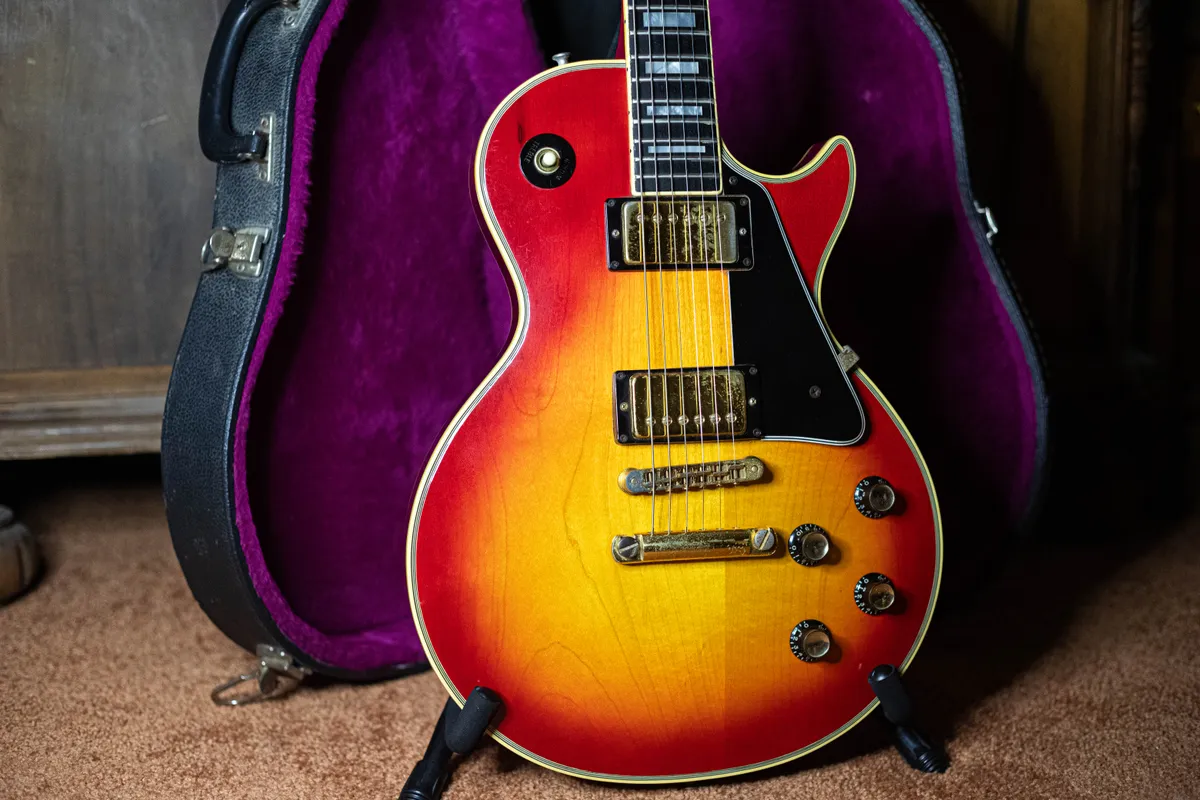
Gibson Les Paul Customs changed considerably between 1968 and 1986. Body construction, neck woods, pickups and hardware can help you identify one, but the changes didn't all happen in the same year. To date one, match the serial number to the guitar's construction and original parts.
What Makes A Gibson Les Paul Custom Different?
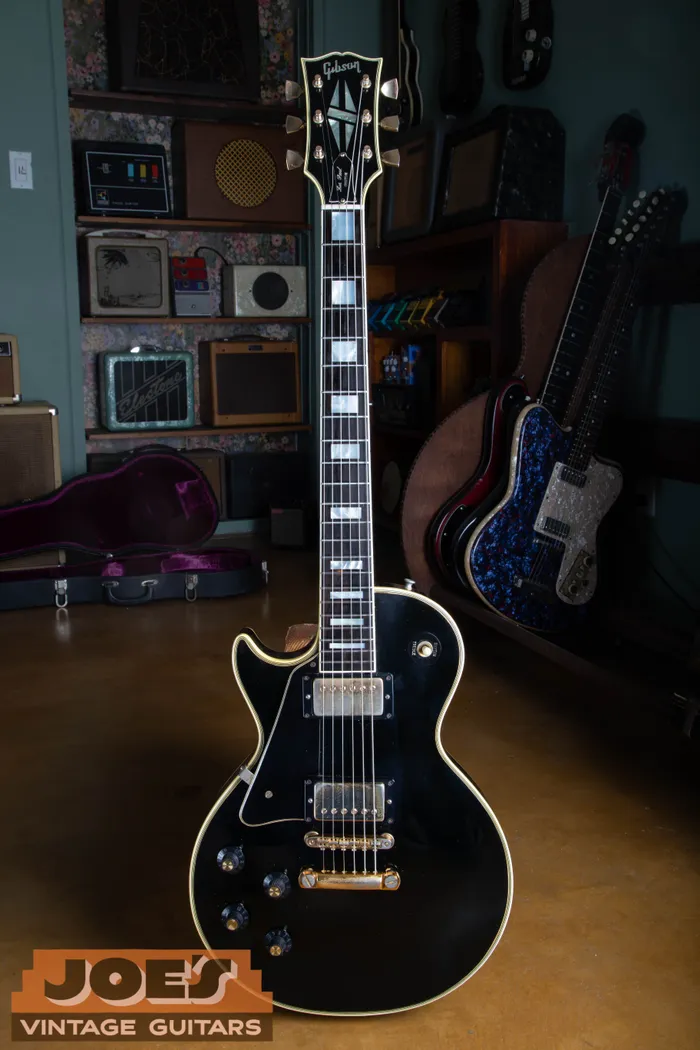
The Les Paul Custom is the more elaborately trimmed member of the Les Paul family. You can recognize the familiar version by its large block fingerboard inlays, split-diamond decoration on the headstock and multiple layers of binding, the contrasting trim around the body and headstock edges. Gold-plated hardware completes the familiar look, although Gibson also offered other finishes and hardware choices during this period.
The single-cutaway Custom returned in 1968 with a carved maple top over a mahogany back, a mahogany neck and an ebony fingerboard. The fingerboard is the playing surface carrying the frets and inlays; it's a separate piece of wood from the neck beneath it. The regular model had 22 frets and two humbucking pickups, the metal-covered units beneath the strings that turn string vibration into an electrical signal for the amplifier.
Those specifications give you a starting point for comparing later Customs. Over the following years, Gibson changed how it assembled the body and neck, introduced more finishes and offered versions with a maple fingerboard or a third pickup. If you're still identifying which Les Paul model you have, the Les Paul dating guide explains how the Custom fits alongside the Standard, Deluxe and other models.
What Is The Gibson Norlin Era?
The term Norlin era describes a period in Gibson's ownership, usually dated from 1969 to 1986. You'll see it used for guitars made during those years, including Les Paul Customs.
Before that period, Gibson already belonged to a larger company called Chicago Musical Instruments, usually shortened to CMI. In 1969, another company, ECL, took control of CMI and therefore Gibson. The name Norlin combined parts of the names Norton Stevens of ECL and Maurice H. Berlin of CMI. A further corporate reorganization followed in 1974, which is why that date also appears in histories of the business. Gibson's ownership had already changed in 1969.
Gibson continued building guitars at its Kalamazoo, Michigan, factory and opened a second factory in Nashville, Tennessee, in 1974. Both operated until Kalamazoo closed in 1984. The ownership period ended in January 1986, when Henry Juszkiewicz, David Berryman and Gary Zebrowski bought Gibson.
For a guitar owner, these dates provide background rather than an exact schedule of specification changes. A new owner or factory didn't replace every part at once. We start this guide with 1968 because the Custom that returned that year supplied the body, neck and hardware designs that Gibson gradually changed during the Norlin years.
How Do 1968, 1969 And 1970 Les Paul Customs Differ?
A 1968 Custom starts with a one-piece mahogany back and a one-piece mahogany neck. During 1969, Gibson began changing the neck construction, the body layers and the joint that holds the neck in the body. By 1970, the familiar combination was a layered pancake body and a three-piece mahogany neck. The Made in USA stamp on the back of the headstock also appeared during 1970.
These changes overlapped. An early 1969 Custom can share much of its construction with a 1968, while a late 1969 can resemble a 1970. Gibson also reused serial-number ranges, so a number alone often gives you more than one possible year. To narrow the date, compare the body, neck joint, headstock shape, tuners and dates on the volume and tone controls together.
The 1968 vs 1969 vs 1970 dating comparison walks through that combined evidence. The individual guides below cover the specifications and transition details for each year.
If you're trying to date your own Custom, you can also send photos for a free appraisal. Include the full guitar and both sides of the headstock so we can compare its construction with the serial number.
What Is A Les Paul Custom Pancake Body?
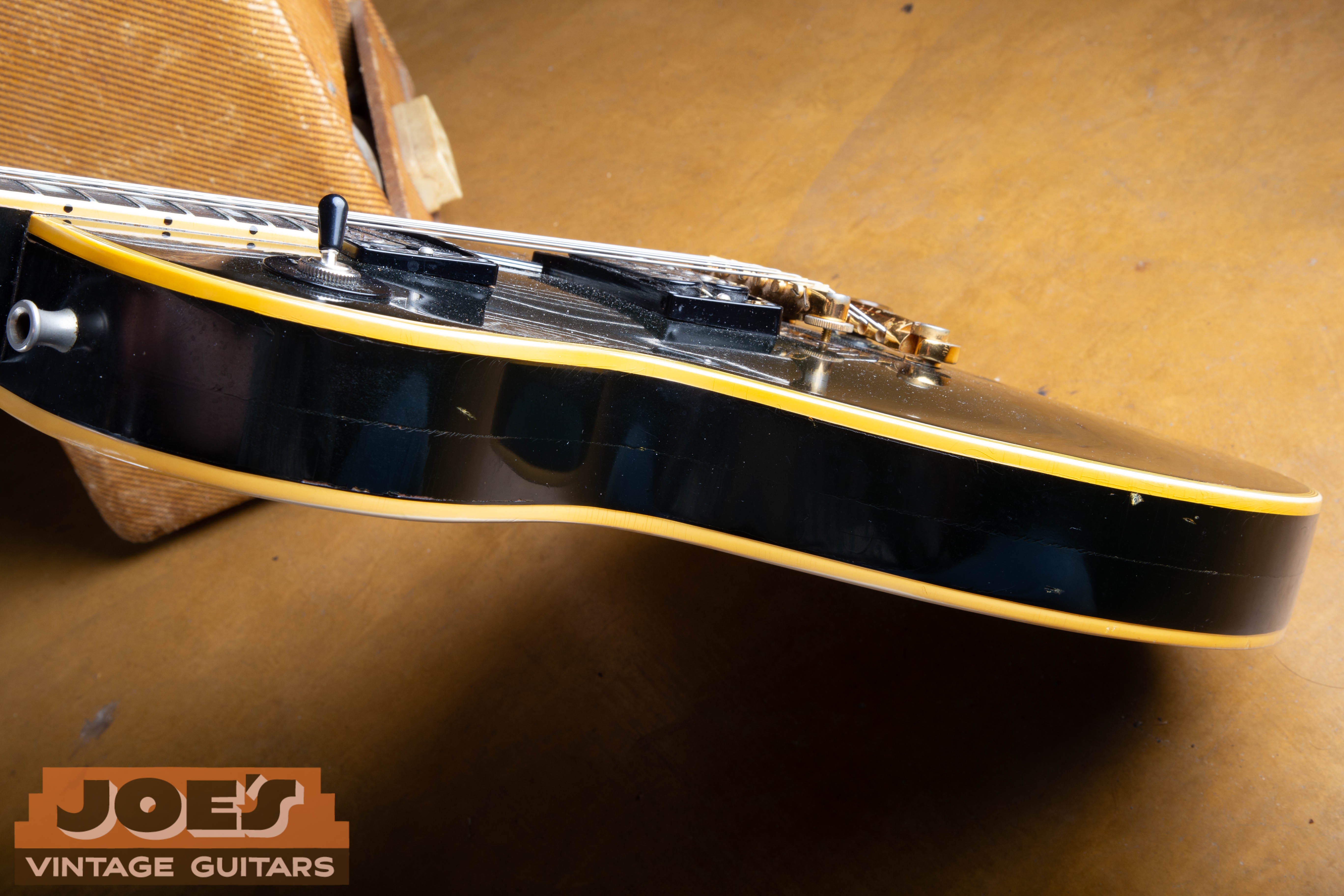
A pancake body is a layered mahogany back with a thin sheet of maple between two thicker mahogany sections. The carved maple top sits above that assembly. Viewed from the side, the thin middle layer creates the sandwich-like appearance that gave this construction its nickname.
Gibson began using this construction late in 1969 and phased it out around 1977. On a guitar where the finish lets you see the wood, look along the body edge near the output jack or cutaway. You're looking for a horizontal join through the mahogany portion below the maple top. The Gibson body construction guide shows how to distinguish these layers.
Some earlier 1969 bodies have a different arrangement: a thin maple layer directly under the carved top, with a full one-piece mahogany back beneath it. This is often called upper crossbanding. Its position separates it from a true pancake back, where the thin maple sheet divides the mahogany into upper and lower sections. The 1968 to 1970 body comparison explains both forms.
When pancake construction ended, Gibson could still join pieces of mahogany side by side to make a back. A seam running along the back and a layer running horizontally through the body describe different ways of assembling the wood. That's why a later non-pancake Custom isn't automatically a one-piece-body guitar.
Les Paul Custom Neck Woods, Volutes And Tenons
One-Piece And Three-Piece Les Paul Custom Necks
A one-piece neck uses a single main piece of wood for the neck shaft. A three-piece neck uses three long sections joined side by side. These joints run along the neck, unlike the horizontal body layers described above.
The 1968 and early 1969 Customs use mahogany necks with a one-piece shaft. Three-piece mahogany necks appear during 1969, followed by three-piece maple necks in the mid-1970s. Gibson's 1980 catalogue still specifies maple; its 1983 catalogue specifies mahogany again. You can compare the grain and joins in the three-piece mahogany neck reference and three-piece maple neck reference.
What Is A Gibson Neck Volute?
The volute is a raised area of wood on the back of the neck where it meets the headstock. It's behind the nut, the small slotted piece that supports the strings before they reach the tuners. A side view of that area shows the volute's profile more clearly than a straight-on photograph.
Small volutes begin appearing late in 1969, with more pronounced examples in the early 1970s. They phase out around 1981, although some Customs retain one into 1982. Size and shape can help place an early guitar in the transition, but there's no single volute size that dates every Custom. Compare it with the neck construction and the other features in the early headstock and volute comparison.
Long And Short Les Paul Neck Tenons
The tenon is the wooden extension at the end of the neck that fits into a matching recess in the body. The glued joint connects the neck to the body, but most of it is hidden. A photograph taken with the neck pickup removed can show how far the tenon reaches into the pickup cavity.
The early long tenon extends into that cavity with a visible tongue. Later transitional joints end closer to the fingerboard. The 1969 short-tenon example below ends near the fingerboard-side wall; the long-tenon photograph shows the farther-reaching rounded tongue. Compare the shape as well as the length, since the photographs were taken from different angles.
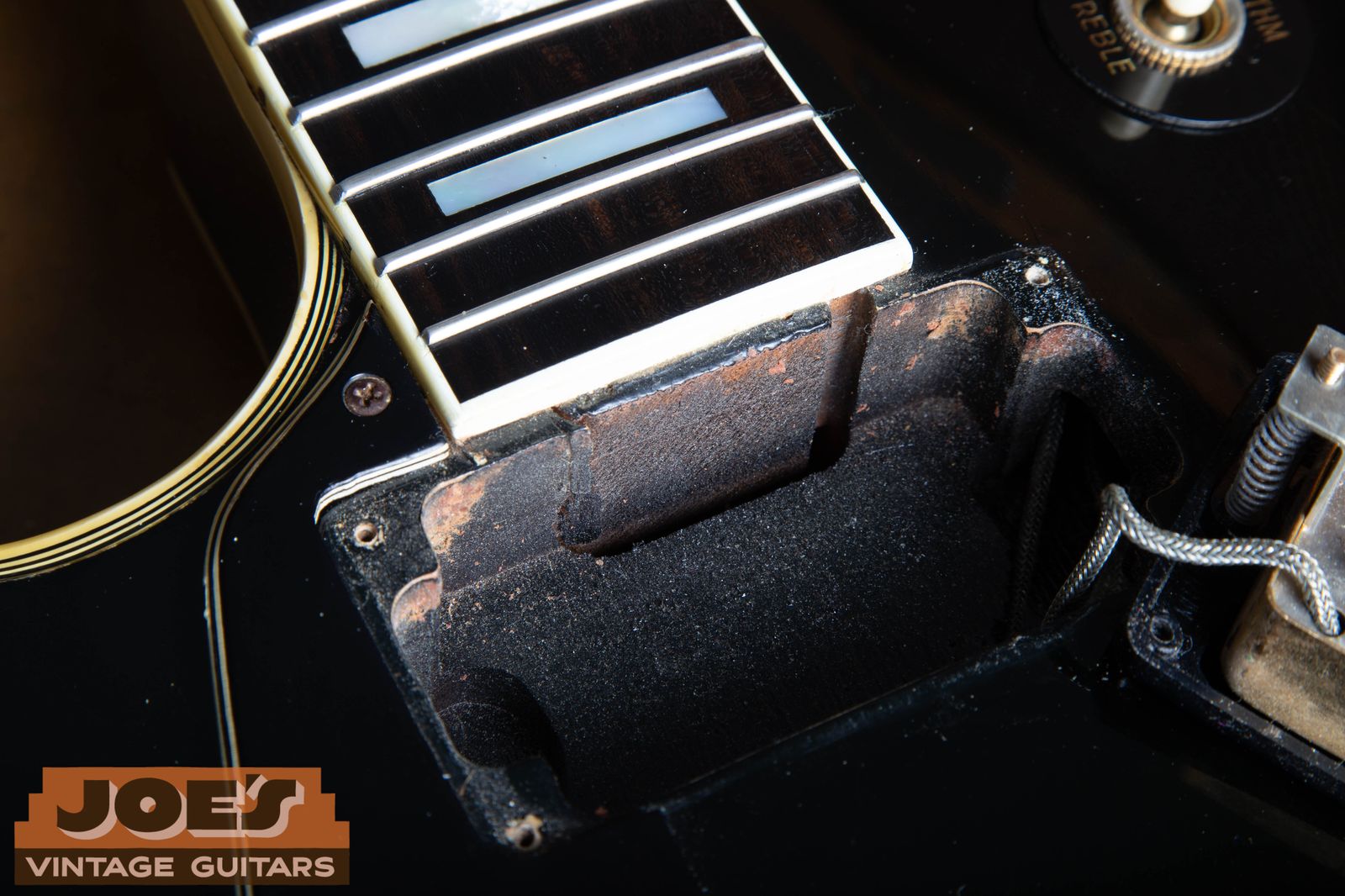
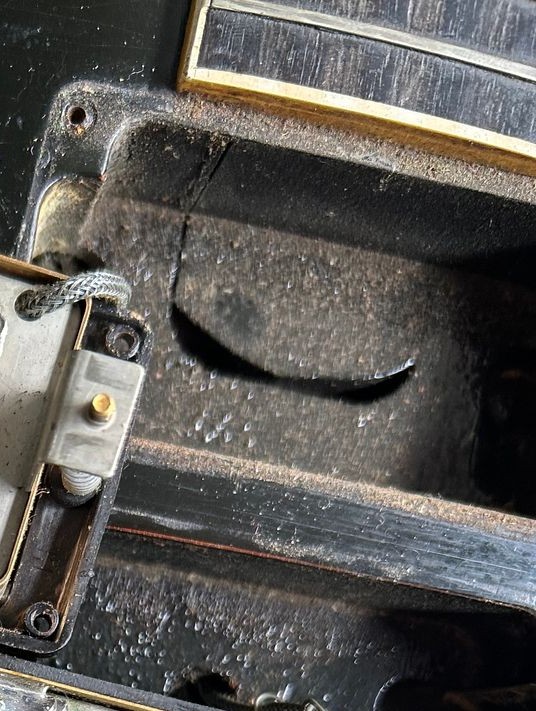
The neck wood and joint changed on overlapping schedules during 1969. Finding a three-piece neck doesn't tell you the tenon length by itself. The 1968 to 1970 neck-tenon comparison shows how to use the joint alongside the body and headstock evidence.
Les Paul Custom Pickups, Bridges, Tailpieces And Frets
Humbuckers, Patent Number Pickups And T-Tops
The regular Custom has two humbuckers, one near the neck and one near the bridge. A humbucker uses two coils to reduce electrical hum. Each pickup has its own volume and tone control, and the three-way selector lets you choose the neck pickup, the bridge pickup or both.
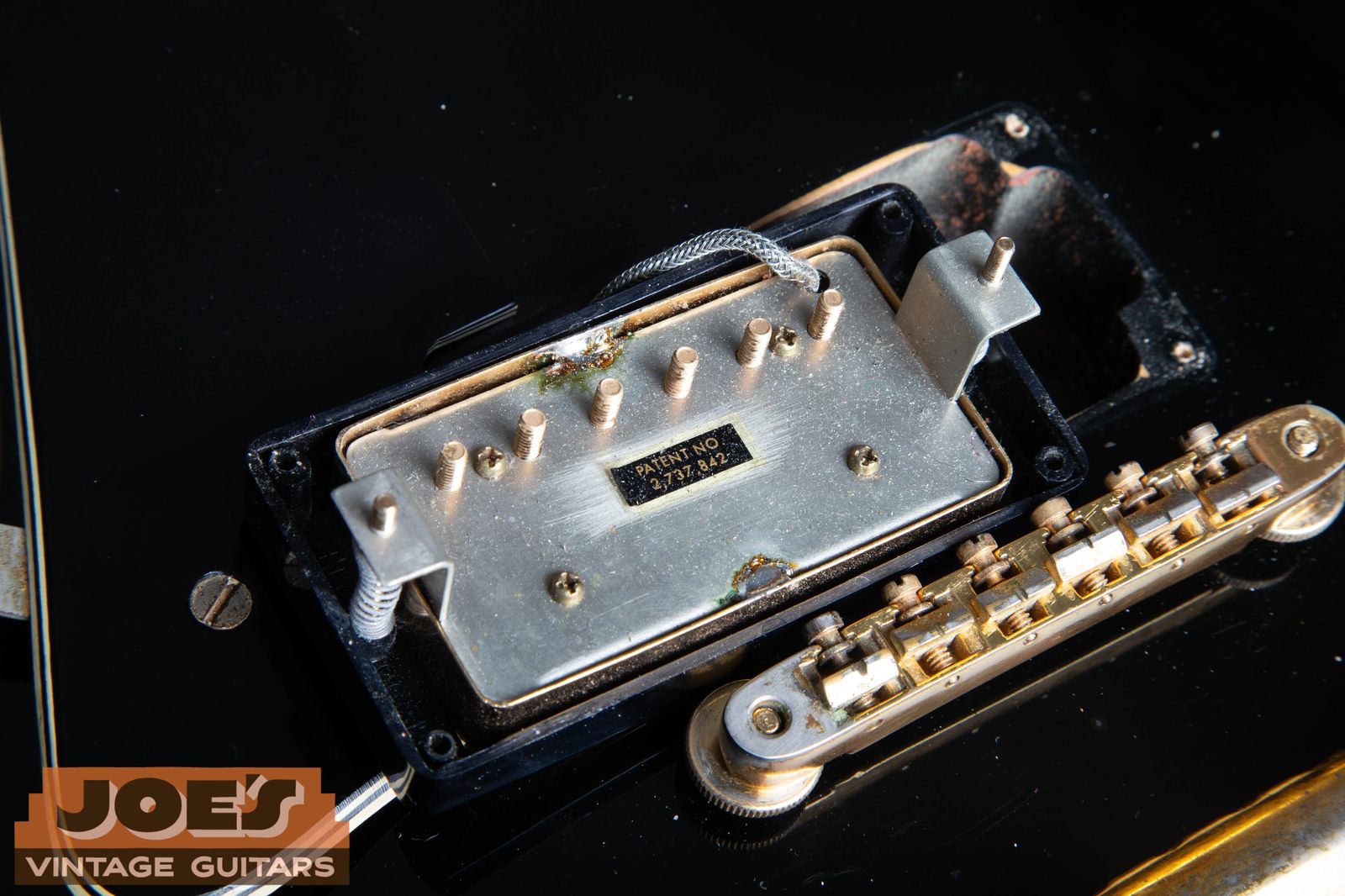
Collectors describe Gibson pickups by markings that can be hidden underneath the metal cover. Patent Number refers to a patent marking on the metal baseplate underneath a pickup. T-Top refers to a molded T on a plastic bobbin, the form around which a coil is wound. A pickup can have both features, so those names aren't mutually exclusive.
The 1969 pickup below carries a Patent No. 2,737,842 sticker on its underside. The sticker identifies a marking style; it doesn't show whether the covered bobbins have a T. The Gibson PAF and Patent Number pickup guide explains the labels and construction details used to distinguish the earlier pickup families.
ABR-1 And Nashville Bridges
The bridge supports the strings near the pickups. Each string rests on a small adjustable saddle, which moves forward or backward to set intonation so the guitar plays in tune along the neck. On the usual Custom setup, the strings then continue to a separate stopbar tailpiece, where their ends are anchored.
Early Customs in this guide use the narrow ABR-1 version of Gibson's Tune-O-Matic bridge. The wider Nashville bridge appears during the mid-1970s and gives the saddles more adjustment travel. The mounting hardware differs too, so identify the posts and the sleeves fitted into the body as well as the bridge itself. The wired ABR-1 reference and Nashville bridge reference show these details.
Gibson TP-6 Fine-Tuning Tailpiece
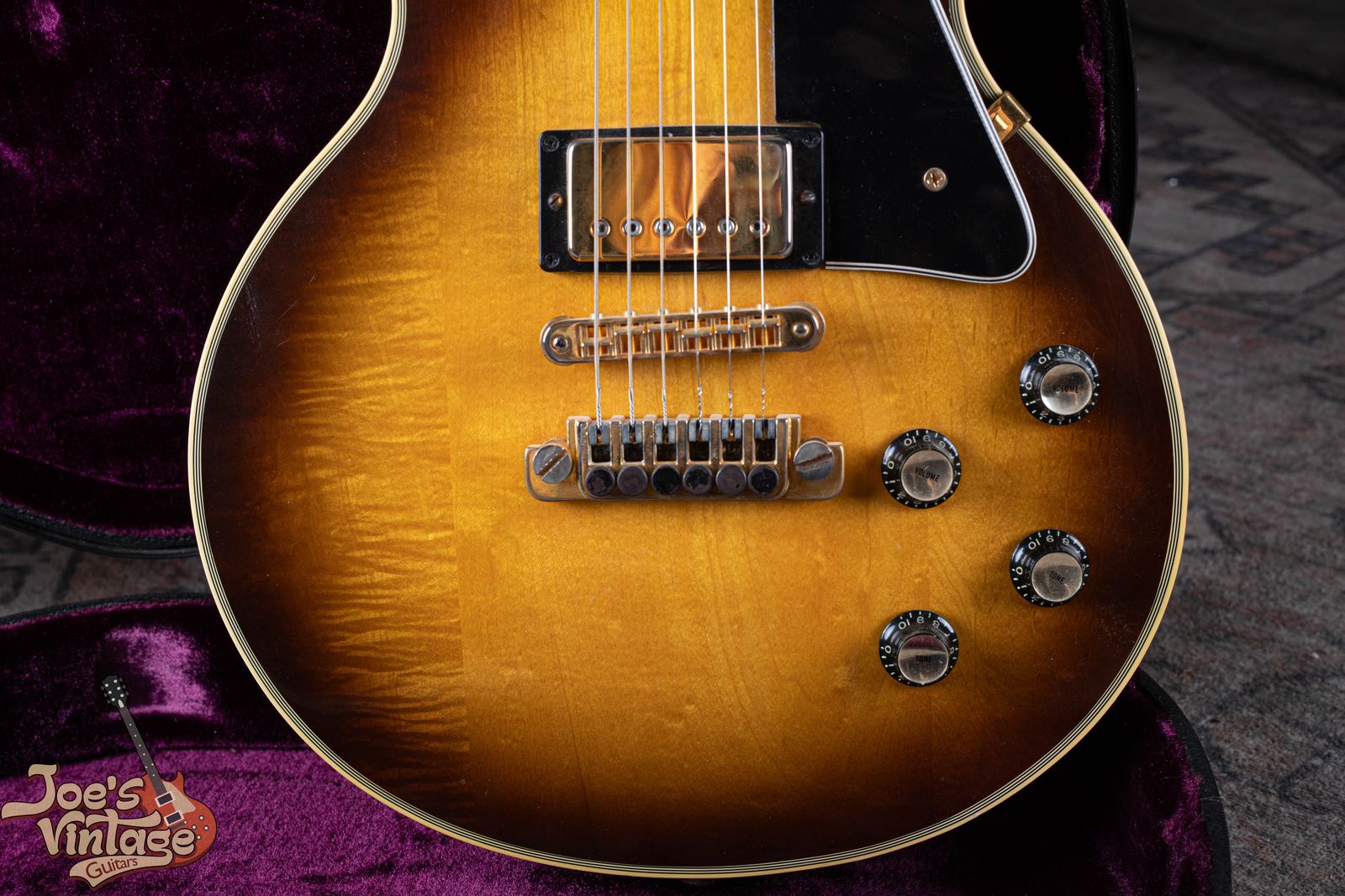
Gibson's fine-tuning tailpiece is called the TP-6. Introduced around the mid-1970s, it adds six small adjustment knobs behind the bridge, one for each string. These let you make small pitch corrections without reaching for the headstock tuners. The TP-6 has no vibrato arm.
You can find TP-6 tailpieces on some Les Paul Customs from the mid-1970s onward, including the 1977 example below. Other Customs retain the plain stopbar. Fitment varies, and a TP-6 can also be added later, so its presence alone doesn't establish the guitar's year or original specification.
Fretless Wonder Frets And Replacement Fretwork
The Custom's low frets are behind its Fretless Wonder nickname. The guitar still has frets; the name describes their low profile. A refret replaces those metal fret wires, and taller replacements can make an older Custom feel quite different under your fingers.
When comparing guitars, note the present fret height, wear and any work to the nut. These describe how the guitar plays now, while the neck wood and fingerboard material describe its construction. A maple fingerboard is a separate factory variation, shown later in the guide.
Les Paul Custom Tuners: Wafflebacks, Gibson And Grover
The tuners are the geared machines on the headstock that wind the strings and set their pitch. Their rear housings are usually more useful for identification than the buttons you turn. Customs can have similar-looking metal buttons on quite different tuner mechanisms.
Kluson Super Waffleback Tuners
Gold Kluson Super tuners are familiar on late-1960s and early-1970s Customs. Their rectangular gear covers have a ribbed pattern that gives them the nickname wafflebacks. The example below has metal keystone-shaped buttons and two mounting screws for each tuner.
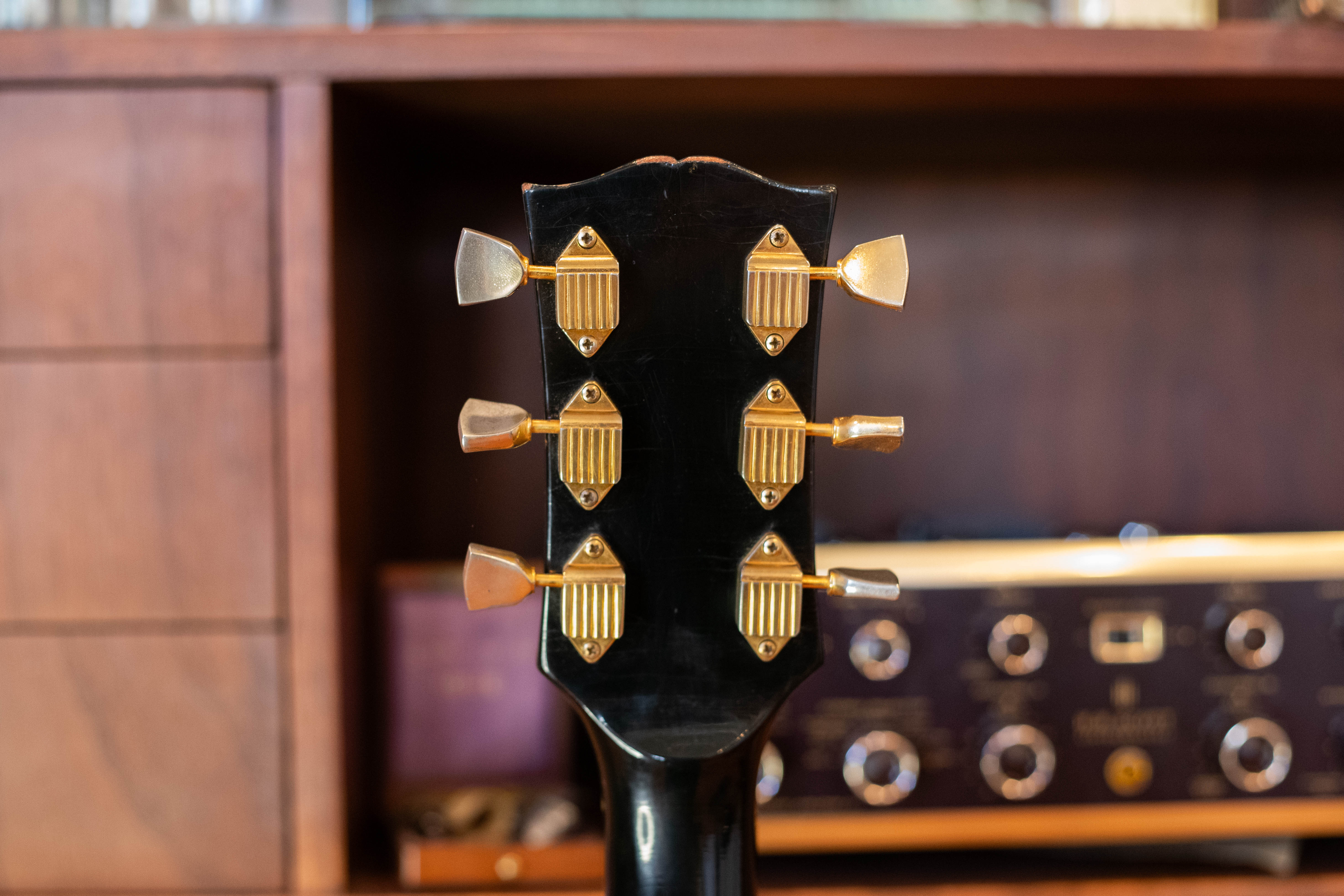
The cover pattern distinguishes these from smooth enclosed tuners. The waffleback tuner guide shows more examples and explains their use across Gibson models.
Gibson-Branded Enclosed Tuners
Later Customs can have smooth enclosed tuners with Gibson engraved on the back. On this 1976 set, the housings have a shield-like outline and a single offset mounting screw. The metal keystone buttons resemble those on the earlier wafflebacks, but the covers and mounting pattern are different.
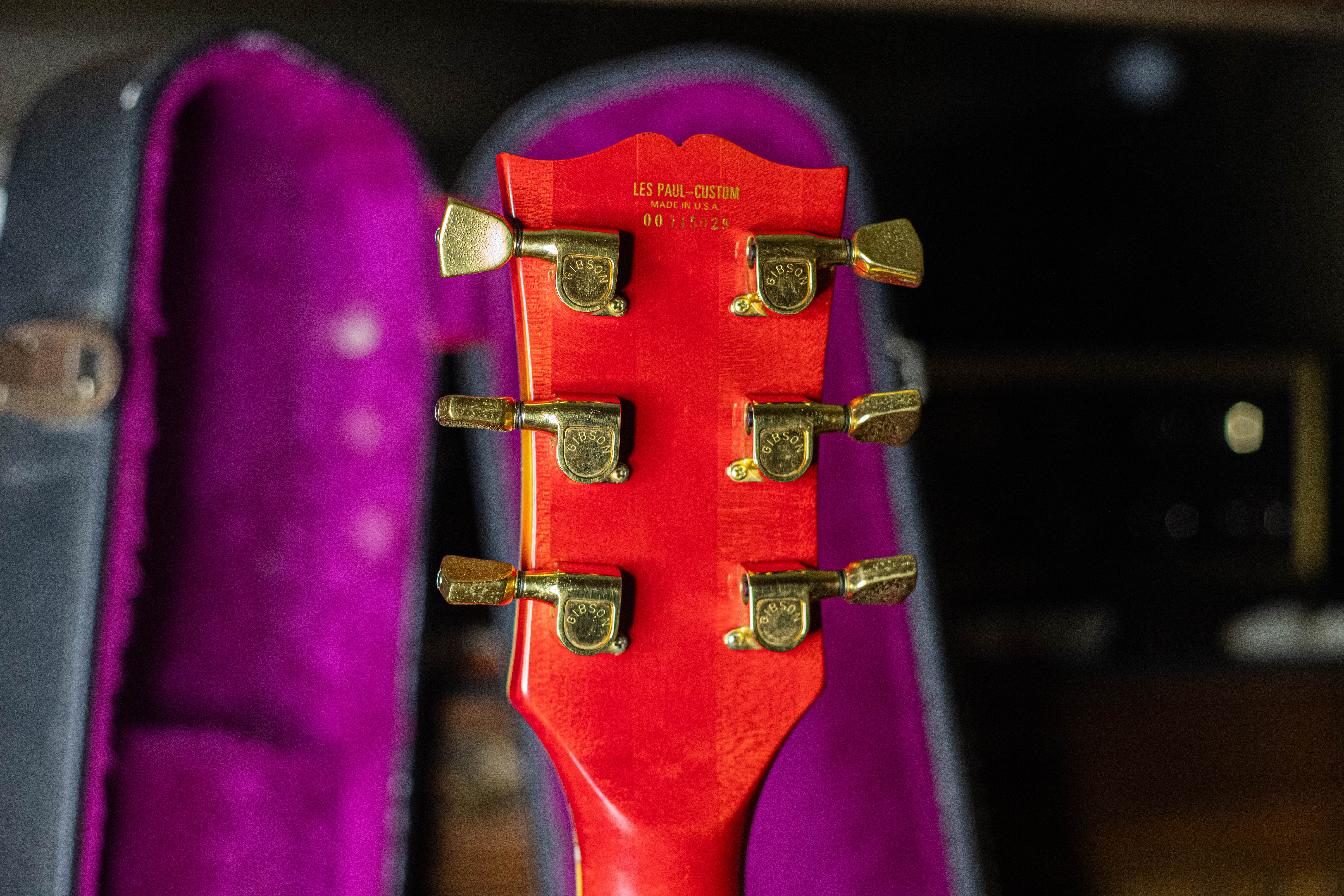
Gibson branding identifies the marking on the tuner; the housing shape and screw position identify the particular design.
Grover Rotomatic Tuners
Grover Rotomatics have round enclosed gear housings, usually with the Grover name on the back. The set below is fitted to a 1974 Custom. Its round covers and single-screw mounting bases distinguish it from the wafflebacks and Gibson-branded set above.
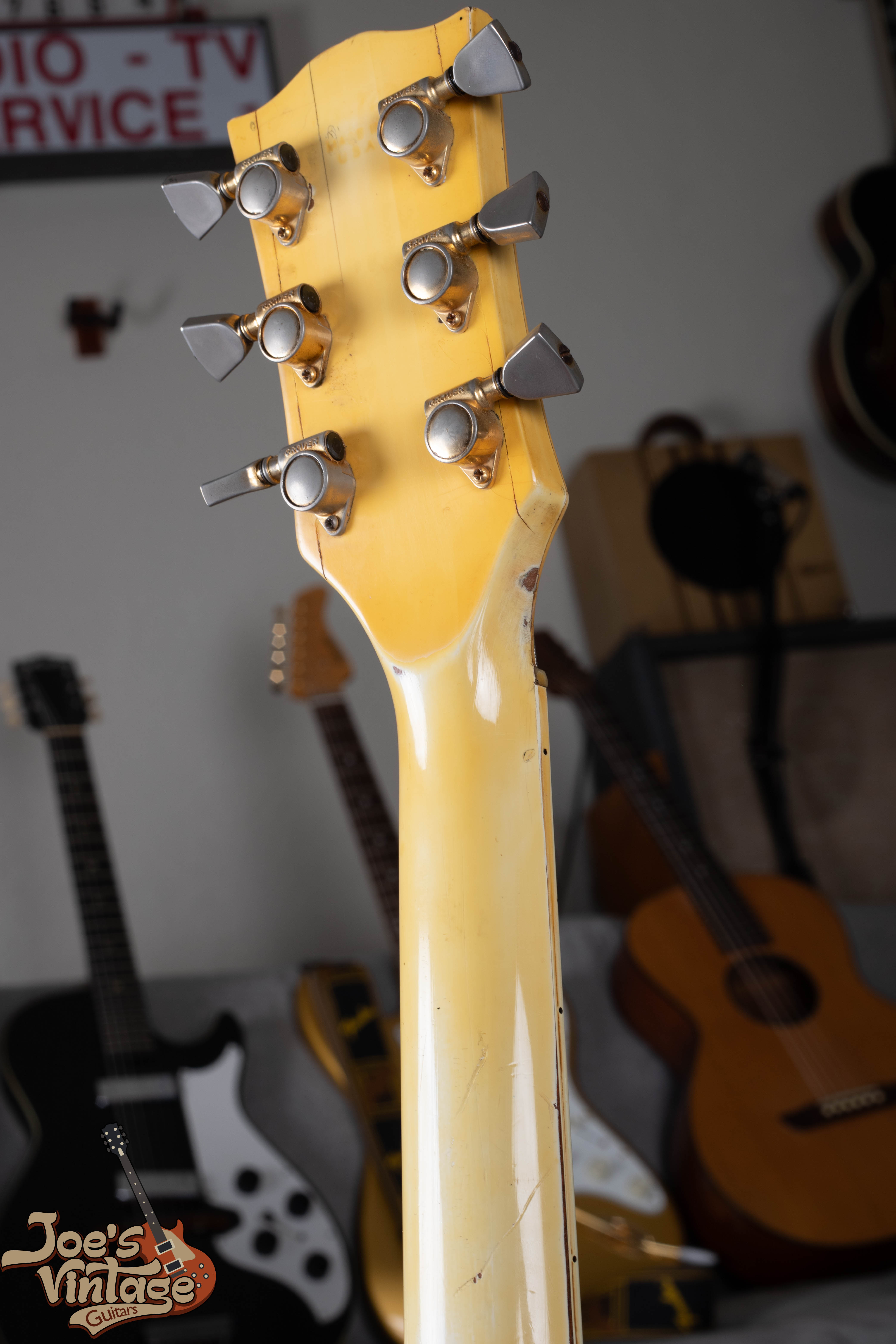
Some 1968 Customs have factory Grovers, so their presence doesn't automatically mean an early guitar has been modified. Grovers were also a popular later upgrade. A tuner photograph identifies the design, while the mounting marks and guitar's history help establish when it was installed.
Unused screw holes, enlarged string-post holes or impressions from different washers can reveal an earlier set. The original-or-replacement tuner guide explains those clues. Use them alongside the serial number and the guitar's construction rather than dating a Custom from its tuners alone.
How To Date A Les Paul Custom With Serial Numbers And Pot Codes
Start with the serial on the back of the headstock, then identify which numbering system Gibson used. The same-looking digits can mean different things in different systems. The Gibson serial number guide covers the full sequence and the reused ranges.
Early Norlin Serial Numbers And 1975 To 1977 Decals
Gibson reused impressed serial-number ranges in the late 1960s and early 1970s. An impressed number is pressed into the wood. If a lookup gives several possible years, compare the guitar's construction and original component dates rather than choosing the first result. This is particularly relevant to dating a 1968, 1969 or 1970 Custom.
The eight-digit decals used in the mid-1970s follow another scheme: a 99 prefix identifies 1975, 00 identifies 1976 and 06 identifies 1977. During 1977, Gibson introduced a new impressed eight-digit system, so Customs from that year can carry either format.
The Eight-Digit Gibson Serial System From 1977
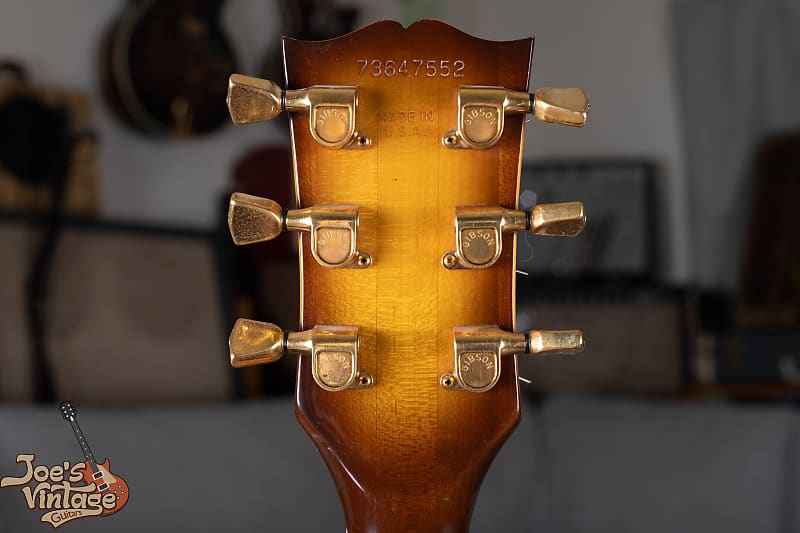
The newer format is written YDDDYRRR. Read the first and fifth digits together for the year. The second through fourth digits give the numbered day of that year, from 001 onward. The last three digits are a factory ranking number used across the factory's output.
For example, the serial 73647552 shown below gives 77 from the first and fifth positions. Its middle 364 means the 364th day of 1977, December 30. The final 552 falls within Nashville's 500 to 999 ranking block. During the period when both factories operated, 001 to 499 identified Kalamazoo. Nashville's block continued after Kalamazoo closed.
The ranking isn't the number of Les Paul Customs made that year. It helps identify the factory within this numbering system, which is useful when comparing instruments from the years when Nashville and Kalamazoo both operated.
How Pot Codes Help Date A Les Paul Custom
A potentiometer, usually called a pot, is the electrical component turned by a volume or tone knob. Its manufacturer often stamped a production code into the metal casing. You can usually photograph these markings inside the control cavity on the back of the guitar.
A common CTS code follows 137YYWW: 137 identifies CTS, the next two digits give the year and the final two give the week. That dates the pot's manufacture. An original pot must have been made before it was installed in the guitar, and it could have sat in inventory for weeks or months. A replacement pot instead tells you about a later repair.
Read the codes together with the solder joints and wiring, using the Gibson pot code guide. For a 1969 or 1970 Custom, combine that evidence with the body layers, neck construction, tenon, volute, tuners and headstock markings before settling on a year.
Gibson Les Paul Custom Specs By Year: 1968 To 1986
Use this table to compare the regular Custom's body, neck, bridge and serial format. The year links lead to the early guides or the period descriptions below, where the special versions are explained. Because Gibson introduced changes gradually, a transition-year guitar may combine earlier and later features.
The 1984 to 1986 rows use the 1983 factory specification as their reference for neck wood. They aren't separate annual specifications. On a guitar from those years, check the actual neck and hardware before treating the catalogue description as a match.
| Year | Body | Neck | Bridge | Serial Format | Notable Details |
|---|---|---|---|---|---|
| 1968 | One-piece mahogany back, maple cap | One-piece mahogany | ABR-1 | Impressed six-digit ranges | Single-cut Custom returns; long tenon; no volute |
| 1969 | One-piece back; upper crossbanding; late pancake construction | One-piece to three-piece mahogany | ABR-1 | Reused impressed ranges | Independent body, neck and tenon transitions |
| 1970 | Pancake mahogany back, maple cap | Three-piece mahogany | ABR-1 | Reused impressed ranges | Made in USA stamp introduced during the year |
| 1971 | Pancake mahogany back, maple cap | Three-piece mahogany | ABR-1 | Reused impressed ranges | Cherry Sunburst finish appears |
| 1972 | Pancake mahogany back, maple cap | Three-piece mahogany | ABR-1 | Reused impressed ranges | 1954-style Limited Edition offered |
| 1973 | Pancake mahogany back, maple cap | Three-piece mahogany | ABR-1 | Reused impressed ranges | 1954-style Limited Edition continues |
| 1974 | Pancake mahogany back, maple cap | Three-piece mahogany | ABR-1 | Reused impressed ranges | Twentieth Anniversary; Nashville opens |
| 1975 | Pancake mahogany back, maple cap | Mahogany/maple transition | Nashville transition | 99 decal | Neck and bridge transitions |
| 1976 | Pancake mahogany back, maple cap | Three-piece maple | Nashville; see variant notes | 00 decal | Maple neck with pancake body |
| 1977 | Pancake phaseout, maple cap | Three-piece maple | Nashville; see variant notes | 06 decal or YDDDYRRR | Two serial systems; pancake phaseout |
| 1978 | Non-pancake mahogany back, maple cap | Three-piece maple | Nashville; see variant notes | YDDDYRRR | Maple fingerboard, three-pickup, nickel and 25/50 versions |
| 1979 | Non-pancake mahogany back, maple cap | Three-piece maple | Nashville; see variant notes | YDDDYRRR | 25/50 Anniversary continues |
| 1980 | Non-pancake mahogany back, maple cap | Three-piece maple | Nashville; see variant notes | YDDDYRRR | Gold or nickel hardware choices |
| 1981 | Non-pancake mahogany back, maple cap | Three-piece maple | Nashville; see variant notes | YDDDYRRR | Volute phaseout around this period |
| 1982 | Non-pancake mahogany back, maple cap | Maple/mahogany interval | Nashville; see variant notes | YDDDYRRR | Compare neck wood and remaining volute |
| 1983 | Non-pancake mahogany back, maple cap | Mahogany | Nashville; see variant notes | YDDDYRRR | Gold/chrome pricing; Super Tune option |
| 1984 | Non-pancake mahogany back, maple cap | Mahogany; 1983 source | Nashville; see variant notes | YDDDYRRR | Kalamazoo factory closes |
| 1985 | Non-pancake mahogany back, maple cap | Mahogany; 1983 source | Nashville; see variant notes | YDDDYRRR | Nashville; last full year before sale |
| 1986 | Non-pancake mahogany back, maple cap | Mahogany; 1983 source | Nashville; see variant notes | YDDDYRRR | January ownership change; Nashville |
1971 To 1974 Les Paul Custom Specs And Variants
By the early 1970s, the regular Custom combined a maple top, pancake mahogany back, three-piece mahogany neck and ebony fingerboard. It retained two full-size humbuckers and an ABR-1 bridge with a separate stopbar tailpiece. Cherry Sunburst joined the finish choices in 1971, giving buyers an alternative to the familiar black Custom.
Gibson also introduced the Les Paul Recording in 1971. If that name appears while you're searching for a Custom, it's a separate model with a different pickup and electronics design. For comparisons within the Custom family, begin with the body construction and pickup layout described here.
1972 Embossed Gibson Pickup Covers
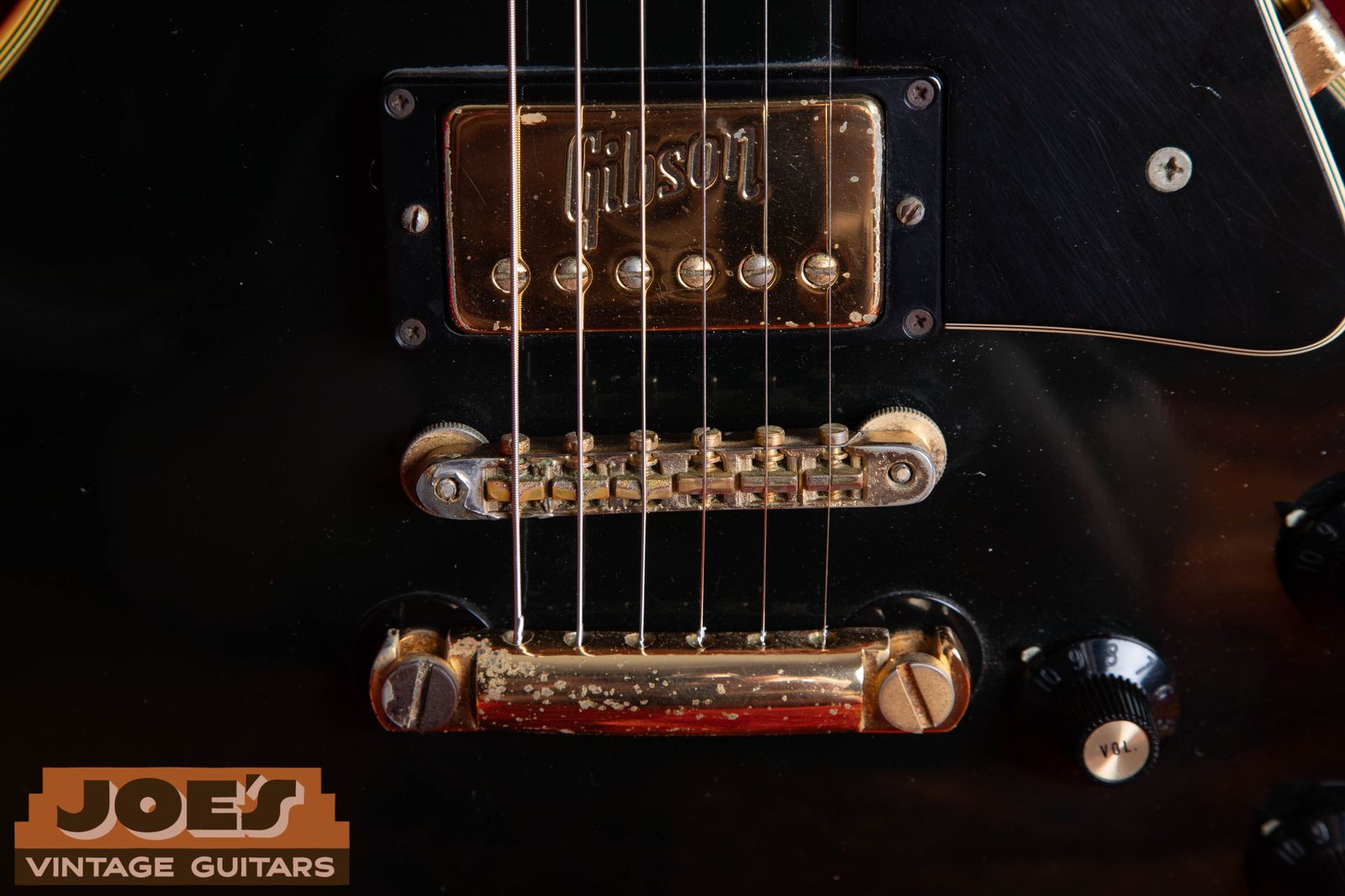
Some early-1970s Customs have metal pickup covers with the Gibson name raised across the face. The 1972 example below shows that embossed logo. Since the cover is a separate part from the pickup beneath it, its appearance is one detail to check alongside the underside markings and wiring.
1972 And 1973 Les Paul Custom 1954-Style Limited Edition
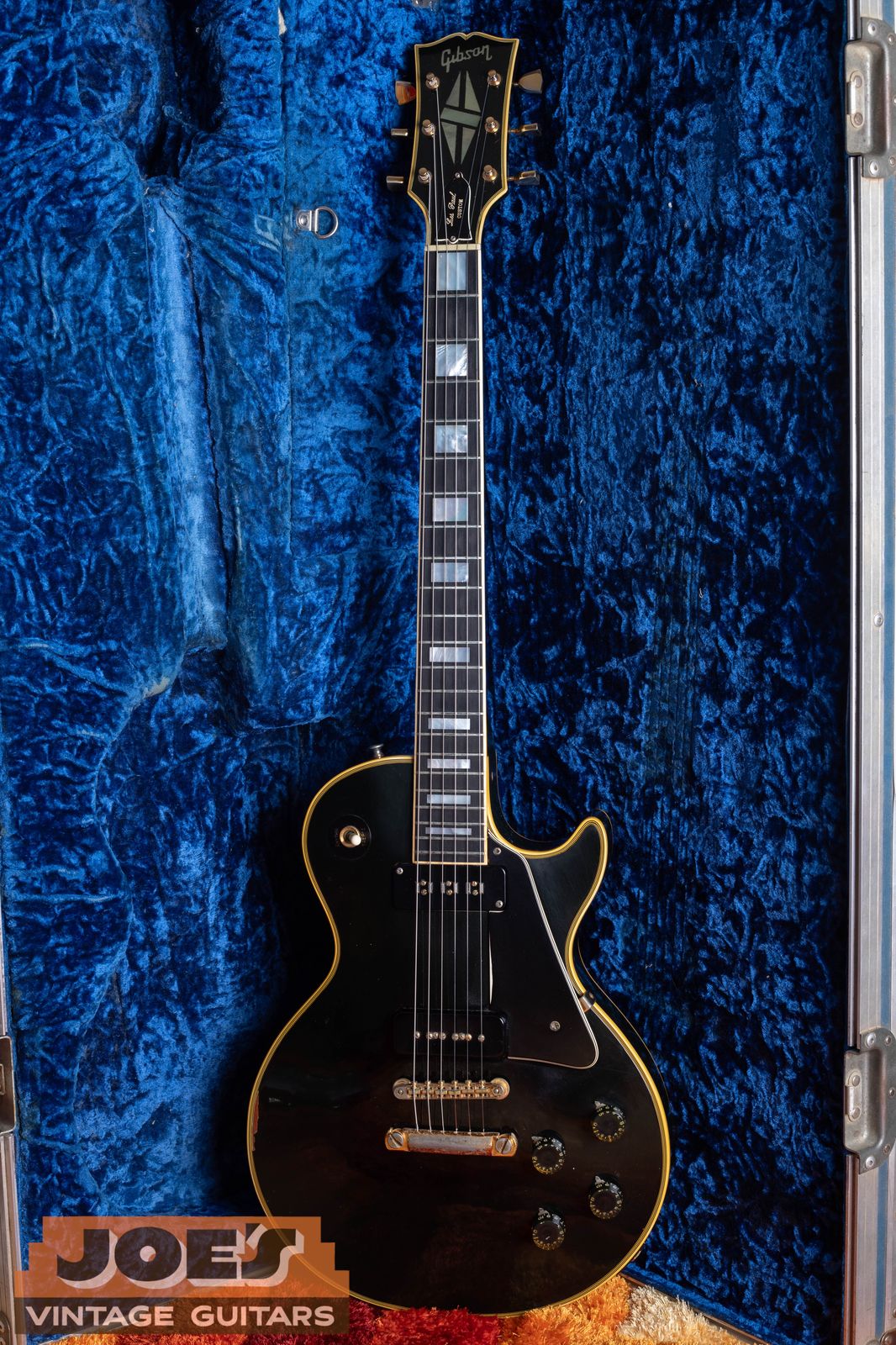
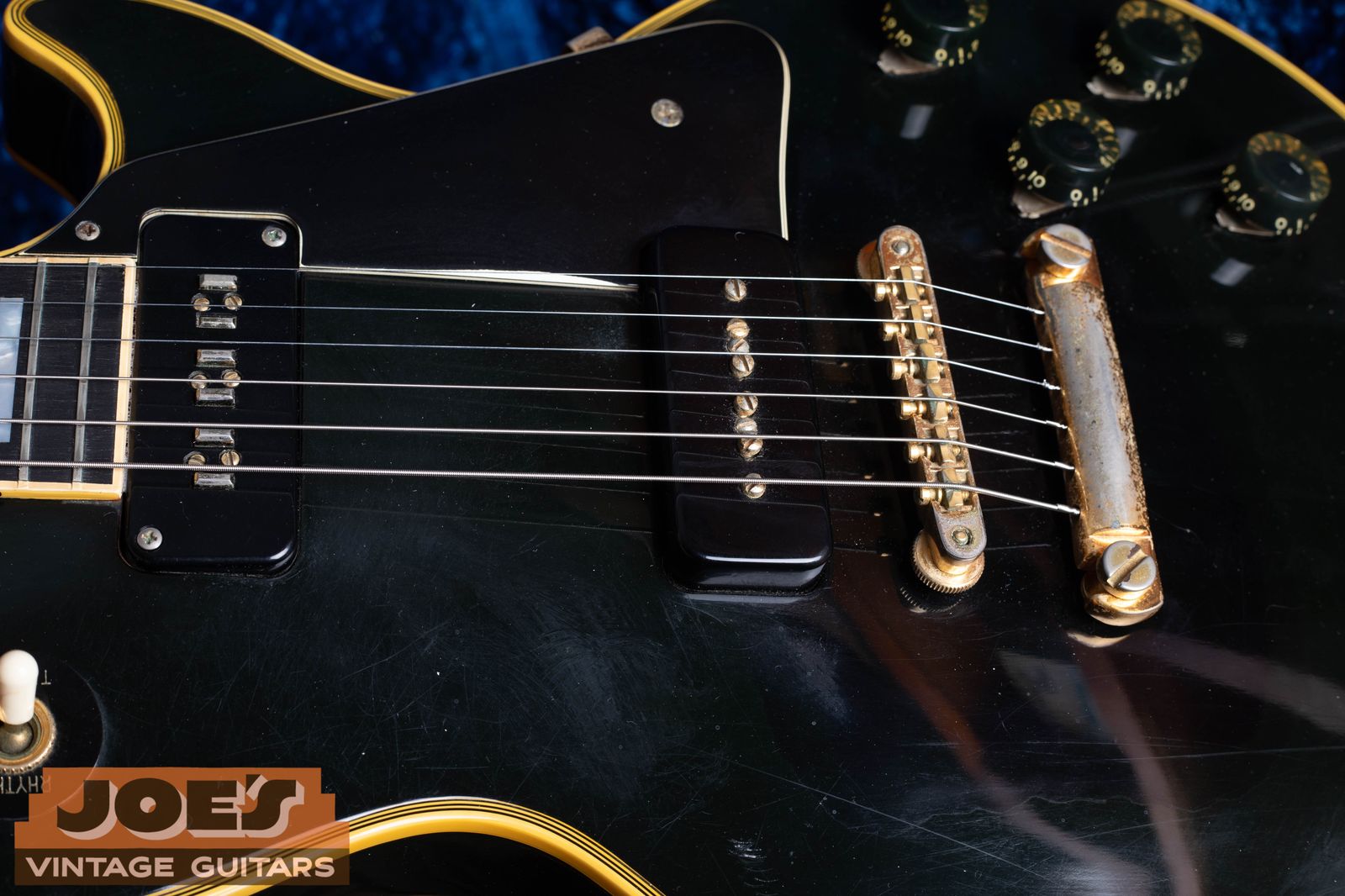
Gibson also offered a Limited Edition Custom that revisited the original 1954 design. Unlike the regular maple-top model described above, this version has an all-mahogany body and two single-coil pickups: an Alnico pickup near the neck and a P-90 near the bridge.
The Alnico neck pickup is commonly called a staple pickup because of its rectangular metal pole pieces beneath the strings. The P-90 has a different shape and a row of adjustable screws. Together with an LE-prefixed serial, that pickup layout helps distinguish the 1972 and 1973 Limited Edition from a regular Custom. The 1973 example below shows the full guitar and a closer view of the pickups.
1974 Les Paul Custom Twentieth Anniversary
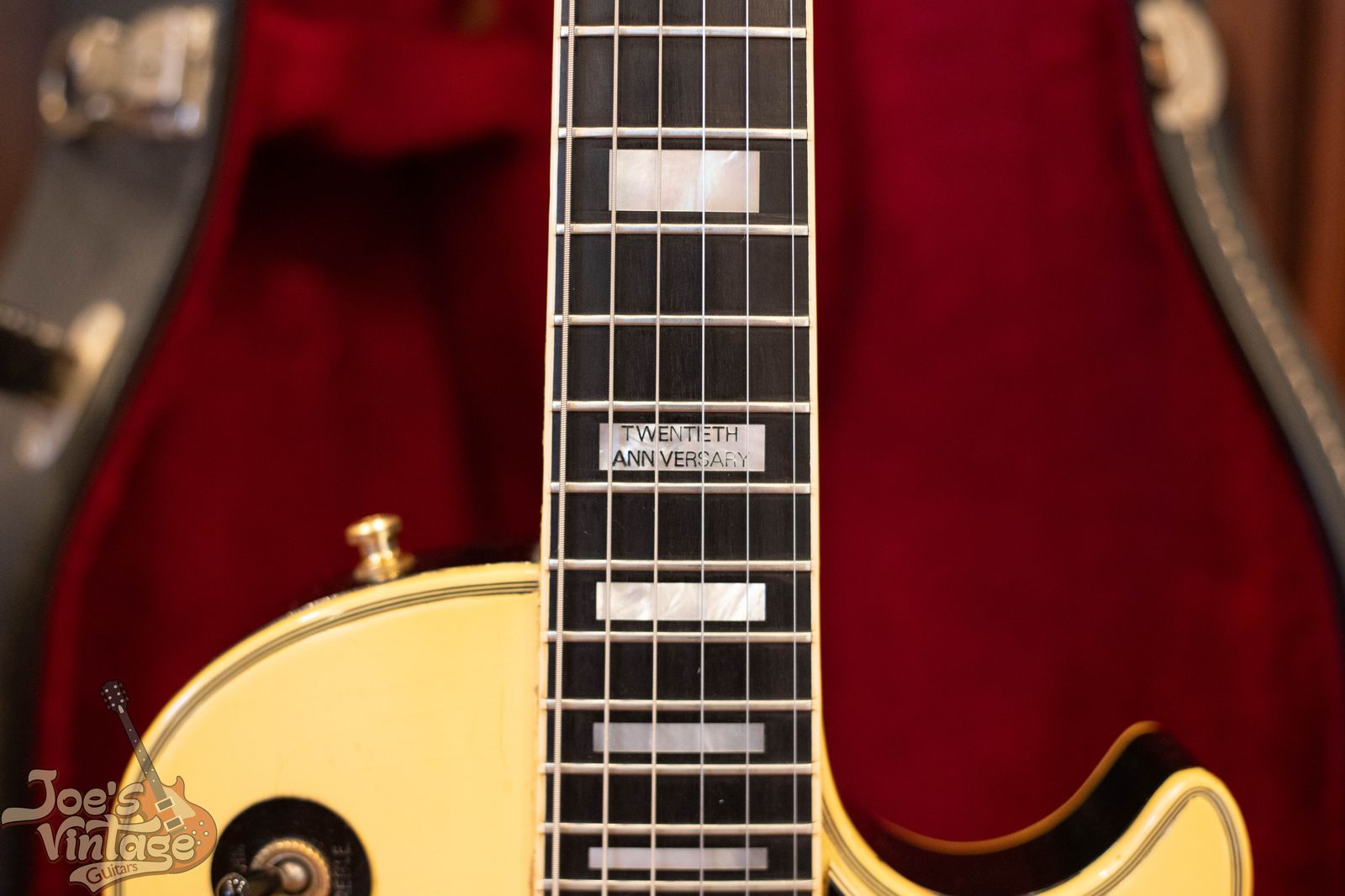
The Twentieth Anniversary marking commemorates the Custom's 1954 introduction. Look for the lettering in the fingerboard inlay, as shown below.
Gibson's Nashville factory opened in 1974, but the bridge named Nashville belongs to the changes that followed. A factory-opening date by itself doesn't establish which bridge or neck a particular 1974 Custom should have.
1975 To 1977 Les Paul Custom Neck, Bridge And Body Changes
The mid-1970s brought the move from mahogany to maple necks and from the ABR-1 to the wider Nashville bridge. These changes overlapped the last years of pancake-body construction. A 1976 Custom can therefore have a three-piece maple neck attached to a pancake mahogany body.
Gibson's 1975 Les Paul Series brochure still describes a laminated mahogany neck, even though the maple-neck transition belongs to this same interval. On a 1975 guitar, inspect the neck wood rather than assuming that the year guarantees one specification. For the bridge, compare the mounting posts and body inserts with the Nashville bridge photographs.
Pancake construction phases out around 1977. The serial format also changes that year, from the 06-prefix decal to the impressed date code explained above. The body construction and serial each provide evidence, but they changed on their own schedules.
Maple-Fingerboard Les Paul Customs
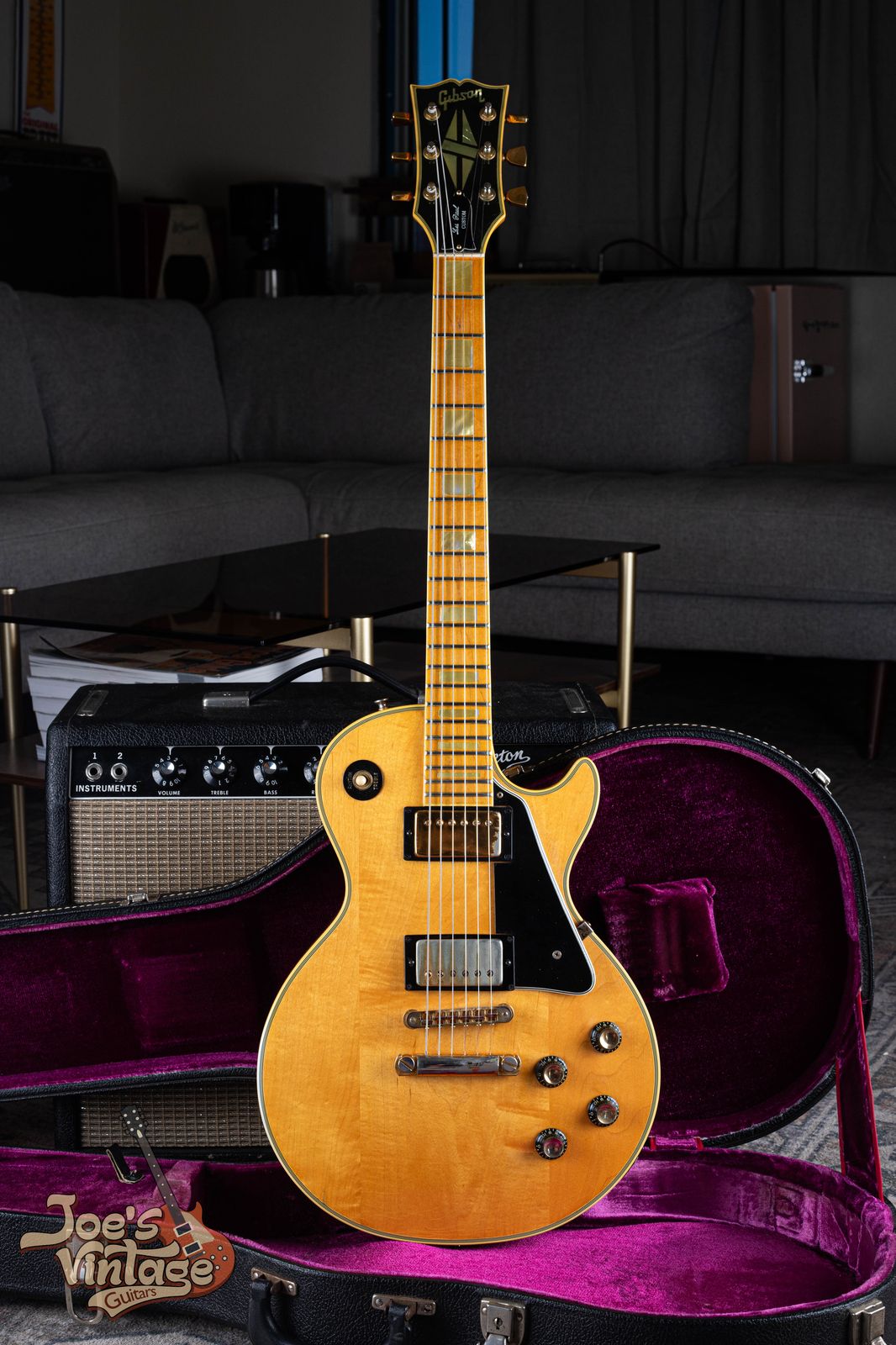
The maple-fingerboard version replaces the usual dark ebony playing surface with light-colored maple. The 1975 Natural-finish example below shows the wood around the block inlays and along the full length of the fingerboard. Look at the back of the neck separately when identifying its wood; a maple fingerboard alone doesn't establish the neck material.
1976 Three-Pickup And Alpine White Customs
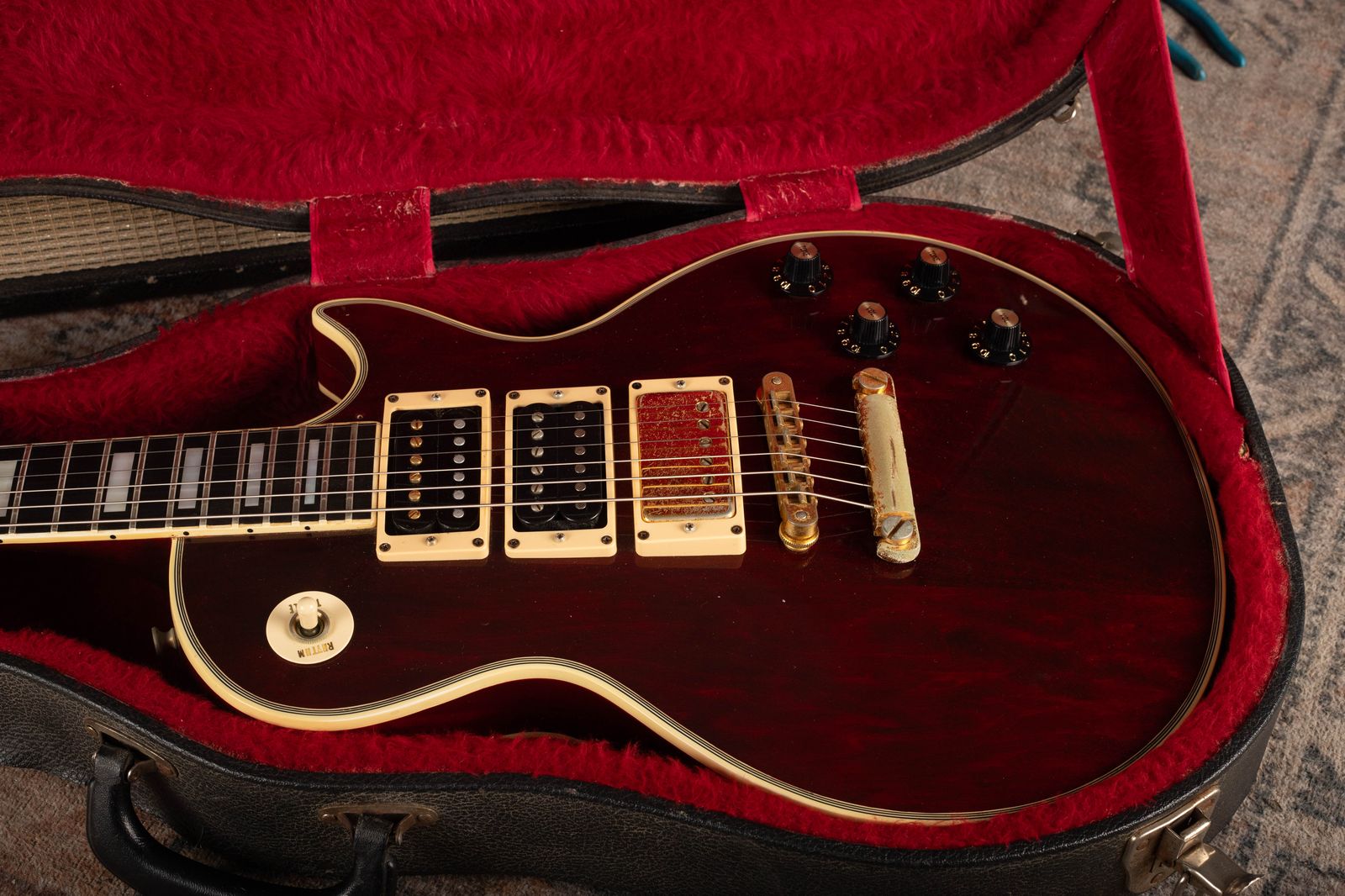
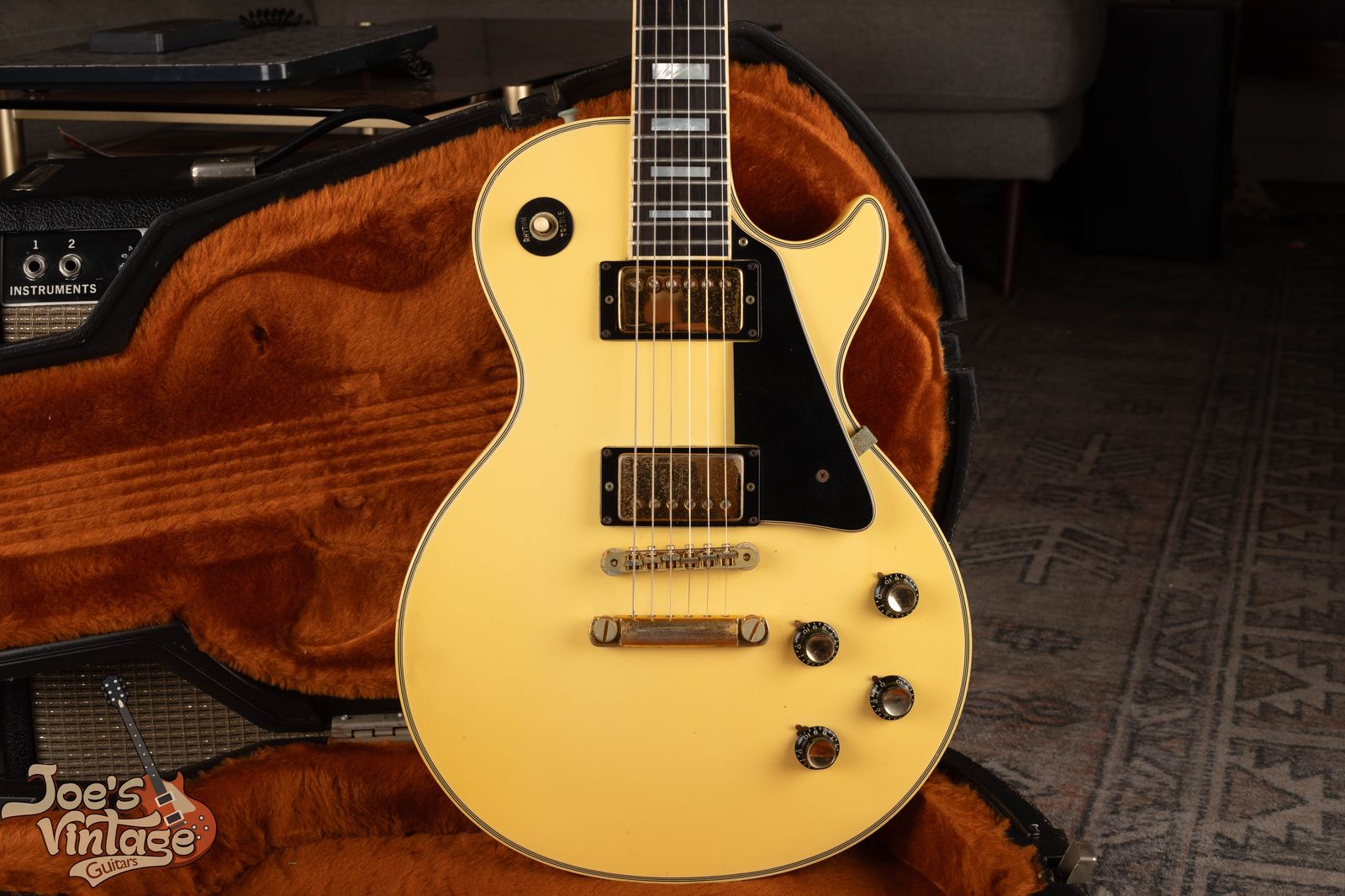
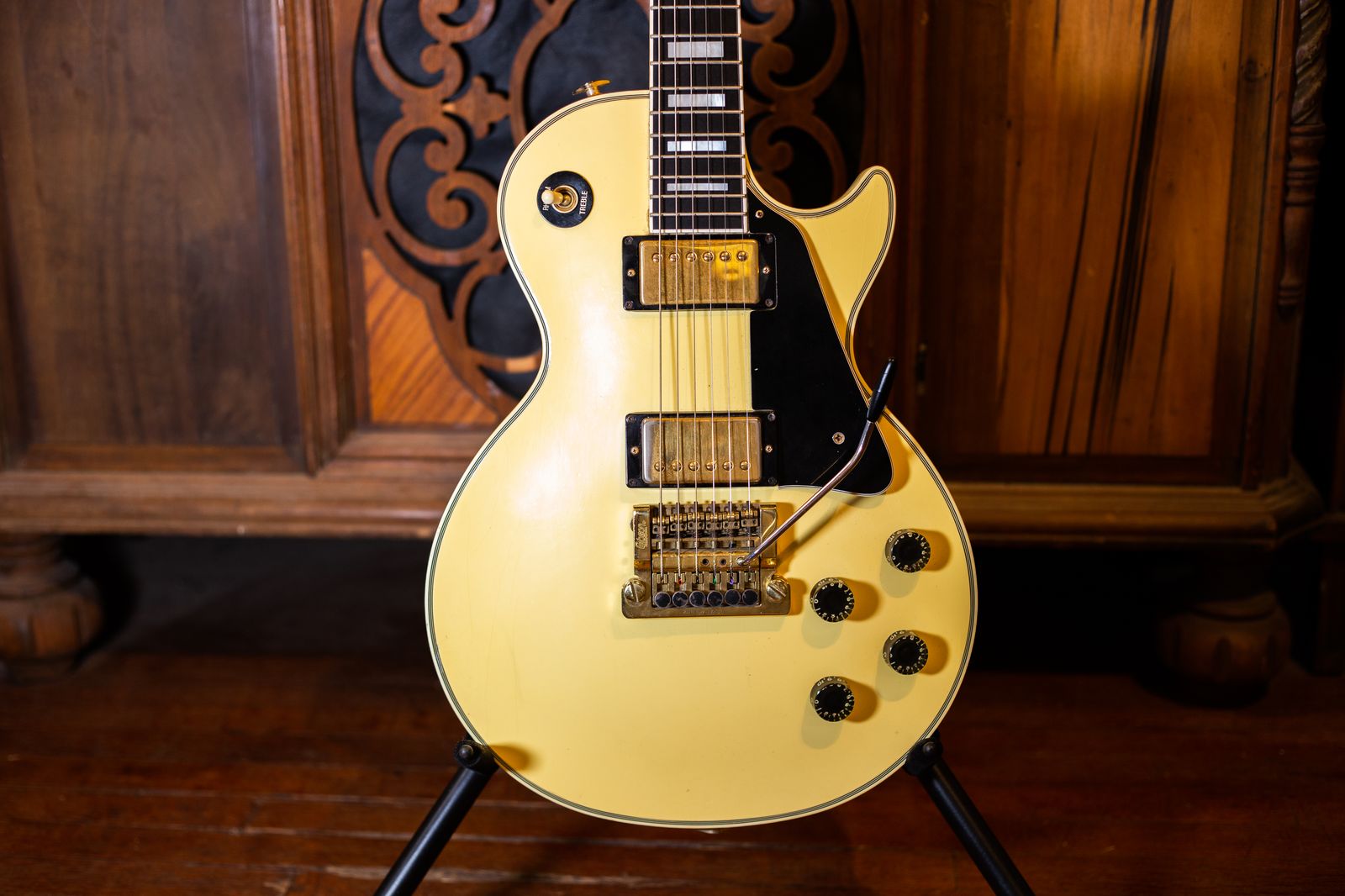
A third humbucker fills the space between the neck and bridge pickups on the three-pickup Custom. The 1976 example below lets you compare that layout with the regular two-pickup Alpine White guitar beside it. These are separate instruments with different pickup arrangements and finishes.
Alpine White can look cream-colored as the finish ages, as it does in this photograph. When identifying a finish, compare the whole guitar and any protected areas rather than relying on the color in one photograph.
1978 To 1980 Les Paul Custom Finishes And Anniversary Models
By 1978, the regular Custom had moved beyond the pancake back while retaining a maple top and three-piece maple neck. Gibson's catalogue offered several versions: the regular gold-hardware Custom, a maple-fingerboard Custom, a three-pickup Custom and a nickel-hardware Custom. The hardware names describe the plating on the metal parts.
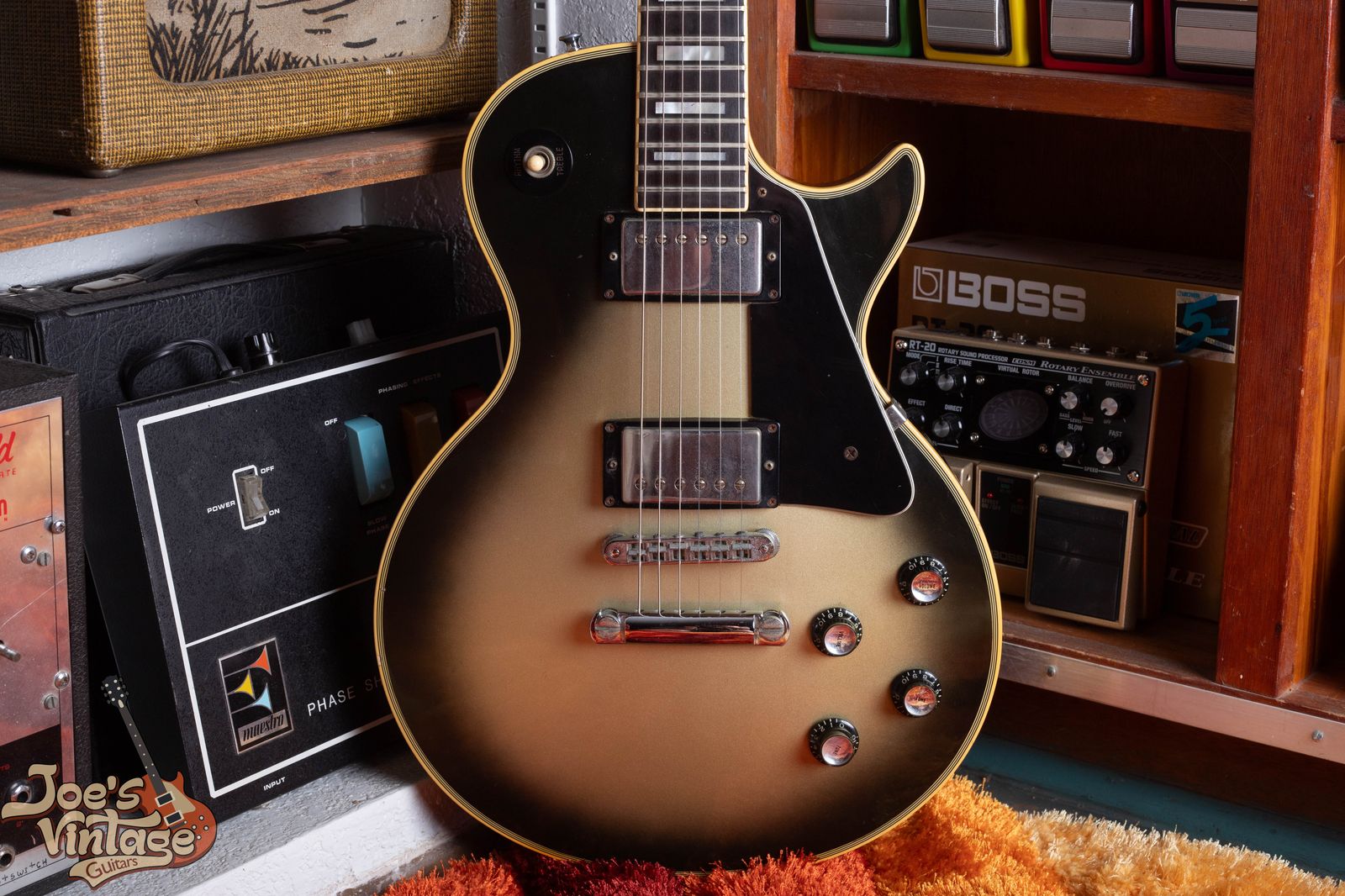
The 1978 catalogue lists the maple-fingerboard version in Natural or Ebony and the three-pickup version in Ebony. Silverburst, with its light center and dark outer edge, appears on the nickel-hardware version in the dated catalogue and price list. The photograph below shows that finish.
1978 And 1979 Les Paul 25/50 Anniversary
The 25/50 Anniversary is a separate commemorative model with a group of identifying features. Its five-piece neck combines maple sections with dark dividing strips. It also has a brass nut, a TP-6 fine-tuning tailpiece, an extra small pickup-wiring switch, a 25/50 headstock motif and slashed block fingerboard inlays.
Look for that combination when comparing a 1978 or 1979 guitar advertised as a 25/50. The TP-6 tailpiece can be fitted to other Les Pauls, so the tailpiece alone doesn't establish the anniversary model.
1980 Les Paul Custom Specifications
The 1980 catalogue presents gold- and nickel-hardware Customs with a three-piece maple neck, ebony fingerboard and 22 frets. It also names Gibson's Crank tuner buttons and Posi-Lok strap buttons. The tuner buttons are the parts you turn to tune the strings; the strap buttons are the fittings where the strap attaches to the body.
A previously advertised special version may need its own paperwork or construction evidence, since its disappearance from a catalogue doesn't establish the day Gibson stopped building it.
1981 To 1986 Les Paul Custom Necks, Pickups And Hardware
Early-1980s Customs span the return from maple to mahogany necks and the disappearance of the volute. Gibson lists a three-piece maple neck in 1980 and a mahogany neck in 1983. For a 1981 or 1982 guitar, inspect both the wood and the raised area behind the nut to place it within that transition.
A UK catalogue distributed by Rosetti, Gibson's British distributor, still lists a maple neck and an Ebony three-pickup Custom. The catalogue is undated but generally placed in late 1981 or early 1982. It helps document what was offered in Britain during the transition, although it doesn't supply an exact changeover date for US production.
1983 Les Paul Custom Neck And Pickup Specifications
Gibson's 1983 catalogue specifies a mahogany neck, two Patent Applied For humbuckers and a 17-degree headstock angle, meaning the headstock tilts back from the neck. Its stated width of 1 11/16 inches is measured at the first fret. That catalogue figure describes the first-fret width, rather than the width at the nut.
PAF is short for Patent Applied For, the wording associated with Gibson's early humbuckers. On an early-1980s Custom, the catalogue's PAF description refers to a later pickup intended to revisit that design. It doesn't mean the guitar left the factory with a pickup made in the 1950s.
You may also see pickups from this period described as Shaws, after Gibson engineer Tim Shaw's work on recreating the earlier humbucker. To identify a particular set, examine its complete underside markings, construction and wiring. A patent stamp or the guitar's year alone won't identify the set. The Gibson pickup identification guide explains the earlier designs and markings behind these names.
Factory Kahler Vibrato And Chrome-Hardware Customs
Gibson offered the Super Tune Vibrola as a factory option in 1983. The 1983 Custom below shows the Kahler vibrato assembly, including its arm, roller saddles and fine tuners. The arm lets the player change string pitch while playing. That's a different arrangement from the usual separate Tune-O-Matic bridge and stopbar tailpiece.
Many Les Paul Customs have also been modified with aftermarket Kahler systems. A factory-installed Kahler on a Custom from this period must carry Gibson branding, as the photographed unit does. Branding is a necessary clue, but a Gibson-branded unit can also be fitted later. The mounting work and the guitar's history need to support a factory installation.
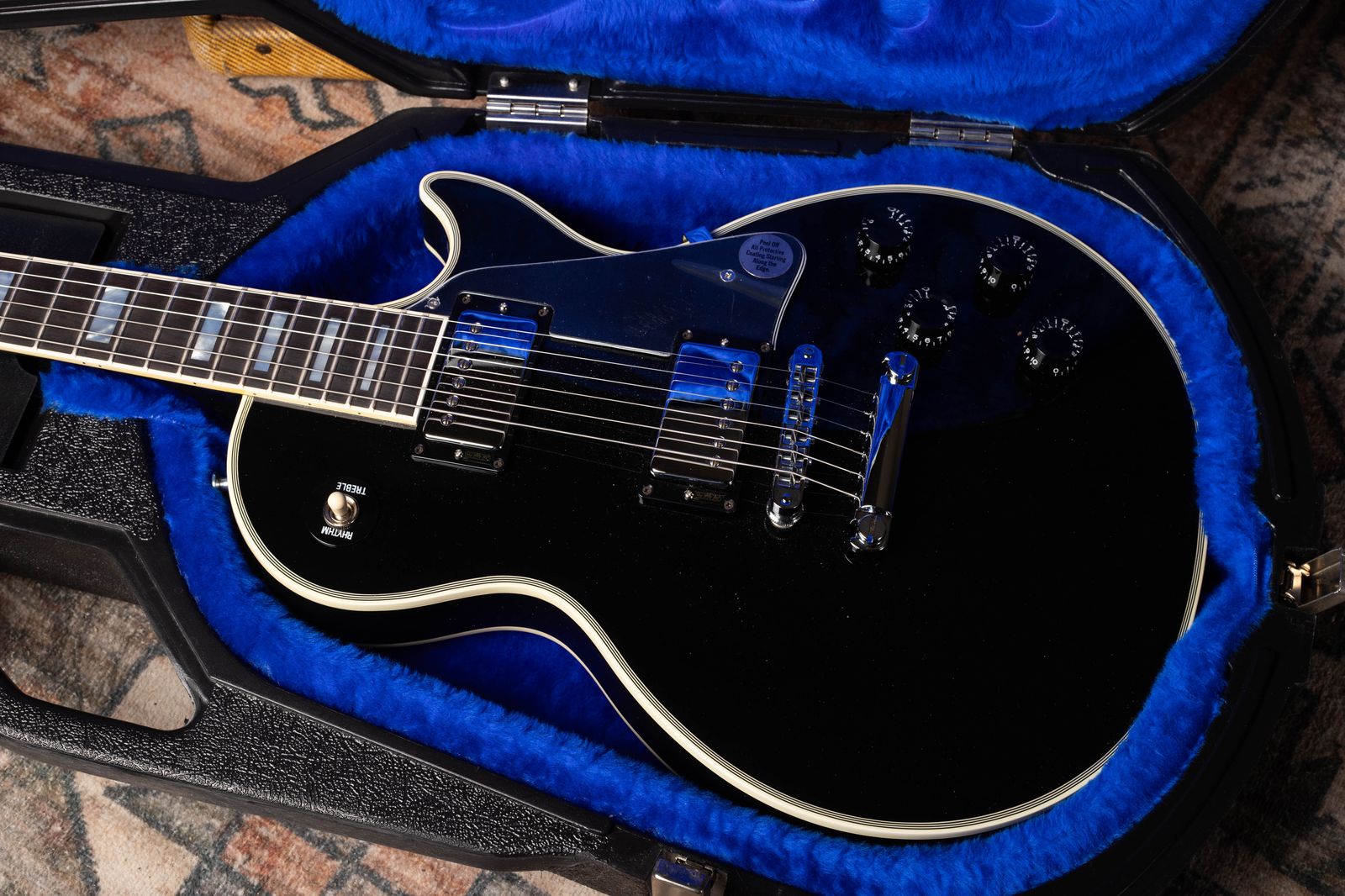
The 1985 black Custom beside it shows chrome hardware. Factory lists priced chrome- and gold-hardware versions separately, so silver-colored metal parts aren't by themselves evidence of a replacement. Compare the version and installation before making that judgment.
1984 To 1986 Production And The End Of Norlin Ownership
Kalamazoo closed in 1984. A serial number from that year can help establish which factory made the guitar, using the ranking blocks explained in the serial-number section. Regular 1985 and 1986 Customs belong to Nashville production.
The 1983 catalogue provides a useful specification reference for these later guitars, but it doesn't document a separate neck or pickup change for each following year. Record the parts actually fitted to a 1984, 1985 or 1986 instrument. Gibson's sale in January 1986 ended Norlin ownership without creating an overnight dividing line in every construction detail.
How Many Les Paul Customs Did Gibson Ship?
The figures below come from the Gibson shipping totals guide. They count guitars recorded as shipped in its Custom category. A shipment is a guitar leaving the factory, so these figures don't count how many survive today or separate every special version.
In this published series, 1968 has 433 recorded Custom shipments and 1978 has 10,171, the highest figure shown. The next year falls to 1,219. The table records those differences without establishing their cause, and its coverage ends in 1979.
| Year | Listed Custom Shipments |
|---|---|
| 1968 | 433 |
| 1969 | 2,353 |
| 1970 | 2,612 |
| 1971 | 3,152 |
| 1972 | 3,934 |
| 1973 | 7,091 |
| 1974 | 7,465 |
| 1975 | 6,229 |
| 1976 | 4,013 |
| 1977 | 1,431 |
| 1978 | 10,171 |
| 1979 | 1,219 |
What Did A Les Paul Custom Cost When New?
The prices below are Gibson's published US list prices at the time. They show how Gibson priced the different versions and options; an individual dealer's selling price could differ. Cases were generally listed separately in these examples. For what a guitar is worth today, use the Les Paul market value guide.
1968 To 1970 Les Paul Custom List Prices
The June 1968 list priced the Custom at $545, with the 0535 Faultless plush case adding $73. The guitar rose to $575 by September 1969, remained $575 in March 1970 and reached $595 in September 1970.
1978 Les Paul Custom List Prices
The May 15, 1978 US list priced the regular gold-hardware Custom at $849. The maple-fingerboard version was $879, the three-pickup version was $949 and the nickel-hardware model was $799. Those differences reflect the distinct versions shown in the catalogue.
1980 Les Paul Custom List Prices
On July 1, 1980, the regular Custom listed at $949 and the nickel version at $899. The left-handed Custom was $999, with Ebony, Wine Red, Tobacco Sunburst or Cherry Sunburst listed as its finishes.
1983 Les Paul Custom Prices And Finish Options
The list effective June 15, 1983 priced the gold-hardware Custom at $1,099 in Ebony or Wine Red. Antique Natural, Antique Sunburst, Vintage Cherry Sunburst, Candy Apple Red, Pearl White and Ivory raised the price to $1,184, an $85 finish premium.
The chrome-hardware version started at $1,049 in Ebony, Silver or Wine Red. Silverburst, Vintage Cherry Sunburst and Antique Sunburst cost $1,134. Silver and Silverburst are separate finish entries, and Silverburst appears on the chrome-hardware offering in this list.
A left-handed gold-hardware Custom was $1,199 in Ebony or Wine Red, or $1,284 in Antique Sunburst or Vintage Cherry Sunburst. That was a $100 premium over the corresponding right-handed version, with fewer finish choices.
The optional factory Super Tune Vibrola added $200. An Ebony gold-hardware Custom therefore listed at $1,299 with that option, before adding a case.
Les Paul Custom Weight, Cases And Original Paperwork
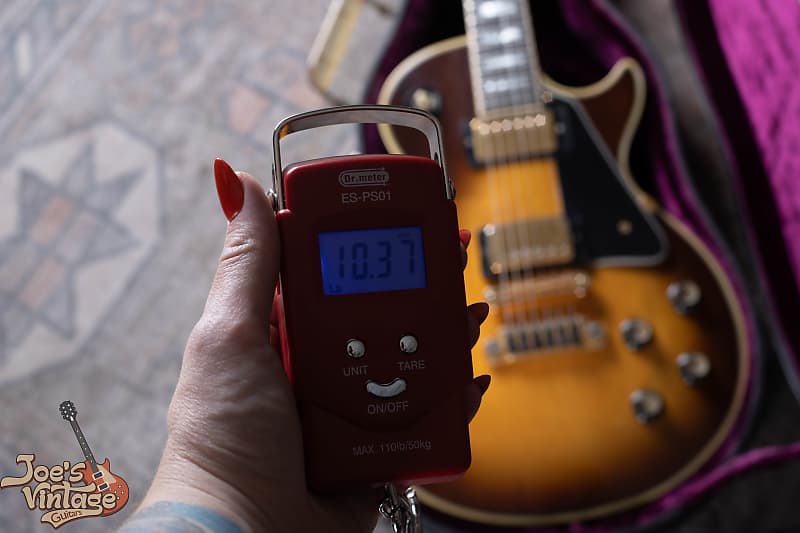
If you're comparing Customs to play, ask for the weight of each guitar. The 1977 Sunburst Custom below weighs 10.37 lb, about 10 lb 6 oz or 4.70 kg. That tells you what this instrument weighs; body construction alone won't give you the weight of another Custom.
Gibson Faultless And Protector Cases
Gibson's catalogues and price lists can also help identify the case originally offered with a guitar. Both the 1975 and 1980 Custom catalogues name the 535 Faultless plush-lined case. In July 1980, it listed at $99.50. The alternative Protector case was $119.50 when bought with the instrument or $129.50 separately.
By June 1983, the Custom's case choices included a 535 at $119.50 and a Pro II at $99.50. A case model number doesn't establish every detail of its appearance across the entire period. Compare the shell, latches, handle and lining with the photographs in the Gibson case guide.
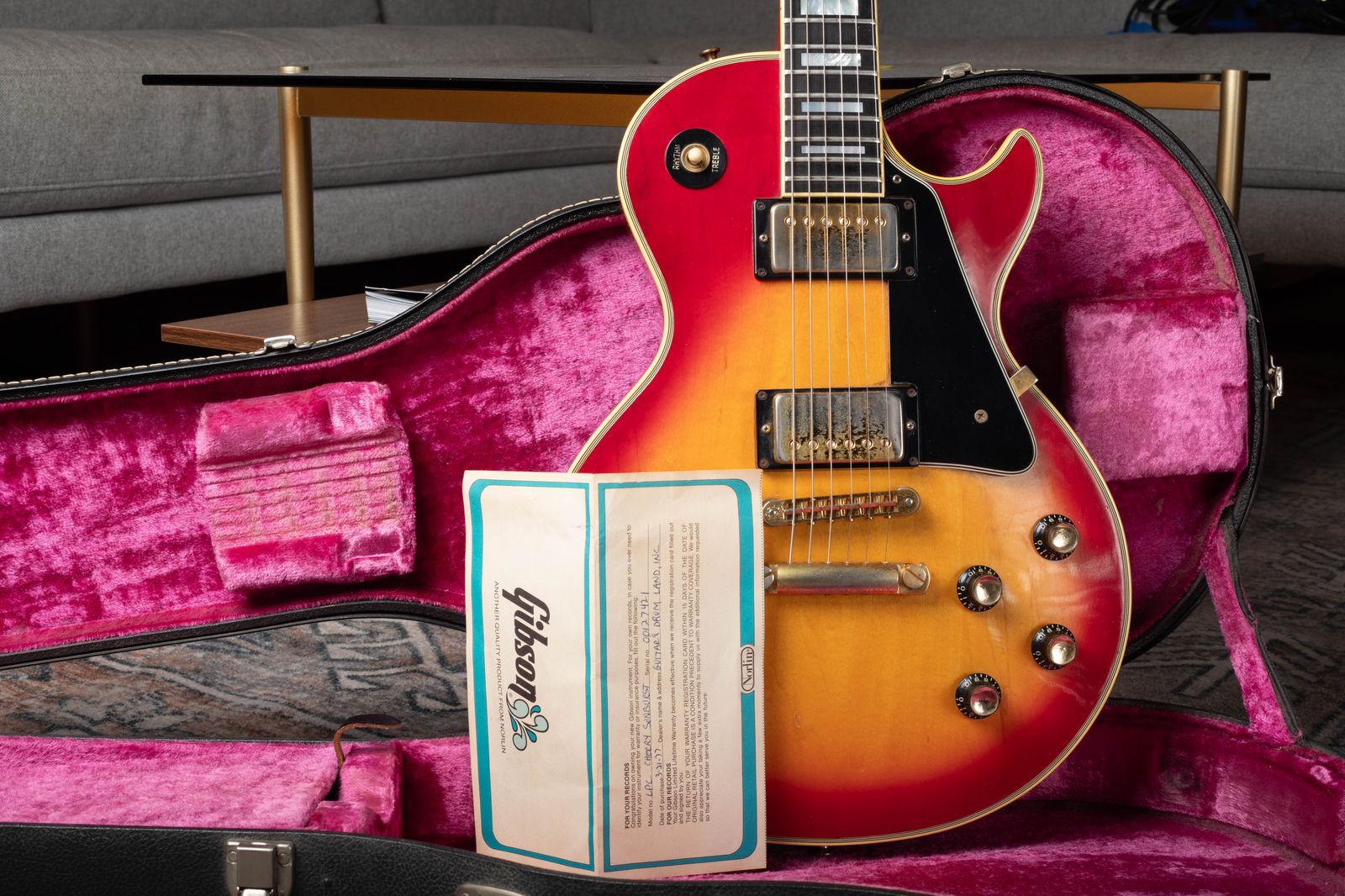
The 1976 Cherry Sunburst Custom below is shown with its case and paperwork. Keep receipts and other dated documents with the instrument: they can connect a particular guitar to a purchase and help explain its history. Since cases can be exchanged, judge the case's age and its connection to the guitar separately.
How To Check Original Les Paul Custom Parts
An original part is one fitted when the guitar was built. A replacement made in the same period can look correct and still be a later addition. To distinguish the two, compare how the part was installed as well as what it looks like.
On the headstock, look for unused tuner screw holes, enlarged holes around the string posts and impressions left by different washers. At the bridge, inspect the metal bridge body, its posts, the sleeves in the wood and the individual saddles. A replacement bridge can conceal earlier mounting work, so the tuner installation checklist and bridge mounting reference can help you compare what remains visible.
For the electronics, photograph the underside of each pickup, its full markings, the wires, the pot codes and the solder joints where the wires connect. Compare that evidence with the control-cavity inspection guide. A date code is more useful when you can also judge whether the component has been replaced.
Keep repair receipts and any removed parts with the guitar. You don't need to remove an intact pickup cover to begin an assessment; clear exterior and control-cavity photographs are enough for an initial discussion.
What Is A 1968 To 1986 Les Paul Custom Worth?
Start by identifying the construction and version you're valuing. An early 1969 Custom with a one-piece neck and back is a closer comparison to the 1968 return than to a later pancake-body guitar. A 25/50 Anniversary and a 1954-style Limited Edition also need to be compared with their own versions.
As checked in October 2026, our Les Paul market value guide gives a broad US retail estimate of $12,000 to $18,000 for 1968 to 1969 Customs in excellent, all-original condition with the correct case. The different 1969 construction groups won't all command the same price, and this estimate doesn't apply to the entire 1968 to 1986 range.
Within a comparable group, inspect the finish, headstock, pickups and fretwork. A refret replaces the metal frets and changes the playing feel. A repaired headstock involves the wood itself and may also involve finish work. Record these separately so you can compare the guitar's condition with the example used to estimate its value.
Weight, replacement hardware, the case and original paperwork can explain further differences between otherwise similar guitars. Use completed sales where available and distinguish them from advertised asking prices. For a value tied to the instrument in front of you, send photos for a free guitar appraisal.
What Photos Help Date A Les Paul Custom?
Begin with full front and back views, then photograph both sides of the headstock, the serial number and the neck profile behind the nut. Add a well-lit view of the body edge to show any layers, along with close-ups of the bridge and tuner housings.
If you already have photographs of the control cavity, pot codes or pickup cavities, include them. They can show the component dates, wiring and neck tenon that aren't visible from the outside. You don't need to dismantle the guitar before sending the first photographs.
Photograph a faint serial from several angles; light that hides a digit in one view may reveal it in another. Include the case and paperwork too. You can click the detail photographs in this guide to inspect the original files at their available resolution.
Gibson Les Paul Custom Dating Resources
For a closer look at a particular feature, use the matching guide:
- Gibson Serial Number Guide: identify the numbering system and understand why some ranges return several years.
- Gibson Pot Code Guide: read the dates on volume and tone controls and compare their installation.
- Les Paul Dating Guide: identify the model before comparing year-specific features.
- Gibson Construction And Hardware Guide: compare body layers, neck woods, bridges and cases in detail.
- Gibson Tuner Dating Guide: compare tuner designs and signs of replacement.
Gibson Les Paul Custom And Norlin-Era Questions
Are All Norlin Les Paul Customs Pancake Bodies?
No. Early 1969 Customs can retain a one-piece mahogany back, and pancake construction phases out around 1977. Later Customs have non-pancake backs, which may still use pieces joined side by side. Identify the body construction separately from the neck wood.
Is A 1968 Les Paul Custom A Norlin Guitar?
A 1968 Custom predates the 1969 ownership change that begins the usual Norlin period. It's included here because its one-piece mahogany neck and back, maple top and long neck tenon provide the starting point for the changes that followed in 1969 and 1970.
Do All Norlin Customs Have Maple Necks?
No. The early Customs use mahogany necks. Three-piece maple necks appear in the mid-1970s, remain in Gibson's 1980 catalogue and give way to mahogany in the 1983 specification. A maple fingerboard is a separate feature from the neck wood beneath it.
Are Norlin-Era Gibson Guitars Bad Guitars?
No. Quality control was uneven, and some guitars left the factory with faults in their fretwork or finish. Those problems helped give the whole era a poor reputation, but many Norlin Gibsons are well-built, rewarding guitars to play. Players have been reassessing them in recent years, and they can offer a more accessible route into vintage Gibsons than the most sought-after 1950s and 1960s models. The condition and playing feel of the individual guitar matter more than the Norlin label.
Did Every Les Paul Custom Have A TP-6 Tailpiece?
No. The TP-6 fine-tuning tailpiece appeared around the mid-1970s and can be found on some Customs from that period onward. Other examples have a plain stopbar. A TP-6 can also be fitted later, so it isn't a universal specification or a date code.
How Can You Tell A Factory Kahler From A Conversion?
Factory Kahler units on Customs from this period carry Gibson branding. Many guitars received Kahler conversions later, and a Gibson-branded unit can also be installed after manufacture. Its branding, mounting work and the guitar's history need to agree before the installation is described as factory original.
Do Grover Tuners Always Mean A Les Paul Custom Was Modified?
No. Some 1968 Customs had factory Grovers. Other Customs received them later as upgrades. Check the rear housing design, screw holes and washer impressions alongside the guitar's history rather than treating the brand alone as proof of a change.
Are Three-Piece Necks A Sign Of Poor Quality?
No. Three-piece describes the neck's wood assembly. It doesn't tell you whether the guitar has poor fretwork, a repair or a comfortable playing feel. Those qualities need to be judged on the individual instrument.
Get Help Dating And Valuing Your Les Paul Custom
To identify your Custom or get a value for it, send photographs for an appraisal or call (602) 900-6635. Include its weight, any known repairs and the original case or paperwork if you have them. Joe Dampt can assess the guitar and discuss selling options if you're considering a sale.