
Martin Serial Number Lookup and Guide
Martin Serial Number Lookup
If you’ve got a Martin, the first thing to figure out is the year it was built. That tells you a lot about the guitar and where it sits on the market. The lookup tool above cross-references Martin’s Nazareth records to date your instrument, and once you know the year you can get a free Martin appraisal.
Where Is The Serial Number Located?
On all vintage Martin acoustic guitars, the serial number is stamped on the neck block inside the soundhole. The neck block is the heavy piece of wood inside the guitar where the neck joins the body. The top number is the model number (e.g., D-28), and the lower one is the serial number. Martin guitars made before October 1930 do not have the Model number stamped. Every brand hides its number in a different spot, so if you also own a Fender, my guide to fender serial number dating shows where to look on those.
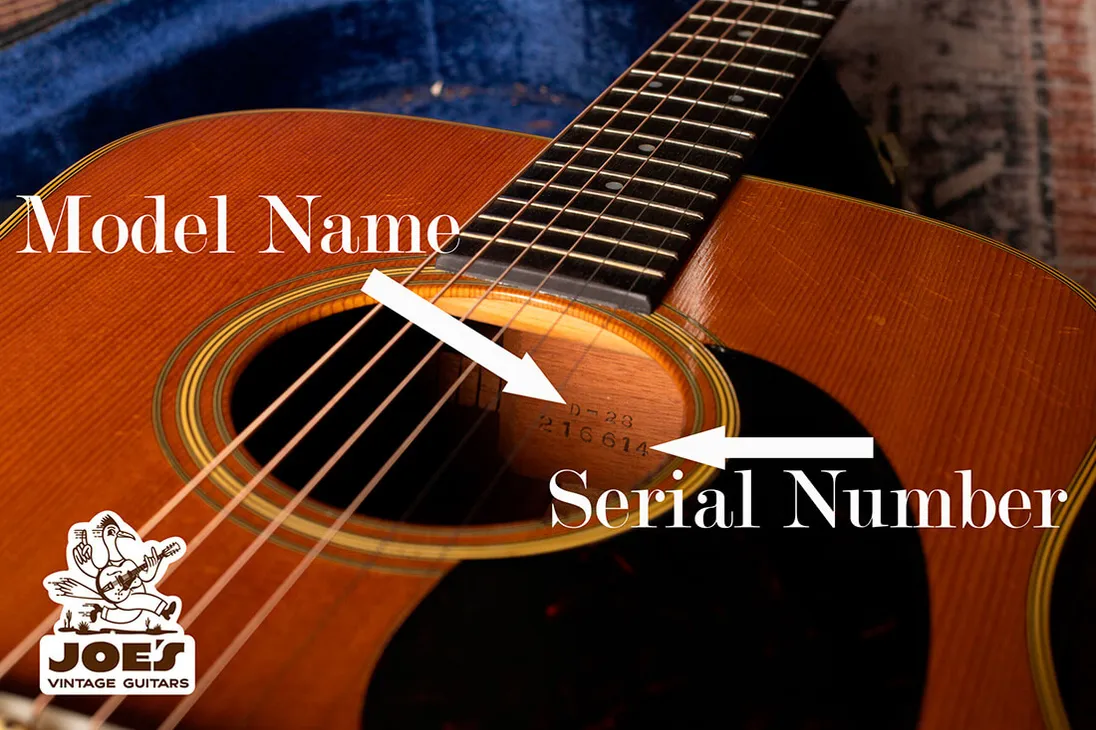
Watch Joe find it on the neck block (0:20).
Martin Serial Number Range Chart
Find the range that your guitar falls into below. This chart contains every production year from 1898 to 2024.
| Year | Serial Number Range |
|---|---|
| 1898 | 0000 to 8348 |
| 1899 | 8349 to 8716 |
| 1900 | 8717 to 9128 |
| 1901 | 9129 to 9310 |
| 1902 | 9311 to 9528 |
| 1903 | 9529 to 9810 |
| 1904 | 9811 to 9988 |
| 1905 | 9989 to 10120 |
| 1906 | 10121 to 10329 |
| 1907 | 10330 to 10727 |
| 1908 | 10728 to 10883 |
| 1909 | 10884 to 11018 |
| 1910 | 11019 to 11203 |
| 1911 | 11204 to 11413 |
| 1912 | 11414 to 11565 |
| 1913 | 11566 to 11821 |
| 1914 | 11822 to 12047 |
| 1915 | 12048 to 12209 |
| 1916 | 12210 to 12390 |
| 1917 | 12391 to 12988 |
| 1918 | 12989 to 13450 |
| 1919 | 13451 to 14512 |
| 1920 | 14513 to 15848 |
| 1921 | 15849 to 16758 |
| 1922 | 16759 to 17839 |
| 1923 | 17840 to 19891 |
| 1924 | 19892 to 22008 |
| 1925 | 22009 to 24116 |
| 1926 | 24117 to 28689 |
| 1927 | 28690 to 34435 |
| 1928 | 34436 to 37568 |
| 1929 | 37569 to 40843 |
| 1930 | 40844 to 45317 |
| 1931 | 45318 to 49589 |
| 1932 | 49590 to 52590 |
| 1933 | 52591 to 55084 |
| 1934 | 55085 to 58679 |
| 1935 | 58680 to 61947 |
| 1936 | 61948 to 65176 |
| 1937 | 65177 to 68865 |
| 1938 | 68866 to 71866 |
| 1939 | 71867 to 74061 |
| 1940 | 74062 to 76734 |
| 1941 | 76735 to 80013 |
| 1942 | 80014 to 83107 |
| 1943 | 83108 to 86724 |
| 1944 | 86725 to 90149 |
| 1945 | 90150 to 93623 |
| 1946 | 93624 to 98158 |
| 1947 | 98159 to 103468 |
| 1948 | 103469 to 108269 |
| 1949 | 108270 to 112961 |
| 1950 | 112962 to 117961 |
| 1951 | 117962 to 122799 |
| 1952 | 122800 to 128436 |
| 1953 | 128437 to 134501 |
| 1954 | 134502 to 141345 |
| 1955 | 141346 to 147328 |
| 1956 | 147329 to 153225 |
| 1957 | 153226 to 159061 |
| 1958 | 159062 to 165576 |
| 1959 | 165577 to 171047 |
| 1960 | 171048 to 175689 |
| 1961 | 175690 to 181297 |
| 1962 | 181298 to 187384 |
| 1963 | 187385 to 193327 |
| 1964 | 193328 to 199626 |
| 1965 | 199627 to 207030 |
| 1966 | 207031 to 217215 |
| 1967 | 217216 to 230095 |
| 1968 | 230096 to 241925 |
| 1969 | 241926 to 256003 |
| 1970 | 256004 to 271633 |
| 1971 | 271634 to 294270 |
| 1972 | 294271 to 313302 |
| 1973 | 313303 to 333873 |
| 1974 | 333874 to 353387 |
| 1975 | 353388 to 371828 |
| 1976 | 371829 to 388800 |
| 1977 | 388801 to 399625 |
| 1978 | 399626 to 407800 |
| 1979 | 407801 to 419900 |
| 1980 | 419901 to 430300 |
| 1981 | 430301 to 436474 |
| 1982 | 436475 to 439627 |
| 1983 | 439628 to 446101 |
| 1984 | 446102 to 453300 |
| 1985 | 453301 to 460575 |
| 1986 | 460576 to 468175 |
| 1987 | 468176 to 476216 |
| 1988 | 476217 to 483952 |
| 1989 | 483953 to 493279 |
| 1990 | 493280 to 503309 |
| 1991 | 503310 to 512487 |
| 1992 | 512488 to 522655 |
| 1993 | 522656 to 535223 |
| 1994 | 535224 to 551696 |
| 1995 | 551697 to 570434 |
| 1996 | 570435 to 592930 |
| 1997 | 592931 to 624799 |
| 1998 | 624800 to 668796 |
| 1999 | 668797 to 724077 |
| 2000 | 724078 to 780500 |
| 2001 | 780501 to 845644 |
| 2002 | 845645 to 916759 |
| 2003 | 916760 to 978706 |
| 2004 | 978707 to 1042558 |
| 2005 | 1042559 to 1115862 |
| 2006 | 1115863 to 1197799 |
| 2007 | 1197800 to 1268091 |
| 2008 | 1268092 to 1337042 |
| 2009 | 1337043 to 1406715 |
| 2010 | 1406716 to 1473461 |
| 2011 | 1473462 to 1555767 |
| 2012 | 1555768 to 1656742 |
| 2013 | 1656743 to 1755536 |
| 2014 | 1755537 to 1857399 |
| 2015 | 1857400 to 1972129 |
| 2016 | 1972130 to 2076795 |
| 2017 | 2076796 to 2161732 |
| 2018 | 2161733 to 2258889 |
| 2019 | 2258890 to 2366880 |
| 2020 | 2366881 to 2454224 |
| 2021 | 2454225 to 2576415 |
| 2022 | 2576416 to 2711440 |
| 2023 | 2711441 to 2829083 |
| 2024 | 2829084 to 2935987 |
Martin 2025 and 2026 Projections
Based on Martin’s current production of about 107,000 guitars a year, here are my projected ranges:
- 2025 Projection: 2,935,988 to 3,043,000
- 2026 Projection: 3,043,001 to 3,150,000
Little Martin (LX Series) Serial Numbers
The Little Martin LX series uses its own separate serial number sequence, completely independent from standard Nazareth production. These compact, HPL-bodied instruments have been made at Martin’s Navojoa, Sonora, Mexico facility since 2003. Use the chart below to date your LX model.
| Year | Last Serial No. |
|---|---|
| 2005 | 41279 |
| 2006 | 54016 |
| 2007 | 69850 |
| 2008 | 85266 |
| 2009 | 98332 |
| 2010 | 115197 |
| 2011 | 129934 |
| 2012 | 145612 |
| 2013 | 172822 |
| 2014 | 205052 |
| 2015 | 236580 |
| 2016 | 263886 |
| 2017 | 284726 |
| 2018 | 319828 |
| 2019 | 344677 |
| 2020 | 361282 |
| 2021 | 388199 |
| 2022 | 406762 |
| 2023 | 417282 |
| 2024 | 429400 |
How to read this chart: The number shown is the last serial number issued in that year. If your serial number falls between the previous year’s last number and the current year’s last number, your instrument was made in that year. For example, a serial number of 100000 falls between 98332 (end of 2009) and 115197 (end of 2010), so it was made in 2010.
Martin Mandolin Serial Numbers
Martin mandolins use an entirely separate serial number system from their guitars. Production ran from the late 1800s through 2002, when Martin ceased mandolin manufacturing entirely. From 1994 to 2002, mandolins were only available as custom orders. Note that from 1991 onward, Martin merged the mandolin serial sequence with the standard guitar numbering system, so serial numbers from 1991 and 1993 will overlap with guitar serials from that period.
The serial number on a Martin mandolin can typically be found stamped on the inside of the instrument, either on the back strip or the neck block, visible through the soundhole. Because Martin stopped making them, vintage mandolins are getting harder to find, and I buy them as well, so if yours has been sitting in a case you can sell your Martin here alongside the guitars.
* Note on 1976: Serial numbers 259,996 to 260,020 were also used in 1976. ** Note on 1991: From serial 509,122 onward, mandolin serials merged into the standard Martin guitar sequence.
| Year | Last Serial No. |
|---|---|
| 1895 | 23 |
| 1896 | 112 |
| 1897 | 153 |
| 1898 | 359 |
| 1899 | 577 |
| 1900 | 800 |
| 1901 | 881 |
| 1902 | 1171 |
| 1903 | 1348 |
| 1904 | 1507 |
| 1905 | 1669 |
| 1906 | 2026 |
| 1907 | 2357 |
| 1908 | 2510 |
| 1909 | 2786 |
| 1910 | 3098 |
| 1911 | 3431 |
| 1912 | 3847 |
| 1913 | 4162 |
| 1914 | 4462 |
| 1915 | 4767 |
| 1916 | 5007 |
| 1917 | 5752 |
| 1918 | 6370 |
| 1919 | 7237 |
| 1920 | 8761 |
| 1921 | 9627 |
| 1922 | 10245 |
| 1923 | 11020 |
| 1924 | 11809 |
| 1925 | 12520 |
| 1926 | 13359 |
| 1927 | 13833 |
| 1928 | 14170 |
| 1929 | 14630 |
| 1930 | 14892 |
| 1931 | 15290 |
| 1932 | 15476 |
| 1933 | 15528 |
| 1934 | 15729 |
| 1935 | 15887 |
| 1936 | 16156 |
| 1937 | 16437 |
| 1938 | 16580 |
| 1939 | 16747 |
| 1940 | 16957 |
| 1941 | 17263 |
| 1942 | 17405 |
| 1946 | 17641 |
| 1947 | 18303 |
| 1948 | 19078 |
| 1949 | 19559 |
| 1950 | 20065 |
| 1951 | 20496 |
| 1952 | 20902 |
| 1953 | 21452 |
| 1954 | 21952 |
| 1955 | 22254 |
| 1956 | 22629 |
| 1957 | 22985 |
| 1958 | 23111 |
| 1959 | 23262 |
| 1960 | 23512 |
| 1961 | 23663 |
| 1962 | 23938 |
| 1963 | 24139 |
| 1964 | 24339 |
| 1965 | 24439 |
| 1966 | 24564 |
| 1967 | 24639 |
| 1968 | 24839 |
| 1969 | 24989 |
| 1970 | 25039 |
| 1971 | 25139 |
| 1972 | 25239 |
| 1973 | 25339 |
| 1974 | 25679 |
| 1975 | 25895 |
| 1976 | 26070 * |
| 1977 | 26101 |
| 1979 | 26112 |
| 1980 | 26156 |
| 1981 | 26215 |
| 1982 | 26225 |
| 1983 | 26247 |
| 1984 | 26254 |
| 1985 | 26263 |
| 1986 | 26273 |
| 1987 | 26279 |
| 1988 | 26281 |
| 1989 | 26283 |
| 1990 | 26291 |
| 1991 | 509122 ** |
| 1993 | 533213 |
Martin Navojoa Ukulele Serial Numbers
Martin produces several ukulele models at their Navojoa, Sonora, Mexico facility. These instruments use three completely separate serial number sequences depending on construction type: Solid Wood, HPL (High Pressure Laminate), and SO. If you’re unsure which type you have, check the back and sides of your ukulele. Solid wood models show real wood grain on the interior, while HPL models have a smooth, uniform paper-and-resin surface.
Navojoa Solid Wood Ukulele Serial Numbers
These are Martin’s higher-end Navojoa ukuleles, built with genuine solid wood tops, backs, and sides. Production data is available from 2010 onward.
| Year | Last Serial No. |
|---|---|
| 2010 | 1282 |
| 2011 | 3607 |
| 2012 | 6702 |
| 2013 | 9266 |
| 2014 | 10829 |
| 2015 | 13298 |
| 2016 | 15594 |
| 2017 | 17465 |
| 2018 | 19924 |
| 2019 | 22337 |
| 2020 | 24189 |
| 2021 | 27497 |
| 2022 | 32393 |
| 2023 | 34983 |
| 2024 | 37638 |
Navojoa HPL Ukulele Serial Numbers
HPL stands for High Pressure Laminate, a composite material made from paper and resin pressed at very high pressure, with a wood-pattern surface finish. These are Martin’s more affordable and durable Navojoa ukulele models, good for travel and beginners.
| Year | Last Serial No. |
|---|---|
| 2010 | 1672 |
| 2011 | 2403 |
| 2012 | 2967 |
| 2013 | 3382 |
| 2014 | 4322 |
| 2015 | 4833 |
| 2016 | 5616 |
| 2017 | 6207 |
| 2018 | 6517 |
| 2019 | 6682 |
| 2020 | 6683 |
| 2021 | 7874 |
| 2022 | 8876 |
| 2023 | 10793 |
| 2024 | 12583 |
Navojoa SO Ukulele Serial Numbers
The SO ukulele series was an earlier Navojoa production line. Important note: the 2000 to 2006 serial range (up to 9972) is approximate only. Martin didn’t keep year-by-year records for this period, so an exact production year can’t be confirmed for instruments in that range. Records become year-specific from 2007 onward.
| Year | Serial Number Range |
|---|---|
| 2000 to 2006(approximate) | 0 to 9972 |
| 2007 | 9973 to 10910 |
| 2008 | 10911 to 11724 |
| 2009 | 11725 to 12570 |
| 2010 | 12571 to 12922 |
The Ultimate Martin Dating & Specifications Guide
Using a serial number is the first step, but identifying the correct specifications is how you verify authenticity and value. Here is how Martin’s construction evolved over the decades.
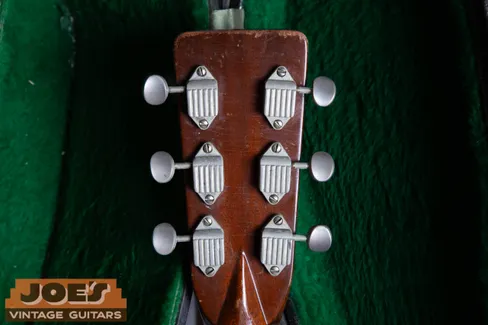
1. Chronology of Martin Tuners (Machine Heads)
Original tuners are one of the most accurate ways to help date a Martin. Hardware evolved from 19th-century friction pegs to specialized wartime metal-saving designs. Dating a different make? The same hardware clues apply, and my gibson serial number lookup walks through the equivalent details for those.
Note: While these are not all the tuner variations Martin used, they are the most commonly seen.
Pre-War Mastery (1900 to 1941)
Waverly Clipped-End: Baseplates with angled-off corners, common in the late 1920s.
Grover G-93 & G-98 Sta-Tite: The definitive “pointed-end” or arrowhead plates.
Banjo Tuners: Long planetary gears seen on early 1929-31 OM models.
Grover G-111 Enclosed: Early covered gears for D-28s with a smooth, rounded protective “shroud.”
The Modern Era (1966 to Present)
Grover Rotomatics: Large, chrome sealed-gear tuners with kidney buttons. Marked the end of the lightweight “Golden Era” feel.
Schaller: Often used in the 70s/80s, similar to Grovers but with a more squared-off casing.
Wartime Variations (1942 to 1945)
Waverly 12:1 “3-Hump”: Plates with three distinct curves and sharp corners.
“Teddy Bear” Waverlys: Rare variant with a silhouette like a bear’s head.
Grey Klusons (1943-44): Dull, non-plated, thin-geared flat plate tuners.
Style 17: Simple 3-on-a-strip gears with exposed rivets.
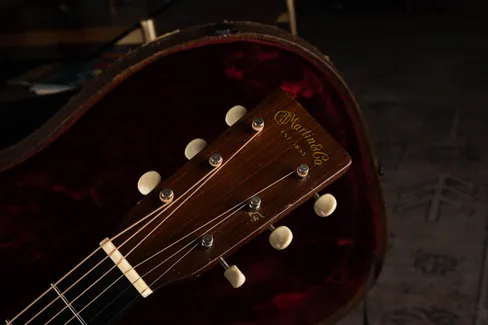
Post-War & Transition (1946 to 1960s)
Waverly “Round-end”: Return to smooth, scalloped plate ends.
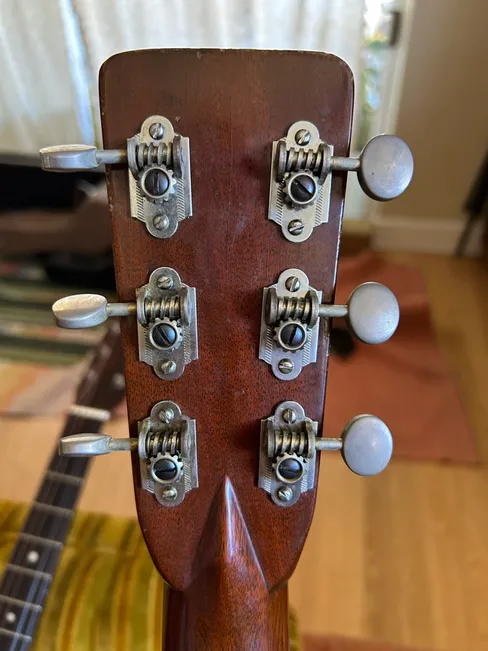
Kluson Post-War Hex: Features a distinctive six-sided gear housing.
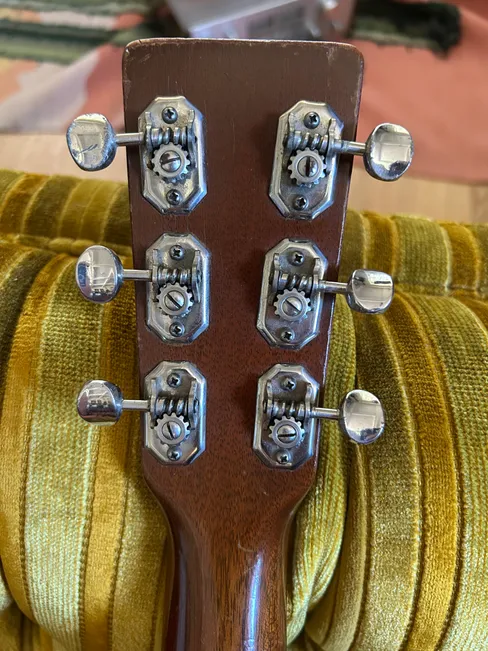
Kluson Deluxe: Classic “closed-back” with a vertical line of text stamped into the housing.
Nickel Waffle-Backs: Heavy-duty Klusons with a textured pattern, often on Style 45s.
2. Purfling & Binding: Identifying High-Value Materials
The “bling” and construction of the edges are direct indicators of a Martin’s style and era. Understanding these material transitions is key for separating “Golden Era” originals from modern reissues.
The Iconic "Bone" (Style 28)
The Standard: This wood-inlay pattern was the standard on Style 28 guitars until 1947.
Aesthetic: Pre-war herringbone is a specific “zig-zag” wood marquetry that defines the high-end working man’s guitar of the 1930s.
Ivoroid Binding: Genuine pre-war models featured grained ivoroid, which develops a creamy yellowish patina.
Abalone Pearl (The Style 45 Pinnacle)
Style 45: The ultimate collectible prize, featuring hand-selected abalone on the top, back, and sides, including a pearl border around the neck joint.
Style 42: Features abalone on the top only, typically stopping at the fingerboard extension.
Style 41: Introduced in 1968 with a wider pearl border than pre-war versions.
Celluloid vs. Wood Binding
Style 18 Transition: Early Style 18s featured real rosewood binding before transitioning to dark brown “Tortoiseshell” celluloid in the mid-1930s.
The Boltaron Shift: In the late 1960s, Martin moved from celluloid to Boltaron, a stark white, stable plastic.
Binding Shrinkage: Common in vintage celluloid where the plastic pulls away from the guitar’s “waist” over decades.
Specialty Purfling (Style 21 & 35)
Style 21: Features simple, dark multi-ply wood purfling for an earthy, understated look.
Style 35: Introduced in 1965 with its 3-piece back; look for two additional vertical strips of decorative “checkerboard” purfling joining the panels.
3. Fretboard & Headstock Inlays: The Art of the Luthier
Standard dots were the norm on working-man guitars, while Martin’s high-end models used detailed “pearl work.” Knowing these patterns helps you confirm a guitar is original.
Evolution of the Fretboard Dot
Micro-Dots (Pre-1932): Tiny, almost microscopic abalone or pearl dots used on early Style 18 models.
Golden Era (1930s to 1944): Dots became slightly larger and more uniform.
1944 “Large Dot” Shift: Martin moved to larger 1/4-inch mother-of-pearl dots across most models to simplify production.
Elite Patterns: Vines & Snowflakes
Tree of Life (Vine): Intricate abalone vine growing up the entire fretboard, reserved for custom commissions.
Snowflake (Style 42 & 45): Delicate, six-pointed floral designs.
Diamonds & Squares (Pre-War Style 28): Elegant slotted patterns that signal a “Golden Era” instrument.
Fancy Headstock: Torch & Flowerpot
The Torch (19th C to Early 1900s): The ultimate pre-war status symbol; an intricate flaming torch design in abalone.
The Flowerpot: A rare, rounded floral variant found on premium late-19th-century parlor guitars.
Vertical Logo: Spell-out “C.F. MARTIN” in vertical pearl blocks, typical of 20th-century Style 45s.
Personalized & Engraved Appointments
Name-in-Fretboard: Players occasionally had their names inlaid in pearl, signaling unique historical commissions.
Engraved Pearl: Elite 19th-century models often featured pearl hand-engraved with fine lines to add detail to flowers or scrollwork.
4. Evolution of the Martin Logo & Stamps
Before the gold decal standard, Martin used various wood stamps and pearl work to brand their instruments. These markers are often the best way to distinguish an early production model.
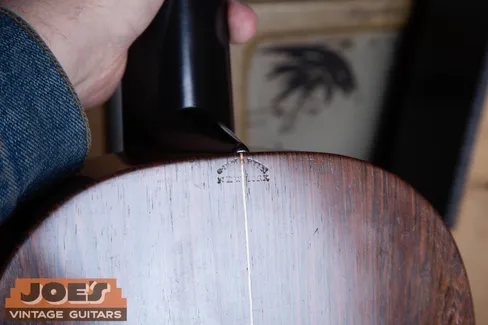
Early External Body Stamp
On some of the earliest Martin models (1833 to mid-1800s), the company name was branded directly into the wood on the back of the body, just below the neck heel.
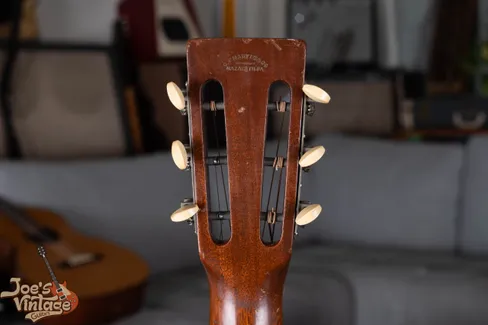
Rear Headstock Stamp (Pre-1932)
Until 1932, there was typically no logo on the front of the headstock! Instead, the brand was stamped into the back of the headstock. This was usually paired with a matching internal wood stamp.
The Inlaid Vertical Logo
Reserved for elite Style 45 models, this premium branding features the company name spelled out vertically in individual blocks of Abalone pearl. It is the pinnacle of vintage Martin branding.
The Gold Decal (1932-Present)
The iconic gold decal was introduced in 1932. Early decals were slightly smaller and had a different font weight than the “Large Decals” seen in the 1960s and 70s.
5. Martin Historical Production Timeline
6. Tonewood Guide: From Standard to Exceptional
The wood is a big part of a Martin’s voice. Two guitars can share the same species, but the specific grain and era can make one worth far more than the other.
Adirondack Spruce (Pre-War "Red Spruce")
Standard: Used until 1946. Look for wide grain spacing and a stiff, lightweight structure.
The Exceptional Piece: Look for “silk” (medullary rays) across the grain. Exceptional Adirondack offers massive headroom and a “punch” that stays clear even when played hard. Mid-40s models may feature rare four-piece Adirondack tops.
Sitka Spruce (Post-War Powerhouse)
Standard: Primary top wood after 1946; generally tighter, more consistent grain than Adirondack with a warmer initial response.
The Exceptional Piece: Look for “Bearclaw” figuring (natural ripples). Once seen as a defect, stiff Bearclaw Sitka is now highly prized for its unique aesthetic and tone. Exceptional vintage Sitka from the 1950s has often “honeyed” over decades, providing a rich, complex tone.
The "Mystery Top" Era (1946 to Early 50s)
The Identity: A post-war transition period away from Adirondack where tops often don’t perfectly fit into the Sitka or Adirondack categories.
The Value: Sought after because these tops often have the tonal power of Adirondack with the visual consistency of premium Sitka.
Brazilian Rosewood (Pre-1969 Gold Standard)
Standard: Definitive back/side wood until 1969. Look for chocolate to orange-red hues with “spidery” black ink lines.
The Exceptional Piece: Exceptional pieces used dead-straight grain for superior bell-like tone and stability. Late-60s transition pieces or D-35s (introduced in 1965) use multi-piece back construction to maximize wood supplies.
Mahogany: The Soul of the Golden Era Workhorse
Standard: Consistent vertical grain with a warm, dry tonal response.
The Exceptional Piece: Look for rare flamed or quilted mahogany on early or custom pieces. A lightweight 1930s D-18 is widely considered the ultimate recording guitar.
Vintage Martin Guitar Values
Martin guitars run anywhere from a couple hundred dollars up to six figures. Pre-war guitars (made before 1941) are the most desirable and valuable. Not sure where yours lands? Just send me photos for a free appraisal and I’ll tell you. If you have several pieces and want to sell a Martin guitar collection, I handle whole estates too, or you can simply contact me to talk it through.
Frequently Asked Questions
How do I read a Martin serial number?
Find the serial number, then match it to the year. Martin has used one continuous serial sequence on its guitars since 1898, so the number alone dates the instrument. Enter it in the lookup tool above, or match it against the chart for its era on this page.
Where is the serial number on a Martin guitar?
On guitars it is stamped on the neck block inside the body, visible through the soundhole. Mandolins, ukuleles, and Little Martin LX models use separate sequences, so pick the right instrument type in the tool above.
How do I date my vintage Martin?
The serial number is the most reliable starting point. The lookup tool cross-references Martin's Nazareth factory records to return the year. Construction details such as bracing, frets, and rosewood type then confirm the era.
What is a pre-war Martin?
A pre-war Martin is one built before 1944, the year Martin stopped scalloping its braces. Guitars made before 1941 are the most sought after, and the 1969 switch from Brazilian to Indian rosewood is another key value line.
How much is my vintage Martin worth?
Value depends on the model, year, condition, and originality, and ranges from a few hundred dollars to six figures for a pre-war example. See my Martin dreadnought value guide or send me photos for a free appraisal.
Unearth The History Of Your Vintage Martin
I collect Martins myself, and I’m always glad to hear about yours. I can help you date it, value it, and sell it for a fair price. If you’re thinking about parting with it, you can sell your Martin guitar here without the hassle.
Once you have the year pinned down, I keep more Martin resources on the site: a complete guide to vintage Martin 0, 00, and 000 guitars, a Martin D-28, D-18 and D-45 value guide for where dreadnought prices sit, a guide to determining the value of your old Martin acoustic, an authentication guide for the 1959 D-18E and D-28E electrics, and a 1976 Martin 000-45 value guide for the rare pearl trimmed 000s.

Talk With
Joe Today
Have a vintage guitar to sell or a question? I’m here to help.