Compare real prewar, speed, bonnet, reflector and witch-hat knobs, then use the timeline and model notes to decide whether the hardware fits the guitar’s claimed era.
An original control knob can support a broad production era, but it cannot confirm one exact year by itself. Gibson changed different models at different times, older parts remained in bins, and players have swapped knobs for decades.
Collector names overlap. This guide uses barrel for the tall, straight-sided postwar form and speed knob for its lower 1950s relative. Bell, bonnet and top hat describe the flared style without a cap. A reflector is a similar top hat with a metal Volume or Tone cap. A witch hat has a flat metal cap above a ribbed, tapered body and flat numbered skirt.
Quick Reference
Gibson Knob Timeline At A Glance
These dates are working ranges, not factory-wide cutoffs. The model exceptions and transition details below explain where the styles overlap.
Approximate Use
Knob Style
What the Range Means
Roughly 1935 to 1943
Prewar molded and radio-style knobs
Cataloged forms included brown and black knobs with arrows, pointers or a white position dot. Shapes and construction are safer clues than a material guess.
1946 to early 1950
Tall clear barrel, usually unnumbered
Seen on early postwar electrics. The clear plastic often clouds or turns amber with age.
1949 to 1952
Tall numbered barrel
A taller clear knob with a 0 to 10 scale visible through the plastic. Early Les Paul Goldtops are a familiar example.
About 1953 to 1955
Low speed knob
Shorter and straighter-sided than the tall barrel. Gold or black versions appear according to the model and finish.
Mid-1955 to mid-1960
Bell, bonnet or top-hat knob
The non-reflector style phased in model by model through 1956. Late 1960 Les Paul Standards are an important reflector-knob exception.
Mid-1960 to the mid-1970s
Reflector knob
A bell-shaped knob with a metal Volume or Tone insert. It remained on some models after witch hats appeared.
Late 1966 to 1981, depending on model
Witch-hat knob
Late 1966 and 1967 are transition years. The ES-335 kept witch hats through 1981, while other models changed sooner.
1970s
Capped top-hat variants
Reflector-style top hats and other capped forms overlapped witch hats. Match the exact cap, body and model instead of assigning a factory-wide cutoff.
Mid-1970s onward
Returning speed and barrel styles
Speed knobs returned model by model and became common later. Their presence does not automatically indicate an early 1950s guitar.
Seven Real Photo Views
Vintage Gibson Knob Styles By Era
Use the enlarge control to compare the profile, lettering and insert on each original photograph.
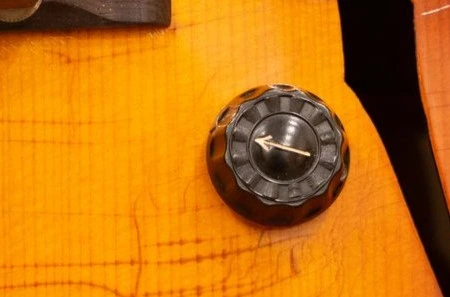
Enlarge photoRoughly 1935 to 1943: Prewar Molded And Radio-Style Knobs
This photograph shows one black ridged prewar knob with a metal pointer. Other cataloged prewar forms differ from this example.
Style 01
Roughly 1935 to 1943
Prewar Molded And Radio-Style Knobs
Gibson did not use one standardized knob on its earliest electric instruments. Cataloged types such as the 504-A include brown and black knobs, along with arrows, separate pointers, white position dots and set-screw construction. Identify the exact form and the guitar model instead of grouping every early molded knob together.
Prewar Construction Clues
Brown or black molded body
Arrow, pointer or position dot
Set screw on some cataloged forms
Dating Limits For Prewar Knobs
You can’t prove the material from a photograph. Don’t use a hot-needle test on an original knob because it can permanently damage the part and may release fumes.
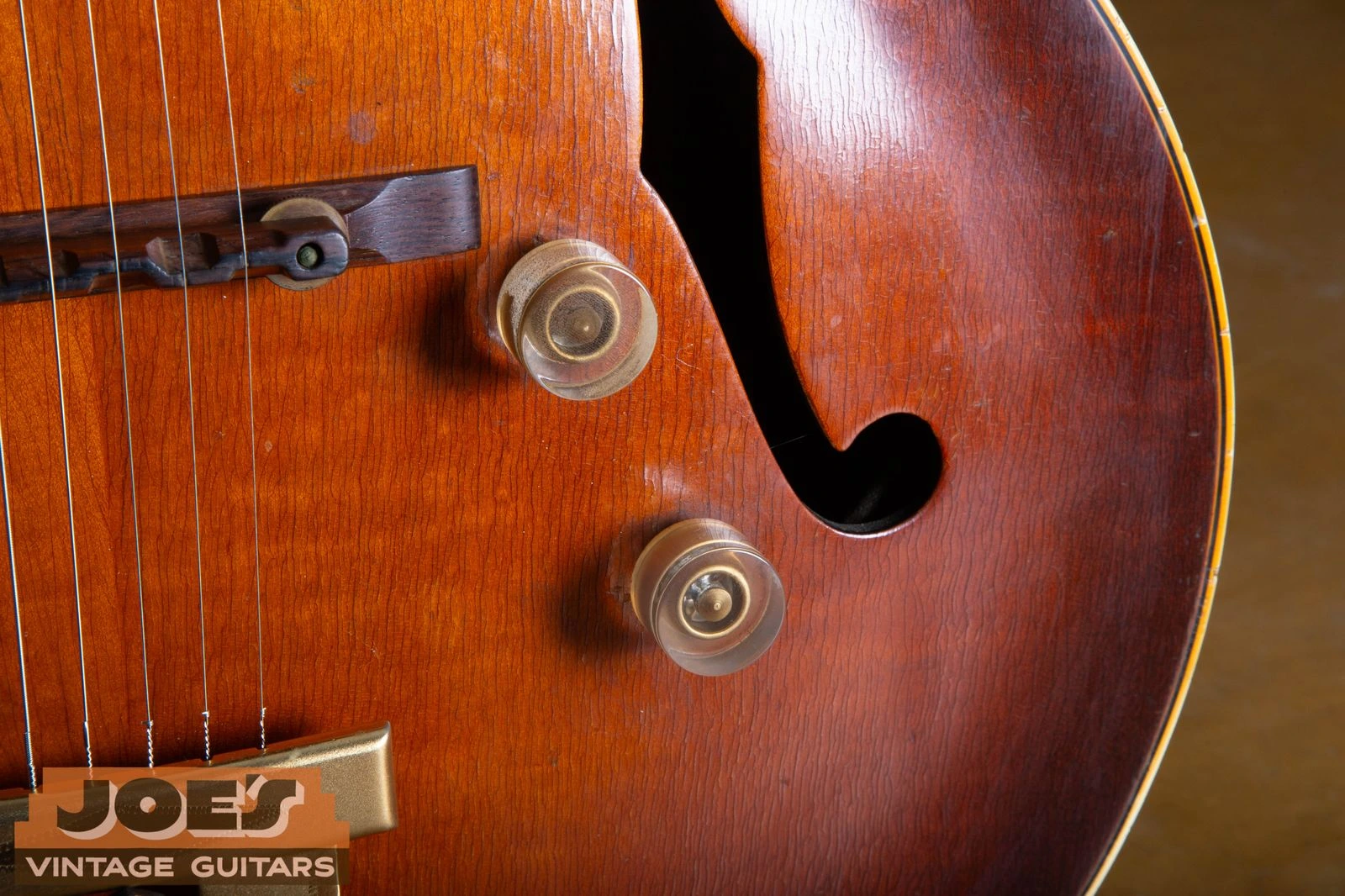
Enlarge photo1946 to early 1950: Tall Clear Unnumbered Barrel Knobs
Two tall clear barrel knobs without a printed number scale on a vintage Gibson archtop. The warm-colored guitar and hardware are visible through the plastic.
Style 02
1946 to early 1950
Tall Clear Unnumbered Barrel Knobs
Gibson used tall clear barrel knobs on early postwar electric guitars before adding the familiar numbered scale. Their straight, high sides separate them from the lower speed knobs that followed. Clear plastic can look smoky, cloudy or amber as it ages, but this photograph alone doesn’t establish how much the knobs have changed color.
Unnumbered Barrel Knob Clues
Tall clear body
No printed numbers
Straight barrel-shaped sides
Dating Limits For Clear Barrel Knobs
The change to numbered tall barrels happened around 1949 to 1950 and varied by model. Check the serial number, FON and other hardware before choosing between the neighboring ranges.
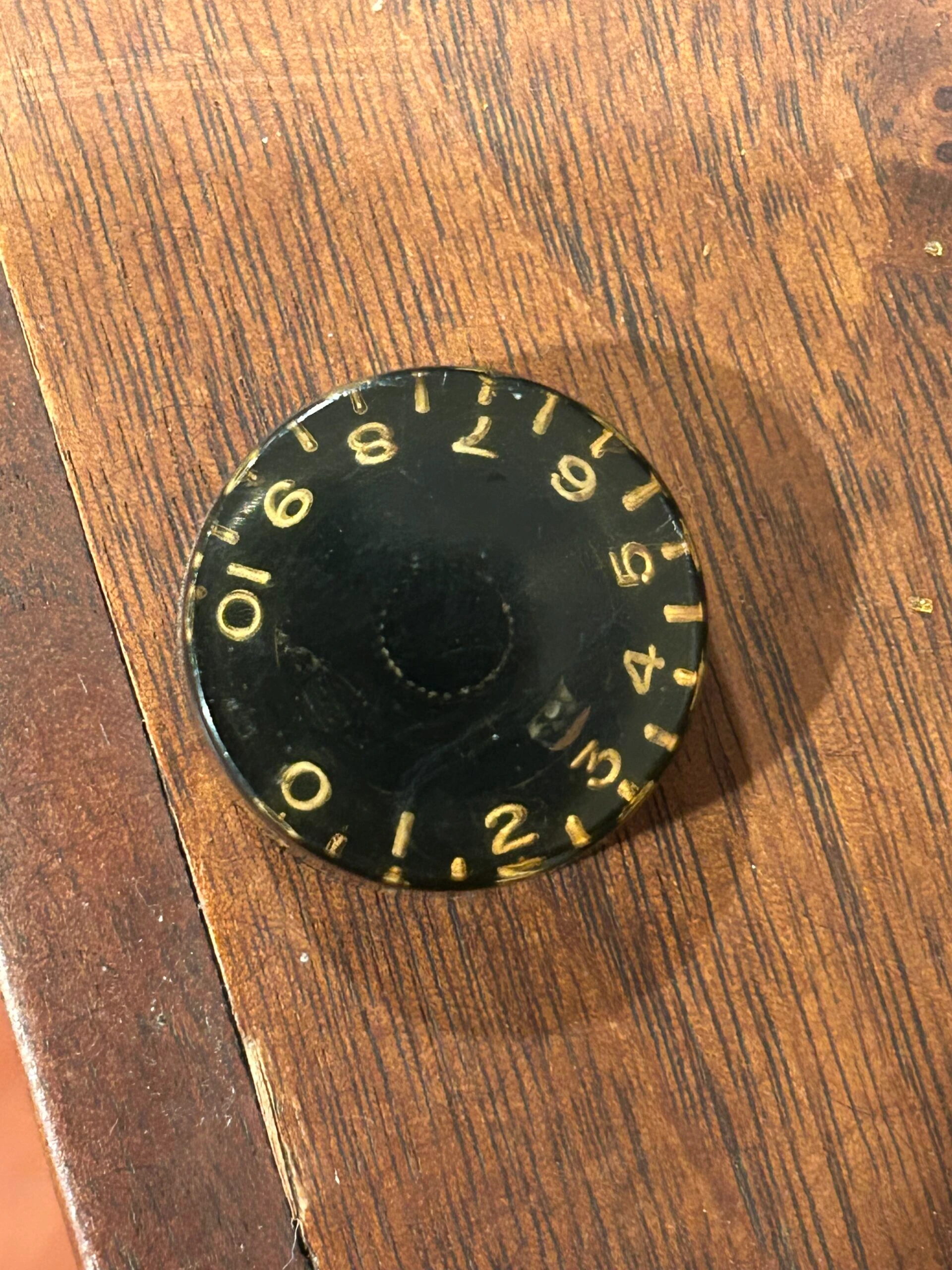
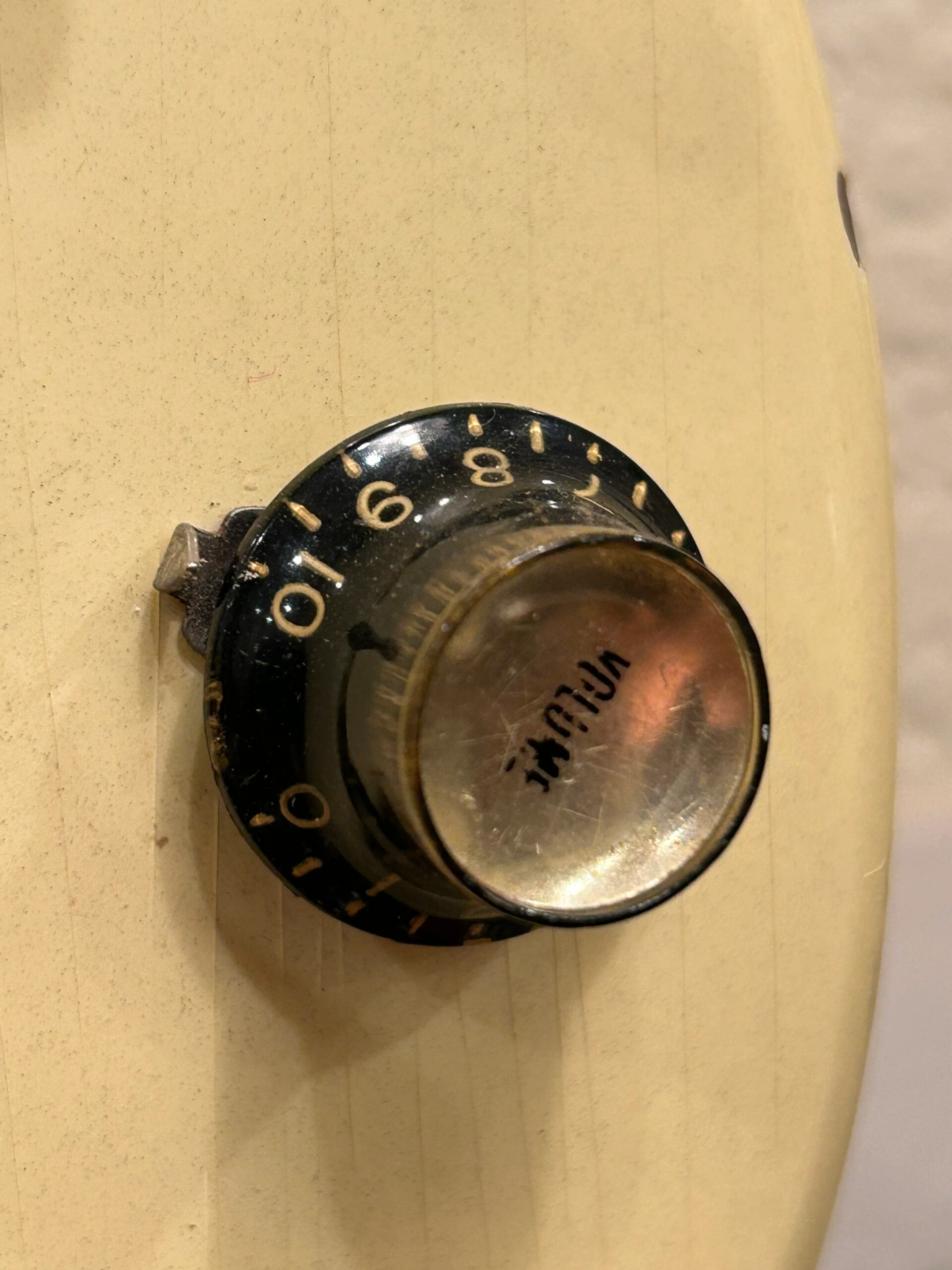
This top view shows the 0 to 10 scale on a black speed knob. It documents the face and lettering, not the knob’s height.
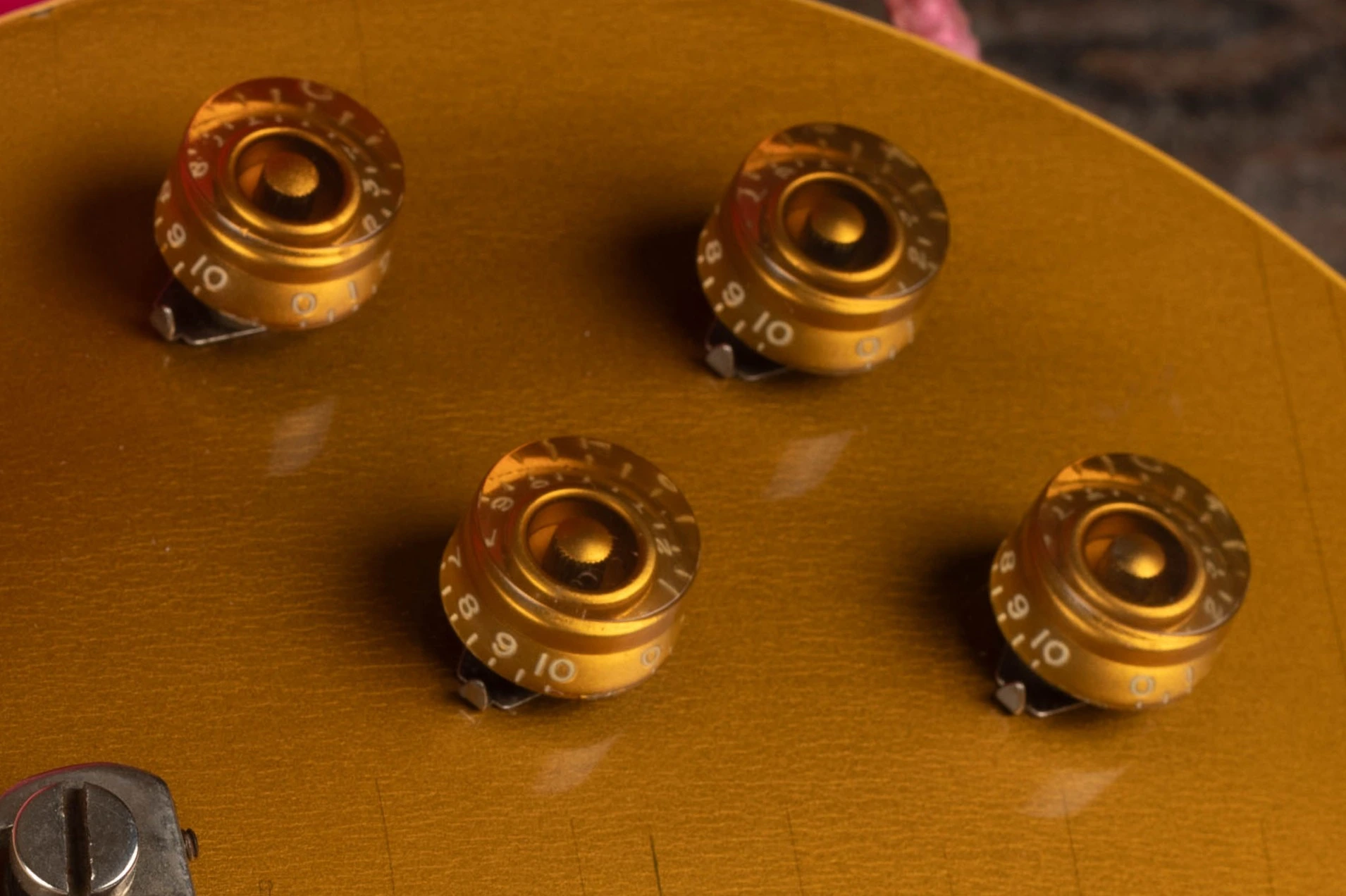
Enlarge photo1954 Gibson Les Paul Goldtop Speed Knobs
This angled view of a 1954 Les Paul Goldtop shows four low gold speed knobs with their 0 to 10 scales and pointer washers.
Style 03
About 1953 to 1955
Low Speed Knob
Collectors also call this straight-sided form a barrel knob, although speed knob is the clearer name for Gibson’s lower 1950s version. The first postwar barrels were generally unnumbered, followed by taller numbered versions around 1949 to 1952. The low speed form is most closely associated with about 1953 to 1955.
Low Speed Knob Clues
Short, low profile
Nearly straight sides
0 to 10 scale around the skirt
Dating Limits For Speed Knobs
The 1946 to 1955 period includes at least three related shapes, and speed knobs returned in the mid-1970s. Calling every straight-sided knob a 1950s speed knob hides useful dating information.
Enlarge photoMid-1955 to mid-1960: Bell, Bonnet Or Top-Hat Knob
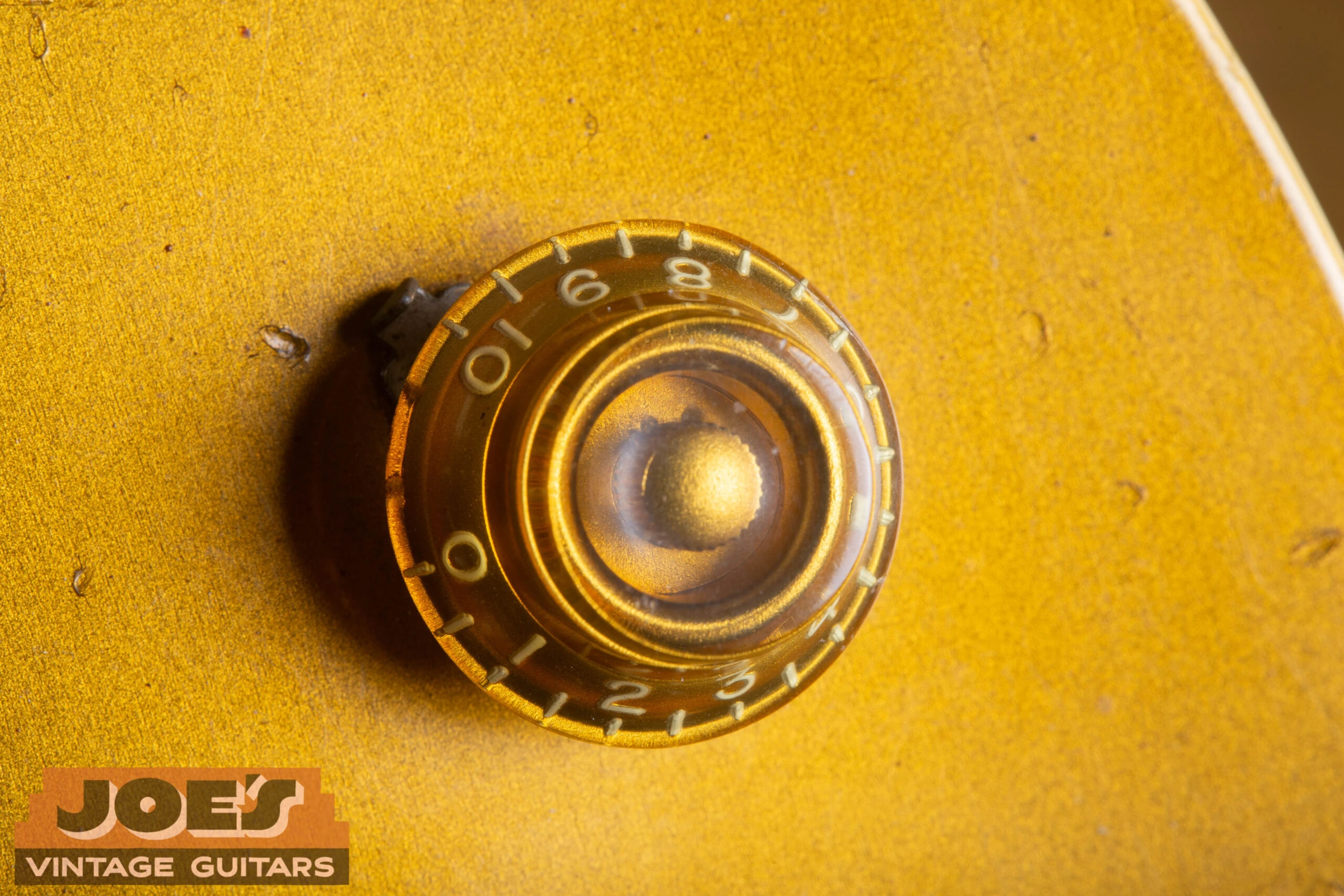
A gold bell or bonnet knob on a 1956 Gibson Les Paul Goldtop. The narrow upper body flares into a skirt at the base.
Style 04
Mid-1955 to mid-1960
Bell, Bonnet Or Top-Hat Knob
The non-reflector bell knob, also called a bonnet or top-hat knob, phased in model by model from mid-1955 through 1956. Gold versions are closely associated with late 1950s Goldtops and most Bursts. Black versions appear on the Les Paul Custom, TV Model, Special, double-cut Junior, 1958 to 1959 Flying V and many 1959 ES-355s.
Bonnet Knob Clues
Flared skirt at the base
No metal center insert
Gold or black back-painted plastic
Dating Limits For Bonnet Knobs
The 1955 to 1956 and 1960 changeovers were gradual. A transition-year guitar should be checked against its model, serial number, pot codes and other original parts.
Enlarge photoMid-1960 to the mid-1970s: Reflector Knob
A reflector knob keeps the bell-shaped skirt and adds a metal cap labeled Volume or Tone.
Style 05
Mid-1960 to the mid-1970s
Reflector Knob
Reflector knobs began appearing around the middle of 1960. They are common on 1960s SG and ES models and continued on selected instruments after witch hats arrived. Silver caps often appear with nickel or chrome hardware and gold caps often appear on gold-trimmed instruments, but that pattern is a tendency rather than a rule.
Reflector Knob Clues
Bell-shaped plastic body
Metal Volume or Tone insert
Silver or gold cap
Dating Limits For Reflector Knobs
Gold plating can wear until a cap looks silver, and cap color can follow a model’s finish or specification more closely than its hardware. Cap color alone doesn’t give a narrower production year.
Enlarge photoLate 1966 to the mid-1970s: Witch-Hat Knob
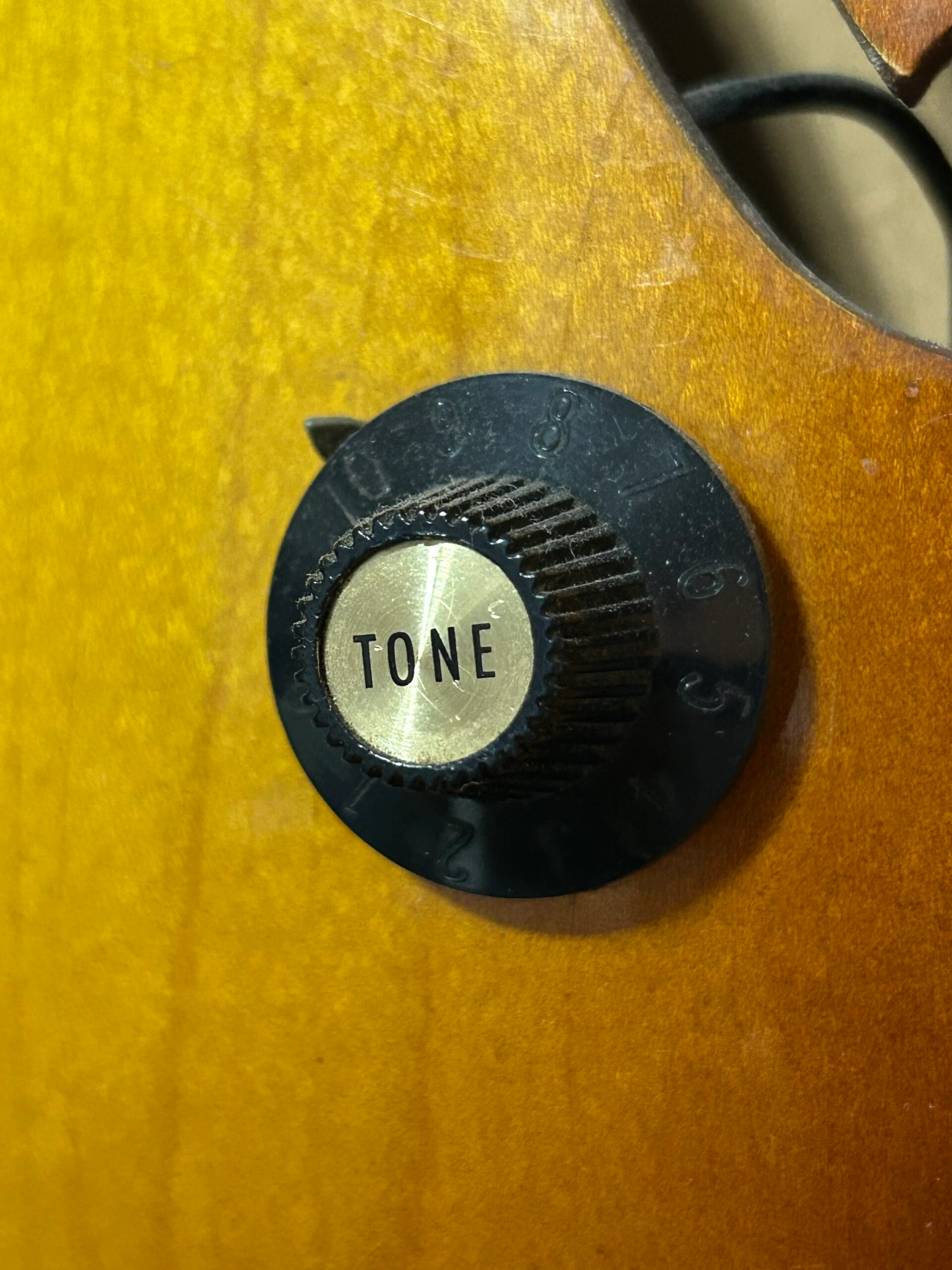
This witch-hat knob has a flat metal Tone cap, a ribbed tapered body and a flat numbered skirt.
Style 06
Late 1966 to the mid-1970s
Witch-Hat Knob
Witch-hat knobs began appearing on some ES models and SGs in late 1966. Many 1966 guitars still have reflectors, and 1967 is a mixed transition year. Period witch-hat caps commonly read VOL or TONE, while reflector caps commonly read VOLUME or TONE.
Witch-Hat Knob Clues
Flat labeled metal cap
Ribbed tapered body
Flat numbered skirt
Dating Limits For Witch-Hat Knobs
A witch hat supports a late 1966 or later date only if it’s original. The ES-335 retained this style through 1981, while other models changed sooner.
Why the Date Ranges Overlap
Match The Knob To The Gibson Model
Gibson did not update every model on the same day. A knob that is right for one 1968 model may be wrong for another, even when both guitars are original.
Les Paul Standard And Goldtop
Early 1950s examples moved from tall numbered barrels to low speed knobs, then to bonnets from mid-1955 into 1956. Most 1958 to mid-1960 Bursts have gold bonnets. Reflectors appear on late 1960 Bursts, roughly around serial 0 7000.
Les Paul Custom And Other Black Bonnets
Black bonnets appear on the 1950s Les Paul Custom, TV Model, Special, double-cut Junior and 1958 to 1959 Flying V. Many 1959 ES-355s also use them. Later Customs do not always follow Standard practice.
ES-335, ES-345 And ES-355
These models generally begin with bonnets and change to reflectors around mid-1960. Late 1966 and 1967 are mixed transition years for witch hats. The ES-335 retained witch hats through 1981 rather than returning to reflectors.
SG, Firebird And Other Models
Some SGs began receiving witch hats during 1966. Reflectors, witch hats and returning speed styles then varied by model and trim level, so use a model-specific guide before treating one knob style as original.
Inspect Before You Trust the Date
How To Check An Original Gibson Knob
1
Compare the exact profile. Height, skirt flare, edge shape, center dome and the presence of pointer washers matter more than a seller’s name for the style.
2
Study the lettering. Check the font, number spacing, paint placement and the wording on a reflector cap.
3
Look underneath. The shaft hole depth, molding marks, fit on the original pot shaft and pointer washer can separate otherwise similar versions.
4
Judge wear as a set. Natural fading, grime and small cracks should agree across the knobs, pointers and guitar, but artificial aging can imitate each clue.
When A Reflector Looks Like A Bonnet
A reflector cap can fall off or be removed. Some altered reflectors have had the recessed top filled and smoothed, which can make them resemble bonnets. Check the top for a filled circular recess before treating the knob as a non-reflector style.
Use Aging As Support, Not Proof
Gold paint on the underside of a clear knob can oxidize toward green, but that is supporting evidence, not proof of age or originality. Compare the aging across the whole set and the pointer washers.
What Not To Do
Don’t burn, pierce or heat a vintage knob to identify its material. Don’t force a tight knob off the shaft with a screwdriver against the guitar top. If removal is necessary, protect the finish and use a proper knob puller or ask an experienced repair technician.
A replacement knob isn’t automatically a problem. It only means the knob shouldn’t be used as dating evidence. The pot codes and untouched solder joints can carry far more information.
No. A correct original knob can support an era, but factory transitions overlapped and knobs are easy to replace. Confirm the estimate with the serial number, FON, pot codes and model features.
What Is The Difference Between A Bell Knob And A Bonnet Knob?
Collectors use both names for the same general flared 1950s shape. A reflector knob uses a similar body but adds a metal Volume or Tone insert.
Are All Prewar Gibson Knobs Bakelite?
“Bakelite” is often used loosely for several early molded knobs. Do not identify the exact material from color or a photograph alone, and never burn or pierce an original knob to test it.
Did Witch-Hat Knobs Replace Reflectors In 1967?
Not all at once. Witch hats began appearing on some models in late 1966, while reflector knobs continued on other models into the 1970s.
How Can I Tell If A Gibson Knob Is Original?
Compare the exact profile, lettering, molding, shaft fit and natural wear with a known original from the same model and period. No single surface clue proves originality because modern reproductions can be convincing.