
Dots or Small Blocks
ES-335
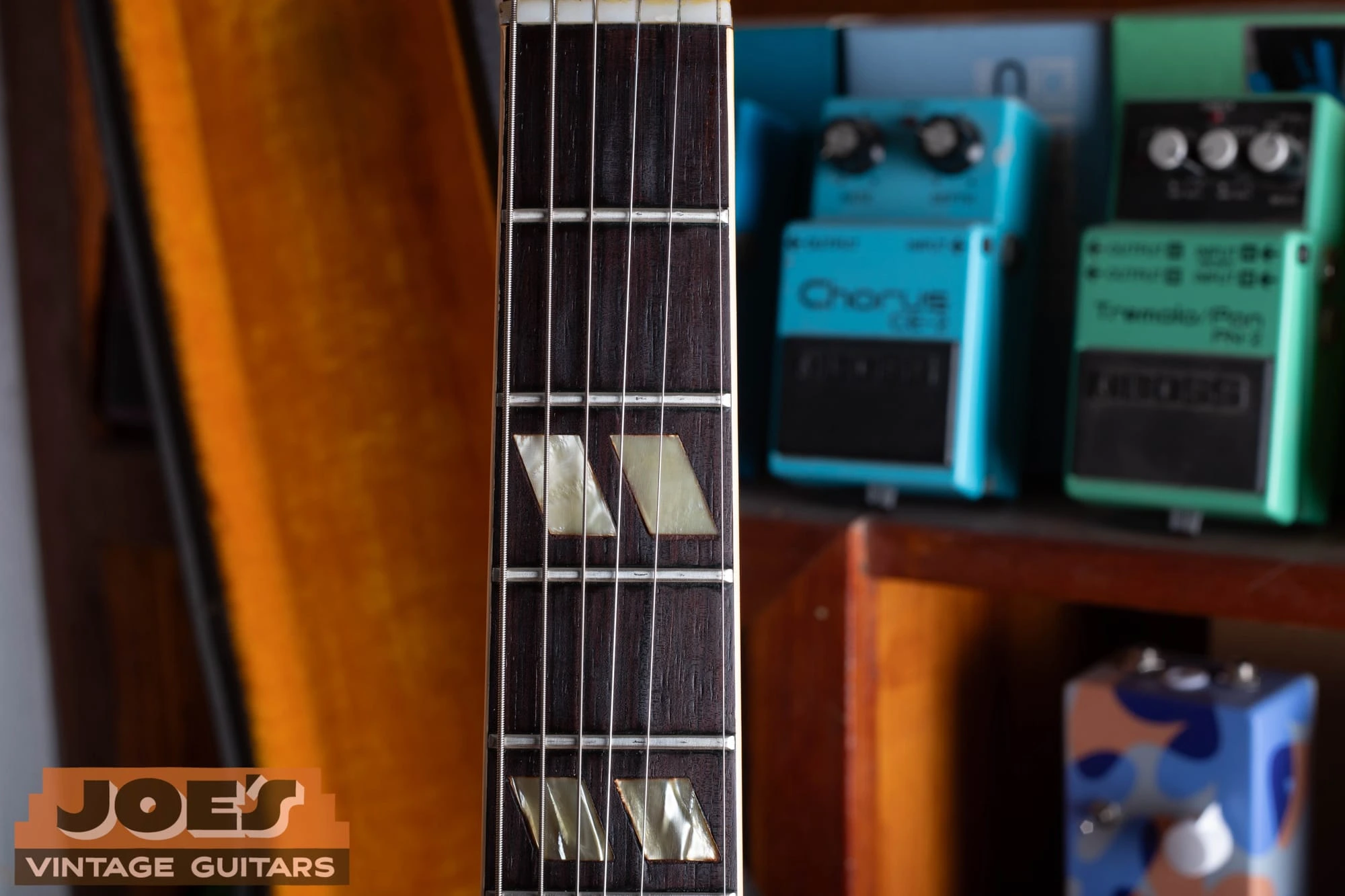
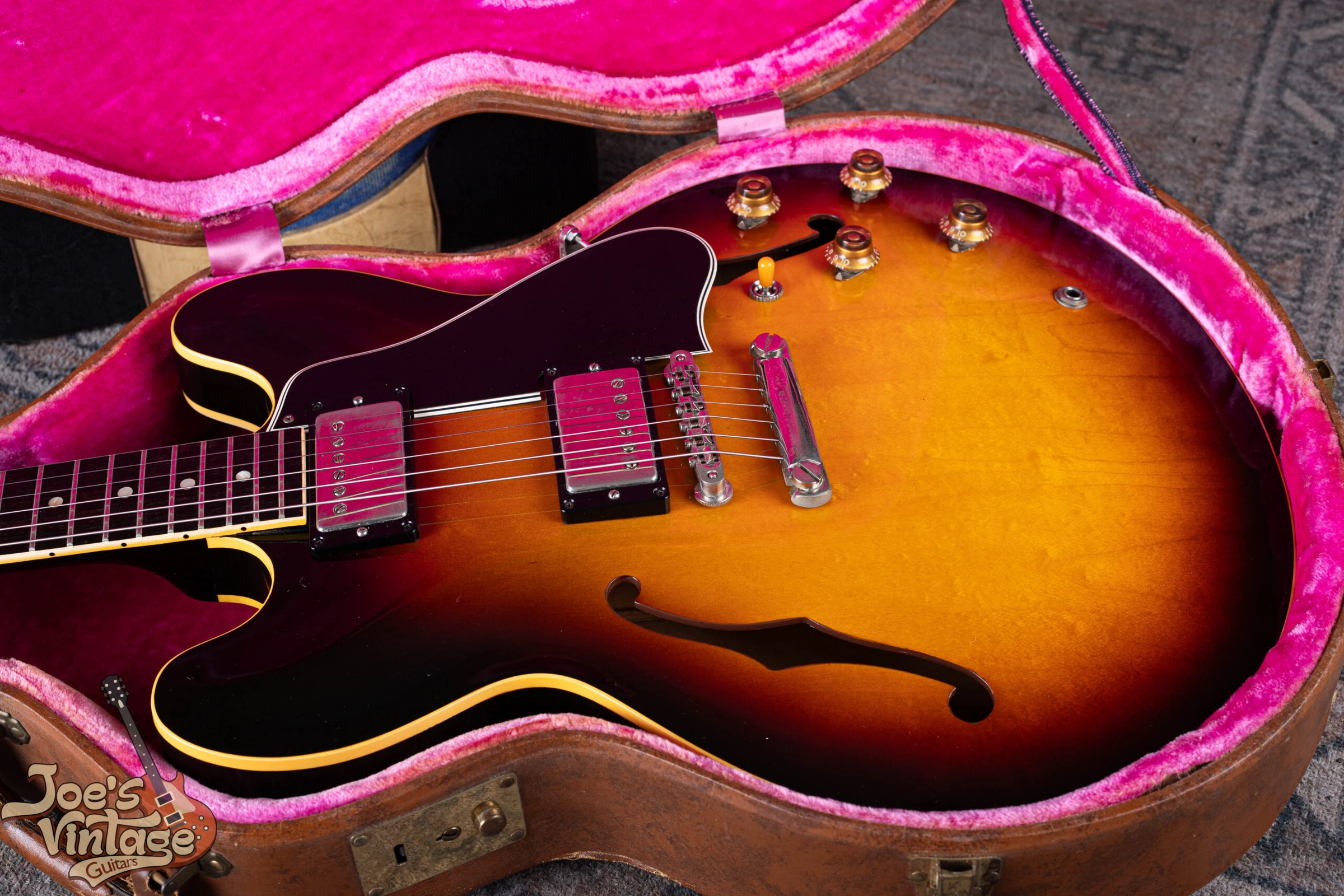
Rosewood fingerboard, dots on early examples and small blocks from 1962. Usually nickel or chrome hardware, four knobs and no Varitone.
See This Model’s ChangesGibson Model Dating Guides
Find the year of your Gibson semi-hollow by following the changes for its model, from inlays and pickups to necks, tailpieces and wiring.
Three Models, Different Clues
The ES-335, ES-345 and ES-355 share a semi-hollow body with a center block, but they don’t share every dating rule. Blocks mean something different on a 335 than on a 355, and gold hardware changes how you read the pickups.
Identify the Family
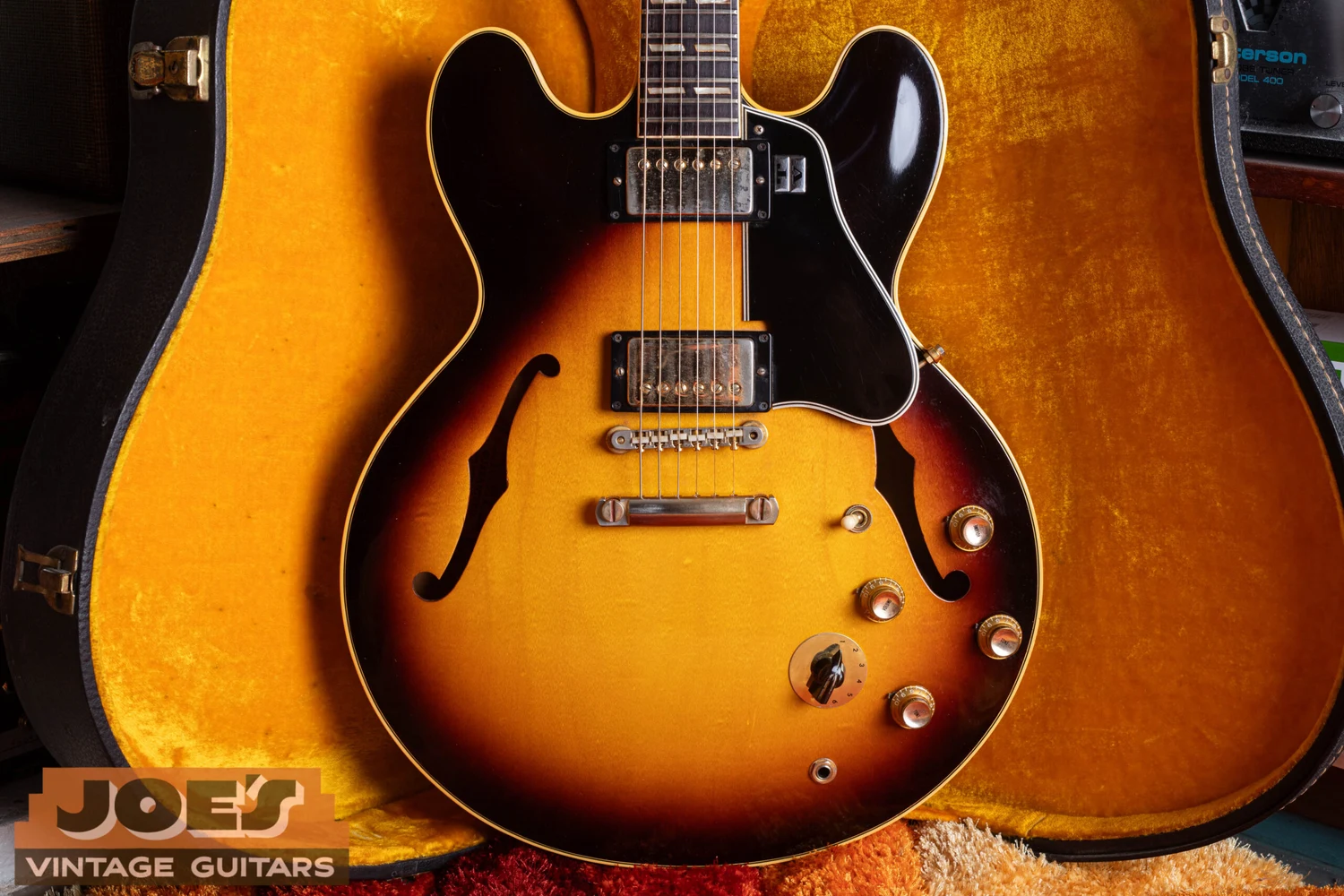
These photos represent the three families. Use the inlays, trim and controls together; a changed tailpiece doesn’t change the model.
Dots or Small Blocks
Rosewood fingerboard, dots on early examples and small blocks from 1962. Usually nickel or chrome hardware, four knobs and no Varitone.
See This Model’s Changes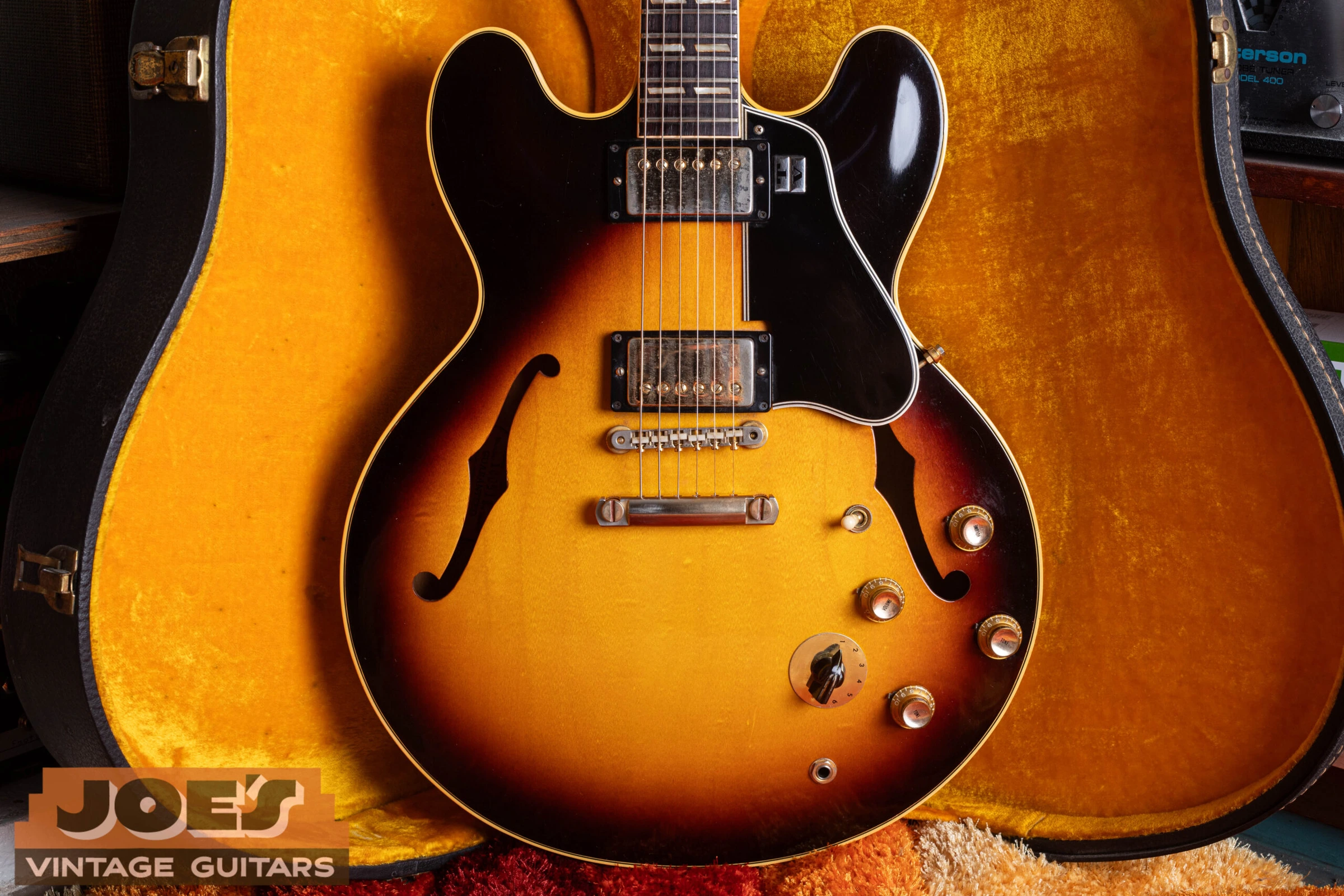
Split-Parallelogram Inlays
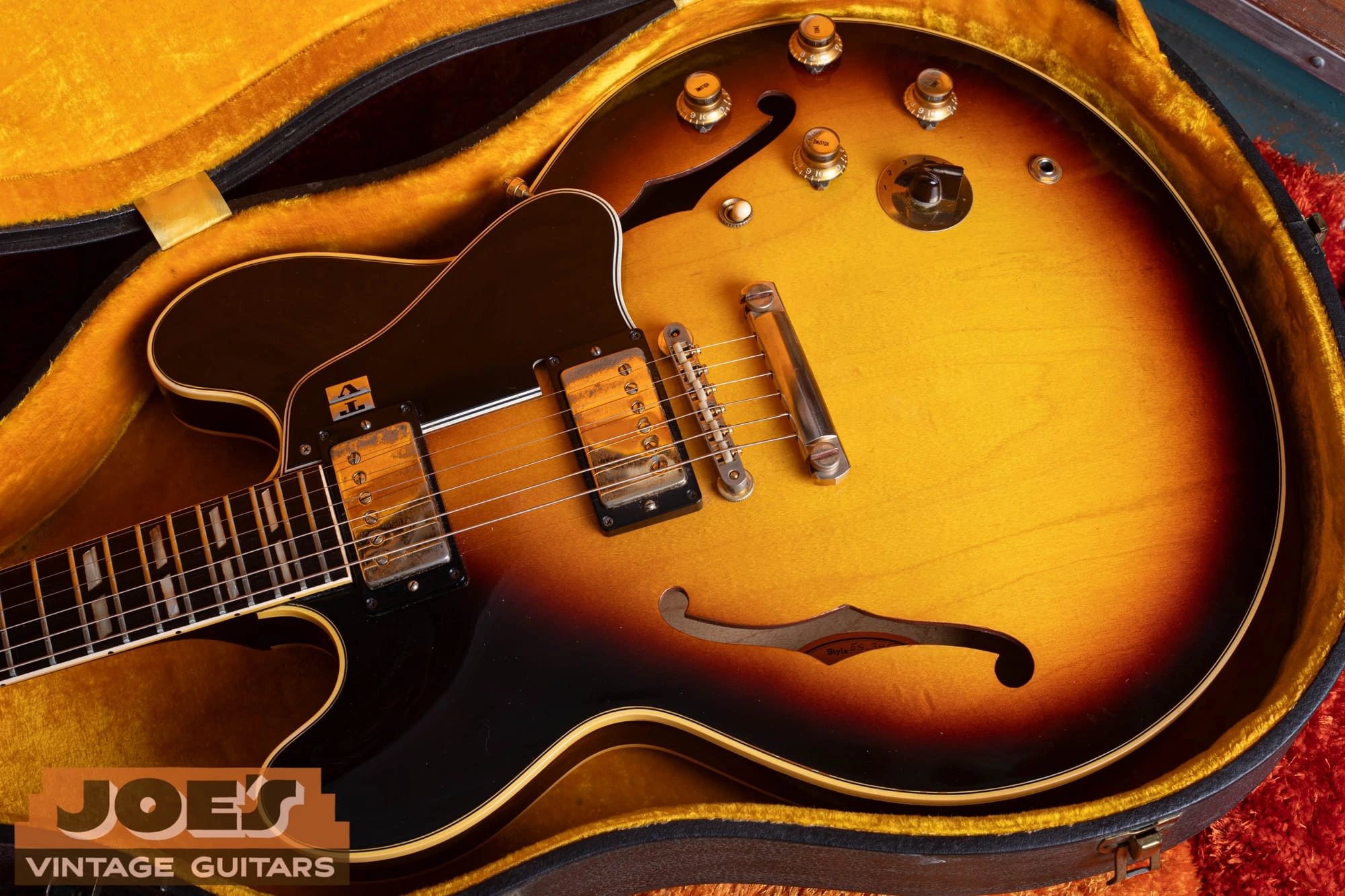
Rosewood fingerboard, split-parallelogram inlays and gold hardware. The vintage model pairs a six-position Varitone with stereo wiring.
See This Model’s Changes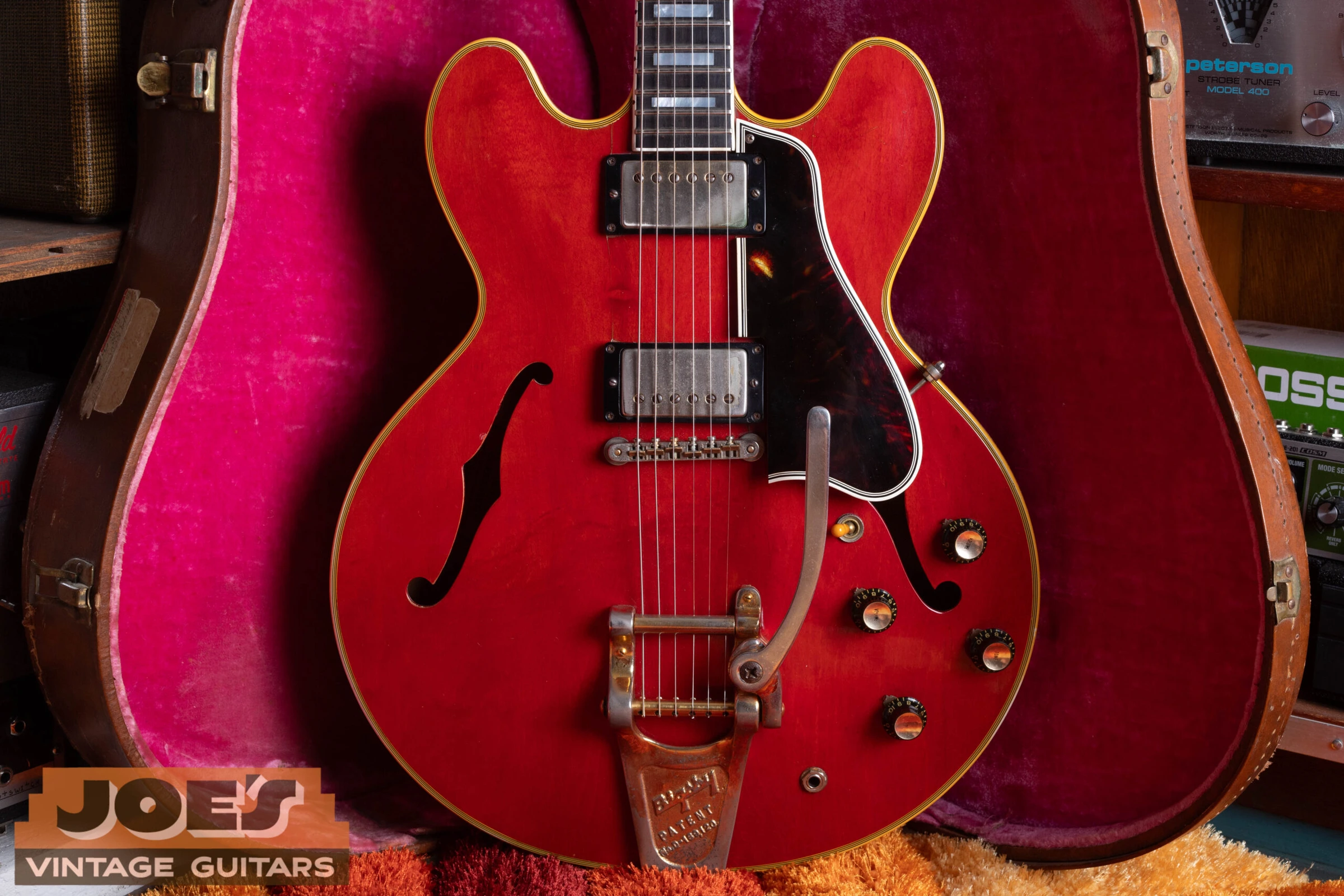
Ebony and Pearl Blocks
Ebony fingerboard, large pearl blocks, split-diamond headstock and elaborate binding. Factory mono and stereo Varitone versions both exist.
See This Model’s ChangesFor a side-by-side identification comparison, see ES-335 vs. ES-345 vs. ES-355.
Quick Reference
These are production windows, not exact cutoffs. Gibson used up parts during transitions, and replacement parts or reissues can repeat an earlier appearance.
| Period | ES-335 | ES-345 | ES-355 |
|---|---|---|---|
| 1958 to 1961 | Dot inlays; long guard on the earliest examples; PAFs and usually a stopbar or Bigsby. | Introduced in 1959 with split-parallelograms, gold hardware and stereo Varitone. | Introduced in late 1958 with ebony, large blocks and gold hardware. Stereo Varitone joins the mono version in 1959. |
| 1962 to 1964 | Dots change to small blocks during 1962. Short guard, ABR-1 and stopbar remain familiar clues. | Split-parallelograms continue. Gold PAF stock can overlap later Patent Number pickups. | Large pearl blocks continue. Check mono or stereo wiring and the original vibrato arrangement. |
| 1965 to 1968 | Trapeze becomes the usual non-vibrato tailpiece around 1965. Narrower nuts and chrome appear during the transition. | Gold plating remains. Check nut width, tailpiece, pickup construction and original harness. | Gold plating and deluxe trim remain. Nut width and vibrato need to agree with the serial and pots. |
| Late 1960s Through the 1970s | Watch for laminated necks, a volute, Made in USA and later pickup construction. | Use the neck, serial and pots to narrow the year; inlays and Varitone alone span decades. | Construction and serial formats change while the recognizable trim continues. Gibson introduces the separate Lucille model in 1980. |
| Later Production and Reissues | Dots, blocks and stopbars recur on later guitars. Vintage styling doesn’t establish a vintage date. | Modern versions can have mono wiring or omit the Varitone. Identify the exact version. | Historic styling, Bigsbys and Maestros also appear on modern instruments. Check the actual build year. |
Model-by-Model Dating
The ES-335 starts in 1958 with two humbuckers, a rosewood fingerboard and simple trim. Its dot-to-block change and stopbar-to-trapeze change are useful dating clues, but neither gives an exact year by itself.
1958 to 1961
Early ES-335s have dot inlays and rounded cutaways, although the first 1958 body shape is a little narrower than the full “Mickey Mouse ear” outline that follows. Rounded horns dominate from later 1958 into 1963. The long pickguard extends below the bridge; the short guard begins appearing very late in 1960 and becomes established during 1961. Nickel hardware, PAF humbuckers and an ABR-1 with a stopbar are familiar features, with Bigsby-equipped examples also found.
The 1958 and 1959 necks are generally fuller than the slim profiles that develop during 1960 and 1961. Neck depth varies between instruments. Very early 1958 guitars can have a shallow neck angle and a low-profile ABR-1. Many of those bridges later bent or were replaced, so bridge height isn't a one-year test.
Early ES-335 Dating Clue: A long guard, dots and a rounded body support an early date when the serial, FON and other original parts agree. Dots alone also fit later reissues.

The round horn and dot-inlay board belong to the early ES-335 appearance. Later reproductions can copy both.
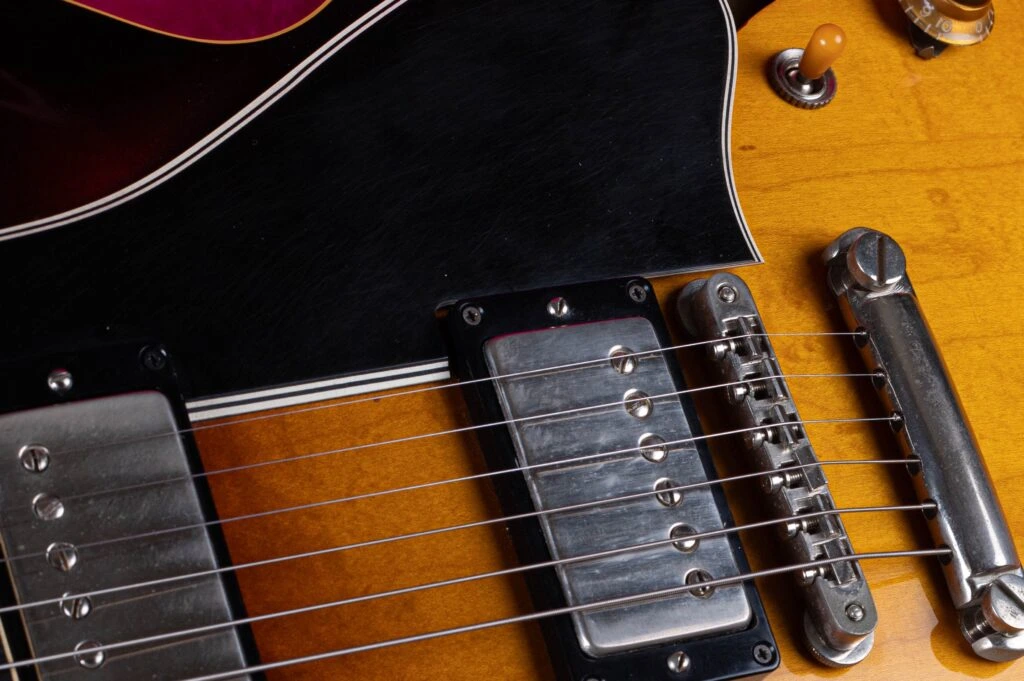
Follow the pickguard’s lower edge beside the bridge pickup. On this 1959 example it extends farther toward the bridge than the shorter guard below.
The ABR-1 bridge supports the strings; the separate stopbar anchors them. The amber bonnet knobs have no metal reflector inserts.
See the 1959 ES-335 authentication guide for more close-ups of this guitar.
1962 to 1964
Small rectangular blocks replace the dots during 1962. Early 1962 dot-neck examples and later block-neck examples both exist. The shorter guard, nickel hardware and stopbar remain characteristic of this period. White nylon saddles appear during 1962 on the earlier no-wire ABR-1. The retaining-wire bridge appears in early 1963, with possible very late 1962 overlap. Bridges and saddles are easy to replace, so inspect the whole assembly.
PAF and Patent Number pickups overlap in the early 1960s. A 1962 can have PAFs, and a transitional guitar can contain different decals. Neck profiles also evolve, with many 1964 examples fuller than the slim early-1960s necks. New body forms during 1963 bring a sharper horn outline, although leftover bodies can create later exceptions.
1962 to 1964 ES-335 Dating Clue: Small blocks place an original vintage guitar in the 1962-or-later group. They don't distinguish 1962 from 1964, or an old guitar from a modern block-neck reissue.
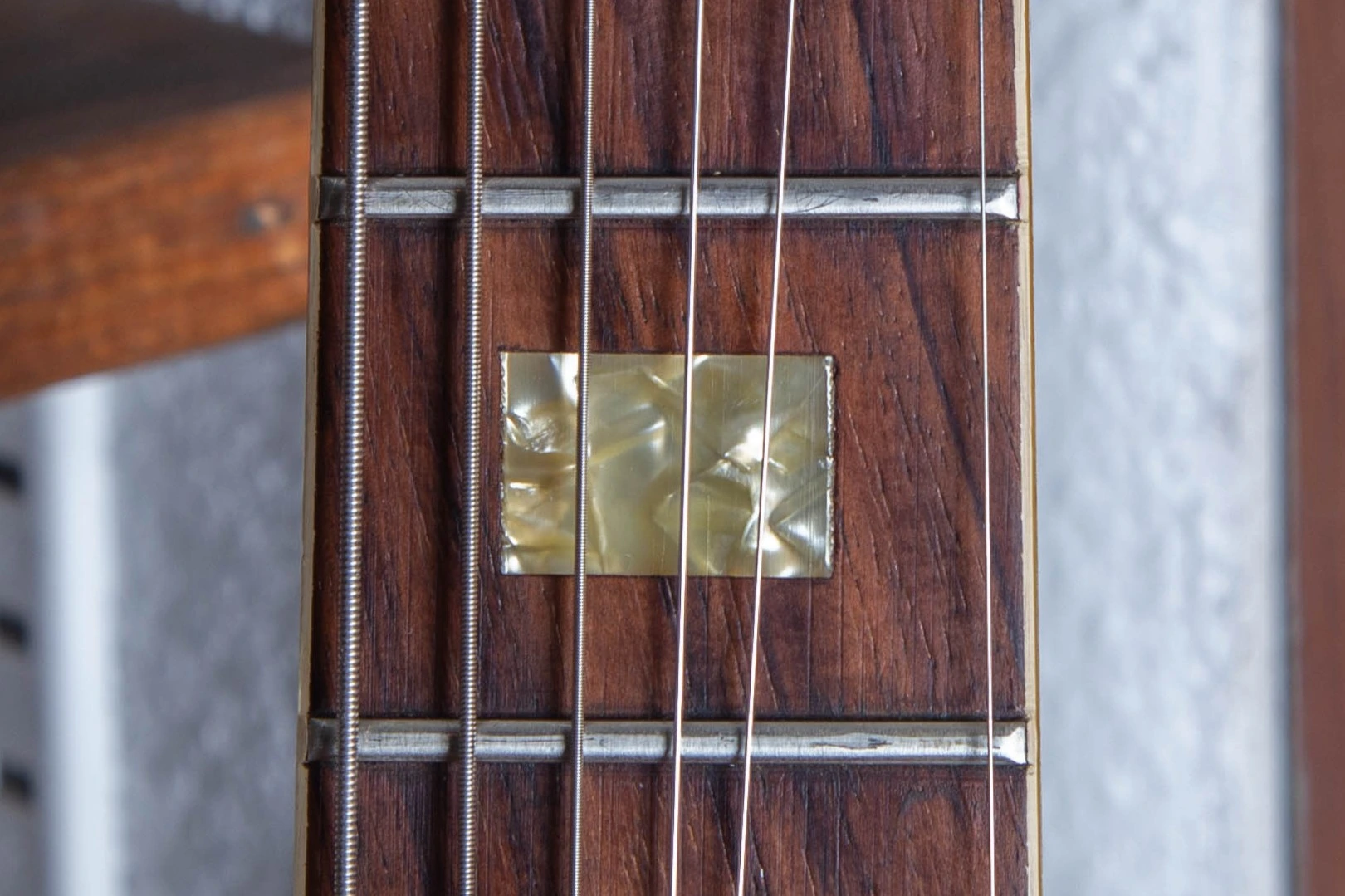
This is the small block used on the ES-335, not the larger pearl blocks and ebony board of the ES-355.
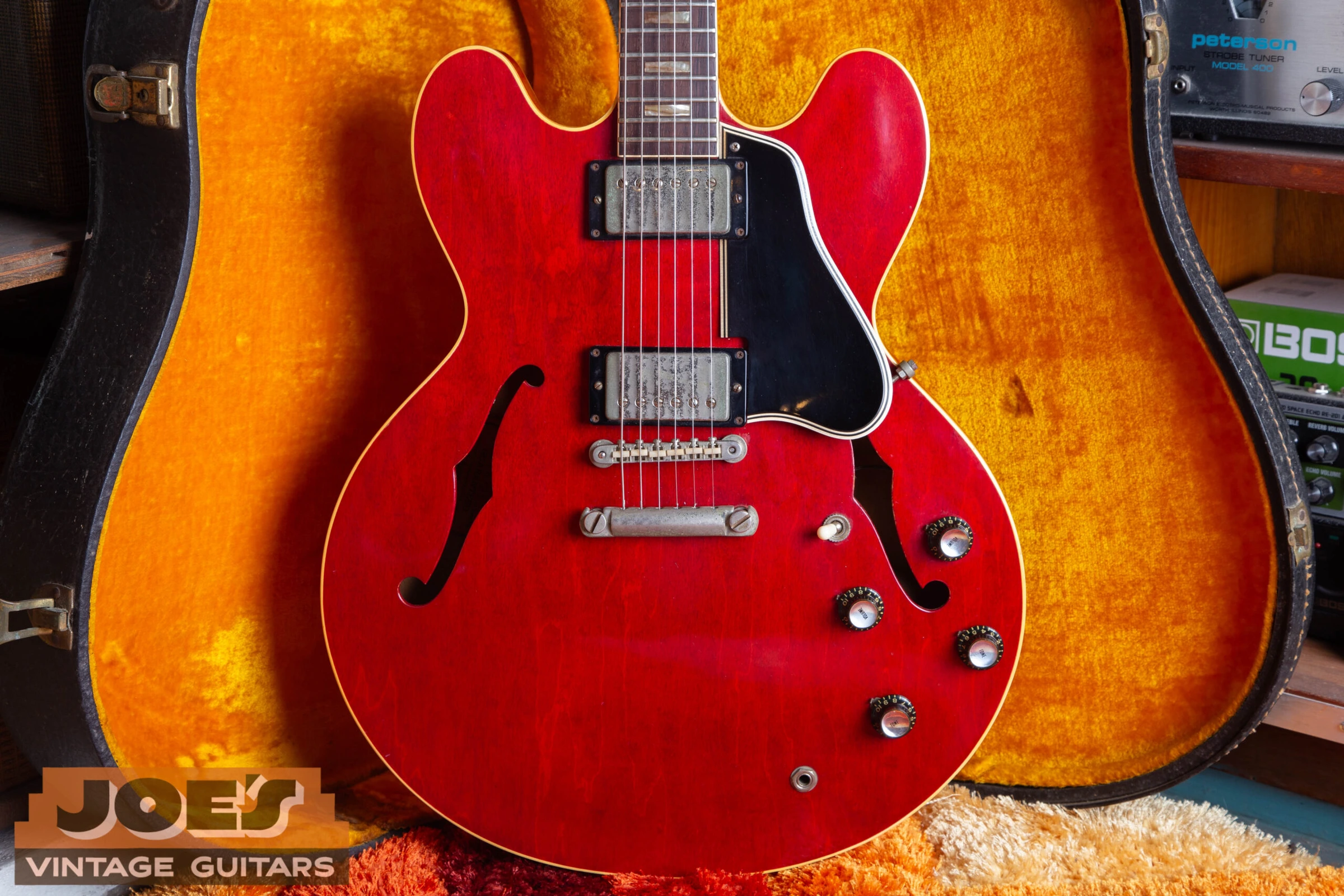
This 1962 example combines small blocks, the short guard, a stopbar and black reflector knobs. Its no-wire ABR-1 has white nylon saddles, the bridge combination expected before the retaining wire becomes normal in 1963.
Compare the 1962 ES-335 guide and the PAF and Patent Number pickup guide. Keep original pickup covers soldered shut.
1965 to 1968
Around 1965, the trapeze becomes the usual non-vibrato tailpiece and nickel gives way to chrome. The nut is generally about 1 11/16 inches through early 1965, about 1 5/8 inches during the transition, then about 1 9/16 inches from mid-1965 onward. Published 1968 specifications sometimes list a wider nut, but many observed guitars retain the narrow width. Measure the guitar instead of assuming a 1968 reset.
Bigsby and other factory vibrato configurations complicate a simple stopbar-versus-trapeze rule. The short Maestro shown here is an unusual 1965 example. Inspect mounting holes, finish shadows and wiring before calling a different tailpiece a modification.
Later-1960s ES-335 Dating Clue: A narrow nut, small blocks and a trapeze fit the later 1960s, but an added stopbar doesn't make that guitar a pre-1965 model.
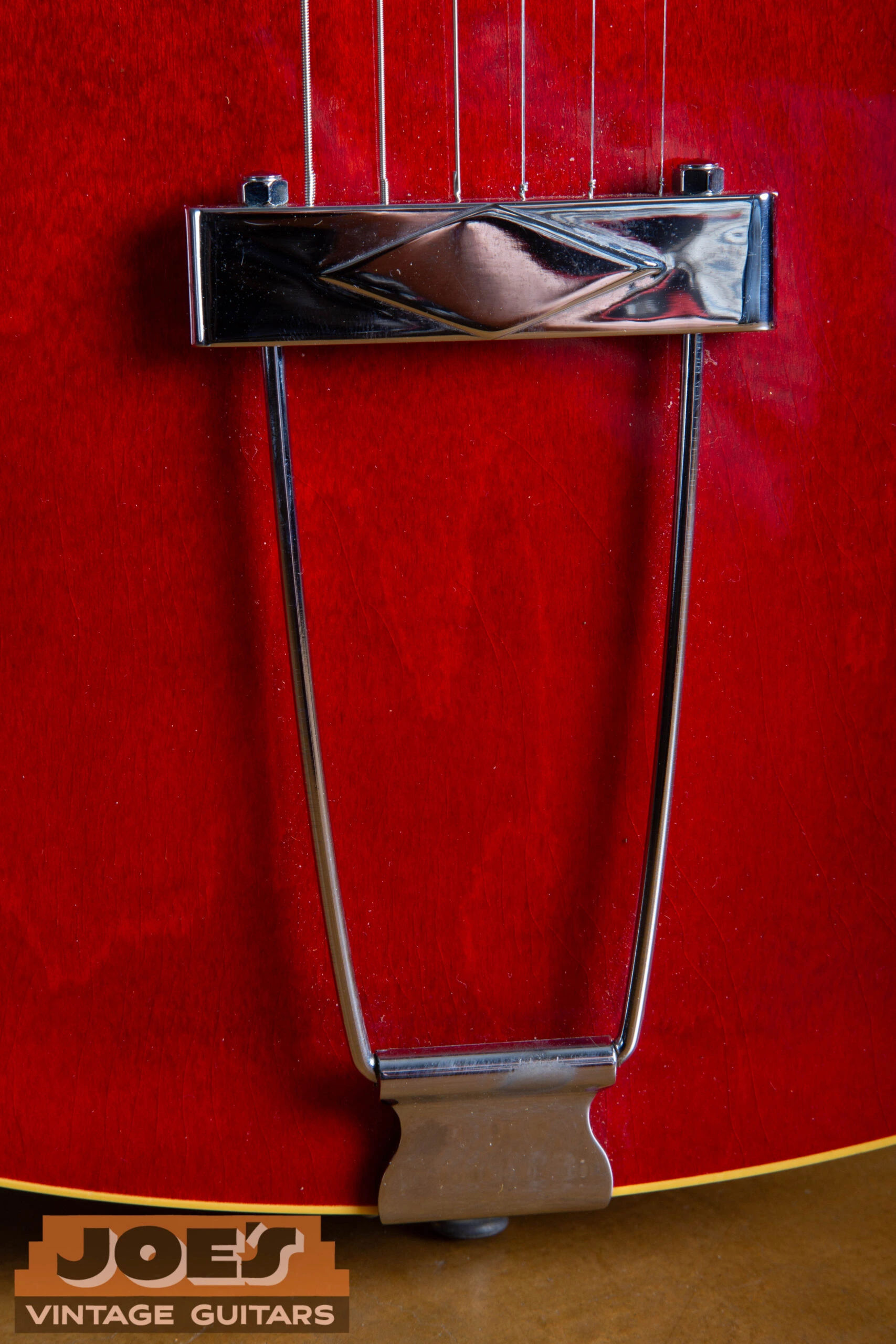
The trapeze anchors at the body’s end instead of using two stopbar studs in the top. This example is from the 1966 ES-335 guide.
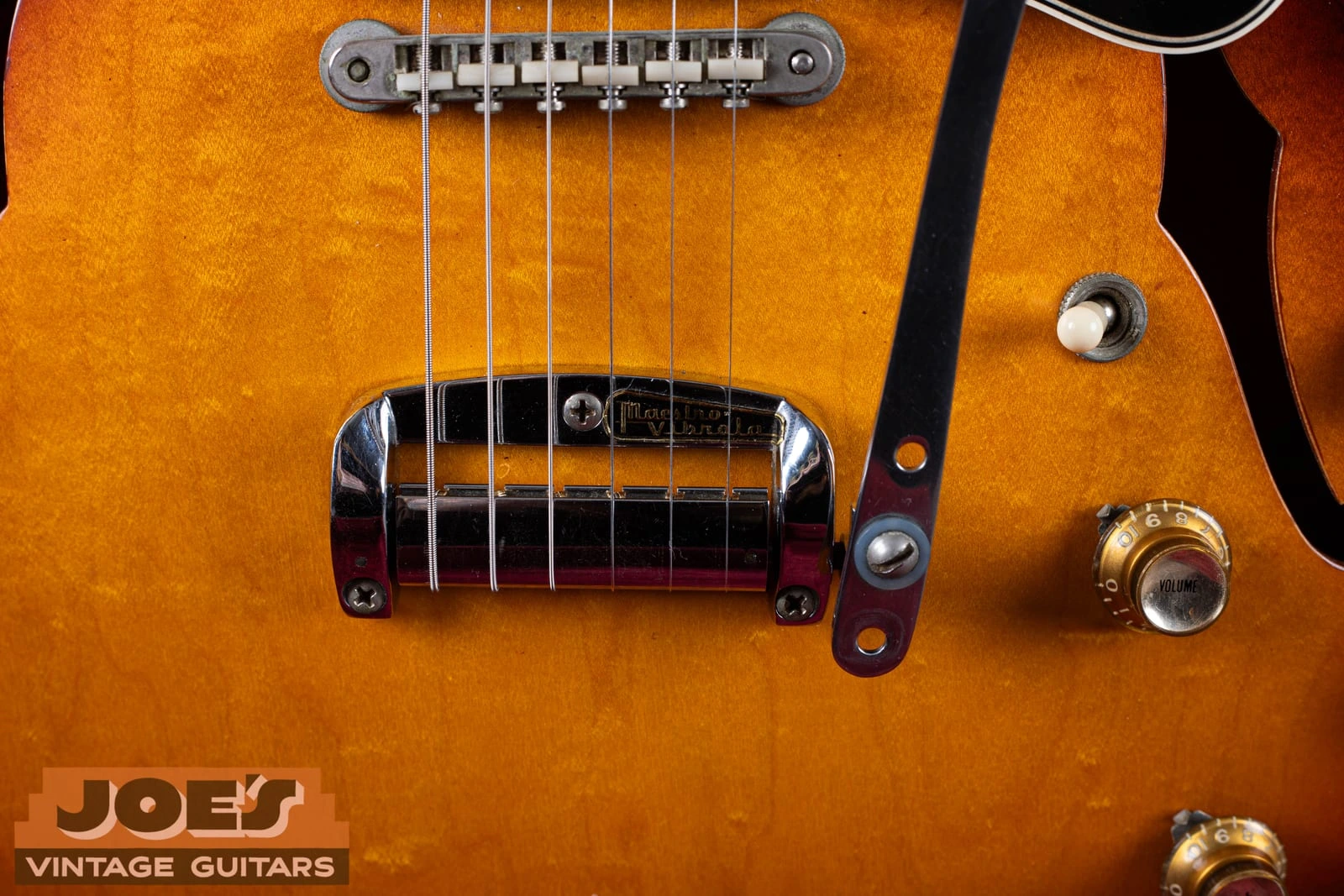
This 1965 ES-335 shows why the normal production pattern needs room for documented factory exceptions. The short unit has no long Lyre cover.
Witch-hat knobs begin appearing in late 1966 and are found on nearly all 1967 examples. Double-line Kluson housings and double-ring buttons are useful later-1960s comparisons. Patent Number pickups can include T-Top construction, but the decal alone doesn't reveal the bobbins under a sealed cover.
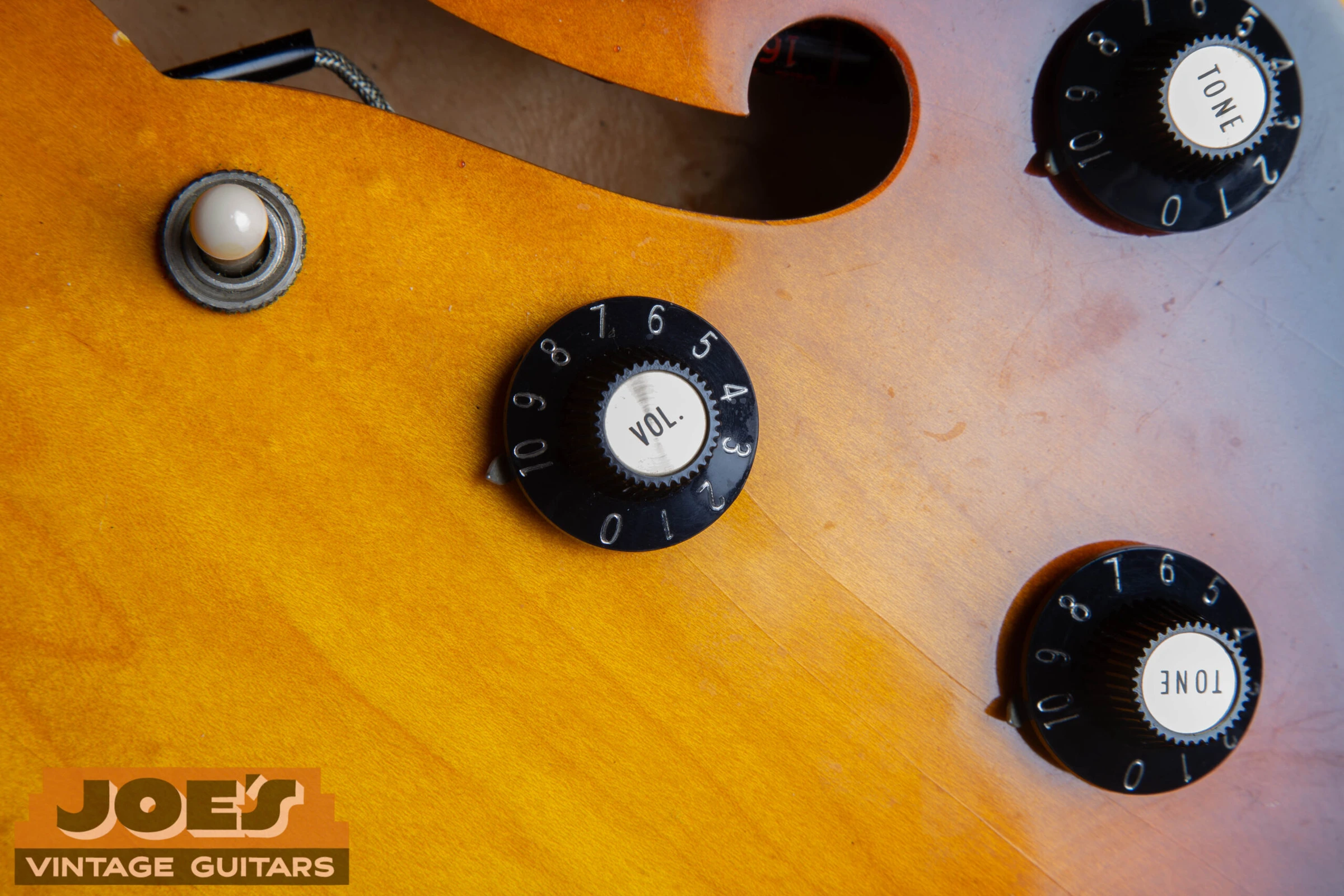
The overhead view clearly shows the ribbed cone and wide numbered skirt of the witch-hat profile. Lighting and wear can make a metal insert look gold or silver, so this photo can't establish its original color.
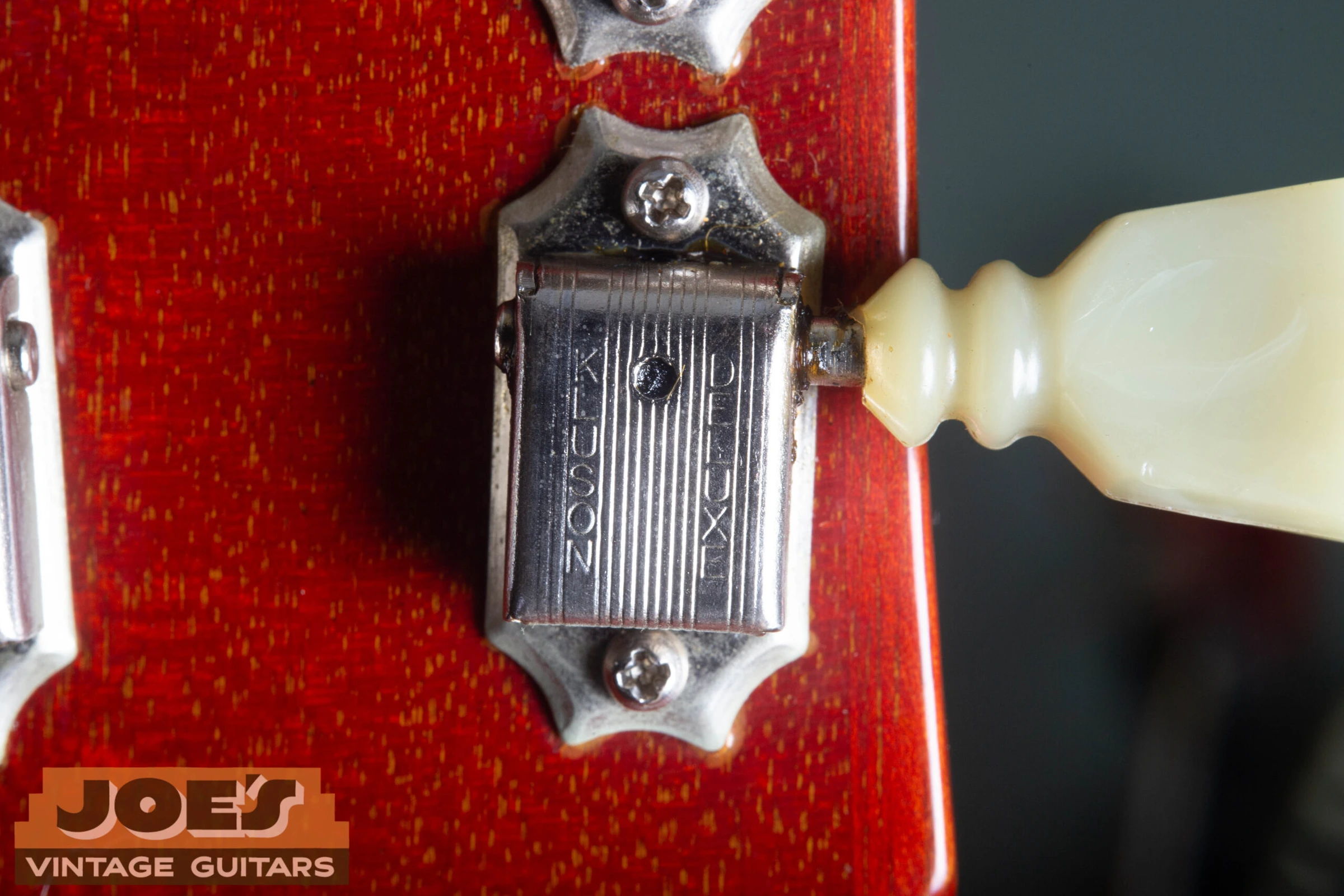
Read the housing stamp, button rings and mounting footprint together. These are the double-line, double-ring Klusons expected on an ES-335 from late 1964 through 1968.
Read the 1965 short Maestro example, 1966 ES-335 authentication guide and 1968 ES-335 guide for individual instruments.
Late 1960s Through the 1970s
Laminated neck construction, a volute behind the nut and the Made in USA stamp become useful clues around the turn of the decade. They don’t all arrive on the same day. Later 1970s guitars can have maple necks and different pickup and switching arrangements.
1970s ES-335 Dating Clue: A block-neck guitar can belong to several decades. Check the actual neck construction and serial format; don't date it solely from the lack of dots. ES-335 Pro and other named variants need their own factory specifications.
The Dot reissue appears in 1981, bringing the earlier dot-and-stopbar look back. Later Dot, Studio, Satin, figured-top and Historic versions can’t be dated by the vintage feature chart alone. See serial numbers and reissues below.
Model-by-Model Dating
The ES-345 arrives in 1959 with split-parallelogram inlays, a rosewood fingerboard, a crown headstock inlay and gold hardware. Its vintage stereo Varitone circuit is a separate clue from its age. A converted 345 remains a 345.
1959 to 1961
Early examples combine rounded horns, gold-covered PAFs and usually a stopbar or a factory vibrato. Long guards give way to shorter guards in the late-1960 transition, and the fuller 1959 neck generally becomes slimmer during the early 1960s. Gold reflector knobs replace bonnet knobs around 1960 on sunburst examples; cherry examples normally use black reflectors with gold inserts. Knobs are easy to replace, so color is supporting evidence only.
Early ES-345 Dating Clue: Split-parallelogram inlays identify the model, not the year. Unlike the 335, the vintage 345 has no dot-to-block transition to use as a date marker.
1962 to 1964
The split-parallelograms and gold hardware continue while the neck profile, guard and body contours evolve. Gold-covered PAF stock can remain in use later on ES-345s than nickel-covered stock on ES-335s. A gold PAF on an early-to-mid-1960s 345 is therefore not an automatic contradiction.
PAF-Era ES-345 Dating Clue: Don't assign a 1950s date simply because a pickup has a PAF decal. Check both pickups, the original harness, serial and construction before narrowing the year.
Use the PAF and Patent Number guide for pickup identification. Wear through the gold can expose the nickel underplate over the nickel-silver base; that alone doesn't prove a chrome replacement.
1965 Through the 1970s
The narrower-nut transition around 1965 applies here too. A trapeze becomes the usual non-vibrato tailpiece around this period, while Bigsby-equipped guitars remain part of the model’s history. The ES-335’s nickel-to-chrome change is not a dating rule for a vintage gold-plated ES-345.
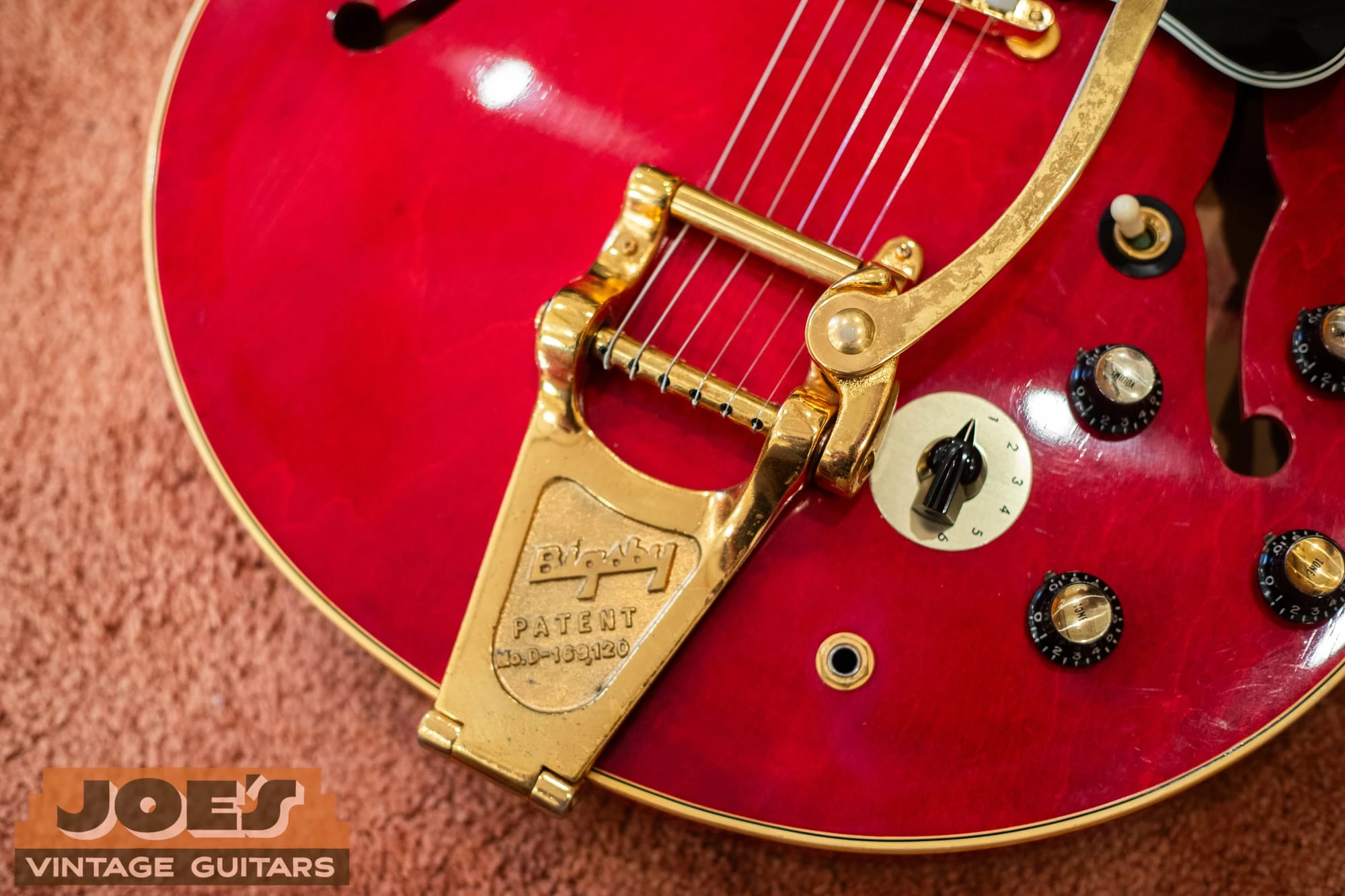
A Bigsby can belong on a mid-1960s ES-345. Its presence does not force the guitar into the 1950s or establish that it was added later.
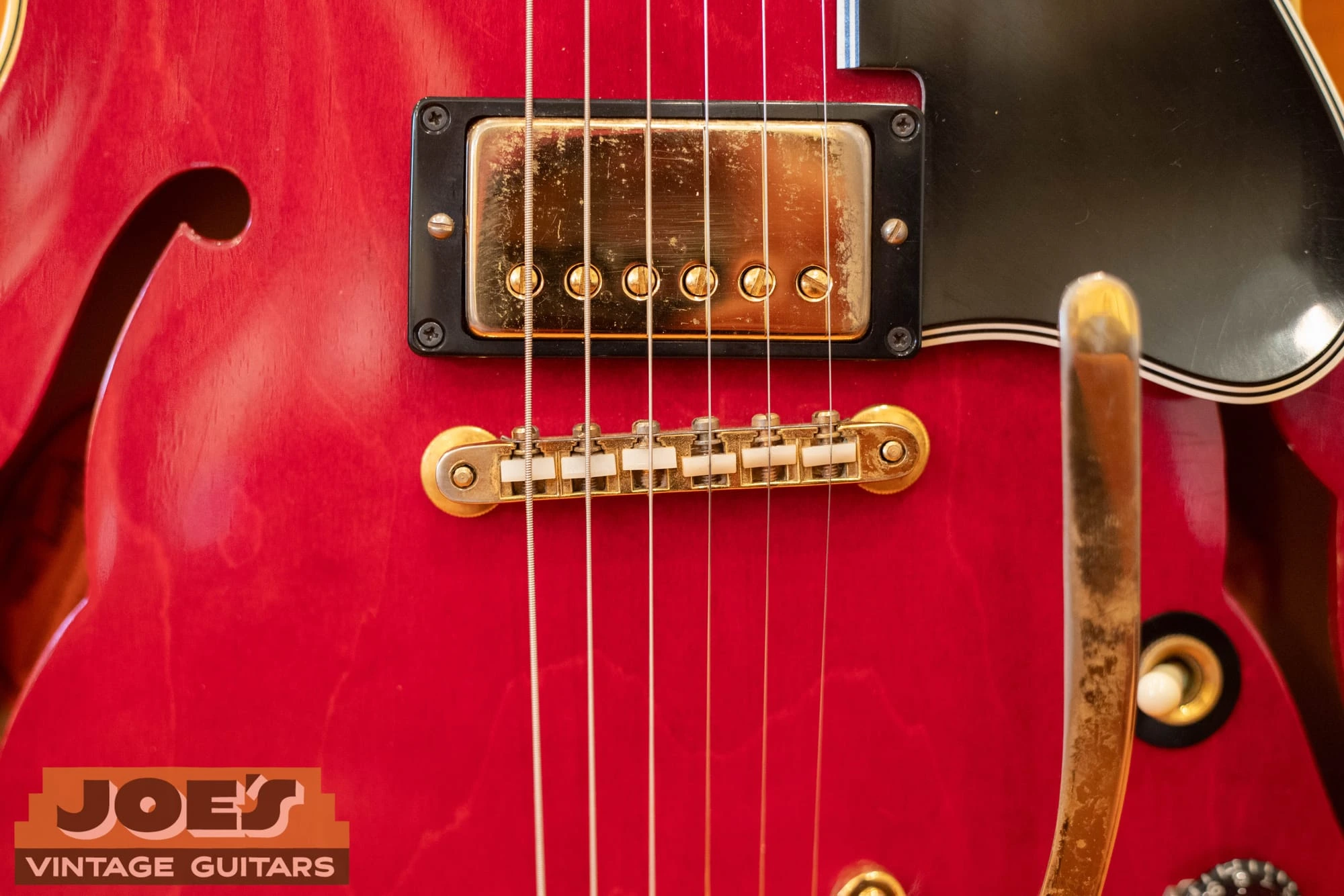
The model still uses gold plating in 1966. Nylon saddles and a pickup cover are supporting clues, not stand-alone dates.
Later-1960s examples can add witch-hat knobs, followed by changes in neck construction, headstock markings and pickup manufacture through the 1970s. A “Stereo” truss-rod cover or Varitone dial can remain after the electronics have been changed.
Later ES-345 Dating Clue: Read the neck, serial and original pot dates to narrow the production year. Read the circuit separately to establish whether the guitar still has its factory wiring.
There are more photos in the ES-345 history and identification guide and the one-owner 1966 ES-345 story.
Model-by-Model Dating
The ES-355 begins in late 1958 as the deluxe model, with ebony, large pearl blocks, multi-ply body and headstock binding, a split-diamond inlay and gold hardware. Its blocks are part of the original design, not evidence of the ES-335’s 1962 transition.
Late 1958 to 1959
First-generation ES-355s commonly combine a cherry finish, full neck profile, gold PAFs, a Bigsby and gold Grover Rotomatic tuners. The stereo Varitone version joins the original mono model in 1959. A factory mono example has no Varitone selector hole.
Early ES-355 Dating Clue: A Bigsby and Grovers can be original equipment. Don't use the early ES-335’s usual Kluson-and-stopbar setup as a checklist for a 355.
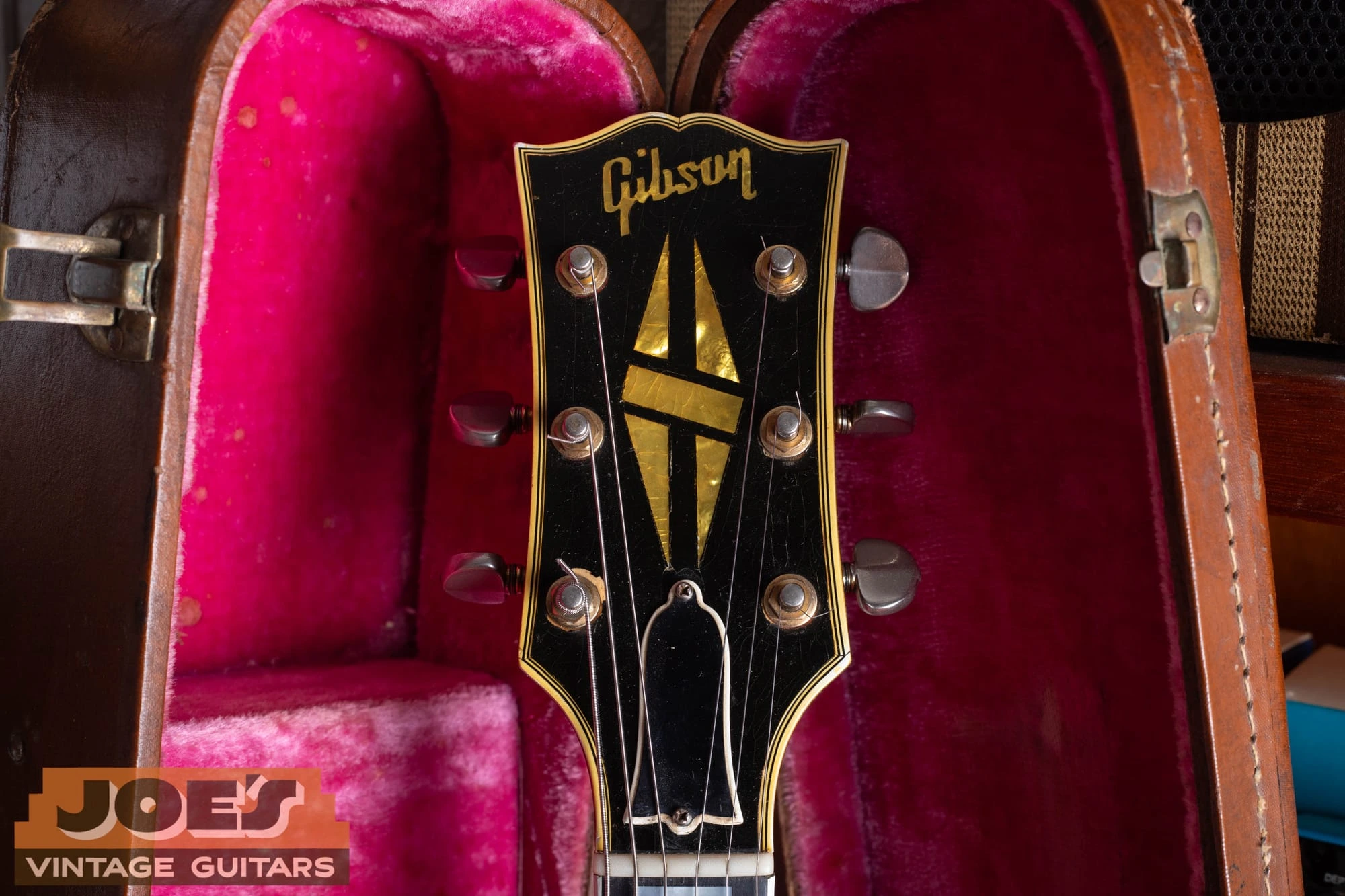
The bound headstock and large split-diamond ornament identify the ES-355 family. They continue beyond the 1950s.
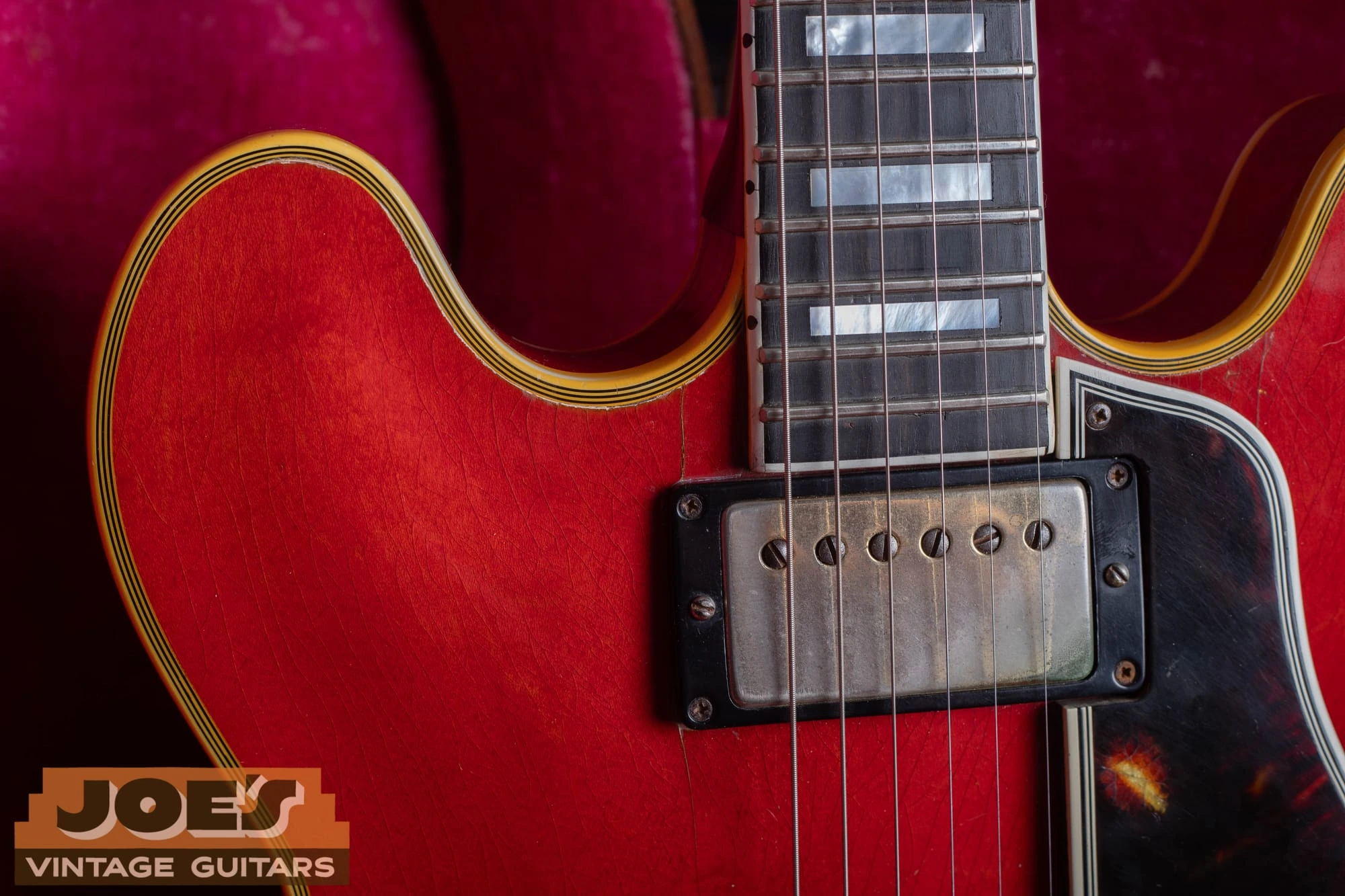
The ES-355 uses larger blocks than the ES-335. This trim belongs to the model from the start.
This 1959 mono example has no Varitone. Its black reflector knobs are a later style, so use the photo for the model and control layout, not as proof of original 1959 knobs.

Gold Grovers fit this early ES-355. Later tuner changes need to be checked against the original holes and finish footprints.
See the 1959 ES-355 guide for the rest of this instrument.
1960 to 1964
The early-1960s neck profiles become slimmer, guards shorten and black reflector knobs with gold inserts become familiar on the cherry ES-355. The sideways Vibrola is documented as early as 1959 but is most associated with 1960 to 1962; the long Maestro with its engraved Lyre cover follows around 1963. Bigsby examples and factory variation mean the vibrato should support a date, not dictate one.
Gold PAT PEND Grover Rotomatics remain normal through late 1963. Gold Kluson waffleback tuners then replace them and continue through the end of the original run. Gold PAFs can persist later than the nickel-covered versions on the ES-335. The mono and stereo question remains separate from the pickup decal.
1960s ES-355 Dating Clue: A Maestro is compatible with the model’s 1960s history. Check the actual mounting, model documentation, neck and original electronics before treating it as a replacement.

The worn areas expose the nickel underplate over the nickel-silver cover base. Surface color alone can't distinguish a PAF from a later pickup.
Use the tuner chronology and PAF and Patent Number pickup guide for closer comparisons.
1965 Through the 1970s
The nut-width changes around 1965 also affect the ES-355. Later guitars can combine sharper cutaways, different knobs and tuner styles with laminated necks, a volute and Made in USA. Gold hardware, ebony and pearl blocks remain model clues rather than tight year markers.
Later ES-355 Dating Clue: Match the construction and electronics to the possible serial years. An original factory mono model and a stereo guitar converted to mono may play similarly but have different histories.
For a documented conversion example, read the one-family ES-355 story. Gibson introduced the separate B.B. King Lucille model in 1980; it isn't a late-1960s or 1970s ES-355 branch. Signature and Historic reissues also need their own model identification.
Shared Clues, With Overlap
The first 1958 bodies have narrower horns, followed by the full rounded “Mickey Mouse ear” shape from later 1958 into 1963. New body forms during 1963 bring sharper horns, although leftover bodies and later exceptions prevent a hard serial-number cutoff. Photograph the full front square-on, since camera angle can make the same cutaway look rounder or sharper.
The bulbous early outline is often called a Mickey Mouse ear. This ES-335 is a shape comparison for the family.
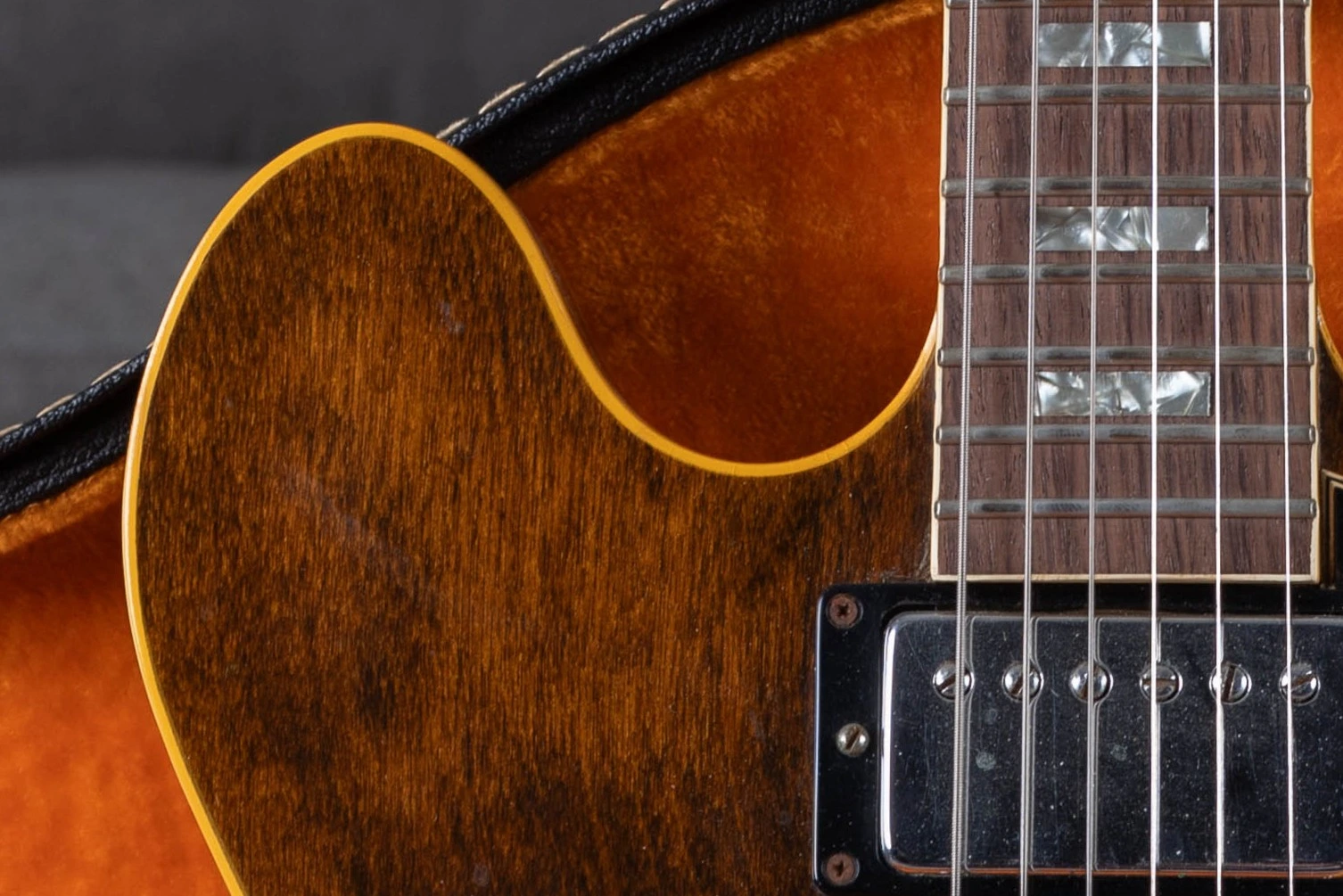
The horn narrows and its tip becomes more pointed. Read the shape alongside the neck and serial, not as an exact date.
Measure across the fingerboard at the nut in millimeters or decimal inches. The usual progression is about 1 11/16 inches through early 1965, roughly 1 5/8 inches during the early-to-mid-1965 transition and about 1 9/16 inches from mid-1965 onward. Dealer measurements vary, so don't round a borderline guitar into the wrong group.
Some period references list a wider nut again for 1968, but many observed examples remain about 1 9/16 inches. Treat a wider 1968 example as something to document, not a default rule. Nut width and neck depth are different measurements.
A replacement neck, refinished headstock or repaired heel can obscure construction clues. The absence of a volute or Made in USA stamp doesn't prove a 1960s date, especially on reissues.
See the physical features and hardware guide, headstock logo chronology and knob guide for individual features.
Model-Specific Hardware And Color
Finish and hardware clues only work when they are read within the correct model. Sunburst, cherry and gold-plated parts age differently, and tuners or knobs can be replaced without changing the guitar’s production year.
| Model | Early Production | Later Production |
|---|---|---|
| ES-335 | Natural or blonde is a 1958 to 1960 production finish. Cherry joins during 1960. | Sparkling Burgundy appears in 1967 and 1968. Walnut appears by 1968 and becomes a catalog finish by 1970. |
| ES-345 | Natural is limited to 1959 and 1960. Cherry begins during 1960 alongside sunburst. | Walnut joins the cataloged finish choices in 1970. |
| ES-355 | Cherry is the standard early finish. Sunburst and blonde examples are rare custom orders, not normal yearly options. | Walnut, wine red and other finishes appear in later production. Confirm them against the serial and factory period. |
| Model | Original Tuner Sequence |
|---|---|
| ES-335 | Single-line, single-ring Klusons from 1958 to mid-1960; single-line, double-ring from mid-1960 to late 1964; double-line, double-ring from late 1964 through 1968; Gibson Deluxe afterward. |
| ES-345 | Gold single-ring tuners remain standard: single-line Klusons from 1959 through 1964, double-line from 1965 through 1969, then Gibson Deluxe. |
| ES-355 | Gold PAT PEND Grover Rotomatics through late 1963, followed by gold Kluson wafflebacks for the rest of the original run. |
Date And Originality Are Different Questions
The Varitone is the six-position rotary selector beside the four volume and tone knobs. Position 1 bypasses its filter; the other positions select different frequency cuts. It doesn’t contain a date code.
The original stereo circuit sends the pickups to separate channels through one three-conductor stereo jack and a suitable cable. It doesn't use two separate output jacks. An ordinary mono cable may leave one pickup unheard.
The first ES-345s use a black Varitone ring; gold becomes normal around mid-1960. The “Stereo” truss-rod cover is absent on some early 1959 guitars and becomes standard by early 1960, although the cover can be replaced and occasionally appears on a mono ES-355.
A factory mono model can have four knobs, one toggle and no Varitone hole. It shouldn't be called incomplete because a stereo model has another selector.
An untouched stereo ES-345 or ES-355 harness commonly has three metal pot cans, with the bridge-tone pot left uncovered because of rim clearance. A plain ES-335 doesn't use that stereo shielding arrangement. Missing cans can indicate service, but the cans themselves aren't a date code.
A disconnected Varitone, plugged selector hole, changed jack or replacement harness can show a conversion. Keep any removed original parts and document the work. A conversion changes originality, not the guitar’s manufacture year.
Later ES-345s and ES-355s can use mono circuits by design. Modern Lucille versions can also use a separate output arrangement. Check the exact factory specification instead of applying the vintage single-jack rule to every later model.
Use the Gibson pot-code guide for the maker, year and week format. An original pot must have been made before it was installed, sometimes well before the guitar shipped. A replacement pot dates the replacement component.
Factory Option Or Later Conversion?
A stopbar anchors into two studs in the top. A trapeze mounts at the body’s end, and a Bigsby or Maestro leaves its own mounting pattern. Check for plugged holes, extra screws, lacquer touch-ups and finish shadows. Do not remove hardware or pry off a plaque just to look underneath.
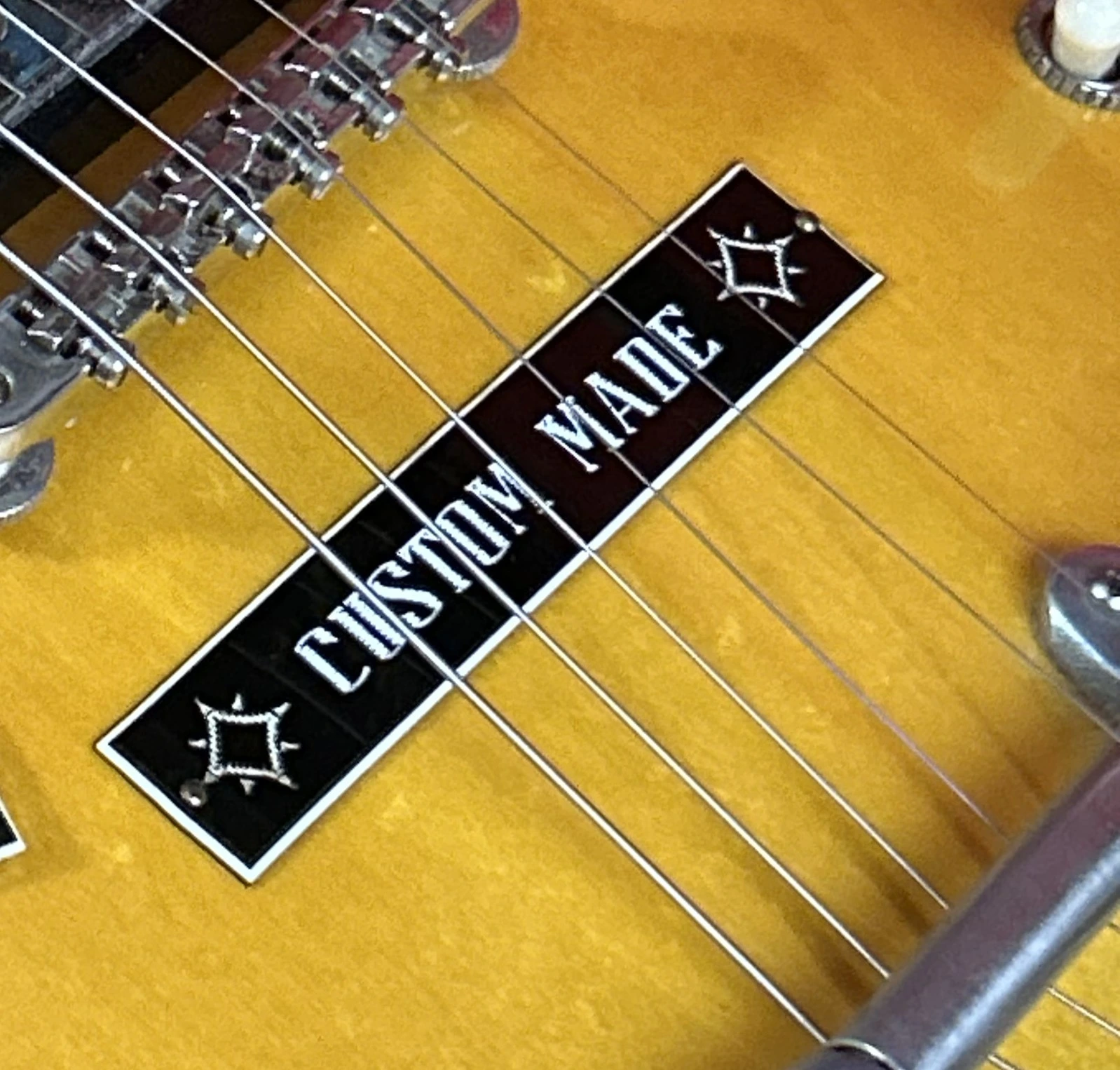
Gibson used this plaque mainly from late 1960 through early 1965 on some factory Bigsby guitars, where it can cover the stopbar stud positions. It isn't a production date or a modern Custom Shop designation.
A plaque supports a configuration only when the mounting and finish evidence agree. Reproduction plaques exist, not every factory Bigsby guitar has one, and it isn't a standard expectation on an ES-355. After the trapeze became normal, a factory vibrato guitar may have no stopbar holes to cover. A rare factory stopbar ES-355 also needs supporting evidence; its unusual configuration shouldn't be accepted or rejected from a single photo.
Confirm the Date
Start with the orange label inside the body and the back of the headstock. Early examples use Gibson’s A-prefix label serials; impressed headstock serials appear during 1961. An early 1961 guitar can legitimately have a label number that doesn't match its newer impressed headstock serial, so record both locations instead of choosing one.
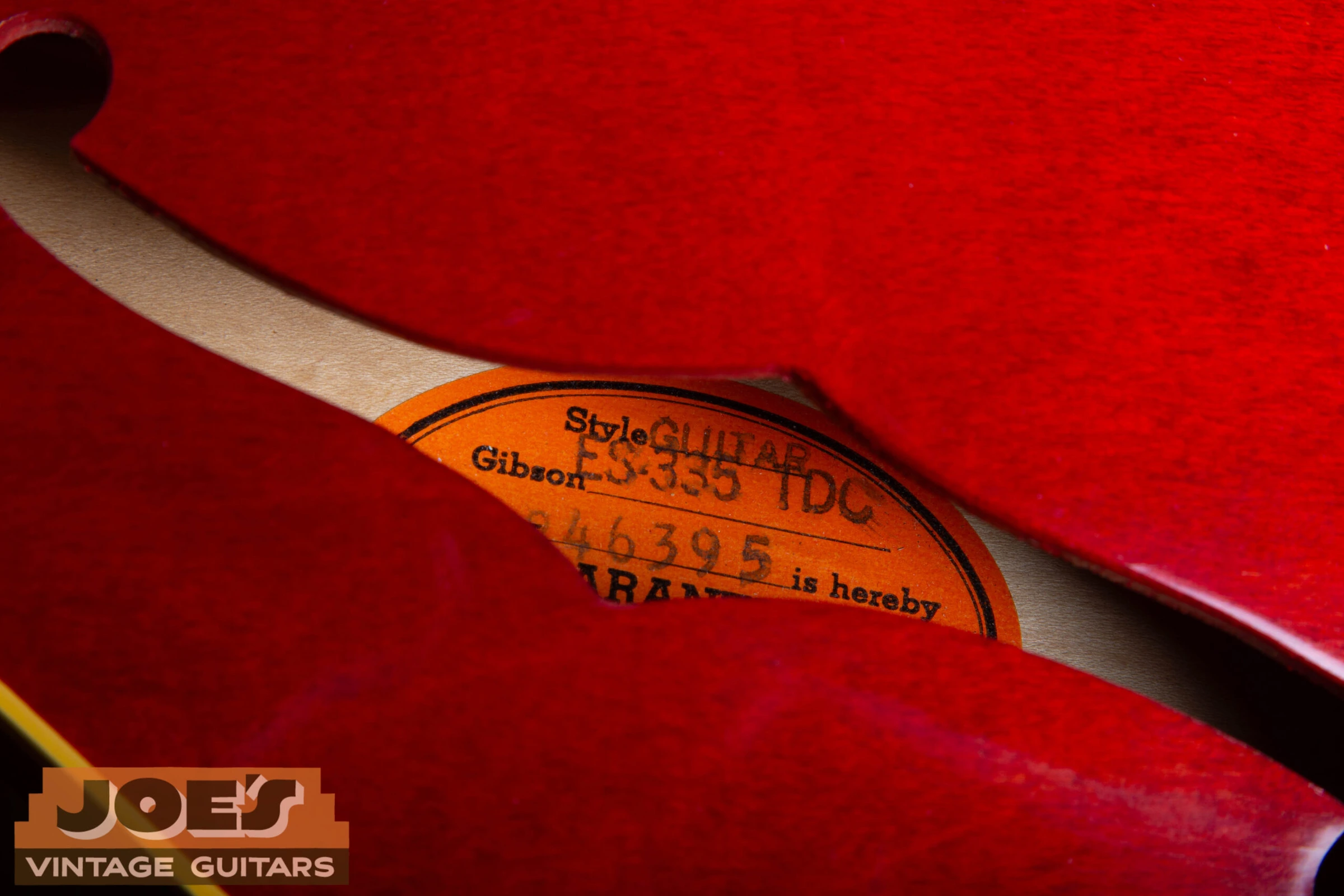
The printed fields read Style, Gibson and Number. This label shows ES-335 TDC in the Style field, but the serial is partly hidden by the body. Photograph every visible digit and compare it with any headstock stamp.
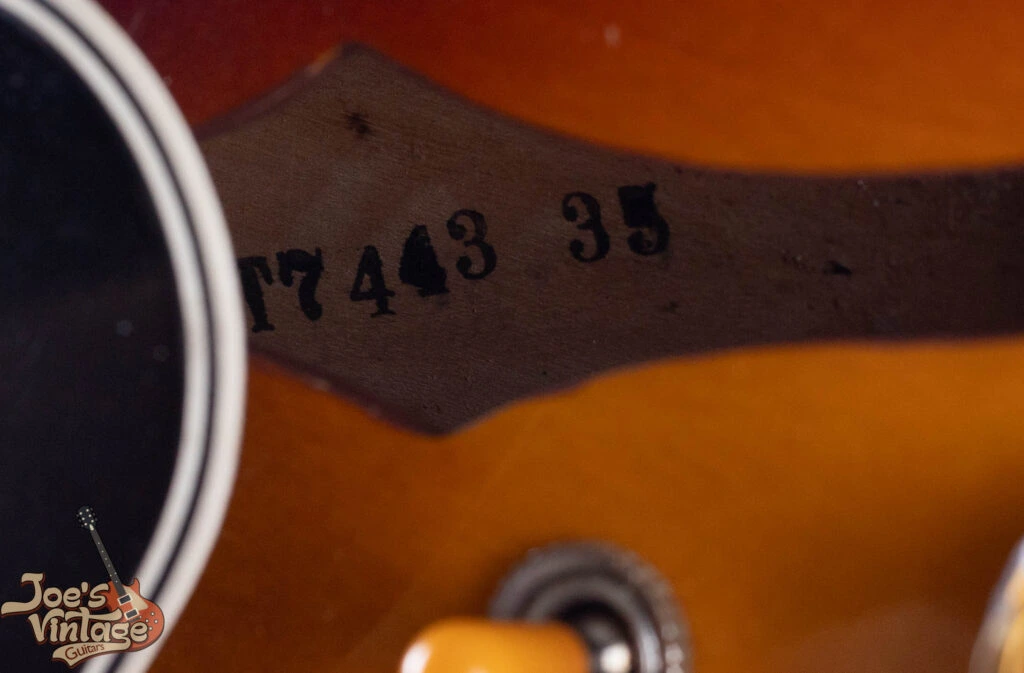
This T-prefix FON marks a 1958 assembly rack, while the guitar is documented as a 1959 example. Assembly can begin in one year and the finished guitar can ship in the next.
A Factory Order Number marks the assembly rack and the guitar’s position within that rack; it isn't a serial number or a parts-manufacture date. On these guitars it is usually viewed through the treble-side f-hole. The letter sequence T, S, R and Q corresponds to 1958, 1959, 1960 and 1961, and the system ends during 1961. See the difference between a serial number and a FON and use the serial decoder and charts for the actual number.
Gibson reused number ranges. An apparent 1960s serial can overlap a later year, so compare the neck, guard, hardware and original electronics before choosing a result.
Use the serial system for the actual production line and year. Memphis, Nashville and Kalamazoo wording can provide context, but a factory name or label color alone doesn’t supply an exact year.
Reissues can reproduce old label formats and omit a headstock stamp. Single production-year digits repeat every decade. Confirm the exact model, certificate and paperwork rather than guessing the decade from its vintage appearance.
“1959 ES-335” or “1964 ES-345” in a reissue name identifies the design being copied. If the exact reissue model isn’t listed in the decoder, keep the complete number and seek individual confirmation. Don’t substitute another ES model’s serial formula.
Use special serial formats for supported reissue and limited-run formats. This guide covers the six-string ES-335, ES-345 and ES-355 families. The fully hollow model has its own ES-330 dating guide. ES-335-12, Trini Lopez, ES-347 and the Lucille model introduced in 1980 also need their own model checks.
Identify the model, record the serial number and any Factory Order Number, then compare that model’s neck, inlays, guard, tailpiece and original electronics. Gibson reused serial ranges, and parts can be replaced. Several independent clues should agree before you assign a year.
Small block inlays replaced dots during 1962. Both styles occur in that transition year. Later Dot and Historic models brought the earlier appearance back, so dot inlays alone don’t prove a pre-1962 build.
No. The trapeze became the usual non-vibrato tailpiece around 1965 and continued afterward. Use the nut width, hardware, serial and original pot codes to narrow the date. Tailpiece conversions are also common.
The classic vintage ES-345 was built with stereo wiring and a Varitone. Some later versions omit the Varitone or use mono wiring from the factory. On a vintage guitar, a missing or disconnected circuit calls for an originality check.
Yes. Gibson made factory mono ES-355s as well as stereo Varitone versions. A converted stereo guitar may still have the selector or a plugged hole. The control layout and original harness help distinguish them.
Yes. Gold-covered PAF stock can appear later on these models than nickel-covered stock on ES-335s. A PAF decal is not proof that the guitar was built in the 1950s. Check both pickups and the rest of the instrument.
The plaque can cover the stopbar stud positions on a factory Bigsby-equipped ES. It isn’t a date code, and it doesn’t prove the guitar came from the modern Gibson Custom Shop. Reproduction plaques exist.
Don’t remove them just to get a date unless you have the necessary repair experience. Metal dust-cover cans can hide the stamps, and retrieving the pots through a semi-hollow body risks wiring, solder joints and finish. Ask a qualified repairer when the codes aren’t safely visible.