

Resistance And Taper
Match the printed value and taper to the model, year and control position. A correct date on the wrong electrical specification is a reason to look closer.
Gibson Dating Guides
A pot code tells you who made a volume or tone control and when it was made. It dates the part, not the guitar, but it can narrow down a Gibson’s age when the serial number gives more than one answer.
Jump Straight To The Pot-Code Formats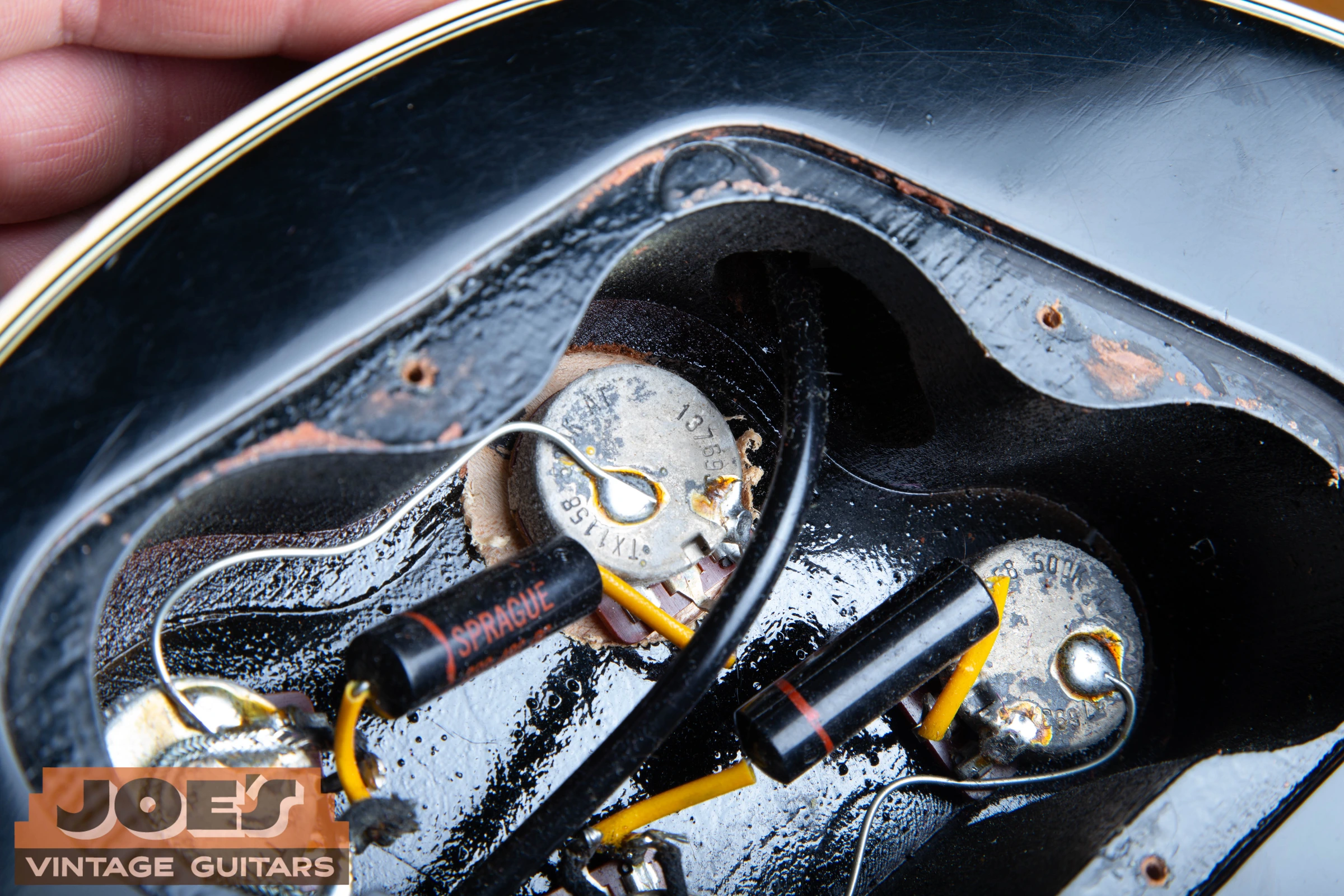
Start With The Digits
“Pot” is short for potentiometer, the component underneath a volume or tone knob. Many vintage pots have an EIA manufacturer-and-date code stamped into the metal casing. Read the maker first, then the year and week. The groups may run together or be separated by spaces, dots or hyphens.
Maker: CTS
Last two digits of the year
Two-digit week number
Maker: Centralab
Last digit of the year
Two-digit week number
In the Gibson period covered here, six-digit EIA source-date codes appear from 1947 through 1959. A year digit of 7, 8 or 9 can point to either the late 1940s or the late 1950s, so the guitar’s construction, serial number and other parts must settle the decade. Seven-digit codes begin appearing in late 1959 and use two year digits.
The final two digits are normally a week from 01 to 52. A number above 52 is not a valid week code. It may belong to a part number, value or another marking.
Use The Suppliers Gibson Actually Used
The first digits name the pot maker, not Gibson. Supplier history helps, but it is approximate because Gibson used stock on hand and changed vendors over time.
| Approximate Period | Supplier And Marking | What To Read |
|---|---|---|
| Early 1950s to late 1955 | IRC, often marked 615-0689 | The 615-0689 group identifies the IRC pot type seen on early Gibsons. A separate three-digit group supplies the one-digit year and two-digit week. For example, 218 means a year ending in 2, week 18. |
| About 1953 into the mid-1960s | Centralab, code 134 | Centralab overlaps IRC in the 1950s and CTS during the early-1960s transition. Its date is usually stamped around the side of the casing, although bottom-stamped exceptions exist. |
| Early 1960s onward | CTS, code 137 | CTS overlaps Centralab during the transition and becomes the usual supplier on many later-1960s and 1970s Gibsons. CTS means Chicago Telephone Supply before 1960 and CTS Corporation after the name change. |
Stackpole 304, Allen-Bradley 106 and Clarostat 140 are valid EIA maker codes, but they are not the normal factory suppliers in a 1950s or 1960s Gibson guitar. Their presence does not prove a replacement. Check the specific model, pot specifications, wiring and solder before deciding.
Look Before Moving Anything
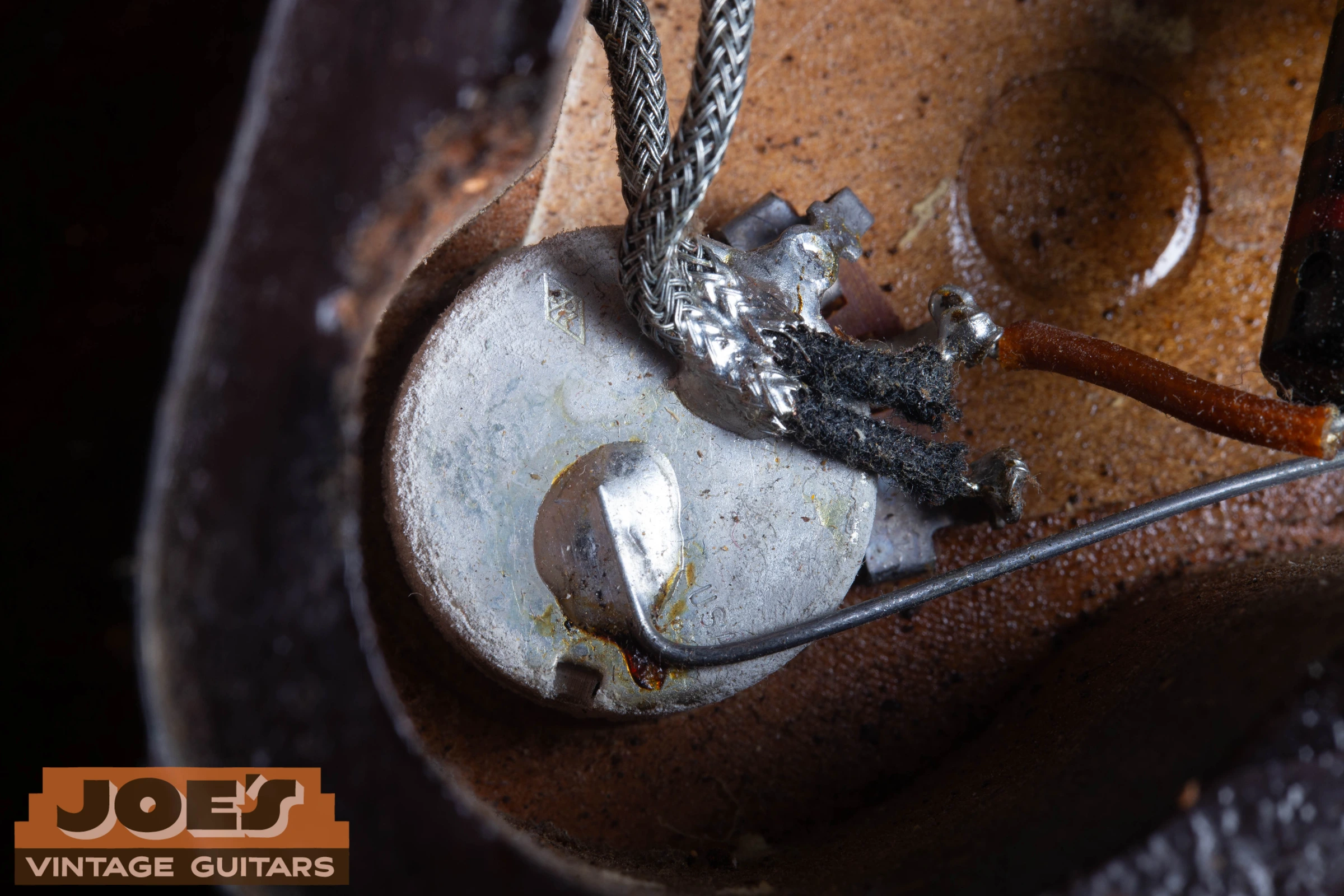
The CRL diamond trademark and USA marking identify the Centralab pot. Its date code is around the side of the casing and is not visible from this angle.
The location follows the pot maker more closely than the guitar’s decade. Centralab dates are usually stamped around the side. CTS dates are usually on the flat back. Those are useful tendencies, not rules: some late-1950s Centralab pots are bottom stamped.
On a Les Paul, SG or another solid-body Gibson, look through the rear control cavity. The code can face a cavity wall, sit behind wires or disappear under solder. Start with a light, magnification, a camera and a small inspection mirror.
Some full-depth archtops from the mid-1950s into the mid-1960s used metal shielding cans over the pots. Stereo and Varitone ES-345 and ES-355 harnesses often used three cans because the fourth pot sat too close to the rim. A standard mono ES-335 generally did not use them.
An intact factory can is evidence that the harness may be undisturbed. Do not pry it open or break its solder just to find a date. If there are no cans, try a light and mirror first. If the code remains hidden, let a repairer who knows vintage Gibson harnesses handle the removal.
Real Examples From Joe’s Photos
The 1969 photo at the top of this page shows 137 69: CTS and 1969. The remaining week digits are partly hidden. The same pot carries a Gibson part number and a 500K resistance marking, which are not part of the date.
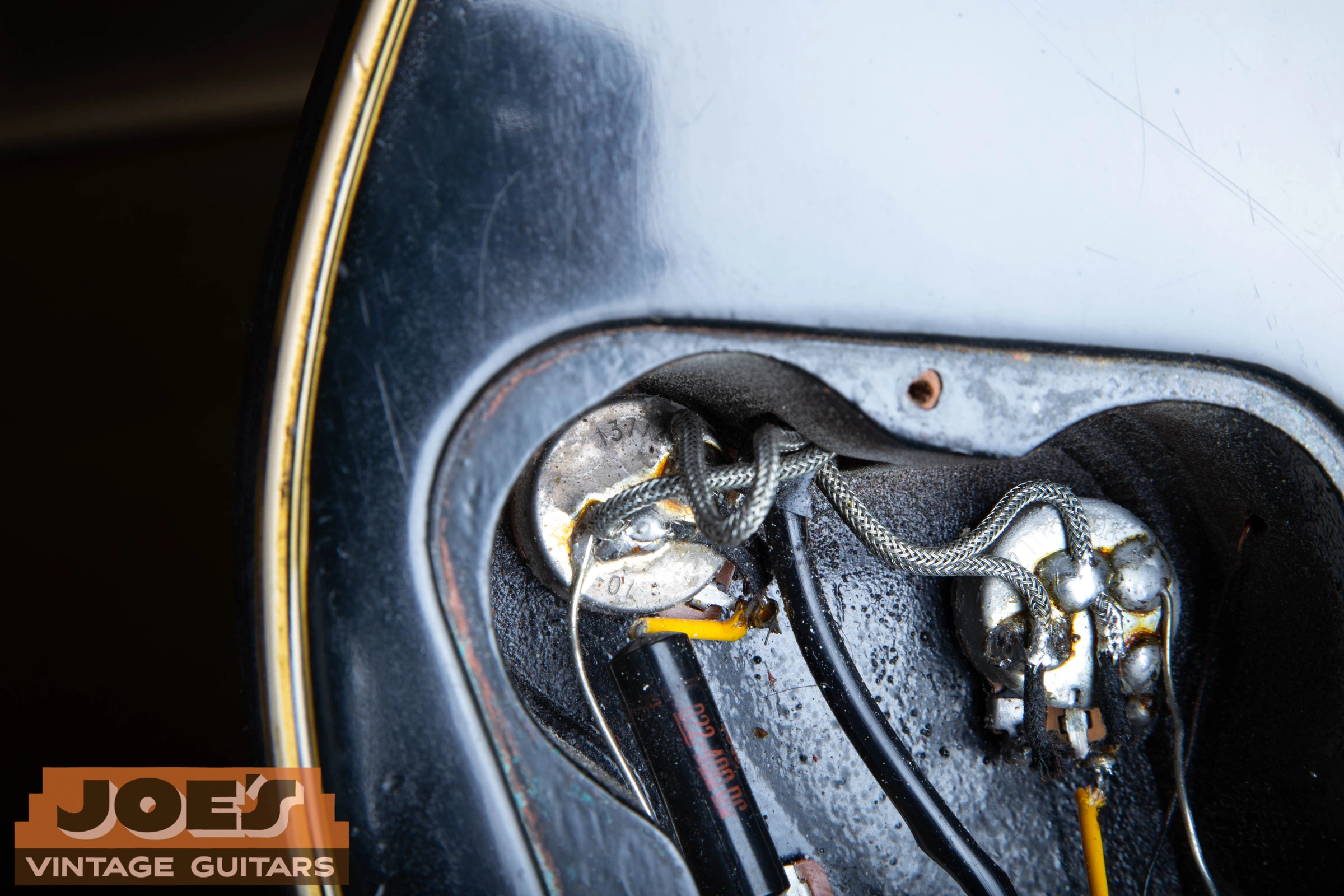
The full code was recorded as 137 72 20: CTS, 1972, week 20. In this photograph, 137 72 is barely visible and the final 20 runs into the solder joint. On the adjacent pot, solder hides almost the entire code.
A photograph may support the maker and year without showing every week digit. Record each pot separately. Do not borrow missing digits from another pot because components in the same guitar can have different dates.
Do not scrape, heat or remove solder just to expose a date. An unreadable code is a reason to use other dating clues, not a reason to disturb the controls.
From A Part Date To A Guitar Date
If a pot is original, the guitar could not have been completed with it before that pot was made. The date is an earliest possible assembly date, not a shipping date, sale date or guarantee of the build year.
A gap of a few weeks to about a year is common on many guitars. One to two years or longer can occur when Gibson had slower-moving parts or older stock on hand. Do not call an older pot a replacement without evidence from the solder, wiring and the rest of the harness.
| What You Find | What You Can Conclude |
|---|---|
| A 1969 pot believed to be original | The guitar could not have been assembled with that part before the pot’s 1969 production date. It may have been completed later. |
| A 1972 pot in a guitar claimed to be from 1965 | Check for a replacement, a misread code or an incorrect guitar date. One newer pot does not automatically redate the whole guitar. |
| Several pots with matching or nearby dates | Consistent dates support originality, but do not prove it. The wiring, solder joints and other parts still need to agree. |
| An original-looking pot one or two years older than the guitar | The gap can reflect factory inventory. Inspect the joint and model-specific specifications before calling the pot a replacement. |
Pot codes are useful when a 1960s Gibson serial number fits more than one year. A serial that could be 1965 or 1968 paired with an original 1967 pot cannot support 1965 assembly. It supports the later possibility, but only after the pot’s originality has been checked.
Record each pot separately, then compare the dates with the Gibson serial-number lookup and charts, construction, hardware and documented history. The latest pot you can establish as original provides the earliest possible assembly date for that set of parts.
If the guitar has humbuckers, compare their labels and construction with the Gibson PAF and Patent Number pickup guide. Pickup features do not replace the pot or serial evidence, but they can show whether the parts belong to the same period.
Not Every Number Is A Date
A pot may carry several markings. Copy every line exactly as it appears before trying to decode it.
An EIA maker code. Look for the year and week digits that follow it.
A resistance value in thousands of ohms, not a year. 500K is common on vintage Gibsons. Some models used 250K, while later-1970s circuits can use 300K volume and 100K tone controls.
AT, AUD, A, LIN or similar markings describe how the control changes as the knob turns. The correct taper depends on the model and control position.
Markings such as BA811-1053 or TX1158 identify a part or specification. On early IRC pots, 615-0689 is separate from the three-digit date group.
If the number does not fit a known date format, leave it unresolved instead of treating any convenient pair of digits as the year.
Check The Whole Harness
A date code is more useful when the rest of the electronics match the model and period. Read these clues together.
Match the printed value and taper to the model, year and control position. A correct date on the wrong electrical specification is a reason to look closer.
Grey Tiger capacitors are common on early-to-mid-1950s Gibsons. Sprague Black Beauty capacitors begin appearing around 1956. Types overlap, and an old capacitor can be moved, so the leads and solder must agree.
Braided-shield wire belongs in many vintage Gibson harnesses, but similar wire is sold today. Check its routing, weave and connections instead of treating braid alone as proof.
Undisturbed joints support originality. Reflowed or replaced joints show that work was done, but they do not tell you by themselves which component was changed.
An intact can on a model that used one can support an undisturbed harness. A missing can is not enough by itself to condemn the guitar.
Compare Gibson part numbers, pot positions, capacitor layout and wiring path with the correct model. Gibson specifications changed, and one universal control-cavity pattern does not exist.
No. A replacement pot can be old, and an entire wiring assembly can be replaced with period parts. Matching dates support an assessment, but the solder joints, wiring, components and guitar’s history also need to agree.
Often the gap is a few weeks to about a year, but one to two years or longer can occur when parts remain in stock. An original pot’s date sets an earliest possible assembly date, not an exact build date.
137 identifies CTS. Without the following year digits, it does not date the pot. Photograph the visible portion and check the other pots without disturbing the wiring.
First check that you have read both formats correctly. Then consider replacement pots, an older wiring assembly or a reused serial-number range. Do not force a guitar date from one component.