
The collector’s guide · 1963 to today
The Gibson
Firebird
History, dating, hands-on authentication, values, and the truth about custom-color rarity.
Every Firebird has a story, and the guitar usually tells it in layers. The silhouette tells me the era. Construction narrows the window. Pots, solder, finish, hardware, and repair evidence either support that story or complicate it. Introduced in 1963, the Firebird was Gibson’s most radical production guitar of the decade. It is exactly the kind of instrument I focus on at Joe’s Vintage Guitars: an unusual design whose construction and history matter as much as the name on the headstock. It combined an automotive designer’s shape, a laminated neck running through the body, banjo tuners, and a pickup voice with Gibson muscle and unusual cut.
01 · Origin
Born in Detroit style
Gibson wanted an electric guitar that couldn’t be mistaken for anything else. For the guitar it launched in 1963, Gibson turned to Raymond H. Dietrich. He had designed cars for Lincoln, Packard, and Chrysler. You can see that background in the Firebird’s long lines and stepped body.
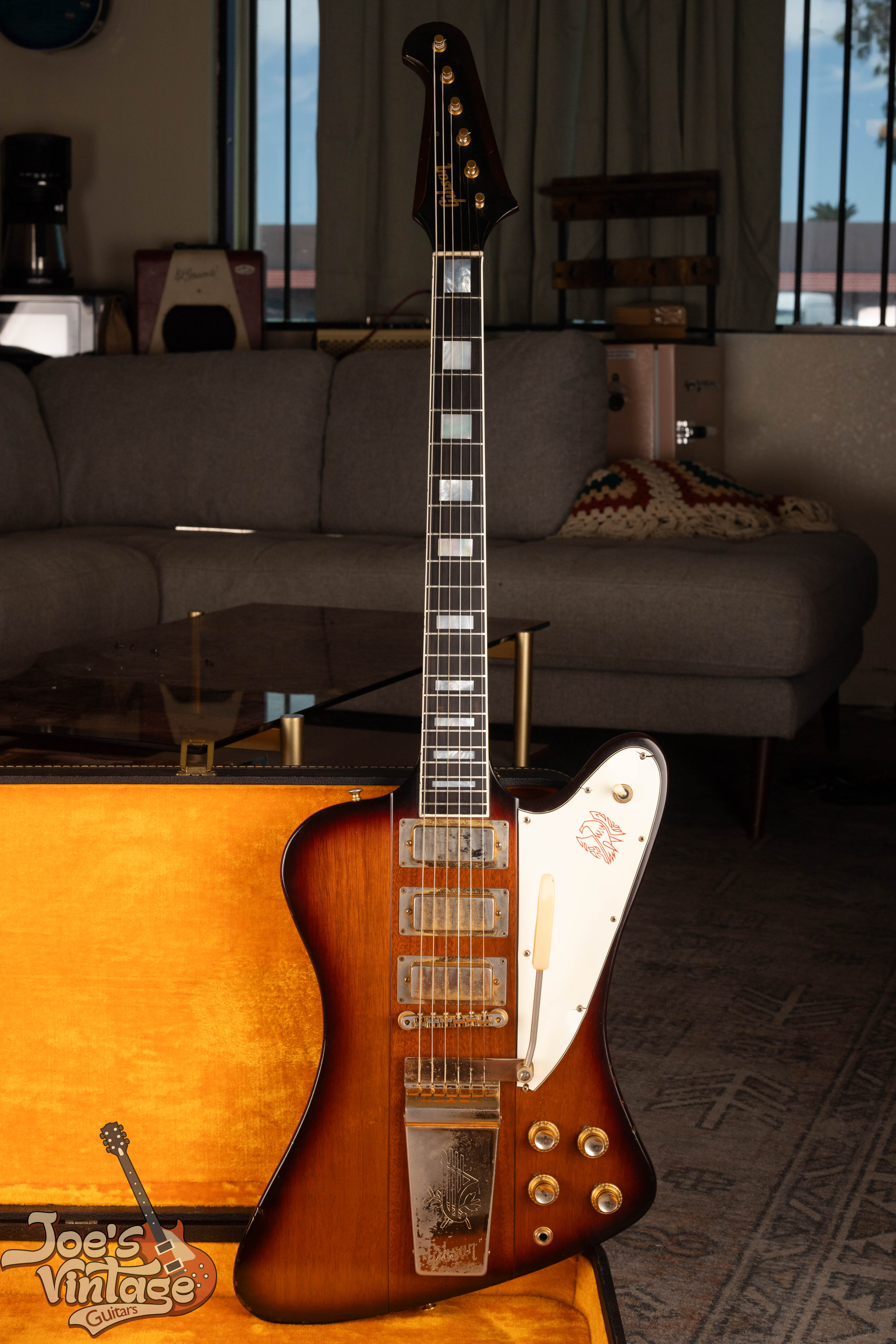
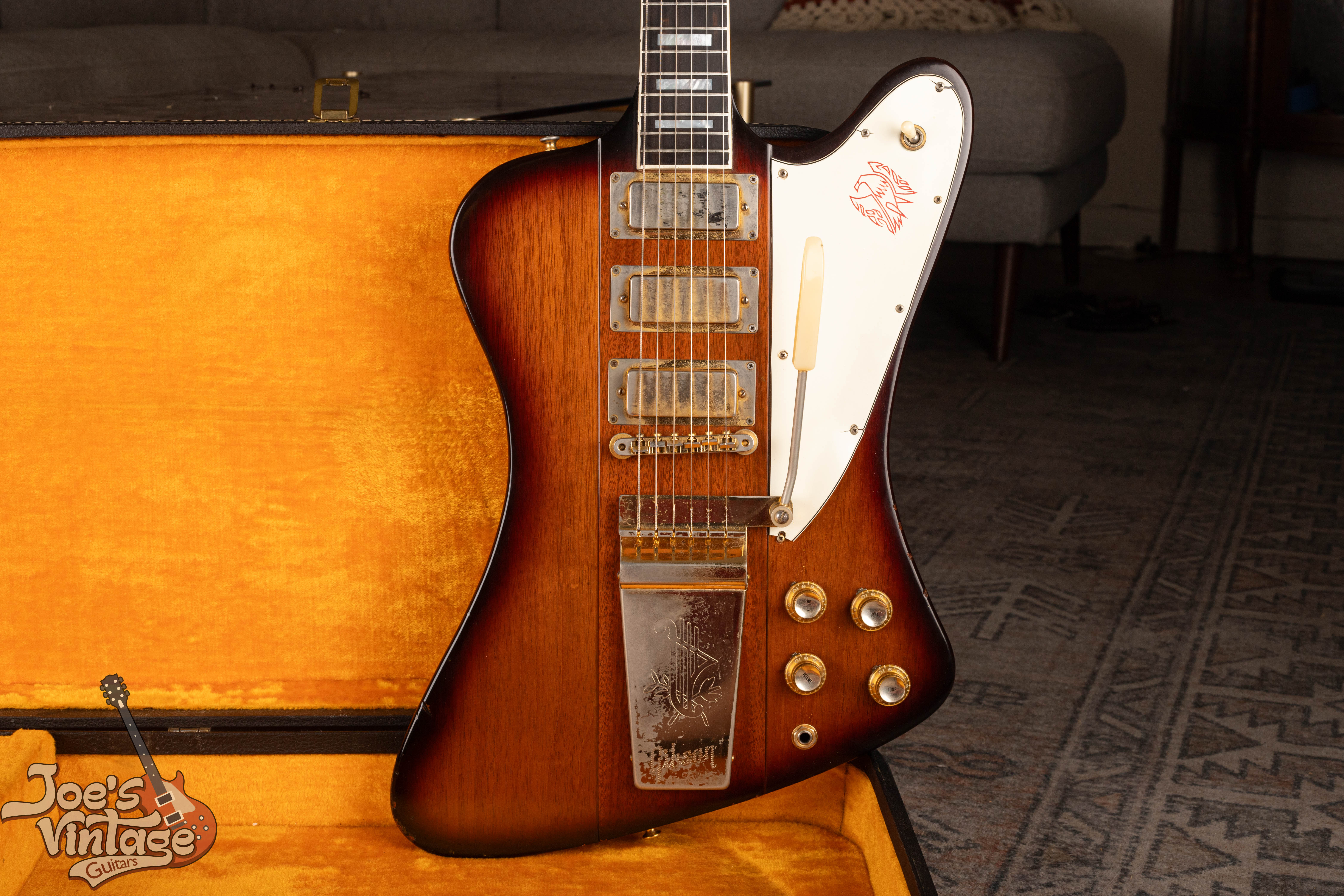
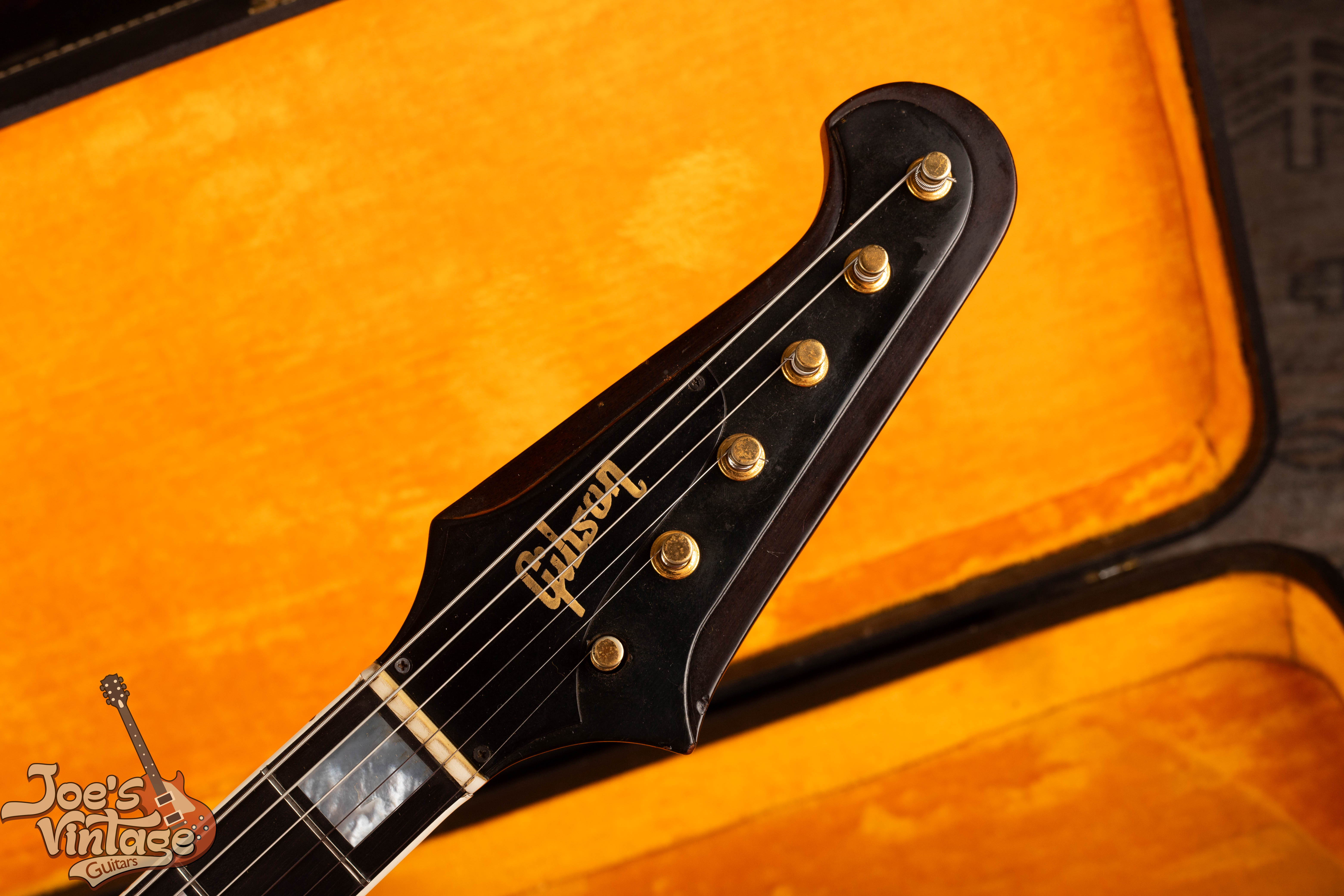
Collectors now call this first version the reverse Firebird. The treble horn reaches forward. The bass side falls away. The six-in-line headstock points the other direction from Gibson’s later redesign. Under the lacquer, a nine-ply mahogany-and-walnut center runs from the headstock through the body. Gibson attached mahogany wings on both sides. The 1963 catalog called this “special construction.” That description was accurate. This wasn’t a reshaped Les Paul or SG.
Gibson built a new structure, not just a new outline.
Sunburst was standard. Gibson offered ten Duco custom colors for another $15. The names, especially the metallic “Poly” finishes, came out of the same automobile culture that shaped the guitar.
02 · The reverse series
Four models with distinct jobs
Gibson used the odd-numbered model names the way it used Junior, Special, Standard, and Custom elsewhere. The higher number brought more hardware and decoration. It didn’t automatically make the guitar a better player.
| Model | Pickups | Fingerboard | Hardware | 1963 shipped |
|---|---|---|---|---|
| Firebird I | One Firebird pickup | Unbound rosewood · dots | Compensated wraparound | 80 |
| Firebird III | Two Firebird pickups | Bound rosewood · dots | Short Vibrola | 272 |
| Firebird V | Two Firebird pickups | Bound rosewood · trapezoids | ABR-1 + Lyre Vibrola | 62 |
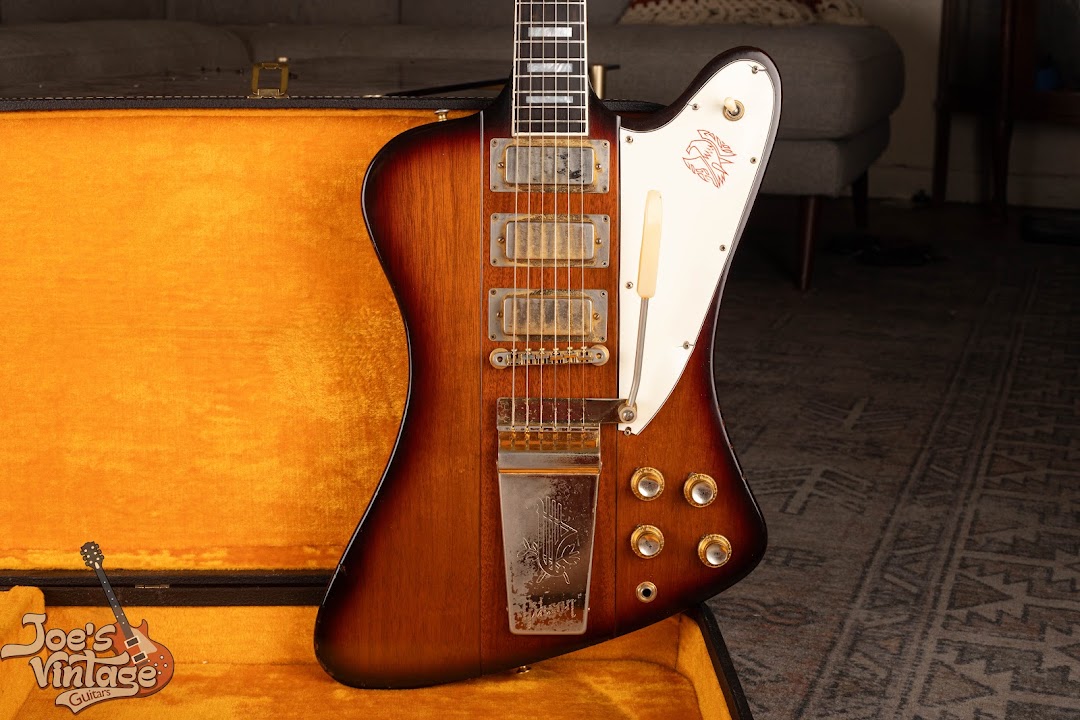
| Firebird VII | Three Firebird pickups | Bound ebony · blocks | ABR-1 + Lyre · gold | 20 |
Firebird I
One bridge pickup. Dot inlays. Very little decoration. I like the I because there’s nowhere for the design to hide. Its connection to Eric Clapton adds interest, but condition and originality still decide value.
Firebird III
The III adds a neck pickup, a bound dot-inlay fingerboard, and a short Vibrola. Gibson shipped more IIIs than any other reverse model in 1963. For many buyers, it’s the most approachable way into the original design.
Firebird V
The V is the version most players picture first: two pickups, trapezoid inlays, an ABR-1 bridge, and an engraved Lyre Vibrola. Johnny Winter made that outline part of the visual language of electric blues.
Firebird VII
The VII sits at the top of the line. It has three pickups, block inlays, an ebony fingerboard, and gold-plated hardware. Gibson shipped 303 reverse VIIs from 1963 through 1965. Low production matters, but I still judge the individual guitar.
1965 to 1969
The non-reverse Firebird
The reverse Firebird was expensive to build. Gibson replaced it with the non-reverse version in 1965. The new guitar used a flatter mahogany body, a glued-in neck, conventional tuners, and a large pickguard that carried much of the wiring. The non-reverse I used two P-90s, and the III used three. The V and VII kept Firebird pickups. Gibson added the Firebird XII 12-string in 1966 and shipped 272 examples across 1966 and 1967.
1963 to 1969
03 · The color card
Ten colors, no reliable totals
“Poly” meant metallic or polychromatic. It did not mean polyurethane. Old clear lacquer yellows. Pelham Blue can look green. Polaris White can turn cream. Metallic coats can oxidize. That aging can be beautiful, but the color I see today isn’t proof of the color Gibson sprayed.
This is my comparative rarity guide based on documented survivors and long-term market observation. It is not a factory production chart. Reliable Firebird shipping totals by individual color are not known to survive.
04 · Authentication and dating
Authenticate the whole guitar, not just the serial
When I date a Firebird, I don’t start by trying to make one number answer every question. Gibson serial ranges overlap in the 1960s, parts could sit in bins, and repairs can mix several eras in one instrument. I build a timeline from independent clues. The strongest conclusion is the one that asks the fewest parts to be exceptions.
Photograph the guitar as received. Record the weight, serial, neck pitch, tuner layout, bridge, tailpiece, plastics, screw positions, and every visible repair. Loosen parts only with the owner’s permission. Brittle guards crack, old solder is evidence, and a careless screwdriver can erase value.
First: place it in the right construction family
Reverse Firebirds, 1963 to 1965: look for the raised, laminated neck-through center section, attached mahogany wings, the long reverse headstock, and rear-mounted banjo-style tuners. Non-reverse Firebirds, introduced in 1965: use a flatter body, a glued-in neck, conventional tuners, and a large pickguard carrying much of the electronics. 1972 to 1973 Medallion models return to the reverse outline and carry a numbered medallion. 1976 to 1979 Bicentennial instruments have their own construction, hardware, and patriotic bird motif. A later reissue can copy the outline, so silhouette alone is only the first gate.
Then: make the appointments agree with the model
On an original reverse series guitar, I expect the Firebird I to be spare: one pickup, dot inlays, and a simple bridge. The III adds a neck pickup, binding, and a short Vibrola. The V moves to trapezoids, an ABR-1, and the engraved Lyre. The VII adds three pickups, block inlays, an ebony board, and gold-plated hardware. Non-reverse specifications are different: the I and III use P-90s, while the V and VII retain Firebird pickups. A feature that belongs to another model isn’t automatic proof of a fake, but it creates a question that the routing, finish, and solder should answer.
| Dating factor | What I record | What it can prove | Common trap |
|---|---|---|---|
| Serial stamp | Every digit, depth, alignment, font, finish inside the impressions, and any “Made in USA” mark | A range of possible years and whether the stamp looks contemporary with the finish | Treating an overlapping 1960s range as an exact build date |
| Pot codes | Maker code, year, week, matching dates, solder joints, and whether every pot is original | The guitar cannot have been assembled before its newest original component | Calling the pot week the guitar’s completion date |
| Construction | Neck-through laminates or set-neck joint, body wings, routes, neck pitch, and tool marks | The correct production family and whether major woodwork was altered | Letting a refinished surface hide plugged routes or rebuilt joints |
| Electronics | Pickup type, lead wire, baseplates, switch, capacitors, harness layout, and solder | Whether the circuit is coherent for the model and period | Using DC resistance alone to call a pickup original |
| Finish | Blacklight response, checking, color in protected areas, cavity edges, and overspray lines | Whether finish layers and repairs appear consistent with age | Assuming yellowed lacquer or convincing checking proves originality |
| Hardware & plastics | Tuners, bridge, Vibrola, plating wear, knobs, guard bevels, logo, screws, and footprints | Whether parts match the model and leave period-correct evidence behind | Calling a period-correct replacement factory-installed |
How I read the numbers
The headstock stamp is a starting point. I compare it with Gibson’s published serial information and my Gibson serial number dating guide, but those references are most useful for separating modern Historic formats from vintage production. An early-’60s Firebird stamp should look pressed into the wood beneath an aged finish, not freshly cut through it. A crisp restamp, disturbed lacquer, odd spacing, or a serial that fights the construction deserves more investigation.
Potentiometer codes give me a second clock. A common EIA code such as 137 6414 reads as CTS, 1964, week 14. That is a component date, not a shipping date. The guitar was assembled after that pot was made. If three pots read early 1964 and one reads 1978, I don’t average them; I inspect the solder and treat the outlier as a likely replacement. Original-looking solder matters because a correct old pot can be installed later.
Open the cavities carefully
Routing is hard to fake cleanly. I look for the shape and depth of factory routes, untouched tool marks, shielding or paint that doesn’t belong, plugged holes, and fresh wood under old-looking lacquer. On neck-through models, the center laminates should remain logically continuous through the body. I also compare screw holes and hardware footprints. Extra holes beneath a Vibrola or tuner can explain a conversion even when the current parts look right.
A vintage Firebird pickup is its own design, not an Epiphone-style mini-humbucker in different trim. Under the smooth cover, I expect two Alnico bar magnets seated inside the coils, a brass baseplate, and no exposed pole screws. But a cover is not an identity card. I want the correct construction underneath, period lead wire, coherent baseplates, and undisturbed joints. A resistance reading can reveal an open coil or a major mismatch. It cannot, by itself, prove who made the pickup or when it entered the guitar.
Finish, color, and blacklight
I inspect the finish in protected areas first: under the guard, inside cavities, beneath hardware, and along chipped edges. Those places show the less-faded color and the order of the layers. Under ultraviolet light, I’m looking for a coherent pattern, not simply whether the guitar “glows.” Overspray, touch-up, replaced wings, and an old headstock repair can fluoresce differently. So can contamination, polish, and naturally varied lacquer thickness. Blacklight is one clue in a chain.
Custom colors demand extra restraint. Pelham Blue can shift green, Polaris White can amber toward cream, and metallic coats can oxidize. I compare the exposed finish with sheltered paint, check whether the color continues naturally into routes and edges, and look for signs that a sunburst was stripped before the current coat. I won’t call a rare color original from front-and-back photographs alone.
The Firebird repair audit
The long headstock and heavy banjo tuners make this family vulnerable. I inspect the nut area, tuner holes, laminate seams, and the transition behind the headstock under direct and raking light. A stable, well-documented repair can make a great playing guitar. It still changes originality and value, and it should be disclosed. I also check guard shrinkage, cracked pickup rings, leaning bridge posts, Vibrola mounting, refrets, planed fingerboards, changed nuts, and widened tuner holes.
A serial can suggest a year. A pot can set an earliest possible date. Construction establishes the family. Finish, hardware, electronics, and repair evidence decide whether the story holds together. For a purchase-level opinion, I need clear cavity, solder, pickup, serial, neck-joint, and blacklight photographs, and sometimes the guitar in hand.
05 · Market value
What a vintage Firebird may be worth
These are broad 2026 retail-market guides, not offers or promises. I start with verified sold comparables. Then I account for originality, condition, repairs, playability, provenance, color, and the timing of the sale. Asking prices aren’t completed sales. Photographs alone aren’t enough for a final number. Owners can start with a free vintage guitar appraisal, and anyone ready to discuss a sale can read how I buy vintage Gibson guitars.
The value factors I weigh
Original custom color: An exceptional, well-documented example can bring materially more than a comparable sunburst guitar. Model, color, condition, and evidence decide the premium.
Headstock repair: A disclosed repair can substantially reduce market value against a comparable unbroken guitar. Quality, stability, appearance, and documentation matter.
Full refinish: A full refinish usually cuts deeper than a localized repair. Added routes, missing wood, and replaced pickups can reduce value further.
Original case and provenance: Both can add value when they support the guitar’s physical evidence. Neither can replace it.
06 · The return flights
The Firebird comes back
Firebird V Medallion
Gibson returned to the reverse outline and added a numbered medallion. The company shipped 366. I expect early-’70s construction and components, not 1963 details hiding under a newer serial.
Bicentennial Firebird
The red, white, and blue bird motif is the obvious clue. Gold hardware and period bridge and tailpiece details help finish the identification. Published shipping records list about 2,850: 117 White, 199 Tobacco Sunburst, roughly 1,277 Ebony, and roughly 1,254 Natural.
Reissues and reinterpretations
Gibson has revisited the I, III, V, and VII, along with non-reverse models, Studios, artist editions, and the Firebird Zero. Epiphone has built its own versions. Some modern serial formats echo a vintage model year. I use the complete serial format and the construction to keep a reissue from becoming an “original” in somebody else’s story.
07 · Sources and method
Where the facts come from
I separate factory documentation from later reference work and my market judgment. Historical specifications and period pricing were checked against Gibson’s 1963 Firebird literature. Serial formats were checked against Gibson’s current published serial guide. Production totals and model changes were cross-checked against specialist references. The rarity chart remains a comparative judgment because reliable factory color totals are not known to survive.
- JVG Gibson shipping totals, 1948 to 1979 : Firebird model and year totals, including the Firebird XII 12-string.
- Gibson Serial Number Search : official guidance, including Historic Firebird formats.
- 1963 Gibson Firebird Series catalog sheet : period construction, appointments, prices, and custom-color surcharge.
- A. R. Duchossoir, Gibson Electrics: The Classic Years : chronology, specifications, and production context.
- George Gruhn and Walter Carter, Gruhn’s Guide to Vintage Guitars: model identification and dating reference.
Have a Firebird with a complicated story?
Send clear photographs of the full guitar, serial stamp, cavities, pot codes, solder joints, pickups, neck joint, and any repair. I’ll tell you what the evidence supports, what remains uncertain, and what I’d want to inspect next.
Free Appraisal08 · Common questions
Gibson Firebird questions
How much is a vintage Gibson Firebird worth?
Broad 2026 retail-market guides run from about $5,500 for some Bicentennial examples to $28,000 to $50,000+ for reverse Firebird VIIs. I still need sold comparables, originality, condition, repairs, sound, and timing to value one guitar.
How do you date a Gibson Firebird?
I use the serial as one clue, then compare construction, pot codes, pickup construction, hardware, finish, solder, and repair evidence. Overlapping serial ranges mean one number is not enough.
What separates a reverse Firebird from a non-reverse model?
The 1963 to 1965 reverse design has a raised neck-through center, attached wings, a reverse headstock, and banjo-style tuners. The non-reverse model introduced in 1965 has a flatter body, a glued-in neck, conventional tuners, and a large pickguard that carries much of the wiring.
Have a Firebird to identify or sell?
Send clear photos of the front, back, headstock, serial, electronics, and any repairs. I’ll tell you what I see and what I still need to verify.
Sell My Gibson