
What Guitar Did Johnny Marr Play? The Smiths ES-355, The 330, And The Rest
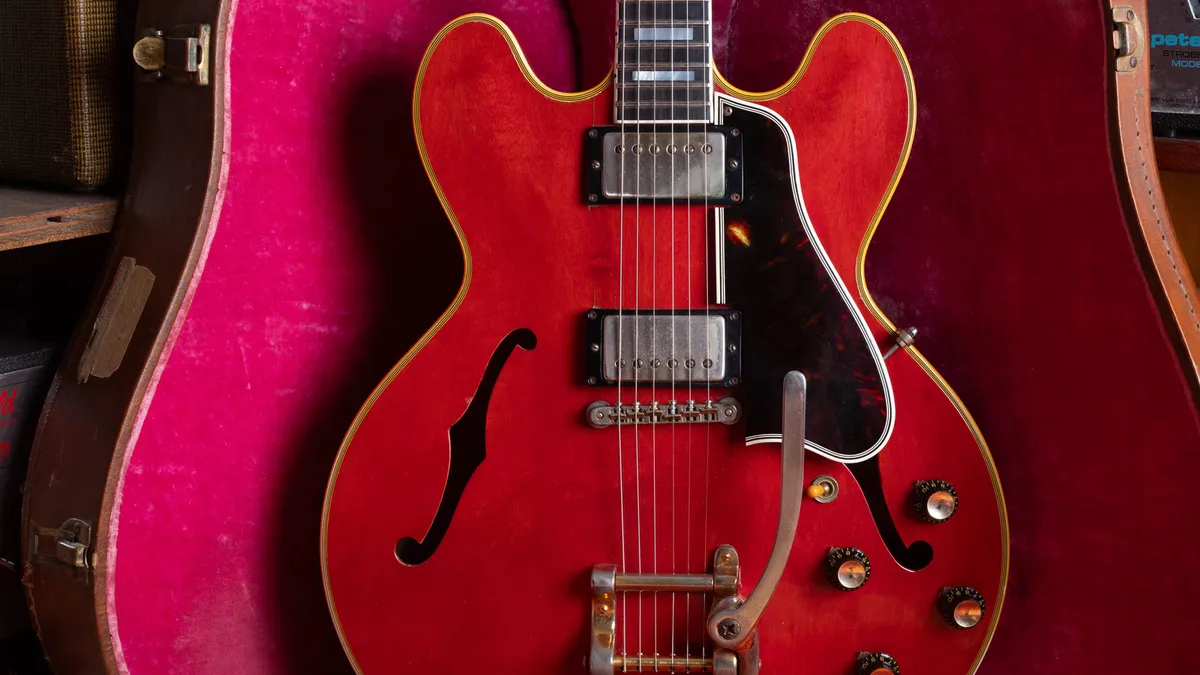
I’m Joe Dampt. I buy vintage guitars nationwide from Mesa, Arizona, and I’ve got a 1959 Gibson ES-355 in cherry on the bench this week: gold Bigsby, pink-lined brown case. People have been searching this guitar because Christie’s is selling Johnny Marr’s collection in London on 17 September 2026, and the cherry 355 Seymour Stein bought him is the lot everyone wants to look at.
The Short Answer
Johnny Marr didn’t play just one guitar. He had a handful, and the searches tend to mash them together.
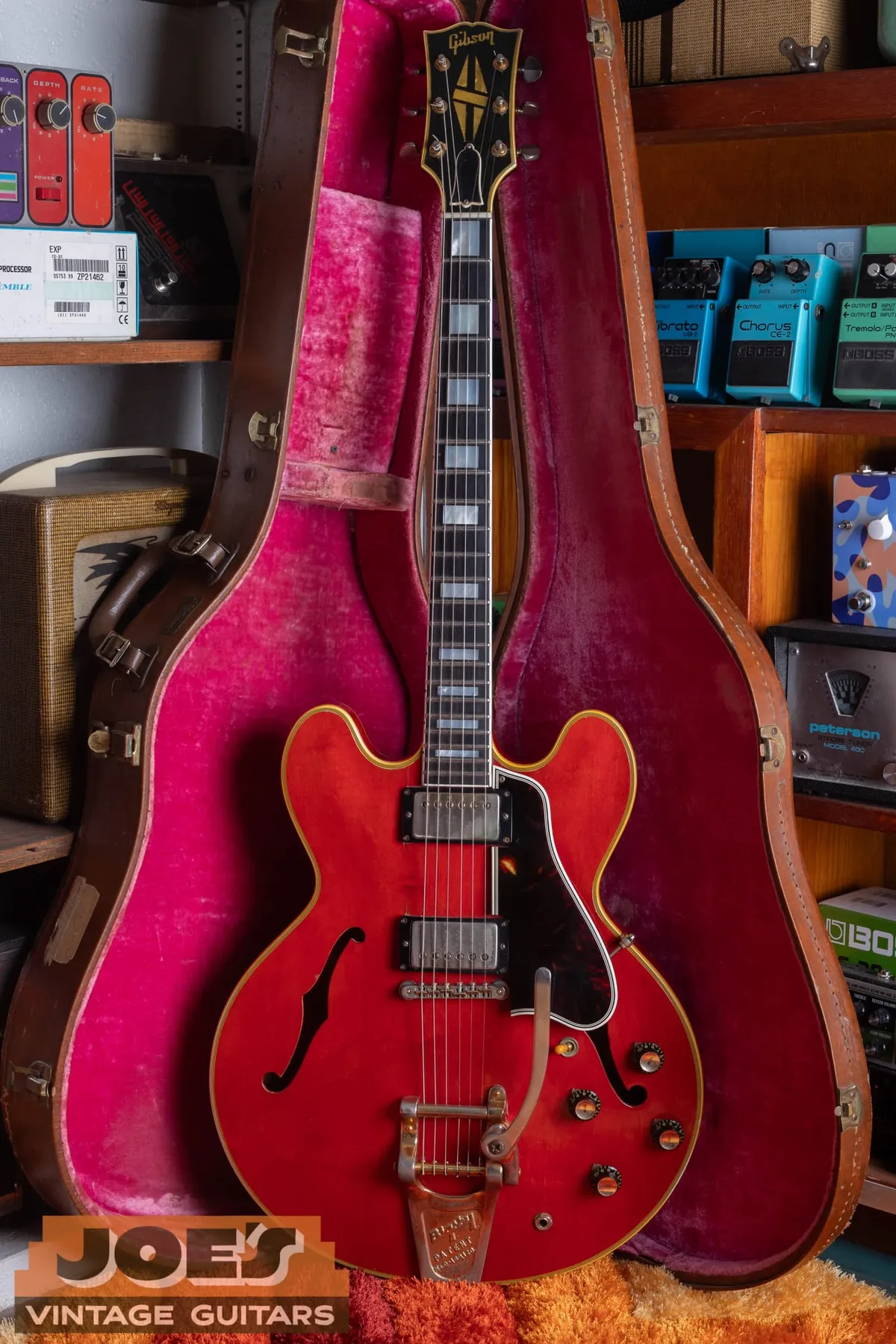
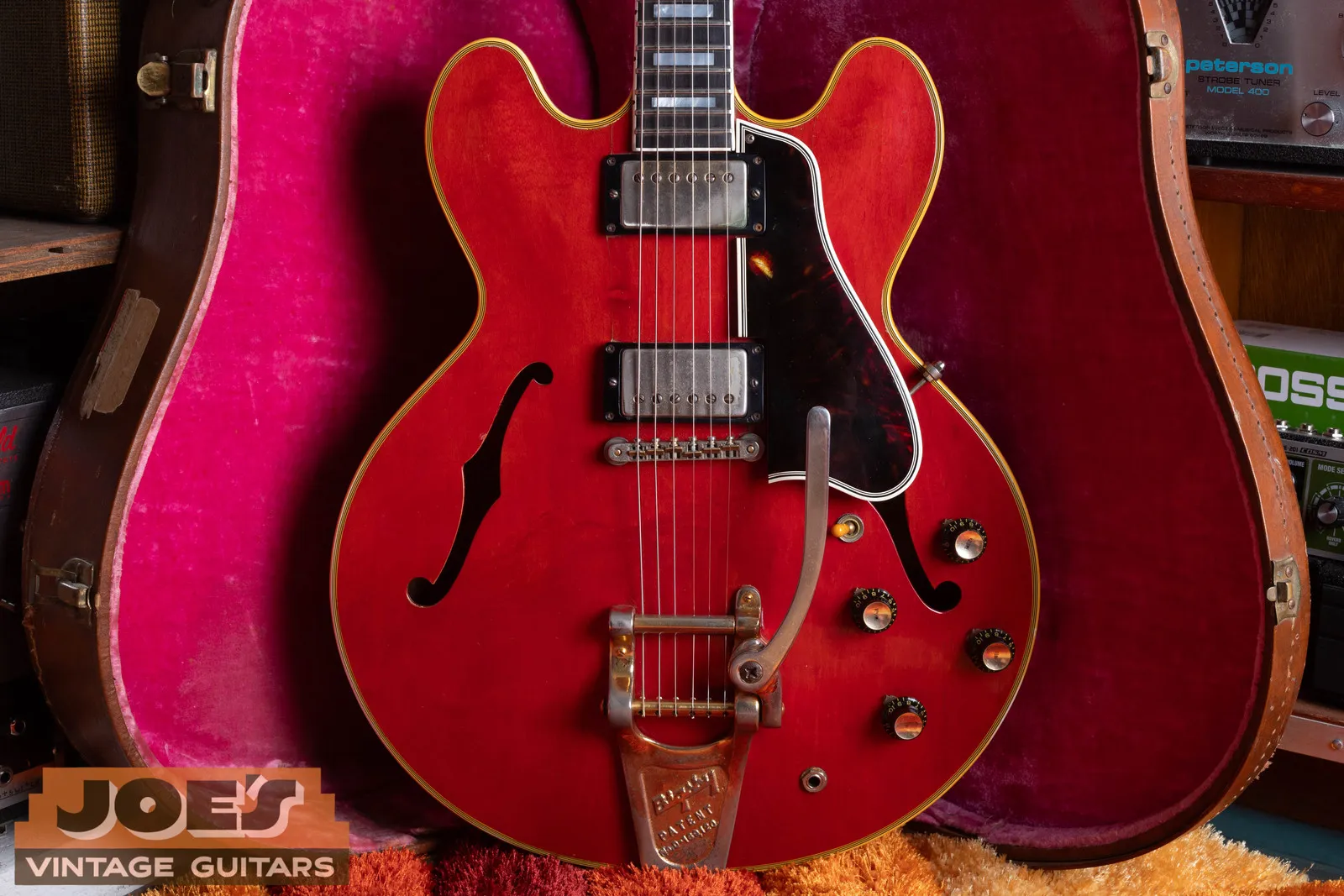
You’re looking at a 1959 cherry 355 in these photos, and that’s the guitar people mean when they talk about the Stein 355. Seymour Stein bought it for him in New York in 1984, and Marr wrote Heaven Knows I’m Miserable Now on it that afternoon. Christie’s has it estimated at £100,000 to £150,000.
Most people know This Charming Man first, though, and that riff is mostly a 1950s Telecaster that belonged to the producer, tracked with a Rickenbacker 330 of Marr’s.
There’s also a 1971 Martin D-28, a six-string, on There Is a Light That Never Goes Out, and the Jaguar you see him with now is a modern Fender signature.
If you’ve got one of those models at home, the rest of this is for you: which guitar is which, and what a regular one actually trades for without the Christie’s name on it.
The Cherry ES-355
I’ll start with the 1959 in these photos, because that’s the guitar I have in the shop this week.
In early 1984 Marr joked that The Smiths would sign to Sire if Seymour Stein bought him a guitar, and Stein actually did. He picked up a cherry Gibson ES-355 on 48th Street in New York, and the Christie’s press kit says Marr took it back to the hotel and wrote Heaven Knows I’m Miserable Now and Girl Afraid the same day.
His is the guitar in the sale, estimated at £100,000 to £150,000. Press copy calls it a 1960, though the lot card says 1959-60 TDSV, and a late 1959 and an early 1960 355 can look the same from across a room. Dating still takes the orange label inside the bass f-hole and the factory order number, so if you’d like that full walk-through, feel free to read my 1959 ES-355 guide.
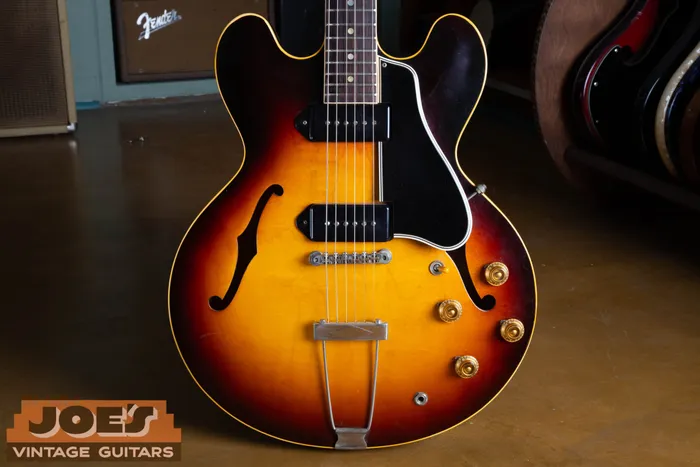
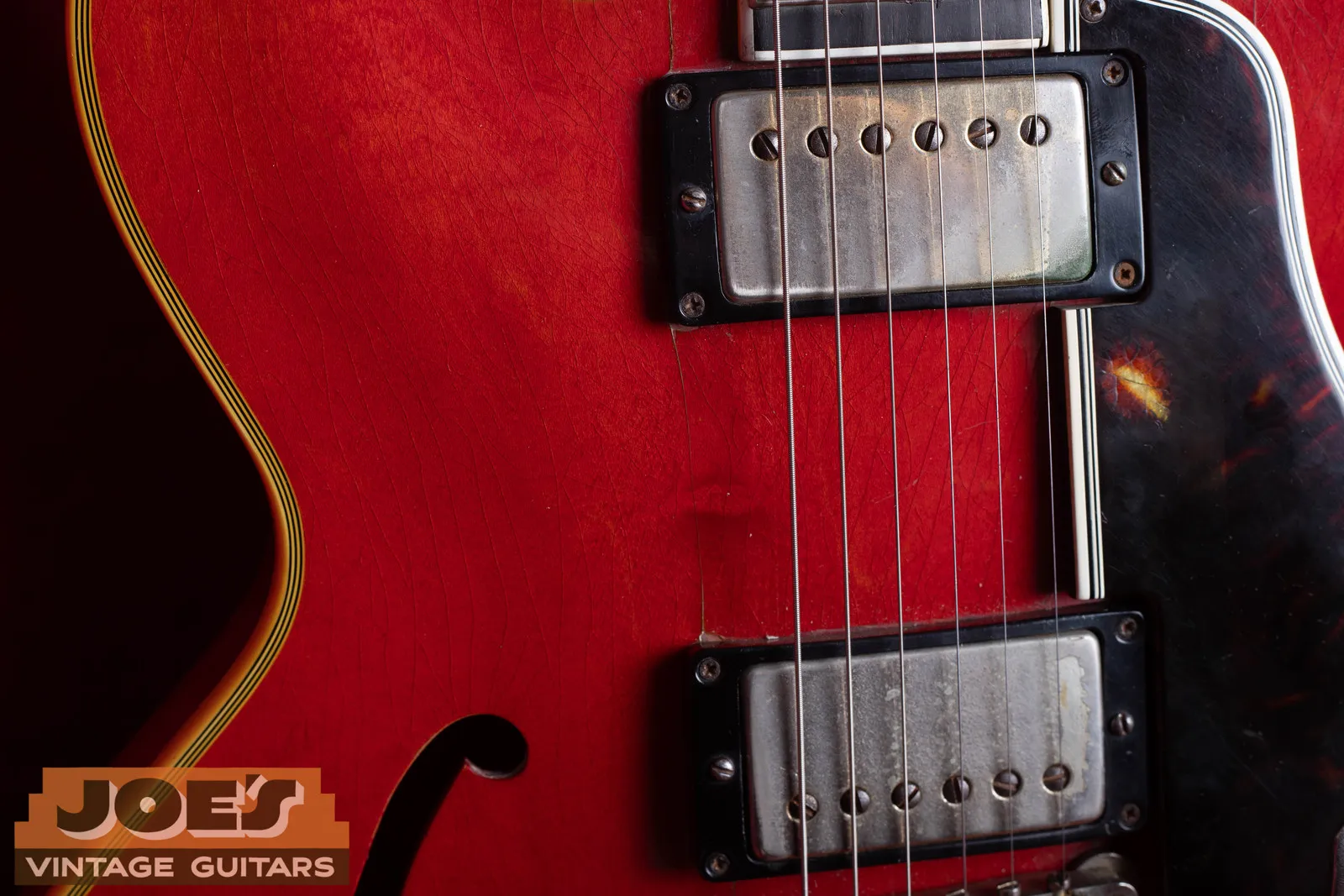
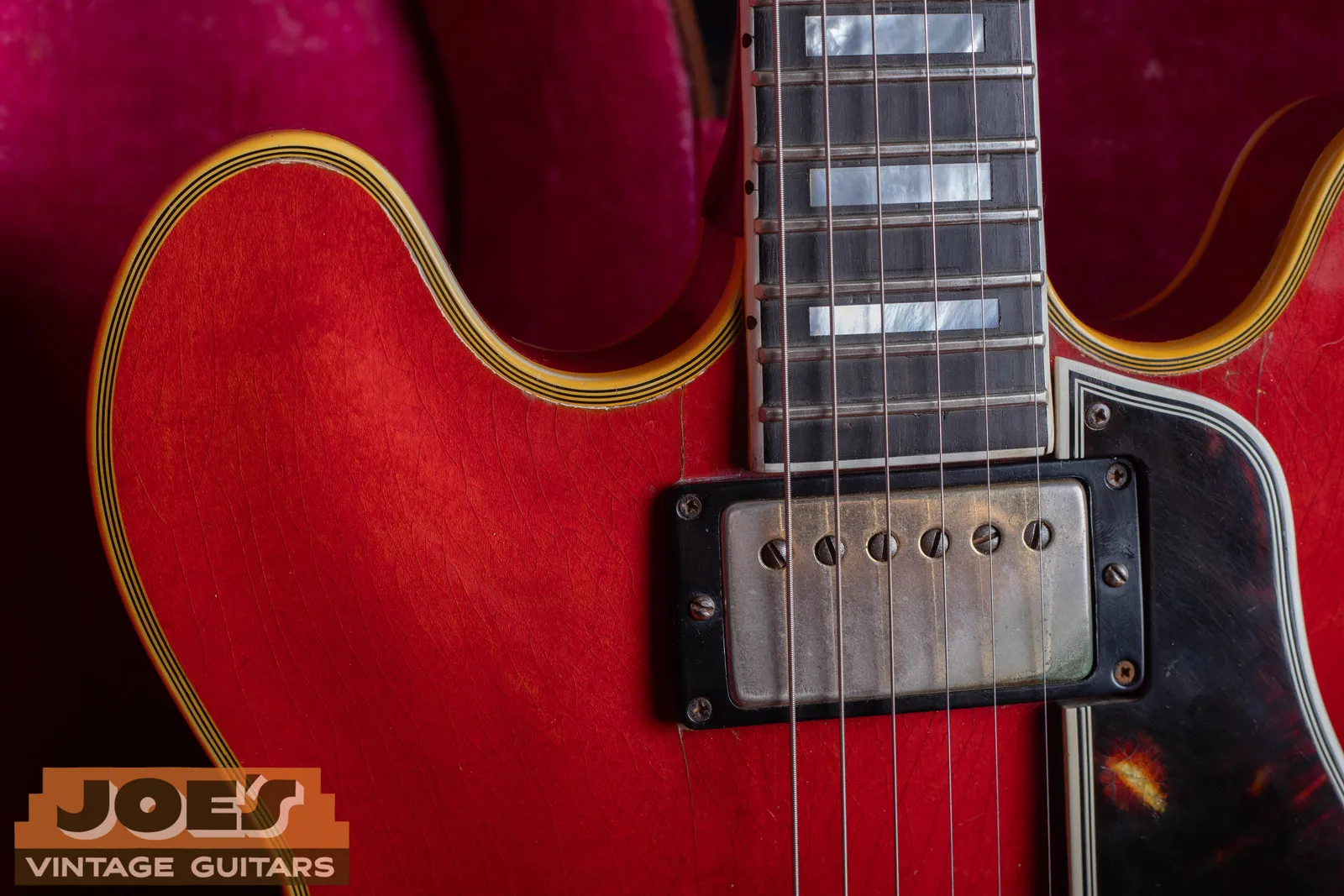
TDSV is the stereo Vari-tone version: two channels, a six-position rotary, and extra wiring in the body. The 1959 in these photos is a cherry mono, with four knobs, a toggle, and no rotary. Typically people pay more for mono 355s. In Marr’s case the stereo wiring won’t really move the number, because so much of that value rides on the celebrity ownership.
This Charming Man
The Stein 355 is the cherry Gibson, like the 1959 in these photos. This Charming Man is a different guitar.
People call the intro “the Rickenbacker,” though The Guardian said it when the sale was announced: the opening riff was played on a 1950s Telecaster. Guitar World has Marr saying the first Tele he ever used was the day he recorded that song, a ’54, maybe a ’53, that belonged to producer John Porter, tracked with a Rickenbacker. “The sound of that intro was always assumed that it was a Rickenbacker because that is what I was most known for at the time.”
The 1982 Rickenbacker 330 in Jetglo is still on that record, and it’s the look people remember. Marr bought it after the first publishing deal and used it on This Charming Man, What Difference Does It Make?, Still Ill, and Accept Yourself. He later lent it to Noel Gallagher, and it ended up on the cover of Oasis’s Supersonic. Christie’s has that 330 estimated at £60,000 to £80,000.
Porter’s Tele isn’t in the sale, and I don’t have it either, though the ’58 in my shop is at least the right family, a few years later than the refinished ’53 or ’54 Marr remembered.
The green Tele that made the sale is a third guitar. Roger Giffin built it around 1984, Angie bought it as an engagement gift, and it’s the one on Top of the Pops in May 1984 and on Meat Is Murder, estimated at £20,000 to £30,000.
If you inherited a Rickenbacker and you need the year, the Rickenbacker serial number guide is a good place to start, because a ’60s 330 and an ’82 don’t draw the same buyer.
The Martin And The Jaguar
Two more keep coming up in the same search.
Marr’s main Smiths acoustic is a 1971 Martin D-28, a six-string, on There Is a Light That Never Goes Out, Well I Wonder, and Cemetry Gates, estimated at £30,000 to £50,000. There’s a 12-string in the sale too, a 1976 D-12-28, estimated at £4,000 to £6,000. They both say D-28 on the headstock. Count the tuning pegs.
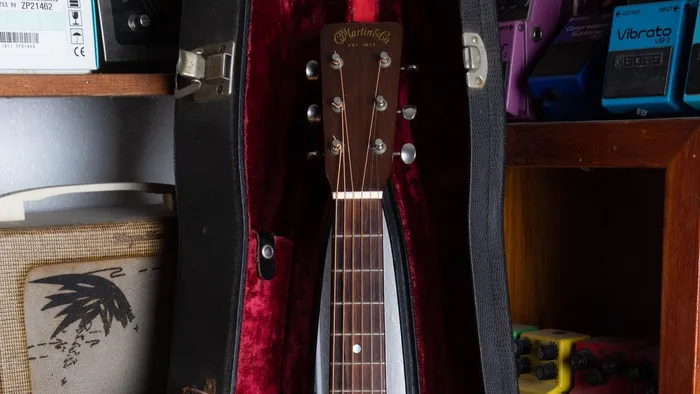
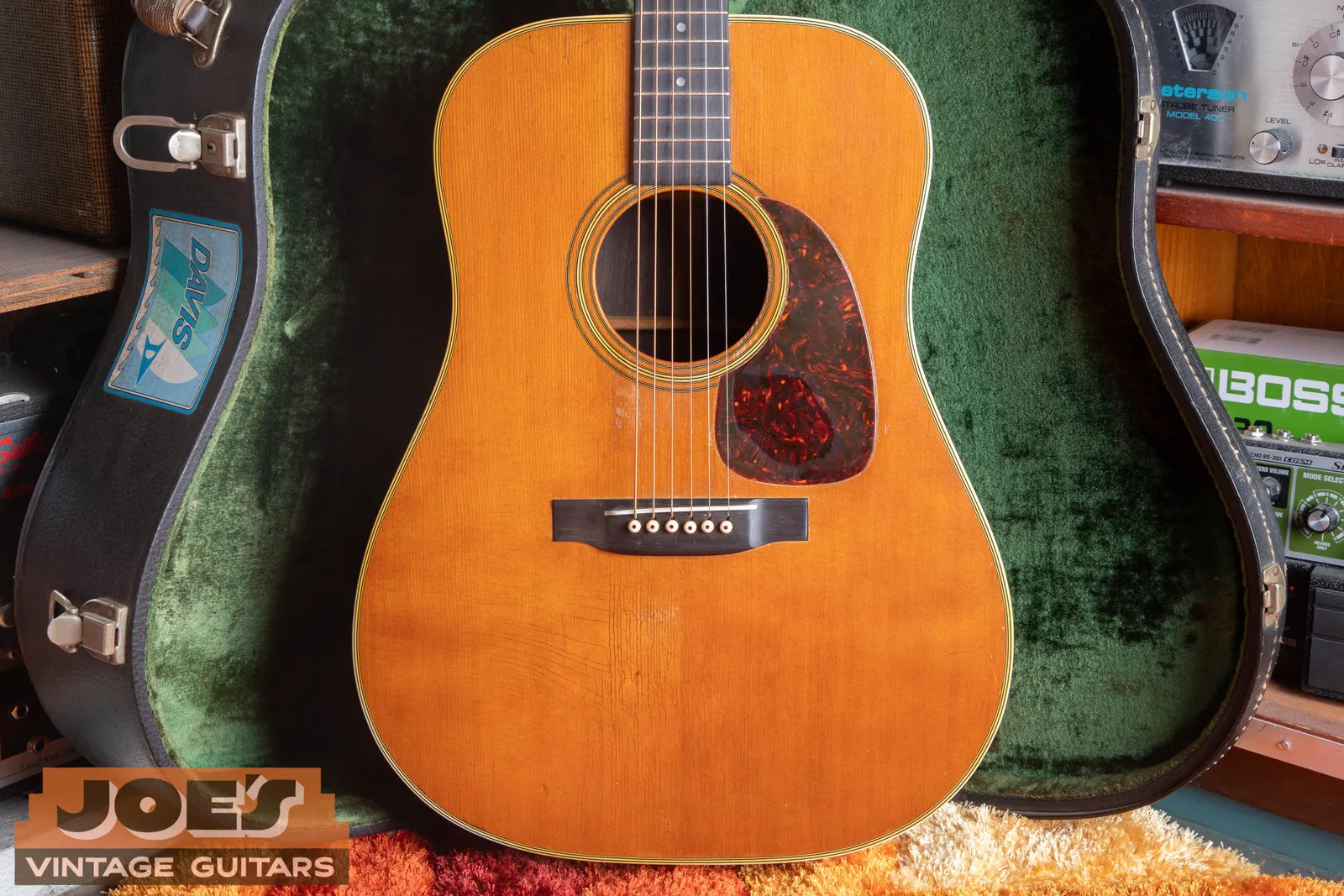
What you see in the photos is a 1959 D-28, Brazilian rosewood and a bit earlier than Marr’s 1971 Indian rosewood, so same shape, though Brazilian and Indian aren’t the same guitar. The Martin D-28, D-18, and D-45 value guide explains the 1969 rosewood change and the earlier D-28 market. Its published ranges end at 1969, so a 1971 D-28 still needs later East Indian rosewood comparables.
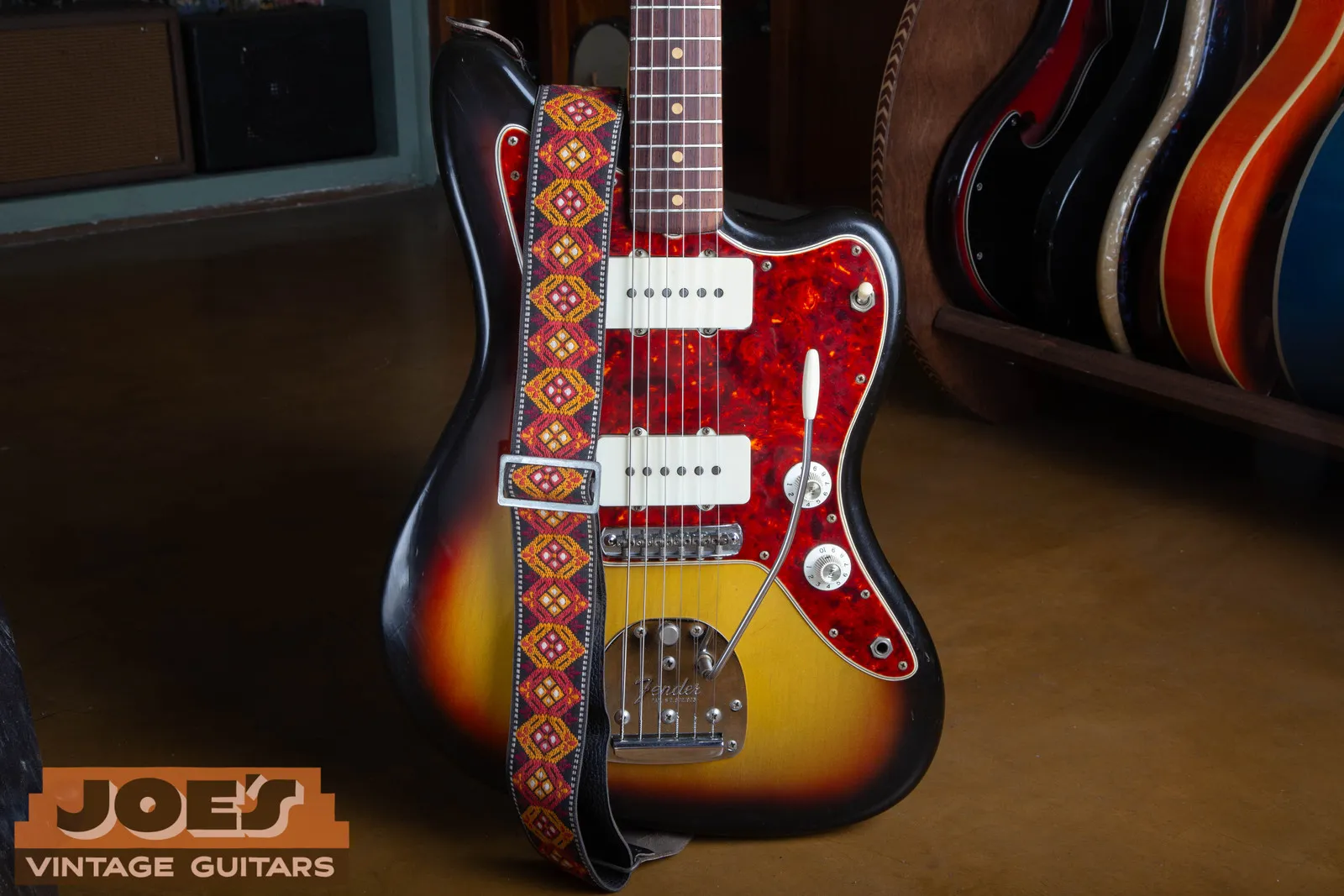
The Jaguar people picture him with now is a Fender Johnny Marr Signature in Comet Sparkle, the one on No Time To Die, estimated at £8,000 to £12,000. Christie’s press kit dates it 2017 and the event page says 2018. Either way it’s a modern signature, and the vintage ones are the 1962-75 Jaguars.
What you get on a 1965 sunburst is that older family: offset body, rhythm circuit on the upper horn, claw pickups, floating trem. The vintage Fender Jaguar guide is the longer version if you want it.
The sale itself is Thursday 17 September 2026, 2pm BST, at Christie’s in London, lots 1 through 112, with London viewing 9-16 September. The New York viewing already happened, anyway, so I’m staying with the guitars people are actually searching.
What They Are Worth Without His Name On Them
Christie’s numbers are what someone might pay for his instruments. Below is what a regular one of these actually trades for, from public asking and sold dealer pages, so read them as market context rather than as an offer from me. The market’s thin, and asking usually runs ahead of sold.
A 1959 ES-355TD mono in cherry, all-original, sits about $30,000 to $45,000 on my 1959 ES-355 page, and stereo Vari-tone is a bit lower, roughly $22,000 to $38,000 on that same page.
A 1960s Rickenbacker 330 is asking about $4,500 to $8,500 right now. Chicago Music Exchange had a 1966 Fireglo at $4,700, and Fretted Americana had a near-mint 1966 at $8,500. An 1980s 330 with no provenance is more like $2,000 to $4,000, and the comps there are thin, so don’t price a 1982 off 1966 comps, because those are two different buyers.
A 1960s Jaguar in sunburst is about $4,000 to $8,000 off 1965 Reverb comps, with custom color running higher. What you’re looking at there is the vintage guitar, and the signature model is its own conversation.
An early-1970s D-28 in Indian rosewood is asking about $3,500 to $7,500. I wouldn’t use the 1960-69 Brazilian D-28 table on it, because the wood and the years aren’t comparable.
Set next to those, the named lots in pounds are another conversation: £100,000 to £150,000 for the 355, £60,000 to £80,000 for the 1982 330, £30,000 to £50,000 for the 1971 D-28, £20,000 to £30,000 for the Giffin, and £8,000 to £12,000 for the signature Jag. That’s provenance money, which isn’t what a regular 1959 355 or a 1960s 330 trades for.
If you want a number on the guitar in your closet, send photos. The appraisal is free and there’s no obligation to sell.
If You Inherited One
Vintage ES-355s, 345s, and 335s are right in what I buy. The Gibson buying page is a good starting point, and if you want help dating one, feel free to read the 1959 ES-355 guide before you guess the year. I’d leave the gold plating and the Vari-tone alone, because those are the parts people tend to “improve” first.
A 1960s Rickenbacker 330 is the same story on that side of the shop: the Rickenbacker serial number guide and the Rickenbacker buying page will get you oriented.
1962-75 Jaguars and 1950s Teles live on the Fender buying page, and the Jaguar guide is there if you want more on the vintage offsets. A Johnny Marr signature Jag is a modern guitar, so I don’t treat a 2017 as vintage.
The 1982 330 and the 1971 D-28 both sit outside the years I advertise, though I’m still happy to look at photos, and I can date a Martin from the neck-block stamp. A vintage Martin dreadnought from the years I do buy is on the Martin buying page.
I buy in all 50 states from Mesa, and I handle packing and insured shipping if we can’t meet here.
Call or text (602) 900-6635 or email joesvintageguitars94@gmail.com.
Frequently Asked Questions
What Guitar Did Johnny Marr Play?
Several, depending on the song. Heaven Knows came off the Stein cherry 355, the early Smiths look is the 1982 330, There Is a Light is the 1971 D-28, and the Jag people picture now is his signature. The green Giffin is the Top of the Pops Tele; Charming Man used Porter’s.
Was This Charming Man Played On A Rickenbacker?
Partly. The 330 is on the record, but Marr has said the intro came mostly off John Porter’s early-50s Tele.
Is Johnny Marr's ES-355 A 1959 Or A 1960?
Christie’s calls it a 1960 in the marketing and 1959-60 TDSV on the lot card. I wouldn’t hang a year on a headline. The one in my photos is a 1959 cherry mono; his is the stereo Vari-tone.
Is The 1971 D-28 A 12-String?
No, the 1971 is a six-string. The 12-string is a 1976 D-12-28 sitting in its own lot.
Is The Giffin Tele The Charming Man Tele?
No. Porter’s ’53 or ’54 did Charming Man, and that Tele isn’t in the sale. The Giffin is a mid-80s one-off he used on Top of the Pops.
What Is A Vintage ES-355 Worth Without Johnny Marr Provenance?
A clean original mono 1959 is about $30,000 to $45,000 in public asking on my 1959 page, stereo a bit less. His estimate is in pounds because of the name.
Will You Buy A 1971 D-28, A 1982 330, Or A Signature Jaguar?
I don’t advertise those three as vintage, though I’ll still look at photos if you want a read. What I buy is vintage ES-355s, 1960s 330s, 1962-75 Jaguars, 1950s Teles, and vintage Martins.
When Is The Christie's Johnny Marr Auction?
Thursday 17 September 2026, 2pm BST, at Christie’s London. Lots 1-112, London viewing 9-16 September, and New York viewing is already over.
Send Me Photos
If you want the short version on your guitar, send photos. Front, back, headstock, the label or serial, and anything that looks like a Vari-tone, a toaster pickup, or a neck-block stamp. I’ll tell you the model and give you a current market read. Use the free appraisal form, or text me at (602) 900-6635.
I’m Joe Dampt. I buy, sell, and appraise vintage instruments in Mesa, Arizona. I’ve been doing this full-time for more than twelve years. If you want me to look at the guitar in the case, that’s the appraisal form.
Who I am and how I work is on the about page.
Disclaimer
Value estimate. This is an estimate of market value, so it isn’t an offer to buy and it isn’t a guarantee. Market values fluctuate. Have your specific item appraised. The dollar figures above are public-market asking and sold ranges without Marr provenance, so they aren’t a bid on your guitar and they aren’t Christie’s estimates converted into dollars.
Originality judgment. Originality is assessed from the information provided. A hands-on inspection can change the conclusion. A photo read isn’t a certificate that a guitar belonged to a named player. None of the shop photos in this post are Johnny Marr’s instruments.
Results vary. Past results don’t guarantee a similar outcome. Each guitar depends on its own facts. The Christie’s sale hasn’t happened yet, so I wouldn’t treat those estimates as hammers.