

Gibson Bass Prices · Original Models Through 1979
Gibson Thunderbird And EB Bass Value Guide
Use the exact model, body generation and finish row. Early reverse Thunderbirds and later EB basses have very different comparisons.
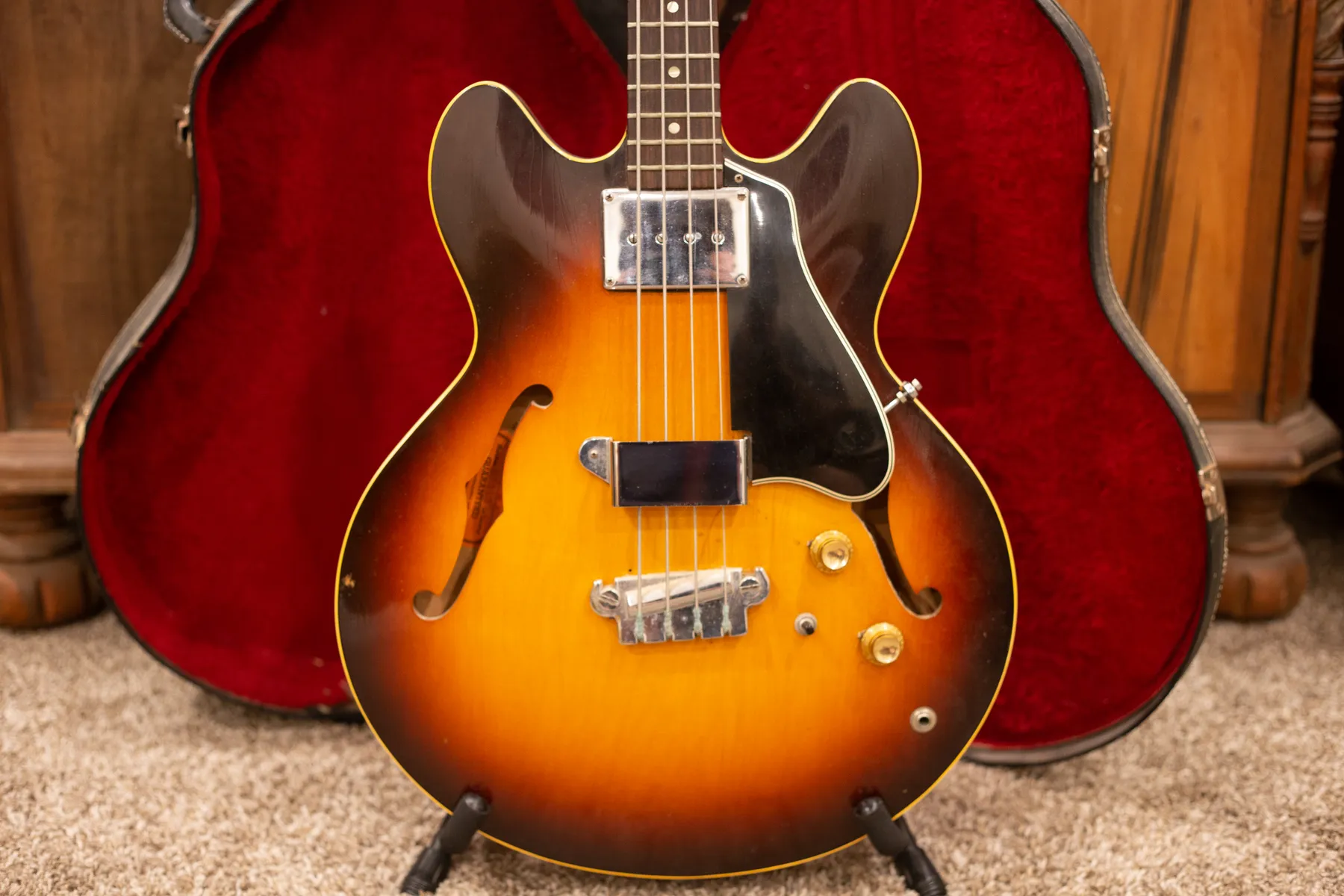
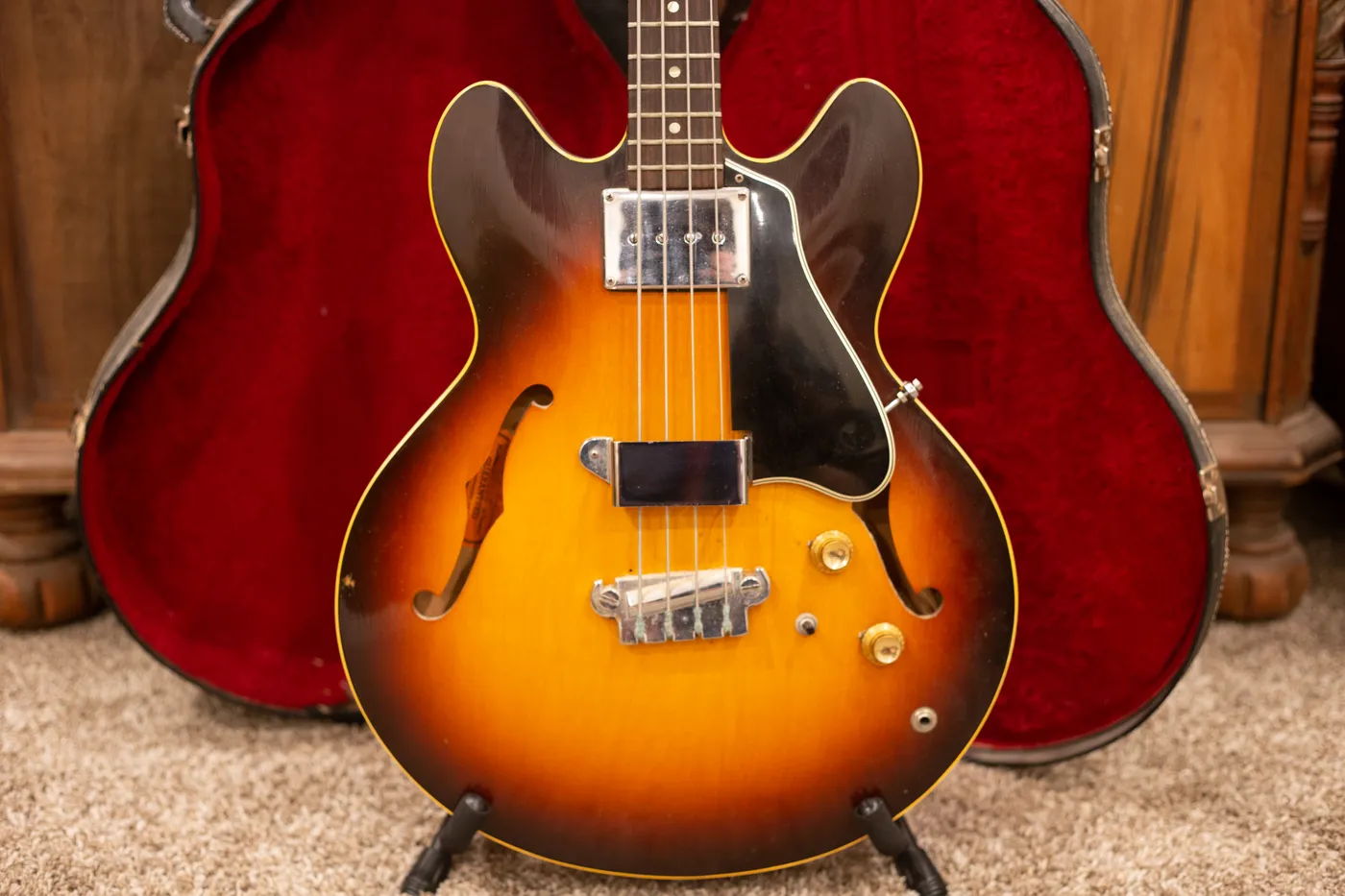
A 1963 sunburst Thunderbird IV is estimated at $10,000 to $12,600, while a 1966 to 1969 cherry or sunburst EB-2 is $2,200 to $2,850 in excellent, original condition with the original case. Joe’s 1967 EB-2 photograph shows the latter family. Use the Gibson bass authentication guide to establish model, scale and body generation before comparing the figures.
This Is An Estimate Of Market Value, Not An Offer To Buy And Not A Guarantee. Market Values Fluctuate; Have Your Specific Item Appraised.
Excellent Original Basses With Their Cases
Vintage Gibson Bass Values By Model And Year
| Model | Pricing Year Group | Configuration | Estimated Value |
|---|---|---|---|
| EB-0 | 1959 to 1960 | Cherry; slab body | $3,100 to $5,350 |
| EB-0 | 1961 | Cherry; SG body | $2,150 to $3,000 |
| EB-0 | 1962 | Cherry | $2,200 to $3,100 |
| EB-0 | 1963 | Cherry | $2,250 to $3,100 |
| EB-0 | 1965 to 1966 | Cherry | $2,200 to $2,650 |
| EB-0 | 1965 to 1966 | Pelham Blue | $3,050 to $3,900 |
| EB-0 | 1967 to 1968 | Cherry | $1,750 to $2,200 |
| EB-0 | 1967 to 1968 | Pelham Blue | $3,450 to $4,750 |
| EB-0 | 1968 | Black | $3,450 to $4,300 |
| EB-0 | 1968 | Burgundy Metallic | $2,650 to $4,000 |
| EB-0 | 1969 | Cherry; solid headstock | $1,550 to $2,000 |
| EB-0 | 1969 | Pelham Blue | $2,250 to $3,100 |
| EB-0 | 1969 to 1974 | Later EB-0 | $1,100 to $1,500 |
| EB-0 | 1975 to 1979 | Later production | $1,100 to $1,500 |
| EB-0F | 1962 to 1965 | Cherry; built-in fuzz | $2,800 to $3,850 |
| EB-0L | 1969 to 1979 | Long scale; various colors | $1,500 to $2,150 |
| EB-2 | 1958 | Sunburst | $4,350 to $6,100 |
| EB-2 | 1959 | Natural | $5,300 to $8,350 |
| EB-2 | 1959 | Sunburst | $3,850 to $5,550 |
| EB-2 | 1960 | Natural | $5,200 to $6,950 |
| EB-2 | 1960 | Sunburst | $3,750 to $4,850 |
| EB-2 | 1961 | Sunburst; black pickup cover | $3,450 to $4,300 |
| EB-2 | 1961 | Sunburst; brown pickup cover | $3,700 to $4,350 |
| EB-2 | 1964 | Sunburst | $2,450 to $3,100 |
| EB-2 | 1965 | Sunburst | $2,400 to $3,100 |
| EB-2 | 1966 to 1969 | Cherry or sunburst | $2,200 to $2,850 |
| EB-2 | 1967 to 1969 | Sparkling Burgundy | $2,650 to $3,550 |
| EB-2 | 1967 to 1969 | Walnut | $2,600 to $3,050 |
| EB-2 | 1970 to 1972 | Sunburst | $2,200 to $2,600 |
| EB-2D | 1966 to 1969 | Cherry or sunburst; two pickups | $2,550 to $4,250 |
| EB-2D | 1967 to 1969 | Sparkling Burgundy; two pickups | $2,350 to $3,000 |
| EB-2D | 1967 to 1969 | Walnut; two pickups | $3,000 to $3,850 |
| EB-2D | 1970 to 1972 | Cherry or sunburst; two pickups | $2,150 to $3,000 |
| EB-3 | 1961 to 1964 | Cherry; two pickups | $3,850 to $5,600 |
| EB-3 | 1965 | Early version | $3,550 to $5,350 |
| EB-3 | 1965 | Late version | $3,000 to $3,850 |
| EB-3 | 1965 | White | $4,400 to $8,800 |
| EB-3 | 1966 | Two pickups | $2,650 to $3,500 |
| EB-3 | 1967 to 1968 | Two pickups | $2,200 to $2,850 |
| EB-3 | 1969 | Early version | $2,000 to $2,650 |
| EB-3 | 1969 | Late version | $2,000 to $2,400 |
| EB-3 | 1970 | Two pickups | $1,700 to $2,150 |
| EB-3 | 1971 | Two pickups | $1,750 to $2,200 |
| EB-3 | 1972 to 1979 | Two pickups | $1,500 to $1,950 |
| EB-3L | 1969 to 1972 | Long scale; cherry, natural or walnut | $1,900 to $2,550 |
| EB-4L | 1972 to 1979 | Long scale; cherry or walnut | $1,350 to $1,800 |
| Thunderbird II | 1963 | Sunburst; reverse body | $8,500 to $11,900 |
| Thunderbird II | 1964 | Pelham Blue; reverse body | $13,200 to $21,550 |
| Thunderbird II | 1964 | Sunburst; reverse body | $8,600 to $12,050 |
| Thunderbird II | 1965 | Cardinal Red; non-reverse body | $8,500 to $11,050 |
| Thunderbird II | 1965 | Inverness Green; non-reverse body | $8,900 to $11,550 |
| Thunderbird II | 1965 | Sunburst; non-reverse body | $6,100 to $8,250 |
| Thunderbird II | 1965 | Sunburst; reverse body | $8,500 to $11,900 |
| Thunderbird II | 1966 | Cardinal Red; non-reverse body | $11,900 to $15,300 |
| Thunderbird II | 1966 | Pelham Blue; non-reverse body | $11,900 to $15,300 |
| Thunderbird II | 1966 | Sunburst; non-reverse body | $6,250 to $8,900 |
| Thunderbird II | 1967 | Cardinal Red; non-reverse body | $10,450 to $13,500 |
| Thunderbird II | 1967 | Sunburst; non-reverse body | $6,250 to $8,450 |
| Thunderbird II | 1968 | Cardinal Red; non-reverse body | $10,300 to $13,350 |
| Thunderbird II | 1968 to 1969 | Sunburst; non-reverse body | $6,250 to $8,450 |
| Thunderbird IV | 1963 | Sunburst; reverse body | $10,000 to $12,600 |
| Thunderbird IV | 1964 | Frost Blue; reverse body | $20,000 to $25,500 |
| Thunderbird IV | 1964 | Pelham Blue; reverse body | $20,450 to $26,100 |
| Thunderbird IV | 1964 | Sunburst; reverse body | $9,900 to $12,900 |
| Thunderbird IV | 1965 | Cardinal Red; non-reverse body | $9,700 to $19,350 |
| Thunderbird IV | 1965 | Inverness Green; non-reverse body | $9,700 to $19,350 |
| Thunderbird IV | 1965 | Sunburst; reverse body | $9,900 to $12,450 |
| Thunderbird IV | 1965 to 1966 | Sunburst; non-reverse body | $7,400 to $10,000 |
| Thunderbird IV | 1966 | White; non-reverse body | $12,300 to $19,800 |
| Thunderbird IV | 1967 to 1969 | Sunburst; non-reverse body | $7,550 to $10,250 |
| Thunderbird 76 | 1976 | Bicentennial; reverse body; various colors | $3,000 to $5,150 |
U.S. dollars. These November 2026 retail market estimates assume excellent, original condition and the original case where applicable. An individual sale can fall outside the range; these figures are not purchase offers. Repairs, changed parts and market conditions require an individual appraisal.
| Model | Pricing Year Group | Unresolved Designation | Conditional Estimate |
|---|---|---|---|
| EB-0 | 1964 | Cherry; late-1964 truss rod | $1,950 to $2,800 |
| EB-0 | 1964 | Cherry; raised truss rod | $2,350 to $2,750 |
| Thunderbird 79 | 1979 | Reverse body; sunburst | $3,000 to $5,100 |
| Thunderbird III | 1979 | Reverse body; two pickups | $3,100 to $3,750 |
These entries are separated from the main comparison table because their descriptions overlap or use unresolved terminology. Individual identification is required before applying a range. The same excellent, original condition and original-case assumptions apply.
The 1979 Thunderbird 79 and Thunderbird III entries overlap in year and basic layout. This table doesn’t establish a reliable physical distinction between them. Joe needs the serial, complete instrument photographs and ownership records before selecting either comparison.
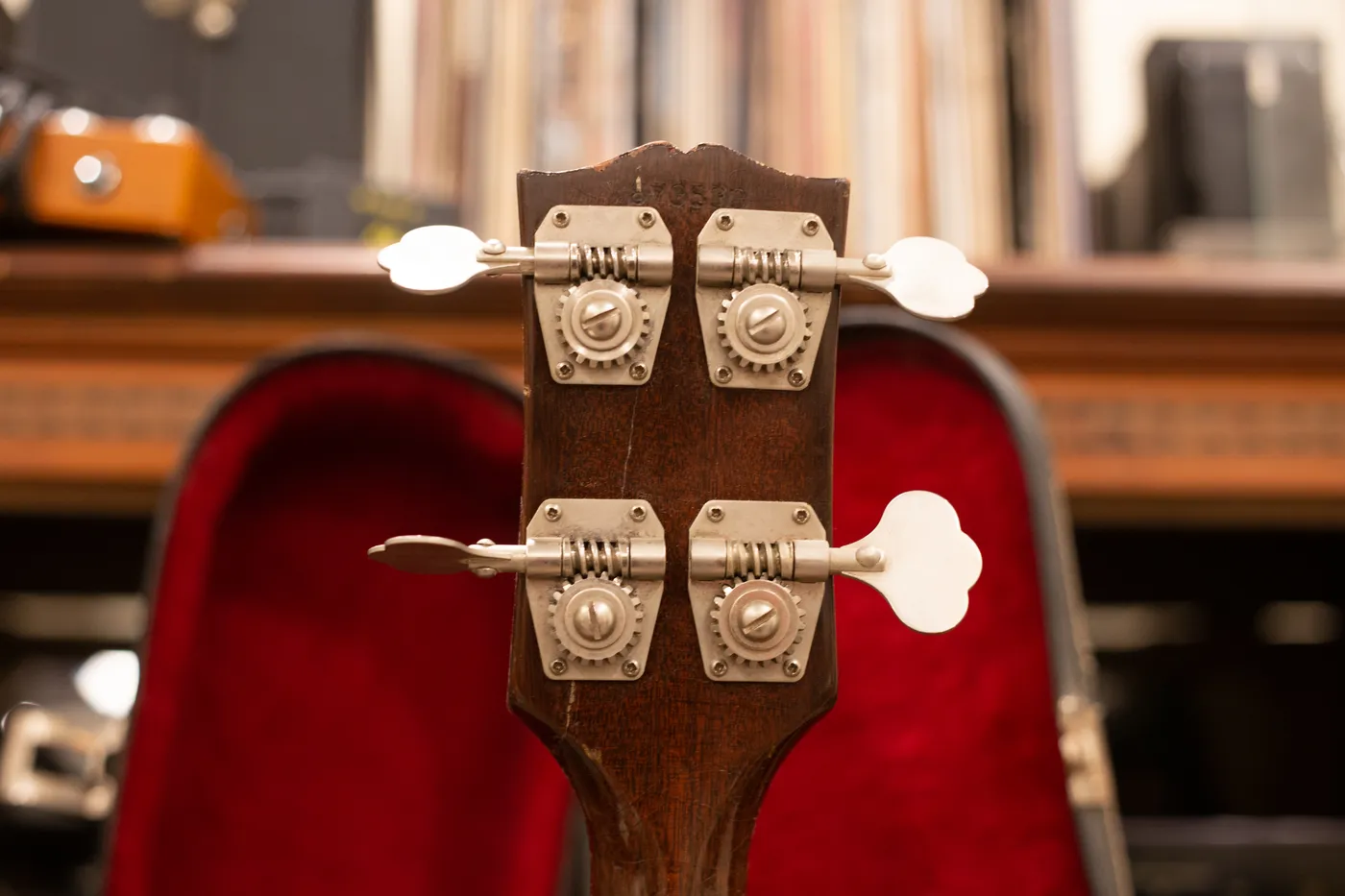
The two 1964 EB-0 estimates retain separate “late-1964 truss rod” and “raised truss rod” designations. The year alone doesn’t establish which comparison applies. Leave that selection to an individual appraisal and send clear headstock face and profile photographs; no adjustment or disassembly is needed. For early and late EB-3 groups, compare the control spacing in 1965 and the solid-to-slotted headstock transition around 1969 in the authentication references. A year alone may leave two possible rows.
Find the model first, then read its year and configuration. The EB-0, EB-2, EB-3 and Thunderbird rows include different finishes and production changes. A multi-year price group is a valuation grouping; it doesn’t establish that every construction feature stayed identical throughout those years.
The table doesn’t supply 1977 or 1978 Thunderbird figures or a 1971 EB-4L figure. Those attributions require a separate appraisal. Modern reissues and later production are outside this through-1979 scope. All figures are November 2026 estimates for the stated condition, rather than purchase offers.
Reverse, Non-Reverse And Later Groups
Thunderbird Prices Depend On Body Generation And Finish
The 1963 sunburst Thunderbird II estimate is $8,500 to $11,900, compared with $10,000 to $12,600 for the two-pickup IV. Confirm the model before using the range. A pickup added to a II doesn’t automatically establish the collector comparison of a factory IV.
Both body generations occur in the 1965 references. A sunburst reverse II is $8,500 to $11,900, while the non-reverse sunburst II is $6,100 to $8,250. The construction and date must be settled together. A serial that allows several years needs supporting physical evidence.
Custom colors have specific rows. For example, the 1964 reverse Thunderbird IV in Pelham Blue is $20,450 to $26,100. That estimate requires support for the original factory color. A later blue refinish should be described and appraised as a refinish, even when it closely resembles an original shade.
The 1976 Bicentennial group is $3,000 to $5,150. The 1979 entries appear in the separate identification-required table above; their ranges can’t be selected from the year and basic layout alone. A replaced decorative guard or a broad “1970s Thunderbird” description can’t establish the correct row.
Body Form, Electronics And Scale
EB-0, EB-0F And EB-0L Comparisons
The 1959 to 1960 cherry slab-body EB-0 is estimated at $3,100 to $5,350. The 1961 SG-body group is $2,150 to $3,000. A changed guard or an uncertain year should not obscure the underlying body generation.
The EB-0F with built-in fuzz has a 1962 to 1965 comparison of $2,800 to $3,850. Its circuit needs to be identified and its working condition described. An external fuzz pedal or a later onboard installation doesn’t create the original factory model.
The long-scale EB-0L group is $1,500 to $2,150 for 1969 to 1979. Supply a scale measurement with the photographs. Long-scale identity affects which comparison applies, even when the body looks much like a shorter instrument in a cropped picture.
Original finishes also have separate EB-0 rows, including Pelham Blue and certain 1968 colors. Don’t turn an uncommon color description into a premium before the finish is examined. Overspray, fading and a complete refinish need distinct condition notes.
Semi-Hollow Bass Configurations
EB-2 And EB-2D Values
The 1966 to 1969 cherry-or-sunburst EB-2 estimate is $2,200 to $2,850. The corresponding two-pickup EB-2D group is $2,550 to $4,250. Count the pickups and inspect the controls before assuming a D designation.
Early natural EB-2s have their own comparisons: $5,300 to $8,350 for 1959 and $5,200 to $6,950 for 1960. Factory-natural finish is part of those assumptions. A stripped sunburst requires an individual appraisal with the altered surface disclosed.
Joe’s 1967 archive example shows the full body, pickup and switch layout. For your bass, include any electrical fault, loose output connection or known harness work in the request. Replacing a failed component may restore function while also changing the original-parts assessment.
Verify The Model Before Comparing Years
EB-3 And EB-4L Price Groups
Early EB-3
The 1961 to 1964 cherry two-pickup group is $3,850 to $5,600. The separate early and late 1965 rows require period identification. An exact year from an overlapping serial range should be corroborated before assigning the higher comparison.
Later EB-3 And EB-3L
The 1972 to 1979 EB-3 estimate is $1,500 to $1,950. The 1969 to 1972 long-scale EB-3L is $1,900 to $2,550. Measure scale and describe any altered pickups or controls.
EB-4L
The supported 1972 to 1979 group is $1,350 to $1,800. Its pickup and switching arrangement need to be present and assessed. A modified single-pickup bass should not be identified solely by the number of pickup covers.
Document The Neck And Electrical System
Repairs And Replaced Parts On Gibson Basses
Headstock and neck repairs can materially change the comparison with an excellent original bass. Show the repaired area from the rear and sides, plus a wider view of the neck. Include receipts or details about reinforcement if available. Repair quality and the remaining condition require individual judgment.
Bridge substitutions can leave new mounting holes or altered posts. Pickup replacements may fit the original opening or involve routing. The pickup replacement guide explains why the part and the wood alteration should be described separately.
Missing hand rests, pickup covers, mutes and original controls affect completeness. Gather anything kept in the case and photograph it without trying to reinstall it. A loose component still needs identification, and its advertised standalone price doesn’t establish its contribution to the bass’s value.
Use the condition and value guide to organize several changes into one coherent description. A refinish may accompany a repaired break or an old pickup conversion. Assessing the complete result avoids counting the same work several times.
For surface work, the refinish guide explains the distinction between original wear and an altered finish. State what was refinished and when, if known. Leave uncertain history open for inspection instead of selecting a factory custom-color row from appearance alone.
Model Evidence, Condition And Transport
Prepare A Vintage Gibson Bass For Appraisal
Send the whole bass, body back, both headstock faces, serial and pickup layout. Add a scale measurement and report which controls work. For a semi-hollow EB-2, initial pictures can be taken without removing the harness. Existing service photographs are useful when hidden components need review.
Photograph the case fit, handle and latches. A long Thunderbird and a semi-hollow EB-2 need different support inside their cases, so discuss packing before shipment. A replacement case should be described as such even if it protects the instrument well.
Before paying for cosmetic repairs or new hardware, read whether restoration makes sense before a sale. Joe can begin with the current condition through a free appraisal, then discuss the next step on the Gibson selling page.
For a bass that has been unused for years, report that storage history and any known electrical problem before arranging service. The initial value review can identify which questions need a repairer’s attention. Avoid replacing functioning vintage equipment simply to make every part look uniform. A documented replacement may be practical, but its cost and its effect on the sale are separate decisions.
Send The Evidence
Get Your Gibson Bass Appraised
Include the model, finish, scale, repair history and case photographs. Tell Joe your location and whether you are considering a sale.
Questions AboutGibson Values
What Is A 1967 Gibson EB-2 Worth?
Can I Use A 1976 Thunderbird Price For A 1977 Bass?
Does A Custom-Color Refinish Get The Original-Color Premium?
The Last Word
A Value For Your Bass
Match the verified bass model, generation and finish to the chart, then describe all repairs and changes. The Gibson bass identification guide helps resolve the configuration before a price is assigned.
This Is An Estimate Of Market Value, Not An Offer To Buy And Not A Guarantee. Market Values Fluctuate; Have Your Specific Item Appraised.