

How To Date A Fender Telecaster
The Telecaster changed its pickguard, its bridge, its saddles, its board, and even its name, each on its own schedule. Several of those read from across a room, starting with the guard: black or white puts the guitar either side of the summer of 1954 before you have picked it up. Here is what changed and when, from the 1950 Esquire through 1971.
Just after the serial number? The full charts and the lookup tool that decodes a number for you are on the main guide.
Look Up A Serial Number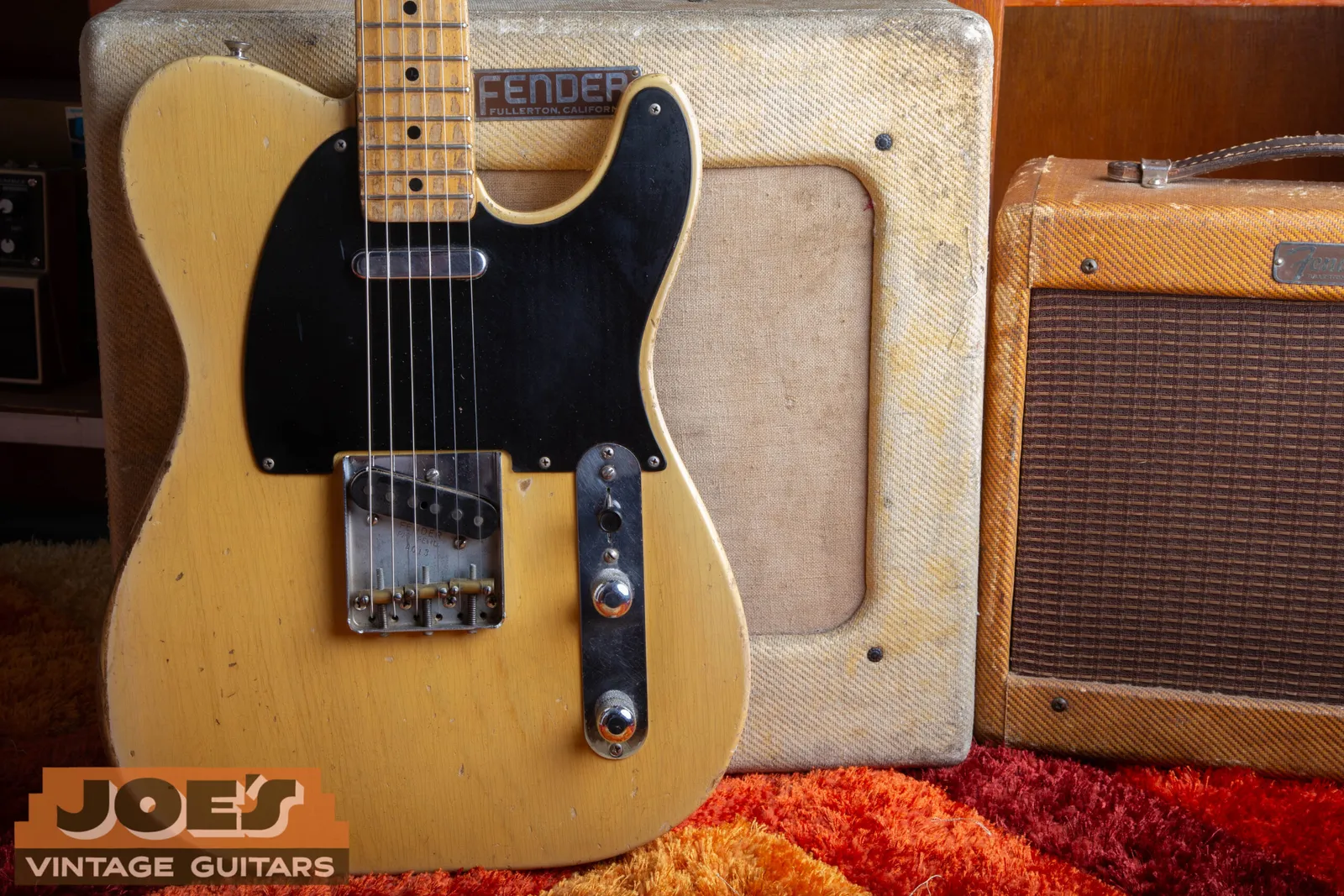
Read The Guitar In Three Passes
Nothing in the first two passes will hand you a single year, and it helps to know that going in. Brass saddles only say before the summer of 1954. A veneer board only says after August 1962. Each feature is a window, and several are wider than the serial number is. Their value is in agreeing with each other and with the number on the plate, because a guitar where six independent things all point at the same stretch of months is a guitar you can be confident about.
Across The Room
The pickguard and the bridge. Black or white, and strings through the body or anchored at the plate. Those two questions cut the vintage era into large pieces before you have touched the guitar.
In Your Hands
The saddles, the board, the knobs, the logo, and the serial number. Take the serial as one vote among several rather than the answer, and read the plate style along with the digits, because where the number sits tells you more than the number does.
Inside The Guitar
The neck heel stamp, the body date, and the pot codes. These are the only places Fender wrote an actual date, and the only things that will give you a month rather than a window. This is also the only pass that needs tools, which is why it comes last.
The three passes should agree. When they do, you have a build date you can stand behind. When they don't, the disagreement is the interesting part, and it usually means a replaced neck, a swapped plate, or a guitar being sold as something it isn't.
Everything in the first two passes can be read with the guitar assembled. Don't take a vintage instrument apart unless you have done it before, because vintage screws, plastics, and finishes strip and crack easily, and an original blackguard is close to irreplaceable. If the outside checks leave you stuck, contact me before you reach for a screwdriver.
The Five Fastest Checks
If you read nothing else on this page, read these five. Read them together rather than one at a time: no single row narrows anything to a year, but five rows overlapping do.
| What to look at | What it tells you | How to read it |
|---|---|---|
| The pickguard | Black phenolic to mid-1954, then single-ply white: five screws to mid-1959, eight after | The blackguard line is the one that moves the money, and the screw count splits the white-guard years. Three-ply mint green nitrate belongs to the Custom and the custom colours rather than to a standard blonde. |
| The bridge | Strings through the body, except for the top-loader period from about mid-1958 through 1959 with some overlap into early 1960 | Turn the guitar over and look for string ferrules. A transition plate can carry both sets of holes, while a documented early-1960 top-loader may have none. |
| The saddles | Brass to mid-1954, smooth steel to 1958, threaded barrels to 1968, smooth with grooves after | Four stages, and more changes than any other single part on the guitar. The brass window is the shortest of the four. |
| The fingerboard | Maple with a skunk stripe to about April 1959, slab rosewood to August 1962, veneer rosewood after, maple cap from about 1965, one-piece maple with the stripe back from 1969 | Look at the rosewood depth at the nut, and at the back of the neck for the stripe. A stripe is correct in the 1950s and again from 1969, so its absence points at roughly 1965 to 1968. |
| The logo | Spaghetti into 1965, transition 1965 to 1967, heavy black CBS from 1967 | The standard Telecaster is the one Fender wearing a silver spaghetti decal; an Esquire or a Telecaster Custom wears gold. The headstock outline never changed size either, so unlike a Stratocaster there is no shape clue here at all. |
The Telecaster is the model people misdate by reading Stratocaster advice. Two traps in particular. The Strat took the transition logo in mid-1964 and the Tele kept the spaghetti logo into 1965, so a spaghetti logo on a 1965 Tele is right and dating it from the Strat timeline puts it a year or more too early. And the Strat headstock grew in late 1965 while the Telecaster's never did, so the single easiest check on a Strat simply is not available here. Neither mistake is obvious while you are making it, and both turn into a bad offer in one direction or the other.
Telecaster Year By Year, 1950 To 1971
What changed each year, and the quickest way to see it. Two things to keep in mind while you read down the table. Fender never made a clean cutover, so a change dated to mid-year means both versions turn up on guitars from that year and a transition example is genuinely correct either way. And parts went into a bin before they went into a guitar, so a feature dates the part, and the guitar is that year or later.
| Year | What changed | Fastest tell |
|---|---|---|
| 19501950 Broadcaster value | The model arrives as the single-pickup Esquire, and by late in the year the two-pickup version follows as the Broadcaster. The serial is stamped into the bridge plate rather than a neck plate. Black phenolic pickguard, one-piece maple neck with a skunk stripe, brass saddles, no-line Kluson tuners, a small round string guide, and a headstock with no patent numbers under the logo at all. | A serial on the bridge plate, and a black guard. |
| 19511951 Nocaster value1951 Telecaster value | Gretsch objected to the Broadcaster name, so Fender cut it off the decal and shipped guitars wearing nothing but the Fender script. Collectors call those Nocasters. By later in the year the model is the Telecaster. Same guitar throughout, three names in about twelve months. | Read the decal. A Fender logo with no model name beside it is a Nocaster. |
| 19521952 value | Blackguard production in full. Round-top Bakelite knobs with coarse, heavy knurling and a black barrel switch tip. Mostly slot-head screws, with Phillips starting to mix in late in the year. A chunky neck, wide-spaced dots at the twelfth fret, and a flat-head truss rod screw at the heel. Pots often marked in blue ink rather than stamped into the metal. | Round-top knobs and a barrel switch tip. Both change in the mid-1950s. |
| 19531953 value | Late 1952 into 1953 brings the circuit collectors call the dark circuit. Leo dropped the blend control for a real tone pot, so the cavity now holds one flat rectangular phone book capacitor alongside a round tubular one. | A flat phone book cap in the control cavity. It does not belong in a 1951. |
| 19541954 value | The year the model splits in two. Around the summer the black phenolic guard gives way to a single-ply white one, which is the line between a blackguard and a whiteguard and the sharpest value boundary on the whole model. The brass saddles give way to smooth flat-bottomed steel at about the same time, and the serial moves off the bridge plate onto the neck plate. Leftover black guards went on guitars after the change, so a 1954 can honestly be either. | Guard color and saddle metal, but expect a 1954 to straddle the change. |
| 19551955 value | The pickup poles change. Through late 1955 the bridge pickup has flat, even poles; from then Fender raised the D and the G so they stand proud of the other four, balancing the wound third string players used at the time. | Look at the D and the G together. Both proud, not just the D. |
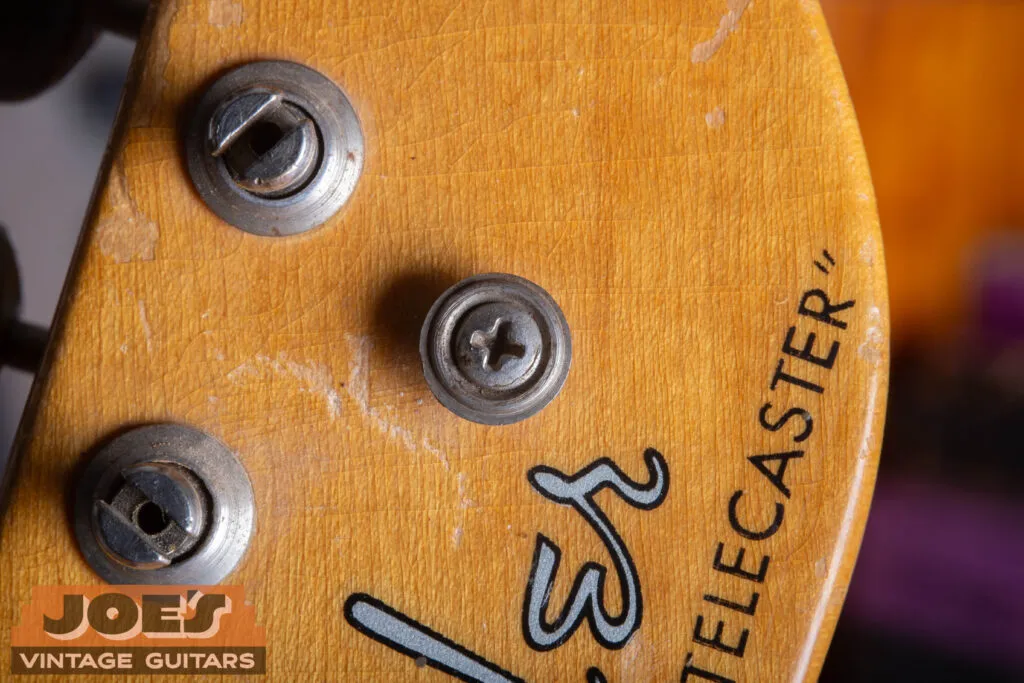
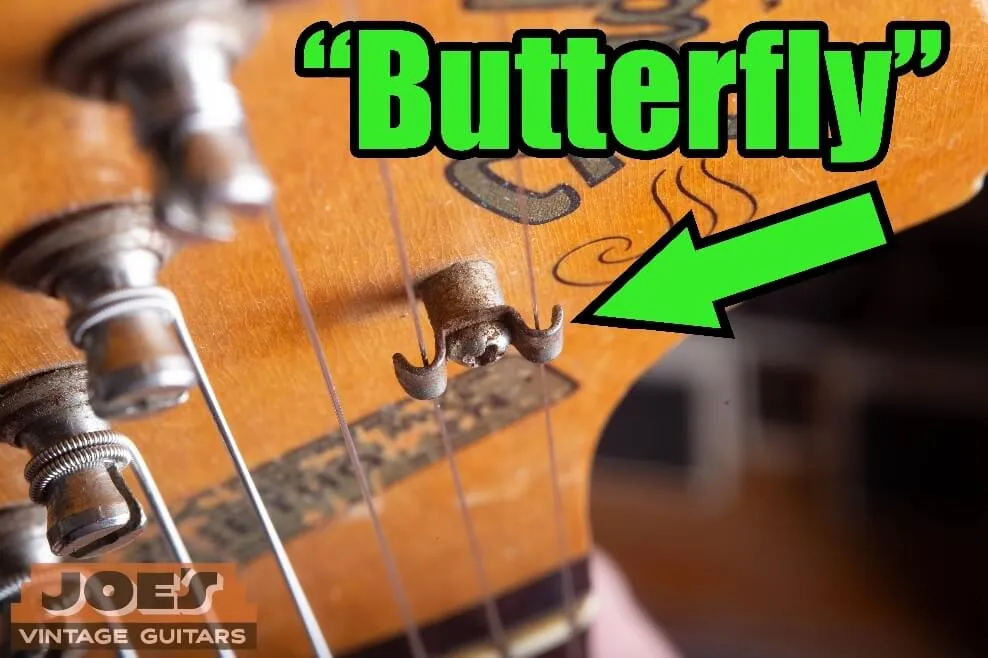
| 19561956 value | Two small parts change around the middle of the year and both are easy to see. The round-top knobs give way to the flat-top skirted knob with finer knurling, and the small round string guide gives way to the wider butterfly tree. | Flat-top knobs and a butterfly string tree on the headstock. |
| 19571957 value | No change. A 1957 carries the same specification as a late 1956, so this is a year to date from the neck stamp and the pots rather than from a feature. | Nothing visual separates it from 1956 or 1958. |
| 19581958 value | The bridge changes twice over. Threaded barrel saddles replace the smooth flat-bottomed steel ones, and around the middle of the year Fender introduced the top-loading bridge, where the strings anchor at the back of the plate instead of running through the body. On Kluson tuners the PAT. APPLD. stamp underneath gives way to a full patent number around now. | Three threaded barrel saddles, and no string ferrules on the back of the body. |
| 19591959 value | The most transition-dense year the model ever had, and a 1959 can look like a 1958 or like a 1960 depending on the month. The one-piece maple neck gives way to a thick slab rosewood board around April, with clay dots. The top loader gives way back to string-through stringing in the middle to late part of the year, and transitional bridge plates carry both sets of holes. The bound Telecaster Custom is introduced, with a three-ply guard and a gold logo. And for a window in the middle of the year Fender told staff not to write dates on neck heels at all. | A completely blank neck heel is correct for mid-1959 and is not a red flag. |
| 19601960 value | The specification settles after the churn of 1959, and string-through construction is typical. A small number of top-loader Telecasters continued into early 1960, so the bridge must be read with the neck stamp, body evidence, serial range, and pots. | An early-1960 top-loader can be correct when the rest of the date evidence agrees. |
| 19611961 value | Late in the year a block of three patent numbers appears under the model name for the first time: DES 164,227, then 2,573,254, then 2,784,631. For its first decade the Telecaster headstock carried no patent numbers at all. | Any patent numbers under the logo mean late 1961 or later. |
| 19621962 value | Partway through August the thick slab rosewood board gives way to the thinner curved veneer. This was a plant-wide change rather than a Telecaster one, so it lands on the same date across the line. | Look at the rosewood depth at the nut. A thick band is slab, a thin line is veneer. |
| 19631963 value | The Esquire takes on the same three-number patent block the Telecaster got in late 1961. The CRL three-way switch also takes a round spring-loaded plastic base this year, having carried two patent numbers from 1950 to 1953 and three from 1953. Around mid-year the pair of dots at the twelfth fret move back closer together. | Nothing on the Telecaster decal. This one is an Esquire marker, but the switch base and the dot spacing both moved. |
| 19641964 value | The Telecaster keeps its established three-number patent block through 1964 and into early 1965. The coil wire changes from Formvar to plain enamel, which was plant-wide, and the Kluson stamp goes from a single line to a double line. Late in the year the pickup bottom plates begin moving from black vulcanised fibreboard to grey, a change that runs into early 1965, and the grey ones often carry a stamped or handwritten date. | Coil wire that reads dark burgundy rather than golden orange. |
| 19651965 value | CBS completes the purchase in January and the guitar changes in stages. The Telecaster held onto the spaghetti logo into 1965, about a year longer than the Stratocaster did, then took the transition logo. The earliest transition decals still carry the three-number block; a later-1965 revision drops to two patents and adds 3,143,028. On the Custom and the custom-colour guitars the three-ply guard material moves from cellulose nitrate to white plastic around mid-year, which is why a later three-ply guard never goes mint green. The big-F neck plate arrives around the third quarter. | A spaghetti logo on a 1965 Telecaster is correct and original. Do not read the Strat's timeline onto it. |
| 19661966 to 1968 values | Double-line Klusons are standard. On a Custom the three-ply guard is now the stable white plastic that ages cream rather than the nitrate that goes mint green, while a standard blonde is still wearing a single-ply white guard. | A three-ply guard that never went green on an otherwise honest 1960s Custom. |
| 19671966 to 1968 values | The heavy black CBS logo arrives on the Telecaster, keeping the two patent numbers but moving them below the Fender name. Fender's own F-stamped tuners become standard across the main lines in the middle to end of the year. | A thick black logo with the patents underneath the Fender script. |
| 19681966 to 1968 values | The saddles change for the fourth and last time in the vintage era, back to a smooth barrel but with a groove cut for each string. Polyester finish arrives, and the wax-treated cloth pushback wire in the cavity gives way to coloured PVC plastic-insulated wire, a change that began in late 1967 as the old stock ran out, so a 1968 can honestly have either. The string ferrules on the back of the body change from flush to a lip-edged type that stands slightly proud. This is also the year of the Paisley Red and Blue Flower finishes. | Smooth saddles with a groove cut into each one. |
| 1969 | The Telecaster moves from 250K to 1 Meg pots around now, which makes it noticeably brighter because far less signal bleeds off. Paisley Red and Blue Flower carry over from 1968. | A pot marked 1 Meg rather than 250K. |
| 1970 to 1971 | In 1969 Fender goes back to the one-piece maple neck with a walnut skunk stripe, routing the truss rod channel from behind the way it did in the 1950s, and standardises that tooling across the line so rosewood-board necks carry a stripe from 1969 too. A one-piece maple neck with a stripe is correct from 1969 onward. The bullet truss rod follows in late 1971 and moves the adjustment to the headstock. | A stripe on a 1969 or later neck is correct, not a red flag. Maple with no stripe is the cap, roughly 1965 to 1968. |
Past 1971 the guitar starts dating itself. From 1976 Fender moved the serial to a headstock decal with the year built into the prefix, and the full serial guide carries those charts along with the reissue and import prefixes.
Blackguard And Whiteguard
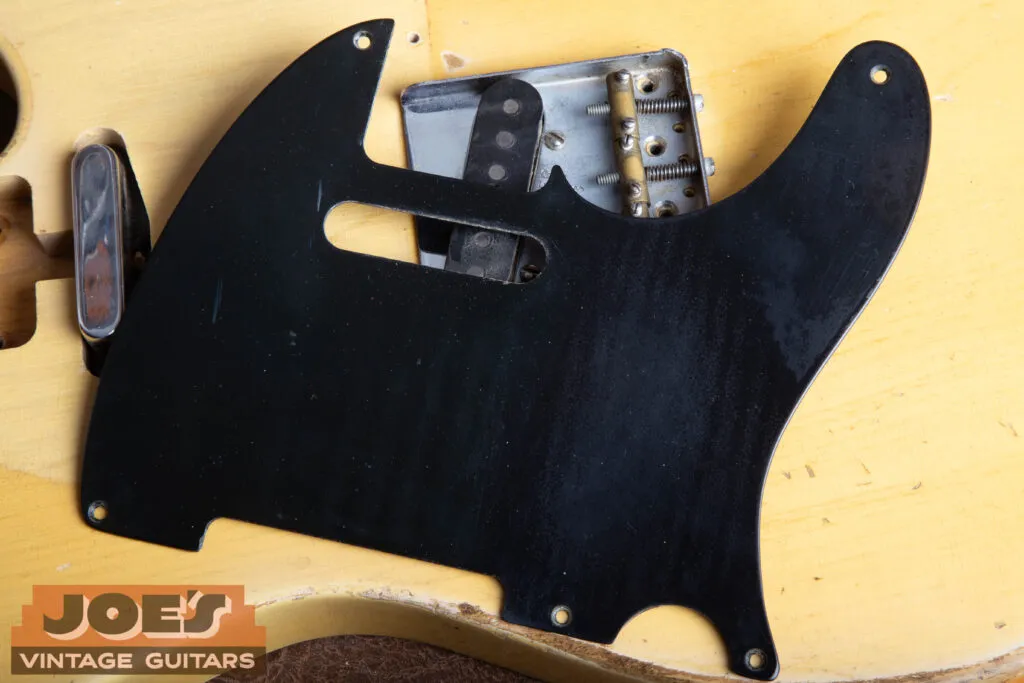
Collectors name whole eras of this guitar after its pickguard, which tells you how much the change matters. A blackguard is a Telecaster or Esquire from 1950 to about the summer of 1954, wearing a single sheet of thick black phenolic. Fender changed to a single-ply white guard mid-1954, and everything from then to 1959 is a whiteguard. Get the two the wrong way round and you have misdated the guitar by years and mispriced it by a great deal more.
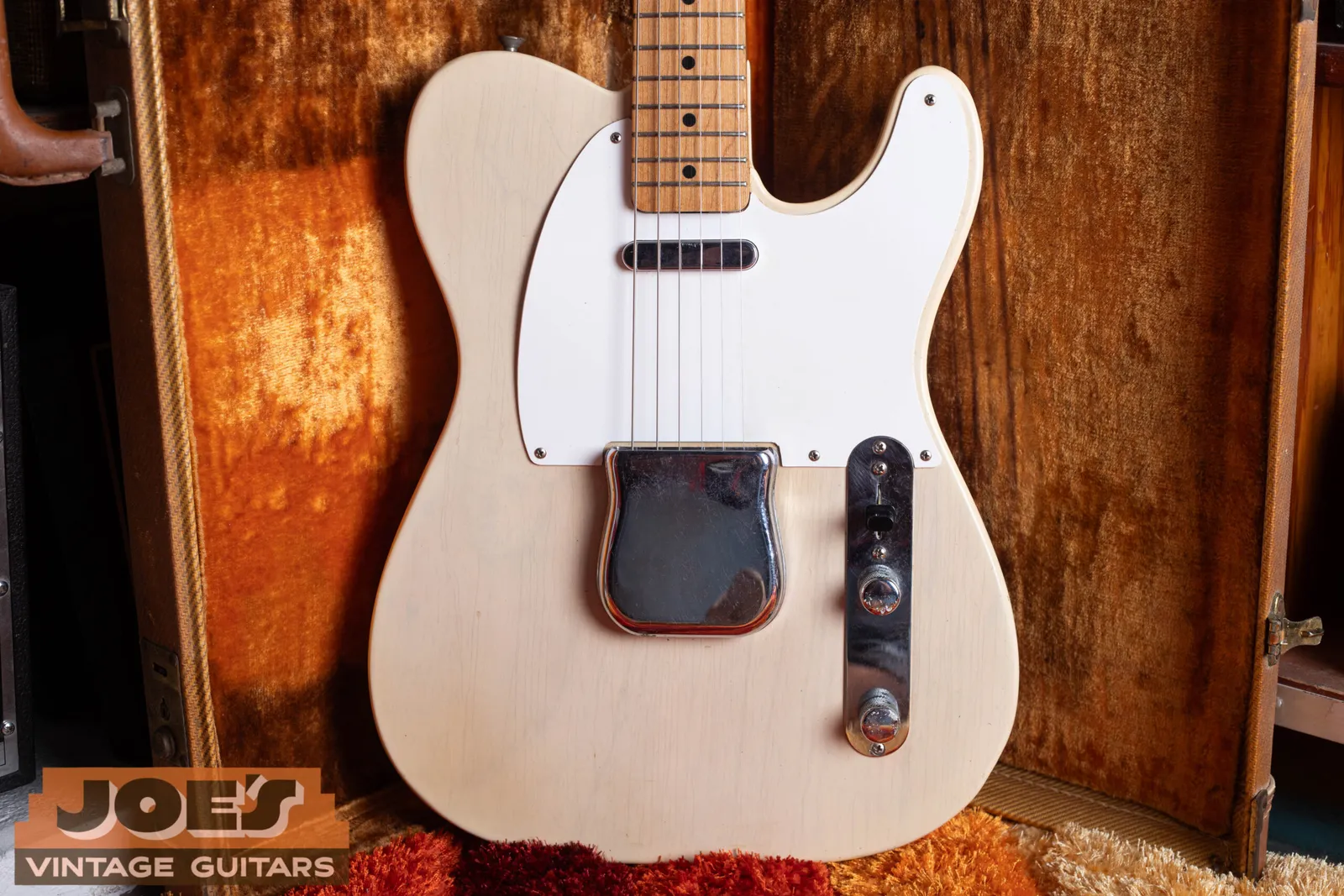

Between the second and third of those came the three-ply cellulose nitrate guard, from 1959 to mid-1965. That one also left the factory white and turns mint green over decades as the nitrate breaks down, so on a Telecaster a genuinely mint guard points at that six-year window and nothing else. There is also a smell test that works: original nitrate has a faint sharp smell like vinegar, because that is the material slowly breaking down. Modern plastic has no smell at all.
Count the layers at the edge before you count anything else. Single-ply and three-ply are the real dividing line, and a white guard on its own spans about twenty years.
The guard is one of the most swapped parts on the guitar, so look at the wood instead. On a blackguard the finish under the guard has been shielded from sixty years of light, so lifting it should reveal noticeably paler wood than the rest of the body. Collectors call that ghosting, and its absence on a claimed blackguard is a much bigger problem than the guard itself, because it points at a refinish.
Count the screws to split the whiteguard years. The single-ply white guard arrives around the summer of 1954 with five mounting holes, and in mid-1959 the count goes up to eight. That is a check you can make from a photograph of the front of the guitar, and it divides the whiteguard era in half without touching anything.
A mint green three-ply guard on a standard blonde Telecaster is not what most people assume. The three-ply cellulose nitrate guard that ages mint green belongs to the Custom Telecaster, introduced in mid-1959 with body binding, and to selected custom-colour guitars. A standard blonde kept a thick single-ply white guard right through the 1960s. So if a blonde Tele is wearing a three-ply guard, that is either a Custom, a custom-colour guitar, or a swapped guard, and it is worth working out which before it sets the price.
Two body details worth turning the guitar over for. The string ferrules on the back sat flush with the wood from 1950 through 1967, and from 1968 Fender used a lip-edged ferrule that stands slightly proud of the surface. And in late 1967, short of lightweight swamp ash, Fender routed large weight-relief cavities into heavy ash bodies under the pickguard area. Those are the guitars collectors call Smugglers. The routs are invisible with the guard on, so the only clues from outside are a body that feels lighter than it should for the year and, if the guard ever comes off, the cavities themselves.
The dots move too. On the twelfth fret the pair of position markers sit closest together on the earliest necks, spread further apart in 1953, and move back closer together again in mid-1963. On rosewood boards the dots are cellulose nitrate clay until late 1964, when white pearloid takes over.
Esquire, Broadcaster, Nocaster, Telecaster
No other Fender changed its name this often. The single-pickup Esquire arrives in 1950 and stays in the line for decades. The two-pickup version follows late in 1950 as the Broadcaster. Gretsch already had a Broadkaster drum kit and objected, so Fender simply cut the model name off the decal and kept shipping, leaving guitars wearing nothing but the Fender script. Those are the Nocasters, they exist only across 1951, and they are among the most valuable guitars the company ever built. Later in 1951 the name settles as Telecaster.
Which means that on an early guitar the decal is a dating tool in itself. Read what is printed beside the Fender script, and if there is nothing there at all, look very carefully at everything else.
The Bridge And The Saddles
The bridge carries two separate dating questions, and the first one is answered from the back of the guitar.
Top Loader Or String-Through
A Telecaster normally strings through the body, with six ferrules visible on the back. From about the middle of 1958 through 1959 Fender used a top-loading bridge instead, where the strings anchor at the back of the bridge plate and never pass through the body at all. Documented top-loader overlap can continue into early 1960, so the bridge must be checked against the rest of the guitar rather than rejected from a hard cutoff.
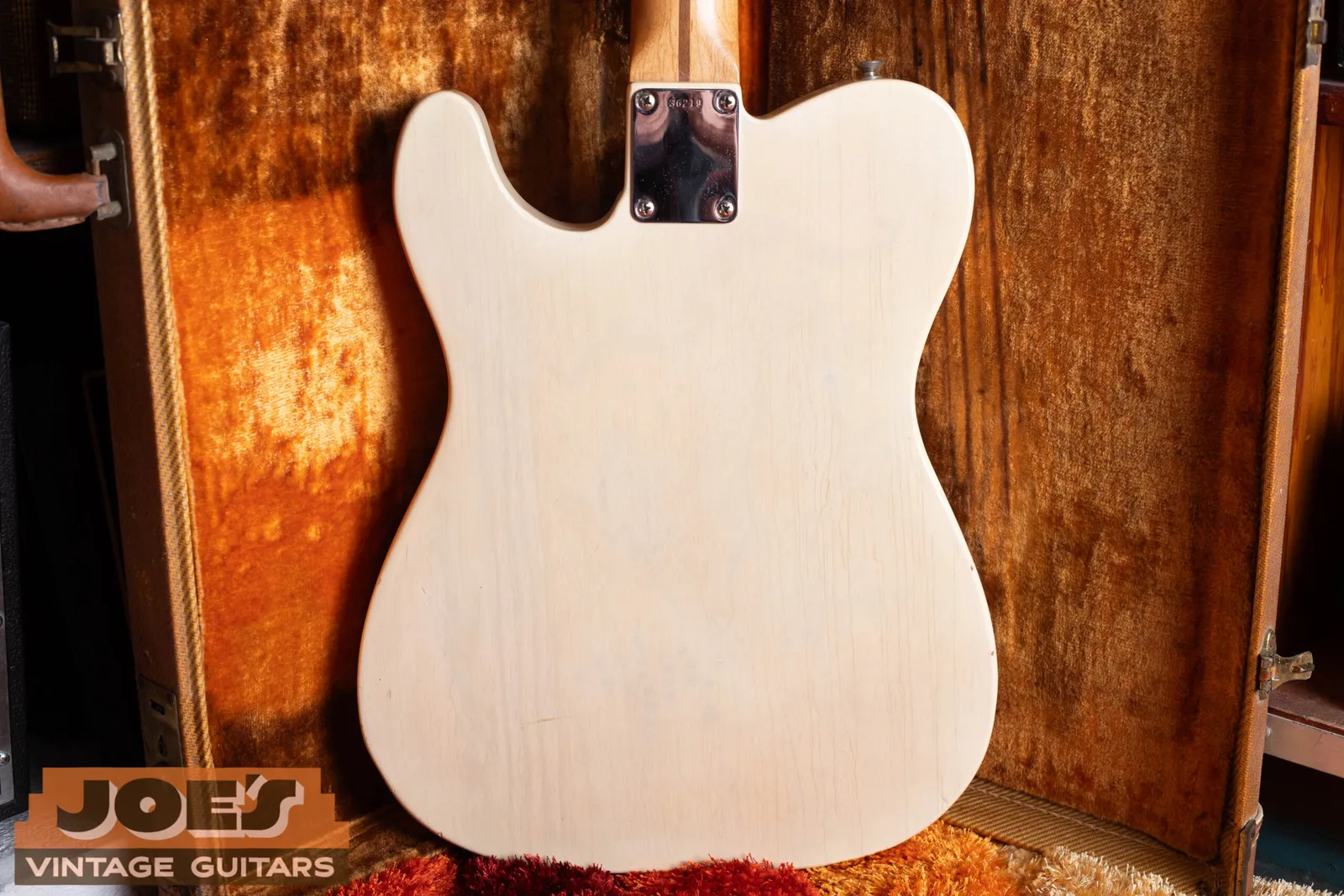
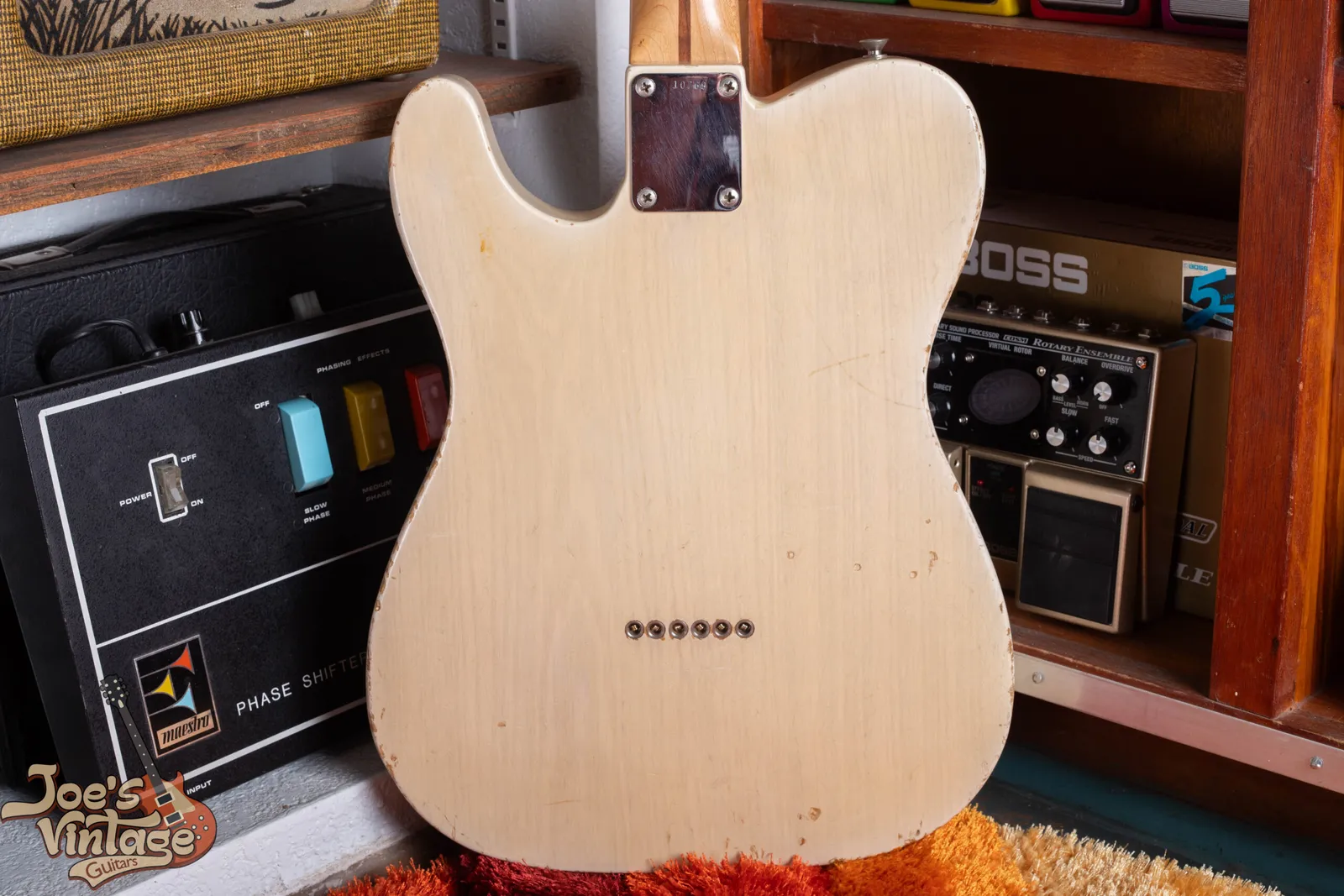
The genuinely useful part is the changeover. Plenty of 1959 bridge plates carry both sets of holes, because Fender was running through transition hardware, and a dual-hole plate is a real 1959 part rather than a compromise. If you have one, it is one of the tightest features on the whole guitar for placing the build inside a single year.
Four Saddles, Four Eras
The saddles changed more often than any other single part of the Telecaster, which makes them worth learning properly. There are three of them, each carrying two strings.
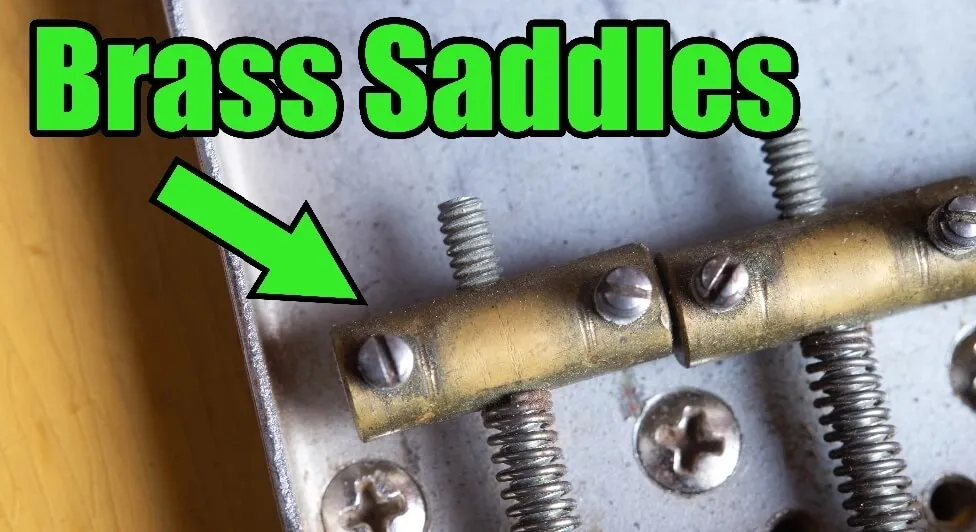
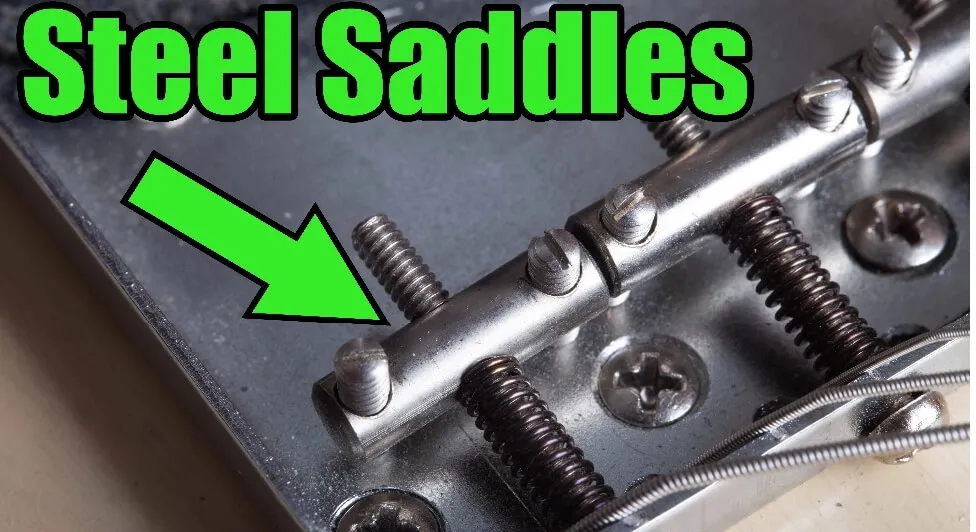
After those two come the threaded barrels, from 1958 to 1968, which are the ones most people picture on a vintage Telecaster, and then from 1968 a return to a smooth barrel with a groove cut for each string. So "steel saddles" on its own tells you almost nothing across a twenty-five year span, and knowing which of the three steels you are holding tells you a great deal.
Put calipers on brass saddles before you believe them. The original brass ones run about 5/16 inch across and the steel that replaced them about 1/4 inch. Reproduction brass saddles are almost always made to the later 1/4 inch size, so brass saddles measuring 1/4 inch on a guitar sold to you as a 1952 are modern parts wearing the right color. A pair of calipers settles the question in seconds, on a feature that carries most of the price gap between a blackguard and everything after it.
The Neck And The Board
Four boards across the years. Through about April 1959 the neck is one piece of maple with the frets cut straight into it. Then a thick flat-bottomed slab of rosewood, about 4.8mm at the nut, glued on top. Partway through August 1962 the slab gives way to a thin curved veneer of roughly 2mm whose underside follows the radius of the neck. Then in the late 1960s maple returns, built the other way round as a separate cap glued over the truss rod.
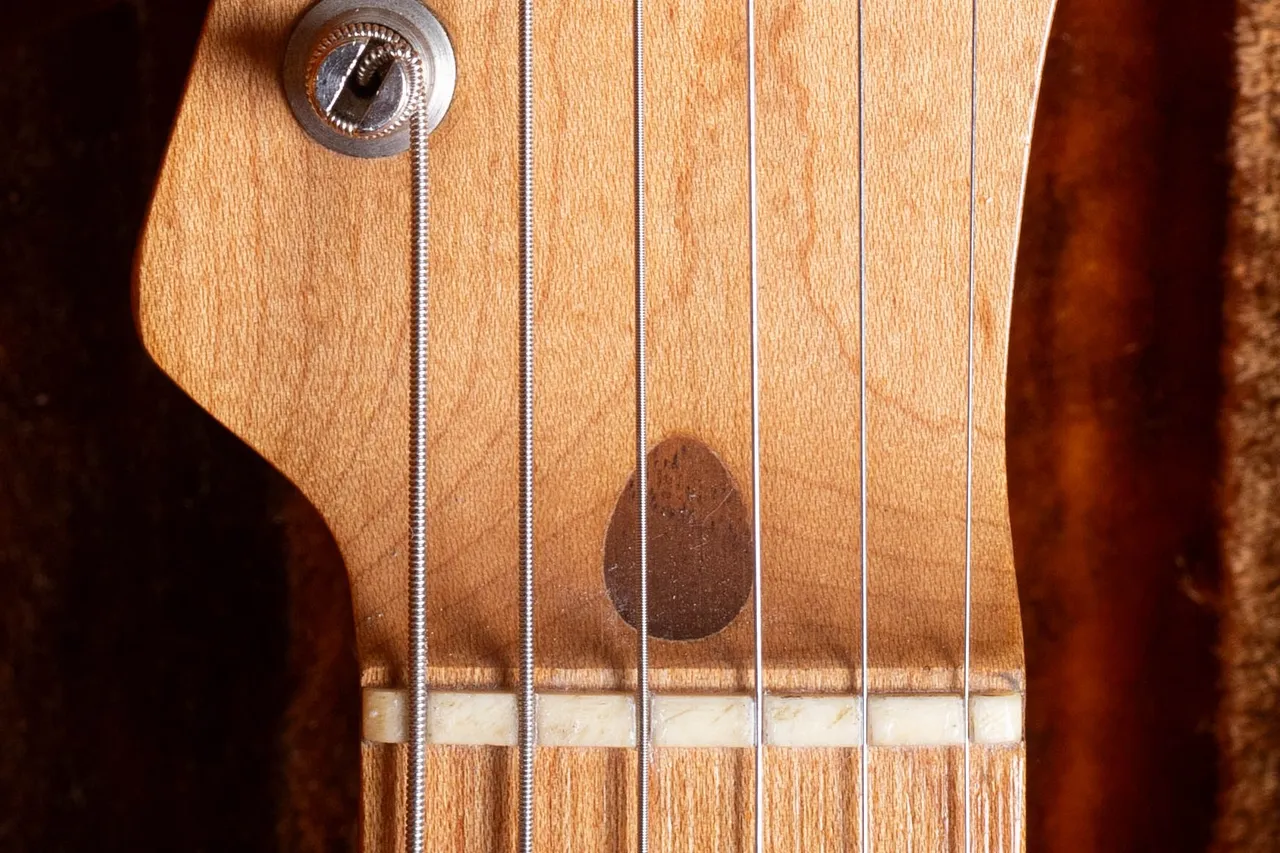
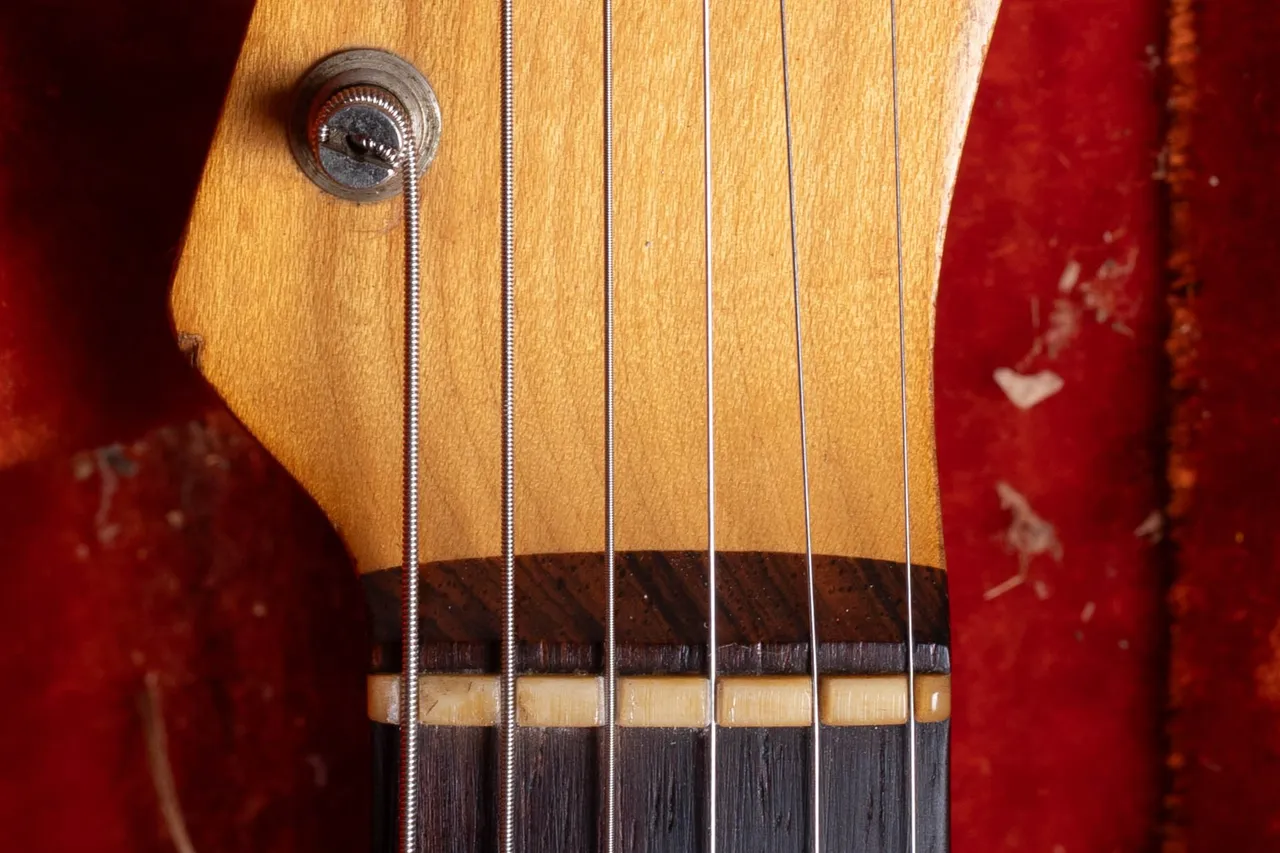
The back of the neck settles the maple question. A maple board on its own tells you almost nothing, because Fender used maple twice and the two look identical from the playing side. A one-piece 1950s neck has to carry a dark walnut skunk stripe down the back, since the truss rod went in from behind and the stripe is the lid on that channel, with a small walnut plug at the headstock end. The maple cap of the late 1960s has a separate board glued over the rod, so nothing needs filling from behind and the back is clean unbroken maple with no stripe and no plug.
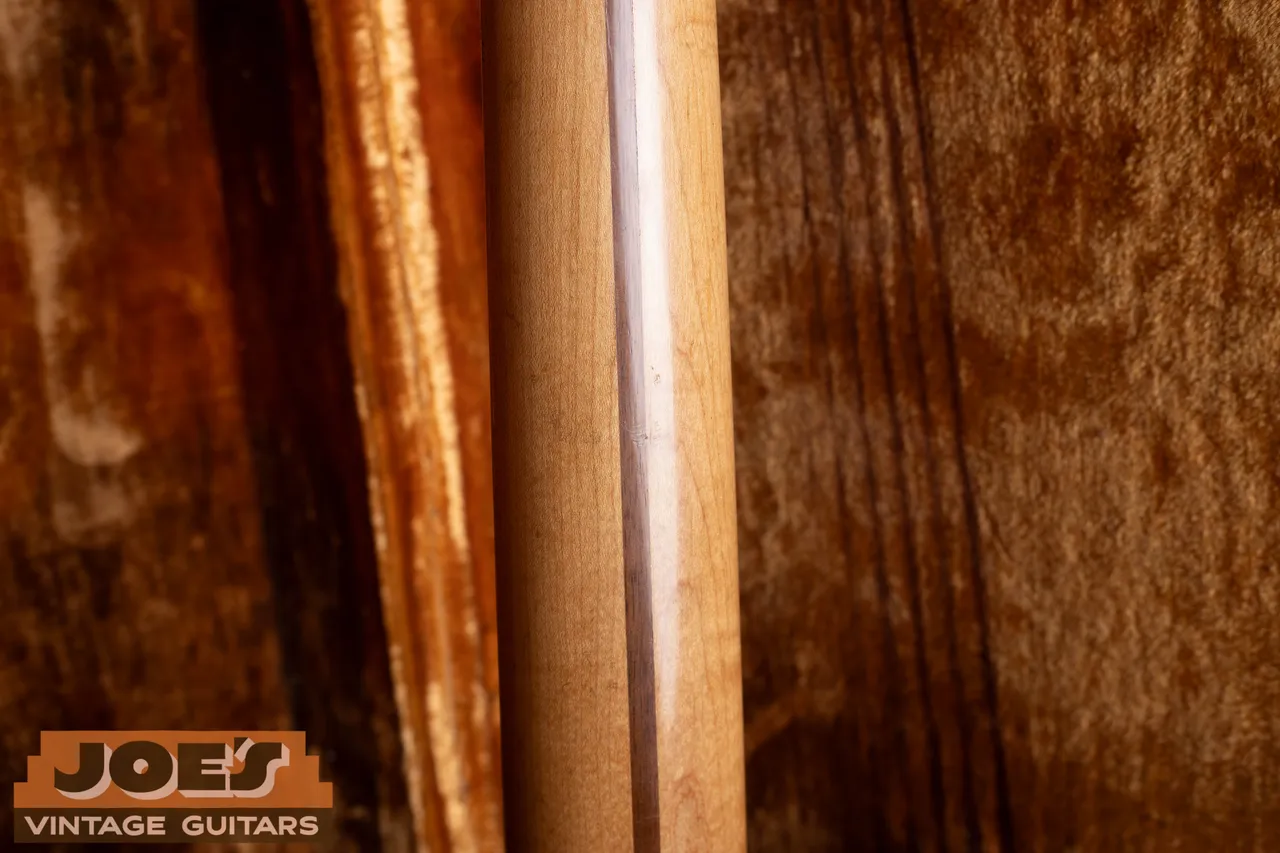
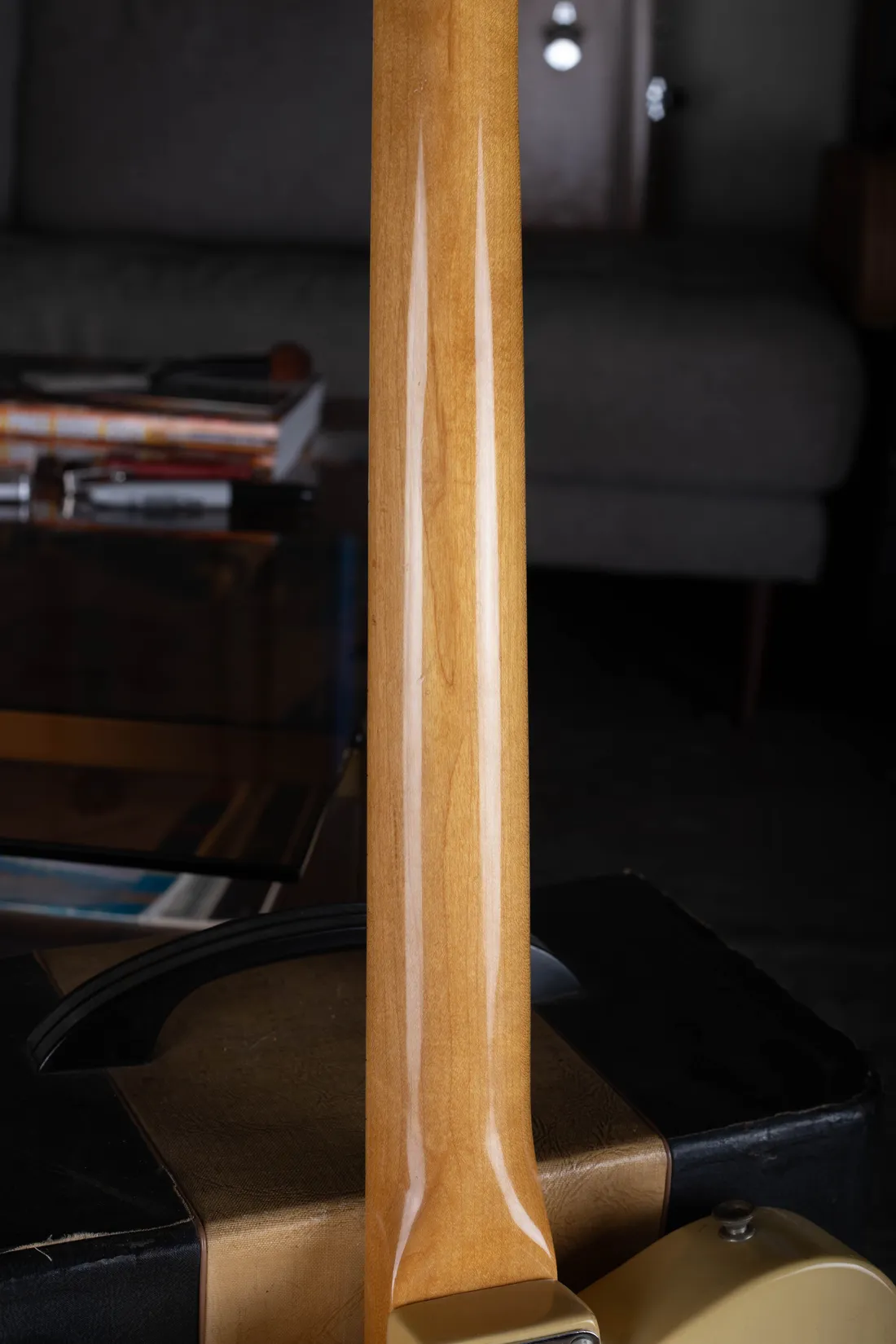
So a stripe on a claimed 1965 to 1968 maple-board Tele is wrong, and no stripe on a claimed 1950s one is equally wrong.
The stripe comes back in 1969, and a striped neck from 1969 onward is correct. Fender returned to the one-piece maple neck that year and went back to routing the truss rod channel from behind, then standardised that tooling across the line, so rosewood-board necks built from 1969 carry a walnut stripe as well. Plenty of people date the return to 1971 and the bullet truss rod instead. The bullet is two years later and adjusts at the headstock rather than the heel, so it is a separate change that happens to need the same rear channel. The practical effect is that a stripe rules out roughly 1965 to 1968 and nothing else.
Two more neck details worth a look. The truss rod adjusts at the heel rather than the headstock throughout this era, and on the earliest guitars that adjustment screw is a slot head, not a Phillips. And the dots at the twelfth fret sat wide apart in the early 1950s and moved inward later, so their spacing is a rough era clue on its own.
Headstock, Logo And Tuners
Start with what the Telecaster does not give you. The outline never changed size. Fender widened the Stratocaster headstock in late 1965, and the Mustang took the enlarged CBS headstock across late 1965 into 1966, but the Telecaster kept its shape from 1950 onward, so the fastest check on a Strat is simply unavailable here. Everything on this headstock has to be read from the decal and the tuners instead.
The Logo And The Patent Numbers
The spaghetti logo, thin and flowing, runs from 1950 into 1965 on a Telecaster. That is about a year longer than on a Stratocaster, which moved to the transition logo in mid-1964, and it is the single most common way a Telecaster gets misdated.
Color separates the models here, not the eras, and the standard Telecaster is the odd one out. A standard Tele wears a silver spaghetti decal. The Esquire and the Telecaster Custom both wear gold ones, as do the Stratocaster and the Jazzmaster. So silver is specific to the standard Telecaster rather than being the normal Fender color, and gold on an Esquire is correct rather than a sign somebody has fitted a Custom's decal. Read the color as naming the model and the weight of the script as naming the era.
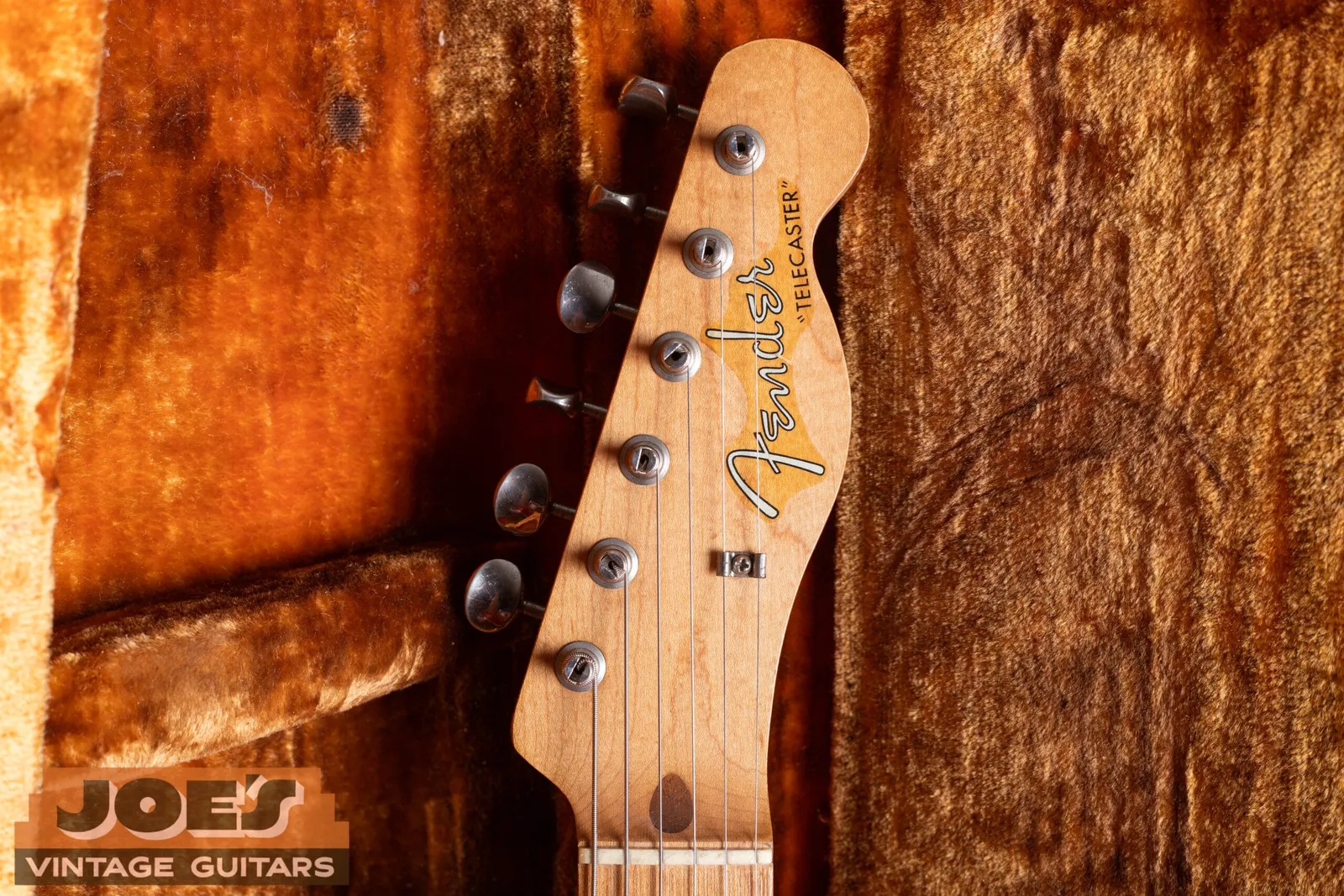
The patent numbers are the better clue, because they changed more often. For its first decade the Telecaster headstock carried no patent numbers at all, so a blank headstock under the model name points at 1950 through 1961. Late in 1961 a block of three appears: DES 164,227, the design patent covering the body and headstock shape, 2,573,254 for the Broadcaster and Telecaster bridge and pickup assembly, and 2,784,631, a tone circuit patent granted in 1957 that Fender never put into production.
The block does not change at the same moment the logo does, and that gap is a dating window. Those three numbers stayed on through the end of the spaghetti era and carried over onto the earliest gold transition decals, so a transition-logo Telecaster from late 1964 or early 1965 correctly wears three patents. Fender revised the decal in late 1965, dropping the design patent and the unused circuit patent and leaving two: 2,573,254 and 3,143,028, the latter covering the curved veneer fingerboard and the truss rod installation. So a gold transition logo with three numbers is a narrow window, and the same logo with two is later.
In late 1967 the bold black CBS logo arrives alongside the F tuners. It keeps the same two patents but moves them out from under the model name to sit directly beneath the Fender block lettering, so on a CBS decal the position is as much of a tell as the count.
A yellowed, checked headstock face on a clear, uncheckered neck is factory on a 1968. Polyester arrived that year and it reacted badly with the decal film, so Fender sprayed a localised coat of nitrocellulose on the peghead face alone to carry the decal, and put polyester on the rest of the neck. Nitrocellulose ambers and checks with age; polyester does not. Sixty years on, that leaves a 1968 with a visibly yellower, finely checked headstock face against a back that still looks clear. It reads like a refinished or touched-up headstock and it is neither. Look for the two finishes meeting at the edge of the peghead rather than at a repair line.
Read the block against the right model. The Telecaster and the Stratocaster ran completely different patent numbers, and a reproduction decal that borrowed the wrong list is a common tell. One number that turns up in fakes and in careless online lists is 2,592,783, which is not a Fender patent at all. It belongs to a heat exchanger, so a headstock wearing it is wrong on its face. There is a full breakdown by model and era on the physical features guide.
Tuners And The String Tree
Kluson made the tuners until the CBS years, and the back of the housing tells you which era you are in. Four stages, and the stamp is readable without taking anything off the guitar.
| What the housing says | Years | How to read it |
|---|---|---|
| Nothing stamped at all | 1950 to about 1956 | The no-line Kluson Deluxe. A smooth housing back. Late in 1951 a second hole was added to the side of the shell, which splits the earliest examples from the rest. |
| KLUSON DELUXE in one vertical line | About 1956 to late 1964 | Single line, running down the housing back. |
| KLUSON and DELUXE in two parallel lines | Late 1964 to about autumn 1967 | The same two words split across two vertical rows. |
| Fender F keys | Autumn 1967 onward | Fender's own tuners take over: chrome buttons, octagonal metal casings, and an F on the back plate. |
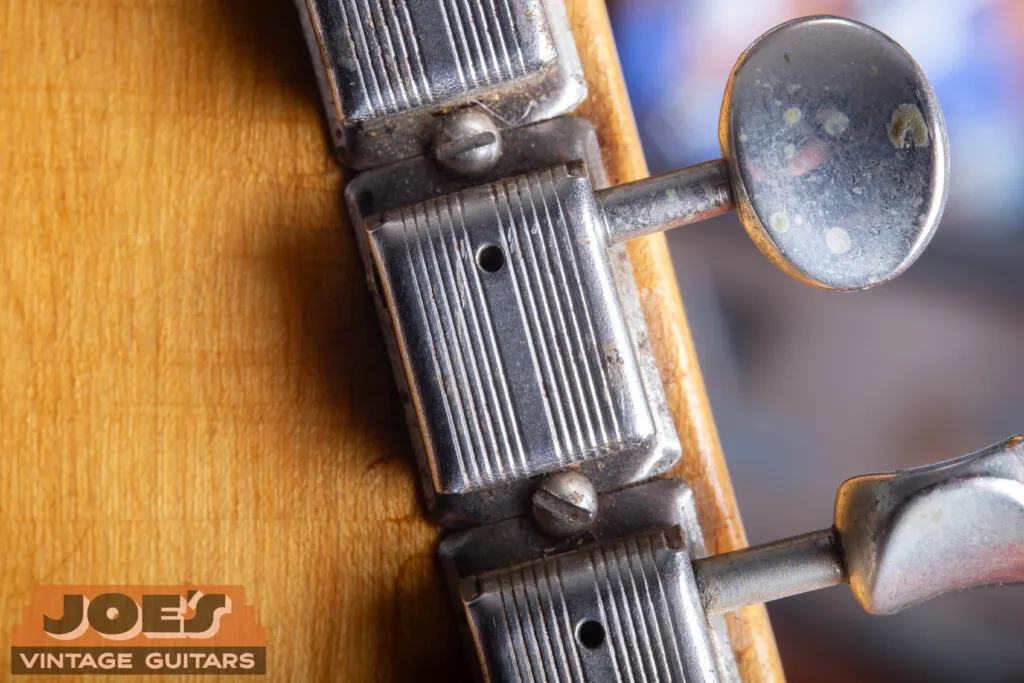
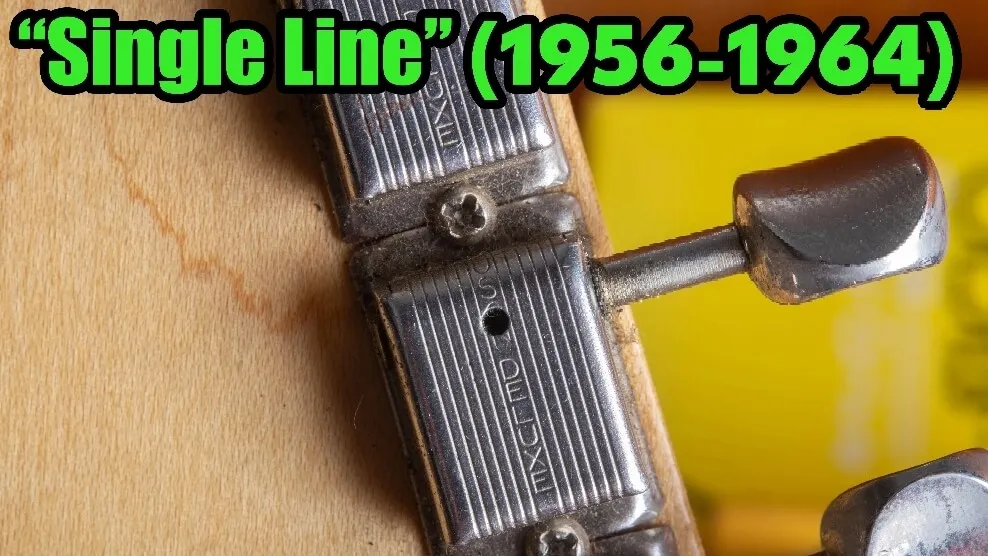
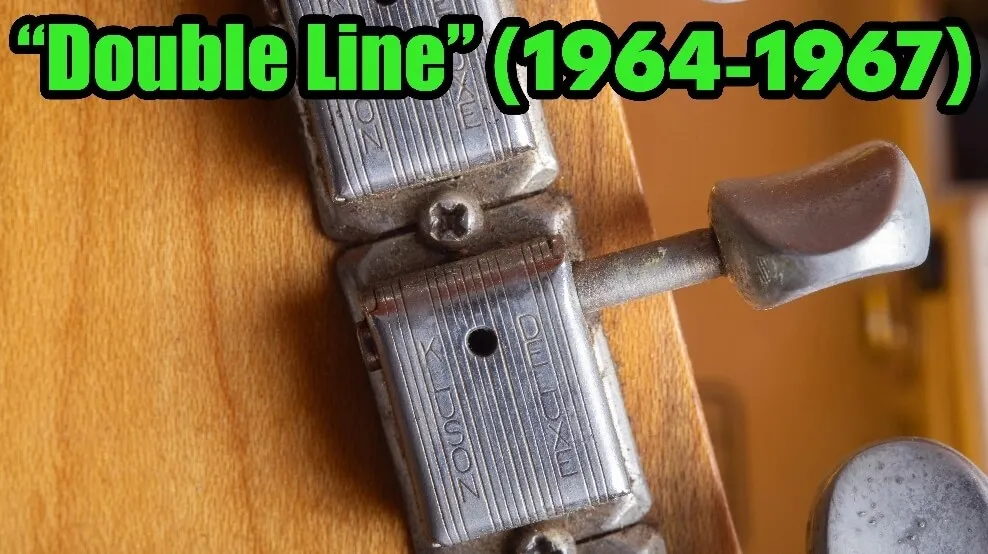
Don't hang a year on a Kluson stamp. The single-line to double-line changeover is genuinely disputed among researchers, with published dates ranging from the late 1950s to about 1964, and nobody has settled it. Double lines on a claimed 1962 are a reason to check the neck date and the pot codes, not a reason to walk away. What is not in dispute: PAT. APPLD. on the underside of a Kluson points to a pre-1958 build, because a full patent number replaced it around then.
The string tree is a smaller clue in the same place. Before about the middle of 1956 it is a small round metal guide; from then it is the wider butterfly, or wing, tree. It is an easy part to replace, so treat it as supporting evidence rather than proof.
The Neck Heel Date
Unlike everything above it, this one is a date rather than a window. Fender wrote the month and year on the butt end of the neck heel, so the neck has to come off the body to read it. On a genuine old one the pencil or ink has aged into the grain.
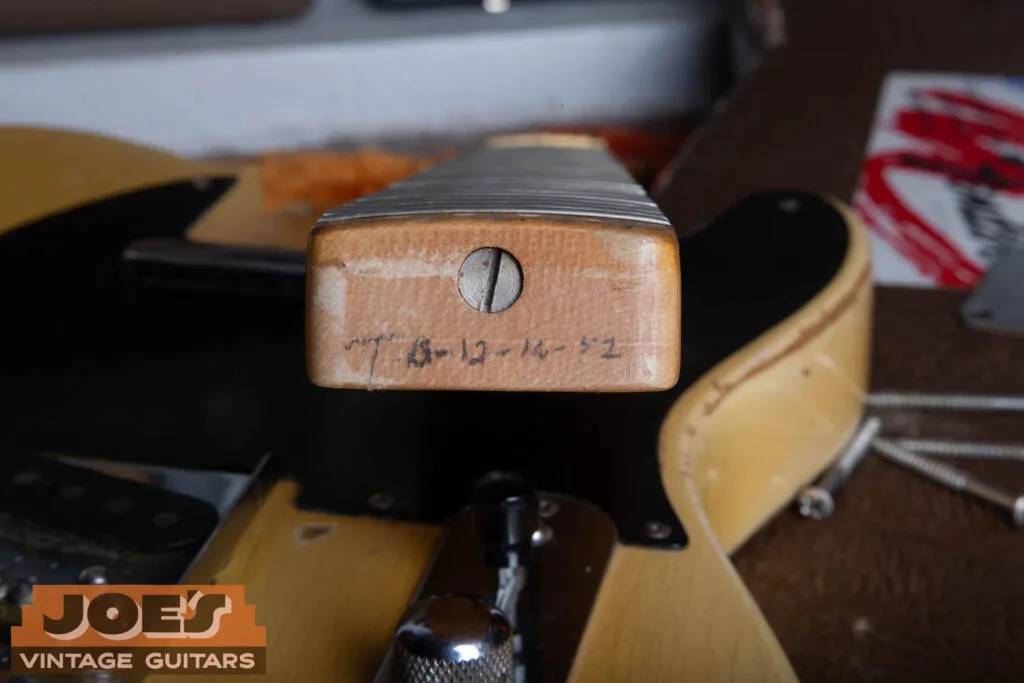
A blank heel is correct for the middle of 1959. Fender told staff not to write dates on neck heels during a window that year, so a genuine mid-1959 Telecaster can have nothing there at all. That is a documented characteristic rather than a red flag, so a blank heel is not grounds for writing off an honest guitar. Date one of those from the body date and the pot codes instead.
What the stamp looks like narrows the era on its own, before you read the date inside it.
| What is on the heel | Years | How to read it |
|---|---|---|
| Pencil, M-D-YY | 1950 to 1954 | Hand written on the butt of the heel, month, day and year. |
| Pencil, M-YY | 1954 to 1959 | Same place, now just month and year. |
| Nothing at all | A window in early to mid-1959 | Fender told staff to stop writing dates. A blank heel here is correct. |
| Ink stamp, XX MMM-YY W | From March 1962 | Black ink. XX is the model code, MMM-YY is the month and year, and W is a nut width letter from A to D. |
| Green ink numerical code | From 1969 | A run of digits and a letter, such as 529129B, alongside the traditional stamp. |
The Model Code, And Why It Doesn't Help Here
The heel stamp usually opens with a model code, and on some Fenders that number is a strong dating clue on its own. Not on a Telecaster.
| Code on the heel | Model |
|---|---|
| 3 | Telecaster and Esquire, which shared the code, plus the Telecaster Custom from 1959 |
The Telecaster is code 3 and stayed code 3. Fender renumbered the models at the end of 1965 and the Stratocaster moved from 2 to 13 and later to 22, which brackets a Strat neck before you read the date beside it. The Telecaster did not move, so the code confirms you are holding a Telecaster or Esquire neck and nothing more. That is still worth checking, because it is the fastest way to catch a neck that came off a different model, but do not expect it to narrow the year.
The full decoder for the heel stamp, including the width letter, the pencil and ink eras, and the green stamp, is on the neck date guide.
Body Dates
The other place Fender wrote a real date, written directly on the body inside a cavity. Where it hides is model-dependent, and a Telecaster does not put it where a Stratocaster does, which is why people look in the wrong place and conclude their guitar has no date at all.
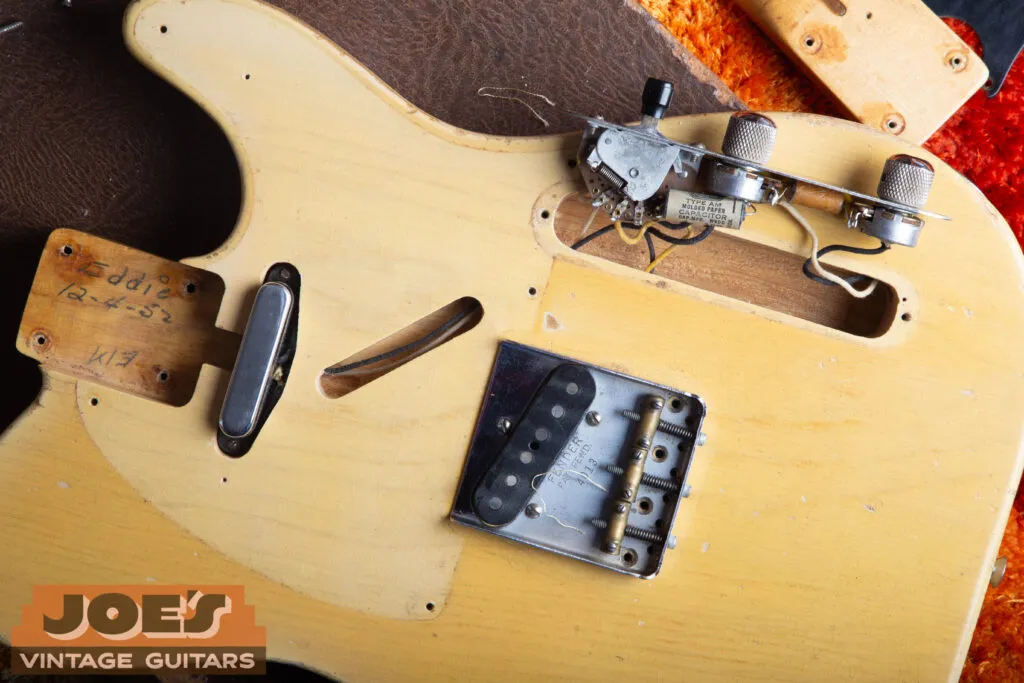
On a Telecaster, check the bridge pickup route first. Then the control cavity. The date can be penciled or written in ink, and on some guitars it is not on the wood at all but on a strip of masking tape stuck inside the cavity, sometimes with a worker's name alongside it.
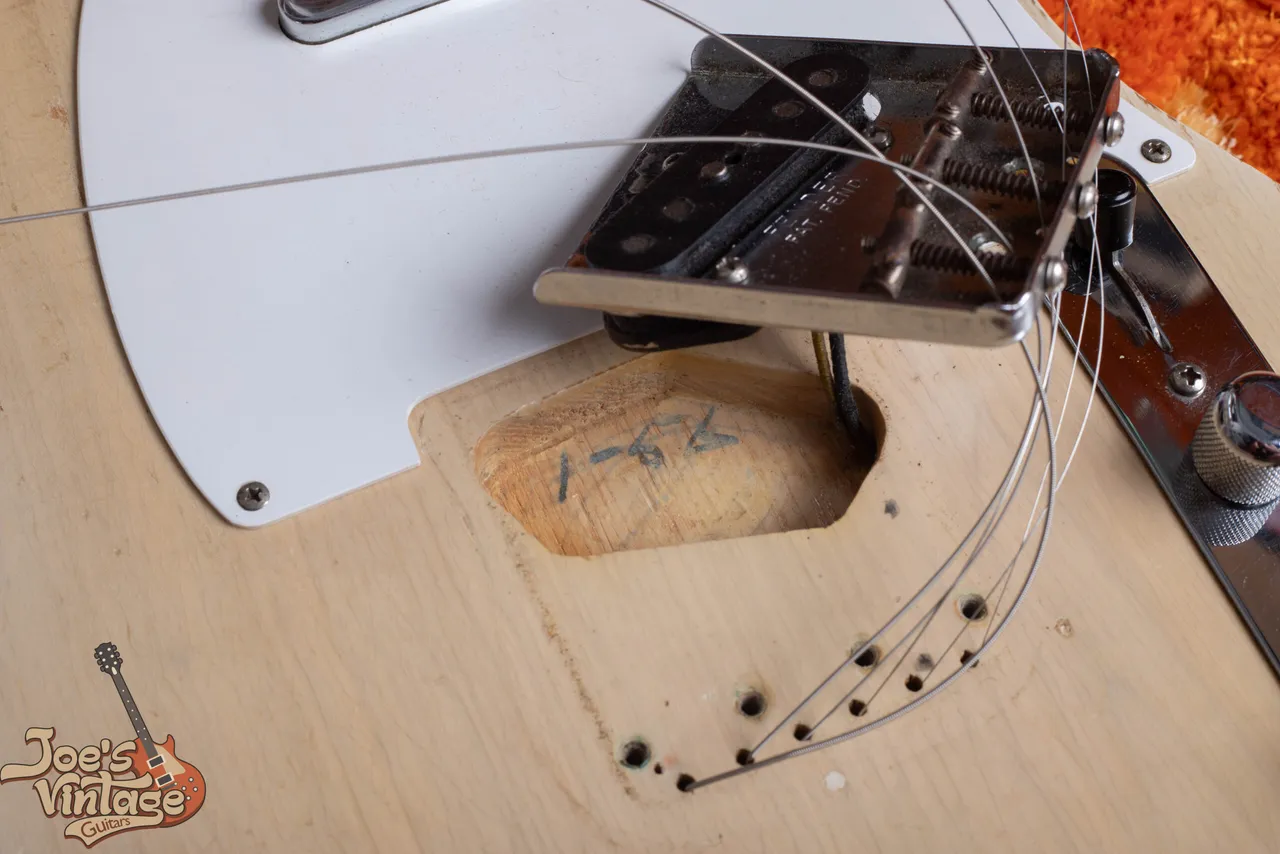
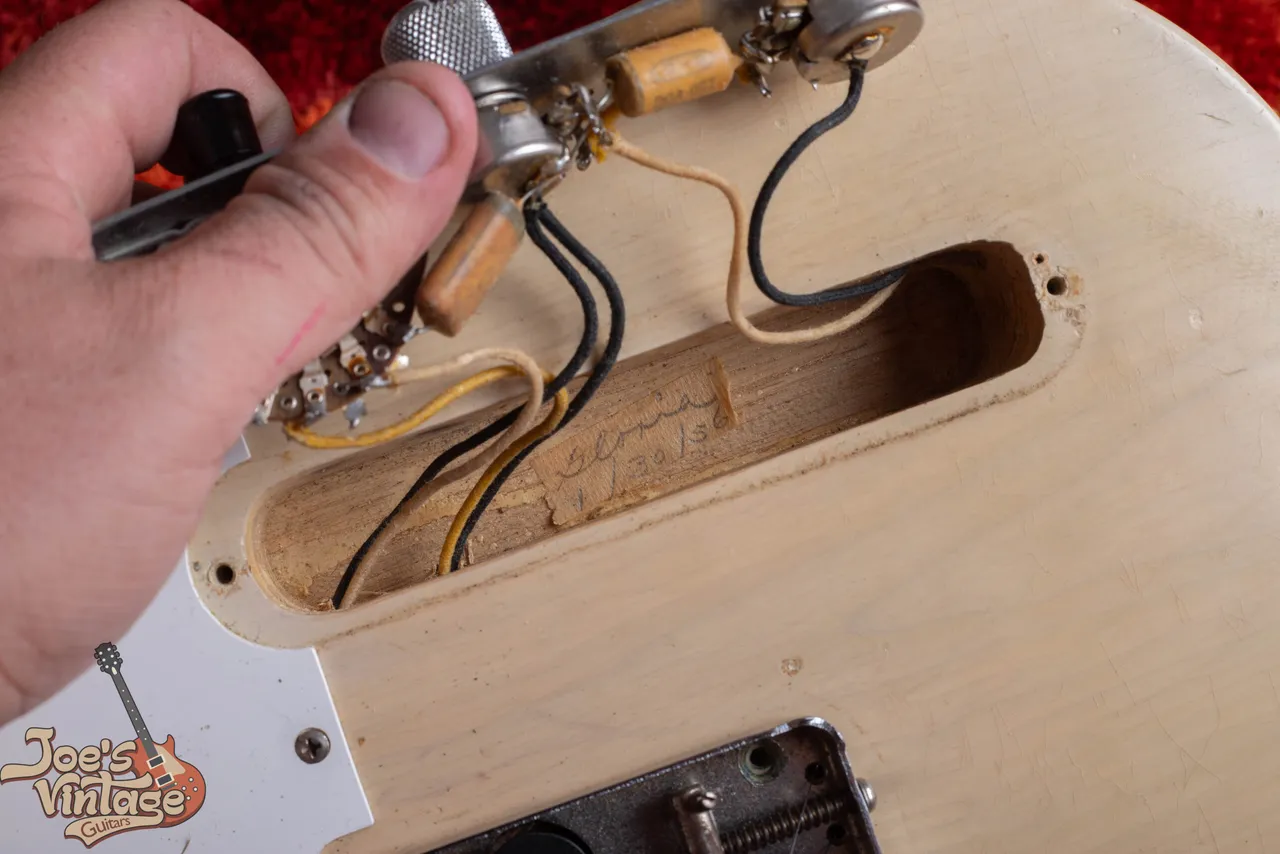
The body date is a corroborating date rather than the build date. It records when the body was routed and prepped, which can precede final assembly by weeks or several months, so read it as a floor. A body date and a neck date a few months apart is the normal, correct result on an untouched guitar.
Where the date hides on every other Fender model, and what the ink stamps and tape markings look like, is on the body date guide.
What The Serial Number Adds
A useful vote, and on an early Telecaster a more interesting one than on most Fenders, because of where it sits. The number will not give you a year on its own: plates were pre-stamped in batches, stored, and pulled off the stack in no order, and the published ranges overlap year to year and disagree between sources. Read it alongside the features rather than instead of them. What the serial tells you most reliably is which era it came from, and its location does that better than the digits do.
| Where it sits | Years | What it looks like |
|---|---|---|
| Bridge plate | 1950 to about 1954 | Stamped into the metal bridge plate itself. A Telecaster and Esquire trait, shared with the earliest Precision Basses, and it covers the most valuable guitars Fender ever built. |
| Plain chrome four-bolt plate | About 1954 to late 1962 | Four or five digits, no letter. Fender pre-stamped plates in batches and pulled them off the stack in no order, so these overlap heavily year to year. |
| L-prefix plate | Late 1962 to late 1965 | An L in front of five digits. The last of the pre-CBS plates. |
| Big-F plate | About the third quarter of 1965 to 1976 | Six digits stamped above a large stylized F. The CBS plate. |
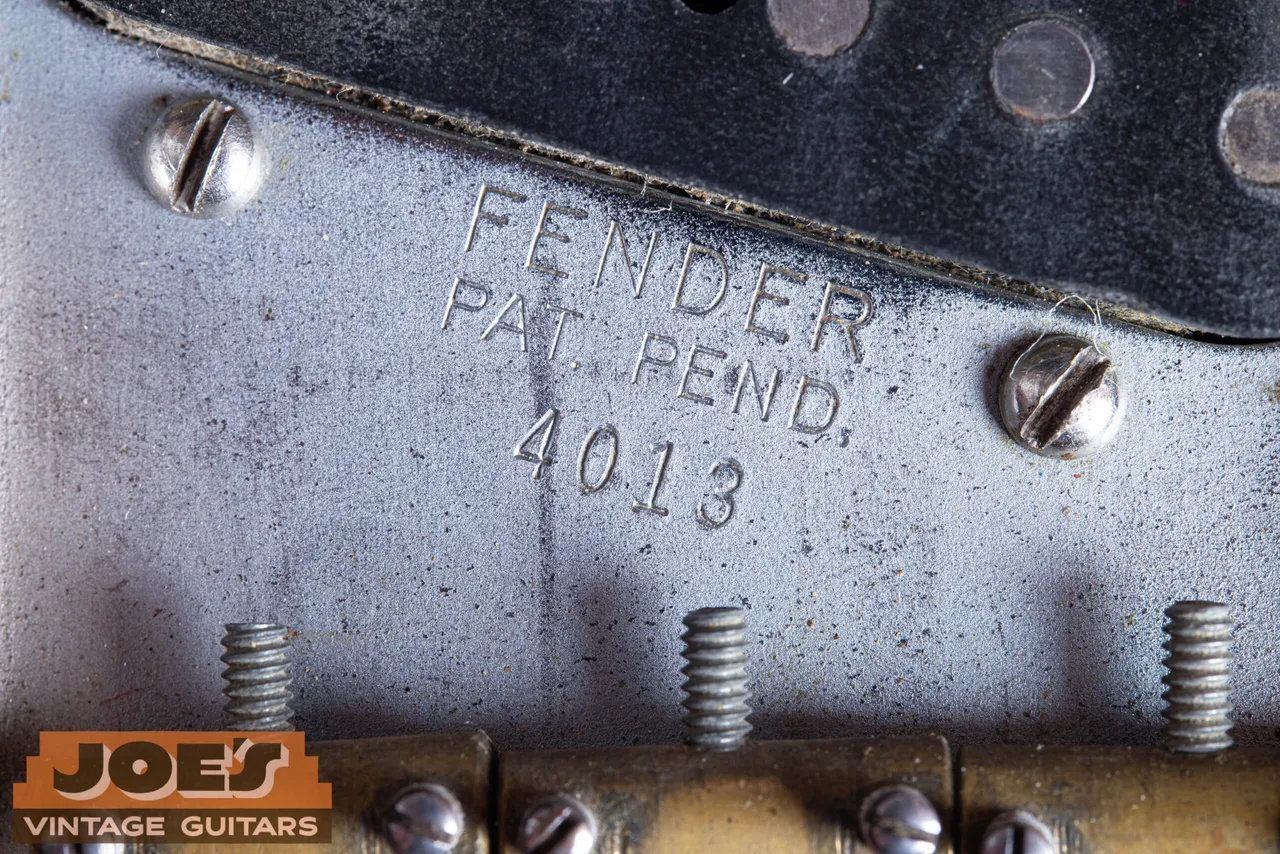
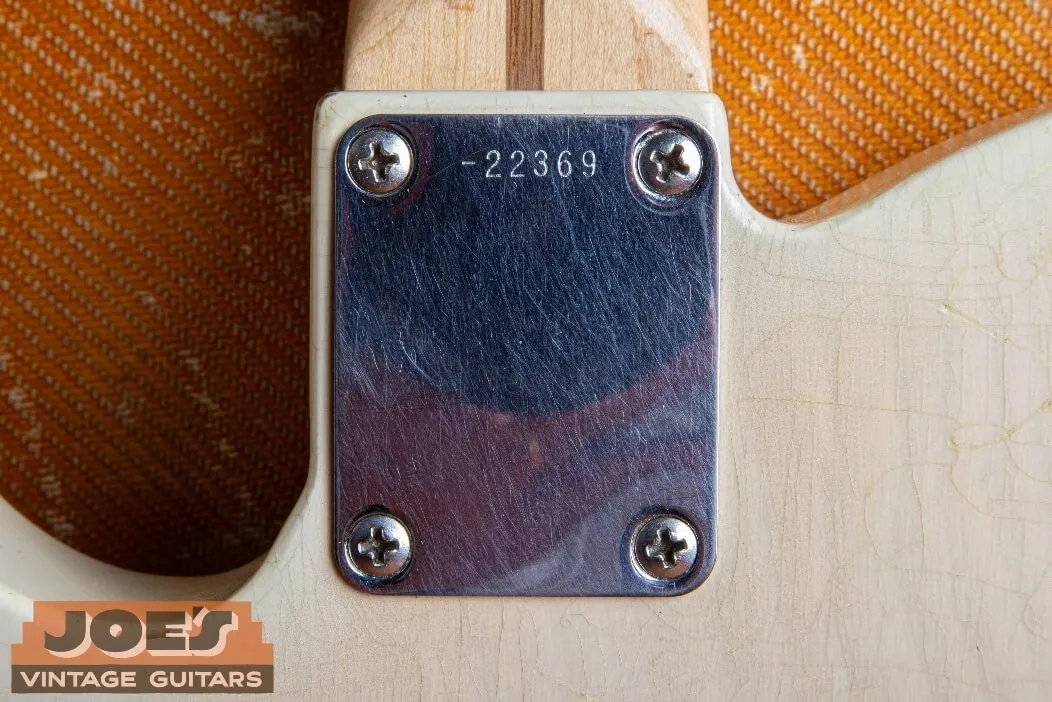
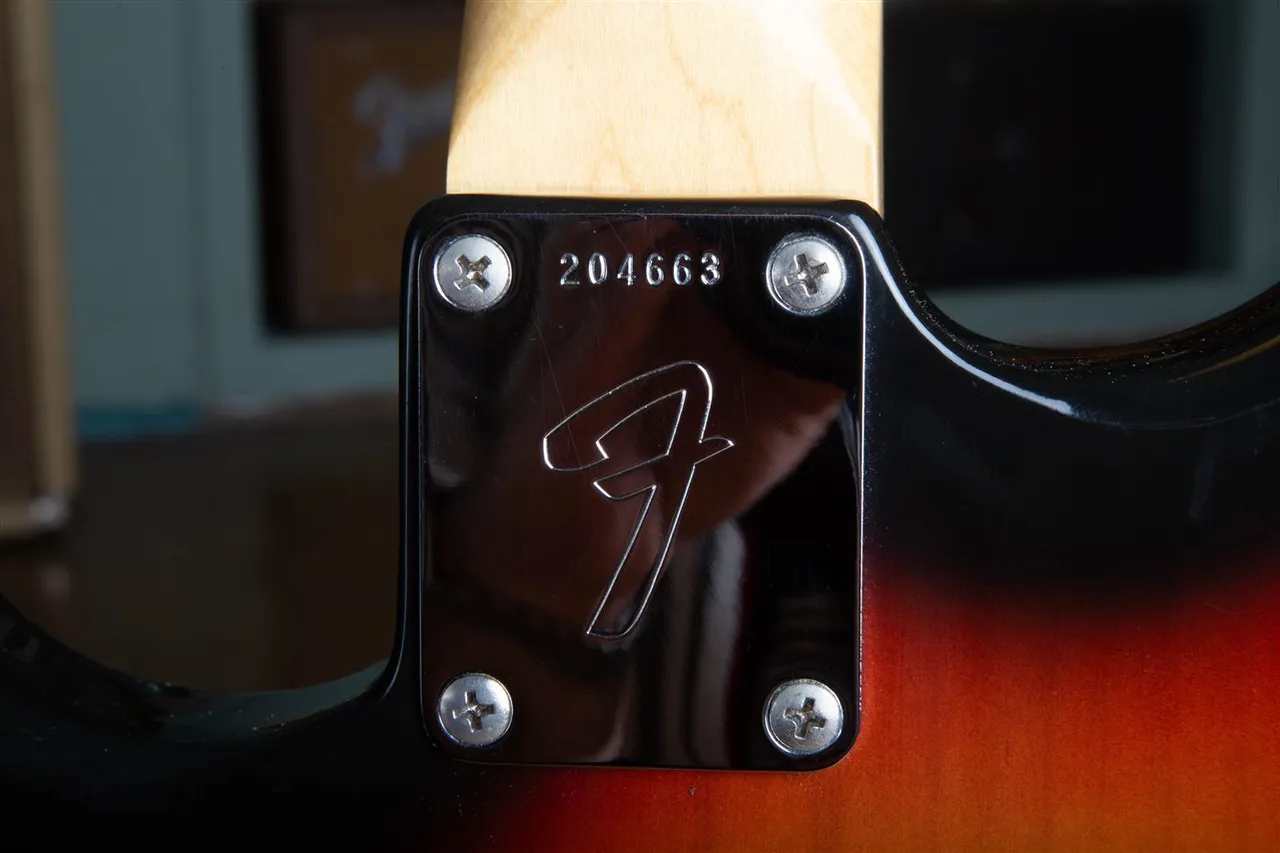
There is no Telecaster serial chart on this page because Fender serials are not model-specific. A 1963 neck plate reads exactly the same whether it ended up under a Telecaster, a Stratocaster, or a Jazz Bass, so the charts live once on the full Fender serial number guide rather than being copied onto every model page. The free lookup and every prefix from the 1950s through the modern reissues and imports are there too.
What The Features Can't Prove
Every feature on this page dates a part. None of them dates the guitar, and the gap between those two things is widest on a blackguard, which is where the money is.
A correct feature set is not proof of originality. A Telecaster can wear a genuine 1952 neck, a genuine 1952 body, and genuine 1952 hardware and still be three guitars in a trenchcoat. Originality is a whole-instrument judgment that weighs the neck date, the body date, the pots, the pickups, the hardware, and the finish against each other and asks whether they tell one story.
Transition dates are approximate, and honest guitars break them. Fender phased changes in as parts bins emptied, so a guitar from a changeover year can legitimately carry either spec, or one of each. 1954 and 1959 are the two years where this happens most on a Telecaster, and both are years where a transitional example is correct rather than suspect.
Features are the easiest thing to fake. A reproduction decal, a set of relic'd tuners, brass-colored saddles cut to the modern size, and a correctly aged guard are all buyable, which is why the dated parts inside the guitar carry more weight than the parts you can see from outside. The finish is where the real money moves, and a refinished blackguard can lose a large share of its value against an original-finish example, so treat any finish call as a job for hands and UV rather than a photograph.
Confirm It From The Inside
The neck heel date and the body date above are the two that give you a month. Two more parts inside the guitar back them up. The pot codes date a potentiometer to the week, which is the tightest number anywhere on the guitar, though it is a floor rather than a build date because pots sat in bins. The pickup dates corroborate, though on a Telecaster the neck pickup usually carries no date at all. For the parts view across every Fender model rather than this one, work through dating a Fender by its parts, and if you are holding something other than a Telecaster, the Stratocaster, Jazzmaster, Jaguar, Jazz Bass, Precision Bass, and Mustang dating guides are built the same way as this one.
If you have already narrowed the year down, these go deeper on one specific Telecaster and show the real thing photographed up close: 1952 and 1959, the two years that matter most on the model. There is also a guide to the 1968 and 1969 Paisley Telecaster, and one on authenticating a custom color finish, which is where the largest premiums and the largest mistakes both live.
This guide is one of the model pages behind the full Fender serial number guide, where the complete year-by-year serial charts live.
Common Questions About Dating A Telecaster
What Year Is My Telecaster?
Work it in three passes and expect each one to give you a window rather than an answer. Start with the pickguard color and the bridge, because those two put the guitar in a broad era from across the room. Then read the saddles, the board, the knobs, and the serial number together, treating the serial as one vote among several. Then open it up for the parts Fender actually dated: the neck heel stamp and the body date, backed up by the pot codes. Those last two are the only things that will give you a month.
What Is A Blackguard Telecaster?
A Telecaster or Esquire built from 1950 to about the summer of 1954, when the pickguard was a single sheet of black phenolic. Fender moved to a single-ply white guard mid-1954, and everything from then to 1959 is a whiteguard. Those are not nicknames for a color, they are the two halves of the early Telecaster, and the changeover is the sharpest value line on the model. Leftover black guards were fitted after the change, so a 1954 can genuinely be either, and the guard alone does not settle the year.
My Telecaster Strings Anchor At The Bridge Instead Of Through The Body. Is It Wrong?
Probably not. Fender used top-loading construction from about mid-1958 through 1959, and documented overlap can continue into early 1960. The strings anchor at the back of the bridge plate rather than passing through the body. Plenty of transition bridge plates carry both sets of holes as well. Confirm the bridge against the neck date, body construction, serial range, electronics, and provenance rather than using one hard cutoff.
Does A Spaghetti Logo Mean My Telecaster Is Pre-CBS?
Not on its own, and this is where reading Stratocaster advice onto a Telecaster costs people money. The Strat moved to the transition logo in mid-1964, but the Tele kept the spaghetti logo into 1965. So a spaghetti logo on a 1965 Telecaster is correct and original, and dating one from the Strat's timeline will put it a year or more too early.
Can I Tell A Telecaster's Year From The Headstock Shape?
No, and that is the one big clue a Stratocaster gives you that a Telecaster does not. Fender widened the Stratocaster headstock in late 1965, and the Mustang took the enlarged CBS headstock over the same stretch, but the Telecaster outline never changed. On a Tele you have to work from the logo, the patent numbers, and everything below the nut instead.
My Telecaster Has A Maple Neck. Does That Make It A 1950s Guitar?
Not on its own. Look at the back. A one-piece maple neck from the 1950s has to carry a dark walnut skunk stripe, because the truss rod went in from behind and the stripe caps the channel, with a walnut plug above the nut. The maple cap Fender offered from about 1965 has a separate board glued over the rod, so the back is clean unbroken maple with no stripe. Same wood, same look from the playing side, and about a decade apart. The stripe comes back in 1969, when Fender reintroduced the one-piece maple neck and reverted to the 1950s method of routing the channel from behind. In that same year Fender standardised its truss rod tooling across the line, so rosewood-board necks built from 1969 also carry a walnut stripe on the back. A one-piece maple neck with a stripe is correct from 1969 onward, so finding one on a 1970s Telecaster is what you should expect rather than a sign of a swapped neck. That is two years before the bullet truss rod, which arrived on the Thinline in late 1971 and adjusts at the headstock instead of the heel. A stripe on its own rules out roughly 1965 to 1968 and nothing more.
Why Does My Telecaster Have Two Capacitors In The Control Cavity?
Because it is a Telecaster. The Tele ran a more involved circuit than the Stratocaster did, and from late 1952 the dark circuit put a flat rectangular phone book capacitor in alongside a round tubular one. Two caps in a Tele cavity is not a modified guitar. That circuit ran until late 1967, and knowing which side of it you are on tells you what the switch should do. On the dark circuit the forward position runs the neck pickup through a 0.1 capacitor to ground for a bass-heavy sound with no tone control, the middle position runs the neck pickup through the tone control, and the rear position runs the bridge pickup on its own with the tone control bypassed. From late 1967 Fender dropped the extra capacitor and moved to modern switching: neck alone, both pickups together in parallel, bridge alone, with the tone control live in all three. So a Telecaster that blends both pickups in the middle position is 1967 or later, and one that cannot is earlier. Check it against the wiring for its own year rather than against a Strat, where one cap is normal.
Should I Take My Telecaster Apart To Date It?
Only if you have done it before. Almost everything in the first two passes can be read with the guitar assembled, which is deliberate. Vintage screws, plastics, and finishes strip and crack easily, and an original blackguard is close to irreplaceable. If the outside checks leave you stuck between two years, send me photos before you reach for a screwdriver.
Think You Have A Blackguard?
The early ones are worth checking properly, because the gap between an original and a good-looking parts guitar runs into serious money. Send Joe three clear photos, the front, the back, and the bridge, for a free expert appraisal within 24 hours. No obligation, and no screwdriver required.
Once you have the year, see what it is worth in the Telecaster value guide, or read how to sell your Fender.

Joe Dampt is the owner of Joe's Vintage Guitars in Mesa, Arizona, where he's spent more than twelve years buying, appraising, and authenticating vintage instruments full-time. He's personally valued over 10,000 guitars for sellers in all 50 states, served as a traveling appraiser for the Treasure Seekers Roadshow, and sourced instruments for Grammy Award-winning artists. Every check on this page comes from that bench work.