

How To Date A Fender Precision Bass
Ask which one before you ask which year. Three genuinely different instruments wear this name, and a 1952 slab bass with a single-coil pickup and a Telecaster headstock shares almost nothing visually with the 1959 below. No other Fender was rebuilt this thoroughly halfway through its own life. Sort out which of the three you are holding and the year follows quickly. Here is what changed and when, from the autumn 1951 launch through 1975.
Just after the serial number? The full charts and the lookup tool that decodes a number for you are on the main guide.
Look Up A Serial Number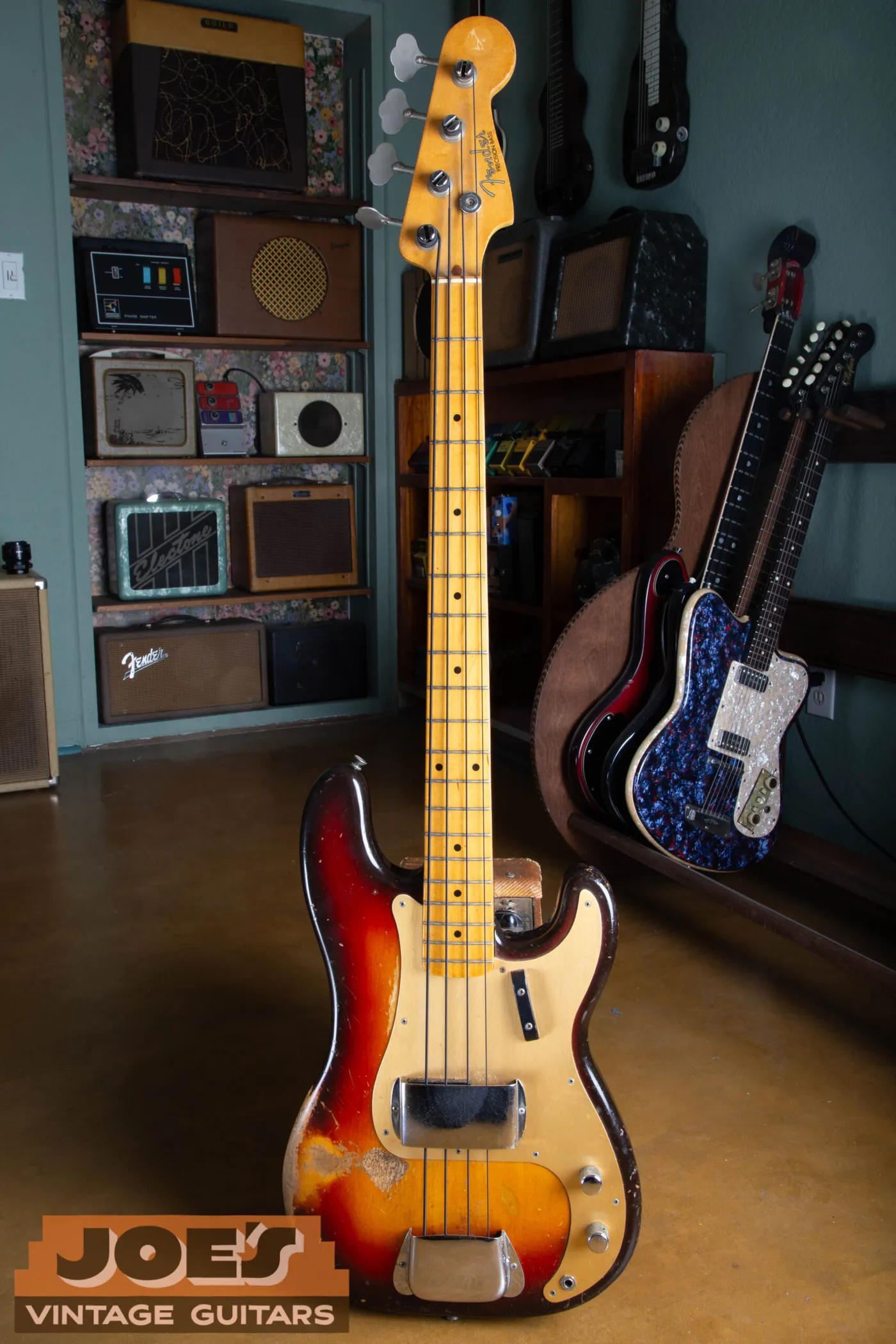
Read The Bass In Three Passes
The Precision Bass runs differently from the other model pages on this site, because the first question is not a year at all. Establish which of the three designs you have, then narrow inside it.
Across The Room
The body shape and the pickup. Slab or contoured, one coil or two offset halves. Those two questions place the bass in one of three eras spanning twenty-four years.
In Your Hands
The pickguard material, the fingerboard, the logo, the tuners, and the serial number. Take the serial as one vote among several, and note that on the earliest basses it is not even on a neck plate.
Inside The Bass
The neck heel date, the body date, and the pot codes, plus a pickup pulled to read the bottom colour. These are the only places Fender wrote a real date.
The three passes should agree. When they don't, the disagreement is the interesting part. On this model it most often means a neck from another bass, or a body that has been refinished and lost its markings.
Both of the first two passes read with the bass assembled. Two things to be careful with on this model if you do go in: a gold anodized guard marks permanently if a screwdriver slips off a screw head, and sixty-year-old nitrate guards crack at the screw ears. If the outside checks leave you stuck, contact me before you take anything apart.
The Three Precision Basses
Every other model page on this site narrows a year inside one design. Here you are choosing between three, because Fender rebuilt this instrument twice while keeping the name. Work out which one is in front of you first and everything afterwards gets easier.
| Which one | Years | What you are looking at |
|---|---|---|
| The slab bass | Late 1951 to mid-1954 | A flat slab ash body with no contouring at all, a single-coil pickup, and a Telecaster-shaped headstock. Blonde nitrocellulose, slotted screws early on, and the serial number stamped into the bridge plate. Visually it has almost nothing in common with a modern Precision. |
| The contoured single coil | Mid-1954 to mid-1957 | The Stratocaster-style forearm bevel and belly cut arrive, so the body becomes the shape people recognise, but the pickup is still the original single coil and the headstock is still the Telecaster shape. The shortest of the three eras and the least photographed. |
| The split coil | Mid-1957 onward | The rebuild. A hum-cancelling split-coil pickup, a gold anodized aluminum pickguard, and the larger headstock. From here the instrument is recognisably the Precision Bass that everything since has copied. |
The middle era is the one people forget exists. Between mid-1954 and mid-1957 the Precision had a contoured body and the original single-coil pickup at the same time, under a Telecaster-shaped headstock. Sellers who only know the two famous versions tend to read a contoured body as "post-1957" and price it accordingly, or read a single coil as "slab era" and date it three years too early. If you have contours and a single coil together, you are in that window, and it is the least photographed stretch of the model's life.
The Five Fastest Checks
If you read nothing else on this page, read these five. Read them together rather than one at a time: no single row narrows anything to a year, but five rows overlapping do.
| What to look at | What it tells you | How to read it |
|---|---|---|
| The body | Slab to mid-1954, contoured after | Look for the forearm bevel and the belly cut. A flat slab is 1951 to mid-1954, and it is the most valuable version of the bass. |
| The pickup | Single coil to mid-1957, split coil after | One bar under the cover or two offset halves. After the body shape, this is the check that decides the era. |
| The pickguard | Gold anodized aluminum 1957 to mid-1959, tortoiseshell after | Metal or plastic, and you can tell across a room. The gold guard window is under two years. |
| The fingerboard | Maple to mid-1959, rosewood after, clay dots to late 1964 then pearloid | Rosewood arrives with the tortoiseshell guard, so those two travel together. |
| The logo | Silver spaghetti to 1964, silver transition to 1967, black CBS after | Silver on this model where a Stratocaster is gold, and it stays silver through the transition era, so read the weight of the script rather than the colour. |
Precision Bass Year By Year, 1951 To 1975
What changed each year, and the quickest way to see it. Fender never made a clean cutover, so a change dated to mid-year means both versions turn up on instruments from that year and a transition example is genuinely correct either way. And parts sat in bins before they went into a bass, so a feature dates the part, and the instrument is that year or later.
| Year | What changed | Fastest tell |
|---|---|---|
| 1951 | Launched in the autumn as the first solidbody electric bass to really catch on. Slab ash body with no contours, single-coil pickup, Telecaster-shaped headstock, blonde nitrocellulose finish. Hardware is entirely slotted-head and the serial number is stamped into the bridge plate. | A flat slab body with no forearm or belly cut anywhere on it. |
| 1952 | The most discussed year of the slab era. Around the middle of the year Phillips-head screws start replacing slotted ones in some hardware positions. Serial ranges expand considerably. Otherwise the specification holds. | Mixed slotted and Phillips screws. Both are correct on this year. |
| 1953 | Production settles. Phillips screws are more uniform. Some examples show noticeably softer, more rounded perimeter edges from heavier hand sanding, which is not the same thing as contouring. The Patent Pending wording begins changing to an actual patent number on some late examples. | Softer edges, but still no true forearm bevel or belly cut. |
| 1954 | Around the middle of the year the Stratocaster-style contours arrive, the deep forearm bevel and the rear belly cut. This is the cleanest single dividing line in the model's early history. | True contours. If it has them it is mid-1954 or later, whatever the seller says. |
| 1955 to 1956 | The quiet stretch. A contoured body carrying the original single-coil pickup and the Telecaster-shaped headstock. The least documented and least photographed era of the model. | Contours plus a single coil plus a Tele headstock, all at once. |
| 1957 | The rebuild lands around the middle of the year: the hum-cancelling split-coil pickup, the gold anodized aluminum pickguard, and the new larger headstock. A handful of genuine transitional basses carry the new pickup with the older Telecaster headstock still fitted. The neck profile is a soft V carried over from the slab era. | A split pickup in two halves rather than one bar, under a gold metal guard. |
| 1958 | Red is added to the sunburst between the black and the yellow, making it three-tone. That red was highly sensitive to ultraviolet light and often faded away completely, which is why so many now read as two-tone. Collectors call the faded result an unburst. The neck moves to a very thick, wide C. | A very chunky neck, and a sunburst that may have lost its red entirely. |
| 1959 | Around the middle of the year the rosewood slab fingerboard and the four ply tortoiseshell celluloid pickguard arrive, ending the gold anodized guard and the maple-neck gold-guard era. | Rosewood instead of maple, and tortoiseshell instead of gold metal. |
| 1960 to 1963 | The specification holds. Rosewood board with clay dots, tortoiseshell guard, split-coil pickup, reverse-wind Kluson tuners. | Nothing visual to separate these years. The heel stamp and the pots do the work. |
| 1964 | Two changes, months apart. In March the pickup bobbin flatwork moves from black to grey. Late in the year the clay dots give way to pearloid, and the logo moves from the thin spaghetti script to the heavier transition decal, staying silver through the change. | Pull the pickup for the bottom colour, then look at the weight of the logo. |
| 1965 to 1967 | CBS completes the purchase in January 1965. Early to mid 1965 the pickguard material moves from nitrate to vinyl. Early 1966 the reverse-wind Klusons give way to non-reverse. The Precision does not follow the Jazz Bass into binding or block inlays at any point. | Still an unbound board with dots, which on this model is correct all the way through. |
| 1968 to 1971 | The bold black CBS logo arrives from late 1967 into 1968, and the F-stamped tuners follow from late 1968 into early 1969. | A black logo and a large stylized F on the tuner back plates. |
| 1972 to 1975 | The Precision keeps its four-bolt neck plate and its heel-adjusted truss rod while the Stratocaster and the Jazz Bass move to three-bolt Micro-Tilt necks with bullet truss rods. Tuner manufacture moves to Schaller by 1976. | Count the neck bolts. Four is correct here, and three is a problem. |
For the long version of the slab era, the 1952 Precision Bass guide goes through it in detail, and the gold guard guide does the same for 1957 to 1959.
The Slab Years, 1951 To Mid-1954
Under three years of production of an instrument that has been built continuously ever since, which is most of why these carry the money they do. A slab Precision is a flat ash plank with no forearm bevel and no belly cut, wearing a single-coil pickup and a Telecaster-shaped headstock.
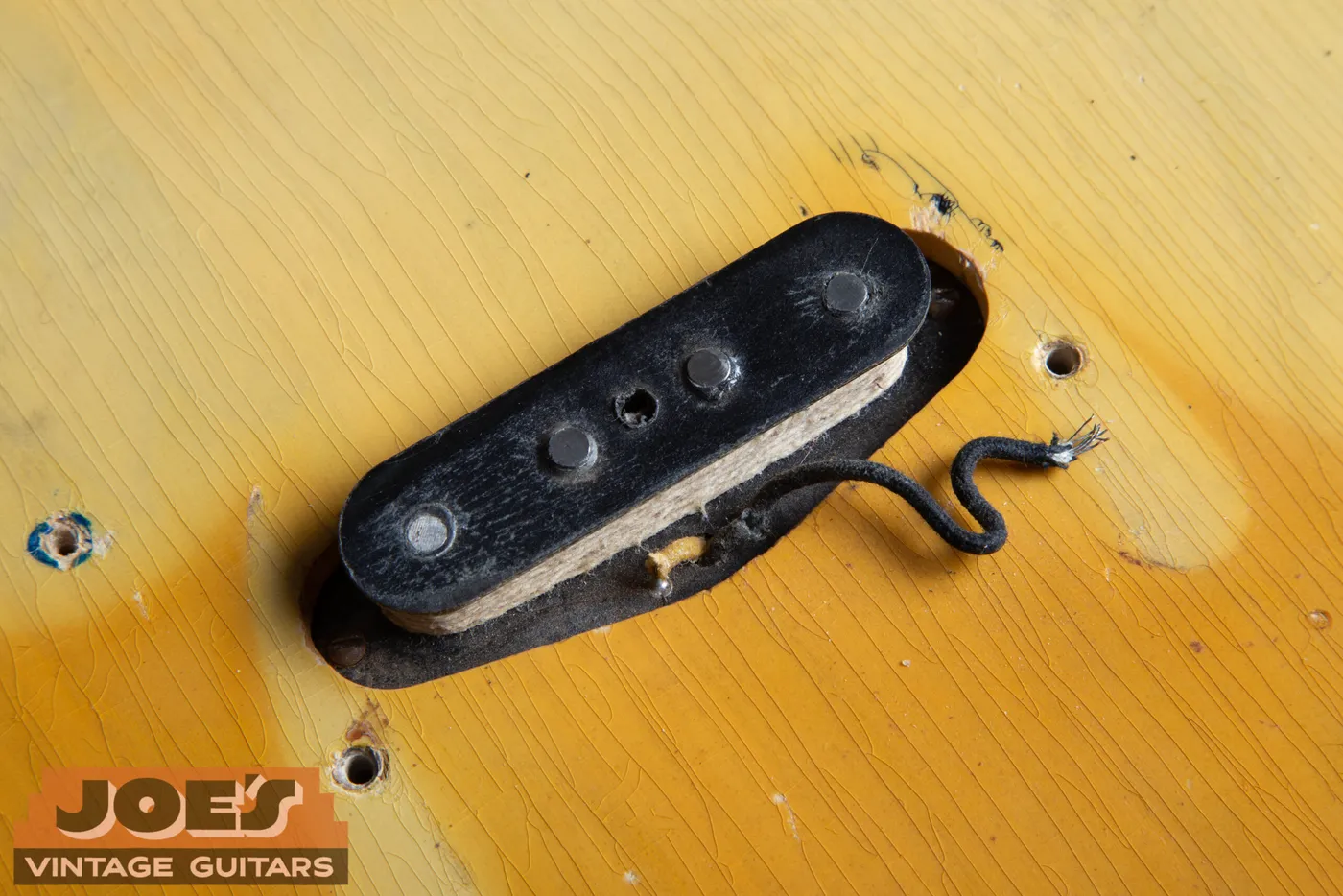
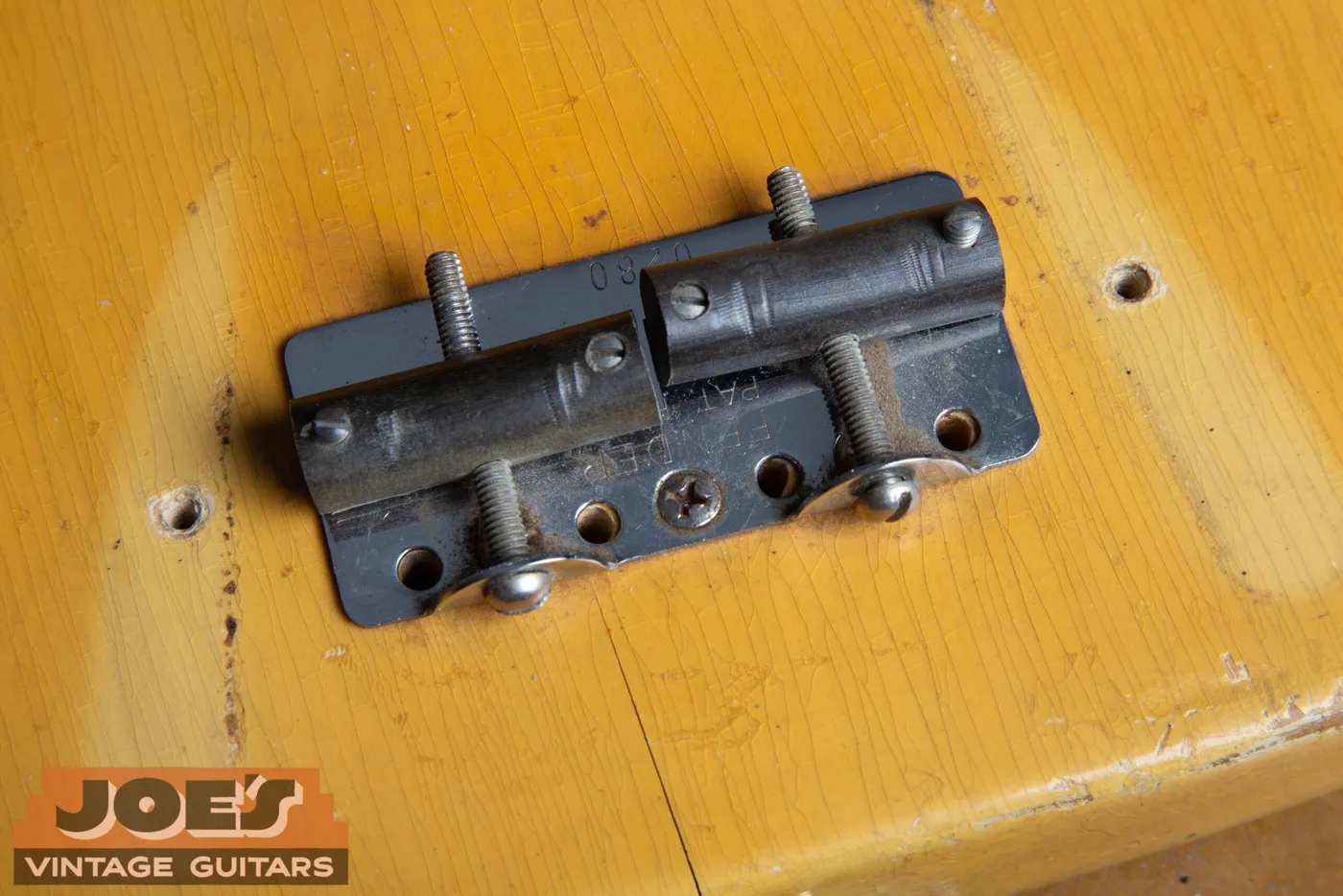
Inside the era, the useful marker is hardware. Late 1951 examples are entirely slotted-head. Phillips-head screws start appearing in some positions around the middle of 1952 and are more uniform by 1953, so a mix of the two on a 1952 is correct rather than evidence of later work. The Patent Pending wording on the decal and the bridge plate starts giving way to an actual patent number on some late 1953 basses.
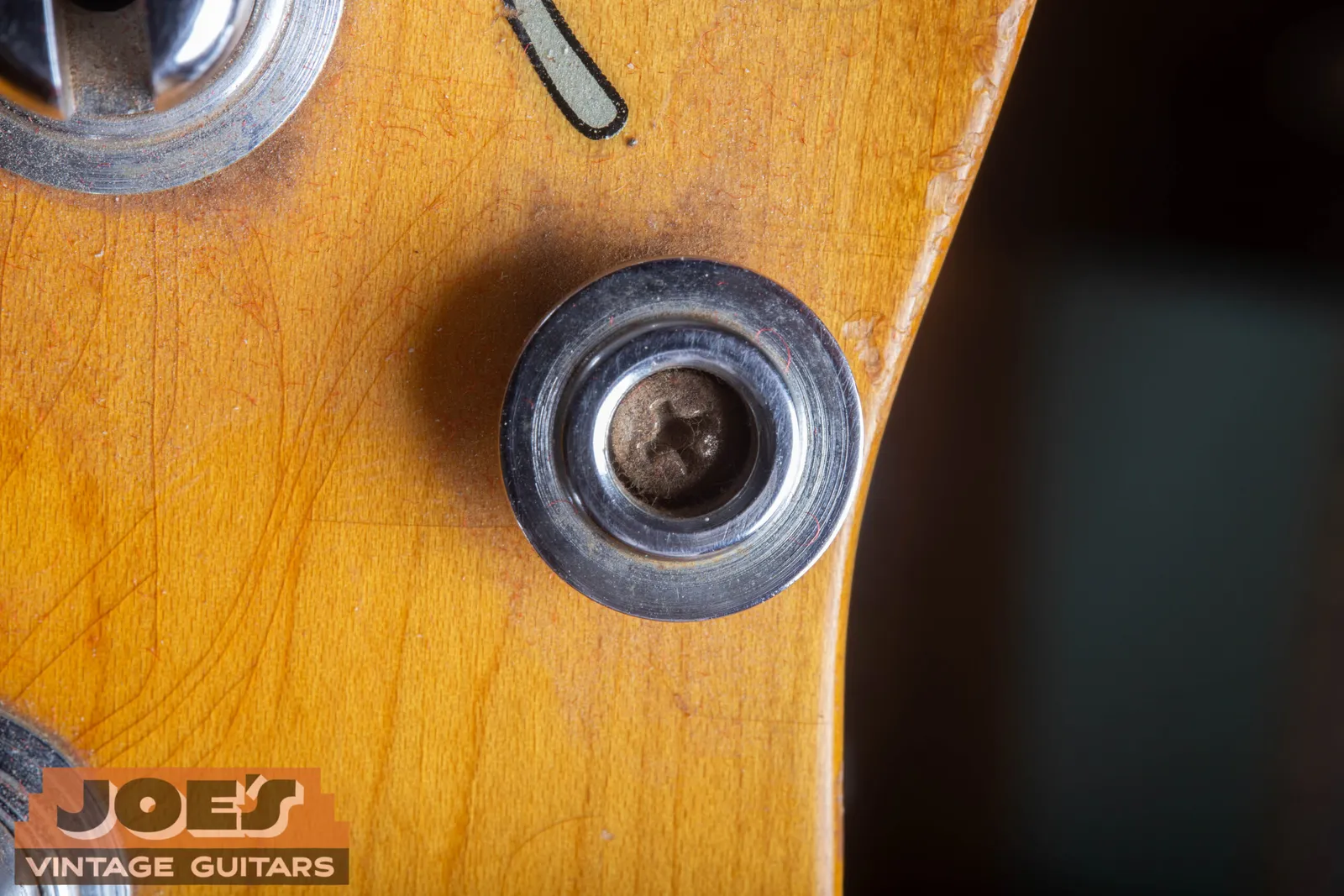
Be careful with 1953 and the word contoured. Some 1953 basses show noticeably softer, more rounded perimeter edges, the result of heavier hand sanding on the line as Fender began thinking about ergonomics ahead of the Stratocaster. That is edge softening. It is not contouring. The deep forearm bevel and the rear belly cut did not reach the Precision Bass until mid-1954, so a bass with true Stratocaster-style contours is not a 1953, whatever the listing says.
The Gold Guard Window, 1957 To Mid-1959
In the middle of 1957 Fender rebuilt the bass. The single-coil pickup gave way to a hum-cancelling split-coil pickup, the pickguard became gold anodized aluminum, and the headstock took its new larger shape. Under two years later it was over, which is what makes this window collectable.
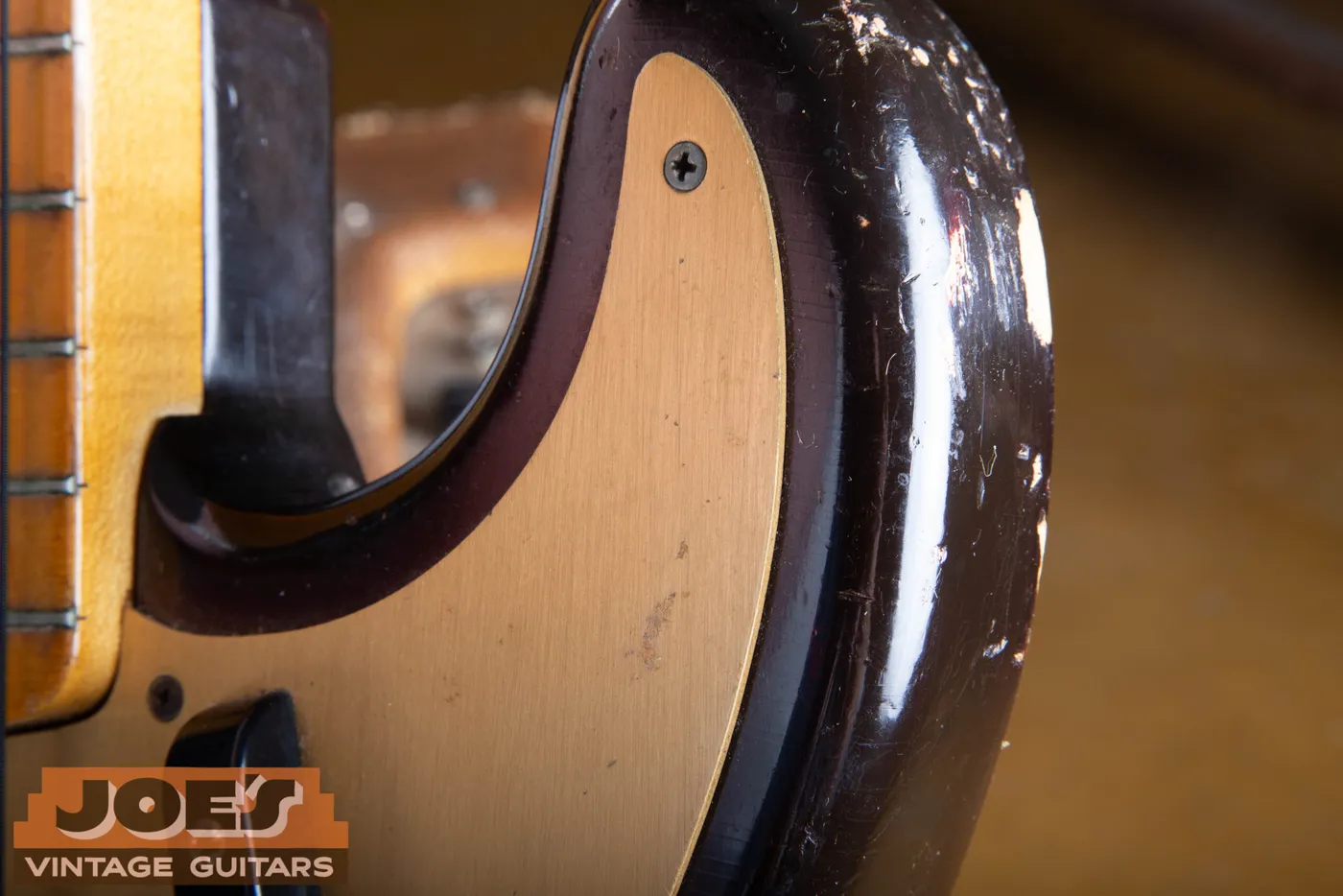
The metal guard was not styling. It shielded the electronics against hum and radio interference, which mattered in the era of early tube amplification, and it stayed flat where the single-ply plastic guards of the slab years warped, shrank and cracked.
The wear tells you whether the guard is original. Over decades the gold anodizing wears off where the player's thumb rested, revealing bare silver aluminum underneath. That worn-through patch develops slowly and is very difficult to reproduce convincingly, so it is a point in the guard's favour rather than damage. A gold guard with no wear at all on a heavily played bass is worth a question.
A handful of genuine 1957 basses carry the new split-coil pickup while still wearing the older Telecaster-shaped headstock, which is a factory hybrid rather than a parts assembly. And the neck profile moved inside the window: a soft V in early 1957, carried over from the slab era, becoming a very thick, wide C by 1958, one of the chunkiest necks Fender ever made. Nut width is a generous 1.75 inches throughout.
How The Window Closes
Around the middle of 1959 the maple board gave way to a rosewood slab fingerboard and the gold guard gave way to a four ply tortoiseshell celluloid pickguard. Those two changes travel together, and between them they end the gold guard era.
The Logo, And Why Its Colour Matters
Three logo eras on this model. The thin spaghetti script runs from the 1950s to 1964. The heavier gold transition logo runs from 1964 to 1967. The bold black CBS logo with its patent text arrives from late 1967 into 1968.
On a Precision Bass the spaghetti logo is silver, not gold. The colour is not consistent across the line and getting it backwards is a common way to misread a headstock: gold on the Stratocaster and the Jazzmaster, silver on the standard Telecaster with gold on the Telecaster Custom, and silver here. The silver carries on through the transition logo too, so on this model the change at 1964 is a change in the weight of the script rather than in its colour: thin and fine, then the same silver drawn much heavier. Colour only re-enters the picture when the black CBS logo arrives from late 1967.
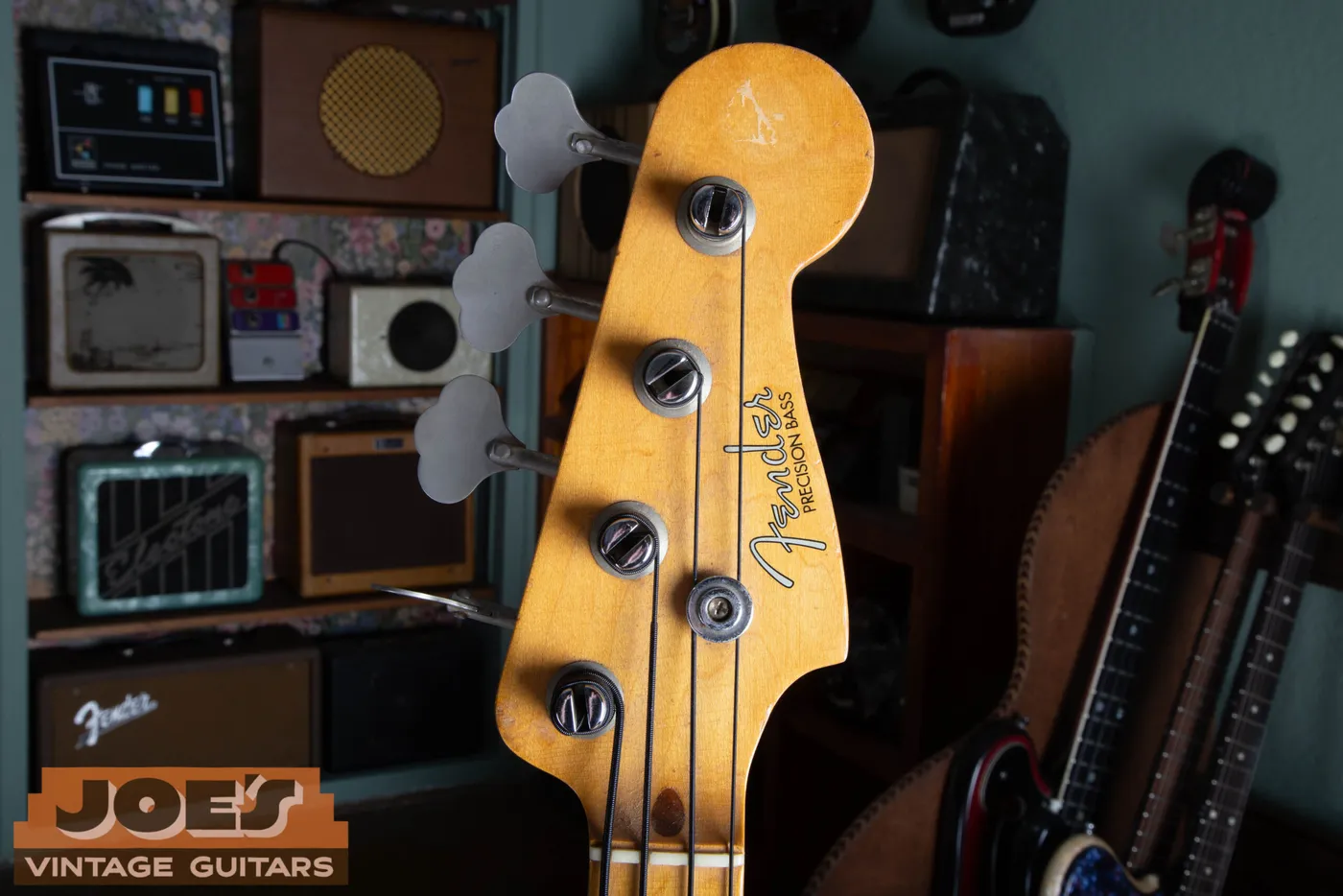
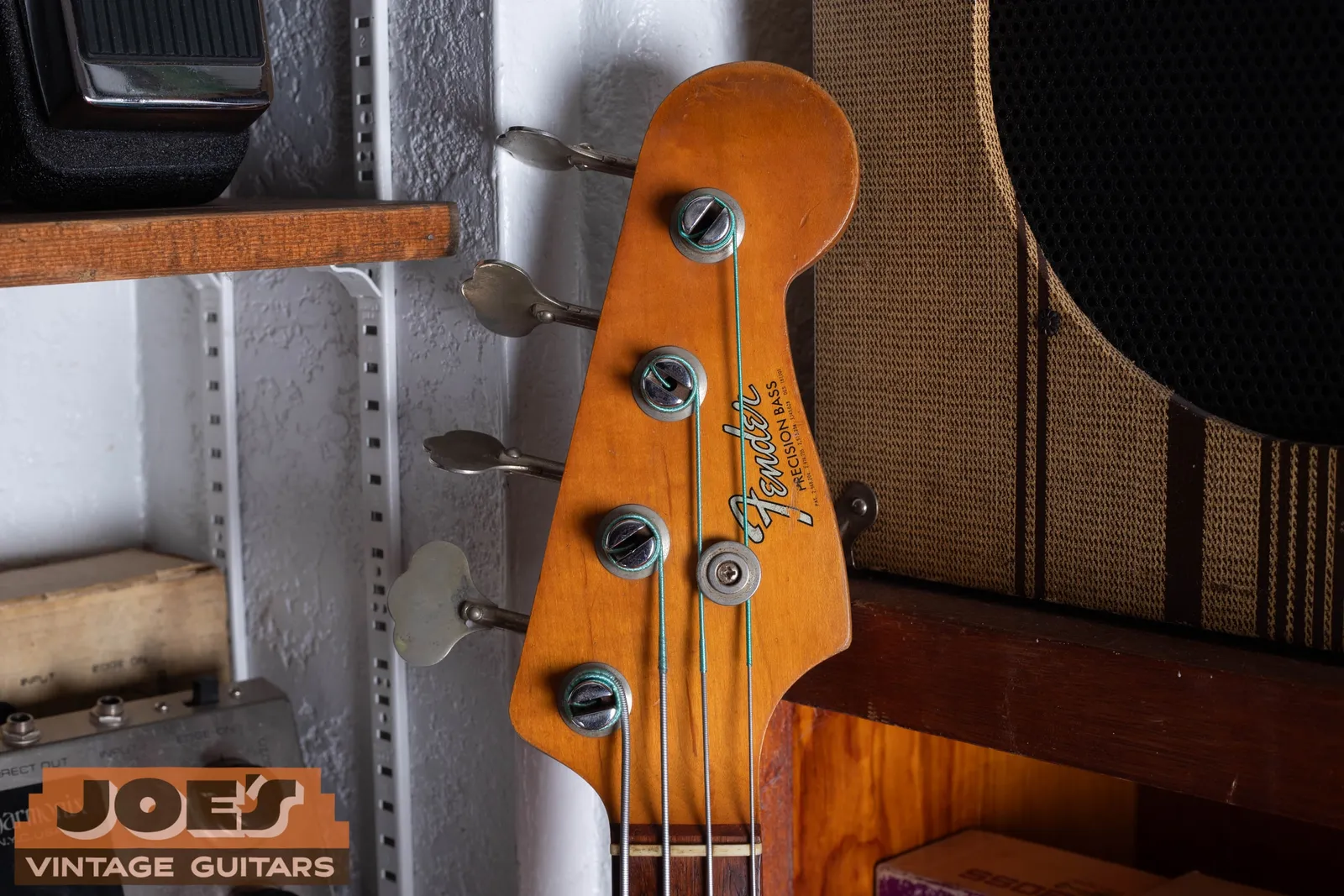
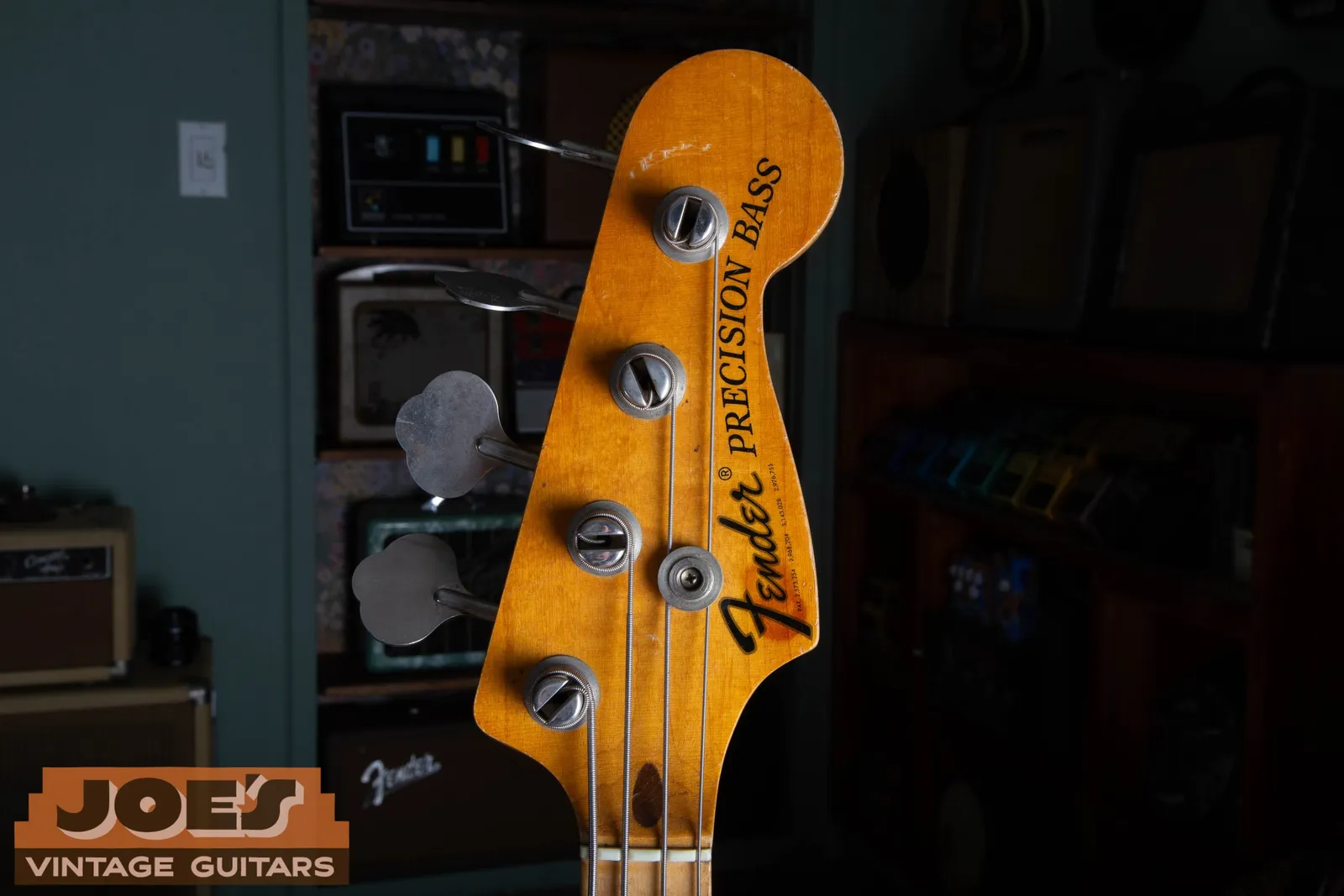
The logo styles across the whole Fender line, and how they date the other models, are on the parts and features guide.
The Board, The Dots, And What It Never Got
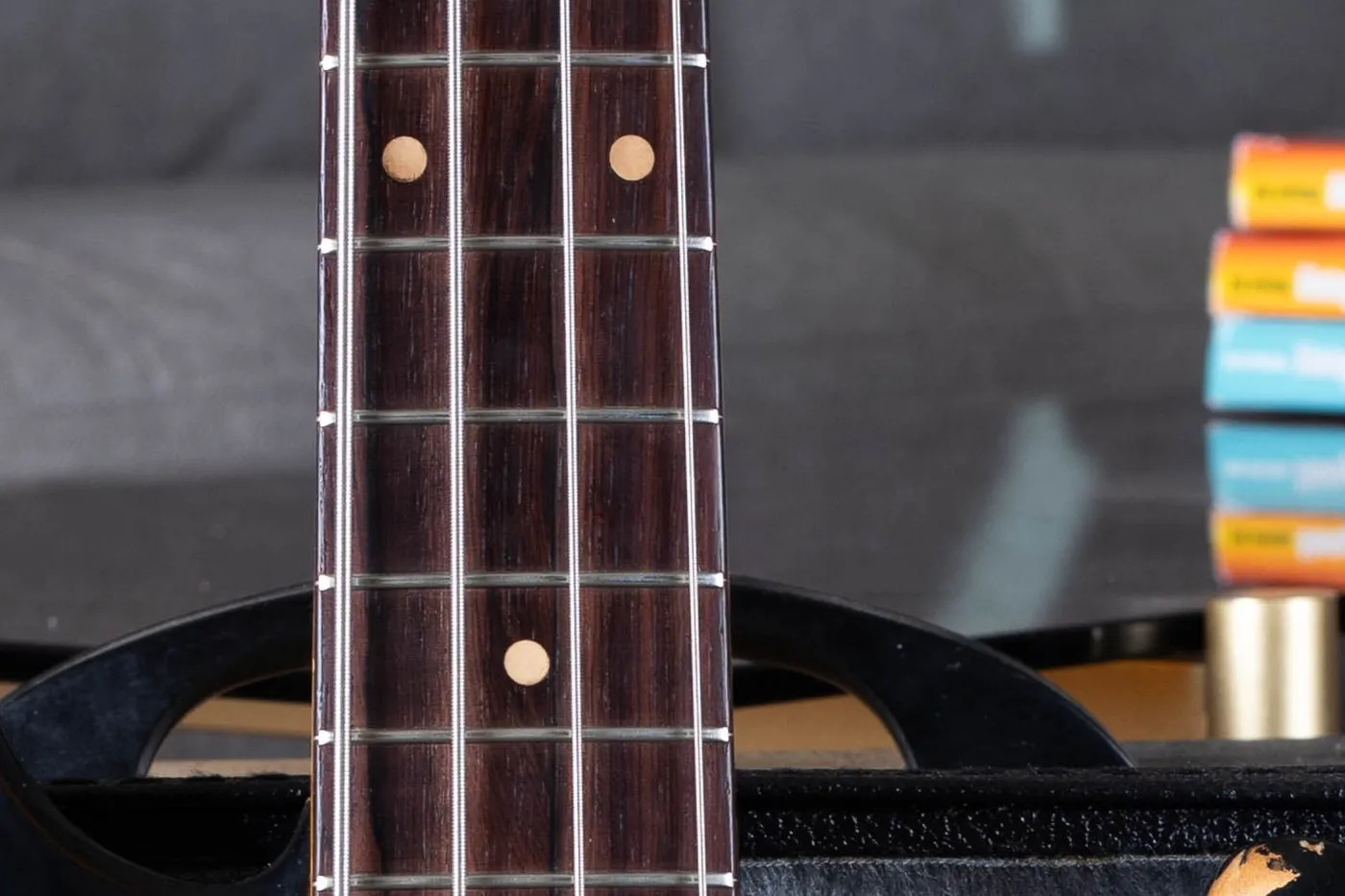
Maple to mid-1959, rosewood after, arriving alongside the tortoiseshell guard. Clay dots run to late 1964 and pearloid dots follow, the same window as the rest of the Fender line. Clay reads matte and chalky and ages toward tan or cream, while pearloid is brighter and visibly reflective.
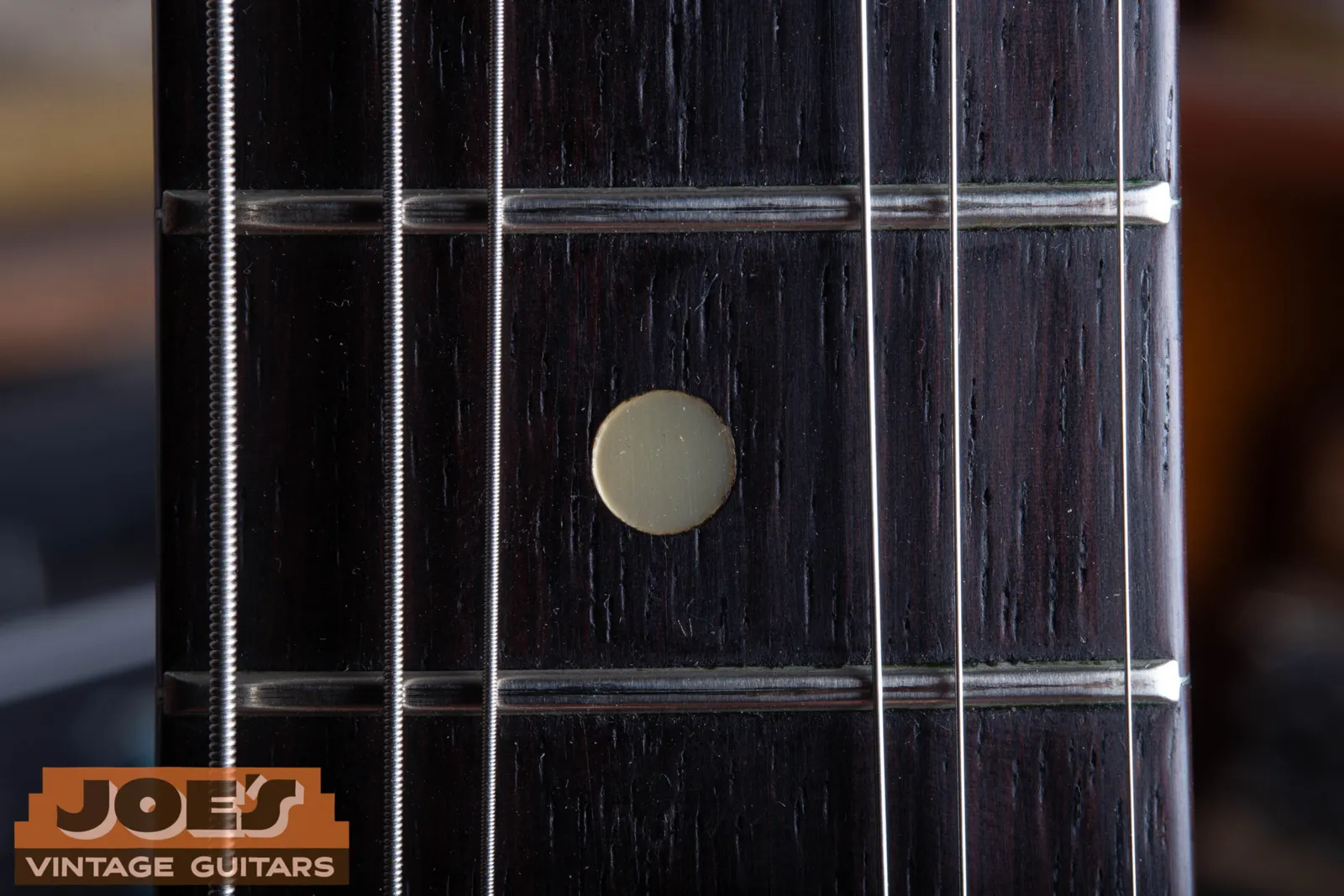
The Precision never got binding or block inlays. Not in standard production, at any point in the vintage era. The Jazz Bass took white binding in late 1965 and pearloid blocks in mid-1966, and the Precision simply did not follow it. So an unbound board with dots is correct on a vintage Precision all the way through, and blocks or binding on one need a very good explanation. The confusion is understandable, because Fender's modern seventies Precision reissues are sold with bound, block-inlay necks, but those borrow Jazz Bass styling rather than recreating a vintage Precision.
Single Coil To Split Coil
The pickup is the second half of the era question, and on this model it is decisive. From 1951 to mid-1957 the Precision carried a single-coil pickup: one bar, sitting under a chrome cover on later examples. From mid-1957 it carried the split-coil pickup, two offset halves wired to cancel hum, which is the design every Precision since has used.
Bottom colour dates the pickup. Fender used black flatwork with cast slug alnico magnets from 1950 to March 1964, then grey flatwork from March 1964 into the late 1970s. It is a quick check on any early bass and it is the same line the Jazz Bass sits on.
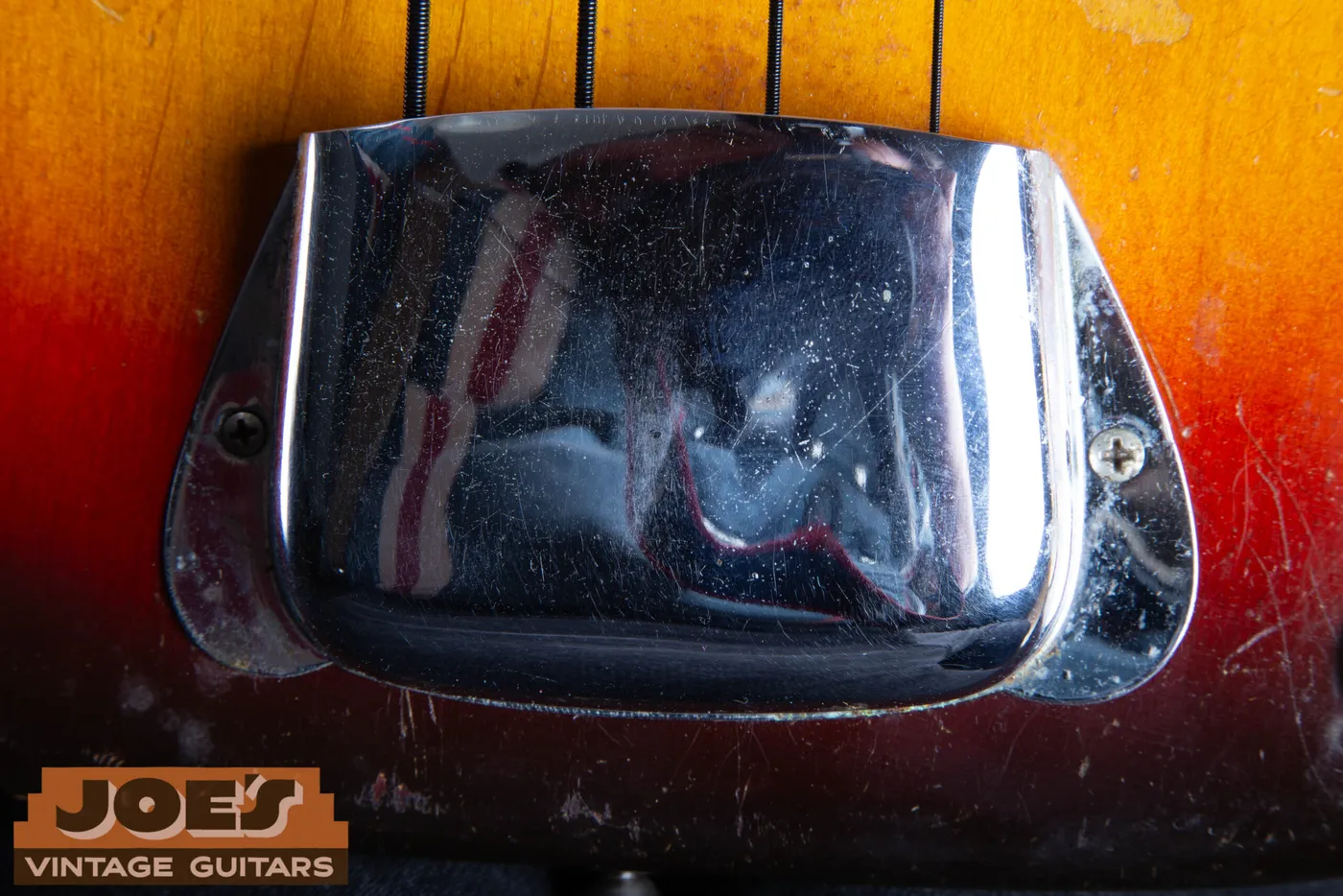
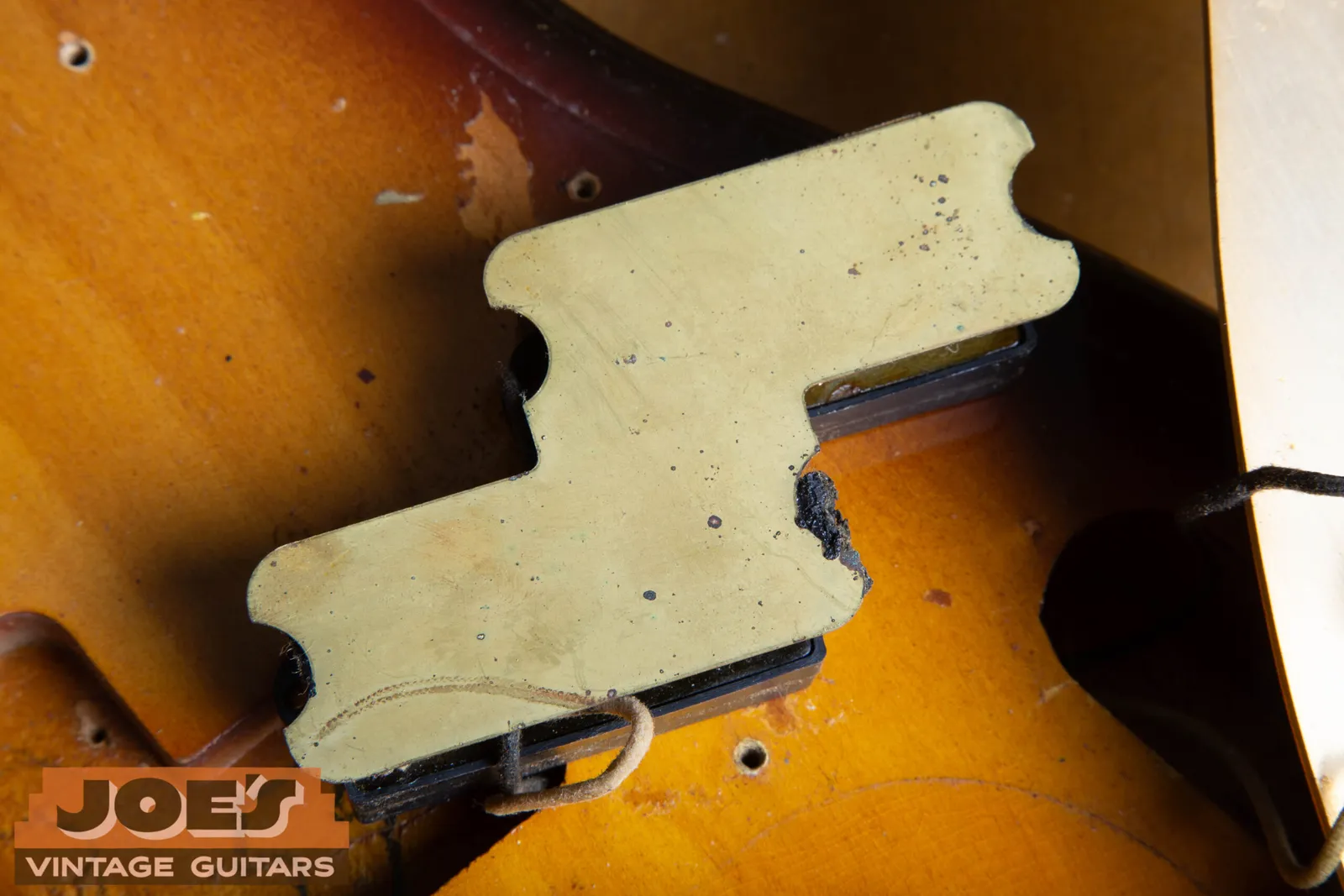
Read the rest of the gold-guard hardware as a group, because it is easy to check and hard to fake all at once: a steel bridge plate with four threaded steel saddles, heavy knurled chrome-plated brass flat-top knobs, and a black plastic finger rest or tug bar mounted below the strings for thumb plucking.
Tuners
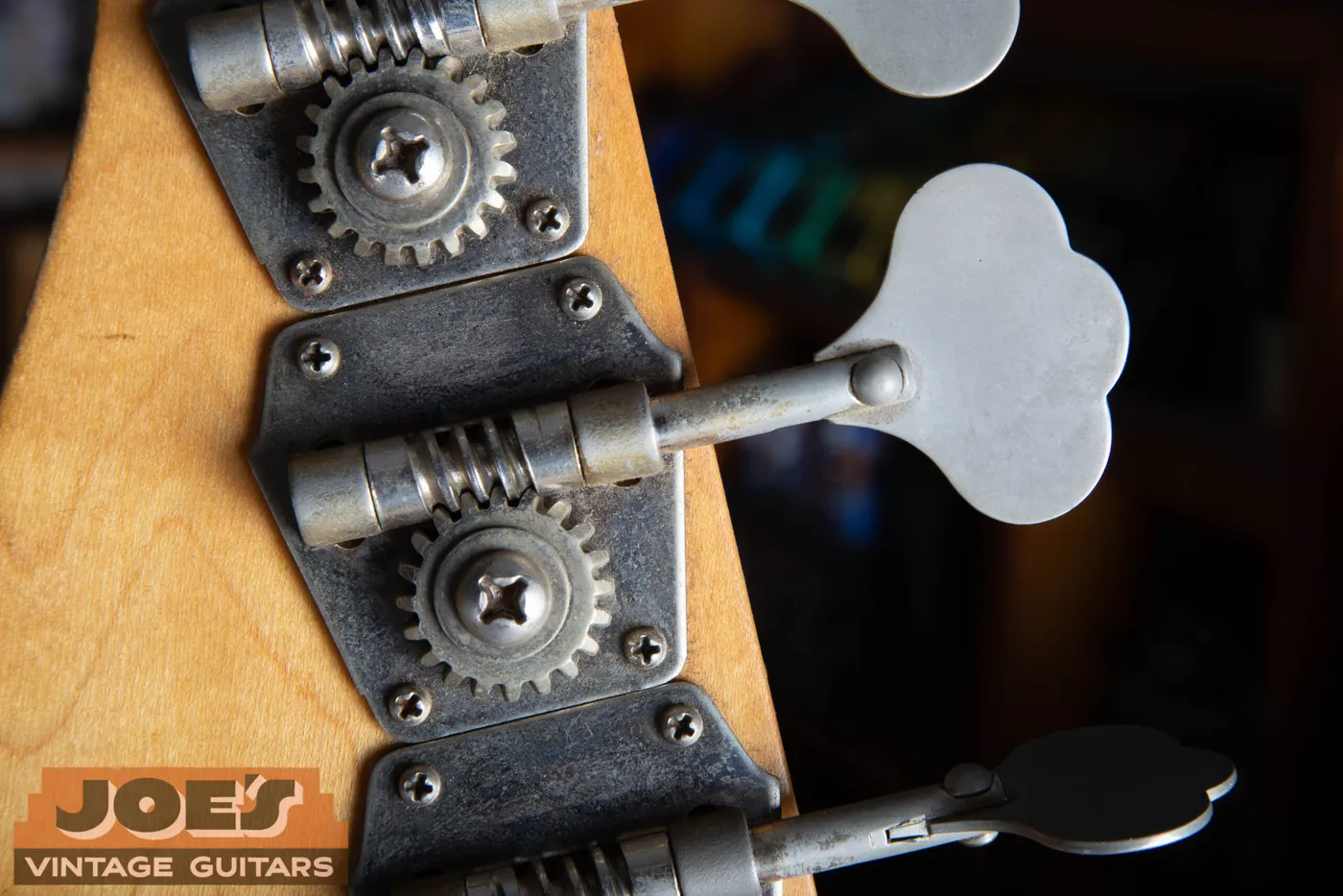
Three eras. Reverse-wind Klusons run from 1958 through early 1966, and they tighten clockwise, which feels backwards to anyone who has only handled modern instruments and is correct here. Non-reverse Klusons follow from early 1966. F-stamped tuners arrive from late 1968 into early 1969.
The F stamp and Schaller are two different things, about seven years apart. Fender produced the F-stamped tuners in house when they arrived at the end of the 1960s. Manufacture only moved to Schaller in Germany by 1976. So an F-stamped tuner on a 1970 bass is not a Schaller part, and treating the stamp as a maker's mark will date a bass wrongly.
The Neck Heel Date
Take the neck off and the heel carries a date. On the early basses it is written in pencil by the shaper, sometimes with initials. From about 1962 Fender moved to an ink stamp running a model code, then the month, then the year, then a letter for the nut width.
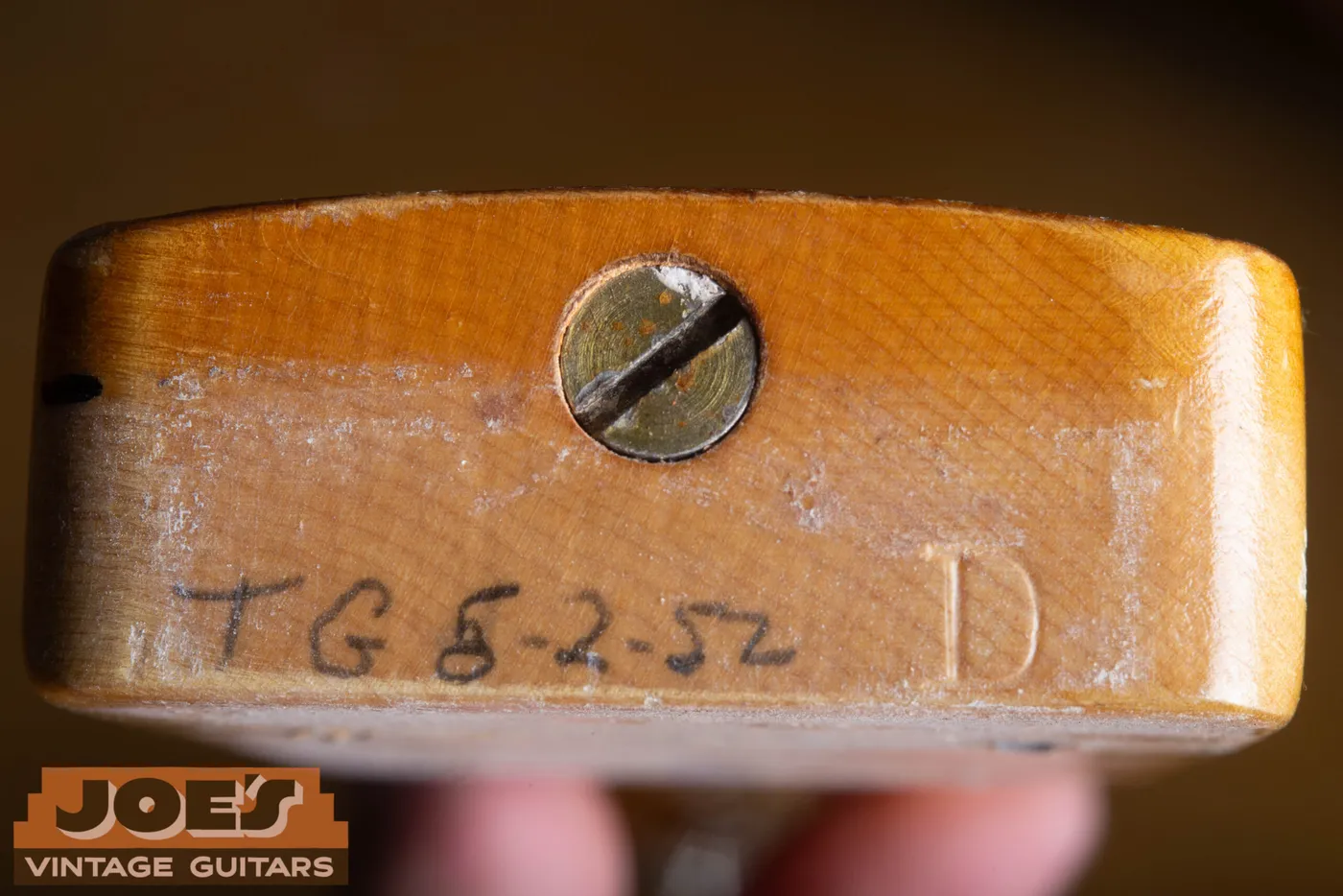
The Precision Bass model code is 5. Worth one caution: the neck stamp code table records a second, later code for several models after Fender renumbered at the end of 1965, and it does not record one for the Precision. So read the month and the year and treat the code as a label rather than as a dating tool on this model.
The stamp format across the whole line, and the full model code table, are on the neck date guide.
Body Dates
The other place Fender wrote a real date: a pencil date on the body. It corroborates rather than decides, because bodies sat before being matched to necks, so a body date and a neck date a few months apart is the normal result on an untouched bass.
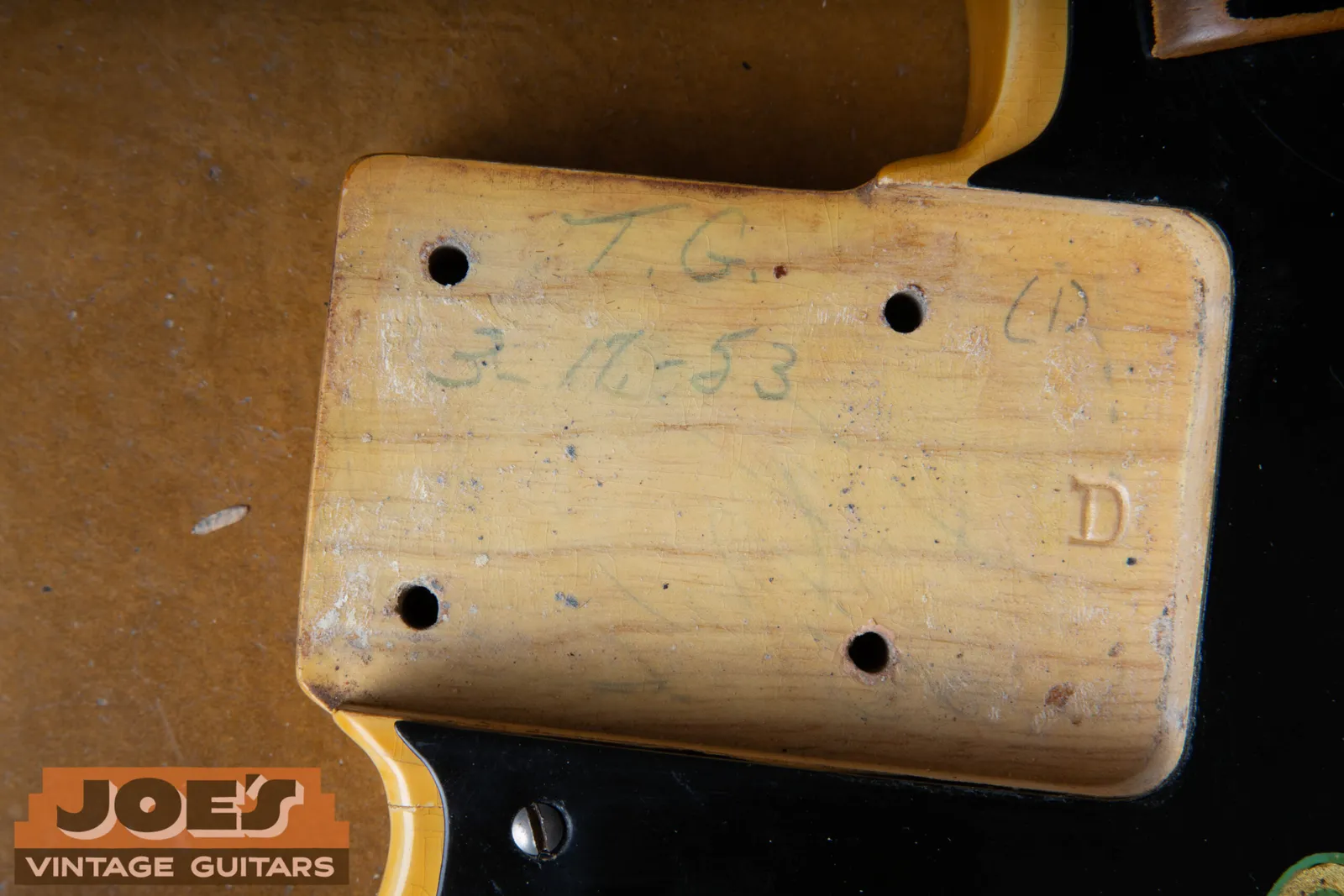
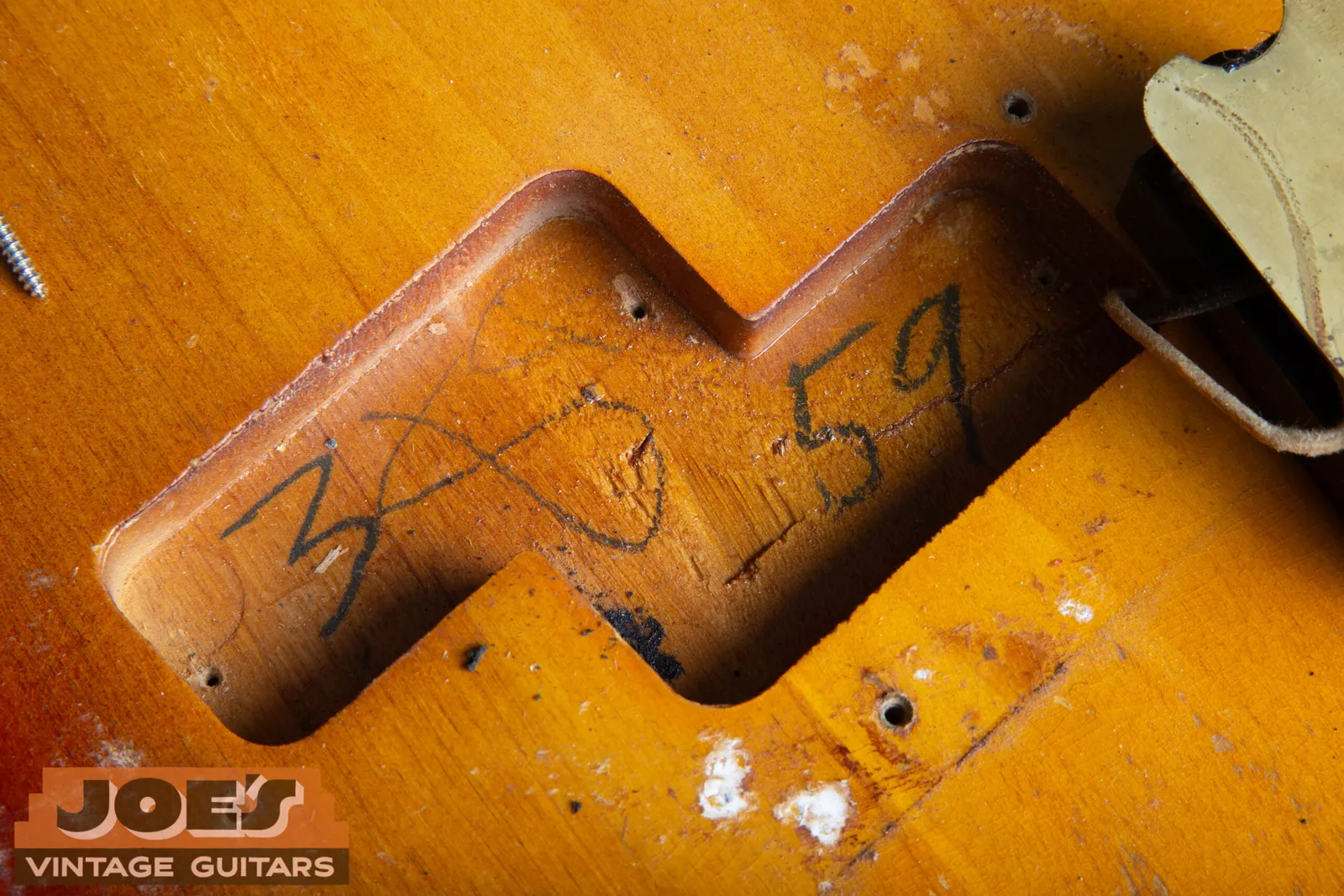
On the slab basses, look at the nail holes and the router marks in the cavities while you are in there, because a respray tends to soften or fill them.
Where the date hides on every Fender model, and what the pencil, ink and tape markings look like, is on the body date guide.
What The Serial Number Adds
A useful vote, and no more. Fender stamped plates in batches and pulled them off the stack in no order, so the number gets you a rough production year and not a month. On this model there is an extra wrinkle: on the earliest basses the serial is not on a neck plate at all, it is stamped into the steel bridge plate.
| Where it is | Years | What it looks like |
|---|---|---|
| Bridge plate | 1951 to about 1954 | Stamped into the steel bridge plate rather than a neck plate, alongside the Patent Pending marking on early examples. |
| Plain neck plate | About 1954 to late 1962 | Four or five digits on a plain chrome four-bolt plate, no letter. |
| L-prefix plate | Late 1962 to late 1965 | An L in front of five digits. The last of the pre-CBS plates. |
| Big-F plate | About late 1965 to 1976 | Six digits stamped above a large stylized F. Still a four-bolt plate on this model. |
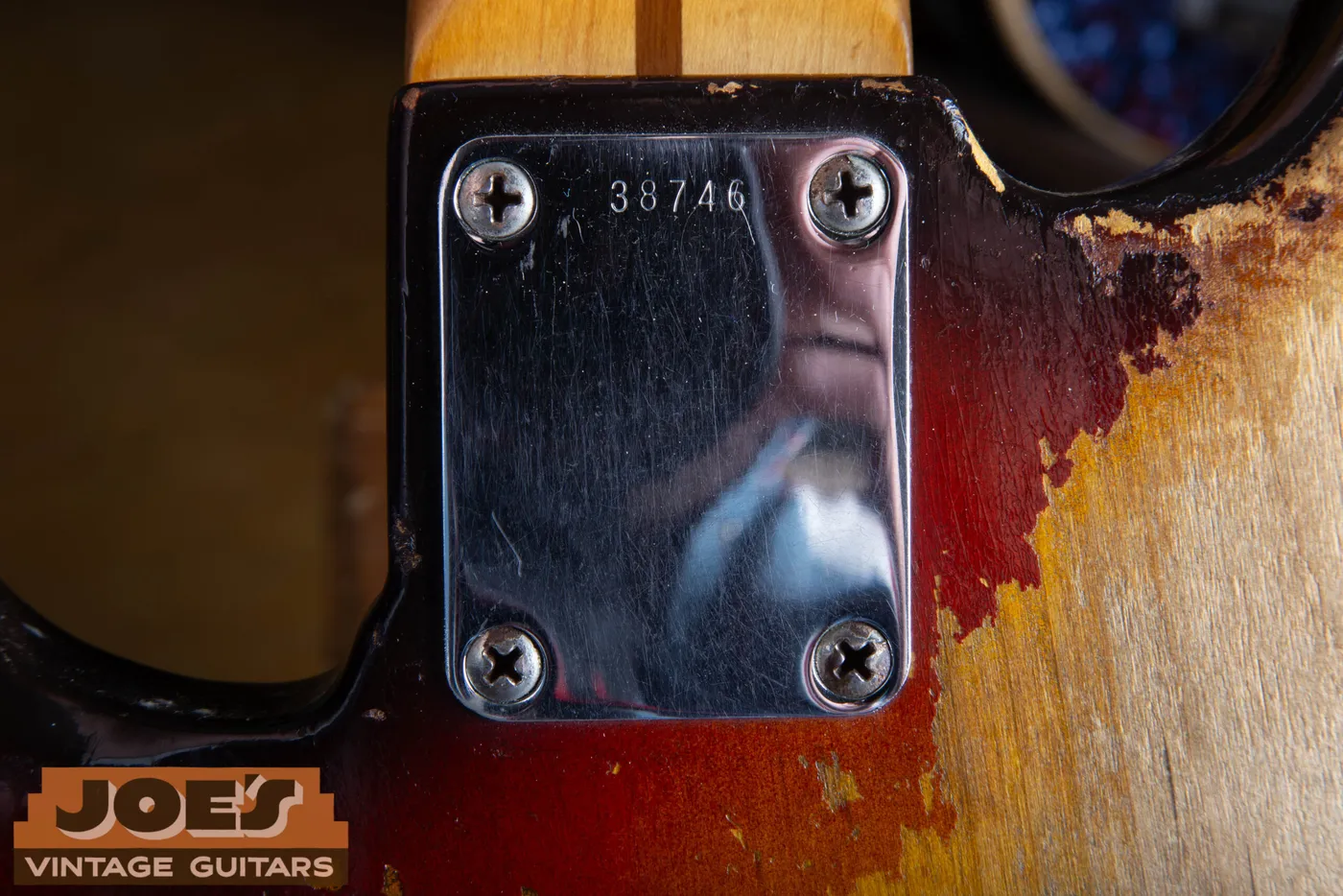
There is no Precision Bass serial chart on this page because Fender serials are not model-specific. A 1963 neck plate reads the same whether it ended up under a Precision, a Stratocaster or a Jaguar, so the charts live once on the full Fender serial number guide.
What The Precision Skipped
Most dating guides are lists of changes. On this model the changes that did not happen are just as useful, because each one is a red flag when you see it on a bass being sold as an original vintage Precision.
No binding and no block inlays, ever, in standard production. The Jazz Bass took both in 1965 and 1966; the Precision stayed unbound with dots.
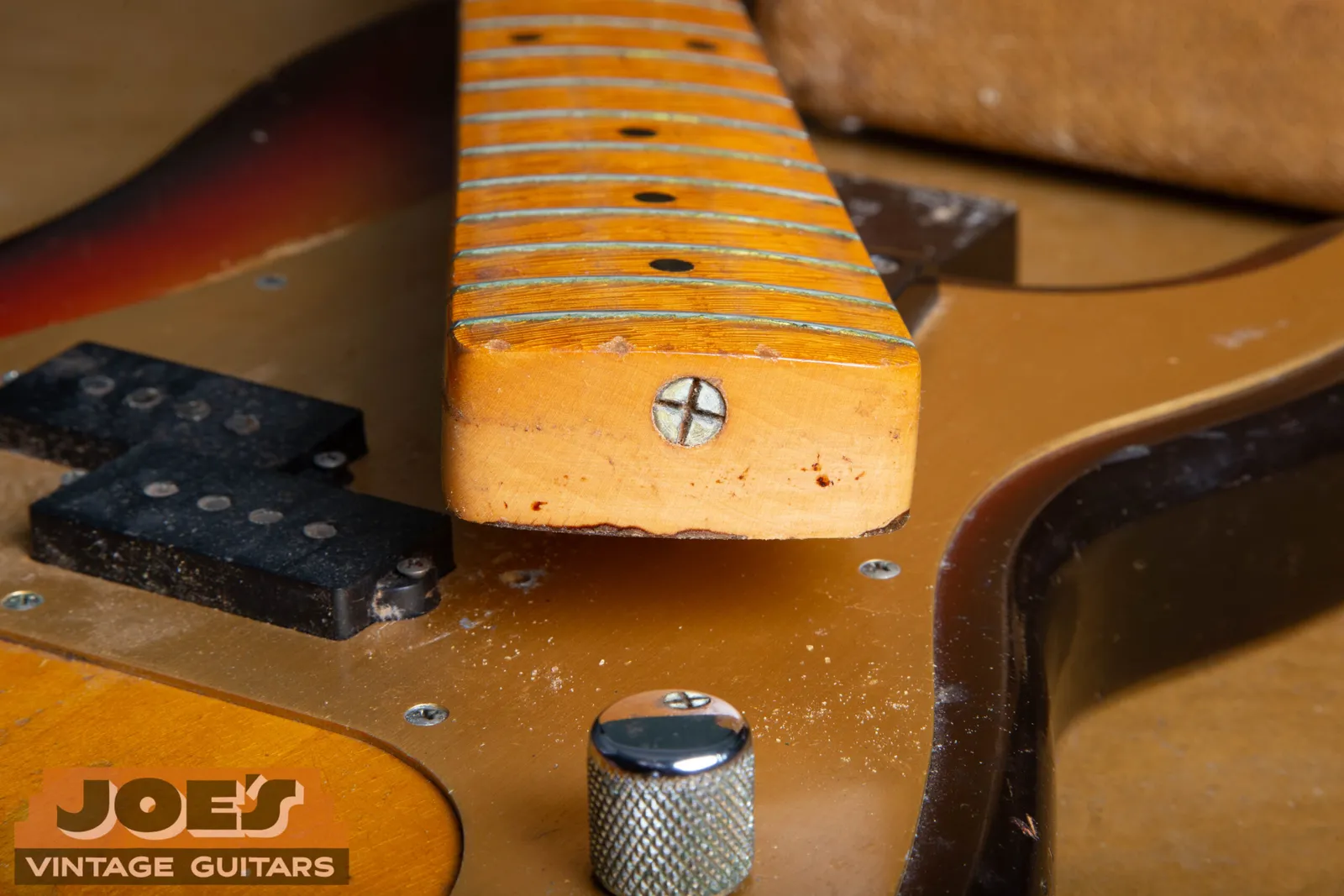
No three-bolt neck and no bullet truss rod. The Stratocaster and the Jazz Bass moved to the three-bolt Micro-Tilt joint with a bullet adjuster, the Jazz Bass in late 1974. The Precision kept its four-bolt neck plate and its heel-adjusted truss rod right through the 1970s. So count the bolts: four is correct on a vintage Precision and three is a problem.
That one runs against the grain. The Precision is usually cast as the plainer of the two basses, the one that got whatever the Jazz Bass got, and on the neck joint it is the Jazz Bass that changed and the Precision that stayed put.
What The Features Can't Prove
Every feature on this page dates a part. None of them dates the bass, and with three different instruments wearing this one name, a parts assembly has more places to hide here than on any other Fender.
The gold guard and the slab body are the two features worth faking, because both carry large premiums and neither is difficult to move or to reproduce. A gold anodized guard is a handful of screws. Confirm either against the neck heel date, the body date and the pot codes before you let it set the price.
A correct feature set is not proof of originality. Originality is a whole-instrument judgment that weighs the neck date, the body date, the pots, the pickup, the hardware and the finish against each other and asks whether they tell one story.
Transition dates are approximate, and honest instruments break them. On a Precision that lands hardest on 1952, where slotted and Phillips screws both appear, on 1957, where genuine hybrids exist, and on 1959, where the rosewood and tortoiseshell change happens mid-year.
The finish is where the most value moves, and the 1958 sunburst is a trap in both directions: a three-tone that has faded to two-tone is normal ageing rather than a refinish, and a suspiciously vivid red on a bass of that age is worth a second look.
Confirm It From The Inside
The neck heel date and the body date above are the two that give you a month. Two more parts back them up. The pot codes date a potentiometer to the week, which is the tightest number anywhere on the bass, though it is a floor rather than a build date because pots sat in bins. The pickup dates corroborate when they are present, and on a Precision the bottom colour does real work alongside them. For the parts view across every Fender model, work through dating a Fender by its parts.
For the long version of either end of this model's life, the 1952 Precision Bass guide covers the slab era in detail and the gold guard guide covers 1957 to 1959. The sibling model pages built the same way as this one are the Stratocaster, Telecaster, Jazzmaster, Jaguar, Jazz Bass and Mustang dating guides.
This guide is one of the model pages behind the full Fender serial number guide, where the complete year-by-year serial charts live.
Common Questions About Dating A Precision Bass
What Year Is My Precision Bass?
Start with a different question than you would on any other Fender: which Precision Bass is it. Three quite different instruments wear the name. A flat slab body with a single-coil pickup and a Telecaster-shaped headstock is late 1951 to mid-1954. A contoured body still carrying that single coil is mid-1954 to mid-1957. A split-coil pickup is mid-1957 or later. Once you know which one you are holding, the pickguard, the fingerboard and the logo narrow it further, and then the neck heel date, the body date and the pot codes give you a month.
Is A Slab Body Precision Bass Really Worth That Much More?
Yes, and the reason is scarcity plus the fact that it is the first one. The slab era ran from late 1951 to mid-1954, so it is under three years of production of an instrument that has been made continuously ever since. Be careful with 1953 though: some 1953 basses have noticeably softer, more rounded perimeter edges from heavier hand sanding on the line, and that gets described as early contouring by people who want it to be. It is not. The true Stratocaster-style forearm bevel and belly cut did not reach the Precision until mid-1954, so a bass with real contours is not a 1953 no matter what the listing says.
What Is A Gold Guard Precision Bass?
The version Fender built between the mid-1957 rebuild and mid-1959: a split-coil pickup under a gold anodized aluminum pickguard, on a maple neck. The window is under two years, which is what makes them collectable. The metal guard was not decoration either, it shielded the electronics against hum and radio interference and it stayed flat where the earlier single-ply plastic guards warped and cracked. Look for the gold anodizing worn through to bare silver aluminum where a player's thumb rested. That patch takes decades to develop and is very hard to fake convincingly.
My Precision Bass Sunburst Looks Two Tone. Has It Been Refinished?
Probably not. Fender added red to the sunburst in 1958, between the black and the yellow, and the red dye of that era was highly sensitive to ultraviolet light. On plenty of examples it has faded out completely, leaving what looks like a two-tone burst. Collectors call that an unburst and it is a normal ageing outcome rather than evidence of a respray. What you want to check instead is whether the finish behaves consistently everywhere, and whether anything is sitting over the body date rather than under it.
Did The Precision Bass Ever Have Block Inlays Or A Bound Fingerboard?
Not in standard production, at any point in the vintage era. That is Jazz Bass territory, where binding arrived in late 1965 and block inlays in mid-1966. The Precision stayed an unbound, dot-inlay instrument throughout. The confusion is understandable, because Fender's modern seventies Precision Bass reissues are sold with bound, block-inlay necks, but those borrow Jazz Bass styling rather than recreating a vintage Precision specification. So blocks and binding on something being sold to you as an original vintage Precision need a very good explanation; rare custom-order exceptions aside, the neck usually came from somewhere else.
Does My 1970s Precision Bass Have A Three Bolt Neck?
It should not. This is one of the more useful differences between the two basses: the Stratocaster and the Jazz Bass moved to the three-bolt Micro-Tilt neck joint with a bullet truss rod, the Jazz Bass in late 1974, but the Precision Bass kept its four-bolt neck plate and its heel-adjusted truss rod right through the 1970s. So a three-bolt plate on a bass presented as a vintage Precision is worth a hard look, and so is a bullet adjuster at the headstock.
Is The Spaghetti Logo On A Precision Bass Gold Or Silver?
Silver on this model. It differs from a Stratocaster, where the spaghetti logo is gold, and getting it backwards is a common way to misread a headstock. The full picture across the line: gold on the Stratocaster and the Jazzmaster, silver on the standard Telecaster with gold on the Custom, and silver on the Precision Bass. The silver does not stop with the spaghetti script either, because the transition logo that follows it in 1964 is silver as well, so on a Precision Bass that change is one of weight rather than colour, thin and fine giving way to the same silver drawn much heavier. The black CBS logo from late 1967 is the only colour change on the headstock. The Jaguar and the Jazz Bass never wore a spaghetti logo at all, because both arrived after that era had ended.
Should I Take My Precision Bass Apart To Date It?
Only as far as you need to. Everything in the first two passes reads with the bass assembled, which is deliberate. Pulling the pickup to read the bottom colour is worth it on a bass from either side of March 1964, and pulling the control plate for pot codes is standard. Be careful with an anodized gold guard, which marks if a screwdriver slips, and with old nitrate guards, which crack at the screw ears. If the outside checks leave you stuck between two years, send me photos before you reach for a tool.
Think You Have A Slab Or A Gold Guard?
Those are the two that carry the money, and both are worth confirming properly before anybody makes you an offer. Send Joe three clear photos, the front, the back and the headstock, for a free expert appraisal within 24 hours. No obligation, and no screwdriver required.
Thinking about selling? Read how to sell your Fender, or see the Stratocaster and Telecaster value guides for a sense of how the vintage market runs.

Joe Dampt is the owner of Joe's Vintage Guitars in Mesa, Arizona, where he's spent more than twelve years buying, appraising, and authenticating vintage instruments full-time. He's personally valued over 10,000 guitars for sellers in all 50 states, served as a traveling appraiser for the Treasure Seekers Roadshow, and sourced instruments for Grammy Award-winning artists. Every check on this page comes from that bench work.