

Fender Neck Dates: How To Date A Fender By Its Neck Heel
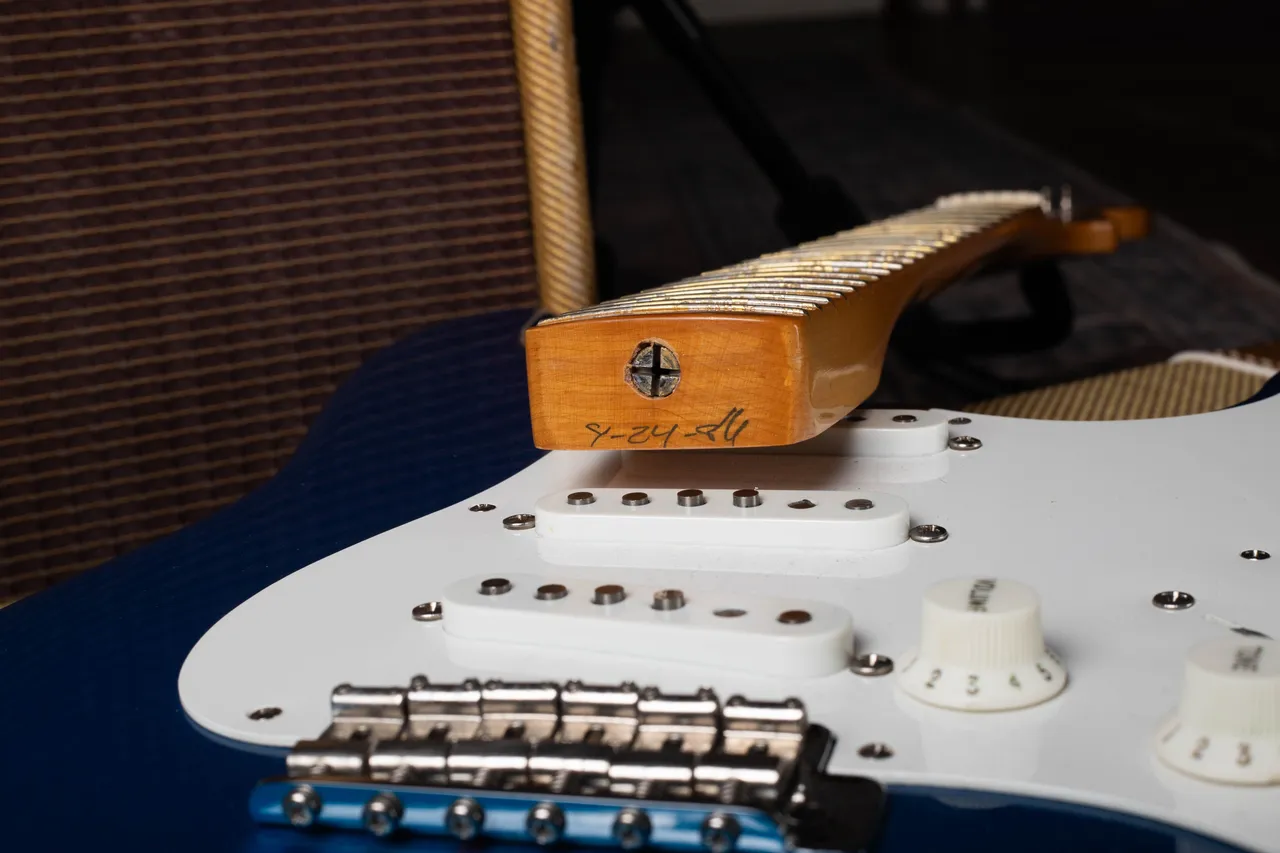
Someone at Fender wrote or stamped the date on the butt of your neck by hand, then bolted it into the body where nobody would see it again for sixty years. It is the most reliable single thing on a vintage Fender, and it takes four screws to get to.
If you're starting with an unfamiliar guitar, see how to establish its age before arranging an internal inspection.
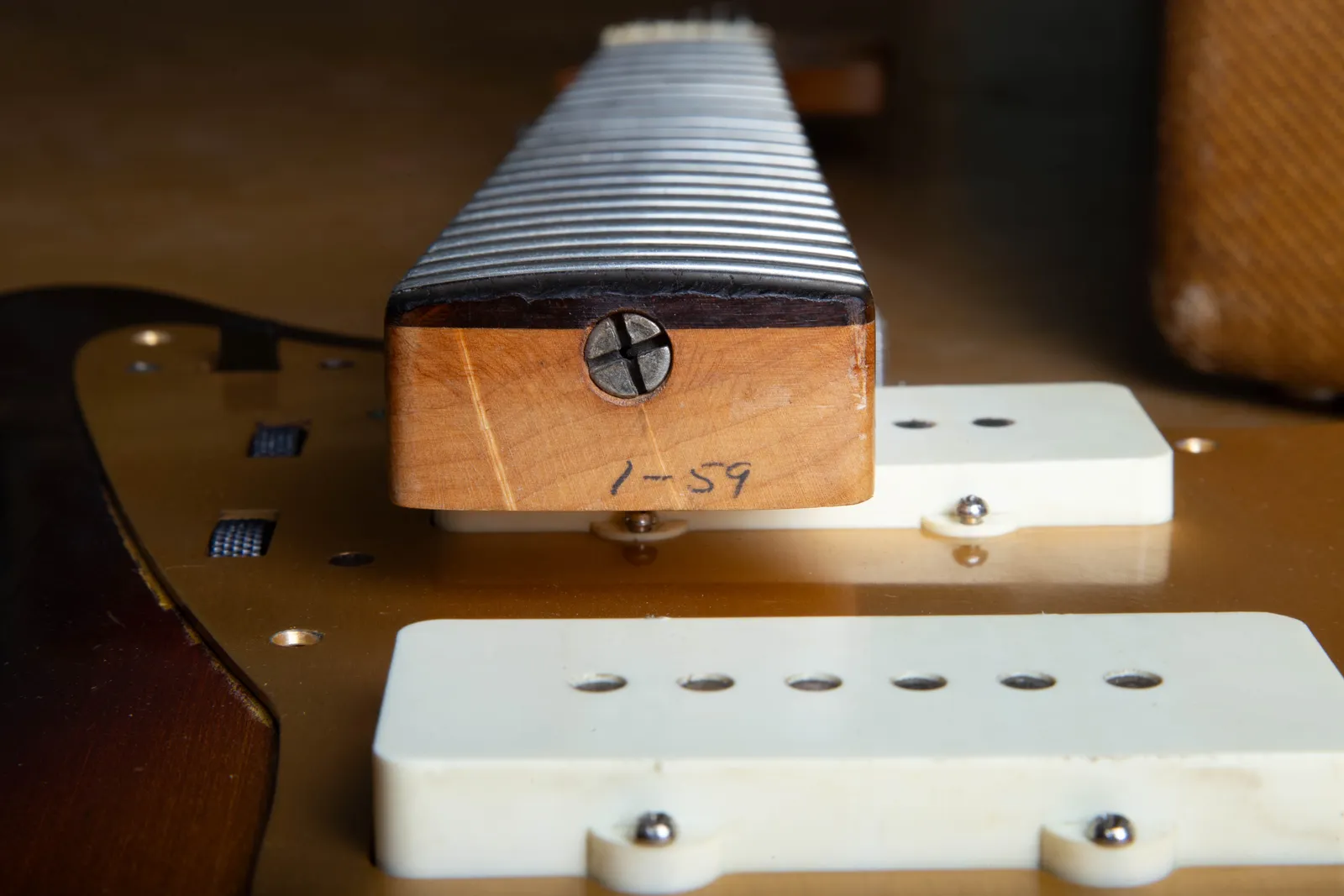
Do not take a vintage instrument apart unless you have done it before. Vintage screws, plastics, and finishes strip and crack easily, and one slip can cost far more than the answer. If you have not done this before, contact me first and I'll help.
What A Neck Date Is
The neck date is a production date written or stamped on the heel of the neck, the flat end that bolts into the body. A Fender worker marked it by hand as they finished the neck, so it records the actual month that neck was made. Almost every Fender built through the early 1970s has one.
It's the single most reliable way to date a vintage Fender, because it was applied at the bench, not assigned from an office. The catch is what it dates. The neck date dates the neck, not the whole guitar. The two line up only when the neck is original to the body.
Where To Find The Neck Date
The date is on the butt of the neck heel, the end that sits down in the neck pocket, so you have to take the neck off the body to see it. On a bolt-on Fender that means backing out the neck plate screws and lifting the neck out of the pocket. Support both halves so nothing swings loose, and take a clear photo of the heel before you put it back together.
Watch Joe take the neck off and read the heel date. The clip starts right at that step.
Taking The Neck Off Without Hurting The Guitar
Slack the strings right off first. Taking them off entirely is better, because it drops all the forward pull across the joint before anything moves. Work on a padded surface that holds up the body and the neck at the same height, and keep a hand on both once the screws start coming out.
Use a screwdriver that actually fills the screw head. A number 2 Phillips is usually right, and a loose fit is how you round out a sixty-year-old screw slot. Back the four screws out slowly and evenly rather than running one all the way out first.
If the neck sits tight in the pocket, and after decades of lacquer many of them do, do not lever it sideways. The pocket walls are thin and that is exactly how they crack. Ease it straight up from the heel instead and let the seal break on its own.
Faint marks are normal. Old graphite goes silvery and ink can fade almost into the wood, so try raking a light across the heel at a low angle, and a magnifier or a UV light will often pull up a date your eye reads as blank. Photograph the heel before you bolt it back together, so you never have to take it apart twice.
If you aren't comfortable taking the neck off, don't force it. A stripped screw or a chipped finish costs more than the answer. Get in touch before you take anything apart and I'll help, or read the date for you if you bring the guitar by.
Read A Pencil Date
On Fenders from the early 1950s into the early 1960s, the date is written in pencil right on the heel. The format is simple: the month, then the year. Sometimes the worker's initials sit next to it.
| Pencil date | Reads as |
|---|---|
| 5-57 | May 1957 |
| 9-60 | September 1960 |
So 5-57 reads as May 1957. That is the whole method for a penciled neck. The only trap is a faint or half-erased pencil mark, which is why a raking-light photo beats a quick glance in the pocket.
Early 1950s Necks Often Carry The Day As Well
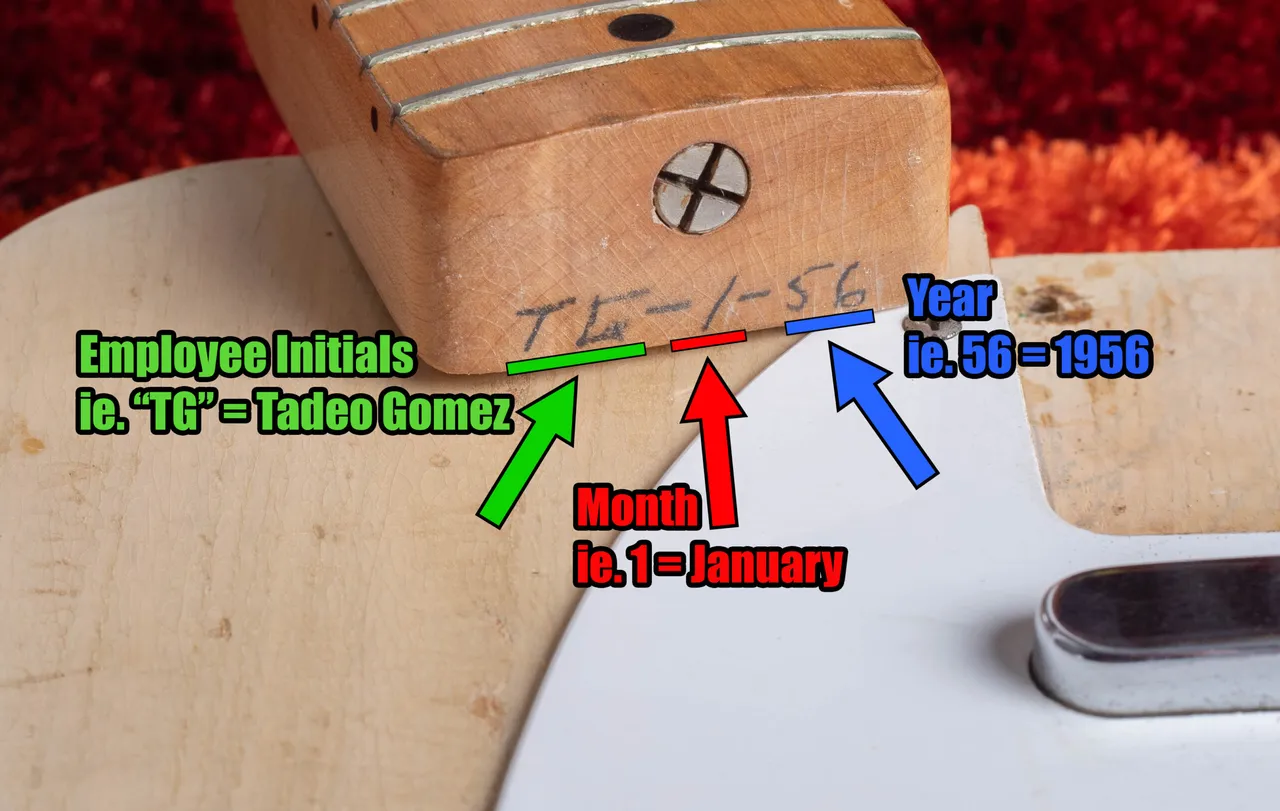
Month and year is the format you'll meet most, but it isn't the earliest one. On Broadcasters, Nocasters, early Telecasters, and Stratocasters from 1950 into early 1955, the worker frequently wrote the exact day too, so you get something like 6-4-52 or 10-12-54 instead of a bare 6-52. Three numbers on an early neck is normal. It does not mean somebody has written on it since.
Those early necks often carry initials in front of the date, and on a 1950s Fender that's a detail worth knowing rather than a smudge to ignore. TG is Tadeo Gomez, who shaped necks at Fender through most of the 1950s, and his necks carry a premium with collectors for exactly that reason. XA is Xavier Armenta, seen mostly around 1956. You'll also run into a lone D stamp on necks, and in body neck pockets, from roughly mid-1951 into the mid 1950s. Nobody has ever established what it meant. Inspected, done, dried, checked, a shift marker and a worker code have all been proposed and none of it is settled, so treat it as a period marking and not as a date. It is not the factory refinish mark either. That one is R&R, and it comes a decade later.
The 1959 Gap, When Fender Stopped Dating Necks
There's a window in 1959 that catches people out. Around March or April, close to when the slab rosewood board came in, Fender stopped penciling dates on neck heels. The practice came back in 1960. In between, a genuine, untouched, correct 1959 neck can come out of the pocket with nothing written on it at all.
The story on the bench is that a customer complained about something profane a worker had penciled on a heel. It's a good story, and it may well be true, but it has never been documented, so treat it as shop legend rather than history. The gap itself is real and is the part that matters.
The practical upshot: on a suspected 1959, a blank heel is not evidence of a refinish or a swapped neck. Date it from the body date, the pot codes, and the hardware instead. Not every neck in the window is blank either, so a dated late-1959 neck is not a problem in itself. Our 1959 Telecaster authentication guide walks a genuine 1959 Fender through this same reasoning.
Read An Ink Stamp
From about 1962, Fender switched to an ink stamp that packs in more. It runs a model code, then the month, the year, and a final letter for the neck width:
| Part of the stamp | What it means | Example |
|---|---|---|
| First 1 to 2 digits | Model code. Ignore it for dating. | 13 |
| Next 3 letters | Month, a three-letter abbreviation such as JAN for January. | JAN |
| Next 2 digits | Year, the last two digits. 66 means 1966. | 66 |
| Final letter | Neck width. A narrow, B standard, C wide, D extra wide. | B |
Worked example. 13JAN66B reads as January 1966 on a standard B-width neck. Ignore the model code for dating; the month and the year are what you are after, and the letter is just the nut width. Here is the stamp broken down:
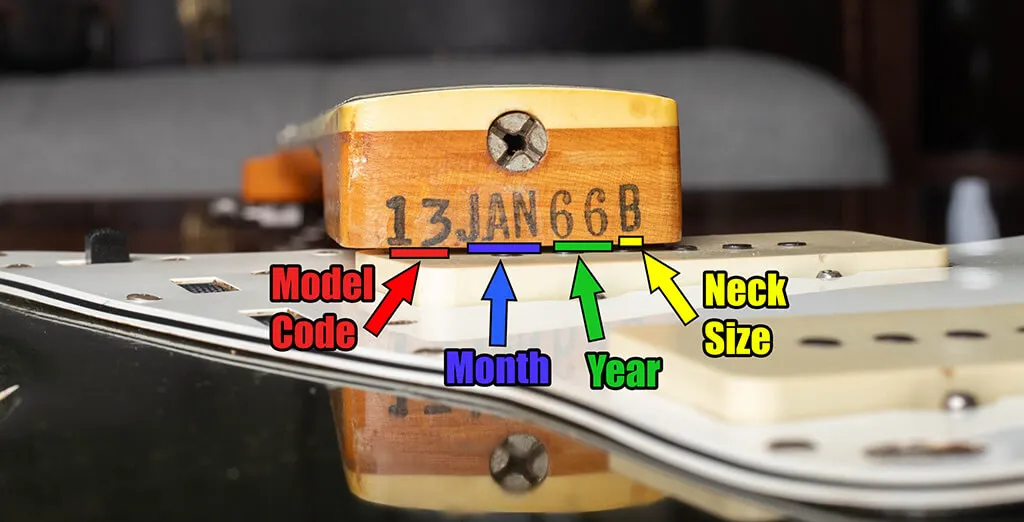
The letter is a spec, not a date. That final letter is the nut width: A narrow, B standard, C wide, D extra wide. It won't date the neck, but it is a quick way to confirm the neck matches the guitar it is bolted to.
The Green Stamp
Starting in 1969, CBS Fender added a new neck stamp in green ink, a run of six to eight digits. For a few years it ran alongside the old month-year stamp, so a Fender from 1969 to 1971 might carry the plain date, the green code, or neither. A neck has one or the other, not both.
The green code reads from the outside in: the first two digits are the model, the next few are a batch number, then a digit or two for the month, one digit for the year, and a letter for the neck width. A Stratocaster starts with 22. For example, 22 384 10 9 B is a Strat, batch 384, October, 1969, standard width.
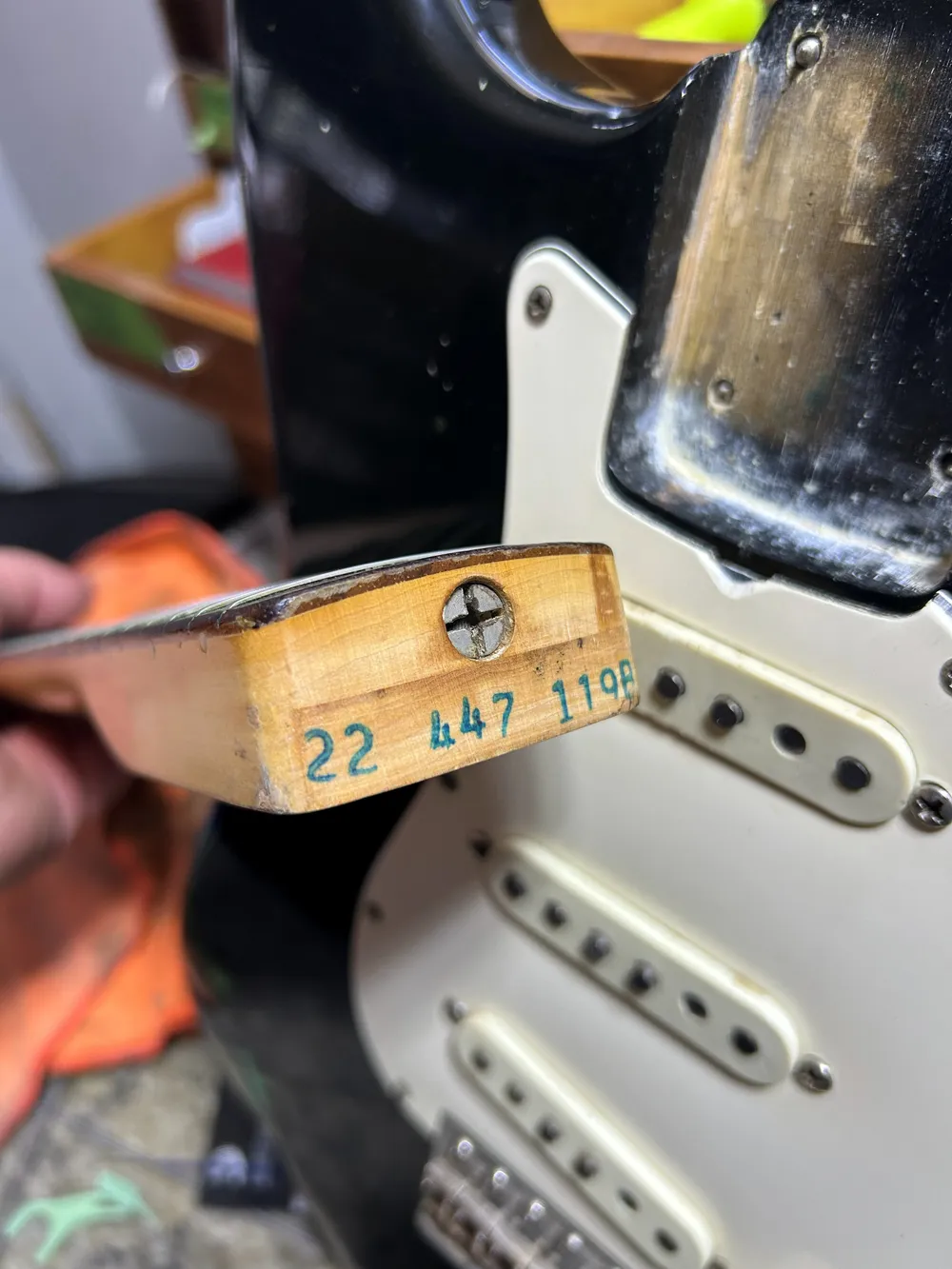
Green codes are the cryptic ones. They are harder to read than the clear month-year stamps, they wear off easily, and the data behind them is still being pieced together. If a green code is faint or does not add up, lean on the pot codes to pin the year.
Where Heel Dating Trails Off
Heel dating doesn't stop on a date you can point to, it just gets less reliable. Consistency falls off sharply after 1973, and through the middle of the decade the marking wanders: the green eight-digit codes give way to red ink stamps, and to printed stickers stuck on the heel or in the neck pocket rather than anything written on the wood. Around 1976 the serial number moves to the headstock decal, and after that the heel stops being where a Fender gets dated.
So treat the mid to late 1970s as the point where this method runs out. On a guitar from that stretch, expect the heel to be inconsistent, and date it from the headstock serial, the pot codes, and the body instead.
Neck Stamp Model Codes
The first one or two digits of an ink stamp or a green code are the model number. Here is what those numbers mean. The same model can carry different codes across the years, which is a dating clue in itself. The Stratocaster is the clearest case, and our 1962 Stratocaster authentication guide works a real early example through the details.
Fender renumbered the models at the end of 1965. This is the part that trips people up, and it is worth more than any single code in the table. A model does not keep one number for the whole era. The Stratocaster runs 2 through 1965, then 13 from 1966 to 1968, then 22 from 1968 to about 1973. The Jaguar runs 1 through 1965, then 15 from 1966. So a 1965 Strat heel reads 2MAY65B and a 1966 one reads 13MAY66B, and the guitar in front of you has not changed model, only the year has. If you are working from an old code list that stops at 1965, it will tell you a 1966 Stratocaster is something it is not.
| Code | Model |
|---|---|
| 1 | Jaguar, 1962 to 1965. It becomes 15 from 1966 |
| 2 | Stratocaster, 1962 to 1965. It becomes 13 from 1966, so a 1965 neck reads 2MAY65B and a 1966 one reads 13MAY66B |
| 3 | Telecaster and Esquire, which shared this code, and the Custom Telecaster from 1959 |
| 4 | Jazzmaster, 1962 to 1965. It moves to 19 in late 1965 or 1966, and turns up as 10 or 13 now and then |
| 5 | Precision Bass |
| 6 | Bass VI |
| 7 | Jazz Bass |
| 8 | Musicmaster II, Mustang, Duo-Sonic II, 1964 to 1965, 22 fret 24 inch scale |
| 9 | Musicmaster II, Mustang, Duo-Sonic II, 1964 to 1966, 21 fret 22 1/2 inch scale |
| 10 | Coronado 1 and 2, and the occasional 1966 Jazzmaster and Stratocaster neck |
| 11 | Bass V |
| 12 | Electric 12, and Maverick / Custom |
| 13 | Stratocaster, 1966 to 1968, and many 1966 Jazzmasters. This is the code that replaced 2 |
| 14 | Coronado 12 |
| 15 | Jaguar, 1966 to 1972 |
| 16 | Musicmaster II, Mustang, Duo-Sonic II, and Bronco |
| 17 | Mustang Bass and Musicmaster Bass |
| 18 | Coronado Bass |
| 19 | Jazzmaster and Coronado 2 |
| 22 | Stratocaster, 1968 to about 1973 |
| 23 | Telecaster Bass |
| 27 | Villager 12 |
| 28 | Shenandoah 12 |
These come from CBS-era neck stamps, and Fender was not always consistent. The codes overlapped and shifted over the years, so read the model prefix next to the other dating clues, not on its own. Gaps in the run are models Fender never assigned a number, or codes not yet documented.
The 1980s Reissues Have Heel Dates Too
In 1982 Fender launched the American Vintage Reissue series, US-made copies of the 1950s and 1960s classics, and it brought the heel date back. The Fullerton reissues, 1982 until the plant closed at the end of 1984, carry a graphite pencil date written numerically, like 12-15-83. Documented examples run from 5-11-82 onward, and pencil stayed the method until about 1988, when Fender moved to a black ink stamp using three-letter months.
There is a catch that sends people the wrong way here. Many Fullerton heels also carry a black ink stamp of the builder or inspector name, and some carry the word VINTAGE stamped on. Neither of those is the date, and it's easy to see one, call the neck ink-stamped, and date it to the wrong end of the 1980s. The pencil date is the date. Some 1982 necks left the factory with no date on them at all, which is its own known quirk rather than a sign of a problem.
Either way, a reissue date does not prove a guitar is pre-CBS.
The giveaway is in the detail. A reissue date often includes the day, not just the month and year, and the rest of the guitar, the serial number, the pot codes, and the hardware, will point to the 1980s or later. Read the heel date, then confirm the era with everything else.
The Neck Date Dates The Neck
Read a neck date the way the bench does. The neck date tells you when the neck was made, not when the guitar was assembled. Fender built necks in batches and pulled them from a bin, so a neck can predate the finished guitar by weeks or months. On an original, unmodified Fender the neck date and the serial number sit within a few months of each other.
When they don't line up, there are a few honest explanations. A neck dated a year or two before the body is often a leftover from an earlier run, which is common and completely original. A neck dated well after the rest of the guitar is the red flag, because that usually means the neck was replaced. A documented transitional build, where an older neck went onto a newer body at the factory, is still all original. The paperwork just makes it interesting, not suspicious.
What A Neck Date Can't Prove
A neck date dates the neck and nothing else. It only speaks for the guitar when the neck is original, so make sure the neck date, the body date, and the serial all tell a consistent story. A neck date that sits years off from everything else points to a swapped neck.
A correct neck date also doesn't prove a guitar is all original. That's a whole-instrument call that weighs the body date, the pot codes, the pickups, the hardware, and the finish together. Treat the neck date as your strongest single clue, then line it up with everything else.
One more honest caveat: a heel stamp itself can be faked or re-applied, and a refinished or reproduction neck can wear a date that looks right. A plausible date is not proof on its own. Judge the character of the ink or graphite and the patina around it, then cross-check the pots, the pickups, and the hardware before you trust it.
Cross-Check With The Other Methods
The neck date is strongest next to the other clues. Pair it with the pot codes for the single best two-part check on a vintage Fender, then confirm with the body date in the neck pocket and the serial number. Read it alongside the pickup date codes and the visible parts, the logo, pickguard, saddles and tuners for the full picture. On an original guitar the neck date, the body date, and the serial all land within a few months of each other.
This guide is one of the dating methods behind the full Fender serial number guide, where the complete year-by-year serial charts live.
Once you have the year, see what a correct example is worth in the Stratocaster, Telecaster, and Esquire value guides, or head to sell your Fender when you are ready.
Common Questions About Fender Neck Dates
Do I Have To Take The Neck Off To Read The Date?
Yes. The date is on the butt of the heel, tucked inside the neck pocket, so the neck has to come off the body. It is four screws on the neck plate, but vintage necks and finishes chip easily. If you aren't comfortable doing that, don't force it. Get in touch and I'll help, or bring the guitar by and I'll read it for you.
My Neck Date Is Older Than My Serial Number. Is That A Problem?
Usually not. Fender kept finished necks in bins and pulled them out of order, so a neck a few months, even a year or two, older than the build is common and original. A neck dated well after the rest of the guitar is the real red flag.
There's No Date On My Neck Heel. Why?
A few reasons, and one of them isn't a fault at all. Fender deliberately stopped penciling heel dates for a window in the spring of 1959, around the time the slab rosewood board arrived, and resumed in 1960, so a genuine 1959 neck can come out blank. Beyond that, heel marking got patchy through the mid 1970s as serial numbers moved to the headstock decal. A pencil date can also wear off or get sanded away in a refret or refinish, or it's there but too faint to see. Send me a clear photo of the heel in raking light and I'll tell you what's there.
What Does The Letter On The Ink Stamp Mean?
The final letter on a 1960s neck stamp is the nut width, not a date. A is narrow (1 1/2 inch), B is standard (1 5/8 inch), C is wide (1 3/4 inch), and D is extra wide (1 7/8 inch). It won't date the neck, but it is a useful originality check against the guitar in your hands.
Does The Neck Date Prove My Guitar Is All Original?
No. It dates the neck. Originality is a whole-guitar judgment that weighs the body date, the pot codes, the pickups, the hardware, and the finish together. Send me three photos and I'll give you the real story for free.
Not Sure What Your Neck Date Is Telling You?
A neck can outlive the guitar it started on, and a swapped neck can throw off the whole read. If you want a definite build date, send Joe three clear photos, the front, the back, and the neck heel, for a free, expert appraisal within 24 hours.

Joe Dampt is the owner of Joe's Vintage Guitars in Mesa, Arizona, where he's spent more than twelve years buying, appraising, and authenticating vintage instruments full-time. He's personally valued over 10,000 guitars for sellers in all 50 states, served as a traveling appraiser for the Treasure Seekers Roadshow, and sourced instruments for Grammy Award-winning artists. Every method on this page comes from that bench work.