

Dating A Fender By Its Parts
You can get a vintage Fender inside a couple of years without ever picking up a screwdriver. Every logo, pickguard, saddle, tuner and inlay has a window when Fender was fitting it, and the place those windows overlap is your answer.
If you're unsure the guitar is a Fender, identify the brand first. The guitar dating overview explains how to combine the evidence.
Why The Parts Beat The Serial Number
Fender built in batches. Necks, bodies, and neck plates were made separately, thrown in bins, and pulled at random on the assembly line, so serial numbers overlap year to year and can't be read as a sequence. That's the whole reason a serial gives you a range instead of an answer.
Parts work the other way round. Fender could only fit a spaghetti logo while it was still printing them, only fit clay dots while it still had them, only fit brass saddles while they were still being made. Each part carries the window it was current in, and when you line several windows up they overlap on a much narrower stretch of time than any serial number will give you.
Best of all, you can read most of this with the guitar in your hands and a screwdriver you never pick up. No cavity, no neck off, no meter.
Fender Logo Evolution
Three logo styles cover the vintage era, and the change points are the single most useful era markers on the whole guitar because you can see them from across a room.
| Logo | Years | What it looks like |
|---|---|---|
| Spaghetti | 1950 to mid-1964 | Thin, elegant script with a fine black outline. The one everybody wants |
| Transition | Mid-1964 to 1967 | Thicker and bolder, gold foil with a heavier black outline |
| CBS, or TV | 1968 into the 1980s | Heavy black script with a thin gold outline, drawn to read on television. Usually on the large headstock |
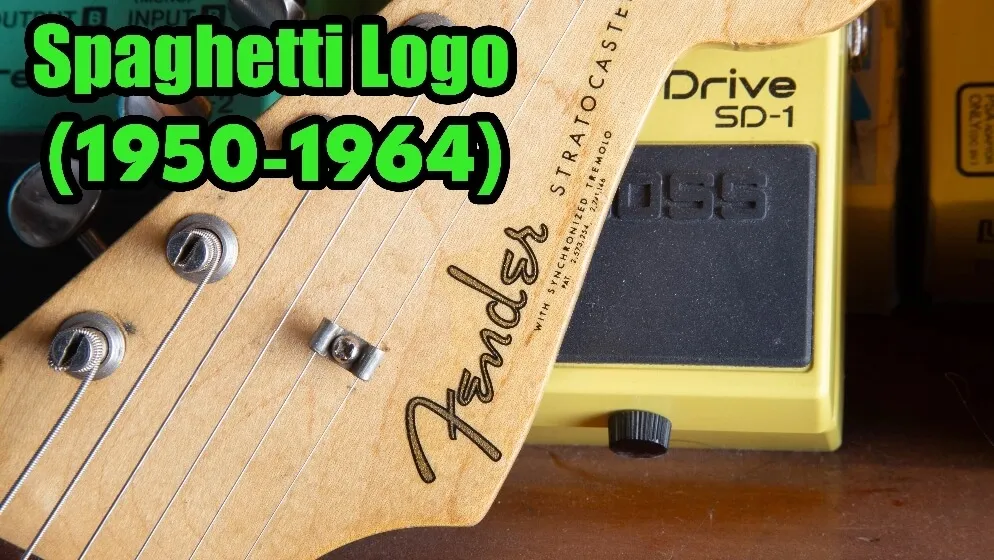
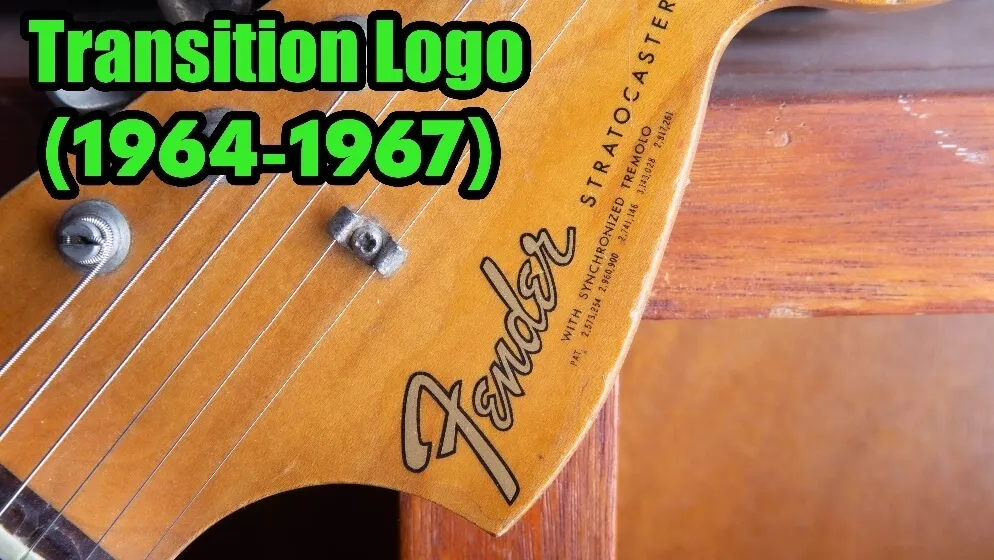
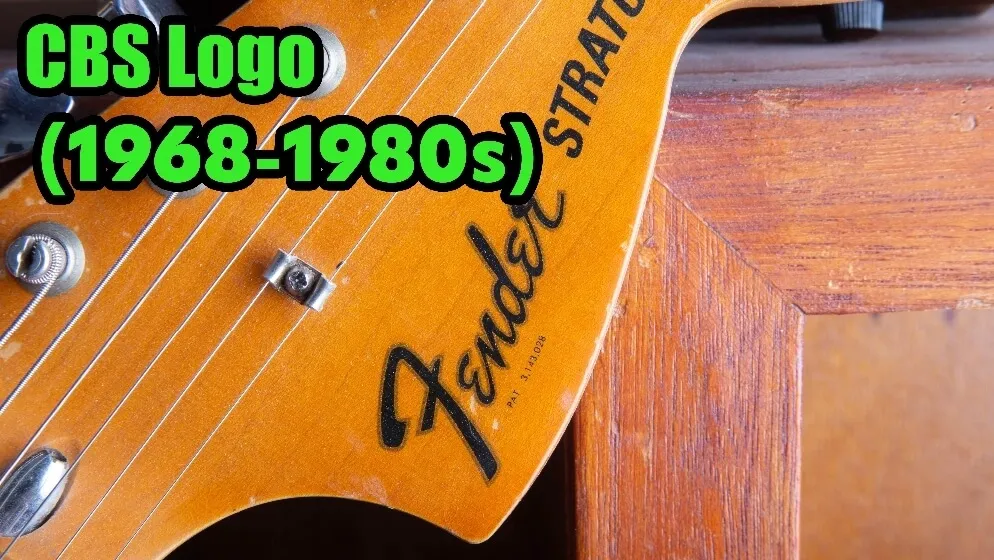
The models didn't change together, and this catches people. The Stratocaster moved to the transition logo in mid-1964, but the Telecaster and Esquire held onto the spaghetti logo about a year longer, into the middle or end of 1965. So a spaghetti logo on a 1965 Telecaster is correct and original. Read the Stratocaster timeline onto a Tele and you'll date the guitar a year or more too early, which is the kind of mistake that turns into a bad offer in either direction.
One more trap: the transition logo sits on plenty of guitars that are otherwise pre-CBS in spec. A transition logo does not make a guitar a CBS guitar, and those crossover instruments are often underpriced because people read the logo and stop.
The headstock grew, too. On the Stratocaster the headstock enlarged from about late 1965, arriving alongside the transition and CBS logos, so the big CBS headstock is a dating tell you can read from across a room. It wasn't only the Strat, though. The Mustang took the enlarged CBS headstock across the same stretch, late 1965 into 1966. The Jazzmaster is a different case again: its outline was reshaped around mid-1967 to match the post-1965 Stratocaster, but that is a subtle change you only catch in a direct comparison, not an enlargement you can spot across a room. The Telecaster never changed at all. So read the change against the model in front of you rather than treating a big headstock as a Stratocaster tell on its own. If it's a Strat you're holding, the Stratocaster dating guide runs the whole model year by year, with this change and every other one in one table.
The Patent Numbers Under The Logo
Under the logo, Fender printed a block of patent numbers, and that block grew as the company's patents were granted, then shrank again in the CBS years. Because the list changed over time, the numbers on a headstock help place the guitar, and they are hard for a faker to reproduce exactly. The Stratocaster block is the fullest and the easiest to read, so it leads here, with the Telecaster and the basses after it and the offset guitars at the end. Each family ran its own set of numbers, so always read a decal against the right model.
| What You See | Years | What It Tells You |
|---|---|---|
| No patent numbers | 1954 to about 1960 | The earliest Stratocasters carry no numbers under the logo, only the Original Contour Body line. The blank block is itself the tell. |
| Two numbers, 2,573,254 and 2,741,146 | Late 1960 to early 1962 | The bridge and pickup patent and the synchronized tremolo patent, the first block to appear. |
| Three numbers, adds 2,960,900 | Early 1962 to mid-1964 | The contour body patent joins the first two. This is the classic spaghetti-logo block. |
| Four numbers, adds 3,143,028 | Mid-1964 to late 1965 | The neck patent joins, arriving with the transition logo. It was granted in August 1964, so any decal carrying it has to be a 1964 or later guitar. |
| Five numbers, adds 2,817,261 | Late 1965, briefly | A hum-cancelling twin-coil pickup patent joins on the enlarged CBS headstock. Five is as high as the block ever went, and it holds there only briefly. |
| Down to three, 2,741,146 and 3,143,028 with DES 169,062 | 1966 to 1967 | The Stratocaster body design patent joins while the older numbers fall away. The block starts shrinking here rather than at the black logo. |
| Down to two, 2,741,146 and 3,143,028 | Mid-1967 to early 1971 | The CBS black-logo era. The list shrinks rather than grows, which is a late-1960s tell on its own. |
| One number, then none | About 1971 to 1976 | The block dwindles to a single number, then Fender drops it by 1976, when the serial moved to the front of the headstock. |
Read this as a bracket, not a birthday. Each block sat on the headstock for two to four years, so the patent list narrows a Stratocaster to a window while the logo style and the headstock size do the finer year-by-year work. Anyone who tells you the numbers change every single year is overselling it.
The one rule you can lean on is a floor, not a date. A decal cannot predate the newest patent printed on it. The most useful of them is 3,143,028, the neck patent, granted in August 1964. If it sits under the logo, the guitar is 1964 or later whatever the seller says, because the number did not exist before then. A single patent's own grant date is not the guitar's date, but the newest number on the decal sets the earliest that decal could have been printed.
This is also the check that catches a good reproduction decal. Getting the script right is easy. Getting the exact list right for one specific window, with the correct numbers and none that don't belong, is not, and reproductions often carry a number that was never there. One that turns up in fakes and in careless online lists is 2,592,783, which is not a Fender patent at all. It belongs to a heat exchanger, so a headstock wearing it is wrong on its face.
The Telecaster and Esquire ran a different block. For their first decade they wore no headstock patents at all, so a blank Tele headstock points to 1950 through 1961. Late in 1961 a three-number block turns up under the model name: DES 164,227, the Telecaster body design granted back in 1951, then 2,573,254 for the bridge and pickup, and 2,784,631, a lead-and-rhythm tone circuit that never became a standard feature. The Esquire took the same three on in 1963. Those three then outlast the spaghetti logo: they carried over onto the earliest gold transition decals, so a transition-logo Telecaster from late 1964 or early 1965 correctly wears three patents. Fender revised the decal in late 1965, dropping the design patent and the unused circuit patent to leave two, 2,573,254 and 3,143,028. The CBS black logo in 1967 kept those two but shifted them below the Fender name. So on a Telecaster the block does not change at the same moment the logo does, and a gold transition decal carrying three numbers is a narrow window rather than a mistake.
The Precision Bass is where the online lists usually go wrong. Its block is built around two patents a guitar never wears: 2,976,755, the split-coil bass pickup, and DES 187,001, the design patent for the Precision Bass body. You will see 2,573,254 and 2,968,204 alongside them, and from 1964 the neck patent 3,143,028 joins in. The common slip is to reach for the Jazzmaster's DES 186,826 on a bass decal, which is the wrong design number. The Precision uses DES 187,001.
The offset guitars keep their own block. A Jazzmaster or Jaguar carries the floating tremolo patent 2,972,923 and the offset body design DES 186,826, neither of which a Stratocaster ever wears. On an offset it works in reverse: the absence of 2,972,923 is the red flag, and its presence is part of what confirms the decal belongs there. The exact block on a Mustang shifted around more than the record fully pins down, so date one of those from the logo and the neck first and treat the patent list as backup. A Jaguar is the opposite case and worth knowing about, because the logo is the one thing that will not date it: a single gold transition decal ran from the 1962 launch to about mid-1968, straight through the CBS changeover. There the patent block is doing the work instead, and its count by era is in the Jaguar dating guide.
Neck And Fretboard Construction
The neck changed twice in ways you can see at a glance, and the dots in it changed again. Between them they cut the vintage era into slices.
Maple, Slab, And Veneer
Look at the joint right above the nut and see how thick the rosewood is.
| Board | Years | What to look for |
|---|---|---|
| One-piece maple | 1950 to mid-1959, and again from the early 1970s | No separate fretboard at all. The frets go straight into the neck, and a dark walnut skunk stripe runs down the back |
| Slab rosewood | Mid-1959 to mid-1962 | A thick, flat-bottomed slab glued on. At the nut the rosewood shows as a deep, curved band |
| Veneer rosewood | Mid-1962 onward | A thin board with a curved underside following the neck radius. At the nut the rosewood line looks thin and flat |
| Maple cap | From about 1967 | A separate maple fingerboard glued onto a maple neck. The back is clean maple with no skunk stripe |
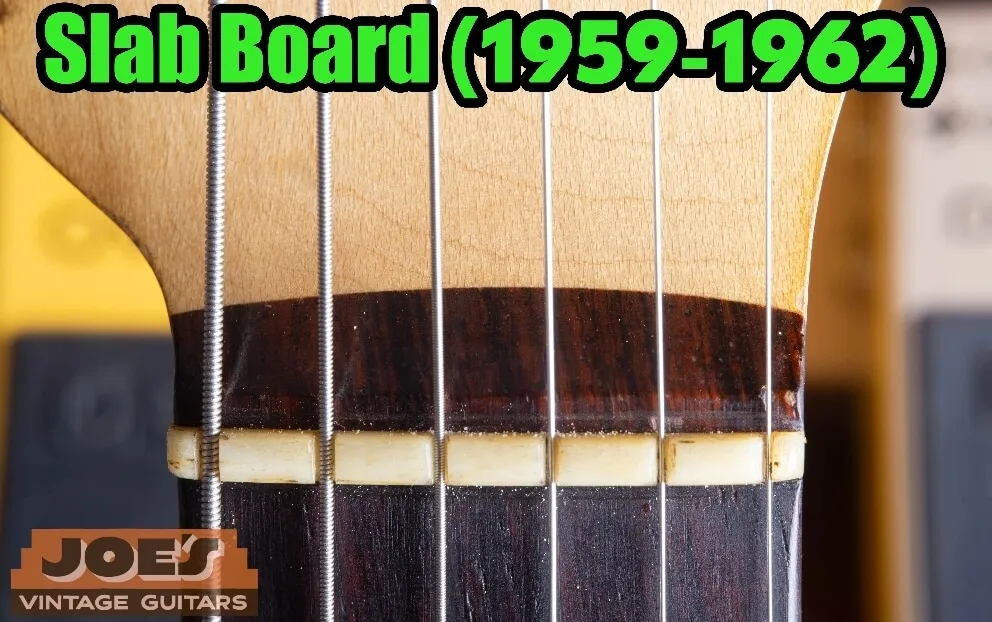
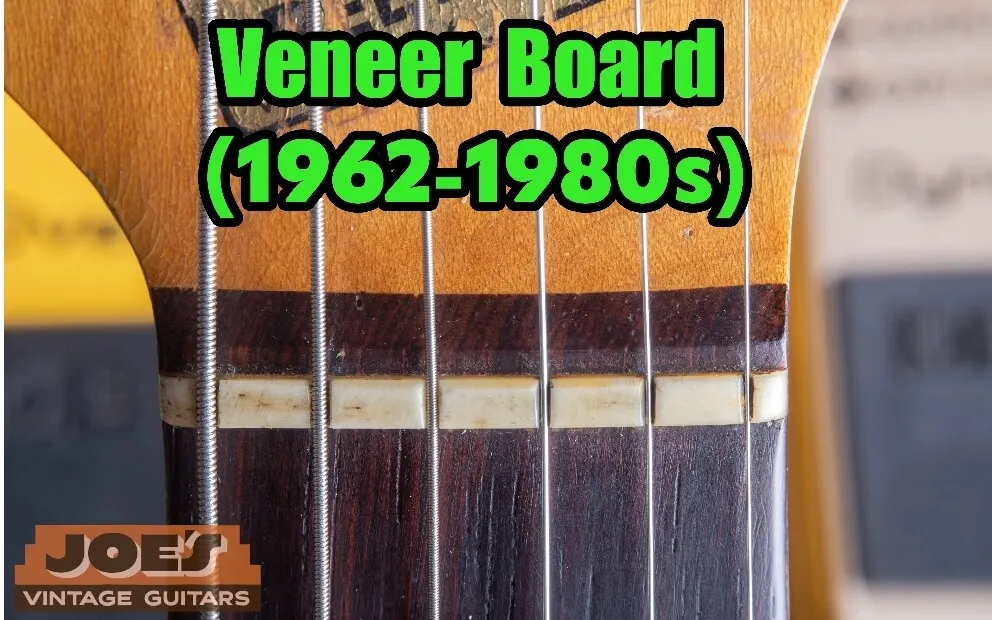
August 1962 is the month to know. Fender changed from slab to veneer boards partway through that month, so both turn up on necks stamped August 1962. A slab board with an August 1962 neck date is a genuine transition guitar and worth more than either side of the change.
One-Piece Maple Or A Maple Cap
Two maple necks can look identical from the playing side and be built completely differently, and the back of the neck gives it away in a second.
On a one-piece maple neck there is no separate fretboard. The frets are cut straight into the neck itself, which means the truss rod has to go in from behind. Fender routed a channel up the back, dropped the rod in, and filled the channel with a strip of dark walnut. That strip is the skunk stripe, and there's a small walnut plug at the headstock end where the rod was fed in. It isn't decoration, it's the lid on the truss rod channel.
A maple cap neck is built the other way round. A separate maple fingerboard is glued on top, so the truss rod drops in from the front before the board goes on and covers it. Nothing needs filling from behind, so the back is clean unbroken maple with no skunk stripe and no plug.
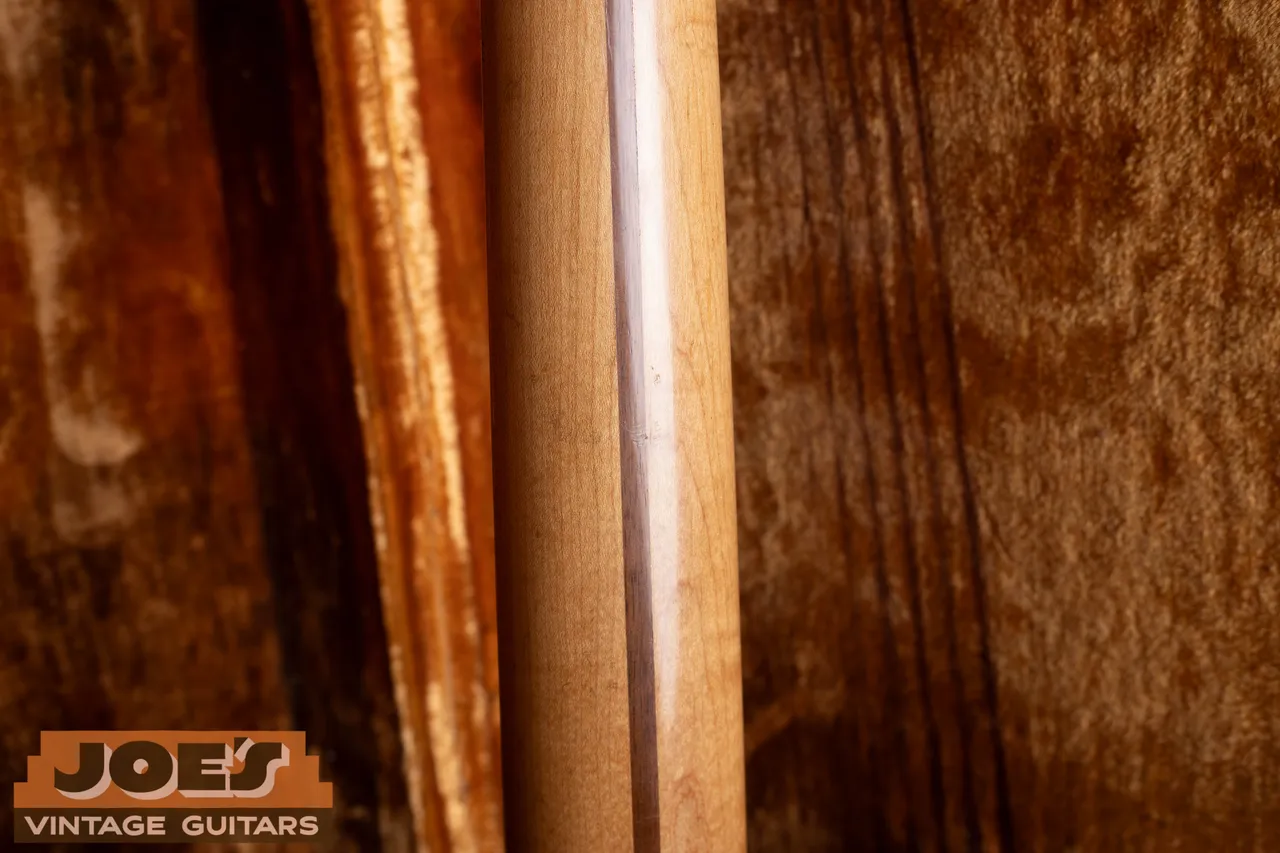
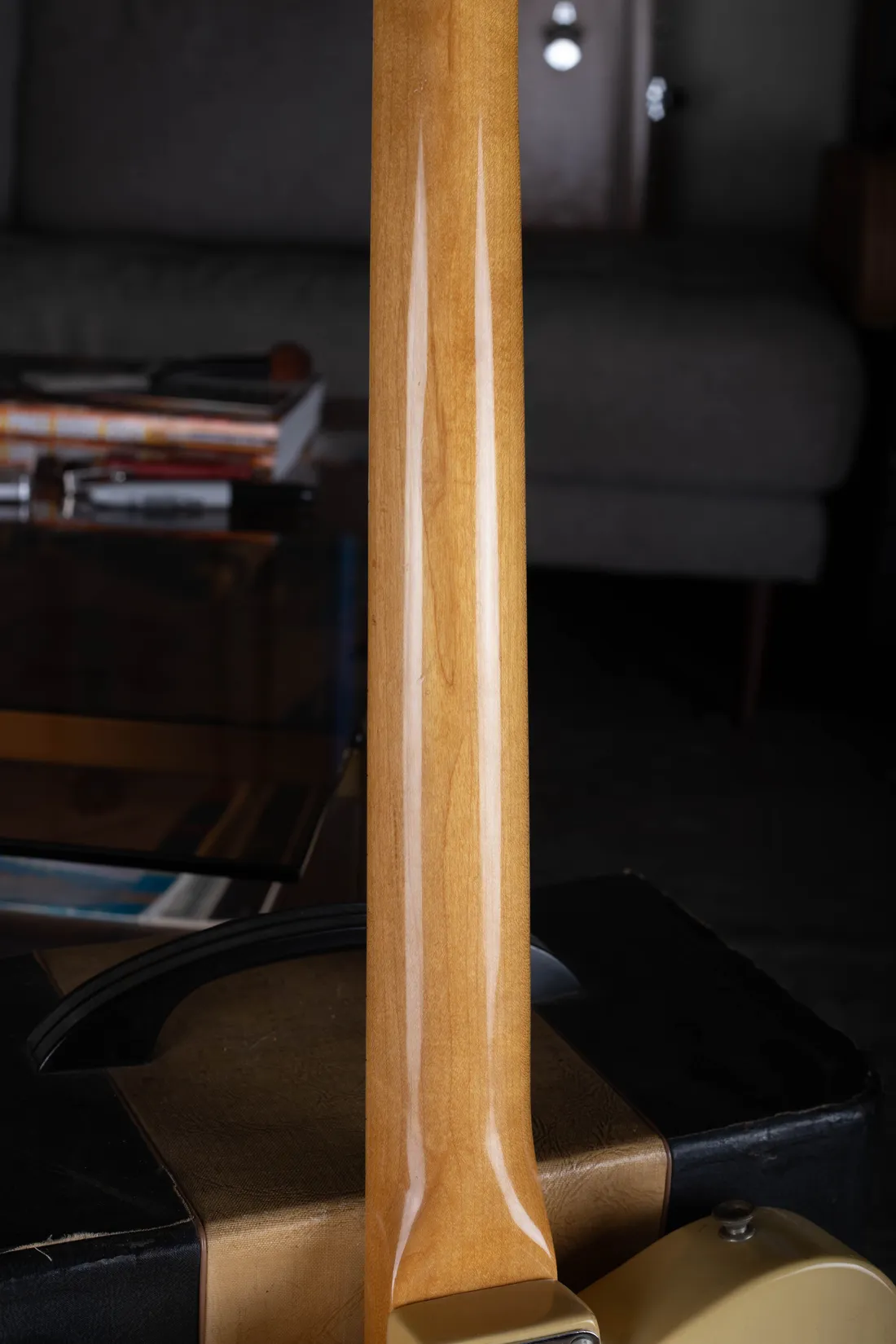
Which matters because a maple neck on its own tells you almost nothing about the year. Fender dropped maple boards in 1959, brought maple back as a glued-on cap in the late 1960s, and returned to one-piece necks in the early 1970s. So the question is never just whether the board is maple. It's whether the back has a stripe.
A stripe on a claimed 1960s maple-board Fender is wrong. Through the maple cap years the back should be clean. Equally, no stripe on a claimed 1950s maple neck is wrong, because every one-piece neck has to have one. This is one of the few checks on the page where the two answers point at genuinely different decades, and it takes one look at the back of the neck.
Clay Dots, Pearloid, And Blocks
| Inlay | Years | What to look for |
|---|---|---|
| Clay dots | 1959 to late 1964 | Not actually clay. Vulcanized fiberboard, dull and porous, aging to a dingy off-white or tan |
| Pearloid dots | Late 1964 into the 1970s | Bright, with a swirled marble figure. They stay shiny because they don't drink up finger oil |
| Block inlays | 1966 on. Jazzmaster, Jaguar, and the Jazz Bass | Large rectangular pearloid blocks on a bound neck. The fastest way to call a post-1966 offset from across a room |
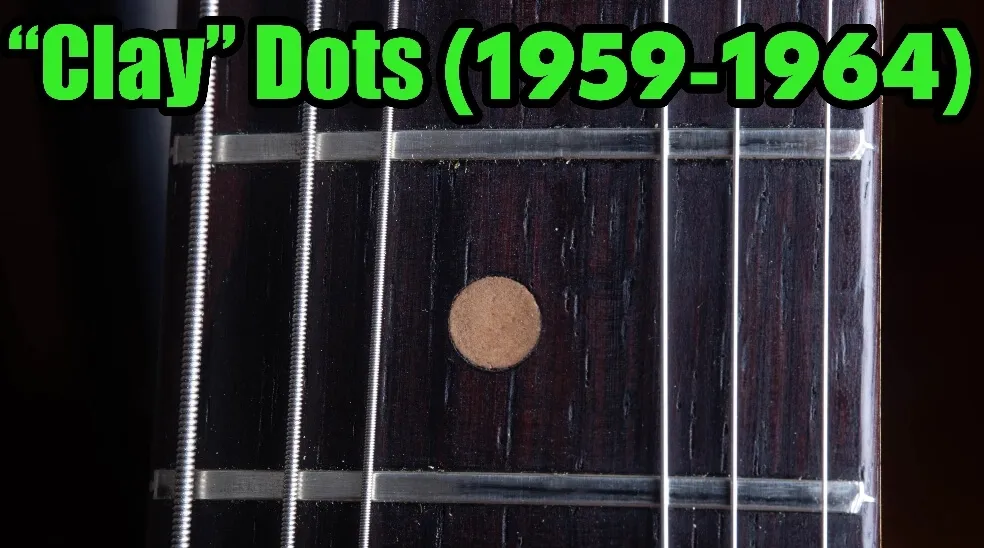
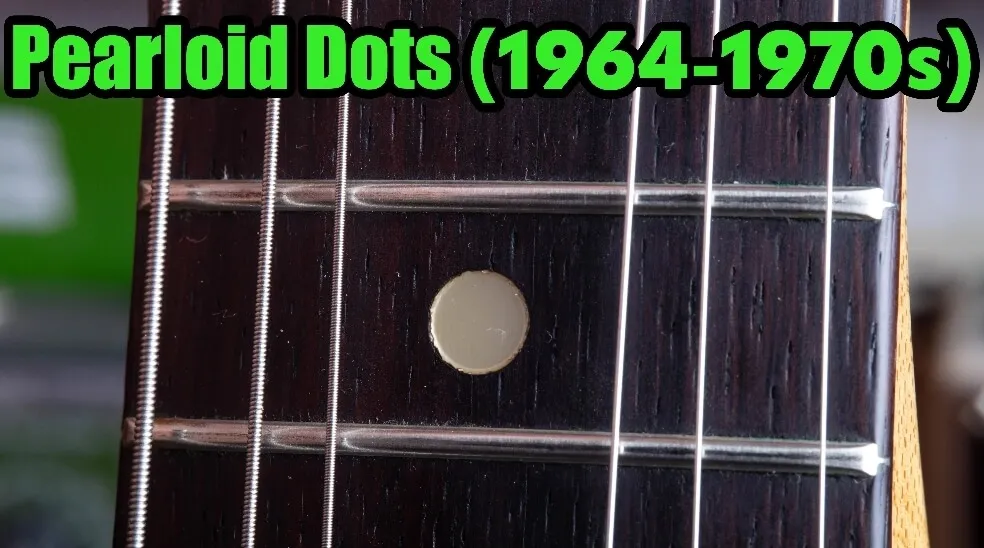
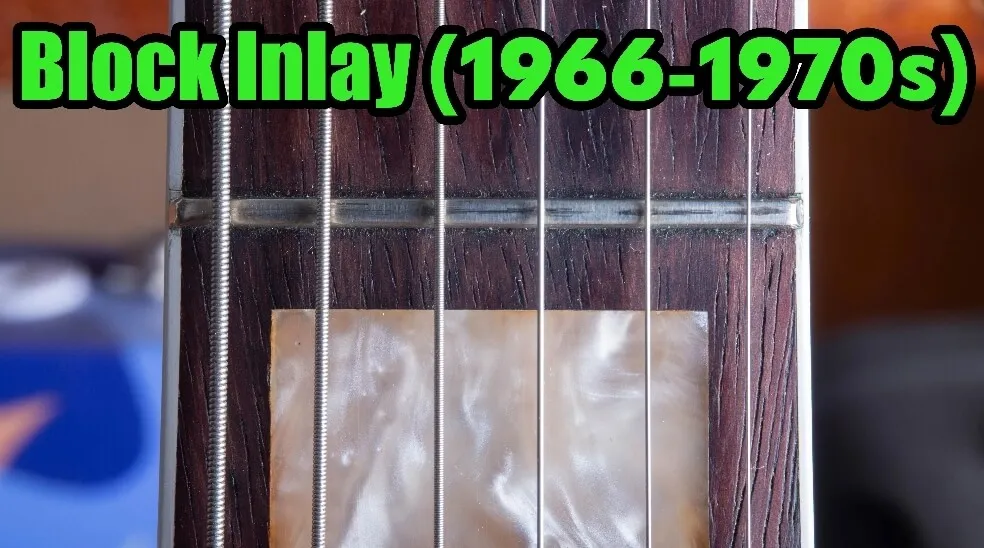
The blocks weren't only a guitar thing. The Jazz Bass got them in the middle of 1966 as well, on a bound neck, and for bass collectors that changeover is every bit the anchor the offset guitars are.
The face dots changed first. In late 1964 Fender switched the dots on the face of the board from clay to pearloid while the small dots on the edge of the neck stayed clay into 1965. So a transition neck can show bright pearloid dots on the face and dull clay dots on the side. That mismatch looks wrong to anyone who hasn't met it before, and it's one of the sharpest tells for the transition period there is.
Pickguard Materials
Four materials across the vintage era, and one of them ages in a way nothing else does, which is why the pickguard is often the first thing a dealer looks at.
The first two matter enormously on a Telecaster, because collectors name whole eras after them. A blackguard is a Telecaster or Esquire from 1950 to the middle of 1954, wearing the thick single-ply black Bakelite guard. In mid-1954 Fender changed to a single-ply white guard, and everything from then to 1959 is a whiteguard. Those aren't nicknames for a color, they're the two halves of the early Telecaster, and the changeover is one of the sharpest value lines on the model. Get it the wrong way round and you've misdated the guitar by years. If it's a Tele you're holding, the Telecaster dating guide runs the whole model year by year. For the one-pickup version, use the vintage Esquire value and authentication guide.
On a Stratocaster there's a faster version of the same check: count the screws. The single-ply white guard the Strat wore from its 1954 launch takes eight of them. The three-ply nitrate guard that replaced it in 1959 takes eleven. You can do that from a photograph. Better still, count the holes in the body rather than the guard, because a guard can be swapped and the holes underneath it cannot. Eleven holes on a guitar sold as a 1956 means the body has worn a later guard, whatever is bolted to it now.
| Material | Years | What to look for |
|---|---|---|
| Single-ply black Bakelite | 1950 to mid-1954, Telecaster and Esquire | Thick, heavy, and hard, with no layers visible at the edge. It is really a fiber-reinforced phenolic, and collectors call it both Bakelite and phenolic. This is the guard the blackguard is named after |
| Single-ply white vinyl | Mid-1954 to 1959. Telecaster, Esquire, and the Stratocaster from its 1954 launch | Smooth white vinyl, still a single ply. On a Stratocaster it takes eight screws. This is the whiteguard era |
| Cellulose nitrate, three-ply | 1959 to mid-1965 | White when it left the factory, and eleven screws on a Stratocaster. The mint green arrives over decades as the nitrate breaks down |
| White PVC, three-ply | Mid-1965 onward | Chemically stable. It may go slightly cream, but it never reaches nitrate's mint green |
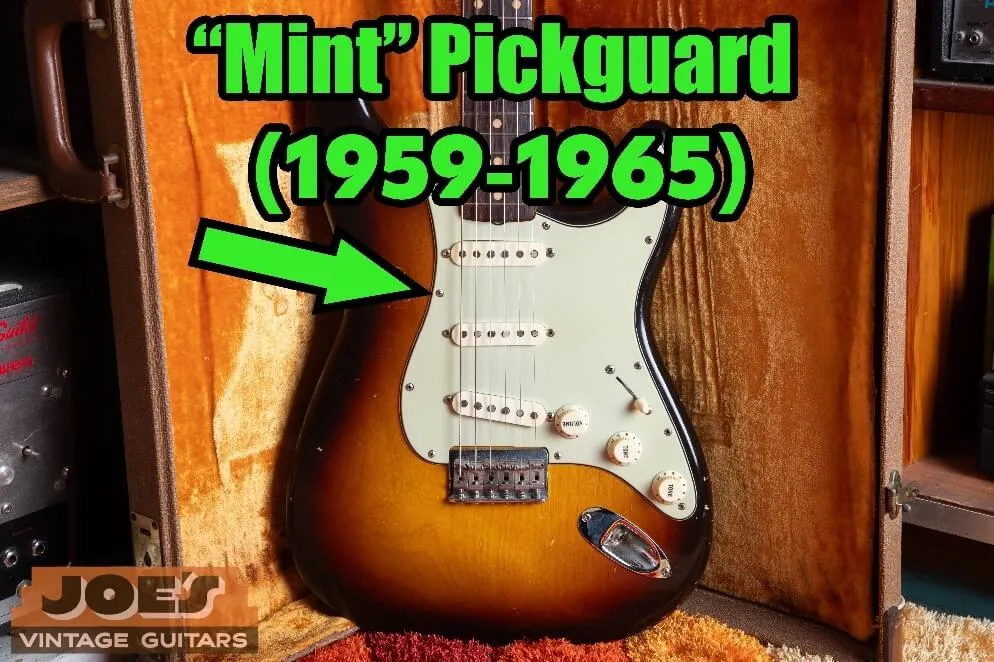

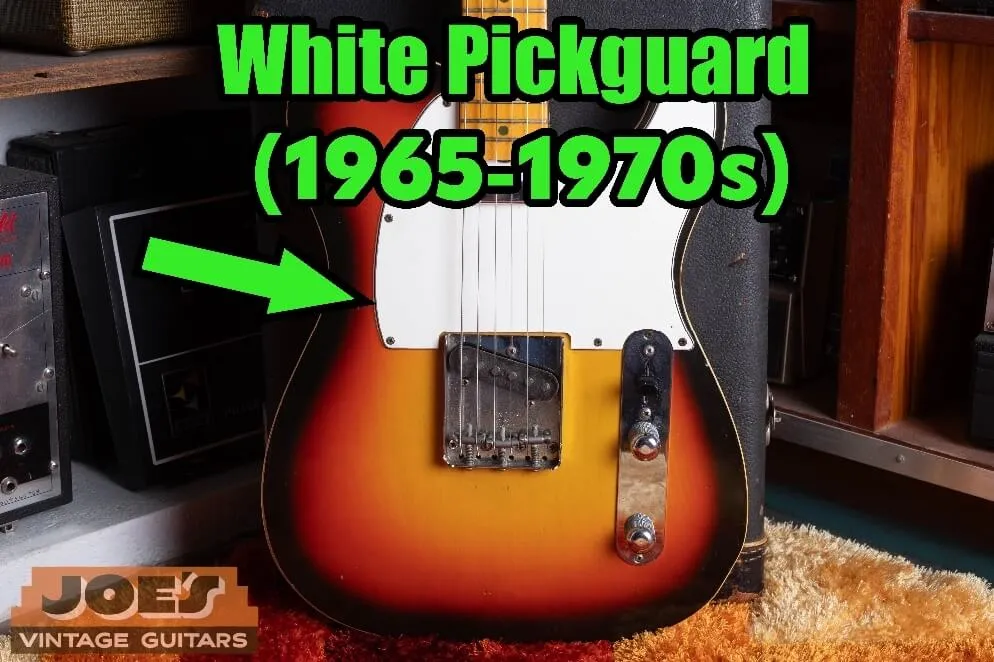
The tortoise rule catches more fakes than anything else here. Fender never paired a tortoise guard with a custom color at the factory, with exactly one exception: Olympic White. So tortoise on a Fiesta Red, a Lake Placid Blue, or any other custom color means swapped parts or a respray, every time. That single rule has saved buyers more money than every logo comparison on this page.
There's also a smell test, and it genuinely works. Original cellulose nitrate has a faint sharp chemical smell, something like vinegar or camphor, because that's the material slowly breaking down. Modern plastic has no smell at all. It's not conclusive on a guard that's been bagged up for years, but on an untouched guitar it's a surprisingly quick check. Nitrate guards also shrink as they age, which is why old screw holes sometimes sit slightly off their screws.
Gold Anodized Guards
The other guard worth knowing is not plastic at all. Fender also made pickguards from anodized aluminum, finished in a warm brushed gold, and they look like nothing else the company built.
You'll meet them mainly on Precision Basses and Jazzmasters, where the gold guard ran for only about nine months and takes nine screws rather than the thirteen every later guard uses. They turn up very occasionally on other Fender models too, and when they do it's usually because somebody ordered one that way rather than because the model ever shipped with them as standard. So a gold guard on an unexpected model isn't automatically wrong, it just needs the rest of the guitar to back it up.
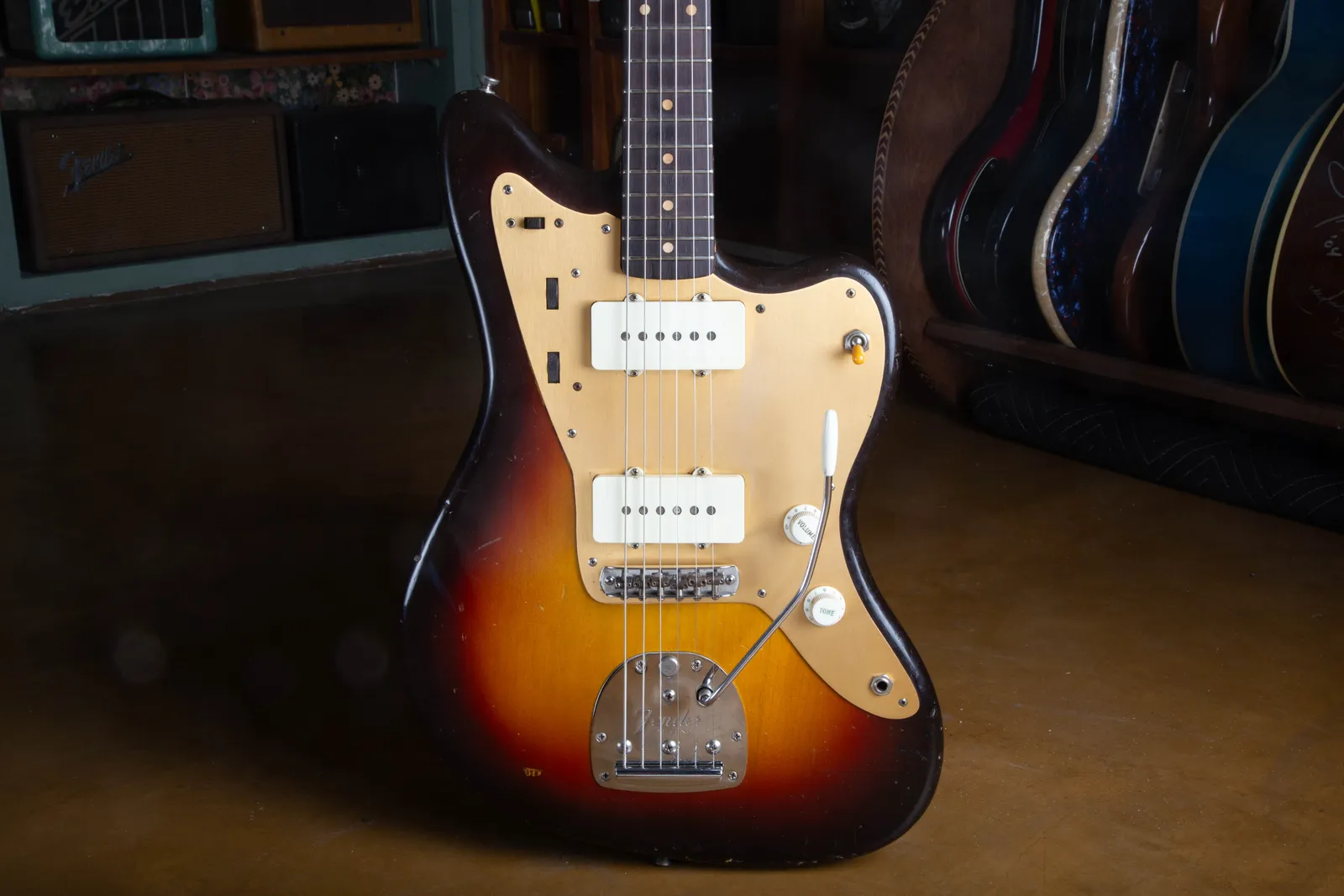
The gold is an anodized surface layer rather than the color of the metal underneath, which is worth knowing for two reasons. On a guitar that has seen hard use, the gold can thin toward bare silvery aluminum where a forearm or a picking hand has sat for decades, and that is honest wear rather than damage. And because the layer is thin, these guards should never be polished or scrubbed. You can take the gold off one and it does not come back.
Bridge Saddles
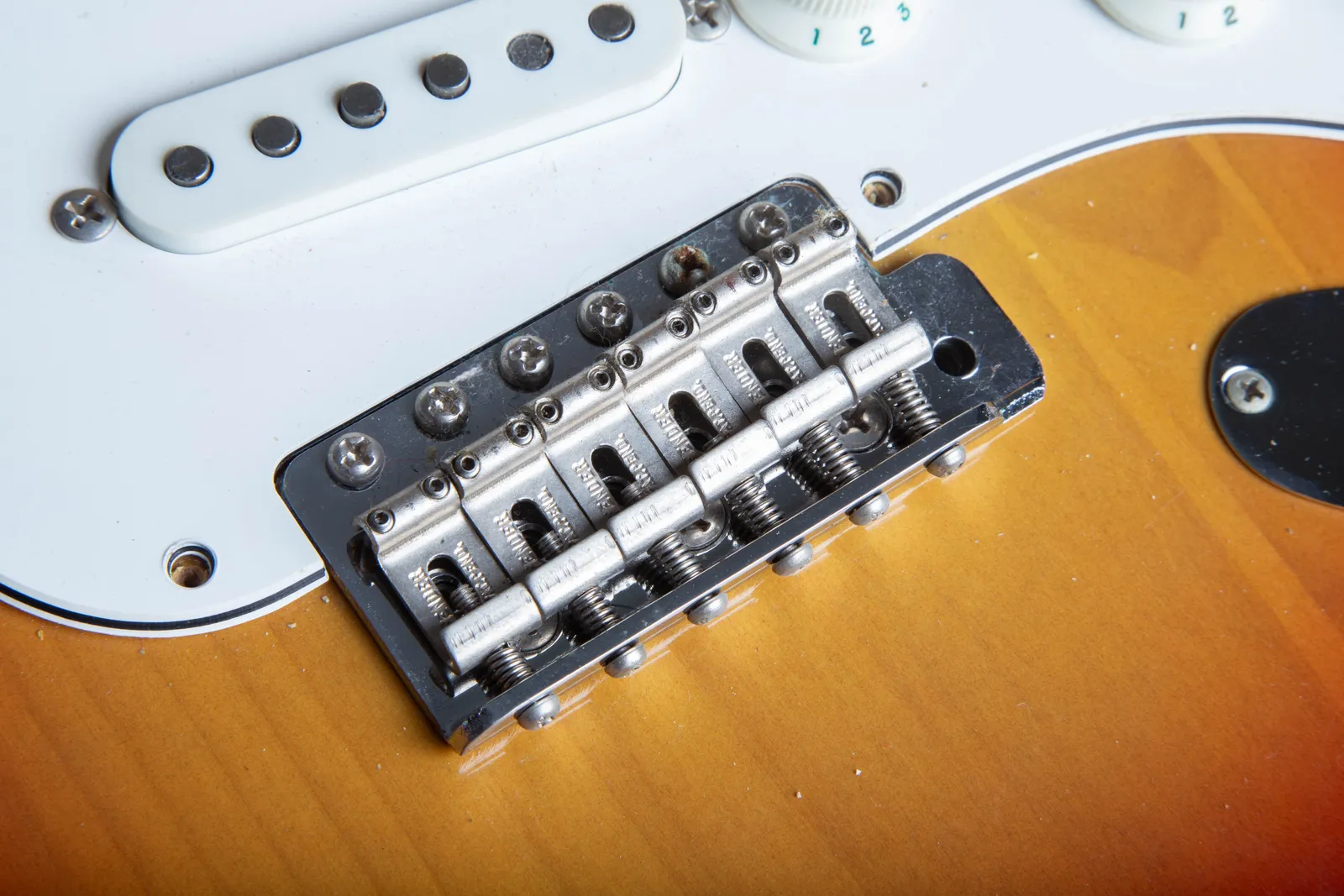
Saddles are small, they're often overlooked, and they're one of the fastest era calls on the guitar.
| Saddle | Years and model | What to look for |
|---|---|---|
| Brass | 1950 to mid-1954, Telecaster | Gold brown, settling into a dull patina. Roughly 5/16 inch across |
| Steel, smooth flat-bottom | Mid-1954 to 1958, Telecaster | Bright silver, and prone to rust and pitting. Roughly 1/4 inch across |
| Steel, threaded barrel | 1958 to 1968, Telecaster | The same steel, now with a threaded barrel that the strings sit across |
| Steel, smooth with grooves | 1968 onward, Telecaster | Back to a smooth barrel, but with a groove cut for each string |
| Stamped steel | 1954 to 1971, Stratocaster | FENDER PAT. PEND. stamped into every one |
| Die-cast zinc | Late 1971 on, Stratocaster | Thick, rectangular, unbranded blocks |
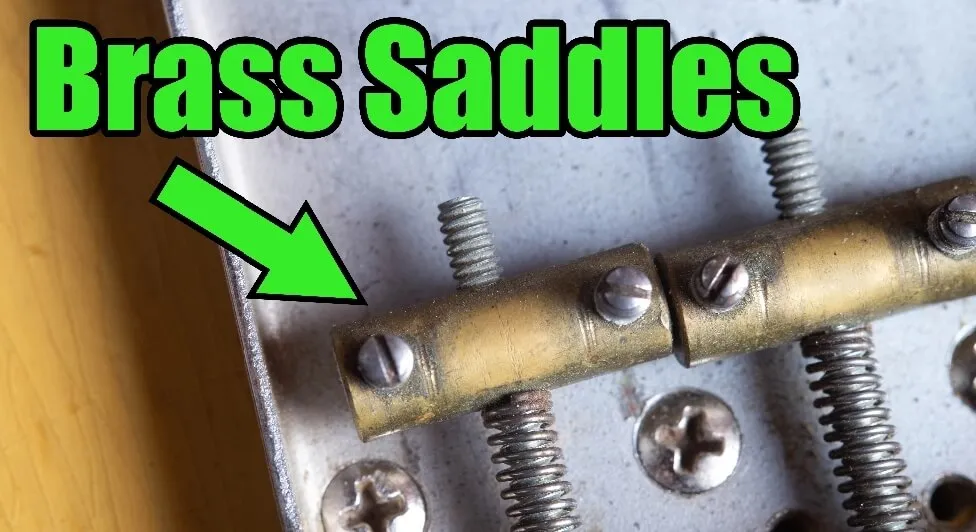
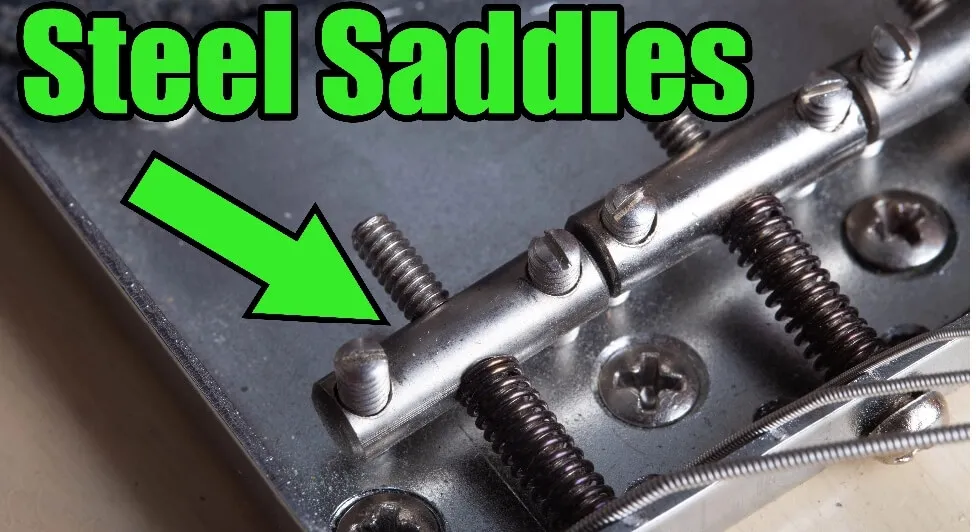
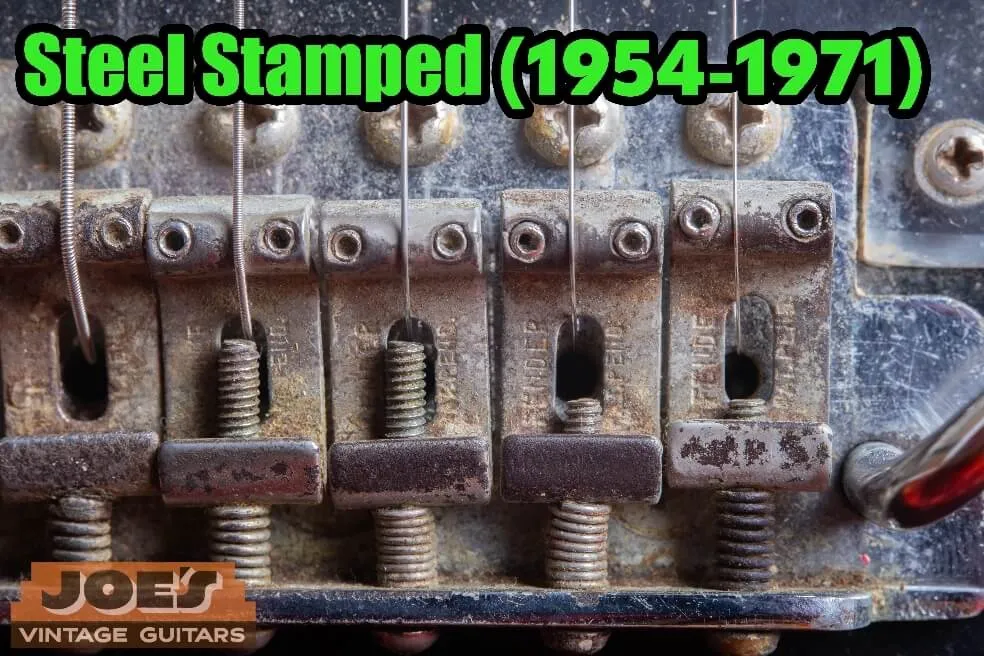
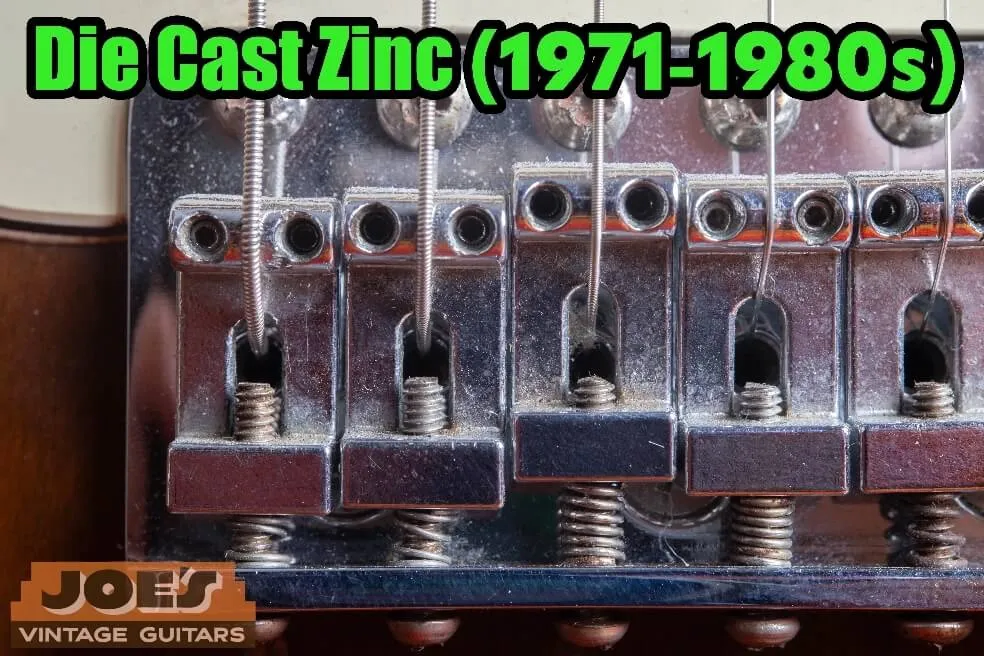
Read the brass-to-steel change as the boundary, not the steel itself. Brass only ran to the middle of 1954, so brass saddles put a Telecaster in the first few years, and that's a genuinely narrow window. Steel is the opposite: once it arrived it never left, right through into the 1980s.
What narrows it down is which steel. Smooth barrels with flat bottoms are the 1950s. Threaded barrels run from 1958 to 1968 and are the ones most people picture on a vintage Tele. From 1968 Fender went back to a smooth barrel, but with a groove cut for each string. So "steel saddles" on its own tells you almost nothing about the year, and knowing which of the three you're holding tells you a great deal.
Put calipers on a Telecaster's saddles. The original brass ones run about 5/16 inch across and the steel ones that replaced them about 1/4 inch. Reproduction brass saddles are almost always made to the later 1/4 inch size, so brass saddles at 1/4 inch on a guitar sold as a 1952 are modern parts wearing the right color. On a Stratocaster the equivalent check is simpler: no FENDER PAT. PEND. stamp on a claimed 1960s guitar means the saddles are not original.
Tuners
Fender fitted Kluson Deluxe tuners from 1950 until the CBS years, then moved to its own F-stamped tuners. The back of the housing tells you which era you're in.
| Tuner | Years | What to look for |
|---|---|---|
| Kluson, no line | 1950 to mid-1956 | The back of the housing is completely smooth, with no text at all |
| Kluson, single line | Mid-1956 to mid-1964 | KLUSON DELUXE stamped in one vertical line |
| Kluson, double line | Mid-1964 to late 1967 | The same words split across two parallel lines |
| F-style | Late 1965 to 1983 | Chrome plated, with a large stylized F stamped on the back. Not standard across the main lines until mid to late 1967. Schaller became the maker around the mid-1970s |
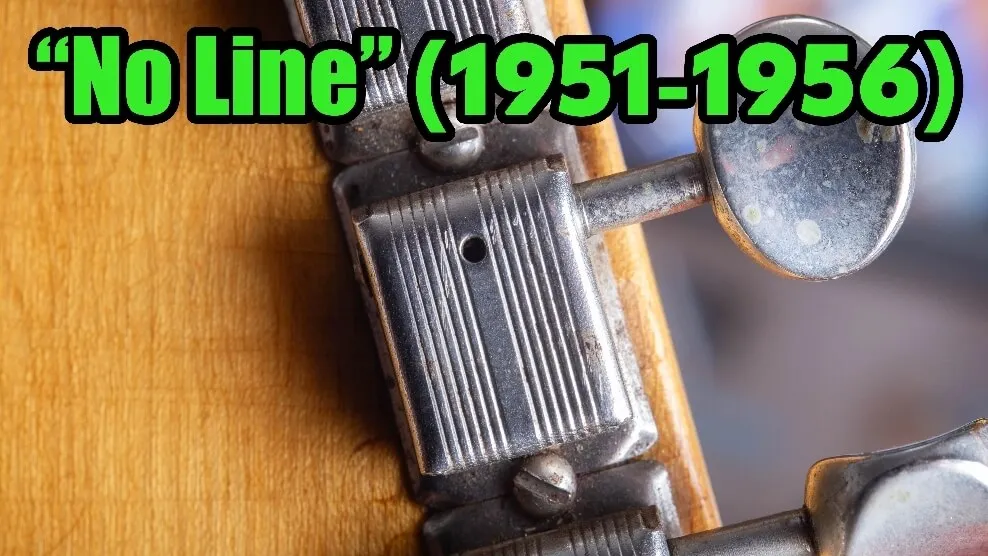
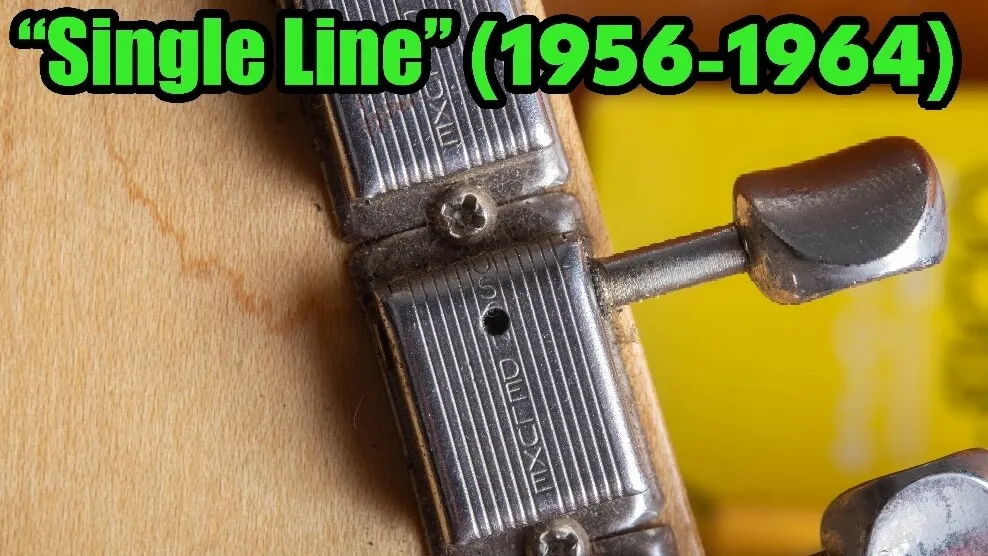
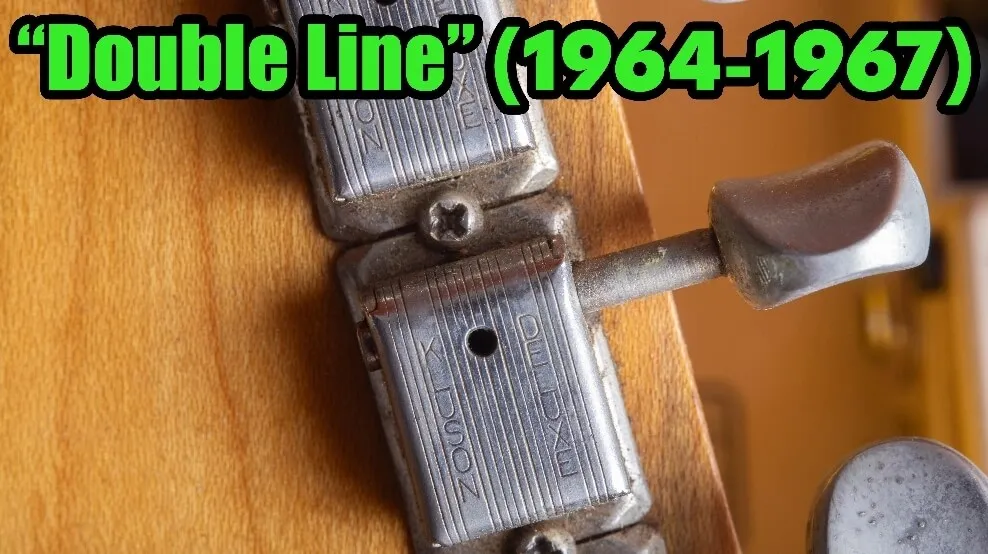
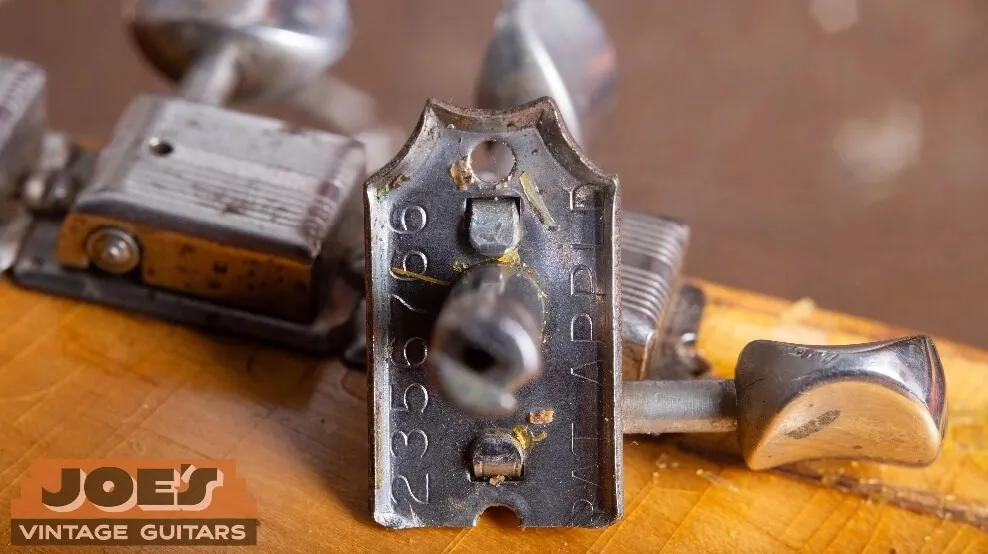
Don't hang a year on a Kluson stamp. The single-line to double-line changeover is genuinely disputed among researchers, with published dates ranging from the late 1950s to about 1964, and no one has settled it. Double lines on a claimed 1962 are a reason to check the neck date and the pot codes, not a reason to walk away. Anybody who quotes you a single confident year for that change is quoting one source and not telling you the others exist.
The F-style changeover was slow, and the dates in the table overlap for a reason. Fender took the F tuners on around late 1965, and they showed up first on the smaller models, the Mustang and Duo-Sonic. The Stratocaster and Telecaster carried on with double-line Klusons well into 1966 and early 1967, and F-tuners only became the standard across the main electric lines in the middle to end of 1967. So double-line Klusons on a 1966 Strat are correct, and F-tuners on one are the thing worth questioning.
Two things that are not in dispute. PAT. APPLD. on the underside of a Kluson points to a pre-1958 build, because a full patent number replaced it around then. And Klusons are nickel plated while the F-style tuners are chrome, so Klusons tarnish to a soft silver grey with age and the F-tuners keep a brighter, faintly blue shine. A set that looks too bright to be sixty years old usually is.
Knobs, Switch Tips, And String Trees
The cheapest parts on the guitar are also the ones nobody thinks to fake, which is exactly what makes them useful.
Round Top And Flat Top Knobs
Up to the middle of 1956, Telecasters, Esquires, and early Precision Basses wore round-top Bakelite knobs with a domed crown and coarse, heavy knurling. From mid-1956 Fender moved to the flat-top skirted knob with finer knurling that most people picture. The switch tip changed in the same era: a plain round barrel tip into the mid-1950s, then the top hat shape still fitted to Telecasters today.
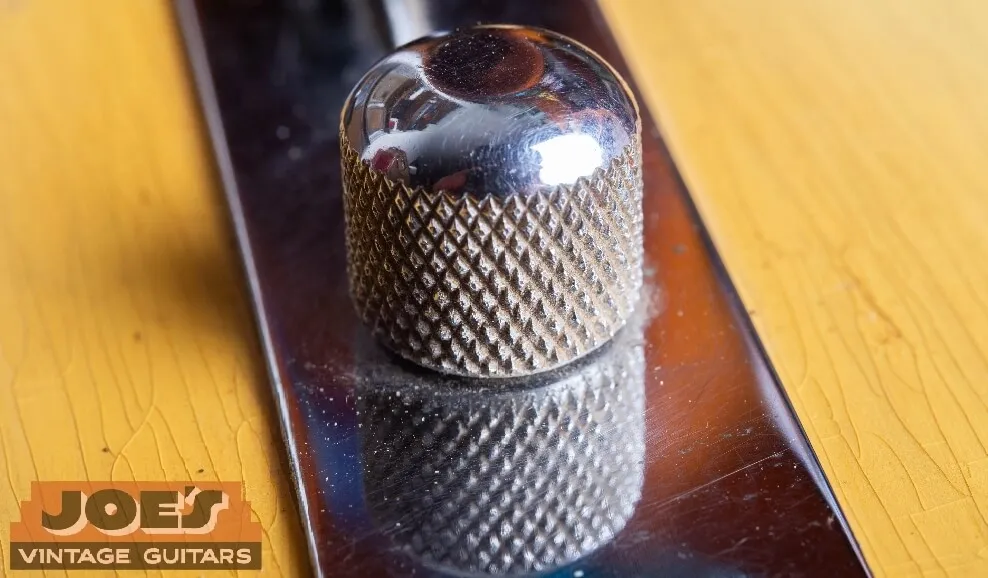
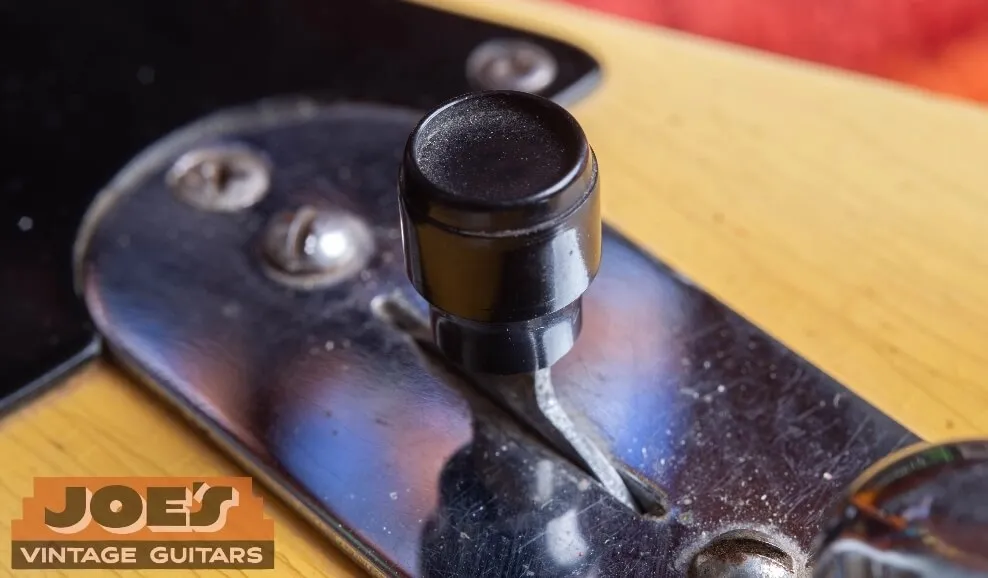
Turn a round barrel switch tip over. Many of the originals were made by Daka-Ware in Chicago and carry that name molded into the underside. Reproductions are almost always blank. The originals are Bakelite too, so they feel harder, heavier, and more ceramic than a modern ABS tip, which feels slick and light by comparison. It's a two-second check on a part most people never remove.
String Trees
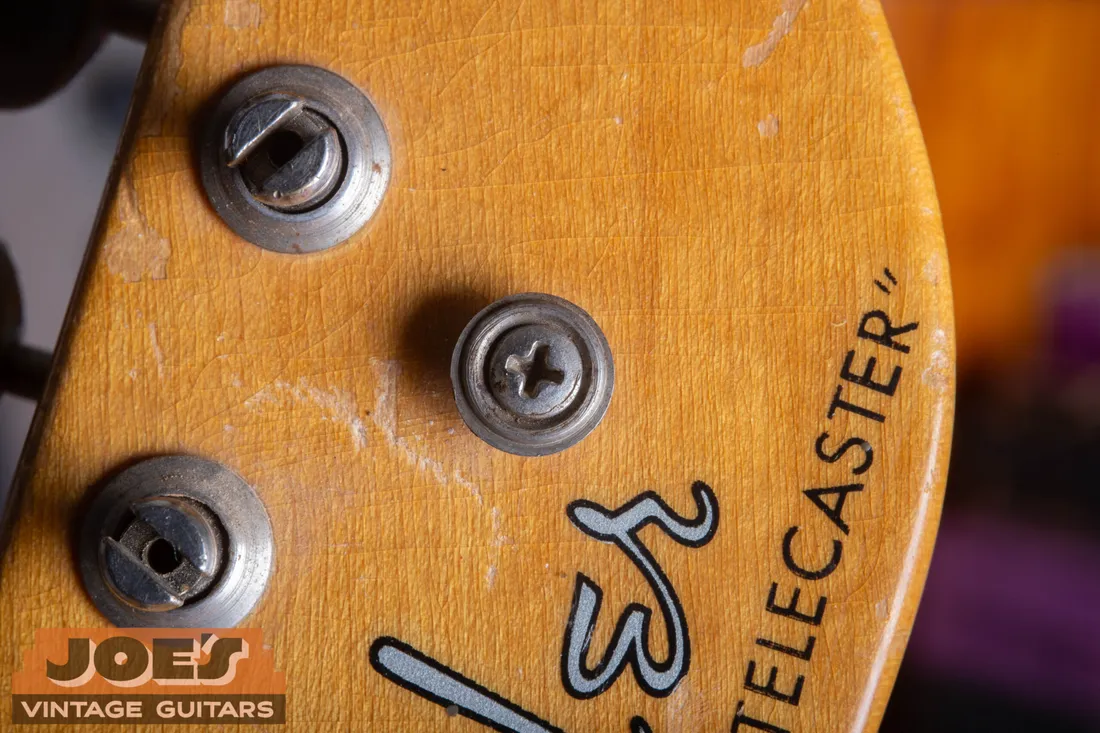
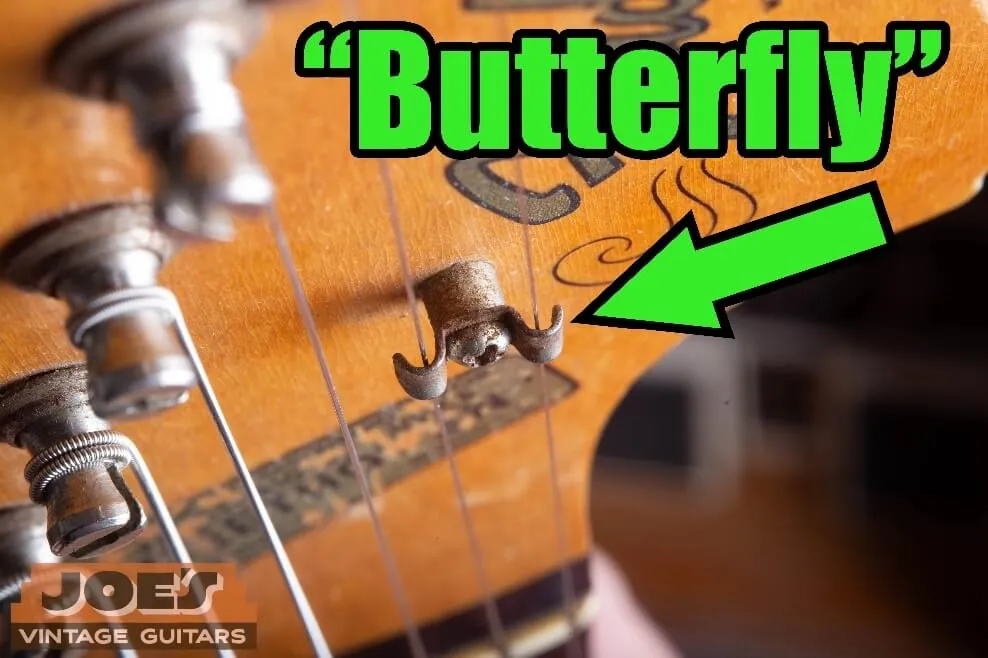
Before mid-1956 Fender used a small round metal string guide. From mid-1956 it changed to the wider butterfly, or wing, tree that holds a more consistent break angle over the nut. It's a small part and an easy one to replace, so treat it as supporting evidence rather than proof of anything.
What Features Can't Prove
Every part on this page can be unscrewed. That's the limit of the whole method, and it cuts both ways.
A correct part doesn't prove a guitar is original, because correct parts are exactly what somebody assembling a convincing guitar would fit. A wrong part doesn't prove a guitar is fake either, because sixty-year-old instruments get played, and tuners, string trees, and pickguards wear out and get changed by people who were just keeping a guitar working.
What features do well is establish a floor and catch contradictions. A pearloid-dot neck cannot be from 1959. A guitar wearing a spaghetti logo, clay dots, and stamped steel saddles has three parts all pointing at the same stretch of years, and that agreement is worth far more than any one of them alone. When one part disagrees with the other four, that part is the story, not the guitar.
One more limit: correct features don't separate an original from a good reissue. The American Vintage and Custom Shop lines deliberately reproduce clay dots, nitrate-style guards, spaghetti logos, and stamped PAT. PEND. saddles, so on a reissue every part can read right. The neck date, the serial, and the pot codes are what tell an original from a faithful reissue. For counterfeit-specific examples, use my guide to spotting a fake Fender.
Cross-Check With The Other Methods
Features get you the era without a screwdriver. To close it down to a date, pair them with the neck heel date and the pot codes, then confirm with the body date and the pickup dates. When the parts and the dates agree, you have a build you can stand behind.
This guide is one of the dating methods behind the full Fender serial number guide, where the complete year-by-year serial charts live.
Once the year is settled, the Stratocaster and Telecaster value guides show what a correct example is worth, and if you are thinking about selling, Joe buys vintage Fenders outright.
Common Questions About Fender Parts And Features
Can I Date A Fender From The Logo Alone?
You can get to an era, not a year. The three logo styles cover long stretches, and the transition logo in particular sits on guitars that still carry pre-CBS specs. A logo narrows the window and then the neck date, the pot codes, and the rest of the hardware close it.
My Pickguard Is Mint Green. Does That Prove It's Original?
It proves the guard is cellulose nitrate, which puts it in the 1959 to mid-1965 window, and nitrate is not something modern reproductions replicate convincingly. It doesn't prove the guard started life on that guitar. Read it with the screw holes, the fit, and the rest of the parts.
What If The Features Disagree With The Serial Number?
Trust the features. Serial numbers came off a bin and overlap year to year, but a spaghetti logo, clay dots, and stamped steel saddles all had to be fitted while Fender was still making them. When the parts say one era and the serial says another, the parts are usually telling the truth.
Are Double-Line Klusons A Red Flag On A 1962?
They're a reason to look harder. The exact year Kluson moved from one line to two is genuinely disputed among researchers, so I wouldn't condemn a guitar on that alone. Check it against the neck date and the pot codes before drawing a conclusion.
Do Replaced Parts Ruin The Value?
It depends entirely on the part and the guitar. A replaced string tree is nothing. A replaced pickguard, tuners, or saddles on a high-value pre-CBS guitar can move the number substantially. Send me three photos and I'll tell you what's original and what it means.
Not Sure Which Parts Are Original?
Originality is where the money is on a vintage Fender, and it's the hardest thing to judge from a photo on a listing. Send Joe three clear photos, the front, the back, and the headstock, for a free, expert appraisal within 24 hours.

Joe Dampt is the owner of Joe's Vintage Guitars in Mesa, Arizona, where he's spent more than twelve years buying, appraising, and authenticating vintage instruments full-time. He's personally valued over 10,000 guitars for sellers in all 50 states, served as a traveling appraiser for the Treasure Seekers Roadshow, and sourced instruments for Grammy Award-winning artists. Every method on this page comes from that bench work.