

How To Date A Fender Stratocaster
Almost nothing on a Stratocaster gives you a year on its own. The serial number gives you an era, and the features give you a window that is often wider than that. What they do is corroborate each other, and when enough of them agree you can trust the answer. The two exceptions are the dates Fender actually wrote on the guitar, on the neck heel and inside the body, and those are accurate. Here is what changed and when, from the 1954 launch through 1971, and how to line it all up.
Just after the serial number? The full charts and the lookup tool that decodes a number for you are on the main guide.
Look Up A Serial Number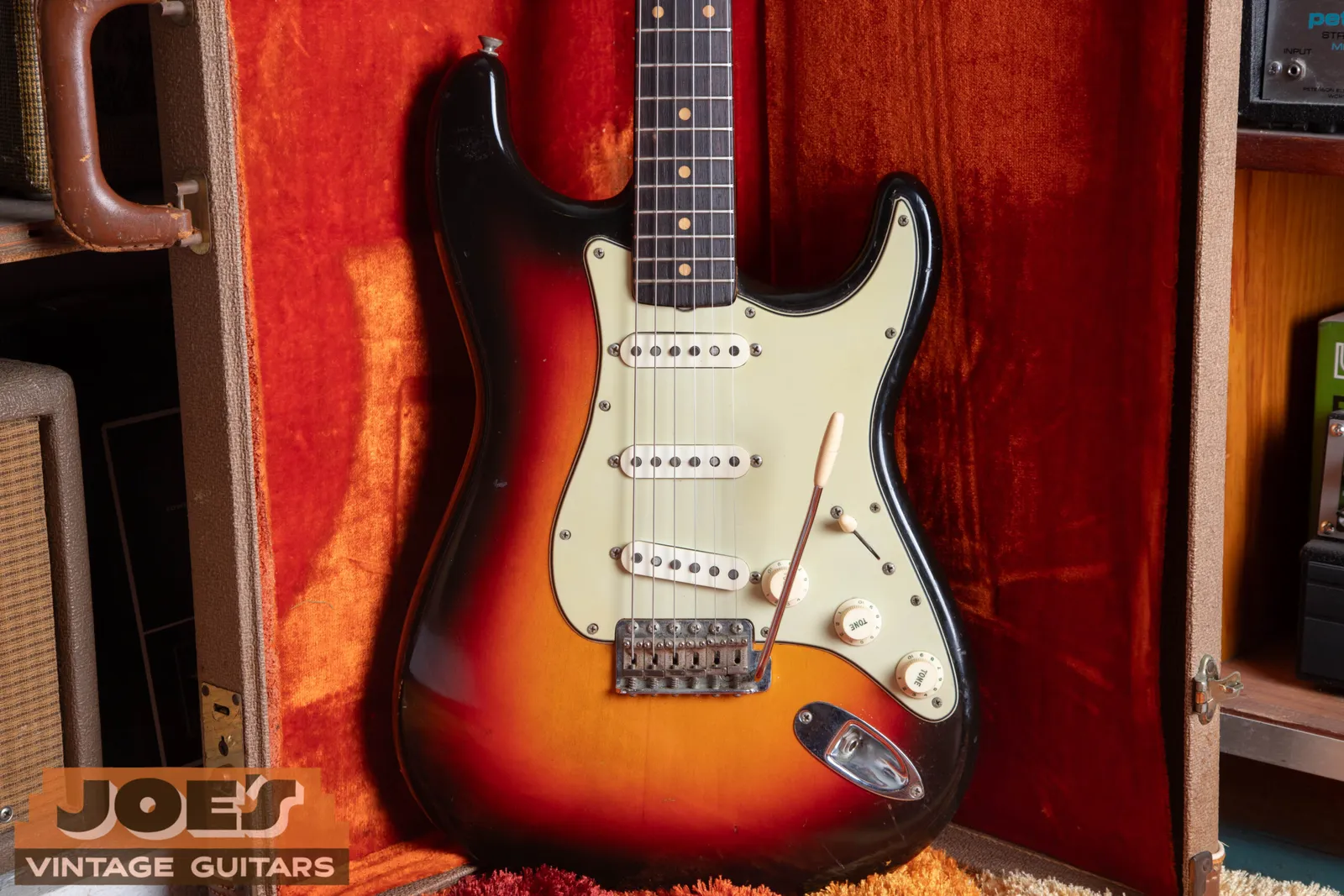
Read The Guitar In Three Passes
Nothing in the first two passes below will hand you a single year, and it helps to know that going in. A large headstock only tells you the guitar is late 1965 or later, which is a wider answer than the serial number gives you. Clay dots only say 1964 or earlier. Each feature is a window, and several of them are broader than the serial. Their value is in agreeing with each other and with the number on the plate, because a guitar where six independent things all point at the same stretch of months is a guitar you can be confident about.
Across The Room
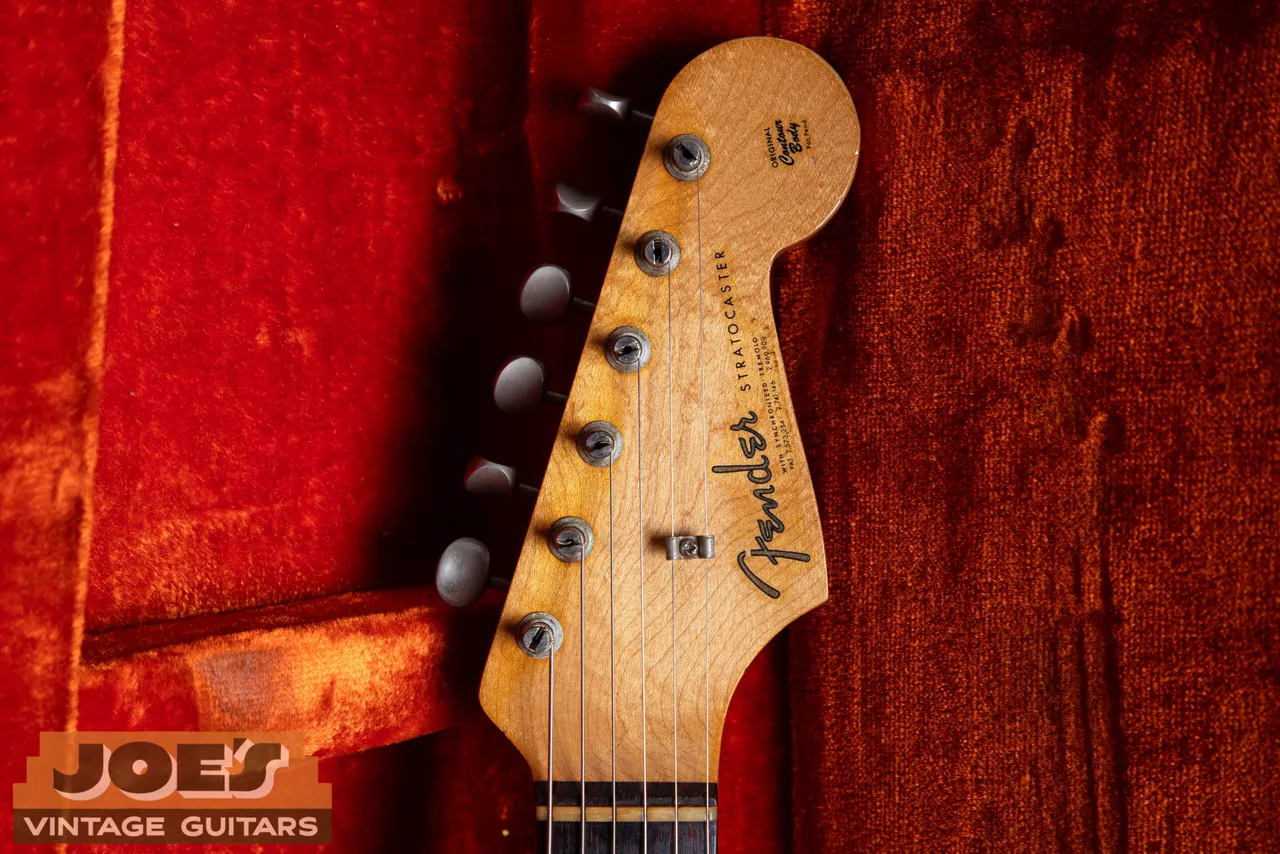
Headstock size and logo style. Between them those two put a Stratocaster inside a five-year window in about two seconds, and neither can be changed without the guitar telling on itself.
In Your Hands
The fingerboard, the dots, the pickguard, and the serial number on the neck plate. Take the serial as one vote among several rather than the answer, and read the plate style along with the digits. Every one of these reads with the guitar fully assembled.
Inside The Guitar
The neck heel stamp, the body date, and the pot codes. These are the only places Fender wrote an actual date, and the only things that will give you a month rather than a window. This is also the only pass that needs tools, which is why it comes last.
The three passes should agree. When they do, you have a build date you can stand behind. When they don't, the disagreement is the interesting part, and it usually means a replaced neck, a swapped plate, or a guitar being sold as something it isn't.
Everything in the first two passes can be read with the guitar assembled. Don't take a vintage instrument apart unless you have done it before, because vintage screws, plastics, and finishes strip and crack easily, and one slip can cost far more than the answer. If the outside checks leave you stuck, contact me before you reach for a screwdriver.
The Five Fastest Checks
If you read nothing else on this page, read these five. Each one is a different decade boundary and they are all visible with the guitar strung up and hanging on a wall. Read them together rather than one at a time: no single row here narrows anything to a year, but five rows overlapping do.
| What to look at | What it tells you | How to read it |
|---|---|---|
| Headstock size | Small through 1965, large from late 1965 | The one you can read from across a room. Read it against the right model though: the Telecaster headstock never grew, so this check does not carry over to a Tele. |
| The logo | Spaghetti to mid-1964, transition mid-1964 to 1967, heavy black CBS from 1968 | On a Stratocaster the first two are both gold, so go by the weight of the script rather than the color. Spaghetti is thin and delicate, transition is thicker and bolder, CBS is heavy black. |
| The fingerboard | Maple with a skunk stripe to mid-1959, slab rosewood to August 1962, veneer rosewood after, and a maple cap option back from mid-1967 | Look at the depth of the rosewood at the nut, and at the back of the neck for the stripe. Maple with no stripe is the 1967 to 1968 cap, not a 1950s neck. The stripe returns in 1969. |
| The dots | Clay to late 1964, pearloid after | Clay is dull, matte, and usually discolored. Pearloid is bright and visibly swirled. |
| The pickguard | One-ply with eight screws to 1959, three-ply nitrate with eleven to mid-1965, three-ply plastic after | Count the screw holes in the body rather than in the guard. A guard can be swapped; the holes cannot. |
Read every one of these against the right model. The screw count is a Stratocaster check. The headstock and the logo are Stratocaster timelines, and they are not the Telecaster's: the Tele headstock never grew at all, and the Tele kept its spaghetti logo into 1965 while the Strat moved to the transition logo in mid-1964. Read the Strat timeline onto a Tele and you will date it a year or more too early, which turns into a bad offer in one direction or the other, every time. The Mustang took a bigger headstock over the same stretch, so the enlargement is not unique to the Stratocaster either. It just is not universal.
Stratocaster Year By Year, 1954 To 1971
What changed each year, and the quickest way to see it. Two things to keep in mind while you read down the table. Fender never made a clean cutover, so a change dated to mid-year means both versions turn up on guitars from that year and a transition example is genuinely correct either way. And parts went into a bin before they went into a guitar, so a feature dates the part, and the guitar is that year or later.
| Year | What changed | Fastest tell |
|---|---|---|
| 1954 | Launch year. Single-ply white pickguard with eight screws, a one-piece maple neck with a skunk stripe down the back, a two-color sunburst, and a small round string guide. The very earliest examples carry the serial number stamped into the plastic tremolo cavity cover on the back rather than on the neck plate, and that window is narrower than most listings suggest: roughly the first hundred instruments, built between March and May, running about 0100 to 0207. From May to September the number moved onto a four-digit neck plate that started again at 0001 and ran into the 09xx range, and full regular production began in October. The two sequences overlap numerically, so a low neck-plate number is not the same series as a low cover number. The spring guitars went out with 100K solid-shaft pots and brittle polystyrene knobs that cracked, sometimes while being pushed on at the factory. By about September Fender had moved to 250K split-shaft pots and a knob redesigned with support spokes under the skirt. | Count the pickguard screws. Eight is 1954 to 1959. Then turn the guitar over and look at the tremolo cover. |
| 1955 | No change. A 1955 carries the same spec as a late 1954, so nothing on the outside separates the two. | Nothing visual. Go straight to the neck stamp and the pots. |
| 1956 | Alder becomes the standard body wood under sunburst and custom colors, chosen over ash for its tighter grain and better paint adhesion. Around the middle of the year the small round string guide gives way to the wider butterfly tree. | A butterfly string tree on the headstock rather than the small round guide. |
| 1957 | The paper-in-oil phone book tone capacitor changes from a brown body to a white one. Everything else holds. | Lift the guard. A white phone book cap on the tone pot means 1957 or later. |
| 1958 | The two-color sunburst gives way to the three-color, with an orange band between the yellow center and the dark edge. On Kluson tuners the PAT. APPLD. stamp under the housing gives way to a full patent number around now. | Is there orange in the burst? No orange points to 1954 through 1957. |
| 1959 | The biggest year on the list, and three changes land together. Around mid-year the one-piece maple neck gives way to a rosewood fingerboard, and the first of those boards are the thick flat-bottomed slabs. The single-ply guard becomes three-ply celluloid nitrate with eleven screws. The dots become clay. | A rosewood board and eleven pickguard screws. A 1959 can honestly be either side of this. |
| 1960 | No change. Some 1960 neck plates carry the serial along the bottom edge rather than in the middle, which is correct and makes people doubt an honest guitar. | Nothing new to see. The neck stamp does the work this year. |
| 1961 | The ceramic disc tone capacitor replaces the paper-in-oil phone book cap. Leftover paper caps still turn up in early 1962, which is a normal Fender overlap. | A round ocher wafer on the tone pot instead of a flat waxed block. |
| 1962 | Partway through August the slab rosewood board gives way to the thinner curved veneer. That single change is the sharpest value line inside the pre-CBS years. Right at the end of 1962 the L-prefix serials begin, so an L plate on a late 1962 build is possible. | Look at the rosewood depth at the nut. A thick band is slab, a thin line is veneer. |
| 1963 | The L-prefix neck plate is the norm, though some January and February guitars still wear the older five-digit numbers. During the year the two clay dots at the twelfth fret move from wide spacing to narrow, and both are correct for 1963 depending on the month. Around mid-year Fender also moved one pickguard screw: the count stays at eleven, but the screw between the neck and middle pickups shifts closer to the middle pickup to stop the celluloid warping. | An L in front of the serial on the neck plate. |
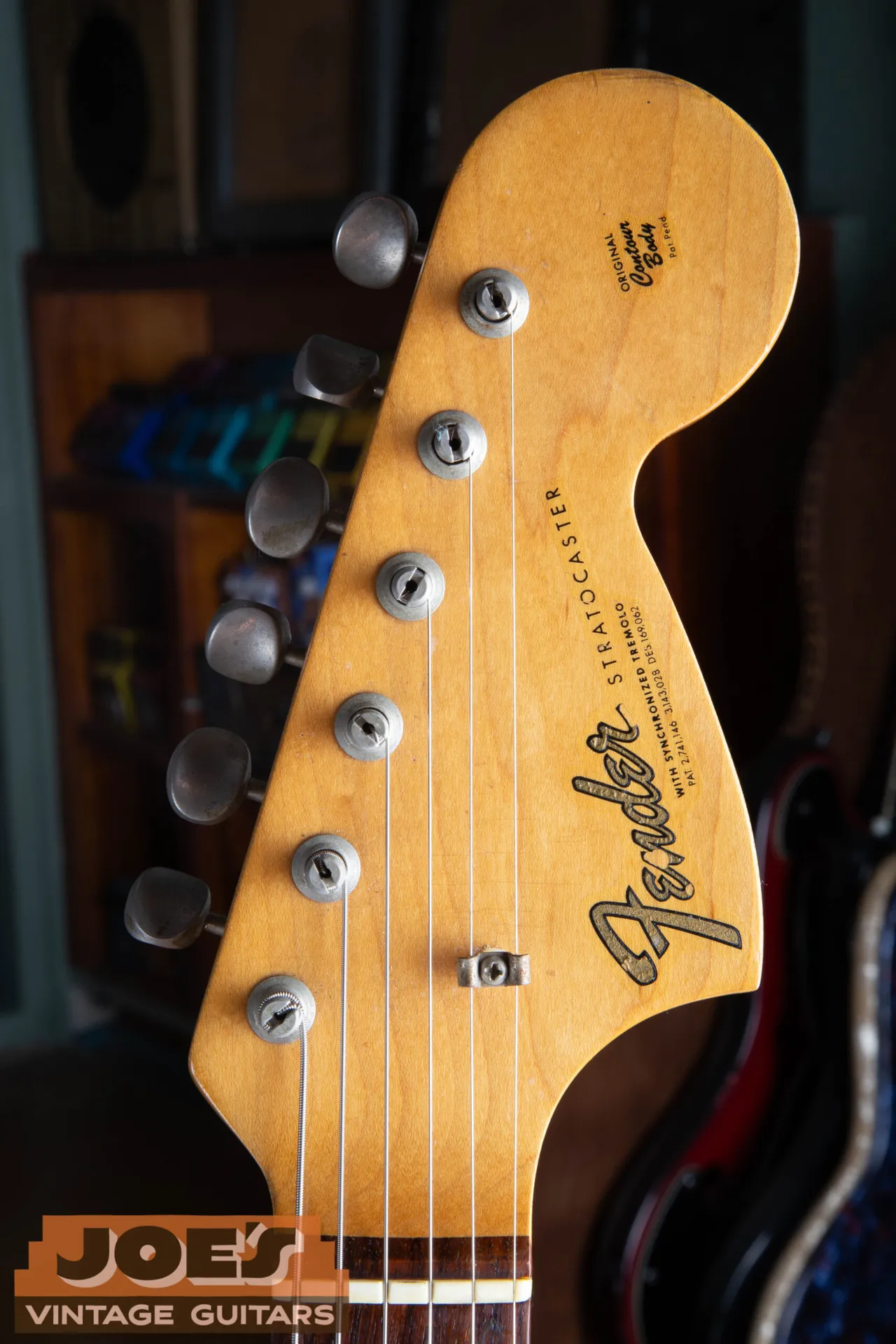
| 1964 | Two changes that get read wrong constantly. Around mid-year the thin spaghetti logo gives way to the thicker transition logo. Both are gold on a Stratocaster, so the tell is the weight of the script and not the color. Late in the year the clay dots on the face of the board give way to pearloid, while the small dots on the edge of the neck stay clay into 1965. The coil wire changes from Formvar to plain enamel, and the pickup bobbins begin moving from black to grey. The neck patent 3,143,028 is granted in August, so it appears on decals from then on. | A noticeably thicker, bolder logo. Read it on a Strat only: a Telecaster kept the spaghetti logo about a year longer. |
| 1965 | CBS completes the purchase in January, but the guitar changes in stages across the year rather than overnight. The pickguard material moves from celluloid nitrate to white plastic around mid-year, the big-F neck plate arrives around the third quarter, and the headstock enlarges late in the year. | A large F stamped on the neck plate, or the wider headstock outline. |
| 1966 | The large CBS headstock is effectively universal, and the handful of small-headstock 1966 guitars are leftover blanks being finished out. Grey-bottom pickups with plain enamel wire, double-line Klusons, and a three-ply white plastic guard that ages cream rather than mint. Fender also bought a huge lot of CTS 250k pots in the middle of the year, and those 137 66XX date codes were drawn from the bins for five full years, turning up in untouched factory harnesses right through 1971. | A big headstock with a gold transition logo, and a guard that never went green. |
| 1967 | A maple cap fingerboard returns as an option around mid-year, glued on top rather than cut into the neck, so the back stays clean. Fender's own F-stamped tuners phase in across the year and are standard by 1968. The bold black CBS logo starts appearing late in the year. | A maple board with no skunk stripe. That pairing is a 1967 or 1968 guitar, never a 1950s one, and the stripe is back from 1969. |
| 1968 | The heavy black CBS logo is standard, polyester finish arrives, and the cloth-covered wire in the cavity gives way to plastic-insulated wire as the old stock runs out. A 1968 can honestly have either, or both. The green Nissei chicklet capacitor appears this year only, and the 0.05 ceramic disc arrives alongside it rather than after it, so a 1968 can legitimately carry the 0.1 Nissei or the 0.05 disc. | The thick black logo, drawn heavy enough to read on camera. |
| 1969 to 1970 | Mostly settled. The 0.05 ceramic disc becomes the sole factory tone capacitor, having run alongside the 0.1 through 1968, so the tone control rolls off less. Maple cap necks are common alongside rosewood. In 1969 Fender goes back to routing the truss rod channel from behind and standardises the tooling across the line, so the walnut skunk stripe returns from this year, on rosewood-board necks as well as maple. | Read the neck stamp. The Stratocaster model code changes inside this window. |
| 1971 | The four-bolt neck plate gives way to the three-bolt Micro-Tilt plate, the bullet truss rod arrives and moves the adjustment to the headstock, and late in the year the stamped steel saddles give way to die-cast zinc. The skunk stripe is already there, having returned in 1969, so it is not what dates a 1971. | Count the bolts in the neck plate. Three means 1971 or later. |
Past 1971 the guitar starts dating itself. From 1976 Fender moved the serial to a headstock decal with the year built into the prefix, and the full serial guide carries those charts along with the reissue and import prefixes.
Headstock And Logo
Two things live on the headstock and they change on different schedules, which is exactly why reading them together is worth more than reading either one alone.
The Outline
Fender widened the Stratocaster headstock late in 1965 and it stayed wide, so the large outline is a floor: late 1965 or later, full stop. It is the single most useful thing on the guitar for a first look, because you can read it from a photograph taken across a room. Two cautions. The Mustang took the enlarged CBS headstock across the same stretch, late 1965 into 1966, so this is not a Strat-only tell. And the Telecaster never grew at all, so the check does not transfer to a Tele. The Jazzmaster is a third case: its outline was reshaped around mid-1967 to match the post-1965 Strat, but it never really got bigger, and you only catch that one side by side.
The Logo
The logo runs on its own clock and on a Stratocaster it moves in mid-1964, a year and a half before the headstock grows. That gap is real and it catches people out. A guitar with a transition logo on a small headstock is a genuine late-1964 or 1965 Stratocaster rather than a parts guitar, and those crossover instruments are often underpriced because somebody read the logo, decided it was a CBS guitar, and stopped looking. A transition logo does not make a guitar a CBS guitar.
Go by the weight of the script, not the color. On a Stratocaster the spaghetti and the transition logos are both gold, so anybody telling you to look for the change from silver to gold is describing a different model. Spaghetti is thin, fine, and delicate. Transition is the same gold in a noticeably heavier hand. The CBS logo that follows is the easy one, because it is black and much bolder than either.
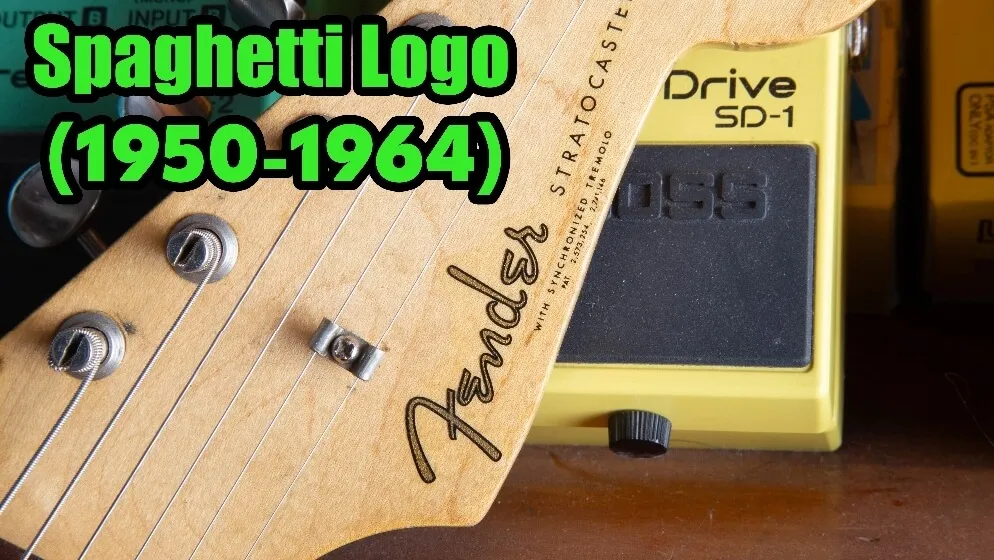
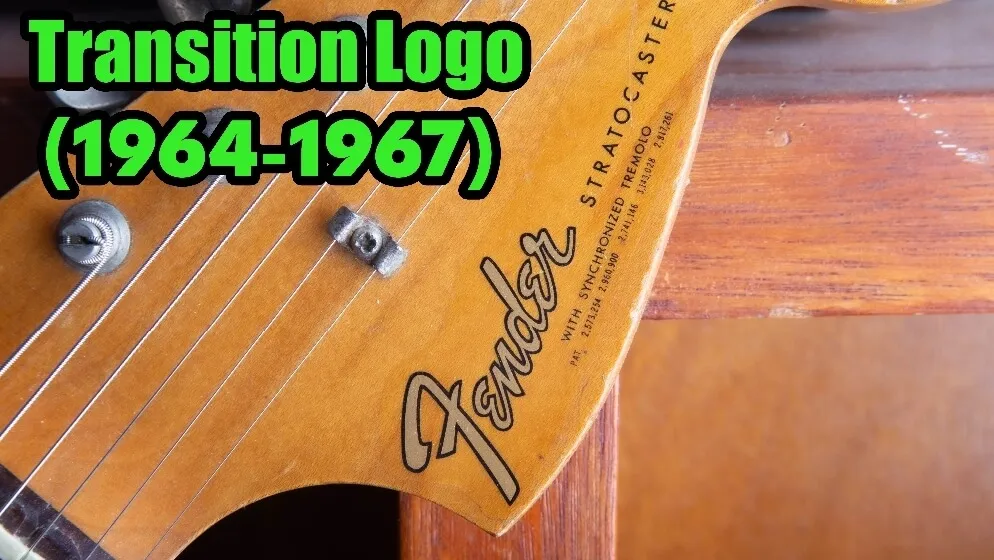
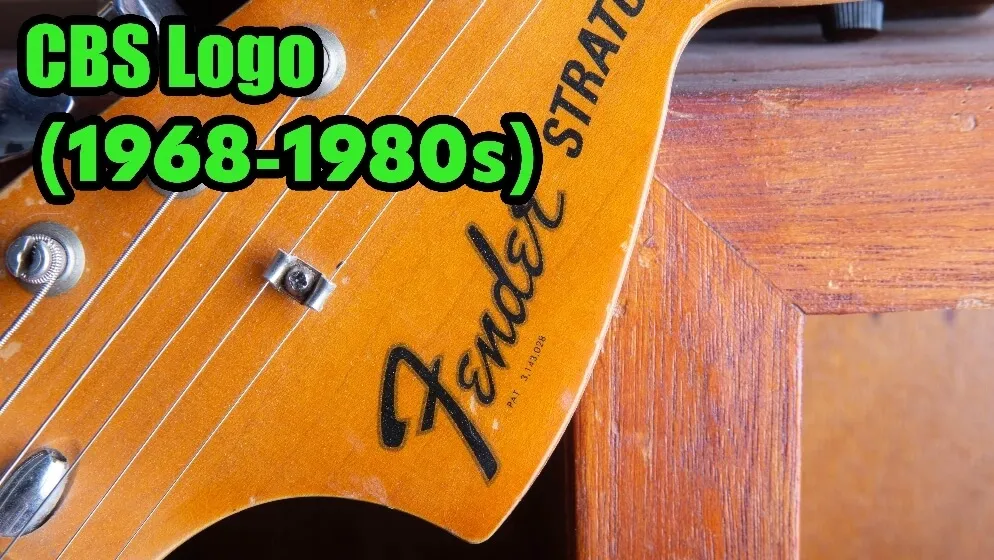
The patent numbers under the logo are the check that catches a good fake decal. Getting the script right is easy. Getting the exact patent list right for one specific window is not, and reproductions routinely carry a number that was never there. The most useful of them is 3,143,028, the neck patent granted in August 1964: if it sits under the logo, the guitar is 1964 or later whatever the seller says, because the number did not exist before then.
| How many | Years | Which numbers |
|---|---|---|
| None | 1954 to late 1960 | No patent numbers under the logo at all. An early guitar wearing a block is wrong. |
| Two | Late 1960 to early 1962 | 2,573,254 and 2,741,146, the bridge and pickup patent and the synchronized tremolo patent. |
| Three | Early 1962 to mid-1964 | 2,960,900 joins. The classic spaghetti-logo block. |
| Four | Mid-1964 to late 1965 | 3,143,028 joins, the neck patent granted in August 1964. |
| Five | Late 1965 | 2,817,261 joins briefly, on large headstocks. Five is as high as the block ever goes and the window is short. |
| Three | 1966 to 1967 | The list shrinks: 2,741,146, 3,143,028 and DES 169,062. |
| Two | Mid-1967 to early 1971 | 2,741,146 and 3,143,028 only, under the black CBS logo. |
Count them before you read them. The block grows to five and then shrinks back to two, so a high count is a mid-1960s marker rather than a late one, and a 1969 guitar carrying four or five numbers has the wrong decal. The count alone will not date a guitar to a year, but it narrows the decal quickly and it is the part a reproduction is most likely to get wrong. There is a wider breakdown across every model on the physical features guide.
The Neck And The Board
The Stratocaster fingerboard changed twice in ways you can see at a glance, and the dots in it changed again on a different schedule. Between them they cut the vintage era into slices.
Maple, Slab, Veneer, And The Maple Cap
Four boards across the years, in this order. Through mid-1959 the neck is one piece of maple with the frets cut straight into it. Around the middle of 1959 Fender went to a rosewood fingerboard glued on top, and the first of those are thick flat-bottomed slabs about 4.8mm deep at the nut. Partway through August 1962 the slab gives way to a thin curved veneer, roughly 2mm, whose underside follows the radius of the neck. Then around the middle of 1967 maple comes back, but built the other way round as a separate cap glued over the truss rod rather than a one-piece neck.

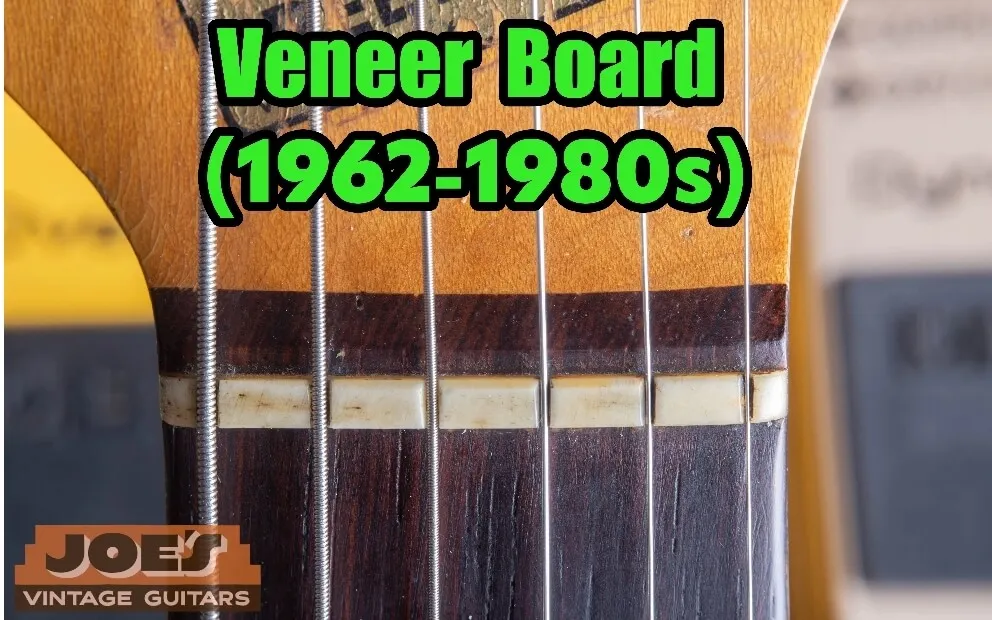
August 1962 is the month to know on a Stratocaster. Fender changed over partway through it, so both boards turn up on necks stamped August 1962. A slab board with an August 1962 neck date is a genuine transition guitar and worth more than either side of the change. A slab example is worth a real premium over a veneer one from the same year with otherwise identical specs, so if a seller describing an early 1962 has not mentioned which it is, look before you buy.
The back of the neck settles the maple question. A maple board on its own tells you almost nothing, because Fender used maple twice and the two look identical from the playing side. A one-piece 1950s neck has to carry a dark walnut skunk stripe down the back, since the truss rod went in from behind and the stripe is the lid on that channel, with a small walnut plug at the headstock end where the rod was fed in. The maple cap that returned around mid-1967 has a separate board glued over the rod, so nothing needs filling from behind and the back is clean unbroken maple with no stripe and no plug. Flip the neck over and the answer takes a second.
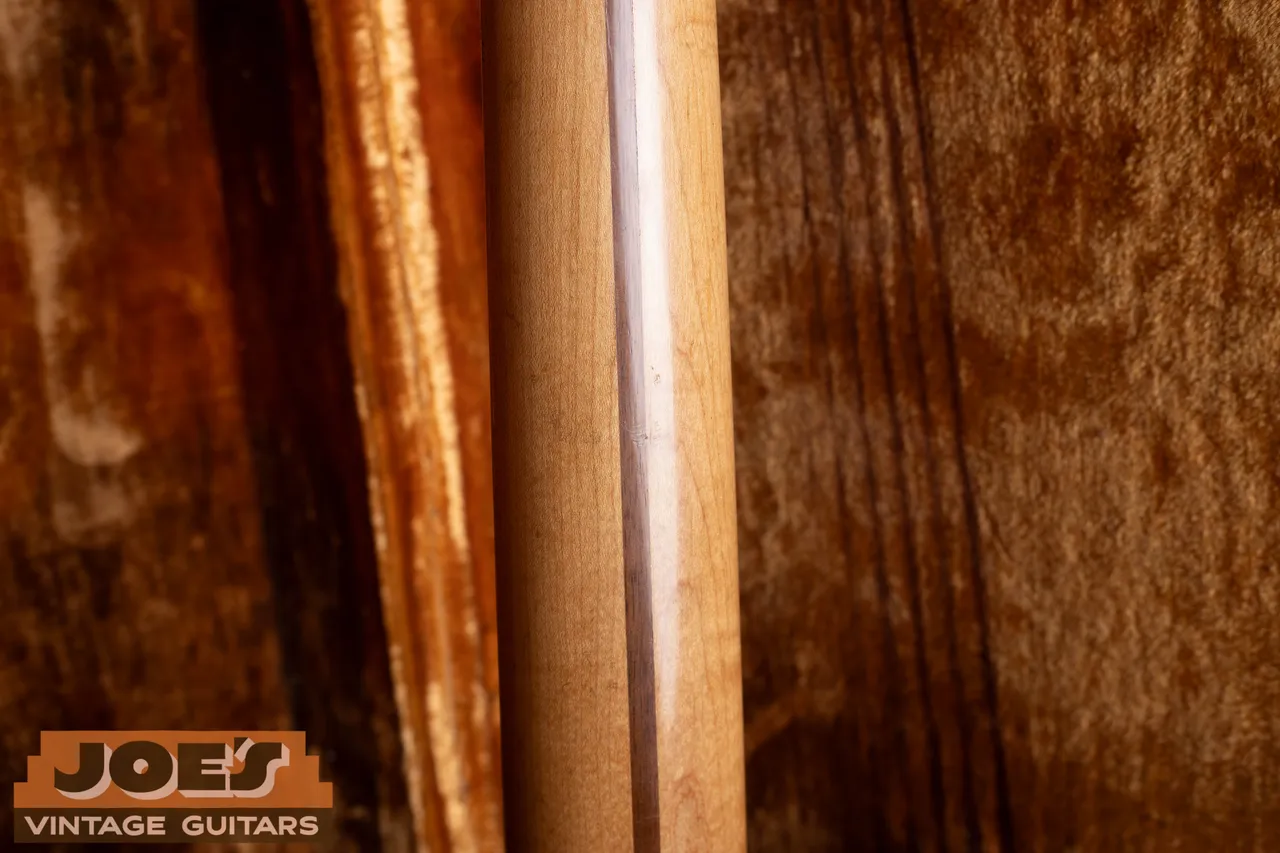
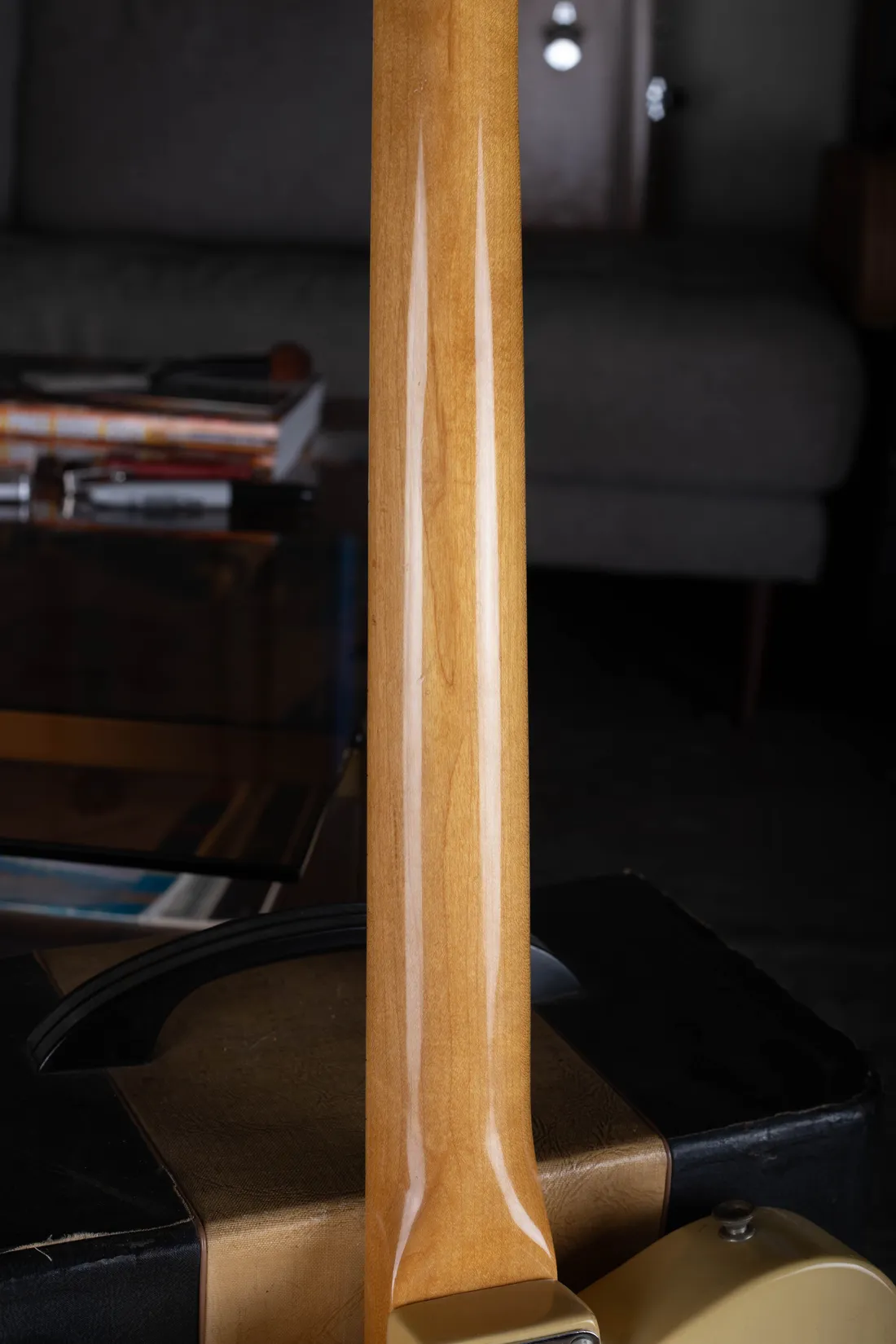
So a stripe on a claimed 1967 or 1968 maple-board Strat is wrong, and no stripe on a claimed 1950s one is equally wrong. This is one of the few checks on the page where the two answers point at genuinely different decades.
The stripe comes back in 1969, and that is earlier than most people place it. Fender returned to routing the truss rod channel from behind that year and standardised the tooling across the line, so from 1969 a maple neck carries a stripe again and rosewood-board necks built from then on carry one too. It is a common mistake to date the return to 1971 and the bullet truss rod. The bullet arrived two years later and adjusts at the headstock instead of the heel, so it is a separate change that happens to need the same rear channel. Practically: no stripe narrows a maple-board Strat to roughly 1967 and 1968, not to the whole late-1960s stretch, and a stripe on a rosewood-board neck is normal from 1969 rather than evidence of a replacement.
Clay Dots And Pearloid
Clay dots run from 1959 to late 1964. They are dull, matte, slightly chalky, and by now usually discolored to an off-white. Pearloid took over from late 1964 and is bright, shiny, and visibly swirled. Shiny dots on a claimed pre-1965 Stratocaster are a problem.
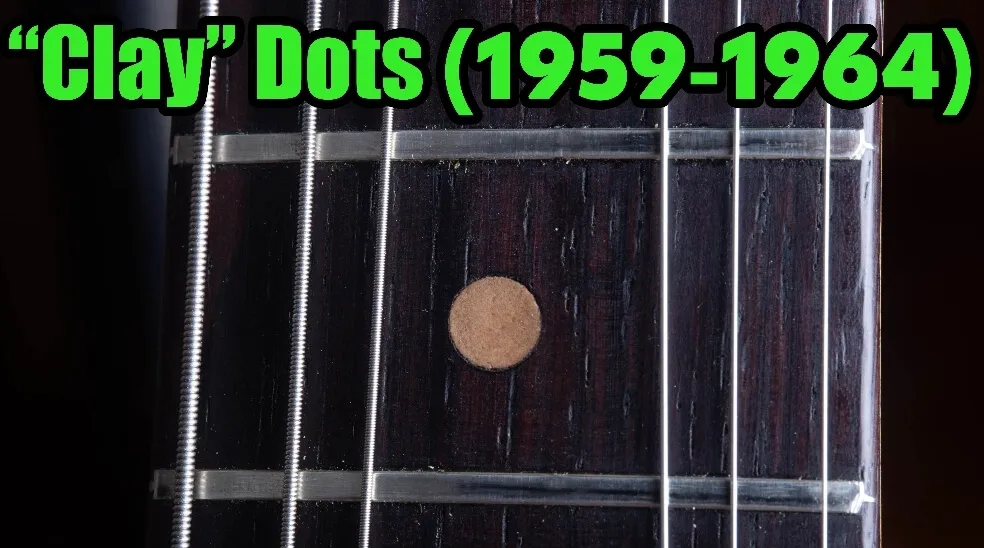
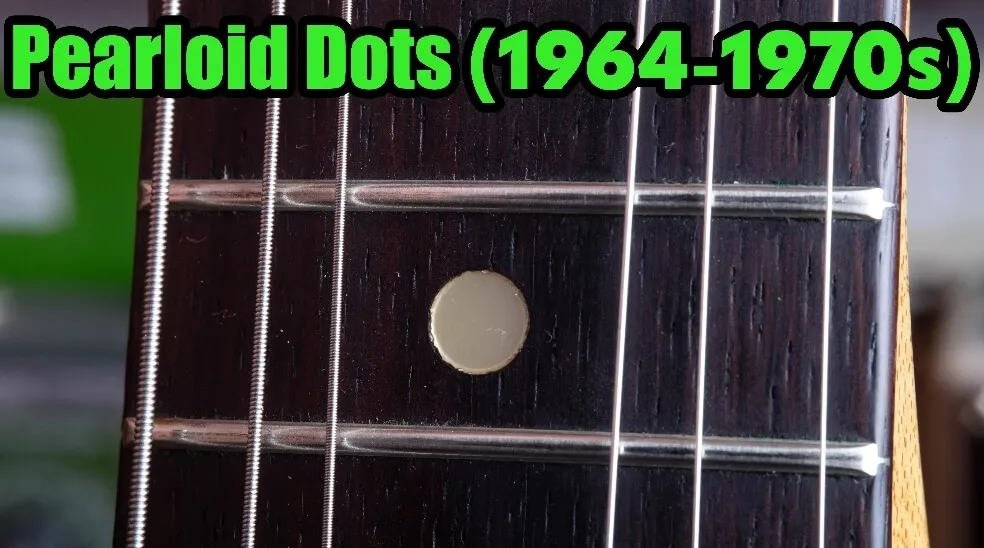
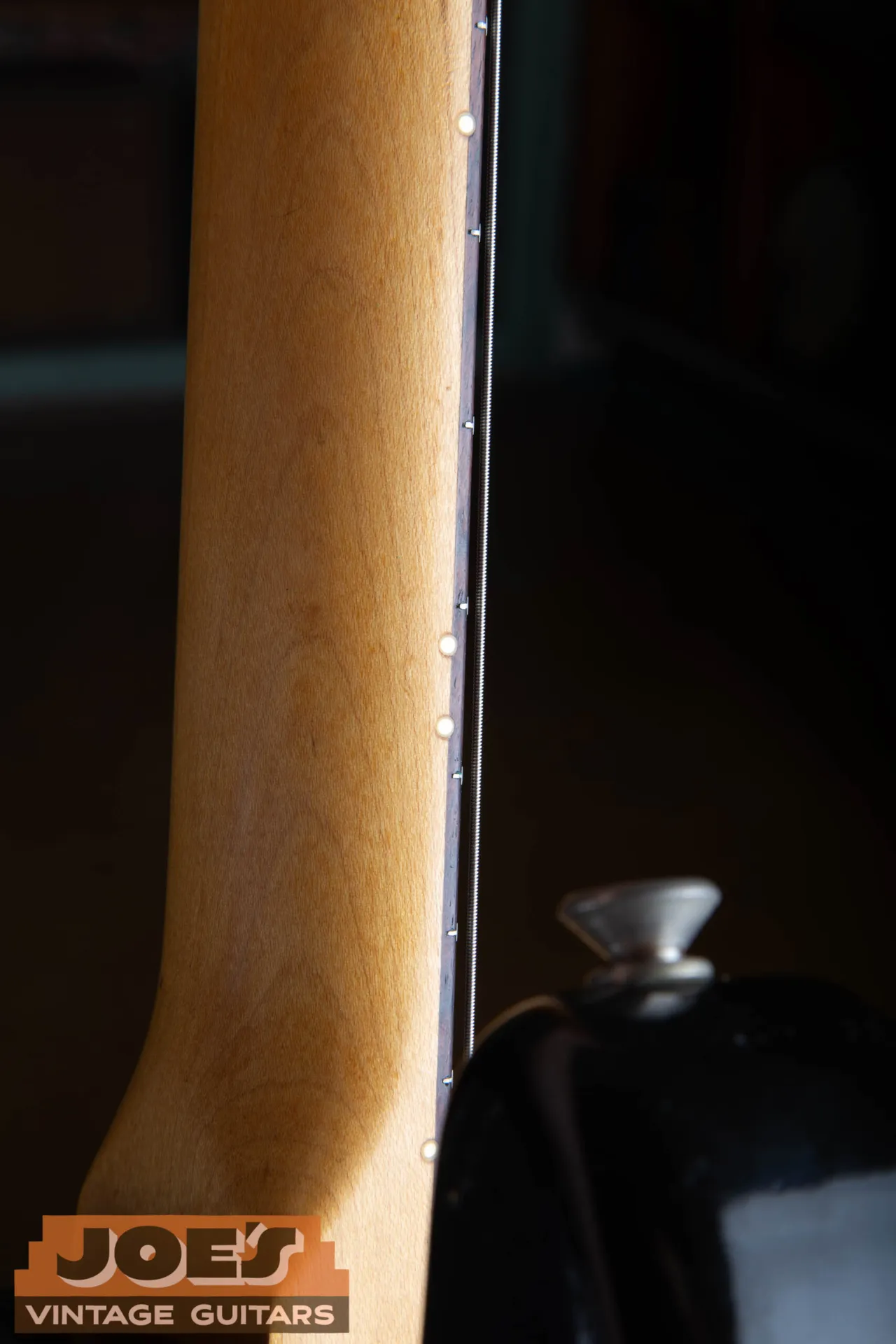
The face changed before the edge. In late 1964 Fender switched the dots on the face of the board to pearloid while the small dots on the side of the neck stayed clay into 1965. So a transition neck can show bright pearloid on the face and dull clay on the edge, which looks wrong to anybody meeting it for the first time and is one of the sharpest tells for the transition period there is. One more quirk worth knowing: during 1963 the pair of dots at the twelfth fret moved from wide spacing to narrow, and both are correct for the year depending on the month.
Pickguard And Pickups
On a Stratocaster the guard is a faster check than it is on any other Fender, because you can just count the screws. The single-ply white guard the model launched with in 1954 takes eight. The three-ply nitrate guard that replaced it in 1959 takes eleven. You can do that from a photograph.
Better still, count the holes in the body rather than the screws in the guard. A guard gets swapped all the time and the holes underneath it cannot be. Eleven holes in a guitar sold to you as a 1956 means the body has worn a later guard, whatever is bolted to it now.

Mint green is a date, not a color option. Only cellulose nitrate ages that way, and Fender used nitrate until around the middle of 1965. From then the guards are plastic, and plastic ages to cream at most and never to green. So a genuinely mint guard means a pre-1965 guitar, and a cream one on a claimed 1962 means the guard has been replaced. A guard that is still bright white after sixty years is a reproduction.
Black Bottoms And Grey Bottoms
Turn a pickup over and the color of the fibre flatwork on the bottom splits pre-CBS from CBS. Black is correct for every pre-CBS Stratocaster. Grey came in around 1964 and ran on through the CBS years, so a grey bottom indicates a later instrument rather than an earlier one.
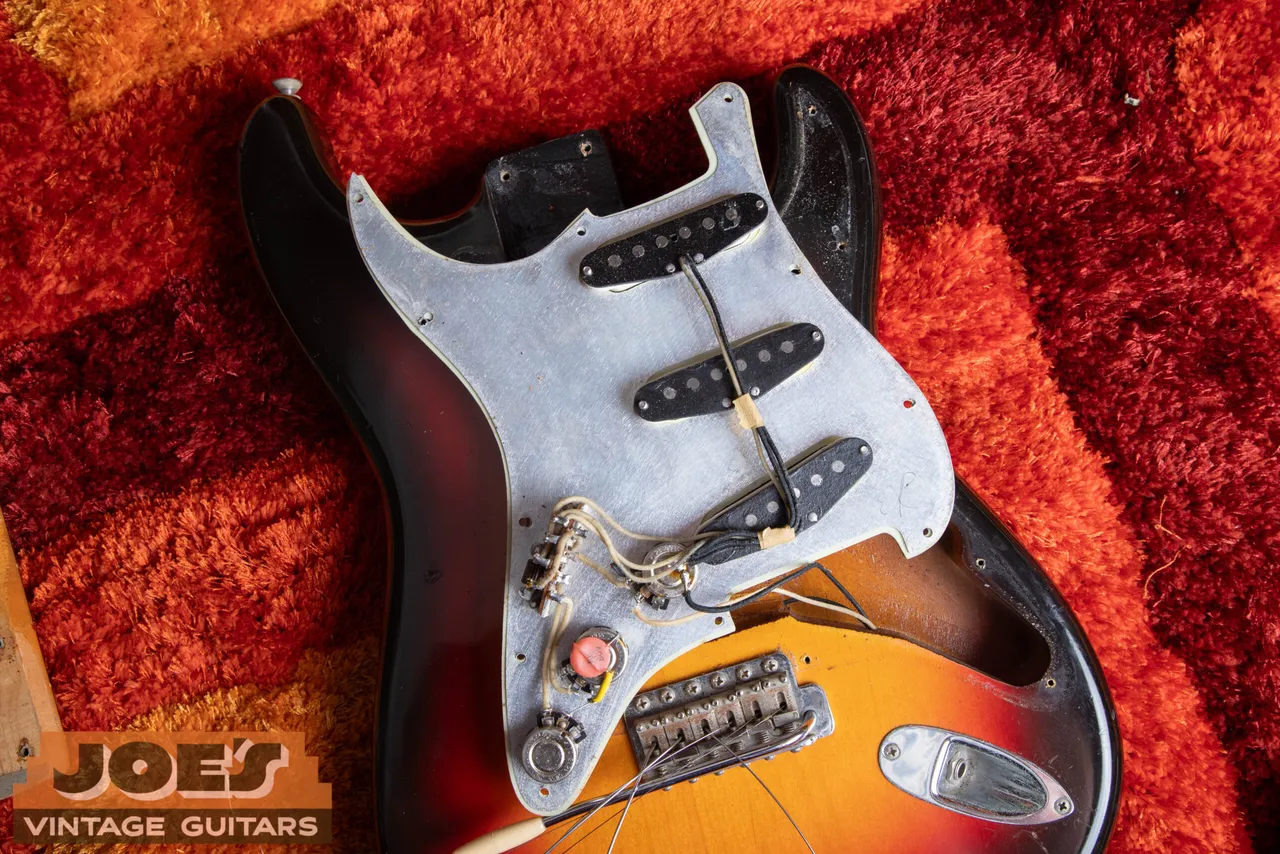
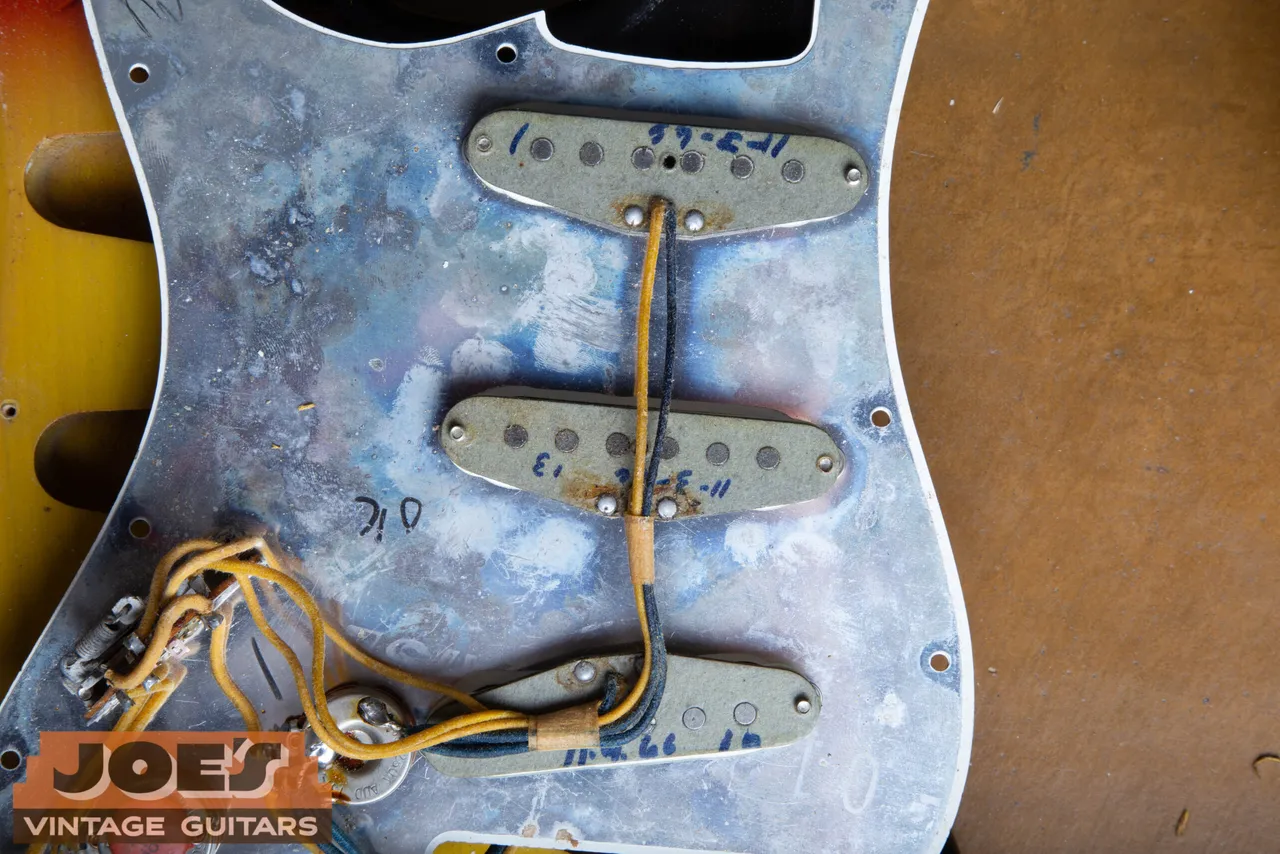
The coil wire moved on the same schedule and is easier to see, because you can read it through the gaps in the string that holds the coil. Formvar, used until 1964, reads golden orange. Plain enamel, from 1964, reads dark burgundy, almost purple. That was a plant-wide change hitting every model at once, so it splits pre-1964 from post-1964 on any Fender single coil. Plenty of people have it backwards, so check the guitar rather than the forum post.
Stratocaster poles were staggered from 1954 and stayed staggered until about 1974, with the G pole standing tallest, so flat poles on a claimed 1960s Strat are wrong. The earliest Stratocaster pickups used Alnico 3 magnets, with Alnico 5 becoming the standard. There is more on all of this, including how to read the date stamped on the pickup base, in the pickup dating guide.
The Neck Heel Date
This is the single most reliable dating reference on a pre-CBS Fender, and unlike everything above it, it is a date rather than a window. Fender wrote the month and year on the butt end of the neck heel, so you have to take the neck off the body to see it. On a genuine old one the ink has aged and partly absorbed into the grain. A fresh-looking stamp on wood that shows its age everywhere else is worth questioning.
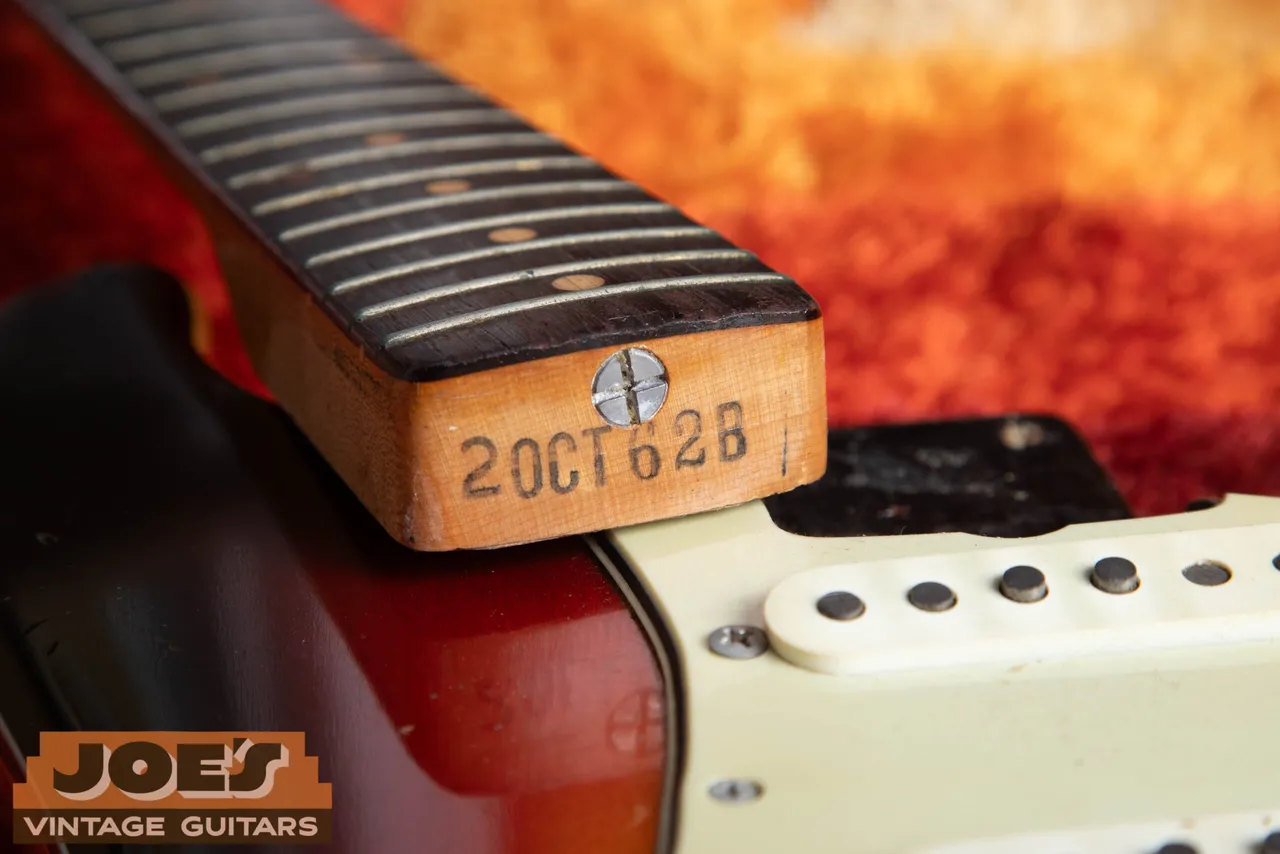
Read it next to the body date rather than on its own. The neck and the body were made separately and married at assembly, so a gap of weeks or a few months between the two is completely normal and is not a sign of anything wrong.
The Stratocaster Model Code
Here is the part hardly anybody uses. The heel stamp usually opens with a model code, and that number is different for each model, so it brackets the guitar before you even read the date next to it. The Stratocaster's own number changed twice.
| Code on the heel | Stratocaster years |
|---|---|
| 2 | Through 1965 |
| 13 | 1966 to 1968 |
| 22 | 1968 to about 1973 |
So a heel stamp opening with 22 is a Stratocaster neck from 1968 or later, and a 2 puts it at 1965 or earlier, whatever the plate on the back says. Because the number names the model as well as the era, it is also the fastest way to catch a neck that came off something else: a Jaguar ran code 1 through 1965 and 15 from 1966, so a 15 on a guitar sold to you as a Stratocaster is not a Stratocaster neck.
The full decoder for the heel stamp, including the width letter, the pencil and ink eras, and the green stamp, is on the neck date guide.
Body Dates
The other place Fender wrote a real date. Somebody penciled the day the body was routed and prepped directly onto the body, inside one of the cavities, and on a Stratocaster it is worth knowing exactly where to look, because the Strat does not put it where a Telecaster does.
Check the pickup cavities first, then the tremolo spring cavity. The middle and neck pickup routes are the usual spots. If it is not there, take the back plate off and look in the spring cavity. What a Stratocaster body date is usually not is in the neck pocket, which is where people look first and come away thinking the guitar has no date at all.
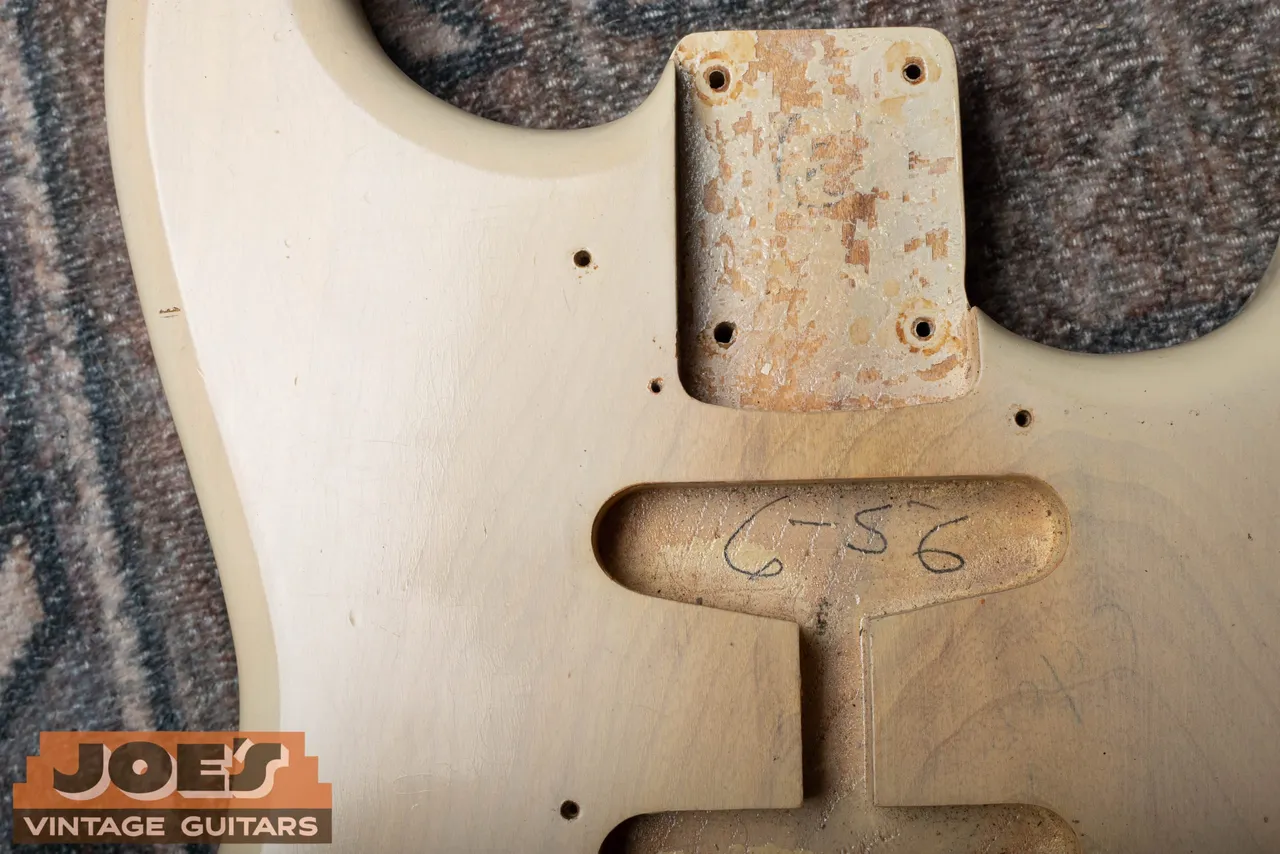
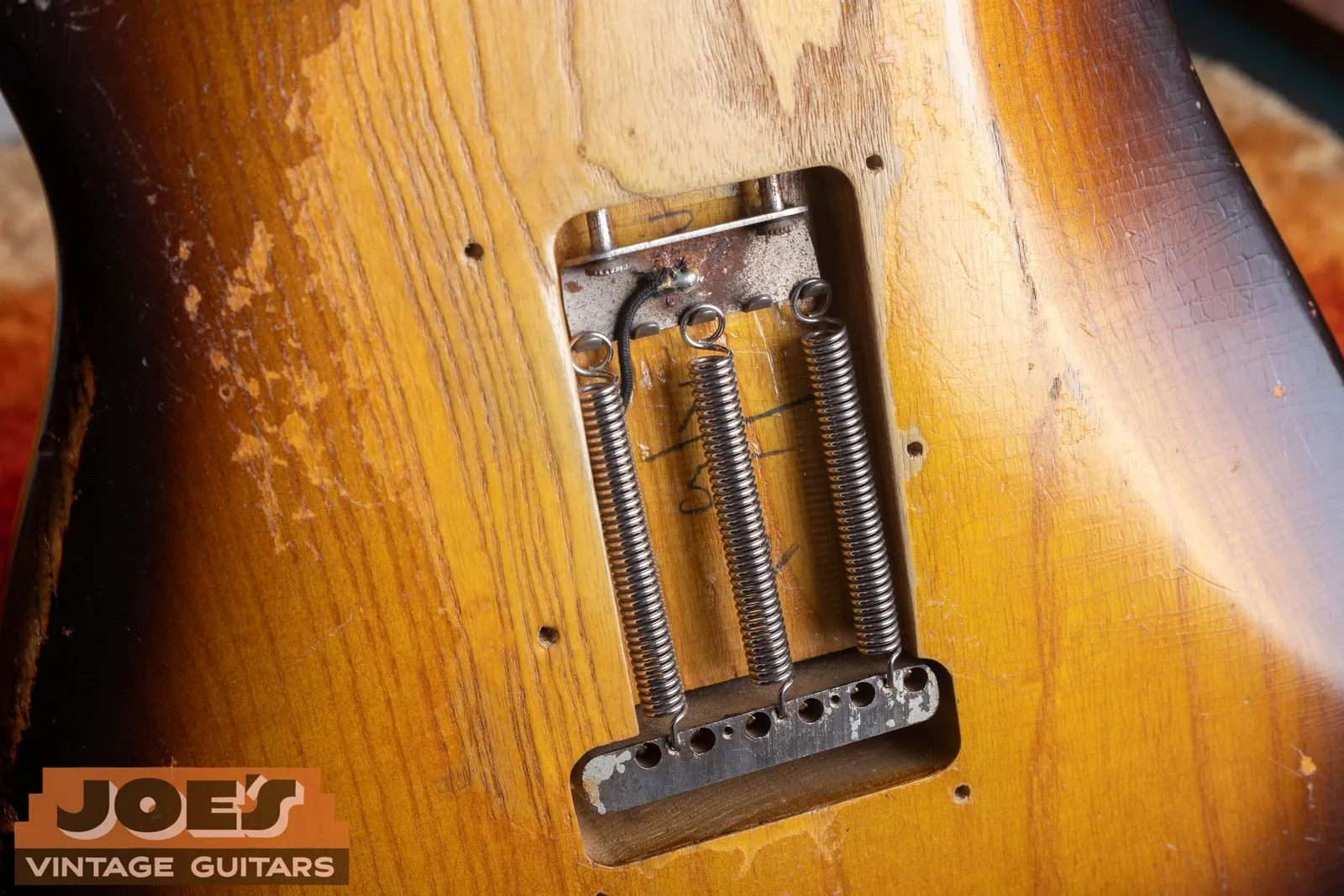
The body date is a corroborating date rather than the build date. It records when the body was routed, which can precede final assembly by weeks or several months, so read it as a floor the same way you read a pot code. A body date and a neck date a few months apart is the normal, correct result on an untouched guitar.
Where the date hides on every other Fender model, and what the ink stamps and masking-tape markings look like, is on the body date guide.
What The Serial Number Adds
A useful vote, and a better one than it usually gets credit for. The number will not give you a year on its own, because the plates were pre-stamped in batches, stored, and pulled off the stack in no order, and the published ranges overlap year to year and disagree between sources. But it is no worse than most of the features, and it is sharper than some of them. Read it alongside them rather than instead of them. What the style of the plate adds is not a second date but a check on the first one, because each style carries its own number format. An L in front of five digits cannot sit on a plain pre-1962 plate, and six digits belong above the big F. Where the style and the digits disagree, the plate has been off the guitar.
Worth knowing why there is no Stratocaster serial chart on this page: Fender serials are not model-specific. A 1963 neck plate reads exactly the same whether it ended up under a Stratocaster, a Jazzmaster, or a Jazz Bass, so the charts live once on the hub rather than being copied onto every model page.
| Plate | Years | What it looks like |
|---|---|---|
| Plain chrome four-bolt plate | 1954 to late 1962 | Four or five digits, no letter. Fender pre-stamped plates in batches and pulled them off the stack in no order, so these overlap heavily year to year. |
| L-prefix plate | Late 1962 to late 1965 | An L in front of five digits. The last of the pre-CBS plates. |
| Big-F plate | About the third quarter of 1965 to 1976 | Six digits stamped above a large stylized F. The CBS plate. |
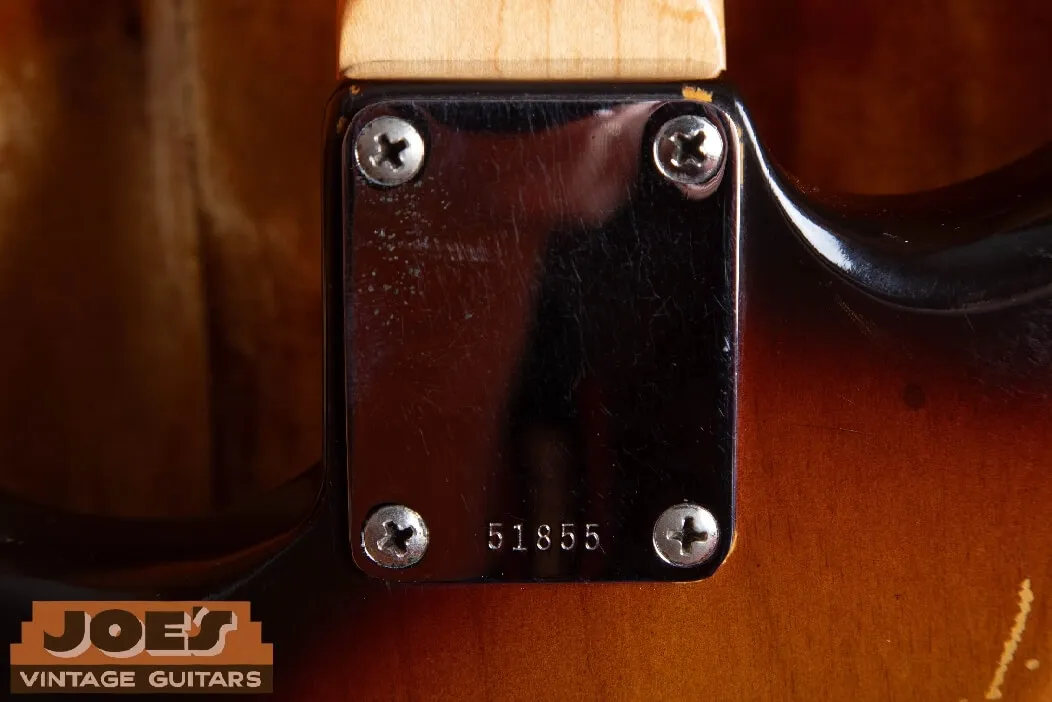
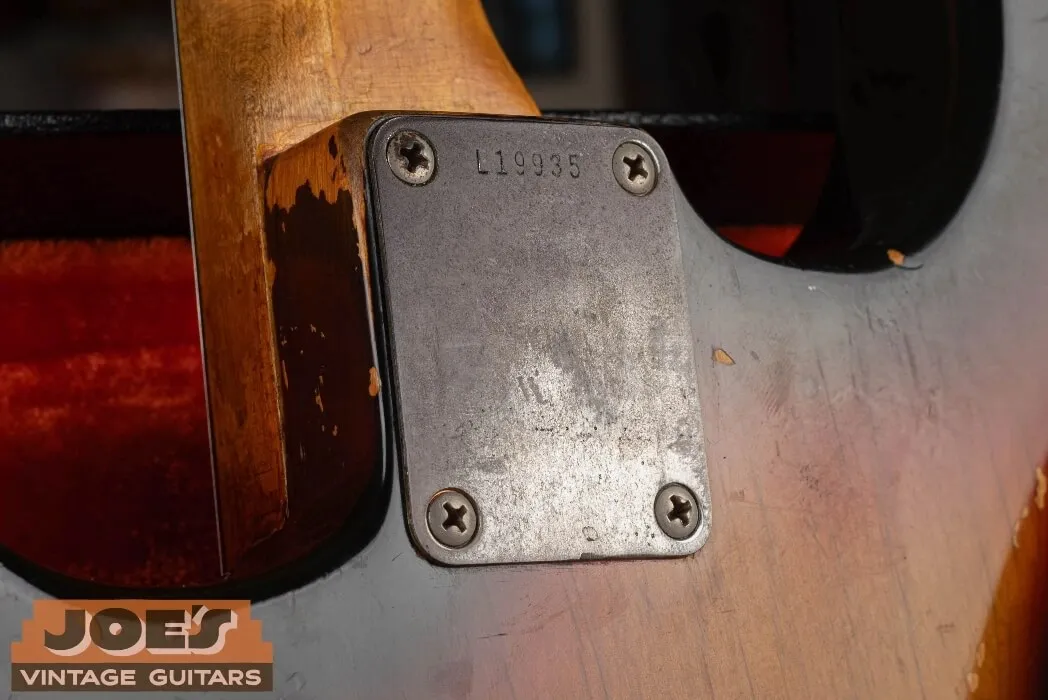
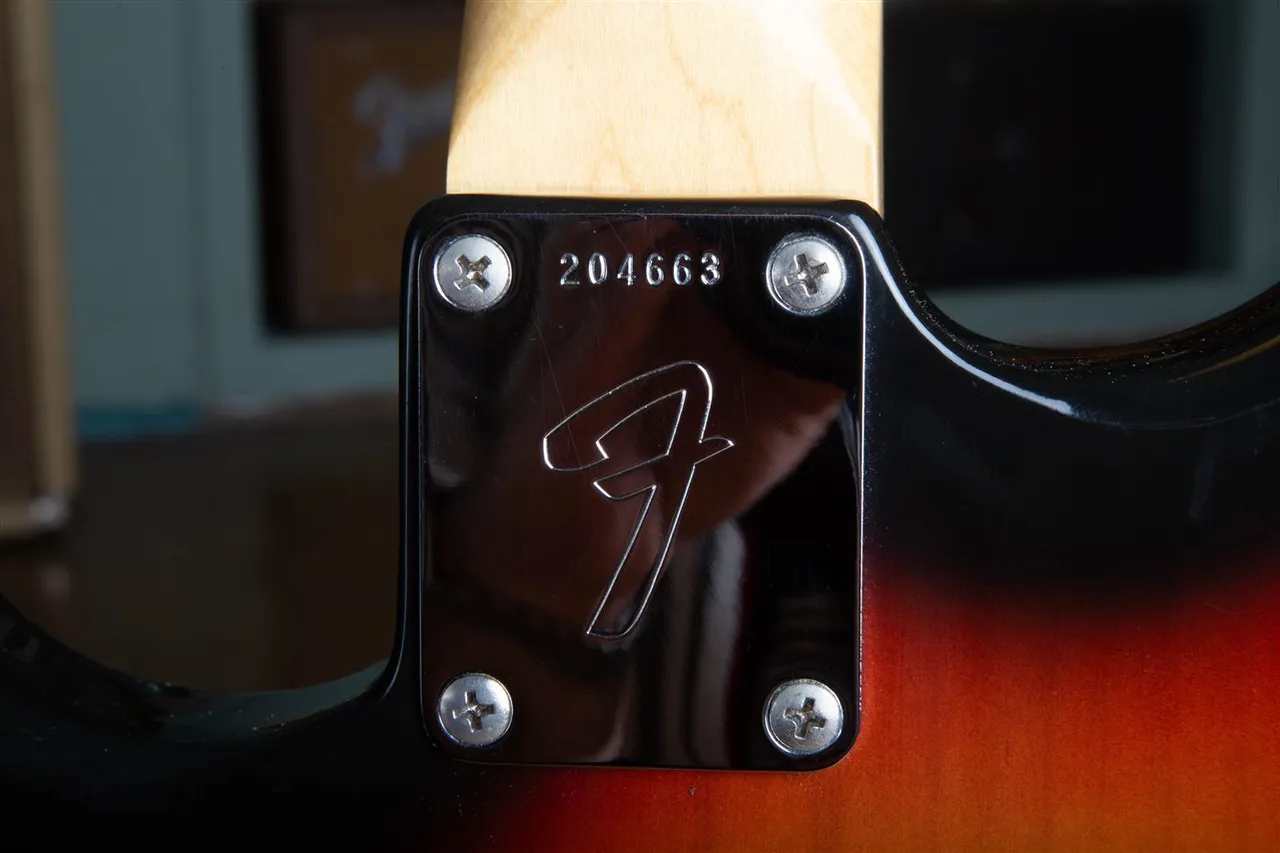
Use the plate to sanity-check the features rather than the other way round. An L plate on a guitar with a large headstock is worth a hard look, because the headstock did not grow until after the L series was most of the way through. The full Fender serial number guide has the year-by-year charts, the free lookup, and every prefix from the 1950s through the modern reissues and imports.
What The Features Can't Prove
Every feature on this page dates a part. None of them dates the guitar, and the difference matters most on exactly the instruments where the money is.
A correct feature set is not proof of originality. A Stratocaster can wear a genuine 1962 neck, a genuine 1962 body, and genuine 1962 hardware and still be three guitars in a trenchcoat. Originality is a whole-instrument judgment that weighs the neck date, the body date, the pots, the pickups, the hardware, and the finish against each other and asks whether they tell one story.
Transition dates are approximate, and honest guitars break them. Fender phased changes in as parts bins emptied, so a guitar from a changeover year can legitimately carry either spec, or one of each. Anybody quoting you a single confident month for every change on this page is quoting one source and not telling you the others exist. The Kluson single-line to double-line change is the clearest example: published dates for it range from the late 1950s to about 1964 and no one has settled it.
Features are the easiest thing to fake. A reproduction decal, a set of relic'd tuners, and a correctly aged guard are all buyable, which is why the dated parts inside the guitar carry more weight than the parts you can see from outside. The finish is where the real money moves, and a refinished pre-CBS Strat can lose a large share of its value against an original-finish example, so treat any finish call as a job for hands and UV rather than a photograph.
Confirm It From The Inside
The neck heel date and the body date above are the two that give you a month. Two more parts inside the guitar back them up. The pot codes date a potentiometer to the week, which is the tightest number anywhere on the guitar, though it is a floor rather than a build date because pots sat in bins. The pickup dates on the base of the bobbins corroborate, when they are there at all. For the parts view across every Fender model rather than this one, work through dating a Fender by its parts, and if you are holding something other than a Stratocaster, the Telecaster, Jazzmaster, Jaguar, Jazz Bass, Precision Bass, and Mustang dating guides are built the same way as this one.
If you have already narrowed the year down, these go deeper on one specific Stratocaster and show the real thing photographed up close: 1962, 1963, 1966, and 1967. There is also a guide to authenticating a custom color finish, which is where the largest premiums and the largest mistakes both live.
This guide is one of the model pages behind the full Fender serial number guide, where the complete year-by-year serial charts live.
Common Questions About Dating A Stratocaster
What Year Is My Stratocaster?
Work it in three passes and expect each one to give you a window rather than an answer. Read the headstock first, because the size and the logo style put the guitar in a five-year window from across the room. Then read the board, the dots, the pickguard screws, and the serial number together, treating the serial as one vote among several. Then open it up for the parts Fender actually dated: the neck heel stamp and the body date, backed up by the pot codes. Those last two are the only things on the guitar that will give you a month.
Can I Date A Stratocaster From The Serial Number Alone?
No. Fender pre-stamped neck plates in large batches and assemblers grabbed them off the stack in no particular order, so a plate can sit for months before it goes on a guitar, and the published ranges overlap year to year and disagree between sources. That said, do not swing too far the other way. The features are not sharper than the serial, and several of them are blunter: a large headstock covers everything from late 1965 on. The serial is one vote, the features are more votes, and only the neck heel date and the body date will actually hand you a month.
My Stratocaster Has A Big Headstock. What Year Does That Make It?
Late 1965 or later. Fender widened the Stratocaster headstock late in 1965 and it stayed wide, so the large outline is a floor rather than a window. Two things to keep straight. The Mustang took the enlarged CBS headstock over the same stretch, late 1965 into 1966, so a large headstock is not by itself a Strat tell. And the Telecaster headstock kept its shape throughout, so this check does not transfer to a Tele at all.
Is My Strat Pre-CBS?
Pre-CBS means built before CBS completed the purchase in January 1965, but the guitars did not change on that date. Early and mid 1965 is a genuine grey area where a guitar can carry an L-series plate, a small headstock, and pre-CBS pickups while technically being a CBS-era instrument. Read the features rather than the calendar, and be careful of a seller who does the opposite.
My Stratocaster Has A Maple Neck. Does That Make It A 1950s Guitar?
Not on its own. Look at the back of the neck. A one-piece maple neck from the 1950s has to have a dark walnut skunk stripe down the back, because the truss rod went in from behind and the stripe caps the channel. The maple cap neck that returned around mid-1967 has a separate board glued on top, so the truss rod went in from the front and the back is clean unbroken maple. Same wood, same look from the playing side, and about a decade apart.
Does A Five-Way Switch Mean My Strat Is Not Original?
It means the switch was changed, and that is all. Fender fitted a three-way switch until 1977. Players had been balancing it between detents for the in-between sounds since the 1960s, and a great many vintage Strats got a five-way dropped in at some point. It costs originality and it is worth noting in a valuation, but it does not make the guitar a fake, and the original three-way often comes with it in the case pocket.
Why Do My Pot Codes Read Older Than The Year On The Neck?
Because that is the expected result, not a problem. A pot code dates the pot, and the guitar was assembled on or after that date. Pots slightly older than the build are exactly right. It gets more extreme on CBS-era guitars, where Fender took delivery of an enormous lot of CTS pots in the mid-1960s and pulled from it for about five years, so 1966 codes turn up routinely in guitars built through about 1971. A pot dated years newer than the rest of the guitar is the real red flag.
Should I Take My Stratocaster Apart To Date It?
Only if you have done it before. Almost everything on this page can be read with the guitar assembled, and that is deliberate. Vintage screws, plastics, and finishes strip and crack easily, and a cracked sixty-year-old pickguard costs far more than the answer is worth. If the outside checks leave you stuck between two years, send me photos before you reach for a screwdriver.
Stuck Between Two Years?
Transition guitars are the ones that stall people, and they are also the ones where the value swings hardest. Send Joe three clear photos, the front, the back, and the headstock, for a free expert appraisal within 24 hours. No obligation, and no screwdriver required.
Once you have the year, see what it is worth in the Stratocaster value guide, or read how to sell your Fender.

Joe Dampt is the owner of Joe's Vintage Guitars in Mesa, Arizona, where he's spent more than twelve years buying, appraising, and authenticating vintage instruments full-time. He's personally valued over 10,000 guitars for sellers in all 50 states, served as a traveling appraiser for the Treasure Seekers Roadshow, and sourced instruments for Grammy Award-winning artists. Every check on this page comes from that bench work.