
1963 Fender Stratocaster: Authentication & Dating Guide
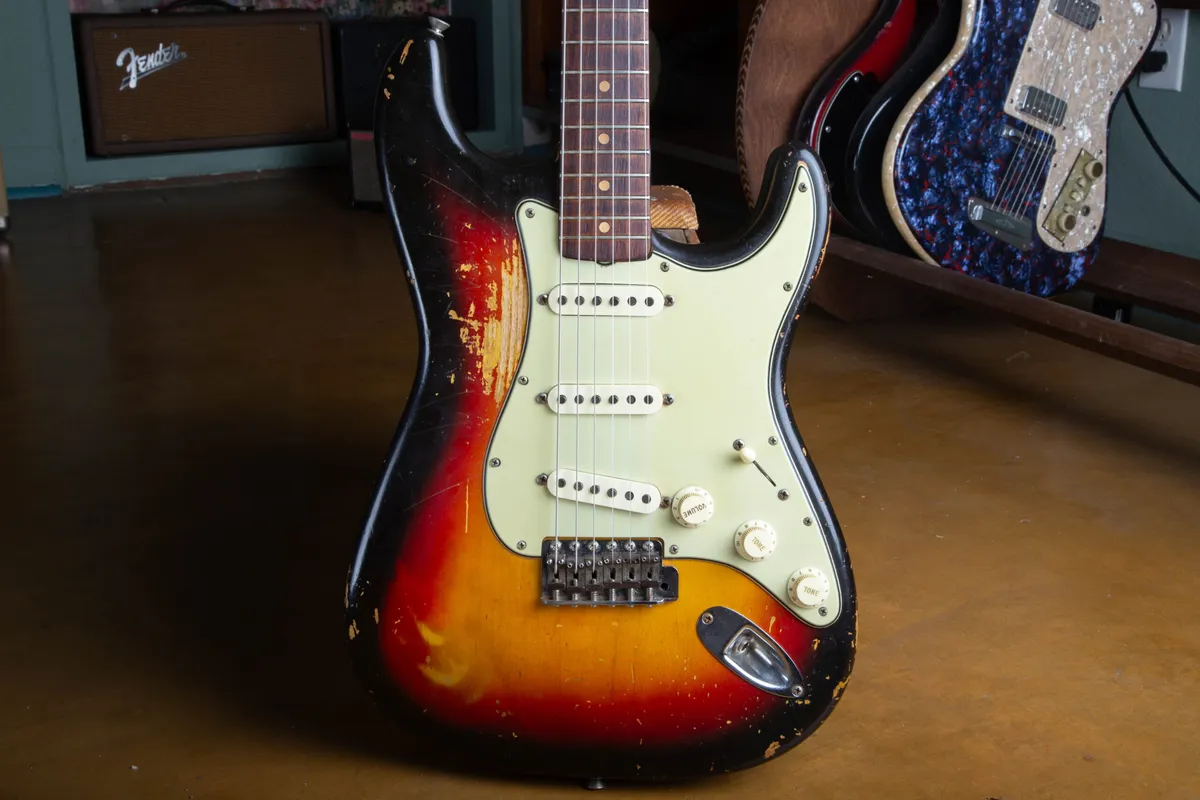
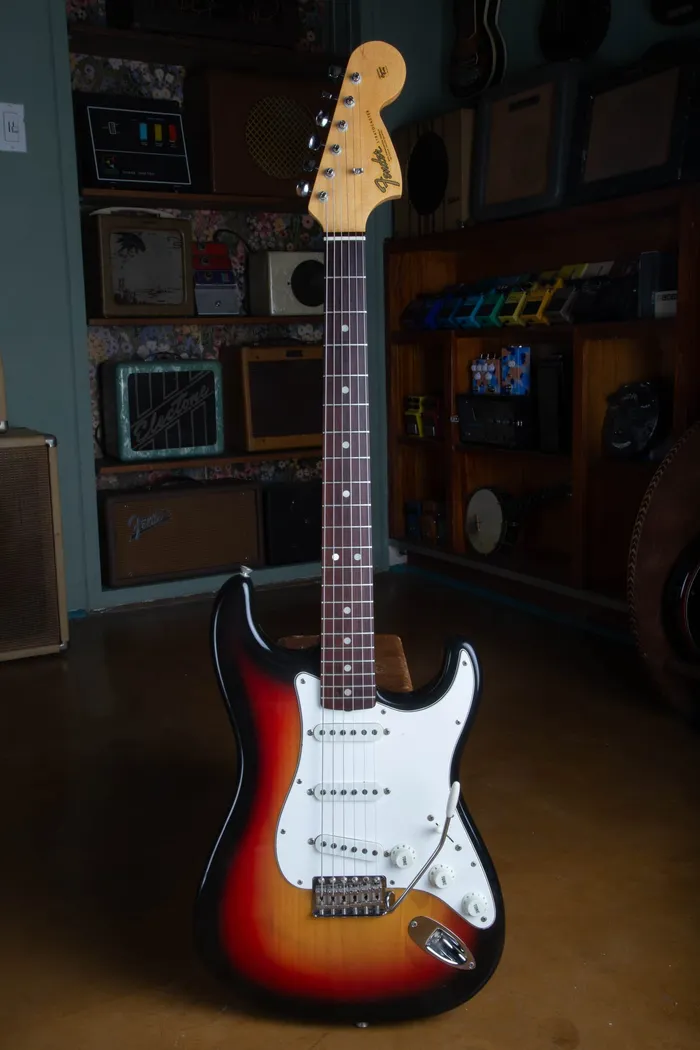
Pre-CBS Strats are why a lot of us got into this business. The ’63s sit in the sweet spot of that era. Fender had the design dialed in by then, and nobody from CBS had walked through the door yet to start cutting corners. They feel different than ’64s and ’65s. They sound different too. When one shows up at the shop with the right paperwork, that’s a good day for me.
What follows is the long version of the conversation I have with sellers when they bring a ’63 in or send me photos. If you’ve inherited one, if you’re looking at buying one, or if you’re trying to figure out whether to sell your vintage Stratocaster, the details below matter. Vintage Strats don’t really have any small details. Every part of the guitar tells you something about whether it is what the seller says it is.
On This Page
- The Trinity: What I Check First
- Under the Hood: Where the Truth Lives
- The Hardware
- The Wood and the Old Finish
- ’63 Weirdness: Three Things Most People Miss
- Custom Colors of 1963
- The Case
- Quick & Dirty: The ’63 Cheat Sheet
- Joe’s Take
The Trinity: What I Check First
There’s a basic order of operations I follow with any Strat someone’s calling a ’63. The case stays mostly shut. The amp stays cold. First thing I want to verify is three internal dates: the serial number on the neck plate, the pot codes in the control cavity, and the date stamp on the neck heel. If all three line up, the guitar earns the next thirty minutes of my time. If they don’t, the conversation goes a different direction.
Serial Number: L-Series (Mostly)
A real 1963 Stratocaster wears an L-series serial on a four-bolt chrome neck plate. The L-series ran from late 1962 into early 1965, so the L by itself doesn’t pin a guitar to a specific year. For ’63 production you’re looking at roughly the L20000s through the L40000s, give or take. Fender wasn’t pulling serials in strict order back then either. I’ve seen two guitars from the same week of ’63 with plates four hundred apart. See our full Fender serial number guide for the complete L-series reference.
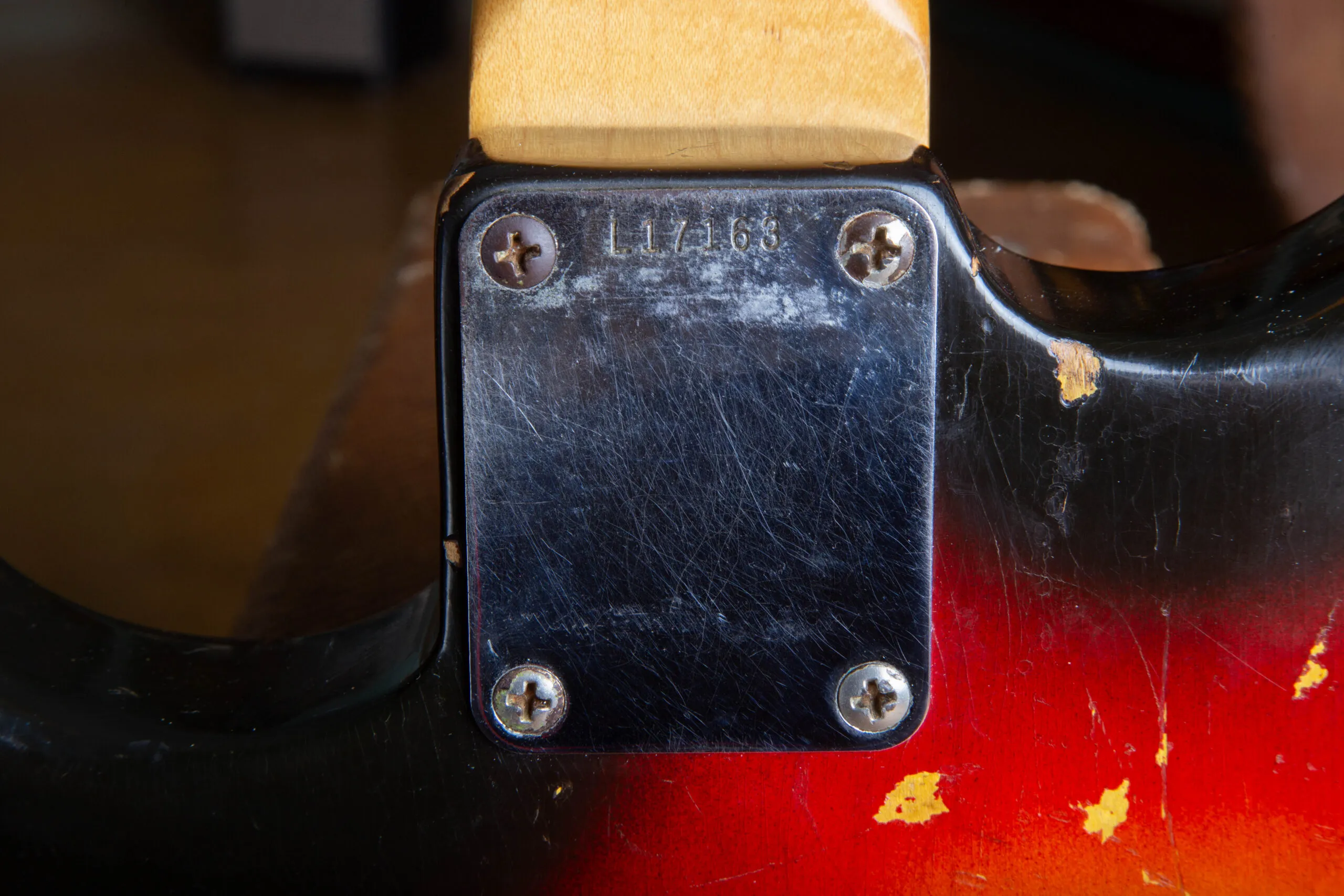
The early ’63 holdover. One quirk to know about. Guitars built in January and very early 1963 sometimes still wear the older six-digit numeric serials in the 80000 or 90000 range, left over from late ’62 production. If you’re holding a Strat with an 80000 or 90000 plate and the pot codes say 1963, don’t assume it’s a misdated ’62. Sometimes it really is an early ’63. Cross-check against the pots before making the call. I see one or two of these come through every year, and the phone call to the seller is always a fun one.
Pot Codes: The One Thing That’s Hard to Fake
Pots are the part of the guitar I trust most when I’m dating it. Three of them sit in the control cavity, one master volume and two tones, all 250k audio taper. Each has a six- or seven-digit code stamped into the side of the metal can. The first three digits tell you who made the pot. 137 is CTS, 304 is Stackpole, 134 is Centralab. The next four digits are year and week.
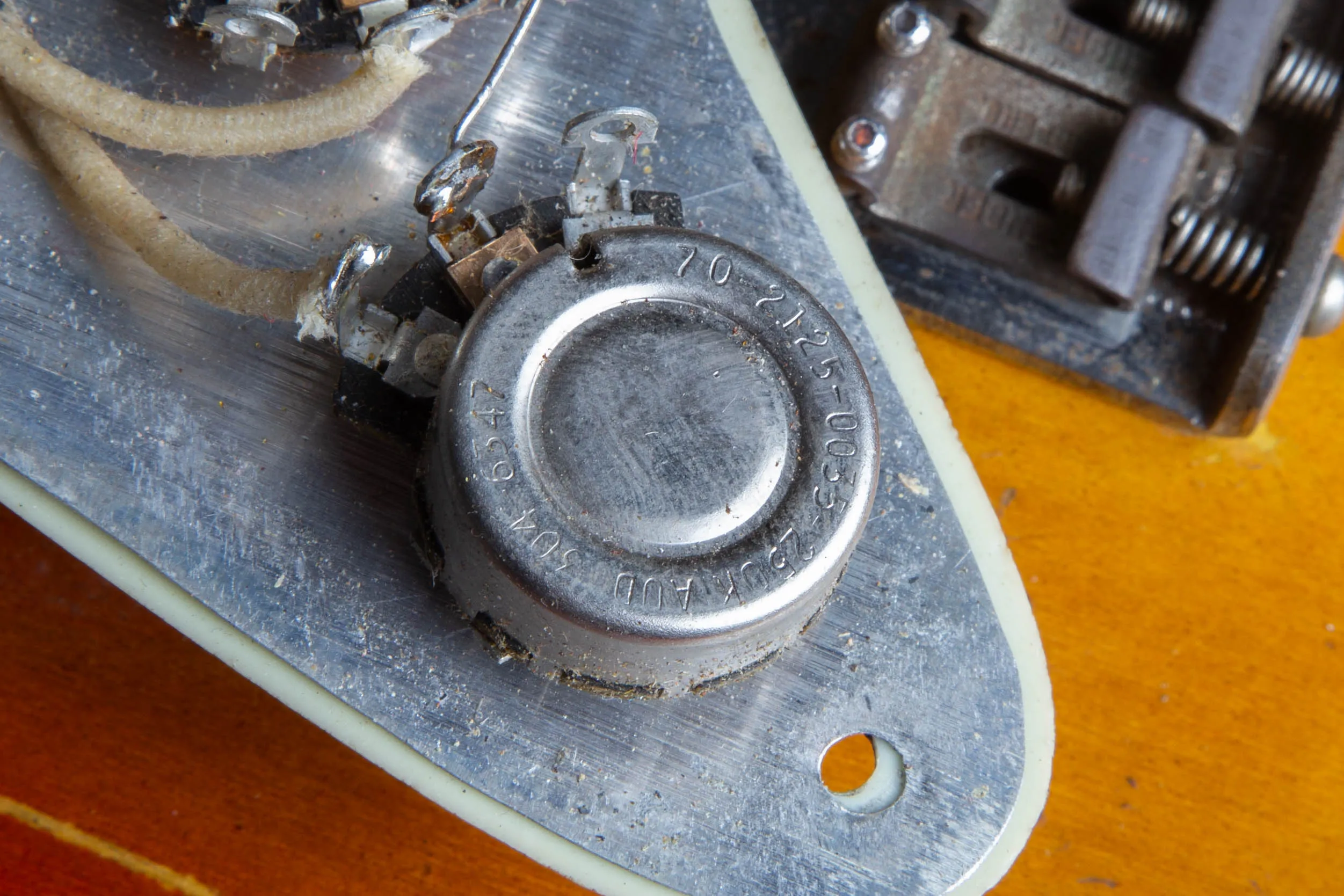
For a real ’63, you want pots dated late 1962 through mid-1963. Most of the ’63 Strats that have come across my bench show pot codes somewhere between week 30 of ’62 and week 35 of ’63. Find a pot dated 1968 or 1972 sitting in there, and you know somebody pulled the originals out.
Neck Heel Stamp
Take the strings off, pull the four neck bolts, lift the neck out of the pocket. On the flat butt of the heel there’s a date stamped in black ink. The format reads something like 2 MAR 63 B. The 2 is Fender’s product code for Stratocaster. MAR 63 is the month and year the neck was finished. The letter at the end is the nut width. B (1 5/8“) is standard. A (1 1/2“) shows up occasionally. C and D were available on order but rare.
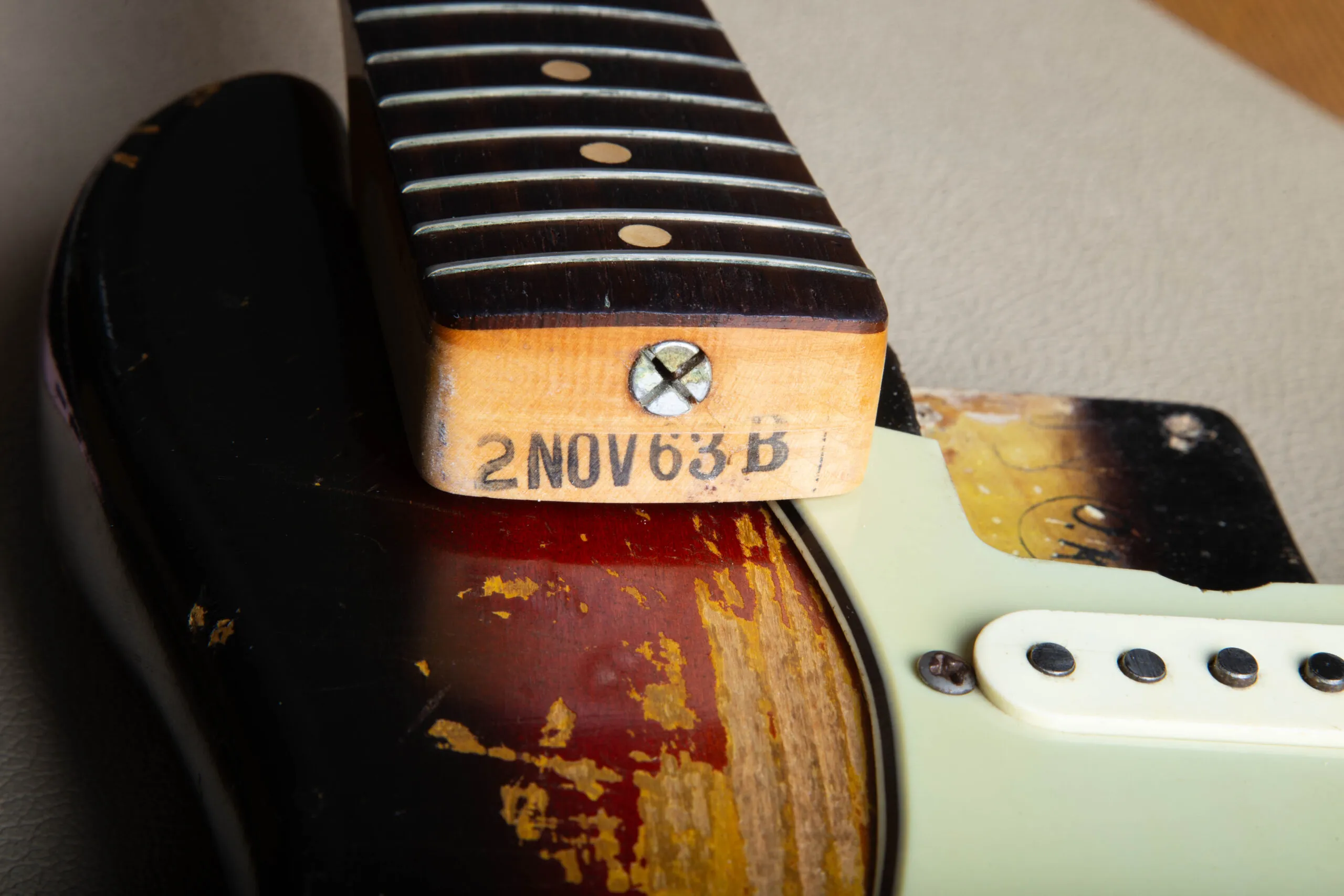
The heel stamp should agree with the pot codes within a few months. Necks were generally finished and assembled within weeks of the pots being stamped. If the heel says March ’63 and the pots say September ’64, somebody bolted the wrong neck to the wrong body.
Body Date: Don’t Panic If It’s Missing
Some ’63 bodies have a date penciled inside the neck pocket or in the bottom of the trem cavity. Plenty of them don’t. Body stamping was inconsistent during this period, and a blank pocket on a genuine ’63 isn’t unusual. The serial, neck stamp, and pots carry the load. Our Fender body date guide covers where the body date hides and why a blank one is not a red flag. If the body date is there and agrees with everything else, great. If it’s missing, that’s not a deal-breaker.
Under the Hood: Where the Truth Lives
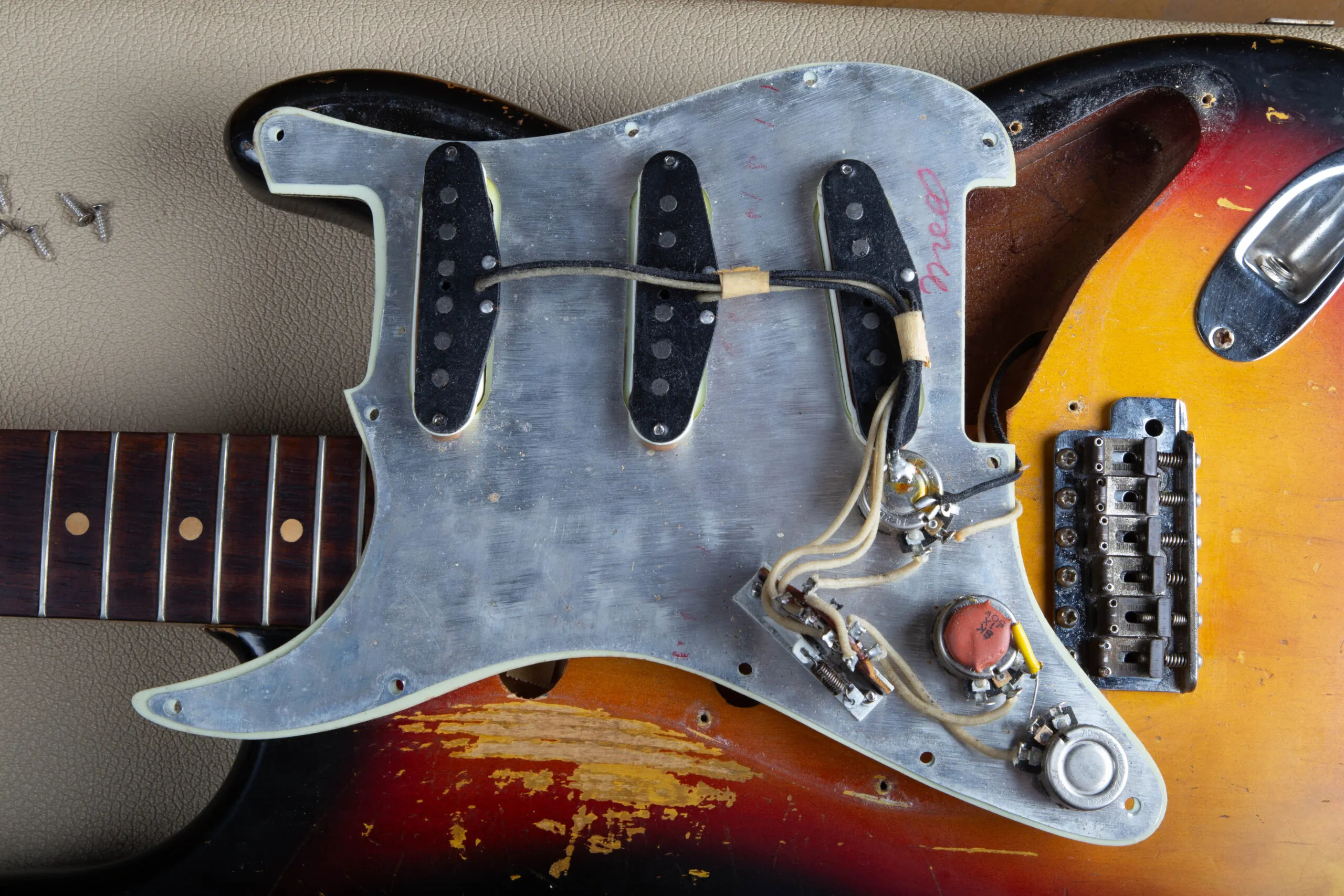
If the trinity checks out, time to pull the pickguard. Slowly. Pickup leads on a sixty-year-old Strat go stiff and brittle, and the cloth insulation will crack if you flex it too hard. Once the guard is off, this is where you find out what you’ve actually got.
Pickups, Cap, and Solder Joints
Pickups in a ’63 Strat are black bobbin. The flatwork at the base is black vulcanized fiberboard, which is what the magnet slugs press through and the wire winds onto. AlNiCo V magnets, staggered pole pieces, formvar-coated copper wire. DC resistance reads somewhere between 6.0 and 6.5k on each one. The cloth-insulated pushback lead is a yellow-and-black braided pair.
An original pickup looks its age. The wax potting is dull and uneven. The leads are stiff. The magnet tips show oxidation, and the black flatwork is actually black, not painted-over. Reproductions are getting better, but they almost always look too clean under a sixty-year-old pickguard.
The tone cap is a small orange ceramic disc, .05 mfd, soldered between the tone pots. The orange disc replaced the older yellow chiclet caps in the early ’60s and stayed on through CBS. Anything else (a blue Mallory, a green Sprague, a paper-and-oil cap somebody pulled out of a Les Paul) is a swap.
Then the solder joints. This is the check I trust most of all. Original Fender solder from ’63 looks its age. Dull. Slightly grey. The joints sit flat and clean on the pot lugs, and after sixty years the flux residue around them is brown and crusty. Reflowed joints look brighter and shinier, even when the repair work was careful. Fresh flux is yellow, not brown. I’ve seen ’63s that look like they got dragged behind a truck still pull top dollar because the solder joints were untouched. The other direction is uglier. I’ve had guys bring in mint-looking Strats that turned out to be $5,000 partscasters because somebody got cute with a soldering iron in the eighties. Even two fresh-looking joints in the cavity will change the conversation.
Nail Holes, Paint Stick Shadow, and the Router Channel
With the guard off, look at the body itself. There should be three or four small nail holes in the wood, each with bare wood inside, no finish. Standard locations are one near the output jack, one near the neck pickup, and one or two near the bridge or down in the bottom of the bridge pickup cavity. These are leftovers from the painting process. Fender drove finishing nails into the body to hold it during spraying, then pulled them out after the finish dried.
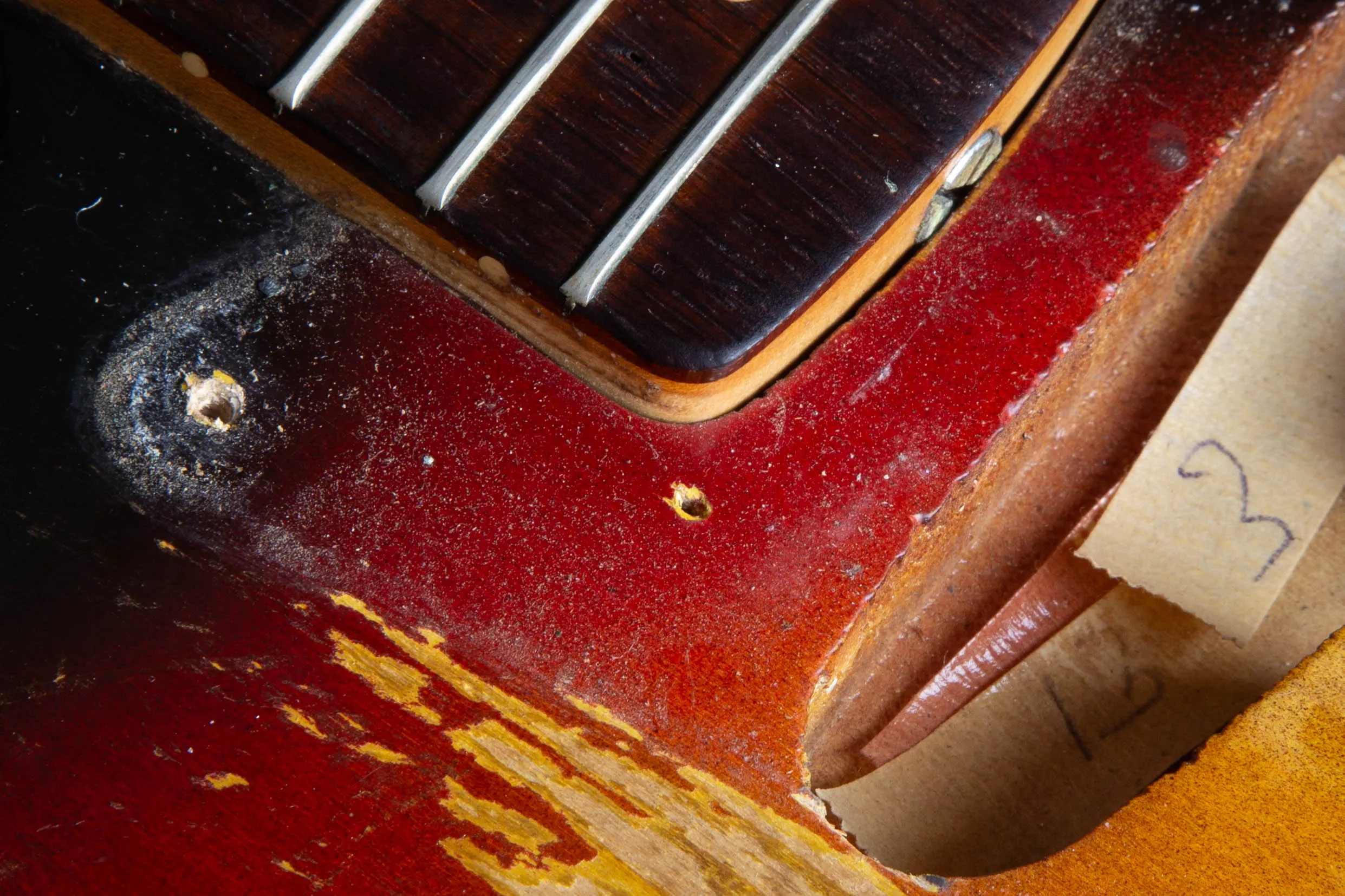
By 1963, Fender had mostly transitioned to the paint stick method, where a wooden rod screwed into the neck pocket so the body could be held during spraying instead of nailed. The paint stick leaves a faint shadow or witness mark in the bottom of the neck pocket where the wood was masked from the finish. So on a real ’63 you might see leftover nail holes from earlier in the year, or a paint stick shadow in the pocket, or both. What you don’t want to see is nail holes with finish inside them, no shadow in the pocket, and no nail holes anywhere. That combination almost always means a refinish.
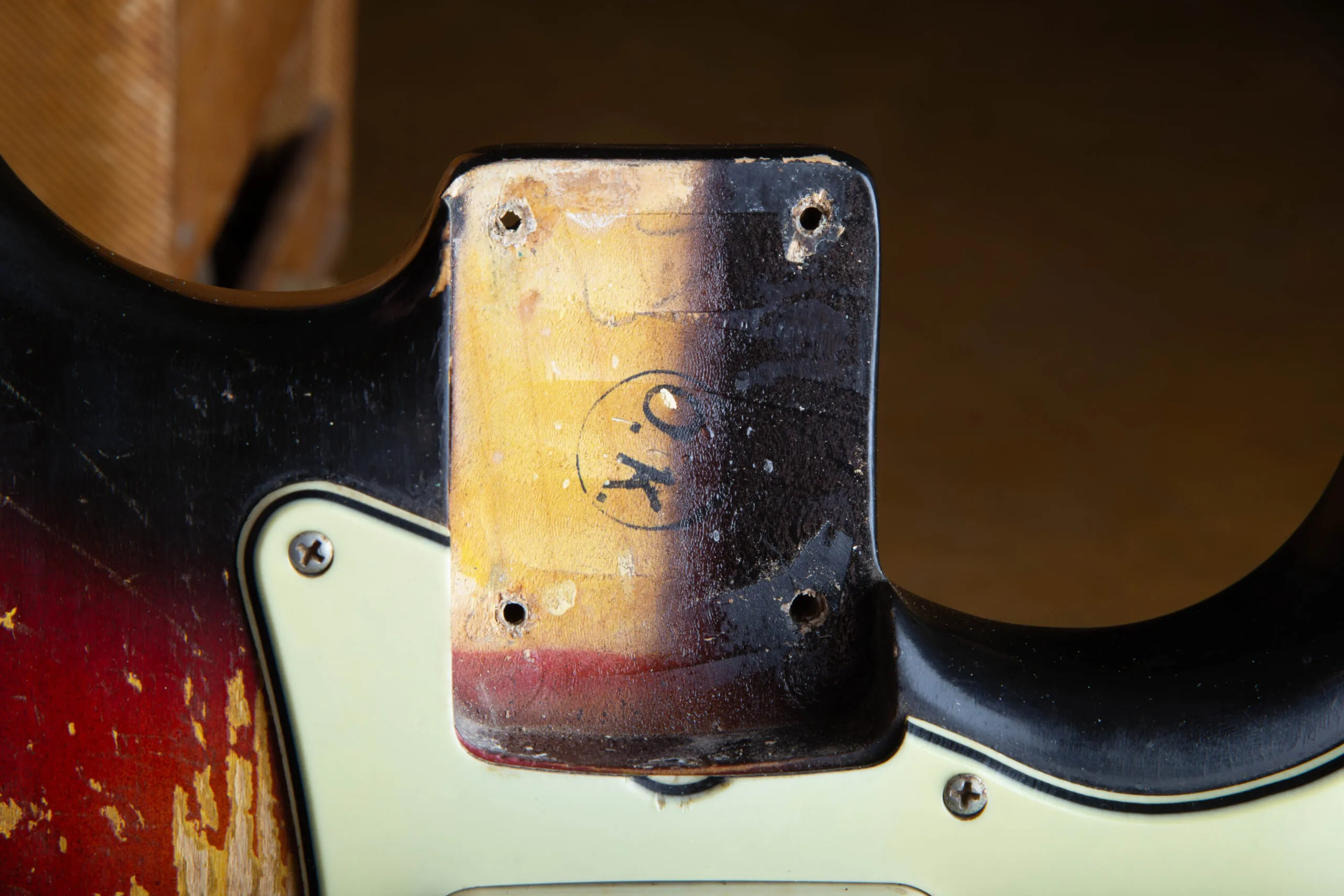
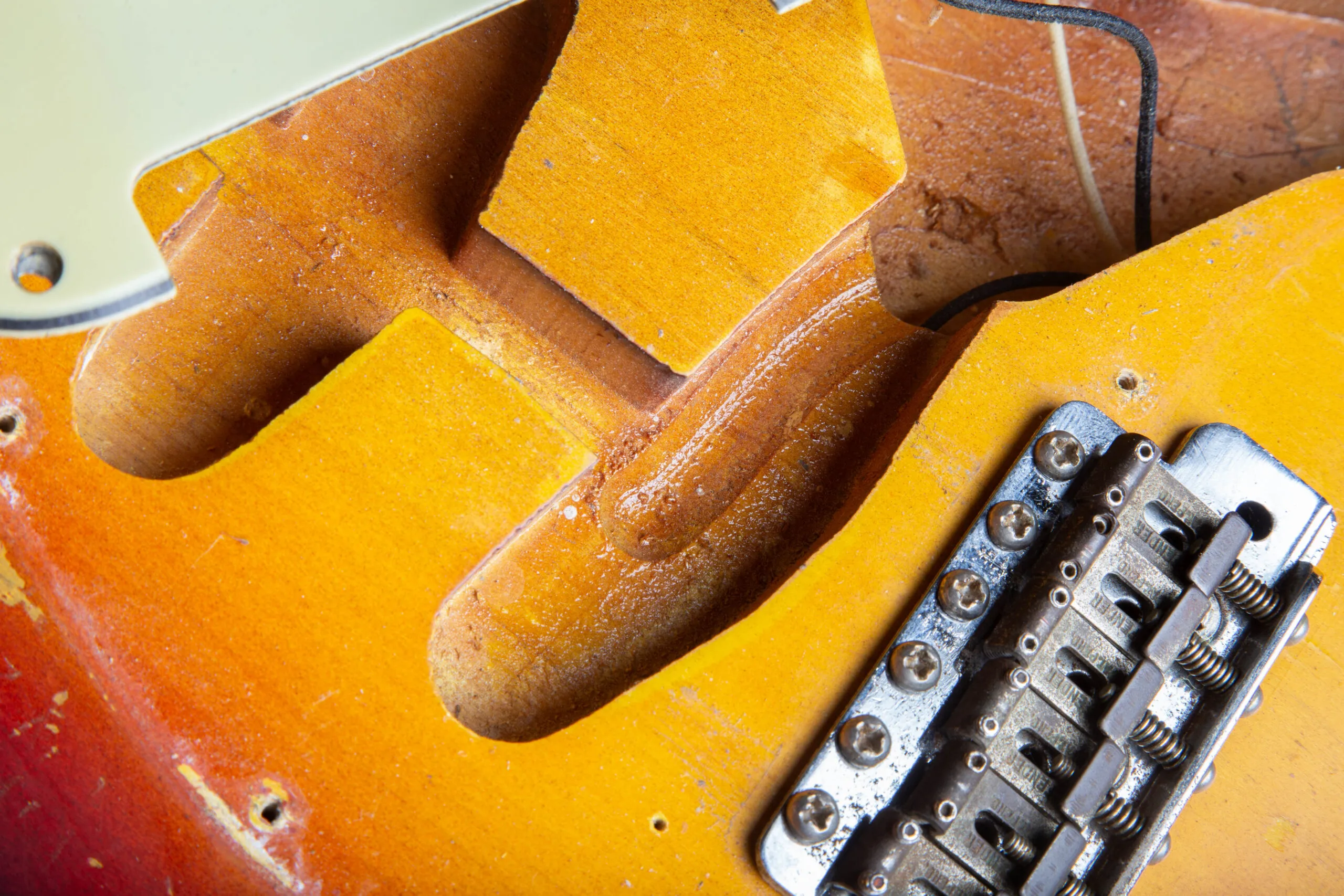
While you’re in there, look at the bottom edges of the bridge pickup cavity. On a factory ’63, the router that cut the cavity left a rough channel with torn-out edges and small wood flakes still hanging off the corners. Fender wasn’t sanding the inside of pickup cavities. They were rough-routed, the body got finished, and the chip-out stayed. If you look in there and the cavity is smooth and rounded over, somebody sanded it. That’s about as clean a refinish tell as you’ll find.
The Puzzle Piece: Neck Plate Meets Shadow
This is one of my favorite authentication checks, and I don’t see it talked about enough in the hobbyist forums or buyer guides. After sixty years bolted to the same body, the neck plate leaves a distinct shadow or witness outline in the finish where its edges sat. The plate itself picks up its own pattern of wear, dings, and oxidation on the back side. When you pull the original neck plate off and lay it down next to the shadow it left in the body, the irregular outline of the plate matches the shadow exactly. The dings, the dents, the slight asymmetry from sixty years of pressure all line up. Like a puzzle piece.
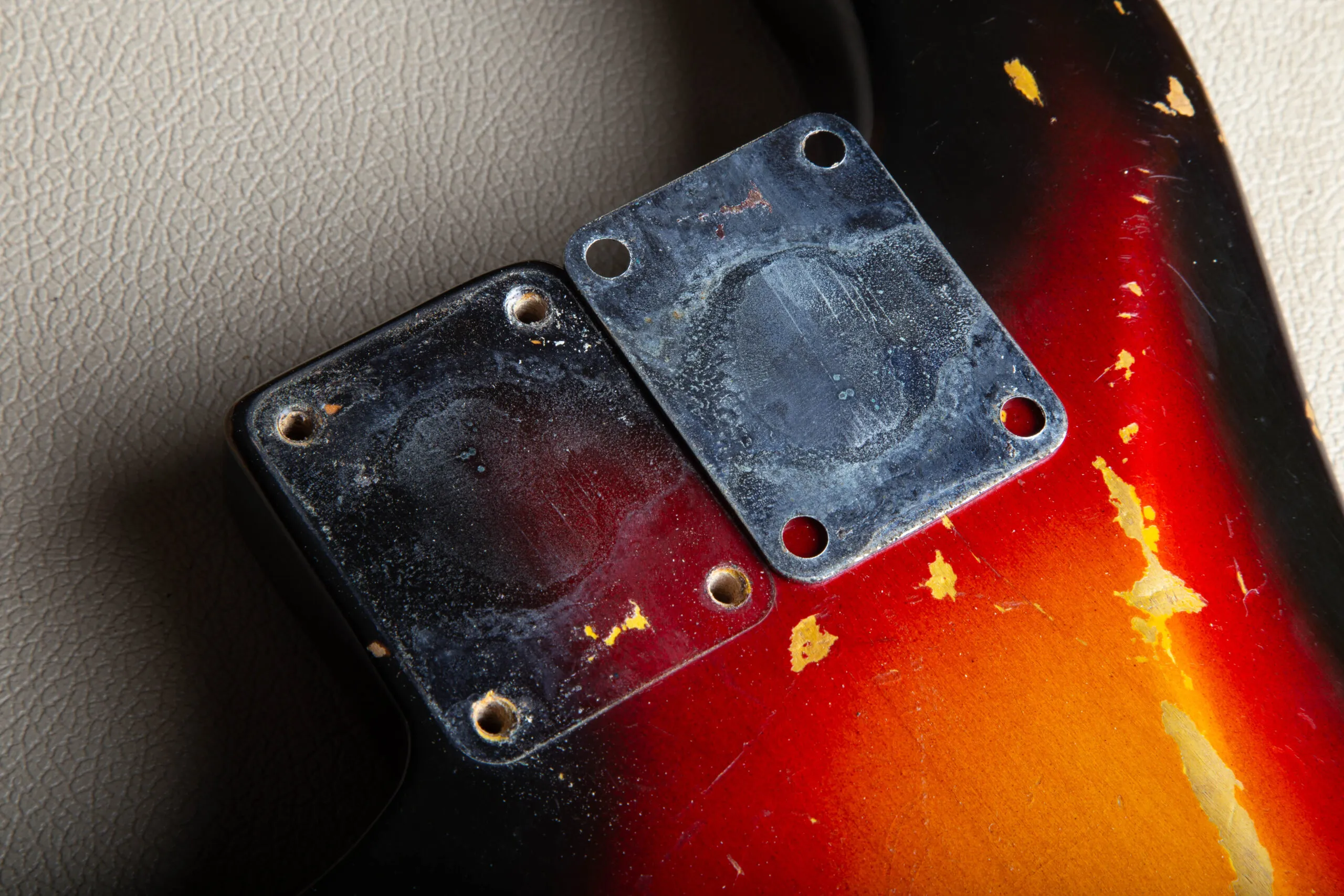
What this check tells you is two things at once. A genuine, untouched ’63 will have a perfect plate-to-shadow match. If the body was refinished at any point, the original shadow is gone (it got sanded out and resprayed over), and the plate sits on fresh-looking finish with no witness mark behind it. If the neck plate was swapped for a different one, the new plate won’t line up with the existing shadow. The outline is off, the proportions don’t match, the corners don’t sit where the shadow says they should.
So this one check verifies two things at the same time. The body has its original finish, and the neck plate has been on this body since the factory floor. Hard to fake. Fast to do. Almost nobody knows to look for it.
The Pickguard and the Shield
1963 pickguards are three-ply nitro, mint green being standard. Tortoise was the standard dress for sunburst and blonde offsets and basses, and on the factory line it was never paired with a custom colour with one exception: Olympic White. A tortoise guard on a Fiesta Red or Lake Placid Blue body means swapped parts until proven otherwise. The “mint green” was actually closer to white when it left the factory in ’63. Sixty years of UV and the natural yellowing of nitro is what turned them the color collectors love now. Original pickguards age uniformly. A swap stands out either as too white (modern repro) or too uniformly aged in a way that doesn’t match the rest of the guitar.
Behind the guard, sandwiched against the body, is a thin aluminum shielding plate. Original Fender aluminum, not copper foil. Copper foil shielding was a popular mod in the seventies and eighties, so seeing copper under the pickguard of a claimed ’63 means somebody added it later.
The shrinkage crack you actually want to see. Nitro guards shrink over time. After sixty-plus years of pulling against rigid mounting screws, you almost always see a small crack at one of the neck pickup mounting screw holes, plus shrinkage pulling around the pot and switch holes. Out here in the Arizona desert those nitro guards shrink even faster, so the neck pickup crack is practically a guarantee on anything that’s spent any real time in this climate. A perfectly intact mint pickguard with no shrinkage anywhere is worth a closer look. There’s a real chance it’s a quality reissue guard, not the original.
The Hardware
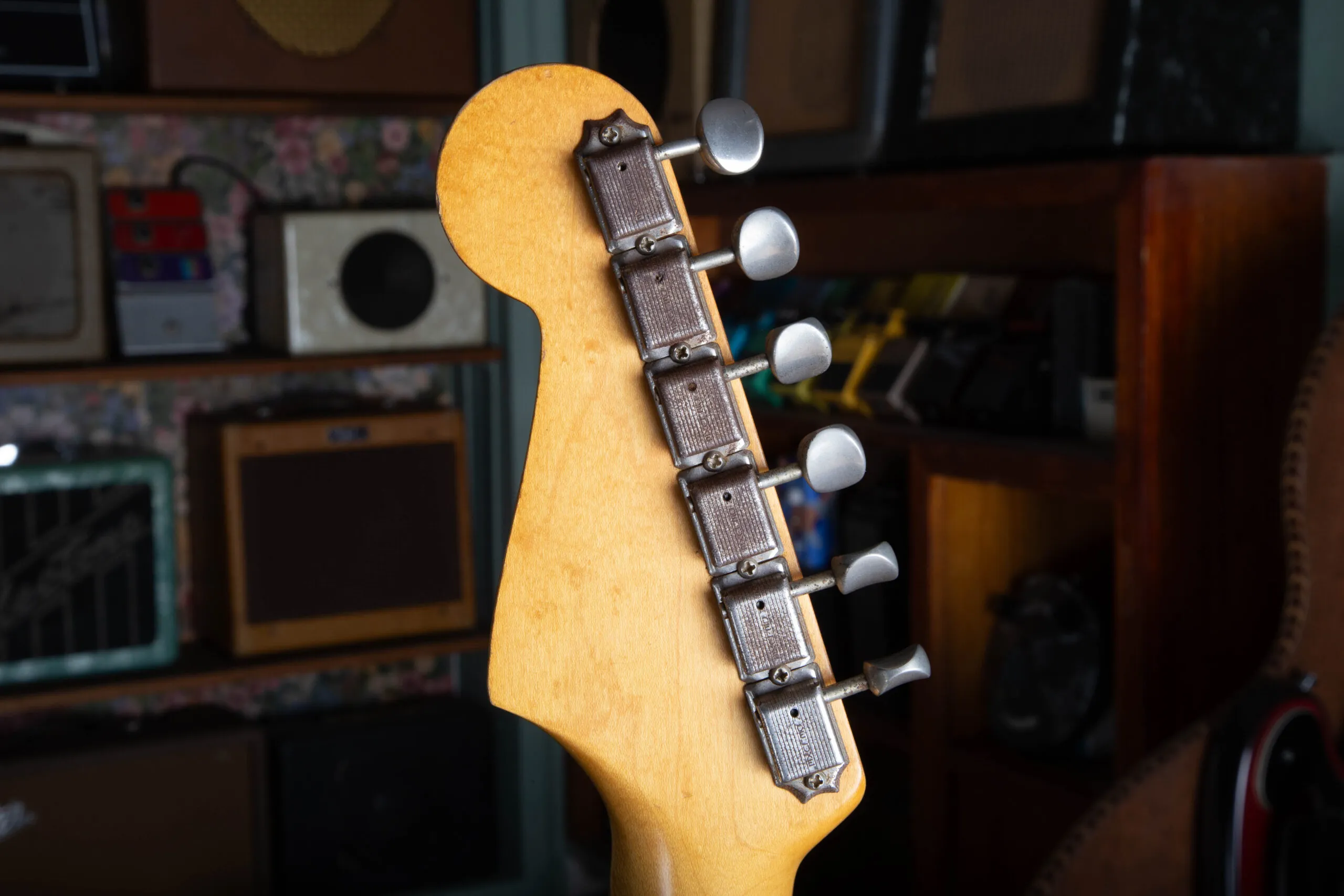
Tuners on a real ’63 are Kluson Deluxe single-line. Six on a side, “KLUSON DELUXE” stamped down the back of each shell in a single line. They have slotted string posts (you push the string straight down into the post) and they wear oval metal buttons. Quick warning here. If you see plastic “tulip” or “double-ring” buttons on a claimed ’63 Strat, those are Gibson-style Kluson buttons or cheap modern replacements. Fender Klusons in 1963 used the metal oval exclusively. The single-line stamping stayed until late 1964, when Fender went to double-line.
Bridge saddles are bent steel, chrome plated, each one stamped FENDER FENDER PAT. PEND. in raised letters. Six saddles total, all stamped. Fender kept this stamping from 1954 right up until 1965, when they finally got the patent and the marking changed to PAT. with a number. On an original set, the wear and oxidation on all six saddles should look like they’ve lived together for sixty years. If five look weathered and one looks suspiciously clean, that’s a tell. Saddles are easy to swap.
The trem block underneath is cold-rolled steel, full-size, with six string-through holes. Three or sometimes five springs run from the block to the claw inside the trem cavity. The trem cover is the same nitro material as the pickguard, with the standard oval cut-out for restringing through the back. Strap buttons are nickel-plated steel. The output jack is the standard cup-style jack mounted in the chrome football-shaped jack plate. None of this hardware should look brand new on a ’63. All of it should wear the same patina as the rest of the guitar.
The Wood and the Old Finish
Brazilian Rosewood
By 1963, every Strat fingerboard was Brazilian rosewood, glued onto a curved-radiused maple neck blank as a thin veneer board. The slab boards of 1959 through mid-1962 were already gone, replaced in July or August of ’62. If somebody hands you a ’63 with a slab board, they handed you a swapped neck. (Curious about the differences between a ’62 and a ’63? The 1962 Stratocaster authentication guide walks through the slab-board era and the other transitional features that separate the two years.)
Brazilian is the real attraction here. It has a tighter, finer grain than the Indian rosewood that replaced it in the late ’60s, with darker overall color and the occasional dark streak running through it. There’s a certain oiliness to a real ’63 board that you just don’t get with Indian. It feels fast under your fingers even when the frets are worn down to the wood. And it has a smell. Especially when you’re refretting one and the rosewood gets warm under the iron, there’s a sweet, slightly fruity perfume to Brazilian that no other wood matches. Once you’ve smelled it, you don’t forget it.
The CITES situation is what it is. Brazilian rosewood has been on CITES Appendix I since 1992, so international shipping requires paperwork, and US-to-US sales are fine but international buyers have hoops to jump through. That scarcity is part of what drives the premium on a pre-CBS Brazilian-board Strat over the Indian-board guitars that came after.
The position markers on the board are clay dots. Not pearl, not plastic, not pearloid. The compound is a clay-and-resin mix with a slightly off-white, almost grey tone, and it ages and yellows in a way reproductions don’t. Genuine clay dots feel slightly porous when you run your thumb across them. Modern reproductions look too clean and too uniform. Clay dots stayed on Strats until pearloid replaced them across the changeover from late 1964 into early 1965.
Spaghetti Logo and the Old Finish
The headstock wears the spaghetti logo. Thin gold script with a black drop shadow, reading “Fender” with “STRATOCASTER” stenciled below. The transition to the bolder Fender logo happened in late 1964, so every ’63 still wears the old script. Below the model name you’ll see three patent numbers: 2,573,254 / 2,741,146 / 2,968,204. The 3,143,028 patent isn’t on Strats yet in ’63.
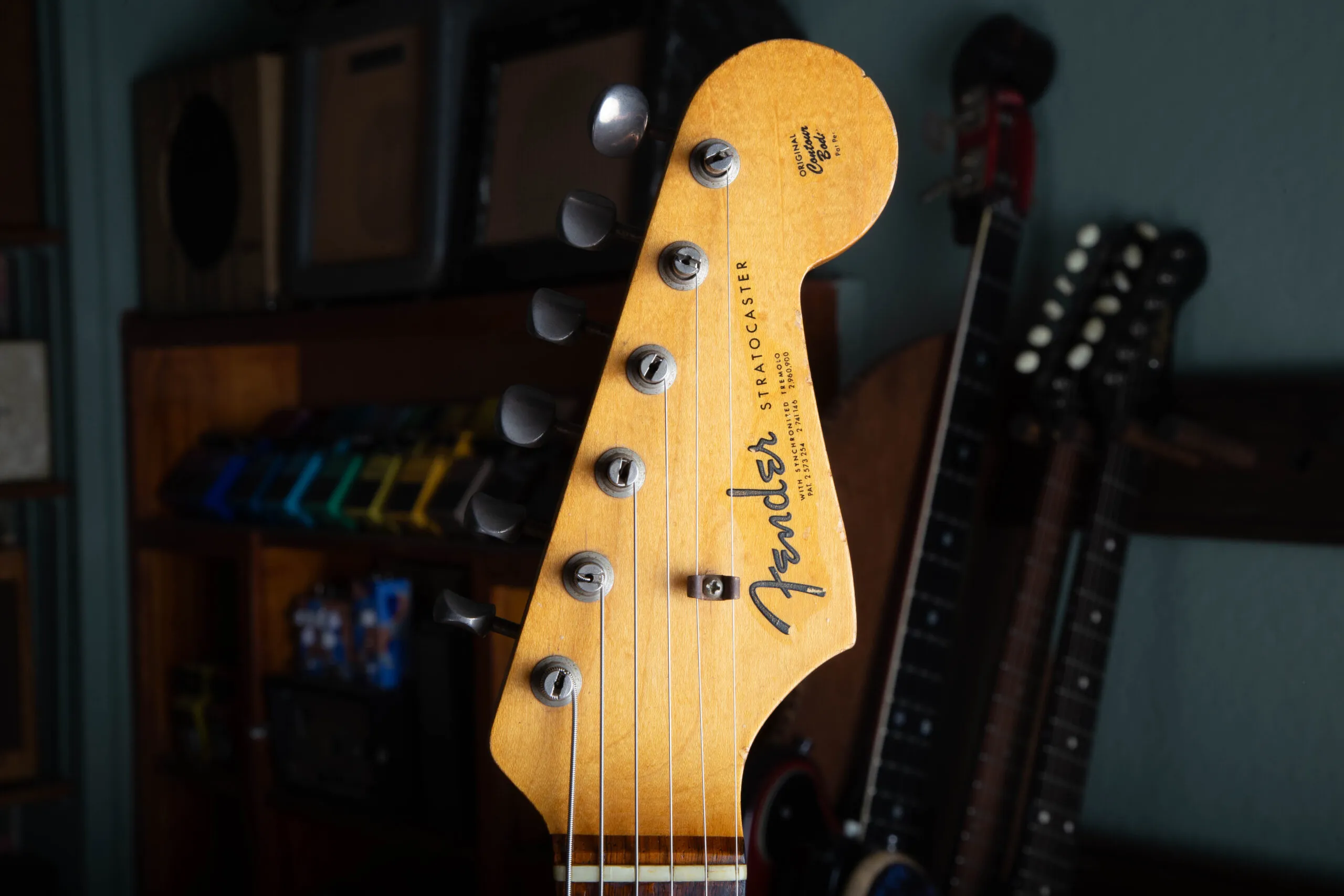
The whole guitar is finished in nitro, which is what Fender used until they switched to polyester and polyurethane in the late ’60s. Real ’63 nitro checks. Hairline cracks in the finish from sixty years of expansion and contraction in different climates. The checking should look natural and follow the wood grain in places. If the finish is glassy and uncracked on a claimed ’63, you’re looking at a refinish or a reissue.
'63 Weirdness: Three Things Most People Miss
A few less obvious details before we get to the cosmetic stuff. These are the ones that catch fakes, partscasters, and replacement necks that walk past a casual inspection.
The 12th Fret Dot Spacing
1963 is the year Fender started moving the two clay dots at the 12th fret closer together. Early ’63 boards still have the older “wide” spacing, with the dots positioned over the outer strings. Sometime in ’63, Fender pulled them inward to “narrow” spacing. Both are correct for 1963, depending on when in the year the neck was made. I’ve had sellers convinced their ’63 was a fake because the dots looked different from a reference photo they pulled off the internet. It’s not a fake. It’s just from a different month of ’63.
The Tapered Headstock
This one catches a lot of replacement necks. Look at the headstock from the side, in profile. A real ’63 Fender headstock gets thinner as it moves toward the tip. The thickness at the nut end is noticeably greater than the thickness at the very top above the tuners. Most modern aftermarket and reissue necks are cut with uniform thickness from base to tip. Sight down the side of a claimed ’63 headstock and if it looks like a slab with parallel top and bottom edges, you’re holding a replacement neck. Even if the rest of the guitar looks right.
The Pre-L Holdover
Mentioned this in the serial section, but it’s worth saying twice. Some January and February 1963 production guitars still carry the older 80000 and 90000 numeric serials. If you wrote off a Strat as a ’62 because the serial wasn’t an L, the pot codes might tell a different story. People bring in what they think are ’62s all the time and walk out knowing they actually had a ’63. If your guitar genuinely is a ’62, the 1962 Stratocaster authentication guide covers the transitional features (slab board, ’62-only neck profile, earlier hardware) that distinguish a real ’62 from a ’63.
Custom Colors of 1963
By 1963 Fender’s custom color program had been running for seven years and was firmly established. The 1963 chart offered fourteen DuPont automotive colors, most lifted directly from Cadillac, Buick, Pontiac, and Chevrolet paint codes. A genuine custom-color ’63 in original finish is one of the most collectable vintage Fenders you’ll come across.
Buyers tend to pay the most for Shoreline Gold and Burgundy Mist (both fade so dramatically with UV that very few survive looking anything close to original), then Sherwood Green, Foam Green, and Surf Green, then the blues (Sonic, Daphne, Lake Placid). Olympic White and standard sunburst sit at the more affordable end of “custom” pricing, though even those carry a healthy bump over a refinished example.
Several of these colors changed dramatically over sixty years of UV exposure. Burgundy Mist often fades to a brownish-pink. Shoreline Gold turns greenish. Surf Green can fade nearly to a pale yellow. None of that is bad. It’s expected. But it does mean evaluating an original custom color often means looking at the parts of the body that didn’t see sun (under the pickguard, in the neck pocket, behind the trem cover) to see what color the body actually started as.
The Case
1963 Strats shipped in one of two cases depending on color choice and timing: a white Tolex case or a brown Tolex case, both with the same orange plush lining inside. White Tolex was typically paired with custom-color guitars (it was an upgrade option), while brown Tolex was the standard case for sunburst Strats. Either one is correct for a ’63.
Original cases are worth real money on their own, sometimes $1,500 to $3,000 depending on era and condition. Latches should match across the case (typically two clasp latches with a center key lock), the orange plush lining should be the right color (not red, not pink), and the handle should be original leather, not a replacement strap. The Tolex itself should show appropriate wear and aging for sixty years of use, especially on the corners where the case takes the most abuse.
Quick & Dirty: The '63 Cheat Sheet
Short version. The must-haves for a clean original ’63 Stratocaster:
- L-series serial on the neck plate (or rare 80000/90000 holdover for very early ’63)
- Pot codes dating late 1962 through mid 1963 (CTS 137, Stackpole 304, or Centralab 134)
- Black ink heel stamp agreeing with the pot codes
- Curved Brazilian rosewood fingerboard (no slab boards on ’63s)
- Clay dots, with either wide or narrow 12th fret spacing depending on month
- Spaghetti logo with three patent numbers underneath
- Headstock that tapers thinner toward the tip when viewed from the side
- Kluson Deluxe single-line tuners with oval metal buttons (no plastic tulips)
- Black bobbin pickups reading 6.0 to 6.5k, formvar wire, AlNiCo V staggered magnets
- Orange ceramic disc tone cap, .05 mfd
- FENDER FENDER PAT. PEND. stamped saddles, all six matching
- Three-ply mint green nitro pickguard, with shrinkage cracks at the neck pickup screw
- Aluminum shield plate behind the guard, not copper foil
- Three or four nail holes in the body with bare wood inside, plus or instead of a paint stick shadow in the neck pocket
- Rough router channel in the bridge pickup cavity with wood flakes still on the edges
- Aged solder joints with brown flux residue, no fresh-looking blobs
- Neck plate that puzzle-pieces into the shadow it left in the finish
- White or brown Tolex case with orange plush interior
All of those check out, you’ve got a clean ’63. Missing one or two of the cosmetic ones is normal. Plenty of original guitars don’t show every single sign. Missing several of the structural ones, like the solder joints or the nail holes or the router channel or the finish evidence, that’s where the conversation gets harder for me.
Joe's Take
The ’63 Stratocaster is one of the most counterfeited and partscaster-prone guitars in the entire vintage market. The money’s there. The parts have been reproduced for decades. There are guys out there who are very good at building convincing fakes. What protects you is knowing what to look for. And being willing to walk away if something doesn’t add up.
If you’re holding an L-series neck plate and aren’t sure if you’ve got a ’63 or a ’64, just text me a photo of the neck heel. I can usually tell you what you’re holding in five minutes. From there we can talk about photos of the cavities, the pots, and the body. We buy nationwide. Shipping is on us. And I’ll tell you straight what your guitar is worth before any money changes hands.
Call 602-900-6635 or reach me through the sell my guitar page. Free vintage guitar appraisals if you’d rather just find out what you’ve got. And if you want to read more about dating Fenders, the full Fender serial number guide goes deeper into the L-series and the cross-referencing process.