

The Starfire Family · Hoboken And Westerly Production
Guild Starfire Authentication Guide
Distinguish I through VI, XII and bass models, then read the serial system and factory evidence that apply to the actual instrument.
Starfire is a Guild family name, not a single specification. A model numeral can distinguish pickup count, tailpiece equipment, body construction or trim. The twelve-string and bass versions need their own comparisons. Read the complete designation before choosing a serial chart or deciding that a part is wrong. This guide covers the Hoboken and Westerly instruments, including later Westerly revivals where the name returned. Imported Newark St. guitars are outside that production scope. After the identity and condition are established, the Starfire value guide separates the model and period estimates.
Authenticity And Originality Are Assessed From The Information Provided. A Hands-On Inspection Can Change The Conclusion.
What The Numeral Changes
Sort The Starfire Family
| Model | Body And Equipment | Identification Caution |
|---|---|---|
| I | Single cutaway, one pickup | Later Starfire I series names describe different instruments |
| II | Single cutaway, two pickups, fixed harp-style tailpiece | An added vibrato does not establish factory III identity |
| III | Single cutaway, two pickups, vibrato | Check label, tailpiece installation and period pickups |
| IV | Double cutaway, two pickups, fixed tailpiece | Later bridge, inlay and control revisions need their own comparison |
| V | Double cutaway, vibrato and master-volume equipment | Use the period specification rather than trim alone |
| VI | Deluxe double cutaway with ornate appointments | The 1966 catalog lists ebony board and gold hardware |
| XII | Double cutaway, twelve strings | Check the complete DC-prefix model record where applicable |
| Bass And Bass II | Four-string bass branches with one or two pickups | Do not confuse the designation with the six-string II |
Guild’s 1960 catalog separates a one-pickup Starfire from the two-pickup versions and lists a vibrato option on the latter. The 1966 catalog shows the enlarged family, including IV, V, VI, XII and the bass. Compare the catalog for the period you are investigating, rather than treating the later lineup as the specification for every earlier instrument.
Body construction adds another distinction. The original I through III are thin hollowbody designs; the IV belongs to the double-cutaway semi-hollow comparison. A view through an f-hole and a documented model record can help establish the internal structure. Don't infer the entire interior from a shared outline or from the presence of two pickups.
The Starfire’s Expanding Family
From Hoboken Hollowbodies To Westerly Variants
The Early Single-Cutaway Line
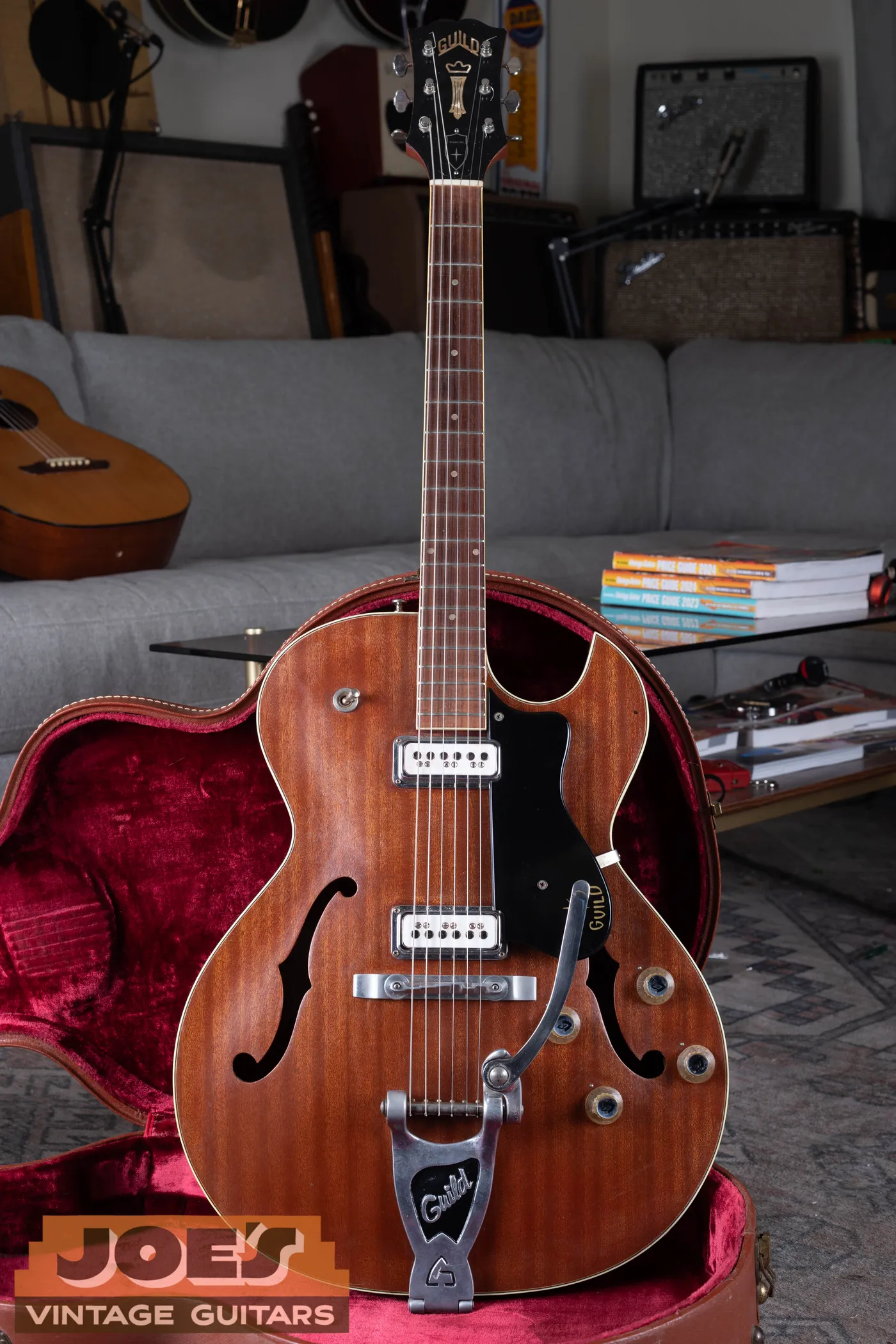
The 1960 Guild catalog introduces the Starfire as a thin hollowbody, with single- and double-pickup versions and vibrato options. The early III in Joe’s archive illustrates that single-cutaway family. Its complete body and tailpiece tell you more about its basic configuration than a close-up of a Guild headstock.
More Models Before And After The Move
The 1966 catalog groups the hollowbody II and III with the double-cutaway IV, V and VI, the XII and the bass. Those model differences already existed before the Westerly move. A Roman numeral should be read as a configuration, not as shorthand for a factory or decade.
Hoboken, Westerly And Later Revivals
Follow The Production And Serial Changes
The First Starfire Models
Period Guild material documents the original single-cutaway family. Early Starfire III inspections show DeArmond single coils, with changes in binding and vibrato equipment through the first years.
The Family Expands
The double-cutaway models and XII broadened the line. By the 1966 catalog, Guild described compact Anti-Hum pickups across the guitar family and presented the bass alongside the six- and twelve-string versions.
The Westerly Relocation
Guild’s history places its Rhode Island relocation in 1967. A Hoboken address can survive on a label after that date. The address alone should not override a model-specific serial reading.
New Sequences And Revised Hardware
Guild returned to a shared numeric system in 1970, followed by later model records. Westerly Starfires also changed pickups, bridges, fingerboard appointments and controls. Revival models in the 1990s need their own specifications.
Joe’s factory-era guide also explains the late-2001 Corona transition and nearly completed Westerly kits. Don't claim that every guitar with an old label was entirely built in the printed city. If an instrument falls near that transition, retain the label, serial and paperwork without forcing a precise assembly-location conclusion.
Inspect The Installation
DeArmond, Anti-Hum And HB-1 Pickups
The early Starfire III archive guitar shows DeArmond-style single coils, which have individual adjustable magnetic poles in a distinct housing. They should not be grouped with Guild’s broad plastic-covered Franz pickups simply because both are single coils. Documented 1961 and 1962 Starfire III inspections provide model-specific comparisons.
The compact Guild Anti-Hum humbucker appears in the 1966 manufacturer catalog. Later larger HB-1 humbuckers require a different comparison. Joe’s pickup and hardware reference keeps these families separate and explains why a modern LB-1 name doesn't date a vintage guitar.
Bridge And Tailpiece Changes
Early Starfire III examples used Bigsby equipment, including Guild-branded assemblies. Compare the hinge, bridge base and mounting evidence with the label. A II fitted later with a vibrato can look like a III until the model field and installation are examined together.
On the Westerly IV, documented research distinguishes an early-1970s floating Hagstrom bridge from a later Muller bridge mounted on body studs. Those are different mounting systems. The approximate change dates shouldn't be treated as a universal cutoff for every Starfire model.
Controls, Inlays And Tuners
Westerly IV research also records changes among dot and block markers, master-volume layouts and tuner types. A single detail may span several years or recur. Use the pattern of equipment, then check for replacement footprints and repair documentation.
A tuner button can be changed independently of its housing. Photograph the maker marks, screw arrangement and front bushings. The absence of extra holes doesn't prove an untouched installation if replacement equipment uses the same footprint.
For basses, compare the actual pickup family rather than transferring the six-string chronology. Early Bi-Sonic-style units and later humbucking equipment belong to different configurations, and modern replacements revisit earlier designs. If a pickup has already been removed during service, retain those photographs; otherwise a first review can begin with exterior views.
| Model And Approximate Period | Observed Change |
|---|---|
| Starfire III, 1962 | The 1962 study records three-ply top binding, a bound back and removal of the three-screw switch plate; it identifies 1962 as the last regular III year for DeArmond pickups |
| Starfire IV, 1970 To 1971 | Hagstrom bridge on a floating rosewood base |
| Starfire IV, About 1971 Onward | Muller bridge mounted on body studs |
| Starfire IV, 1973 | Block markers and master volume appear in the recorded feature sequence |
| Starfire IV, About 1981 | Ebony board with dots and stop tailpiece enter the comparison |
The firsthand feature survey warns that dates are approximate and exceptions exist. These IV details do not date a III, XII or bass.
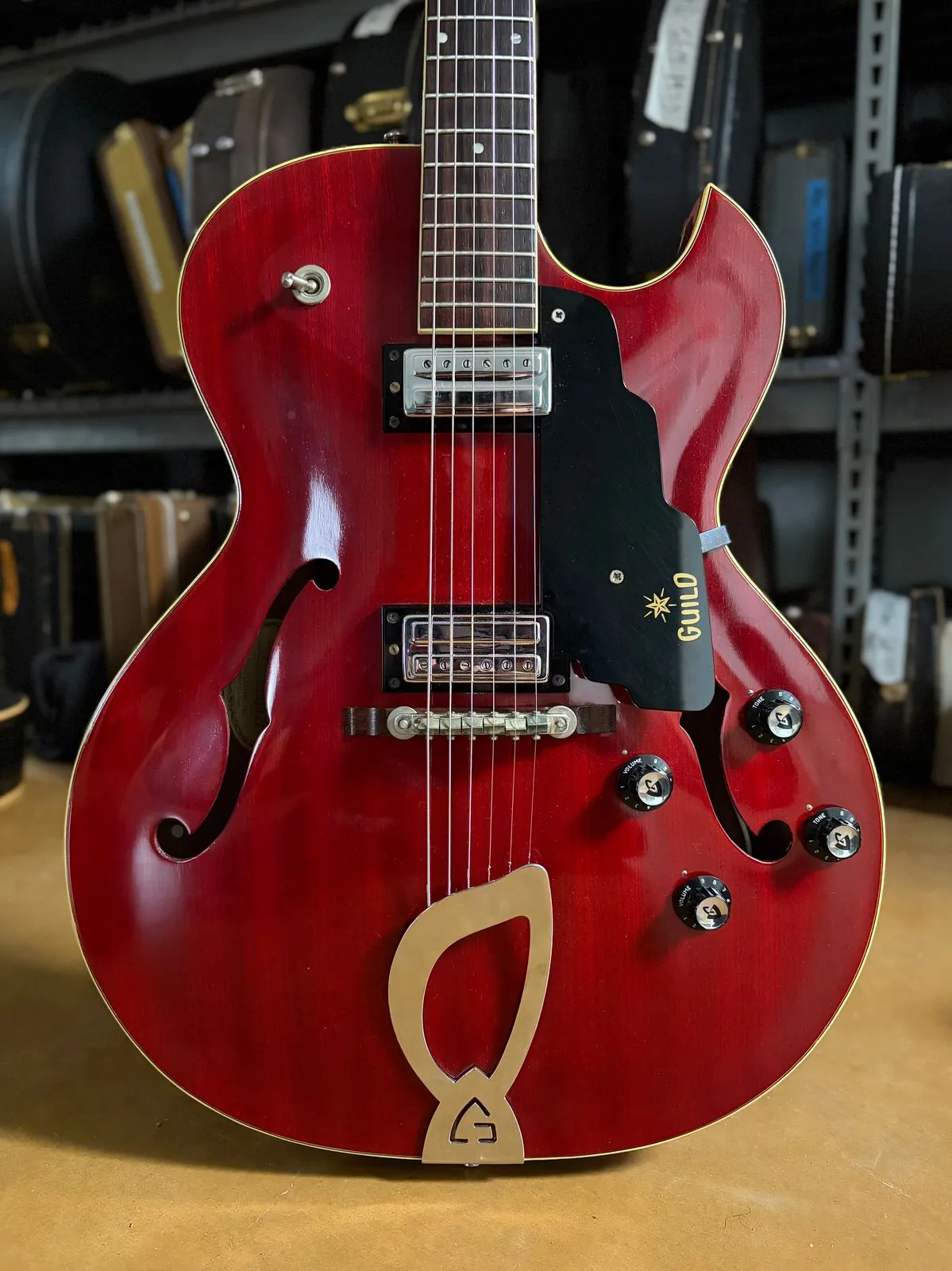
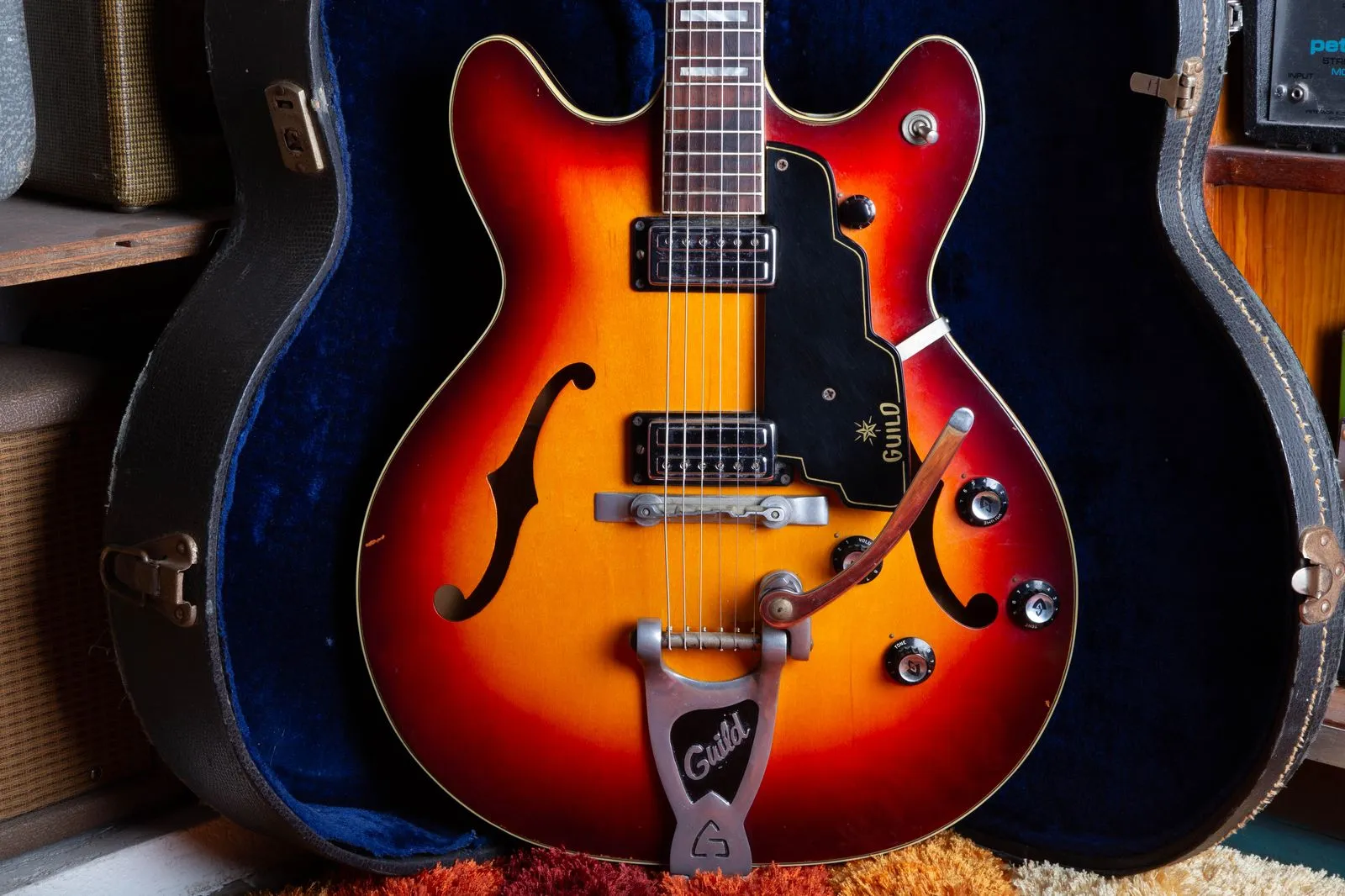
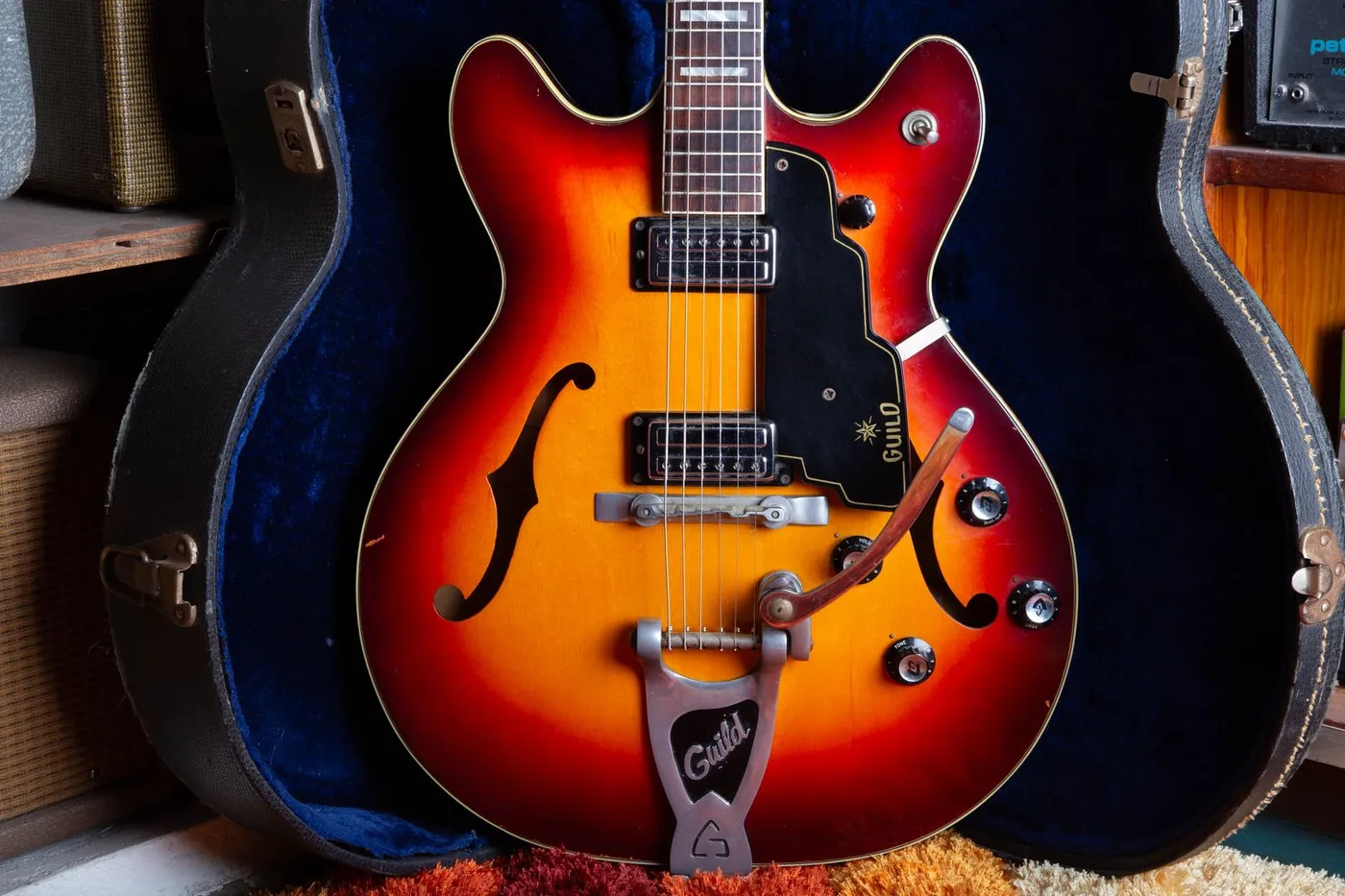
One cutaway and a harp tailpiece on the 1964 II; two cutaways and a Bigsby on the 1966 V. Keep the model distinctions visible in every photo set.
The Model Families
Choose A Starfire Configuration Before Dating
I, II And III
These single-cutaway hollowbody configurations differ in pickup count and tailpiece. The III’s vibrato must be inspected with the body and mounting history; a later-added vibrato does not rename a II.
IV, V And VI
The double-cutaway semi-hollow family uses different appointments and controls. The 1966 VI catalog specifies ebony, elaborate markers and gold hardware. Record those together rather than identifying a VI by gold plating alone.
XII And Starfire Basses
A XII’s twelve-string neck and the bass models’ string length require separate checks. Photograph all tuners, bridge saddles and pickups, and use the correct serial table and model specification.
Photo Timeline
Five Starfire Examples In Joe’s Archive
Early 1960s · Starfire III
Single Cutaway And DeArmond Equipment
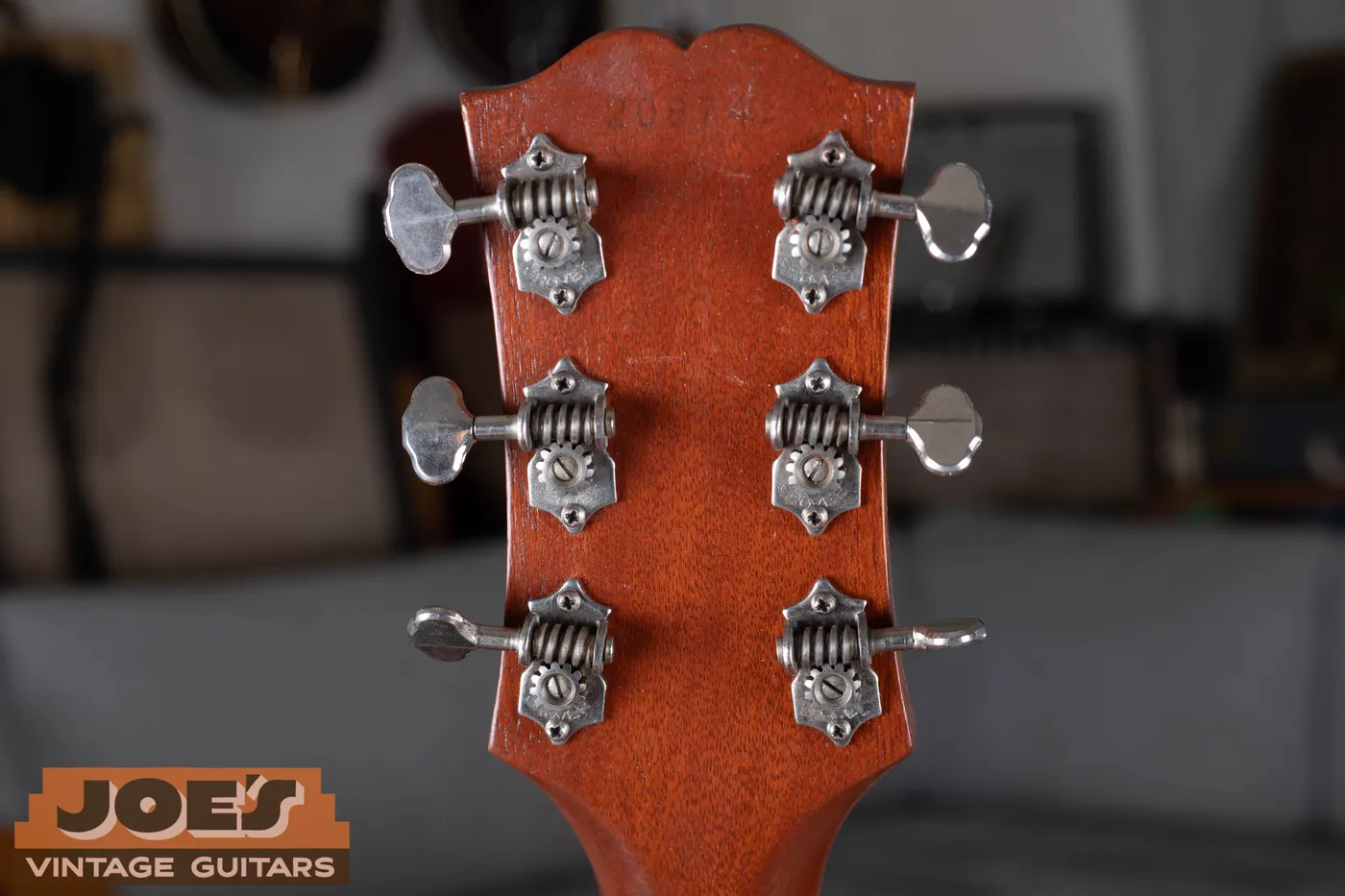
The III set shows a single-cutaway body, two pickups and a Guild-branded vibrato. The rear-headstock photo documents the tuners but doesn't provide a readable serial in that frame.
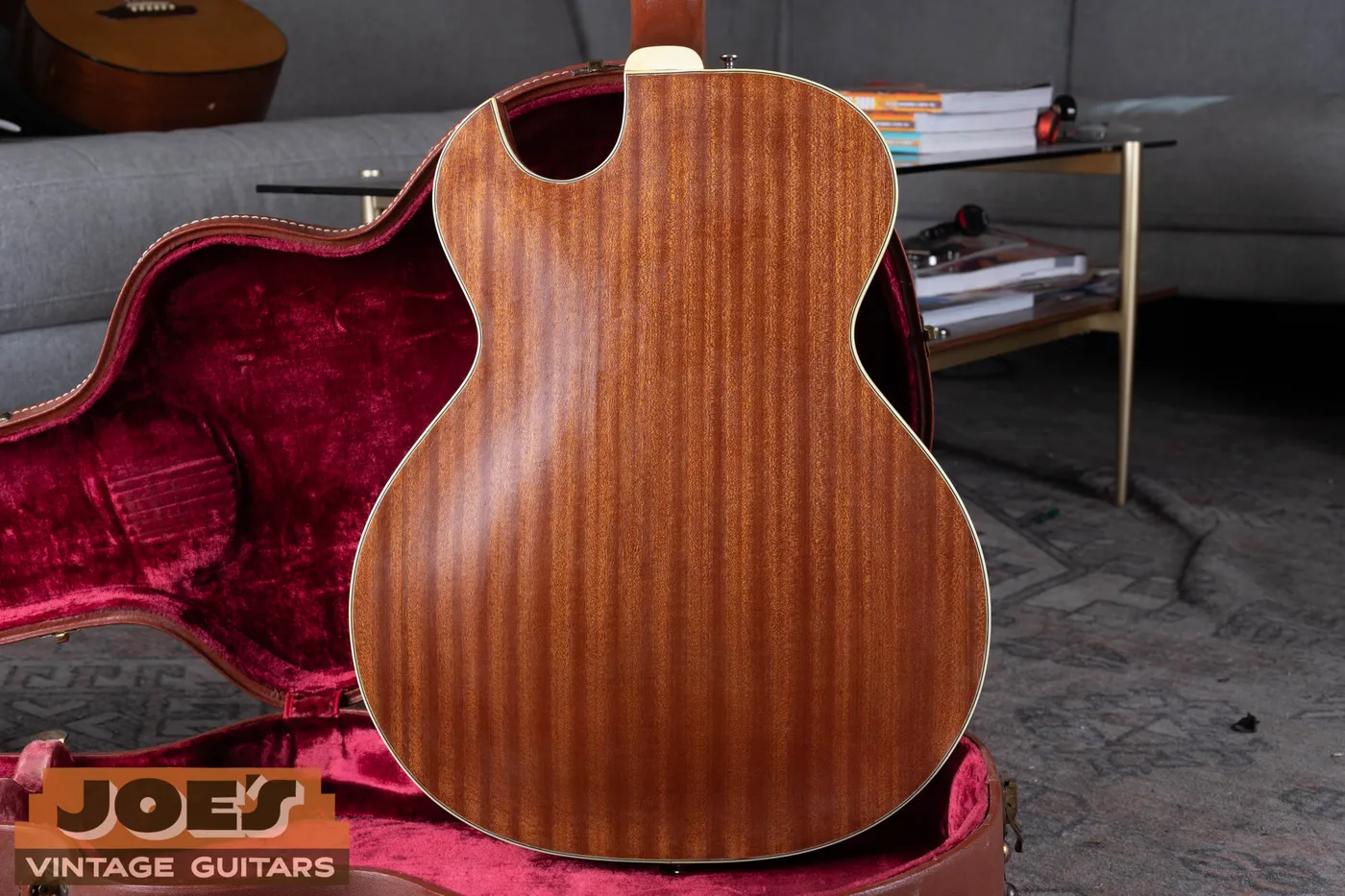
The finish is recorded as it appears. A natural-looking or faded color isn't proof of a factory finish specification. More evidence is needed before using a color name as an originality claim.
1964 Guild Starfire II
Single Cutaway, Two Humbuckers And A Harp Tailpiece
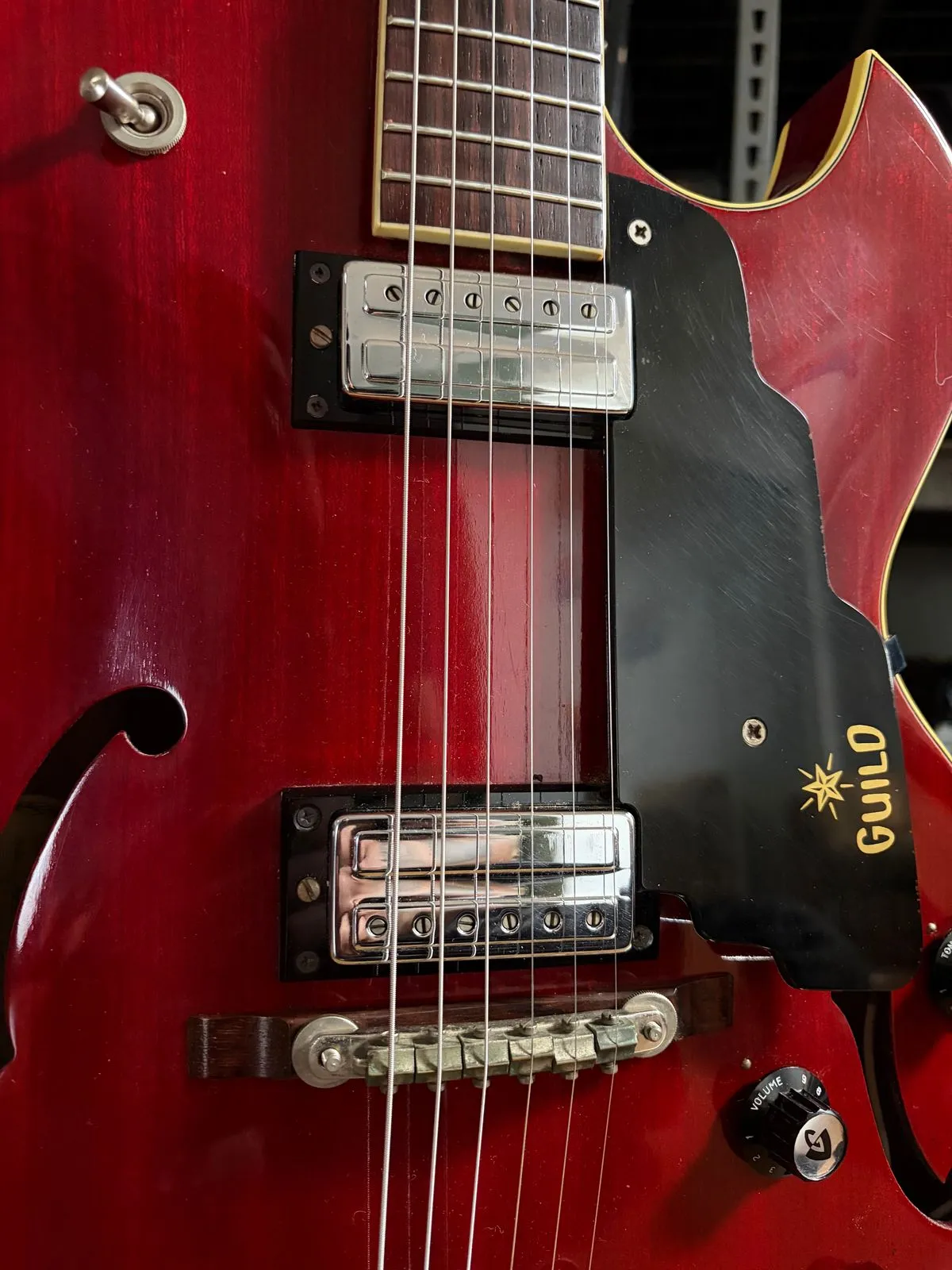
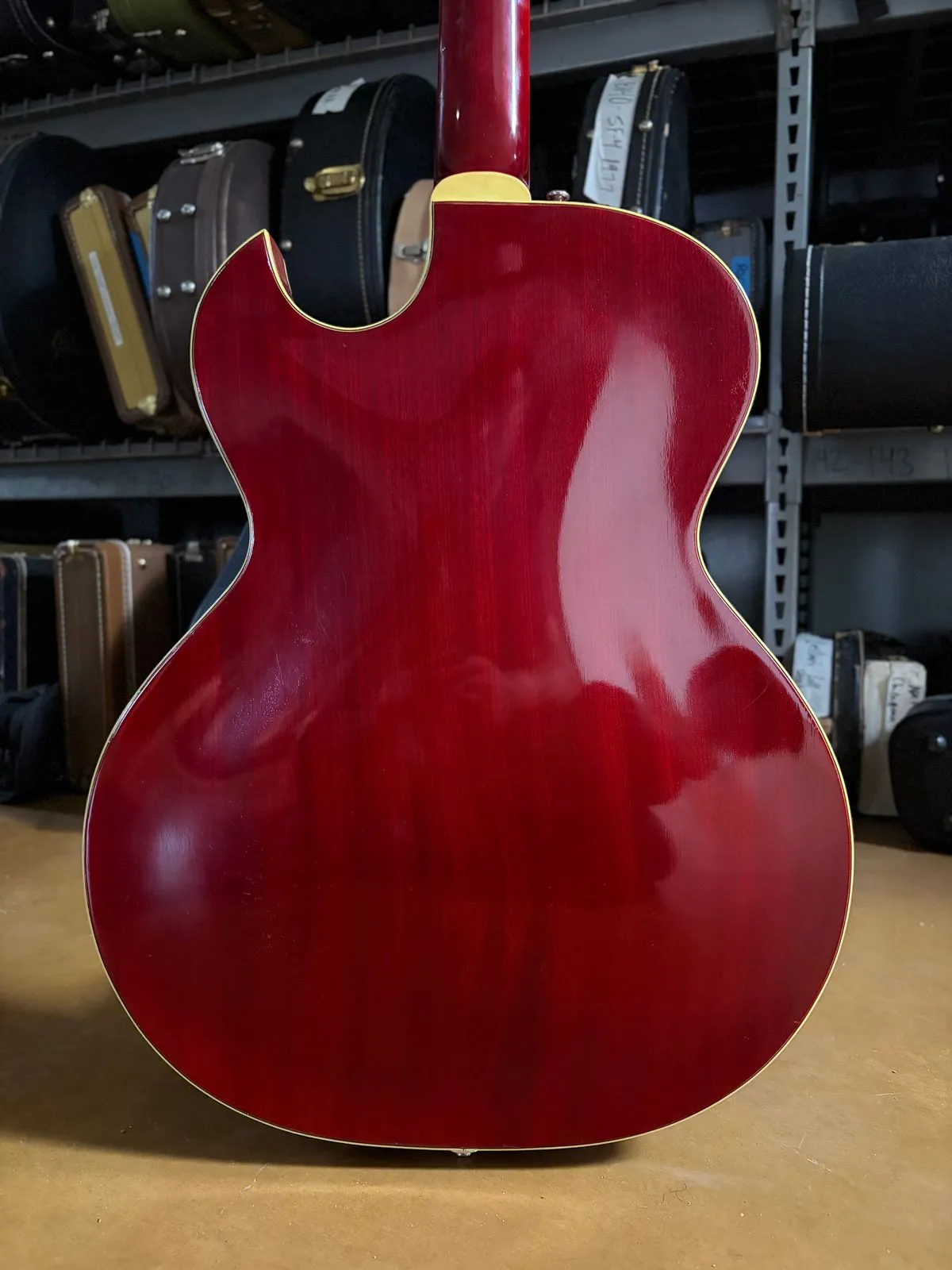
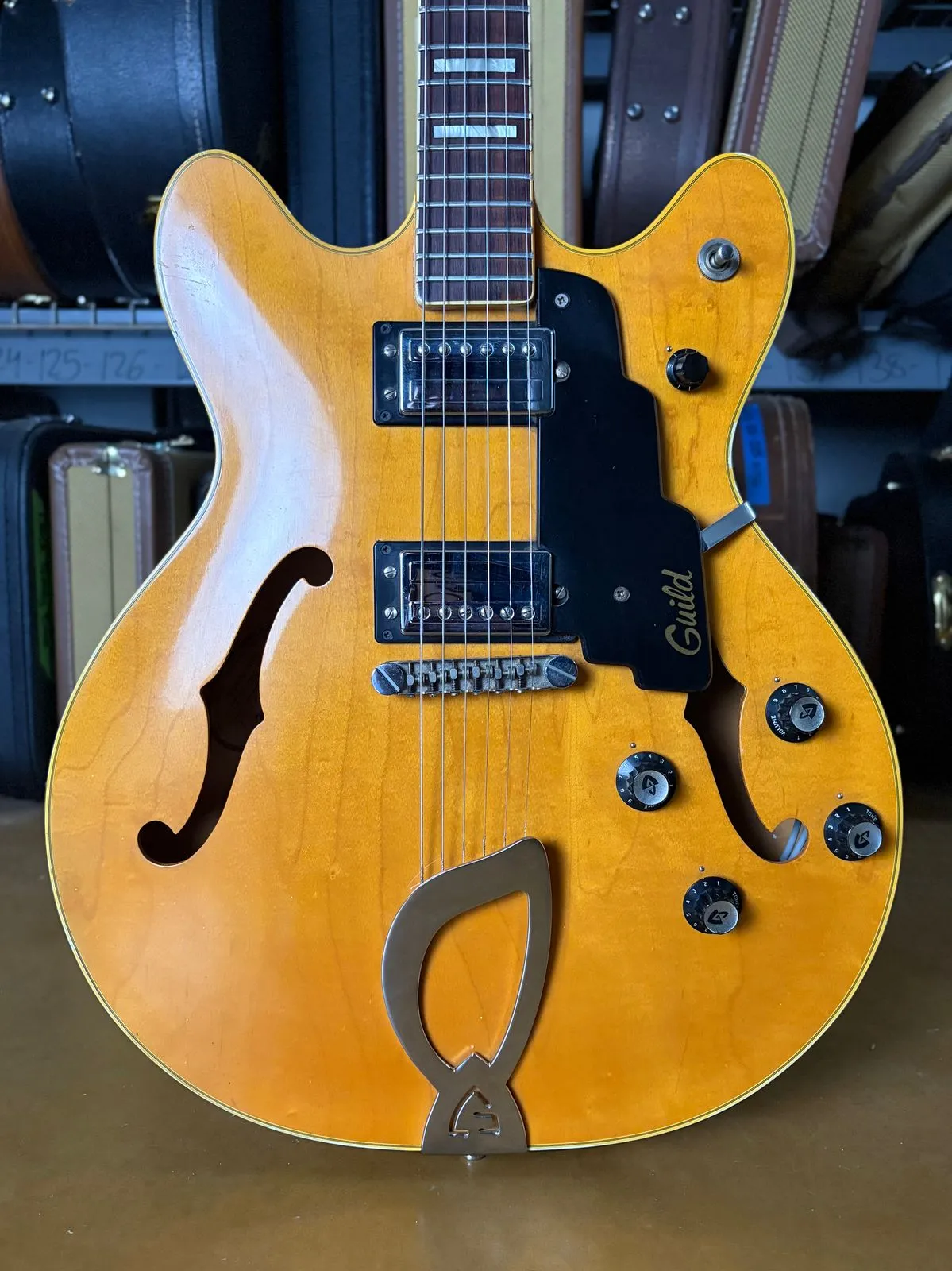
The cherry Starfire II photographs show one cutaway, two humbucking pickups, a floating bridge and a fixed harp-style tailpiece. The close front view preserves the pickup covers, bridge and surrounding body surface. The back view records the neck joint and binding.
Keep the body shape visible when identifying a II. This guitar’s single cutaway should be compared with the double-cutaway IV and V shown below. Adding a vibrato to a II would not, by itself, establish that it left the factory as a III.
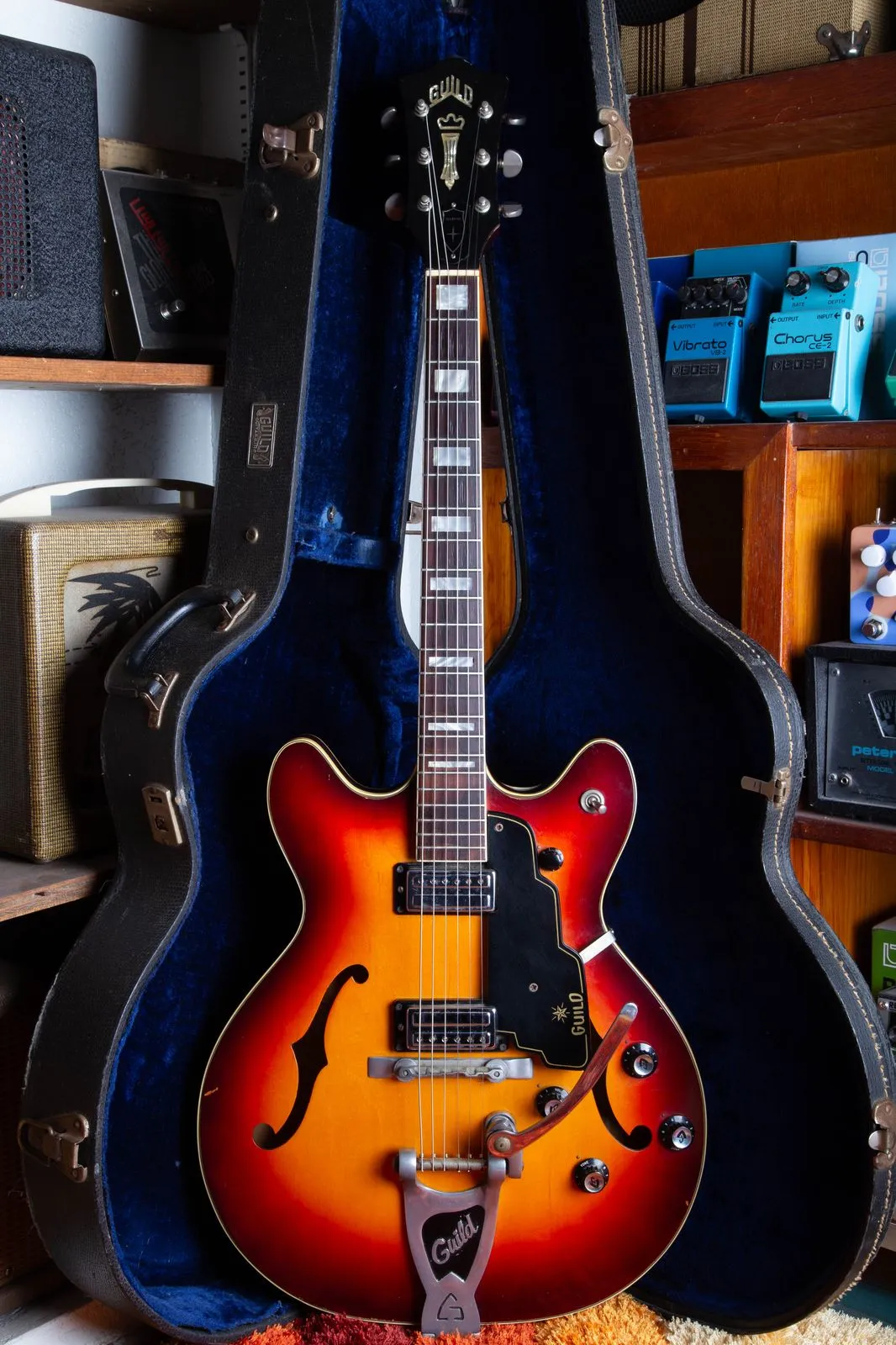
1966 Guild Starfire V
The Sunburst V And Its Bigsby Assembly
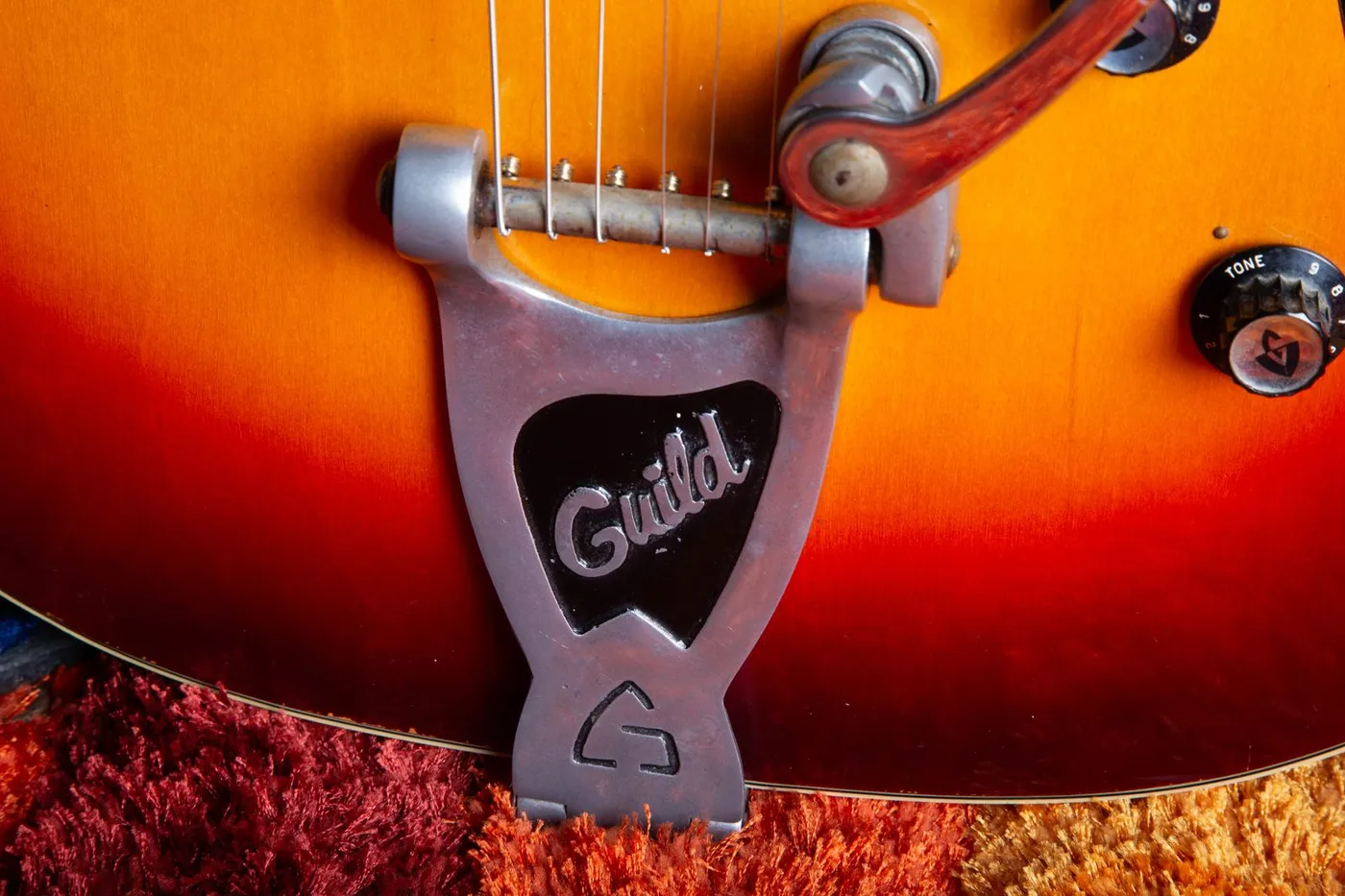
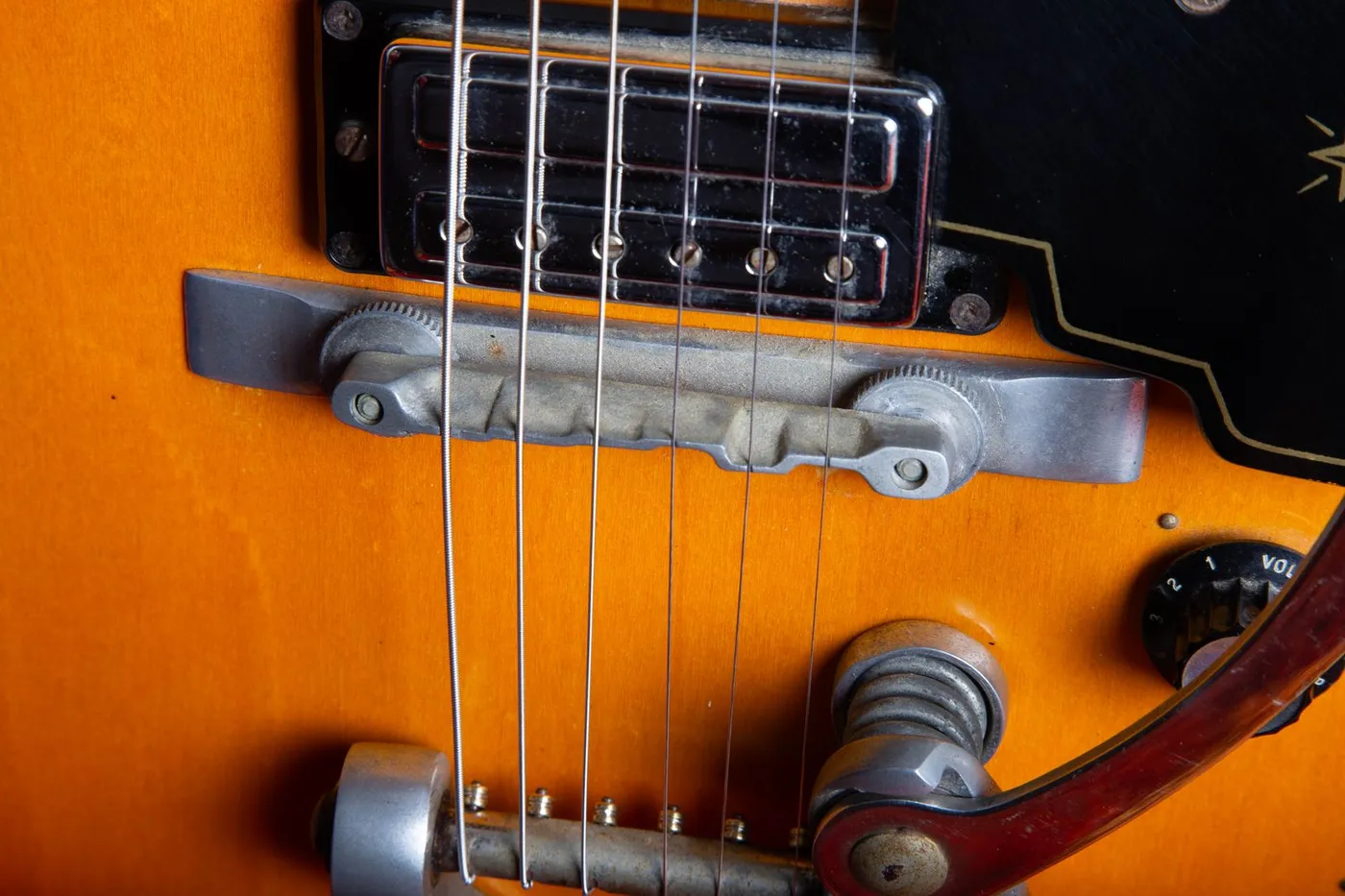
The 1966 Starfire V has a double-cutaway body, two covered pickups and block fingerboard markers. Joe’s listing identifies the Bigsby as factory equipment. The detail photograph shows its Guild-branded face, and the bridge view records the aluminum bridge, base and string path.
Read those pieces as an installed assembly. The arm, hinge, bridge and nearby body surface help distinguish a configuration from a loose replacement part. The photographed Bigsby belongs to this V example; it should not become a blanket specification for every Starfire model.
1966 · Starfire XII
The Number And Body Agree
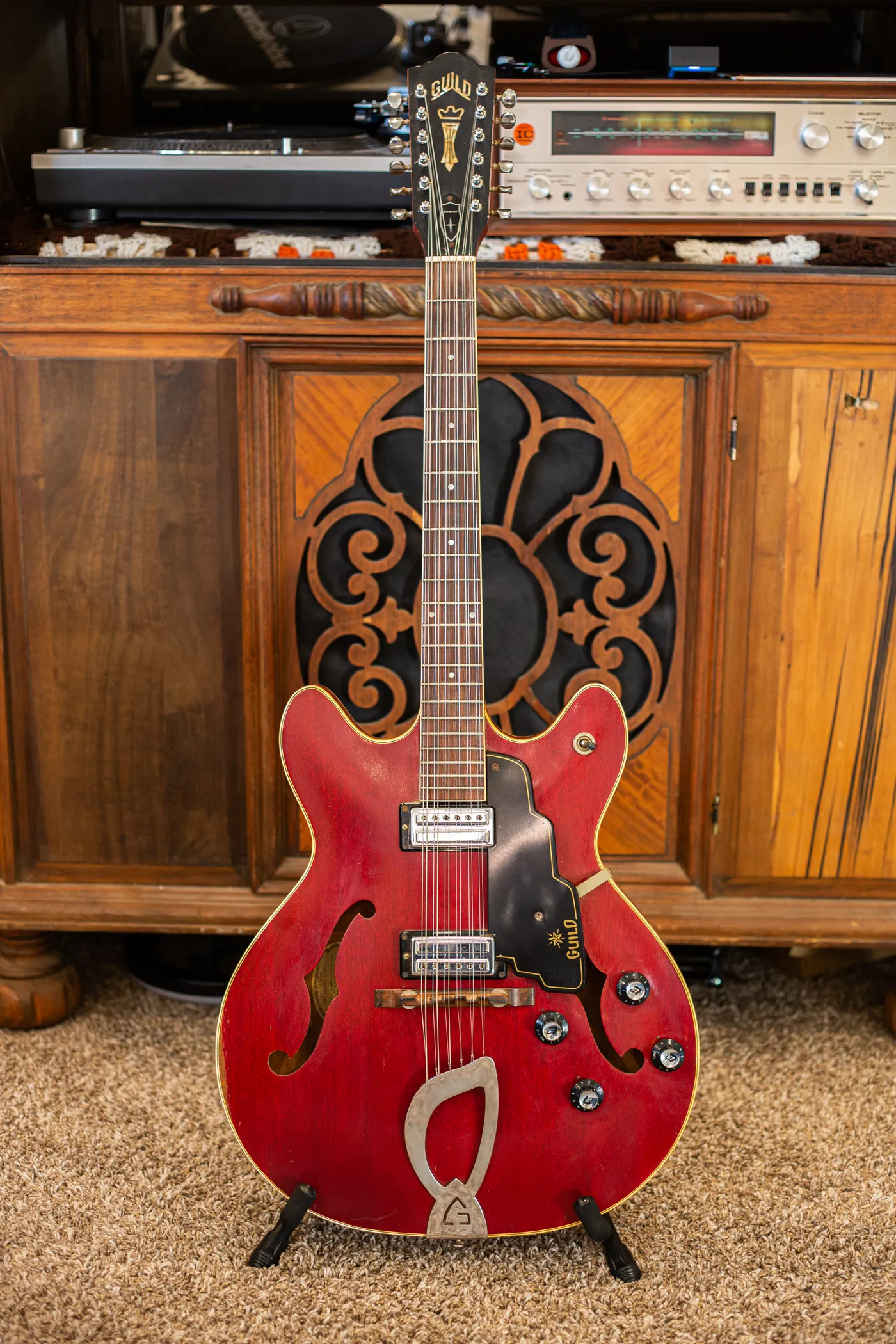
The XII's DC347 mark can be paired with the front and headstock views in this set. Twelve tuners and paired strings make the model branch visible, while the back and heel photographs preserve condition evidence. The serial chart result dates the instrument's record; it doesn't certify every installed component.
When assessing your own XII, show the neck joint and string height as well as the tuner array. A replaced tuner, refret or earlier neck work should be documented separately from the model's manufacture year.
1977 Guild Starfire IV
SF-4 Headstock And Later Body Details
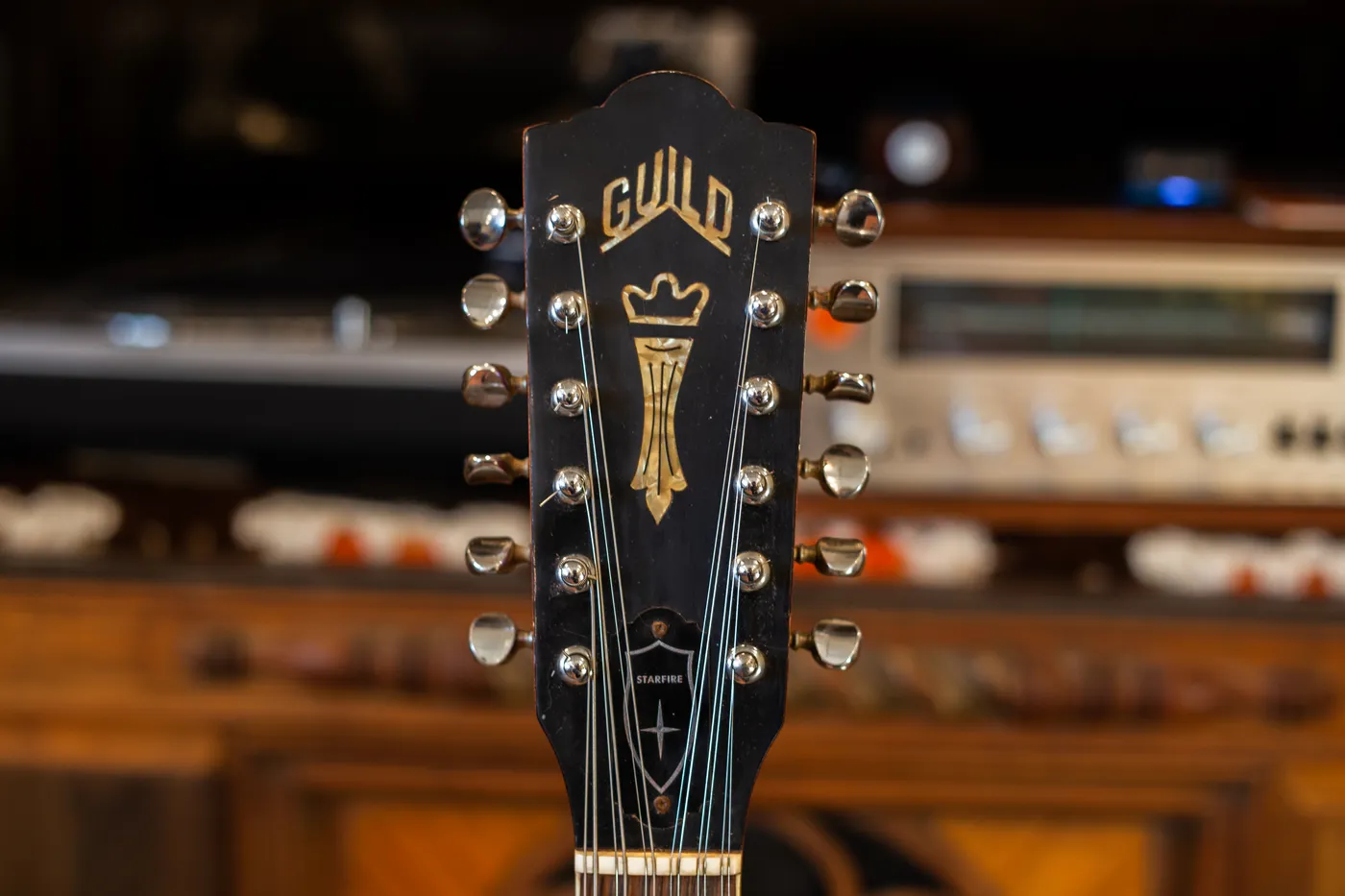
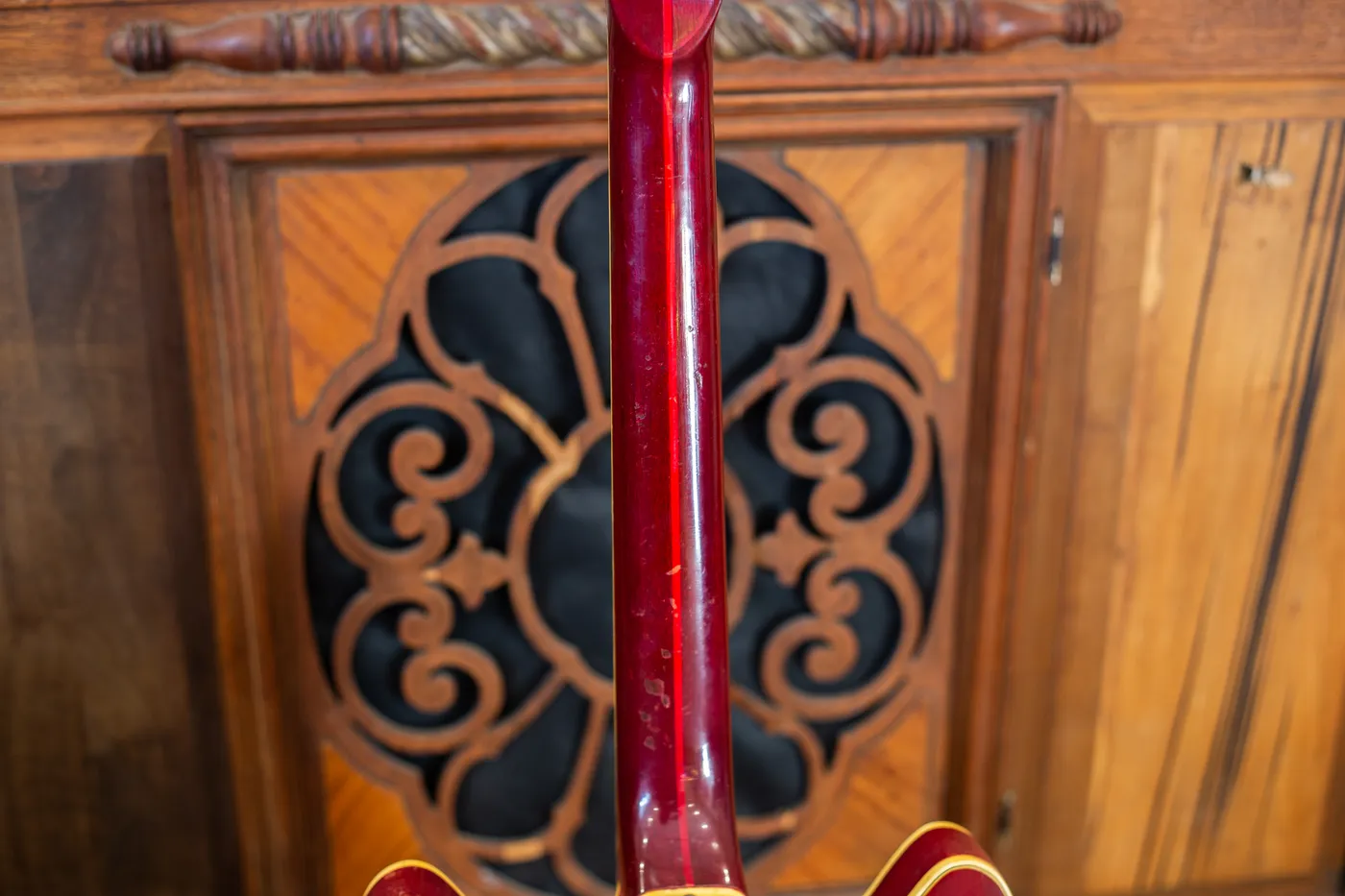
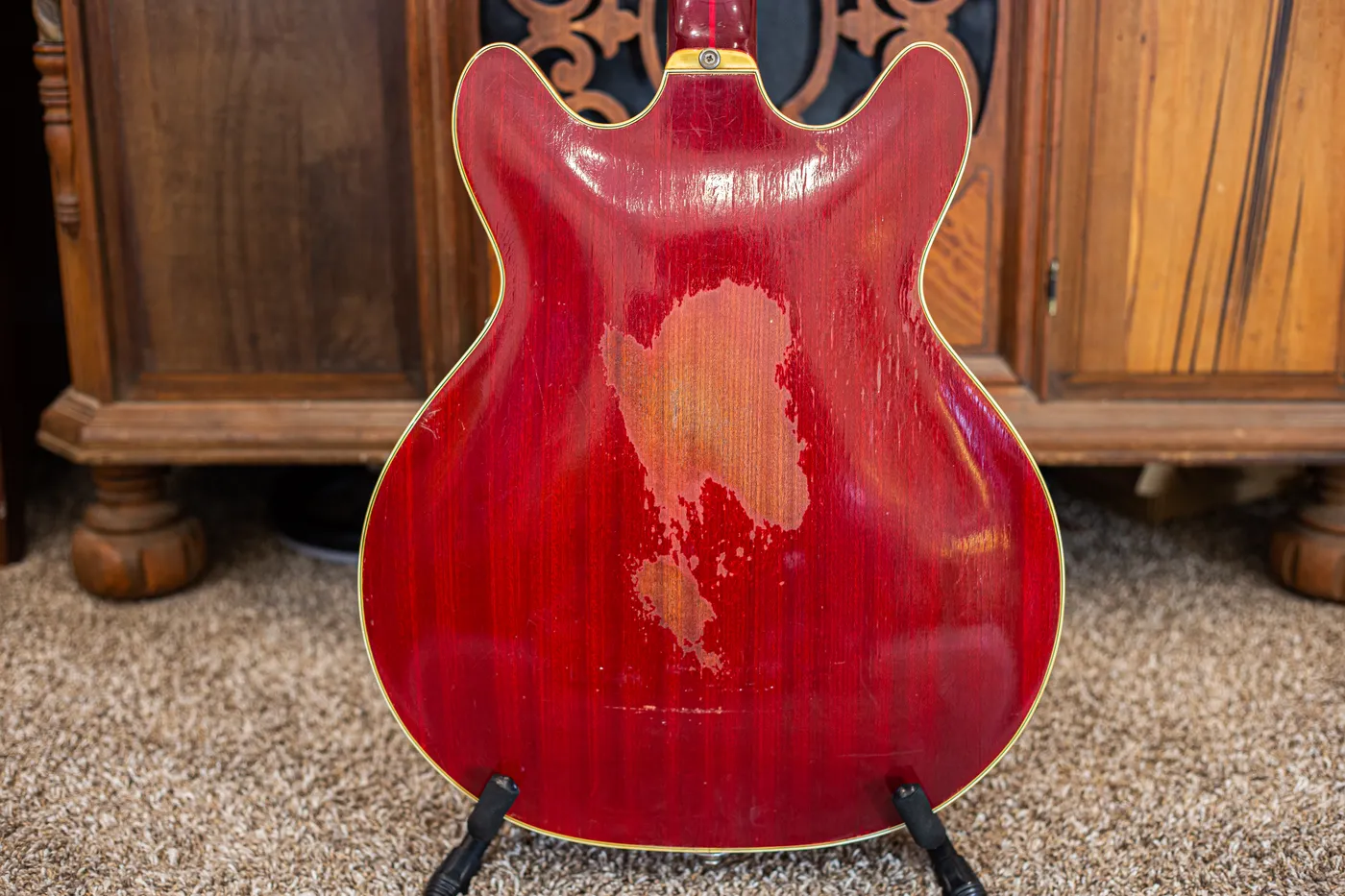
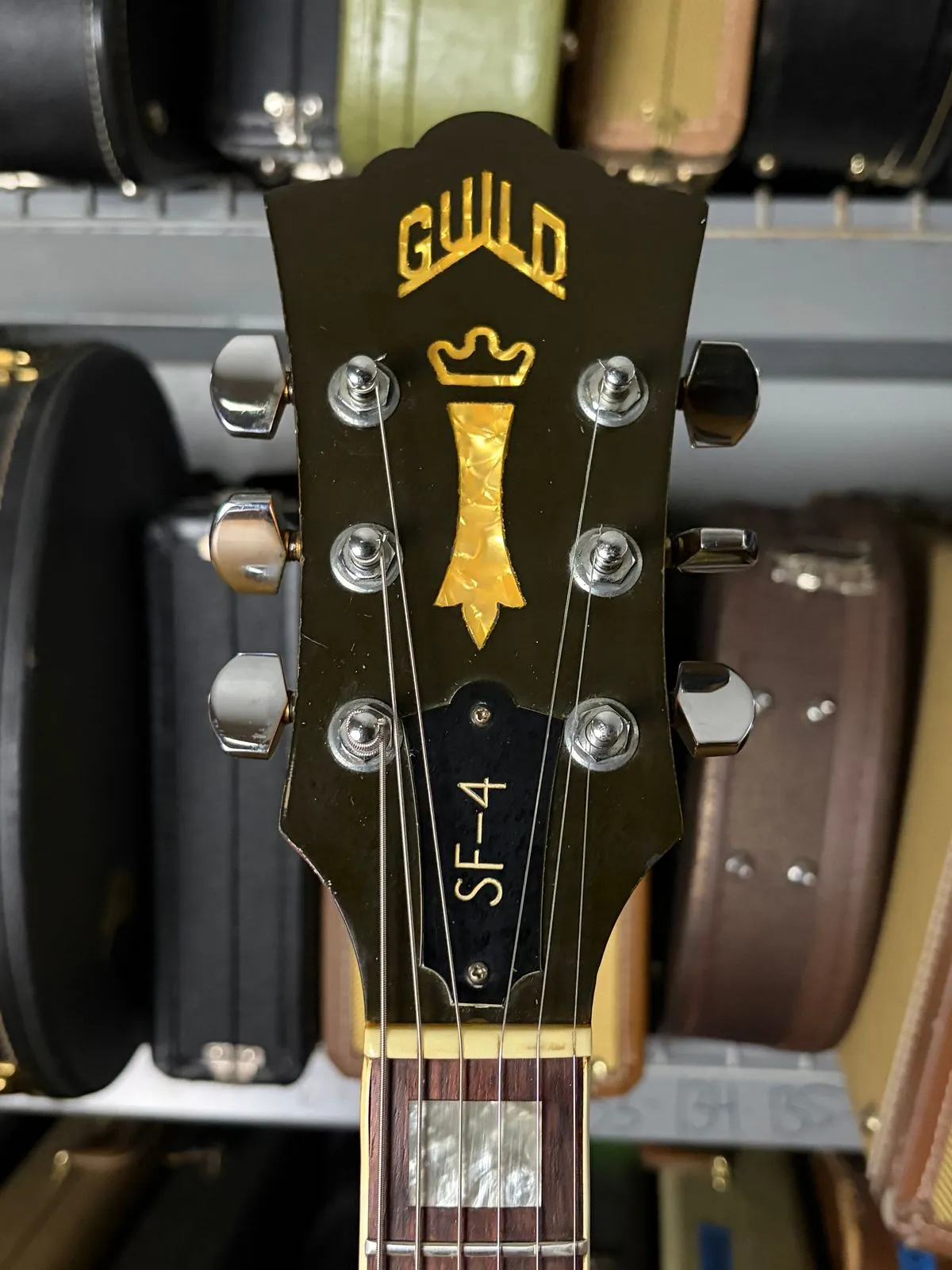
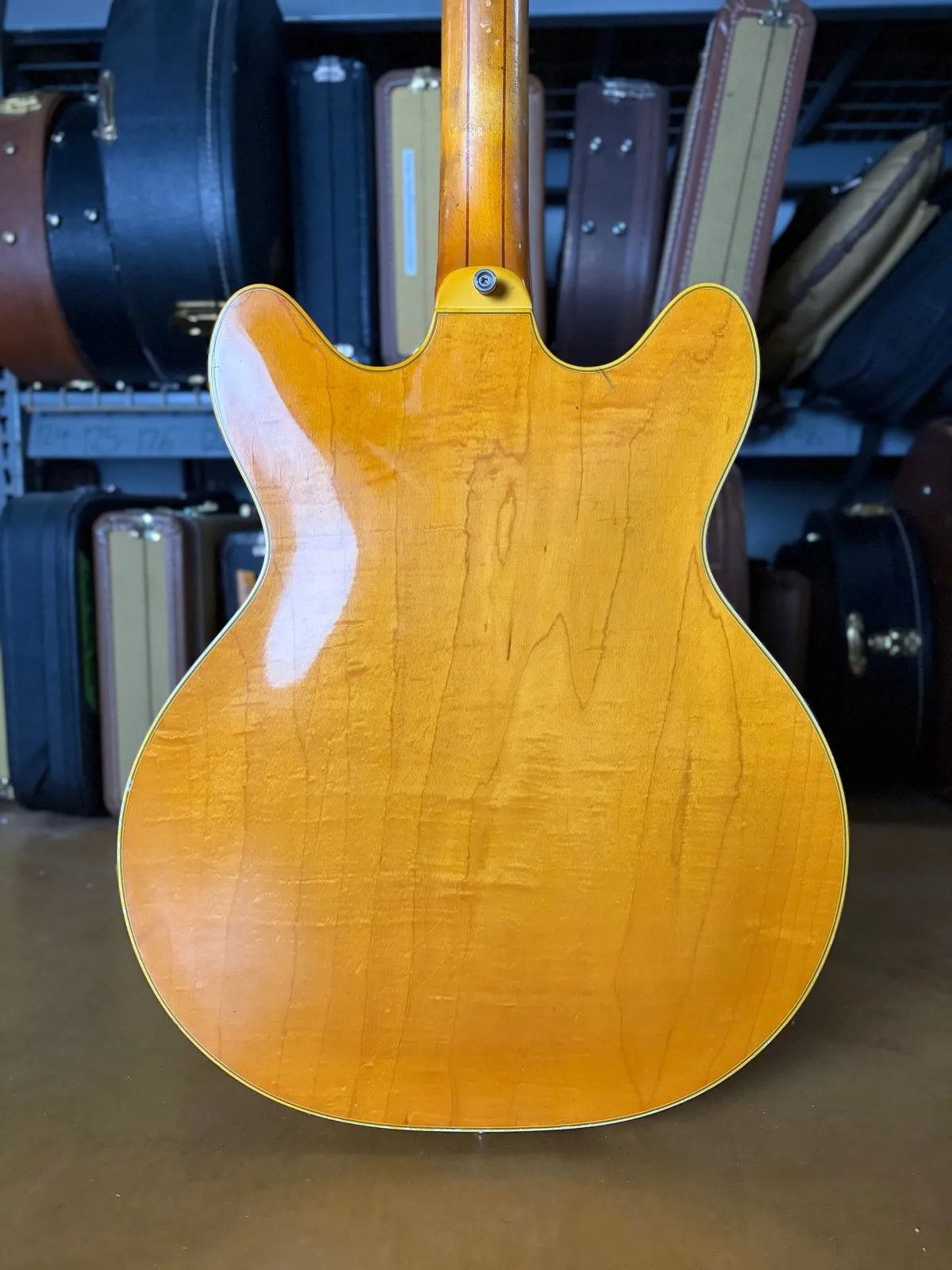
The blonde 1977 IV shows the later double-cutaway body, block markers, two humbuckers and a fixed harp tailpiece. Its headstock photograph includes the SF-4 marking beneath the Guild inlay. The back view connects the neck joint and rear finish with that same guitar.
The model marking identifies a branch of the family rather than acting as a date code. Compare this Westerly example with the earlier instruments using its own controls, bridge mounting and serial system. A blonde finish or an SF-4 marking alone cannot establish a manufacture year.
A Starfire XII Number You Can Read
Use The Model Before Decoding The Prefix
The 1966 Starfire XII
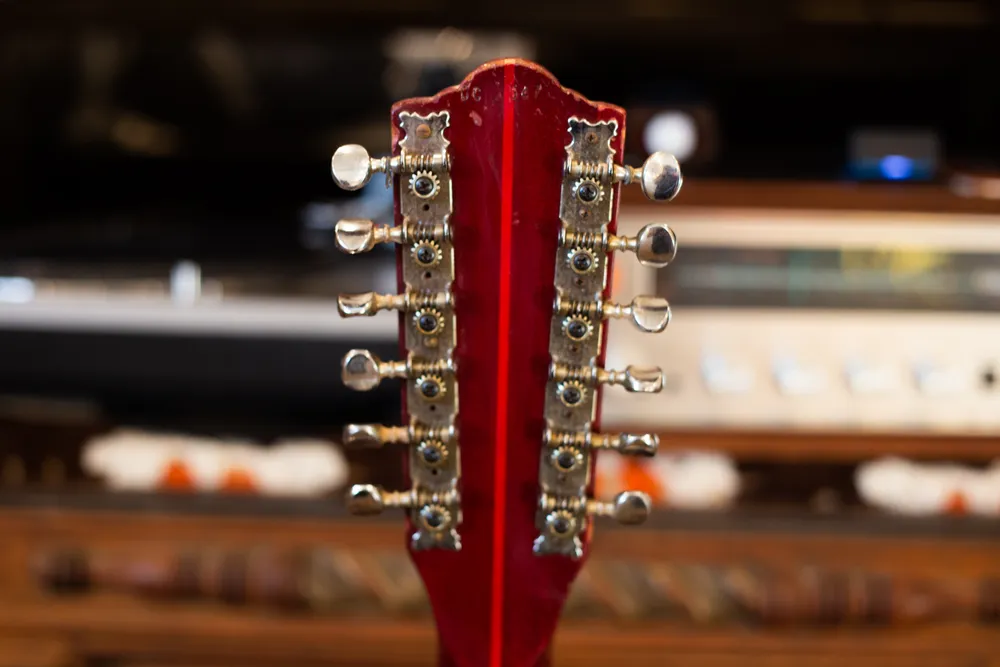
The original-resolution rear-headstock photo reads DC347. Guild’s Starfire XII row gives DC101 through DC586 for 1966. That supports the archive's 1966 identification when the complete twelve-string instrument is considered with the number.
DC is part of the model-specific sequence. The digits 347 do not encode March, a week number or the year 1947. Nor should this short DC sequence be confused with a different model's later, longer serial.
Earlier Starfires may carry plain numeric serials. Guild's 1960 to 1964 chart supplies first and last numbers for the shared sequence. During 1965 to 1969, use the model row: II and III share EK records, while IV, V, VI, XII and bass models have their own comparisons. Preserve letters and leading digits exactly.
The Guild model-prefix charts distinguish complete ranges from annual last-number records. A missing year between two endpoints limits what can be inferred. Don't invent a date by extending a sequence beyond the records simply because the number looks close.
Photograph the interior label as well as the rear headstock when both are present. An f-hole may hide a letter or final digit. A second angle is preferable to completing the number from a hoped-for year. Joe’s label guide explains how a printed Hoboken address and a later model-prefix date can coexist.
A Starfire Inspection List
Check For Changes A Model Label Cannot Explain
Confirm String Count And Construction
Include the full neck, body outline and accessible interior. A bass, tenor-like appearance or twelve-string headstock must be reconciled with the actual model designation.
Compare Pickup Mounting
Show covers, surrounds and the nearby finish. Record adapters, extra screw holes and known routing. A period-looking cover may conceal a replacement pickup.
Check The Neck And Body Joint
Photograph the heel from both sides and provide known repair records. A seam or reflection alone doesn't establish a broken neck. An in-person inspection may be needed to diagnose structure.
Retain Finish And Wear Evidence
Show the rear, rim and binding under even light. Refinished surfaces and local touch-up should be described according to what is known, without guessing from one bright or dark patch.
Identify The Case And Loose Parts
Keep removed pickups, bridges and guards with any documentation. Their presence can explain a repair, but a part found in the case isn't automatically original to that guitar.
Once those checks establish a supported description, use the Starfire value page with the actual condition. A guitar can be correctly dated and still have extensive modifications. Separating those findings helps an owner understand why an identification and a price estimate require different evidence.
Keep The Production Line Visible
Later Starfires And Reused Names
Some later Westerly Starfires revived earlier names, and those American instruments remain within this guide's factory scope. Their 1990s specifications and serial records must still be read as later production. An original 1960s III and a Westerly revival III should not be described as the same year or automatically assigned identical equipment.
Newark St. instruments are a different production line. Guild's familiar headstock, harp tailpiece and compact-looking pickups can appear on those later guitars. A modern Starfire I designation can also belong to a broader series instead of the original one-pickup I. Read the complete suffix, country marking and serial.
Joe’s vintage and reissue guide explains that a historical series name doesn't establish a factory location. In particular, “Westerly Collection” is not proof that an instrument was manufactured in Rhode Island. Keep manufacturer series wording separate from the older factory era.
Send The Number With The Guitar
Get A Model-Specific Starfire Assessment
Send The Evidence
Ask Joe To Identify Your Starfire
Include the complete model, serial photographs and the equipment that seems inconsistent. If the number is only partly legible, mark the uncertain characters instead of guessing. A first photo review can identify the next evidence needed before a firm date or originality conclusion.
Manufacturer Records And Instrument Studies
Starfire Research References
- Guild 1960 Catalog
The first single- and double-pickup Starfires and period equipment.
- Guild 1966 Catalog
Starfire family, Anti-Hum pickups, XII, bass and deluxe appointments.
- Guild’s Published Serial Records
Shared sequences, model-prefix ranges and the XII DC101 to DC586 record for 1966.
- Documented 1961 Starfire III
Firsthand instrument study of DeArmond equipment and early vibrato arrangements.
- Documented 1962 Starfire III
Binding and pickup comparison for the following production period.
- Westerly Starfire IV Feature Study
Approximate bridge, tuner, pickup, marker and control changes; exceptions explicitly retained.
- Joe’s Guild Factory Eras
The 1967 move, later factory transitions and printed-label limitations.
- Joe’s Guild Hardware Reference
Bass pickups, compact Anti-Hum, HB-1 and modern-name distinctions.
Questions AboutGuild Identification
What Does DC347 Mean On The Pictured Starfire XII?
Can A Hoboken Label Appear After The Westerly Move?
Does An Added Bigsby Turn A II Into A III?
Are All Later Starfires Excluded Here?
The Last Word
Keep The Evidence Together
The numeral and factory context determine which Starfire comparison is useful. Read the whole serial, allow for documented transitions and keep replacement hardware separate from the build-date conclusion. That produces a description another owner, repairer or buyer can follow. For the matching price ranges, see the Guild Starfire value guide.
Authenticity And Originality Are Assessed From The Information Provided. A Hands-On Inspection Can Change The Conclusion.