
Joe's Vintage Guitars - Preserving History One Guitar at a Time

Vintage guitar authentication guide

How to Spot a Fake Gibson Guitar

A copied serial number can look convincing. The safer test is whether the neck, hardware, construction, finish, and electronics all tell the same story for the claimed model and year.

Use several clues togetherModel and year matterPhotos are enough to start
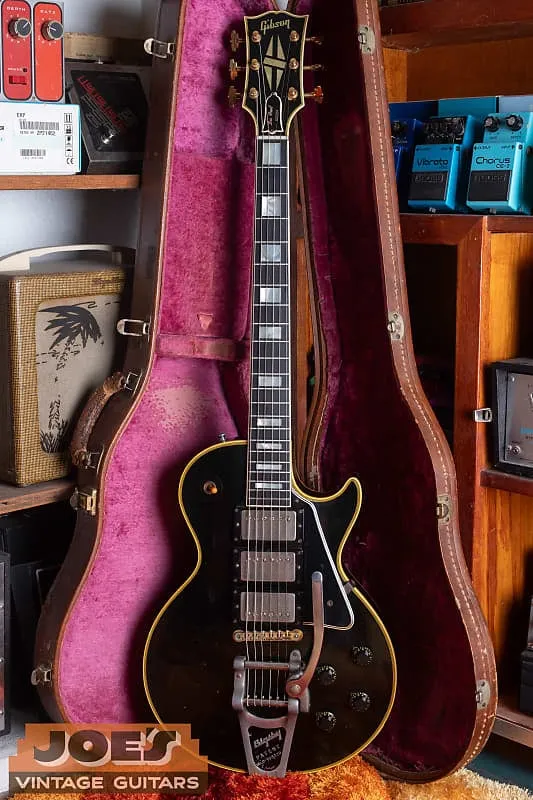
Vintage Gibson Les Paul Custom shown in its case
Start with the whole instrument, then move to the details that are hardest to fake.
One clue is not a verdict

Counterfeiters copy real details. Authentic guitars can also be repaired or modified.

Identify the exact claim

The model, factory, and production period decide which features should be present.

Do no harm

Photograph first. Do not force old screws, pull electronics, or clean away useful evidence.

Start here

The Fast Gibson Field Check

Start with the easy exterior clues, then compare the details as a group. None of these signs should be used alone to condemn a guitar: legitimate Gibsons vary by model and era, and repairs can change what you see.

1

First field check

Look Under the Truss Rod Cover

Gibson guitars have a brass truss rod nut adjusted with a nut driver. An Allen-wrench adjustment or a deeply recessed truss rod socket is a sign of a fake Gibson. Joe's Gibson physical-features and hardware guide gives the wider period context.

  • Compare the adjustment hardware with the exact model and production period.
  • Check the cavity's shape, depth, and finish along with the nut.
  • Stop if the cover is stuck or a screw will not turn easily; damage is not worth one clue.
Keep it in context. Important: this is a screening clue, not a universal rule. Some Gibson-family instruments, modern variants, and repaired guitars can differ.
Suspect exampleRecessed socket and rough cavity on a counterfeit example.
Authentic comparisonTraditional brass nut on the vintage Gibson used for this comparison.
2

Hardware clue

Read the Bridge, Posts, and Thumbwheels

Copy guitars often use inexpensive import bridge hardware that only approximates Gibson's look. Large slotted post heads, unfamiliar bushings, and an assembly that does not match the claimed year can be a useful red flag. Compare the whole assembly with Joe's Gibson bridge and hardware chronology.

  • Identify the bridge family before judging one screw or saddle.
  • Check post spacing, bushings, thumbwheels, retaining wire, saddle orientation, and plating together.
  • Replacement hardware lowers originality, but replacement alone does not make the guitar counterfeit.
Keep it in context. Gibson used more than one bridge design, and owners frequently replace worn bridges. Date the instrument before deciding what should be present.
Suspect exampleImport-style bridge hardware with a large slotted adjustment post.
Period comparisonABR-1-style bridge detail from an authentic vintage Gibson.
3

Woodworking clue

Inspect the Headstock Construction

On many classic USA Gibson necks, the wider sides of the headstock are formed by glued-on wood wings, leaving visible seams on the back. The counterfeit example shown here has no glued-on wings and no visible wing seams. That is a sign of a fake. A scarf joint is a separate warning sign. A Gibson neck never uses a scarf joint and should be made from one continuous piece of wood. Cross-check the outline and inlay with the Gibson headstock logo chronology.

  • Use raking light to reveal wing seams, repairs, overspray, and altered contours.
  • Compare the headstock angle, outline, thickness, logo placement, and tuner layout.
  • A repaired headstock can add seams or finish work that mimic a construction clue.
Keep it in context. Construction changed across Gibson's long history. Confirm the exact family and era before treating a seam as evidence.
Suspect constructionNo seam on a counterfeit example.
Authentic comparisonSubtle side-wing seams on an authentic Gibson headstock.
4

Marking clue

Judge the Serial Number in Context

A serial number can be copied from a real guitar in seconds. Gibson serial numbers were stamped into the wood before the finish was applied, so the finish should lie over the stamp. A laser-etched serial number is a sign of a fake Gibson. The same is true of a number that appears on top of the finish or cuts through it. The counterfeit example in the photos has a laser-etched serial number. Start with the Gibson serial-number lookup and charts, then read what a serial number cannot tell you before treating the number alone as proof.

  • Verify the format, number range, font, spacing, position, and production method.
  • Check whether the logo, finish, neck construction, hardware, and electronics belong to the same period.
  • Use an online serial-number lookup as a date clue, not an authenticity certificate.
Keep it in context. A copied number can still fall within a valid Gibson range. The stamping method, finish, construction, hardware, and electronics all have to agree.
Suspect exampleLaser-etched serial number cut into the finish on a counterfeit example.
Authentic comparisonA stamped number integrated with the finish on an authentic Gibson.

The deeper check

What Else Has to Match?

A convincing Gibson should remain convincing as you move from the obvious details to the construction and parts beneath them.

  • Logo and inlaysShape, material, placement, and workmanship should fit the model and year.
  • Body and neck constructionTop carve, neck joint, binding, cavities, and routes should match known factory practice.
  • ElectronicsPickup construction, potentiometer codes, wiring, and solder joints should form a believable timeline.
  • Finish and agingChecking, wear, color in cavities, and finish beneath hardware should be consistent rather than theatrical.
  • HardwareTuners, bridge, tailpiece, knobs, plastics, and fasteners should agree with one another.
  • ProvenanceReceipts and family history support the physical evidence, but paperwork never replaces it.

Before you buy or sell

Photos to Send for a Gibson Authentication Review

Start with what you can photograph safely. Joe will tell you if one more hidden detail would settle the question.

  • Full front and back of the guitar
  • Front and back of the headstock
  • Serial number in straight and raking light
  • Truss rod cavity with the cover safely removed
  • Bridge, tailpiece, tuners, knobs, and plastics
  • Pickup cavities, control cavity, pot codes, and solder only when safely accessible
  • Neck joint, repairs, overspray, and suspicious seams
  • Case, receipts, tags, and any removed original parts

Common questions

Gibson Authentication Questions

A real guitar can have changed parts. A clean-looking guitar can still be wrong. These distinctions matter before you price it.

Does a valid Gibson serial number prove the guitar is real?

No. Counterfeiters can copy a valid number. The format, marking method, construction, hardware, finish, and electronics all need to agree.

Does a repaired or modified Gibson become a fake?

No. An authentic Gibson can have replacement parts, a refinish, or a repaired headstock. Those changes affect originality and value, not necessarily manufacturer identity.

Should I take the guitar apart?

Start with safe exterior photos. Remove only an easy truss rod cover if you are comfortable. Wait for guidance before pulling pickups or electronics.

Can Joe authenticate a Gibson from photos?

Often, yes for an initial opinion. A rare, heavily altered, or exceptionally valuable guitar may still require an in-person inspection.

Still unsure?

Have Joe Review the Whole Guitar

A serial number or one photo can raise a question. A complete photo set is how the answer becomes reliable.

Get a Free Gibson Appraisal
Enlarged authentication photo