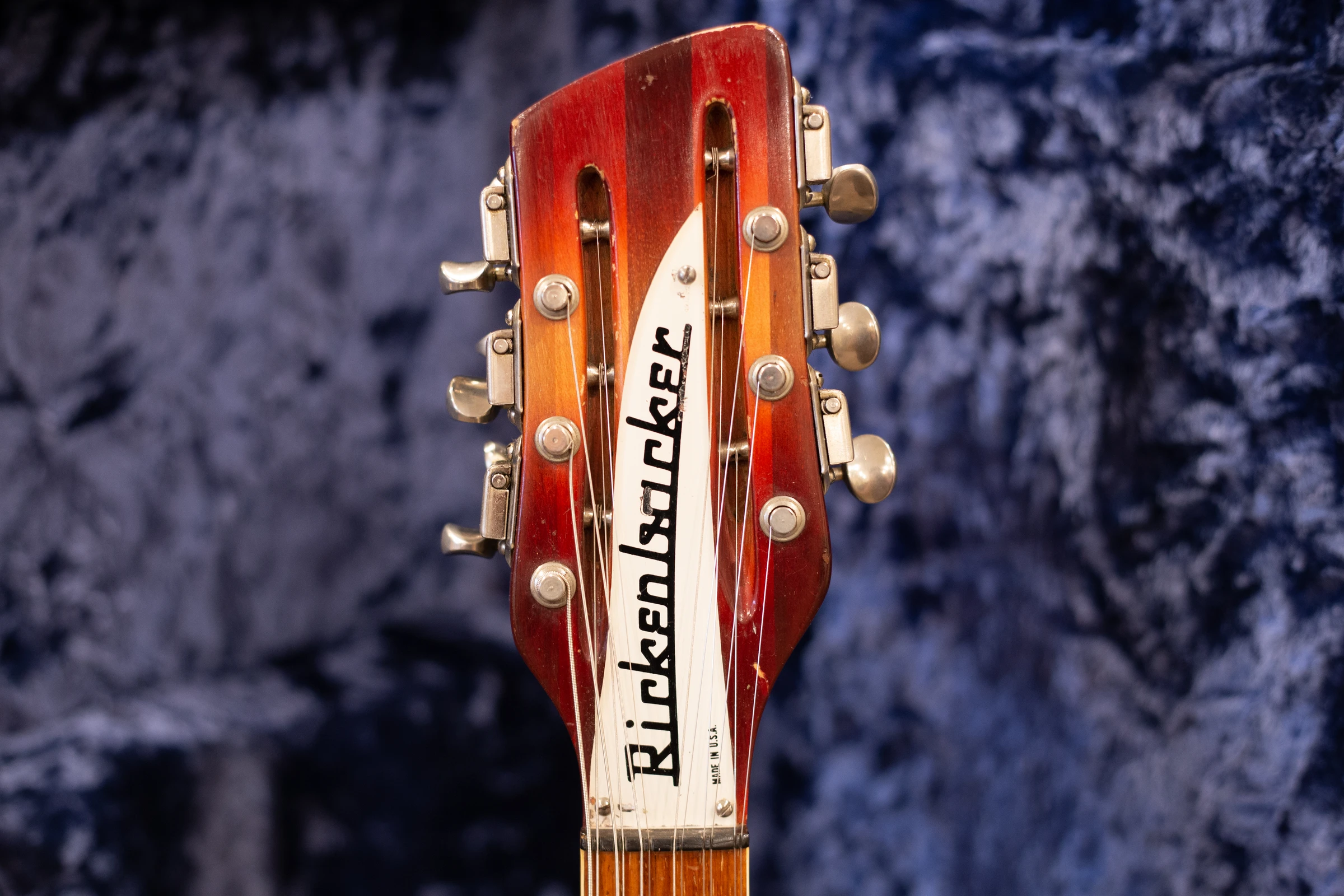
Dates below describe common production periods. Parts overlap between models, and reissues or replacements can resemble earlier hardware. Use several details before deciding that a part conflicts with the serial.
Fingerboard Inlays
Dot Inlays: Standard Trim
Dot inlays are associated with standard-trim models such as the 330 and 340. A dot pattern usually tells you more about the model than the year; compare the whole instrument and its serial date.
Triangle Inlays: Deluxe Trim Models
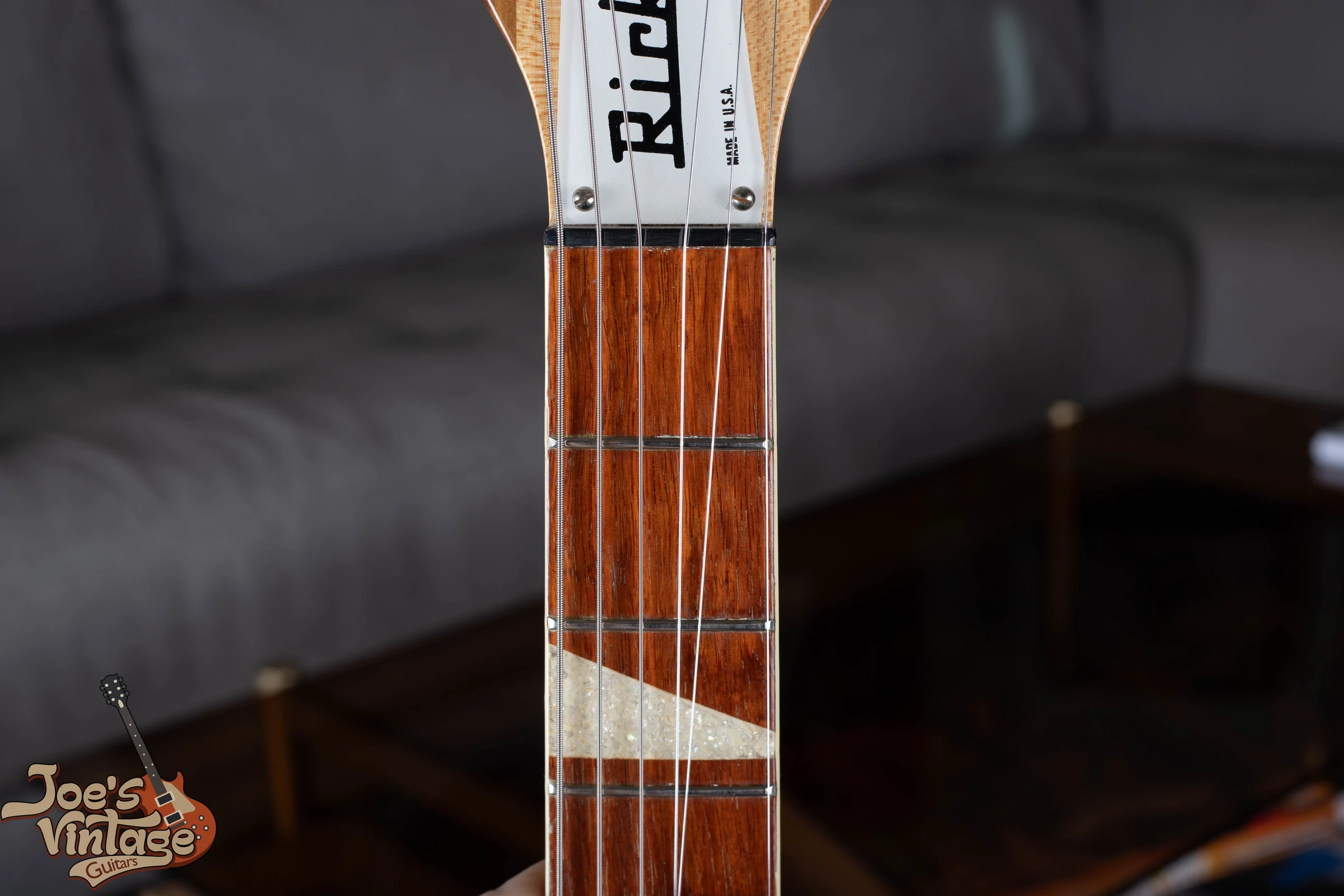
Triangle inlays are the hallmark of Rickenbacker Deluxe models (360, 370, 460, 4001, etc.) and their construction can help narrow a period when checked against the model. The triangle design derives from the Mittenwald School of German lutherie via Roger Rossmeisl.
This 1960s 360 shows the full-width triangle pattern. Compare where the inlay meets the fingerboard edges, then check its material and the model; full-width triangles also returned on later instruments.
1958 to 1963Full-width poured pearlescent resin, early: Clear resin with pearlescent powder poured into routed channels and cured in place. Very early 1958 examples have sharp-pointed triangles that barely reach the fingerboard edge. By late 1958 the points are blunted, and remain so from that point on.
Mid-1961 to Mid-1962Crushed pearl (first run): Crushed mother-of-pearl fragments bound in epoxy, cut from sheets and glued into ⅛″-deep channels. Found on the “New Capri” / OS body-style 360s introduced with the new body shape in mid-1961. Other Deluxe models (460, 4001, F-bodies) did not receive crushed pearl at this time. Back to poured resin by the second half of 1962 for reasons unknown.
Late 1963Poured resin resumes on all Deluxe models including the 1963 Capris (meaning George Harrison’s famous 360/12 has poured resin inlays, not crushed pearl).
1964 to 1973Crushed pearl (main run): Returns with the “New Style” round-top 360 in 1964 and by mid-year appears on all Deluxe models. Material believed to have come from a now-protected marine reserve near Okinawa. Runs continuously until the source became unavailable circa 1972 to 1973.
March 1973Full-width poured resin returns on the 4001, exactly as before. Only lasts approximately six weeks before the design narrows.
Late April to May 1973Inset (not full-width) poured resin: The triangles are now inset from the fingerboard edges rather than running fully across. This reduces the depth of the channel needed and preserves neck stiffness. Backing paint is cream-colored in this early period. Other Deluxe models follow quickly.
~Late 1973 / Early 1974Backing paint shifts from cream to light grey. The color of the resin inlays appears to shift slightly around this time as well, likely related to the backing color change.
1973 to 2007Inset poured pearlescent resin (grey backing): The long-running standard. Color and pearlescence varied over the run (formula changes noted in 1984 and 1990). V/C-series reissue models and some Signature Limited Editions received full-width poured versions during this era.
Late January 2008 to PresentLaser-cut full-width pearlescent acrylic: Grover Jackson (who managed Rickenbacker’s shop 1996 to 1999 and again as a consultant from the late 2000s) introduced laser cutting for inlays. All Deluxe models receive full-width acrylic inlays cut with a laser from ⅛″ pearlescent acrylic sheet. February 2008 4003s briefly got inset acrylic before standardizing on full-width. This remains the current production method.
2021 to PresentCrushed pearl returns (limited): 90th Anniversary 480XC and 4005XC bring back crushed pearl inlays for the first time since 1973, followed by the 4005V (2024). Flake size and color differ slightly from the 1960s material but are the closest modern equivalent.
Body Styles, Binding, And Construction
Thin Hollowbody (Capri) Body Styles
1958 to 1960Thick “OS” body (2½″ deep), square edges: The original Capri body shape. Standard models had no binding or back binding only; Deluxe models (360, 365, etc.) had top and back binding with square edges.
1961Thin “OS” body (1½″ deep), still square edges: Body depth reduced dramatically. Standard models remained unbound. Deluxe models retained top and back binding with square edges (these are the OS / “double-bound” guitars).
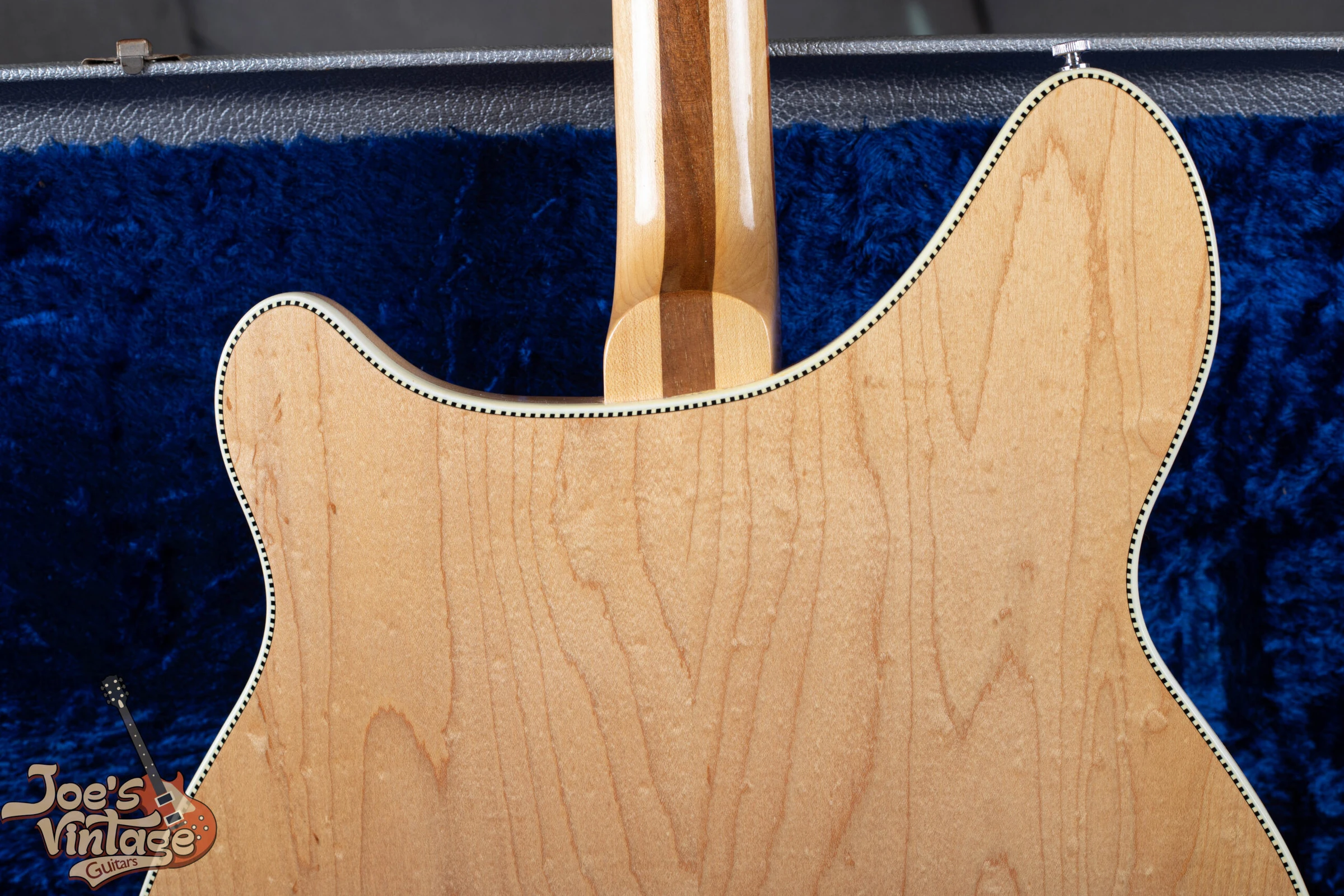
June 1964“New Style” (NS) body introduced on Deluxe 360-series: rounded top edges, no top binding, checkered back binding only, bound cat-eye soundholes. This major cosmetic change accompanies the new knobs, white pickguard, and (on non-vibrato models) the R tailpiece. Standard models (330, 340) retained their existing construction with no major body changes at this time.
Checkerboard binding on a Rickenbacker body. Inspect its placement, the body outline and inlays together; the pattern also appears on later vintage-style models.
Soundholes
1958 to 1963: “Cat eye” or slash f-holes on most Capri models. Some early 310 to 325 short-scale models had no soundholes at all.
1964: Slash-shaped soundholes remain familiar on domestic models. Rose Morris export models use traditional violin-style f-holes, so a different opening is not automatically a modification. Binding depends on the model.
1979: F-holes dropped as standard on short-scale 310/315/325 (available by special order only).
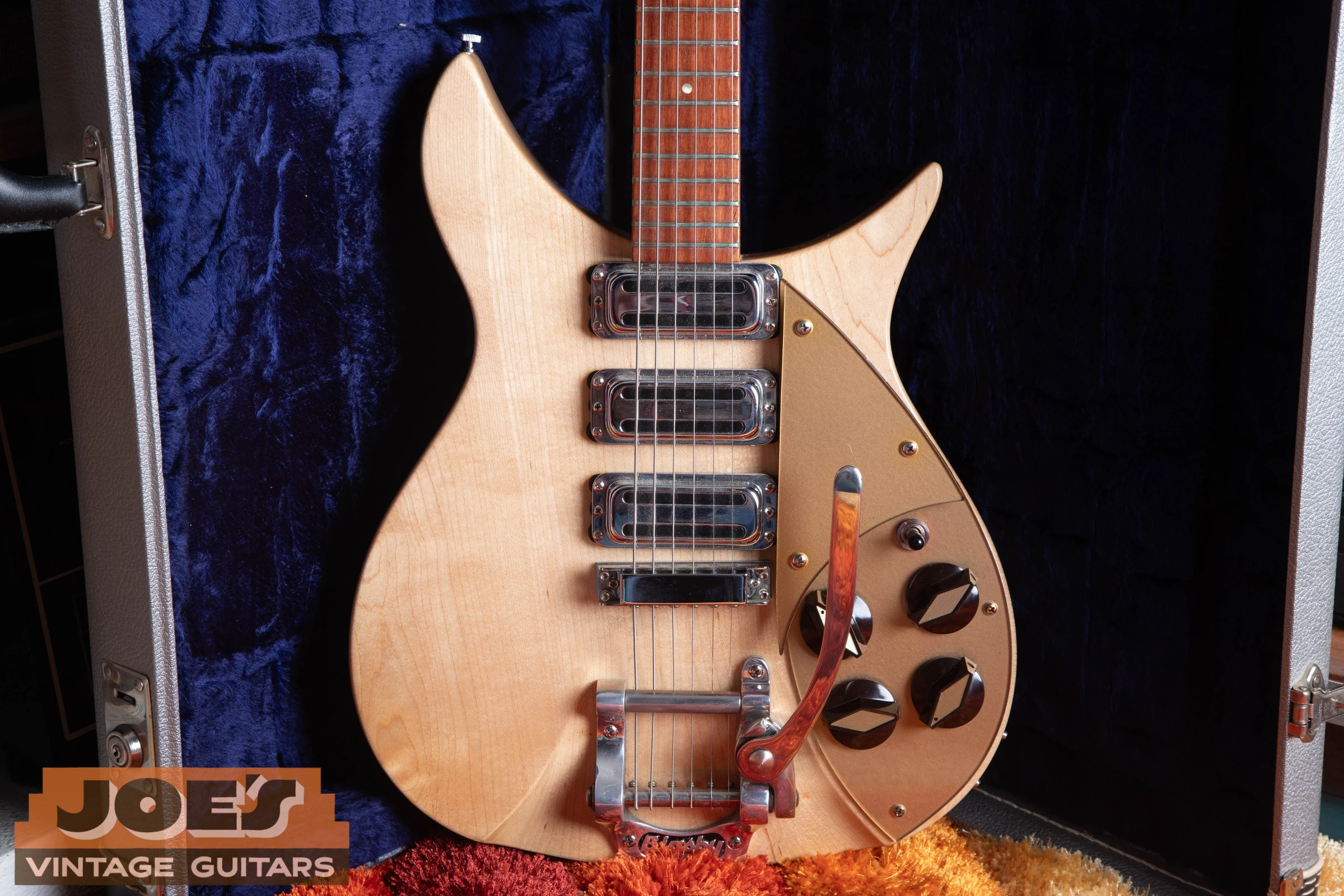
This later 325 has no soundhole, small dot markers and a gold pickguard. Compare the model as well as the period before applying the hollowbody timeline.
Pickguards
1956 to 1963: Gold back-painted clear Lucite / acrylic. The gold color comes from the paint on the back of a clear sheet, a hallmark of the TV knob / stove knob era.
1964 onward: Thick solid white plastic. The change from gold to white pickguard coincides precisely with the change from cooker knobs to black vintage knobs on hollowbodies, one of the most reliable single visual dating cues for pre/post-1964 Rickenbacker hollowbodies.
Hollowbody models from 1958 onward use a split-level (stepped) pickguard design.
Later vintage-style models recreate gold guards, and guards are also replaceable. The pictured 325 is an example of why gold alone does not establish an early production date.
Headstock Logos And Spelling
Early instruments can carry the Rickenbacher spelling. Later Rickenbacker lettering, a logo plate or a replacement truss rod cover does not establish the year by itself. F. C. Hall bought the company in 1953; the spelling should not be used as a universal before-or-after-1950 test.
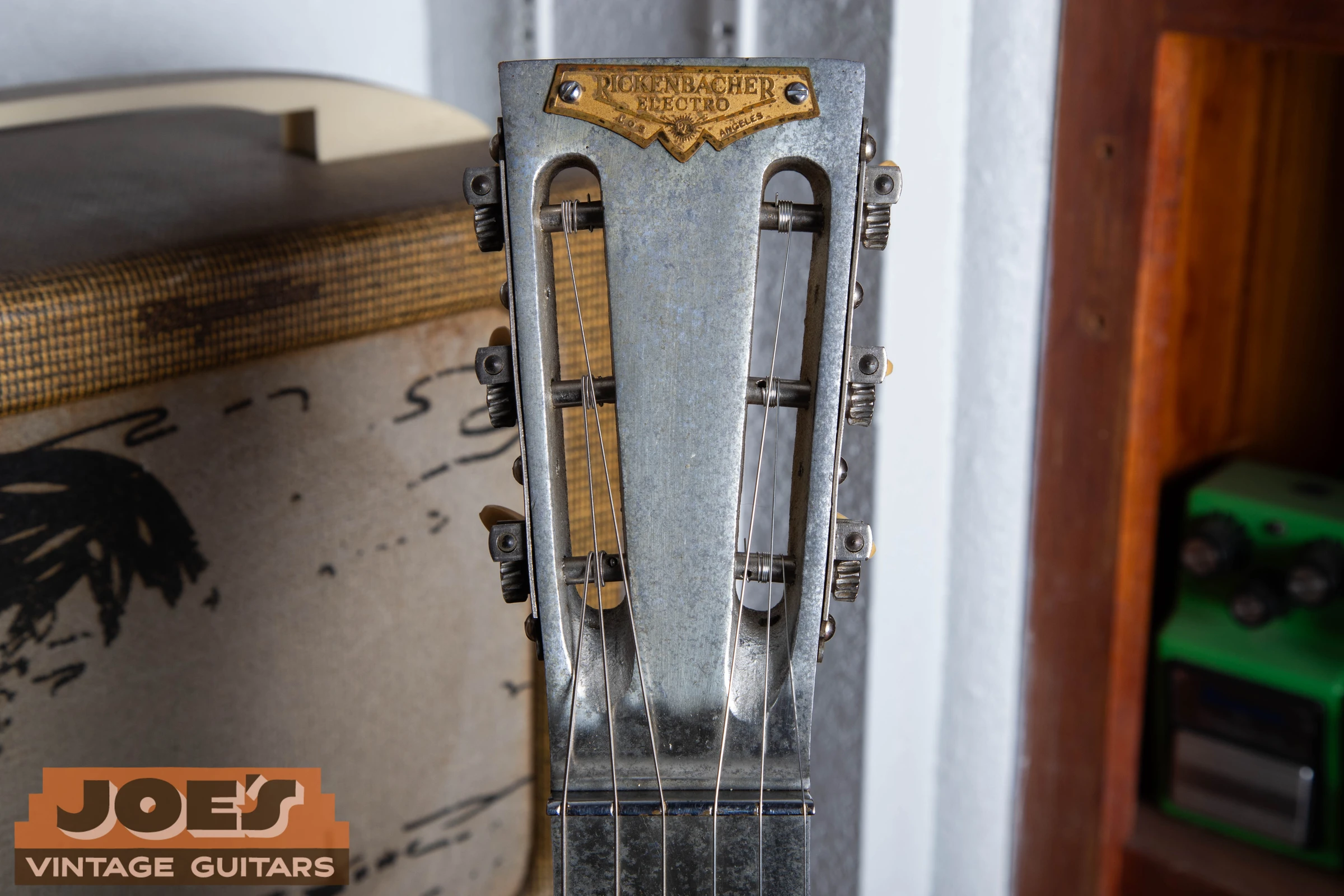
The metal badge on this early Frying Pan reads Rickenbacher Electro. It is a different headstock and logo arrangement from the later guitar beside it.The 360/12 has a white Rickenbacker logo cover and two tuner orientations for its twelve strings. Compare twelve-string headstocks with other twelve-string examples.
Inspect Both Sides Of The Headstock
Compare the outline, tuner spacing, logo plate, screw holes and finish. A replaced plate can put a later logo on an older neck. Twelve-string headstocks also differ from six-string layouts, so compare the same instrument type.
The broader headstocks associated with some later six-string models should be considered alongside the installed Grover and Schaller tuner styles. Extra holes and enlarged bushings may show a tuner conversion.
Get Help Identifying Your Rickenbacker
Send photos of the complete instrument, serial plate and the detail you want checked. Include any known repair or replacement history.