

Dreadnoughts · 1931 To 1969
Martin D-28 And D-28S History And Year Changes
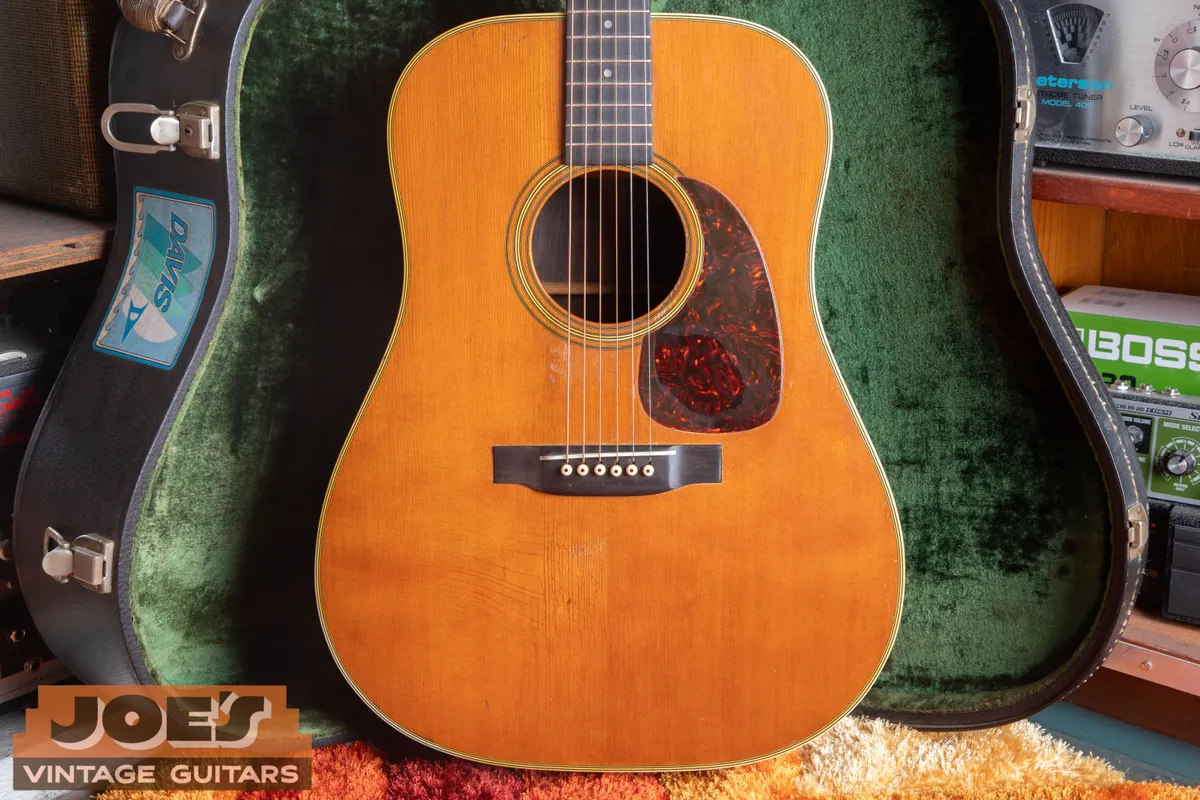
The D-28 changed substantially between its 1931 introduction and the end of the 1960s. Its history runs from a 12-fret dreadnought to the 14-fret model, then through changes in brace position, neck width, brace carving, top trim, bridge design and rosewood. These changes happened at different times.
- First D-28
- 1931
- 14-Fret Version
- 1934
- Scalloped Bracing Ends
- Late 1944
- Regular D-28S Batches
- From December 1967
- Body-Wood Transition
- Late 1969
Model Changes By Year
| Year Or Period | What Changed |
|---|---|
| 1931 | The first D-28s used a 12-fret body, spruce top, Brazilian rosewood back and sides, and herringbone top trim. |
| 1934 | The 14-fret D-28 entered production. T-frets and steel T-bar neck reinforcement replaced the earlier bar-fret and ebony-reinforced construction during this period. |
| 1938 | The X-brace intersection moved rearward, farther from the soundhole. The braces remained scalloped. |
| 1939 | The standard 14-fret neck narrowed from a 1 3/4-inch nut to 1 11/16 inches. |
| Late 1944 | Scalloped bracing ended. Martin had built 1,451 D-28s before this change. |
| 1945 And The Later 1940s | Tapered braces followed the scalloped pattern, then developed into the straighter postwar profile. During the 1945 to 1946 transition, Sitka spruce replaced red spruce as the usual top material. |
| 1946 To 1947 | Herringbone top trim gave way to the simpler postwar border. The trim change came after the end of scalloped bracing. |
| 1965 | The long through saddle gave way to a short drop-in saddle. |
| 1967 | Black pickguards replaced tortoise-pattern guards. Square steel tube neck reinforcement replaced the steel T-bar. |
| December 1967 And 1968 | Regular D-28S production restored the 12-fret body pattern alongside the 14-fret D-28, following earlier 1960s special orders. |
| April 9, 1968 | Martin changed from maple to rosewood bridge plates. |
| Late 1969 | East Indian rosewood entered standard back-and-side production as Martin phased out standard Brazilian rosewood sets. |
1931 To 1934: From Twelve Frets To Fourteen
The first D-28 was a 12-fret dreadnought with a slotted headstock. In 1934, Martin introduced the 14-fret D-28, reshaping the upper body to give the player two more frets clear of the body. Brazilian rosewood, a spruce top, ebony fingerboard and bridge, and herringbone top purfling defined Style 28 in this period.
The 1934 construction changes also included T-shaped frets and steel T-bar neck reinforcement in place of bar frets and an ebony reinforcement strip. The new body pattern and new neck construction were separate changes, even though both belong to the same period.
1938 And 1939: Bracing Position And Neck Width
In 1938, the X-brace intersection moved farther back from the soundhole. This changed where the top was supported, but Martin still scalloped the braces. Rear-shifted bracing and scalloped bracing therefore occur together on original late-1930s D-28s.
The standard 14-fret nut width narrowed in 1939, from 1 3/4 inches to 1 11/16 inches. The familiar early wide-neck, forward-braced combination gave way through two successive changes. The prewar Martin guide places these changes alongside other models of the period.
1942 To 1947: Wartime Necks, Brace Carving And Herringbone
Wartime material shortages interrupted the use of steel neck reinforcement. Ebony reinforcement appears in parts of the 1942 to 1946 production period, with overlap rather than a single uninterrupted substitution.
Scalloped braces ended in late 1944. Tapered braces followed, before the straighter postwar profile developed later in the decade. Martin’s recorded total before the end of scalloping was 1,451 D-28s.
Herringbone survived beyond the bracing change and disappeared during the 1946 to 1947 transition. A herringbone D-28 can therefore have original tapered, non-scalloped braces. During the 1945 to 1946 transition, Sitka spruce replaced red spruce as the usual top material. Individual transition guitars and later exceptions prevent a universal species rule based on year alone.
The 1950s And 1960s: The Postwar D-28 And D-28S
The postwar D-28 retained a two-piece rosewood back, ebony fingerboard and bridge, and 14-fret neck. Its simpler top border and non-scalloped bracing distinguish it from the earlier herringbone era. The 1959 D-28 shown above belongs to this postwar form.
Earlier 1960s special orders preceded the regular D-28S batch in December 1967 and its place in the 1968 line. The D-28S restored a 12-fret dreadnought configuration alongside the 14-fret model. The late-1960s version combined a slotted headstock with a wider neck and longer upper body. The S suffix had also been used for special orders in earlier periods, so that later meaning should not be applied to every prewar S stamp.
1965 To 1969: Saddles, Pickguards, Plates And Rosewood
The long through saddle changed to a short drop-in saddle in 1965. In 1967, black pickguards replaced tortoise-pattern guards, and square steel tube neck reinforcement replaced the T-bar. These were factory changes within the postwar D-28 design.
Maple bridge plates gave way to rosewood on April 9, 1968. The bridge plate is the interior reinforcement under the bridge; the exterior D-28 bridge remained ebony.
The back-and-side wood transition came in late 1969, when East Indian rosewood entered standard production. Brazilian rosewood continued into this transition, so a 1969 serial is not a species identification. The serial-number chart supplies the production year, while the guitar’s construction establishes its particular combination of features.
Did Scalloped Bracing End With Herringbone Trim?
No. Scalloped bracing ended in late 1944; herringbone top trim continued into the 1946 to 1947 transition. The two features changed on different schedules.
Is The D-28S The Same As An Early D-28?
The late-1960s D-28S returned to a 12-fret body-and-neck layout, but it used the construction of its own production period. It was not a complete return to the bar frets, neck reinforcement and scalloped bracing of the earliest D-28s.
Martin Identification Resources
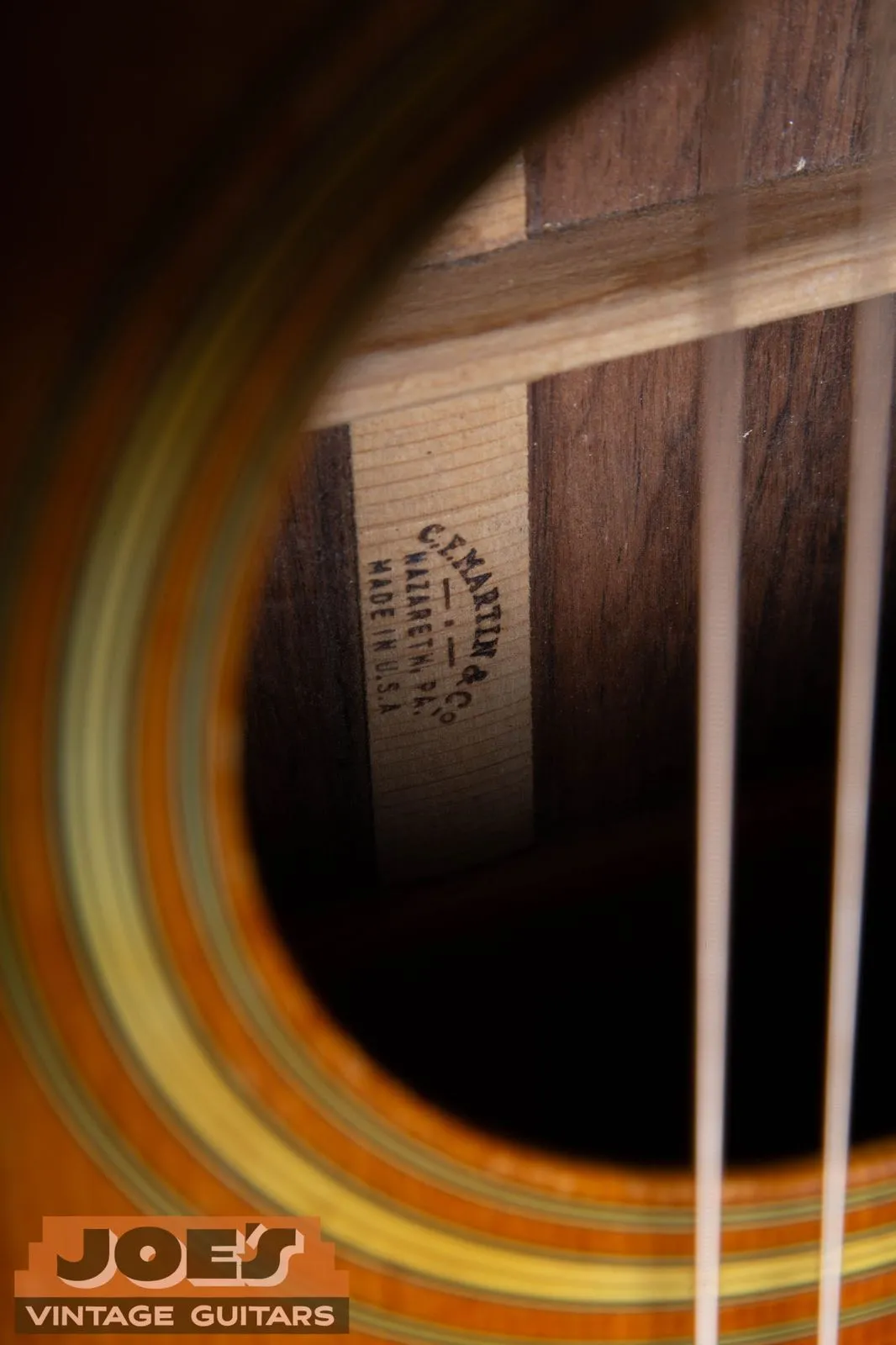
- Martin Headstock Logo Dating
Check logo type alongside the serial and hardware rather than dating from the front decal alone.
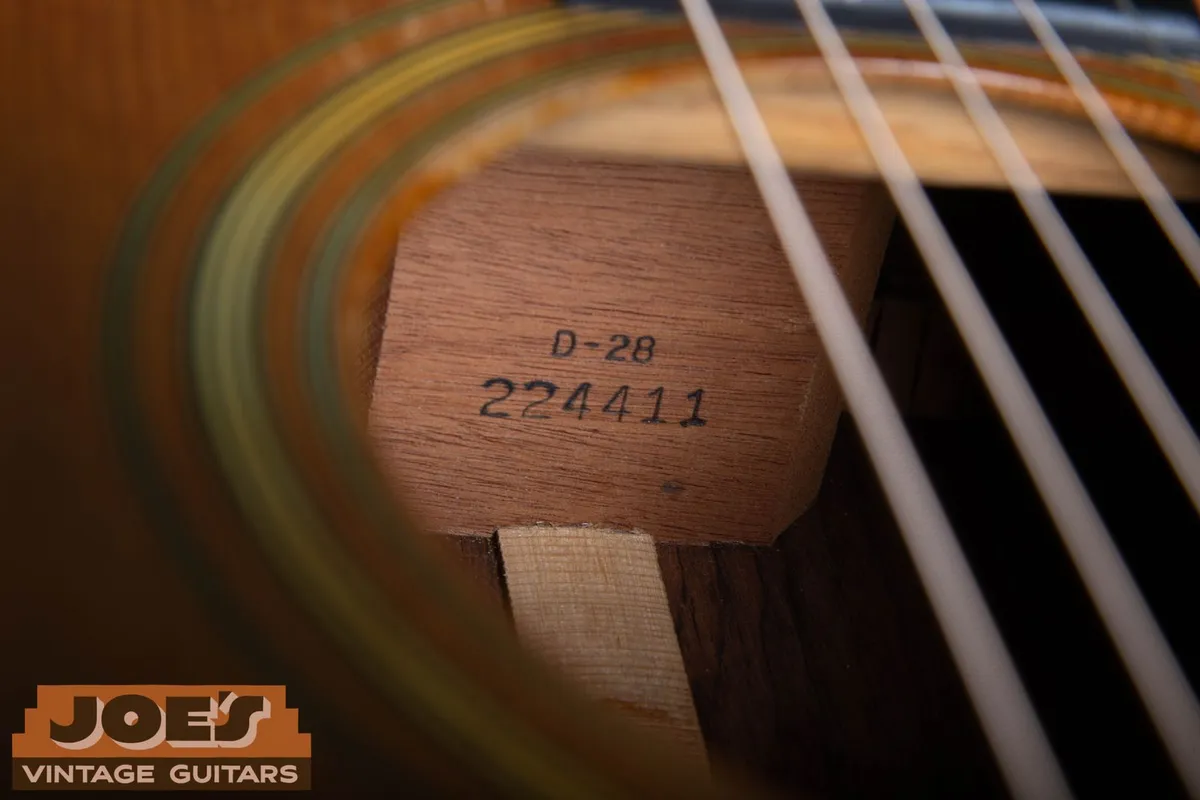
- Martin Neck-Block Stamps
Record the full model designation, suffix and serial while preserving the surrounding wood in photographs.
- Sell A Martin Guitar
Send Joe the details of a Martin you are considering selling.
- Martin Serial And Model Numbers
Find the production year from the neck-block serial.
- Martin Construction And Dating
Follow changes in bridges, necks, braces and materials.
Martin Owners On Working With Joe
“feeling no regrets after selling our 1920’s Martin on to these folks”
“they took the time to look at the photos of my Martin D18 and emailed back an appraisal”
Your Martin’s Model, Year And Condition
Send Joe Photos Of Your Martin
Include the front, back, headstock, model and serial markings, and any known repairs.
Photo Credits
Photographs from the Joe’s Vintage Guitars archive. Each caption identifies the instrument shown, including comparison photographs.