

Dreadnoughts · 1933 To 1969
Martin D-45 History And Changes Through 1969
The D-45 has two distinct early production periods: the original guitars made from 1933 through 1942, and the model’s return in 1968. The first period includes the move from a custom 12-fret guitar to the 14-fret model and the 1939 change to hexagon inlays. The reintroduced D-45 used late-1960s construction.
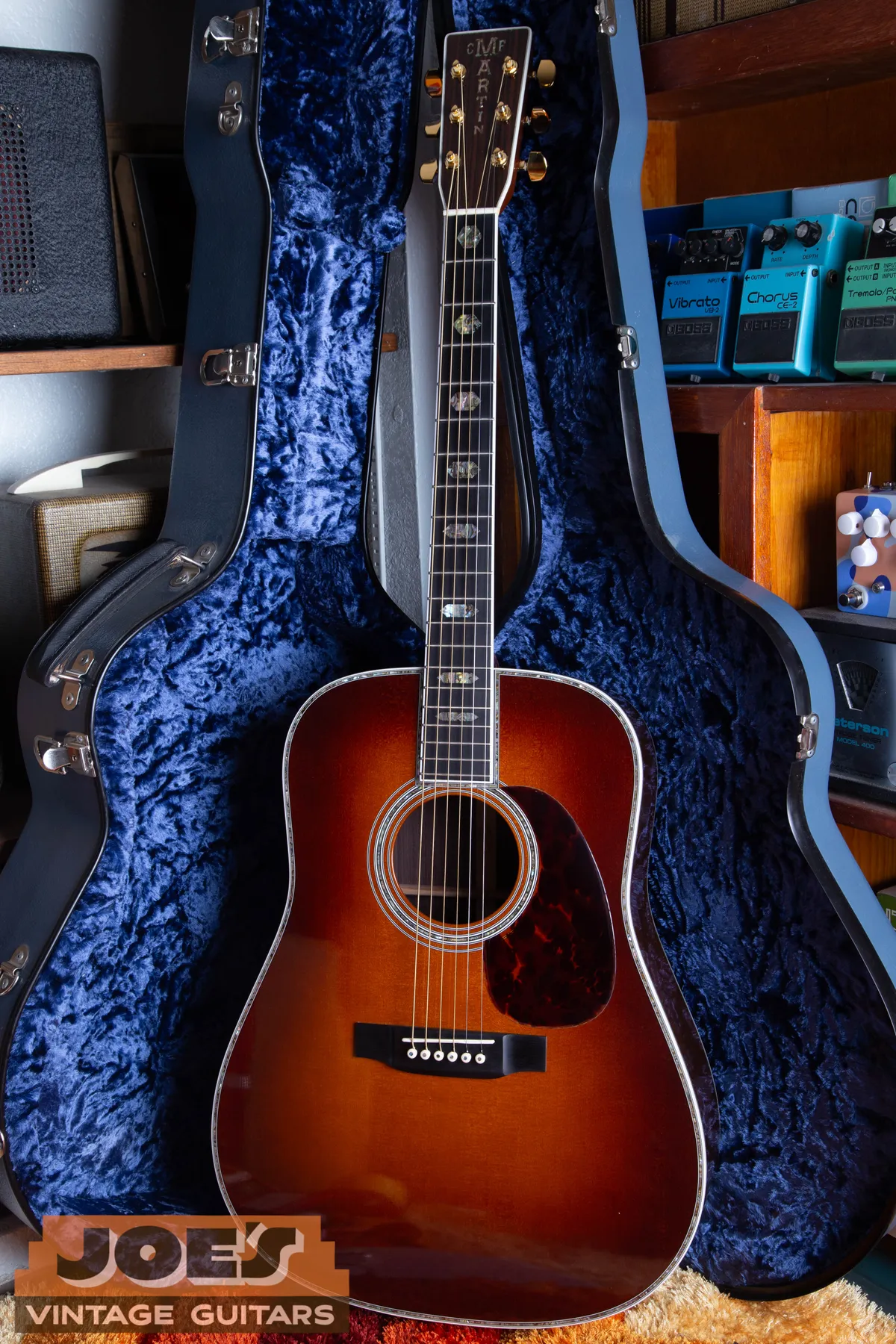
Comparison Photo: 2005 Martin D-45
- Original Production
- 1933 To 1942
- Original Run
- 91 Guitars
- Standard Hexagon Inlays
- 1939
- Production Resumed
- 1968
- Decoration
- Pearl Borders On Top, Back And Sides
D-45 Changes By Year
| Year Or Period | What Changed |
|---|---|
| 1933 | The first D-45 was built for Gene Autry with a 12-fret neck and slotted headstock. Style 45 pearl decoration extended around the top, back and sides. |
| Mid-1930s | Custom production expanded to include 14-fret D-45s alongside the early 12-fret design. |
| 1938 | The D-45 entered the catalog after its earlier custom-order period. Rear-shifted bracing also appears during this period. |
| 1939 | Hexagon fingerboard inlays became the standard D-45 pattern, replacing snowflakes. The standard 14-fret dreadnought nut width narrowed to 1 11/16 inches during this period. |
| 1942 | The original D-45 run ended after a total of 91 guitars. |
| 1968 | The D-45 returned with a 14-fret neck, hexagon inlays and non-scalloped bracing. Martin’s bridge-plate change from maple to rosewood is dated April 9, 1968. |
| 1968 And 1969 | Roughly 230 Brazilian rosewood D-45s were made during the initial revival period. |
| Late 1969 | The revival reached Martin’s transition toward East Indian rosewood for standard production. |
The 1930s: From Custom Orders To The Catalog
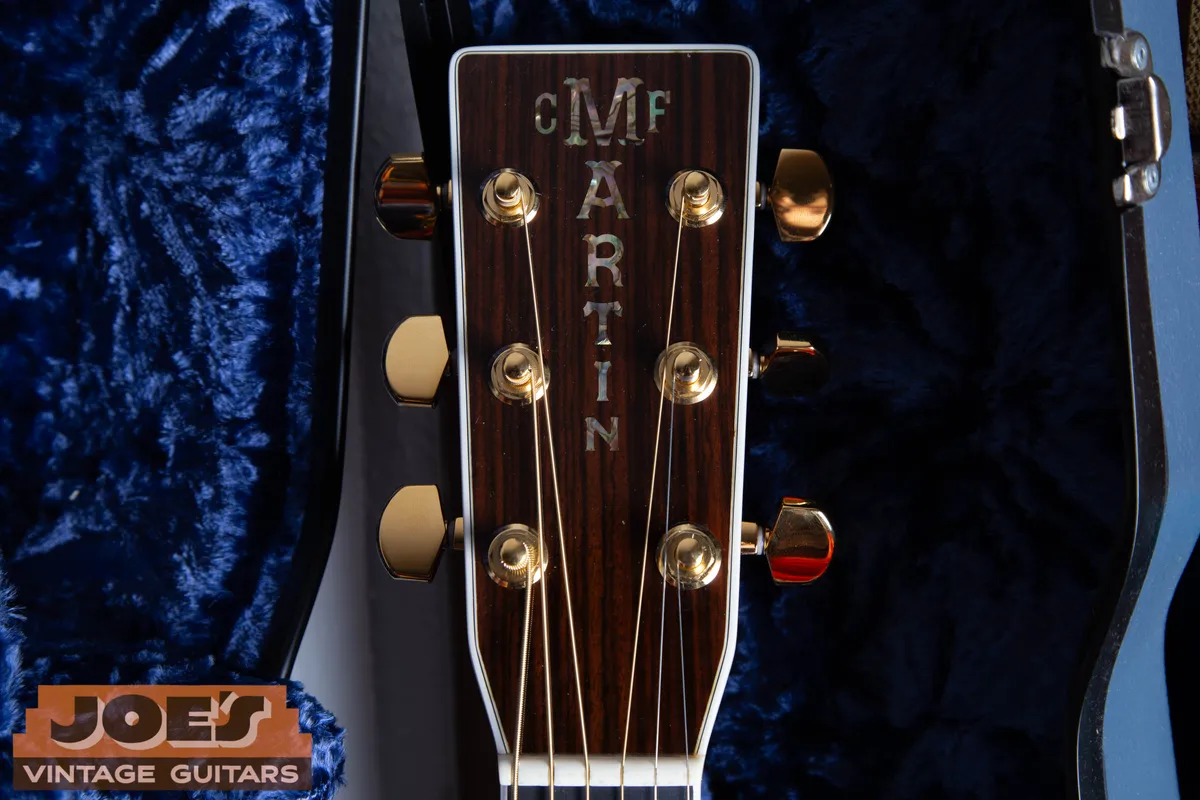
Gene Autry’s 1933 guitar established the D-45 as a pearl-trimmed dreadnought. It had a 12-fret neck and slotted headstock. The small custom-order period that followed included both 12-fret and 14-fret instruments. The D-45 became a cataloged model in 1938.
Style 45 carried pearl around the top, back and sides, with an ornamented fingerboard and headstock. The guitar still belonged to the rosewood dreadnought family: spruce top, Brazilian rosewood back and sides, and ebony fingerboard and bridge. Its decoration distinguished it from the plainer D-28.
1938 And 1939: Bracing, Neck Width And Inlays
The late-1930s dreadnought changes reached the D-45 as well as the plainer models. The X-brace moved rearward in 1938, and the standard 14-fret neck narrowed from a 1 3/4-inch nut to 1 11/16 inches in 1939. The braces remained scalloped.
In 1939, hexagons became the standard fingerboard inlay pattern in place of the earlier snowflakes. Early custom instruments can depart from the standard sequence, so this date describes the production-pattern change rather than a claim that no hexagon example could precede it.
1942: The Original Run Ends
Martin stopped the original D-45 run in 1942. Total prewar production was 91 guitars. That number covers the original run, including the earliest custom instruments; it is not a count of every later guitar carrying a D-45 name.
There was no continuous D-45 production through the 1950s. Later pearl-trimmed conversions of other Martin models belong to their own repair and modification histories, not to the factory’s 91-guitar total.
1968: The D-45 Returns With Postwar Construction
The D-45 returned in 1968 after more than two decades out of production. It combined Style 45 decoration and hexagon inlays with the then-current 14-fret dreadnought construction. The neck used square steel tube reinforcement, and the top had non-scalloped braces.
Martin dates the move from maple to rosewood bridge plates to April 9, 1968. The restored model therefore belongs to a bridge-plate transition year. A late-1960s D-45 is not a prewar structural specification reproduced solely because its model number and pearl trim match.
1969: Brazilian Rosewood And The Material Transition
The first two years of the revival produced roughly 230 Brazilian rosewood D-45s. Published counts vary slightly, so an exact total is less useful than the distinction between this early revival period and the subsequent standard East Indian rosewood production.
By late 1969, Martin was transitioning its rosewood models to East Indian rosewood. The factory D-45 of this period had non-scalloped bracing and square tube neck reinforcement; documented 1969 examples have a large rosewood bridge plate. Those features describe the late-1960s construction, independently of the exterior pearl work.
When Did The D-45 Change From Snowflakes To Hexagons?
The standard D-45 inlay pattern changed to hexagons in 1939. The earlier snowflake pattern belongs to the first part of the original production run. The 2005 D-45 photograph used here is a later hexagon comparison, not a photograph of an original prewar guitar.
Was The 1968 D-45 Built Like A Prewar D-45?
It restored the D-45 model and Style 45 appointments, but its non-scalloped bracing, square steel tube neck reinforcement and late-1960s bridge-plate specifications differed from prewar construction. Joe’s Martin construction timeline explains those changes across the broader guitar line.
Martin Identification Resources
- Martin Neck-Block Stamps
Separate the original factory designation from later added decoration or replacement parts.
- Martin D-28 Authentication Guide
Identify the underlying model when a dreadnought has been decorated or converted.
- Martin OM-45 Authentication Guide
Compare the smaller Orchestra Model while keeping its body, scale and original production period separate.
- Sell A Martin Guitar
Send Joe the details of a Martin you are considering selling.
- Martin Serial And Model Numbers
Find the production year from the neck-block serial.
- Martin Construction And Dating
Follow changes in bridges, necks, braces and materials.
Martin Owners On Working With Joe
“feeling no regrets after selling our 1920’s Martin on to these folks”
“they took the time to look at the photos of my Martin D18 and emailed back an appraisal”
Your Martin’s Model, Year And Condition
Send Joe Photos Of Your Martin
Include the front, back, headstock, model and serial markings, and any known repairs.
Photo Credits
Photographs from the Joe’s Vintage Guitars archive. Each caption identifies the instrument shown, including comparison photographs.