

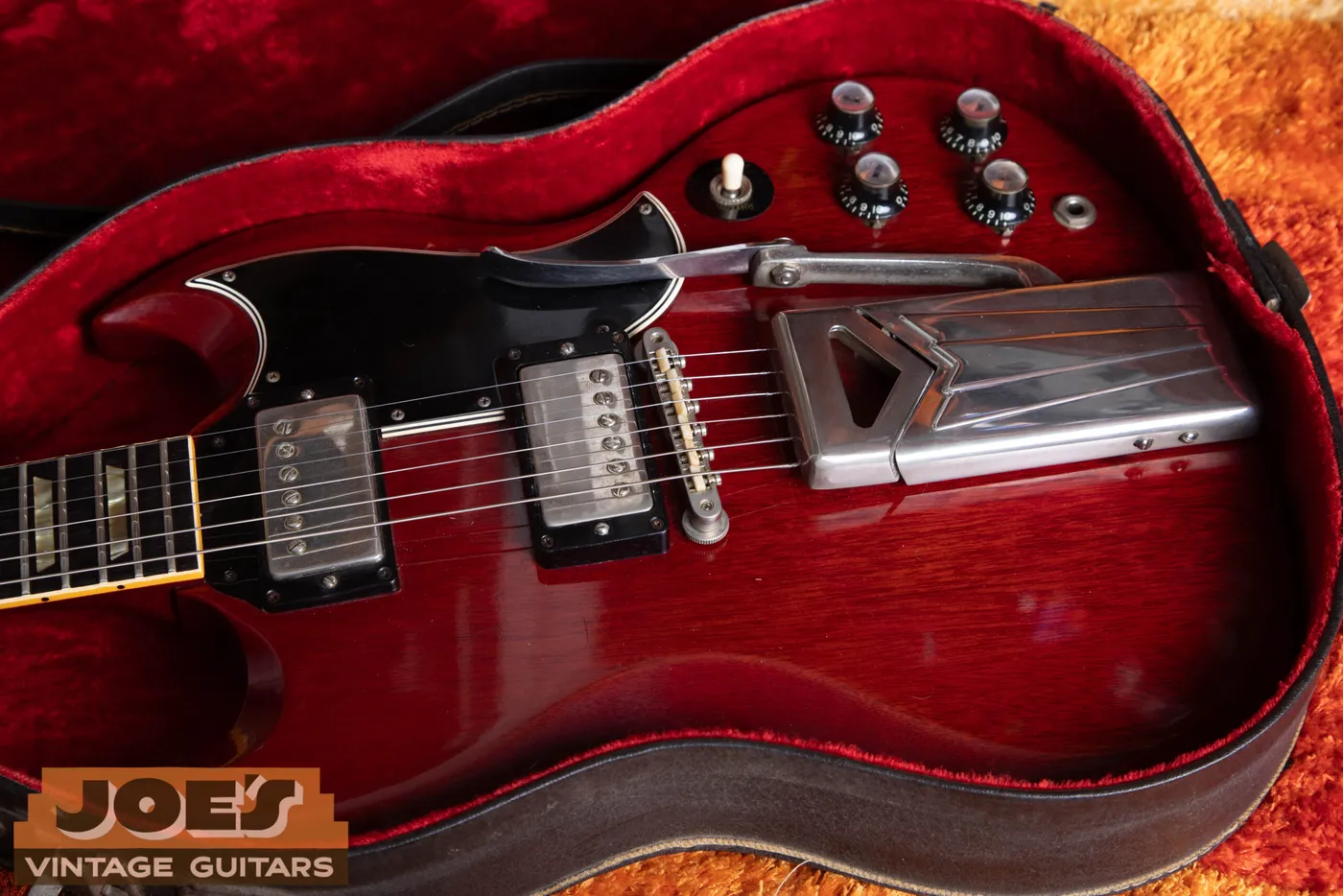
Start Here
How to Tell the Four Vintage SG Models Apart
I use Gibson’s familiar student-to-deluxe hierarchy to sort the thin double-cutaway models. The Junior is spare. The Special adds a second pickup. The Standard moves to humbuckers and dressier trim. The Custom sits at the top with three pickups, gold hardware, and the most elaborate appointments. Browse my vintage Gibson model guides for more instrument-by-instrument research.
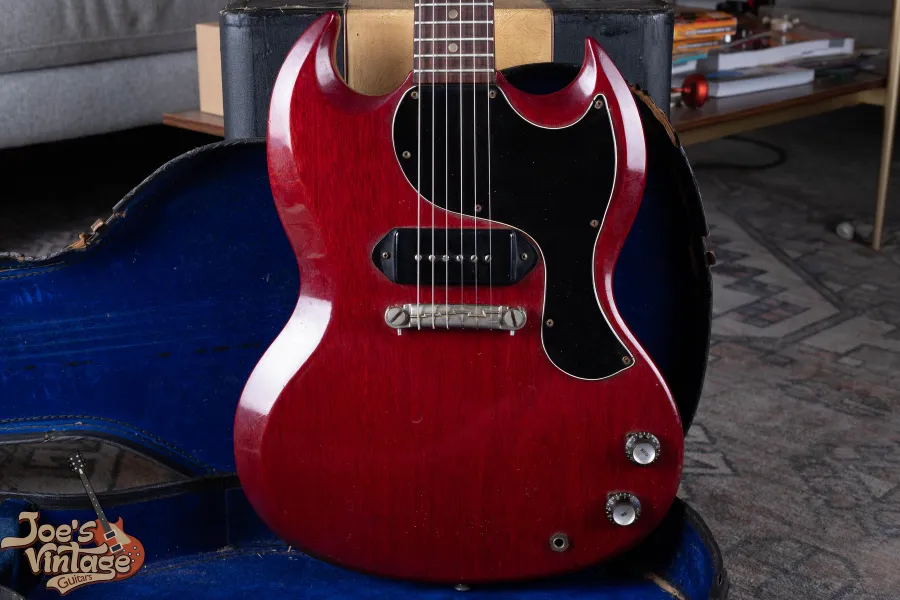
SG Junior
One dog-ear P-90I look for dot inlays, no fingerboard binding, one volume control, one tone control, and a wrapover bridge. Those details make the student model easy to identify.
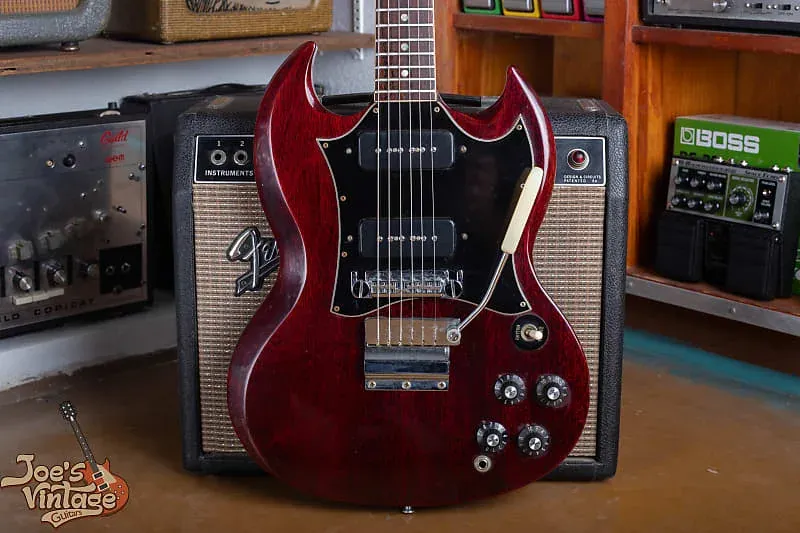
SG Special
Two pickups, usually P-90sI place the Special between the Junior and Standard. Early examples have two soapbar P-90s and dot markers. Some early 1970s Specials received mini-humbuckers.
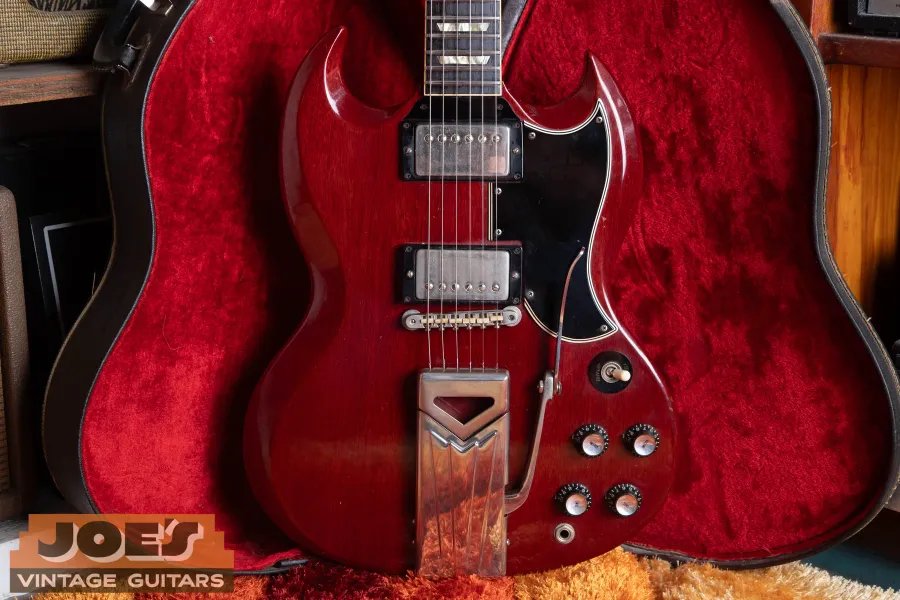
SG Standard
Two humbuckersI look for a bound rosewood fingerboard, crown inlays, four controls, and two full-size humbuckers. Gibson sold the earliest examples under the Les Paul name.
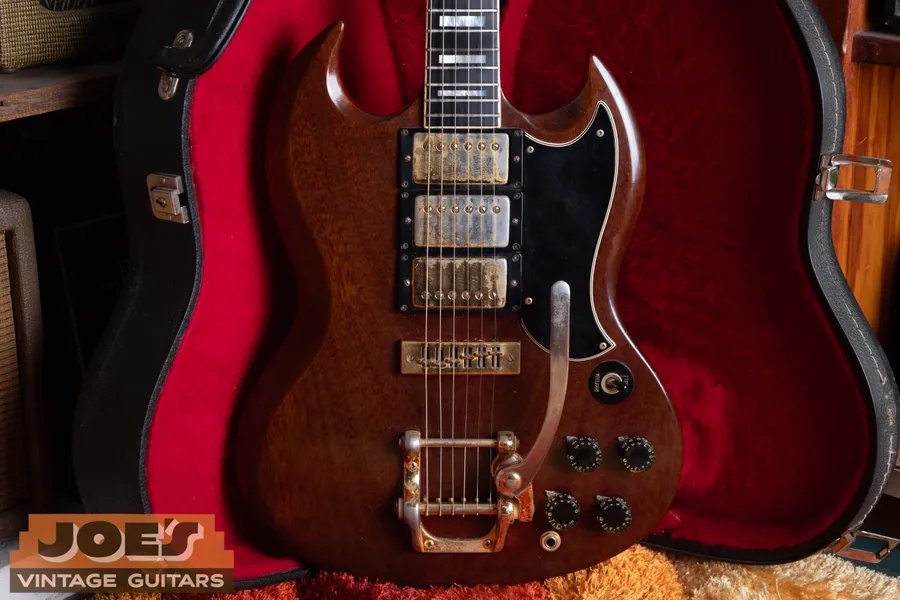
SG Custom
Three humbuckersI identify the top model by its three pickups, ebony fingerboard with block inlays, multi-ply binding, split-diamond headstock, and gold hardware.
| Model | Pickups | Fingerboard | Typical Tailpiece | Controls |
|---|---|---|---|---|
| SG Junior | 1 dog-ear P-90 | Dots; no binding | Wrapover bridge | Two knobs |
| SG Special | 2 soapbar P-90s; early 1970s minis | Dots; simple trim | Wrapover or vibrato | Four knobs and switch |
| SG Standard | 2 humbuckers | Bound board; crowns | Stopbar or vibrato | Four knobs and switch |
| SG Custom | 3 humbuckers | Ebony; blocks; multi-ply trim | Vibrato or later options | Four knobs and switch |
Gibson still sold the earliest SG-shaped instruments as Les Paul models. An early guitar can have the body we call an SG without saying “SG” anywhere on it. My Les Paul Junior evolution guide documents that transition on the one-pickup model. I put more weight on construction and original features than the wording on a truss-rod cover.
Two Humbuckers
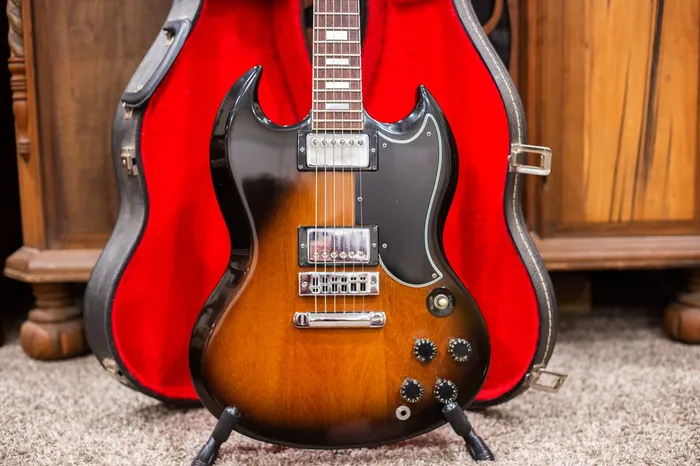
Gibson SG Standard
The Standard is the guitar most players picture when someone says “vintage SG”: two full-size humbuckers, four controls, a bound rosewood fingerboard with crown inlays, and cherry-finished mahogany. I use the hardware and neck details to separate one decade from another, then compare them with my SG Standard dating charts before assigning a year.
What Makes It a Standard
- Two full-size humbuckers. PAFs and Patent Number pickups can appear on the earliest 1961 to 1962 guitars, followed by T-Tops.
- Bound rosewood fingerboard. Crown or trapezoid-style inlays separate it from the dot-marker Junior and Special.
- Four knobs and a selector. The familiar two-volume, two-tone Gibson control layout remains a core clue.
- Model- and era-correct bridge. Stopbars, sideways units, Maestro vibratos, and later hardware must agree with the date.
- 1961 to 1962
- Les Paul/SG name, one-piece mahogany neck, 1 11/16-inch nut, no volute
- 1963 to 1964
- SG name established; one-piece neck; early Patent Number pickup period
- 1965 to 1969
- Narrower 1 9/16-inch nut; T-Top transition; large guard from the later 1960s
- 1969 to 1975
- Three-piece mahogany neck, volute, and walnut finish option
- 1975 to 1984
- Some three-piece maple necks; TP-6 fine-tuner tailpiece from 1977
Finish Atlas
Color Can Rule an Era In or Out
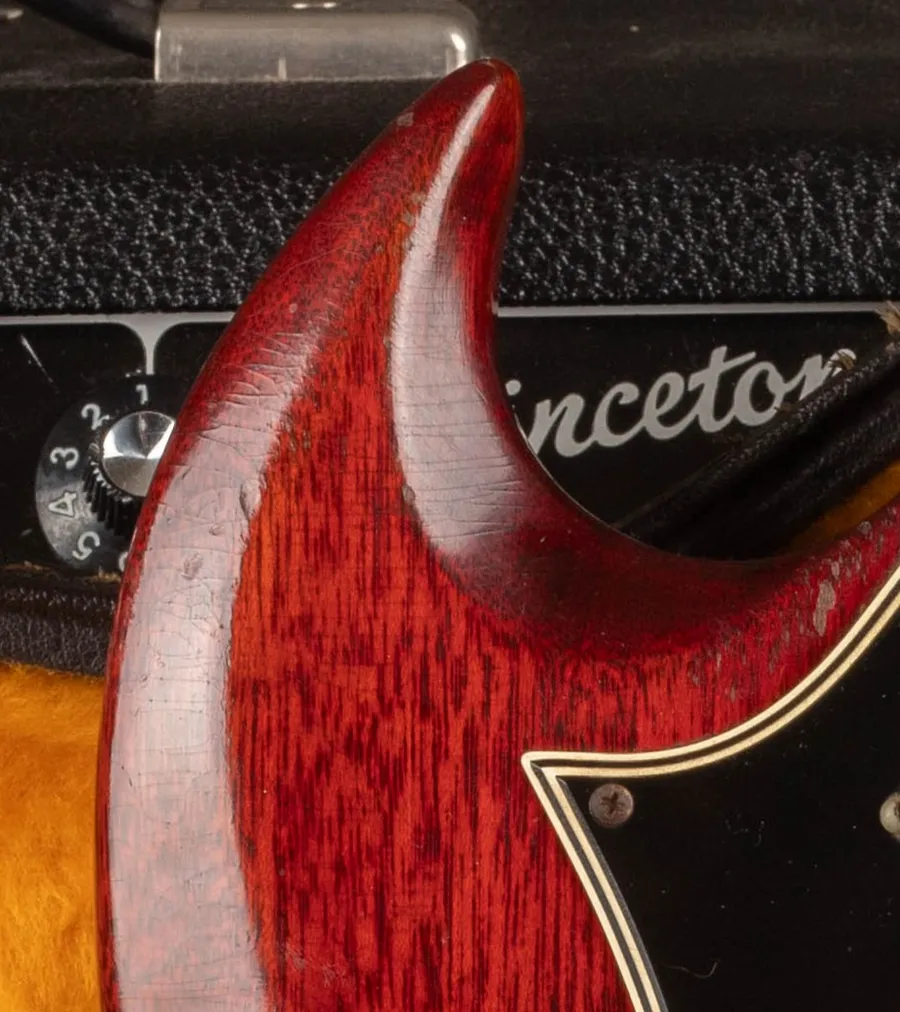
Cherry spans the whole story, so it can’t date a guitar by itself. Rarer colors are more useful once I’ve confirmed the original lacquer.
| Period | Expected Pickup Family |
|---|---|
| 1961 to 1962 | PAF, with early Patent Number overlap |
| 1962 to 1965 | Patent Number humbuckers |
| 1965 to 1975 | T-Top era |
| Period | Construction Clue |
|---|---|
| 1961 to 1969 | One-piece mahogany; no volute |
| 1969 to 1975 | Three-piece mahogany; volute |
| 1975 to 1984 | Some three-piece maple necks |
Three Humbuckers
Gibson SG Custom
I identify the top-line SG by its three humbuckers, gold-plated hardware, ebony fingerboard with block inlays, multi-ply binding, and split-diamond headstock ornament. Gibson introduced it in 1961 as the Les Paul Custom. Early Polaris White examples are easy to recognize, while walnut and ebony appear later.
The Fastest Custom Checks
- Three pickups. That’s the clearest difference from the two-humbucker Standard.
- Gold hardware. Natural plating wear can expose nickel underneath. Uniform bright plating deserves a closer look.
- Deluxe trim. Ebony board, block inlays, multi-ply binding, and the headstock diamond should read as one coherent package.
- Original routing. Pull the guard before assuming a three-pickup conversion is a factory Custom.
Les Paul Custom
Three PAFs, a one-piece mahogany neck, gold hardware, deluxe binding, and typically Polaris White. These are the earliest and most collectible.
SG Name, Evolving Hardware
Patent Number pickups give way to T-Tops. The nut narrows after 1965, and Grover Rotomatics become common around the later 1960s.
Norlin Construction
Three-piece necks, volutes, walnut or ebony finish options, and later TP-6 hardware separate these from the early white Customs.
Two Pickups, Simpler Trim
Gibson SG Special
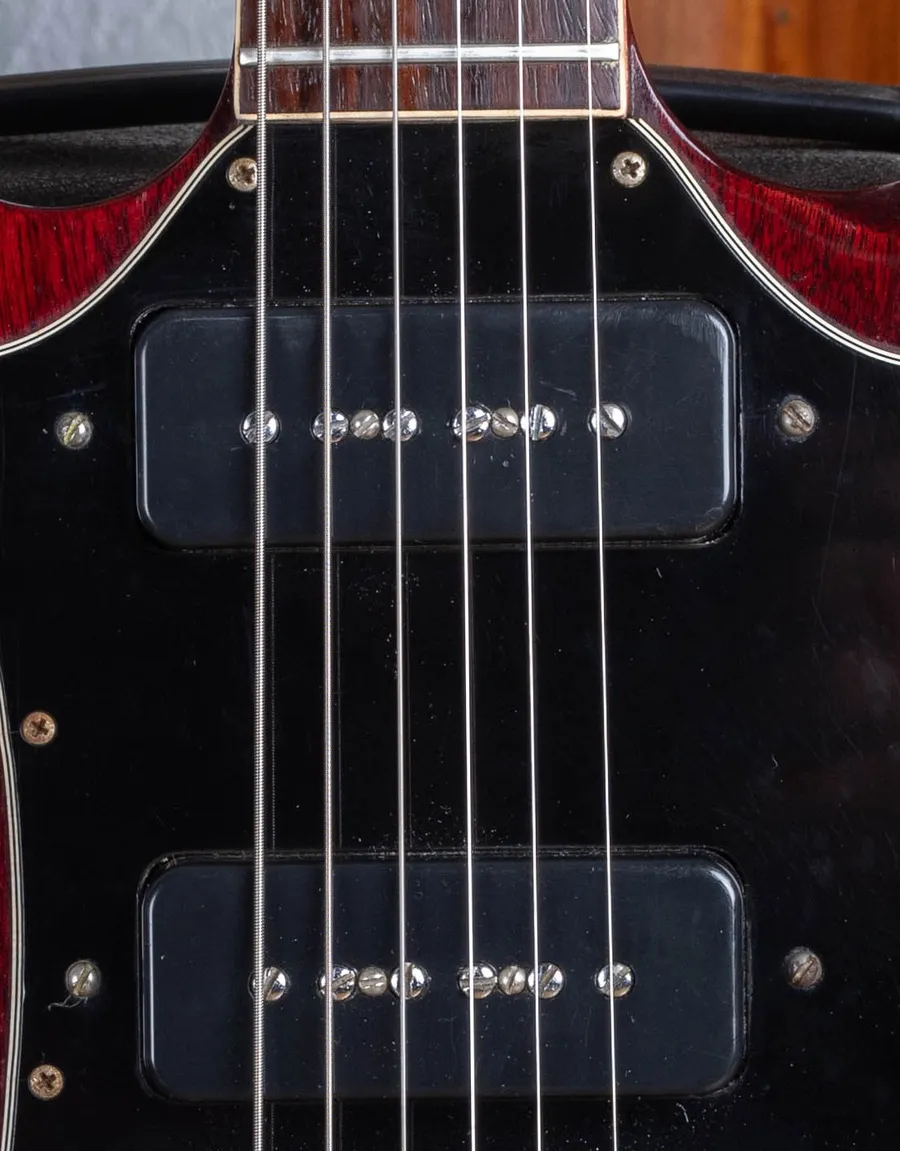
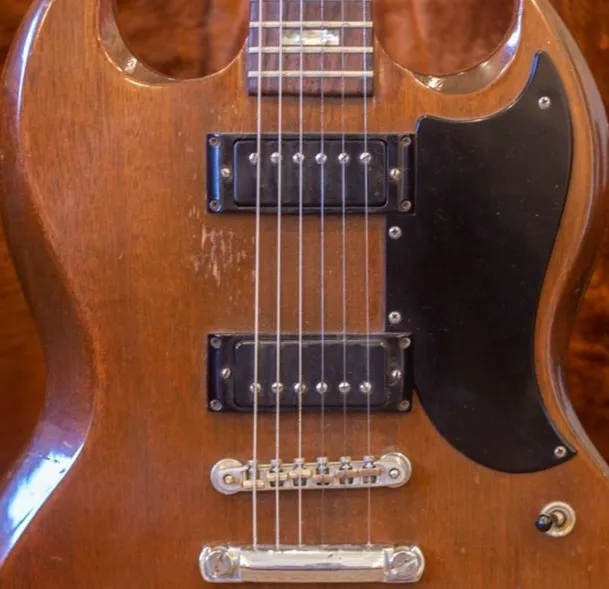
I place the classic SG Special between the Junior and Standard. It has two pickups and four controls, but it keeps dot inlays and simpler trim. Early examples use two soapbar P-90s. Some early 1970s Specials received mini-humbuckers, as documented in my Gibson SG model guide.
Les Paul Special / SG Body
Two soapbar P-90s, thin one-piece mahogany neck, no volute, and cherry, white, or scarce TV Yellow finishes.
The P-90 SG Special
The SG name is established, while the two-soapbar layout remains the model’s strongest visual signature. Later guitars follow the larger-pickguard transition.
Mini-Humbucker Variation
Mini-humbuckers appear on some early 1970s Specials. I don’t reject one by pickup type alone, but I inspect the routes because later pickup swaps are common.
One Pickup, One Purpose
Gibson SG Junior
The Quickest SG to Recognize
One Dog-Ear P-90. Two Knobs. No Binding.
Gibson’s student model entered the SG shape in 1961 but kept the Les Paul Junior name through 1962. In my complete Gibson Les Paul Junior guide, I follow that evolution from the 1954 slab body into the SG transition. I identify an SG Junior by its thin pointed body, single bridge-position dog-ear P-90, wrapover bridge, dot markers, and two-control layout.
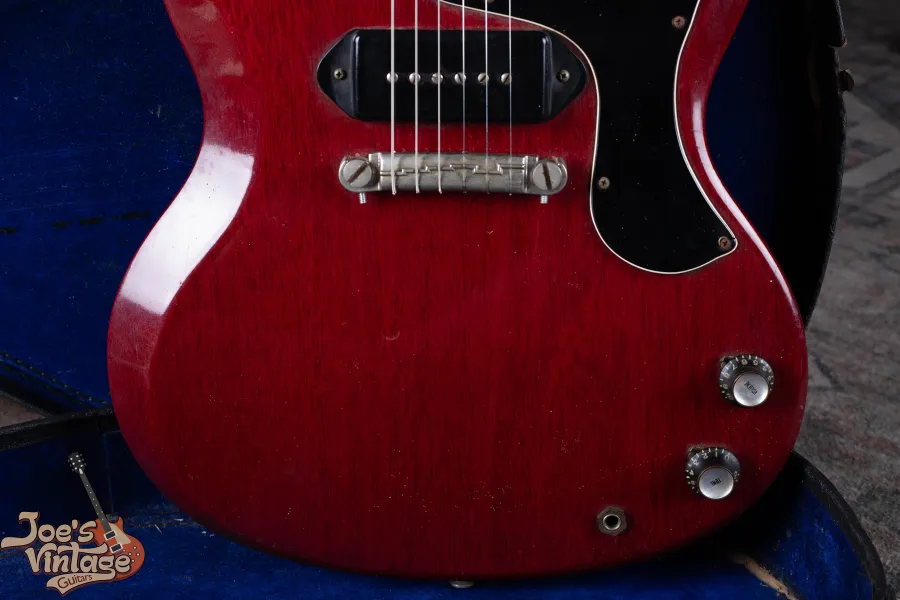
A period SG Junior should make sense around a wrapover bridge. An ABR-1 or Tune-o-matic can indicate a conversion, altered body, or misidentified guitar. Look for post holes, plugs, and finish disturbance.
The Whole Family
Vintage Gibson SG Production Timeline
Factory changes overlap, so I treat these as working eras rather than strict January-to-December rules. A transitional guitar can carry features from both sides of a date line. Pair this timeline with my Gibson SG production and shipping totals to see how Standard, Custom, Special, and Junior output changed by year.
The Les Paul/SG Transition
The pointed double-cutaway body replaced the familiar single-cut Les Paul shape. Standards and Customs were sold as Les Paul models, and Juniors also retained Les Paul branding. These are the earliest and most sought-after SG-bodied instruments.
The Classic Small-Guard SG
The SG name was established across the line. Maestro-style vibrolas became closely associated with Standards and Customs, while Juniors and Specials kept their direct P-90 character. Nut widths begin to narrow during 1965.
The Batwing Period
The large pickguard moved around the pickups and became the fastest visual clue for a later 1960s SG. Narrow 1 9/16-inch nuts, T-Top humbuckers, chrome hardware, and a changed neck joint help separate these from the early small-guard instruments.
The Early Norlin Transition
Three-piece mahogany necks and a volute became important construction clues. Walnut joined cherry in the finish palette, and the catalog briefly made room for the SG Deluxe, SG Pro, and the budget SG-100, SG-200, and SG-250 series.
The Experimental Catalog
Familiar names briefly gave way to SG Deluxe, SG Pro, SG-100, SG-200, and SG-250. Front-mounted control plates, altered pickup layouts, and unusual hardware make this short run visually distinct from both 1960s and later 1970s SGs.
Mid- and Late-Norlin SGs
Some necks moved to three-piece maple, hardware kept evolving, and the TP-6 fine-tuning tailpiece appeared from 1977. Standard, Custom, Special, and derivative model names overlap across a period best dated by construction plus electronics.
Short-Lived 1970s SG Offshoots
SG Deluxe and SG Pro: transitional models with hardware and control layouts that don’t follow the earlier Standard/Special template.
SG-100, SG-200, and SG-250: budget models from the early 1970s; pickup count and front-mounted electronics help tell them apart.
SG I, II, and III: later numbered variants that belong to the wider SG family. I wouldn’t represent one as a Standard, Special, Junior, or Custom.
Hardware Atlas
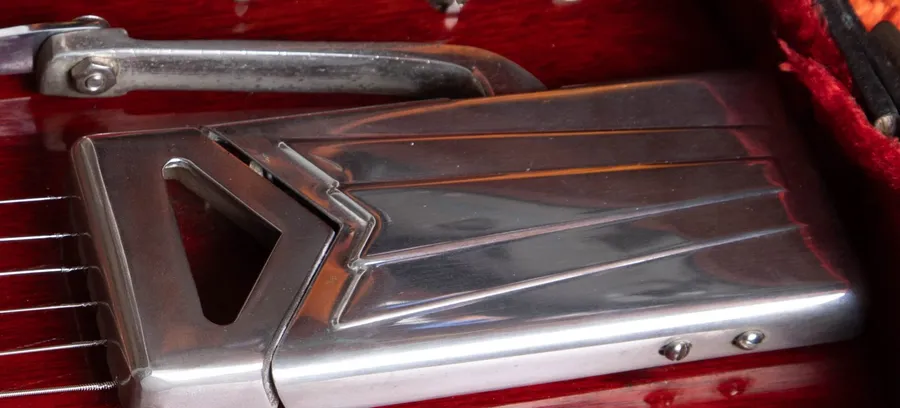
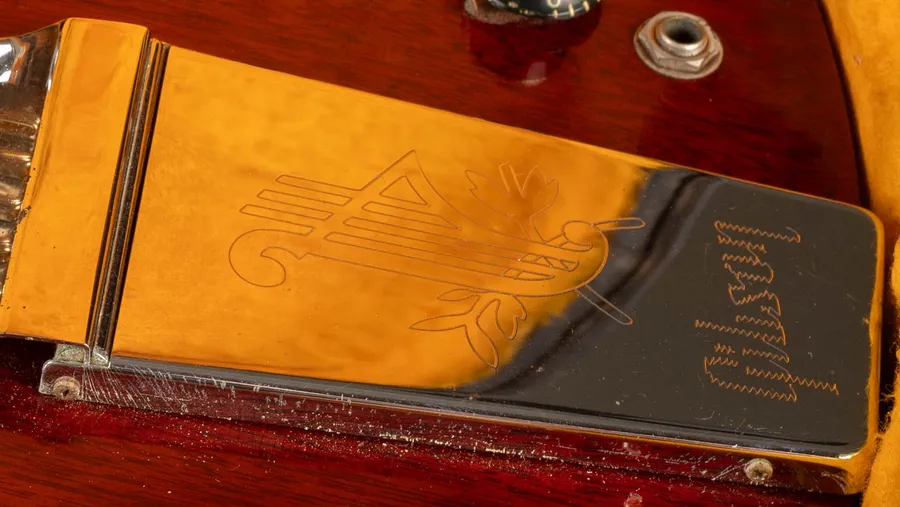
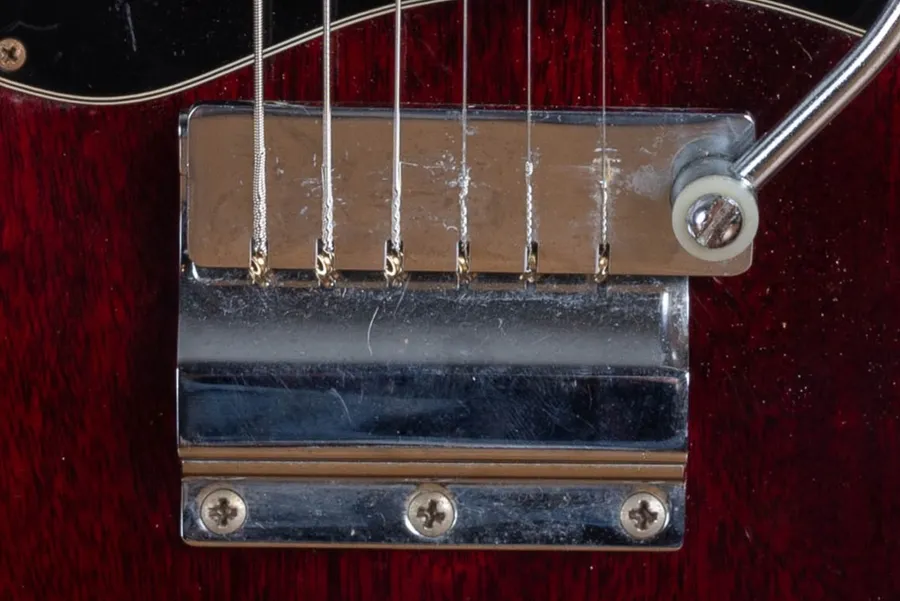
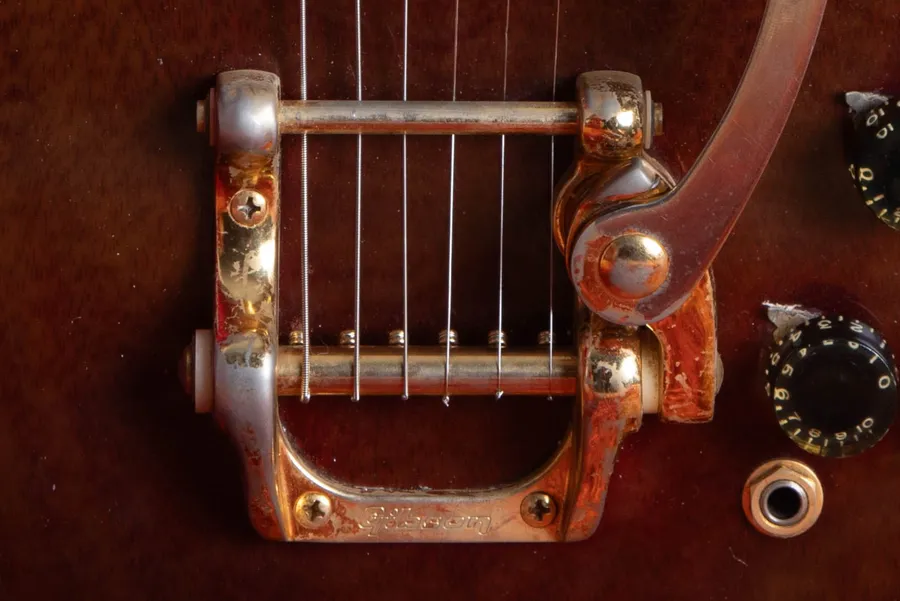
Four SG Vibratos That Change the Identification
Tailpiece type is one of the most visible dating clues. It’s also one of the easiest parts to replace. I study the unit’s footprint, screw holes, bridge, plating, and finish shadows to decide whether it has always been on that guitar. Then I compare the whole instrument with my complete Gibson serial number guide.
Visual Dating
How I Identify an Unknown SG
I start with features that require permanent woodwork, then move toward parts that can be changed with a screwdriver. I check the serial number near the end of the sequence. Once the physical evidence agrees, I use my free Gibson serial number decoder to test the date.
Establish the Model
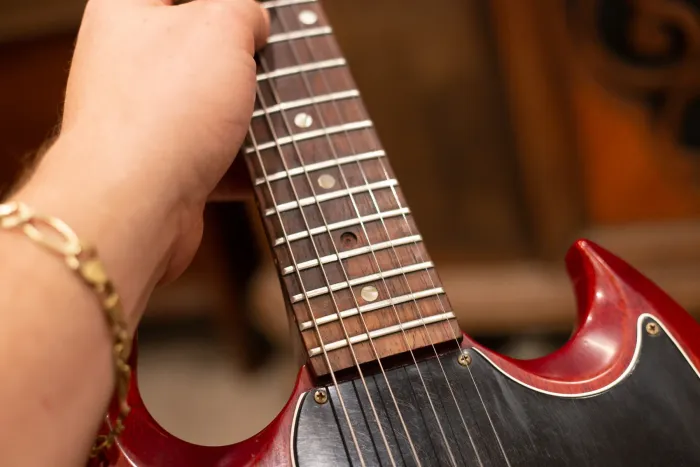
Count the pickups, identify their type, and confirm the control layout, fingerboard markers, binding, and headstock trim.
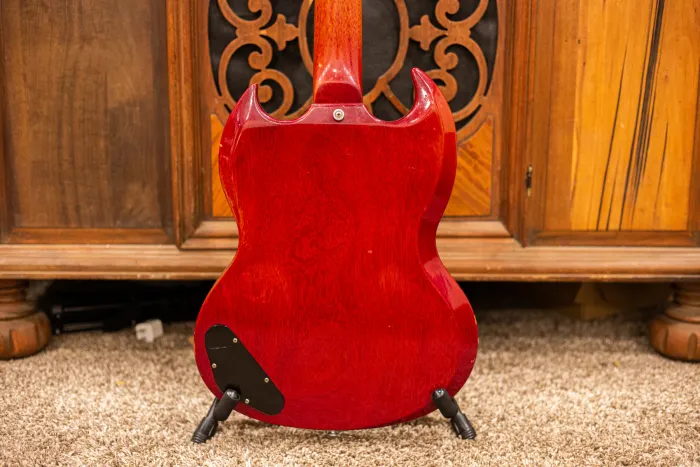
Read the Body and Pickguard
Small guard, large batwing guard, control plate, bevel shape, and neck-joint position narrow the production era before a number is decoded.
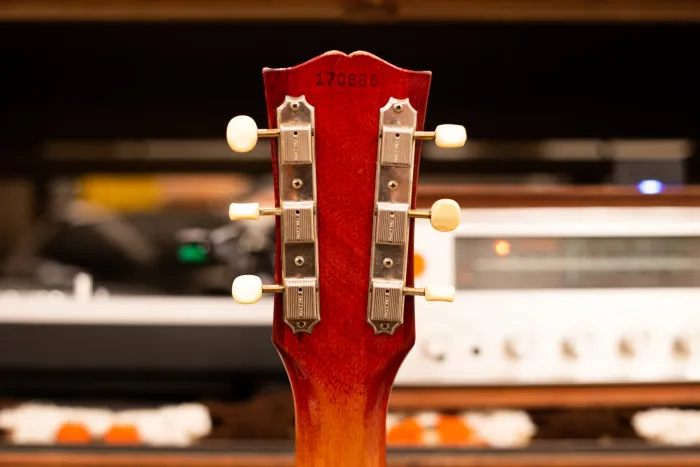
Measure the Nut and Study the Neck
Early guitars are generally 1 11/16 inches at the nut. Many 1965 to 1969 examples narrow to about 1 9/16. One-piece versus three-piece construction and a volute are major clues.
Match the Bridge and Vibrato
Wrapover, sideways, Lyre, short Maestro, Bigsby, stopbar, and TP-6 systems belong to different models and periods. Extra or plugged holes record earlier hardware.
Inspect the Pickups and Harness
Baseplates, stickers, patent markings, lead wire, pot date codes, capacitors, and untouched solder should support the claimed era together.
Look for Repairs and Finish Work
Check the headstock, neck heel, pickup routes, tuner footprints, and protected finish under guards. UV light can expose overspray and touch-up.
Cross-Check the Serial Number
Only after the guitar has an evidence-based model and era should the headstock number, Made in USA stamp, and production references be used to test the conclusion.
Before Buying or Selling
Vintage SG Authentication Checklist
I’ve seen plenty of light, playable SGs with repairs or modifications earned through years of use. That history can still leave you with a wonderful instrument, but the description and price must reflect it. If the clues don’t line up, send me the photographs through my free vintage guitar appraisal for a second look.
Photograph the full front and back before removing any parts; document every screw and finish shadow as found.
Inspect the back of the headstock and the neck heel under strong side light for glue lines, overspray, or a change in lacquer texture.
Remove the pickguard when permission allows and look for enlarged pickup routes, plugged bridge holes, and added vibrato holes.
Confirm that pickup baseplates, stickers, leads, solder joints, pot date codes, and capacitors agree with one another.
Compare tuner footprints and screw holes. Replaced tuners are common even when vintage-looking replacements are installed.
Check cherry or custom-color finish in protected areas. Original aging should make physical sense around guards and hardware.
Record the case, paperwork, receipts, and old photographs. Provenance can support both authentication and value.
A Serial Number Is Evidence, Not a Verdict.I expect the body, neck, finish, hardware, and electronics on a vintage Gibson to tell the same story.
Collector Value
What Makes One Vintage SG Worth More Than Another?
I use the model and year to establish the market category. Finish, originality, condition, repairs, and documentation decide where an individual guitar sits inside it. My vintage Gibson value-by-year guide explains the wider market context. If you’re ready for an offer, go directly to Sell My Gibson.
Exact Model and Era
I value an early SG/Les Paul Standard in a different market from a 1970s SG Standard, even when both guitars are original.
Original Finish
Natural cherry fade isn’t damage. I treat a refinish, overspray, or color change as a major value issue.
Pickups and Electronics
I look for original PAF, Patent Number, or P-90 pickups and an undisturbed wiring harness.
Breaks and Repairs
I see headstock and neck joint repairs often. The quality and visibility matter, but any break affects collector value.
Hardware and Plastics
I check that the tuners, bridge, vibrato, pickguard, knobs, and pickup rings match the claimed production period.
Color, Case, and History
I consider documented custom colors, the correct case, receipts, family photographs, and a clear ownership story.
A Repaired SG Can Still Be a Very Good Guitar
A stable professional repair and clear pricing can make a broken-and-repaired SG an excellent player. I don’t value it like an otherwise equivalent unbroken collector example.
Use the Complete Research Set
Keep Researching on Joe’s Vintage Guitars
I use these resources from the Joe’s Vintage Guitars home page to move from broad SG identification to pickup authentication, serial-number cross-checking, production context, year-based value, and the earlier Junior story.
Identify PAF, Patent Number, and T-Top pickups by their construction, decals, hardware, and era.
Read the GuideGibson Serial Number DecoderUse my decoder as a starting point, then verify the guitar’s physical features.
Read the GuideGibson Production and Shipping TotalsCompare recorded SG Standard, Custom, Special, and Junior shipments by year.
Read the GuideLes Paul Junior Authentication GuideFollow the Junior from the 1954 slab body through the 1961 SG transition.
Read the GuideHow Gibson Year Affects ValueSee where the 1960s transition and Norlin years fit in the larger Gibson market.
Read the GuideCommon Questions
Vintage Gibson SG FAQ
Is a 1961 Gibson SG Actually a Les Paul?
Yes. The body is the design we now call the SG, but Gibson initially sold the Standard and Custom under the Les Paul name. Early Juniors also kept Les Paul branding. By 1963, the SG name was established across the family.
What Is the Difference Between an SG Junior and SG Special?
A vintage SG Junior has one dog-ear P-90 at the bridge and two controls. A vintage SG Special has two soapbar P-90s, a selector switch, and four controls. Both are plainer than a Standard.
Does an SG Serial Number Prove the Year?
No. Gibson reused and overlapped serial ranges during the 1960s. I check the number against the pickguard, neck joint, nut width, hardware, pickup codes, pot codes, and construction.
Does a Repaired Headstock Make a Vintage SG Worthless?
No, but it changes the market. A clean, stable repair can make a good player’s guitar. I still value it below an otherwise equal unbroken example.
Which Vintage SG Models Are Worth the Most?
Early Les Paul branded Standards and Customs usually sit near the top. I still judge each guitar by its originality, condition, finish, pickups, repairs, and history.
When Did Gibson Add a Volute to the SG?
I start seeing volutes around the 1969 transition into early Norlin production. Gibson changes overlapped, so I compare the volute with the neck construction, Made in USA stamp, hardware, finish, and electronics.
Did Vintage SG Specials Come With Humbuckers?
Yes, but the factory exception is the mini-humbucker version found on some early 1970s examples. The classic early SG Special has two soapbar P-90s. I still check that the pickup routes, pickguard, and the rest of the guitar agree with the claimed model and year.
Is Pelham Blue an Original Vintage SG Color?
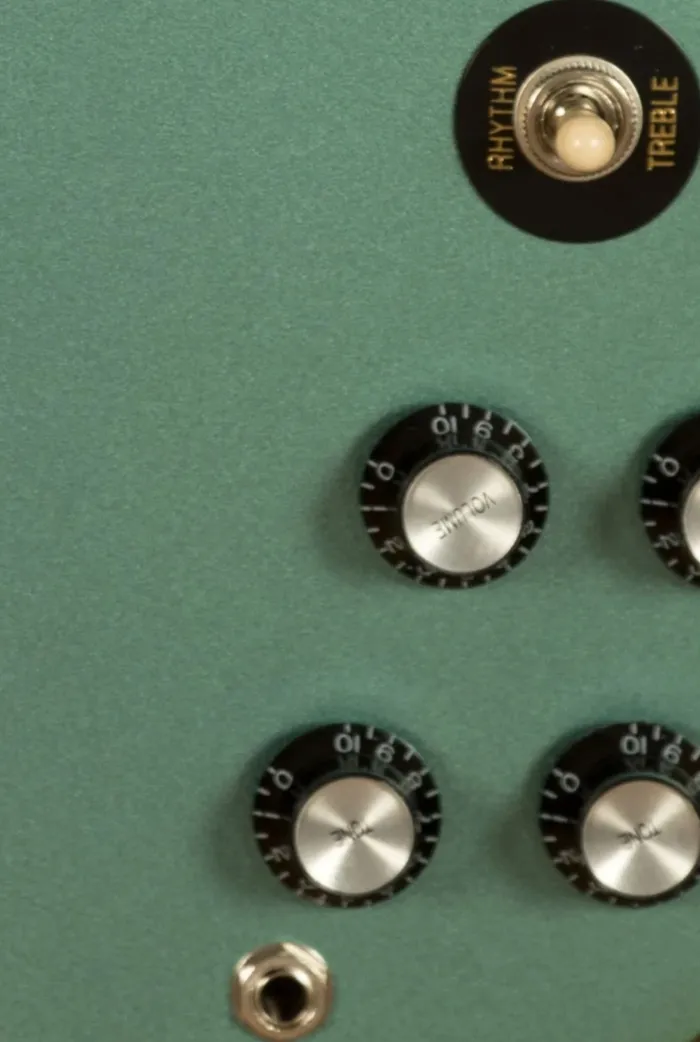
Yes. I see Pelham Blue on a small number of 1960s SGs, and it’s far less common than cherry. I check a valuable custom color claim under the guard and with ultraviolet light for original lacquer, fading, overspray, and finish work.
About the Photographs and Research
The photographs come from guitars I’ve documented at Joe’s Vintage Guitars and in my Gibson serial number and dating guide. I cross-check production context with my Gibson shipping totals. Factory changes overlap, so I don’t treat any single feature as proof of a production year.