

The Collector's Field Guide · 1850s to Today
Martin 0, 00 & 000 Guitars
Three small-bodied Martins. More than a century of changes. Here is how I read the woods, trim, neck joint, bracing, tuners, and repairs, and what those details mean when it is time to buy, sell, or appraise one.
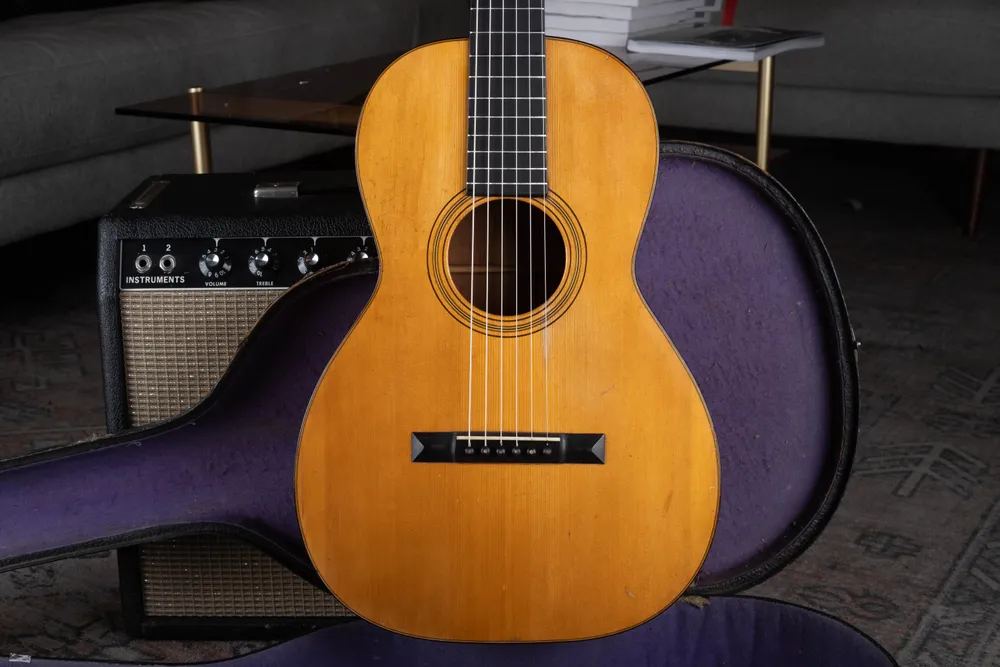
Every guitar has a story, but the model stamp only tells you the first sentence. A 1929 12-fret 000-28, a 1935 14-fret 000-28, and a 1965 000-28 share a basic name, but not their architecture, materials, response, or market. I start with the stamp and serial number, verify the year with my Martin serial number and model guide, then read the guitar itself.
Use the body-size and style decoder to read the model designation, then compare the headstock logo and tuner details with dated examples.
Decode the Stamp
The Martin Model Families
The number before the hyphen identifies body size. The number after it identifies style, traditionally controlling woods and ornament. The style number began as a price, but became Martin's durable specification language. Not every size and style was offered every year.
Style 15
0-15 · 00-15 · 000-15All-mahogany, austere trim, rosewood board and bridge; prized for dry, direct fundamentals.
Style 17
0-17 · 00-17 · 000-17The all-mahogany economy family. Black or dark finishes appear in important periods.
Style 18
0-18 · 00-18 · 000-18Spruce over mahogany with restrained trim: the benchmark small-body Martin workhorse.
Style 18K
0-18K · 00-18K · 000-18KKoa construction. Early K models may have been built for Hawaiian playing.
Style 21
0-21 · 00-21 · 000-21 · 00-21NYRosewood with quieter trim than Style 28. The 12-fret 00-21 is a connoisseur favorite.
Style 28
0-28 · 00-28 · 000-28Spruce over rosewood. Classic pre-1947 examples carry herringbone top trim.
Gut and Classical 28
00-28G · 00-28C · 000-28CGut-string and classical families with different necks, bridges, bracing, and intended tension.
Styles 30 and 34
0-30 · 0-34 · scarce early pairingsElaborate 19th-century marquetry and pearl vocabulary; exact period details determine identity.
Styles 40 and 40H
00-40H · rare early Style 40Pearl-trim lineage. The 00-40H was built for Hawaiian play and conversions require scrutiny.
Styles 42 and 45
0-42 · 00-42 · 000-42 · 0-45 · 00-45 · 000-45Pearl flagships. Style 45 extends decoration to the back and sides; prewar 000-45s sit at the summit.
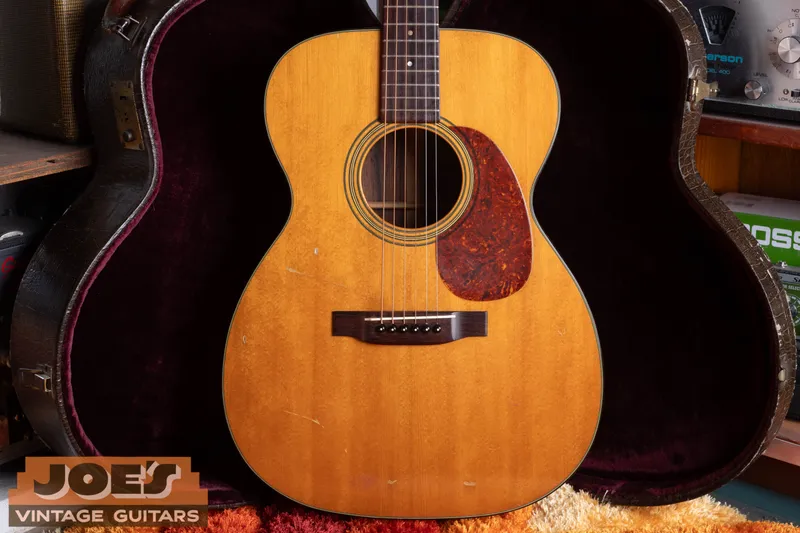
Size predicts feel and air volume. Style predicts wood and ornament. Year predicts structure.
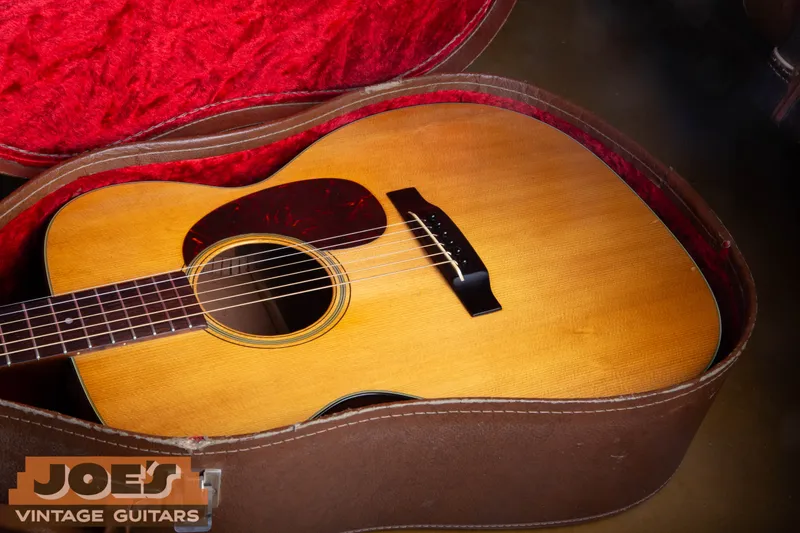
Geometry Matters
Martin 0 vs. 00 vs. 000: Size and Sound
Fast, focused attack and surprising depth for its width.
The balanced middle ground, especially loved in 12-fret form.
More top area, bass reach, and headroom. The 14-fret outline is shared with the OM.
Typical Martin 0, 00, and 000 Dimensions
| Model Size | Lower Bout | Typical Body Length | Common Scale Length | Neck Joint |
|---|---|---|---|---|
| Martin 0 | About 13 1/2 in. | About 19 1/8 in. | About 24.9 in. | 12 or 14 frets, depending on era |
| Martin 00 | About 14 1/8 in. | About 19 5/8 in. | About 24.9 in. | 12 or 14 frets, depending on era |
| Martin 000 | About 15 in. | About 20 3/8 in. | About 24.9 in.; early OM generally 25.4 in. | 12 or 14 frets, depending on model and era |
Construction Chronology
Vintage Martin 0, 00 & 000 History by Era
Pre-Serial
Labels, address stamps, outline, bracing, neck joint, bridge, and marquetry must agree. Many instruments predate formal model names.
Serial Era, Gut-String Design
Serial numbers begin, but most guitars remain intended for gut. Delicate tops and small bridge plates demand conservative setup.
Hawaiian Steel to Spanish Steel
Steel appears through Hawaiian orders, then Spanish steel regulation spreads by style: 17 around 1922, 18 around 1923, and 28 around 1926.
The OM Revolution
The OM establishes long scale, 14 frets, and modern neck access. Bar frets and ebony neck reinforcement mark much of the era.
The Peak Prewar Recipe
T-frets and steel T-bars arrive. Forward-positioned scalloped X-bracing, red spruce, hide glue, and light construction drive demand.
Rear-Shifted, Still Scalloped
The X moves rearward, but braces remain scalloped. Wartime material substitutions create distinctive neck and tuner combinations.
Tapered Braces and Spruce Transition
Scalloping ends, tapered braces appear, and red spruce gives way to Sitka during 1946. Transitional examples vary.
Postwar Classics
Sitka becomes standard and builds gradually grow more robust. Excellent instruments generally trade below comparable prewar examples.
Factory and Rosewood Transition
The short saddle arrives, maple replaces the small rosewood bridge plate in 1968, and standard Brazilian rosewood ends in 1969.
Heavier Builds and Revivals
Larger bridge plates appear. Later Vintage, Authentic, New Yorker, Custom Shop, and limited models must be judged by actual specifications.
The X-brace position did not change on every size at once. The 0 and 00 shift around 1935 to 1936; the important 000 change comes around mid-1938. Production transitions can overlap, so the individual guitar wins every argument.
Voice, Scarcity, Identity
Woods, Trim & Hardware
Top Woods
Red spruce, commonly called Adirondack in the vintage market, is associated with the most desirable pre-1946 steel-string Martins. Sitka spruce becomes normal during 1946. A distinctive group of 1953 tops is often described as Engelmann or government-surplus spruce. Color alone is not identification.
Back and Sides
Mahogany defines Styles 15, 17, and 18. Brazilian rosewood defines classic Styles 21, 28, 42, and 45 through 1969 standard production. East Indian rosewood follows. Koa appears in K models and special runs. Early production can also include maple, Gonçalo Alves, and veneers.
Trim as Evidence
Count purfling lines and inspect rosette, binding, backstrip, end graft, fingerboard inlay, headstock treatment, and pearl boundaries as one system. Pre-1947 Style 28 herringbone is important, but herringbone alone proves nothing.
Bridges and Bridge Plates
Early guitars can carry pyramid bridges. Belly bridges become normal in the 1930s. Long through-saddles precede the mid-1960s short drop-in saddle. Small original rosewood bridge plates differ dramatically from oversized repairs; Martin changes to maple in 1968 and later plates grow larger.
From Joe's Archive
Five Small Martins, Five Different Stories
These examples show why size, style, year, wood, and originality have to be read together. They also connect the model chart to real guitars Joe has handled.
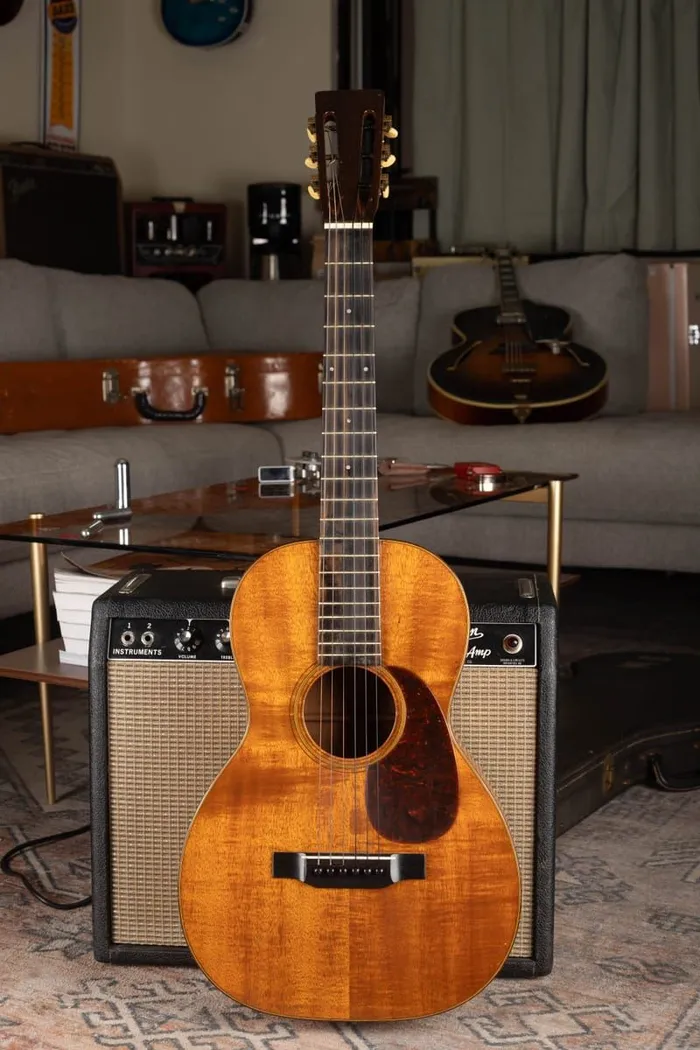
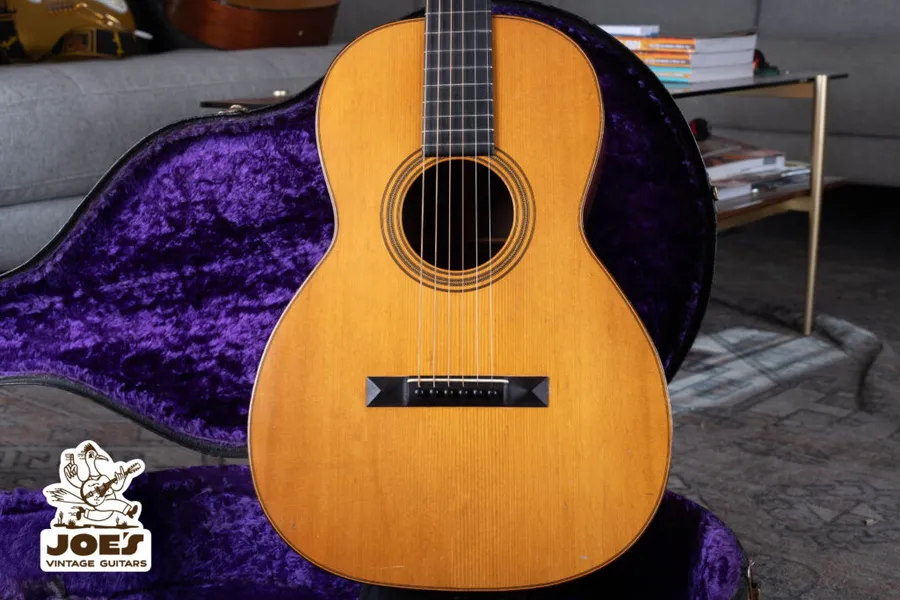
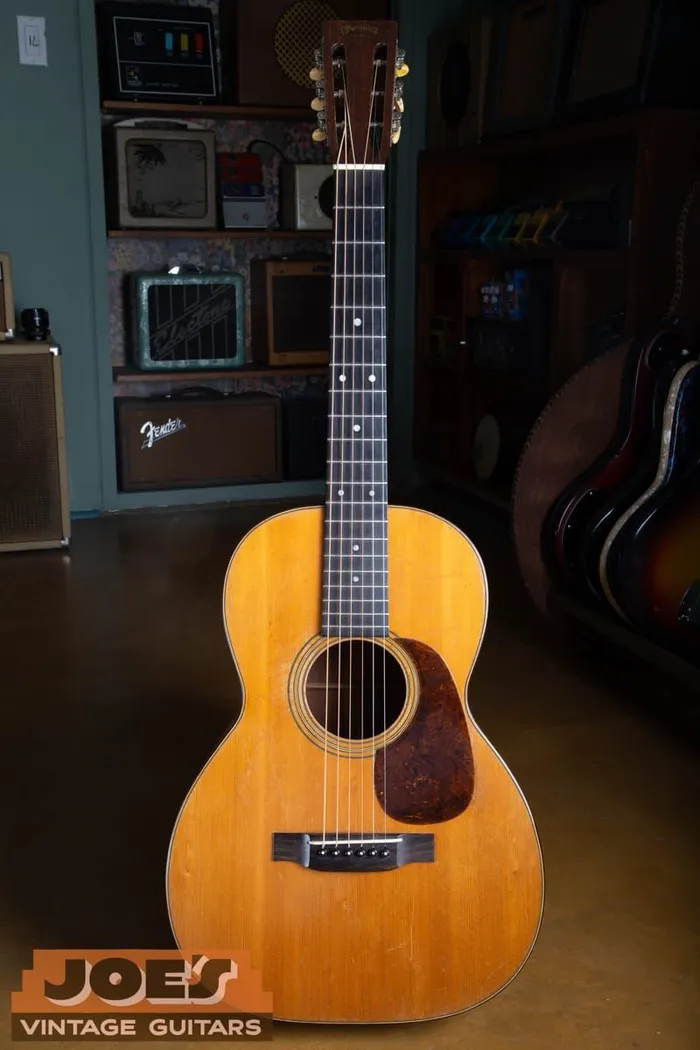
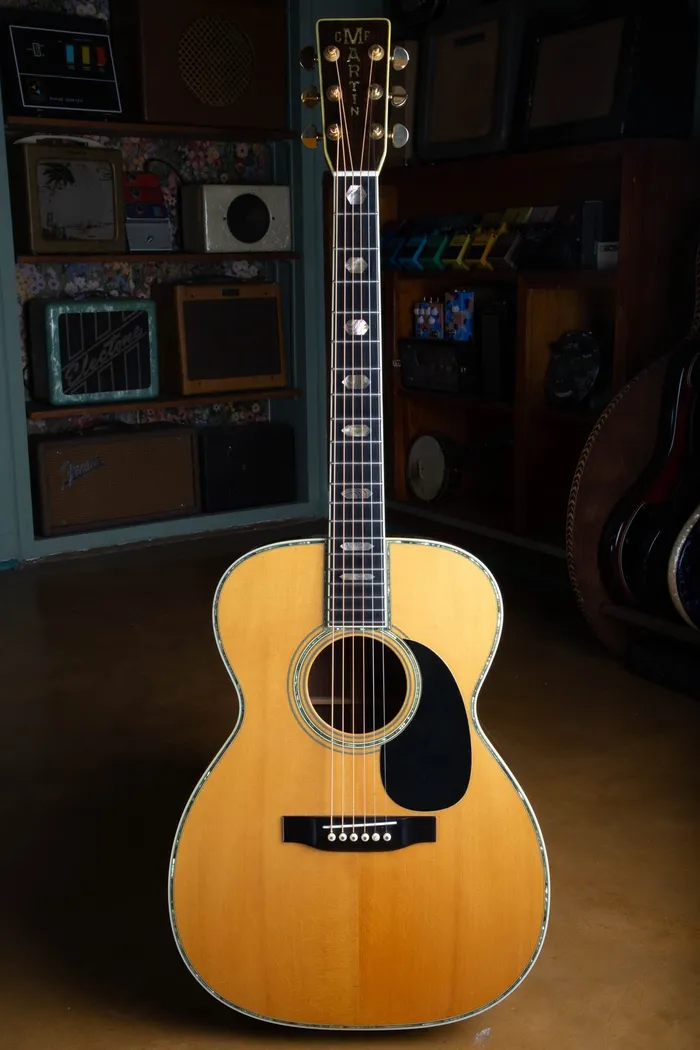
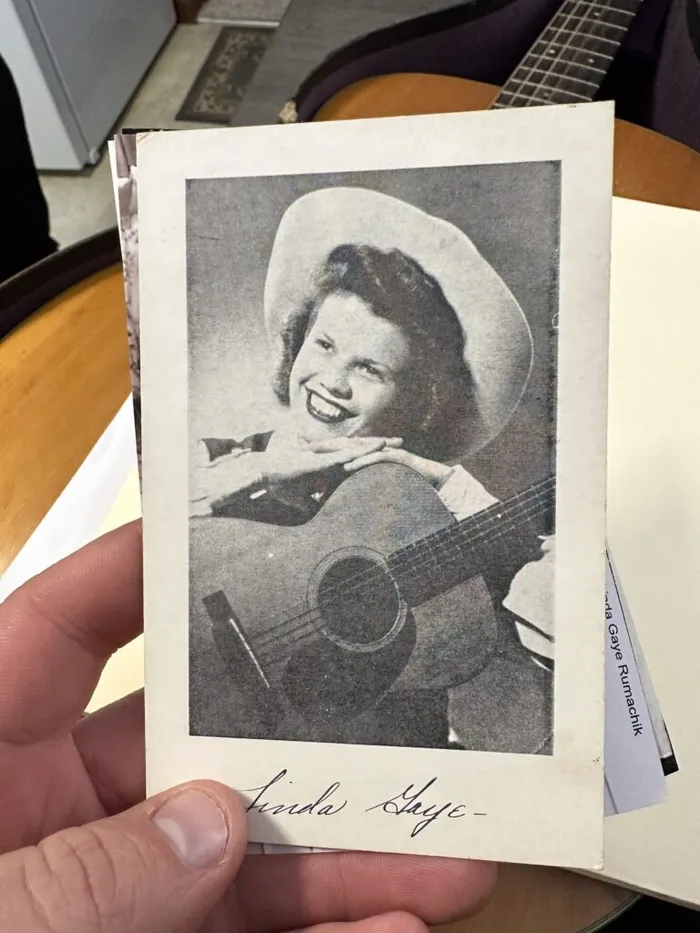
For a close inspection of pearl trim, Grover tuners, bracing, and value, read the complete 1976 Martin 000-45 guide.
Inspect in Sequence
How to Authenticate a Vintage Martin: 10-Point Checklist
Stamp and Serial
Read the complete model and serial stamp. Earlier instruments may use a serial stamp, backstrip stamp, headstock stamp, or label.
Outline and Neck Joint
Measure lower bout, body length, depth, scale, and nut. Confirm 12-fret or 14-fret geometry, headstock, and heel.
Woods
Inspect top, back, sides, neck, fingerboard, and bridge. Never identify Brazilian rosewood or red spruce from one photograph.
Bracing and Bridge Plate
Use a mirror, light, or internal camera. Verify X position, carving, tone bars, plate wood, plate size, glue, and patches.
Finish Under Light
Black-light response, pore fill, checking, color beneath hardware, and protected edges can expose refinish, overspray, or touch-up.
Bridge and Pickguard
Check footprint, thickness, belly orientation, pin spacing, saddle slot, shrinkage, curling, and surrounding finish.
Neck and Frets
Bar versus T-frets, ebony rod versus steel T-bar, neck carve, nut, and evidence of a reset should agree with the year.
Tuners and Hardware
Match plates, gears, posts, bushings, buttons, screw spacing, pins, nut, saddle, and endpin to the period.
Repairs
Map cracks, cleats, patches, replaced braces, top distortion, neck work, finish work, and altered wood.
Provenance
Receipts, photographs, the case, family history, and factory records should support the physical evidence, not override it.
Small Parts, Large Clues
Tuners and Dating Details
Read the Footprint
Look for extra screw holes, altered post holes, finish shadows, mismatched bushings, and plate outlines. Early instruments may have engraved plates with ivory or pearl buttons. Later guitars can carry Waverly or Grover open gears, wartime Kluson variants, and postwar enclosed machines.
Match the Whole Assembly
Button material, plate shape, gear orientation, screw spacing, plating, and stamped markings all matter. Clean tuners are not automatically original, and tarnished tuners are not automatically old. A correct-looking replacement remains a replacement.
Market Logic, Not Wishful Pricing
Vintage Martin 0, 00 & 000 Values
Collector demand generally centers on original prewar steel-string examples. The late 1920s through 1938 combine light construction, red spruce, hide glue, scalloped bracing, and modern geometry. The years 1939 through 1944 remain exceptionally desirable. Late 1944 through 1946 is a feature-sensitive transition.
Era Premium
Prewar pearl Styles 42 and 45 lead, followed by prewar herringbone Style 28. Wartime examples and pre-1969 Brazilian rosewood remain strong. Clean postwar mahogany guitars can be more accessible.
Originality
Original finish, bridge, bridge plate, tuners, pickguard, and unaltered wood are decisive. A professional neck reset or refret can preserve value; a refinish, retop, shaved bridge, or oversized plate usually cannot.
Condition and Sound
Cracks, distortion, neck angle, brace work, repair quality, setup, and musical response all matter. A clean year does not outrank an earlier guitar with honest professional maintenance by default.
Responsible Pricing
Start with recent sold examples of the same size, style, year band, and condition. Asking prices show expectations, not market value. Adjust for rarity, originality, structure, sound, provenance, and timing.
If the model stamp begins with D, compare the separate Martin D-18, D-28, and D-45 dreadnought value guide. For a broader market framework, see how Joe determines the value of an old Martin acoustic. If you are ready to discuss an instrument, the sell a vintage Martin page explains Joe's nationwide buying process.
Martin 0, 00, and 000Frequently Asked Questions
What is the difference between a Martin 0, 00, and 000?
How do I date a vintage Martin 0, 00, or 000?
Where is the serial number on a vintage Martin guitar?
Is a 12-fret Martin more valuable than a 14-fret Martin?
What is the difference between a Martin OM and a 000?
Which vintage Martin 0, 00, and 000 guitars are most collectible?
Can I put steel strings on a 1920s Martin?
How much is an old Martin 0, 00, or 000 worth?
Are Martin 0 and 00 guitars considered parlor guitars?
The Collector's Rule
Buy the Guitar in Front of You, Not the Legend Attached to It.
The best small Martins combine honest structure, period-correct details, and a voice worth preserving. A serial number gives me a starting year. The wood, bracing, bridge plate, finish, hardware, and tool marks tell me the rest.