

Champion 600, Tweed Champ And Later Originals
Vintage Fender Champ And Vibro Champ Identification
A simple control panel can still belong to several generations. Cabinet shape, tube layout and the chart distinguish the original Champ family.
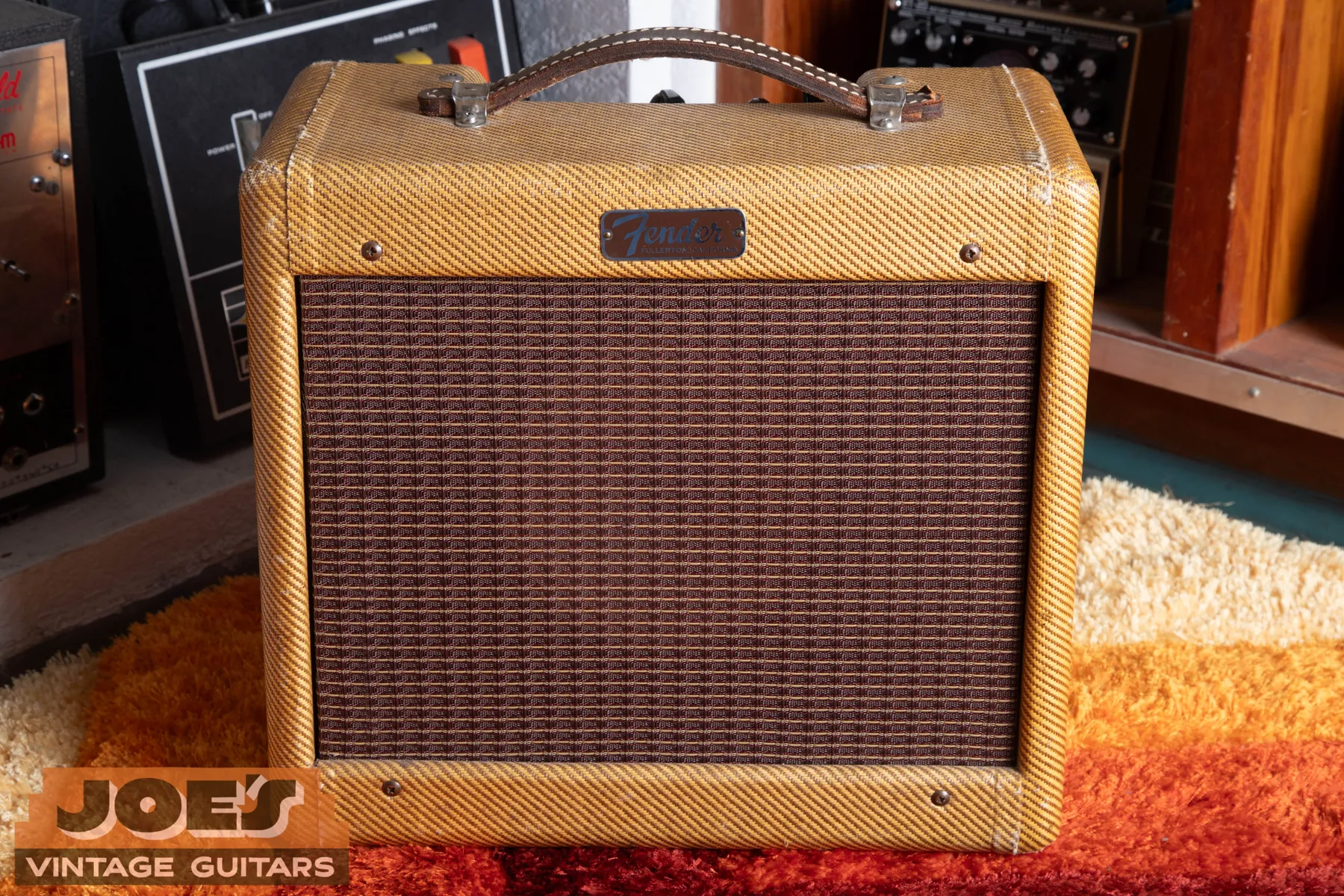
An original Fender Champ is a small single-output-tube amplifier. The tweed 5F1 has a volume control and no built-in tremolo or reverb; the later Vibro Champ adds Speed and Intensity controls. Use those features to establish the model before reading the Champ and Vibro Champ values. Joe’s photographs show a 1949 Champion 600, 1956 and 1959 tweed Champs, a 1965 blackface Vibro Champ and a 1968 drip-edge Vibro Champ. The 1959 chart carries a readable IB date stamp.
Authenticity And Originality Are Assessed From The Information Provided. A Hands-On Inspection Can Change The Conclusion.
Several Modern Champs Copy Earlier Styling
Original Or Reissue?
’57 Champ, ’57 Custom And EC Vibro-Champ
Fender’s ’57 Custom specification describes a handwired 5F1 with a Weber eight-inch speaker and a 12AY7 preamp tube. Its modern manufacture shows why handwiring alone is insufficient. Fender’s Champ history identifies the EC Vibro-Champ by its EC grille badge, added tremolo-speed control and output attenuator. The original 5F1 has neither tremolo control nor attenuator.
Champion 600 And Vibro Champ Reverb
The modern Champion 600 introduced in 2007 closely copies the earlier two-tone appearance. Fender’s history identifies its revised preamp and internal speaker-output jack. The ’68 Custom Vibro Champ Reverb is easier to distinguish: it has a ten-inch Celestion TEN 30 and digital hall reverb. A reverb control and larger stock speaker don’t match an original silverface Vibro Champ.
Read any rear product label and compare the entire amplifier with the documentation for that exact model. A replacement label or recovered cabinet can make the outside less conclusive. Have a technician document the board, transformers and tube sockets if the identification remains uncertain. Modern vintage-style components should be evaluated by their actual markings.
The XD and X2 families add modern voicing or effects controls and fall outside this original-amp guide. Rivera-era Champ II and Super Champ models are also later exclusions. The familiar Champ name was used for several different products, so it shouldn’t be treated as a continuous specification from the 1940s onward.
A replaced speaker in an old Champ is a condition finding, not automatic evidence that the whole amp is new. The reverse is also true: fitting an old speaker into a newer reproduction doesn’t create an original vintage amplifier. Identify the chassis and cabinet, then record the age of the installed parts individually.
1949 To 1953: Two-Tone TV Front
The Original Champion 600
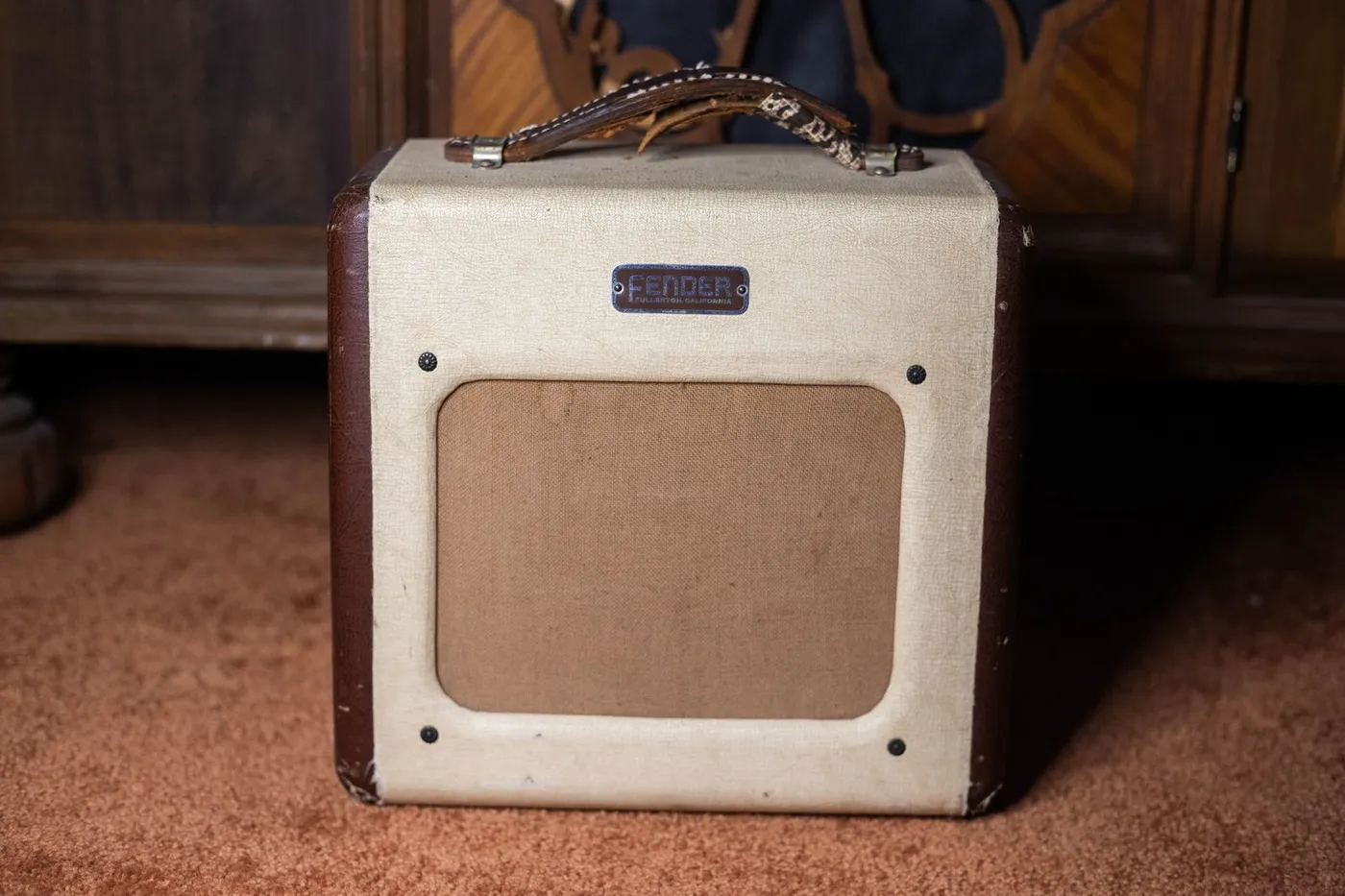
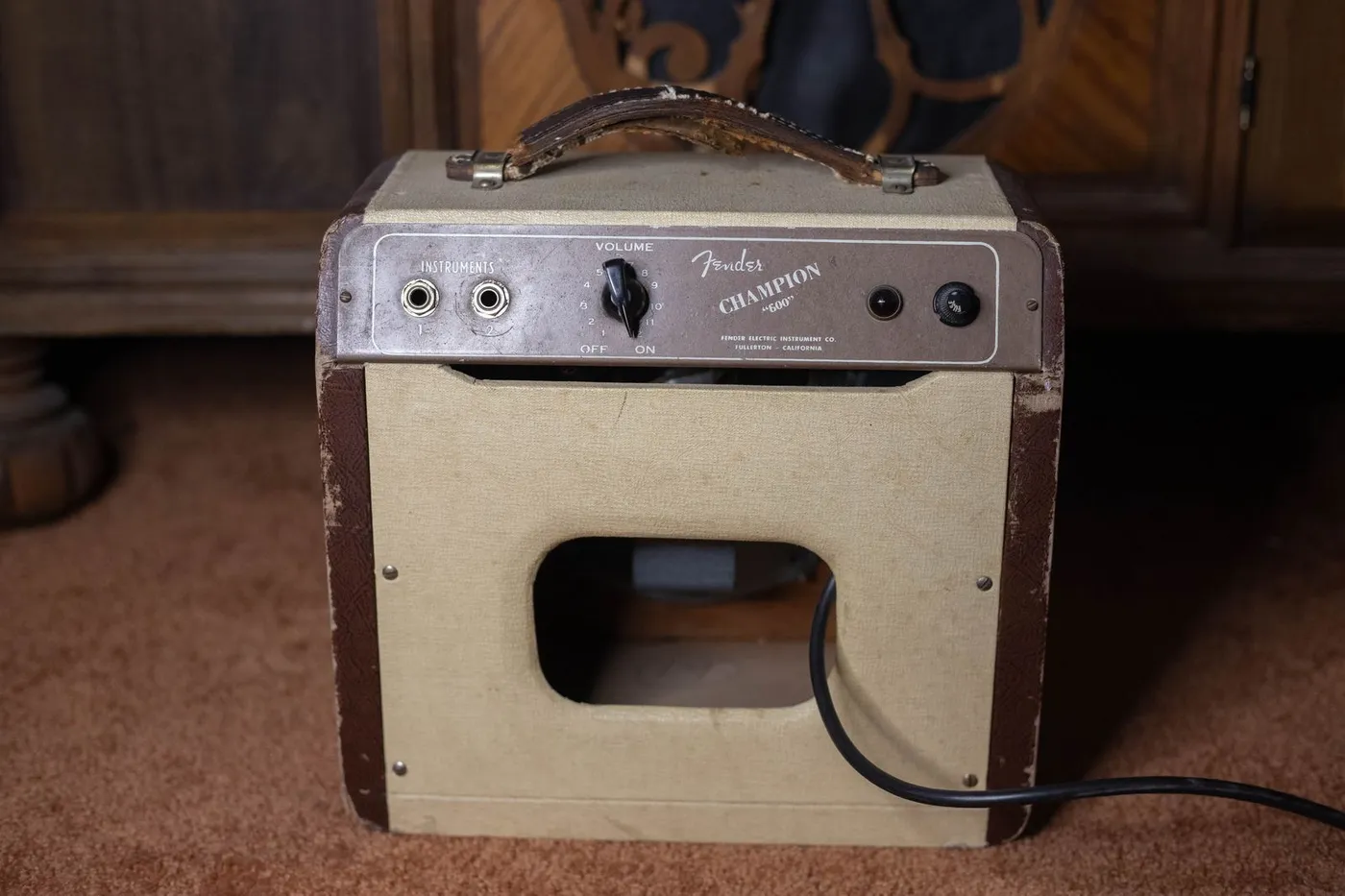
Fender introduced the Champion 600 in mid-1949, replacing the Champion 800’s eight-inch speaker with a six-inch speaker while retaining the early four-watt circuit. Its brown and cream covering surrounds a small TV-front grille opening. Two inputs and a single Volume control sit on the angled rear panel. The wide-panel tweed cabinet followed in 1953, before the later narrow-panel Champ familiar to many players. See Fender’s Champ history for that sequence.
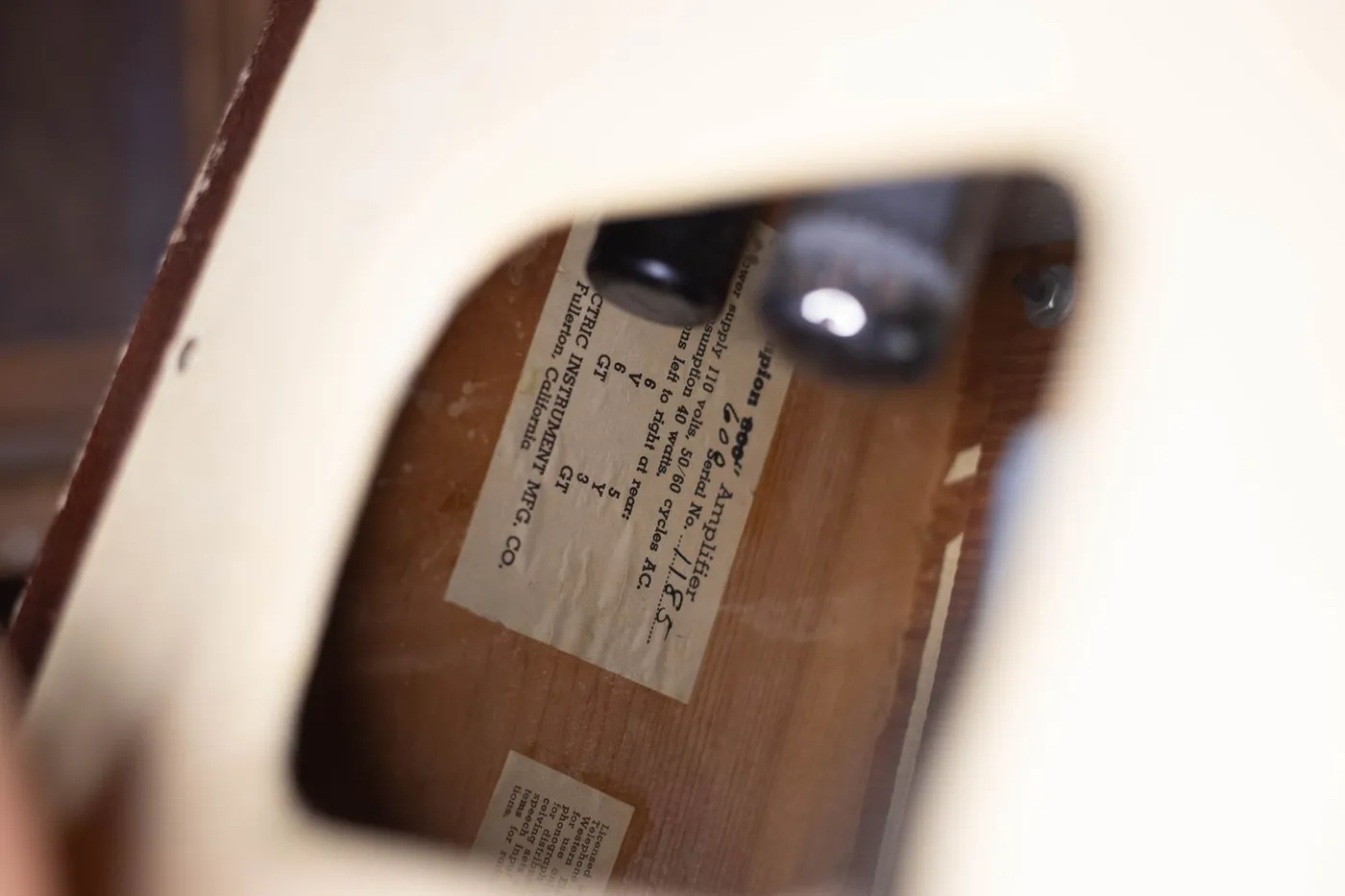
Joe’s 1949 Champion 600 shows the two-tone cabinet, rear controls and paper labels. The listing records a few replaced capacitors, a three-prong cord and a worn handle. Those details belong in this example’s condition description.
The 1949 model predates the two-letter tube-chart dating system described below. Identify it from the complete construction and supporting component evidence. A later Champion 600 reissue can share the two-tone appearance; compare the chassis and rear connections as well as the covering.
This Family Skips A Brownface Redesign
Champ Changes Across The Fender Eras
Champion 800, Champion 600 And Champ
The Champion 800 begins in 1948 with an eight-inch speaker. The two-tone Champion 600 follows with a six-inch speaker. Wide-panel and narrow-panel Champ cabinets come later, and the 5E1/5F1 circuits use a miniature 12AX7 preamp tube.
The Champ Keeps Its Tweed Form
The broad Fender era changes, but this model continues in its narrow-panel form into 1964. Don’t expect a brownface Champ counterpart merely because other Fender families received brown cabinets and front controls.
The New Champ And Vibro Champ
In 1964 the Champ adopts the larger front-panel cabinet and AA764 design with Treble and Bass controls. The Vibro Champ adds tremolo. Black-covered examples of the earlier cabinet form also require separate identification.
Silver Panels, Familiar Small-Amp Format
The Champ family’s silver-panel change occurs in 1968, a model-specific transition within the broader silverface era. Both models retain a single eight-inch speaker. The 1980 owner’s manual still shows the Champ’s three controls and the Vibro Champ’s two additional tremolo controls.
One Output Tube Throughout These Versions
Original Champ Specifications
| Version | Power / Speaker | Full Tube Set | Controls And Exterior |
|---|---|---|---|
| Champion 800 / 600 | About 4 W; 800: 1x8; 600: 1x6 | Early circuit family: 1x6SJ7, 1x6V6 and 1x5Y3 | Single Volume; TV-front form; Champion 600 uses two-tone covering; compare exact early construction |
| Wide-Panel 5C1 Champ | About 4 W; 1x6 | 1x6SJ7, 1x6V6GT and 1x5Y3GT | Volume with power switch; tweed, brown cloth, block badge, chicken-head knob, flat leather handle |
| Narrow-Panel 5E1 / 5F1 | About 5 W; early 1x6, later 1x8 | 1x12AX7, 1x6V6GT and 1x5Y3GT | Two inputs and Volume; 5E1 has a choke, 5F1 does not; tweed and dark striped cloth, top chrome panel, script badge, leather handle |
| Blackface AA764 Champ | About 6 W; 1x8 Oxford 8EV | 1x12AX7, 1x6V6GT and 1x5Y3GT | Volume, Treble, Bass; black covering/panel, silver grille, skirted knobs, black strap; early examples lack a grille badge |
| AA764 Vibro Champ | About 6 W; 1x8 | 2x12AX7, 1x6V6GT and 1x5Y3GT | Volume, Treble, Bass, Speed, Intensity; blackface or later silverface appearance |
| Silverface Champ | 6 W in the 1980 manual; 1x8 | 1x12AX7, 1x6V6GT and 1x5Y3GT | Three tone/volume controls; silver panel, silver/blue grille, black cabinet, skirted knobs and black handle |
The miniature preamp tube and extra Vibro Champ tube are useful identification clues. Power-consumption figures on labels aren’t audio-output ratings. Tube substitutions should be evaluated by a qualified technician.
The 5E1 schematic shows the power-supply choke. The 5F1 schematic uses a resistor in that part of the supply. Both specify the same basic three-tube set, so counting tubes alone cannot distinguish them.
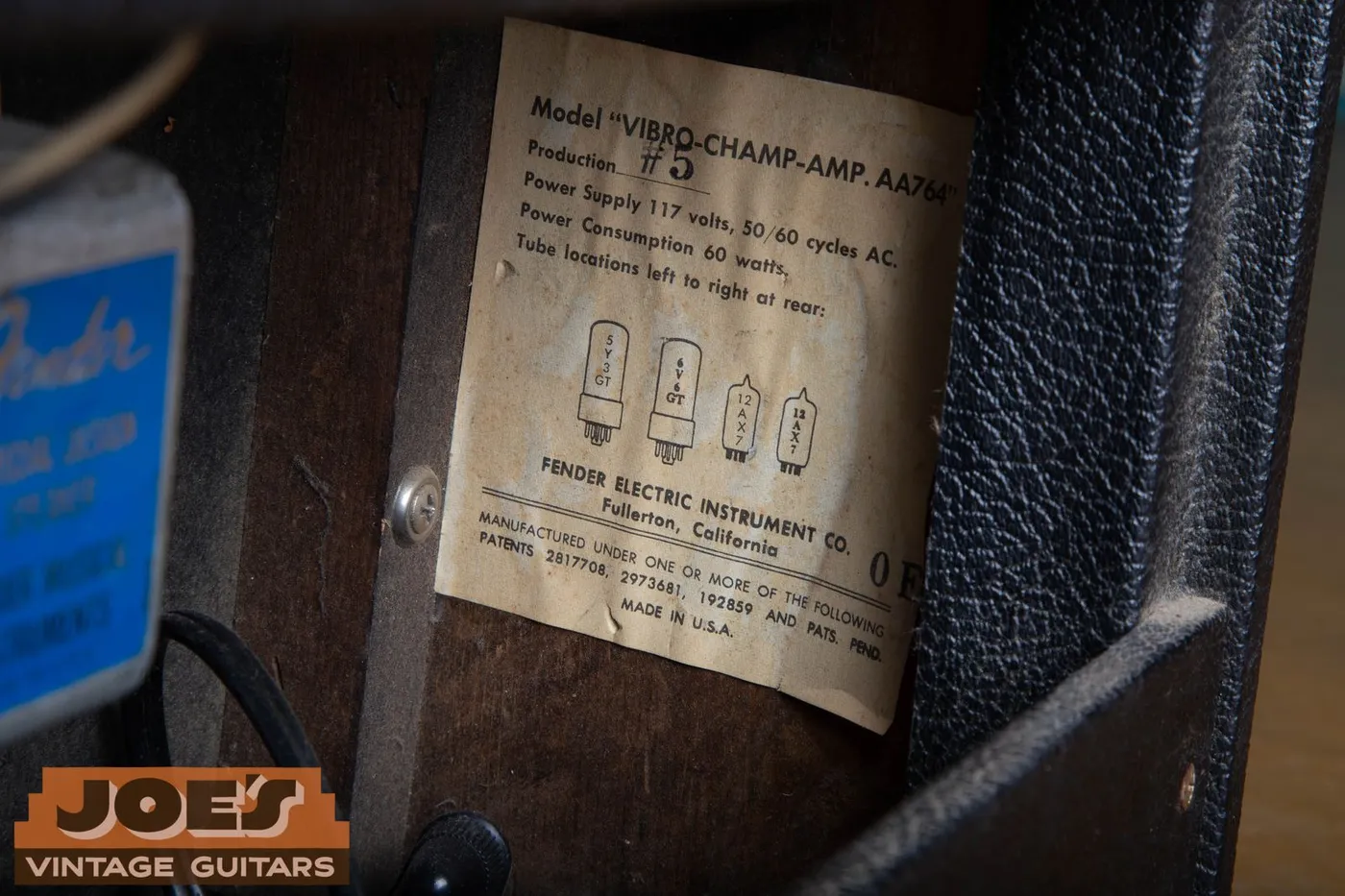
Compare the separate AA764 Champ and AA764 Vibro Champ drawings. The repeated AA764 designation doesn’t make them identical: the Vibro Champ includes the additional tremolo circuitry and tube. Read the model name on the drawing as well as its code.
The Cabinet And Circuit Must Agree
Reading A Tweed Champ’s Construction
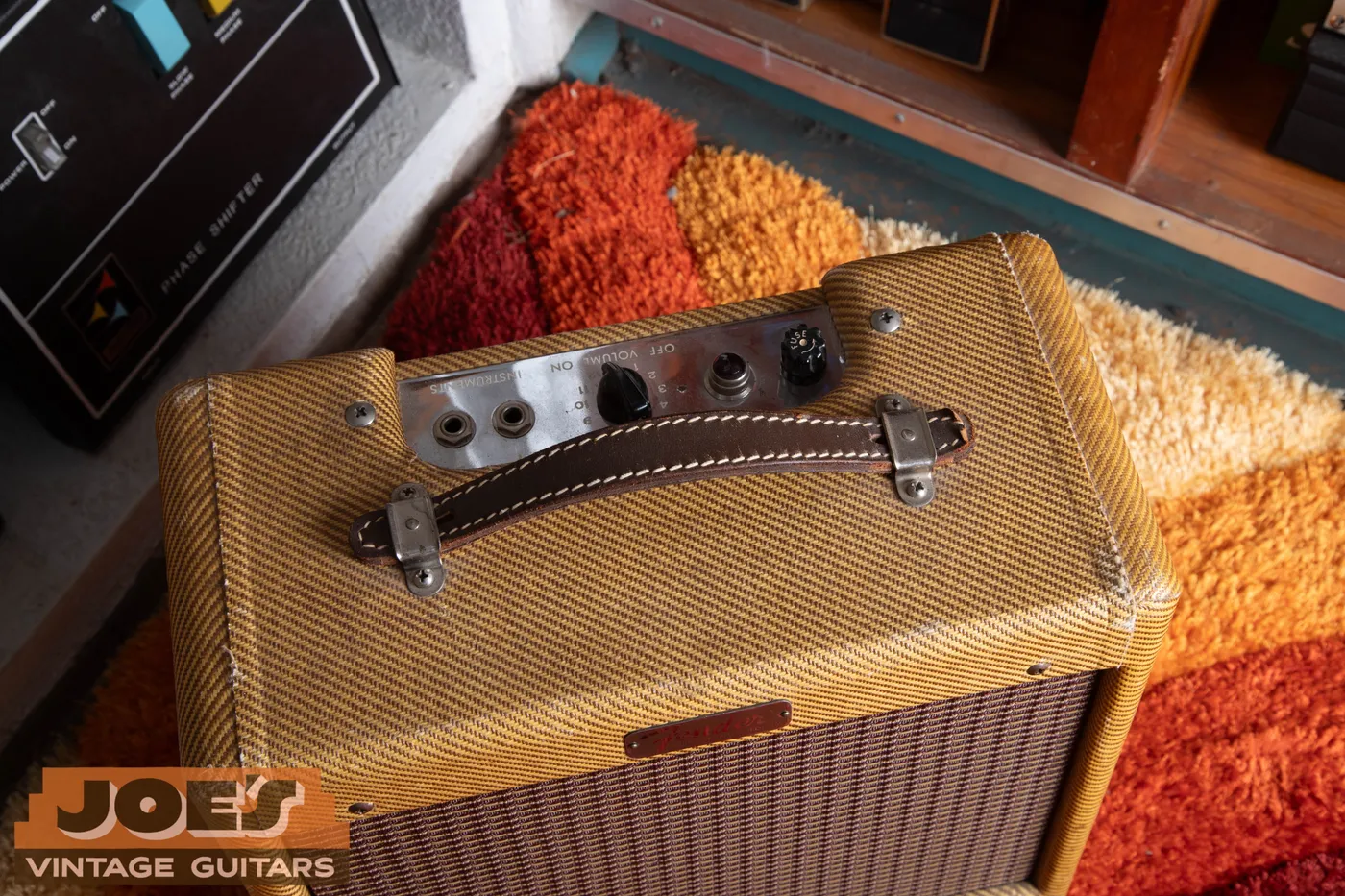
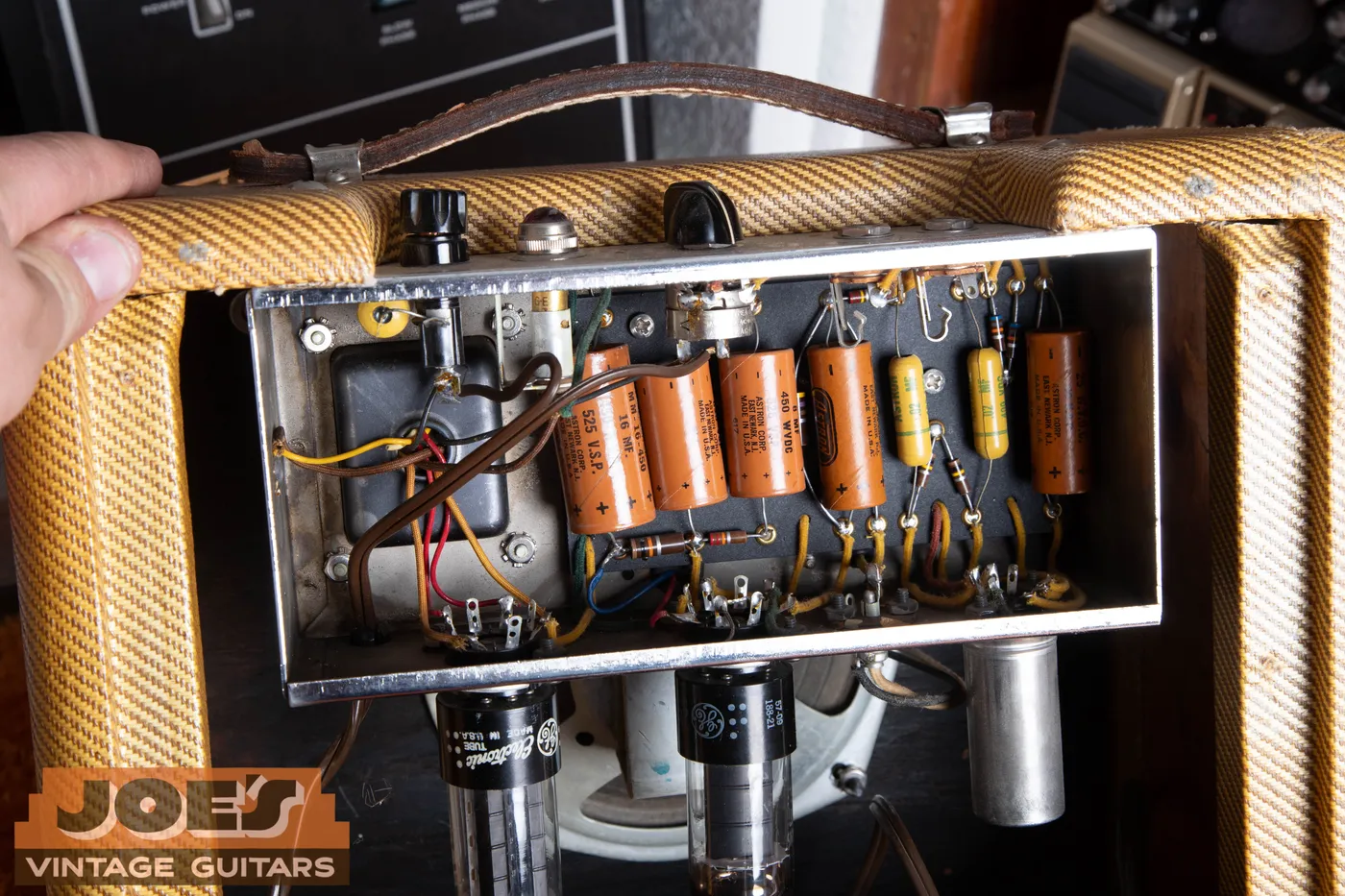
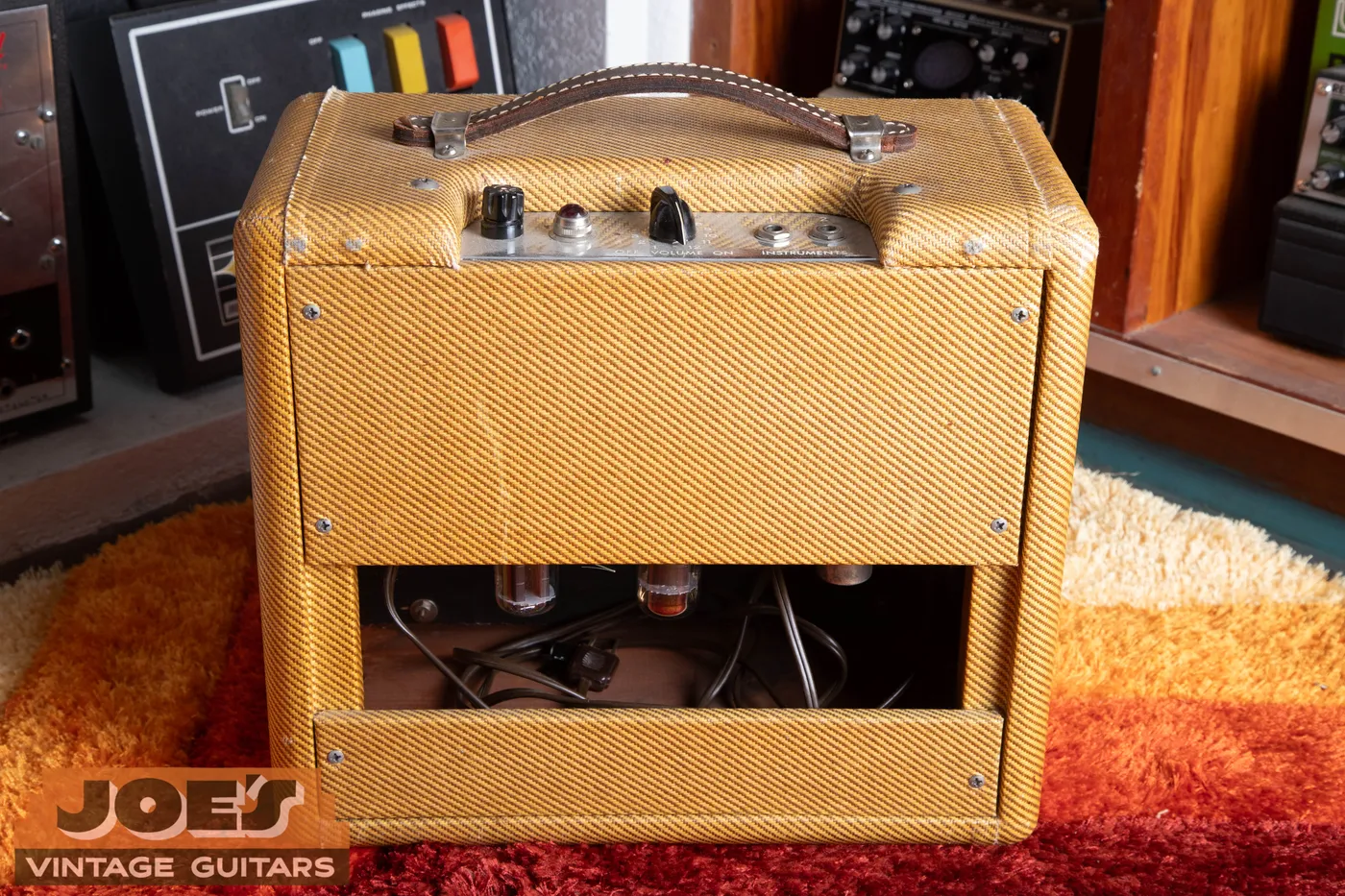
Joe’s 1956 Champ has a compact chrome top panel. Its single control makes the format recognizable, but that layout has been copied in many later amplifiers. The rear view supplies the cabinet opening and speaker context that a front picture lacks. A technician’s board photograph then helps establish which circuit actually occupies the cabinet.
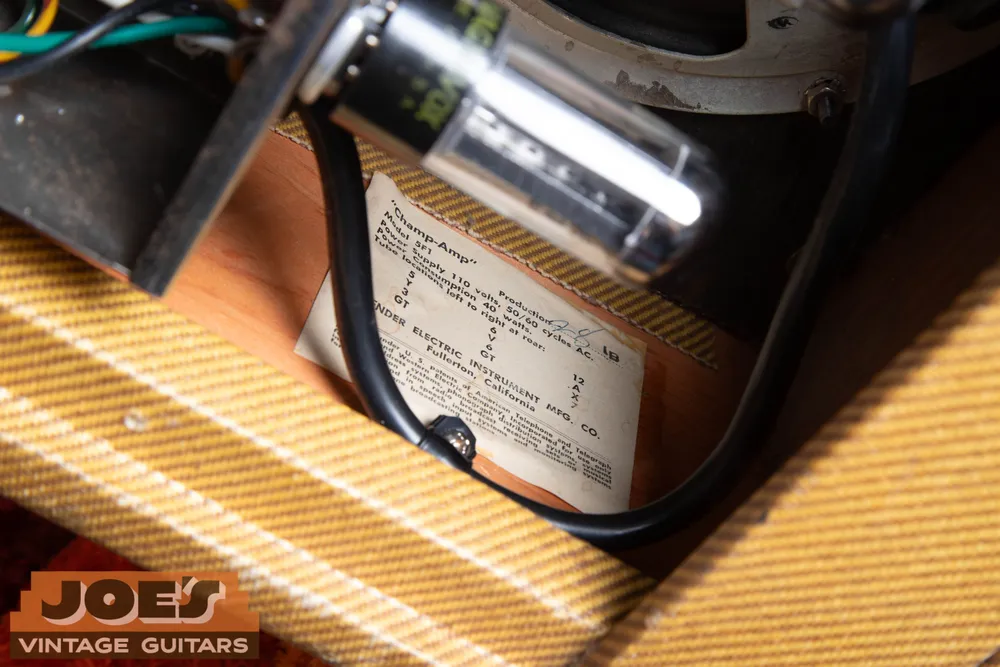
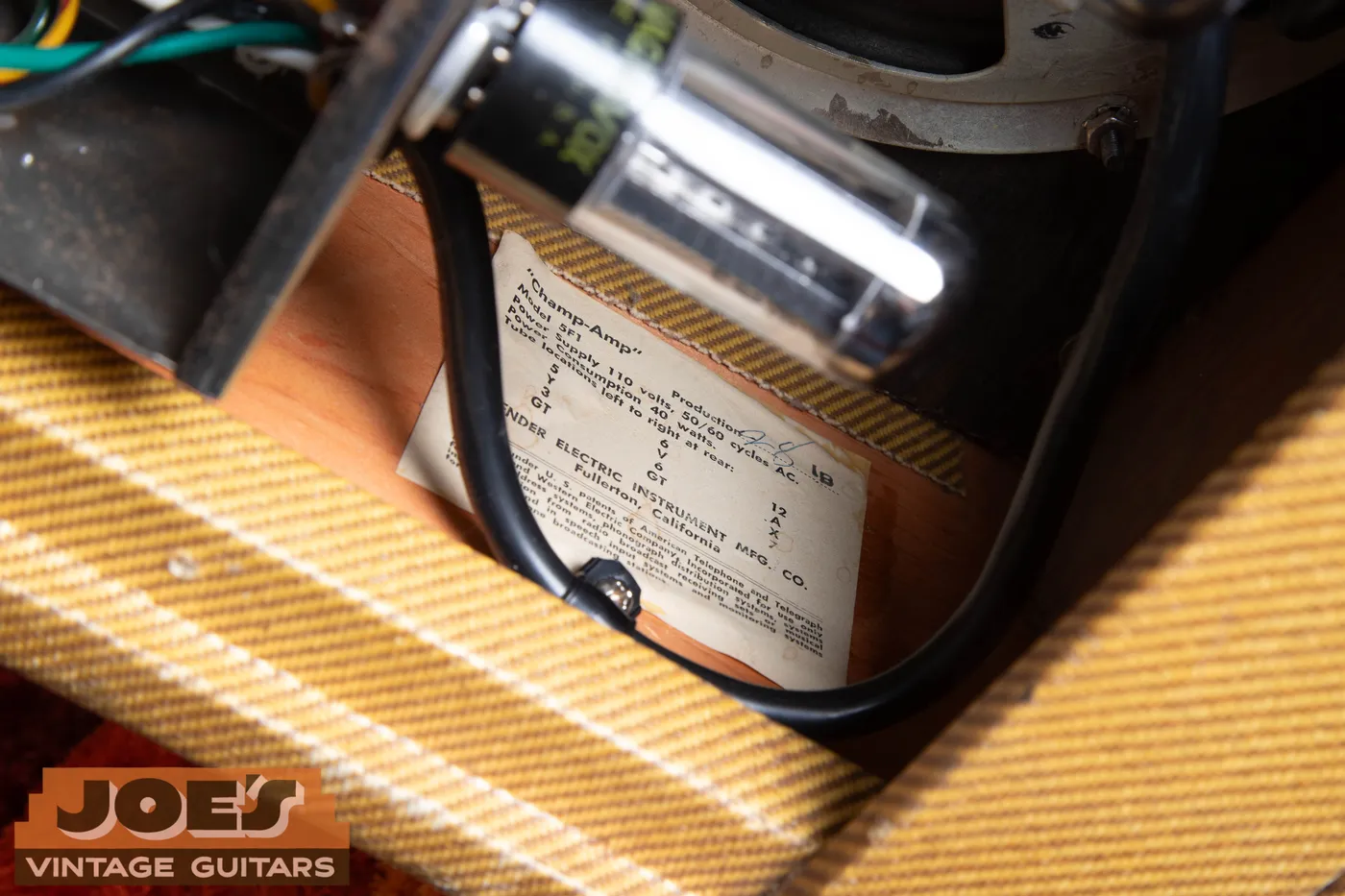
On the 1959 example, the paper chart clearly prints 5F1. Its inked IB stamp can be decoded separately. The handwritten production entry on the same paper is another mark with a different purpose; it is not used here as a date. A photograph that includes the whole chart keeps those distinctions visible to another reader.
An old chart can survive inside a cabinet after a chassis or speaker change. Look for agreement between the paper, the construction and the dated parts. If the chart and current circuit differ, record both findings. Avoid removing or cleaning a fragile paper label in an attempt to make it more readable.
A larger replacement speaker may require a changed baffle or new mounting holes. That work can be difficult to see from the front because the grille remains in place. A rear view helps identify the alteration without assuming that every eight-inch speaker indicates a factory eight-inch cabinet. The exact condition needs inspection.
The narrow-panel Champ also overlaps the broader blackface transition. Black covering over an older-style cabinet doesn’t make it the later front-panel AA764. The value guide has separate 1964 entries for those forms. Establish cabinet and controls first, then use component evidence to narrow its date.
The IB Stamp Is Readable
Date A Champ With Its Chart And Components
Joe’s Fender tube-chart decoder uses two inked letters on charts through about 1970. The first follows the year sequence beginning with A for 1951; the second identifies the month. Fender amplifier serial numbers don’t provide a reliable year, so the chassis serial should remain an inventory identifier rather than the main dating method.
February 1959 On Joe’s 5F1 Champ
The image clearly shows I followed by B. In the tube-chart date table, I is 1959 and B is February. The printed 5F1 text identifies the circuit family. The handwritten production number is left out of the date interpretation.
If the chart has disappeared, move to the transformer and speaker code section. Keep full component markings in the photograph instead of copying only the final digits. The pot-code guide provides another reference when control markings can be documented safely.
Compare the dates of parts that appear original to the chassis. A replacement speaker may postdate the amp by decades, while original parts can predate final assembly. One especially old component doesn’t make the whole amplifier that old. A useful identification states the supported production window and names any evidence that remains unresolved.
A Small Amp Still Needs A Complete Record
Eleven Checks For A Vintage Champ
Transformers And Choke Where Fitted
Document the power and output transformers separately. The 5E1 drawing includes a choke; the 5F1 does not, so absence alone isn’t a fault. A technician should check specifications, mounting and lead connections before a part is described as original.
The Single Speaker
Show the label, frame, cone and mounting wherever visible. A six-inch or eight-inch diameter helps identify the version, but a baffle alteration can change that evidence. Record reconing and replacements instead of assuming an old basket means an untouched speaker.
Capacitors And Resistors
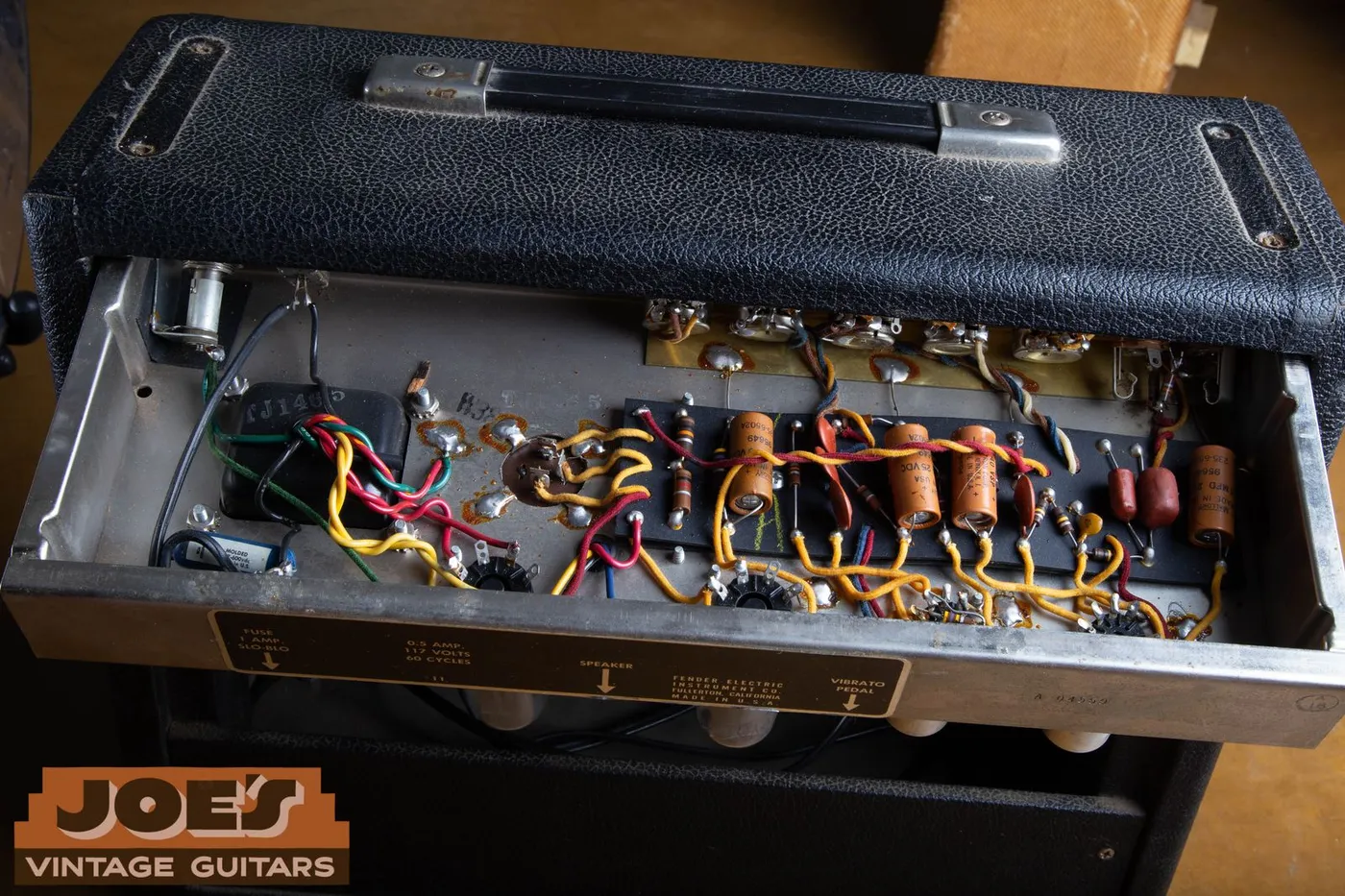
Ask for a circuit photograph and an itemized service record. Replacement filter capacitors can be necessary maintenance. Added gain stages, altered tone controls or a substantially rebuilt board need a different description from a simple repair.
Tube Chart
Preserve the chart in place, including damaged areas. A printed circuit designation, ink date stamp and handwritten production notation should be transcribed separately. A missing chart increases reliance on the cabinet, chassis and component evidence.
Cabinet And Covering
Inspect the bottom, corners and baffle for changed wood. Look at the covering around the control opening and rear panels, where restoration may be easier to see. A repainted or recovered cabinet should be described without guessing what lies beneath it.
Grille And Logo
Compare the cabinet generation before calling a badge missing. Early blackface Champs can lack a grille logo. Cloth and badges can also be replaced, so their condition needs to be considered alongside mounting evidence and the rest of the cabinet.
Faceplate And Knobs
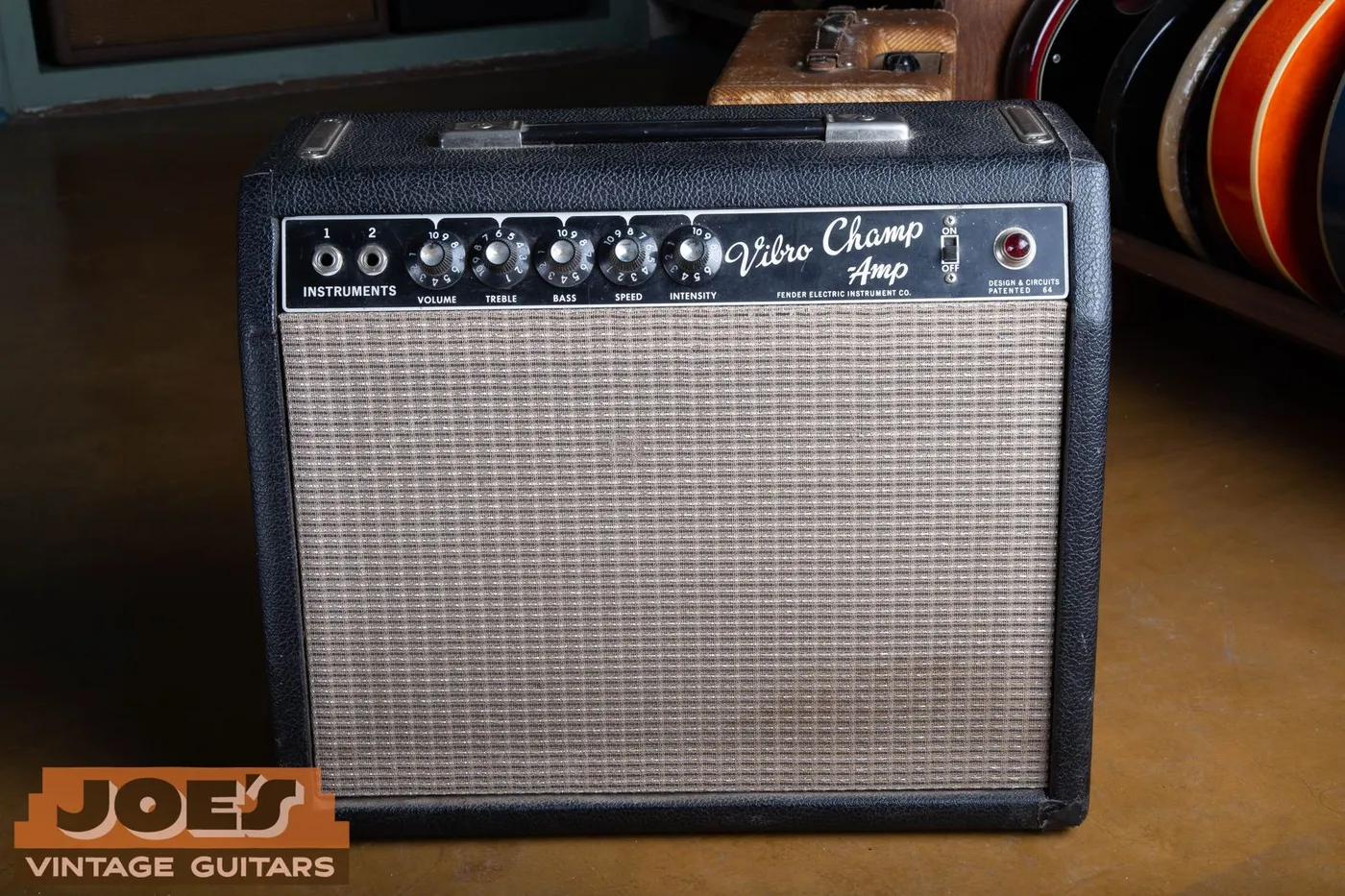
Count the controls and read their names. One volume knob suggests the earlier simple format; Treble and Bass identify the later control arrangement, and Speed and Intensity distinguish the Vibro Champ. Added holes or switches should be photographed closely.
Handle
The handle and its mounts can be worn or replaced even when the cabinet survives. Show any extra holes, different brackets or repaired wood. Keep the older piece with the amplifier if it was removed for safe carrying.
Effects And Footswitch
Original Vibro Champs have tremolo; ordinary Champs don’t. Neither original model in this guide has built-in reverb. Identify any tremolo footswitch and added effects equipment separately, and photograph the connection rather than guessing from a loose pedal.
Rear Panel Pieces
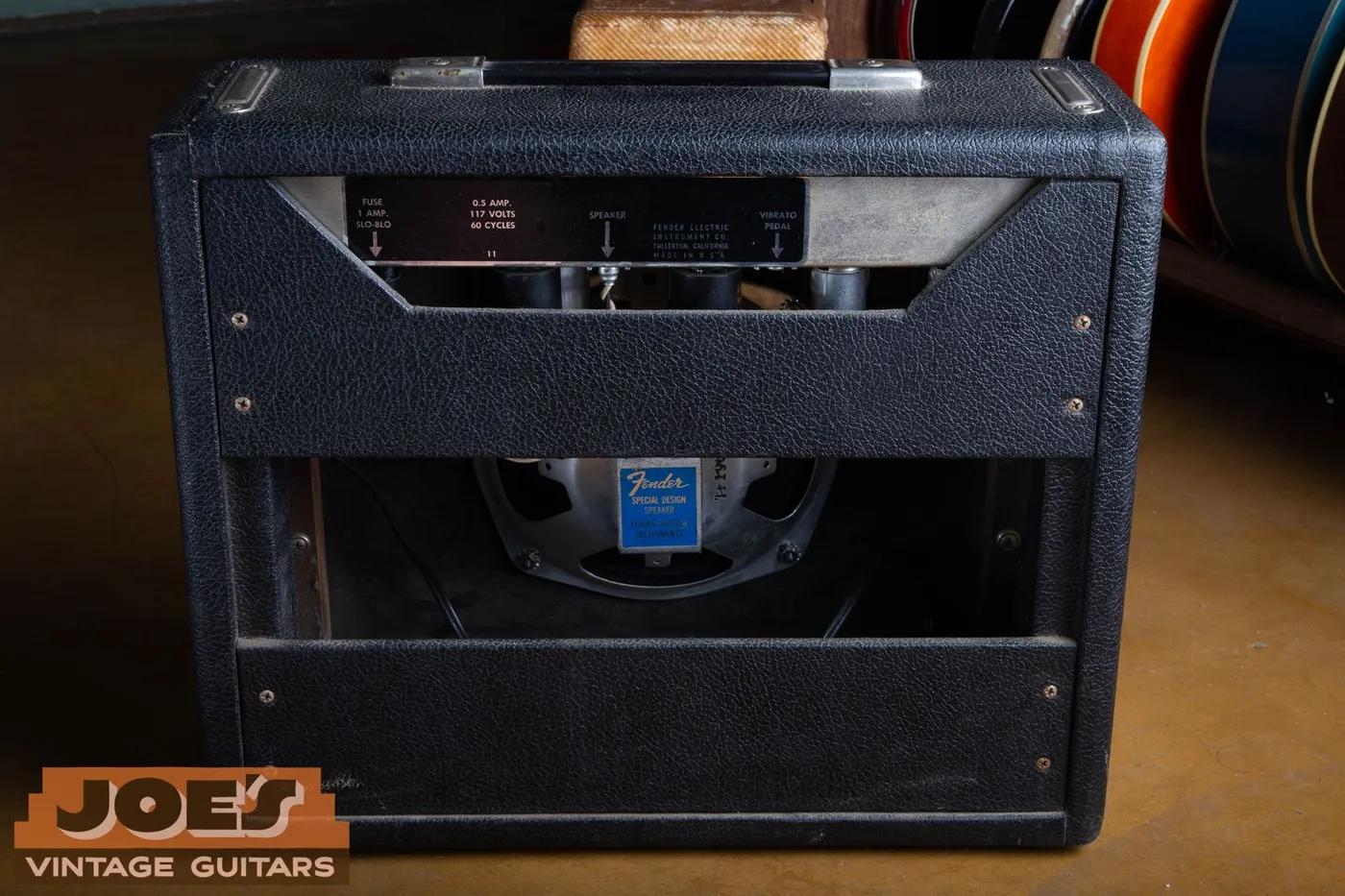
Check the size, covering and attachment of each panel. A missing piece may expose more of the chassis, while a new panel can conceal a cabinet modification. The overall rear image should show the speaker and panel arrangement together.
Cover And Loose Parts
Photograph the cover beside the cabinet and record any removed components. An accessory can be useful without being original to the amp. Family history or an old receipt adds context, but the physical item still needs its own assessment.
Condition Is More Than Whether It Plays
Service Work On A Small Tube Amp
A quiet demonstration can establish that an amp operates at that moment. It doesn’t establish the age of its speaker, the condition of its filter capacitors or the originality of its transformer set. A qualified technician can evaluate those questions and document the work required. Don’t open the chassis yourself; these small amps can retain dangerous voltage after unplugging.
Keep routine maintenance distinct from changes to the design. Replacing worn tubes or failed filter capacitors differs from enlarging the speaker opening, fitting a new transformer or adding controls. An amp can remain useful after any of those changes, but its originality description needs to follow what actually happened.
The Champ value guide explains what to send for an appraisal once the version is known. Retain the repair invoice and label any old parts that accompany the amplifier. There’s no need to describe a serviced amp as untouched to give an appraiser an accurate and useful history.
Tweed, Blackface And Drip Edge
Champ Photo Timeline
Mid-1950s Tweed
1956 Fender Champ
The control, rear and board photographs provide several views of one small amplifier. The archive year is retained; no unclear date stamp is decoded from this example. The interior image is condition evidence rather than an instruction to open another amp.
Dated 5F1 Example
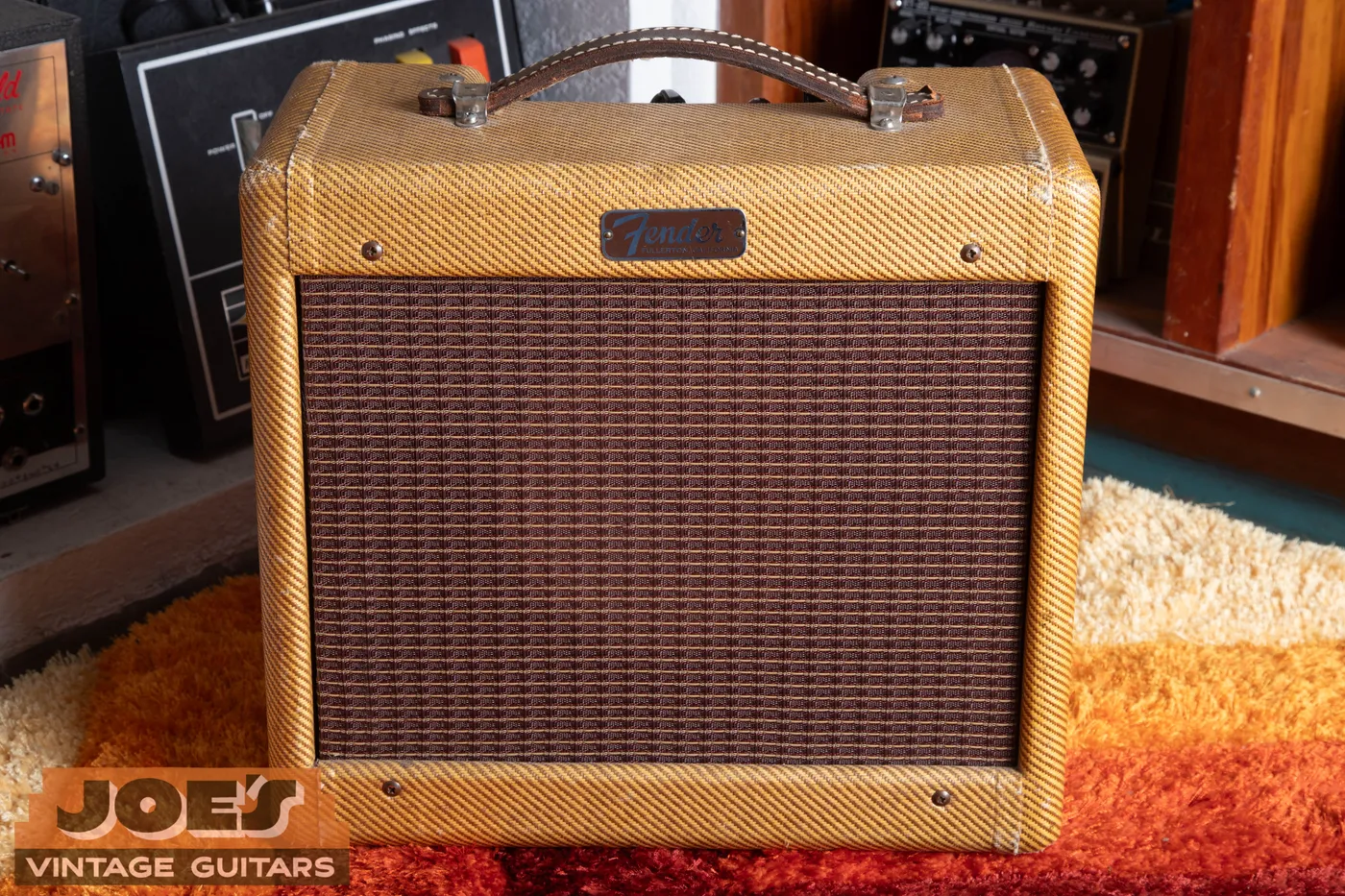
1959 Fender Champ
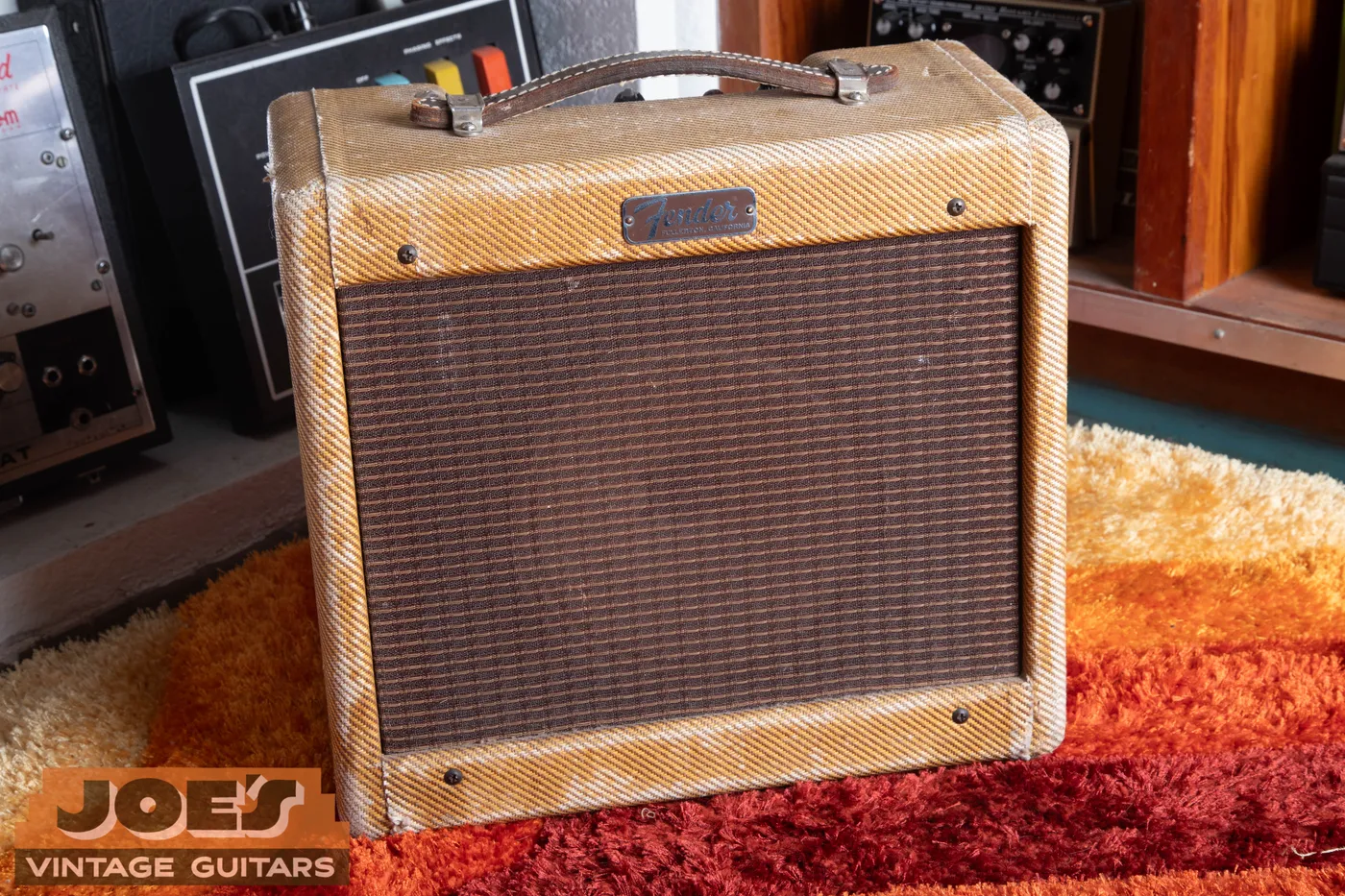
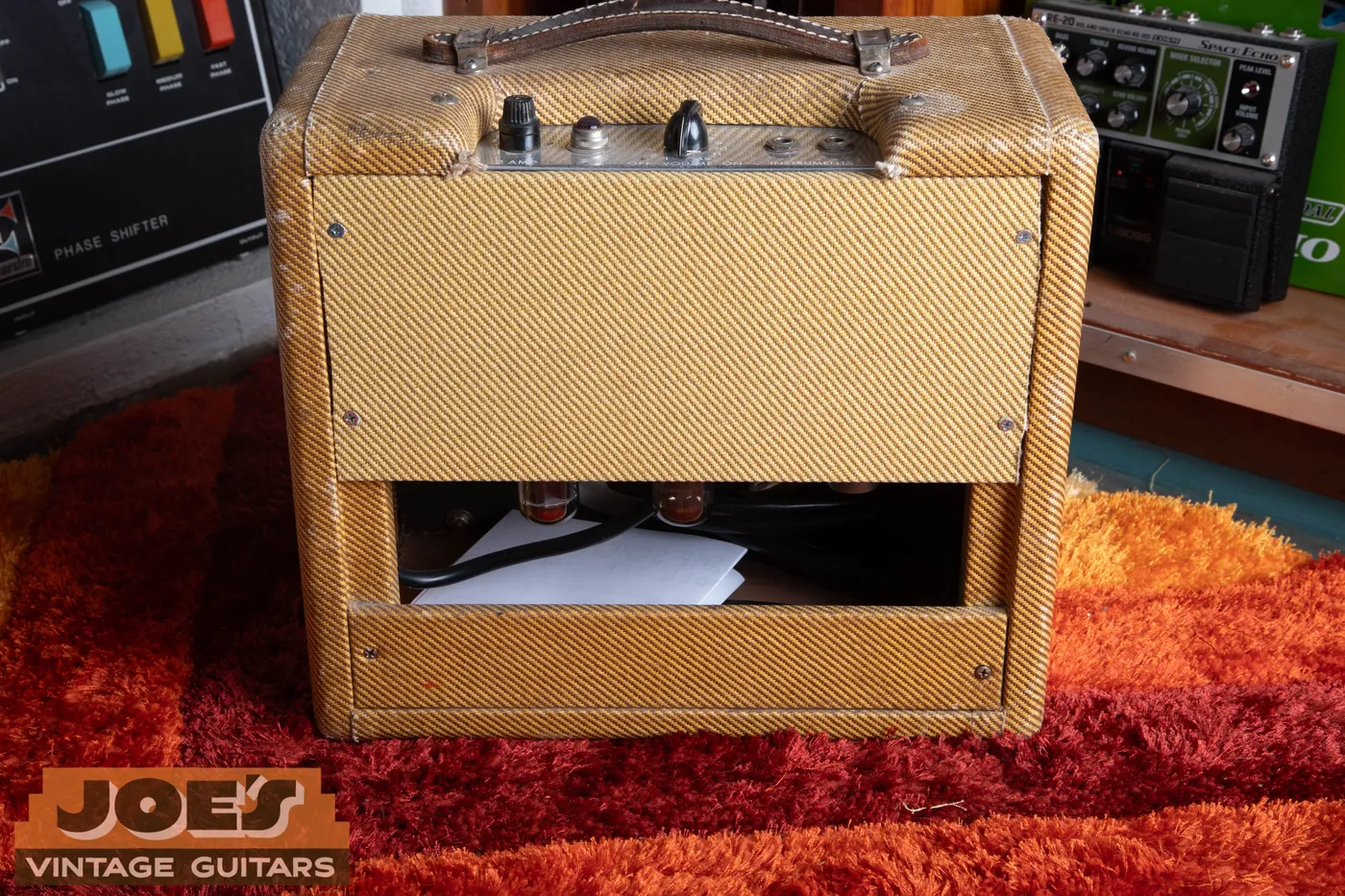
This cabinet’s chart provides the readable IB stamp shown above. Its front and rear photographs keep the label in the context of the complete amp. They don’t certify all components as original simply because the paper date is legible.
Blackface With Tremolo
1965 Fender Vibro Champ
Joe’s 1965 blackface example shows the front controls, single-speaker rear layout, circuit board and AA764 tube chart. Volume, Treble and Bass are joined by Speed and Intensity for tremolo. Compare that five-control panel with the single Volume control on the earlier tweed Champ. The printed AA764 designation identifies the circuit family; the listing supplies this example’s 1965 date.
Early Silverface With Aluminum Trim
1968 Fender Vibro Champ
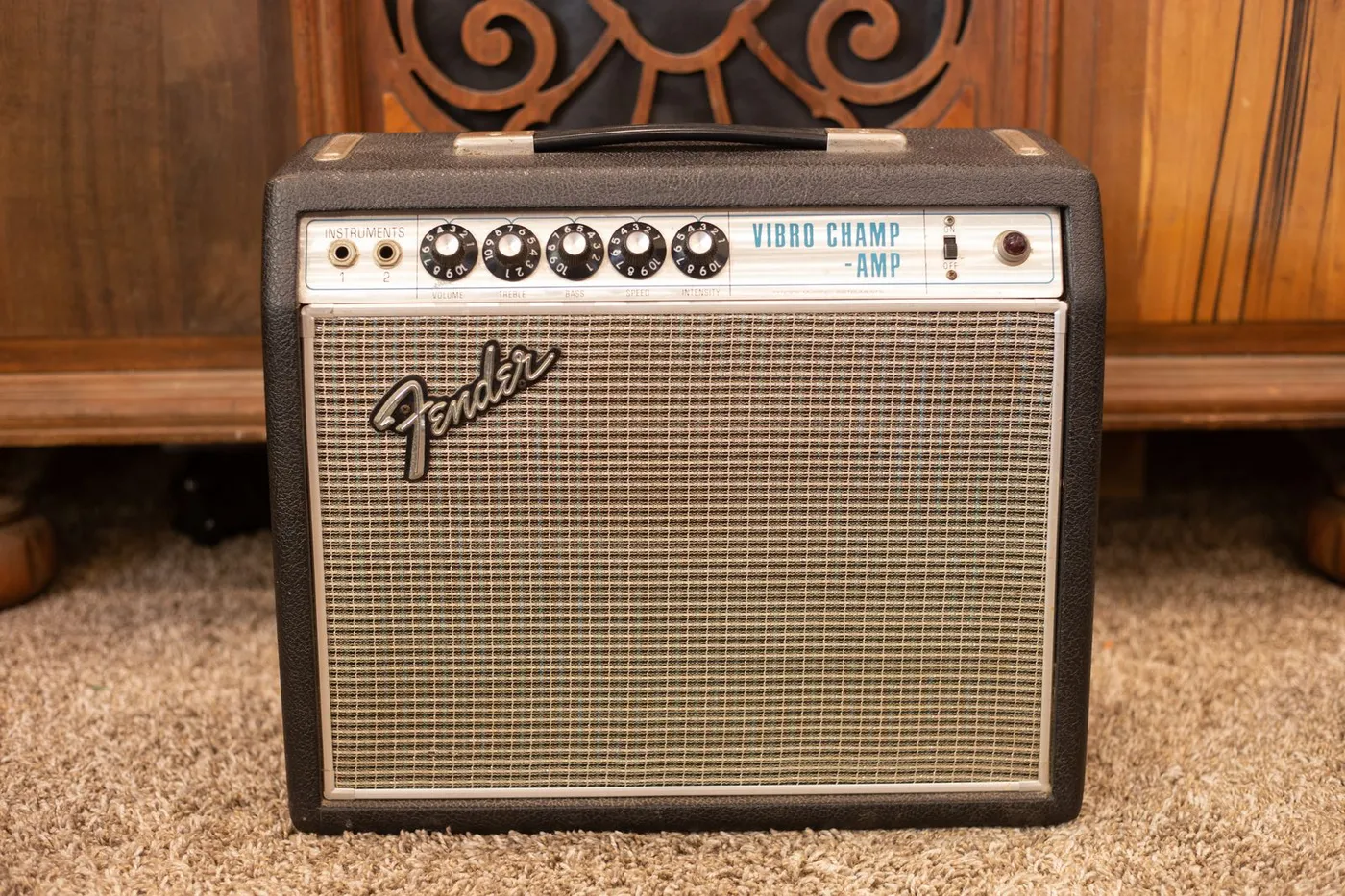
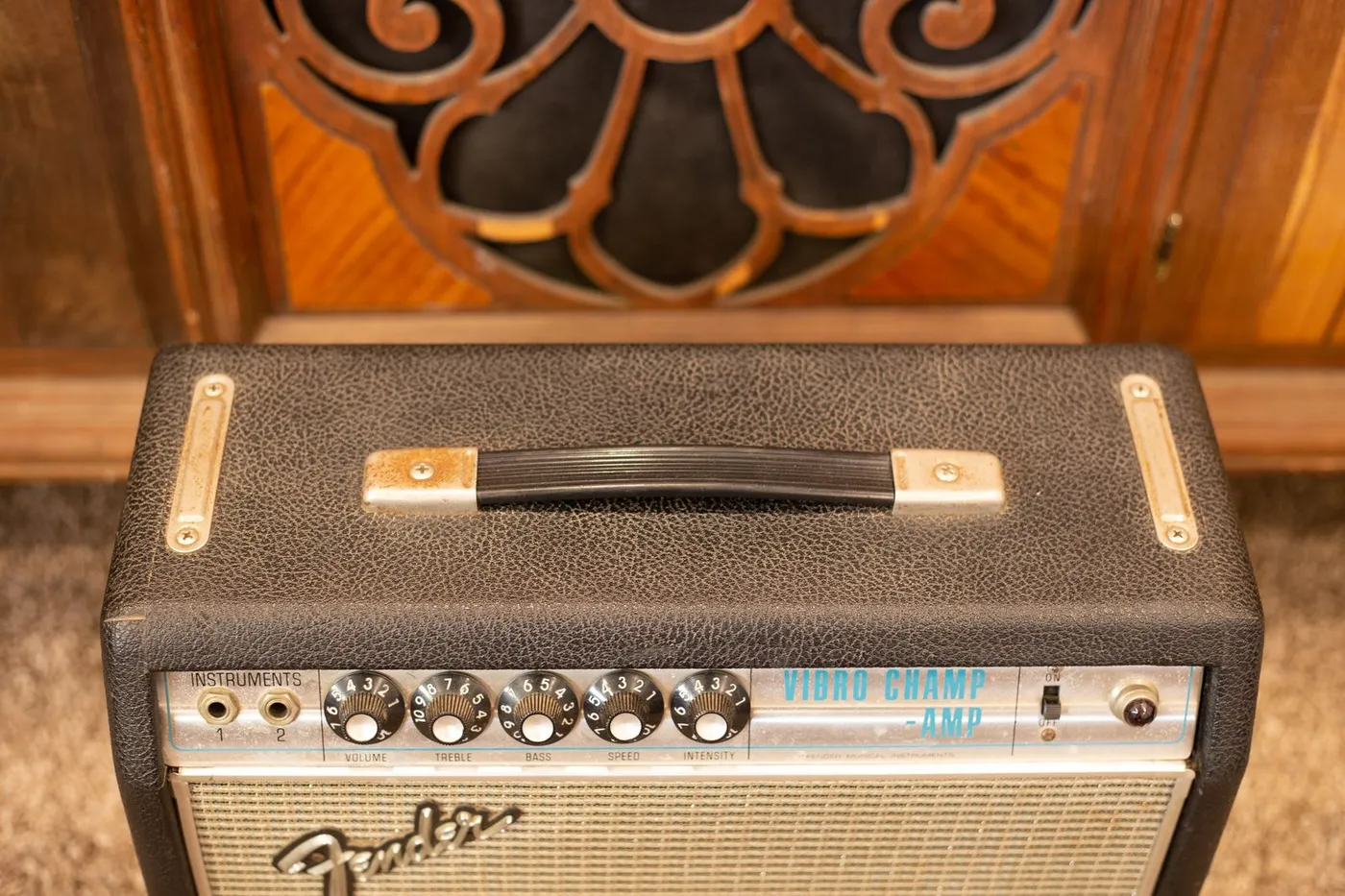
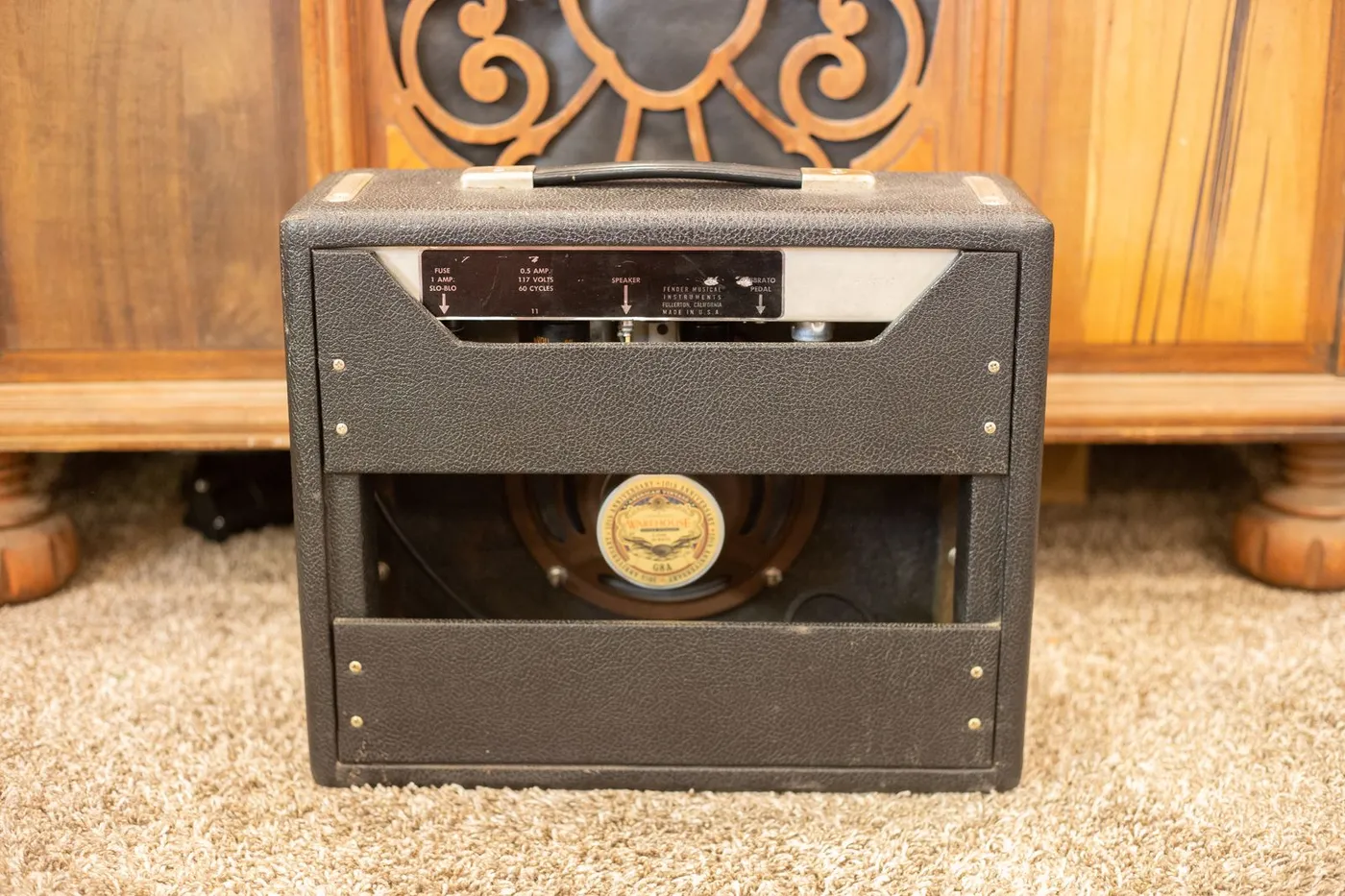
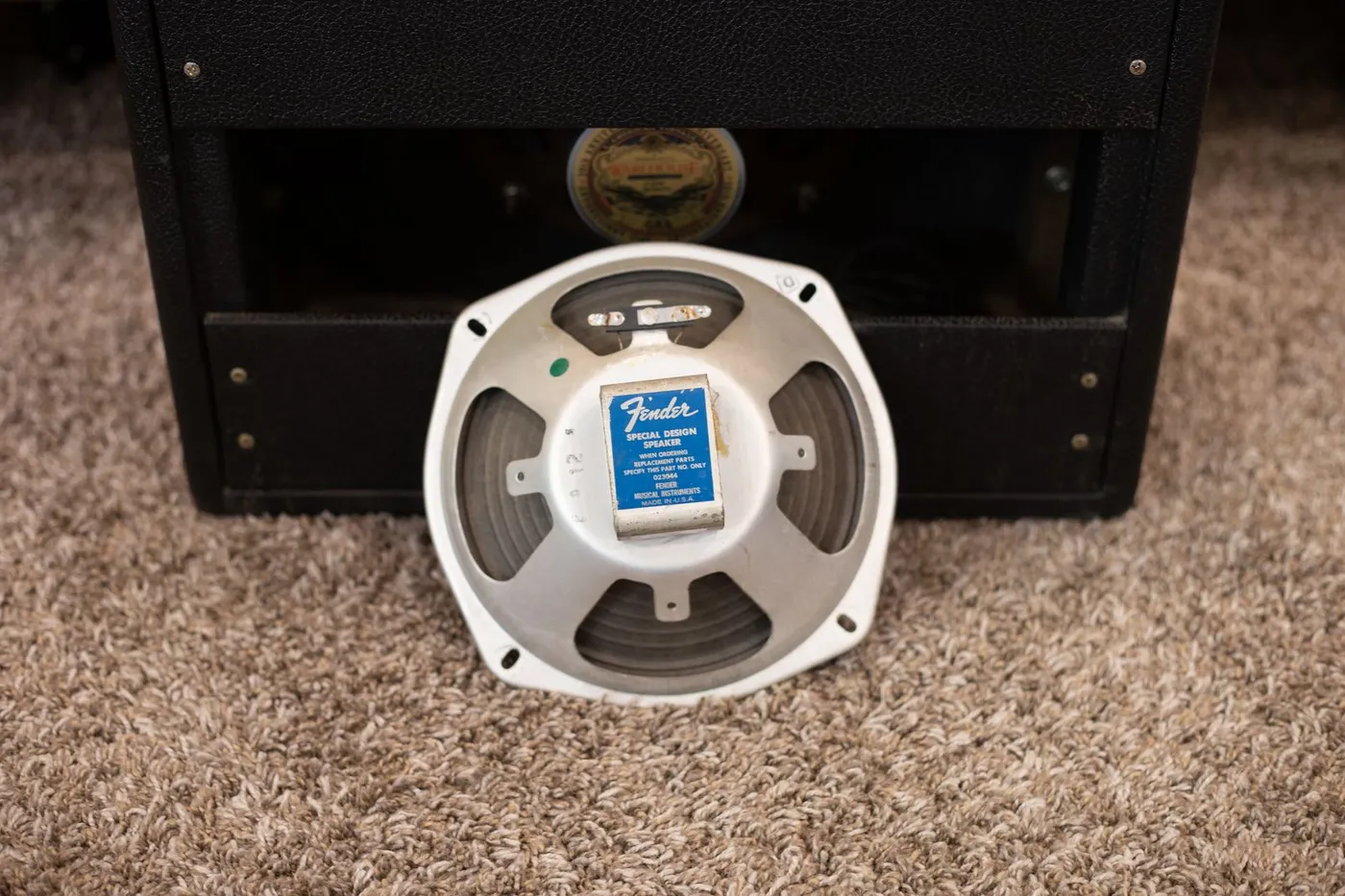
The silver panel and aluminum surround on Joe’s 1968 drip-edge Vibro Champ show the early silverface appearance. The five controls retain the separate tremolo Speed and Intensity adjustment. Its rear photograph shows the installed Warehouse replacement speaker. The loose speaker is the original supplied with the amp; Joe’s listing says it needs a recone. Keep that distinction when comparing the photos with factory specifications.
History, Factory Drawings And Original Specifications
Champ Identification References
- Joe’s 1949 Champion 600
Two-tone cabinet, rear controls and disclosed service work.
- Joe’s 1965 Blackface Vibro Champ
Front, rear, chassis and tube-chart photographs.
- Joe’s 1968 Drip-Edge Vibro Champ
Silverface appearance and replacement/original speaker distinction.
- Fender Champ History
Champion origins, the 1964 redesign and later model exclusions.
- Wide-Panel Champ Field Record
5C1 tube set, rating and cabinet details.
- Narrow-Panel Champ Field Record
5E1/5F1 sequence, speaker sizes and black-covered transition.
- Blackface Champ Field Record
AA764 controls, eight-inch speaker and early grille-logo details.
- Fender Champ And Vibro Champ Manual
1980 six-watt rating and separate control layouts.
Send The Evidence
Send Your Champ Photos To Joe
Show the front, rear, paper chart and visible speaker markings. Include what you know about repairs, storage and any parts kept with the amplifier.
Questions AboutOriginal Fender Amplifier Identification
Is Every Handwired 5F1 An Original Fender Champ?
What Separates A Champ From A Vibro Champ?
Did An Original Silverface Vibro Champ Have Reverb?
Can I Date A Champ From Its Serial Number?
The Last Word
Identify Your Amp With Joe
Identify the cabinet and controls, then compare the chart and circuit before narrowing the date. The Champ and Vibro Champ price guide keeps the different versions separate. If the panel says Vibrolux, use the Vibrolux guide instead. The Fender amp eras article explains why the Champ’s long-running tweed form can overlap other families’ cosmetic changes.
Authenticity And Originality Are Assessed From The Information Provided. A Hands-On Inspection Can Change The Conclusion.