

Original Bassman Combos And Heads Through 1980
How To Identify A Vintage Fender Bassman
A 5F6-A combo and a silverface Bassman head need different checks. Start with the format, then match the circuit.
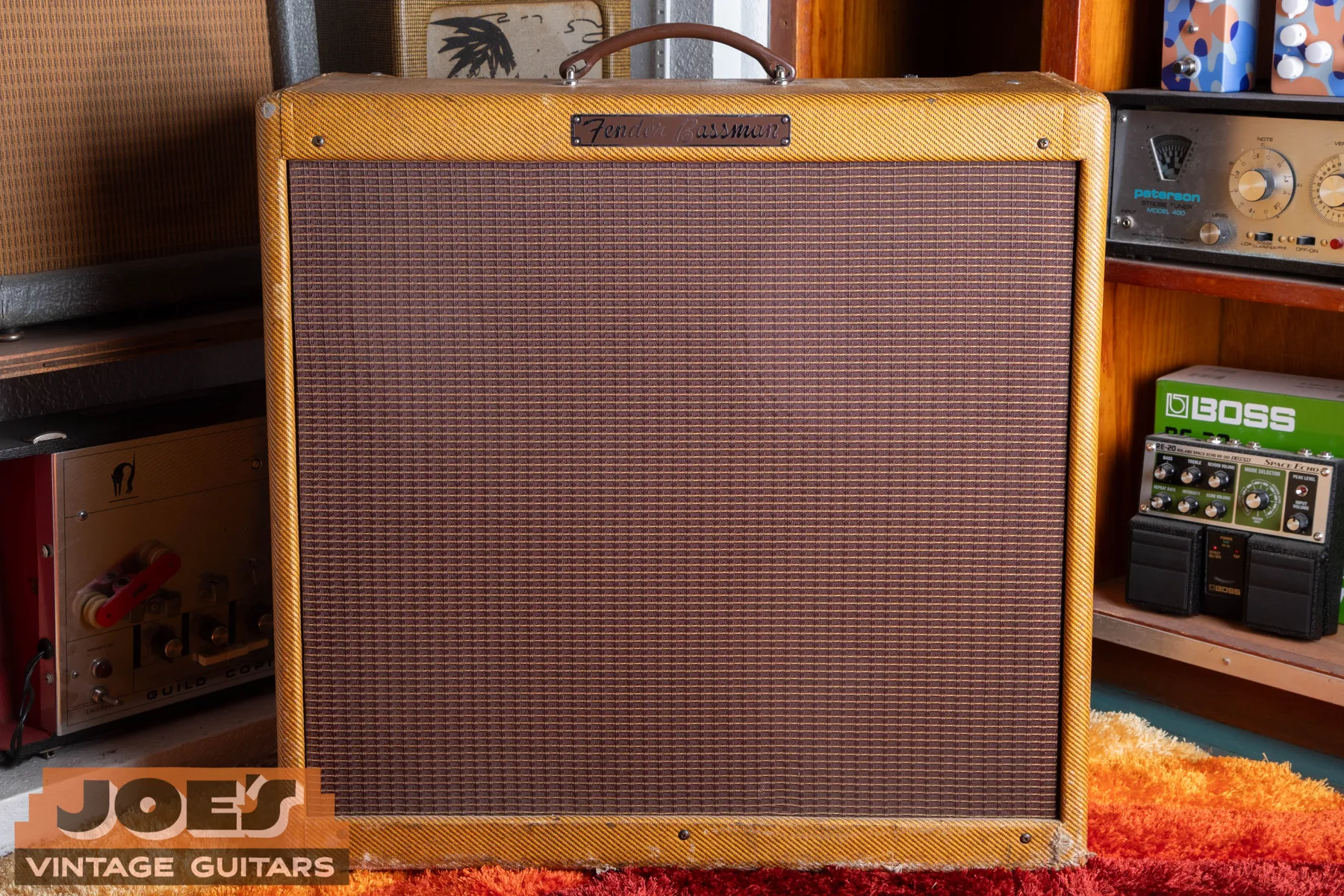
An original Fender Bassman can be a tweed combo, a blonde piggyback set or a later blackface or silverface head. Identify that format before consulting the Bassman value chart. Joe’s 1959 combo and 1963 6G6-B photographs show two versions that share the name while differing in cabinet, controls and rectification. This guide follows the original family through 1980 and uses factory drawings to separate the principal circuits.
Authenticity And Originality Are Assessed From The Information Provided. A Hands-On Inspection Can Change The Conclusion.
Check The Construction And Model Markings
Original Or Reissue?
’59 Bassman Reissue And LTD
Fender’s ’59 reissue service drawing identifies control and main printed circuit boards. That differs from the original 5F6-A eyelet-board layout. The LTD specification lists a lacquered tweed pine cabinet, four Jensen P10R speakers and a rubber dogbone handle. Those present-day parts can resemble older designs, so their appearance alone doesn’t authenticate a 1959 amp.
Later Bassman Names
The Bassman 60 service document identifies the much later PR421 model. Fender’s history also places the Bassman 20 and solid-state Compact after this guide’s cutoff. Read the complete rear model identification. Don’t place an unfamiliar Bassman into a 1960s group merely because it has black covering or a low serial number.
Ask a technician to photograph board construction if exterior labels leave the question open. A modern handwired replacement board or a complete replica can follow an old drawing closely. Hand assembly establishes how something was built, not when it was built. The same caution applies to an aged cabinet fitted with modern transformers.
A new speaker inside an old cabinet is evidence of a changed speaker. It doesn’t, by itself, make the entire amplifier a reissue. Record the parts separately and look for agreement among the chassis, cabinet and component dates. If those groups disagree, describe the amp as needing further identification rather than forcing one date onto everything.
Broad Eras, Then Model-Specific Details
Bassman Changes Across The Fender Eras
Single Fifteen To Four Tens
The Bassman itself arrived in 1952. Fender’s history describes the TV-front 1x15, the 1953 wide-panel cabinet and the first 4x10 in 1954. Later four-input 5F6 and 5F6-A versions add the middle control. Tweed Bassman production continued into 1960, a model-specific overlap.
The Separate Head And Cabinet
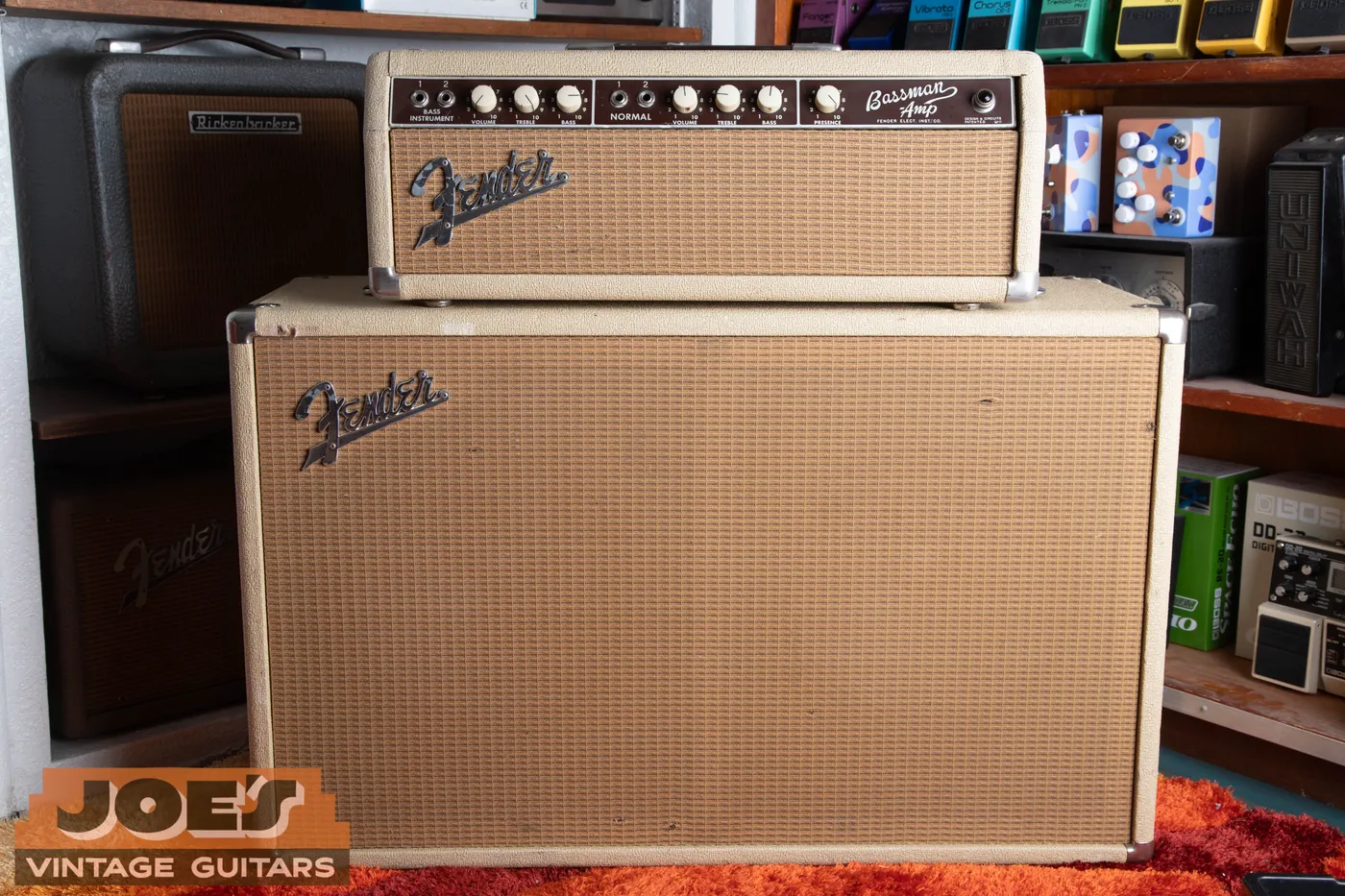
The blonde Bassman changes to piggyback construction. The 6G6 uses a GZ34 rectifier; the 6G6-B drawing uses diodes. Joe’s 1961 blonde and oxblood Bassman provides an early example with a 1x12 tone-ring cabinet.
Oxblood is the dark maroon grille cloth used on early blonde Bassmans. Fender’s model history places the change to lighter wheat-colored cloth in late 1962. Check the weave, attachment and replacement history alongside the covering, knobs and dated chassis. Cloth color helps identify the appearance; component evidence is needed to establish the amp’s year.
AA864 And AB165 Are Different Circuits
The black-covered head loses the blonde version’s presence control and gains channel switches. AA864 and AB165 share the broad format but differ internally. A surviving earlier chart doesn’t guarantee that the chassis follows that earlier drawing.
Joe’s archived 1960s blackface Bassman head is another example from this period. Its listing records a replacement blue pilot-light jewel and gives no exact year or circuit designation. Keep those limits when comparing it with a claimed AA864 or AB165.
More Names And Higher Output
The silver-panel family includes Bassman 50, 70, 100 and 135 heads and the four-ten Bassman 10 combo. Later high-power versions use ultralinear output stages. Factory master-volume controls and rear output markings help narrow the version before a technician checks it.
Read The Exact Drawing For The Chassis
Bassman Circuits And Tube Complements
| Version | Output / Speakers | Rectifier And Full Tube Set | Controls And Appearance |
|---|---|---|---|
| Early 5B6, 1x15 | About 26 W; Jensen P15N 1x15 | 5U4G; 2x5881; 1x6SC7 and 1x6SL7GT | Volume, Tone, two inputs; wide-panel tweed, brown grille, block badge, chicken-head knobs, leather handle |
| 5E6-A 4x10 | About 40 W; four ten-inch speakers | 2x5U4G; 2x6L6G; 2x12AY7 and 1x12AX7 | Two volumes, Treble, Bass, Presence; two inputs; narrow-panel tweed |
| 5F6-A 4x10 | About 45 W; Jensen tens | GZ34; 2x5881; 1x12AY7 and 2x12AX7 | Four inputs; two volumes, Treble, Middle, Bass, Presence; dark grille, chrome top panel, chicken-head knobs |
| Blonde 6G6 / 6G6-B | About 50 W; separate 1x12 or 2x12 cabinets by version | 6G6: GZ34; 6G6-B: diodes. Both: 2x5881 and 4x7025 | Bass and Normal channels with Volume, Treble, Bass; Presence; brown panel and light covering; later cosmetic transitions |
| Blackface AA864 / AB165 | 50 W; commonly 2x12 cabinet | Diodes; 2x6L6GC, 3x7025 and 1x12AT7 | Bass Deep and Normal Bright switches; separate Volume, Treble, Bass; black panel and covering, silver grille, skirted knobs, black strap |
| Bassman 10 | 50 W or later 70 W drawing; sealed 4x10 combo | Diodes; 2x6L6GC, 2x7025 and 1x12AT7 | Normal and Studio channels, Master Volume; black cabinet, silver panel, silver/blue grille |
| Bassman 70 | 70 W; separate cabinet | Diodes; 2x6L6GC, 3x7025 and 1x12AT7 | Bass and Normal channels, Master Volume; ultralinear output transformer; silver panel |
| Bassman 100 / 135 | 100 / 135 W; commonly 4x12 cabinet | Diodes; 4x6L6GC, 2x7025 and 1x12AT7 | Master Volume; 135 uses ultralinear output stage; black cabinet and silver panel |
7025 is the low-noise 12AX7-family designation used in the drawings. Ratings identify designs, not a measured guarantee for a particular serviced amp. Cabinet pairings varied; record the actual cabinet.
The 5F6-A layout shows the eyelet board and socket order. Compare it with the AB165 schematic before describing a later head as electrically equivalent. Fender’s Bassman history supplies the model and cabinet sequence; individual factory drawings control the tube counts in this table.
A solid-state rectifier in a tube Bassman isn’t the same thing as the separately marketed period solid-state Bassman. Rectification is one function in the power supply. The tube heads listed above still have valve preamp and output stages. A vintage all-transistor example belongs to its own model group and shouldn’t be judged by the tube socket checklist.
Controls, Board And Cabinet
What To Check On A Claimed 5F6-A
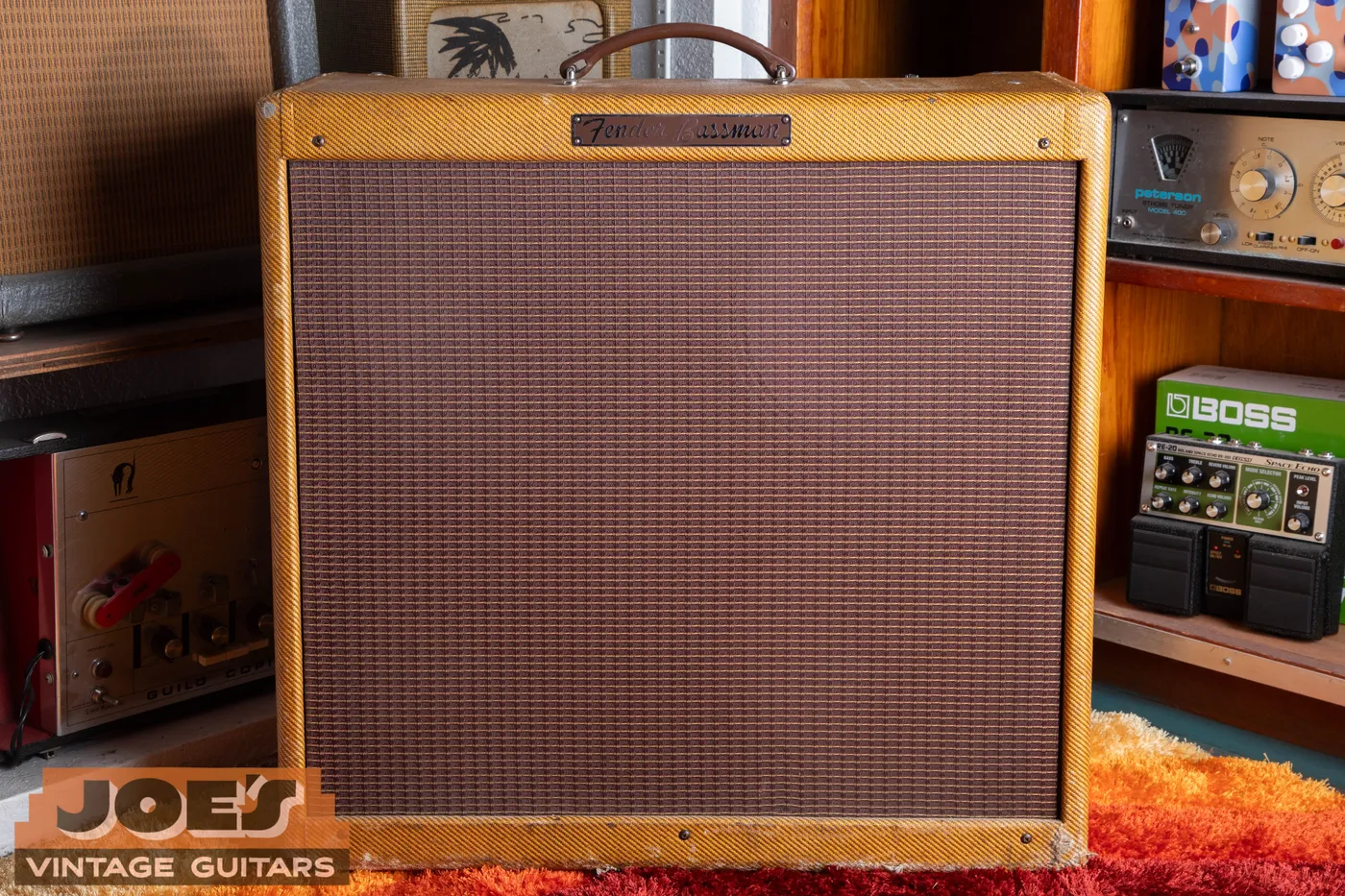
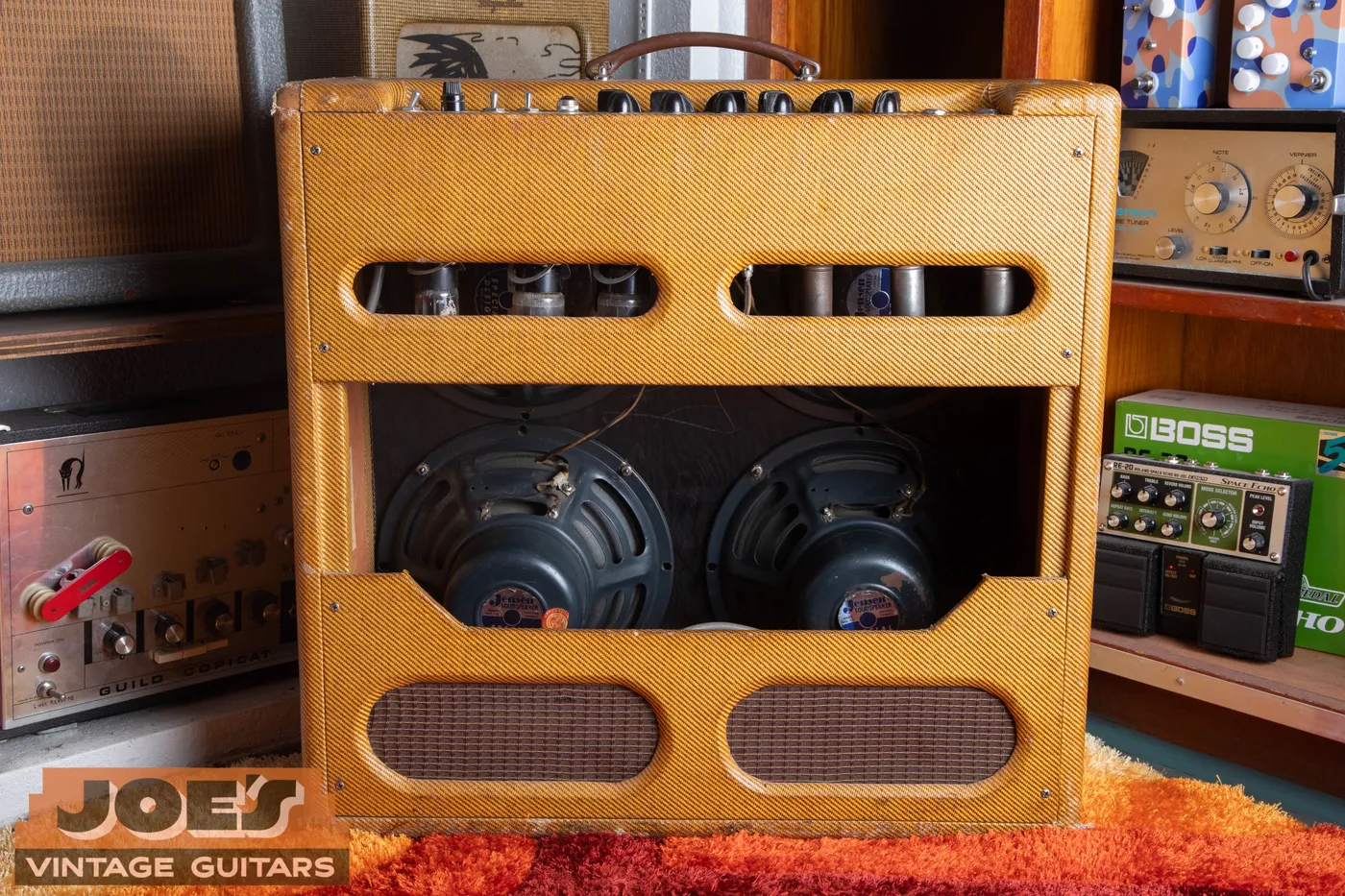
Begin with the top panel. Joe’s 1959 Bassman has four inputs, two channel volumes and separate treble, middle, bass and presence controls. The rear view shows the four-speaker format. These visible features are consistent with the late tweed family, but the same arrangement is copied by later amps. A front photograph is the start of identification.
The original drawing calls for a GZ34 rectifier and a pair of 5881 output tubes. Tubes installed during servicing may carry different markings, so a mismatch needs explanation rather than an immediate conclusion about the whole chassis. A technician should identify the circuit and determine whether the installed parts suit it. Don’t substitute tubes merely to make a photograph match a chart.
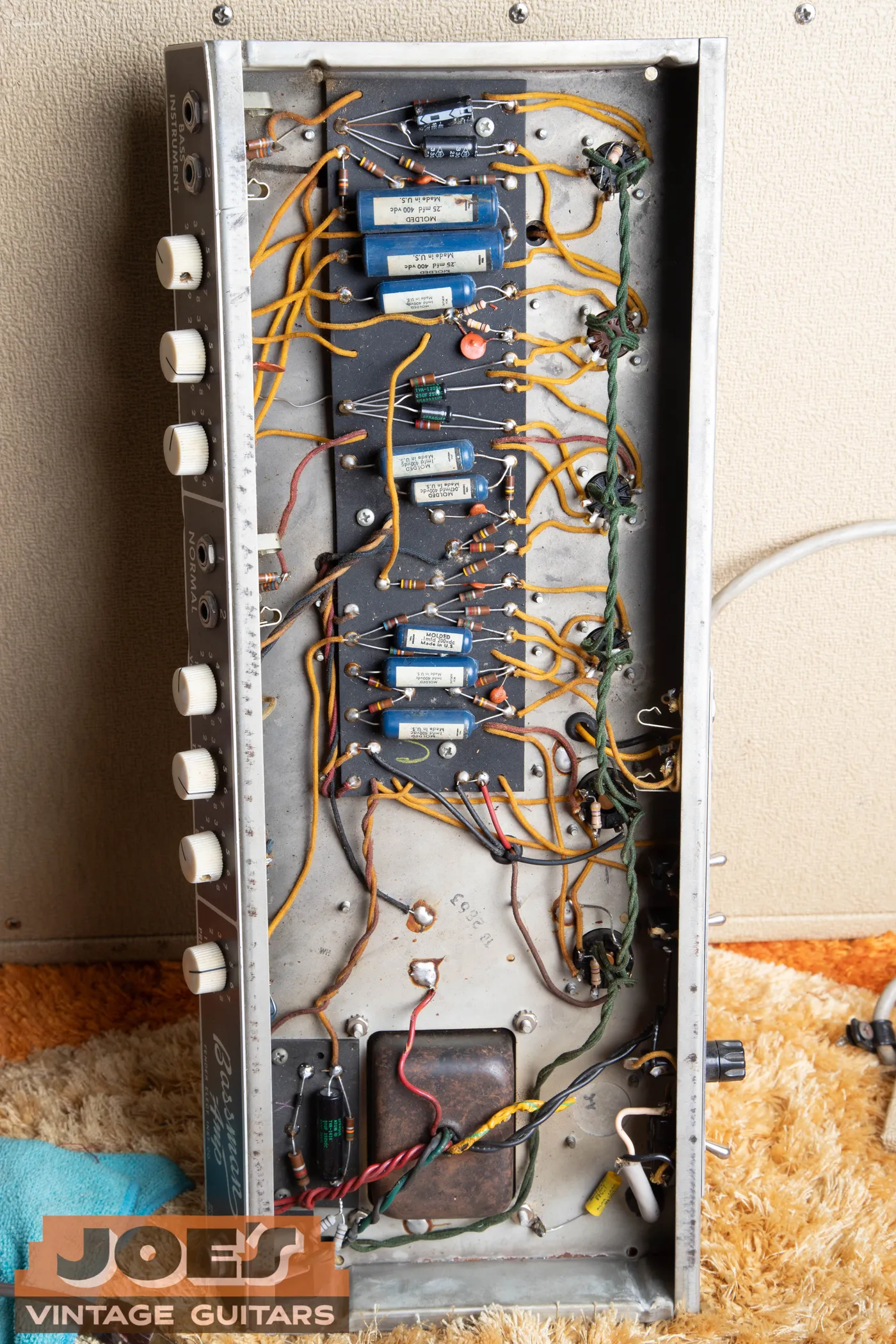
Joe’s board photograph contains newer blue service capacitors among older components. That visible work prevents a casual “untouched” claim. It doesn’t erase the identity of the chassis. The useful description states which circuit it follows, what remains and what a technician replaced. Keep that level of detail when an amp has been converted or rebuilt.
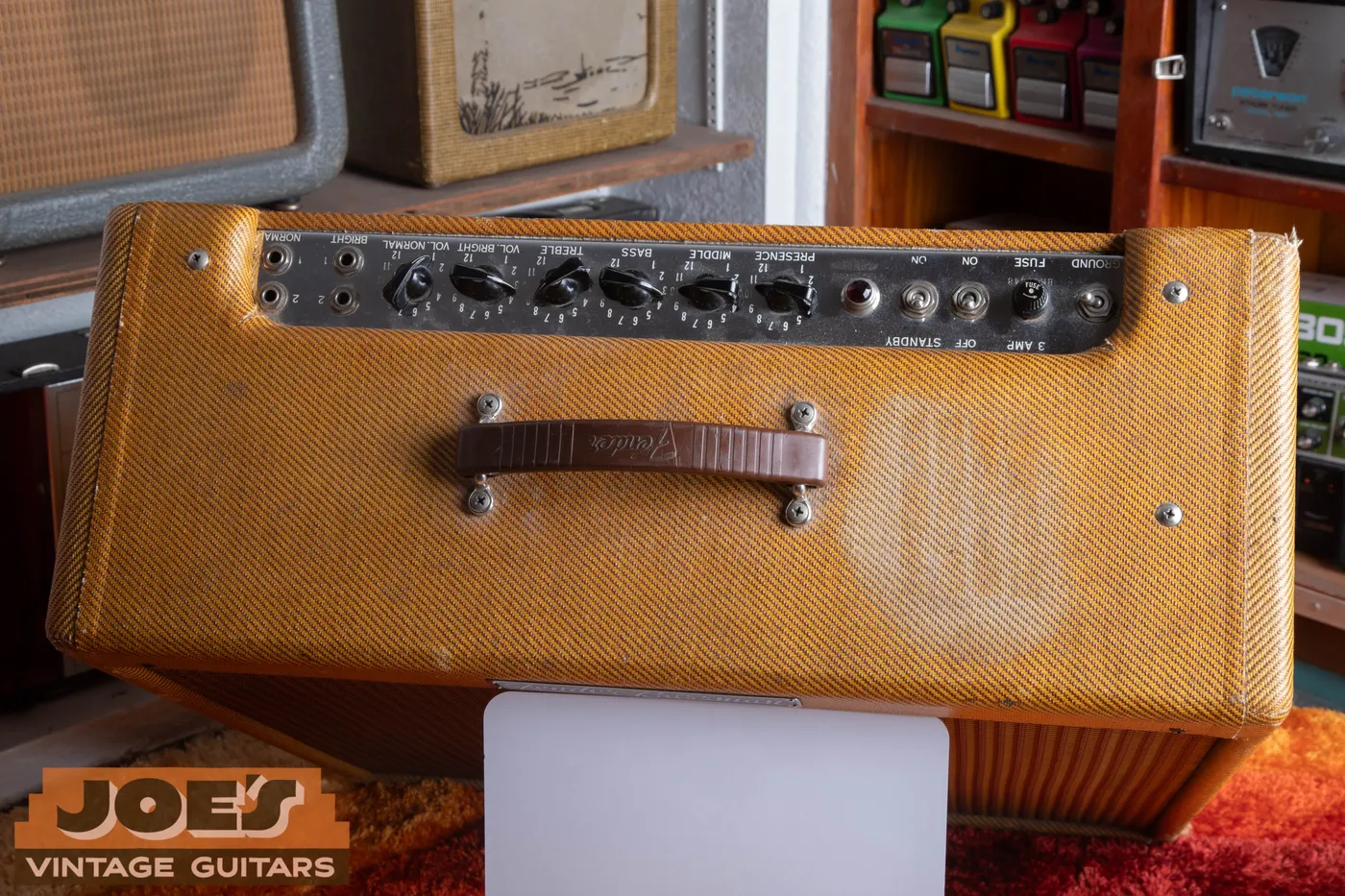
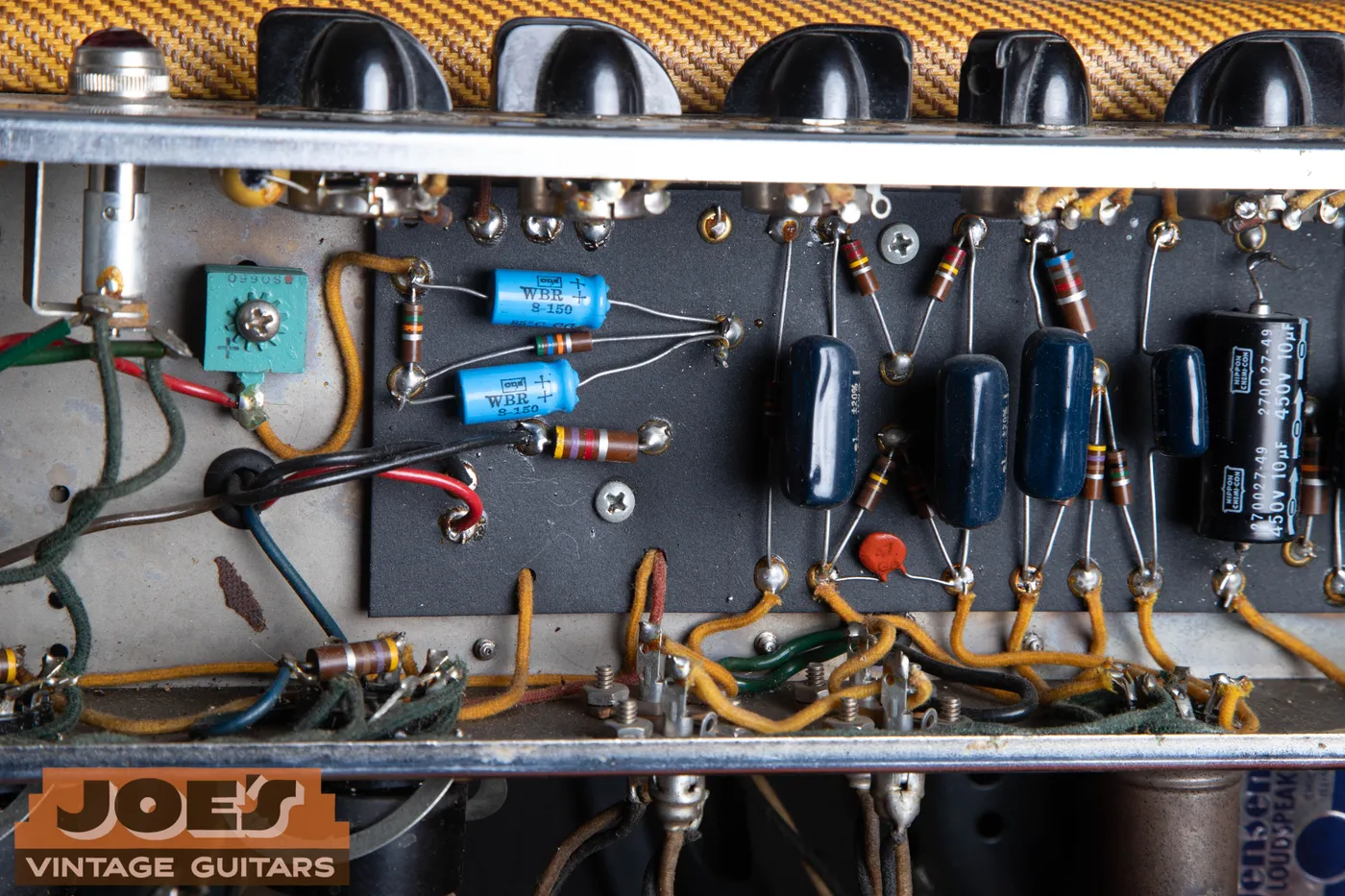
Chart Printing And Component Stamps
Dating A Bassman From Readable Evidence
Use Joe’s tube-chart decoder for the two-letter ink stamp used until about 1970. Its year sequence starts with A for 1951. Printed 5F6-A or 6G6-B text names a circuit and isn’t a date stamp. Fender serial numbers aren’t reliable year locators, even when a stamped number looks neatly sequential.
When the ink or paper is missing, collect several transformer and speaker source-date codes. The pot-code reference can support the control inspection. Parts can wait in stock before assembly; a replacement part can be much newer than its chassis. The proposed production window should explain the surviving original group.
A Readable Speaker Stamp
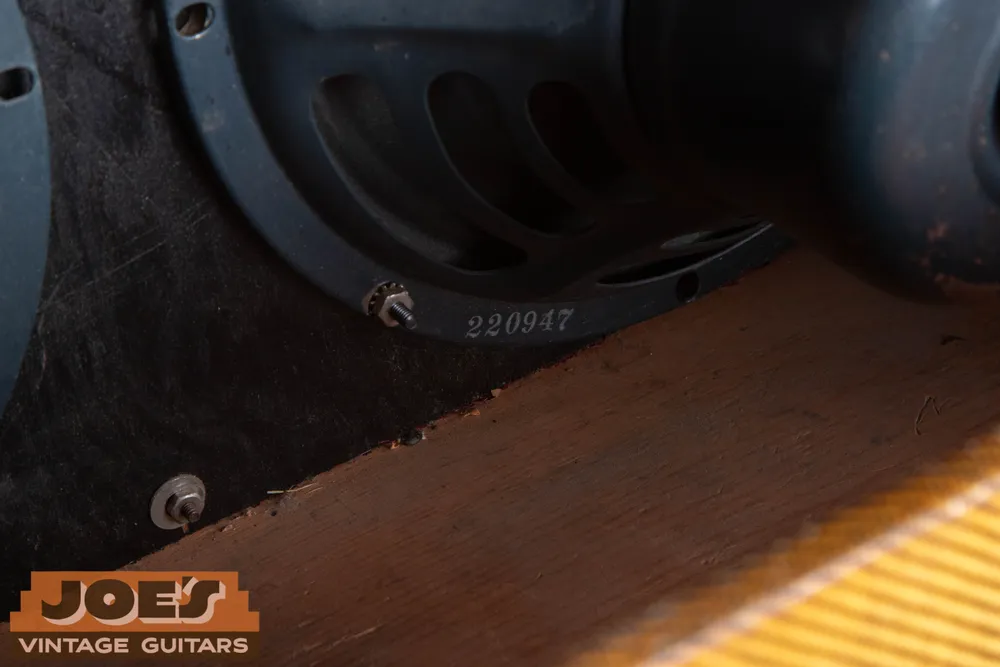
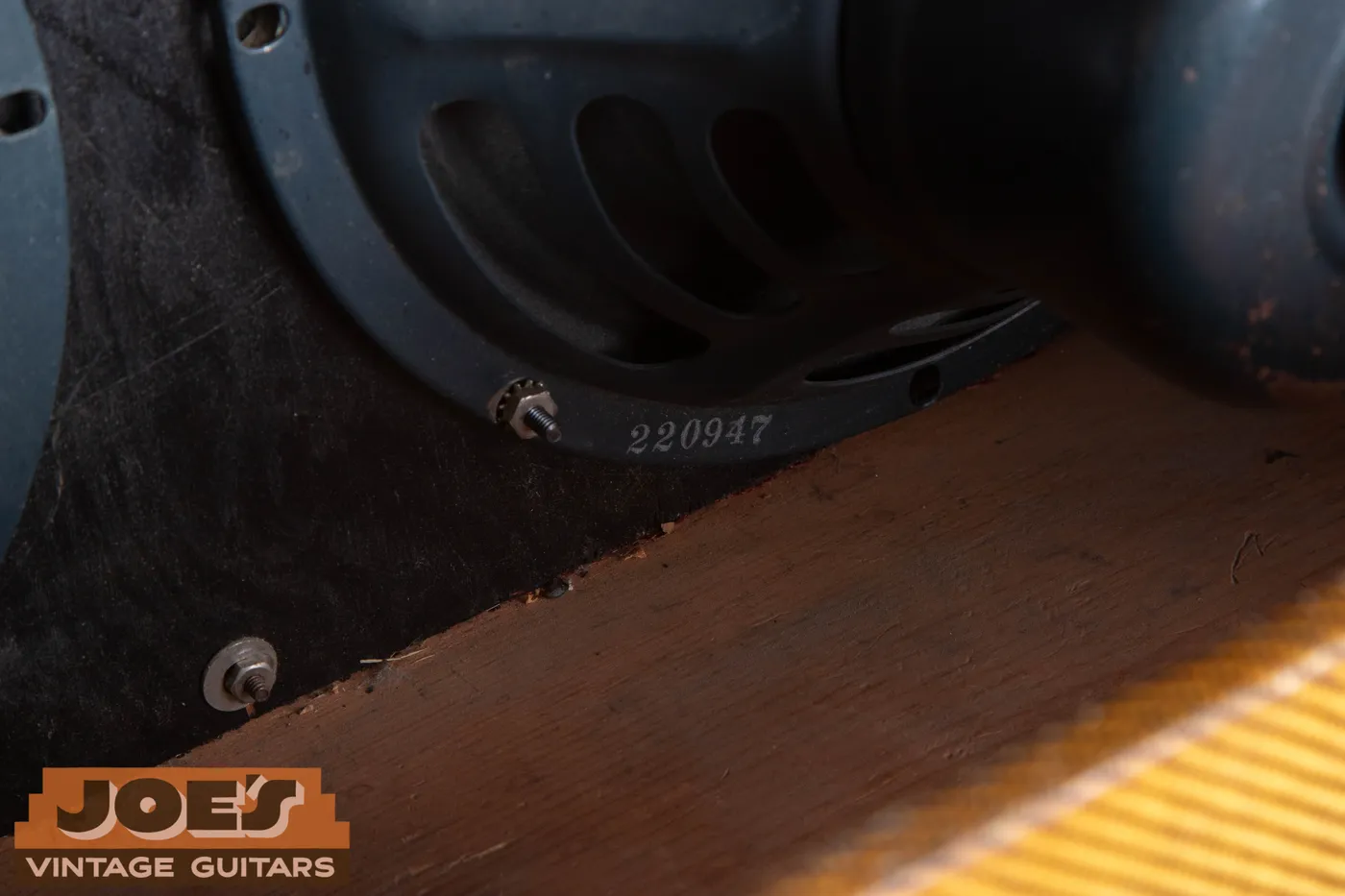
All six digits are visible on a speaker in Joe’s 1959 Bassman. Keep this frame photograph with the full rear view, then use the component-code section to interpret it. One speaker stamp doesn’t date the other three speakers or certify their cones.
Printed Circuit Identification
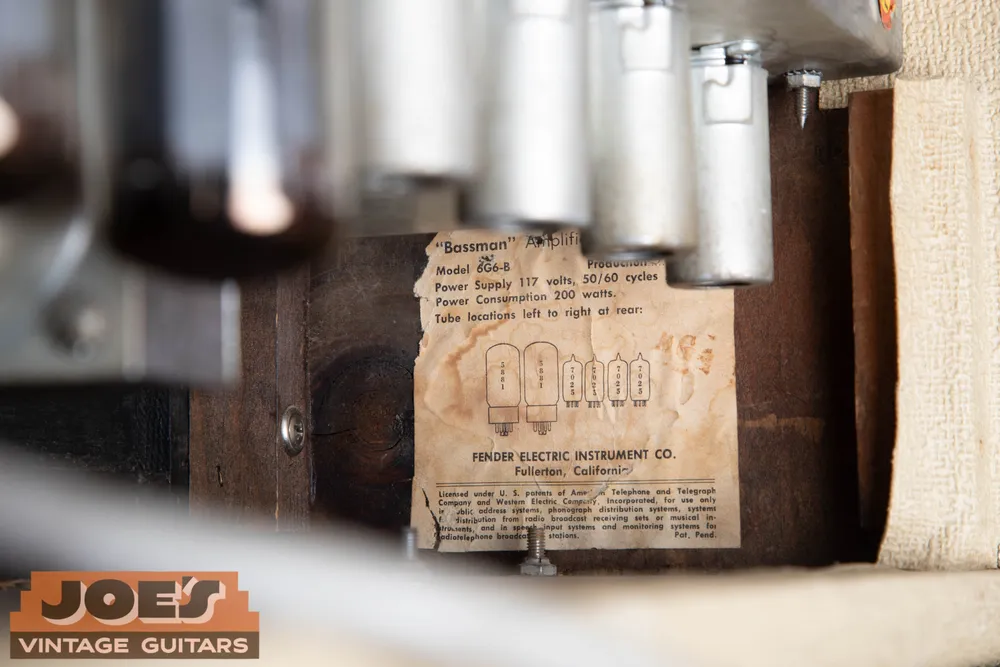
This designation is legible on Joe’s 1963 blonde Bassman chart. The faded ink stamp isn’t clear enough for a dependable two-letter reading, so no month is assigned from it. The archive year and the readable circuit printing remain separate observations.
Have A Technician Handle Chassis Access
Eleven Bassman Originality Checks
Transformers And Choke
Match the power and output transformers to the exact circuit, then document the choke where fitted. Photograph the full stamps and mounting hardware. Extra holes, adapters or spliced leads merit a technician’s explanation. A correctly rated replacement can function well without being the factory part.
Speakers
Inventory every basket, label and frame code. Four tens in a tweed combo need four records; a piggyback cabinet needs its own record independent of the head. Reconing preserves some speaker components and replaces others, so describe that work specifically.
Capacitors And Other Components
Ask which filter and signal capacitors were changed. The board should be compared with the relevant drawing, including bias and feedback circuitry on later heads. New parts are visible in Joe’s tweed board photograph; they’re documented as service history.
Tube Chart
Show the whole paper label where it is attached, including damage and adhesive edges. Read the printed model separately from ink stamps. A replacement chart can reproduce the correct design name while providing no evidence of when the amplifier was assembled.
Cabinet And Covering
Inspect the combo’s baffle and rear opening or both piggyback cabinets. Changes to speaker openings, new wood and recovering should be identified. A blonde head and cabinet with similar material may have been paired later.
Grille And Logo
Compare the grille weave, mounting and badge attachment with the version being claimed. Reproduction material can be visually convincing. Look for evidence around the reverse of the baffle when a technician has it accessible, rather than judging only the clean front.
Faceplate And Knobs
Record input count, channel wording and every control. A black panel with white knobs can be a transition detail that needs corroboration. A substituted panel or added master-volume hole changes the evidence; don’t infer a circuit solely from its lettering.
Handle
Photograph the handle, brackets and surrounding wood. A safe replacement may be sensible for use, especially on a heavy combo. Preserve the old handle if it survives and disclose new mounting holes or reinforcement.
Reverb Equipment And Footswitch
The standard original Bassman versions discussed here don’t have built-in reverb or tremolo. A tank, footswitch socket or added effects control calls for a modification explanation or a separate accessory description.
Back Panels
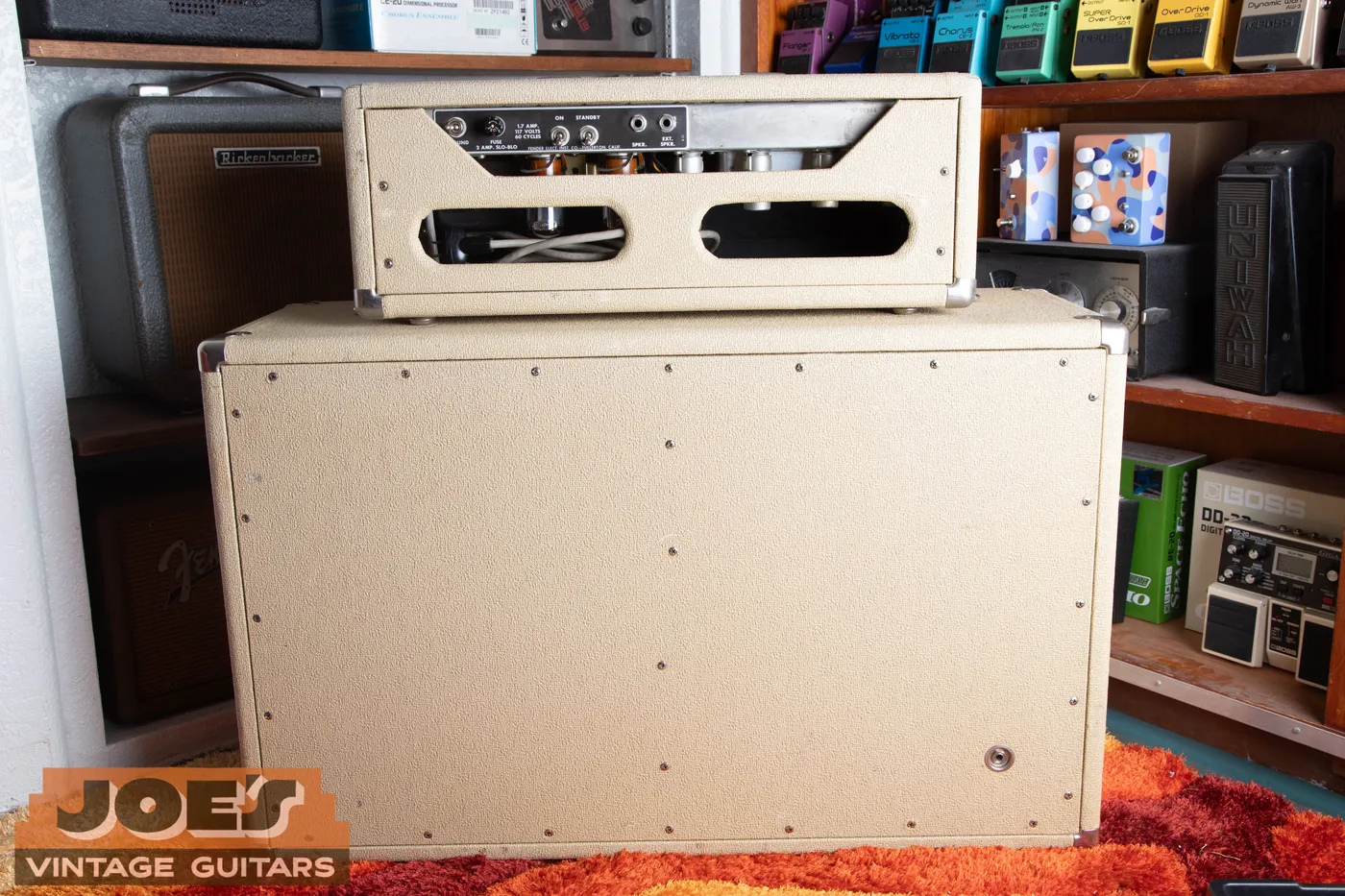
Show panel edges, screw positions and ventilation openings. A closed speaker cabinet and a partially open combo are different constructions. Replacement rear panels shouldn’t be used to infer the original speaker arrangement without further evidence.
Covers
Check each surviving cover against the piece it fits. Photograph the stitching, openings, lettering and wear. A later protective cover is useful equipment, but it doesn’t establish that a head and cabinet left the factory together.
Keep The Repair Description Specific
Service History And Originality
Replacing exhausted filter capacitors or a damaged cord can be routine maintenance. Replacing a transformer, rebuilding a cabinet or converting the circuit changes other parts of the originality assessment. The Bassman value guide explains how to prepare those details for pricing. It’s more useful to name the work than to call an amp simply “all original except service.”
An old amplifier can retain hazardous voltage after it is unplugged. Leave chassis removal and electrical testing to a qualified amp technician. Request dated photographs and an itemized repair record. An owner can still supply the outside views, visible labels and ownership history without reaching into the circuitry.
Two Original Amps From Joe’s Archive
Bassman Photo Timeline
Late Tweed Combo
1959 Fender Bassman
The top controls and four-speaker rear view belong to the same archived combo. Its speaker stamp and board photographs add evidence that a front view cannot provide. Visible service components are retained in the record.
Blonde Piggyback
1963 Fender Bassman
The light-covered set has a readable 6G6-B paper chart. Compare the rear and chassis views with the tweed combo’s construction. The images document this example; they don’t establish that every similar head and cabinet is a factory pair.
Factory Drawings And Model History
Bassman Reference Documents
- Fender Bassman History
Model introductions, cabinet changes and later names.
- Early Bassman Field Record
5B6 rating, octal tube set and exterior details.
- Fender 5E6-A Drawing
Two rectifier tubes and the earlier four-ten layout.
- Fender 6G6-B Drawing
Blonde head tube complement and diode rectification.
- Fender Bassman 70 Drawing
Ultralinear output stage and tube set.
- Fender Bassman 100 Drawing
100-watt output stage and complete tube set.
- Fender Bassman 135 Drawing
135-watt ultralinear output stage and complete tube set.
Send The Evidence
Send Joe Your Bassman Identification Photos
Include the whole set, panel lettering, paper chart and visible speaker codes. Technician photographs can resolve questions about the circuit.
Questions AboutOriginal Fender Amplifier Identification
Does 5F6-A On A Tube Chart Prove A 1959 Bassman?
Is Every Blonde Bassman Tube Rectified?
Can I Use The Serial Number To Find Its Year?
Does A Replaced Filter Capacitor Make The Amp A Reissue?
The Last Word
Identify Your Amp With Joe
Start with the cabinet format, then confirm the controls, circuit and dated parts. The Bassman price guide keeps complete sets and heads alone separate. For related combos, see the Super identification guide and the Fender eras article. Joe can review your evidence through the free appraisal form.
Authenticity And Originality Are Assessed From The Information Provided. A Hands-On Inspection Can Change The Conclusion.