

Identify The American Original · 1961 To 1970
Epiphone Casino Authentication Guide
Check the hollow body, pickup layout and production evidence before assigning a year to a Casino.
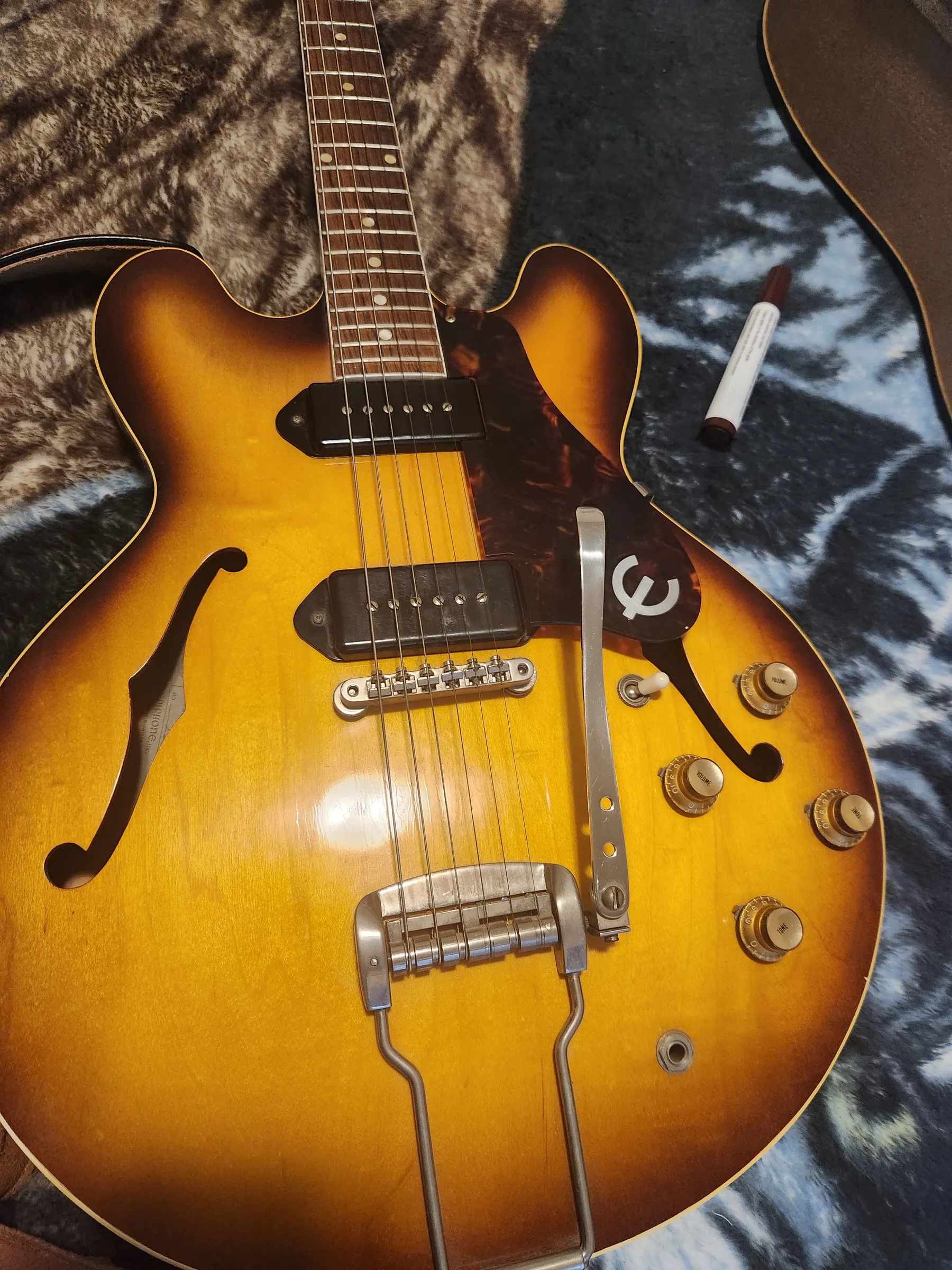
An original Epiphone Casino is a Kalamazoo-built hollowbody with a double cutaway and one or two P-90 pickups. Establish those features first, then date the guitar from its number, label and remaining construction. The Casino value guide supplies prices after the identity is settled. A model name alone can’t separate a 1960s instrument from a later Casino, and even a modern American-made example belongs to a different production period.
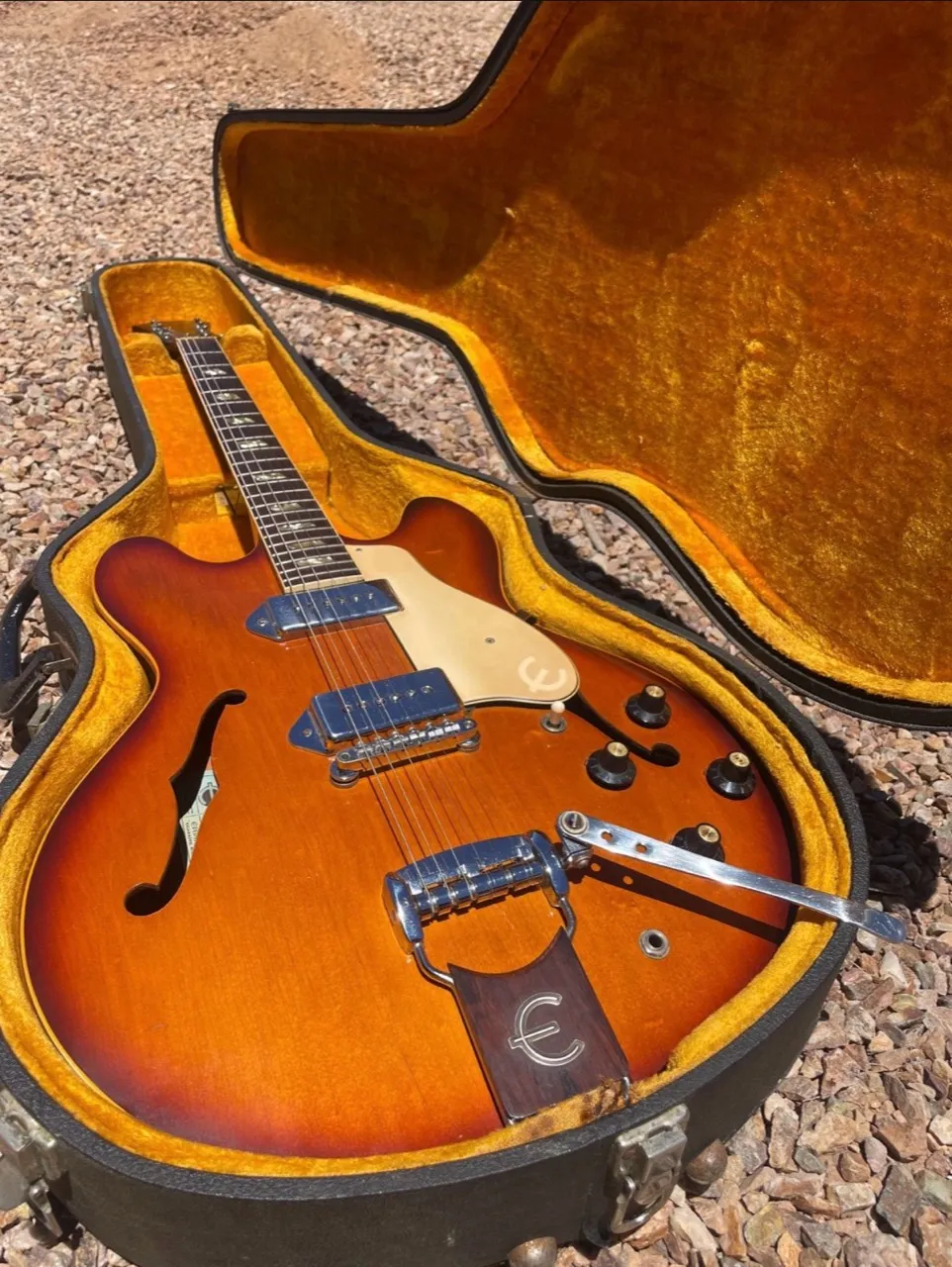
The Casino did not have a New York acoustic predecessor under this name. It entered Epiphone’s Gibson-era range in 1961. This guide follows the Kalamazoo period through the end of the original American line in 1970, then uses later instruments only to explain exclusions. The photographs below show Joe’s 1962 Casino with black P-90 covers and his 1965 Casino with chrome covers. A separate 2022 USA example illustrates later production.
Authenticity And Originality Are Assessed From The Information Provided. A Hands-On Inspection Can Change The Conclusion.
Establish The Model
The Casino’s Defining Construction
| Feature | What To Establish | Why It Matters |
|---|---|---|
| Body | Fully hollow, laminated maple, double cutaway | Separates the Casino from center-block Epiphones |
| Dimensions | 1961 catalog: 16 inches wide, 19 inches long, 1¾ inches deep | A period comparison, not a substitute for measuring |
| Neck | Set mahogany neck, rosewood fingerboard, 24¾-inch scale | Check neck construction and any replacement work |
| Electronics | One or two dogear P-90 pickups | Mini-humbuckers point to a different specification or a modification |
| Model designation | E230T single pickup; E230TD double pickup | Read the complete suffix with the actual hardware |
| Bridge and tailpiece | Tune-o-matic bridge; verify trapeze or vibrato configuration | Later installation can leave holes or disturbed finish |
Begin with an overall photograph before concentrating on the serial. A two-pickup Casino normally has separate volume and tone controls for each pickup and a selector. A single-pickup version has a simpler arrangement. If the holes and controls don’t agree with the label, record that discrepancy. A plausible serial can’t establish that the top has never been routed or that the installed harness left Kalamazoo with the guitar.
A New Model In An Established Factory
How The Casino Entered The Kalamazoo Line
Epiphone After The 1957 Sale
CMI acquired Epiphone in 1957, and Kalamazoo production began in 1958. The Sheraton history explains that transition. The Casino followed in 1961 as a fully hollow thinline. Don’t apply the older New York Epiphone serial sequence to it merely because the brand name is the same. Its production evidence belongs with Gibson-era instruments.
Epiphone’s earlier archtops explain the company’s background, but they aren’t intermediate Casino versions. A large non-cutaway acoustic with an old Epiphone label needs identification under its own model name. Adding a pickup to that guitar doesn’t place it in the Casino family.
The ES-330 Connection
The useful Gibson comparison is the ES-330: a thin, fully hollow electric with P-90 pickups. The shared construction helps explain why an ES-335 checklist can lead you astray. The Casino and Sheraton can look related in a distant photograph, but the Sheraton’s center block and different pickups answer a different set of questions.
Use the ES-330 dating guide only alongside the Casino’s own catalog evidence. A Gibson specification change doesn’t automatically establish the same change on every Epiphone built nearby. Headstock decoration, model labels and tailpieces still need to fit the Epiphone instrument.
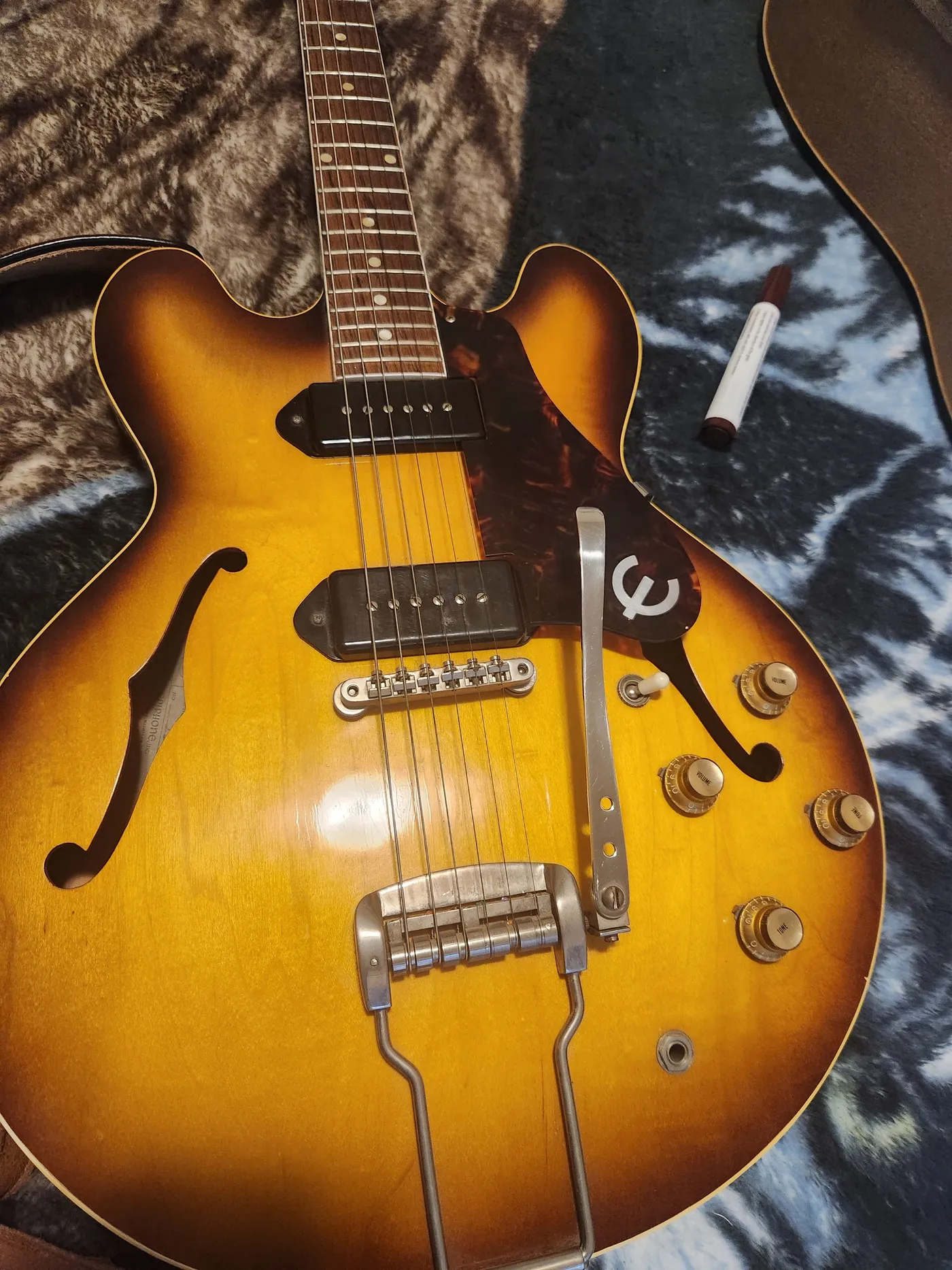
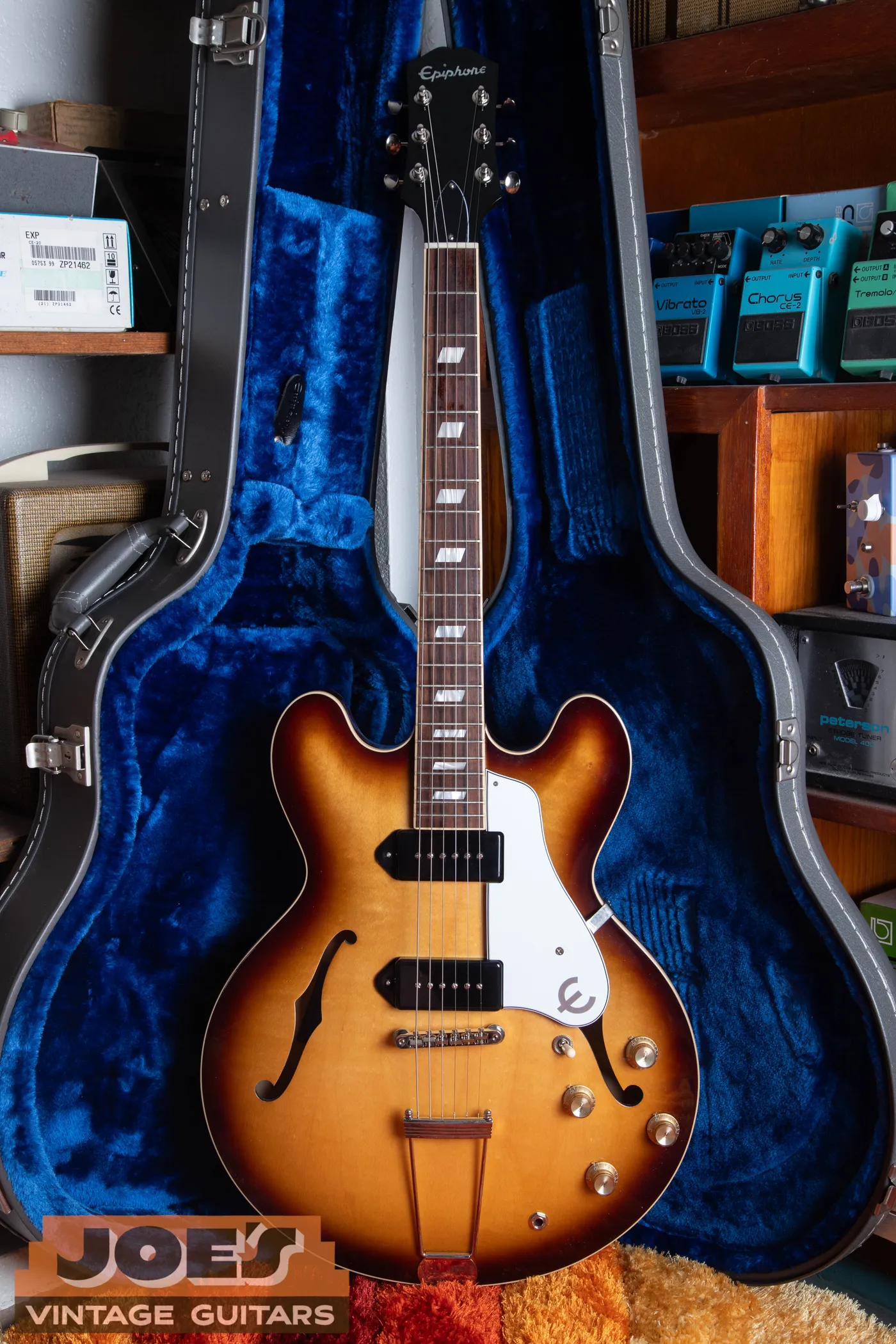
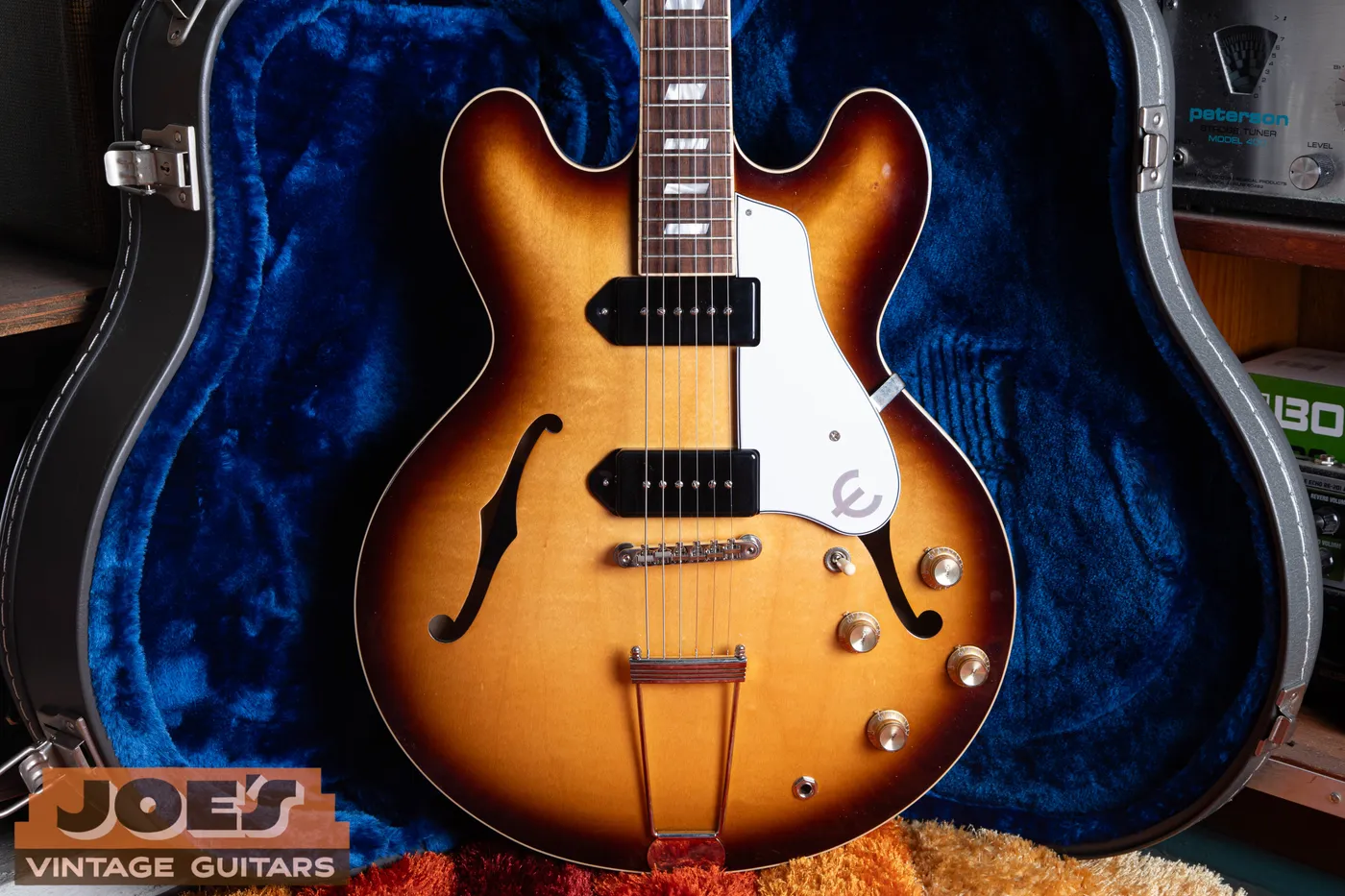
These 1962 and 1965 Casinos show different pickup covers, guards and fingerboard markers.
Read The Evidence As A Group
Casino Features Through The Original Run
Single And Double Pickup Choices
The introductory catalog lists E230T and E230TD versions and illustrates the Tremotone-equipped double-pickup guitar. It specifies Royal Tan or shaded finish. Early dot markers, dark guards and the early headstock presentation belong in the comparison set. Do not make any one detachable item an exact-year test; guards and covers are easy to change.
Logo And Trim Changes
The Casino’s early appearance developed into the better-known script-logo, parallelogram-marker form. Inspect the whole fingerboard and headstock together. A replacement neck or altered inlays require a different explanation from a swapped pickguard. Metal pickup covers also need to be checked against the pickup underneath rather than treated as proof of a particular year.
Compare The Later Headstock And Hardware
The longer Epiphone headstock and the mid-decade catalog form provide useful visual references. The 1966 catalog still lists single and double pickup choices and vibrato-equipped variants. Photograph the tailpiece mounting and bridge before assuming that every Casino should have the same hardware as the catalog illustration or a well-known artist’s guitar.
Late Kalamazoo Evidence
Sunburst remained part of the late-period range, with cherry also appearing late in the decade. Finish identification needs protected areas and inspection for overspray; a faded surface can look unlike a fresh color sample. Follow the original American line to its 1970 endpoint without extending an individual serial range or a particular variant beyond the evidence available for it.
The Most Useful Hardware Check
Confirm P-90s And An Unaltered Top
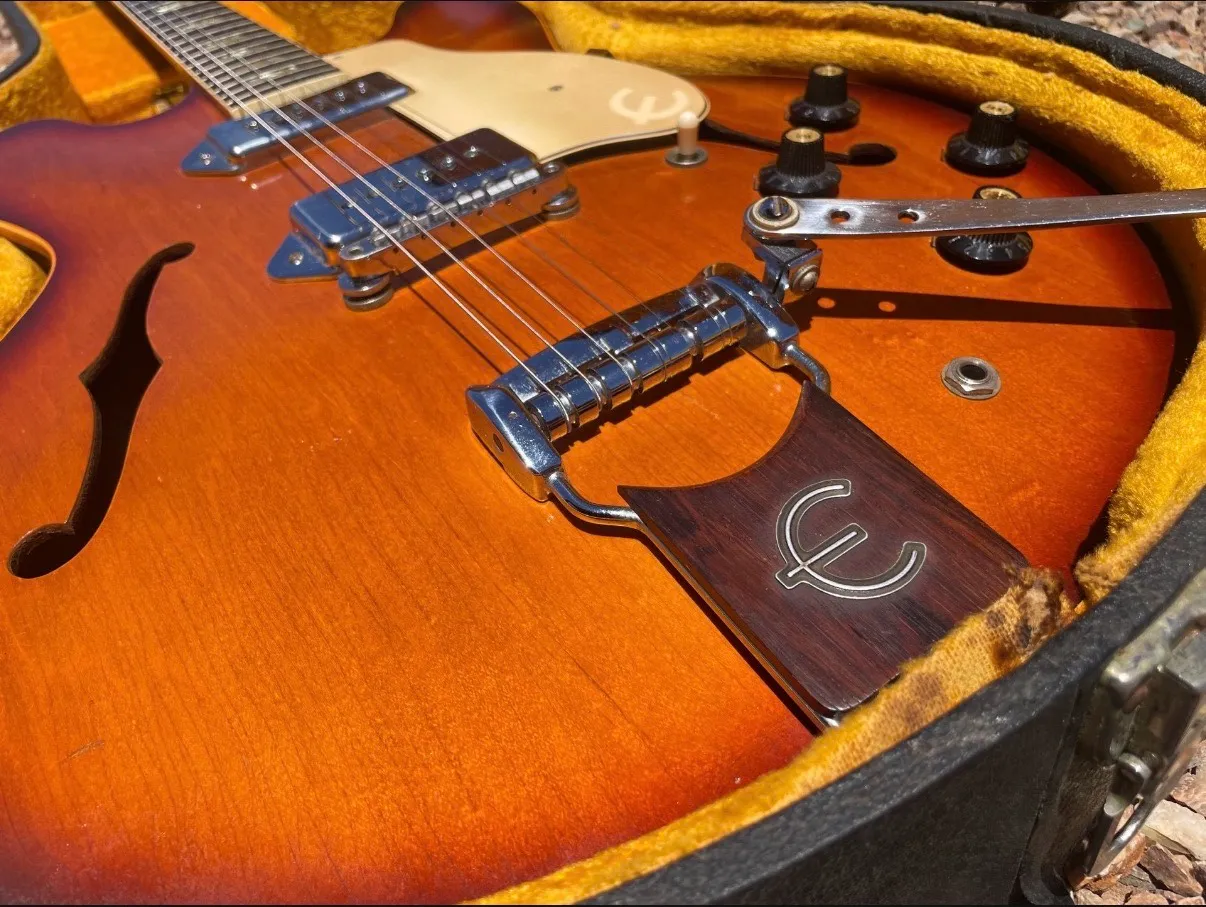
The Casino’s P-90 is a single-coil pickup. It is not the New York pickup used on some early Kalamazoo Epiphones, and it is not an Epiphone mini-humbucker. The 1962 Casino pictured here has black P-90 covers; the 1965 has chrome covers. Both show the dogear mounting shape. A guitar fitted with mini-humbuckers needs its actual model established or its alteration explained.
Look at the mounting ears, screw positions and the outline around each pickup. A wider replacement can hide an enlarged opening. Ask for existing repair photographs or a technician’s inspection before removing a pickup yourself. The object is to document original wood and mounting, not to risk damage just to obtain a picture for an online appraisal.
Cover color alone is weak evidence. Black and metal covers belong in the model’s history, but replacement covers can change that appearance without changing the coil. Likewise, a working pickup does not establish an untouched winding. If originality matters to a purchase, inspect the underside, lead and solder connections as part of a careful professional examination. Keep a rewound original distinct from a complete replacement.
E230T
Confirm one factory pickup opening and the corresponding controls. An extra switch or second pickup needs explanation. Photograph the entire top, including the space where a bridge pickup would sit on a double-pickup model.
E230TD
Confirm both P-90s, the selector and the separate control pairs. Read the label carefully enough to preserve the D suffix. Then compare the electrical layout with the body rather than relying on the handwritten model description alone.
Vibrato Configurations
Tremotone and other period vibrato arrangements require photographs of their attachment points. A changed tailpiece may leave exposed or filled holes. Neither a vibrato nor a trapeze by itself proves the guitar’s year or the installation’s originality.
1962, 1965 And A Modern Comparison
Joe’s Casino Photo Archive
Black P-90 Covers
1962 Epiphone Casino
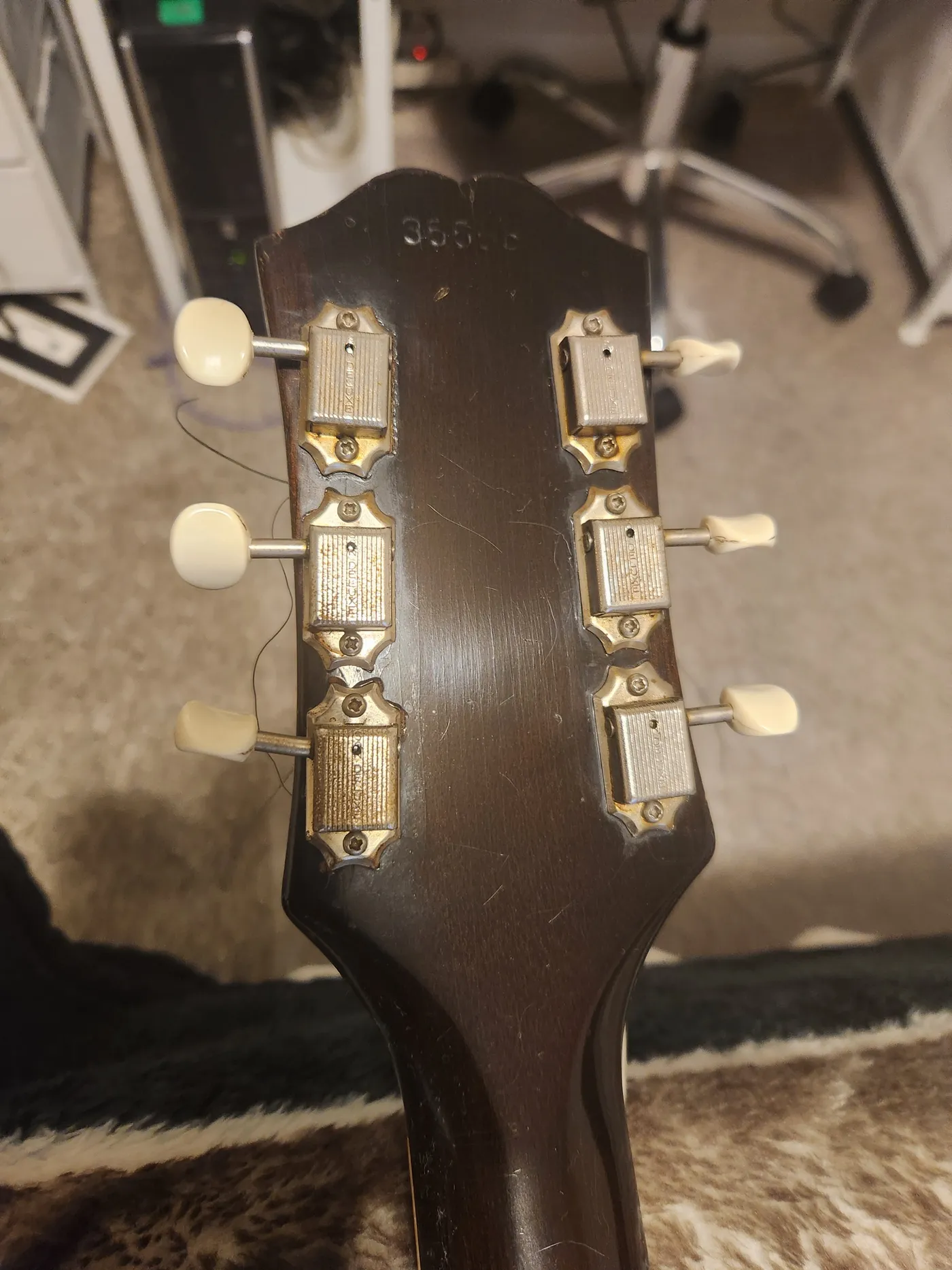
This 1962 Casino has two black dogear P-90 covers, dot fingerboard markers and a dark pickguard. The body photograph shows the pickup layout, bridge, vibrato and four control knobs together. Its rear headstock photograph records the stamped number and all six tuners.
Compare the complete set of features with the 1965 guitar below. A replacement pickup cover or guard can alter the appearance, so use these photographs alongside the neck, label and construction checks rather than as an exact-year test for an isolated part.
Chrome P-90 Covers
1965 Epiphone Casino
This 1965 Casino has chrome P-90 covers, parallelogram fingerboard markers and a white pickguard. The case view shows the guitar’s overall appearance, while the closer body photograph records the bridge, controls and vibrato with its E-decorated panel.
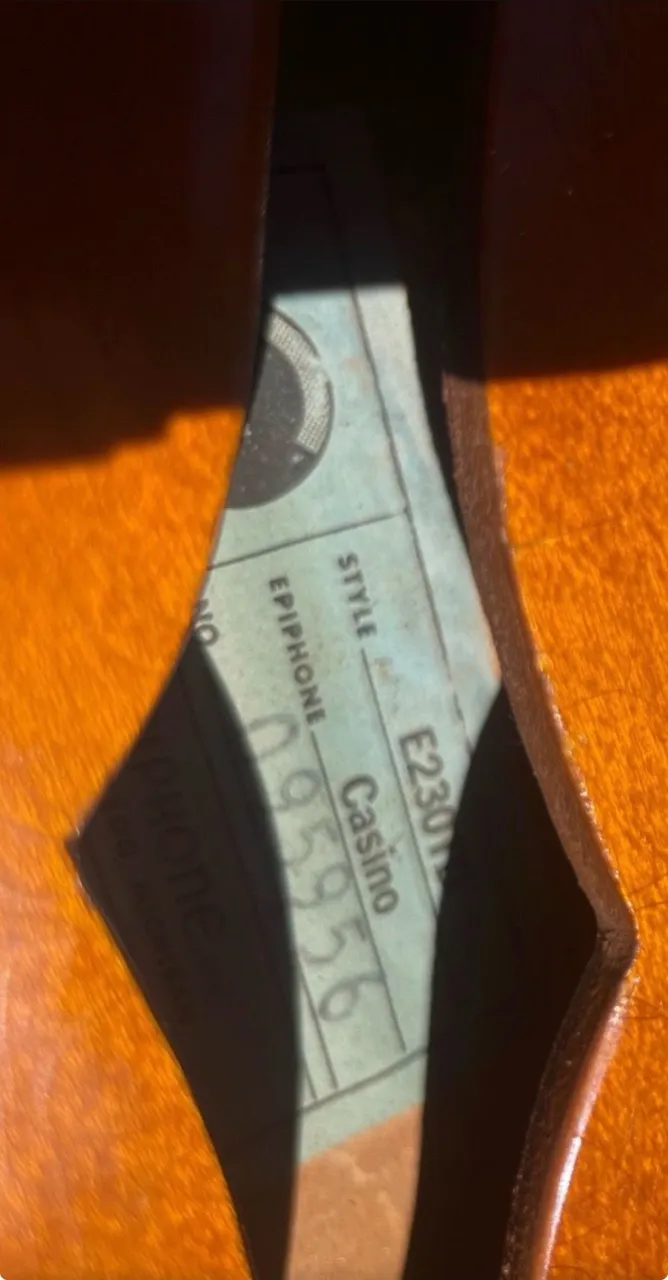
The f-hole photograph shows the internal Casino label. Keep that label view with the full guitar photographs when documenting an instrument. These pictures record visible hardware and identification details; they do not establish the condition of hidden pickup windings or solder joints.
Exclusion Example
2022 USA Casino
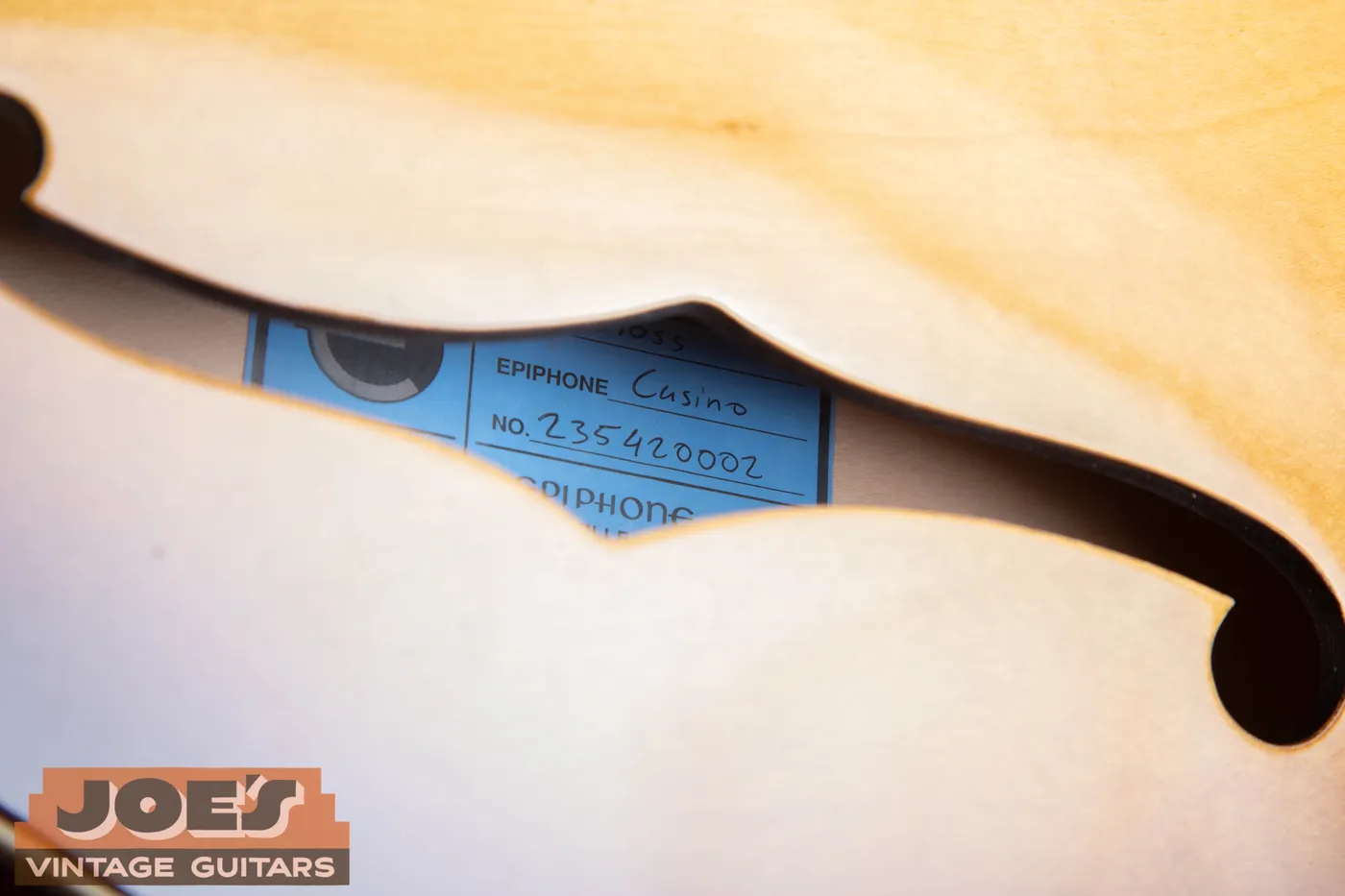
This sunburst Casino is documented in Joe’s archive as a 2022 USA instrument. The body view shows two black dogear pickups, a trapeze tailpiece and a white pickguard. Those familiar details demonstrate why appearance alone cannot establish Kalamazoo manufacture. Its blue label provides modern identifying evidence that must stay attached to the photograph.
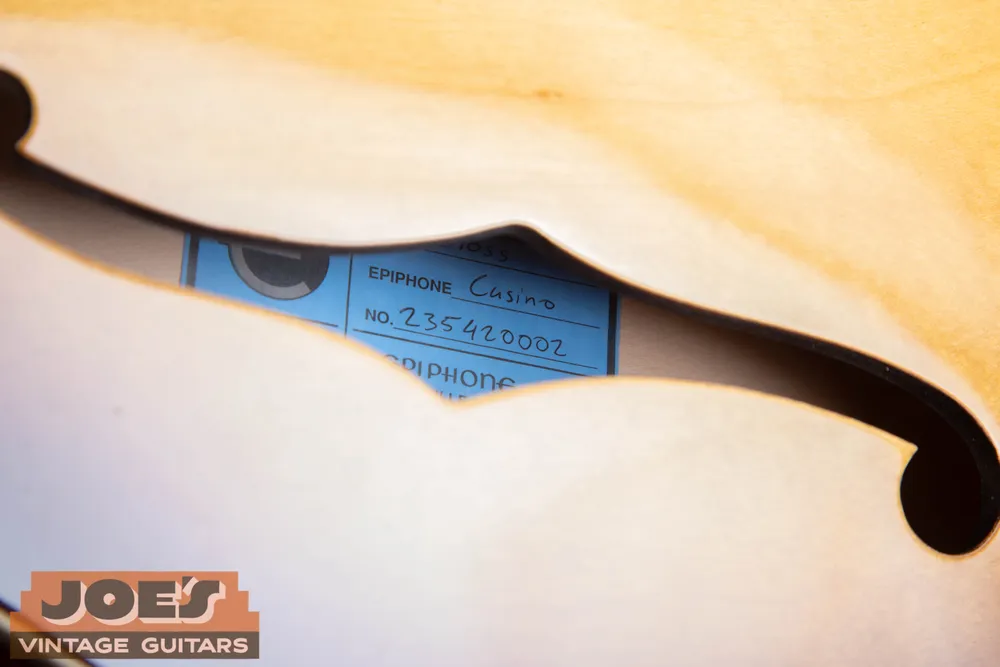
The label reads Casino and carries the nine-digit number 235420002. That is the number visible on this guitar, not an example of the original 1960s serial format. A blue label, script logo and American manufacture can all appear on a later instrument. Keep its production documents with the guitar instead of trying to force the number into a vintage chart.
Gibson-Era Records
Date The Casino From Numbers And Construction
Early Kalamazoo hollowbodies need a separate first check: an A followed by four digits on the interior label belongs to Epiphone’s early A-series, not the similarly named Gibson A-prefix chart. Photograph the whole label and keep any factory order number separate. A model code is not a serial number. Later impressed numbers can be compared with the shared Gibson system, with the guitar’s construction used to check the result.
A Modern Casino Number For Comparison
This photographed label belongs to Joe’s 2022 USA Casino. It excludes this example from the Kalamazoo group. It should not be shortened, split or otherwise altered to fit a 1960s serial range.
For an original-period guitar, photograph the serial exactly as it appears and include the back of the headstock around it. The Gibson serial number guide is the relevant starting reference because from 1961, Kalamazoo Epiphones used the shared Gibson numbering system. Some ranges overlap, so the result can be a set of possible years rather than one certain date.
Next photograph the internal label, any accessible factory order number and the neck joint. A factory order number is a separate piece of evidence; do not substitute it for the serial without identifying which marking you are reading. A flashlight and a phone at the f-hole are usually a better first step than removing the electronics. Leave inaccessible markings for a person equipped to inspect the instrument.
Potentiometer codes can add a component date when the original harness can be examined safely. A pot was made before the guitar was assembled, so its code is not the guitar’s birthday. Replacement pots need to be identified before drawing a dating conclusion. A coherent combination of number, neck, headstock and hardware is more convincing than one unusually clear code that disagrees with everything else.
Keep Findings Separate From Assumptions
Inspect A Kalamazoo Casino In Order
Establish The Hollow Body
Confirm the double-cutaway laminated body and inspect the cavity with suitable light. Do not identify a Casino solely from a front silhouette. Record dimensions and any evidence of a replaced top, altered neck joint or internal repair before applying the period specification.
Match Model And Controls
Read E230T or E230TD when the label is legible, then count pickups and controls. Preserve unclear lettering in the photographs. A missing label is a gap to work around with other evidence, not a reason to create a replacement identification label.
Check The Neck And Headstock
Photograph the logo, fingerboard markers, truss-rod cover, tuner layout and heel. Look for extra tuner holes and changes in finish around the joint. A repaired or replaced neck can retain convincing period parts, so report the repair separately from the guitar’s model identity.
Inspect Finish And Tailpiece Footprints
Use angled light to show finish transitions and filled holes. Document the bottom rim as well as the front. Do not remove the guard or tailpiece just to expose a protected area if the screws or finish are fragile; professional inspection can answer that question with less risk.
Reconcile The Date
Compare the complete serial with period features and any dated ownership records. If the evidence points to different periods, leave the date unresolved and explain why. A narrow but unsupported year is less useful than an accurate production interval.
Name And Country Are Not Enough
How Later Casinos Fall Outside This Guide
Japanese, Korean and Chinese Casinos, Japanese Elitist models, anniversary editions and signature versions belong to later production families. Their model names may deliberately reference a 1961 or 1965 design. That historical name describes the design being reproduced; it is not the manufacturing date of the instrument in your hands.
Modern USA Casinos require the same separation. Joe’s 2022 example shows why a country-of-origin claim cannot replace an era check. Read the complete serial and label, retain the original paperwork and identify the actual production series. A later instrument can be well made and useful without being a Kalamazoo original.
Do not apply a blanket rule that a particular imported factory, truss-rod cover or label color identifies every later Casino. Different reissue programs used different details. The practical exclusion is a documented later manufacturing period, supported by the instrument’s own markings and records. When those are absent, ask for a closer inspection instead of guessing a factory from finish color.
Send The Evidence
Have Joe Review Your Casino Evidence
Send the complete guitar, serial, label and any known alterations for an appraisal. The Casino price guide helps after the version is established. For a purchase offer, use Sell My Epiphone and include the repair history.
An Original Guitar Can Have Changed Parts
Separate Identity From Originality
A real Kalamazoo Casino can have a refinish, changed pickups or a repaired headstock. State those findings individually. Calling the model authentic does not certify every screw or solder joint. Conversely, a replaced bridge does not turn an otherwise identifiable Casino into a counterfeit. The useful description tells the reader which conclusions are supported and which parts remain uncertain.
For the financial effect, follow the condition guide and pickup-change guide. Keep repair estimates and market prices out of the identification decision itself. First establish what the guitar is and what changed; then choose the appropriate range or request an individual value.
Catalogs, Factory History And House Guides
Casino Research References
- 1961 Epiphone Catalog
Original Casino listing, dimensions, scale, pickup-count choices and finish terminology.
- 1966 Epiphone Catalog, Page 3
Original catalog image and specification matrix; use the scan, not the dealer listings below it.
- Gibson’s Casino History
Manufacturer history supporting the 1961 introduction, hollowbody design, trim development and later production exclusions.
- Epiphone Serialization Reference
Epiphone section, page 1071: the early hollowbody A-label sequence differs from Gibson’s A-prefix series; later impressed numbers require feature checks.
- JVG Gibson Serial Reference
Kalamazoo serial ranges and the need to compare physical features.
- JVG Sheraton History
House chronology for the 1957 purchase, 1958 Kalamazoo start and 1970 end of the original American line.
Questions AboutEpiphone Identification
Is An Epiphone Casino Semi-Hollow?
Did Kalamazoo Make A Single-Pickup Casino?
Can A Modern USA Casino Be Mistaken For A Vintage One?
Does A 1965 Reissue Model Name Mean It Was Made In 1965?
The Last Word
Keep The Evidence Together
Identify the hollow body and factory pickup layout, then make the serial and physical features agree. Keep later Casino production and each documented alteration separate from that conclusion. Once the identity is clear, the Casino value guide provides the next step.
Authenticity And Originality Are Assessed From The Information Provided. A Hands-On Inspection Can Change The Conclusion.