

Orchestra Models · 1929 To 1969
Martin OM-28 History And Specification Changes
The OM-28 introduced Martin’s long-scale, 14-fret Orchestra Model in 1929. Its original production evolved through bridge, guard, tuner and inlay changes before the model became the 000-28 in 1934. A six-guitar order revived the OM-28 name in 1969.
Comparison Photo: 2005 Martin OM-28V
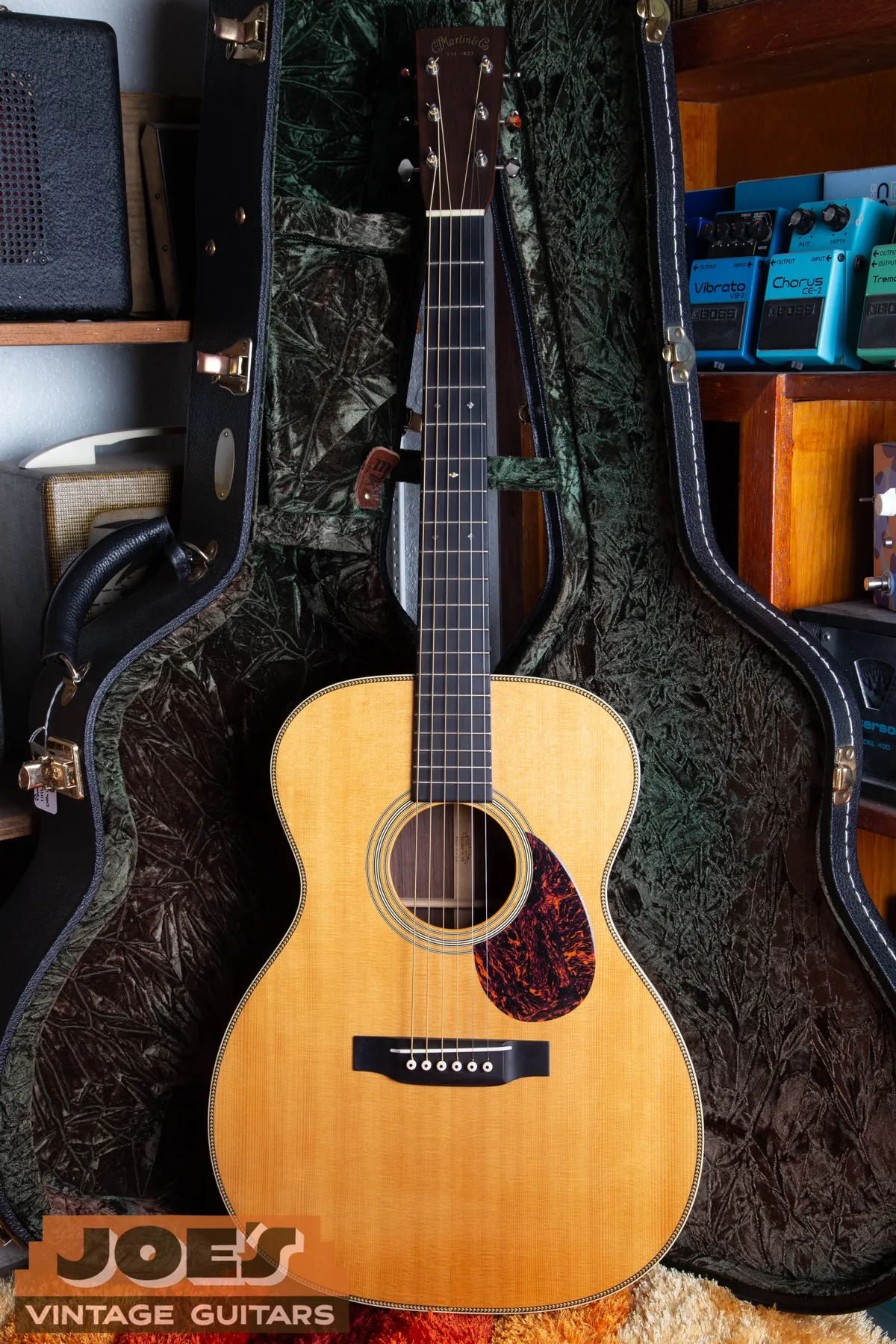
- Original Period
- 1929 To 1933
- Body
- 14-Fret Orchestra Model
- Back And Sides
- Brazilian Rosewood In Original Construction
- Nominal Scale
- 25.4 Inches
- Nearby Identification
- Long-Scale 1934 000-28
- Later Order
- Six Ordered In 1969
OM-28 Changes By Year
| Year Or Period | What Changed |
|---|---|
| 1929 | The first OM-28 developed from the 000-28 with a 14-fret neck joint and long scale. |
| 1930 | The belly bridge replaced the early pyramid bridge. |
| 1931 | Larger pickguards replaced the small teardrop form, and open-back guitar tuners replaced banjo-style machines in separate transitions. |
| Early 1932 | The diamonds-and-squares fingerboard pattern extended to the twelfth and fifteenth frets. |
| 1934 | The model name changed to 000-28 while the earliest renamed guitars retained the long scale. |
| Later In 1934 | The 000-28 scale shortened to approximately 24.9 inches. T-frets and steel T-bar neck reinforcement replaced the earlier neck system during the successor era. |
| 1969 | Eric Schoenberg’s six-guitar order revived the OM-28 through the Folklore Center and Matty Umanov. |
1929: The First Fourteen-Fret Orchestra Model
The OM-28 grew out of the 000-28 body family. Its shortened upper body and 14-fret neck joint increased access above the twelfth fret while retaining the approximately 25.4-inch scale. Brazilian rosewood back and sides, a spruce top, ebony fittings and herringbone top trim supplied the Style 28 specification.
The earliest custom guitar associated with Perry Bechtel had a requested 1 13/16-inch nut. That custom measurement should not replace the familiar 1 3/4-inch production OM specification. The beginning of the model includes development work as well as the settled production design.
1930: From Pyramid To Belly Bridge
The first OM-28s had pyramid bridges. In 1930, the broader belly bridge replaced that form. The new bridge extended farther behind the pins while retaining ebony as the material.
Some unsold earlier guitars received belly bridges at the factory before shipment. The change therefore describes a production transition, not an exception-free rule tying one bridge outline to every guitar stamped during a particular month. The 2005 OM-28V photograph on this page illustrates the later belly outline, not an original 1930 instrument.
1931: The Pickguard And Tuners Change Separately
The early small teardrop guard became a larger pickguard in 1931. Banjo-style tuners also gave way to conventional open-back guitar machines during the year.
The transitions overlapped. Larger-guard guitars can still have original banjo tuners, so the two features should not be described as a single simultaneous redesign. Both changes were established before the original OM-28 run ended.
1932 And 1933: Fingerboard Decoration Extends Up The Neck
The early diamonds-and-squares pattern occupied the fifth, seventh and ninth frets. In early 1932, Style 28 added decoration at the twelfth and fifteenth frets.
The basic rosewood body, herringbone border, long scale and bar-fret neck continued through 1933. The original OM-28 used ebony neck reinforcement; the steel T-bar system arrived after the original OM production period.
1934: The 000-28 Name And Shorter Scale
Martin renamed the model 000-28 in 1934. The first guitars carrying that name retained the long scale, and the reduction to roughly 24.9 inches followed later in the year.
The same successor period brought T-shaped frets and steel T-bar reinforcement. An early long-scale 000-28 can share dimensions with an OM-28 while carrying the later factory designation. The 0, 00 and 000 guide covers the continuing 000 history.
1969: The OM-28 Revival
Eric Schoenberg ordered six OM-28s in 1969 through the Folklore Center and Matty Umanov. This revived the model decades after the original run.
The order belongs to a new production episode. It did not make every 1969 construction detail identical to a 1929 or 1933 OM-28. Original production and the revival should remain separate chapters of the model’s history.
When Did The Original OM-28 Run End?
The original OM-28 period ended in 1933. In 1934, the successor carried the 000-28 name; the scale shortened later that year.
Did Every Original OM-28 Have A Pyramid Bridge?
No. The pyramid bridge belongs to the earliest production. The belly bridge became the standard form during 1930 and remained through the rest of the original run.
Martin Identification Resources
- Martin Tuner Dating Guide
Compare plates, buttons and mounting evidence rather than accepting a broad period-correct claim.
- Martin OM-18 Authentication Guide
Contrast mahogany Style 18 construction and track the related early OM changes.
- Sell A Martin Guitar
Send Joe the details of a Martin you are considering selling.
- Martin Serial And Model Numbers
Find the production year from the neck-block serial.
- Martin Construction And Dating
Follow changes in bridges, necks, braces and materials.
Martin Owners On Working With Joe
“feeling no regrets after selling our 1920’s Martin on to these folks”
“they took the time to look at the photos of my Martin D18 and emailed back an appraisal”
Your Martin’s Model, Year And Condition
Send Joe Photos Of Your Martin
Include the front, back, headstock, model and serial markings, and any known repairs.
Photo Credits
Photographs from the Joe’s Vintage Guitars archive. Each caption identifies the instrument shown, including comparison photographs.