

Fender Serial Number Lookup: Free Decoder & Dating Guide
Type your serial for an instant read on era and factory. Most lookups stop there. This page tells you what the number can and cannot prove, then walks you through the cross-checks that confirm the year, the same way I do it at the bench.
Free Tool · Joe's Vintage Guitars
Fender Serial Number Lookup
Decode any Fender guitar or bass serial number. American, Mexican, Japanese, and Custom Shop, 1950 to present.
Last reviewed by Joe, July 2026Serial Number Decoded
Approximate Year
Serial number ranges are estimates. Fender production was rarely perfectly sequential. For a precise appraisal or help selling your guitar, contactJoe's Vintage Guitars. Call or text(602) 900-6635, orcontact us online.
Curious what your Fender is worth?Get Joe's free, no-obligation appraisalCross-date your guitar for a more precise year
We couldn't automatically decode that serial number. Some older or rare Fenders need a hands-on look. Joe's Vintage Guitars can help. Call or text(602) 900-6635, orcontact us online.
Try cross-dating manually
I Need Help Finding My Serial Number
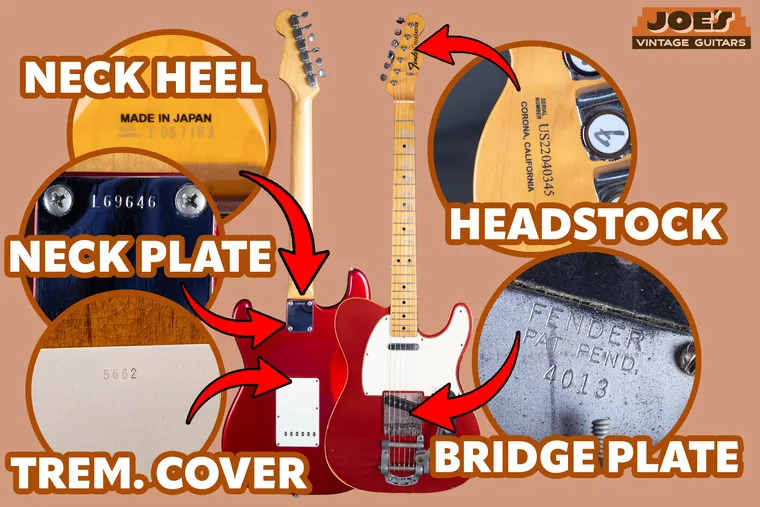
Six possible spots: the neck plate, the bridge plate, the front or back of the headstock, the neck heel, and, on 1954 Strats only, stamped into the plastic tremolo cover. Where it sits already narrows the era.
Cross-Check With Other Dating Features
A serial gets you close, but serial numbers are not 100% reliable, so you have to cross-check to land on an exact year. The parts pin down the real date. There are five ways in, and each one is a full step-by-step guide:
Potentiometer Date Codes
Decode the EIA codes on your volume and tone pots. A pot code sets the earliest date your guitar could've been built, a strong cross-check against the serial.
Decode Pot CodesPath 2: The NeckNeck-Heel Date Stamps
Locate the handwritten pencil dates and rubber-stamped codes on the butt end of the neck, the most reliable single tell.
Read Neck DatesPath 3: The BodyBody Dates
Locate the date markings Fender left on the body itself and what they look like from era to era.
Read Body DatesPath 4: The PickupsPickup Date Codes
Read the date on the base of a pickup, then use the pickup's own build, the pole pieces, the bobbin color, and the coil wire, to place it in an era.
Read Pickup DatesPath 5: The PartsLogos, Guards, Saddles And Tuners
Everything you can check without picking up a screwdriver. The headstock logo, the pickguard material, the bridge saddles, the tuners, and the fretboard inlays all changed at known points.
Date It By Its PartsSerial Number Not Giving You The Full Picture?
Vintage Fender serial numbers are notoriously non-sequential because factory workers grabbed plates out of mixed bins. To close in on the real build date, you need the secondary indicators on this page.
Watch Joe walk through where the serial lives, how to check the neck heel date, and how to read potentiometer codes.
No single one of these is the answer on its own. Read two or three and look for agreement, because a guitar whose neck date, pot codes, and parts all point at the same stretch of months is telling you something a serial number never can. If the guitar wears a custom color, the finish itself is worth reading too.
Date It By Model, Year By Year
The five paths above read any Fender by method, across every model. These read one model through everything that changed on it, from its launch to the end of its vintage run, as a single year-by-year table. If you already know what you have, start here.
Stratocaster
Almost nothing on a Stratocaster gives you a year on its own. The two dates Fender actually wrote, on the neck heel and inside the body, are the accurate ones, and the rest of the guitar is there to corroborate them.
Date A Stratocaster1950 to 1971Telecaster
A black guard or a white one puts the guitar either side of the summer of 1954 before you have picked it up. The bridge, the saddles, the board, and even the name each changed on their own schedule.
Date A Telecaster1958 to 1971Jazzmaster
The pickguard cuts the run into three and the inlays cut it into three again, so most examples date to a couple of years from a photograph. Includes the gold anodized guard that shipped for about nine months.
Date A Jazzmaster1962 to 1975Jaguar
Start anywhere except the headstock. One gold decal ran from the 1962 launch to about the middle of 1968, straight through the CBS changeover, so the patent block under it does the dating instead.
Date A Jaguar1964 to 1982Mustang
It arrived after most of the transitions the Fender checklist is built on, so a slab board or a spaghetti logo is a red flag rather than a date. What dates it instead is hardware no other Fender wore.
Date A MustangPrecision Bass
Ask which one before you ask which year. Three genuinely different instruments wear this name, and sorting out which of them you are holding gets you most of the way to the year.
Date A Precision Bass1960 to 1975Jazz Bass
Count the knobs. Two stacked concentric knobs to late 1961, three separate ones after, and you can answer that from any photograph of the body.
Date A Jazz BassSerial number charts are not on those pages, because a serial does not know what model it was stamped for. The full ranges live here, further down this page, and every model guide points back to them.
Fender Serial Numbers By Year
The complete year-by-year ranges, right on this page. Serial number ranges are estimates, and Fender production was rarely perfectly sequential. Treat them as a starting point, then confirm with the neck heel date and pot codes above.
A Bridge-Plate Serials
1950 to 1954
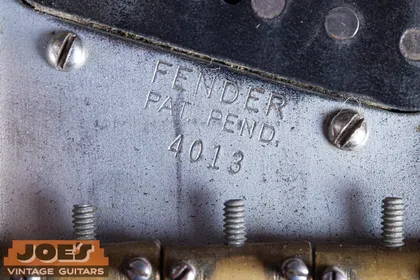
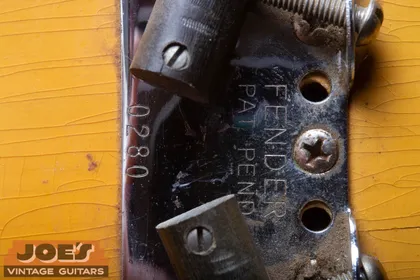
On Fender's earliest electric instruments, the serial was stamped right onto the bridge plate. That covers the original Broadcaster, No-Caster, Telecaster, Esquire, and early Precision Bass, the rarest and most valuable Fenders ever made. Dating one from the bridge plate serial alone is difficult, so cross-reference the neck heel dates, pot codes, and body dates.
| Model | Serial range | Year | Production details |
|---|---|---|---|
| Telecaster / Esquire | 0001 to 1300 | 1950 to 1952 | Broadcaster, No-Caster, and early Tele |
| Telecaster | 1300 to 3000 | 1951 to 1954 | Telecaster name established around mid-1951 |
| Telecaster | 3000 to 5000s | 1952 to 1954 | Transition toward the neck plate |
| Precision Bass | 100 to 600 | 1951 to 1952 | Earliest P-Basses, serial on the bridge |
| Precision Bass | 0001 to 0900 | 1952 to 1953 | Second P-Bass sequence |
| Precision Bass | 0900 to 2000 | 1954 | Redesign year approaching |
B 4 And 5 Digit Neck Plate Serial Numbers
1954 to 1963, no letter prefix
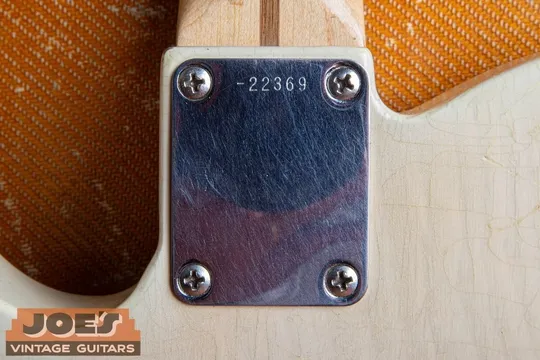
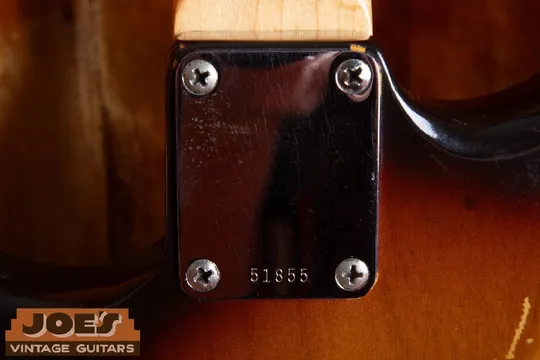
From the mid-1950s into the early 1960s, Fender stamped 4 and 5 digit serial numbers onto the metal neck plate. This window covers nearly every landmark model: the original Stratocaster (1954), Jazzmaster (1958), Jazz Bass (1960), and Jaguar (1962). Fender pre-stamped large batches of neck plates and pulled them off the stack in no particular order during assembly, so a guitar carrying serial 58,000 could legitimately be a 1960 or a 1961. The neck heel pencil date is far more reliable for pinning down a specific year.
| Serial range | Year |
|---|---|
| 0001 to 8000 | 1954 |
| 6000 to 10000 | 1955 |
| 9000 to 16000 | 1956 |
| 16000 to 25000 | 1957 |
| 25000 to 30000 | 1958 |
| 30000 to 40000 | 1959 |
| 40000 to 58000 | 1960 |
| 55000 to 72000 | 1961 |
| 72000 to 93000 | 1962 |
| 93000 to 99999 | 1963 |
This 1960 Stratocaster carries its serial along the bottom edge of the neck plate. The location makes people doubt the serial is authentic, but Fender really did stamp some plates this way. I have watched original guitars get called fakes over exactly this.
C L-Series Transition Plates
1963 to 1965, capital L prefix
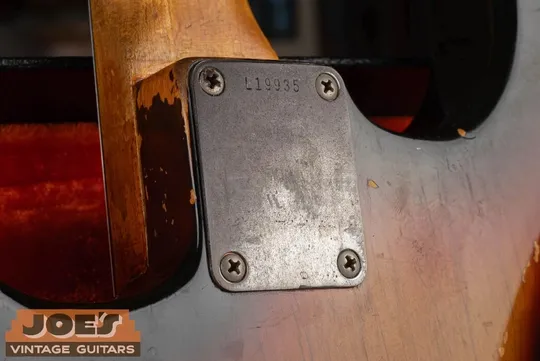
When Fender's sequential neck plate numbers got close to 99999, the factory tacked on an L prefix instead of rolling over to a 6 digit number. These guitars, built from late 1962 through 1965, cover the final years of the pre-CBS era and rank among the most collectible Fenders ever made. The L-Series straddles the CBS acquisition in January 1965, which means some L prefix instruments are true pre-CBS and others are early CBS.
| Serial range | Year | Era |
|---|---|---|
| L00001 to L20000 | 1963 | Pre-CBS |
| L20000 to L55000 | 1964 | Pre-CBS |
| L55000 to L99999 | 1965 | Transition to CBS |
D CBS 6-Digit F-Plates
1965 to 1976, embossed F on the plate
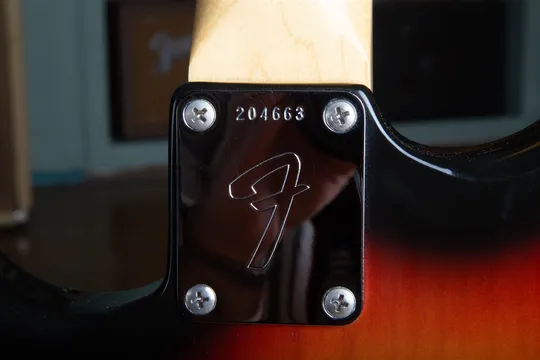
After the CBS acquisition in early 1965, Fender brought in a new neck plate with a large stylized F logo and a 6 digit serial number. This system stayed in place until 1976, when Fender moved serials to the headstock. F-plate guitars are easy to spot: big headstocks on the Strats from about late 1965 onward, CBS-era styling throughout, and models like the Thinline Telecaster and Coronado that only existed in this period.
| Serial range | Year | Era |
|---|---|---|
| 100000 to 110000 | 1965 | Transition |
| 110000 to 200000 | 1966 | CBS |
| 180000 to 210000 | 1967 | CBS |
| 210000 to 250000 | 1968 | CBS |
| 250000 to 280000 | 1969 | CBS |
| 280000 to 300000 | 1970 | CBS |
| 300000 to 330000 | 1971 | CBS |
| 330000 to 370000 | 1972 | CBS |
| 370000 to 520000 | 1973 | CBS |
| 500000 to 580000 | 1974 | CBS |
| 580000 to 690000 | 1975 | CBS |
| 690000 to 750000 | 1976 | CBS |
Serial numbers aren't always reliable, especially on vintage instruments. Confirm the year with the neck heel date and pot codes, or send me photos below and I will confirm it for you.
E V-Prefix Serial Numbers
American Vintage reissues, 1982 onward
When Fender launched its Vintage Reissue series in 1982, faithful recreations of classic 1950s and 1960s Strats, Teles, and Precision Basses, it put a separate V prefix serial on the neck plate. These aren't vintage instruments. They're modern reissues built to replicate the original specs.
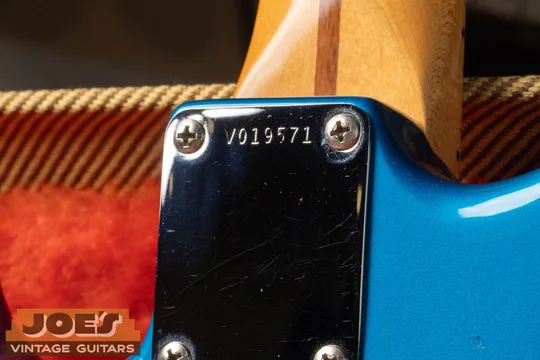
V prefix numbers have no reliable dating scheme. Date a V-prefix guitar by the neck heel date, usually written in pencil.
F Custom Shop Serial Numbers
CN, CZ, and R prefixes on the neck plate
The Fender Custom Shop, established in 1987, runs its own neck plate serial number system. Three prefixes show up most often, and one of them gets widely misunderstood across forums and listings.
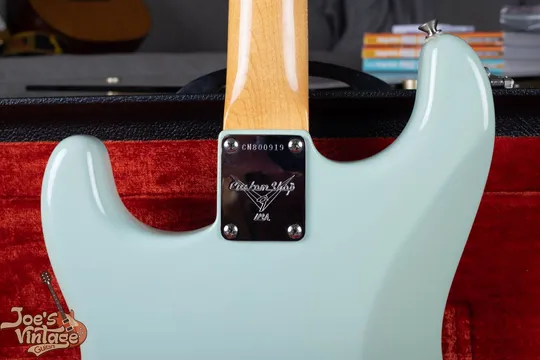
| Prefix | How to decode | Era | Example |
|---|---|---|---|
| CN + digit | C means Custom Shop, N means the 90s, and the next digit is the year | 1990s | CN6XXXXX = 1996 |
| CZ + digit | C means Custom Shop, Z means the 2000s, and the next digit is the year | 2000s | CZ3XXXXX = 2003 |
| R + digits | No reliable decode | See the tip below | No year encoded |
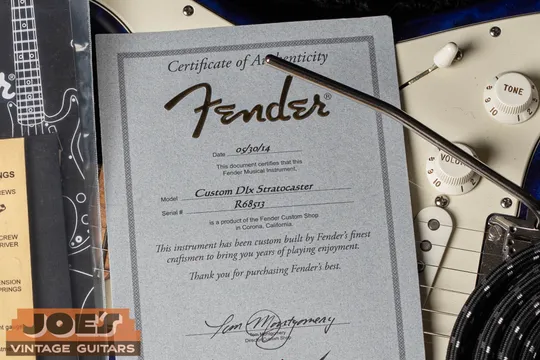
R doesn't stand for Relic, and it doesn't stand for Reissue. That is one of the most repeated myths in Fender Custom Shop collecting, and even a circulating Fender customer service email gets it wrong. The R prefix turned up on Custom Shop instruments with no consistent logic behind its assignment, and there's no reliable dating scheme for it. To date or authenticate one, reference the COA, which lists the model, construction date, specs, and builder, or check the neck heel dates and pot codes. If a seller leans on R = Relic as a selling point, that's a red flag about the seller, not the guitar. Always ask for the COA.
The COA below is the proof: an R prefix Custom Deluxe Stratocaster that's neither a Relic nor a Reissue.
G Alphanumeric Headstock Decals
1976 to present
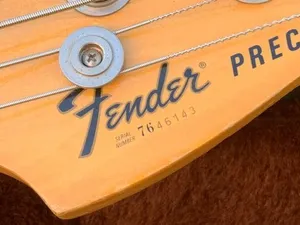
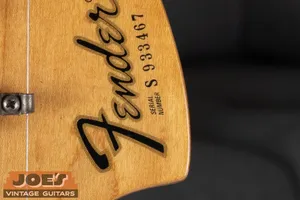
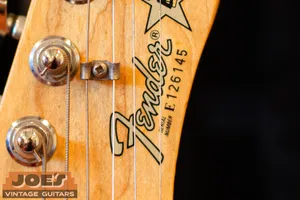
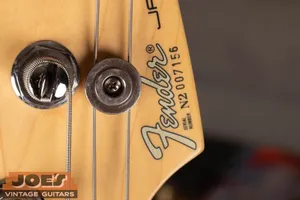
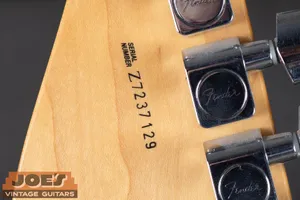
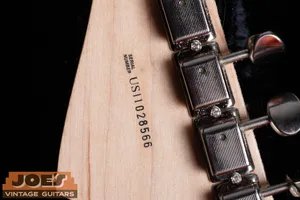
In 1976 Fender moved serial numbers off the neck plate and onto a headstock decal, where the letter encodes the decade and the digit after it encodes the year. Some guitars from the final months of 1976 carry S prefix headstock serials even though the neck plate was still in use on certain models. An F-plate paired with an S prefix headstock serial marks a transition-period instrument, so confirm with pot codes and neck stamps.
| Prefix | Decade | How to read it | Example |
|---|---|---|---|
| 76XXXXX | 1976 | Starts with 76, overlaps the early S prefix | 76XXXXX = 1976 |
| S + digit | 1970s | S means the 70s, next digit is the year | S8XXXXX = 1978 |
| E + digit | 1980s | E means the 80s, next digit is the year | E4XXXXX = 1984 |
| N + digit | 1990s | N means the 90s, next digit is the year | N2XXXXXX = 1992 |
| Z + digit | 2000s | Z means the 2000s, next digit is the year | Z2XXXXXX = 2002 |
| US + digits | 2010s onward | First two digits after US are the year | US10XXXXXX = 2010 |
Rare 1980s Prefixes
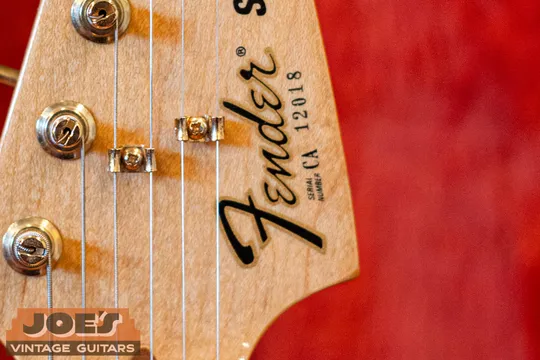
A small number of limited-edition CBS-era models used two-letter prefixes starting with C instead of the standard E. They follow the same decode formula (the first digit after the prefix equals the year), but each one ties to specific collectible models:
| Prefix | Ties to |
|---|---|
| CA | Gold Stratocasters, the limited-run gold-hardware Strat from the early 1980s |
| CB | Precision Bass Specials and Gold Jazz Basses, both active-electronics basses with gold hardware |
| CE | Precision Bass Specials and Black & Gold Telecasters, another limited CBS-era run |
H Made In Mexico And Made In Japan Serial Numbers
MIM, MIJ, and CIJ
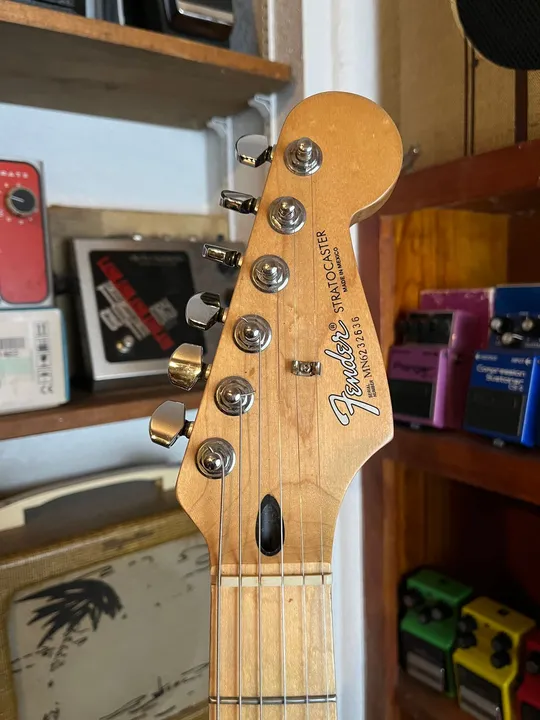
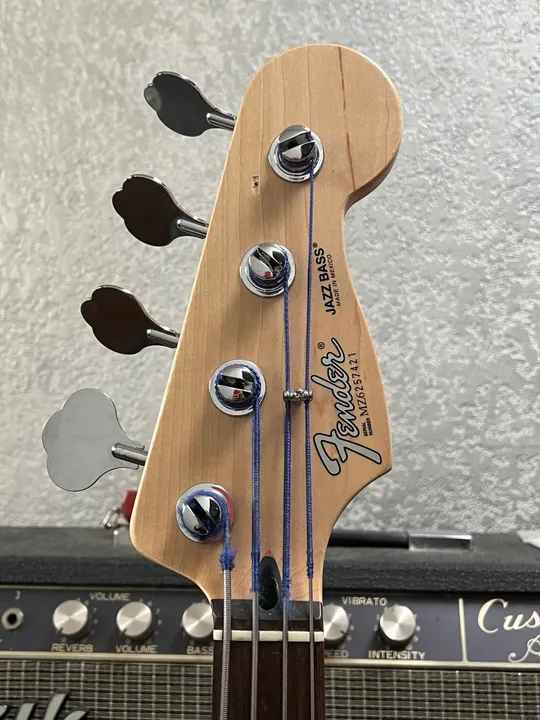
Mexican-built Fenders from the Ensenada plant start with M plus a decade letter, the same decade logic as the American serials. Japanese Fenders work differently: the letter corresponds to a production year range rather than a specific year digit, so it narrows the window instead of naming the year. The Crafted in Japan label replaced Made in Japan in the late 1990s, and the letter codes were reused between the two eras, so always read the Made in Japan or Crafted in Japan wording on the guitar, not just the letter. The earliest JV-series guitars, built from 1982 to 1984, are serious collector pieces in their own right.
| Prefix | Made in | Formula |
|---|---|---|
| MN | 1990s | M means Mexico, N means the 90s; next digit is the year. MN0 = 1990 |
| MZ | 2000s | M means Mexico, Z means the 2000s; next digit is the year. MZ0 = 2000 |
| MX | 2010s to 20s | The one or two digits after MX are the year. MX12 = 2012, MX23 = 2023 |
| JV / SQ | Japan, 1982 to 1984 | The earliest Made in Japan export models |
| JD | Japan, 2010s | Japan Dyna, first two digits are the year. JD11XXXXXX = 2011 |
Show The Complete Japan MIJ And CIJ Letter Codes
| Code | Digits | Year range |
|---|---|---|
| JV | 5 | 1982 to 1984 |
| SQ | 5 | 1983 to 1984 |
| A | 5 | mid-1980s |
| B | 6 | 1985 to 1986 |
| F | 6 | 1986 to 1987 |
| G | 6 | 1987 to 1988 |
| H | 6 | 1988 to 1989 |
| I or J | 6 | 1989 to 1990 |
| K | 6 | 1990 to 1991 |
| L | 6 | 1991 to 1992 |
| M | 6 | 1992 to 1993 |
| O, P, or Q | 6 | 1993 to 1994 |
| S or T | 6 | 1994 to 1995 |
| U or N | 6 | 1995 to 1996 |
| V | 6 | 1996 to 1997 |
| Code | Digits | Year range |
|---|---|---|
| A | 6 | 1997 to 1998 |
| B | 6 | 1997 to 1999 |
| O | 6 | 1997 to 2000 |
| P | 6 | 1999 to 2002 |
| Q | 6 | 2002 to 2004 |
| R | 6 | 2004 to 2005 |
| S | 6 | 2006 to 2008 |
| T | 6 | 2007 to 2010 |
| U | 6 | 2010 to 2011 |
Still Not Sure? Have Joe Confirm It
Vintage Fender serial numbers are notoriously non-sequential and overlap across years. If you want to confirm your guitar is 100% original, send Joe three clear photos (front, back, and headstock) for a free, expert appraisal within 24 hours.
Once You Know The Year
Find Out What It's Worth
Dating a guitar is usually the first half of the question. The second half is what it's actually worth now, and that depends on the model, the year, the originality, and the finish far more than on the serial number.
Telecaster Values For The Year You Found
Choose the matching year after using the serial range and the physical evidence above.
Go Deeper On Your Exact Guitar
If you know the model, the seven model guides above run it year by year in one table. If you've narrowed the year down as well, these go through what one correct example should have, with photographs of the real thing.
That's a selection rather than the whole shelf. There are more Fender guides on the blog, covering models and years not listed here, and I add to them as guitars come across the bench. If you can't find yours, call or text me and I'll point you at the right one.
Thinking About Selling
Joe buys vintage Fenders outright, pays on the spot, and covers shipping. No consignment wait and no auction fees.
Working on a Gibson instead? Use the Gibson serial number lookup and dating guide.
Common Questions About Fender Serial Numbers
Where Exactly Is My Fender's Serial Number?
One of six spots depending on the year: the neck plate, the front or back of the headstock, the bridge plate, or the neck heel. On 1954 Stratocasters only, it is stamped into the plastic tremolo cover.
Can The Serial Alone Tell Me The Exact Year?
It gives a range, not a single year. Fender pulled plates from bins out of order, so ranges overlap. Confirm the exact year with the neck heel date and pot codes.
My Serial Isn't In Fender's Official Lookup. Is It Fake?
Almost never. Fender's official lookup only covers recent production, and plenty of genuine vintage serials never match a tidy pattern. Cross-date it by hand instead.
Are Custom Shop R Numbers A Reliable Date?
No. R doesn't stand for Relic or Reissue, and there's no reliable dating scheme for it. Reference the Certificate of Authenticity, or check the neck heel dates and pot codes.
Do You Appraise Or Buy Vintage Fenders?
Both. Free appraisals, and I buy outright with same-day payment. Send me three photos and I'll tell you the real story.

Joe Dampt is the owner of Joe's Vintage Guitars in Mesa, Arizona, where he's spent more than twelve years buying, appraising, and authenticating vintage instruments full-time. He's personally valued over 10,000 guitars for sellers in all 50 states, served as a traveling appraiser for the Treasure Seekers Roadshow, and sourced instruments for Grammy Award-winning artists. Every chart and method on this page comes from that bench work. He also wrote a featured guest essay on vintage-guitar authentication for Vintage Verified, the independent Nashville instrument-authentication lab.