Joe's Vintage Guitars Blog

Vintage Guitar Resource Center: Authentication & Selling Guides

Model-by-model authentication guides, serial-number dating help, and honest advice on valuing and selling vintage guitars, written by Joe Dampt from real instruments handled at the shop.

A stunning lifestyle photograph featuring an investment-grade 1952 Fender Precision Bass paired with a matching "TV Front" 1952 Fender Bassman amplifier. The bass features the original owner's name neatly hand-painted on the black phenolic pickguard, mirrored by the same personalized name on the amp's original linen grill cloth, a rare, documented piece of provenance linking these two instruments as a lifetime pair.
Specific Model Highlights

The 1951, 1952 & 1953 Fender Precision Bass: Slab-Body P-Bass Authentication & Valuation Guide

A collector's guide to the 1951, 1952, and 1953 Fender Precision Bass: the original slab-body P-Bass. Joe Dampt covers every authentication detail: butterscotch nitro finish, tan lines under the hardware, nail holes, the early single-coil pickup with white string wrapping, pressed fiber saddles, Clarostat pots, paper-in-oil capacitor, large flat metal tuner buttons, mismatched neck and body dates, and more. Free appraisals nationwide.

Read more
Rear view of a vintage Fender Stratocaster hardtail body showing the solid wood construction with six chrome string-through-body ferrules and the absence of a tremolo spring cavity or plastic backplate.
Specific Model Highlights

The Hardtail Stratocaster: Why This Underrated Vintage Fender is a Tone Monster

Think of it as a “Telecaster on steroids.” The Fender Hardtail Stratocaster is one of the most underrated tools in vintage Fender. From the resonant pre-CBS models of the 1950s to the punchy, lightweight players of the 1970s, the hardtail offers a percussive “snap” and rock-solid tuning stability that traditional tremolo models don’t. Find out why these rare “string-through” Strats, which made up only about 5% of early production, were the choice of players like Nile Rodgers and Robert Cray.

Read more
1969 Gibson L-5 CES hollow body electric guitar in a sunburst finish, featuring a Florentine cutaway, gold hardware, and a Bigsby vibrato tailpiece. The guitar is shown without a pickguard, highlighting the wood grain and dual humbucking pickups.
Specific Model Highlights

The Gibson L-5 CES: A Guide to Gibson's Top Archtop

A history of the Gibson L-5 CES, the electric archtop that set the standard. This guide covers its evolution from the 1920s acoustic work of Lloyd Loar to the “Staple” and PAF humbucker eras. Learn how to identify rare finishes, date your instrument using serial numbers and orange labels, and tell Venetian and Florentine cutaways apart. If you are looking for a professional appraisal or the full story of this guitar, here is what you need to know about the king of Gibson archtops.

Read more
A 1959 Gibson ES-335TD in original sunburst finish resting in a vintage brown Lifton case with pink interior at Joe's Vintage Guitars.
Specific Model Highlights

The 1959 Gibson ES-335 Authentication Guide: Identifying the “Holy Grail” Semi-Hollow

A close look at the details that set the 1959 apart. From the rare 1958 ‘thin top’ construction and ‘mummified’ Kluson tuners to the ‘white bobbin’ PAF pickups hidden beneath original nickel covers, we go through an exceptionally preserved 1959 Gibson ES-335 ‘Dot Neck.’ If you are a collector looking to authenticate one or a seller trying to understand what your guitar is worth, this guide walks through the small things that tell you what you have. It also explains why the 1959 ES-335 is so highly regarded for its tone and build.

Read more
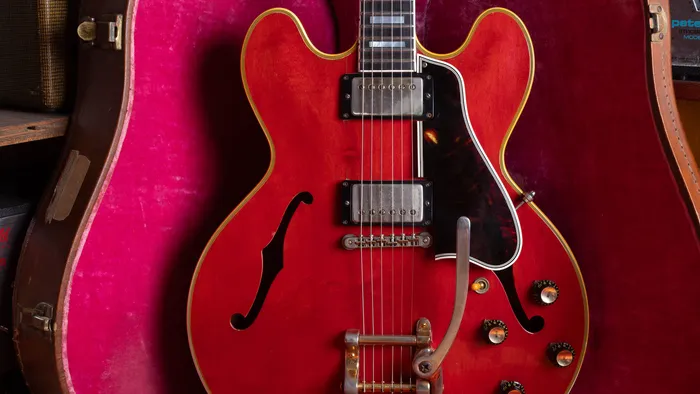
A 1962 Gibson ES-335 in Cherry finish. An example of the post war peak for Gibson electrics
Specific Model Highlights

The 1962 Gibson ES-335 Guide: Identifying the Block Inlay & Patent Number Transition

The 1962 Gibson ES-335 is a “transitional” model that sits between the 1950s dot-neck era and the block-inlay look. This guide covers the “Mickey Mouse” ear body shape, the shift from PAF to Patent Number pickups, and the details that determine 1962 vintage value. If you are looking for an appraisal or want to know what makes this “Golden Era” semi-hollow sound the way it does, here is why the 1962 ES-335 stays a collector favorite.

Read more
1958 Gibson Les Paul Special with TV Yellow finish
Specific Model Highlights

Authentic 1955-1958 TV Yellow Les Paul Special: A Collector’s Guide

In the ‘Golden Era’ of Gibson production, few instruments carry as much mojo, or as much confusion for collectors, as the 1955 to 1958 single-cutaway Les Paul Special. Finished in TV Yellow, these ‘slab-body’ mahogany guitars sit between the working-man’s Junior and the high-end Standard. But with seventy years of history comes seventy years of modifications. From ‘Bumblebee’ capacitors and original P-90 soapbars to the patina of aged brass tuner posts, we go through the details that tell you what you’ve got. Maybe you’re a longtime collector, or maybe you’re looking to sell a family heirloom. Either way, this guide, backed by personally authenticating over 40 of these models, covers what makes a ‘dead-original’ Special worth holding onto.

Read more
1959 Martin D-28E vintage acoustic-electric guitar frontal body shot featuring dual DeArmond pickups, Brazilian Rosewood, and gold hardware.
Specific Model Highlights

Identifying the Rare “Electric” Martin: A Look at the D-18E and D-28E Specs

A look at the rare “Electric” version of Martin’s most famous dreadnoughts. From the Brazilian Rosewood and gold hardware of the D-28E to the mahogany punch of the D-18E, we go through the specs of these 1950s guitars. Learn the “smoking gun” of ladder bracing, the history of the DeArmond pickups, and how the “Kurt Cobain effect” sent their value into the millions. For collectors, and for anyone looking to appraise and sell a family heirloom, here’s how to tell a factory original from a conversion.

Read more

Talk With
Joe Today

Have a vintage guitar to sell or a question? I’m here to help.

Best way to reply:

*If you have photos, you will have the option to upload them after clicking submit