Joe's Vintage Guitars Blog

Vintage Guitar Resource Center: Authentication & Selling Guides

Model-by-model authentication guides, serial-number dating help, and honest advice on valuing and selling vintage guitars, written by Joe Dampt from real instruments handled at the shop.

A detailed look at an original 1957 Gibson Les Paul Standard, highlighting the iconic bullion gold top and dual PAF humbucking pickups.
Specific Model Highlights

1957 Les Paul Goldtop Guide: PAFs, Dark Backs & Expert Specs

1957 was the year Gibson introduced the PAF humbucker. With values reaching all-time highs, how do you verify a true ’57 Goldtop? From the “M-69” stamps inside the pickup rings to the “Dark Back” finish and reddish tortoise side dots, this authentication guide covers the small details that mark a genuine 1957 Standard. Get the facts from Joe’s Vintage Guitars before you sell.

Read more
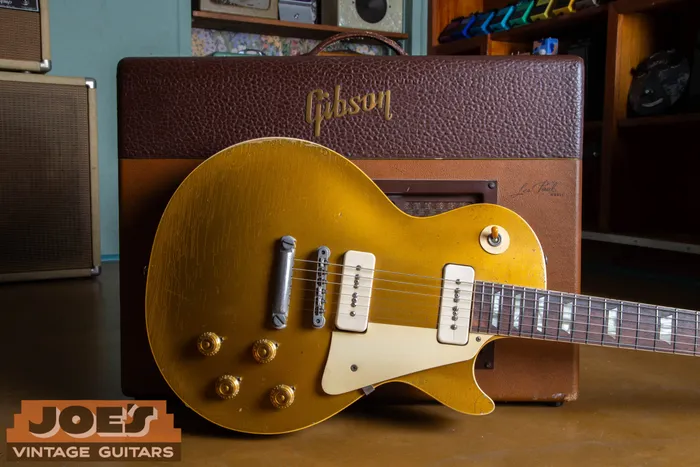
1956 Gibson Les Paul Goldtop with P-90 pickups and no-wire ABR-1 bridge leaning against a vintage 1950s Gibson Les Paul GA-40 amplifier.
Specific Model Highlights

1956 Gibson Les Paul Goldtop Authentication Guide

The 1956 Les Paul Goldtop is a transition-year guitar: the only year where the growl of P-90s met the ABR-1 bridge. In a market full of good fakes, how do you know yours is the real one? From “Patent Applied” tuners to the “stepped” control cavity routing, this head-to-toe authentication guide covers the small details that tell a genuine ’56 apart. Before you sell, make sure you have the facts from Joe’s Vintage Guitars.

Read more
1952 Fender Telecaster body in Butterscotch Blonde finish featuring black phenolic pickguard and brass bridge saddles.
Specific Model Highlights

Guide to the 1952 Fender Telecaster: The “Blackguard”

The 1952 Fender Telecaster is one of the early solid-body electric guitars, built from Leo Fender’s focus on utility and durability. The ’52 “Blackguard” is known for its “butterscotch blonde” finish and biting bridge pickup. This guide covers why this year is a favorite for tone and playability: the single-ply black phenolic pickguard, the wiring and “flat-pole” bridge pickup, the chunky ‘U’ shape neck profile players still ask for, and why the ’52 holds its value in a vintage collection. Whether you collect or just chase that signature “twang,” here’s the history of the guitar.

Read more
A 1950s Gibson J-45 in its original case. Sunburst finish
Specific Model Highlights

How to Identify a Vintage Gibson J-45, J-50, and Southern Jumbo (SJ)

Ever wondered why your vintage Gibson acoustic doesn’t have a model name inside? You aren’t alone. From the ‘Golden Era’ bracing shifts to the iconic ‘Banner’ headstocks, we break down the physical specs you need to identify a J-45, J-50, or Southern Jumbo. We walk through the history of the ‘Workhorse’ so you can see where your guitar fits in the Gibson timeline.

Read more
Vintage 1950s Gibson LG-2 acoustic guitar with large pickguard and original small rectangular rosewood bridge
Specific Model Highlights

Vintage Gibson LG Series: A Guide to the LG-0, LG-1, LG-2, and LG-3 Models

The Gibson LG series packs a lot of guitar into a small body. From the X-braced LG-2 to the mahogany LG-0, these “Little Guitars” offer a focused, punchy tone that has made them a favorite for over 80 years. If you have a wartime “Banner” model or a late-60s workhorse, our guide helps you identify your specific model and explains why these small-body Gibsons are climbing in collector value.

Read more
Close-up of a 1961 Epiphone Crestwood headstock featuring the early symmetrical three-per-side tuner configuration and the raised metal Epiphone logo plate.
Specific Model Highlights

The Epiphone Crestwood: A Guide to Its Vintage Solid-Body History

The Epiphone Crestwood comes from the “Golden Era” of electric guitar design. Introduced in 1958 as Epiphone’s first original solid-body model, the Crestwood, and its later incarnation the Crestwood Custom, offered a sleek, asymmetrical alternative to Gibson’s double-cut offerings. From the early “New York” pickups to the mini-humbuckers and the “batwing” headstock of the 1960s, these instruments are popular with collectors for their lightweight feel and high-output snarl. If you have an early Crestwood Deluxe or a 60s Custom, knowing how the specs changed over the years helps you identify what you’ve got.

Read more

Talk With
Joe Today

Have a vintage guitar to sell or a question? I’m here to help.

Best way to reply:

*If you have photos, you will have the option to upload them after clicking submit