
Gibson ES-125 Complete Guide: Every Variant, Era & What to Look For
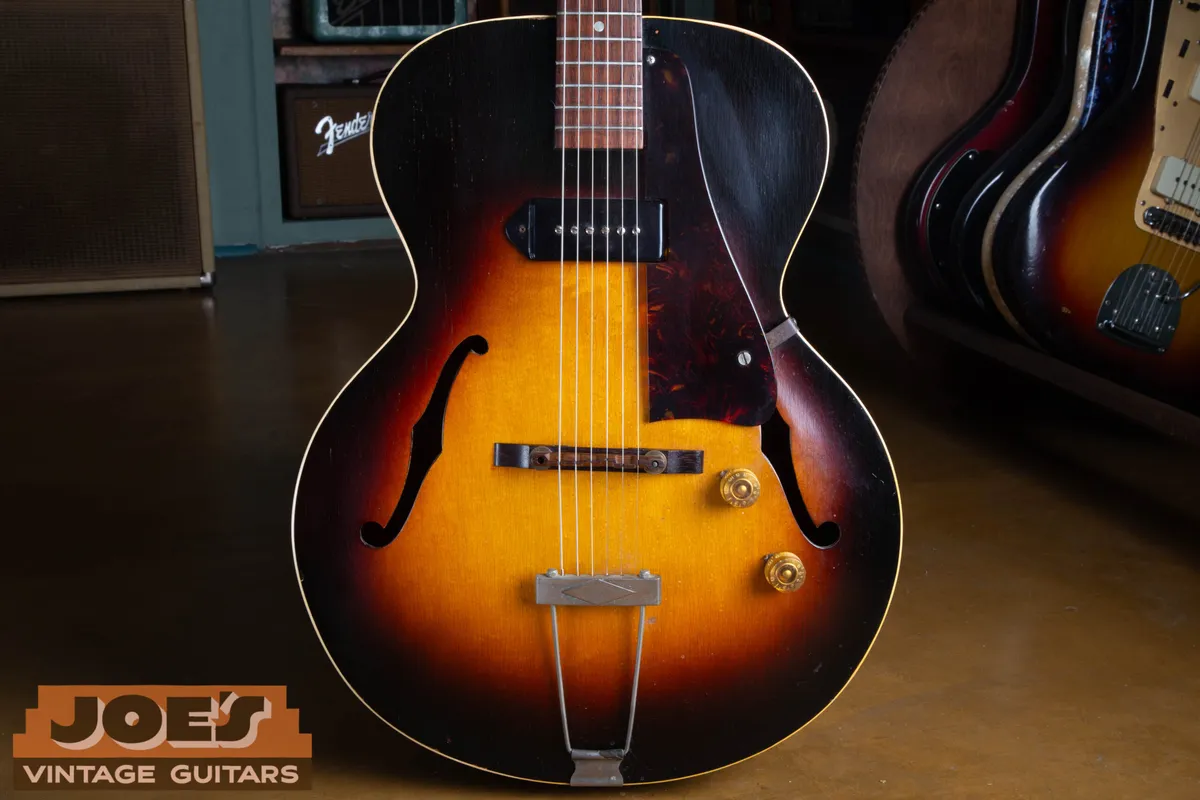
The Gibson ES-125 was on the bandstand for almost thirty years, and for most of that time nobody was looking at it. The flashier names in the Gibson catalog were the ES-175, the ES-335, and the L-5. The ES-125 just kept showing up: jazz combos, Chicago blues clubs, country sidemen, rockabilly players who needed something that could survive a tour. It cost less than its stablemates, it carried the same P-90 pickups that made the rest of Gibson’s 50s lineup what it was, and right now it’s one of the harder vintage semi-hollows to find at a fair price.
Contents
- Origins & History
- The Model Alphabet: Every Variant Explained
- Body & Construction: Era by Era
- Electronics: The P-90 Pickup
- Hardware & Aesthetics: The Dating Details
- Finishes: Standard, Rare & Custom
- Tonal Character & Playing Feel
- Buying a Vintage ES-125: What to Know
- Notable Players & Musical Contexts
- Legacy & Why It Matters Now
Origins & History
The ES-125 arrived in 1941 as the replacement for the ES-100, an entry-level archtop Gibson had introduced in 1938. “ES” stood for Electric Spanish, the label Gibson used to separate the round-neck guitars from their Hawaiian lap-steel products. The ES-125 sat at the bottom of the Electric Spanish line: laminated body instead of the carved spruce tops Gibson reserved for the L-5 and Super 400, but reliable amplified tone at a price a working player could actually swing.
Production stopped almost immediately. Civilian guitar manufacturing went on hold for the war, and only a small number of ES-125s left the factory in 1941 and 1942 before Gibson redirected the plant. The model came back in 1946 with a handful of refinements that would carry it through the next two decades. By the early 50s it had outgrown the student-grade label and earned its spot on professional stages.
A note on the name: “ES-125” originally referenced its price. The guitar retailed at roughly $125 at introduction, which fit Gibson’s naming convention of the period (see also the ES-100, ES-150, ES-175, and ES-300). Inflation kept moving but the names stayed put, so by the 1960s the number no longer told you what the guitar actually cost.
The ES-125 family stayed in production through 1970, one of the longer runs of any Gibson electric. The final years tracked the decline that came with Norlin ownership and aren’t sought after now, but the bulk of the run, especially 1950 through the mid-1960s, represents some of the best value in vintage Gibson electrics you can still find.
The Model Alphabet: Every ES-125 Variant Explained
No other Gibson generated quite this many suffix variants. Each letter at the end of the name tells you something specific about the guitar’s configuration, and knowing the code is essential for buying or selling these accurately. The short-scale 3/4 model in particular shared a slot in Gibson’s student-market thinking with the LG-series acoustics of the same era: smaller instruments built for smaller budgets and smaller hands.
| Model | Years | Body Depth | Cutaway | Pickups | Notes |
|---|---|---|---|---|---|
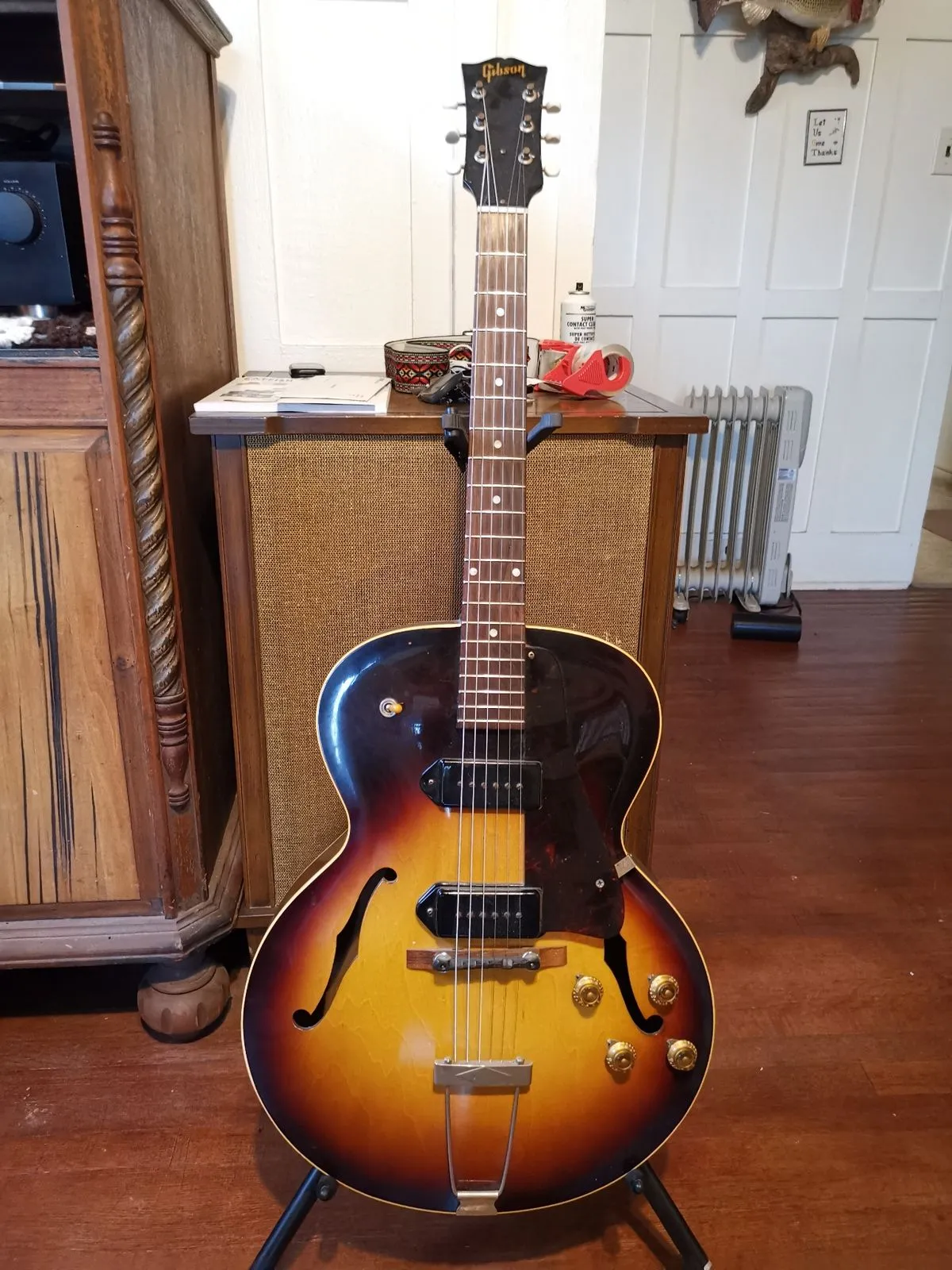
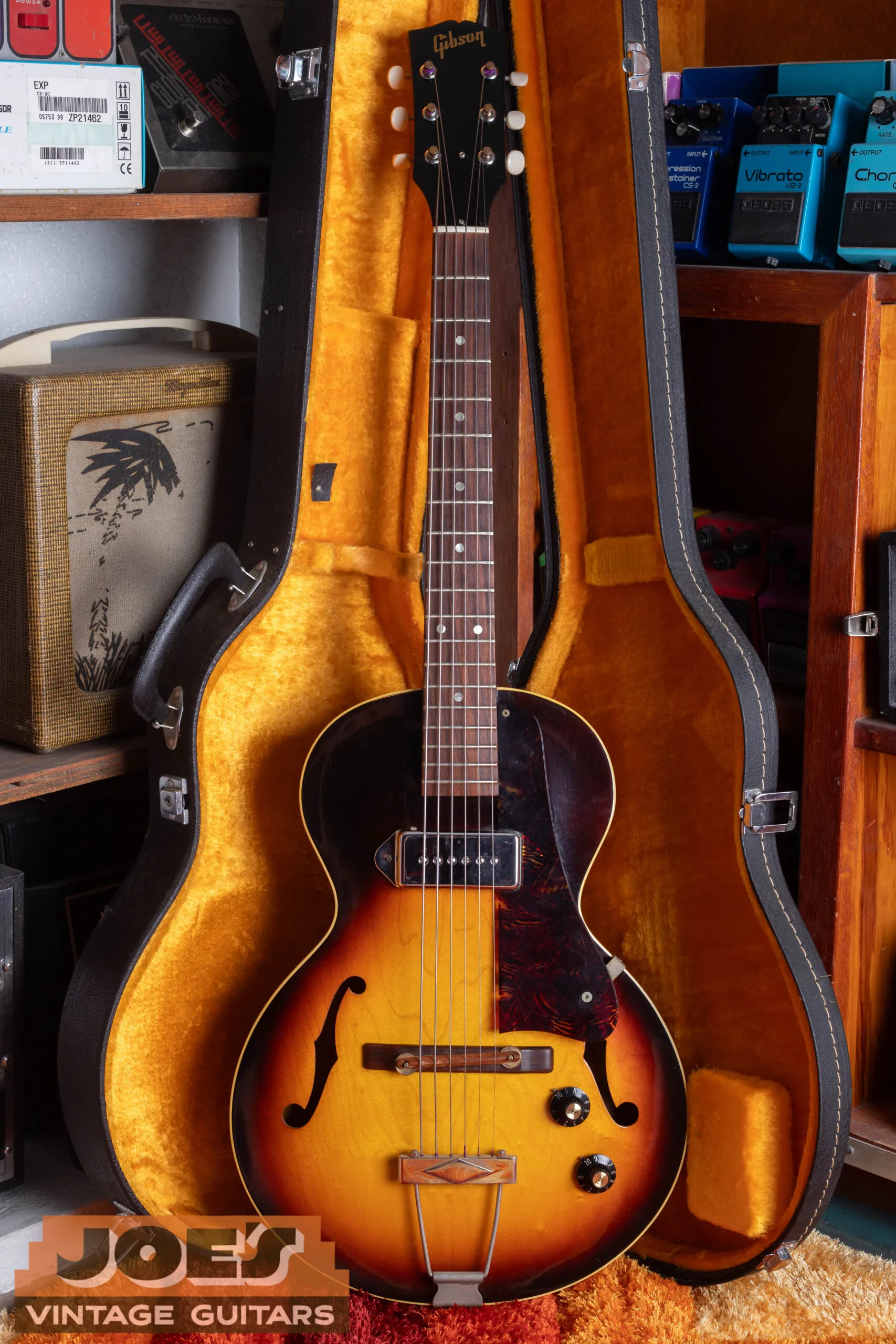
| ES-125 | 1941 to 1942, 1946 to 1970 | Full (3.25 to 3.5“) | No | 1 × P-90 | The original. The most common variant. |
| ES-125T | 1956 to 1968 | Thinline (1.75“) | No | 1 × P-90 | Arrived with the thinline trend. Sold well. |
| ES-125TC | 1960 to 1970 | Thinline (1.75“) | Yes, Florentine (sharp) | 1 × P-90 | Best single-pickup version for upper-fret access. |
| ES-125TDC | 1960 to 1970 | Thinline (1.75“) | Yes, Florentine | 2 × P-90 | The “rock and roll” spec. Most versatile thinline. |
| ES-125TD | 1957 to c.1963 | Thinline (1.75“) | No | 2 × P-90 | Uncommon after the early 60s. Transitional. |
| ES-125C | 1965 to 1970 | Full (3.25 to 3.5“) | Yes, Florentine | 1 × P-90 | Late addition to the full-depth line. |
| ES-125CD | 1966 to 1970 | Full (3.25 to 3.5“) | Yes, Florentine | 2 × P-90 | The full-depth dual-pickup option. Scarce. |
| ES-125 3/4 | 1956 to 1969 | Full (reduced body) | No | 1 × P-90 | Short 22.75“ scale. Student model. |
Decoder key: T = Thinline body · D = Dual pickups · C = Cutaway · 3/4 = Short scale. Stack them: TDC means Thinline, Dual pickup, Cutaway.
Body & Construction: Era by Era
The ES-125’s body construction tracks Gibson’s manufacturing changes across three decades. Where the top-tier archtops got hand-carved solid spruce, the ES-125 used laminated (pressed) tonewoods from day one. That wasn’t a corner cut so much as a working decision. Laminate handles humidity swings and road abuse better than a carved top, and it’s a real part of why an ES-125 sounds warm and slightly compressed through an amplifier the way it does.
Pre-War Production (1941 to 1942)
The first ES-125s came with a 16“ wide body at full depth. The original non-adjustable single-coil pickup sat at the bridge before being moved to the neck position fairly early in the run. Very few complete pre-war examples have survived in original condition. The ones that have are collector-grade regardless of finish or configuration, and the headstock profile on these earliest guitars differs slightly from what came after the war.
Early Post-War (1946 to 1949)
When civilian production restarted, the body grew slightly to 16¼“. The most interesting and least-documented variation from this stretch is the all-mahogany body on some 1946 examples: top, back, and sides all in mahogany instead of the laminated maple that would become standard. This was almost certainly a materials decision driven by what Gibson could actually get its hands on in 1946, but the tonal result is distinct. Warmer in the mids, less of the glassy top-end shimmer you hear from maple-top examples.
What to look for: The 1946 all-mahogany bodies can be identified by the grain showing through the finish and by a slightly different resonance when you tap the top acoustically. Sunburst on these instruments was sprayed over mahogany rather than maple, which sometimes gives the top a more orange-brown cast compared to later examples.
The Golden Era (1950 to 1959)
By 1950 Gibson had settled on laminated maple top, back, and sides, the recipe that would define the model for the rest of the run. Body width stayed at 16¼“ at full depth. The thinline models that arrived in 1956 used the same laminated maple but with body depth cut to 1¾“, which made the guitar friendlier on louder stages and less prone to feedback as rock and roll volumes climbed.
Collectors keep a closer eye on 1959 examples than on most other years. Like the solid-body Gibsons of the same year, late-50s ES-125s tend to carry chunkier, rounder neck profiles, sometimes called “baseball bat” shapes, and a lot of players find them the most comfortable necks in the catalog. Pair that with broken-in P-90s and early-60s knob hardware and you get one of the more desirable vintage examples.
The Norlin Era (Late 1960s to 1970)
After CMI (Chicago Musical Instruments) sold Gibson to the Ecuadorian brewery conglomerate Norlin in 1969, quality control started to slip, and the slide kept going through the 1970s and into the early 80s. In the final years of ES-125 production, necks transitioned from one-piece mahogany to three-piece mahogany or maple, a cost-cutting change that also altered the feel and resonance of the guitar. Binding work, finish quality, and hardware plating all got more inconsistent toward the end of the run.
Electronics: The P-90 Pickup
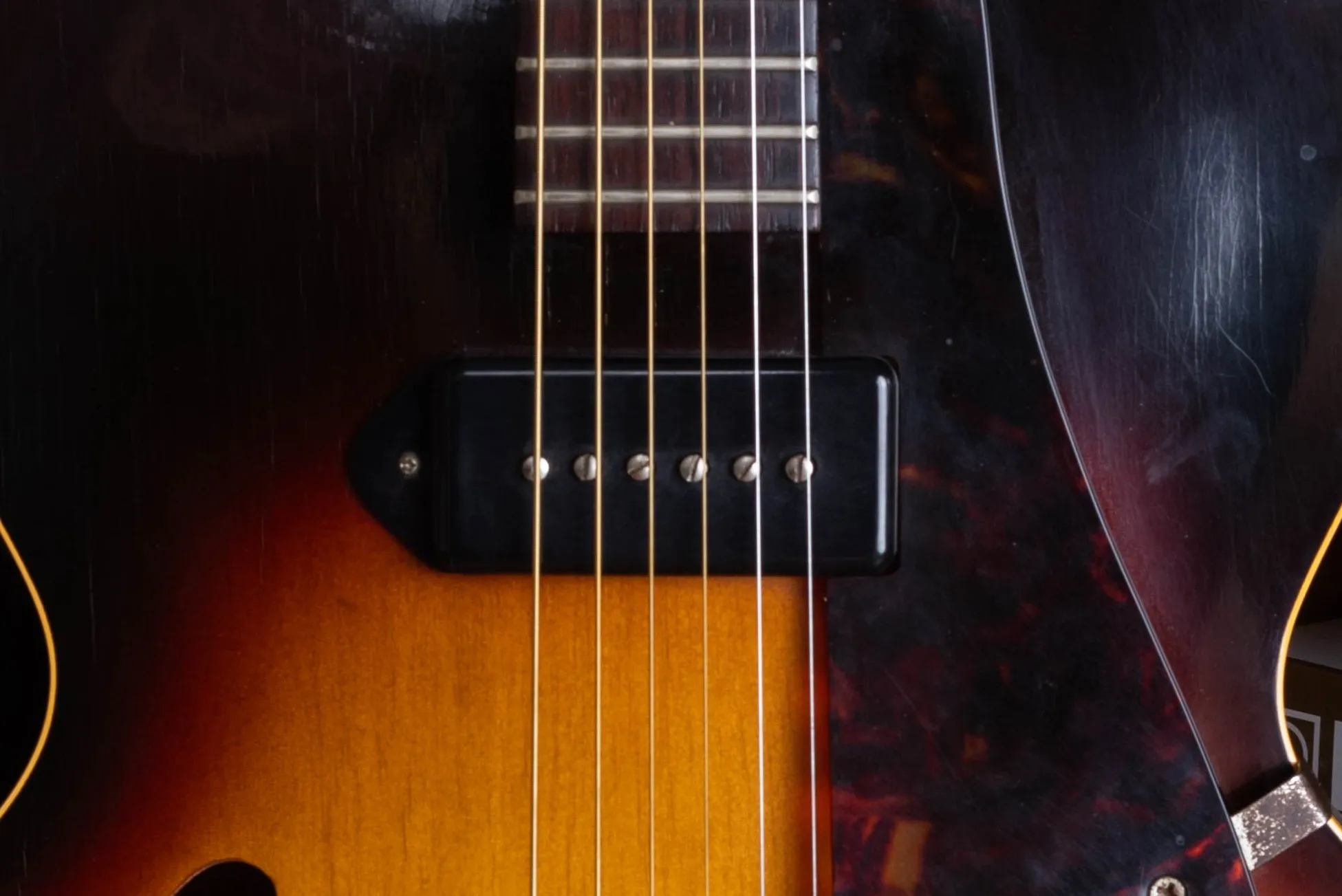
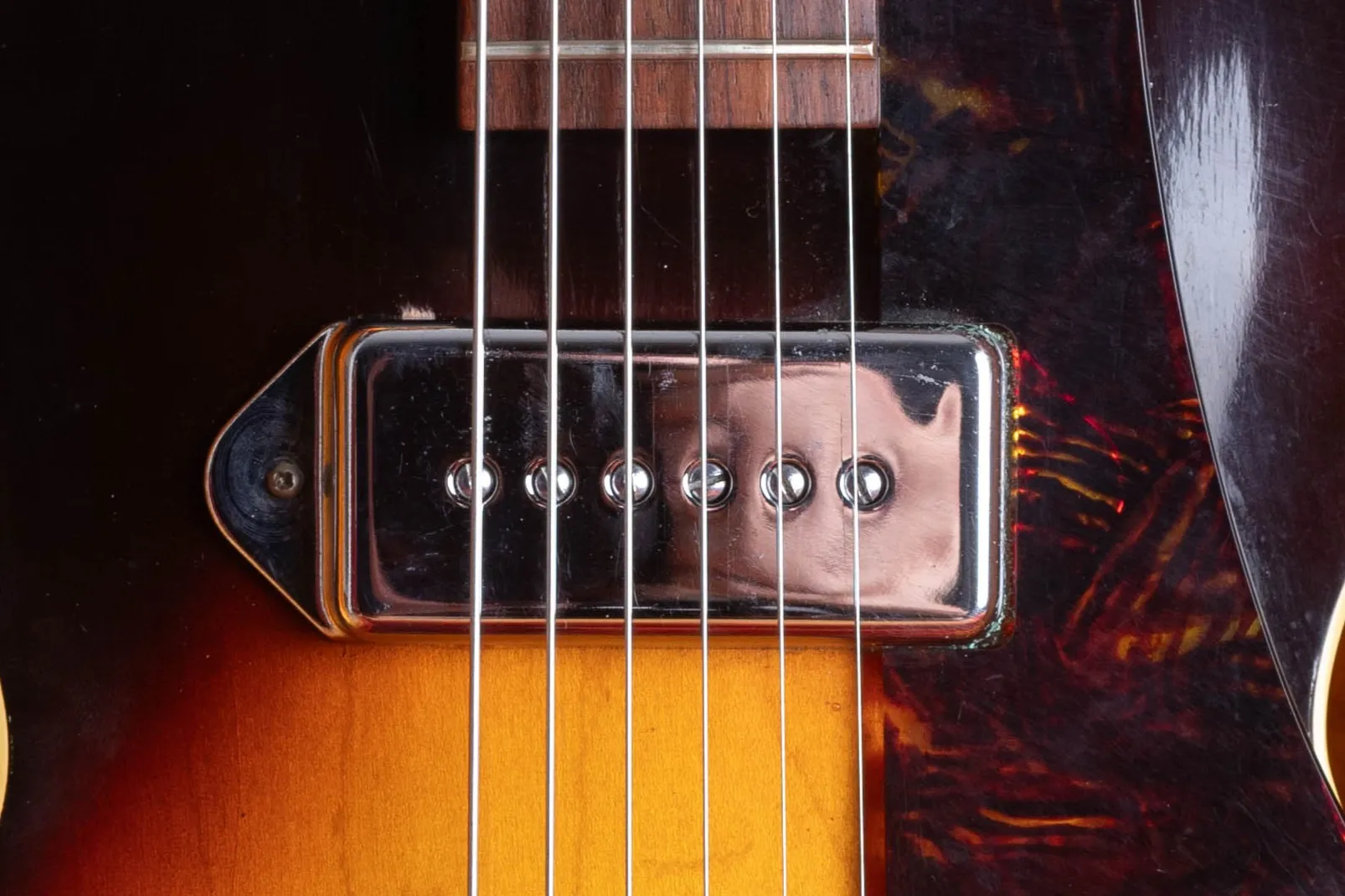
The P-90 is what makes the ES-125 the ES-125. It showed up in Gibson’s lineup around 1946 and stayed the company’s main single-coil through 1957, when the humbucker took over. The same pickup powered Gibson’s other working-musician electrics of the period, the Les Paul Junior and the Les Paul Special, which tells you where Gibson placed it: this was the pickup for guitars that were going to get played. Tonally it sits between the bright glassy clarity of a Fender single-coil and the thick warmth of a PAF humbucker. Strong midrange punch, a slightly dirty top end that breaks up nicely when an amp is leaned on. On a semi-hollow body the natural acoustic resonance gives the P-90 some extra bloom and sustain you won’t get from a solid-body P-90 guitar.
Early P-90s (1946 to 1949)
The earliest post-war P-90s on the ES-125 used non-adjustable pole pieces, a fixed-height setup that didn’t last long. The dog-ear covers on these are also slightly taller than what came later, which is something experienced collectors will spot visually. The tone tends to read as a little more open and airy, though most of that is sixty-plus years of wax and insulation aging rather than any deliberate engineering difference.
Standard Production P-90s (1950 to 1970)
From 1950 on, pole pieces became individually adjustable through slot-head screws, which matters more on an archtop than on a solid-body. The arched top changes the distance from string to pickup across the radius, and adjustable poles let you balance output string by string. On dual-pickup models (the -TD, -TDC, -CD configurations), the bridge pickup is typically shimmed closer to the strings to make up for the greater distance the arch creates at the bridge.
Hum sensitivity: The P-90 is a single coil, and it picks up 60-cycle hum from electrical interference. You’ll notice it more with higher-gain amp settings or when you’re playing near dimmer switches and fluorescent lighting. This isn’t a defect. It’s how single-coils work. Players who want hum cancellation in the neck position often use a shielded cable and pay attention to where they stand, or swap in modern noiseless replacements (though most owners just learn to live with the hum, because it goes away the moment you start playing).
Hardware & Aesthetics: The Dating Details
Few guitars give you as many useful dating clues as the ES-125. Gibson’s hardware changes through the 1940s, 50s, and 60s are well-tracked in the Gibson literature (Duchossoir, Carter, the Schultz/Beauchamp shipping data), and specific combinations of features can usually put a guitar inside a two- or three-year window even without a clean pot code or factory order number.
Headstock Logos
Gold silkscreened script “Gibson” logo with no tail on the lowercase ‘n.’ The crown inlay above the nut is missing on most examples from this stretch.
Transition to the gold silkscreened block logo, “Gibson” in a slightly condensed sans-serif face. This is the logo you’ll see on most production ES-125s.
Logo style went through small refinements through the 60s as Gibson standardized across the product line. Later examples can show slightly different proportions on the lettering.
Inlays
A brief transitional run in 1946 shipped some ES-125s with pearloid trapezoid inlays, the same style used on higher-tier Gibsons of the period. By 1950 at the latest, the ES-125 had settled into its permanent setup of pearloid dot inlays, which stayed in place through the rest of production.
Control Knobs
Knob style is one of the most reliable visual dating clues on any vintage Gibson:
Gold “Speed” knobs, tall and cylindrical, sometimes called “barrel” knobs. Unmarked or with simple line indicators.
Gold “Bonnet” or “Top Hat” knobs, the dome-shaped profile that became synonymous with the vintage Gibson look. These get pulled regularly for use as replacements on other vintage instruments.
Gold “Reflector” knobs, with a metal insert in the center of the dome that catches light. Sometimes called reflector caps.
Black “Witch Hat” knobs, a taller pointed profile in black plastic. When you see these on an ES-125 you’re looking at one of the final-run guitars, which is also when build quality was at its weakest.
Tailpiece
The ES-125 uses a “Raised Diamond” trapeze tailpiece, a pressed-steel unit with a raised diamond cutout in the center bar. The diamond geometry and the plating shifted subtly across the run. The most useful change for dating is the move from nickel to chrome plating around 1965, which is a clean visual tell on mid-decade transitional examples. Chrome reads cooler and brighter. Nickel ages to a warmer amber.
Finishes: Standard, Rare & Custom
Sunburst (Standard)
Sunburst is what almost every ES-125 left the factory in. It isn’t one color, though. Gibson’s sunburst evolved across the production run.
- 1940s Sunburst: Darker and more sepia in tone. Amber center moves into a deep brown or near-black edge, sometimes with an orange or red intermediate layer that has mostly oxidized away on surviving guitars.
- 1950s Sunburst: Warmer, more amber-dominant in the center, with cleaner transitions out to the dark edge. The most “classic” of the vintage looks.
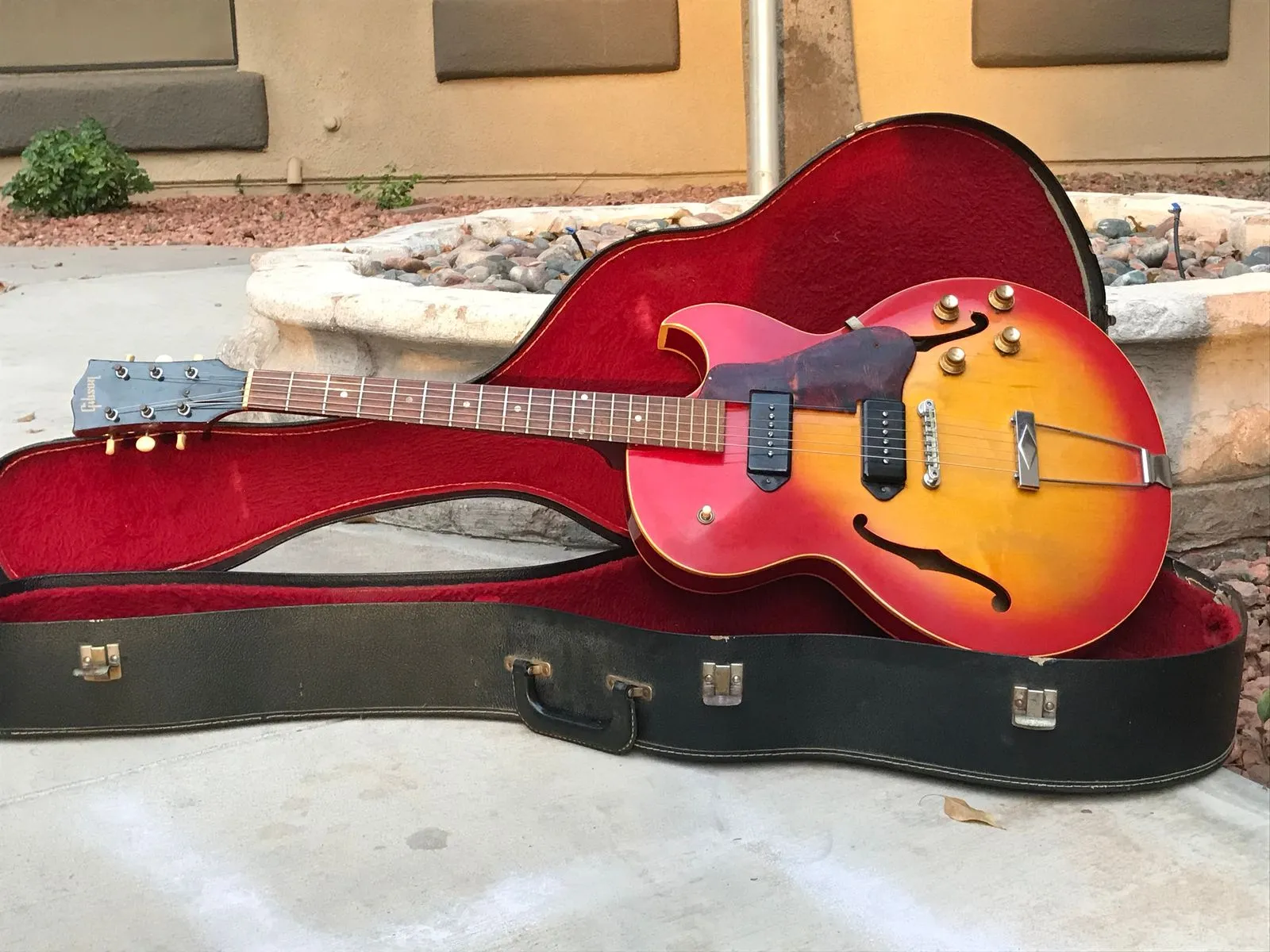
- Cherry Sunburst (1960 onward): Introduced first on the cutaway models. Cherry Sunburst adds a red intermediate layer between the amber center and the dark edge. Decades of UV exposure tend to fade the red dyes, leaving a finish people call Tea Burst or Honey Burst: a golden tone with no real red left in it. Original strong Cherry Sunbursts that haven’t faded are getting harder to find and they look striking when you see one.
The “Dark Back” or Walnut Stain
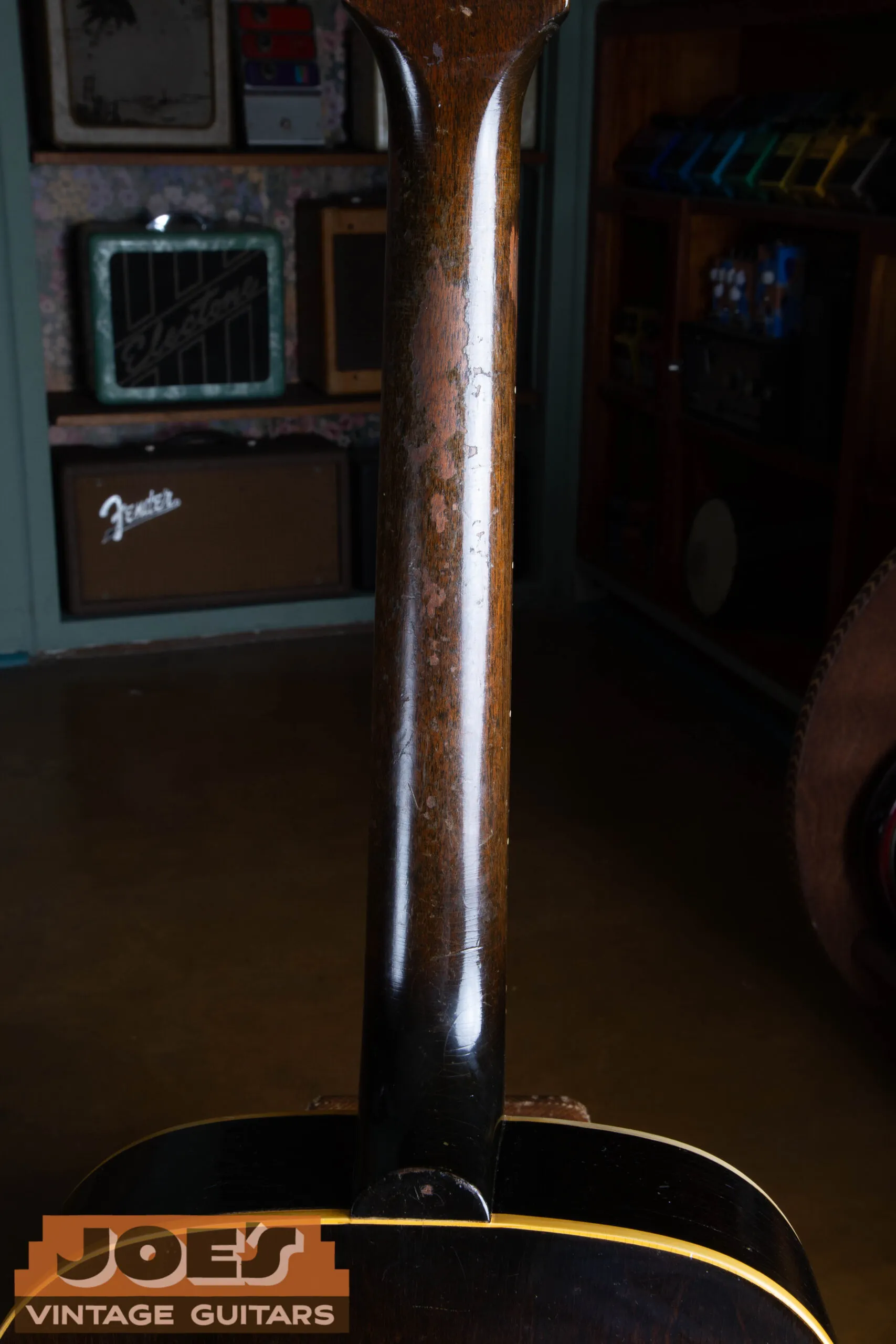
One finish detail from the very early post-war period (1946 to 1950) is worth pulling out. The top of these guitars carries a normal sunburst, but the back and sides are finished in a deep opaque dark brown or sepia stain that period documentation sometimes called “Walnut.” The two-tone treatment was applied mostly to all-mahogany examples, probably to hide mahogany’s less visually striking grain on the back and sides while keeping the sunburst look on top. The result resembles Gibson’s higher-end archtops of the same era, like the L-7, and gives the guitar a distinctive two-tone presentation that stands out next to the uniform sunbursts that came later.
Ebony (Black), the Rarest Standard Finish
Collector Alert: A factory-original Ebony ES-125 is a real find. Black wasn’t a standard catalog option on this model for most of its production run. Gibson did fulfill custom-order requests for the finish, and a small number of pre-war examples (1941 to 1942) were produced in “Deep Ebony” as part of specific batches. A handful of 1950s factory-black examples are documented, usually with white or cream binding that creates a dramatic contrast against the dark body. If someone’s selling a factory-black ES-125, authentication is mandatory. Refinishing a sunburst guitar to black is one of the more common modifications you’ll see in this model, and a legitimate factory original commands a meaningful premium.
Authentication checklist for a claimed factory Ebony ES-125:
- Binding shows correct color under finish edges (factory black goes on before binding on some Gibson models, leaving telltale color cues)
- No trace of sunburst color visible under the binding or in the pickup routes
- Hardware dates align with claimed production year
- Factory order number (FON) or serial number verifiable in Gibson ledger records (our guide to reading vintage Gibson serial numbers walks through the FON and orange-label systems)
- Any sunburst shadow or color bleed visible anywhere on the body
- Refinish crazing or texture inconsistent with original nitrocellulose lacquer aging
- Missing or replaced binding that could be concealing a finish strip
Natural (Blonde), Almost Non-Existent
The ES-175 was offered in Natural finish as a catalog option for much of its production. The ES-125 almost never was. The overwhelming majority of natural-finish ES-125s on the vintage market are refinishes, guitars whose original sunburst was stripped and replaced with a clear or amber finish. A handful of factory special orders in Natural may exist, but documentation has to be airtight to authenticate one. Default assumption on any natural ES-125: treat it as a refin until proven otherwise.
Tonal Character & Playing Feel
The ES-125 sits in a tonal slot that’s hard to replicate with anything else. The laminated maple body, often written off as a cost-cutting move, is a big part of why the guitar sounds the way it does: warm, naturally compressed, and surprisingly finished-sounding through modest amplification. The hollow body’s acoustic resonance adds bloom and sustain to the P-90 signal. Notes swell instead of spike, and the midrange has a woody, organic quality that solid-body P-90 guitars chase but rarely catch.
Full-Depth vs. Thinline
The two body depths produce real tonal differences even though the electronics and hardware are identical:
Neck Profiles by Era
ES-125 neck profiles follow Gibson’s broader evolution across the period. The necks players want most are the substantial late-1950s round-C profiles, generous in the hand without being unplayable. Through the 60s the profiles got progressively thinner, ending at the slim “60s C” that a lot of players find less satisfying for chord-heavy styles. Post-1965 examples generally reflect this thinning, and the three-piece neck construction of the very final years is widely viewed as a downgrade from the one-piece mahogany of the earlier guitars.
Buying a Vintage ES-125: What to Know
The ES-125’s old reputation as a “budget” Gibson kept its prices well behind the ES-175 and ES-335 for a long time. That gap has narrowed quite a bit as the vintage market has matured and players have come around to the ES-125 on its own terms, but it’s still one of the more accessible vintage Gibson electrics if you want real pre-CBS-era American tone without ES-175 money.
Price Tiers (General Guidance)
Valuations move constantly with the vintage market, so treat this as framework rather than a price guide. For actual production data that helps put rarity in context, our Gibson shipping totals reference (1948 to 1979) is a useful starting point:
- Late 1960s examples (Norlin transition, three-piece necks): Entry-level pricing for the model. Condition-dependent but generally the most accessible.
- Early to mid 1960s thinlines (TC, TDC): Strong player-grade demand. The dual-pickup cutaway models bring a premium over the single-pickup non-cutaway.
- 1950s full-depth examples: Collector and player crossover demand. Late-50s “chunky neck” examples sit at the top of this tier.
- Pre-war and all-mahogany 1946 examples: Specialist collector territory. Condition and originality drive pricing.
What to Inspect
- Neck joint: Archtop neck resets are expensive. Check the neck angle before anything else. If the bridge saddle is bottomed out trying to compensate for a fallen neck angle, you’ve found a reset bill waiting to happen.
- Top cracks: Laminate tops don’t crack the way solid tops do, but binding separation and top-joint failures at the waist are common on these guitars. Take a flashlight to the inside of the body and look carefully.
- Finish originality: Refinished ES-125s are common. Original finish, even checked or faded, generally holds more collector value, though players often care less about this than collectors do.
- Pickup integrity: Original P-90s should read in the correct resistance range and the pole-piece screws should still adjust freely. Check the dog-ear covers for cracks, and look for replacement pickups. A period-correct replacement is a much smaller hit to value than a modern aftermarket pickup.
- Tuner functionality: The original Klusons are often worn or replaced by now. Working originals are a plus. Period-correct replacement Klusons are acceptable. Modern lock tuners are a value drag if you’re a collector.
Common modifications to watch for: Replaced tuners, refretted necks, swapped pickups, replaced pots or caps, refinished bodies. All of it is common on working-musician instruments from this era. None of it necessarily disqualifies a guitar as a player. Each one affects collector value, though, and the price should reflect it.
Notable Players & Musical Contexts
The ES-125 never picked up a signature player the way the ES-175 attached itself to Joe Pass or the ES-335 attached itself to B.B. King. Its profile was always more democratic. It showed up wherever someone needed a reliable, affordable amplified archtop.
- Through the 50s and 60s the ES-125 was a fixture in jazz combos, especially in the rhythm chair, where its natural compression and warm midrange sat in the mix without crowding the horns or the piano.
- Blues players in the Chicago and Detroit scenes leaned on it heavily. A P-90 through a pushed tweed amplifier is the sound of a lot of fundamental electric blues records.
- Rockabilly and country players took to the thinline models in the late 50s for the lighter weight and better feedback resistance on louder stages.
- The price kept the ES-125 in the hands of working musicians and session players who needed a professional result without a premium budget. It was the guitar people actually used, as opposed to the guitar they aspired to.
Legacy & Why It Matters Now
The ES-125 was never glamorous. It didn’t have the ornate inlays of a Super 400 or the historical weight of an L-5, and it never became a pop-culture object the way the ES-335 did. What it had was a thirty-year run of being the guitar working players actually bought and actually used.
That counts for something now. The vintage market is full of boutique reissues and accurate-spec recreations, but an original ES-125 (especially a 50s full-depth example with its original P-90 and a neck that fills your hand) gives you something the reissues can’t manufacture: actual age. The P-90 hasn’t been rewound. The caps haven’t been replaced. The nitro has been on the body for sixty-plus years and looks like it. None of that is sentiment. It’s just time.
If you want a semi-hollow with real vintage age in the wood, a price that doesn’t require ES-335 money, and a tone that’s been proven in just about every American style since the 1940s, the ES-125 is still one of the better deals on the table. Plug a clean one into a Deluxe Reverb that’s been pushed past three on the volume knob. It won’t take long to figure out why these stayed in the catalog for thirty years.
More Vintage Gibson Guides
- Complete Dot-Neck ES-330 Guide: 1959 to 1962. The ES-125’s fully hollow thinline cousin, and one of the most underrated guitars Gibson ever made.
- Gibson Les Paul Junior Buyer’s Guide. The other great P-90 workhorse of the 1950s, a natural companion piece to this article.
- 1955 to 1958 TV Yellow Les Paul Special Guide. Two P-90s, a slab mahogany body, and one of the boldest finishes Gibson ever offered.
- Gibson Shipping Totals 1948 to 1979. Hard production numbers to put true rarity in context across the entire vintage Gibson line.
- How to Read Gibson Serial Numbers. Date your instrument with confidence using factory order numbers, ink stamps, and the orange label system.
- Identify a Vintage Gibson J-45, J-50 or SJ. If the archtop side of Gibson’s catalog has you curious about their acoustics, start here.
- Identify a Vintage Gibson LG-Series Guitar. Gibson’s student-market flat-tops, contemporaries of the ES-125 3/4 and just as historically interesting.
Have a Gibson ES-125 to Sell or Appraise?
We specialize in vintage Gibsons and buy guitars outright. No consignment, no waiting. Whether it’s a single instrument or an entire collection, we can help.
- Request a free appraisal. Tell us what you have and we’ll give you an honest current-market assessment.
- Sell your Gibson guitar. Fast, fair offers on vintage Gibsons in any condition.
- Selling a large guitar collection? Every option explained honestly, from dealers to auctions to private sale.
- Browse our current vintage inventory. Updated regularly with instruments we’ve personally inspected and authenticated.