
How to Sell a Large Guitar Collection (Every Option, Honestly Explained)
Contents
Contents
Maybe you spent years (decades, even) putting it together yourself. Or maybe a parent or grandparent just left you a room full of guitars, and you’re staring at cases you can’t identify, instruments you can’t price, and paperwork that may or may not exist. Either way, the same question lands on your shoulders that lands on thousands of people every year: how do you actually sell all of this?
Short answer: selling a real collection is a real job. Not a side project. Not something you knock out in a weekend. Depending on the size of the collection and what’s in it, you’re looking at anywhere from a couple weeks of steady work to several months of active management. We’ve worked on collections of 700 instruments and up. At that scale you aren’t selling a few guitars, you’re running a full inventory liquidation, with months of photography, listing, messaging, packing, and shipping ahead of you, all while trying to price accurately in a market that moves week to week. And that’s assuming you already know what you’ve got.
This guide walks through every legitimate avenue: what each platform requires, what it actually costs in time and money, and which type of seller it suits. At the end, I’ll explain how Joe’s Vintage Guitars handles the whole thing for you, identification, documentation, organization, so you don’t have to figure all of it out before you can even start.
Who this is for: anyone selling 10 or more instruments. Your own lifetime collection, an inherited collection from an estate, or instruments you’re managing on behalf of a family member. The math works the same. Collections range from a dozen guitars to several hundred or more. We’ve personally handled collections over 700 instruments. Whatever the scale, if you don’t know what you have or where to begin, start here. We can help from step one.
If You've Inherited a Guitar Collection: Read This First
Inherited collections are the situation we deal with most often, and the one where people feel the most overwhelmed. A parent or grandparent passes, and suddenly you’re the executor of an estate that includes dozens (sometimes hundreds) of guitars, amps, cases, and accessories. They’re spread across a spare room, a garage, a storage unit, maybe a second property. We’ve personally evaluated inherited collections of over 700 instruments. You may not play guitar. You may not know the difference between a Stratocaster and a Les Paul. You may have no clue whether what you’re looking at is worth $500 or $50,000. At larger scale, that uncertainty multiplies fast.
That uncertainty is normal. Nobody expects you to know any of this. But it does mean the standard “just list it on Reverb” advice doesn’t apply to you, at least not yet. Before you can list, price, or even photograph an inherited collection properly, you have to know what’s in it.
The Special Challenges of Inherited Collections
- No documentation. Plenty of collectors never kept formal records. Receipts, serial number logs, purchase histories. Gone, or buried in estate paperwork that hasn’t been opened yet. Without documentation, dating and authenticating vintage instruments takes hands-on expertise. Our brand-specific serial number guides for Fender, Gibson, Gretsch, Rickenbacker, and Martin are a useful place to start, but for a large inherited collection a hands-on evaluation beats researching each instrument one at a time.
- Unknown condition. Guitars that have sat in a case for years can have humidity damage, neck warps, finish cracks, or dead electronics that don’t show up until the instrument is played and inspected closely. What looks fine in the case may need significant work before it’s sellable.
- Hidden value, in both directions. A beat-up case you’d walk past could hold a 1959 Gibson worth more than a car. A guitar mounted prominently on the wall might be a midrange production piece worth a few hundred dollars. Without expertise, telling those apart from appearance alone is nearly impossible.
- Mixed-quality collections. Most serious collectors accumulate instruments across a wide value range. Trophy pieces next to player guitars, boutique builds next to production models. Selling all of it the same way, in the same place, is rarely the right strategy.
- Emotional weight. These were someone’s prized possessions. There’s real pressure to handle them responsibly, get fair value, and not make decisions you’ll regret. That pressure is legitimate, and it deserves a process that takes it seriously.
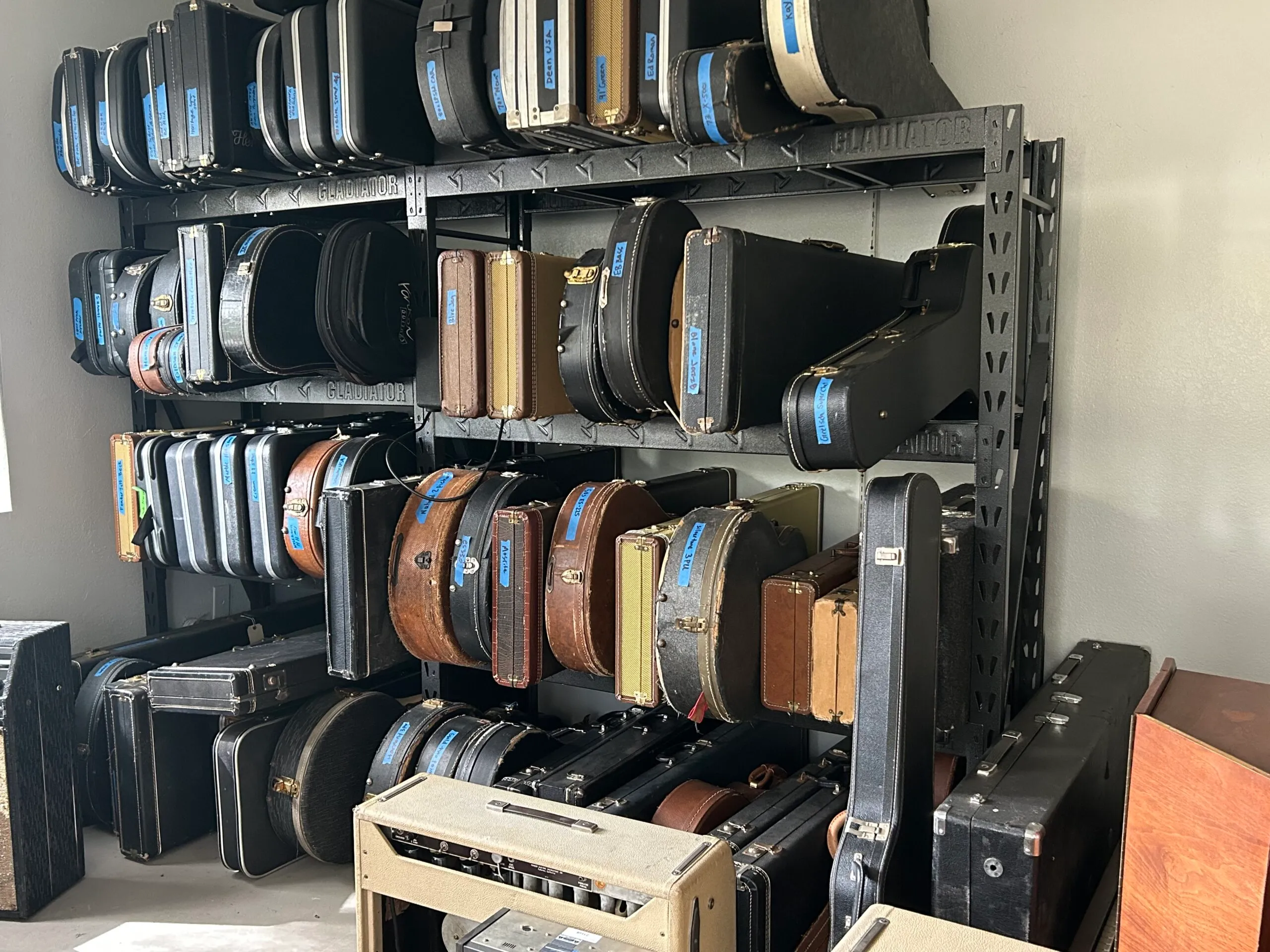
You don’t need to figure this out alone. When you reach out to us, we can come to you, look at what’s there, identify the instruments, give you honest context about values, and walk you through your options. No charge, no obligation. You can also request a free appraisal if you want a professional valuation before making any decisions. Most families find that one conversation with us saves them weeks of research and uncertainty.
What to Do (and Not Do) Before Calling Anyone
- Don’t throw anything away. Cases, straps, hang tags, tremolo arms, documentation, original receipts, even empty string packages. All of it can matter. Accessories that look like junk can be meaningful to a collector or help authenticate an instrument.
- Don’t “clean” the guitars. Well-meaning polishing with the wrong products will damage vintage finishes. A guitar with original patina and wear is often worth more than one that’s been polished up. Leave them as-is until someone who knows what they’re doing has looked at them.
- Don’t list anything until you know what it is. Mislabeling a vintage guitar, or underpricing it, is a mistake you can’t undo once it’s sold. Take the time to get proper identification before you commit to a price. I’ve written up the mistakes to avoid when selling a vintage guitar separately, and every one of them applies double at collection scale.
- Do photograph everything where it sits. A quick walk-through with your phone, one shot of each instrument and case, gives anyone you consult something to work from before they show up in person.
- Do locate any paperwork you can find. Look for receipts, insurance documents, old appraisals, anything the collector kept with the instruments. Even partial records help.
Before You List a Single Guitar: Taking Inventory the Right Way
The single most common mistake sellers make is jumping straight to listings without a proper inventory. Skip this step and you’ll mislabel instruments, miss documentation, price inconsistently, and end up listing the same guitar twice on different platforms without realizing it. Fix this before you do anything else.
Build a Master Inventory Sheet
Create a spreadsheet with a row for every instrument. Minimum columns:
- Make, model, year. Be precise. “Gibson Les Paul” isn’t enough. “1959 Gibson Les Paul Standard” is a listing. “2018 Gibson Les Paul Standard HP” is a different listing with different comps.
- Serial number. Photograph it before anything else. It’s your proof of authenticity and how you verify the manufacture date against factory records. Cross-reference against the right brand guide, see our serial number guides for Fender, Gibson, Gretsch, Rickenbacker, and Martin.
- Condition. Rate it honestly using standard descriptors: Mint, Excellent, Very Good+, Very Good, Good, Fair, Poor. Keep a separate notes column for specific issues like fret wear, refrets, finish checking, cracks, replaced tuners.
- Originality. Note any non-original parts. Replaced pickups, tuners, bridges, nuts, pots, and caps all affect value on vintage instruments. Buyers will ask. Having it documented up front saves time and headache later.
- Included accessories. Original case (hardshell, gig bag, or none), hang tags, case candy, tremolo arm, strap buttons, documentation.
- Estimated value range. Use Reverb completed sales, recent eBay sold listings, and published price guides to bracket a realistic range. Note where your guitar sits in that range: stock example, highly original, or player-grade.
- Where purchased / provenance notes. This matters for vintage pieces and can meaningfully affect buyer confidence and price.
Serial number guides by brand: Decoding a serial number tells you the actual manufacture year, the factory it came from, and sometimes the production sequence. All of which matter for pricing and authenticity. Use our free guides: Fender Serial Numbers · Gibson Serial Numbers · Gretsch Serial Numbers · Rickenbacker Serial Numbers · Martin Serial & Model Numbers
Grade Your Condition Honestly
Nothing wrecks your reputation as a seller faster than inflated condition grades. Buyers compare your photos and description to the grade you claim, and disputes, returns, and negative feedback almost always trace back to a seller who called something Excellent when it was clearly Very Good. When in doubt, grade one step lower than you think. Buyers who receive something better than expected are happy. Buyers who receive something worse are furious.
Important on vintage guitars: “All original” is a specific, defensible claim. Verify it before you make it. Check tuner buttons, pot dates (accessible through the cavity covers), pickup wire integrity, solder joints. A single replaced tuner drops an otherwise all-original vintage guitar into a different valuation tier, and you need to know that before you price it. Our serial number guides for Fender, Gibson, and Martin can help you confirm manufacture dates before you make any claims about originality.
Photograph Everything Before You Start Listing
Do all your photography in one sustained effort. Borrow or rent a lightbox if you need to. Use a consistent background. White seamless paper or a neutral grey surface both work well. Diffused natural light from a north-facing window beats direct sun every time. For every guitar, you need at a minimum:
- Front full-body shot (body, neck, headstock visible)
- Back full-body
- Headstock front (tuners, logo, truss rod cover)
- Headstock back (serial number)
- Body front detail (pickups, controls, pickguard)
- Body back (any checking, finish wear, strap button placement)
- Neck joint / heel area
- Fretboard (fret condition, inlays, binding if applicable)
- Any damage, wear, repairs, or notable cosmetic issues, photographed clearly and not obscured
- Case interior and exterior (if included)
- Labels, pot dates, pickup codes, anything that validates originality or date
For a 50-guitar collection, this photography session alone will take you a full day if you do it right. Budget for it. Do not skip the damage shots. A clear photo of a repaired headstock break builds more buyer trust than hiding it, and it eliminates “item not as described” returns down the road.
Research Pricing Thoroughly
Good pricing is an active research task. For each instrument, pull completed (sold) listings from Reverb and eBay. Not asking prices. Sold prices. Asking prices tell you what people hope for. Sold prices tell you what the market actually pays. Factor in condition, originality, included accessories, and current demand. Some categories move fast at strong prices: late-60s Fenders, pre-war acoustics, certain boutique builders. Others sit for weeks at almost any price: midrange production guitars, lower-tier electrics. If you’re not sure about the value of a significant piece, our free appraisal service will give you a professional market valuation before you commit to a price.
Selling on Reverb
Reverb is the dominant dedicated marketplace for musical instruments, and it’s the first platform most serious guitar sellers turn to. The audience skews heavily toward musicians, collectors, and dealers who actually know instruments. That means buyers are more educated, comparisons are sharper, and condition grading matters more than on a general marketplace.
The Setup
Creating a seller account is straightforward. For a collection, you’ll want to verify your identity, connect a bank account or PayPal, and set your shop policies before your first listing goes live. Reverb offers a standard seller policy template, but customizing your return policy, shipping terms, and handling time up front saves friction later.
Writing a Listing That Actually Converts
Reverb has a defined listing structure: title, category, condition, price, shipping, and a free-text description. The title is your primary search vehicle. A good title includes year, brand, model, and one or two key attributes buyers search for:
Weak: “Cool old Les Paul” | Strong: “1978 Gibson Les Paul Custom, All Original, Black Beauty, OHSC”
Your description needs to answer every question a buyer might have before they ask it. Cover the exact configuration, modifications or repairs, fret life remaining, neck profile, weight (buyers care about weight), action and setup status, electronics function, tuner stability, any known history. Experienced buyers on Reverb will send detailed questions. Be ready to answer. Slow replies and non-replies kill conversions.
What Reverb Takes
Shipping: The Part Nobody Warns You About
Shipping guitars is one of the harder parts of selling at scale. Each guitar has to be properly packed. Double-boxed for anything vintage or over $500, with enough bracing to keep the neck from impacting the inside of the box if it’s dropped. A proper packing job for a guitar with a case takes 30 to 45 minutes and requires the right box sizes, foam or bubble wrap, bracing material, and packing tape. You’ll need a steady supply of boxes on hand. Guitar-specific boxes from UPS or specialty suppliers are strongly recommended over random cardboard you find in the garage.
- Domestic shipping on a standard electric in a case: $60 to $110 depending on weight, dimensions, and distance, via UPS or FedEx Ground
- Fragile vintage acoustic: often $80 to $130 once you add appropriate insurance
- Acoustic without a case in a guitar box: $55 to $95
- Always buy shipping insurance. Reverb’s Safe Shipping program offers some protection, but for instruments over $1,000, buy declared value coverage from the carrier directly
Buyers expect tracking numbers fast, usually within 1 to 2 business days of payment. If you’re selling high volume you’ll need dedicated packing days built into your schedule, not packing done ad hoc between other obligations.
Returns and Disputes
Reverb’s buyer protection program tilts toward buyers in disputes. If a buyer claims an item arrived not as described, Reverb will often side with them even when your listing was accurate, particularly if your photos left gaps. Another reason exhaustive photo documentation matters. Set a clear return policy. Thirty days with the buyer paying return shipping is standard for most professional sellers. Factor potential return costs into your pricing on expensive pieces.
The Actual Time Commitment on Reverb
Here’s what Reverb selling labor really looks like for a 50-guitar collection:
That’s roughly 115+ hours of active work on a 50-instrument collection. And that’s the optimistic version, assuming it all sells in a reasonable window, nothing gets damaged in transit, and no difficult buyers turn up.
Selling on eBay
eBay has a larger total audience than Reverb, and for certain instrument categories it can produce strong results. Particularly for rare vintage pieces, where bidding wars push final prices above what a fixed-price Reverb listing would have gotten you. For more common production guitars, though, eBay’s guitar market tends to produce lower average sale prices than Reverb. The buyer pool is less focused, less condition-educated, and the bargain hunters are louder there.
Auction vs. Buy It Now
For rare, highly desirable, or hard-to-price vintage instruments, 7 to 10 day auctions with low starting prices can generate real buyer competition and maximize the final price. For standard production guitars, Buy It Now with Best Offer is generally more efficient. You set a floor and negotiate, rather than waiting out an auction cycle. Auctions require active monitoring and timing matters. Ending Sunday evenings typically produces stronger results.
eBay Fees: Higher Than Reverb
eBay’s final value fees are significantly higher than Reverb’s. On a $2,500 guitar, you’re handing eBay about $331. On a $500 guitar, $66. That cost needs to factor into your asking prices, or it eats your net considerably.
eBay Returns and Money Back Guarantee
eBay’s Money Back Guarantee heavily favors buyers. “Not as described” returns are nearly impossible to fight, even when your listing was accurate. This isn’t unique to guitars. It’s eBay policy across categories. For vintage instruments, the exposure is real. A buyer who claims a crack wasn’t disclosed, even if it’s right there in your photos, can return the guitar, and eBay will typically approve it. Some sellers add a “no returns” policy, but eBay’s buyer protections override that in most dispute scenarios.
eBay Works Best For
- Rare vintage pieces where auction bidding could push the price above market
- Instruments with broad collector appeal outside the musician community
- Accessories, parts, and lower-value items where Reverb’s audience is thinner
- Sellers with established eBay feedback scores who already have buyer trust built up
Selling on Facebook Marketplace
Facebook Marketplace has become a dominant local and regional classifieds platform, and for guitars in the $200 to $1,500 range it can move inventory quickly. Especially for players and gigging musicians who want to inspect before they buy. The listing process is fast, there are no listing fees for local sales, and the reach is genuinely broad.
The Reality of Facebook Guitar Sales
Facebook’s buyer pool is a very different demographic than Reverb’s. You’ll reach more casual players and fewer serious collectors. That’s a feature for some guitars (production instruments, amps, effects) and a real limitation for others (rare vintage, boutique). Expect:
- High message volume, low conversion. “Is this still available?” is the most common message on Facebook Marketplace, and a high percentage of those inquiries go nowhere. Budget your mental energy accordingly.
- Lowball offers. The platform’s culture encourages low opening offers. Set prices with room to negotiate, or mark items as “firm” explicitly in your listing title.
- No-shows. Meet-up commitments on Facebook have a genuinely poor show rate. Confirm day-of before you drive anywhere or wait at your location.
- Cash-only complications. Insist on cash or PayPal Goods & Services for anything worth protecting. “Friends and Family” PayPal transfers offer zero protection against payment reversal claims.
Facebook Guitar Groups: A Better Option Inside the Platform
Beyond the general Marketplace, Facebook has hundreds of buy/sell/trade groups dedicated to specific guitar brands, eras, and categories. These groups have more educated buyers, stronger community norms, and better conversion rates than the general Marketplace. Search for groups like “Vintage Gibson Buy Sell Trade,” “Fender Vintage Guitars,” boutique builder communities, and regional guitar groups in your area. A post in three well-chosen groups will outperform a Marketplace listing for the right instruments.
Shipping via Facebook
Facebook does offer shipping through their Commerce platform, with buyer and seller protections, but it’s less mature than Reverb or eBay. For instruments over $500, verify buyer accounts carefully and use tracked, insured shipping regardless of which platform you’re on.
Selling on Craigslist
Craigslist is cash, local, no fees. For production instruments under $1,000 in a metropolitan area, it can move guitars quickly to players who want to plug in before they pay. For high-value vintage instruments, it’s less appropriate. The buyer pool is shallow for $3,000+ instruments, and the lack of any buyer/seller protection makes it risky for both parties.
What Works on Craigslist
- Player-grade instruments priced to move quickly
- Common production guitars (Fender Standards, Gibson Studios, Mexican-made instruments)
- Amps, effects, accessories
- Anything you’d rather sell locally to avoid packing and shipping
What Doesn’t
- Rare or high-value vintage instruments. Your buyer pool is whoever is in your metro area browsing Craigslist this week.
- Boutique or collector-grade pieces that need context to value properly
- Anything you need sold at full market value, not at a discount
Safety note: Meet in a public, well-lit location for any Craigslist transaction. A busy parking lot, a bank lobby, or your local police station’s designated exchange zone are all appropriate. Never invite strangers to your home when selling an instrument collection. They now know you have more gear, and they know where you live.
Other Platforms Worth Knowing
Reddit: r/Gear4Sale and Instrument-Specific Communities
Reddit’s buy/sell subreddits, particularly r/Gear4Sale and category-specific subs like r/vintageguitars, r/Guitar’s BST threads, and brand-specific subs, attract informed buyers who often pay fair prices with minimal friction. Seller reputation on Reddit is tracked through karma and transaction history in specialized subreddits. PayPal Goods & Services or Venmo Business is standard. Shipping arrangements happen directly between parties. This channel works best for sellers already embedded in these communities and for instruments where the subreddit’s audience is a precise match.
The Gear Page (TGP) Emporium
The Gear Page forum’s Emporium section is a well-established marketplace for guitars, amps, and effects. The buyer and seller community is experienced, prices tend to be fair to strong, and the community actively polices bad actors. Posting requirements include photos, detailed descriptions, and a shipping/payment policy. For boutique and high-end modern instruments, particularly amps, TGP can outperform Reverb in terms of buyer quality. You need a forum account with posting history to list.
Harmony Central Classifieds
Smaller than Reverb or TGP, but still maintains an active classifieds section with a dedicated guitar community. Useful as a supplementary listing channel at essentially no cost.
Local Music Stores, Consignment
A lot of independent music retailers will take guitars on consignment, typically at 30 to 40 percent commission. Meaning you receive 60 to 70 percent of the selling price. The upside: no effort on your part, professional display, built-in buyer traffic. The downside: instruments can sit for months, you have no control over pricing strategy, consignment agreements can be vague about liability if something is damaged in the store, and you don’t get paid until it sells. For a large collection, the commission cost is substantial.
On a $50,000 collection sold at 35 percent consignment commission, you leave roughly $17,500 on the table. Plus months of waiting. Get any consignment agreement in writing and confirm the store carries adequate insurance to cover your instruments while they’re in their possession.
Guitar Shows and Instrument Swap Meets
Regional guitar shows, like the ones hosted by vintage guitar associations and dealer groups around the country, give you direct access to collectors and dealers in a concentrated setting. Table fees vary, $50 to $300 for a dealer table, and you need to transport, display, and staff your instruments for a full day. Buyer quality is usually excellent for vintage and boutique instruments. You may not sell everything, but serious, motivated buyers are in the room. Check NAMM regional events, local vintage guitar shows, and swap meets organized through guitar clubs in your area.
Estate Auction Houses (Instrument-Specialized)
For collections that include genuinely significant vintage pieces, pre-war acoustics, 1950s Les Pauls, pre-CBS Fenders, specialized instrument auction houses are worth considering. Houses that handle musical instruments understand provenance, know the collector community, and can pull prices above retail for truly exceptional pieces. The tradeoffs: auction commission rates of 10 to 25 percent, longer timelines (auctions are scheduled months in advance), and the need to have instruments appraised, photographed professionally, and catalogued. Not the right channel for production guitars or common vintage instruments. This is for the top of the collection only.
Dealers and Broker Networks
Reaching out directly to established vintage guitar dealers, beyond just your local area, is worth doing for high-value pieces. A lot of dealers are actively buying inventory and will make offers without the friction of a formal auction process. Expect wholesale offers (typically 50 to 70 percent of retail depending on the instrument), but factor in the zero time cost and zero shipping risk. This is essentially what we do at Joe’s, with a specific focus on making the process efficient, fair, and transparent for collectors and families.
Instagram and Direct Collector Outreach
For specific, high-demand vintage instruments, Instagram has become a real sales channel. Dealers and collectors with established followings regularly sell instruments via DM after posting photos. If you don’t already have a following, this channel requires building one, or reaching out directly to well-followed vintage guitar accounts and asking if they’ll post your instruments (typically for a commission or finder’s fee). More effective for individual standout pieces than for moving an entire collection.
Guitar Collector Forums and Email Lists
Some of the most targeted buyers for specific vintage categories live in private collector communities. Email lists, Discord servers, invitation-only forums dedicated to specific brands, eras, or instrument types. Access to these requires existing relationships in the collector community. If you’ve been collecting for years, you likely already have some of these connections. Activating them directly, reaching out to fellow collectors you know and offering first right of refusal, can produce fast, fair, no-fee private sales for the strongest pieces in your collection.
Platform Comparison at a Glance
| Platform | Fees (approx.) | Buyer Quality | Best For | Biggest Friction |
|---|---|---|---|---|
| Reverb | ~8% | High, instrument-educated | Most guitars, vintage, boutique | Shipping labor, high message volume |
| eBay | ~13 to 15%+ | Mixed, broad audience | Rare vintage, parts, accessories | High fees, buyer-tilted returns |
| Facebook Marketplace | Free (local) | Low to medium, casual players | Production guitars, local cash sales | No-shows, lowballers, time-wasters |
| Craigslist | Free | Low, local only | Player-grade, sub-$1K, local only | No-shows, safety, shallow pool |
| Reddit / TGP | Free to small | High, community-vetted | Boutique, modern, enthusiast gear | Requires reputation/account history |
| Consignment | 30 to 40% | Medium, walk-in retail | Hands-off sellers, mid-range stock | Huge commission, slow, no control |
| Auction Houses | 10 to 25% | Very high, serious collectors | Museum-quality, pre-war, trophy pieces | Long timeline, high minimum quality bar |
| Joe’s Vintage Guitars | No fees | Direct sale, you deal with us | Entire collections, vintage, serious instruments | Wholesale pricing (offset by zero time cost) |
The True Cost of Selling It Yourself
Most sellers badly underestimate how much work selling a large collection really is, and overestimate how much more money they’ll net by doing it themselves.
Let’s run the numbers. Say you have 40 guitars with a collective market value of $80,000, assuming every one sold at full retail on Reverb over a period of months. Now apply that same math to a 200- or 700-piece collection. The numbers and the time commitment scale proportionally, but the stress and logistics scale faster.
The Math Most People Skip
And that doesn’t price your time. At 115+ hours of work, with a conservative $40/hr value on your time, you’re looking at another $4,600+ in personal time cost. Plus months of your house being a shipping warehouse, months of managing messages, and the ongoing stress of an unfinished task sitting in your peripheral vision every day.
What Usually Gets Sellers Off the DIY Track
- The first packing session. The moment you realize how long proper guitar packing actually takes.
- The first disputed transaction. A buyer claiming damage you can’t prove didn’t happen.
- The slow-moving inventory. When 15 guitars have been listed for six weeks and are getting no offers.
- The inherited collection reality check. When you realize that identifying, researching, and documenting 40, 100, or 700+ instruments you didn’t collect yourself is a project that runs months before a single listing goes live.
- The estate timeline. Probate, executor responsibilities, and family dynamics don’t wait for your Reverb shop to find buyers. A lot of estates need collections liquidated on a schedule that DIY selling simply can’t accommodate.
- The realization that “retail value” was aspirational. Most guitars sell at 70 to 85 percent of the comp price you found, not at it.
None of this means you shouldn’t sell on Reverb or eBay. For a small collection of common instruments where you have the time and deep knowledge of what you have, DIY selling makes sense. But for a large collection, especially one that came to you through an estate, where the instruments deserve proper identification and the process needs to move efficiently, there’s a better path.
Why Collectors and Their Families Choose to Sell to Us
Joe’s Vintage Guitars has been buying collections from serious collectors, estates, and families throughout Arizona and across the country for years. We’ve handled collections at every scale, from a dozen guitars to estates with over 700 instruments. The majority of the collections we buy are inherited. Families navigating an estate who need the instruments identified, valued, and handled professionally, without becoming guitar experts overnight.
We built our process around that reality. You don’t need to have anything organized, documented, or even identified before you call us. That’s our job, not yours.
Experience We’ve personally handled collections of 700+ instruments from a single estate. If your situation feels overwhelming because of sheer volume, large-scale is exactly where we operate most comfortably. The bigger the collection, the more valuable a single coordinated evaluation becomes, versus months of piecemeal DIY selling.
We Help With Every Step, Including the Steps Before the Sale
Most dealers will only engage once you’ve done the homework: identified every instrument, pulled serial numbers, organized the collection, and presented it cleanly. We work differently. If you’ve inherited a room full of guitars and have no idea where to start, we can:
- Come to you. For local collections in the Phoenix metro area, we’ll come to the location. A home, a storage unit, an estate property, whatever the situation is.
- Identify every instrument. We’ll tell you what you have. Make, model, approximate year, and any notable features or originality concerns.
- Pull and verify serial numbers. So you have an accurate record regardless of what you decide to do next.
- Organize and document the collection. If there’s no existing inventory, we’ll build one with you during the evaluation visit.
- Explain the value honestly. We’ll tell you what each instrument is worth in the current market, what factors affect that value, and what a fair offer looks like.
- Work around estate timelines. If you’re an executor with probate deadlines, or a family that needs a clean resolution on a schedule, we accommodate that.
If you’re managing a parent’s or grandparent’s collection and feel completely lost, that’s exactly the situation we’re set up to help with. Reach out here and we’ll have a straightforward conversation about what you have and what makes sense. No pressure, no obligation.
Here’s What the Full Process Looks Like
- You reach out. Through our Sell My Collection page, by phone, or by email. Tell us what you know. Approximate number of instruments, general categories if you know them, and your situation. You don’t need answers. Just a starting point.
- We evaluate, at your location if needed. For local collections, we come to you. We handle the identification and documentation ourselves. For out-of-area collections, photos and whatever records exist give us enough to have a meaningful conversation and figure out next steps.
- You receive a clear, itemized offer. We don’t do vague lowball numbers. We tell you what we’ll pay for the collection, walk you through the reasoning on significant pieces, and give you time to consider it without pressure.
- You get paid. Same day for local transactions. No waiting on buyers, no platform fees deducted, no returns weeks later.
- You’re done. The instruments leave with us. The room is cleared, the estate item is resolved, and you’re not managing an ongoing selling project for the next six months.
What We Actively Look For
- Vintage American electric guitars: Fender, Gibson, Gretsch, Rickenbacker, Guild, and more
- Pre-war and vintage acoustic guitars: Martin, Gibson, and similar makers
- Boutique and small-builder instruments with documented provenance
- Vintage amplifiers: Fender, Marshall, Vox, Ampeg, and comparable
- Complete collections from estates or retiring collectors. We evaluate the whole and make one offer, which simplifies the process enormously.
- Collections with missing or incomplete documentation. We’re experienced at working through unorganized estates and will not penalize you for paperwork that doesn’t exist.
Yes, We Pay Wholesale. Here’s the Honest Tradeoff
We won’t pretend otherwise. Buying collections to resell is a business, and the offers we make reflect that. You will not net the same dollar amount you’d theoretically achieve if every guitar sold at full retail, every buyer was reasonable, and the process took no time. What you will get is a fair wholesale price, paid immediately, with the identification and documentation handled for you, and zero ongoing effort on your part. For most families and collectors who run the real math on DIY selling versus a direct sale, that gap narrows considerably. And for inherited collections, where the alternative is months of unfamiliar work during an already difficult time, the value of a clean resolution is real.
We’re based in Mesa, Arizona, and we travel for the right collection. If you’re in the Phoenix metro area, we can typically schedule an evaluation within a week. Out of state? Start the conversation here. We’ll tell you quickly whether it makes sense to proceed and what the process looks like.
See Real Collections We’ve Purchased
A look at what the process actually looks like, from initial evaluation to completed sale.
A real collection walkthrough and evaluation
See how we handle large, varied collections
From identification to offer, the full process
From Our Instagram
Real collection buys. Follow along as we evaluate and purchase vintage instruments.
[
View this post on Instagram
](https://www.instagram.com/reel/C7RuJUeRW2O/?utm_source=ig_embed&utm_campaign=loading)
[
View this post on Instagram
](https://www.instagram.com/reel/C3oOvxOvFJp/?utm_source=ig_embed&utm_campaign=loading)
Ready to Get an Offer on Your Collection?
Your own collection or one you’ve inherited. We handle every step. Identification, documentation, organization, and a fair offer. No prep work required on your end.
Common Questions About Selling a Guitar Collection
What about selling vintage guitars I inherited as part of an estate?
This is the most common situation we work with, and it deserves a real answer. Inherited guitar collections come with several layers of complexity that don’t apply to a collector selling their own instruments:
- Legal authority to sell. As executor or administrator of the estate, you’ll need to establish the right to sell personal property before completing any transaction. An estate attorney can confirm what documentation you need. We’re experienced working alongside estate attorneys and can coordinate timing with probate requirements.
- Identification without the collector’s knowledge. When the person who knew every instrument is no longer there to explain what things are, identifying the collection accurately takes hands-on expertise. We do this regularly and don’t require you to provide information you don’t have.
- Missing documentation. Most guitar collectors, even serious ones, don’t keep formal inventory records. If receipts, serial logs, or purchase histories don’t exist, that’s not an obstacle. We’ll build documentation from the instruments themselves.
- Tax and reporting considerations. Inherited property typically receives a stepped-up cost basis for tax purposes, which affects how gains are calculated if the estate sells at a profit. That’s a question for your CPA or estate attorney, not us. But it’s worth understanding before you decide how to sell.
- Family dynamics. Sometimes multiple heirs have an interest in the collection, or family members want input on where specific instruments go. We’re comfortable navigating those conversations and can work with multiple parties when needed.
If you’re an executor or family member handling a guitar collection as part of an estate and don’t know where to start, contact us directly or request a free appraisal. We’ll walk you through the process from the beginning. That includes coming to the location, identifying every instrument, and giving you an honest picture of what you’re working with before you make any decisions.
What if the collection isn’t organized at all, no list, no records, instruments in different rooms?
More common than you’d think, especially with inherited collections. Serious collectors often have instruments spread across multiple rooms, storage spaces, and cases. Some labeled, some not. Records, if they exist at all, may be handwritten notes, old receipts in a filing cabinet, or nothing.
When we evaluate a collection, we bring the expertise to work through exactly that kind of situation. We’ll go through everything methodically, identify each instrument, note condition and originality, pull serial numbers against the appropriate factory records (using resources like our Fender, Gibson, Gretsch, Rickenbacker, and Martin serial number guides), and build an organized picture of what’s there. You don’t need to do any of that before calling us. That’s precisely where we add value no online platform can replicate.
How long does it take to sell a large guitar collection on your own?
Realistically, plan on three to nine months to sell a collection of 30+ instruments through online marketplaces. Longer if any pieces are unusual or require finding the right buyer. Some instruments will sell in days. Others will sit for months. Total active time involved (identifying, listing, photography, communication, packing, shipping) is typically 100 to 200 hours for a mid-size collection. For an inherited collection where you’re starting without knowledge of the instruments, add significant time for research and identification before you can list anything at all.
Do I need to set up a business account to sell on Reverb or eBay?
For a small number of guitars, a personal account is fine. If you’re selling a large collection, both platforms may flag you as a high-volume seller and require additional verification, tax ID information, or seller account upgrades. Reverb in particular has guidelines around volume selling that can affect your account standing if not managed properly. Consult a tax professional about reporting obligations for large collection sales. In most cases, proceeds from selling personal property at a gain are taxable events.
Should I get a formal appraisal before selling?
For insurance or estate administration, a written appraisal from a credentialed appraiser is worth the cost. For selling purposes, market research (completed sales comps) is generally more useful than a formal appraisal, and a lot of appraisers use the same data you can access directly. Where appraisals add genuine value: authenticating significant vintage pieces, supporting an estate filing, or establishing a defensible value basis for instruments being donated or used in a business transaction. Our free appraisal service is a practical no-obligation starting point. A professional market valuation before you commit to any selling strategy.
Is it worth selling guitars individually or as a lot?
Selling individually maximizes theoretical gross revenue but requires maximum time and effort. Selling as a lot to a dealer trades some revenue for speed and simplicity. For most people with large collections, a hybrid approach makes sense. Identify the top 5 to 10 most valuable and desirable pieces for individual listing, where the extra effort is justified by meaningfully higher prices. Sell the balance as a lot or to a dealer who will move them efficiently. For inherited collections where you don’t have the background to confidently identify the top pieces yourself, a dealer evaluation is the most reliable way to know which instruments fall into which category.
What’s the best way to ship an expensive guitar?
Double-box it. The guitar in its case goes into a guitar-specific box with blocking foam or wrapped bubble wrap to keep the case from moving. That box goes inside a slightly larger outer box with at least 2 inches of packing material on all sides. Use carrier-grade tape on all seams. Declare the full value for insurance. Carrier insurance is the only protection with any teeth if something is damaged. FedEx and UPS Ground are both commonly used. USPS Priority Mail is not recommended for expensive instruments. Their handling standards and damage claim process don’t hold up.
Joe’s Vintage Guitars is located in Mesa, Arizona. We buy vintage and quality used guitars, amplifiers, and musical instruments from collectors, estates, and families throughout the Phoenix metro area and across the country. We specialize in inherited collections and handle identification, documentation, and organization as part of our process. Learn more about selling your collection →