

New York, Philadelphia And Kalamazoo · Broadway Models
Epiphone Broadway Authentication Guide
The Broadway changed from a carved acoustic archtop to a full-depth electric with laminated maple construction.
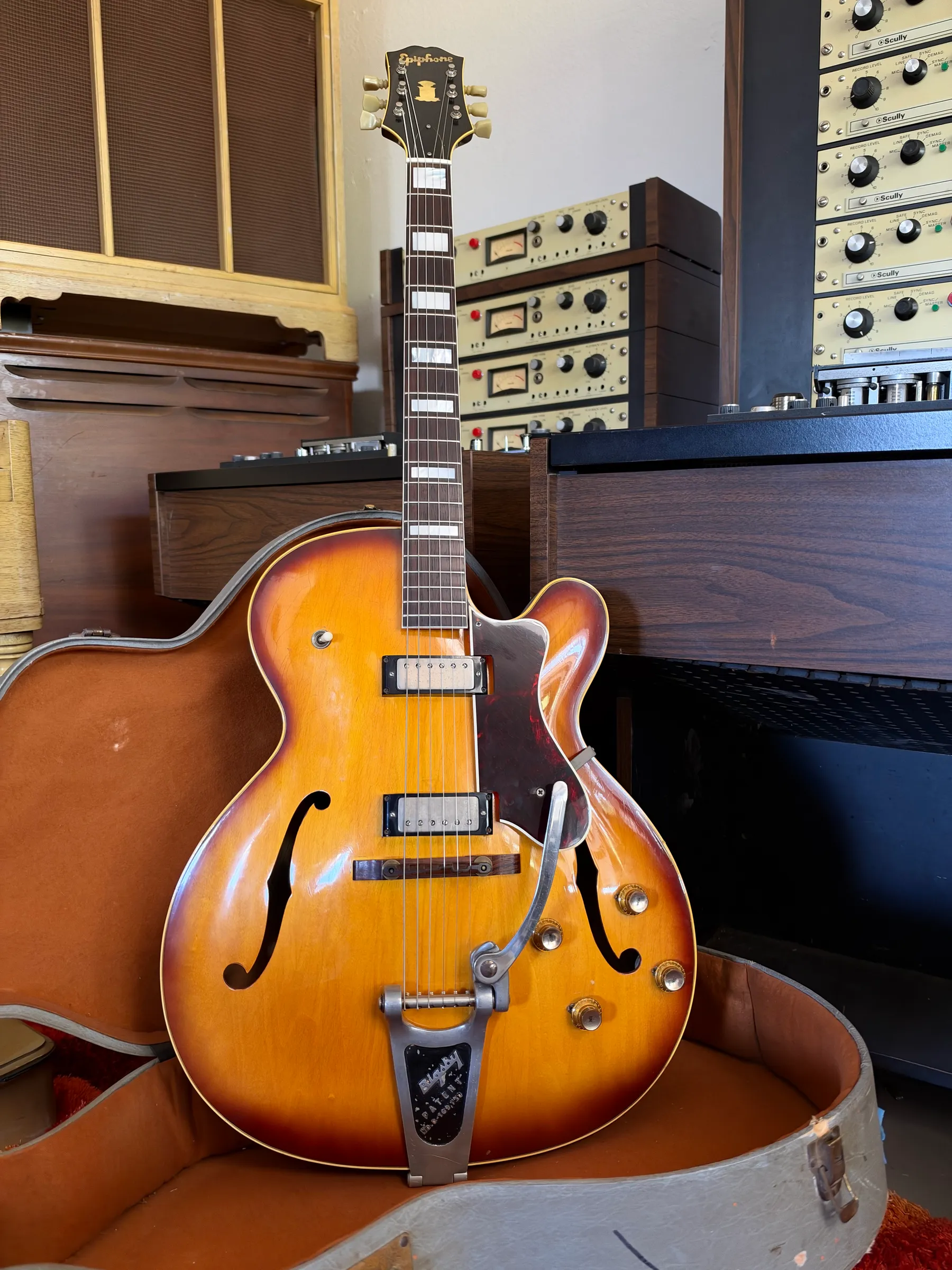
Identify a vintage Epiphone Broadway by construction first. The older acoustic model has a carved spruce top, while the Kalamazoo E252 is a full-depth electric with laminated maple construction and two pickups. A familiar headstock or block fingerboard doesn’t distinguish those versions. The Broadway value guide provides separate comparisons once the factory period and original configuration are established.
Authenticity And Originality Are Assessed From The Information Provided. A Hands-On Inspection Can Change The Conclusion.
Acoustic And Electric Construction
Broadway Specifications That Separate The Families
| Version | Body And Neck | Hardware And Markings |
|---|---|---|
| New York Acoustic | Carved spruce top; walnut and later maple body groups | Acoustic bridge, period Epiphone decoration and pre-Gibson label |
| Broadway Regent | Acoustic cutaway within the older family | Cutaway construction must agree with the parent model |
| Philadelphia-Era Acoustic | Large acoustic archtop documented in the 1954 catalog | Maple body, ornate headstock, block markers and Frequensator |
| Kalamazoo E252 / E252N | Laminated maple top and back, maple rims, mahogany neck | Two pickups, separate volume and tone controls, selector and Frequensator |
| 1961 Electric Dimensions | 17⅜-inch width, full-depth body and 25½-inch scale | Read the E252 shaded and E252N natural catalog designations |
The body’s arch isn’t enough to identify how its top was made. Compare a visible edge or interior evidence where accessible, and have uncertain construction inspected. Don’t remove a pickup or force a mirror through an f-hole merely to complete an initial appraisal request. The first photographs can establish which questions need closer work.
New York Acoustics And Philadelphia Continuation
The Broadway Before Kalamazoo
The New York Acoustic Model
The Broadway dates to the original 1931 Epiphone archtop line. Its early body size and appointments developed through the 1930s, with walnut and later maple constructions represented in the model history. A later maple Broadway should not be used as the universal visual template for an early walnut example.
Look at the body dimensions, headstock decoration, fingerboard markers and tailpiece together. Replaced inlay or a later tailpiece can make one clue misleading. The acoustic identity also remains intact when a removable pickup has been fitted, provided the underlying model and alteration are described separately.
Philadelphia And The Acoustic Regent
The 1954 catalog documents the Broadway as a carved spruce-top acoustic with maple body and elaborate appointments. The Broadway Regent is the cutaway version of the acoustic Broadway. It should not be confused with the later factory electric simply because both guitars can have a cutaway and an Epiphone tailpiece.
Keep the factory chronology in order: the older New York and Philadelphia instruments precede CMI’s 1957 purchase and the start of Kalamazoo production in 1958. The Sheraton history documents that factory transition. A printed address on a surviving label supports the record without necessarily establishing a precise build year.
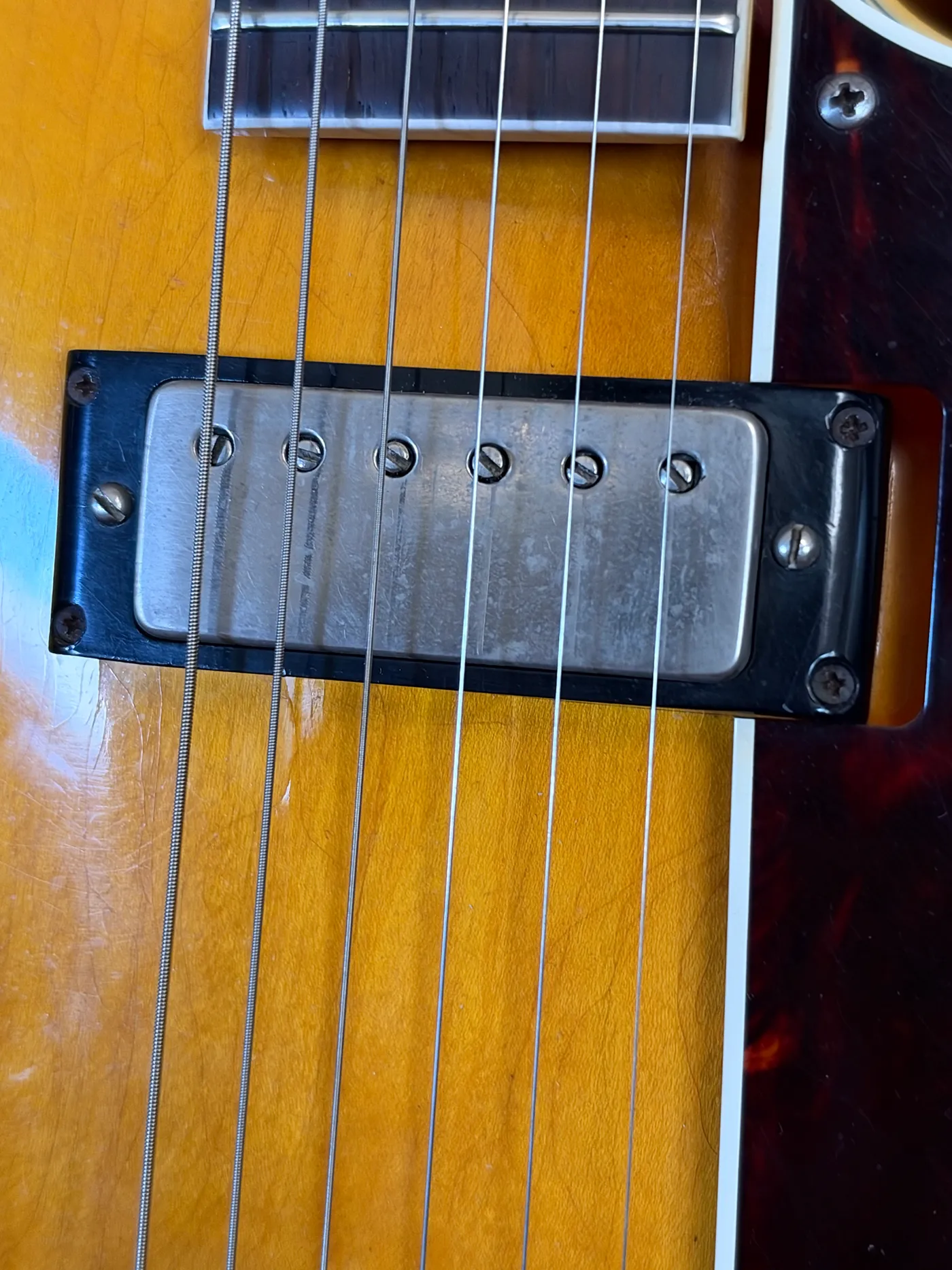
Broadway details: the 1961 guitar’s mini-humbucker and a 1964 natural-finish example.
Follow Construction And Electronics
Broadway Changes Across The American Years
The Acoustic Broadway Develops
Use the appropriate early catalog for size and ornamentation. The change from walnut to maple belongs to the older acoustic history, not the later switch from carved acoustic construction to a laminated electric body.
Non-Cutaway And Regent Acoustics
The large acoustic remains the reference, with the Regent identifying a cutaway option. Inspect the original rim and binding around the cutaway rather than treating a seller’s terminology as proof of the factory version.
The Kalamazoo Electric Broadway
The Gibson-built Broadway uses a full-depth electric body. Early instruments carry New York pickups; the Gibson mini-humbucker transition follows the broader Epiphone electric chronology. A broad year group should not be mistaken for a uniform pickup specification.
The E252 Specification Is Explicit
The catalog describes two adjustable-pole pickups, independent tone and volume controls, toggle selection and laminated maple construction. Read those details as a set. A three-pickup layout or a center-block double-cutaway body points to another model or substantial alteration.
Check The Individual Finish And Features
Continue to compare the serial, neck and hardware rather than dating a Broadway from its color. Natural, sunburst and cherry descriptions need finish evidence. This guide doesn’t assign an exact factory color schedule from an ambiguous year grouping.
Full-Depth Laminated Construction
How Gibson Changed The Broadway
The 1961 E252 catalog description specifies laminated arched maple for both top and back, with maple rims and a mahogany neck. The width is 17⅜ inches, and the full-depth body is substantially deeper than the Zephyr thinline shown beside it. The long 25½-inch scale also distinguishes it from several smaller Gibson and Epiphone electric archtops.
This is a construction change from the older carved spruce-top acoustic Broadway. Don’t describe the Kalamazoo electric as a carved acoustic merely because the name continued. A fitted pickup on an older acoustic and a factory E252 are different manufacturing configurations, even when both can be played through an amplifier.
Pickup And Control Checks
The E252 has two factory pickups with separate volume and tone controls and a selector for either or both. Early New York single coils give way to Gibson-made mini-humbuckers in the electric line. Inspect the actual pickup construction, mounting and wiring before assigning the transition from a serial alone.
A mini-humbucker can retain an old cover while the coil or internal parts have changed. Keep technician documentation for repairs. Epiphone mini-humbuckers and Firebird pickups are different internal designs; don’t treat them as equivalent because both use narrow metal covers. A routed full-size replacement is another alteration that needs to be recorded.
Logo, Neck And Frequensator
The Epiphone headstock decoration, bound rosewood fingerboard with block markers and Frequensator belong in the model comparison. The 1961 catalog also specifies nickel-plated metalwork and a rosewood bridge. A replacement bridge or tailpiece may be practical, but it should not be silently treated as the factory equipment.
Photograph the heel, truss-rod cover, logo and tuner backs. A headstock repair can affect the serial area, and changed tuners can leave extra holes. Record those findings independently of the broader conclusion that the guitar is a Kalamazoo Broadway.
For a Gibson-family comparison, the ES-5 demonstrates a full-depth laminated electric archtop with a long scale. The ES-5 guide documents those features. Its three-pickup circuit, maple neck and hardware are not the Broadway specification. The 1961 Broadway catalog specifies a 3⅜-inch body depth, measured at the rim. Its full-depth body separates it from the thinner Sheraton comparison shown here.
The Sheraton comparison photographs show a different distinction. Its thin double-cutaway center-block body does not become a Broadway because it carries the same pickup family. Use the photographs to compare visible mini-humbuckers, while taking the Broadway body specification from the original catalog and the guitar under examination.
Width, Neck And Decoration
Physical Differences Across The Factory Move
Read The Older Body And Neck As A Set
The New York model research records a smaller early Broadway and the later larger body, with walnut giving way to maple before the postwar instruments. Those changes mean a measurement should be tied to a period rather than treated as one permanent Broadway dimension. A late acoustic photograph cannot supply every feature expected on a 1931 guitar.
The 1954 acoustic catalog describes a laminated neck and carved spruce top. The Kalamazoo electric catalog instead specifies a mahogany neck and laminated maple top. Keep the distinction between a laminated neck and a laminated top clear: they describe different parts of the instrument and should not be combined into a vague claim that the entire guitar is laminated.
Keep Ornamentation Attached To The Correct Model
Block fingerboard markers occur on the Broadway, but blocks alone cannot distinguish it from every other Epiphone archtop. Compare their pattern with the headstock design, body binding and model label. A replaced fingerboard or restored inlay can retain the general appearance while removing some of the original dating evidence.
The Frequensator is another family feature rather than a Broadway-only identifier. Record the whole assembly and its attachment to the rim. A correct-looking tailpiece does not authenticate the body, and a replacement tailpiece does not erase an otherwise supported Broadway identity. Describe each conclusion at the level the evidence permits.
Cutaway, Finish And Pickup Installation
Keep Broadway Variants And Alterations Separate
Acoustic Non-Cutaway
Confirm the uninterrupted upper bout and acoustic construction. A floating or pickguard-mounted pickup should be described as an accessory. Inspect any added controls or jack separately so an amplified acoustic is not mistaken for the factory electric branch.
Acoustic Regent
Check that the cutaway, binding and rim are consistent with the period acoustic design. A repaired area around the cutaway is not automatically a conversion, but it needs documentation. Preserve the distinction between the original body and later work.
Kalamazoo Electric E252
The deep laminated body, two pickup positions and complete control layout establish the electrical branch. Model marking, scale and Epiphone appointments should corroborate it. A single correct mini-humbucker does not identify a guitar whose body and label point elsewhere.
Natural, Shaded And Claimed Cherry Finishes
The 1961 catalog explicitly lists natural and shaded versions. For another claimed finish, inspect the surface and seek documentation rather than dating it by color alone. Wear, fading, overspray and stripping can change the appearance substantially without changing the original factory model.
Joe’s 1961, 1964 And 1966 Examples
Kalamazoo Broadway Photo Archive
1961 Electric Broadway
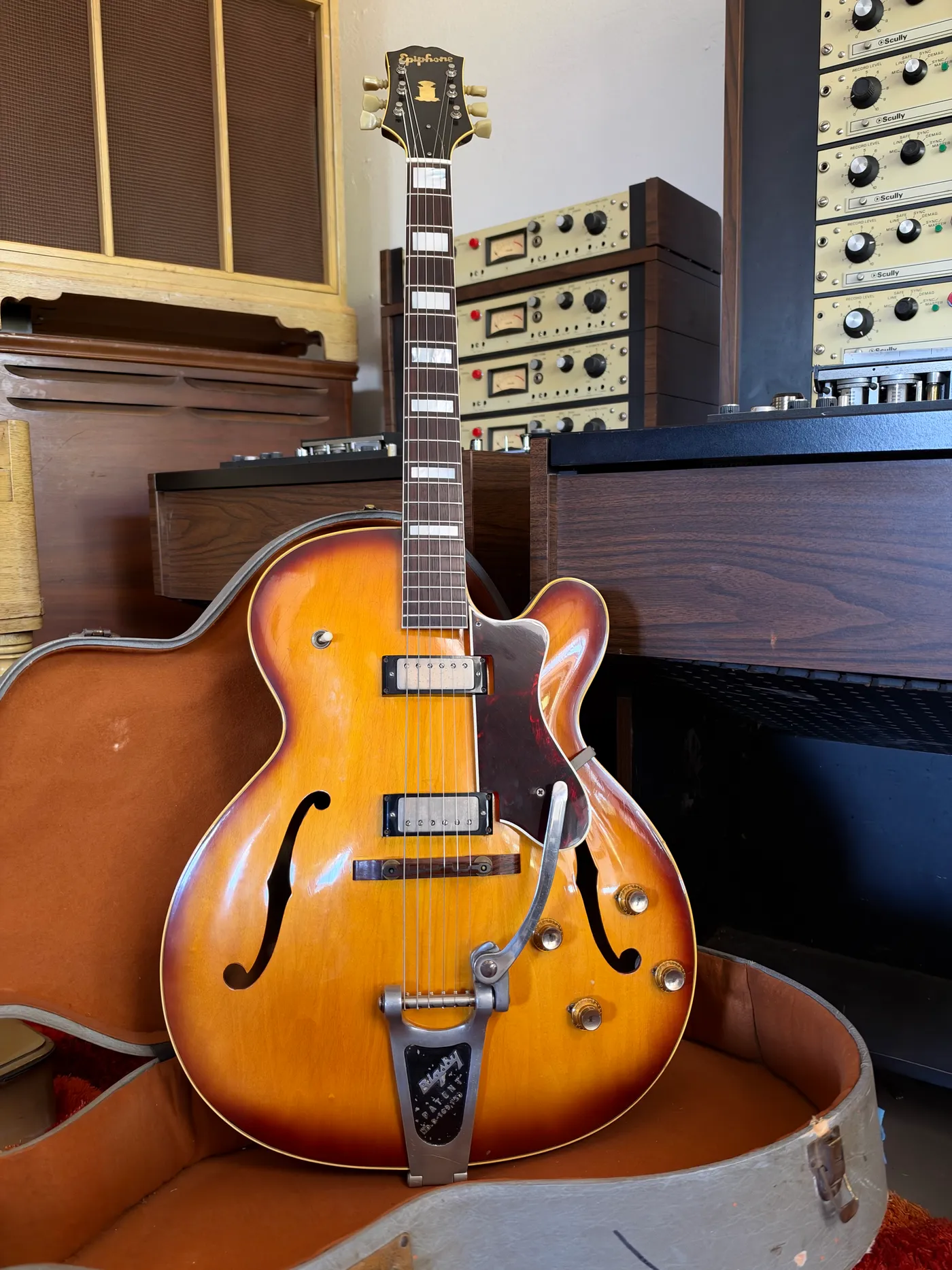
1961 Broadway With Mini-Humbuckers And Bigsby
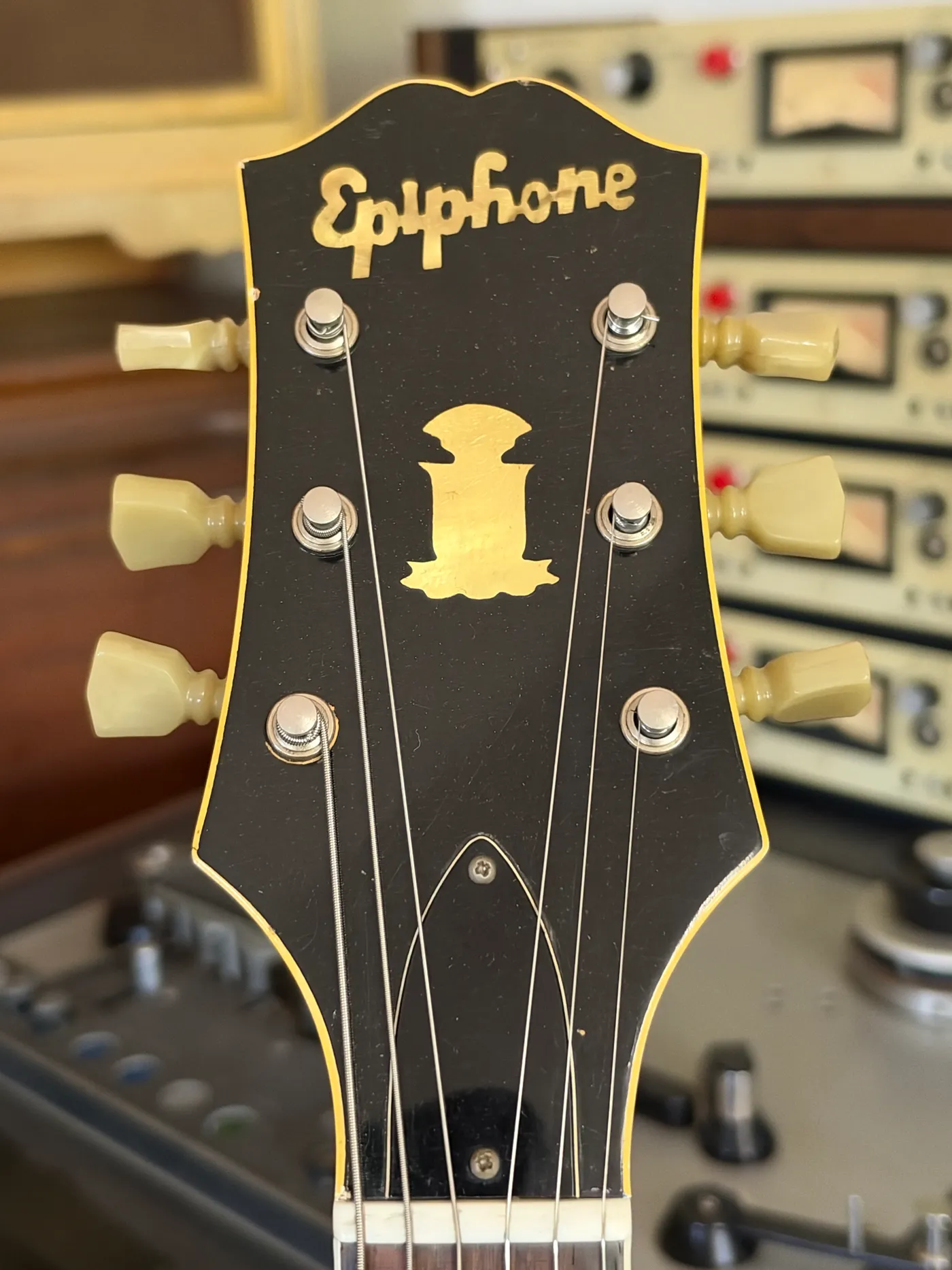
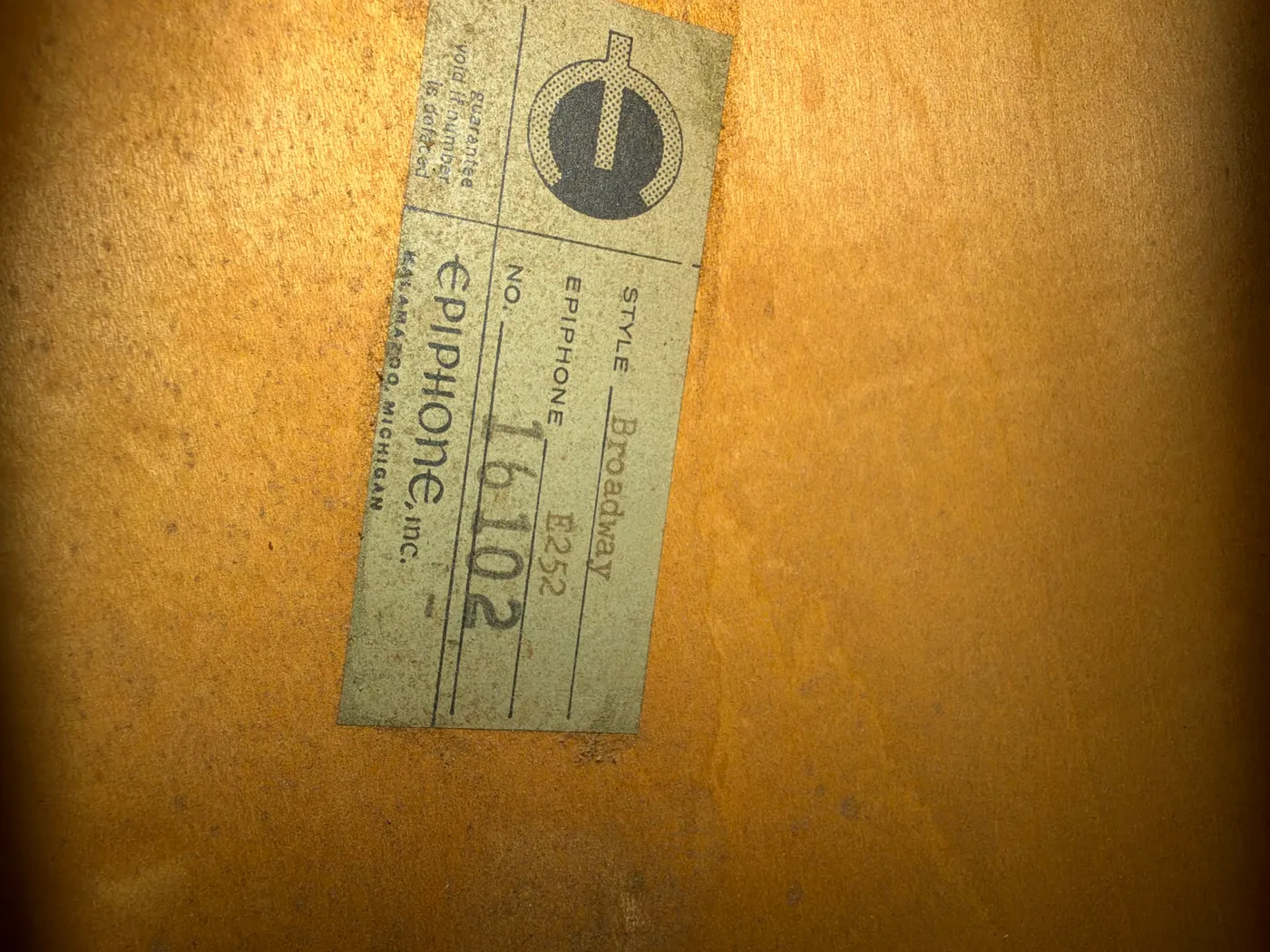
The full front shows the single-cutaway Broadway body, two mini-humbuckers, four controls, selector and Bigsby vibrato. The pickup close-up shows the cover, pole screws and mounting surround. The headstock view records the Epiphone logo, decorative inlay and six tuner positions. The internal label reads Broadway, E252 and serial 16102.
The Bigsby is the tailpiece installed on this example. Its presence in the photograph does not by itself establish when it was fitted. Keep the guitar’s hardware history with the model and serial record when evaluating originality.
Natural-Finish Electric
1964 Broadway In Natural Finish
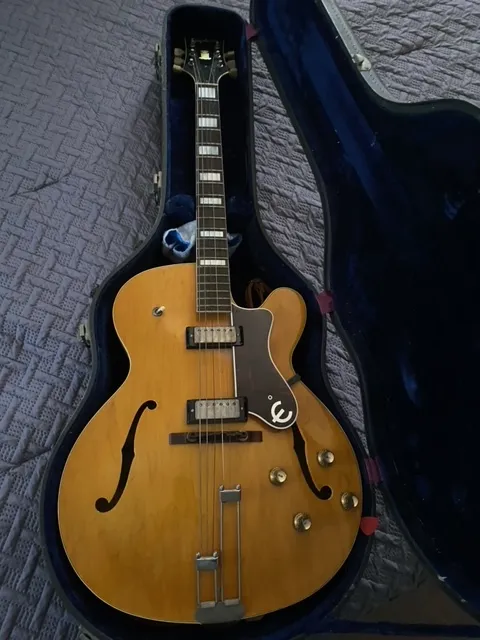
This 1964 Epiphone Broadway is shown in its case with a natural finish, single cutaway, two mini-humbuckers and Frequensator tailpiece. The full view places the neck, body and controls together. It provides a natural-finish comparison alongside the sunburst examples without treating color alone as a dating method.
Original-Owner Photograph
The Original Owner With A 1966 Broadway
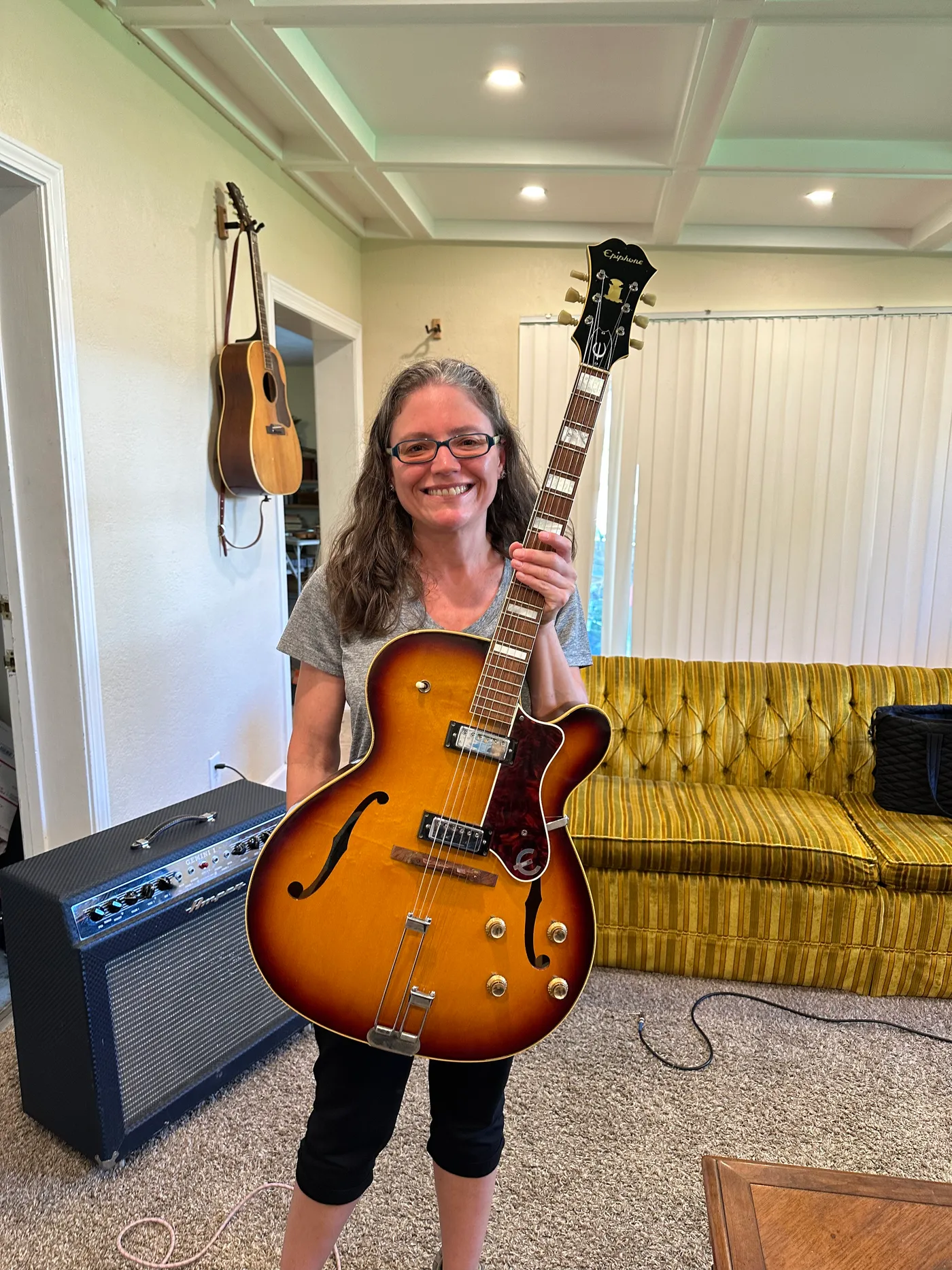
The original owner is pictured holding a 1966 Epiphone Broadway. The photograph shows the sunburst body, two mini-humbuckers, controls and Frequensator together with its ownership context. Keep an owner photograph with the guitar’s label, serial, receipts and condition records. The 1966 date identifies the guitar, not the date this photograph was taken.
Keep The Actual Models Named
Broadway And Comparison Photographs
Older Acoustic Broadway
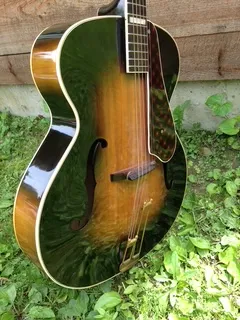
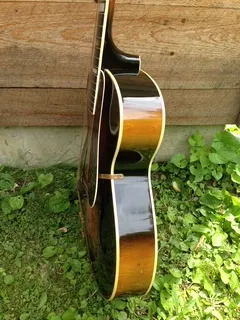
1947 Epiphone Broadway
Joe’s customer archive supplies these views of a 1947 Broadway. The non-cutaway acoustic body, block fingerboard markers, floating bridge and Frequensator are visible, with a side view showing the deep rim. The surviving files are small, so they support the overall configuration rather than close inspection of finish or repairs. No readable serial is shown, and the archive year is not presented as a decoded number.
Kalamazoo Pickup Comparison
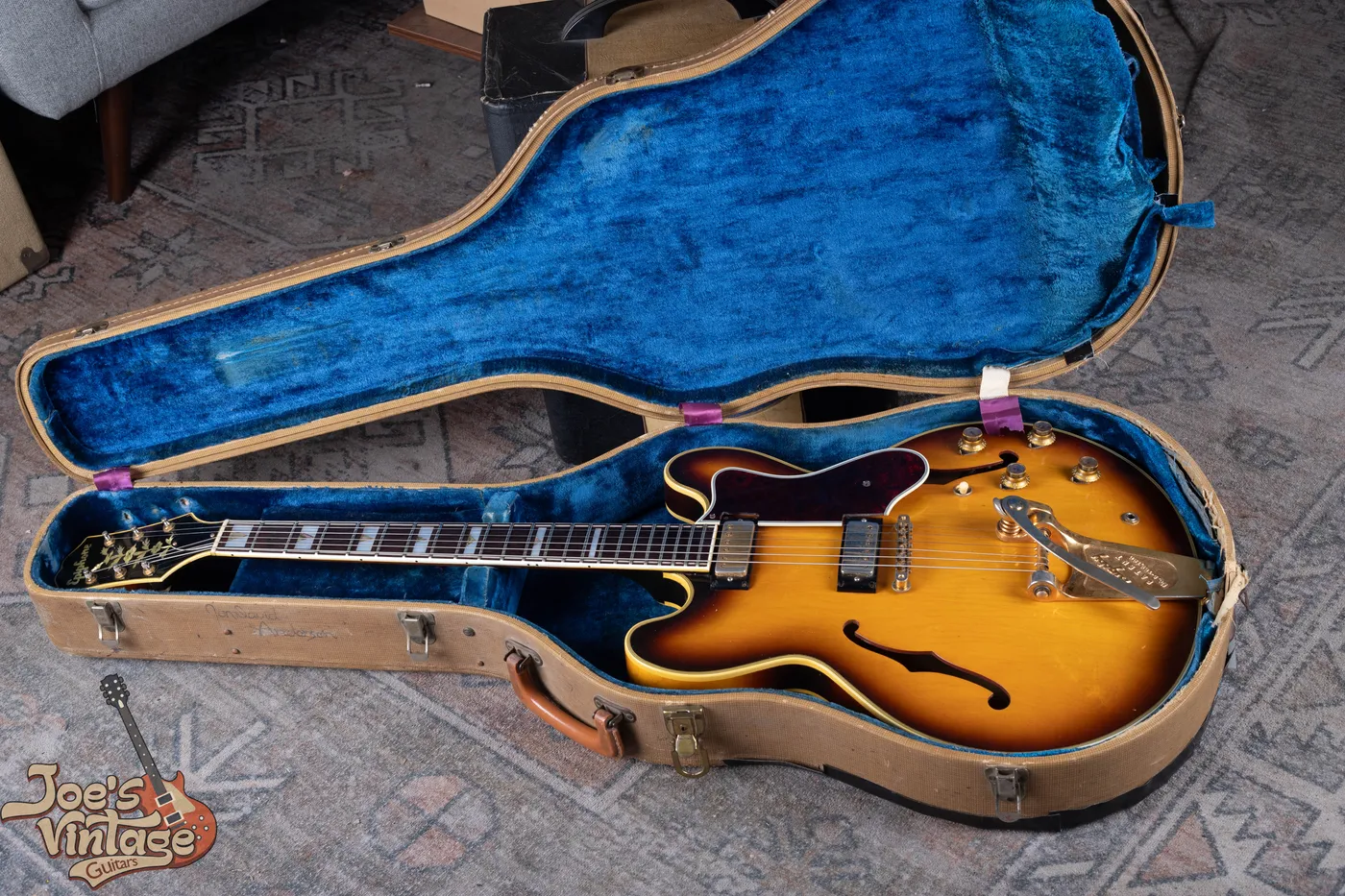
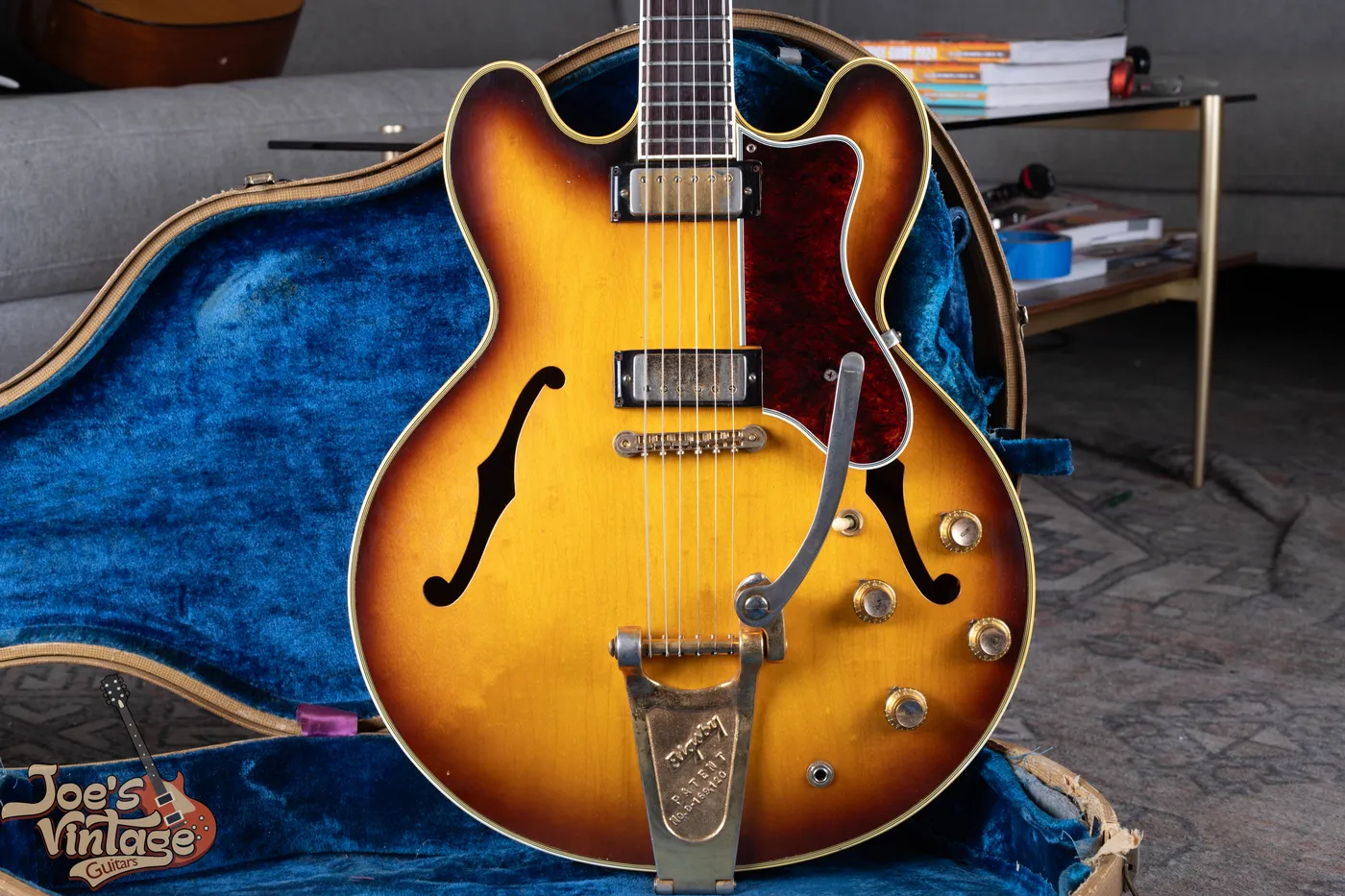
1961 Sheraton With Mini-Humbuckers
The body view shows two mini-humbuckers and a Bigsby on Joe’s Sheraton. It is useful for recognizing the visible pickup family, but its body construction, tailpiece and decorative package should not be copied into a Broadway description. The caption names the actual guitar so the comparison stays limited.
Older Acoustic Comparison
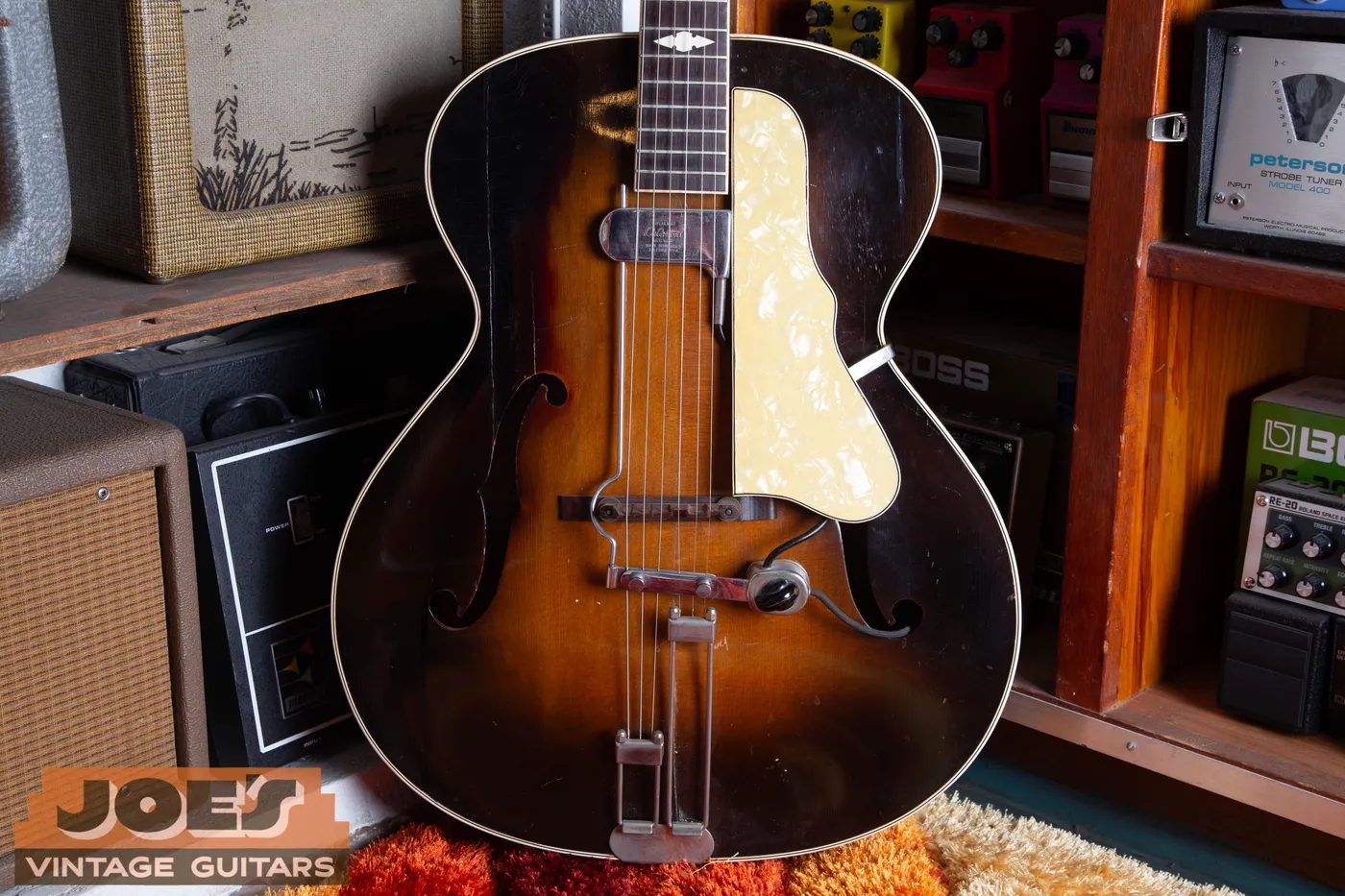
1946 Triumph With An Added DeArmond
This Triumph illustrates an older acoustic instrument carrying an electrical accessory. It is not a Broadway specimen. Its label, dimensions and trim must not be treated as Broadway evidence, but the photograph makes the distinction between an accessory and a factory electric body concrete.
Different Factories, Different References
Read Broadway Labels And Serials In Context
Early Kalamazoo hollowbodies need a separate first check: an A followed by four digits on the interior label belongs to Epiphone’s early A-series, not the similarly named Gibson A-prefix chart. Photograph the whole label and keep any factory order number separate. A model code is not a serial number. Later impressed numbers can be compared with the shared Gibson system, with the guitar’s construction used to check the result.
For a pre-Gibson Broadway, record the complete label and compare the guitar with the relevant acoustic catalog. Model-batch numbering and incomplete surviving factory records limit exact year claims. A serial estimate should be supported by body construction and appointments rather than repeated as a guaranteed completion date.
A Kalamazoo Broadway belongs in the Gibson serial-number system. Photograph both the serial area and any internal model marking. Read prefixes and faint characters carefully, but leave uncertain digits uncertain. A plausible lookup result is only one part of the identification.
Ask whether the neck, label or finish has been repaired or replaced. An altered serial area can make an exact date impossible from photographs. That does not mean the whole instrument is unidentified; a supported model and production interval can still be a useful conclusion while the missing evidence is investigated.
Confirm The E252 As A Whole
A Kalamazoo Broadway Authentication Checklist
Measure The Full-Depth Body
Record the lower-bout width and rim depth, and show the single cutaway. Separate it from a thinline Zephyr or a double-cutaway Sheraton before interpreting shared hardware.
Check Laminated Electric Construction
Use accessible edge and interior evidence to establish the body type. A deep rim does not prove a carved spruce top. Leave an uncertain construction question for hands-on inspection instead of guessing from the sunburst.
Document Both Pickups And All Controls
Show the mounting, selector and four knobs together. Note mismatched parts and known rewiring. A changed cover or guard can conceal work, so retain any technician photographs of the original openings.
Compare Neck, Tailpiece And Markings
Photograph the headstock, fingerboard, heel, bridge and Frequensator attachment. Read the serial and model evidence alongside those features, using the appropriate Gibson reference for the Kalamazoo period.
Separate Repairs From Model Identity
List repaired breaks, finish work and replaced components individually. An identifiable Broadway may still have substantial alterations. Avoid an all-original claim unless the evidence supports each part of it.
Scope And Originality
Later Broadways And Repaired American Examples
Japanese, Korean and Chinese Broadways, Elitist instruments and signature versions belong to later production programs. A familiar outline or old-style logo does not make them Kalamazoo originals. Their complete serial, country marking, label and factory paperwork should establish their actual series.
For an American Broadway, repairs should remain visible in the description even after the model is authenticated. The condition guide and Broadway value guide address the financial consequences. The identification should explain what the guitar was built as and what is known to have changed.
Send The Evidence
Have Joe Check Your Broadway Evidence
Send the full body, label, serial and pickup details for a free appraisal. Use Sell My Epiphone to discuss a purchase offer after the configuration and condition are clear.
Catalogs And House Comparisons
Broadway Research References
- Epiphone Serialization Reference
Epiphone section, page 1071: the early hollowbody A-label sequence differs from Gibson’s A-prefix series; later impressed numbers require feature checks.
- New York Epiphone Model Research
Early Broadway development, materials and acoustic family identification.
- 1954 Epiphone Catalog
Philadelphia-era acoustic Broadway construction and appointments.
- 1961 Epiphone Catalog
Kalamazoo E252 construction, dimensions, controls, hardware and finish designations.
- 1964 Epiphone Catalog, Page 2
Original full-depth Broadway illustration within the Kalamazoo electric line.
- JVG Sheraton History
House factory chronology, pickup transition and center-block comparison.
- JVG ES-5 History
Limited comparison of deep laminated electric construction and long scale; no production totals transferred.
- Epiphone Serial Research
Limits of precise pre-Gibson serial dating.
Questions AboutEpiphone Identification
Does A Kalamazoo Broadway Have A Carved Spruce Top?
Is A Broadway A Sheraton With A Deeper Body?
Did Early Kalamazoo Broadways Use New York Pickups?
Can A Refinished Broadway Still Be An Authentic American Guitar?
The Last Word
Keep The Evidence Together
Let construction establish the Broadway family, then reconcile its pickups, appointments and markings. Keep an added accessory or repair separate from the factory identity. The Broadway value guide provides the next comparison once those details agree.
Authenticity And Originality Are Assessed From The Information Provided. A Hands-On Inspection Can Change The Conclusion.