
Rickenbacker Serial Numbers
Quick Decoder Tool
Enter a serial number exactly as it appears on the jackplate (letters and numbers only, no spaces). The tool will identify the era and decode the production date.

Era Guide: Pre-1961 (Model-Specific Numbers)
Before November 1960, Rickenbacker used several separate serial schemes depending on the type of guitar. None of these are decodable by the tool above — they require pattern-matching against the formats below. Expect exceptions throughout this entire era.
Solidbody Combo Guitars — 1954 to Late 1958

The Combo 600 and 800 introduced Rickenbacker's first modern serial format, later extended to the 400, 450, and 650/850. The first one to three characters identify the model and type, a single year digit follows, and the remaining digits are a production sequence.
| Format | Model | Example | Decodes As |
|---|---|---|---|
| 4C[Y]### | Combo 400 | 4C6123 | 1956 Combo 400, seq. 123 |
| 4C[Y]####A | Combo 450 | 4C7234A | 1957 Combo 450, seq. 234 |
| 6C[Y]### | Combo 600 | 6C5456 | 1955 Combo 600, seq. 456 |
| 8C[Y]### | Combo 800 | 8C6789 | 1956 Combo 800, seq. 789 |
| 85C[Y]### | Combo 850 | 85C7001 | 1957 Combo 850, seq. 001 |
| 65C[Y]### | Combo 650 | 65C7123 | 1957 Combo 650, seq. 123 |
| C#### | 650 / dual-toaster 850 | C1234 | No date info — special cases only |
Year digit key: The single digit after the type letter codes directly to the year — 4 = 1954, 5 = 1955, 6 = 1956, 7 = 1957, 8 = 1958. This year information disappears at some point in late 1958, after which the serial simply reads as "4C" or "85C" followed by a production number with no date embedded.
Hollowbody Capri and F-Series — 1958 to October 1960
The full-scale Capris (models 330–375) and F-series launched in 1958 using a different scheme. The first character is the pickup count (2 or 3); the second is a tailpiece/options code. No date information is embedded.
| Format | Pickup Count | Tailpiece Code | Notes |
|---|---|---|---|
| 2T### | 2 | T = Trapeze | Standard non-vibrato models |
| 2V### | 2 | V = Vibrola / Accent | Vibrato-equipped models |
| 3T### | 3 | T = Trapeze | Three-pickup standard |
| 3V### | 3 | V = Vibrola / Accent | Three-pickup vibrato |
| 2R### | 2 | R = Rick-O-Sound stereo | Deluxe models only, from June 1960 |
Short-scale Capris (models 310–325) initially used the solidbody "V###" short-scale format in 1958, then switched to the pickup/tailpiece format in 1959. Basses used B[Y]### with a year digit, which also disappeared in late 1958–1959.
The JK / JL Transition — November–December 1960
In November 1960, Rickenbacker briefly previewed the system that would become permanent. Serials from this two-month window begin with JK (November 1960) or JL (December 1960), followed by a production number. J = the 10th letter = year 1960. K = 11th letter = November, L = 12th = December. If your serial starts with JK or JL and is followed only by digits, it's from this narrow window.
Era Guide: 1961–1986 (Two-Letter Code)
This is the most famous and longest-running Rickenbacker serial system. The first two characters — both letters — stamp a precise year and month on every instrument. Letters appear above the output jack hole on the jackplate; digits appear below.

From 1961 to 1965, production numbers ran 01–999 (resetting to 01 when they hit 999). From 1966 onward, the range expanded to 001–9999 and never needed to reset in a single year.
Bridge-stamped serials on 1960s Combo models: While the output jackplate is the standard serial location from 1961 onward, some lower-end solidbody models — particularly the Combo series — continued to have their serials stamped directly on the bridge plate rather than the jackplate well into the 1960s. These bridge-stamped serials follow the same two-letter year/month coding system and decode identically. If you find no serial on the jackplate of a 1960s solidbody Rick, always check the bridge before assuming it's missing.
First Letter = Year of Production
Second Letter = Month of Production
Example: A serial reading GD1234 decodes as: G = 1967, D = April → April 1967, production number 1234. This is the system in place for the peak Beatle, Byrds, and Tom Petty eras.
Era Guide: 1987–1998 (Letter + Digit)
With Z assigned to 1986 and the full alphabet exhausted, Rickenbacker redesigned the system. The letter and digit swap roles compared to the 1961–1986 scheme: the letter now indicates the month and the digit indicates the year. Two separate sub-eras use this structure, distinguished by the month letters used.
1987–1996: Month Letters A–L
The same A–L = January–December month mapping as the second-position letters above, now moved to first position. The digit following indicates the year from a base of 1987.
Example: A0001 → January 1987. L9001 → December 1996.
1997–1998: Month Letters M–Y (skipping O)
A new set of month letters was introduced to avoid confusion with the A–L block above. The letter O is skipped to avoid confusion with the digit zero. The year digit resets: 0 = 1997, 1 = 1998. This sub-era lasted only two years before the whole format was replaced.
Example: M0001 → January 1997. Y1001 → December 1998.
Era Guide: 1999–Present (Year + Week)
The current system is the most transparent Rickenbacker has ever used and should remain valid through 2098. The serial number begins with the two-digit year, followed immediately by the two-digit production week, then a production sequence number.
Format: YY + WW + [sequence]
The first two digits are the year (99 = 1999, 00 = 2000, 01 = 2001 … 26 = 2026). The next two digits are the week of the year, running 01 through 52 (occasionally 53). Any remaining digits are the production sequence for that week.
Examples: 9901001 → Week 1 of 1999. 2108001 → Week 8 of 2021. 2635001 → Week 35 of 2026.
Exceptions and Edge Cases
XX Replacement Jackplates
During the 1980s, Rickenbacker sold replacement output jackplates as service parts. To prevent these from being used on counterfeit instruments, all replacement plates were stamped with a serial number beginning with XX. Any serial starting with XX has no dating significance — it identifies only that the plate is a replacement part, not an original production jackplate.
1965 Headstock Sticker Serials
A small number of guitars produced in 1965 carried a serial number sticker on the back of the headstock beneath the clear coat, in addition to or instead of the jackplate serial. These guitars used their own distinct numbering scheme separate from the standard 1961–1986 system.
Vibrato-Equipped 425 (1965–1967)
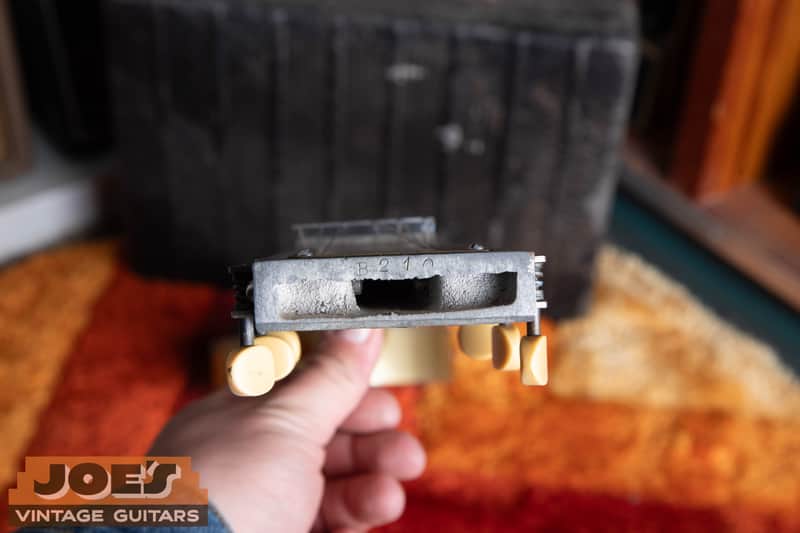
The vibrato-equipped Combo 425 built between 1965 and 1967 used a serial number that was stamped directly onto the vibrato housing — not the jackplate. This number follows its own scheme and is unrelated to the standard two-letter format in use at the time.
Pre-1961 Numbers Without Date Information
As noted above, serial numbers from late 1958 through October 1960 — on Combo, Capri, and bass instruments — provide model or configuration information but no reliable date. Dating these instruments requires the spec-based approach in Part 2 below.
A note on accuracy: The serial number date reflects when the jackplate was stamped, which is typically close to — but not always identical to — the completion date of the instrument. Factory inventory, back-order situations, and custom orders can place a guitar's actual finish date days, weeks, or in rare cases months after the plate date. The serial establishes a production window; the specs below can help narrow it further.
Advanced Dating by Specs and Features
Pickups
Rickenbacker's pickup evolution is one of the most reliable dating tools on the instrument. The three main production families — Horseshoe, Toaster, and Hi-Gain — overlap at their transitions but follow a clear overall arc.
Horseshoe Pickup — 1932 to 1971
Toaster Pickup — 1957 to 1974
The Toaster is the defining Rickenbacker sound — clear, jangly, and chimey. Its name comes from its visual resemblance to the top of a bread toaster. It appeared first on the Capri hollowbodies and spread across the line.

Hi-Gain Pickup — 1968 to Present
The Hi-Gain uses a rubberized magnet mounted beneath the pickup body rather than pole magnets — a fundamentally different topology from both the Horseshoe and Toaster. Dating Hi-Gain versions is highly precise once you know what to look for.
Mounting note: All top-mounted guitar Hi-Gains of every generation sit on foam pads, not the rubber grommets used by Toaster pickups. Finding a Hi-Gain on grommets is a reliable indicator that the pickup has been replaced or the mounting has been modified.
| Variant | Approx. Dates | Bobbin | Polepieces |
|---|---|---|---|
| Bass first-gen | Late 1968–Apr 1973 | Fiberboard, painted or unpainted | Slotted (do not adjust) |
| Guitar first-gen ("transitional") | Early 1969–Apr/May 1973 | Painted fiberboard | Threaded rod (no heads) |
| Button top | Mar/May 1973–1986ish | Painted fiberboard | Painted black button tops |
| Unpainted button top | 1986ish–Aug 1991 | Unpainted fiberboard | Unpainted black button tops |
| Dual-use plastic, no dimples | Aug 1991–Mar 2003 | Molded plastic w/ toaster slots | Unpainted button tops |
| Dual-use plastic, dimpled | Mar 2003–May 2005 | Dimpled molded plastic | Unpainted button tops |
| Current (adjustable) | May 2005–Present | Dimpled molded plastic | Adjustable button tops |
Control Knobs
Knobs are easy to swap, so always cross-check against other features before relying on knobs alone for dating. That said, original-knob guitars provide some of the clearest visual dating cues available.
Quick rule of thumb: Cooker/TV knob → pre-1964 hollowbody. Gold pickguard + cooker knob → 1958–1963. White pickguard + vintage black knob → 1964. Silver-top knob → 1964–2020ish (with labeled version narrowing to mid-1965 onward).
Tuning Machines
Rickenbacker's tuner history involves three main suppliers — Grover, Kluson, and Schaller — used at different times on different models. The transitions are model-specific and do not always happen simultaneously across the line.
Grover Sta-Tite — 1956 to 1959/1960
Open-back tuners with cloverleaf buttons — pre-war in design but reliable and affordable. Used on entry-level and some student models: Combo 400 (1956 launch), Combo 450 (1957), and all short-scale Capris (310–325) through most of 1959. Full-scale Capri prototypes briefly had them; production standardized on Klusons by end of 1958. The 450 transitioned to Klusons in early 1959; the short-scale Capris held out until the very last guitars made in 1960.
Kluson Deluxe — 1954 to 1982
The dominant Rickenbacker guitar tuner for nearly three decades. Closed-back, the first of their type when introduced in 1947. Present on Combo 600 and 800 from 1954 onward. White plastic or nickel "bean" buttons in different periods.

- Kluson 548 (very large footprint) on 4000 bass, 1957–1961
- Kluson 536 (smaller) on 4000/4001 bass from 1963
- Standard Kluson Deluxe on all non-Grover guitars 1960–1982
- Kluson closed entirely in late 1981 after the death of John Kluson, forcing Rickenbacker to find alternatives
Grover Slimline (Bass) — 1969 to 1974 and 1982 to 1983
Two-piece pressure-fit sealed back tuners with small footprint. Replaced Kluson on all 4000-series basses in May 1969. Flat cloverleaf keys from 1969 to June/July 1972; "wavy" or S-shaped keys from mid-1972 to July 1974 when Klusons returned. After Kluson's closure, returned to 4001/4003 basses in mid-to-late 1982 until Schaller BM tuners replaced them in August 1983. The "wavy Grover" on a bass is a reliable indicator for 1972–1974.
Grover Rotomatic (360 Guitar) — September 1971 to Early 1985
Sealed full-size tuners introduced on the 360 six-string in September 1971 as part of the early-1970s 360 upgrades. The Rotomatic's large bushings required a redesigned headstock — giving rise to the wider "Gumby" headstock on transitional-era 360s. The specific version Rickenbacker used was a two-piece pressure-fit unit, unlike the more common one-piece Rotomatic found on Gibson and other guitars.
- Two-piece Rotomatic: September 1971 to early 1984
- One-piece (standard) Rotomatic: early 1984 onward, when the two-piece version appears to have been discontinued
- Also fitted to the 481 and the six-string neck of the 362/12 (both from 1974)
- After Kluson's closure in 1982, all six-string guitars including those previously on Klusons received Grover Slimline guitar tuners (mid-1982)
- When Slimlines were discontinued (late 1983), all six-string guitars moved to Rotomatics through late 1984
Schaller M6 / Mini M6 — 1985 to 1996
The new "paddle headstock" introduced on all non-reissue six-string guitars in late 1984 was designed to accommodate the Schaller M6's bushings (same diameter as the Rotomatic). Schallers replaced Grovers in early 1985. Black hardware/black trim (BH/BT) guitars held onto black Rotomatic tuners until Schaller produced black M6 variants — which arrived in approximately March/April 1996, ending Grover's relationship with Rickenbacker. BH/BT non-reissue six-strings with black Rotomatics date between roughly 1985 and early 1996.
| Tuner | Instrument Type | Dates |
|---|---|---|
| Grover Sta-Tite | Combo 400, 450; short-scale Capris | 1956–1959/60 |
| Kluson Deluxe | Most guitars | 1954–1982 |
| Kluson 548 | 4000 bass | 1957–1961 |
| Kluson 536 | 4001 bass | 1963–1969 |
| Grover Slimline (flat key, bass) | 4000/4001 bass | May 1969–mid 1972 |
| Grover Slimline (wavy key, bass) | 4000/4001 bass | Mid 1972–July 1974 |
| Grover Rotomatic (2-piece) | 360 six-string, 481, 362/12 (six-string neck) | Sep 1971–early 1984 |
| Grover Slimline (guitar) | All six-string guitars (ex-Kluson models) | Mid 1982–late 1983 |
| Grover Rotomatic (1-piece) | All six-string guitars | Late 1983–early 1985 |
| Schaller Mini M6 | All non-reissue six-string guitars | Early 1985–present |
| Black Rotomatic | BH/BT guitars | 1985–early 1996 |
| Black Schaller M6 | BH/BT guitars | Early 1996–present |
| Schaller BM (Kluson-copy) | 4003 bass | Aug 1983–present |
Fingerboard Inlays
Dot Inlays — Standard Trim
All standard-trim Rickenbackers (330, 340, 420, 450, etc.) use simple dot fingerboard inlays for their entire production run. No changes affect dating.
Triangle Inlays — Deluxe Trim Models
Triangle inlays are the hallmark of Rickenbacker Deluxe models (360, 370, 460, 4001, etc.) and their evolution is a very precise dating tool. The triangle design derives from the Mittenwald School of German lutherie via Roger Rossmeisl.
Body Styles, Binding, and Construction
Thin Hollowbody (Capri) Body Styles

Soundholes
- 1958–1963: "Cat eye" or slash f-holes on most Capri models. Some early 310–325 short-scale models had no soundholes at all.
- 1964: All models standardize on cat-eye f-holes. Standard models (330 etc.) had them bound starting with the NS body; Deluxe models had their f-holes bound from the beginning.
- 1979: F-holes dropped as standard on short-scale 310/315/325 (available by special order only).
Pickguards
- 1956–1963: Gold back-painted clear Lucite / acrylic. The gold color comes from the paint on the back of a clear sheet — a hallmark of the TV knob / stove knob era.
- 1964 onward: Thick solid white plastic. The change from gold to white pickguard coincides precisely with the change from cooker knobs to black vintage knobs on hollowbodies — one of the most reliable single visual dating cues for pre/post-1964 Rickenbacker hollowbodies.
- Hollowbody models from 1958 onward use a split-level (stepped) pickguard design.
Tailpieces

Trapeze Tailpiece — 1958 to 1965
All Capri and F-series models from their 1958 introduction used a simple trapeze tailpiece (non-vibrato models) or vibrola (vibrato models). The T/V/R coding in the serial number reflects this configuration. The trapeze era ends with the introduction of the R tailpiece in 1964–1965.
Kauffman Vibrola — 1958 to ~1961
The original vibrato unit on 1958–1961 Capri models. Replaced by the Accent vibrato. The "V" in Capri-era serial numbers originally referred to this unit.
Accent Vibrato — ~1961 onward
Replaced the Kauffman as Rickenbacker's vibrato of choice on Capri and other hollowbody models. The "V" in the serial number carried over to continue indicating vibrato, now meaning the Accent.
"R" Tailpiece — October 1964 to Present
One of the most iconic pieces of hardware in guitar history — named for the stylized "R" shape (also described memorably as a "baby dinosaur"). Introduced on the October 1964 production of New Style 360/12s, then rapidly becoming standard on all non-vibrato semi-hollow models and the 4005 bass.
Distinguishing brass from zinc without removal: Measure the mounting screw spacing. Brass units: approximately 7/8" on center. Zinc units: approximately 11/16" on center. If you can remove the tailpiece, brass backs are rough-textured; zinc backs show smooth round mold marks. All 12 slots on a brass tailpiece are hand-cut and equal; zinc tailpieces have casting-integrated slots in the correct count for the model.
Control Configurations
The number and arrangement of controls changed at a few key moments and provides a useful cross-check for dating, especially on hollowbody models.
| Configuration | Models Affected | Dates |
|---|---|---|
| 2 knobs + 1 switch (solidbodies) | Combo 600, 800 (1 switch = tone/selector) | 1954–1959 |
| 4 knobs (hollowbodies) | All Capri / F-series, standard and deluxe | 1958–1962 |
| 5 knobs (hollowbodies) | 330/340 series from 1963; 360/365 from 1963 | 1963–present |
| Rick-O-Sound stereo jack | Deluxe hollowbodies (360, 370, 460, 4001) | 1960–present (optional/standard varies by model) |
Finishes
Headstock Logo and Spelling
Quick-Reference Dating Cheat Sheet
Use this summary table to quickly bracket a guitar's age from a single visible feature. Work through as many rows as possible and look for agreement.
| What You See | Likely Date Range | Notes |
|---|---|---|
| Gold Lucite pickguard | 1956–1963 | All hollowbodies. One of the clearest single dating cues. |
| Cooker / TV knobs | 1958–1963 | Hollowbodies only. Never on solidbodies in period. |
| White pickguard + black vintage knobs | 1964 | Very short-lived combination before silver tops appear. |
| Silver-top knob, no labels | Late 1964–mid 1965 | Round-top 360 era. Very collectible. |
| Silver-top knob, labeled, white top dash | Mid 1965–late 1966 | Labels appear ~July 1965; dash → dot change ~late 1966. |
| Silver-top knob, labeled, white dot on top | Late 1966–~2020 | Long-running standard version. |
| Horseshoe pickup on guitar | 1932–1957 (mostly) | 1¼" magnet = post-war. 1½" = pre-war. |
| Toaster pickup | 1957–1974 | On post-1970 guitar = early that model year or late holdout. |
| First-gen Hi-Gain (threaded polepieces, no heads) | Early 1969–1973 | Guitar only. Less hot than later Hi-Gains or Toasters. |
| Button-top Hi-Gain, painted | 1973–~1985 | The classic Hi-Gain sound. |
| Full-width crushed pearl inlays | 1961–62 or 1964–1973 | Or 2021+ (90th anniversary / 4005V limited run). |
| Inset poured pearlescent resin inlays | 1973–2007 | Cream backing = 1973–early 1974. Grey backing = 1974–2007. |
| Full-width laser-cut acrylic inlays | Jan 2008–present | Very easy to spot — crisp, precise edges. |
| Grover Sta-Tite (open back, cloverleaf) | 1956–1960 | Combos 400/450; short-scale Capris. |
| Grover Slimline, flat key (bass) | 1969–mid 1972 | Bass only in this first run. |
| Grover Slimline, wavy key (bass) | Mid 1972–July 1974 | Extremely reliable dating marker for basses. |
| Grover Rotomatic (2-piece back) | Sep 1971–early 1984 | 360 and related. "Gumby" headstock accompanies. |
| Paddle headstock (six-string) | Late 1984–present | Non-reissue only. Designed for Schaller M6 bushing size. |
| R tailpiece, brass | Oct 1964–mid 1966 | Hand-cut slots (12 per tailpiece regardless of string count). Wider screw spacing. |
| Square body edges (Capri) | 1958–mid 1964 | OS body. Rounded edges = NS body, mid-1964 onward. |
| Checkered back binding only (360 etc.) | Mid 1964–present | NS body. Top+back binding on both sides = OS pre-1964. |
| "Rickenbacher" spelling on headstock | Pre-1950 | The H spelling definitively pre-dates F.C. Hall's ownership. |
Dating strategy: Start with the serial number to establish a production month and year (for 1961+). Then run through the spec checklist above. If the specs all agree with the serial date, you have high confidence. If one or two specs suggest a different era, check for replaced parts (knobs and tuners are most commonly swapped). If the serial is missing or pre-1961, use three or more independent spec markers and look for internal agreement. No single spec is infallible — Rickenbacker frequently used old-stock parts, ran overlapping transitions, and made custom or special-order instruments that don't follow the standard timeline.
Now that you know what you have — find out what it's worth.
Joe has appraised over 10,000 instruments and buys Rickenbackers nationwide. Get a free, no-obligation valuation in under 24 hours.
Related Guides
Looking to date or value a different instrument? Joe has published comprehensive serial number and dating guides for every major American brand.


