The Ultimate Guide to the Gibson J-45, J-50, and Southern Jumbo (SJ)

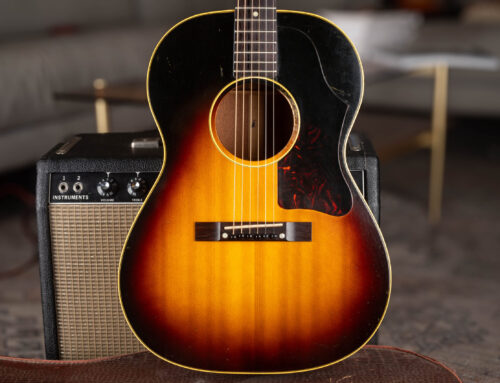
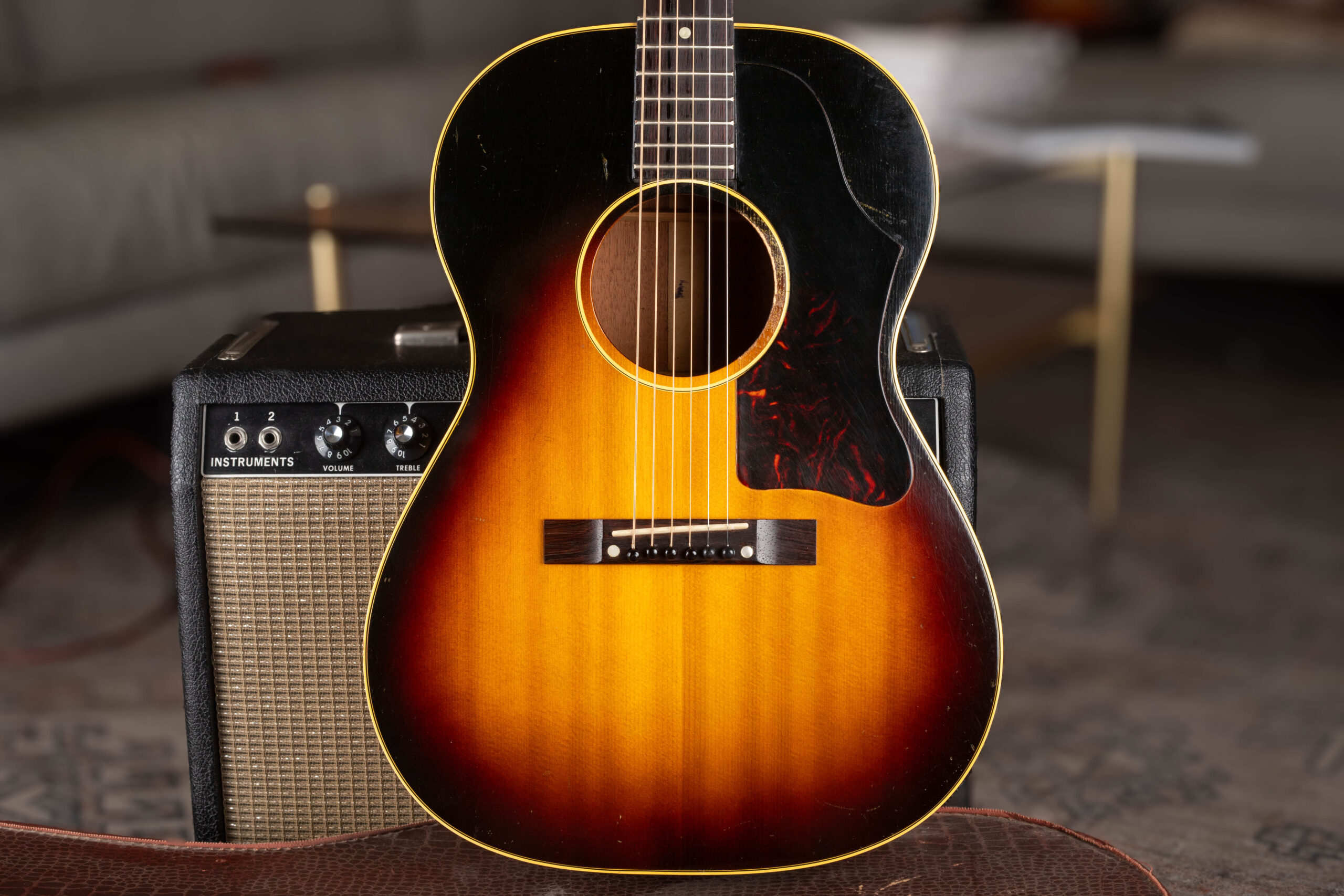
A stunning 1950s Gibson J-45 “Workhorse” featuring a classic sunburst finish, resting in its original hardshell case at Joe’s Vintage Guitars in Mesa, AZ. Identifying these unlabeled vintage acoustics requires a close look at the specific 1950s specs and Factory Order Numbers.
In the world of vintage acoustics, there is perhaps no greater “mystery” than the mid-century Gibson flat-top. At Joe’s Vintage Guitars, we’ve helped countless collectors and families identify instruments that have been sitting in cases for fifty years without a single label to identify them.
Unlike their competitors at Martin, Gibson was notoriously inconsistent with interior labels. From the 1940s through the 1960s, many of these guitars were shipped without any model designation whatsoever. To know what you have, you must become a student of the specs. This guide is designed to be the definitive resource for identifying, dating, and understanding the “Workhorse” family of Gibson guitars. If you need some expert guidance, feel free to contact us for a free appraisal. If you’d like to sell your guitar, we can make a competitive cash offer.
Part 1: How to Tell the Models Apart (The Spec Checklist)
Because the body shape (16-inch “Jumbo” lower bout) and woods (Mahogany back/sides, Spruce top) were largely the same, you have to look at the “trim” level to differentiate the models.
1. The Gibson J-45: “The Workhorse”
-
Finish: Sunburst (standard).
-
Top Binding: Single-ply (usually white or cream).
-
Fretboard: Rosewood with simple Pearl Dot inlays.
-
Logo: Usually a gold silk-screened logo.
-
The Vibe: Utilitarian, rugged, and designed for recording.
2. The Gibson J-50: The Natural Standard
-
Finish: Natural (blonde).
-
Top Binding: Usually triple-bound (starting in 1950) to give it a slightly more premium look than the J-45.
-
Fretboard: Simple dots.
-
The Logic: Gibson charged $5 more for the J-50 in the 1940s because they had to use “cosmetically perfect” spruce. A J-45 sunburst could hide grain streaks or minor knots; a J-50 had to be flawless.
- Bottom Line: The Gibson J-50 is extremely similar to the J-45, but it can be easily distinguished by its non- sunburt, natural finish.

A stunning 1952 Gibson J-50 in its original natural finish. This example perfectly illustrates the early ’50s transition, sporting the desirable small teardrop pickguard and the “belly-up” rosewood bridge.
3. The Southern Jumbo (SJ): The Southerner Deluxe
-
Fretboard: This is the dead giveaway. It features Double-Parallelogram inlays.
-
Binding: Multi-ply binding on the top and back, and almost always features a bound fingerboard.
-
Logo: A pearl-inlaid logo (often with a “Crown” or “Crest” inlay on the headstock). Gibson Script & Banner logo guitars are an exception to this.

Detailed view of the split-parallelogram mother-of-pearl inlays on a Gibson fretboard. These “deluxe” inlays are the most reliable visual indicator to differentiate a Southern Jumbo or Country Western from the more common dot-inlay J-45 and J-50 models.
4. The Country Western (SJN): The Blonde Deluxe
-
If you see the parallelogram inlays and fancy binding of an SJ, but the guitar has a Natural finish, you are looking at a Country Western (introduced in 1956).
Part 2: The Historical Timeline of Spec Changes
Understanding the evolution of the J-45, J-50, and Southern Jumbo is essential because Gibson was constantly “tweaking the recipe.” Small changes in bracing or neck shape can lead to massive differences in market value and tone. Because Gibson FONs & serial numbers are not 100% consistent, these physical specs are cucial if you want to accurately date your instrument.
The Banner Era (1942–1945)
These are the “Holy Grail” models.
-
The Logo: A gold banner reading “Only a Gibson Is Good Enough.”
-
The Neck: Due to wartime metal shortages, many lack truss rods and have massive “baseball bat” neck profiles.
-
The Bracing: Light, hand-scalloped X-bracing. This is why they sound like cannons.

The unmistakable 1944 “Banner” headstock. This gold decal—stating “Only a Gibson Is Good Enough”—is the primary identifier for the highly coveted wartime Southern Jumbo (SJ). At Joe’s Vintage Guitars, we specialize in the identification and purchase of these rare “Kalamazoo Gal” built instruments.
The Post-War Script Era (1946–1947)
-
The Banner is removed, but the “Gibson” logo is still in a cursive Script font.
-
These are often considered the best “player” vintage Gibsons because the necks got slightly slimmer while the bracing stayed light.
The Gold Logo Era (1948–1954)
-
The modern Block Logo is introduced.
-
1950: The J-50 gets its triple-bound top.
-
The Bridge: Moves from the small rectangle to the “Belly Up” shape (where the wider part is toward the soundhole).

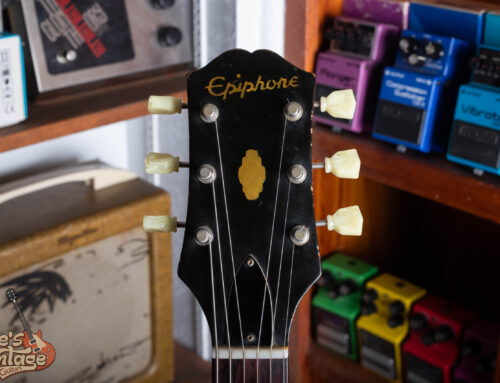
The classic gold block logo. Introduced in 1948 to replace the post-war script style, this logo is a vital “checkpoint” when we authenticate and date Golden Era Gibson acoustics.
The “Stiffening” Period (1955–1961)
-
1955: A massive turning point. Gibson moved to Non-Scalloped Bracing. The braces were left thicker to prevent warranty repairs, resulting in a “tighter,” punchier sound.
-
Pickguards: The small “teardrop” guard was replaced by the large, pointed pickguard.
-
1961: The introduction of the Adjustable Bridge. While modern players often replace these with fixed bone saddles, they are a hallmark of the 60s Gibson sound.
The Square Shoulder Transition (1962–1969)
-
1962: The J-45 changes from a dark Tobacco Sunburst to a bright Cherry Sunburst.
-
1968–1969: The end of the classic era. Gibson changed the body from “Round Shoulder” to Square Shoulder (looking more like a Martin D-18). Scale length often shifted from the short 24.75″ to the long 25.5″ scale.
Part 3: Interesting Facts & Trivia
-
The Price Tag Name: The “45” in J-45 literally stood for its 1942 retail price: $45.00.
-
The War Effort: Many of the most legendary “Banner” Gibsons were actually built by women (The “Kalamazoo Gals”) while the men were away at war.
-
The Bridge Swap: In the 60s, Gibson briefly experimented with plastic bridges screwed onto the top. If you find one of these, it’s almost always been replaced by a rosewood bridge by now—and for good reason!
-
The 20th Fret: Before 1955, these guitars had 19 frets. In 1955, Gibson added a 20th fret, which is a quick way to date a mid-50s model at a glance.
Part 4: How to Date Your Guitar
Since there are no labels, you must look for the Factory Order Number (FON). This is an ink stamp located on the wood block inside the neck joint.
-
1942–1945: Usually 3 or 4 digits, sometimes with a “letter” suffix.
-
1952–1961: Follows a letter-code system (e.g., “Z” is 1948, “X” is 1950, “S” is 1955).
- 1961-1970s: Gibson switched to a serial number stamped into the back of the headstock.
For a deep dive into the specific codes and to see where your serial number falls, visit our Gibson Guitar Dating Guide.
Why We Love These Guitars
At Joe’s Vintage Guitars, we specialize in high-value vintage acoustics. These round-shoulder Gibsons are the “gold standard” for recording because their mahogany warmth doesn’t “crowd” a microphone the way a rosewood guitar might. If you have a vintage Gibson and aren’t sure of the model or year, give us a call. We love talking shop and helping owners understand the history of their instruments. We’re always looking to add vintage Gibson dreadnoughts to our collection! Contact us today to sell your Gibson!

Joe’s Vintage Guitars
47 N Fraser Dr E
Mesa, AZ 85203
Phone: (602) 900-6635
Email: joesvintageguitars94@gmail.com

Written by Joe Dampt
“Driven by a love for classic tunes, I specialize in buying, selling, and appraising vintage guitars, bringing music and history together.”