
Collector’s Guide to the Gretsch 6120: History, Specs, and Value
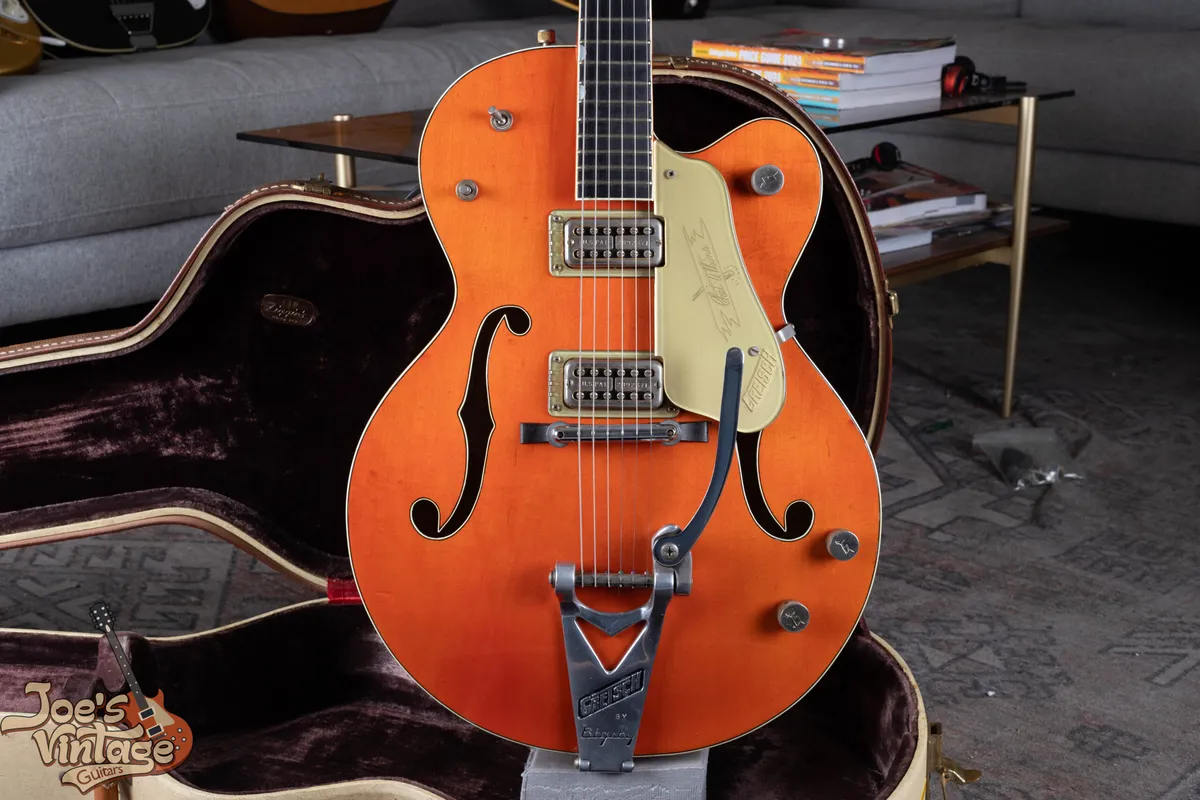
The 1960 model year was an important refinement for the 6120, featuring the slimmed-down 2.5-inch body and the introduction of the zero fret. Instruments in this ‘Collector Grade’ condition are in strong demand in the vintage market right now.
Few instruments are as tied to the ‘Golden Era’ of rock ‘n’ roll as the Gretsch 6120. From its ‘Western Orange’ finish to its ‘Filter’Tron’ twang, the 6120 is a high-value piece of American history. At Joe’s Vintage Guitars, we are currently looking to add original 1950s and 60s 6120s to our collection. If you have an instrument you’re considering selling, we provide expert Gretsch guitar appraisals and offer top-dollar payouts for well-preserved examples. If you’re a collector or have recently inherited one, knowing its specific history is what tells you its real market value.
Year-by-Year Evolution & Specifications
The “Golden Era” of the 6120 (1954 to 1961) is defined by rapid changes in aesthetics and internal construction. Identifying these shifts is the first step in determining a guitar’s market value.
1954 to 1956: The “Full Western” Era
These are the most visually distinct 6120s. They were designed to appeal to the “Cowboy” market.
-
Body: 16″ wide, 2.75″ deep single-cutaway hollow body.
-
Inlays: “Western” motif featuring engraved cows and cacti.
-
The “G” Brand: A large “G” branded into the top wood (lower bout).
-
Headstock: Large “horseshoe” or steer-head inlay.
-
Pickups: DeArmond Dynasonic single-coils (clear, punchy, and loud).
-
Market Value: $14,000-$18,000+ (depending on condition and “G” brand clarity).
1957: The Transition Year
Gretsch began stripping away the “Cowboy” aesthetic. The “G” brand disappeared, and the inlays changed.
-
Inlays: Transitioned to “Hump-block” inlays (plain white/pearloid).
-
Pickups: Still Dynasonics, but often with newer “Bar” bridges.
-
Market Value: $10,000 to $16,000.
1958 to 1959: The “Trestle Bracing” Peak
Many players, including Brian Setzer, consider these the greatest 6120s ever built.
-
Pickups: Introduction of the Filter’Tron humbucker (invented by Ray Butts). Look for “Patent Applied For” (PAF) on the covers.
-
Internal Bracing: The introduction of Trestle Bracing, heavy wooden supports that reduced feedback and added sustain.
-
Inlays: “Neo-Classical” or “Thumbprint” inlays on the side of the fretboard.
-
Market Value: $9,000 to $16,000. (1959 is the “Holy Grail” year for players).
1960 to 1961: The Thinner Body
Gretsch began slimming down the 6120 to compete with Gibson’s ES-335.
-
Depth: Reduced from 2.75″ to 2.5″ (1960) and eventually 2.25″ (1961).
-
Zero Fret: A permanent fret added next to the nut to improve intonation.
-
Market Value: $6,000 to $10,500.
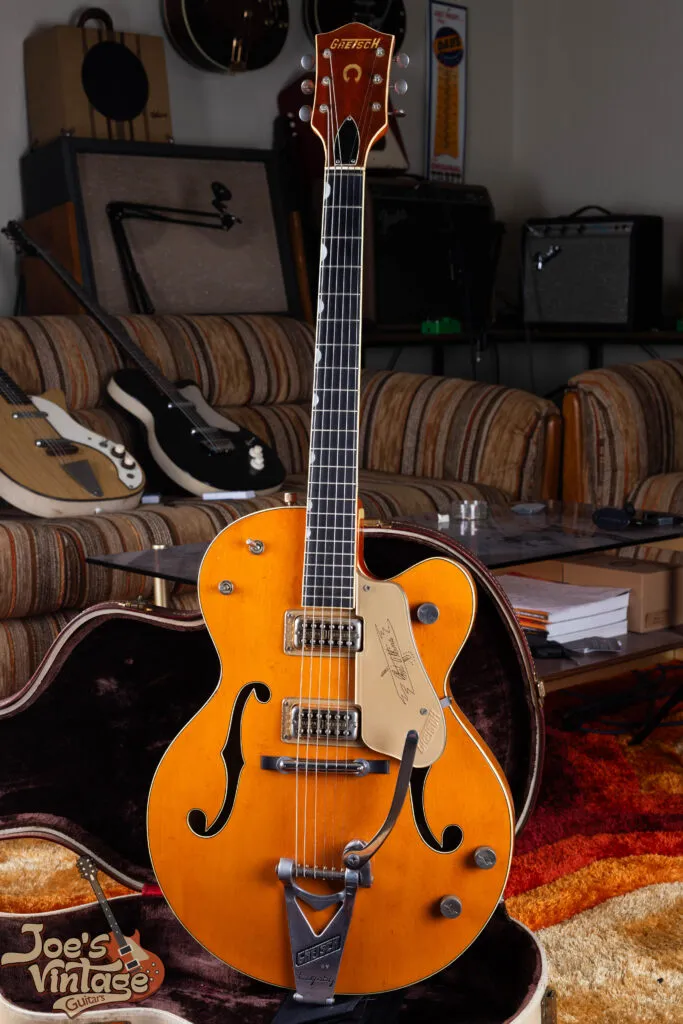
The 1961 model year is in strong demand as the last full year of the classic single-cutaway design. When evaluating your 1961 6120, we look for original ‘V-cutout’ Bigsby tailpieces and the presence of the original ‘standby’ switch, which are good indicators of a high-value collector’s piece.
1962: The Double Cutaway (The “Nashville”)
A radical redesign that split the collector market.
-
Body: Transition to a double-cutaway shape.
-
F-Holes: Many 1962 models have painted-on (simulated) F-holes to further reduce feedback.
-
Market Value: $4,000 to $7,500.
The “Red Flags”: Originality and Condition Checks
When selling a high-value vintage Gretsch, condition is everything. Here are the three biggest issues that can affect your payout:
1. “Binding Rot” (The Celluloid Disease)
Vintage Gretsch binding was made of a specific celluloid that off-gasses over time. This causes the binding to turn yellow, crack, and eventually crumble like old cheese.
-
Check: Look for “sugaring” (a crystalline look) on the edges. Total binding replacement is a $1,000+ repair and can reduce the guitar’s value.
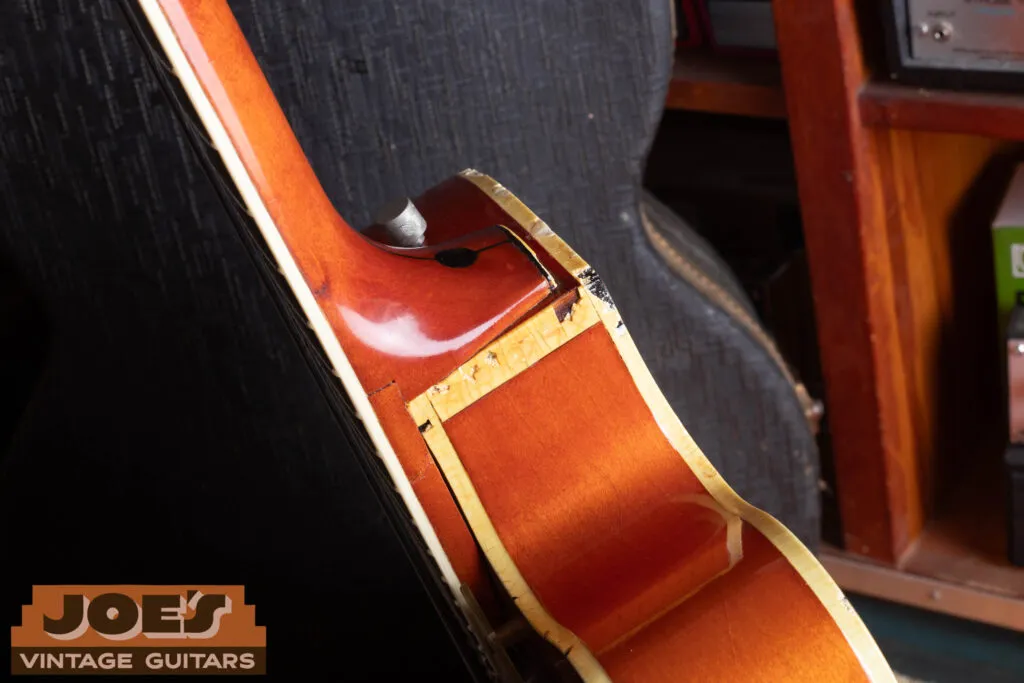
Binding rot (celluloid degradation) is a common issue on ‘Golden Era’ Gretsch models. While it can look devastating, it doesn’t mean your guitar has lost all its value. We specialize in evaluating ‘project’ vintage instruments and offering fair market prices despite condition issues.
2. The Neck Angle & The “Heel Screw”
Gretsch used a wooden dowel and a hidden screw in the neck joint. Over decades, the glue can fail, causing the neck to pull forward.
- Check: Look at the bridge. Is it bottomed out? If the action is high and the bridge can’t go any lower, you need a neck reset.
3. Originality of Electronics
Collectors want the original wiring harness.
- Originality Check: If the pots have been replaced with modern parts, the value drops. Look for “bumblebee” or “tiger” capacitors and original grey-sheathed wiring.
How to Date Your Gretsch 6120
Before 1966, Gretsch used sequential serial numbers. You can usually find the number:
-
On the orange label inside the F-hole.
-
Stamped into the top edge of the headstock (on early 50s or 60s models).
-
13000 to 16000: 1955
-
22000 to 25000: 1957
-
30000 to 34000: 1959
-
43000 to 48000: 1961
For more information on dating a Gretsch guitar, check out our Gretsch Serial Number Page. You can also check out the Serial Number Guide on the Gretsch website.
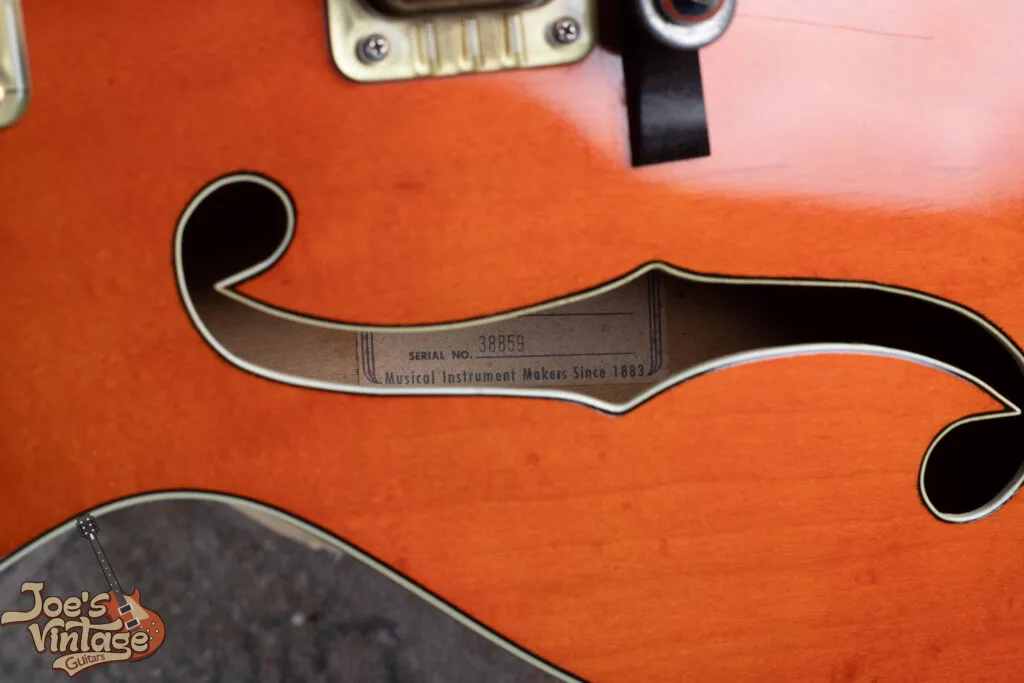
The 1960 orange label is the ‘birth certificate’ of your 6120. For this year, look for a serial number in the 34000 to 39000 range. At Joe’s, we use these original markings to cross-reference production batches and provide you with an accurate, high-value appraisal for your instrument.
Thinking of Selling?
The vintage market is currently very strong for all-original, single-cutaway 6120s. At Joe’s Vintage Guitars, we help owners identify these specific nuances to ensure they aren’t leaving money on the table. If you have a Gretsch and aren’t sure of the year or the “originality status,” a professional appraisal is the only way to protect your investment. While self-evaluating your guitar using the Blue Book or a similar guide may be useful, there is no replacement for an expert appraisal. Contact us today to appraise or sell your Gretsch guitar.