
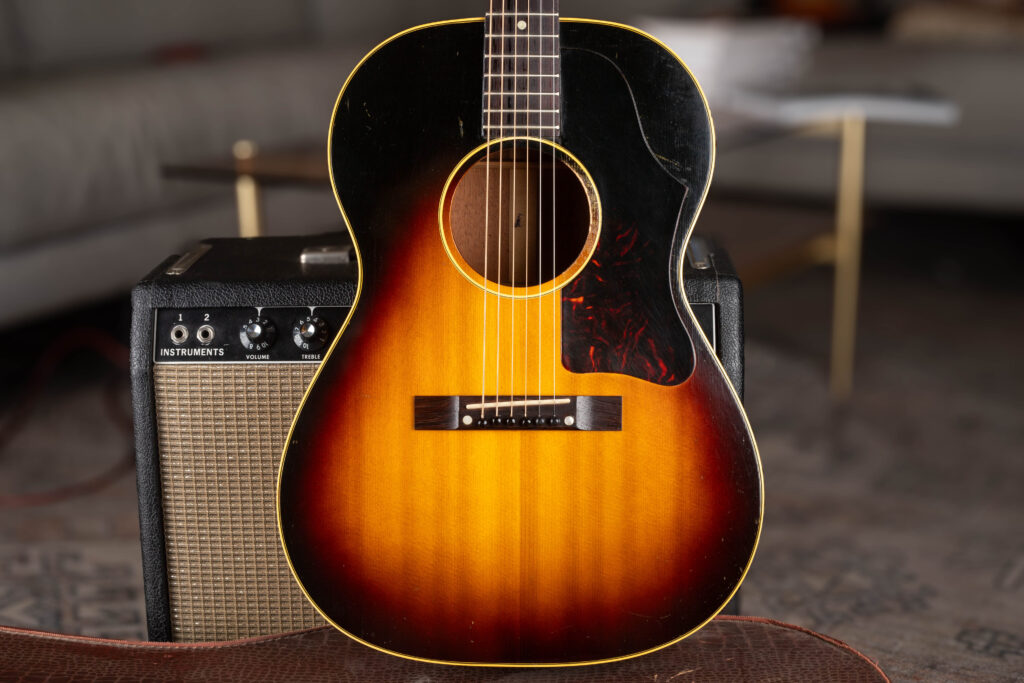
A prime example of a late 1950s Gibson LG-2. This model features the transition-era large pointed pickguard while retaining the highly desirable small rectangular bridge and X-braced construction.
In the world of vintage acoustics, the Gibson LG series is the ultimate “sleeper” guitar. While the J-45 gets the glory for its stadium-filling volume, the LG models—the LG-0, LG-1, LG-2, and LG-3—are the secrets of the studio. Their 14 1/8″ body size makes them comfortable, balanced, and incredibly articulate.
At Joe’s Vintage Guitars, we see many collectors and heirs who are unsure exactly which model they have. Understanding the nuances between these models is crucial—not just for your playing, but for understanding the true market value of your instrument. Feel free to contact us at any time for a free appraisal or to sell your guitar.
Every LG model shares the Grand Concert body shape (roughly 14 1/4″ wide) and a 24.75” scale length, but the “voice” of each is defined by its tonewoods and architecture.
The LG-2 is the undisputed king of the series.
Specifications: Solid Sitka spruce top, mahogany back and sides, and X-bracing. Features 19 frets (pre-1955) or 20 frets (post-1955), and a rosewood fingerboard with dot inlays.
Tone: It delivers a punchy, balanced, and surprisingly loud response. It has that classic “Gibson Thump” and deep sustain. It is the most versatile guitar in the lineup, capable of handling heavy strumming or light fingerstyle.
Collector’s Note: Early models feature a small “teardrop” pickguard, while post-1955 models moved to the larger “pointed” guard.
The LG-3 is the natural-finish twin of the LG-2.
Specifications: Shared specs with the LG-2, but with a high-grade Natural spruce top. These were often built with “premium” spruce because a natural finish doesn’t hide grain imperfections.
Tone: Characteristically identical to the LG-2, but often described as having a slightly “sweeter” or “brighter” top end due to the specific selection of the spruce.
Rarity: Gibson produced significantly fewer LG-3s than LG-2s, making them highly sought-after.
A beautiful example of a 1950s Gibson LG-3. Unlike the sunburst LG-2, the LG-3 features a natural spruce top, but retains the highly desirable X-bracing that collectors look for.
Introduced in 1943, the LG-1 is the most common model found today, but it’s often misidentified as an LG-2.
Specifications: Solid spruce top, mahogany body, Ladder Bracing.
Tone: Because of the ladder bracing, the sound is percussive, mid-range heavy, and “boxy.” It lacks the long sustain of an X-braced guitar but has a “woody” honesty and a percussive “snap” that sits perfectly in a blues or folk mix.
Visual ID: Usually features a Sunburst finish and a simple single-ply binding.
A 1960s Gibson LG-1. Note that it is identical in appearance to an LG-2. The only distinguishing factors are the bracing and back strap.
Launched in 1958, the LG-0 was Gibson’s most affordable flat-top.
Specifications: All-mahogany construction (top, back, and sides) with ladder bracing and a satin finish.
Tone: Extremely warm, dark, and naturally compressed. It is “dry” and “woody,” lacking the high-end sparkle of spruce but offering a beautiful, mellow resonance.
Critical Detail: Avoid or plan to upgrade the 1962–1966 models with the injection-molded plastic bridge. These bridges were bolted on with four screws and are notorious for warping the top and stifling the sound. Replacing these with a rosewood bridge is a “must-do” for any serious player.
If you want to know the true value of your Gibson LG, you have to look “under the hood.”
Simply take a small flashlight and a handheld mirror (or your phone’s front-facing camera) and look inside the soundhole toward the bridge.
X-Bracing (LG-2/LG-3): You will see two main wooden struts crossing to form a large “X” directly behind the soundhole. This design allows the top to move more freely, creating the complex harmonics and sustain valued by professionals.
Ladder Bracing (LG-0/LG-1): You will see parallel wooden bars running horizontally across the width of the guitar’s lower bout. This makes the top stiffer, resulting in the percussive, “fundamental” tone associated with early blues records.
The “feel” of an LG changes drastically by era:
1942–1945 (Banner Era): Massive “baseball bat” necks, often with a wide 1 3/4″ or 1 7/8″ nut width. Many of these lack truss rods due to wartime metal shortages but are incredibly stable.
1947–1959: Transitioned to a comfortable 1 11/16″ nut with a full, rounded “C” profile.
1965–1968: The nut width narrowed to a slim 1 5/8″. If you have a narrow-nut Gibson, it is generally valued lower than the wider “pre-65” versions because it can feel “cramped” for fingerstyle players.
Rectangle Bridge (Pre-1961): Solid rosewood with a bone saddle. This is the gold standard for tone transfer.
Belly-Up Bridge (1960s): Gibson introduced the “reverse belly” bridge.
Adjustable Saddle (1961–1970s): Gibson added a ceramic or rosewood adjustable saddle system. While this allows for quick action adjustments, the extra hardware often creates a slightly “thinner” sound compared to a fixed bone saddle.
A close-up look at the classic “belly up” rosewood bridge found on later Gibson LG-1 models. When evaluating these, we check for lifting, bridge plate wear, and original saddle height to ensure maximum playability and value.
Logo: 1942–1946 features the Script Logo; 1948 onward features the Block Logo. The “Banner” decal only appeared during WWII (1942–1945).
Tuners: Early models used open-back Kluson tuners with cream buttons. By the 50s, these transitioned to “single line” or “double line” Kluson Deluxe enclosed tuners.
When you’re peering into the soundhole of a vintage Gibson LG, one of the most reliable ways to separate the professional models from the student models is to look at the interior back center seam.
In the vintage guitar world, we call the vertical piece of wood running down the middle of the back a “Back Strap” or “Center Strip.” This small detail is a major indicator of the guitar’s original “tier” and build quality.
The LG-2 (Sunburst) and LG-3 (Natural) were Gibson’s flagship small-body guitars. Because these were designed as “professional” instruments, Gibson took the extra step of reinforcing the two-piece mahogany back.
The Detail: You will find a vertical spruce reinforcement strip glued over the center seam inside the guitar.
Why it Matters: This strip prevents the two halves of the back from separating or “zippering” open due to dry weather or age. It is a hallmark of the higher-end X-braced models.
The LG-0 (all mahogany) and LG-1 (ladder-braced spruce top) were designed to be affordable for students. To keep labor costs down and production moving fast, Gibson skipped the interior back strip.
The Detail: If you look inside, you will see a smooth mahogany back with a visible glue line where the two pieces meet, but no wooden reinforcement strip covering it.
Guru Tip: If you find an LG-1 with a back strip, you might have a rare “transitional” model or a guitar that had a back replaced at the factory. However, 99% of the time, the presence of that strip is your green light that you’re looking at a high-value LG-2 or LG-3.
The presence of a back strip—the decorative or structural center seam on the back of the guitar—is a key indicator for many collectors. While common on the X-braced LG-2 and LG-3, its absence on other models can help us date and identify the instrument correctly.
The Gibson LG series was produced for decades, but the value between models varies significantly based on how the guitar was built. The most critical factor for collectors is the internal bracing—specifically the difference between ladder bracing and X-bracing. While student-level models like the LG-0 are great players, X-braced models like the LG-2 and LG-3 are highly sought after by vintage enthusiasts. Use the identification chart below to determine which Gibson LG model you have.
| Model | Top Wood | Bracing Style | Finish | Collector Value |
|---|---|---|---|---|
| LG-0 | All Mahogany | Ladder Braced | Natural (Brown) | Student Grade |
| LG-1 | Spruce | Ladder Braced | Sunburst | Entry-Level |
| LG-2 | Spruce | X-Braced | Sunburst | High (Priority Buy) |
| LG-3 | Spruce | X-Braced | Natural | High (Rare) |
*Swipe left/right on mobile to view full chart.
Identifying the exact year of an LG is often the biggest hurdle for a seller. Because these guitars were produced during several era-defining shifts in Gibson’s production, you might find a traditional serial number, a Factory Order Number (FON), or in some cases, both.
If you have an older LG-2 or LG-1, the number you see stamped on the inside (usually on the neck block) isn’t actually a serial number—it’s a Factory Order Number.
During the 1940s and 50s, Gibson used these to track batches of instruments moving through the factory.
Banner Era (1942–1945): These often feature a four-digit number followed by a letter (like “7412 H”). These are critical for identifying the high-value “Wartime” builds.
Letter Prefixes (1952–1961): In the 1950s, Gibson used a letter at the start of the code to denote the year. For example, a code starting with “V” is from 1956, while “U” is from 1957.
In 1961, Gibson moved to a more standardized, 6-digit serial number system usually found stamped into the back of the headstock. However, be careful—Gibson famously reused these numbers throughout the 1960s, making the physical specs (like the bridge style and nut width we discussed above) just as important as the number itself for a proper valuation.
Inside the Soundhole: Peer toward the neck block. You may need a flashlight to see the faded ink stamp.
Back of the Headstock: Look for impressed digits at the very top.
The Bridge: While not a “number,” the bridge style often acts as a timestamp for the era.
If you have found a number on your instrument and want to confirm its age, you can use our comprehensive Gibson Serial Number Lookup Guide to narrow down the exact year of production.
The Gibson LG-2 and LG-3 are the most valuable models in the series. Because they feature high-quality X-bracing (similar to a J-45), they are highly sought after by collectors and players. Early 1940s “Banner” models typically command the highest prices at Joe’s Vintage Guitars.
The primary difference is the internal bracing. The LG-1 is ladder-braced, resulting in a punchy, “boxy” blues tone. The LG-2 is X-braced, offering a richer, more resonant sound with better sustain. Visually, they look identical from the outside, often both featuring a sunburst finish.
The easiest way is to look inside the soundhole with a small mirror or your phone camera. If the wooden braces cross each other in an “X” shape near the soundhole, it is X-braced (LG-2/LG-3). If the braces run straight across the width of the guitar like rungs on a ladder, it is ladder-braced (LG-0/LG-1).
Identifying a 1944 Banner LG-2 vs. a 1964 B-25 (the model that replaced the LG-2) requires an expert eye. Small differences in bracing, bridge material, and nut width can mean a difference of thousands of dollars in valuation.
At Joe’s Vintage Guitars, we specialize in these nuances. If you have a vintage LG-series guitar and are looking for a transparent, expert evaluation, we are here to help you get the maximum value for your piece of music history. If you’d like to sell your Gibson, we are prepared to make a competitive cash offer today! We are a premium vintage guitar shop in Arizona, but we buy nationwide using an easy and risk-free process.
Joe’s Vintage Guitars
47 N Fraser Dr E
Mesa, AZ 85203
Phone: (602) 900-6635
Email: joesvintageguitars94@gmail.com
Written by Joe Dampt
“Driven by a love for classic tunes, I specialize in buying, selling, and appraising vintage guitars, bringing music and history together.”
Deciphering Guild serial numbers is part science, part history lesson, and—if we’re being honest—occasionally a…
Ever wondered why your vintage Gibson acoustic doesn't have a model name inside? You aren't…
The Epiphone Crestwood stands as a testament to the "Golden Era" of electric guitar design.…
Since its debut, the Gibson ES-175 has been the quintessential jazz box. From its signature…
Thinking of selling a vintage Gretsch 6120? This comprehensive guide covers everything from 1954-1962 specifications…
Ready to sell your vintage guitar? Avoid mistakes, get top price, and ensure a smooth,…


