The Hardtail Stratocaster: Why This Underrated Vintage Fender is a Tone Monster
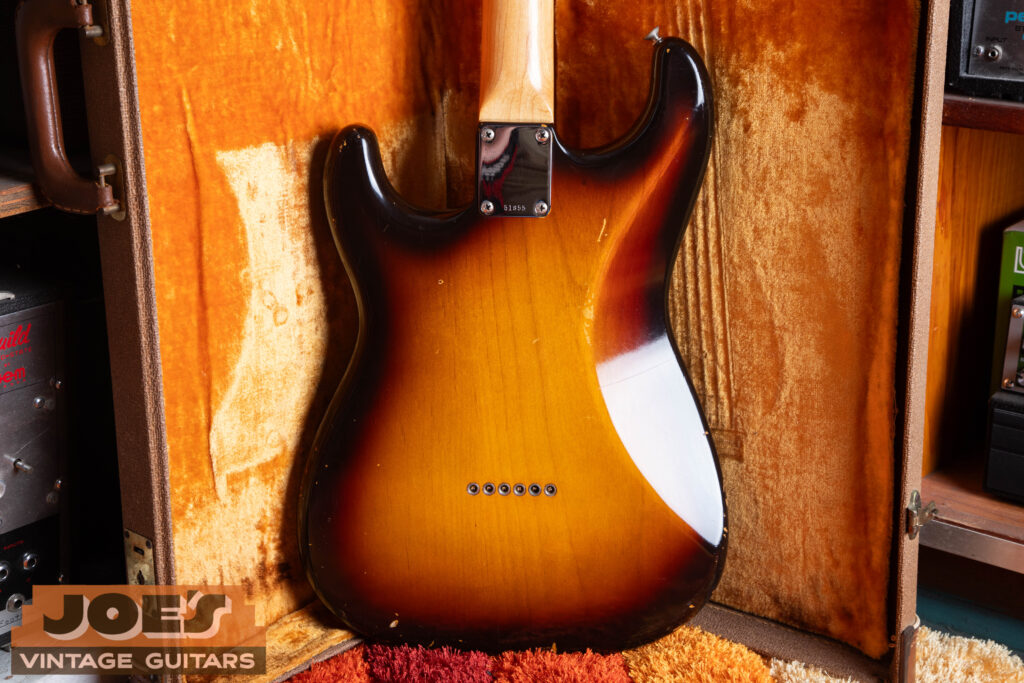
The “clean” look of a hardtail: Notice the solid wood back and the six chrome string-through-body ferrules. Because there is no large tremolo cavity routed out, the body retains more mass, contributing to the “Telecaster-on-steroids” punch and resonance I love in these instruments.
The Fender Stratocaster is almost synonymous with the synchronized tremolo bridge. For many, that’s the “soul” of the guitar. But there is a leaner, meaner version of the Strat that has been quietly winning over players for decades: the Hardtail.
At Joe’s Vintage Guitars, we often see these come through the shop, and they always spark a great conversation. If you’ve never spent significant time with a hardtail, you might be missing out on one of Fender’s best-kept secrets. If you have a Fender and you’re wondering what it’s worth, feel free to reach out for a free appraisal.
What is a Hardtail Stratocaster?
A hardtail Stratocaster lacks the routed-out tremolo cavity and the spring-tensioned bridge found on standard models. Instead, the strings go through the body—much like a Telecaster—and the bridge is screwed directly into the solid wood of the body.
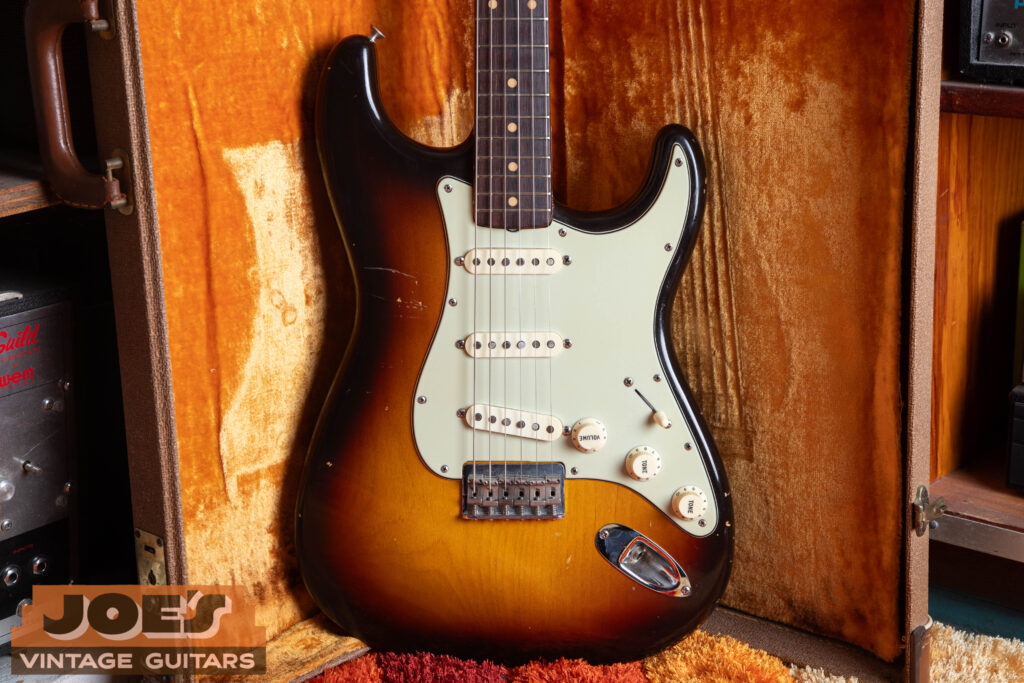
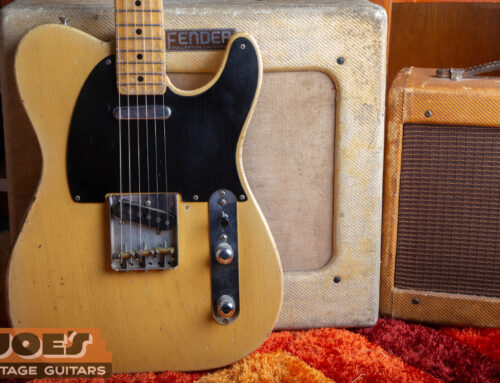
Look closely at the chrome bridge plate on this 1960 Stratocaster: you’ll notice there is no hole for a tremolo arm. Unlike a “blocked” or “decked” tremolo, a true factory hardtail features a solid bridge plate screwed directly into the body, providing the superior resonance and tuning stability that makes these rare pre-CBS models so special.
The “In-Between” Vibe: Strat meets Tele
I personally have a huge soft spot for these guitars. To me, a hardtail Stratocaster sits right in the sweet spot between a traditional Strat and a Telecaster. You get the ergonomic contours and the versatile three-pickup “quack” of a Strat, but you gain the punchy, immediate attack and tuning stability of a Tele.
It’s often described as a “Telecaster on steroids.” You keep the comfortable belly cut and forearm contour that make a Strat so easy to play for three hours straight, but the note delivery is much more “honest.” There is no tremolo bridge “floating” on a knife-edge to soak up your pick attack. Instead, the energy goes straight into the wood.
Fender Hardtail vs. Tremolo: What are the differences in tone?
The most striking difference is the resonance. If you’ve ever played a Strat unplugged, you know that “zingy” acoustic quality it has. On a tremolo model, a large part of that comes from the cavity in the back.
-
Tremolo Strats: Think of the tremolo springs as a sort of primitive reverb tank. They add a natural mechanical reverb and a slight compression to the sound. When you dig in, the bridge “gives” just a tiny bit, softening the initial transient. This is part of that classic “glassy” Strat sound.
-
Hardtail Strats: Because the bridge is coupled directly to the body with screws and the strings pass through the wood (ferrules), you get more sustain and a much more percussive “snap.” The low end is usually tighter and more defined. You lose that “springy” ghost-reverb, but you gain a woody, fundamental tone that cuts through a mix with much more authority. The overall vibration of the wood is more apparent against your ribs while you play; you can literally feel the low E-string resonating through the entire chassis of the guitar.
Lightweight and Reliable
One of the most practical reasons to love a hardtail is the weight. Because a hardtail isn’t missing a giant chunk of wood for the tremolo route and doesn’t require a heavy steel or brass inertia block, they are typically significantly lighter than their tremolo-equipped siblings.
In the vintage world, where 1970s Strats can sometimes lean into the “boat anchor” weight category, a hardtail version is often the saving grace that keeps the guitar under 8 pounds. For players who do long sets or have back issues, that pound of difference is a lifesaver.
Beyond weight, the reliability is unmatched. If you break a string on a floating tremolo, the tension shift causes every other string to go sharp, effectively ending your song. On a hardtail, the rest of the guitar stays perfectly in tune. It’s a “set it and forget it” instrument that handles aggressive blues bending and heavy-handed rhythm playing without breaking a sweat.
The “Sustain” Factor
In a traditional Strat, the string vibration has to travel through the saddle, into the bridge block, and is then partially dissipated by the tension of the springs. In a hardtail, the bridge plate is screwed flat against the finish (or the wood). This creates a much more efficient transfer of energy. When you hit a big open chord on a ’50s or ’60s hardtail, the decay is much slower and more melodic. It has a “singing” quality that many tremolo players find surprising the first time they plug one in.
The Years of Production
The transition from the 1950s into the 1960s saw the Stratocaster evolve significantly, and the hardtail models followed suit. While they remained a staple of the Fender catalog, they were produced in much smaller numbers than their tremolo-equipped counterparts. If you need help dating your stratocaster, please visit our Fender serial number guide.
1954–1964: The Pre-CBS Era
During these early years, hardtails were a consistent option, but they were far from the “standard.” Early 1954 to mid-1956 models typically featured ash bodies, while most guitars produced after 1956 shifted to alder. Similarly, neck profiles moved from the chunky “D” and “V” shapes of the mid-50s to the slimmer “C” profiles of the early 60s.
While Fender didn’t keep perfectly granular production logs for every single unit, historians and collectors generally estimate that hardtails accounted for only about 5% to 10% of total Stratocaster production during the 1950s and 60s.
Because the tremolo was the Strat’s “killer feature,” the vast majority of store orders were for the synchronized bridge. This makes finding a clean, original pre-CBS hardtail a real challenge today—they were rare then, and they are even rarer now.
The 1970s: The Hardtail’s “Golden Era”
Interestingly, the hardtail saw a surge in popularity during the 1970s. During this decade, the production percentage jumped significantly, sometimes estimated to be as high as 15% to 20% of total output in certain years.
Many players in the 70s were looking for more sustain and better tuning stability to handle the heavier rock styles of the time. This was also the era of the “three-bolt” neck and the “large headstock,” which gave these hardtails a very distinct look and feel compared to the early versions.
The Decline in the 1980s
By the time the 1980s rolled around, the hardtail Stratocaster almost vanished from the main production line. The rise of Eddie Van Halen and the “Super Strat” meant that if you didn’t have a tremolo—and preferably a locking one like a Floyd Rose—you weren’t playing the “right” guitar for the era’s music. The hardtail became a “special order” or “Signature Series” item (like the Robert Cray model), making those original vintage examples even more prized by those of us who appreciate that specific hardtail resonance.
Why Weren’t They More Popular?
The “Gadget” Gap
In 1954, the tremolo was high-tech. If you were paying top dollar for a Fender—which was a significant investment at the time—most players felt they were leaving value on the table by opting for the hardtail. It was often viewed through a “base model” lens, much like buying a car without the optional high-performance engine. Because the hardtail lacked the futuristic chrome bridge and the internal spring cavity, it visually and functionally felt “lesser” to the average consumer, despite being a professional-grade instrument with incredible tuning stability.
The Power of the “Guitar Hero”
Perhaps the biggest hurdle for the hardtail was the lack of visibility on the world’s biggest stages. The most iconic “Strat Moments” in history almost exclusively featured the tremolo version:
-
Buddy Holly: One of the first to bring the Strat into the mainstream, his 1955 and 1958 models were both tremolo-equipped.
-
Hank Marvin: The lead guitarist for The Shadows made the “whammy bar” a signature part of the British guitar sound, influencing everyone from Jeff Beck to David Gilmour.
-
Jimi Hendrix: Hendrix turned the tremolo from a subtle vibrato tool into a weapon of sonic destruction. His dive bombs at Woodstock cemented the image of the Stratocaster as a guitar that needed that bridge to express itself fully.
-
Eric Clapton & Stevie Ray Vaughan: While they had very different styles, both relied on the traditional tremolo setup (even if Clapton eventually “blocked” his, the guitar was still a tremolo model at its core).
When kids went into music stores in the 60s and 70s, they wanted to look like their heroes. Since those heroes were using the tremolo to create sounds that were impossible on a Telecaster or a Les Paul, the hardtail became a niche choice for a very specific type of player—usually those who prized the “Tele-on-steroids” punch and lighter weight over the “shimmer” of the springs.
Famous Hardtail Players
Several legendary players preferred the reliability and “thump” of the hardtail:
-
Nile Rodgers: His famous “Hitmaker” is a 1960 hardtail Strat. That crisp, percussive funk sound is the definition of hardtail tone.
-
Robert Cray: Known for his incredibly clean, stinging blues tone, Cray has long championed the hardtail for its purity.
-
Billy Gibbons: The ZZ Top frontman has been known to use hardtails for their unique resonance.
-
Kenny Wayne Shepherd: While he uses both, he has a signature model specifically in a hardtail configuration.
Sell Your Vintage Hardtail Stratocaster
If you own a vintage Fender and have been considering selling, we are always looking to add high-quality hardtail Stratocasters to our inventory. Whether it’s a rare 1950s ash-body model or a resonant player from the 1970s, we offer fair, expert evaluations and a seamless selling process.
Click here to contact us to get a free appraisal or to chat about your instrument.

Joe’s Vintage Guitars
47 N Fraser Dr E
Mesa, AZ 85203
Phone: (602) 900-6635
Email: joesvintageguitars94@gmail.com
Written by Joe Dampt
“Driven by a love for classic tunes, I specialize in buying, selling, and appraising vintage guitars, bringing music and history together.”