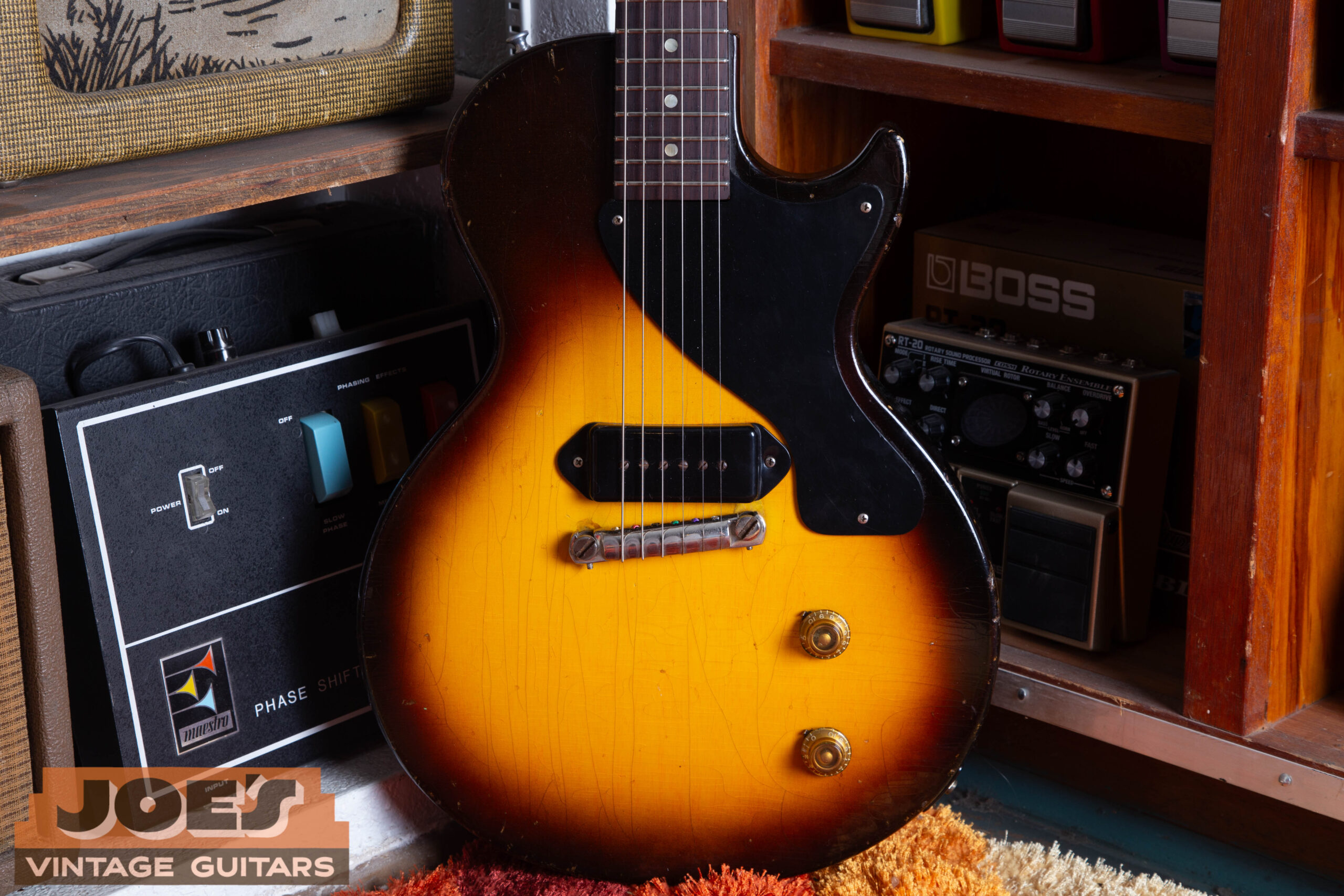
Few guitars in history have traveled a stranger road than the Gibson Les Paul Junior. Born in 1954 as a deliberately modest, cost-reduced alternative to Gibson's flagship models, it was marketed squarely at students and beginners who couldn't afford the real thing. No binding. No carved top. No neck pickup. No frills whatsoever.
And yet, within two decades, the Junior had been adopted by some of the most uncompromising players in rock history — and today it sits near the top of nearly every serious vintage guitar collector's wish list.
The story of the Les Paul Junior between 1954 and 1962 is the story of Gibson responding to market pressures, manufacturing realities, and changing tastes — sometimes elegantly, sometimes awkwardly — while inadvertently creating three distinct instruments that each have their own passionate advocates. The single-cutaway slab of 1954, the double-cutaway redesign of 1958, and the proto-SG body of 1961 are all called "Les Paul Junior," but they are meaningfully different guitars that reward careful study.
This guide is intended to be the most thorough free resource available on the subject. Whether you are trying to authenticate a potential purchase, understand how a specific year will sound and feel, research the investment merits of a particular era, or simply deepen your knowledge of one of the great American electric guitars, you will find what you need here.
To understand why the Les Paul Junior exists, you have to understand Gibson's competitive position in 1954. The Korean War had just ended, the American economy was beginning its post-war expansion, and a generation of young people was discovering the electric guitar through radio, early television, and the first tremors of rock and roll. Guitar sales were climbing rapidly, and Gibson's problem was that its least expensive solidbody electric — the Les Paul Goldtop — retailed for $225, which was a significant sum at a time when the federal minimum wage was 75 cents per hour.
Fender, by contrast, was selling the Telecaster at a lower price point and had just introduced the Stratocaster. Gibson needed a solidbody entry-level instrument it could put in the hands of first-time buyers and music school students. The answer was the Les Paul Junior, introduced in mid-1954 at a list price of $99.50 — less than half the cost of the Goldtop.
The Junior was not the only new model Gibson introduced to fill out the lower end of the line. The Les Paul TV (introduced in 1955) and the Les Paul Special (also 1955) joined it almost immediately, creating a tiered lineup that gave teachers, school programs, and budget-conscious players options at several price points. Understanding this commercial context explains many of the Junior's design choices: every specification that was simplified or omitted relative to the standard models was a deliberate cost-reduction decision.
The very earliest Les Paul Juniors, produced in the first months of 1954, are among the most interesting and least well-documented instruments in Gibson's history. Production records from this period are incomplete, and the guitars themselves show considerable variation that suggests Gibson was still finalizing specifications well into the production run.
The most significant and hotly debated feature of the very earliest 1954 Juniors is the body material. While the guitar's reputation rests entirely on its all-mahogany construction, a small number of instruments from early 1954 are believed to have been built with two-piece maple bodies. These guitars are exceptionally rare, and because maple and mahogany can look similar under old opaque finishes, positive identification typically requires inspection under the pickguard or in the control cavity where raw wood is exposed. Maple-bodied 1954 Juniors produce a noticeably brighter, harder-edged tone than their mahogany counterparts and are prized by collectors as much for their historical significance as their sonic character.
By mid-1954, Gibson had standardized on solid mahogany for the body — typically two pieces joined at the centerline, though single-piece bodies exist. The body is a slab design: flat on both top and back, with no carved maple cap and no binding. The mahogany used in this early period was generally high-grade Honduras mahogany (Swietenia macrophylla), a dense, tight-grained wood that contributes substantially to the guitar's warm, thick fundamental tone.
The body thickness is approximately 1¾ inches, consistent throughout the single-cutaway era. The single cutaway on the treble side allowed comfortable access to approximately the 14th fret, with the neck heel making anything above the 16th fret essentially unreachable.
The neck is one-piece mahogany, set into the body with a glued-in joint — Gibson's standard construction that contributes to the warm, sustained tone characteristic of all Les Paul models. The scale length is officially listed as 24¾ inches, though the actual playable string length on most examples measures closer to 24-9/16 inches due to the wraparound bridge's intonation position.
The neck profile on 1954 Juniors is substantial — what collectors often describe as a "baseball bat" or full C-shape — with significant depth both front-to-back and side-to-side. Players accustomed to modern slim-taper necks will find these necks challenging at first, but many ultimately prefer the feel once they adjust, citing improved grip stability and reduced hand fatigue during sustained playing.
The inlays on 1954 models — particularly early production — are a crucial authentication point. The very earliest examples use genuine mother-of-pearl (MOP) dot inlays with a distinctive iridescence and depth that plastic cannot replicate. Under magnification, you can see the natural layered structure of the shell material. Gibson transitioned to plastic dots sometime during 1955, making genuine pearl inlays a reliable marker of early-to-mid 1954 production.
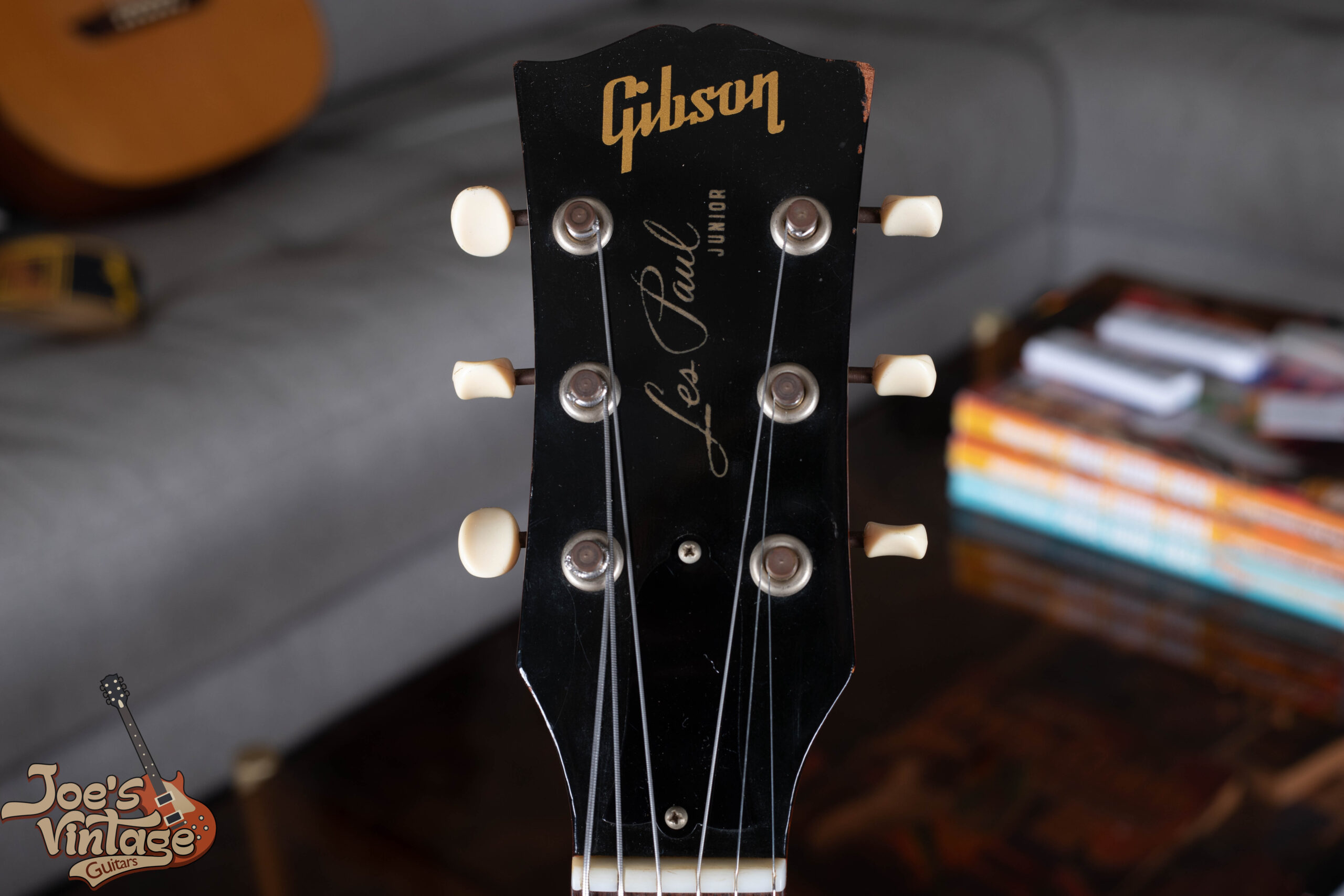
The headstock is the standard Gibson three-and-three layout, unbound, with a black painted face. The "Gibson" script logo and "Les Paul Junior" model designation are silk-screened in gold ink — not inlaid in pearl as on the more expensive models. Tuning machines are Kluson "strip" tuners — a single metal strip mounting three tuners per side with stamped metal housings and oval plastic buttons. Authentic Kluson strip tuners have brass shafts; reproductions or replacements often use pot metal that looks similar but feels different under hand.
The single pickup is a P-90 in the "dog ear" mounting configuration — so named because the pickup's side-mounted ears extend outward, resembling a dog's floppy ears. The dog ear configuration allowed the pickup to be mounted directly to the body without routing a separate mounting ring cavity, simplifying production. The plastic cover of the dog ear P-90 is slightly larger than the soapbar version used on the Special and Goldtop.
On 1954 models, the pickup is positioned extremely close to the bridge — closer than in any subsequent year. This was almost certainly a deliberate tonal choice to add brightness and cut to the naturally warm mahogany body. The magnets in the earliest examples are generally Alnico 3, which has a lower magnetic strength than Alnico 5 and produces a slightly softer, warmer attack. DC resistance on original 1954 P-90s typically measures between 7.5K and 8.5K ohms.
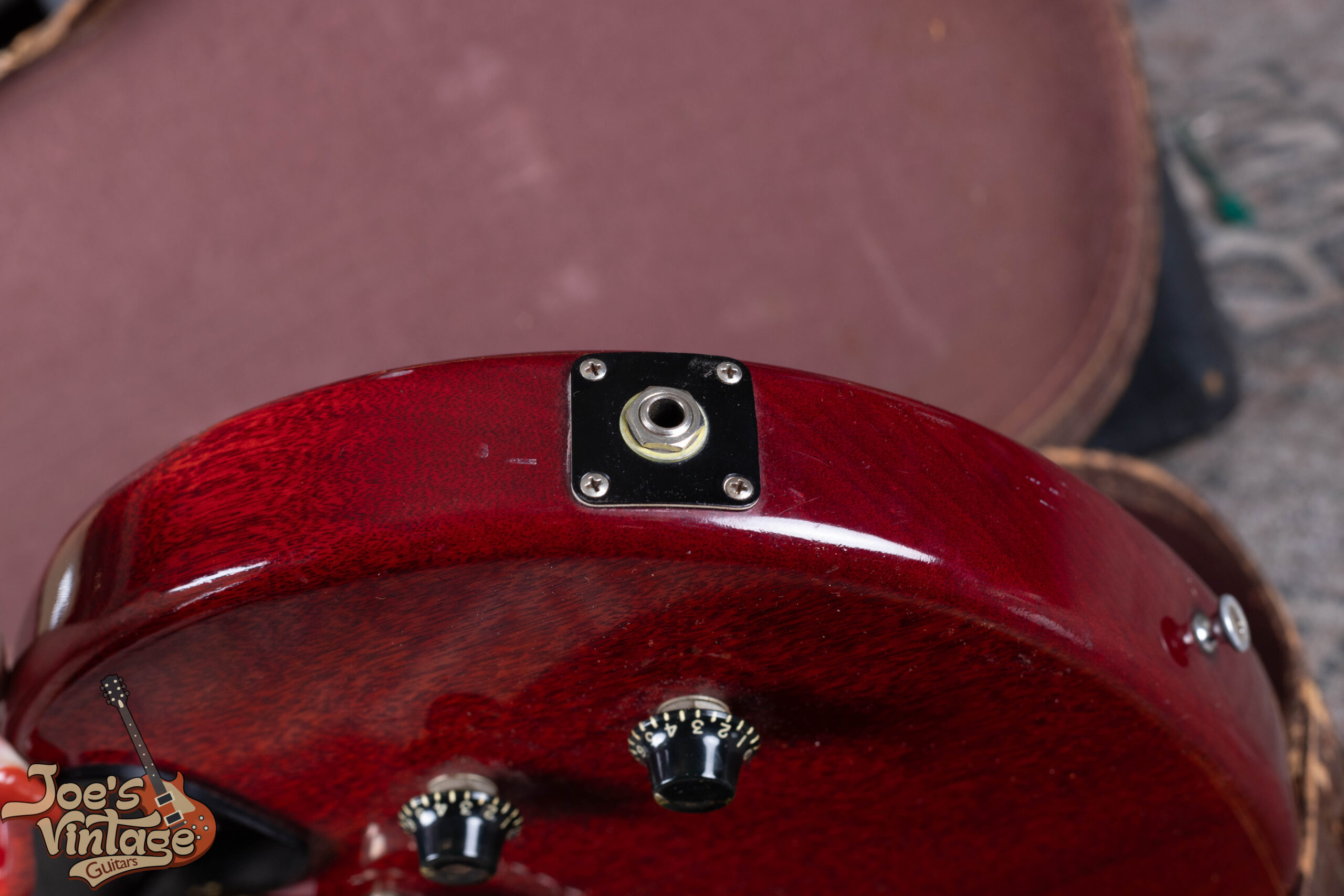
Controls are minimal by design: a single master volume and master tone, both using 500K audio-taper potentiometers with "speed" or "hatbox" style knobs. The tone capacitor is a "Grey Tiger" waxed-paper unit — an important authentication marker for this period. The bridge/tailpiece is a nickel-plated pot-metal wraparound combining both functions in a single piece, providing good sustain through direct coupling of string energy to the body.
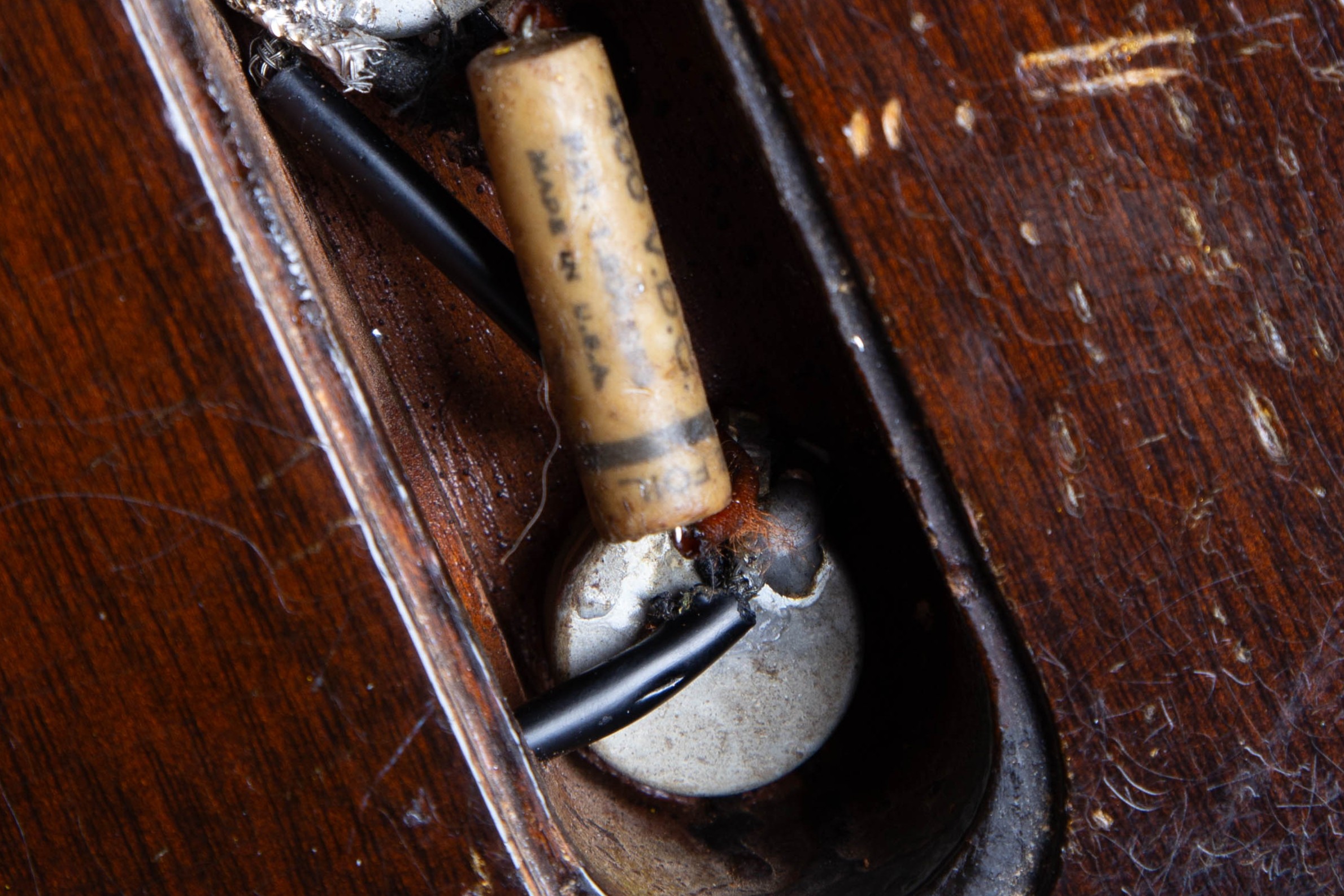
If a guitar purporting to be a 1954 or early 1955 Junior has bonnet-style knobs (taller, barrel-shaped), either the knobs have been replaced or the instrument is a later model. Speed/hatbox knobs are correct for all of 1954 and the first part of 1955. The change to bonnet knobs happened in 1956.
The standard 1954 finish is a two-tone sunburst in nitrocellulose lacquer. The center of the body is a warm amber-yellow that transitions to darker brown-to-black edges. The very earliest examples sometimes show a finish closer to Gibson's "Cremona" sunburst — a deeper, richer burst pattern borrowed from the company's acoustic guitar tradition. By mid-1954 the finish had standardized into the classic Junior sunburst: intense yellow center with translucent edges that allow the mahogany grain to show through.
Sometime in 1955, Gibson switched the fingerboard inlays from genuine mother-of-pearl to white plastic dots — a straightforward cost-reduction measure. Under bright light, original pearl inlays exhibit a range of colors (pinks, greens, blues), while plastic dots appear a flat, uniform white. This distinction is visible to the naked eye under good lighting and is one of the most reliable quick-check authentication tools for dating an early Junior.
One of the most significant developments of 1955 was the introduction of the Les Paul TV model — essentially a Les Paul Junior with a different finish. The TV finish was officially called "limed mahogany" by Gibson, but the name "TV Yellow" has stuck in the collector community. The finish is a pale, slightly greenish yellow — not a true yellow but more of an off-white with warmth. The story, probably apocryphal but persistently repeated, is that the finish was developed to appear as a clean, neutral white on black-and-white television broadcasts of the time.
TV Yellow Juniors were produced in significantly lower numbers than sunburst models throughout the entire production run, making them more collectible across all eras. Over decades, TV Yellow finishes age to a wide range of colors depending on UV exposure — some examples have yellowed to a deeper amber, others faded to nearly white. Refinished examples are common and require careful authentication. Understanding how this finish ages authentically is essential before purchase.
Two notable changes occurred in 1956. First, the P-90 pickup was repositioned slightly away from the bridge — perhaps a few millimeters — but with a perceptible effect on tone. Moving the pickup away from the bridge reduces emphasis on upper harmonics and increases the fundamental tone, giving 1956-and-later Juniors a slightly warmer, less metallic quality compared to the extreme-bridge-position 1954 examples.
Second, the knobs changed from the earlier "speed" style to the "bonnet" style — a taller, more barrel-shaped knob with a wider grip area. These bonnet knobs were used from 1956 through the end of the original Les Paul Junior production run and into the SG era.
Also in 1956, Gibson switched from the Grey Tiger waxed-paper capacitors to "bumblebee" capacitors — so named for their distinctive yellow-and-black banded appearance. Original bumblebee caps are sought after by collectors both for authentication purposes and because some players genuinely prefer their tonal character, particularly in the way they affect the tone control's sweep across its range.
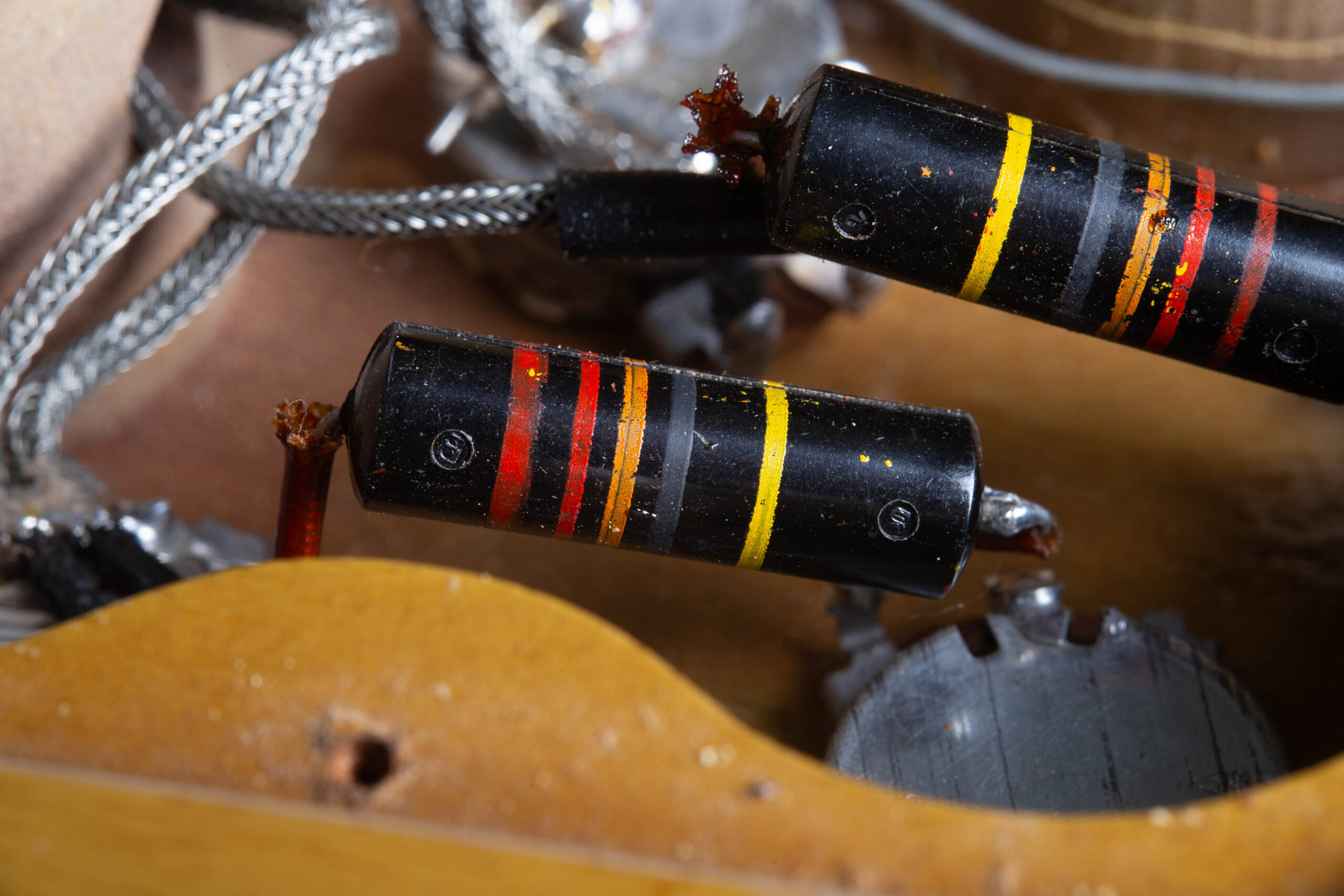
During 1956 and 1957, many Juniors were equipped with P-90s using Alnico 5 magnets rather than the Alnico 3 of the earliest models. Alnico 5 has a stronger magnetic field, which increases output and sharpens the attack slightly. Gibson was not always consistent in magnet sourcing, so pickups from this period testing with either type should not be considered automatically non-original — but Alnico 3 in a late-1956 or 1957 instrument does warrant closer examination of other components.
By 1957, the Les Paul Junior had settled into a consistent, well-understood specification that varied little from instrument to instrument. Manufacturing processes at the Kalamazoo factory had been refined over three years of production, and the result was probably the most consistent batch of single-cutaway Juniors produced during the entire run.
The neck profile had begun to slim slightly from the very chunky 1954 dimensions, though it remained substantial by any modern standard. Players who find vintage neck profiles intimidating often discover that 1957–1958 single-cutaway necks are slightly more approachable than the earliest examples while still delivering the full, warm tone that a heavy profile contributes.
The sunburst finish in 1957–1958 had evolved from the intense yellow-center burst of 1954 toward a warmer, more amber-to-brown progression. The yellow is still present but less dominant; the overall effect is richer and arguably more sophisticated. Some collectors specifically seek late-period single-cutaway sunburst examples for this finish characteristic, which many find more visually appealing than the earlier bright-yellow version.
By 1957, the list price had increased from the original $99.50 to $120 — a modest but meaningful increase reflecting both material cost increases and the guitar's growing reputation among players who had discovered that its simplicity was a feature rather than a limitation.
The introduction of the double-cutaway Les Paul Junior in 1958 is one of the most significant design decisions in the model's history. It transformed the guitar from a single-cutaway instrument with limited upper-fret access into a genuinely versatile electric that could compete with anything Fender was offering in terms of playability.
The double-cutaway body retained the slab mahogany construction and overall dimensions of the single-cutaway but added a second symmetrical cutaway on the bass side of the body. The neck now joins the body at the 22nd fret rather than the 16th, providing access to all 22 frets with comfort. This change was enormous for lead guitarists who had found the single-cutaway design limiting for anything above the 14th fret.
The body weight decreased slightly compared to the single-cutaway — not because of different wood but simply because the second cutaway removed a meaningful amount of mahogany from the upper bass bout. Double-cutaway Juniors tend to have slightly less low-mid density and slightly more midrange definition compared to single-cutaway examples of equivalent quality. Neither is objectively superior — they suit different playing styles and musical contexts differently.
A small number of double-cutaway Juniors — perhaps a few dozen total known examples — have surfaced with an opaque black finish. The majority of documented black-finish examples are paired with a tortoiseshell pickguard, and tortoiseshell is generally considered the expected pairing for that configuration. Whether these guitars were special orders, dealer requests, or some other category of exceptional production is not definitively documented, and their rarity means every example warrants heightened authentication scrutiny.
One additional pickguard detail worth knowing: black pickguards are not exclusive to black-finish Juniors. A small number of cherry-finish double-cutaway Juniors — primarily from 1959 — are known to have left the factory with a black pickguard rather than the more common configuration. This is rare enough that encountering one should prompt careful authentication rather than automatic suspicion, but it is a documented factory variation. As with all pickguard questions on these instruments, the correct approach is to evaluate the pickguard alongside the finish: check UV response of both, examine the finish under and around the pickguard edges for overspray or ghost lines, and assess hardware patina for age consistency across the whole instrument.
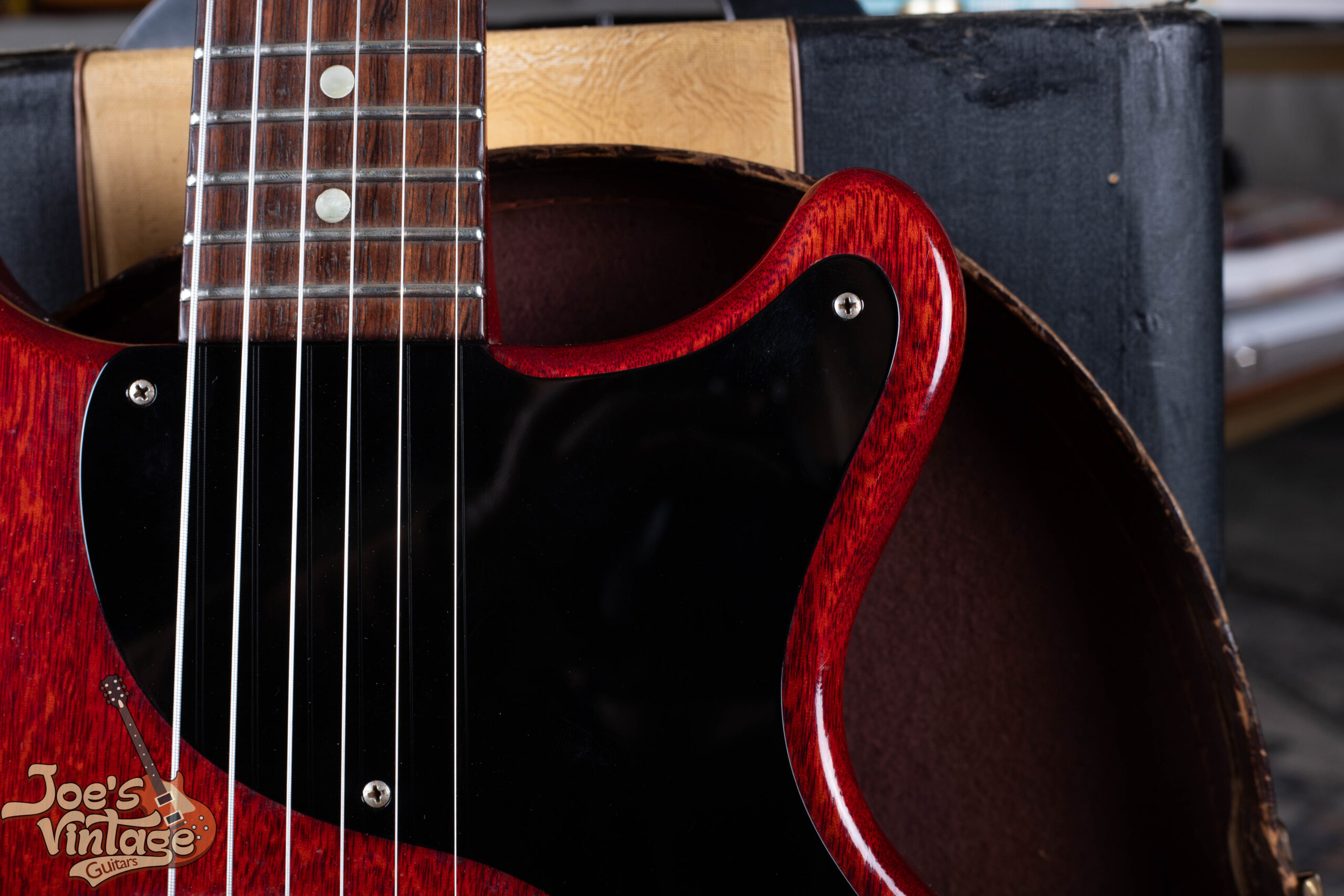
The 1958–1960 double-cutaway Junior is considered by many collectors and players to represent the sweet spot of the model's evolution — retaining the mahogany slab body and all the tonal characteristics that make Juniors desirable while adding the upper-fret access the single-cutaway lacked. TV Yellow double-cutaways command the highest prices of any standard-production Junior in most market conditions.
In 1961, Gibson undertook a wholesale redesign of its entire solidbody line. The new body shape — what we now call the SG — was thinner, lighter, and more dramatically contoured than any previous Gibson solidbody. The double cutaway became sharper and more angular, with pronounced pointed horns. Overall body thickness was reduced from approximately 1¾ inches to roughly 1⅜ inches.
These changes dramatically altered the character of the Junior. The lighter, thinner body produces a brighter, more aggressive tone with faster attack and somewhat less midrange warmth and bass depth. The neck joint moved even closer to the body, providing completely unrestricted access to the highest frets. Many lead guitarists found the new design more comfortable and faster-playing, while players who valued the warm, thick tone of the original slab body were less enthusiastic about the trade-off.
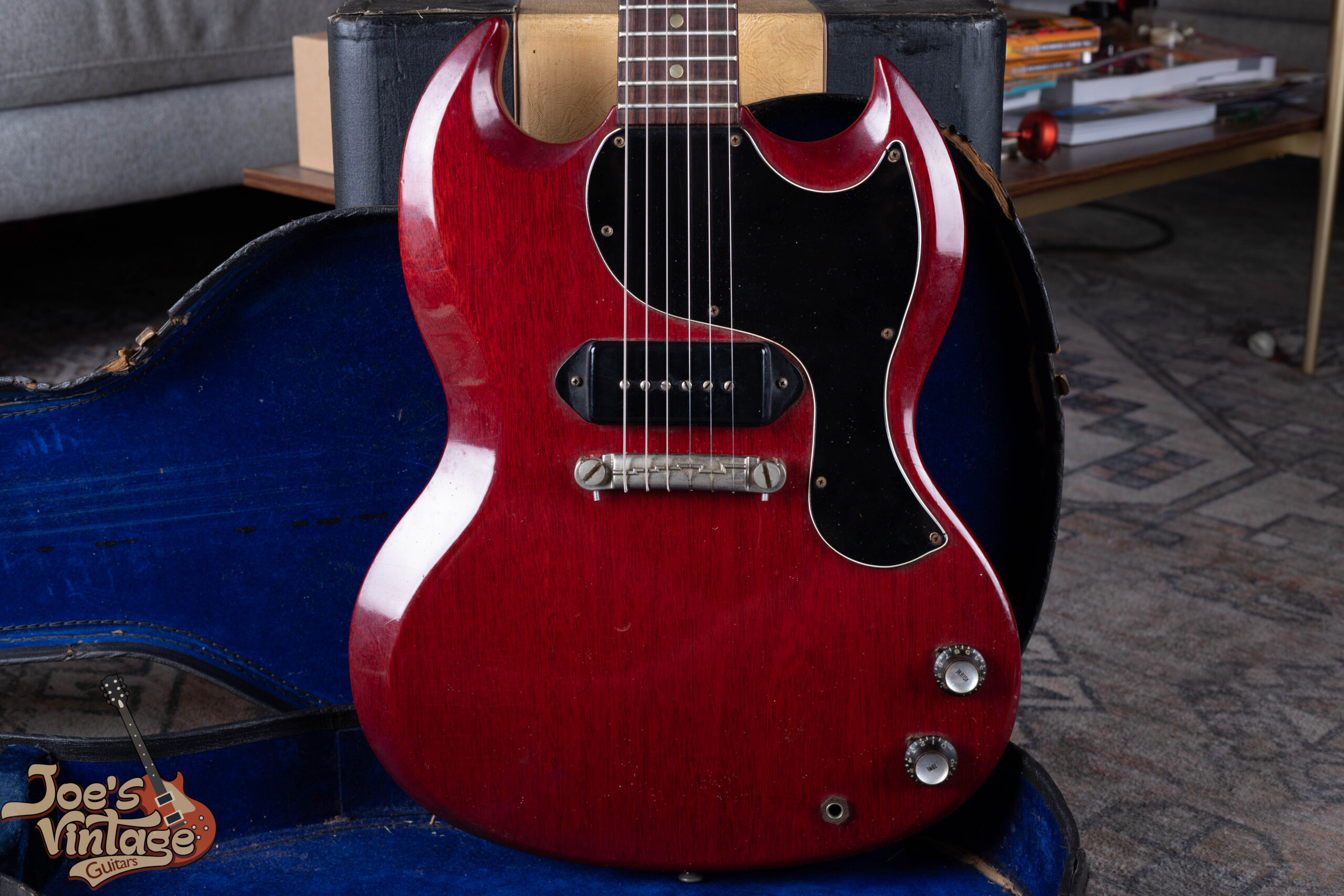
The necks on 1961–1962 SG-style Juniors are noticeably slimmer front-to-back than the single-cutaway or double-cutaway predecessors. Gibson was clearly responding to player feedback and market trends — Fender's slimmer neck profiles were commercially successful, and Gibson moved in a similar direction. The result is a neck that many modern players find easier to play quickly but that some vintage enthusiasts feel contributes less to the instrument's resonance than the earlier full profiles.
The SG body design has one well-documented weakness: the thinner neck heel and the deeply set cutaways leave the neck joint area vulnerable to breakage. A dropped guitar — or sometimes simply a hard knock — can fracture the neck at or near the joint. Repaired neck breaks are extremely common on 1961–1962 Juniors. Any example should be inspected carefully for visible glue lines under the finish, slightly uneven finish texture in the neck joint area, or color mismatches under UV light. A repaired break does not disqualify the guitar, but its quality and structural integrity must be evaluated.
Throughout 1961 and 1962, these guitars were still labeled "Les Paul Junior" on the headstock silk screen. Gibson's relationship with Les Paul had been deteriorating throughout the late 1950s and early 1960s over financial and contractual disputes, and in 1963 the Les Paul name was officially dropped. Guitars produced in 1961 and 1962 occupy a unique transitional position: they have the SG body but the Les Paul branding — and are treated as Les Paul Juniors for valuation purposes by the collector market.
The P-90 is central to the Les Paul Junior's identity. All P-90s share the same fundamental architecture: a flat coil wound around a bobbin surrounding six individual adjustable polepieces (steel screws), under which are positioned two bar magnets oriented with opposite poles facing each other. The coil is typically wound with 42-gauge plain enamel wire for approximately 9,500 to 10,500 turns, achieving a DC resistance of roughly 7.5K to 9.5K ohms in original vintage examples.
The pickup position in 1954 — extremely close to the bridge saddle — is the defining characteristic of the earliest Juniors' sound. At this position, the pickup captures more of the string's upper harmonics and less of its fundamental vibration, producing a tone that is bright, cutting, and aggressive even through a clean amplifier. The Alnico 3 magnets exert a weaker magnetic pull on the strings, allowing them to vibrate more freely and contributing to a slightly sweeter, more complex harmonic content that many vintage pickup enthusiasts prize highly.
The repositioned pickup of 1956 shifts the tonal emphasis slightly away from extreme upper harmonics toward a more balanced midrange emphasis. Moving even a few millimeters away from the bridge at this position has a disproportionate tonal effect because the relationship between pickup position and harmonic content is not linear — small changes near the bridge produce larger tonal shifts than equivalent changes near the neck. The result is a guitar with more vocal, slightly less metallic character in the bridge position. The transition to Alnico 5 magnets adds output and sharpens the attack, partially offsetting the warmer quality of the repositioned pickup.
The P-90 specifications remained largely consistent through the double-cutaway era, but the change in body shape and mass means the same pickup sounds somewhat different in these instruments than in their single-cutaway predecessors. The reduced body mass shifts tonal emphasis slightly toward the midrange and away from the low-frequency warmth that characterized the best single-cutaway examples. Whether this is preferable is a matter of playing context and personal taste.
In the SG-body instruments, the P-90 specifications were again similar, but the drastically different body — thinner, lighter, with different density and internal cavity geometry — means these guitars sound distinctly different from any earlier Junior. The overall character is brighter and more aggressive, with a faster transient response and less of the warm, thick sustain that defines the best slab-body examples.
Measurements given as distance from the bottom of the string (fretted at the highest fret) to the top of the polepiece:
Individual polepiece height is frequently overlooked but significantly affects string-to-string balance. Wound strings (E, A, D) vibrate with greater amplitude than plain strings (G, B, E) and generally benefit from slightly lower polepiece height. Adjust a quarter-turn at a time and evaluate through a clean amplifier — it is the only reliable method for finding optimal balance on a specific instrument.
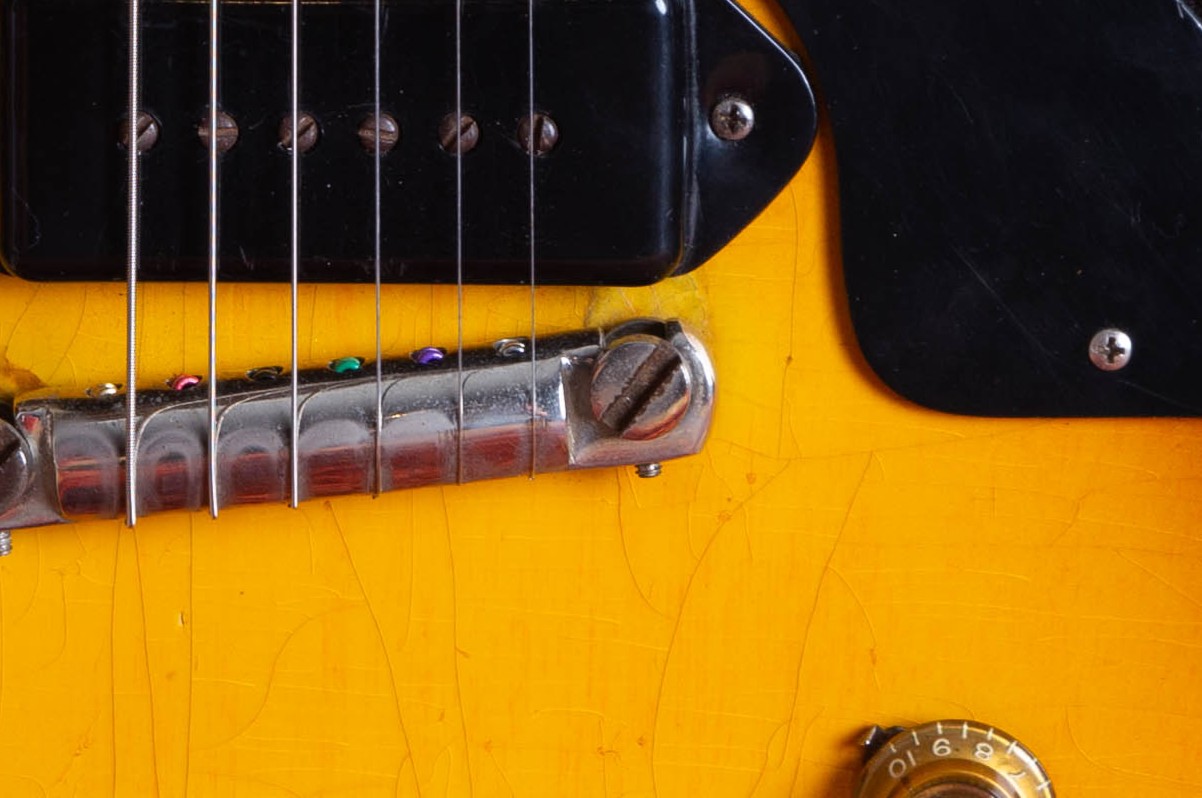
The wraparound bridge/tailpiece combination is one of the defining visual and sonic characteristics of the Les Paul Junior. It combines bridge and tailpiece functions in a single piece that wraps over a small metal bar anchored to the body. The design provides good sustain through very direct coupling of string energy to the body — a quality many builders and players consider sonically superior to more complex separate-bridge systems.
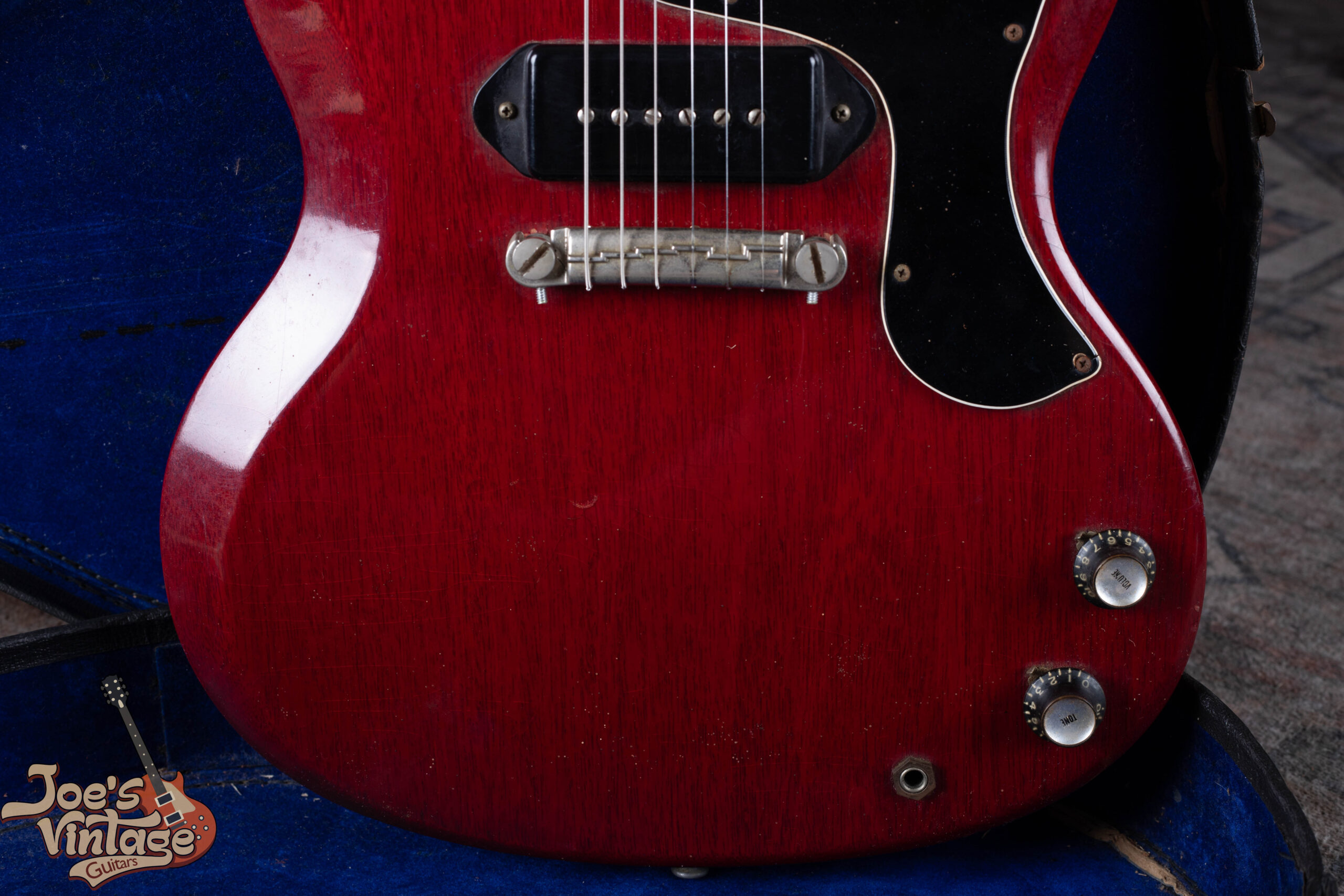
The saddle on the original one-piece wraparound is a single curved bar, not individual adjustable saddles, meaning intonation is set as a compromise across all six strings. A Les Paul Junior with a stock original bridge will never intonate as precisely across the full range of the neck as a guitar with individual saddle adjustment. However, many players find that the intonation is close enough for practical purposes, and the direct coupling of string to bridge to body contributes measurably to the guitar's percussive attack and sustain — qualities that many players find more than compensate for the mild intonation compromise.
The original 1954–1958 wraparound bridges are nickel-plated pot metal (zinc alloy). These age with a characteristic patina — the nickel plating wears and the underlying zinc takes on a grayish, slightly matte appearance. Original pot-metal bridges are lighter and have somewhat different resonant properties than replacement bridges made from aluminum or brass, which became popular aftermarket options. Identifying a period-correct original bridge versus a replacement requires careful comparison with documented examples from the same production period.
A small number of Les Paul Juniors were fitted with compensated saddles — bridges with a stepped or angled saddle bar that approximates the intonation correction of individual saddles. These are found primarily on later single-cutaway and early double-cutaway examples. Their presence is not a red flag — they are period-correct components — and their absence should not be considered an authentication problem.
The finish on a vintage Les Paul Junior is one of the most important tools for both dating and authentication. Gibson's nitrocellulose lacquer finishes age in predictable but not perfectly uniform ways, and the specific pattern of aging on a particular guitar can tell a careful observer a great deal about its history.
Nitrocellulose lacquer is a thermoplastic material that continues to off-gas solvents and shrink very slowly over decades. This gradual shrinkage — combined with the expansion and contraction of the underlying wood in response to seasonal humidity changes — eventually causes the finish to develop "checking" or "crazing": a network of fine cracks that follow the grain of the wood and the stress lines in the finish. Vintage-correct checking on a 60-year-old Junior is a complex pattern of fine lines that is difficult to replicate convincingly, though skilled refinishers can simulate it.
Under UV light, original nitrocellulose lacquer fluoresces differently than modern polyester, polyurethane, or water-based finishes. A UV lamp operating in the 365nm wavelength range is an indispensable authentication tool. Areas of refinish, overspray, or touch-up will typically fluoresce at a different intensity or color than the original surrounding finish — revealing repairs or alterations that are completely invisible under normal light.
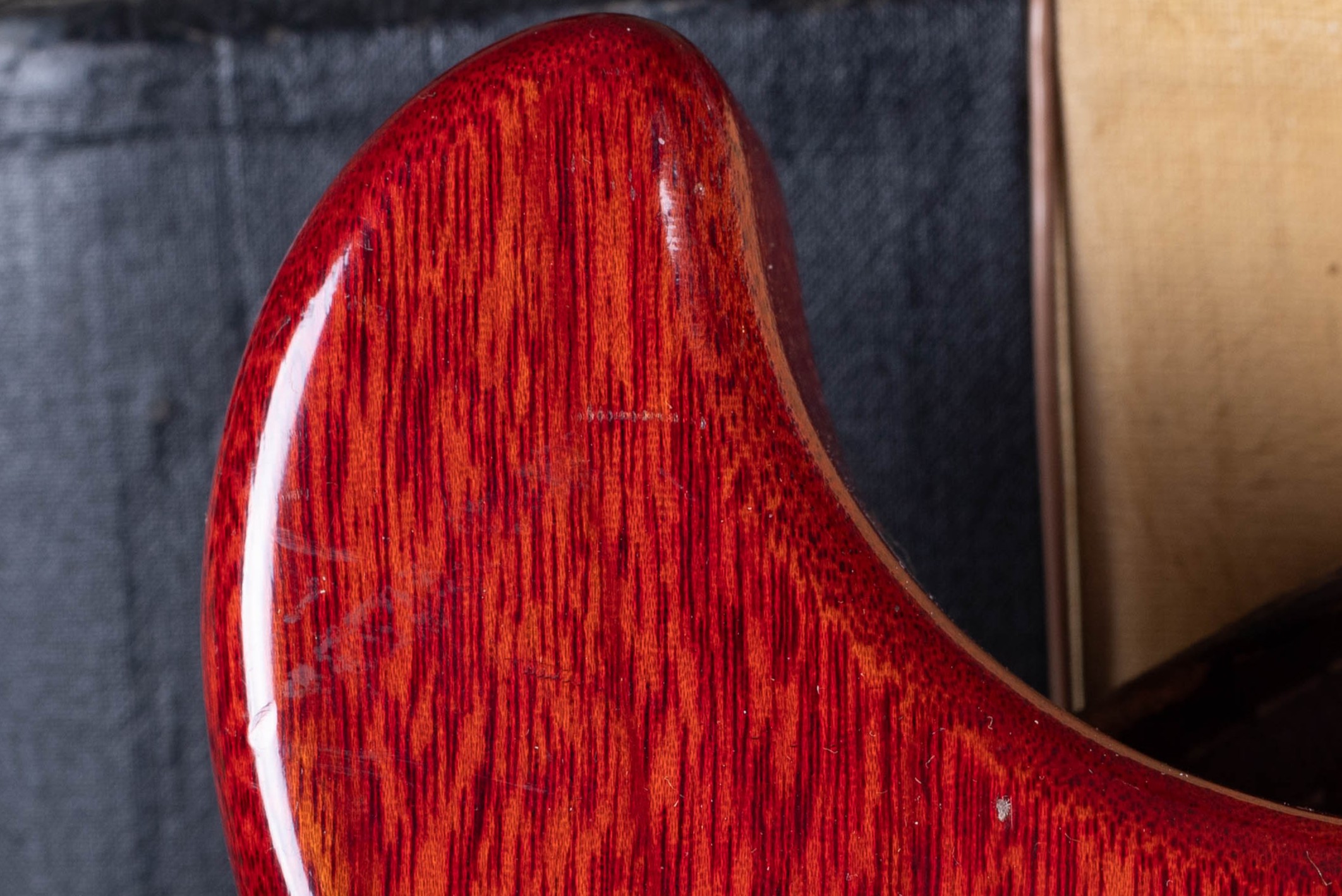
Cherry Red finishes on double-cutaway and SG-style Juniors are notorious for fading, sometimes dramatically. The specific red dyes used by Gibson in this period are highly susceptible to UV light, and guitars exposed to sunlit display cases or windows can fade to a deep brown or almost walnut color over decades. Areas protected by the pickguard, control covers, and the player's body will retain more of the original red, creating a ghost image of brighter red surrounded by faded areas. This patterning is itself a form of authentication evidence — it shows the guitar was actually played and exposed to light over a long period. A Cherry Junior in bright, completely unfaded red condition should be examined carefully under UV.
No single feature alone proves or disproves authenticity. Authentication is an accumulation of evidence that, taken together, either supports or undermines the instrument's claimed identity. Cross-referencing serial number, pot date codes, component styles, finish characteristics, and construction details always produces more reliable conclusions than relying on any single feature in isolation.
Potentiometers used by Gibson in this period were sourced primarily from CTS (manufacturer code 137) and Centralab (code 134). The standard stamped format reads: manufacturer code + two-digit year + two-digit week. A pot stamped "137 5634" is a CTS pot made in the 34th week of 1956. Because pots were manufactured and then warehoused before use, pot codes establish the earliest possible date of manufacture — not the exact year of construction. Pot codes several years older than the claimed production year are a red flag, while codes from a year or two prior are typical and expected.
Gibson's serial number system and Factory Order Numbers apply across all eras of Les Paul Junior production — not just one year. Understanding how to read and cross-reference them is one of the most important tools available for dating any Junior from 1954 through 1962.
Gibson's serial numbering during this period used an ink-stamped system on the back of the headstock. Numbers were applied sequentially but not always in strict chronological order, as batches of instruments were sometimes assembled from components built over a range of dates. Factory Order Numbers (FONs) — stamped inside the control cavity or visible at the neck joint — provide a complementary dating reference that, cross-referenced with serial number databases, can narrow production dates considerably.
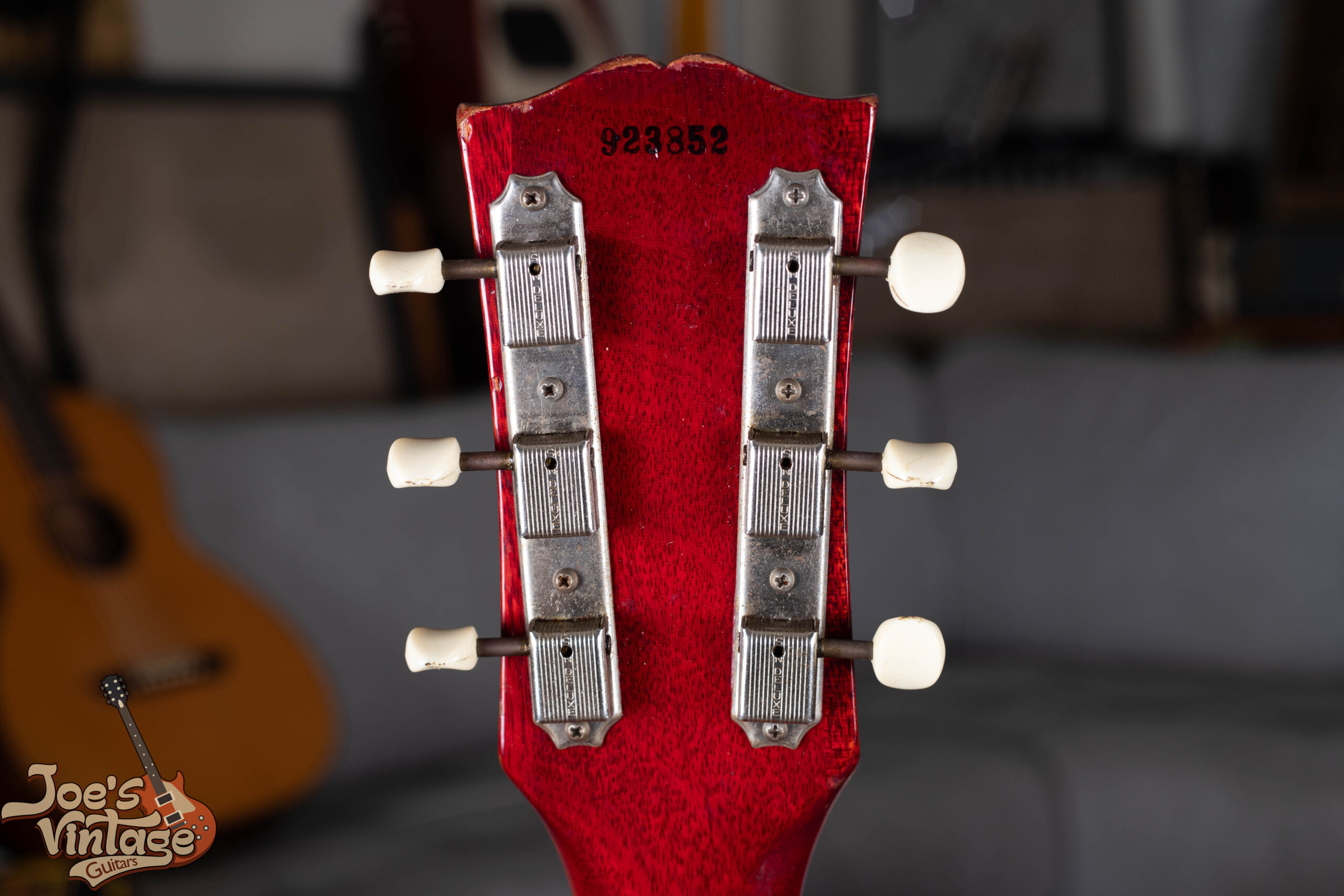
The key principle: always cross-reference the headstock serial number with the FON from the control cavity or neck joint. If the two codes suggest inconsistent production dates, that inconsistency warrants further investigation of components and construction details before drawing any conclusions.
| Era | Bass | Midrange | Treble | Sustain | Overall Character |
|---|---|---|---|---|---|
| 1954–1955 Single-Cut | Rich, substantial | Strong upper-mid bark | Bright, cutting | Excellent — complex decay | Warm yet aggressive; thick fundamental with real edge |
| 1956–1958 Single-Cut | Full | Vocal, balanced | Present but less metallic | Excellent | More musical; slightly warmer than '54 placement |
| 1958–1960 Double-Cut | Slightly reduced | Focused, defined | More articulate | Very good — faster decay | Most versatile era; balanced, punchy, lead-friendly |
| 1961–1962 SG-Body | Reduced | Forward, aggressive | Pronounced bite | Shorter — very fast attack | Brightest and most cutting; raw, aggressive presence |
The Special shares the slab mahogany body but adds a second soapbar P-90 at the neck position and a three-way selector switch, offering substantially more tonal flexibility. Players who need tonal range prefer the Special; players who want a single, uncompromising voice shaped entirely through technique and amplifier settings often prefer the Junior's radical simplicity.
The Goldtop is a fundamentally different instrument. The carved maple top adds clarity, compression, and sustain that the mahogany slab doesn't quite replicate. Goldtops are generally warmer in the low frequencies and have more harmonic complexity in sustained notes, while Juniors are more immediate and aggressive in attack. The Goldtop is a more sophisticated instrument; the Junior is a more elemental one — and elemental is not a criticism.
Introduced in 1959 as an even more affordable alternative, the Melody Maker used a thinner body, shorter scale length, and a smaller, lower-output single-coil pickup rather than the P-90. The result is a softer, thinner tone with much less of the aggressive midrange character that defines the Junior. The Junior is the superior instrument by virtually every measure relevant to serious players.
Gibson produced three-quarter scale versions of the Les Paul Junior during the late 1950s, intended for younger players or those who found the full-size instrument too large. These use a shorter scale length (approximately 22.75 inches) and a smaller body, but retain the basic construction approach: slab mahogany body, single dog ear P-90, wraparound bridge, simple controls. Three-quarter Juniors are rarely encountered and command significant collector premiums when authenticated examples appear for sale.
Left-handed versions were produced in extremely small quantities throughout the model's run. These instruments are built as mirror images of the standard configuration with all hardware oriented for left-handed playing. Documented left-handed Juniors from this period are extremely rare and typically command very significant premiums over equivalent right-handed instruments when they surface.
The black double-cutaway models are the most famous non-standard finish variant — a small number of blue, green, and other non-standard finish examples have also occasionally surfaced. Extreme skepticism and rigorous authentication are warranted for any Junior presented as having an original factory color outside the documented range of sunburst, TV yellow, cherry, and black. The era also produced a steady supply of refinished guitars presented as original special colors.
One of the most common modifications encountered on surviving Juniors is the addition of a second pickup to replicate the functionality of the Les Paul Special. A factory-original single-pickup Junior that has been converted carries diminished collector value compared to an unmodified example, though the sonic result can be excellent if the work is well executed. Evidence of a filled or modified pickup route under the pickguard is the primary indicator.
During the Junior's first years of production, it was used predominantly by the players it was designed for — students and players in modest local contexts. Professional use was limited; the Junior was seen as an inferior alternative to the Goldtop or the Special. Leslie West, who fronted Mountain in the late 1960s and early 1970s, is often cited as one of the first high-profile professionals to embrace the Junior as a deliberate choice rather than a budget compromise, demonstrating through recordings that the guitar's simple, one-pickup design could produce thick, powerful rock tone through appropriate amplification.
The most significant inflection point in the Junior's cultural history came in the mid-to-late 1970s, when the New York punk and proto-punk scenes discovered that the guitar's simple, aggressive design was ideally matched to the music they were making. Johnny Thunders of the New York Dolls and the Heartbreakers became the most iconic Junior player of this era, using double-cutaway examples to create a raw, streetwise rock tone that became enormously influential. Thunders' use of the Junior was a deliberate rejection of the complex, expensive guitars associated with arena rock — the Junior's simplicity and its identity as a "lesser" guitar made it perfect for punk's aesthetic. Mick Jones of The Clash and Steve Jones of the Sex Pistols further cemented the Junior's punk credibility through some of the most important recordings of the era.
Through the 1980s and into the 2000s, a diverse range of players continued to develop the Junior's associations across multiple genres. Warren Haynes' use of Juniors in blues-rock contexts demonstrated the guitar's versatility well beyond punk and hard rock. Billie Joe Armstrong of Green Day brought massive mainstream visibility to the Junior through both his use of vintage examples and his signature model relationship with Gibson, introducing the instrument to a generation of younger players who might otherwise have been unaware of its existence — with measurable effects on vintage market demand.
The vintage Les Paul Junior market is active, well-established, and driven by a combination of factors that interact in complex ways. Rather than cite specific dollar figures — which change constantly with market conditions — this section describes the structural factors that determine where any given instrument falls in the value hierarchy.
Condition is the single most important determinant of value for any given configuration. Moving from "good" to "excellent" increases value substantially, but moving from "excellent" to "near mint" can increase value by an equal or greater absolute amount — because truly pristine vintage examples are exceedingly rare among instruments that were originally student-grade tools, handled daily and rarely stored with care.
Beyond overall condition, the specific originality of individual components matters significantly. A guitar with all original hardware, electronics, and finish is worth substantially more than one with replaced tuners, a non-original bridge, or replaced pickups — even if the replacements are high-quality period-correct components. Original pickups are particularly important: the specific sonic character of original vintage P-90s is highly prized and difficult to replicate exactly with new production pickups, even excellent modern ones.
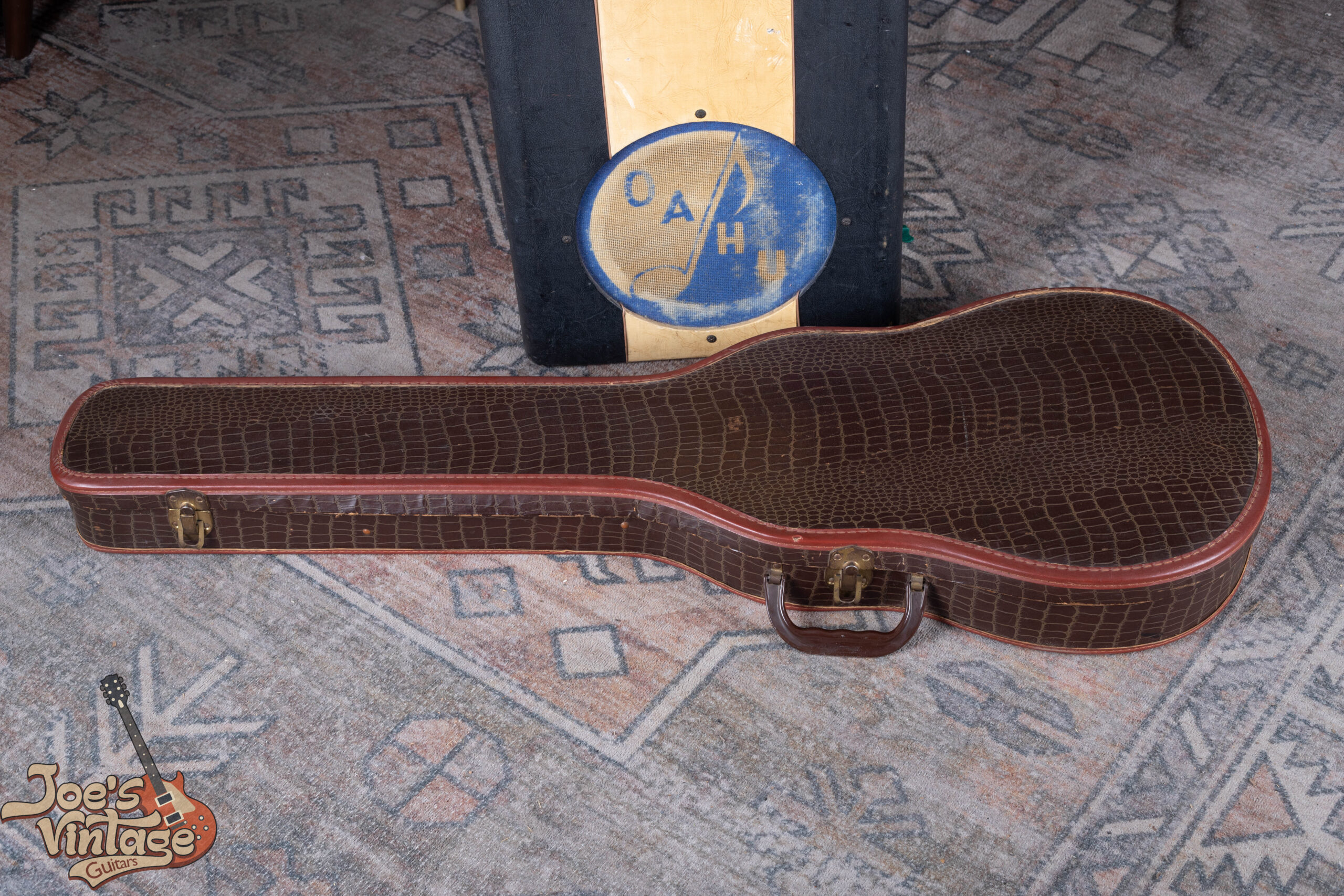
Vintage guitars with documented provenance — original receipts, documented ownership history, photographs showing the instrument at a specific historical moment — command meaningful premiums over undocumented examples. Original cases, hang tags, warranty cards, and any other period documentation also add value, both for their own rarity and for the authentication support they provide.
| Feature | Vintage Original | Gibson USA Reissue | Gibson Custom Shop | Epiphone |
|---|---|---|---|---|
| Neck Profile | Full C / "baseball bat" | Slimmer modern taper | Historically accurate | Slim, bolt-on construction |
| Pickup | Original wound P-90, Alnico 3 or 5 | Modern P-90, Alnico V | Vintage-spec P-90 | Often humbucker, not P-90 |
| Finish | Thin vintage nitrocellulose | Nitro, thicker application | Thin nitro with aged options | Polyurethane |
| Mahogany Species | Honduras (Swietenia macrophylla) | African mahogany (Khaya) | African mahogany (Khaya) | Asian mahogany |
| Hardware | Nickel pot metal, naturally aged | Modern nickel | Aged vintage-correct hardware | Chrome-plated |
| Electronics | CTS/Centralab pots, bumblebee caps | Modern CTS pots | Vintage-correct components | Generic components |
Gibson Custom Shop Juniors represent a significant investment but still fall well short of the prices commanded by original vintage examples in good condition. For players who want the genuine vintage feel and sound without the premium and provenance anxiety of original instruments, Custom Shop reissues are worth serious consideration. For players simply seeking the visual aesthetic and basic playability of the Junior design at an accessible price, Epiphone versions serve their purpose — but they are a different instrument category rather than a substitute for the original.
The original nickel-silver frets on surviving vintage Juniors range from nearly new condition to heavily worn. Options for restoration include leveling and recrowning (removing material from existing frets to create uniform height) and full refret (removing and replacing the wire entirely). For collector-grade instruments, any fretwork should be performed by an experienced vintage instrument technician. Fret replacement should use vintage-specification wire — medium to medium-tall gauge in nickel-silver — rather than modern stainless or EVO gold alloys, which are inconsistent with period-correct restoration and may affect resale value.
The original electronics — pots, capacitors, pickup — are among the most valuable components on a vintage Junior from a collector standpoint. When electronics require work, the approach should prioritize preservation of original components. Cleaning dirty potentiometers with appropriate contact cleaner can restore function without requiring replacement. When a vintage P-90 requires rewinding, the work should be done by a specialist who can document the original winding specifications before proceeding — these are irreplaceable measurements once the original coil is disturbed.
Nitrocellulose lacquer finishes require different care than modern finishes. Many commercial guitar polishes contain silicone that can damage nitro over time. Products designed specifically for nitrocellulose finishes should be used, or a simple dry or slightly damp cloth for routine cleaning. The finish should never contact rubber, certain plastics, or aggressive cleaning chemicals.
Never use rubber guitar stands or hangers in direct contact with a nitrocellulose finish. Rubber reacts chemically with nitro lacquer and can permanently stain or partially dissolve the finish over time — even through brief contact. Use stands and hangers with foam or fabric contact points only, or hang the guitar from its strap.
The ideal relative humidity for guitar storage is 45–55%, with stable temperature and minimal swings. Keeping a vintage Junior in a hard case with a two-way humidity control system — such as Boveda packs — is best practice for long-term preservation. Never store a vintage guitar in a car trunk, attic, or basement, where extreme temperature and humidity fluctuations can cause glue joint failures, finish damage, and wood cracking in instruments that may have survived for 65+ years in better conditions.
Before you begin seriously evaluating instruments, be clear about what you're looking for and why. Are you primarily a player who wants the genuine vintage experience and doesn't care if the guitar has some replaced parts or repaired damage? Are you a collector who wants all-original condition and will keep the guitar in its case much of the time? Are you thinking about the instrument primarily as an investment? The answers to these questions will determine which guitars you should be looking at and how you should evaluate the trade-offs between condition, originality, price, and playability.
Established vintage guitar dealers with strong reputations have financial and reputational incentives to sell accurately described instruments and stand behind their representations. Auction houses with specialist vintage guitar departments provide documentation and expert assessment that private-party transactions typically lack. Casual marketplace listings from unknown sellers require maximum skepticism and ideally a pre-purchase inspection by an independent expert you have identified and trust.
No photograph, no matter how well shot, is a substitute for hands-on examination. Critical authentication tools — UV light, a DC resistance meter for the pickup, physical examination of the finish and hardware — require the instrument to be present. For any purchase above a modest threshold, insisting on in-person inspection (or having an independent expert perform one on your behalf) is not just advisable — it is essential. The cost of an expert appraisal is trivial relative to the cost of a significant authentication error.
The price of a vintage Junior incorporates not just the physical instrument but its story, its rarity, and its place in guitar history. When you buy an all-original 1958 Cherry Red double-cutaway Junior in excellent condition, you are buying something that cannot be reproduced — a genuine artifact from a specific moment in instrument-making and cultural history. That irreproducibility is part of what you are paying for. If that dimension of the transaction doesn't resonate with you, a high-quality reissue may serve your musical needs at a fraction of the cost.
The Gibson Les Paul Junior is one of the great unlikely success stories in the history of the electric guitar. The story of its evolution from 1954 to 1962 is a story of continuous refinement punctuated by two major redesigns, each of which created a genuinely different instrument while retaining the core identity that makes a Junior a Junior: slab mahogany body, single bridge-position P-90, minimal hardware, and a complete absence of sonic compromise.
For the collector, the Junior presents a fascinating multi-dimensional challenge — understanding the specific evolution of specifications, finishing techniques, component changes, and production variations across nearly a decade of production, and learning to read the physical evidence that each instrument presents. For the player, the Junior offers something simpler and more immediate: a guitar that gets out of the way and lets the music happen.
The Les Paul Junior's journey from student guitar to cultural icon demonstrates a principle the guitar world proves repeatedly: great tone is not a function of complexity or cost. Sometimes the stripped-down, elemental choice — one pickup, one volume, one tone, one idea — is the most powerful choice of all.
Both are P-90 pickups with the same fundamental coil construction, but they differ in their cover design and mounting method. The dog ear (used on the Junior) has extended mounting tabs on its long sides that screw directly to the guitar top, eliminating the need for a separate mounting ring. The soapbar (used on the Special, Goldtop, and others) has a flush rectangular cover and mounts via a separate frame or directly into the body. The electrical and magnetic specifications are essentially identical; any tonal differences between them are attributable to mounting position and body routing differences rather than the pickup design itself.
UV light is the most reliable tool. Small touch-ups typically show as localized areas of different fluorescence intensity surrounded by original finish. Full refinishes typically fluoresce uniformly but at a different color or intensity than original 1950s nitro. The areas under hardware (bridge, pickguard, pickup) are your best reference points: if the finish under these areas matches the visible finish exactly, and both differ from what original nitro should look like under UV, a full refinish is likely. If hardware areas show the "ghost" of the original finish while the exposed areas have been refreshed, a partial refinish or significant touch-up is indicated.
Not necessarily, but they require careful evaluation. A well-repaired break — using the correct hide glue, properly clamped, with no remaining gap or flex at the joint — may be structurally sound indefinitely and have minimal impact on tone or playability. A poorly repaired break, or one that has been repaired multiple times, may be structurally compromised and at risk of re-failure. Having a repaired break evaluated by an experienced luthier before purchase is strongly advisable. A verified, well-executed repair on an otherwise desirable instrument should reduce purchase price but need not eliminate the guitar from consideration.
Many players consider the 1958–1960 double-cutaway models to offer the best combination of vintage authenticity, playability, and tonal quality. The improved upper-fret access relative to single-cutaway models makes them more versatile as working instruments, while the slab mahogany body retains the tonal character that defines the model. SG-body 1961–1962 models with cleanly repaired neck breaks can be excellent players' instruments at lower prices than equivalent double-cutaway examples, but the structural vulnerability of the design requires ongoing care and awareness.
Single-cutaway models typically weigh between 7.5 and 9 pounds. Double-cutaway models are generally lighter, in the 7 to 8.5 pound range. SG-body models are the lightest, usually between 6 and 7.5 pounds. The relationship between weight and tone in solid-body guitars is genuine but complex — greater mass generally correlates with more sustain and lower-frequency body resonance. However, the quality and density of the wood matters more than raw weight. Weight is a useful proxy but should not be treated as a definitive tonal indicator.
Original 1950s Gibsons were typically strung from the factory with relatively heavy gauges by modern standards — .013 to .056 or similar. However, running heavy strings on an aging vintage neck creates significant tension that can stress the neck joint, truss rod, and body over time. Most technicians advise vintage guitar owners to use lighter gauges — typically .010–.046 or .011–.048 — to reduce stress on aging components while still achieving good tone. If the guitar has been set up for a specific gauge, changing significantly from that gauge will require truss rod adjustment and possibly saddle work to maintain optimal setup.
A Factory Order Number is an internal Gibson production batch code, typically ink-stamped inside the control cavity or visible at the neck joint. FONs were applied when a batch of instruments entered production, encoding the year and batch sequence in a format that researchers have decoded and published in various reference resources. Cross-referencing the FON with the headstock serial number gives a more reliable production date range than either number alone. If the two codes suggest inconsistent dates, that warrants further investigation of other components and construction details.
Joe’s Vintage Guitars
47 N Fraser Dr E
Mesa, AZ 85203
Phone: (602) 900-6635
Email: joesvintageguitars94@gmail.com
Written by Joe Dampt
“Driven by a love for classic tunes, I specialize in buying, selling, and appraising vintage guitars, bringing music and history together.”
The Fender Jazzmaster changed more times in its first 14 years than almost any other…
The 1966 Gibson ES-335 is a pre-Norlin Kalamazoo instrument built to the same standard as…
The 1962 Fender Stratocaster sits at the end of the first golden age of Fullerton…
The 1959 Fender Telecaster is the most transition-dense year in the instrument's history — slab…
The complete authentication reference for the 1954 Gibson Les Paul Goldtop — the first full…
How to identify and authenticate any Gibson Byrdland — from the first Kalamazoo prototypes in…