
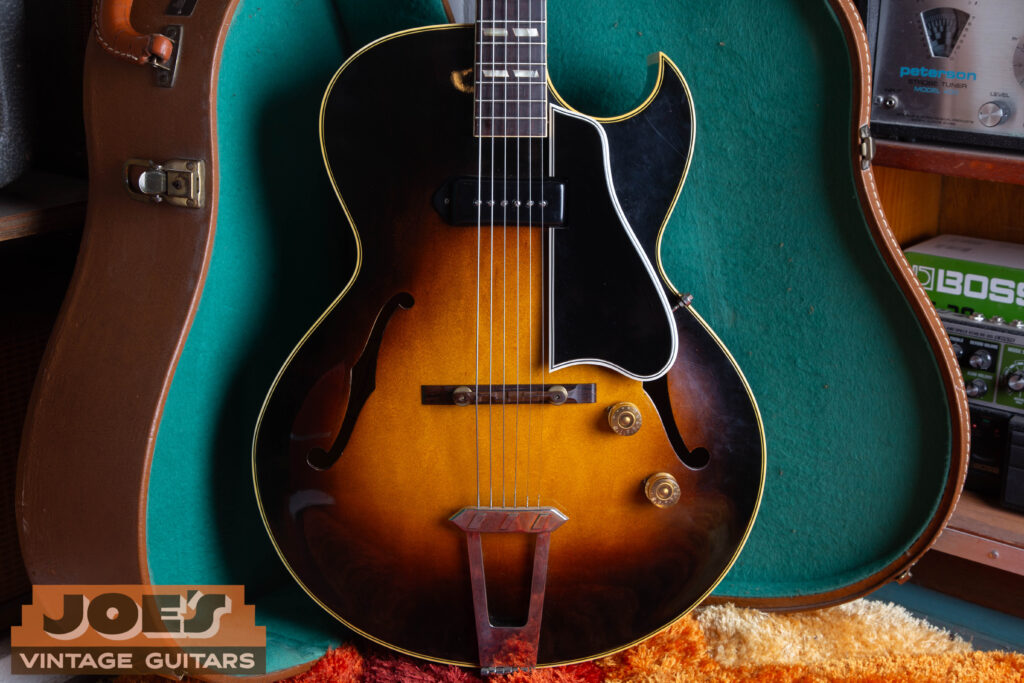
The “Gold Standard”: A stunning 1950s Gibson ES-175 featuring the iconic Florentine cutaway and Sunburst finish—an instrument that defined the sound of jazz for generations.
If there is one guitar that truly defines the “workhorse” era of Gibson’s golden years, it’s the ES-175. While the high-end carved-top models like the L-5 were getting all the glory in the late 40s, the 175 was quietly becoming the most recorded jazz guitar in history. At Joe’s Vintage Guitars, we’ve handled our fair share of these instruments, and honestly, no two are exactly alike. If you’re sitting on one—maybe it was your father’s or you found it at an estate sale—you’re looking at a piece of history that has a very specific “DNA” that determines its value. As always, if you need help appraising your guitar, we are happy to help with a valuation, as well as a competitive cash offer to buy your Gibson if you are in the market to sell.
Before the 175 hit the scene, “electric” guitars were mostly acoustic archtops with a pickup slapped on them. Gibson’s big move in 1949 was deciding to use laminated maple instead of solid spruce. Now, to a casual observer, “laminated” sounds like a cost-cutting measure. In reality, it was a genius move for tone.
Solid spruce is beautiful, but it’s a feedback nightmare when you plug into a loud amp. The laminated maple top on the 175 was stiffer and heavier, which meant it didn’t vibrate as much. This gave the guitar a “thump” and a quick note decay that became the signature sound of Joe Pass, Herb Ellis, and Jim Hall. It was also the first Gibson to sport that sharp, pointed “Florentine” cutaway, which looks as cool today as it did 70 years ago.
If you’re trying to figure out what your guitar is worth, look at the pickups first. From 1949 to 1956, they had P-90 single-coils. These sound incredible—clear, punchy, and a bit raw. But 1957 changed everything.
That was the year Gibson introduced the “Patent Applied For” (PAF) humbucker. If you have a 1957, 1958, or 1959 ES-175 with its original PAFs, you are looking at the peak of the vintage market. These pickups have a warmth and harmonic complexity that modern reissues just can’t quite capture. A “Natural” or “Blonde” finish from this era is even rarer; because the wood had to be flawless to not be hidden under a Sunburst finish, Gibson only made a handful of them. If yours is a “Blonde” with PAFs, you’re holding a top tier investment.
A museum-grade 1962 Gibson ES-175D. This particular example is highly coveted as it features two original Patent Applied For (PAF) humbuckers, representing the pinnacle of Gibson’s Golden Era electronics before the full transition to Patent Number pickups.
When we evaluate a 175 at the shop, we’re looking at more than just the year. The feel of the neck is a huge deal for buyers.
Pre-1960: These have that “baseball bat” feel—thick and rounded.
Early 60s: Gibson went very thin for a few years, which some players love for speed, but others find a bit “wimpy.”
The 1965 Shift: This is a big one. Mid-way through 1965, Gibson narrowed the nut width from 1 11/16″ to 1 9/16″. Collectors almost always pay a premium for the wider nut, as it’s much more comfortable for complex chord work.
The 70s (Norlin Era): You’ll notice a “volute” or a small bump on the back of the headstock near the nut. While purists used to turn their noses up at these, they’re actually very stable guitars. However, the market value is generally lower than the 50s and 60s models.
A remarkably original 1968 ES-175D. This era is defined by unique transitions, including the rare Gibson logo on the pickguard and the factory-standard nylon saddle bridge, which offers a slightly warmer, mellower attack than traditional metal saddles.
If you’re thinking about selling, you need to look “under the hood.” One of the first things we do is check the potentiometer (pot) codes. By looking inside the f-holes with a mirror, you can often see a 7-digit code starting with “137.” The last four digits tell you the year and week those electronics were made. This is the “smoking gun” for dating a Gibson when the serial number on the orange label has faded or doesn’t make sense. As always, you can also use our Gibson Serial Number Guide to aid you in dating your guitar.
We also look for “The Big Three” value killers:
Headstock Repairs: Because of the angle of Gibson headstocks, they are prone to cracking if the guitar falls over. A clean repair is fine for playing, but it can cut the collector value by 40-50%.
Refinishes: If someone “freshened up” the paint in the 80s, the vintage value plummets. We use blacklights to check for the original nitrocellulose lacquer glow.
Modified Pickups: If someone routed the body to fit different pickups, it’s a major hit to the price.
When assessing the current market value of a Gibson ES-175, it’s important to understand that “vintage” doesn’t have a flat price. Because these guitars were produced continuously for decades, the worth of an ES-175 can swing by tens of thousands of dollars based on a few specific variables. Whether you’re looking for a valuation for insurance purposes or trying to determine a fair asking price, here is how the market currently breaks down.
The most significant price driver is the finish. A Natural (Blonde) finish is significantly more valuable than a Sunburst. Because clear finishes show every grain of the wood, Gibson used their highest-grade maple for these, and they were produced in much smaller numbers. A blonde ES-175 from the late 1950s is considered a “blue-chip” guitar, often reaching double the price of a Sunburst model from the same year.
The electronics under the hood are the secondary price pillar.
Golden Era (1957–1960): Guitars equipped with original PAF humbuckers are the most expensive. These are high-liquid assets that hold their value even in fluctuating markets.
P-90 Era (1949–1956): These have seen a massive surge in value recently as more players seek out that early “Charlie Christian-adjacent” clarity.
Early Patent Number (1962–1965): Often regarded as having nearly identical sound to PAFs, these represent a high-value middle ground for collectors.
A “museum-grade” instrument—one with the original frets, no modifications, and the original hard-shell case—commands a massive premium. However, the ES-175 was a working man’s guitar. You will often find them with “player mods” like replaced tuners (look for the “footprints” of old Grover or Schaller tuners on the back of the headstock) or swapped bridges. While these make the guitar more functional for a gigging musician, they do detract from the collector value.
The most critical condition factor is the headstock. Like many Gibsons, a 175 is vulnerable to neck cracks. A professionally repaired headstock crack usually results in a 40% to 50% drop in market value, even if the repair is stable and invisible to the ear.
Market demand for the ES-175 remains high because it is the “gold standard” for an entire genre of music. Unlike “pointy” 80s guitars or niche vintage models, there is always a buyer for a clean 175. When determining what your vintage Gibson is worth, always look at recent realized auction prices rather than “asking prices” on forums, as the latter often reflect sentiment rather than actual cash value.
The ES-175 is a complex beast. Between the single-pickup (ES-175) and double-pickup (ES-175D) versions, the transitions from nickel to chrome hardware in 1965, and the rare variations like the ES-175CC (with the Charlie Christian pickup), there is a lot of room for error.
At the end of the day, these guitars were built to be played. They have soul, they have history, and they have a value that has remained remarkably steady for decades. If you have one sitting in a closet in Arizona or anywhere else, it’s worth taking the time to have it appraised by someone who knows the difference between a “player grade” 1972 and a “museum grade” 1959. Joe’s vintage guitars is here to help! Contact us for a free appraisal today!
Joe’s Vintage Guitars
47 N Fraser Dr E
Mesa, AZ 85203
Phone: (602) 900-6635
Email: joesvintageguitars94@gmail.com
Written by Joe Dampt
“Driven by a love for classic tunes, I specialize in buying, selling, and appraising vintage guitars, bringing music and history together.”
While the Gibson SG and Les Paul often dominate the conversation, the Epiphone Crestwood is…
Thinking of selling a vintage Gretsch 6120? This comprehensive guide covers everything from 1954-1962 specifications…
Ready to sell your vintage guitar? Avoid mistakes, get top price, and ensure a smooth,…
Curious about your vintage Fender amp's age? Use tube codes, transformer details, and features to…
How accurate are the Vintage Guitar Price Guide and Blue Book of Guitar Values? Joe's…
Easily date your Gibson Les Paul! Use this detailed serial number guide to find your…


