Collector's Reference · Gibson Electric Archtop
A complete year-by-year reference to features, construction changes,
and dating criteria — 1955 to the Custom Shop era

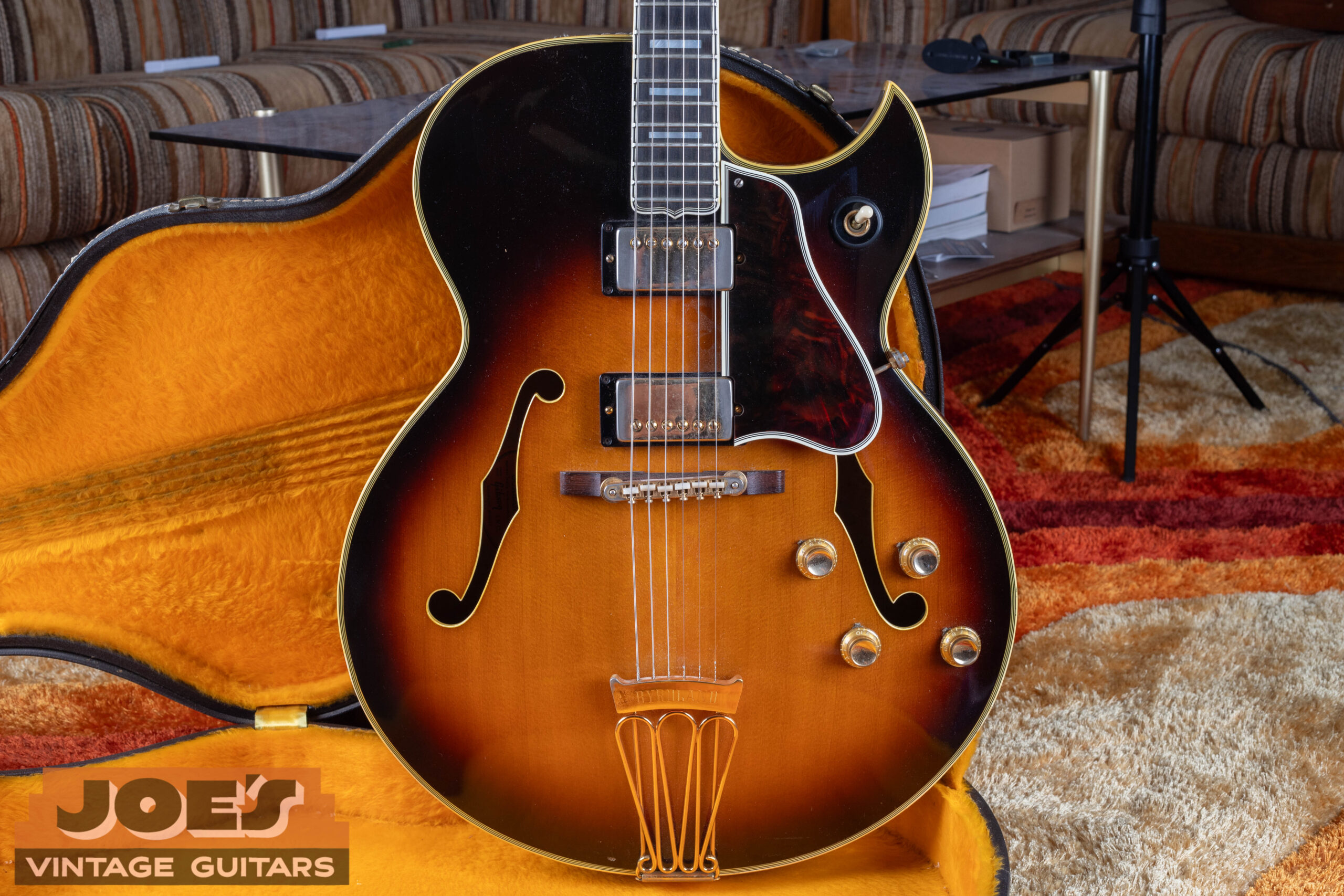
The Gibson Byrdland is the instrument that invented the thinline electric archtop. Its name is a portmanteau of Nashville session guitarists Billy Byrd and Hank Garland, the two players who co-designed it with Gibson president Ted McCarty in 1955. Both men were frustrated by the bulk of traditional archtops — the standard L-5CES was over 3⅜ inches deep — and wanted something that combined acoustic resonance with the ease of a solidbody. What they got was a guitar 2¼ inches deep, with a shortened 23½-inch scale, a narrower-than-standard nut, and all the premium appointments of Gibson's flagship L-5CES.
Four prototypes were logged in Gibson's Kalamazoo ledgers on April 4, 1955, described simply as "special thin models" of the L-5CES. The first production serial (A-20985) was registered in June 1955 for display at the July 1955 NAMM show. Public sales began in 1956. Gibson listed it at $550 in sunburst or $565 in natural — premium prices that reflected its top-of-line status.
The Byrdland remained a standard production model through 1993, when it moved to the Gibson Custom Shop as a special-order instrument. Total Kalamazoo production between 1955 and 1979 has been recorded at roughly 2,670 instruments, of which approximately 75% were finished in sunburst.
The correct spelling is Byrdland — not "Birdland." The guitar is named after Billy Byrd. The Birdland jazz club in New York actually sued Gibson for trademark infringement over the name, and Gibson successfully argued the spelling was sufficiently distinct. You will often see the misspelling "Birdland" in listings — always check the actual headstock logo and tailpiece engraving.
These are the original 1955–1957 specifications. All subsequent sections document deviations from this baseline. Note that several of these specs changed over the decades — the table below reflects the original configuration only.
Key changes are noted in each cell above. Full details on each change are in the relevant sections below.
The cutaway profile is the single most dramatic visual change in the Byrdland's history, and it cycles. Knowing which shape is correct for a given year is fundamental to authentication.
The original cutaway inherited from the L-5CES is the Venetian style — a soft, fully rounded horn that curves elegantly back to the body. This is considered the "classic" Byrdland shape. It was the exclusive form from 1955 through 1960, and returned in 1969 as Gibson reverted to the original design.
A 1969–early 1970 Venetian-cutaway Byrdland should have the wider 1 11/16" nut. If a guitar is presented as a 1969 with the original narrow 1⅝" nut AND a Venetian cutaway, that is a very late transitional example. Always cross-reference nut width with cutaway style for this year.
In late 1960 (with production examples appearing as 1961 models), Gibson restyled the Byrdland with a sharp-pointed Florentine cutaway, ostensibly to improve access to the upper frets. This shape features an elegant, knife-edged horn with a distinct point rather than a curve.
The Florentine period (1961–68) coincides with the PAF and Patent Number humbucker eras at their finest. A clean Florentine Byrdland with original gold PAF or Patent Number pickups, Kluson Sealfast tuners, and the original engraved tailpiece is among the most collectible Gibson archtops ever produced.
| Years | Cutaway Style | Pickguard Length | Notes |
|---|---|---|---|
| 1955–1960 | Venetian (rounded) | Long | Original shape, inherited from L-5CES |
| 1961–1968 | Florentine (pointed) | Shorter | Phased in during 1960; most 1961 examples are Florentine |
| 1969–present | Venetian (rounded) | Long | Returned alongside wider nut width |
The Byrdland has used four distinct pickup types over its history. Because of its narrow 1⅝" nut and short scale, the neck-position pickup on early Byrdlands required custom narrow pole spacing — the distance between the two outer "E" pole pieces is 1 13/16" on a Byrdland neck pickup, versus the standard 1 15/16" on other Gibson models. This is critical for authentication: a replaced neck pickup with standard spacing is immediately apparent.
The earliest Byrdlands received a special version of the high-end archtop single-coil pickup — called "staple" or "Alnico" pickups — featuring six individually adjustable rectangular magnet poles projecting through a flat cover. These are distinct from the P-90 dog-ear style used on more affordable Gibson models. They were gold-plated to match the rest of the hardware and produce a warm, transparent, vocal tone prized today. These pickups were shared with the L-5CES and Super 400CES of the same period. The presence of humbuckers on a claimed "1955–57" guitar is an immediate red flag.
In early 1958, Gibson replaced the Alnico staple pickups with the newly developed humbucking pickup — the same PAF appearing simultaneously on the Les Paul Standard. Byrdland PAFs carry the narrow pole spacing at the neck position and are gold-plated. From 1957–1961, PAFs used long (2.5") Alnico 2, 3, 4, or 5 magnets assigned essentially at random, wound with #42 plain enamel wire. The "Patent Applied For" sticker appears on the underside from late 1957 onward. DC resistance typically varies from 7k to over 9k ohms due to manual-stop winding — this variation is authentic and expected. Double-white-bobbin PAFs (both coils cream-colored) are extremely rare and command significant premiums. After 1959–60, one bobbin became black again, so "zebra" (one black, one cream) or all-black bobbins are standard for most PAF Byrdlands.
By mid-1962, the "Patent Applied For" sticker was replaced by one reading "Patent No. 2,737,842" — notably, this patent number refers to the Les Paul trapeze tailpiece design, not the humbucker itself. Construction remained similar to the PAF through approximately 1964–65, using plain enamel wire. Around 1963, Gibson switched to polyurethane-coated wire, and by 1965 automated winding standardized DC resistance to approximately 7.5k ohms. They retain gold plating and narrow neck spacing on the Byrdland and are highly regarded, though generally valued slightly below PAFs on the collector market.
Beginning around 1967–68, Gibson transitioned to what collectors call "T-Top" humbuckers, named for a raised "T"-shaped ridge visible on the inside of the bobbins. These were fully automated-wound pickups, highly consistent at approximately 7.5k ohms, using polyurethane wire. They carry the Patent Number sticker. On Byrdlands they remain gold-plated. T-Top production wound down around 1975.
Post-T-Top Byrdlands received later-era Gibson humbuckers that evolved through the late 1970s and 1980s. Earlier examples in this group still carry Patent Number markings. All Byrdland pickups through this period remained gold-plated to match the instrument's hardware standard. The tonal character of these pickups is generally considered solid but lacks the nuance and variation of the earlier hand-wound examples.
Pickup swaps are extremely common on vintage Byrdlands. Original gold-plated PAFs and Patent Number pickups have been harvested for decades and transplanted into Les Paul Standards. Always look for signs of re-routing or screw-hole misalignment, check that the pickup covers are gold (not nickel or chrome), verify narrow neck pole spacing, and use DC resistance readings to help date the pickup. Original pickup covers should show appropriate uniform age — not polished-new gold.
Unlike many less expensive Gibson archtops that used laminated (pressed) tops, the Byrdland maintained a hand-carved solid spruce top throughout its entire production run. This is one of its defining premium characteristics and should never vary. The top is reinforced with two parallel braces.
Shine a light through the f-holes and examine the top's inner surface. A solid carved top shows tool marks and a slightly rough, organic interior surface. A pressed laminate is smooth and uniform. The grain pattern should be visible running through the full thickness of the binding channel at the f-holes on a solid top. No glue lines should be present.
The back is where the Byrdland's construction story is most nuanced, with three distinct periods:
| Period | Back Construction | Sides | Top |
|---|---|---|---|
| 1955–c.1962 | Solid 2-piece curly maple | Solid curly maple | Solid carved spruce |
| c.1963–1968 | Laminated (pressed) maple | Solid curly maple | Solid carved spruce |
| 1969–present | Solid carved maple (returned) | Solid curly maple | Solid carved spruce |
Around 1963, Gibson began transitioning to a laminated back as a cost-reduction measure. This change was gradual — some 1963–64 examples still have solid backs — but by the mid-1960s laminated backs became standard. When the Venetian cutaway returned in 1969, Gibson simultaneously reverted to a solid carved maple back, restoring the instrument to its original premium construction standard. This is an important and sometimes overlooked authentication point: a 1970s Byrdland should have a solid back, not a laminated one.
Look inside through the f-holes with a light. A laminated back shows thin glue lines between the laminations at any exposed edge. A solid back shows continuous wood grain through the full thickness with no glue lines. The exterior appearance can be nearly identical — figuring and flaming appear on both. Sides remained solid curly maple throughout all eras.
The body dimensions of the Byrdland remained essentially constant throughout production: 17 inches wide, 21 inches long (same as the L-5), and 2¼ inches deep. This depth is roughly 40% shallower than a standard L-5CES (3⅜ inches). The reduced depth was the central design request from Byrd and Garland and has never changed.
One of the more unusual design decisions Byrd and Garland made — and one that surprises many players encountering a Byrdland for the first time — is that the neck does not taper in the conventional way. On most guitars, the neck is noticeably narrower at the nut and progressively wider toward the body. On the Byrdland, the neck is essentially the same width from nut to body join, creating a very uniform feel across the entire length. This was intentional — the design goal was maximum consistency for chord shapes and single-note runs anywhere on the neck. It takes a moment to adjust to if you're used to conventional instruments, but players who adapt to it often find it facilitates the kind of stretch voicings Garland had in mind when he conceived the guitar.
The neck joins the body at the 14th fret throughout virtually all production. However, a handful of the very earliest Byrdlands — from the initial 1955 production run — joined at the 15th fret. This is an extremely rare configuration and has been noted on only a small number of documented early examples. If you encounter a Byrdland with a 15th-fret join, count very carefully before drawing conclusions, as it could also be a miscount. Confirm with other 1955 dating evidence (orange label, A-series serial in the A-20985 to A-21909 range, Alnico staple pickups).
The Byrdland's narrow nut was one of its defining original specifications, specifically requested by Byrd and Garland for fast chord work. This measurement changed once and is an essential dating tool.
| Years | Nut Width | Notes |
|---|---|---|
| 1955–1968 | 1⅝" (41.3mm) | Original narrow spec; some early 1969 examples retain this |
| 1969–present | 1 11/16" (42.9mm) | Widened to standard Gibson spec; some early 1970s examples still narrow |
The 1969–early 1970 transition is not clean. Always physically measure a claimed-1969 instrument rather than relying on a seller's description.
| Period | Construction | Notes |
|---|---|---|
| 1955–1962 | 3-piece maple with walnut center strip | The original spec: two outer maple pieces flanking a thin walnut center strip. One center seam line visible on the back of the neck, sometimes with a darker walnut stripe |
| 1962–present | 5-piece maple/mahogany | Alternating maple and mahogany laminations; visible as contrasting stripes on the back of the neck |
Note that these are multi-piece glued constructions for structural stability — not thin veneers as in a budget instrument. The strips are full-thickness lengths of solid lumber. The 5-piece neck continues to the present day in Custom Shop production.
The volute is a small reinforcing ridge of extra wood at the back of the headstock/neck junction, added to reduce headstock breakage — a common failure point on set-neck Gibson instruments. On the Byrdland, it appears around 1976. It was removed in the early 1980s as Gibson moved away from Norlin-era construction choices.
The presence of a volute on a Byrdland indicates Norlin-era production, approximately 1976–1981. Its absence is correct for all pre-1976 examples and all post-1981 examples. A guitar presented as a 1964 Byrdland with a volute has either been misdated or has had a neck replacement.
The Byrdland's 23½-inch scale length never changed — it is a constant throughout all eras and one of the instrument's most defining characteristics. Neck profiles varied somewhat by era. Pre-Norlin necks generally have a slim, comfortable "D" profile. The ebony fingerboard was maintained throughout the production run on all authentic instruments.
The Byrdland's tailpiece is a distinctive three-loop trapeze design with the word "Byrdland" engraved on the crossbar. This engraving is present throughout production and is one of the quickest authentication points — both for confirming the model and for checking the spelling. All hardware on authentic Byrdlands is gold-plated from day one. A Byrdland with nickel or chrome hardware has had parts replaced.
The Byrdland uses an ABR-1 Tune-o-Matic bridge throughout the pre-Norlin period, mounted on a carved rosewood (or ebony) base that is individually contoured to the specific top it sits on. Early bridges (pre-1962) are "no wire" style — no retaining wire across the saddles. The retaining wire appears around 1962. The ABR-1 on classic-era Byrdlands typically uses nylon saddles rather than metal — this detail is sometimes changed by previous owners. The bridge base being individually fitted to its top is an important detail: it should rock or not sit flat on any other surface.
The Byrdland was fitted with Kluson Sealfast tuners with tulip-shaped buttons throughout the vintage production era. These tuners have become quite scarce and are among the most coveted original hardware details on vintage Byrdlands. Grover Rotomatic tuners are a common replacement and are an immediate sign of modification. Original Kluson Sealfast tuners on a vintage Byrdland should show consistent patina across all six units — mismatched aging is suspicious.
This is a simple but useful dating check. The truss rod cover changed once:
| Period | Truss Rod Cover |
|---|---|
| 1955–1969 | Black/white 2-layer, reads "Custom" — engraved in white, consistent with Gibson's top-of-line designation |
| 1970–present | Black, reads "Byrdland" — Norlin era switched to a model-specific black cover |
A pre-1970 Byrdland with a "Byrdland" truss rod cover has had the cover replaced (or is misdated). Conversely, a 1970s example with a "Custom" cover is similarly suspicious.
| Period | Knob Style |
|---|---|
| 1955–1960 | Bonnet knobs — gold, dome-shaped (same as golden-era Les Pauls) |
| 1960–1967 | Top-hat / reflector knobs — gold, with metallic reflector insert on top |
| 1967–c.1975 | Witch-hat / bell knobs — gold with metal top |
| 1970s–1980s | Bell-shaped gold plastic knobs; some late examples have black variants |
The pickguard is tortoiseshell celluloid with 5-ply white/black/white/black/white binding throughout the classic era. As noted in the cutaway section, the Venetian-body pickguard is longer than the Florentine-body pickguard — a simple and reliable cross-check. Old tortoiseshell pickguards frequently develop crystalline fractures ("crystallizing") as the celluloid ages and off-gasses. A completely pristine pickguard on a claimed 1960s instrument should be noted.
Gibson used CTS and Centralab potentiometers. The code stamped on the pots — typically in the format XXYYWW (manufacturer code, year, week) — is one of the most reliable dating tools available. CTS pots carry manufacturer code 137; Centralab pots carry 134. A pot stamped "137 64 42" was made by CTS in 1964, week 42 (mid-October). The guitar cannot have been completed before that date. Cross-reference pot codes with serial number and physical features for a triangulated date. See our full Gibson serial number and dating guide for more on reading pot codes.
The Byrdland used two distinct interior label types over its production history. Unlike many Gibson models, it did not go through the white label or cream label eras that appear on some other instruments — Byrdlands moved directly from the orange label to the Norlin-era label.
The orange label era covers all of the pre-Norlin Byrdlands — the most collectible production period. The first orange label Byrdland serial is A-20985 (June 1955). These labels were used through the end of Kalamazoo pre-Norlin production.
Post-1969 labels reflect the Norlin corporate ownership. The headstock now carries a "Made in USA" stamp below the serial number — its presence definitively confirms post-1969 production on any Gibson.
| Era | Format | Location | Notes |
|---|---|---|---|
| 1955–1969 | A-XXXXX (ink stamped) | Orange label inside body | A-20985 = first production. Also impressed on headstock from 1961 onward |
| 1961–1969 | 4–6 digits impressed | Back of headstock | NO "Made in USA" below. Numbers frequently reused — verify by physical features |
| 1970–1975 | 6 digits impressed | Back of headstock | "Made in USA" stamp present below serial |
| 1975–1977 | Transparent oval decal | Back of headstock | Brief era; "99" prefix = 1975, "00" prefix = 1976 |
| 1977–2005 | 8 digits impressed | Back of headstock | Format: digits 1 and 5 = year; digits 2–4 = day of year; digits 6–8 = production rank |
| 2005–present | 9 digits impressed | Back of headstock | Similar modern format with expanded production capacity coding |
For a complete interactive serial number decoder and full dating guide, see: How to Read Gibson Serial Numbers.
Gibson reused 6-digit serial numbers multiple times during the 1960s — the same number can appear on guitars from completely different years. Never date a 1961–1969 Byrdland by serial number alone. Always cross-reference with pot codes, pickup type, cutaway shape, nut width, neck construction, and knob style. For high-value purchases, consult a recognized specialist who can physically examine the instrument.
From 1955–1961, Gibson also used a Factory Order Number system on higher-grade models. FONs use a letter prefix indicating the year the batch entered production. The codes for the Byrdland's first era: W=1955, V=1956, U=1957, T=1958, S=1959, R=1960, Q=1961. The FON reflects when that production batch started, which can be weeks or months before shipping — so a guitar with an R (1960) FON might carry a 1961 serial number. When both a FON and an orange-label serial are present and agree, it strengthens authenticity considerably.
The Byrdland carries the pearl "flowerpot" inlay on the headstock face — a design also called the "torch" — the same used on the L-5 and Super 400. This inlay is a complex, multi-element mother-of-pearl piece with a flared base, stem, and blooming petals at the top. On authentic Byrdlands, this inlay should be:
The "Gibson" script logo on the headstock was always a pearl inlay throughout all eras of Byrdland production — never a silkscreen or decal. What changed was the letter forms within that inlay:
| Period | Logo Style | Key Identifiers |
|---|---|---|
| 1955–1967 | Open-letter pearl inlay | Pearl script "Gibson" with open "b" and "o" (counters/interiors are open voids); dot present over the "i" |
| 1967–1969 | Closed-letter pearl inlay | "b" and "o" are filled/closed; dot over "i" drops off on some late-1960s examples |
| 1970–1972 | Closed letters, no dot on "i" | Early Norlin period; closed "b" and "o" with the dot over "i" absent on most examples |
| 1972–present | Closed letters, dot restored | Closed "b" and "o" with dot over "i" reinstated — standard Norlin and post-Norlin logo |
The Byrdland uses the same long-headstock template as the L-5 throughout its history. The headstock angle changed in the mid-1960s across most Gibson models — earlier instruments have a steeper pitch; later ones a shallower angle. Binding on the headstock has been consistently 5-ply. The back of the headstock is black-painted on authentic examples throughout all eras.
Finish availability expanded over time. Understanding what colors were offered in a given year helps authenticate claimed dates.
| Period | Available Finishes | Notes |
|---|---|---|
| 1955–1969 | Sunburst, Natural | Approximately 75% were sunburst; natural examples are rarer and typically command a premium. No other colors were offered |
| 1970 onward | Sunburst, Natural + new colors | Norlin era introduced additional colors; Wine Red appeared in 1972, 1974, and 1981 in limited runs |
| 1977 onward | Wine Red, Ebony, Cherry Sunburst added | The 1978 catalog was the first to officially show Wine Red. Ebony (black) and Cherry Sunburst also available |
All Byrdlands through the 1990s were finished in nitrocellulose lacquer. Authentic vintage finishes show characteristic aging: fine lacquer checking (crazing), slight amber patina on clear-finished maple, and a satin-matte quality in worn areas rather than the plastic-smooth feel of modern polyurethane. A Byrdland with a thick, plastic-feeling finish showing no checking or patina after 40+ years has likely been refinished. Refinished examples can still be excellent players, but command significantly less collector value.
Four prototypes logged in Kalamazoo ledgers April 4 as "special thin model" L-5CES. Serial A-20985 registered June 1955 for NAMM display. Alnico staple single-coil pickups (gold). Venetian cutaway. Solid spruce top, solid curly maple back and sides. 3-piece maple neck with walnut center strip. 1⅝" nut. 23½" scale. A handful of earliest examples join at 15th fret rather than 14th. Orange oval label. All gold hardware. Kluson Sealfast tuners. Engraved Byrdland tailpiece. "Custom" truss rod cover. Available Sunburst and Natural.
First year publicly available to buyers. Alnico staple pickups. Venetian cutaway. Orange label, A-series serial. Sunburst ($550) or Natural ($565). Bonnet knobs. 3-piece maple/walnut neck. Solid back.
In early 1958, Alnico staple pickups replaced by PAF humbuckers. Byrdland received narrow-spaced neck PAFs (1 13/16" E-to-E) with gold covers. PAF sticker decals appear on pickup underside from late 1957 onward. All other specs unchanged. Orange label. Venetian cutaway. Solid back. 3-piece maple/walnut neck. Bonnet knobs.
PAF humbuckers continue. 1959–60 PAFs may show cream/black "zebra" bobbin configurations. Orange label, A-series serial. Among the most collectible Byrdlands. Venetian cutaway. Solid spruce top, solid curly maple back. 3-piece maple/walnut neck. Bonnet knobs standard.
Sharp-pointed Florentine cutaway phased in during late 1960 — most 1961 shipments are Florentine. PAF pickups continue (transitioning to Patent Number stickers by mid-1962). Serial number system changes: impressed headstock digits (no "Made in USA"), though orange label inside the body continues. Shorter Florentine pickguard replaces longer Venetian version. FON letter series ends at Q (1961). Solid back continues.
Neck changes from 3-piece maple/walnut to 5-piece maple/mahogany. By mid-1962 PAF sticker replaced by "Patent No. 2,737,842" sticker. ABR-1 bridge gains retaining wire (previously "no-wire"). Florentine cutaway. Solid back. Nylon bridge saddles typical.
Gibson begins using pressed/laminated maple backs as a cost reduction. Transition gradual — some 1963–64 examples still have solid backs. Patent Number humbuckers now standard. Florentine cutaway continues. 5-piece maple/mahogany neck. Top-hat reflector knobs now in use.
Laminated maple backs standard. Patent Number humbuckers, gold covers, narrow neck spacing. Florentine cutaway. 5-piece maple/mahogany neck. 6-digit impressed headstock serial (no "Made in USA"). Open-letter pearl "Gibson" logo (through 1967). Top-hat reflector knobs. "Custom" truss rod cover. All gold hardware.
Around 1967: Gibson logo changes to closed-letter style (filled "b" and "o"). T-Top humbuckers begin appearing, replacing earlier Patent Number construction. Witch-hat/bell knobs begin replacing top-hat style. Florentine cutaway continues through 1968; Venetian begins returning in very late 1968 on some examples. Laminated back.
Venetian (rounded) cutaway fully reinstated. Solid carved maple back returns — Gibson reverts to premium construction alongside the Venetian cutaway. Nut width widened from 1⅝" to 1 11/16" on most examples (some transitional narrow-nut 1969s exist). Still 6-digit headstock serial without "Made in USA." Orange label. Only approximately 60 Byrdlands produced in 1969. Patent Number / T-Top humbuckers. Kluson Sealfast tuners. "Custom" truss rod cover.
ECL/Norlin acquires Gibson's parent company. "Made in USA" stamp now appears below headstock serial on every Gibson from this point forward — its presence definitively confirms post-1969 manufacture. Truss rod cover changes from "Custom" to black cover reading "Byrdland." Venetian cutaway. Solid back. Wider nut (1 11/16"). Norlin-era interior label. Kalamazoo production continues. Natural and Sunburst finishes. Logo transitions to closed-letter with no dot over "i" on some early examples.
Wine Red finish offered in limited production for 1972 and 1974 only — extremely rare. Venetian cutaway. Solid back. Norlin-era construction throughout. Logo dot restored by 1972.
Brief era (1975–1977) of transparent oval decal serial numbers on headstock. Volute appears at headstock/neck junction around 1976. "Made in USA" continues on all examples. 8-digit modern serial format begins 1977.
8-digit modern serial format introduced. Wine Red, Ebony, and Cherry Sunburst officially offered (1978 catalog first to show Wine Red). Kluson Sealfast tuners continue. Venetian cutaway. Solid back. Volute present. 5-piece maple/mahogany neck.
Wine Red offered again in limited production. Volute eliminated around 1981. Nashville plant increasingly involved in production as Kalamazoo wind-down approaches.
Kalamazoo factory closes June 1984. All subsequent production from Nashville. Heritage Guitars founded by former Kalamazoo workers. Norlin sells Gibson in January 1986.
Byrdland removed from standard catalog and placed in the Gibson Historic Collection as a special-order Custom Shop instrument. Both Venetian and Florentine cutaway styles available by custom order. Solid spruce top and solid maple back maintained. Construction quality improves significantly under new ownership era.
The Byrdland continues as a Gibson Custom Shop instrument. Modern examples feature high-grade figured maple backs and sides, solid carved spruce tops, ebony fingerboards, and period-correct hardware. A 12-string Byrdland variant was offered in a limited run of approximately 20 instruments in 1976.
Use this checklist when examining any Byrdland. Not all items apply to all eras — cross-reference with the timeline and feature sections above.
For any Byrdland with a claimed value above $10,000, obtain a written assessment from a recognized vintage Gibson specialist who has physically examined the instrument. Cross-reference the three most reliable dating tools simultaneously: (1) pot codes, (2) pickup type and sticker, and (3) serial number range. If all three agree and align with the physical features described in this guide, you can proceed with confidence. If any two disagree, investigate further before purchasing. For a free online appraisal inquiry, visit our free appraisal page.
Expand your knowledge of vintage Gibson authentication and valuation with these detailed guides.
Joe’s Vintage Guitars
47 N Fraser Dr E
Mesa, AZ 85203
Phone: (602) 900-6635
Email: joesvintageguitars94@gmail.com
Written by Joe Dampt
“Driven by a love for classic tunes, I specialize in buying, selling, and appraising vintage guitars, bringing music and history together.”
The 1962 Fender Stratocaster sits at the end of the first golden age of Fullerton…
The 1959 Fender Telecaster is the most transition-dense year in the instrument's history — slab…
The complete authentication reference for the 1954 Gibson Les Paul Goldtop — the first full…
The definitive collector's guide to the 1951, 1952, and 1953 Fender Precision Bass — the…
Think of it as the ultimate "Telecaster on steroids." The Fender Hardtail Stratocaster is one…
Explore the history of the Gibson L-5 CES, the instrument that set the standard for…


