Evolution & Reference Guide · Fender Offset · 1958–1971
Every specification change documented year by year — gold guard to tort, slab to veneer, clay to pearl to blocks, spaghetti to transition logo, Klusons to F-tuners, and the complete custom color and pickguard reference

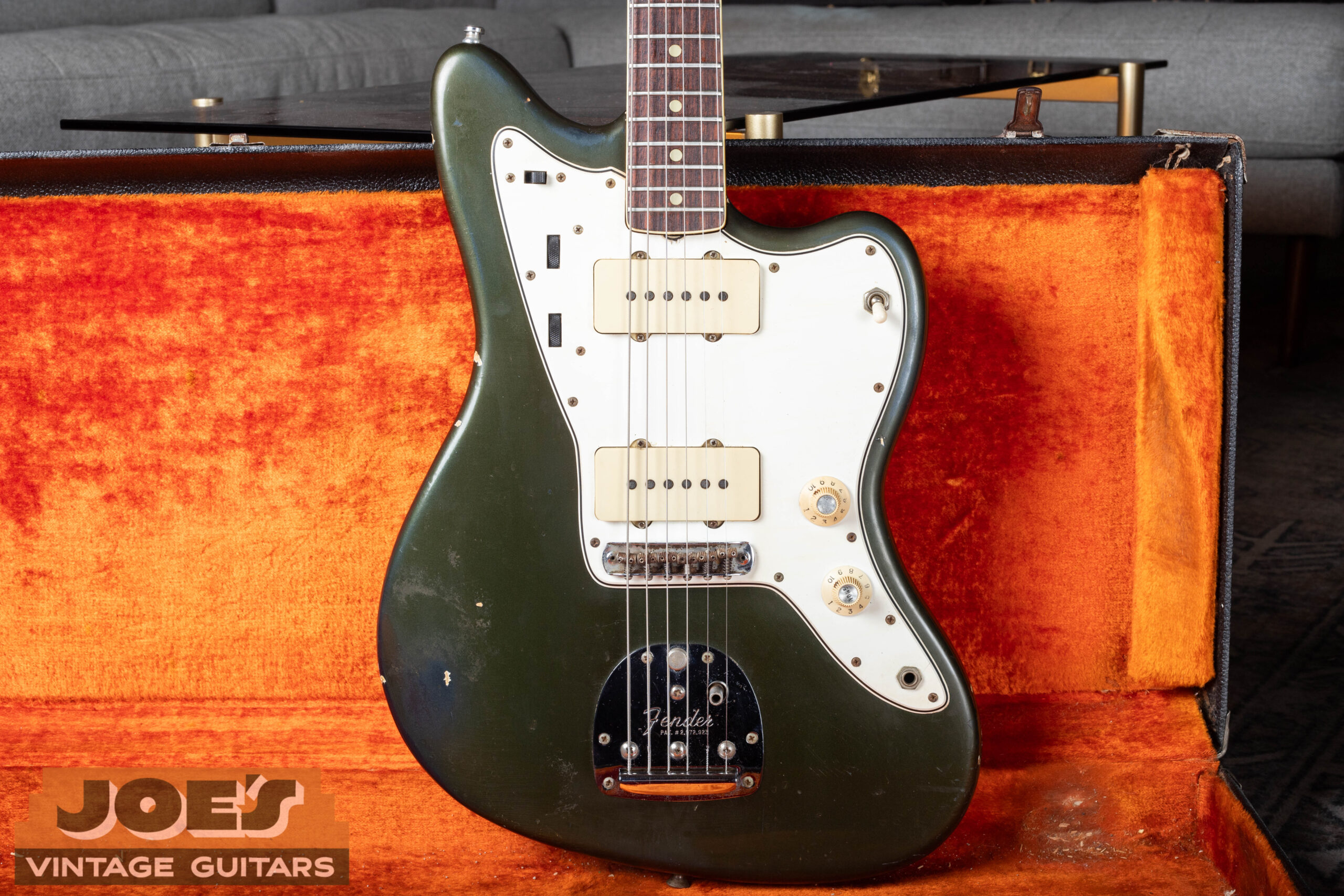
The Fender Jazzmaster debuted in late 1958 as the most expensive and feature-rich guitar in the Fender lineup — a deliberate attempt by Leo Fender to capture the jazz market with a guitar that felt different from the Telecaster and Stratocaster in every meaningful way. It was the first Fender production guitar with a rosewood fingerboard, the first with an offset-waist body, and the first with the elaborate dual-circuit rhythm/lead switching system that remains one of the most distinctive electronics setups in electric guitar history.
Jazz guitarists largely ignored it, preferring Gibson hollowbodies. But the Jazzmaster found an enthusiastic audience among surf musicians in the early 1960s, who prized its floating tremolo and bright, resonant tone. By the mid-1960s it had become a fixture on California stages, and decades later it would be adopted by indie, shoegaze, and alternative players who valued its tonal complexity and unconventional feel.
This guide documents every specification change the Jazzmaster underwent between its 1958 introduction and 1971, covering the full pre-CBS golden era and the early CBS period. Understanding these changes precisely is essential for accurate dating, authentication, and valuation.
Pre-CBS (1958–early 1965): Built under Leo Fender's ownership at the Fullerton, California factory. Generally considered the most desirable and collectible production period. Guitars from this era command significant premiums over later examples.
CBS Era (January 1965–1971): CBS Corporation acquired Fender on January 5, 1965. Changes began immediately but were gradual — the first truly CBS-influenced guitars didn't appear until mid-to-late 1965. By 1967–68 the character of the instrument had shifted substantially.
The Jazzmaster body is alder throughout the production run — the same tonewood used on the Stratocaster from 1956 onward. The offset-waist design is the Jazzmaster's most distinctive visual feature: the upper and lower bouts are offset from each other rather than symmetrical, creating a body that balances differently when playing seated compared to a Strat or Tele. The body has a single forearm contour cut on the upper bass side — less pronounced than the Stratocaster's double contour.
Body dimensions remained essentially constant throughout 1958–1971. The body is slightly larger and heavier than a Stratocaster.
The standard production finish throughout the entire run was 3-color sunburst — yellow center transitioning to orange then dark brown/black at the edges. The sunburst always received a white pickguard (see Section 04). Custom colors were available at an additional charge of 5% over list price; these are covered in detail in Section 05.
The finish medium was nitrocellulose lacquer throughout the pre-CBS era. CBS-era guitars transitioned to polyester finish starting approximately 1967–68. Poly finishes are thicker, more resistant to checking, and have a distinctly different aging character than nitro — a meaningful dating and authenticity indicator.
The Jazzmaster's electronics are its most complex feature — and the one most likely to be misunderstood or partially non-functional on older examples. The guitar has two entirely separate circuits operated by a single slide switch on the upper horn.
The Jazzmaster holds a significant place in Fender history: it was the first Fender production guitar to feature a rosewood fingerboard, introduced in 1958. The Telecaster and Stratocaster followed with rosewood options in 1959. This makes a 1958 Jazzmaster the earliest rosewood-necked Fender that can be purchased — a historical distinction that resonates with serious collectors.
The single most significant neck specification change in the Jazzmaster's history is the transition from slab to veneer rosewood fingerboard. This is the first thing any knowledgeable buyer checks, and it divides the pre-CBS era into two clearly defined periods.
The Jazzmaster switched to veneer rosewood in spring 1962 — several months before the Stratocaster (mid-1962) and the Telecaster (1959 had already moved to slab; veneer came later). This makes the Jazzmaster's fingerboard transition an important reference point for understanding the overall Fender production timeline.
The Jazzmaster went through three distinct inlay periods between 1958 and 1971, each with a specific character that serves as an immediate dating indicator:
Neck binding — a white plastic binding strip applied to the fingerboard edges — was introduced on the Jazzmaster in late 1965, coinciding with the early CBS-era changes. The bound neck with pearloid dots lasted only briefly before block inlays arrived in mid-1966. All bound-neck Jazzmasters are CBS-era instruments. An unbound neck is correct for all pre-CBS examples and for CBS-era guitars through late 1965.
Throughout the entire 1958–1971 production run, the Jazzmaster truss rod adjusts at the body end of the neck (the heel), not at the headstock. This requires removing the neck to access the adjustment nut. Headstock truss rod access did not appear on Fender instruments until 1971. Any claimed pre-1971 Jazzmaster with headstock truss rod access has a non-original neck.
Necks are dated directly on the wood at the heel. The method changed over the production run:
The Jazzmaster pickguard is one of the guitar's most visually distinctive and historically interesting features. Its large size — covering most of the body top — integrates the rhythm circuit controls as part of an aluminum-shielded upper plate, making it unlike any other Fender pickguard. The material and style changed three times between 1958 and 1971.
The first Jazzmasters carried a gold anodized aluminum pickguard — a continuation of the material Fender had used on student-model Musicmaster and Duo-Sonic guitars since 1956. The gold aluminum served a functional purpose beyond aesthetics: it provided significant electromagnetic shielding for the wide, hum-sensitive Jazzmaster pickups. The aluminum pickguard is secured by nine screws.
Guitars with the original gold anodized guard are known among collectors as "gold guard" Jazzmasters and are the rarest and most valuable examples. The gold guard era lasted approximately from the last quarter of 1958 through mid-1959 — roughly six to nine months of production. Gold guard Jazzmasters are found primarily in sunburst finish; some early custom colors may also have gold guards.
Because gold guard Jazzmasters command substantial premiums, replacement gold anodized guards (available from parts suppliers) are sometimes fitted to later guitars. Verify the guard with the neck heel date, pot codes, and body date — all must be consistent with 1958–early 1959 production for a genuine gold guard example.
In mid-to-late 1959, Fender replaced the gold anodized guard with a 4-layer celluloid tortoiseshell pickguard — tortoiseshell on top, then white, black, and white. This is the classic Jazzmaster look most associated with the 1960s surf era. The tortoiseshell celluloid was also used on the Precision Bass in 1959.
Celluloid is notorious for its instability: it shrinks, warps, and can become brittle over 60+ years. Original celluloid guards are frequently cracked, warped, or have shrunk noticeably — this is period-authentic behavior, not a quality flaw. The guard changed from nine screws (gold guard era) to thirteen screws from 1959 onward, as Fender added screws to combat the celluloid's tendency to warp.
An important exception: custom color guitars received white celluloid pickguards (not tortoiseshell) when the tortoiseshell era began. See Section 05 for the full custom color / pickguard pairing reference.
Around late 1964, Fender switched from celluloid to a more stable plastic (ABS or vinyl) tortoiseshell pickguard. The material change was practical — celluloid was fire-hazardous during manufacturing and temperamental in use. The plastic guard maintains the same visual appearance but does not warp and shrink the way celluloid does.
Collectors generally consider the plastic guard less visually attractive than the celluloid — the tortoiseshell pattern is often more uniform and less rich-looking. The transition from celluloid to plastic is a late pre-CBS / transition-era specification marker. The tortoiseshell pattern also changed slightly in the late 1960s, becoming more brown-red with black swirls and fewer white chunks compared to the earlier red-dominant celluloid pattern.
| Period | Material | Screws | Sunburst | Custom Colors |
|---|---|---|---|---|
| 1958–mid 1959 | Gold anodized aluminum | 9 | Gold guard | Gold guard (early) |
| Mid 1959–late 1961 | Celluloid tortoiseshell (4-ply) | 13 | Tortoiseshell | White celluloid |
| Late 1961–late 1964 | Celluloid tortoiseshell (4-ply) | 13 | Tortoiseshell | White celluloid (mint green aging) |
| Late 1964–1971 | Plastic tortoiseshell (3-ply) | 13 | Tortoiseshell | White plastic |
Custom colors were available on the Jazzmaster from its introduction, at a 5% premium over the standard list price. The lineup expanded and contracted over the years, and the correct pickguard for a given color changed depending on production period. This section provides a complete reference.
The key rule: sunburst Jazzmasters always received the tortoiseshell (or gold aluminum) guard; custom color Jazzmasters generally received a white guard — but this has nuance by era.
Custom color Jazzmasters available with a headstock painted to match the body — a significant value premium that collectors call a matching headstock. On Jazzmasters, all custom colors except Blonde received matching painted headstocks — Blonde guitars retained a natural maple headstock. Non-matching headstocks on non-blonde custom colors were standard only through approximately spring 1962; from spring 1962 onward matching headstocks are correct for all non-blonde custom colors. Always verify that a claimed matching headstock shows the same aging and lacquer character as the body finish — a fresh-looking headstock on an otherwise aged body is a red flag.
The following colors were available on the Jazzmaster at various points during 1958–1971. Availability varied by year; not all colors were offered throughout the entire run. Colors marked with (M) indicate matching headstock was standard; colors without (M) had non-matching natural maple headstocks on most examples.
When custom color Jazzmasters were painted at the Fullerton factory, the body was hung on a paint stick inserted into the neck pocket during spraying. The stick masked a small area of the neck pocket floor, leaving a shadow of bare wood or lighter finish where the stick blocked the paint. This "paint stick shadow" in the neck pocket is a period-authentic detail found on genuine factory custom color guitars — particularly from approximately late 1962 onward. Its presence in the neck pocket, showing the characteristic shape of the stick under the finish, is a positive authentication indicator for custom colors.
Many Fender custom colors fade dramatically with age. Sonic Blue, Seafoam Green, and Surf Green are among the most extreme faders — a heavily played example may look almost white or pale gray today. Daphne Blue fades toward a chalky gray-blue. Lake Placid Blue is more stable but can shift. When evaluating a faded guitar, UV light examination, and checking unfaded areas under the pickguard or at the neck pocket, help assess the original color and confirm the finish is original.
The Jazzmaster pickup is entirely unlike any other Fender pickup. Rather than a tall, narrow coil (Stratocaster) or a compact rectangular unit (Telecaster), the Jazzmaster pickup is a wide, flat, low-inductance single coil with a large aperture that senses the vibrating string over a wider zone. This design produces a warmer, rounder tone with more midrange presence and less high-frequency edge than a Stratocaster pickup — closer to a humbucker in some ways despite being a single coil.
The two pickups are reverse-wound and reverse-polarity relative to each other (RWRP), meaning that when both are engaged in the lead circuit's middle position, they achieve partial hum-cancellation — a feature Fender marketed prominently in 1958.
The pickup covers are plastic (not chrome) and mount directly to the body — not to the pickguard. The covers are flush with the pickguard surface, giving a clean integrated appearance with no exposed pole pieces visible from above. Pickup height is adjusted via screws that go through the body from below.
The color of the pickup base (bobbin bottom) changed during production and is a useful dating reference:
Original Jazzmaster pickups were installed with a piece of open-cell foam beneath each pickup to spring-load them upward against the strings — a tension-based height adjustment system. This foam is critical to proper pickup function but is also notoriously unstable over time.
After 50–60 years, the original foam typically decomposes completely — collapsing, hardening, or crumbling into nothing. When the foam fails, the pickups drop down into their routes, reducing output and changing the instrument's tone significantly. This is known as "foam rot" in the vintage Jazzmaster community and is one of the most common condition issues on vintage examples.
Checking for and replacing deteriorated foam (with appropriate modern open-cell foam cut to size) is standard maintenance, not a modification. The presence of the original deteriorated foam, or evidence of its prior presence, is an authenticity indicator — the absence of any foam (original or replacement) explains why a vintage Jazzmaster may sound weak or dull.
The body date on a Jazzmaster is penciled in the bridge pickup cavity, visible through the pickguard route. This date reflects when the body was routed and is a valuable independent dating reference, particularly for 1958–1965 guitars. Cross-reference with neck date and pot codes for a complete picture.
The Jazzmaster uses a floating bridge — a chrome unit with six individual threaded barrel saddles that sits in two posts but is not mechanically anchored to them. The bridge rests on the posts by gravity and string tension alone and can rock slightly with tremolo use. This floating design is integral to the Jazzmaster tremolo system's function.
The barrel saddles are individually adjustable for intonation and are threaded cylinders — quite different from the flat saddles of a Telecaster or the ABR-1 of a Gibson. The floating bridge is notorious for allowing strings to slip out of saddle grooves, particularly with aggressive playing or light string gauges. Many players address this with aftermarket saddle replacements or by substituting a Mustang bridge.
The tremolo is a separate unit from the bridge — a vibrato tailpiece that anchors and actuates the strings while the bridge floats. The tremolo features:
The toggle switch tip on the Jazzmaster's lead circuit selector changed in appearance during production and is a useful period indicator:
The Jazzmaster headstock shape remained essentially consistent from 1958 through approximately mid-1967 — the familiar large offset shape with six tuners in a row. Around mid-1967 the headstock was modified to the slightly different shape used on post-1965 Stratocasters. This is a subtle change not as dramatic as the Stratocaster's well-known headstock enlargement but visible in direct comparison.
Jazzmaster serial numbers are located on the neck plate on the back of the guitar — not on the headstock as on Gibson. The neck plate is a four-bolt chrome plate securing the neck to the body. Serial number formats changed over the production run.
| Format | Approximate Years | Example | Notes |
|---|---|---|---|
| 5-digit (no prefix) | 1958–1963 | 30,000–99,999 | Shared with other Fender models. Range overlaps significantly; serial alone cannot distinguish model. |
| L prefix + 5 digits | 1963–1965 | L00001–L99999 | "L" prefix applied to all Fender models in this period. L-series Jazzmasters are late pre-CBS and transition era. |
| 6 digits above large "F" | 1965–1977 | 100000–999999 | The large stylized "F" on the neck plate is a clear CBS-era indicator. Six-digit format used throughout. |
Fender serial numbers in the 1960s were batch-assigned and not strictly sequential by production date. A serial number places a guitar in a general range; precise dating requires cross-referencing the neck heel date, body cavity date, and pot codes. Relying solely on a serial number for precise year dating is a common and costly mistake.
The Jazzmaster debuted in the last quarter of 1958 as Fender's top-of-the-line guitar. It was the most expensive Fender available and the first to feature a rosewood fingerboard on a production model. Initial production was limited.
A transitional year dominated by the pickguard change. Early 1959 guitars still have the gold aluminum guard — the most valuable configuration. Mid-to-late 1959 guitars switch to the tortoiseshell celluloid guard that would define the model for the next five years.
The tortoiseshell celluloid pickguard is now fully established as standard. The custom color range is expanding. Relatively few year-specific changes — 1960 guitars share most features with late 1959 examples.
A relatively stable year with a few notable detail changes. The switch tip becomes whiter plastic (previously a slightly different material). The tremolo changes to the patent-number version.
1962 is the most specification-dense year in Jazzmaster history. The slab-to-veneer fingerboard transition — the single most important spec change in the model's run — occurs in spring 1962. Simultaneously, custom color guitars receive matching headstocks for the first time, and neck dating changes from pencil to rubber stamp.
All 1963 Jazzmasters have veneer rosewood fingerboards. The model is now fully in its mid-production configuration: spaghetti logo, clay dots, single-line Klusons, tortoiseshell celluloid guard, rubber-stamped neck dates.
Late 1964 sees the first cluster of changes since the 1962 fingerboard transition. The spaghetti logo gives way to the transition logo, clay dots are replaced by pearloid, and the celluloid pickguard is replaced by plastic. These changes mark the beginning of the "transition era" ahead of the CBS acquisition.
CBS Corporation acquired Fender on January 5, 1965. Guitars already in production were largely unchanged; new changes began appearing through the year. By late 1965, several CBS-era specifications were in place.
Mid-1966 brings the most visually dramatic CBS-era neck change: block inlays replace dots, establishing the appearance that will define the Jazzmaster through 1971. The bound neck with block markers is the classic late-1960s Jazzmaster look.
The finish transitions from nitrocellulose to polyester in 1967–68, a significant change in both manufacturing process and aging character. The CBS black logo replaces the transition logo.
Production quality continues to shift under CBS management. The model is increasingly out of step with the rock-oriented market dominated by Gibson Les Pauls and SGs. Sales decline.
The Jazzmaster continues in production through 1971 before being discontinued (temporarily — it would return decades later). Late CBS-era examples reflect the full extent of the post-1965 changes.
This table summarizes all major specification transitions across the full 1958–1971 production run for quick reference dating.
| Feature | 1958–mid 1959 | Mid 1959–1962 | 1962–late 1964 | Late 1964–mid 1965 | Mid 1965–mid 1966 | Mid 1966–1971 |
|---|---|---|---|---|---|---|
| Pickguard | Gold anodized aluminum | Celluloid tortoiseshell | Celluloid tortoiseshell | Plastic tortoiseshell | Plastic tortoiseshell | Plastic tortoiseshell |
| Custom color guard | Gold anodized | White celluloid | White celluloid | White plastic | White plastic | White plastic |
| Matching headstock | No | No | Yes (from spring 1962) | Yes | Yes | Yes |
| Fingerboard | Slab rosewood | Slab → Veneer (spring 1962) | Veneer rosewood | Veneer rosewood | Veneer rosewood, bound (late 1965) | Veneer rosewood, bound |
| Inlays | Clay dots | Clay dots | Clay dots → Pearl dots (late 1964) | Pearl dots | Pearl dots → Blocks (mid 1966) | Block inlays |
| Logo | Spaghetti | Spaghetti | Spaghetti → Transition (mid 1964) | Transition | Transition | CBS black (late 1967) |
| Tuners | Kluson no-line | Kluson single-line | Single-line → Double-line | Double-line → F-tuners (late 1965) | F-tuners | F-tuners |
| Knobs | Strat-style dome | Strat-style dome | Strat-style dome | Strat-style dome | Witch hat (mid 1965) | Witch hat |
| Tremolo mark | Pat. Pend. | Pat. Pend. → Patent # (mid 1961) | Patent number | Patent number | Patent number | Patent number |
| Finish | Nitrocellulose | Nitrocellulose | Nitrocellulose | Nitrocellulose | Nitrocellulose | Polyester (from ~1967–68) |
| Serial format | 5-digit | 5-digit | 5-digit / L-prefix | L-prefix | 6-digit + F plate | 6-digit + F plate |
| Neck dating | Pencil (or none) | Pencil → Stamp (spring 1962) | Rubber stamp | Rubber stamp | Rubber stamp | Rubber stamp |
Use these checks in sequence to narrow down the production date of any 1958–1971 Jazzmaster.
Step 1 — Immediate Visual Dating
Step 2 — Logo & Hardware
Step 3 — Fingerboard Depth Test
Step 4 — Internal Dating
Custom Color Verification
Joe’s Vintage Guitars
47 N Fraser Dr E
Mesa, AZ 85203
Phone: (602) 900-6635
Email: joesvintageguitars94@gmail.com
Written by Joe Dampt
“Driven by a love for classic tunes, I specialize in buying, selling, and appraising vintage guitars, bringing music and history together.”
The 1966 Gibson ES-335 is a pre-Norlin Kalamazoo instrument built to the same standard as…
The 1962 Fender Stratocaster sits at the end of the first golden age of Fullerton…
The 1959 Fender Telecaster is the most transition-dense year in the instrument's history — slab…
The complete authentication reference for the 1954 Gibson Les Paul Goldtop — the first full…
How to identify and authenticate any Gibson Byrdland — from the first Kalamazoo prototypes in…
The definitive collector's guide to the 1951, 1952, and 1953 Fender Precision Bass — the…


