
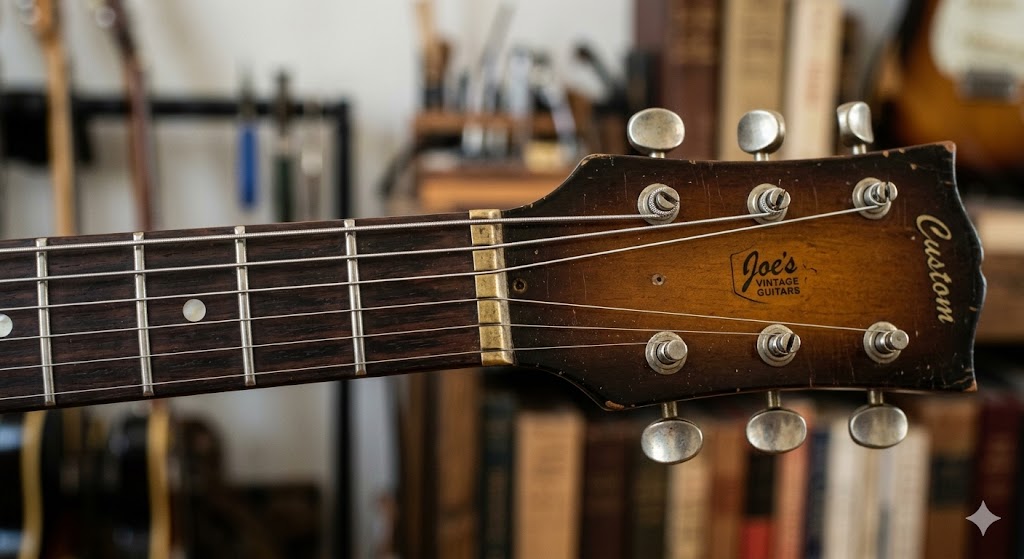
If you spend enough time looking at guitars from the late 70s and early 80s, you’re going to run into it: that gleaming, heavy piece of brass sitting at the top of the neck. For some, it’s a nostalgic badge of honor from the “sustain at all costs” era. For others—especially collectors—it’s the first thing that makes them reach for a bottle of wood glue and a bone blank to fix it.
At Joe’s Vintage Guitars, we see plenty of these come through. Whether it’s an old Strat that’s been heavily modded or a factory-original Gretsch, the brass nut tells a specific story about where guitar tech has been.
The brass nut craze didn’t happen in a vacuum. It was the 70s and 80s, and the industry was obsessed with mass. The thinking back then was that if you made everything heavier and denser, the guitar would ring forever. This gave us heavy ash bodies, heavy brass bridge blocks, and the aftermarket brass nut.
Companies like Stars Guitars and DiMarzio sold thousands of these to players who wanted that “infinite sustain” they heard on Jerry Garcia or Yngwie Malmsteen records. If you own a guitar that lived through the 80s, there’s a high chance someone at some point considered knocking out the original nut to “improve” it with brass.
It’s not just about looks; there is a real physics change here. Brass is a metal, and when you use it at the anchor point of the strings, the behavior changes:
The “Zero Fret” Effect: Since the nut is made of the same material as your frets, your open strings end up sounding almost exactly like fretted notes. You get a very consistent, balanced timbre across the whole board.
Top-End “Clank”: Brass doesn’t soak up high-frequency energy the way bone or plastic does. It reflects it. This results in a much brighter, “hi-fi” attack on your open notes. It’s a sharp, immediate sound that cuts through a mix.
The Reality of Sustain: Here’s the secret—the nut only really affects the tone of open strings. As soon as you fret a note, the nut is out of the loop. So while it might feel like the guitar is more resonant, that “infinite sustain” is often more psychological than physical once you’re actually playing a lead.
While it was usually an aftermarket mod, some brands leaned into the brass look. Gretsch is the most famous example. On some Chet Atkins 6120 models, they used plated brass nuts. These were often finished to match the gold or chrome hardware, giving the guitar a sleek, integrated look that fit the high-performance vibe Gretsch was chasing at the time.
I’ll be blunt: If you have a 1950s or 60s “Golden Era” guitar, a brass nut almost always dings the value.
When I’m looking at an instrument to buy, a brass nut is a “red flag” for a few reasons. First, the installation often leaves scars—chips in the headstock finish or an oversized nut slot. Second, it tells me the guitar was owned by a “modder,” which means I have to look twice as hard at the pickups, pots, and wiring to see what else was messed with.
For a collector, originality is everything. While a nut replacement is reversible, the work required to put a period-correct bone nut back in—and potentially fix finish chips—is a cost that comes right off the top of the guitar’s value.
If you’ve got a 70s “player” guitar and you love that bright, metallic snap, keep the brass. It’s part of that guitar’s history. But if you’re holding a pristine vintage piece, think twice before modifying it. In the vintage world, original bone or nylon almost always beats aftermarket brass.
At the end of the day, a brass nut is just one small piece of a much larger puzzle. Whether you are looking to restore a 70s “player” to its former glory or you’re trying to determine if a modification has compromised the investment potential of a family heirloom, you need an expert eye.
We specialize in navigating the nuances of the vintage market—from the “sustain mods” of the 80s back to the pristine factory specs of the 1950s. If you’re standing at a crossroads with your instrument, we’re here to help you make the right call for its tone and its future value.
Ready to learn more about your instrument? Explore our most popular resources:
Curious about what your gear is worth? Get a professional vintage guitar appraisal to see how modifications like these impact your specific instrument’s market price.
Thinking of moving on? We are always looking for high-quality pieces. If you want a fair, expert offer, visit our we buy vintage guitars page.
Need to date your instrument? Before you swap any parts, make sure you know exactly what you have with our Fender serial number guide or our Gibson dating resource.
Browse the Vault: See how original bone and factory brass look on the real deal by checking out our current vintage guitar inventory.
Joe’s Vintage Guitars
47 N Fraser Dr E
Mesa, AZ 85203
Phone: (602) 900-6635
Email: joesvintageguitars94@gmail.com
Written by Joe Dampt
“Driven by a love for classic tunes, I specialize in buying, selling, and appraising vintage guitars, bringing music and history together.”
Think of it as the ultimate "Telecaster on steroids." The Fender Hardtail Stratocaster is one…
Explore the history of the Gibson L-5 CES, the instrument that set the standard for…
Discover the forensic details that define the most coveted year in electric guitar history. From…
The 1962 Gibson ES-335 is the ultimate "transitional" masterpiece, bridging the gap between the 1950s…
Stop guessing about the rarity of your instrument and dive into the official Kalamazoo records.…
In the 'Golden Era' of Gibson production, few instruments carry as much mojo—or as much…


