The 1962 Gibson ES-335 Guide: Identifying the Block Inlay & Patent Number Transition
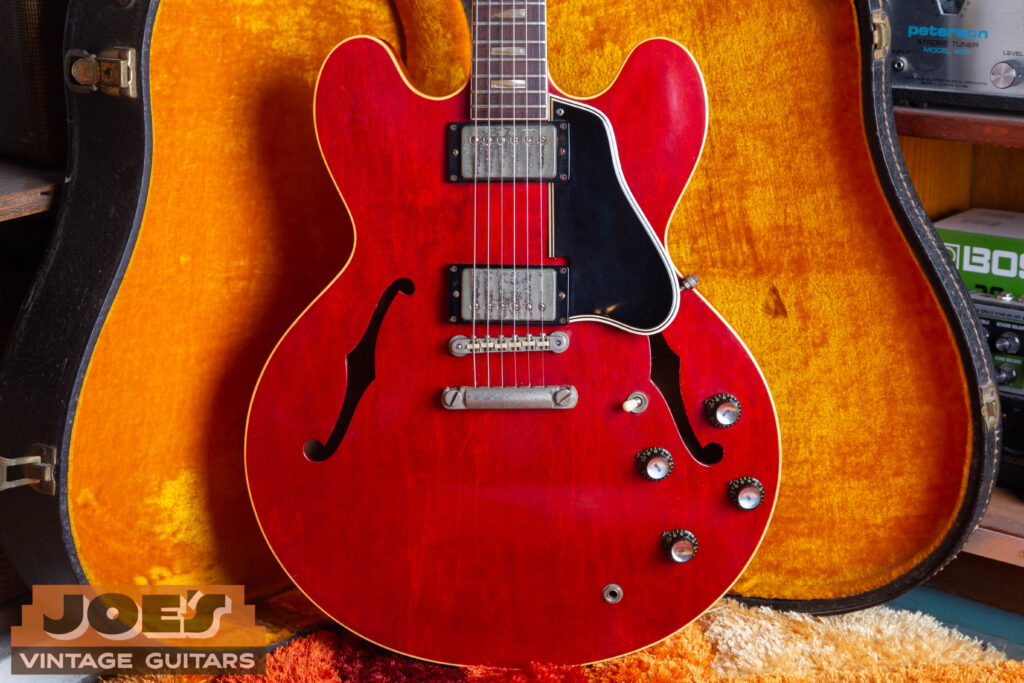
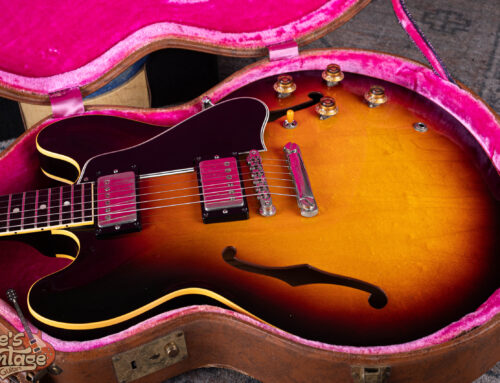
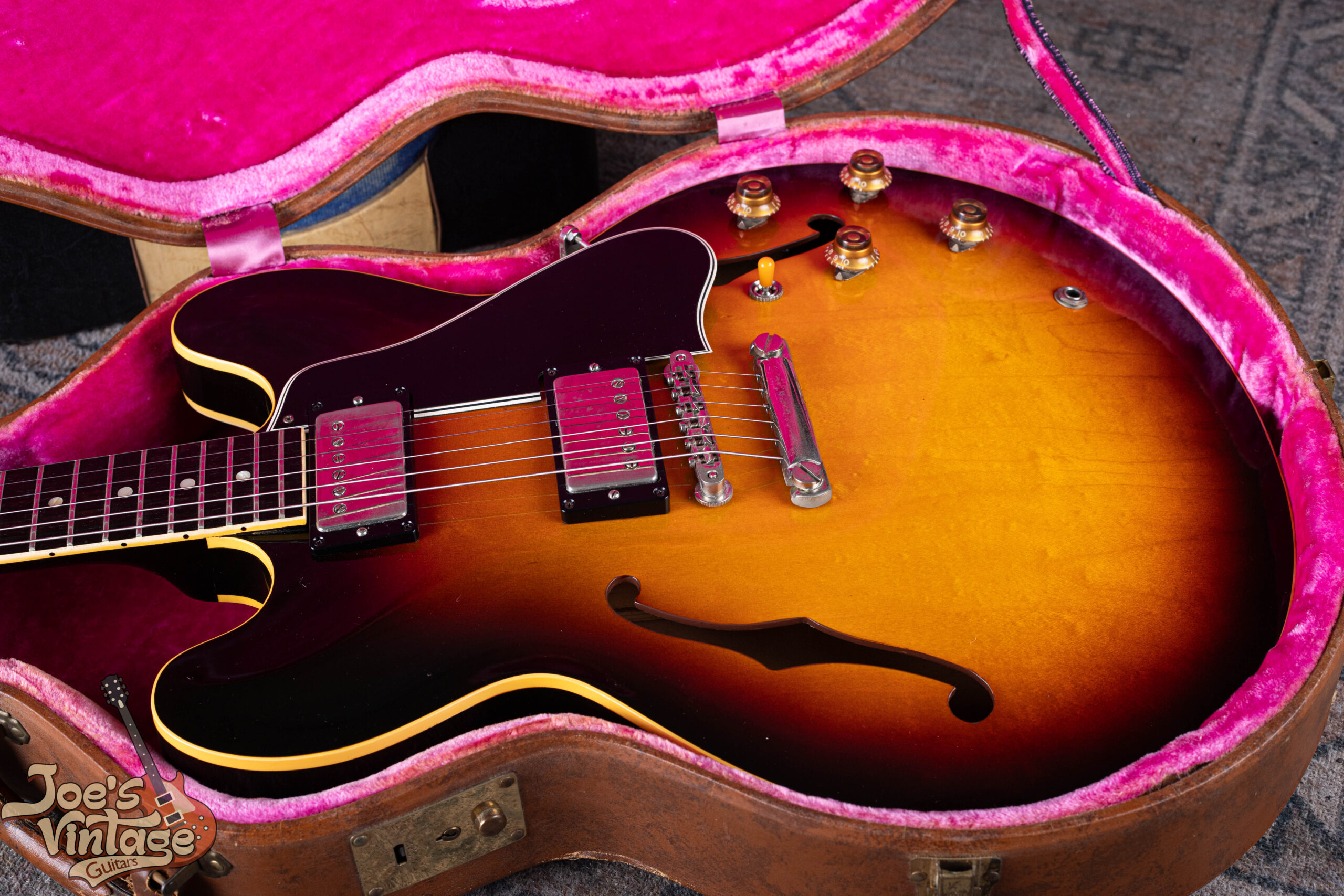
A pristine 1962 Gibson ES-335 showing the transition to block inlays while retaining the classic ‘Mickey Mouse’ ear cutaways and original Cherry nitrocellulose finish.
The 1962 Gibson ES-335 represents the ultimate “sweet spot” for collectors, marking the precise moment Gibson transitioned from the 1950s “dot neck” era into the iconic block inlay aesthetic. In this expert guide, we perform a deep-dive forensic evaluation of the 1962 ES-335 specifications, including the critical shift from PAF humbuckers to early Patent Number pickups and the final full year of the coveted “Mickey Mouse” ear body shape. Whether you are looking to verify the originality of a 1962 ES-335 or seeking a professional vintage guitar appraisal, understanding these nuanced 1962-specific details is essential for determining the true market value of this legendary semi-hollow staple.
Key Specifications of the 1962 ES-335
The 1962 Gibson ES-335TD marks a legendary “transitional” era, sitting perfectly between the early 1950s construction and the standardized mid-60s look. For collectors and players alike, the ’62 is often the “sweet spot”—it retains the most desirable “Golden Era” build quality while introducing the iconic block-inlay aesthetic.
The Great Pickup Transition: PAF vs. Patent Number Humbuckers
1962 was the definitive year Gibson transitioned from the legendary PAF (Patent Applied For) humbuckers to the “Patent Number” pickups. This is a critical detail for vintage guitar valuation, as early ’62 models often still feature the exact same components found in the 1950s.
-
How to Identify Them: Early Patent Number pickups are electronically identical to late-era PAFs. They still utilized the dark maroon/purple 42-gauge enamel wire and have a black lead wire.
-
The Decal Change: The primary physical difference is the sticker on the baseplate. While PAFs feature the “Patent Applied For” decal, these versions feature a black-and-gold decal reading “PATENT NO 2,737,842.”
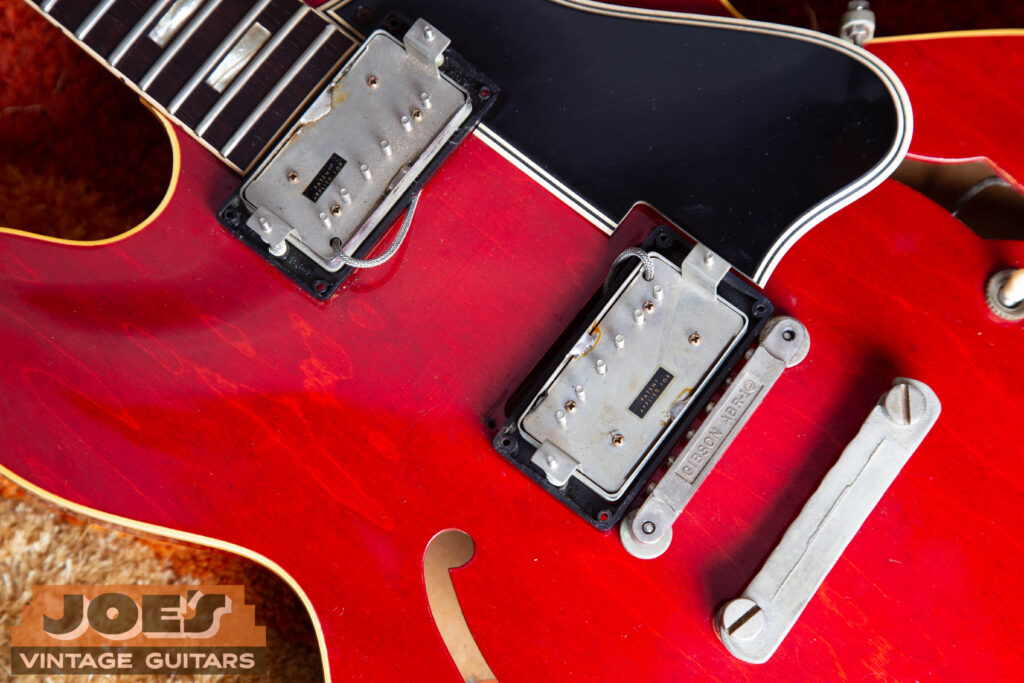
A rare sight: a matched pair of original 1962 PAF humbuckers. While many 1962 ES-335s feature two Patent Number pickups or a “transitional” mix of one PAF and one Pat No, finding two original 1950s-spec PAFs in a block-neck ’62 is a significant value-driver for collectors.
-
The Sound: Because the winding machines and materials remained consistent through 1962, a Patent Number pickup from this year delivers that same woody, touch-sensitive, and harmonically rich tone that made the original humbucker famous.
Visual Evolution: Block Inlays and “Mickey Mouse” Ears
The most striking visual shift in 1962 was the move from simple pearloid dots to cellulose nitrate block inlays. This elevated the ES-335’s look to align more closely with its upscale siblings, the ES-345 and ES-355.
Beyond the fretboard, the body shape is a hallmark of this year. 1962 is the final full year to feature the “Mickey Mouse” ears—the wider, more rounded cutaway bouts. By 1963, Gibson began narrowing these horns into the “pointed” shape seen throughout the rest of the 1960s. A 1962 model with “Mickey Mouse” ears and block inlays is one of the most recognizable and sought-after silhouettes in the vintage market.
Neck Profile and Brazilian Rosewood Fingerboard
While 1960 and 1961 necks are famous for being very thin and “blade-like,” the 1962 profile began to regain some much-needed depth.
-
The Feel: Though still slim compared to a chunky ’59, the ’62 neck typically has a bit more “meat” in the palm. It offers a comfortable medium-slim C-shape that provides better hand support and improved neck stability.
-
The Wood: Every 1962 ES-335 features a dark, high-grade Brazilian Rosewood fingerboard. This wood is prized for its density and oily texture, contributing to the guitar’s legendary sustain and warm tonal response.
Hardware and Appointments: Nickel, ABR-1, and Klusons
The hardware in 1962 remained high-spec, featuring nickel plating which ages with a beautiful, dull patina, rather than the shiny chrome that became standard in mid-1965.
-
Bridge & Tailpiece: This year features the “No-Wire” ABR-1 bridge, which lacks the metal retainer wire found on later 60s versions. The standard setup included a lightweight nickel-plated stopbar tailpiece, though many were shipped with the factory-option Bigsby B7 vibrato.
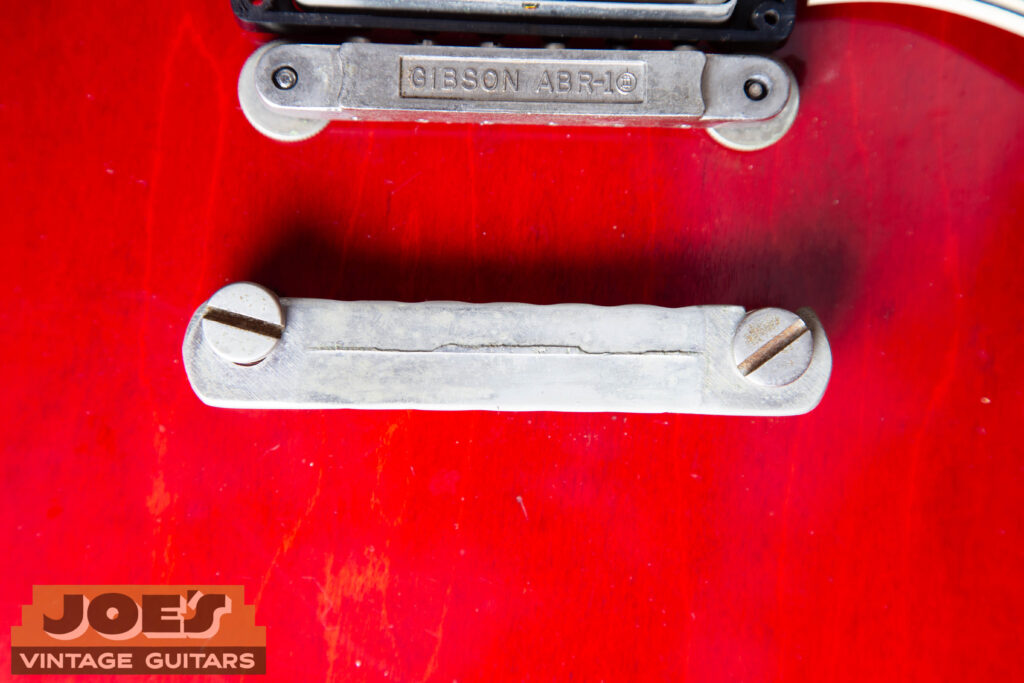
The mechanical heart of a ’62: This shot captures the rare ‘no-wire’ ABR-1 bridge alongside the back of an original lightweight tailpiece. Notice the ‘short seam’ on the tailpiece casting—a critical forensic marker that separates these original 1962 nickel components from later, heavier replacements.
-
Tuners: The guitar utilized Kluson Deluxe “Single Line” tuners (meaning “Kluson Deluxe” is stamped in a single vertical line). Notably, 1962 versions feature the “Double Ring” plastic buttons, a distinct change from the single-ring buttons of the late 50s.
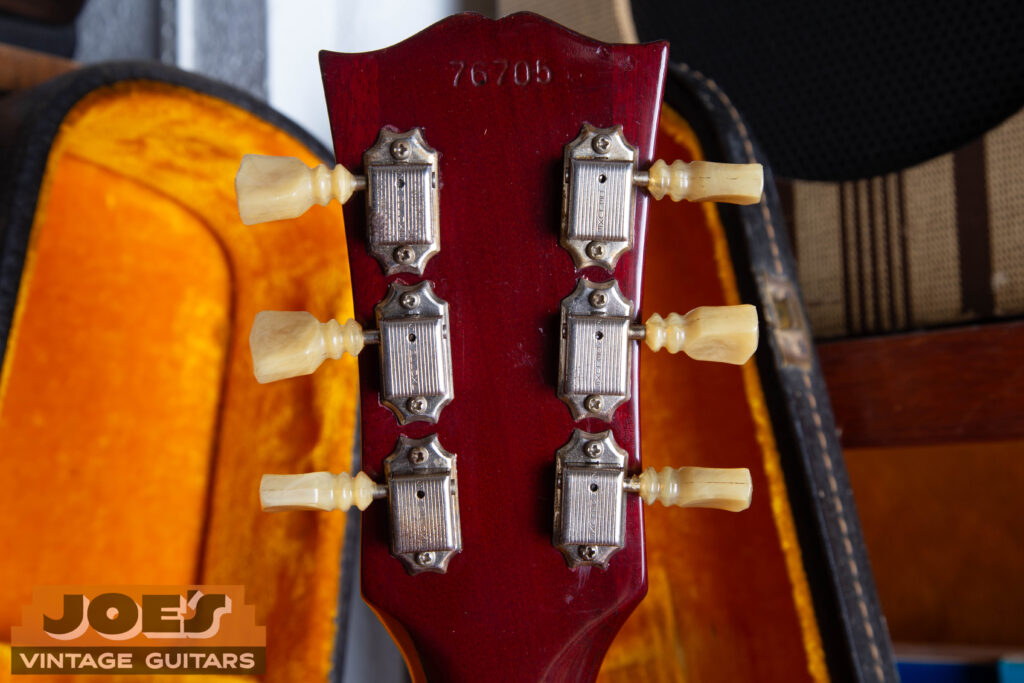
A hallmark of the 1962 transition: Kluson Deluxe ‘Single Line’ tuners featuring the distinct ‘Double Ring’ buttons. These replaced the single-ring versions of the 1950s and are a critical forensic marker for verifying a period-correct 1962 ES-335 headstock.
Identifying Your 1962 ES-335: Serial Numbers and Labels
To properly authenticate a 1962 Gibson ES-335, you must verify the serial number in two specific locations. Because 1962 was a transitional year, these numbers are critical for distinguishing a “Dot neck” from a “Block neck” and ensuring the hardware matches the production date.
-
Headstock Stamping: On the back of the headstock, the serial number is deeply “pressed” or stamped into the wood. Unlike later decades, 1962 stamps do not feature a “MADE IN USA” imprint, which was not introduced until 1970.
-
The Orange Label: Inside the bass-side f-hole, you will find the classic Gibson “Orange Label”. This label should clearly display the model name (ES-335TD) and a serial number that perfectly matches the stamp on the back of the headstock.
-
Production Ranges: Serial numbers for 1962 typically fall within the 42441 to 99999 range, though some overlapping occurs with 1963 production.
For a full breakdown of production years and factory codes, please refer to our Comprehensive Gibson Serial Number Decoder & Dating Guide.
The Case Transition: From Brown to Black
Even the “house” for these instruments evolved in 1962. This year marked the transition away from the classic 1950s brown Lifton case with the pink plush interior.
In its place, Gibson introduced the sleek black hardshell case with a vibrant yellow (marigold) interior. This black-and-yellow combination became the iconic look for Gibson’s professional-line guitars throughout the golden era of the 1960s. Finding a ’62 in its original black-and-yellow case is a “time capsule” experience for any collector.
Complete Specifications Chart for the 1962 Gibson ES-335
1962 Gibson ES-335 Specifications
| Specification | Detail |
|---|---|
| Body Wood | Laminated maple top, back, and sides with solid maple center block |
| Body Style | Semi-hollow double cutaway with "Mickey Mouse" rounded ears |
| Neck Wood | One-piece mahogany |
| Fingerboard | Brazilian Rosewood with cellulose nitrate block inlays |
| Fingerboard Radius | 12" radius |
| Neck Profile | Medium-slim C-shape (Transitional depth) |
| Neck Joint | Set neck, long tenon |
| Scale Length | 24.75" (Gibson standard) |
| Nut Width | 1-11/16" (1.6875") |
| Frets | Medium-jumbo wire, 22 frets |
| Pickups | Two humbucking pickups (Transitioning from PAF to early Patent Number) |
| Pickup Output | Approximately 7.5k-8.5k ohms DC resistance per pickup |
| Magnets | Alnico (Transitioning to Alnico V short magnets) |
| Pickup Covers | Nickel-plated covers |
| Bridge | Nickel-plated ABR-1 "No-Wire" Tune-o-matic |
| Tailpiece | Lightweight nickel-plated stop-bar or factory Bigsby B7 vibrato |
| Tuners | Kluson Deluxe single-line, double-ring plastic buttons |
| Truss Rod | Adjustable truss rod |
| Truss Rod Cover | Bell-shaped, two-ply black/white |
| Controls | Two volume, two tone, three-way toggle switch |
| Knobs | Gold or Black "Reflector" top hat knobs with metal inserts |
| Switch Tip | Amber or white plastic tip |
| Capacitors | "Black Beauty" .022mfd capacitors |
| Wiring | Braided shield wire |
| Binding | Single-ply cream binding on body and neck |
| Finish | Nitrocellulose lacquer (Cherry Red or Sunburst) |
| Weight Range | Typically 7.5-8.5 lbs |
| Case | Black hardshell case with Yellow (Marigold) interior |
What is a 1962 Gibson ES-335 Worth?
Determining the value of a 1962 Gibson ES-335 requires a deep dive into the specific features of that individual instrument. Because 1962 was a transitional year, a “Dot neck” version (produced early in the year) typically commands a higher premium than the “Block inlay” version. However, regardless of the fretboard markers, condition and originality are the primary drivers of market price.
Collector’s Note: Condition is everything. A 100% original 1962 ES-335 with a “Dot” neck is the rarest and most valuable variation of this year. When we appraise a ’62, we look at several critical factors:
-
Originality: Are the solder joints untouched? Are the tuners original “Single Line” Klusons?
-
The “PAF” Factor: If your ’62 still has original PAF stickers intact rather than the Patent Number stickers, the value jumps significantly.
-
Repairs: Beyond the obvious, we look for “Grovered” tuner holes or hidden structural issues that impact the final sale price.
Hardware and Components: The Value of Originality
In the vintage market, every screw and solder joint matters. When components are swapped, the value of a 1962 ES-335 can drop by 20% to 50% depending on the severity.
-
Pickups and Electronics: Original 1962 pickups (PAF or early Pat No) are worth thousands on their own. If the pickups have been replaced or the pots and electronics have been swapped, the value takes a major hit. We look for the original “Black Beauty” or “Bumblebee” capacitors and untouched harness soldering.
-
Tuners and Headstock Integrity: Many owners in the 70s swapped original Klusons for heavy Grover or Schaller tuners. The value is negatively affected if the original holes were widened or if additional screw holes were drilled into the back of the headstock. A “no-issue” headstock is a primary value driver.
-
Bridge and Tailpiece: Collectors look for the original nickel-plated “No-Wire” ABR-1 bridge and lightweight stop-tailpiece. Replaced bridges or modern “Nashville” style replacements are common but detract from the vintage appeal.
-
Knobs and Plastics: Even small parts like the original Reflector Top knobs, wide-bevel pickguard, and pickup rings hold significant value. Replacing these with modern reproductions can shave hundreds, if not thousands, off the appraisal.
The Bigsby Factor: Factory vs. Added
The presence of a Bigsby B7 vibrato significantly alters the value and “vibe” of a ’62.
-
Factory Bigsby: A factory-installed Bigsby is highly desirable. These are identified by a “Custom Made” plaque covering the stop-bar tailpiece holes and an internal ground wire running specifically to the Bigsby unit.
-
Later Added Bigsby: If a Bigsby was added later, it often means the stop-tailpiece was removed and the holes are either visible or plugged. While still a great playing modification, it does not carry the same premium as a factory-ordered vibrato.
Structural Integrity and Common Repairs
Because the 1960–1962 neck profiles were famously thin, they are more susceptible to specific types of damage.
-
Headstock Breaks: A classic Gibson “smile” (headstock crack) usually reduces the value of the guitar by 50%, even if the repair is professionally done and stable.
-
Truss Rod Cracks: Due to the slimness of the ’62 neck, it is common to see vertical stress cracks on the back of the neck caused by the pressure of the truss rod. While less catastrophic than a full break, they must be disclosed and accounted for in the price.
-
Refinishes and Overspray: An original nitrocellulose finish is paramount. A full refinish can cut the value in half. Even a “pro” overspray on the back of the neck to hide wear will diminish the collector’s value.
-
Frets and “Nibs”: For a guitar to be considered “all original,” it should ideally have its original frets. You can identify these by the plastic “nibs” (binding ends) that overlap the ends of the frets. If the guitar has been refretted, the nibs are usually gone. While a good refret makes a guitar more playable, collectors prefer the original fretwork if it still has life left.
Common Modifications for 1962 ES-335s
If you are looking at a 1962 ES-335, these are the most typical modifications you will encounter. Each one moves the guitar further from “Investment Grade” and closer to “Player Grade”:
-
Replaced Tuners: Usually changed to Grovers for “better stability” in the 1970s, often involving widened holes.
-
Replaced Bridge/Tailpiece: Often swapped for modern Nashville bridges or heavier zinc tailpieces.
-
Replaced Pickups: Many 1962s had their original humbuckers “borrowed” for Les Paul projects, replaced by later T-Tops or modern pickups.
-
Changed Nut: Original bone or nylon nuts are often replaced during refrets.
What Does a 1962 ES-335 Sound Like?
The sound of a 1962 ES-335 is often described by collectors as the “holy grail” of versatility, offering a unique tonal profile that sits between the aggressive bite of a solid-body and the airy resonance of a full hollow-body.
The Impact of Electronic Components
The specific electronics used in 1962 are fundamental to the guitar’s “vocal” quality and touch sensitivity:
-
PAF and Early Patent Number Humbuckers: Whether sporting the “Patent Applied For” or early “Patent Number” decal, these pickups utilized the same 42-gauge purple enamel wire and winding patterns. This results in a clear, uncompressed tone with a “chimey” top end and a woody, articulate low end that never becomes muddy.
-
Alnico Magnets: The transition to Alnico V short magnets during this era provided a slightly punchier, more focused magnetic field compared to the softer Alnico II magnets of the late 50s, giving the ’62 a bit more “cut” in a mix.
-
“Black Beauty” Capacitors: These .022mfd capacitors are famous for their smooth treble roll-off. When you back down the tone knob, the guitar retains its clarity rather than becoming muffled, allowing for “woman tone” or dark jazz textures.
-
Braided Shield Wiring: The high-quality internal wiring ensures minimal signal loss and interference, maintaining the pure harmonic content of the pickups.
The Impact of Construction Details
The physical build of the 1962 model shapes how that electrical signal resonates and sustains:
-
Semi-Hollow Design with Maple Center Block: The solid maple block running through the center of the laminated maple body provides the sustain and feedback resistance of a Les Paul. However, the hollow “wings” add a layer of acoustic resonance and “air” around the notes that you won’t find in a solid-body.
-
Brazilian Rosewood Fingerboard: The high oil content and density of the Brazilian Rosewood add a fundamental warmth and smoothness to the attack of each note.
-
Nickel-Plated Hardware and ABR-1 Bridge: The “No-Wire” ABR-1 bridge provides a direct, metallic transfer of string vibration to the body. The lightweight zinc or aluminum tailpiece (or the added mass of a Bigsby B7) further influences sustain; a stop-tail usually offers more “snap,” while a Bigsby adds a subtle, shimmering acoustic quality.
-
Transitional Neck Profile: The medium-slim C-shape neck of 1962 has more mass than the very thin 1961 profiles. This extra mahogany in the neck typically results in better note fundamental stability and improved overall resonance.
The Magic of Aging: Nitrocellulose and Vintage Tone Wood
Beyond the electronics and hardware, the physical aging process of a 1962 ES-335 plays a massive role in its unique sonic thumbprint.
-
Thin Nitrocellulose Lacquer Finish: Unlike modern thick poly finishes that can “choke” a guitar’s resonance, the original nitrocellulose lacquer used in 1962 is extremely thin and porous. Over sixty years, this finish has hardened and sunk into the grain, allowing the wood to vibrate more freely and “breathe”. This results in a more open, resonant acoustic response that translates directly through the pickups.
-
Aged “Old Growth” Tone Woods: The mahogany and maple used in the early 1960s came from old-growth forests, offering a density and grain pattern rarely seen today. Decades of vibration and drying have crystallized the resins within the wood cells, making the instrument more stable and acoustically “alive”. This “seasoned” wood provides a fundamental warmth and a complex harmonic richness that new instruments struggle to replicate.
-
The “Vibe” of the Semi-Hollow Construction: The combination of the solid maple center block and the hollow laminated “wings” creates a unique compression. When you dig in, the center block provides the snap and sustain of a solid body, while the air in the outer bouts adds a “halo” of resonance around the note, giving it a three-dimensional quality.
-
Hide Glue Construction: In 1962, Gibson was still using traditional hide glue for critical joints like the neck-to-body connection. Because hide glue dries to a glass-like hardness, it creates a superior mechanical bond that allows vibration to transfer seamlessly from the neck into the body, enhancing the guitar’s overall sustain and “thump”.
Iconic Players of the 1962 ES-335
Vintage & Session Legends
-
G.E. Smith: The legendary Saturday Night Live bandleader and Hall & Oates guitarist has owned a 1962 ES-335 since the 1970s and still uses it for its specific “cut” in a mix.
-
Alvin Lee: While his famous “Big Red” started as a 1959 model, after a neck break, it was fitted with a 1960s block-inlay neck identical to 1962 specifications, creating its signature “hybrid” look.
-
Kirk Fletcher: The blues powerhouse frequently uses a 1962 Sunburst dot-neck (an early 1962 rarity) to achieve his signature thick, soulful blues tones.
-
Brian Ray: The longtime guitarist for Paul McCartney owns and performs with a 1962 “dot neck” 335, a rare early-year version that retains the 50s aesthetic with 60s electronics.
The Modern Masters
-
Keith Urban: One of the most prominent current users, Urban plays his original 1962 Cherry ES-335 (fitted with a Bigsby) almost every night, specifically on the song “Sweet Thing”.
-
Chris Buck: The Cardinal Black guitarist is frequently seen with a beautiful 1962 Sunburst ES-335 that he describes as one of the best-sounding guitars he has ever played.
-
Larry Carlton: Known worldwide as “Mr. 335,” Carlton is famously associated with his 1969 model, but he has been filmed and recorded extensively playing a 1962 block-neck during special sessions and at Norman’s Rare Guitars.
-
Joe Bonamassa: A massive collector and advocate for the 1962 transition, Bonamassa often tours with and showcases his 1962 ES-335 in both Cherry and Sunburst finishes.
Notable Honorable Mentions
-
Eric Clapton: While his most famous “Crossroads” 335 was a 1964, he is the primary reason the early-60s “block neck” cherry 335 became the industry standard for rock and blues.
-
Freddie King: Though he is most often associated with the ES-345, the 1962 ES-335 is the guitar most often cited as the “blueprint” for capturing his stinging, aggressive blues tone.
-
Miles Kane: The Last Shadow Puppets co-frontman uses a 1962 Bigsby-equipped 335 for his gritty, vintage-inspired indie rock sound.
Why Choose Joe’s Vintage Guitars for Your 1962 ES-335?
When it comes to a high-value transitional instrument like the 1962 ES-335, general guitar shops simply don’t have the specialized knowledge required to spot the nuances that determine tens of thousands of dollars in value. At Joe’s Vintage Guitars, we live and breathe the “Golden Era” of Gibson production.
Unmatched Technical Expertise
We don’t just look at the serial number; we perform a deep-dive forensic evaluation of every 1962 model that crosses our bench. Our expertise allows us to accurately identify:
-
The PAF vs. Patent Number nuances: We know exactly how to identify the purple enamel wire and long-magnet transitions that can significantly increase the value of an early ’62.
-
Structural Verification: We are experts in detecting the specific vertical truss rod cracks and “smile” headstock repairs that are common on these thinner 60s neck profiles.
-
Component Integrity: We verify the “Black Beauty” capacitors, the “No-Wire” ABR-1 bridge specs, and ensure the solder joints are untouched and original.
A Transparent Appraisal Process
Whether you are looking for an insurance valuation or a “fair market” price, our Official Appraisal Services provide you with the documentation and peace of mind you need. We treat your 1962 ES-335 with the respect it deserves, providing a level of detail that big-box retailers can’t match.
The Best Choice to Sell Your Gibson
If you are ready to part with your instrument, we are the premier destination for those looking to Sell My Gibson Guitar. We understand the emotional and financial weight of selling a vintage piece, which is why we offer a straightforward, high-value acquisition process that cuts out the middleman and the auction fees.

Joe’s Vintage Guitars
47 N Fraser Dr E
Mesa, AZ 85203
Phone: (602) 900-6635
Email: joesvintageguitars94@gmail.com

Written by Joe Dampt
“Driven by a love for classic tunes, I specialize in buying, selling, and appraising vintage guitars, bringing music and history together.”