Authentication Guide · Fender Solid Body · 1962
The complete year-specific reference for dating and authenticating a genuine 1962 Fender Stratocaster — the slab-to-veneer transition, black-bottom pickups, serial numbers, pot codes, and every pre-CBS detail that matters

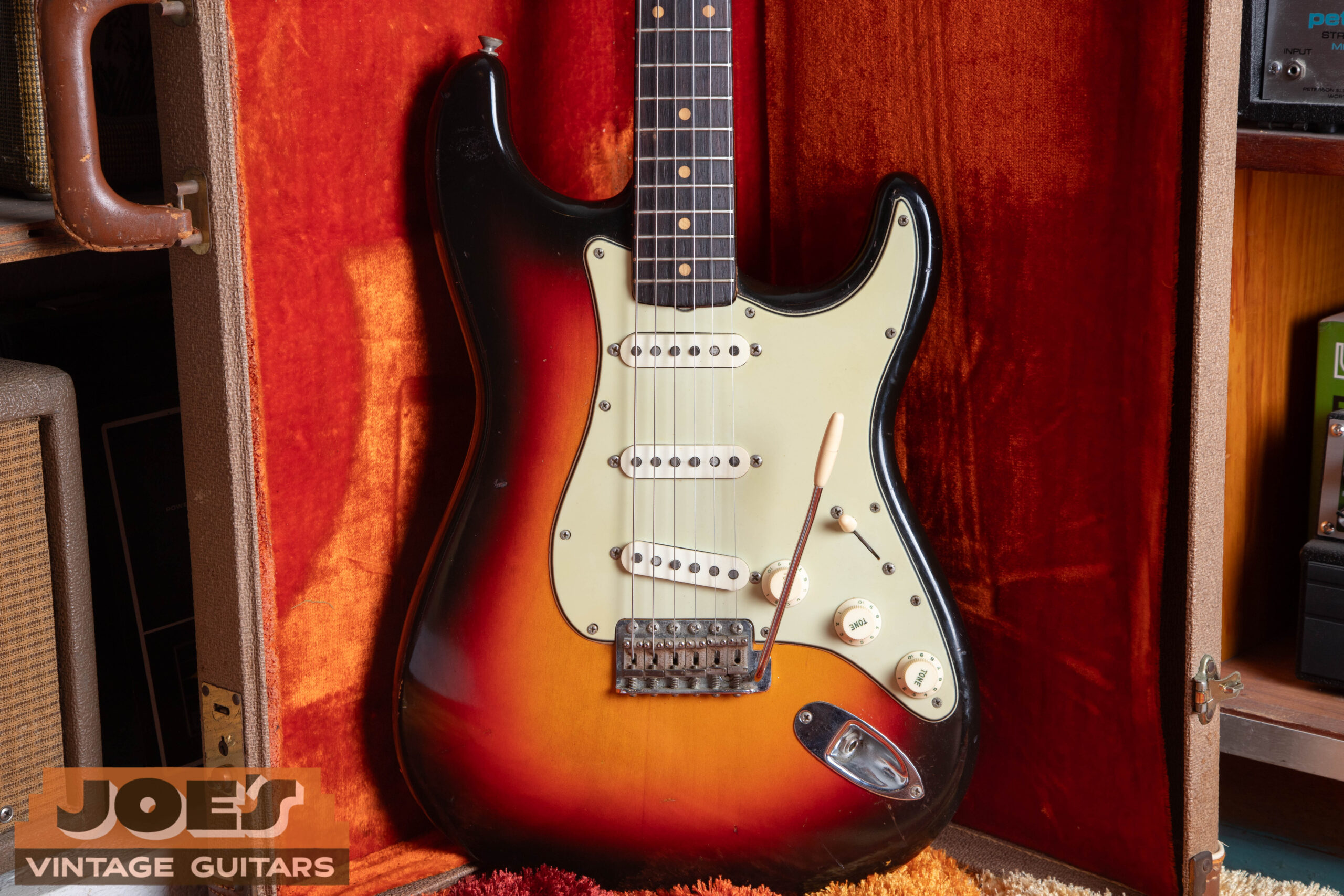
The 1962 Fender Stratocaster occupies a singular position in the instrument's history. It sits at the precise end of what collectors consider the first golden age of Stratocaster production — pre-CBS, pre-veneer, and built at the Fullerton factory at the peak of Leo Fender's quality control. CBS acquired Fender in January 1965, and while the guitars didn't change overnight, the slow drift toward cost-cutting had already begun by 1964. A genuine 1962 Stratocaster predates all of that.
The year's defining authentication challenge is the slab-to-veneer rosewood fingerboard transition that occurred in mid-1962. This single change — from a thick, flat-bottomed slab of rosewood to a thinner curved veneer — is the most consequential physical divide in vintage Stratocaster collecting. Early 1962 examples with the slab board are more desirable and more valuable than late 1962 examples with the veneer board. Knowing which you have, and how to prove it, is the core task of authenticating a 1962.
1. Slab or veneer rosewood fingerboard? Slab boards run from 1959 through approximately mid-1962; veneer boards from mid-1962 through approximately 1983. Both are correct for 1962 depending on production date. Slab examples command a significant premium.
2. Do the pickups have black fiber flatwork on the bottom? Black-bottom pickups are correct for all pre-CBS Stratocasters including 1962. Gray flatwork appeared later, around 1964, and continued into the CBS era — so gray bottoms actually indicate a later, not earlier, instrument. This is one of the most commonly misunderstood authentication details.
3. Do the pot codes confirm 1962? Pot codes provide the earliest possible assembly date and are the most reliable internal dating tool. A guitar claiming to be a 1962 with pot codes from 1964 or 1965 is not a 1962.
4. Is the finish original? Refinished Stratocasters are extremely common — the value difference between an original-finish and refinished pre-CBS Strat is enormous. A sunburst should show the characteristic three-tone fade; custom colors should show the correct aging and checking pattern for nitrocellulose.
These specifications reflect standard 1962 production. Where the slab/veneer transition creates a split, both variants are noted. All changes from 1961 are marked.
Like all pre-CBS Fender instruments, the 1962 Stratocaster serial number is an unreliable standalone dating tool. Neck plates were produced in batches and stored, then assigned by assemblers who grabbed from bins without regard for sequence. The serial number places a guitar in a broad era — it does not confirm the year.
The serial number is stamped on the plain chrome 4-bolt neck plate on the back of the body. For 1962 production the approximate range is 80000 to 99999 — five digits, no prefix letter. This range overlaps significantly with late 1961 and early 1963 production.
A critical dating marker: the L-series serials began in January 1963. L-series serials have a prefix letter "L" followed by five digits (e.g., L00001). If a claimed 1962 Stratocaster has an L-series serial, either the neck plate has been swapped, or the guitar was built in 1963 or later. Conversely, a 5-digit serial in the 80000–99999 range is consistent with 1962 but not conclusive.
Fender serial plates from this era are notoriously unreliable for precise dating. Always cross-reference: neck heel date + body date + pot codes + physical features. The serial is an era indicator, not a year confirmation. See our complete Fender serial number guide for the full dating framework.
The most reliable single dating reference on a pre-CBS Fender is the penciled or stamped date on the butt end of the neck heel, visible only when the neck is removed from the body. By 1962, Fender had resumed rubber-stamping dates after the mid-1959 pencil moratorium. The date appears in a month-year format (e.g., "3-62" for March 1962 or "9-62" for September 1962) stamped into the wood.
On a genuine 1962, the stamp ink will have aged and partially absorbed into the wood grain. Fresh-looking stamps on wood that shows other signs of age are suspicious. The stamp is always on the butt end of the heel — never on the face of the heel or on the side.
Fender penciled a date inside one of the body's routed cavities. On a 1962 Stratocaster this is most commonly found in one of the pickup cavities or in the tremolo spring cavity on the back of the body — not in the neck pocket as on some other Fender models. Check the middle or neck pickup route first, then the trem cavity if not found there. The date is in M-YY format (e.g., "6-62" for June 1962) and reflects when the body was routed and prepared, which may precede final assembly by weeks or several months. A body date and neck date differing by a few months are normal.
The three pots in the control cavity carry manufacturer-stamped date codes in the format MFRYYWW: manufacturer code, year (2 digits), week (2 digits). Common 1962 Fender pot manufacturers:
The pot code gives you the earliest possible assembly date. Always read all three pots — the latest date code sets the floor. A pot reading significantly later than the neck date indicates a replaced pot.
Remove the 11 pickguard screws and lift the guard carefully — the wiring harness is attached. The three pots are soldered to the pickguard. The date code is stamped on the back of the pot casing. A flashlight and a magnifier make reading them much easier without fully removing the harness.
The transition from slab to veneer rosewood fingerboard is the single most important feature distinction in 1962 Stratocaster authentication. It affects value, desirability, and historical placement within the year's production. Understanding it in detail is essential.
Introduced on the Jazzmaster in 1958 and adopted across all Fender models in 1959. The rosewood fingerboard is a thick, flat-bottomed slab approximately 4.8mm deep, glued directly onto the flat-milled top of the maple neck blank.
The replacement introduced in mid-1962, used on all rosewood-board Stratocasters through approximately 1983. The rosewood is a much thinner curved veneer (~2mm) whose underside follows the radius of the neck, requiring a curved top on the neck blank.
The definitive test is to look at the headstock end of the neck from the front, where the rosewood meets the maple at the nut. The depth of the rosewood relative to the maple is immediately visible:
A slab-board 1962 Stratocaster can be worth substantially more than a veneer-board example from the same year with otherwise identical specifications. The slab board is thicker, tonally distinct to many players, and historically significant as the design Leo Fender intended when he introduced the rosewood fingerboard. If you're evaluating a claimed early-1962 and the seller hasn't mentioned slab vs. veneer, look before you buy.
By 1962 Fender had settled into what collectors call the slim "C" profile — a comfortable oval-to-C cross-section that is thinner front-to-back than the chunky "V" profiles of 1954–1957. The 1962 neck is not as thin as the very narrow profiles that appeared on some CBS-era Strats, but it is distinctly slimmer than any 1950s example. Players accustomed to vintage Telecasters sometimes find the 1962 Strat neck slightly thinner than expected. This is correct and period-authentic.
The standard 1962 Stratocaster body is alder — a light, even-grained hardwood with a moderate weight that Fender adopted for non-transparent finishes in 1956. The choice of alder for sunburst and custom color bodies was driven by its tighter grain and superior paint adhesion compared to ash. On a genuine 1962 body, the wood grain should be subtly visible through the lacquer at oblique angles even on opaque finishes.
Ash bodies are correct for blonde Stratocasters — the standard wood for that finish in 1962. Ash was used for blonde because its pronounced grain shows attractively under the semi-transparent blonde lacquer. If a claimed 1962 sunburst or custom color has an ash body rather than alder, that warrants investigation.
The Stratocaster's double-cutaway contoured body is one of Leo Fender's most distinctive designs — the forearm comfort cut on the top edge and the ribcage belly cut on the back were unique features in 1954 and remain hallmarks of the instrument. On a genuine 1962 body, both contours should be smooth, well-defined, and show the same finish aging as the rest of the body. Sharp, fresh-looking contours on an otherwise aged body suggest a refinish or body replacement.
Unlike the Telecaster (where the body date is under the bridge plate), the 1962 Stratocaster body date is penciled inside one of the pickup cavities — typically the middle or neck pickup route — or inside the tremolo spring cavity on the back. Check these locations with the pickguard removed and the spring cover off. The neck pocket on a Stratocaster typically does not carry the body date.
The standard finish for the 1962 Stratocaster is the 3-color sunburst: a center of yellow or amber, transitioning to orange, then to a dark brown or black at the edges. This replaced the earlier 2-color sunburst (yellow to black, no orange layer) in 1958. The 3-color was the standard through the CBS era and beyond.
On a genuine original-finish 1962 sunburst, the yellow center will have faded and the orange layer may have shifted toward amber or brown with age. The dark outer edge holds its color better than the middle layers. Under UV light, the yellow and orange layers often fluoresce differently than a modern refin — experienced appraisers use UV inspection routinely on sunburst Strats.
Checking patterns in the nitrocellulose lacquer are a positive aging indicator — nitro checks (fine cracks in the finish) develop over decades. Modern polyester or polyurethane finishes used on refins don't check the same way. However, checking can be artificially induced, so it's a supporting indicator rather than definitive proof.
One of the most compelling authentication details on an original-finish pre-CBS Stratocaster is the "puzzle piece" pattern visible under the neck plate. When a guitar is finished before the neck plate is attached, lacquer builds up around the plate's footprint. Over decades, the finish checking and wear pattern on the neck heel area of the body follows the exact outline of the plate — chips, cracks, and lacquer lifting conform precisely to the plate's edge.
When you remove the neck plate, you should see a clearly defined area of less aged or protected finish underneath exactly matching the plate's shape. More tellingly, any finish chips or checking that cross the plate boundary should match up perfectly — a chip that starts on the exposed body and continues under the plate, or checking patterns that continue across the boundary, confirm the plate has never been removed or swapped. If the finish under the plate looks dramatically different (fresher, differently checked, or if chips along the edge don't align), the plate may not be original to this body.
Fender suspended bodies from nails during the finishing process — the nail was driven in first, then the body was sprayed. On a 1962 Stratocaster the nail holes are on the face of the body, hidden under the pickguard. The critical authentication point: because the nail was in place during spraying, it masked the inside of the hole from the finish. A genuine original nail hole should have bare, unfinished wood inside — the lacquer never reached it. If the inside walls of a nail hole show finish coating, the body was refinished after the nail was removed, with lacquer flowing into the now-empty hole. On a genuine 1962, lift the pickguard and look inside the nail holes with a light — bare wood inside is correct.
The 1962 Stratocaster uses a 3-ply white/black/white pickguard — the three layers visible at the edge as a white-black-white sandwich. This replaced the single-ply anodized aluminum guard (1954–1959) and the single-ply white celluloid guard (briefly used in the transition). By 1959–1960 the 3-ply celluloid guard was standard, and it remained so through the CBS era. The 1962 guard has 11 mounting screws.
The original 1962 pickguard will show visible aging — slight warping or cupping from decades under string tension. Importantly, the outer white layer of genuine pre-CBS 3-ply guards ages to a distinctive mint green color over time, caused by the off-gassing of the celluloid material. This mint green aging is a hallmark of an original period guard and is very difficult to replicate convincingly on a reproduction. A guard that remains bright white after 60+ years is more likely a replacement. The screw holes should show the same chrome oxidation as the hardware.
The Stratocaster pickguard is one of the most frequently replaced parts on vintage examples. Players crack them, break screw ears, or swap them for different colors. A replacement guard is not automatically a red flag, but if the replacement doesn't match the period spec (wrong ply count, wrong screw count, wrong material), note it. More importantly, the screw holes in the body should show their original patina — fresh holes suggest the guard was removed and replaced repeatedly or the body was refinished.
The 1962 Stratocaster control layout is fixed: master volume, neck pickup tone, middle pickup tone — with no bridge pickup tone control. The bridge pickup runs entirely without a dedicated tone control on vintage Strats. This layout was standard from 1954 through the present day on vintage-spec instruments.
The 3-way pickup selector switch is positioned on the upper bout, angled at approximately 45 degrees. A crucial authentication point: the 5-way switch was not introduced until 1977. Any claimed 1962 Stratocaster with a 5-way switch has had the switch replaced. This is an extremely common modification — players discovered in the 1960s and 70s that balancing the 3-way switch between positions produced desirable "in-between" tones, which led Fender to officially adopt the 5-way in 1977. The original 3-way switch has two visible positions rather than five.
The 1962 Stratocaster uses white plastic "dome" knobs — round-topped with a flat skirt and a knurled edge. These are sometimes called "Strat knobs" or "top-hat knobs" in the vintage community. They are white (aging to cream) and made of a plastic that becomes slightly brittle with age. The volume knob is typically positioned closer to the strings and wears differently than the tone knobs — look for consistent aging across all three.
The knobs fit push-on over a splined shaft. Original knobs should fit snugly without wobble. Replacement knobs (if not correct period parts) may fit loosely or show different aging.
The single fastest authentication check on any claimed pre-CBS Stratocaster is to look at the bottom of the pickups. Genuine pre-CBS Fender Stratocaster pickups use black fiber flatwork on the bobbin bottom — the flat base plate from which the pole pieces extend. This black color is the correct specification for all 1962 production. Gray flatwork appeared later, around 1964, and continued into the CBS era — counterintuitively, gray bottoms indicate a later instrument, not an earlier one. This is one of the most commonly confused details in vintage Strat authentication.
Accessing the pickup bottoms requires removing the pickguard. With the guard removed and the pickups flipped, look at the bottom bobbin: a genuine 1962 should show black fiber flatwork. Gray flatwork on a claimed 1962 indicates either a replacement pickup from a later period or a misidentified instrument.
This is one of the most widely misunderstood details in vintage Strat collecting — the common assumption that gray bottoms are pre-CBS is incorrect. Black fiber flatwork is correct for all genuine 1962 Stratocaster pickups. Gray flatwork came in around 1964. If a claimed 1962 has gray-bottom pickups, they are either replacements from a later period or the guitar itself is not a 1962. Check all three pickups — they should all match.
The Fender Synchronized Tremolo — introduced on the Stratocaster in 1954 — is one of Leo Fender's most significant engineering contributions. Unlike the Bigsby and Kaufman vibratos that preceded it, the synchronized tremolo maintains relative tuning across all six strings by pivoting on six screws and returning to the same position. The 1962 bridge is unchanged from the original design in all essential respects.
The tremolo operates by tension against three springs (standard configuration) mounted in a routed spring cavity on the back of the body. The spring claw is adjusted with two screws to balance the spring tension against string tension. Original spring cavities on 1962 bodies will show the natural wood color — no paint, no shielding. Black shielding paint in the spring cavity is a non-factory addition.
The spring cavity is covered by a single-ply white plastic back plate secured by five screws. The plate on a genuine 1962 will show aging consistent with the rest of the instrument. A bright white, unworn plate on an otherwise well-played guitar suggests a replacement.
Many 1962 Stratocasters were set up with the tremolo "decked" — the back of the bridge plate resting flat on the body rather than floating above it. This was a common player modification for improved tuning stability at the cost of down-only tremolo travel. Evidence of decking (screw marks on the body from the six pivot screws being tightened down) is period-authentic and does not affect authenticity.
The 4-bolt plain chrome neck plate carries only the serial number — no Fender logo, no model name. The four Phillips-head screws secure the neck. The plate on an original 1962 will show the characteristic electrode mark from the chrome plating process — a slightly rougher or differently-textured spot visible on the chrome surface. The neck pocket fit should be snug; a loose pocket often indicates a neck swap.
The Stratocaster has two chrome barrel-style strap buttons — one on the lower bout and one on the upper horn. The upper horn button placement is a Stratocaster-specific design that distributes the guitar's weight for better balance when standing. Original strap buttons have the same chrome aging as the rest of the hardware and show the characteristic flathead screw in the center.
The 1962 Stratocaster has a single butterfly/wing string tree on the headstock that guides the B and high-E strings to maintain adequate break angle over the nut. A round-button string tree predates 1955 and is incorrect for 1962. Some 1962 examples may show a second string tree added for the G and D strings — this is a period player modification and is not uncommon.
The 1962 Stratocaster headstock carries the classic "spaghetti" Fender logo — the thin, flowing cursive script in silver/chrome that was used from the early 1950s through approximately 1964–65. The logo is a water-slide decal applied on top of the headstock finish and protected by a clear topcoat. Key authentication points:
The 1962 Stratocaster uses Kluson Deluxe "single line" tuners — named for the single vertical line of text reading "Kluson Deluxe" stamped on the back of each gear housing. This distinguishes them from the earlier "no line" Klusons (blank housing) and the later "double line" versions. The tuner housings and buttons are all metal — chrome-plated throughout. There is no plastic or cream-colored material on these tuners.
Modern Grover Rotomatics — enclosed, circular-housing tuners — are the most common replacement on vintage Strats and are immediately identifiable. When Klusons are replaced with Grovers, the original mounting holes remain but additional screw holes from the Grover's three-point mounting are added. Three mounting screw holes per tuner (instead of one or two) indicates Grover replacement.
Because the 1962 serial number is unreliable as a standalone tool, triangulating from multiple internal sources is essential. The methodology for a 1962 Stratocaster:
| Source | Where to Find It | What It Tells You | Reliability |
|---|---|---|---|
| Neck heel date | Butt end of neck, visible when neck is removed | Month and year neck was manufactured. Rubber stamp format: M-YY (e.g., "6-62") | Very high — single most reliable reference |
| Body date | Pickup cavity (middle or neck route) or tremolo spring cavity on back | Month and year body was routed. May differ from neck date by months | High — corroborating date |
| Pot codes | Back of volume and tone pots — remove pickguard | Earliest possible assembly date. Format: MFRYYWW | High — gives earliest assembly floor |
| Pickup dates | Bottom of pickup bobbin or tape around base | Approximate manufacture date of pickup when present | Moderate — corroborating, not always present |
| Neck plate serial | Chrome plate on back, neck-body junction | Approximate era — 80000–99999 is 1962 range; L-prefix = 1963+ | Low standalone — era indicator only |
| Fingerboard type | Headstock end of neck — slab vs. veneer depth | Slab = early 1962 or before; veneer = mid-1962 or after | High for placing within the year |
| Pickup flatwork | Bottom of pickup bobbins — remove pickguard | Black = correct for 1962 and all pre-CBS; gray flatwork appeared ~1964 onward | High for era confirmation |
Early 1962: Slab rosewood board + black-bottom pickups + pot codes in early 1962 + 5-digit serial 80000s + neck date early 1962.
Mid 1962: Transitional — slab or veneer rosewood + black-bottom pickups + pot codes mid-1962 + serial 85000–93000 + body/neck dates mid-1962.
Late 1962: Veneer rosewood board + black-bottom pickups + pot codes late 1962 + serial 90000s + neck date late 1962. Still 100% pre-CBS and highly desirable.
Fender offered optional custom colors on the Stratocaster from 1956, but they remained a small fraction of production through the pre-CBS era. A genuine 1962 Stratocaster in a custom color is significantly rarer and more valuable than a sunburst example with otherwise identical specifications. Custom color Strats also have a much higher rate of refinishing — the value difference between original and refinished is enormous.
Fender used automotive lacquers from DuPont and Ditzler for all custom colors. The colors were drawn from current automotive paint charts and changed periodically as automakers updated their palettes. Colors available and used in 1962 production include:
Note: Color swatches above are approximations for reference. Original custom colors have aged significantly and vary by example. Always consult authenticated reference guitars or original Fender color chip charts for precise color matching.
Refinished Stratocasters in custom colors are extremely common, and identifying an original custom color finish requires expertise. Key indicators: the color should be under the pickguard and in body cavities, not just on exposed surfaces; the finish should show appropriate aging and checking in the nitrocellulose; the color should match known period examples (not modern re-issues); UV light can reveal original vs. later finishes. For any high-value custom color purchase, a hands-on expert appraisal is strongly recommended.
All custom color 1962 Stratocasters use alder bodies. Blonde Stratocasters use ash — the grain is part of the look under the semi-transparent blonde finish. Blonde and custom color are distinct categories with different body wood. Custom color guitars are painted with an opaque lacquer, so the body wood species does not affect the appearance, but it is a consistent specification.
The most common reissue encountered. Fender introduced the American Vintage Reissue (AVRI) series in 1982, and the '62 Strat has been a consistent part of the lineup. These are quality instruments but are not originals. Key differentiators:
Made in Japan (MIJ) Fenders from this era are sometimes confused with or misrepresented as originals. The early JV-series (1982–84) are widely considered the highest quality Japanese reissues and occasionally appear with fraudulently applied neck dates and removed serial numbers. Tells:
Fender's Custom Shop produces extremely accurate reproductions including "relic," "closet classic," and "time capsule" finishes designed to look aged. These can fool inexperienced buyers. Key tells:
Modifications that reduce value but don't disqualify authenticity:
Use this checklist as a starting framework. No single item is definitive — authentication requires the full picture. Items in bold are the highest-priority checks.
Serial & Neck Plate
Neck & Fingerboard
Body
Pickguard & Electronics
Pickups
Bridge & Tremolo
Headstock
By 1962, Fender had completed its transition from the late-1950s tweed case to a new case design. The correct original case for a 1962 Stratocaster is distinctly different from both the tweed case of 1959 and the black tolex cases that came later.
A 1962 Stratocaster with its original brown Tolex case, original case key, original tremolo arm, and any surviving paperwork (hang tags, owner's manual, warranty card) represents a complete and historically intact instrument. These accessories are increasingly rare as decades pass and original cases wear out or get separated. A complete original package can add meaningfully to both value and authentication confidence — an unbroken chain of custody from the Fullerton factory is the most compelling authentication available.
Further reading and tools for dating and valuing your vintage Fender.
Joe’s Vintage Guitars
47 N Fraser Dr E
Mesa, AZ 85203
Phone: (602) 900-6635
Email: joesvintageguitars94@gmail.com
Written by Joe Dampt
“Driven by a love for classic tunes, I specialize in buying, selling, and appraising vintage guitars, bringing music and history together.”
The 1959 Fender Telecaster is the most transition-dense year in the instrument's history — slab…
The complete authentication reference for the 1954 Gibson Les Paul Goldtop — the first full…
How to identify and authenticate any Gibson Byrdland — from the first Kalamazoo prototypes in…
The definitive collector's guide to the 1951, 1952, and 1953 Fender Precision Bass — the…
Think of it as the ultimate "Telecaster on steroids." The Fender Hardtail Stratocaster is one…
Explore the history of the Gibson L-5 CES, the instrument that set the standard for…


