
In the pantheon of vintage electric guitars, few instruments command as much reverence as the 1959 Gibson ES-335TD. Often hailed by collectors and players as the “Holy Grail,” 1959 was the pivotal year where Ted McCarty’s revolutionary semi-hollow design reached its physical and sonic perfection. It was the year Gibson corrected the structural teething or “fragility” issues of the inaugural 1958 models while retaining the massive, hand-shaped neck profiles and legendary “Long-Magnet” PAF humbuckers that define the Golden Era sound. From the iconic “Mickey Mouse” ear cutaways to the transition of the 4-ply maple top, every millimeter of a ’59 was engineered for a specific kind of harmonic “bloom” and sustain that modern CNC machines still struggle to replicate. Whether you are a “Tone Chaser” or an investor seeking the crown jewel of a collection, understanding the forensic details—from the spring-loaded Stone cases to the tortoiseshell side dots—is essential to mastering the legacy of the greatest semi-hollow ever built. If you need help dating your Gibson, check out our Gibson Serial Number Tool. If you are curious about the value of your Gibson, reach out for a free appraisal!
The 1959 model year is most famous for its symmetrical double-cutaway body, featuring the rounded, bulbous horns affectionately known by collectors as “Mickey Mouse ears.” These ears are more pronounced and circular than the “pointy” ears seen in the mid-1960s.
One of the most significant technical upgrades in 1959 was the change in top construction.
Note: This shift was done gradually. 1959 ES-335s with thin tops do exist. Generally speaking, thin top ES-335s are slightly more desirable than their thicker top counterparts. To see if your guitar is a thin top, look at the edge of the f-hole and count the layers of wood.
While many 1958 models shipped without neck binding (giving them a more “workhorse” look), 1959 was the year neck binding became standard. This single-ply cream binding provided a smooth transition between the fretboard and the neck, adding a touch of luxury that defined the “Golden Era” aesthetic.
The 1959 ES-335 was finished in Nitrocellulose lacquer, a thin, breathable finish that ages beautifully over time.
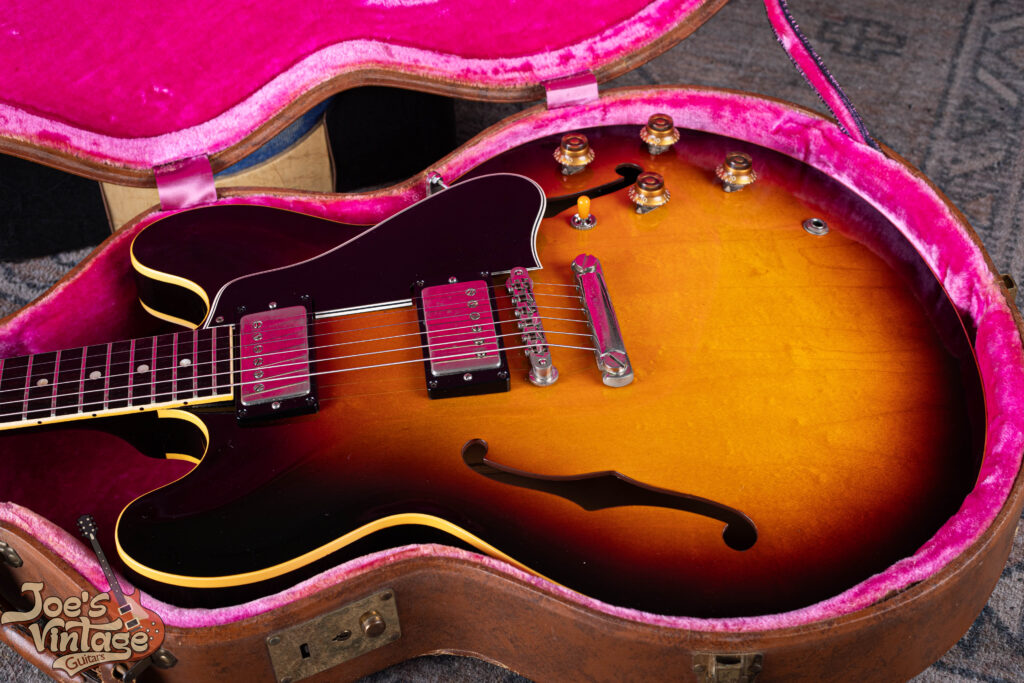
This 1959 Gibson ES-335 showcases the incredible depth and luster of an original nitrocellulose lacquer finish in near-museum condition. Finding a sunburst finish from this era without significant weather checking or fading is a rarity that drastically impacts the market value for collectors.
The magic of the ’59 tone lies in its internal architecture. The combination of the thicker 4-ply top and the solid maple center block creates a unique sonic profile:
The 1959 neck is widely considered the gold standard of electric guitar ergonomics. It represents a specific window in Gibson’s history before the company shifted toward the ultra-thin “Slim Taper” profiles of 1960.
Collectors and players often refer to the ’59 neck as the “Full Rounded” or “Chunky C” profile. To understand why it is so coveted, one has to look at the specific dimensions and the “hand-shaped” nature of the era:
Pro Tip for Collectors: Because these necks were hand-sanded at the Parsons Street factory, no two ’59 necks are identical. Some “late ’59s” actually began to transition toward the thinner 1960 spec, making the “Early-to-Mid ’59” the most sought-after for those seeking the true chunky feel.
The back of this 1959 ES-335 neck is a testament to careful preservation. Retaining its original gloss with almost no “buckle rash” or finish thinning, it features the sought-after “chunky” ’59 rounded profile that defines this golden era of Gibson production
One of the most critical technical evolutions in 1959 was the adjustment of the neck set pitch.
The fine details of the 1959 neck are the primary “tells” used to authenticate these six-figure instruments.
The simple pearloid dots on a dark, rich Brazilian rosewood board are the hallmarks of the 1958 and 1959 ES-335. Unlike the later “block” inlays, these dots signify the most coveted production years. This particular example shows no “lifting” or shrinking of the pearloid, a key indicator of a guitar kept in a climate-controlled environment.
If the body is the heart and the neck is the soul, the tuners are the “ID card” of a 1959 Gibson. For collectors, the hardware on the headstock tells a story of period-correct manufacturing that is nearly impossible to fake without specialized knowledge.
In 1959, Gibson exclusively used Kluson Deluxe tuners with the iconic “Tulip” or “Keystone” buttons. To the untrained eye, all vintage tuners look similar, but the 1959 spec is defined by its stamping:
One of the most authentic—and frustrating—traits of original 1959 tuners is the chemical instability of the Celluloid (Nylon) buttons.
This 1959 ES-335 provides a perfect visual lesson in vintage preservation. Here we see the original “single ring” Kluson tuners in a unique state of transition: four of the original celluloid buttons have “mummified”—a natural off-gassing process that causes them to shrink and crumble over decades. In perfect contrast, two buttons were replaced years ago with stable, period-correct material. Seeing this side-by-side helps collectors and sellers identify the authentic aging process of 1950s Gibson hardware.
The hardware of a 1959 ES-335 isn’t just about aesthetics; it is the mechanical heart of the guitar’s legendary sustain. In the late fifties, Gibson was using specific alloys and designs that modern manufacturers spend millions of dollars trying to replicate through “Reverse Engineering.”
The bridge on a 1959 ES-335 is the iconic ABR-1 Tune-o-matic. However, the 1959 version has a quirk that terrifies modern players but delights purists:
A hallmark of the 1959 ES-335 is the original ABR-1 “no-wire” bridge. Produced before Gibson added the retainer wire in the early 1960s to prevent saddles from falling out during string changes, these bridges are highly prized for their historical accuracy and tonal transfer. This example retains its original nickel plating and shows the correct “GIBSON ABR-1” casting on the underside—essential markers of an unmolested Golden Era instrument.
While the bridge was nickel-plated brass, the Tailpiece was a different beast entirely.
One of the most specific visual “tells” of a Golden Era ES-335 is the mismatched strap buttons. Most people expect two metal buttons, but the 1959 spec is unique:
A subtle but vital detail for any 1959 ES-335 is the original white plastic strap button. In the late 1950s, Gibson utilized these plastic buttons before transitioning to the more common metal versions in the early 1960s. Seeing an original, un-cracked plastic button in this location is a fantastic indicator that the guitar has been handled with care and hasn’t been subjected to the typical “player mods” of the 1970s.
If the 1959 ES-335 is the “Holy Grail,” the PAF (Patent Applied For) pickups are the magic elixir inside. In 1959, Gibson’s humbucker production hit a legendary stride, resulting in a pickup that many describe as having a “3D” harmonic richness—a sound that is both airy and aggressive. I am actively loooking for PAF equipped Gibson guitars. If you have a guitar you’d like to sell, please reach out!
The 1959 PAF is defined by its internal components, which differ significantly from the “T-Top” or “Patent Number” pickups that followed in the 1960s:
While most PAFs have black plastic bobbins hidden under their nickel covers, 1959 was a transition year for Gibson’s plastic suppliers.
To verify the pedigree of this 1959 ES-335, we’ve carefully removed a single pole piece screw to reveal the highly coveted white butyrate bobbin underneath the original nickel cover. While “Double Whites” and “Zebras” are the holy grail for 1959-1960 collectors, we strongly advise against beginners attempting this check. These vintage bobbin leads are extremely fragile; one slipped screwdriver or over-turned screw can break a coil wire, potentially devaluing a $5,000+ pickup in seconds.
Authenticating a six-figure ’59 ES-335 requires looking for specific “forensic” details on the pickups:
Note: DO NOT remove the metal pickup covers just to authenticate your pickup. You will hurt the value of your guitar!
While this specific pickup isn’t currently mounted in our featured ES-335, it serves as a perfect reference for what a legitimate 1959-spec ‘Patent Applied For’ humbucker should look like. Note the specific ‘L-shaped’ tooling marks on the mounting legs and the slightly yellowed edges of the ‘Patent Applied For’ decal. For any ES-335 from the Golden Era, these internal details are the difference between a standard vintage guitar and a world-class investment piece.
To the uninitiated, the numbers inside a 1959 ES-335 look like random bookkeeping. To a seasoned collector, they are the DNA of the instrument. In 1959, Gibson utilized a dual-identification system: the Serial Number (for the finished product) and the Factory Order Number (FON) (for the production batch). If you need more help with Gibson serial numbers, check out our Gibson Serial Number Decoder.
Visible through the upper (bass-side) f-hole, the Orange Oval Label is the most recognizable internal marking of a Golden Era Gibson.
Note: The serial number and FON can tell you the year, but if you want to know how rare your specific year, model and finish is, check out out Gibson Shipping Totals guide.
Visible through the bass-side f-hole, the orange oval label is a cornerstone for authenticating a 1959 ES-335. On an example this clean, the label remains bright and legible, lacking the heavy “tea-staining” or peeling often seen in guitars kept in humid environments. Note the “Union Made” text and the specific hand-inked serial number prefix—details that collectors and appraisers use to pinpoint the exact production month during Gibson’s most celebrated year.
While the orange label was applied when the guitar was completed and ready to ship, the Factory Order Number (FON) was stamped onto the raw wood of the back before the guitar was even assembled. You can find this stamped in blue or black ink, visible through the lower (treble-side) f-hole.
While this ES-335 was completed and shipped in 1959, the Factory Order Number (FON) stamped inside the body reveals it was actually started in late 1958. This is a critical distinction for tone purists: because of its 1958 origin, this guitar features the thinner three-ply maple top specification typical of the first-year 335s. This “transitional” combination of 1958 construction with the refined 1959 neck profile makes it one of the most resonant and sought-after variations in the history of the model.
When verifying these markings, the “font” is everything. Gibson used specific rubber stamps and ink types that have a distinct “softness” to the edges.
The plastics of a 1959 ES-335 are more than just cosmetic flair; they are specific industrial artifacts of the era. For the 1959 model year, these components followed a “long-profile” aesthetic that was drastically shortened just a year later.
In 1959, Gibson used the classic “Bonnet” knobs.
The pickguard is one of the easiest ways to spot a 1959 ES-335 from across a room.
Tip: If you’d like to compare the long vs. short pickguards and the reflector vs. bonnet knobs, compare this 1959 ES-335 to this 1962 Gibson ES-335
One of the most striking features of this 1959 ES-335 is the original “long” pickguard. This specific style was used from the model’s debut in 1958 until early 1961, and is easily identified by the way the plastic extends significantly past the bridge toward the tailpiece. Collectors highly prize the long guard for its classic silhouette and historical accuracy.
Want to see the difference for yourself? Scroll down a little bit and click on our 1962 ES-335 link if you’d like to compare the short and long pickguards side-by-side to help identify your own guitar.
The toggle switch tip on a 1959 ES-335 is another legendary detail.
The final piece of the 1959 puzzle isn’t the guitar itself, but the “home” it lived in for the last 60+ years. In 1959, Gibson utilized two primary suppliers for their high-end hardshell cases: Lifton and Stone. While they are visually very similar, knowing the mechanical differences is key for a collector’s inventory.
At a glance, these cases are often indistinguishable because they share the iconic “California Girl” color palette:
The iconic brass Lifton badge is more than just a logo—it’s a hallmark of the “Golden Era.” For a 1959 ES-335, the presence of an original Lifton “California Girl” case (so named for its brown exterior and bright pink interior) can add significant value to the overall package. This badge, featuring the famous “Built Like a Fortress” tagline, confirms that the guitar has been shielded by the industry standard of the 1950s. When we evaluate a vintage Gibson at Joe’s Vintage Guitars, the condition of this badge and the case’s internal plush lining are key factors in our top-dollar offers.
While the Lifton is often the first thing people think of, many 1959 ES-335s were originally paired with these high-quality Stone cases. This original metal logo plate from the Stone Case Co. of Brooklyn, N.Y., is a hallmark of authenticity. At Joe’s Vintage Guitars, we pay close attention to these original accessories because they significantly increase the historical and market value of a ’59 Dot Neck.
While not necessarily rarer than the Lifton, the Stone Case Company (of Brooklyn) version has a distinct build quality that sets it apart if you know where to look.
While many 1959 ES-335s shipped in Lifton cases, the Stone Case Co. examples are equally iconic and rugged. A defining feature of these cases is the spring-loaded, briefcase-style latch shown here. Unlike the standard flip-latches seen on later models, these provide a satisfying mechanical ‘snap’ that is synonymous with late-50s Gibson protection. Finding these latches fully functional and without heavy corrosion is a clear sign that the instrument inside has been stored in a dry, safe environment for decades.
The Lifton brand is the name most synonymous with the 1950s Gibson era, famous for their “Built Like a Fortress” marketing.
Regardless of the manufacturer, a genuine 1959 case should show specific signs of “honest” aging:
Note: Gibson used the same color scheme and construction for many different cases. To see an example of a Lifton case, but for a Les Paul, check out our 1957 Gibson Les Paul Goldtop guide.
The 1959 Gibson ES-335 isn’t just a museum piece; it is the engine behind some of the most influential recordings in music history. While many players use 335s, a select few are synonymous with the specific power and “bloom” of the 1959 model.
If Clapton proved the 335 could rock, Larry Carlton proved it could do everything else.
A master of slide and soulful blues-rock, Warren Haynes (Gov’t Mule, Allman Brothers Band) is a dedicated devotee of the 1959 dot-neck.
Whether you are holding a museum-grade 1959 Gibson ES-335 with original “mummified” tuners or a well-loved player’s piece, understanding the specific “Golden Era” details is the first step in protecting your investment. At Joe’s Vintage Guitars, we don’t just buy and sell instruments; we preserve the history of the “Dot Neck” era.
If you are looking for a transparent, expert evaluation for your instrument, please visit my Sell My Gibson Guitar page to see how I offer top-market value without the stress of auctions. You can also learn more about my lifelong passion for these instruments on my About Me page. If you have questions about a specific serial number, FON, or part, don’t hesitate to Contact Me directly. I am always happy to chat about vintage gear and help you navigate the process with total confidence.
Joe’s Vintage Guitars
47 N Fraser Dr E
Mesa, AZ 85203
Phone: (602) 900-6635
Email: joesvintageguitars94@gmail.com
Written by Joe Dampt
“Driven by a love for classic tunes, I specialize in buying, selling, and appraising vintage guitars, bringing music and history together.”
Think of it as the ultimate "Telecaster on steroids." The Fender Hardtail Stratocaster is one…
Explore the history of the Gibson L-5 CES, the instrument that set the standard for…
Is a brass nut a classic sustain upgrade or a vintage value killer? We dive…
The 1962 Gibson ES-335 is the ultimate "transitional" masterpiece, bridging the gap between the 1950s…
Stop guessing about the rarity of your instrument and dive into the official Kalamazoo records.…
In the 'Golden Era' of Gibson production, few instruments carry as much mojo—or as much…


