The Master Guide to the 1952 Fender Telecaster: The “Blackguard” Deep Dive
Table Of Contents
- I. The Body: Ash, Paint, and Factory “Scars”
- II. The Neck: Hand-Shaped History
- III. Hardware: Screws and Steel
- IV. Electronics: The “Guts” of the Guitar
- V. Authentication Checklist
- Verify Your Vintage Legacy: Professional Authentication & Buying
The 1952 Fender Telecaster is widely considered the definitive “Blackguard” and the blueprint for the modern solid-body electric guitar. By 1952, Leo Fender had moved past the Broadcaster and Nocaster naming transitions, finally cementing the Telecaster name in music history. Because of their rarity and cultural significance, authentic 1950s Telecasters have become some of the most forged and modified instruments on the vintage market.
Whether you are an heir looking to value an inherited instrument or a collector verifying a potential purchase, distinguishing a factory-original 1952 Telecaster from a high-end reproduction requires looking at specific, microscopic tooling marks and internal components. This guide provides a technical breakdown of the 1952 specifications—from Tadeo Gomez neck shapes to period-correct electronics—to help you determine the true value and authenticity of your vintage Fender. If you want to know the year of your vintage Fender, use our handy Fender serial number lookup tool. If you have a vintage Fender you’d like to sell, please don’t hesitate to reach out to Joe’s Vintage Guitars.
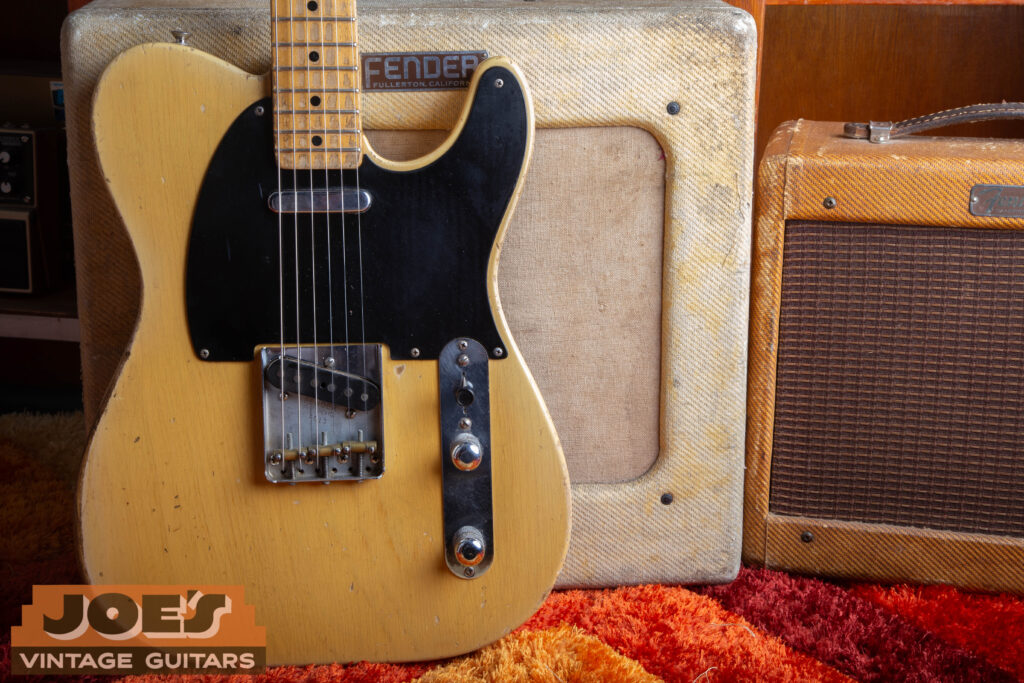
A prime example of the “Blackguard” era. This 1952 body features a premium ash grain visible through its aged nitrocellulose finish. Key features include the original black phenolic pickguard, solid brass bridge saddles, and the factory serial number stamped into the bridge plate.
I. The Body: Ash, Paint, and Factory “Scars”
In 1952, Fender used Premium Ash for the bodies. Ash is a beautiful, durable wood with a very prominent grain that you can usually see through the paint.
The “Router Hump” and Flat Spots
In the early 1950s, guitars were made by hand using manual machines called pin routers. These machines left specific “signatures” in the wood:
-
The Hump: If you look at the “cutaway” (the scooped-out part of the body where the neck meets the wood), there should be a slight, uneven “hump.” This happened because the worker had to pull the routing tool away at a certain point. Modern, fake guitars are usually perfectly smooth and symmetrical here because they are made by computers.
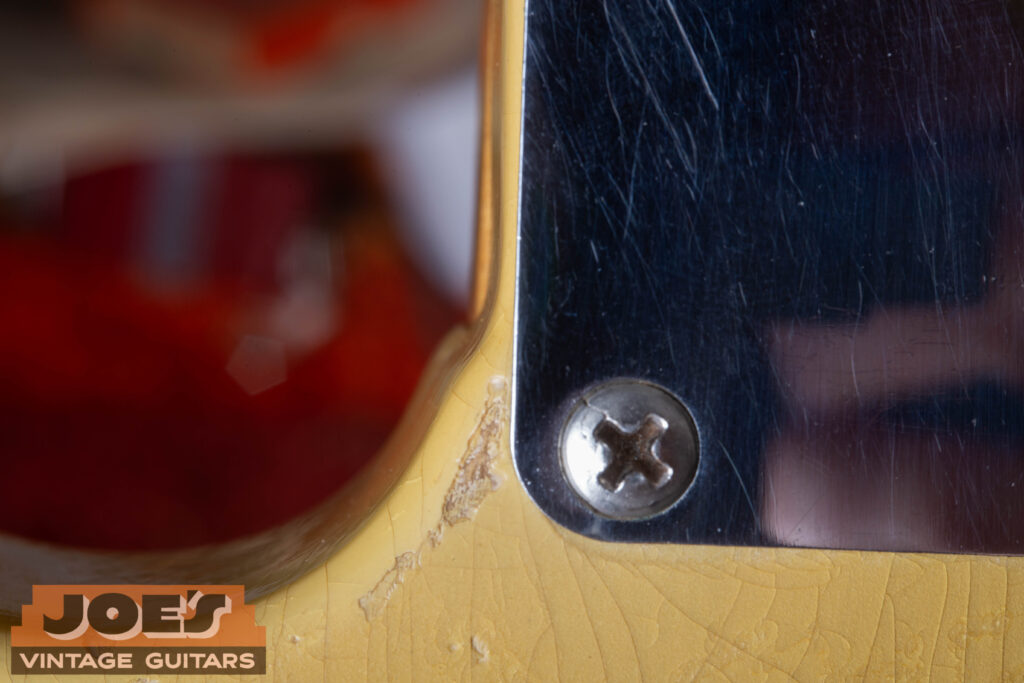
A key identifier of a genuine 1952 body. This slight, uneven “hump” in the cutaway was created by the manual pin-router template exit point. A perfectly smooth, symmetrical curve in this area is often a sign of a modern reproduction.
-
The Output Jack Flat Spot: Look at the side of the guitar where you plug in the cable. The edge of the guitar shouldn’t be a perfect circle. There is a small, subtle “flat spot” sanded into the wood so the metal jack cup can sit flat against the body.
The Mystery of the Nail Holes
When these guitars were painted in the factory, workers drove three or four small nails into the wood (usually under where the pickguard and bridge plate sit) so they could paint one side, then flip it over, suspended on the nails to paint the back. Once the paint dried, the nails were pulled out. On a real ’52, you will see these tiny, pin-sized holes. If the holes are missing or filled with thick, plastic-like paint, the guitar has likely been refinished or is a modern copy.
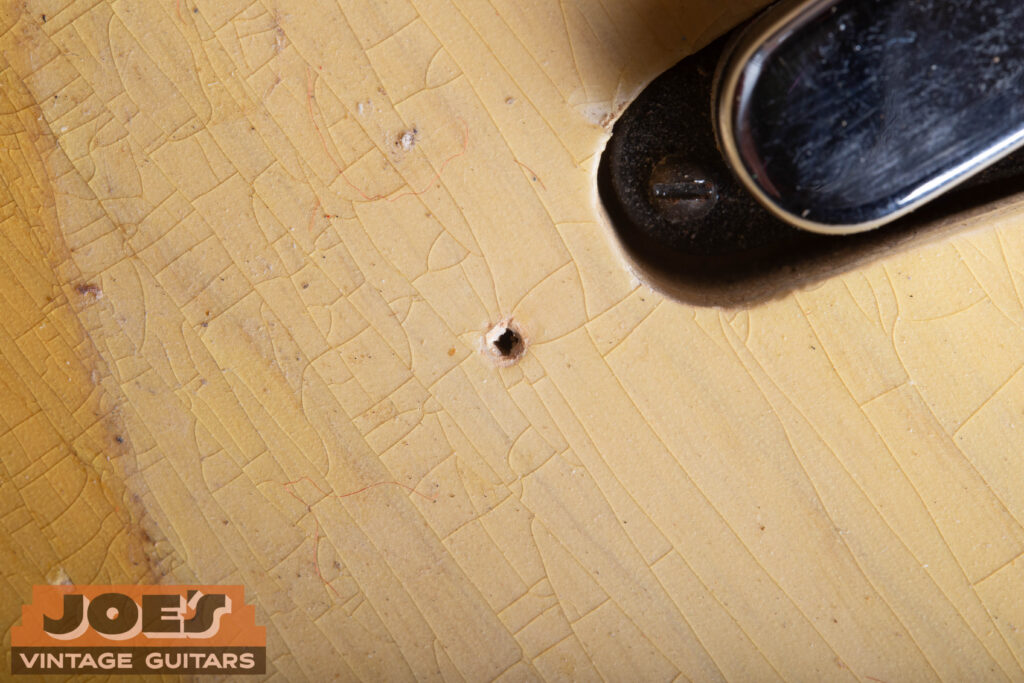
A crucial indicator of an original 1952 finish. These tiny holes were created by nails used to suspend the body during the painting process at the Fullerton factory. Finding these holes—especially when they are clear of modern paint buildup—is a hallmark of an authentic, non-refinished Blackguard body.
The “Butterscotch” Ghosting
The famous yellow color of a ’52 Tele is actually an accident of time. Originally, they were a pale, creamy “Blonde.” Over 70 years, the clear lacquer finish reacted with sunlight and oxygen, turning into that iconic “Butterscotch” hue.
-
The Test: If you unscrew the black pickguard, the wood underneath should be much lighter (pale cream) than the rest of the guitar. This is called “ghosting.” If the color is the same everywhere, even under the pickguard, it’s a modern paint job.
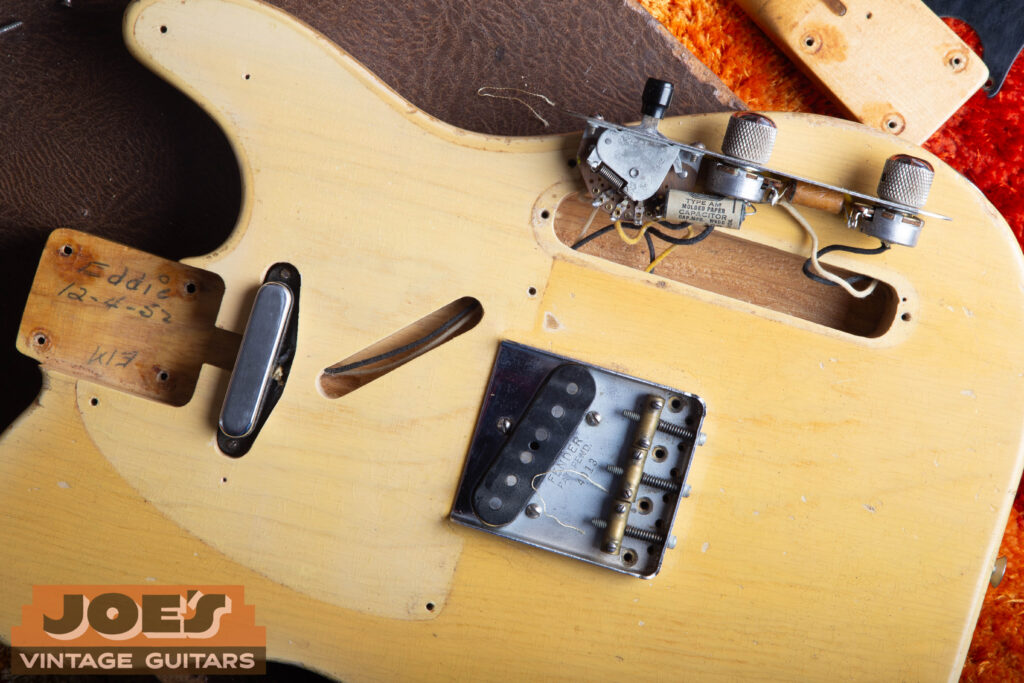
This image highlights “ghosting,” showing the original pale blonde finish preserved under the pickguard. The surrounding butterscotch color is the result of seven decades of UV exposure on the nitrocellulose lacquer. This contrast is a key indicator of an original, non-refinished body.
II. The Neck: Hand-Shaped History
The neck is a single piece of maple wood. In 1952, these were shaped by a legendary craftsman named Tadeo Gomez.
The “Baseball Bat” and the Truss Rod
-
The Feel: A 1952 neck is famously thick. It feels almost like holding a baseball bat that has been cut in half. It is very chunky and fills up your entire hand.
-
The Adjustment Screw: Inside the neck is a metal rod (the truss rod) that keeps it straight. The adjustment screw for this rod is located at the very bottom of the neck, where it connects to the body. On a ’52, this must be a Flat-head (Slot-head) screw. If you see a cross-shaped Phillips screw here, the neck is likely not from 1952.
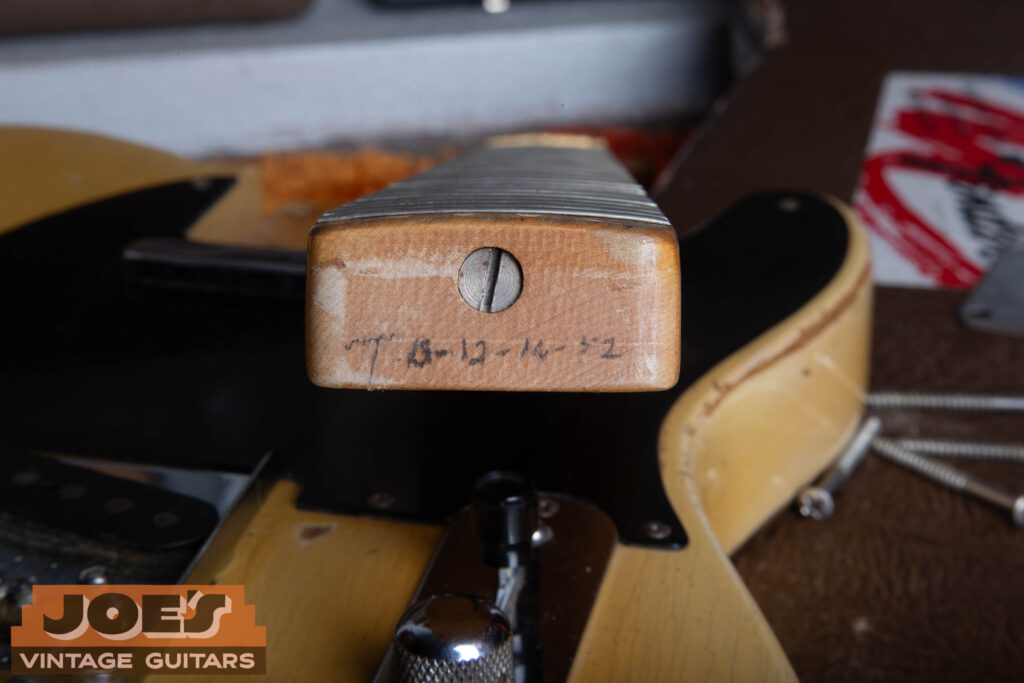
A critical authentication point for any “Blackguard.” In 1952, the truss rod adjustment screw located at the heel of the neck was a flat-head (slot-head) variety. Finding a Phillips-head screw in this position is a common indicator of a replacement part or a later-era neck. This detail, combined with the handwritten Tadeo Gomez initials often found nearby, confirms the neck’s early 50s origin.
Dots and the “Skunk Stripe”
-
The 12th Fret: Look at the two black dots at the 12th fret. In 1952, these dots were spaced wide apart (about 1.125 inches). Later Fenders moved them closer together.
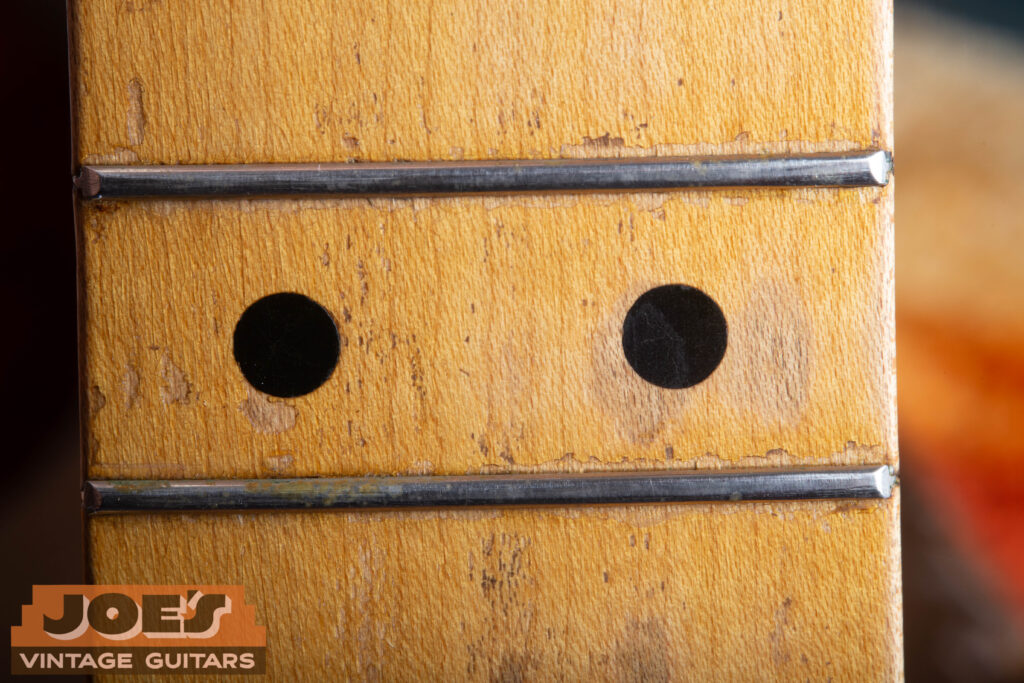
A definitive marker for early 50s authentication. On an original 1952 Telecaster, the two black phenolic dots at the 12th fret are spaced approximately 1.125 inches apart. Fender transitioned to a narrower spacing much later in the production timeline, making this “wide” gap a key detail for identifying a true Blackguard neck.
-
The Stripe: On the back of the neck, there is a dark strip of wood. This is called the “skunk stripe,” and it is made of Walnut. It should feel smooth and flush with the maple.
The Headstock Details
-
The String Tree: This is the small metal button on the headstock that holds the strings down. In 1952, it must be a small, round circle. Fender didn’t switch to the “wing” shape until years later.
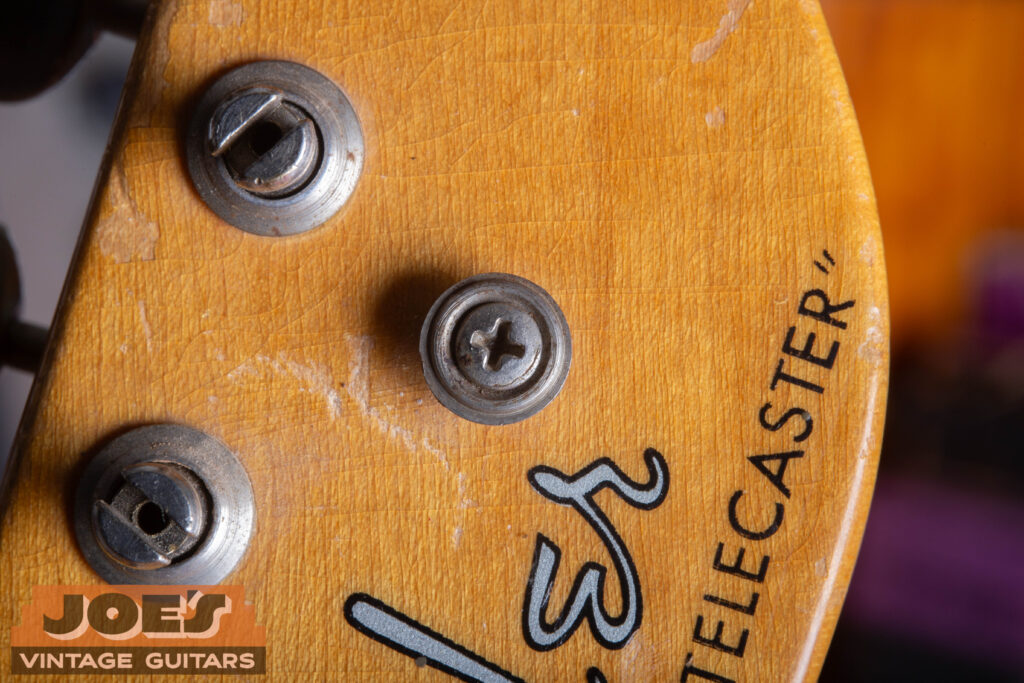
A signature detail of the early 50s headstock. The 1952 Telecaster uses a small, round metal button to hold the E and B strings in place. Fender did not transition to the more common “butterfly” or “wing” style string tree until mid-1954, making this specific hardware piece a key indicator of a period-correct Blackguard.
-
The Logo: The “Fender” logo is a thin silver decal. In 1952, these were applied on top of the finish, not under it. You should be able to feel a slight edge if you run your finger over it very gently.
The Neck Heel Pencil Date
To truly authenticate a ’52, you have to look where the neck meets the body. When you remove the neck, the flat end (the “heel”) should have a handwritten date in pencil. These were often signed by the craftsman who shaped the neck; the most coveted being the “TG” initials for Tadeo Gomez. The format usually looks like a month and year (e.g., TG 6-52). If the date is stamped with ink or missing entirely, it is a major red flag for a 1952 model.
III. Hardware: Screws and Steel
The hardware (the metal parts) underwent a huge change in 1952, which makes it easy to spot fakes.
Slot-Head vs. Phillips Screws
Fender was switching from old-fashioned flat-head (slot) screws to the newer Phillips-head screws in 1952.
-
Early ’52: Almost every screw on the guitar (pickguard, bridge, tuners) will be a flat-head.
-
Late ’52: You will often see a mix. You might find Phillips screws on the pickguard but flat-heads on the metal bridge plate. If a guitar has only Phillips screws and no flat-heads at all, it’s likely a later model or a reissue.
The “No-Line” Tuners
The tuning keys at the top of the neck have a very specific look.
-
The Stamp: On the back of the metal casing, it should be stamped “PAT. APPLD.” (Patent Applied).
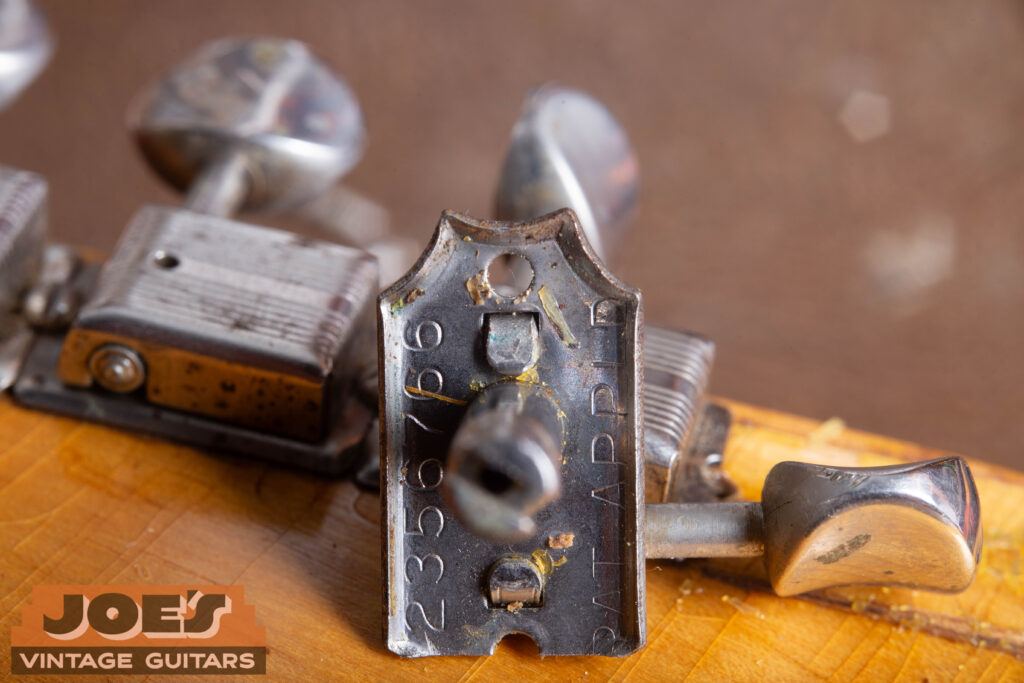
A crucial detail for any 1952 Telecaster. These tuners are known as “No-Line” because they lack the “Kluson Deluxe” text typically found down the center of later models. On the back of the metal housing, you should find the “PAT. APPLD.” (Patent Applied For) stamp. This specific hardware configuration is a hallmark of early 1950s Fender production.
-
The “No-Line” Rule: There should be no brand name (like “Kluson Deluxe”) stamped down the middle of the casing. Those “single-line” stamps didn’t start appearing until after the 1952 era.
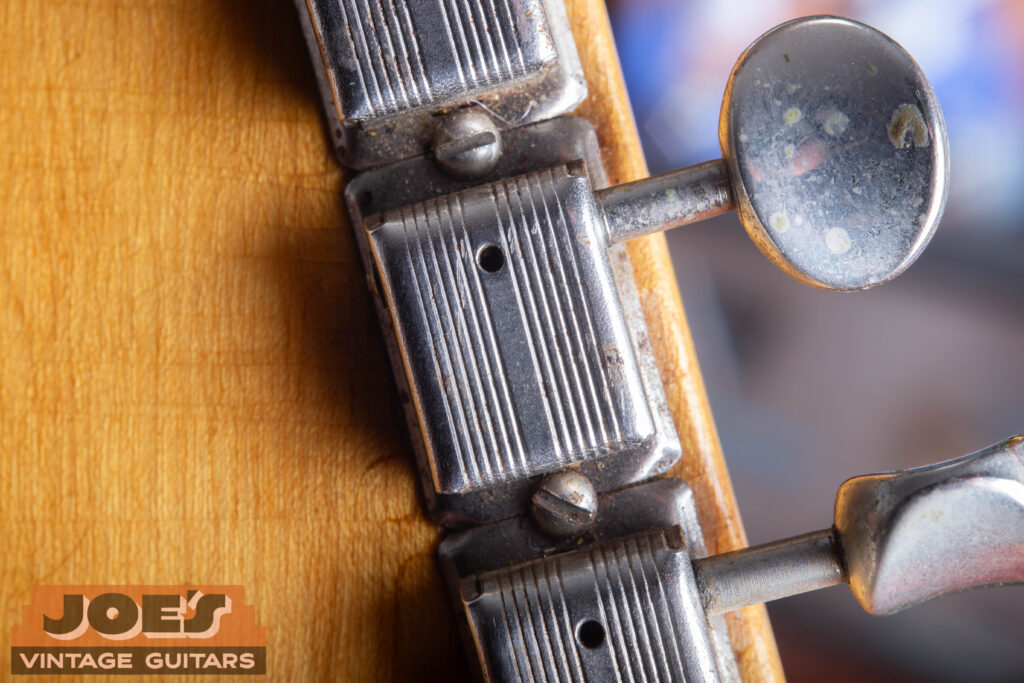
A quintessential 1952 feature. These tuners are designated “No-Line” because the center of the casing is smooth, lacking the “Kluson Deluxe” branding that appeared in later years. For a true Blackguard, these tuners should be consistent across the headstock and feature the “PAT. APPLD.” stamp on the underside of the housing.
Knobs and the “Barrel” Tip
-
The Knobs: The two chrome knobs on the front should have a “coarse” texture (rough to the touch) and a rounded, dome-shaped top. Later knobs have flat tops.
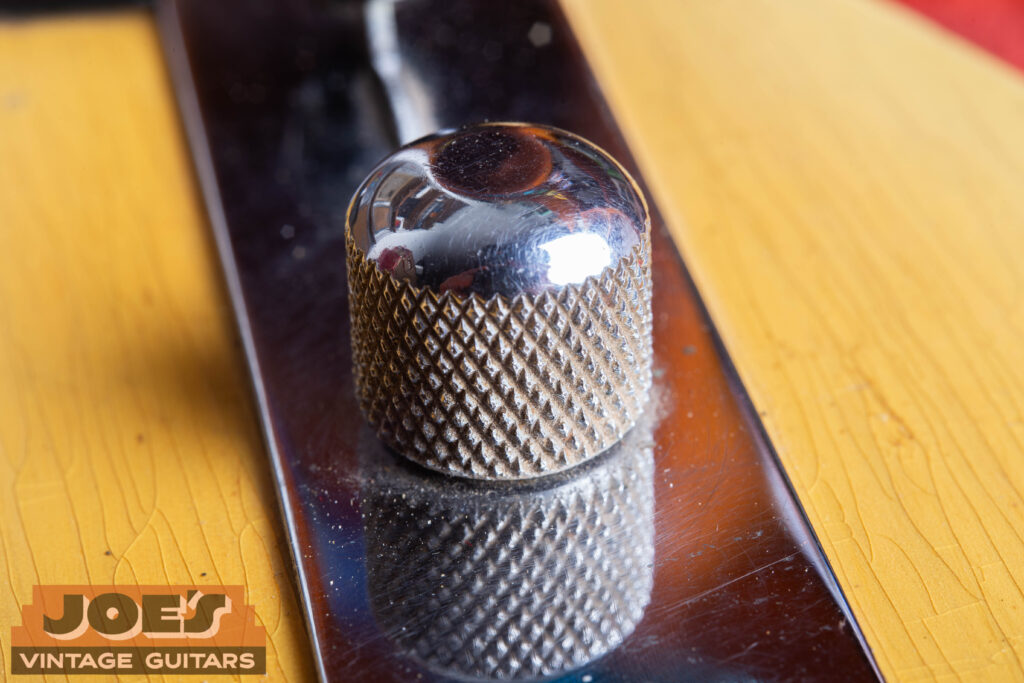
A small but vital detail for 1952 authentication. These original chrome knobs are characterized by a “coarse” knurl, which provides a heavy, rough grip compared to later versions. Additionally, the top of the knob should have a distinctively rounded, dome-like shape rather than the flat-top profile seen on later 1950s and 60s models.
-
The Switch Tip: The plastic tip on the pickup selector should be a black “Barrel” shape—it looks like a tiny cylinder.
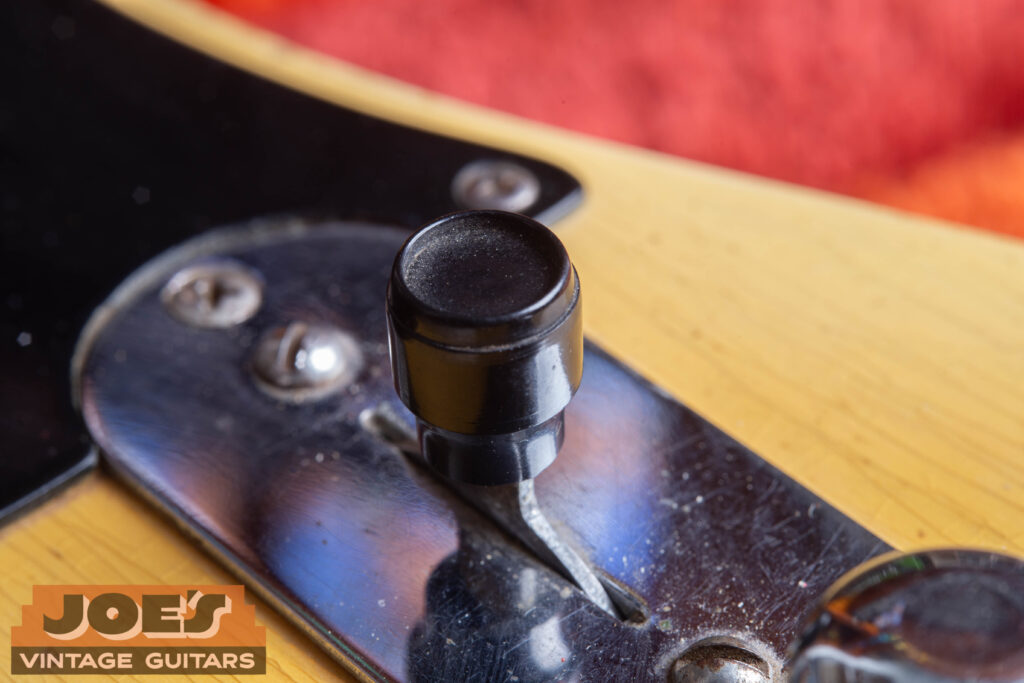
A key cosmetic detail for any true 1952 Blackguard. In this era, the pickup selector was fitted with a cylindrical, “barrel-shaped” tip that is noticeably taller and narrower than the “top hat” style tips that became standard in later years. Ensuring this tip is period-correct is essential for ascertaining the historical accuracy of a 1952 Telecaster.
- Pickguard: In 1952, the pickguard was made of a single layer of black phenolic (fiber) material. For authenticity, look for circular sanding marks on the back and a thin coat of clear lacquer on the front.
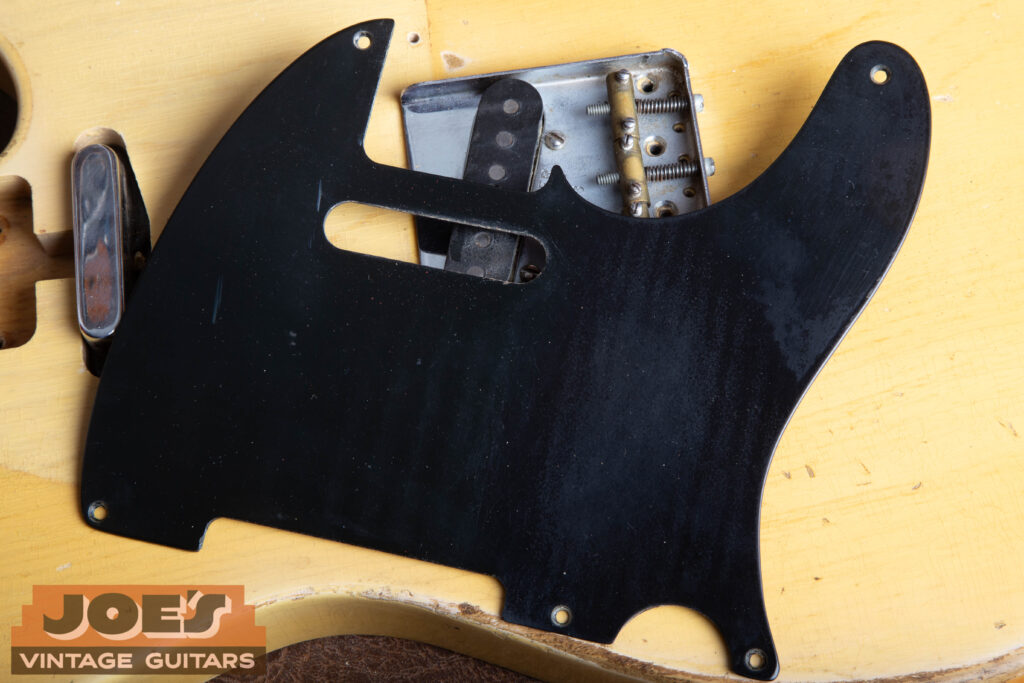
This image showcases the unique surface wear found on an original 1952 black phenolic pickguard. Unlike modern plastic guards, these early “Blackguards” were clear-coated with lacquer at the factory, which wears and dulls over decades of play. This specific type of patina is nearly impossible to replicate and serves as a significant indicator of the guitar’s age and history.
IV. Electronics: The “Guts” of the Guitar
If you open the control plate, the electronics offer the final proof.
Potentiometers (The Volume/Tone Knobs)
In 1952, Fender used a brand called Clarostat.
-
The Blue Ink: These are very easy to identify because they have codes stamped on them in bright blue ink.
-
The Date Code: Look for the number 140. In the 50s, the date was the very next digit. So a 1952 pot would read 1402. Note that these codes are often hidden under a blob of silver solder from the factory, so you may only see part of the blue ink.
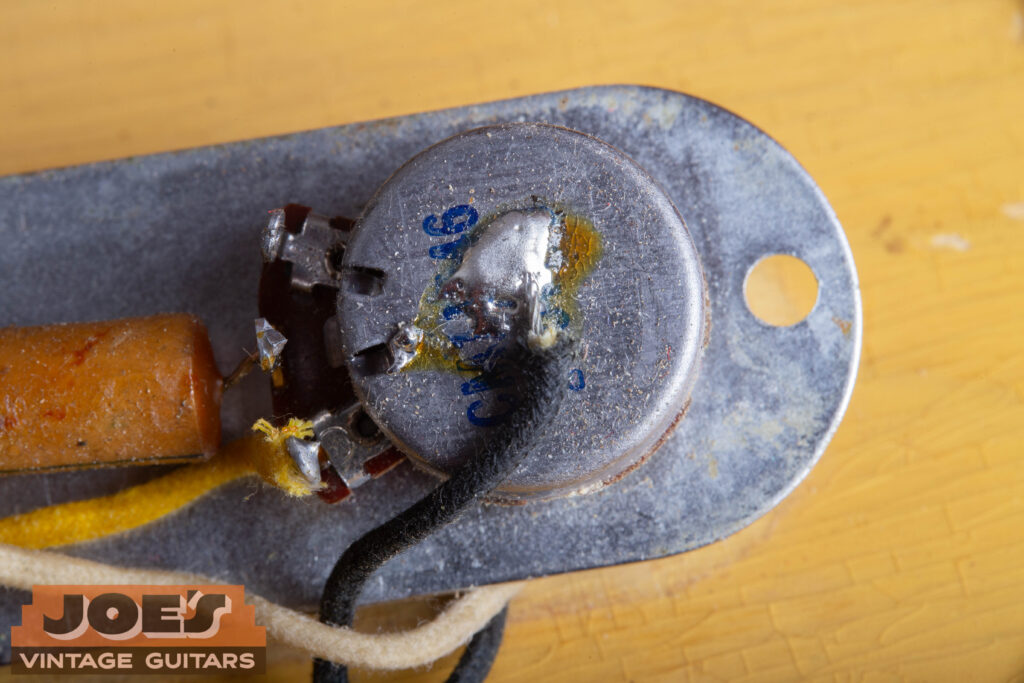
A definitive internal marker for a 1952 Telecaster. These potentiometers, manufactured by Clarostat (manufacturer code 140), are identifiable by their unique blue ink stamps. In the 1950s, the date was indicated by a single digit following the manufacturer code; for 1952, this appears as “1402.” These codes are frequently found partially obscured by factory solder joints. Such is the case with this pot, making the codes illegible. Still, the presence of a blue ink stamp is a verification win on this 52′ tele.
The 3-Way Switch
- The metal switch that changes the sound should be stamped with “CRL 1452”.
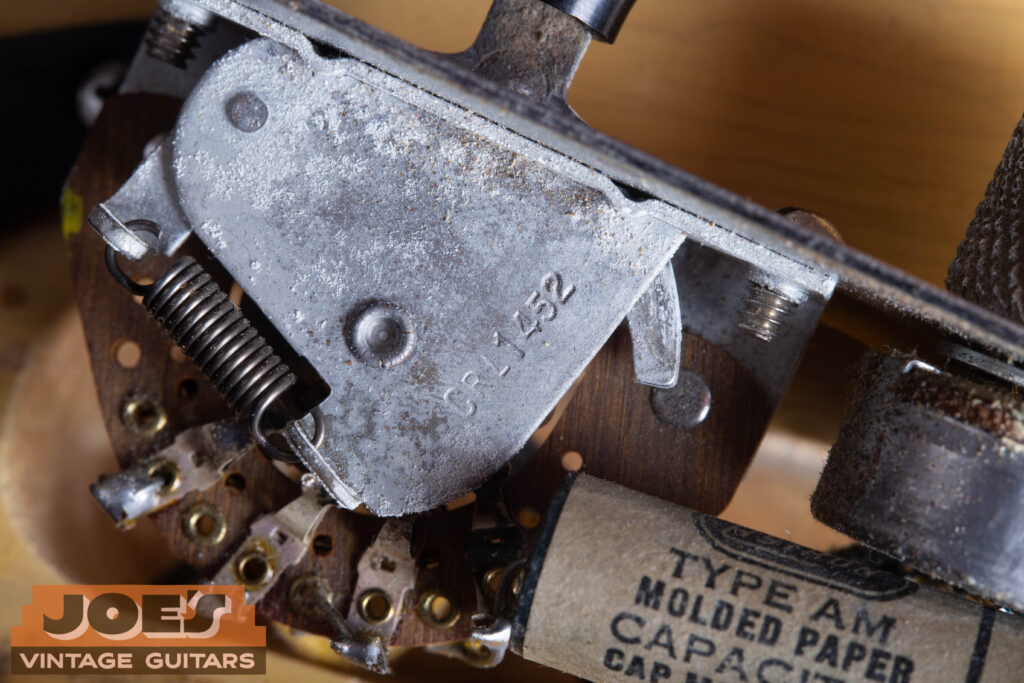
Inside the electronics cavity of a true 1952 Blackguard, the 3-way pickup selector switch is a critical piece of evidence. It must be stamped with “CRL 1452,” identifying it as a Centralab-manufactured switch from the correct era. Verifying this stamp is a non-negotiable step for collectors seeking to confirm the originality of the guitar’s internal components.
The Neck & Bridge Pickups
-
Pickup Construction: Original 1952 bridge pickups feature flat, non-staggered pole pieces and are wrapped in black string, while the neck pickup is encased in a chrome-plated brass cover.
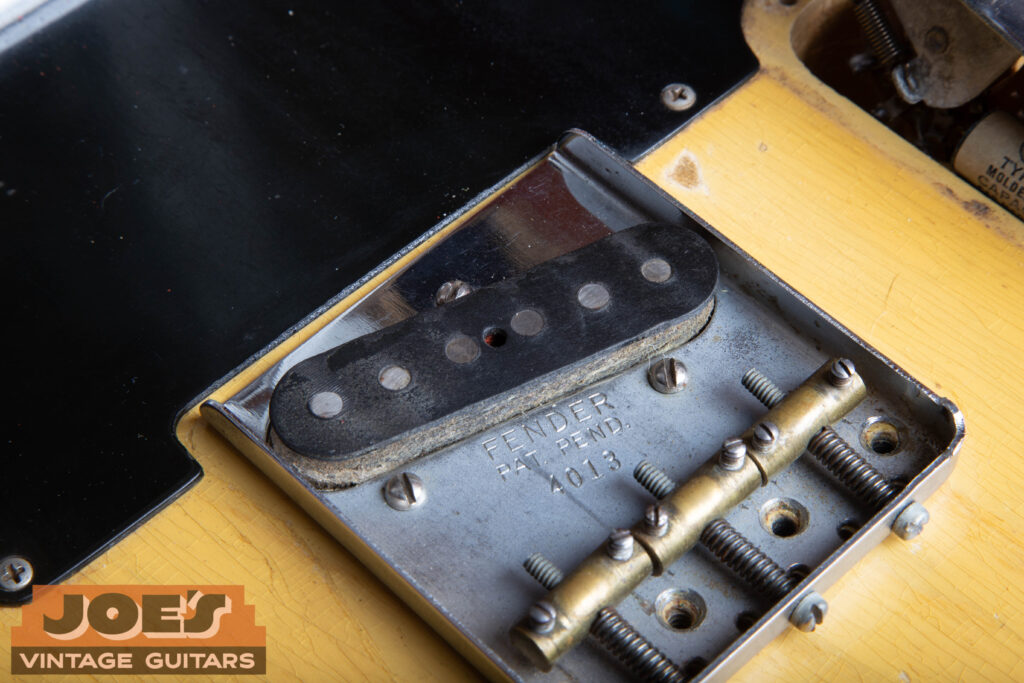
This image highlights the core components of the “Blackguard” bridge pickup. To be period-correct for 1952, the magnets must be flat (non-staggered) and wrapped in protective black string. Authentic lead wires will always be black and white cloth-covered wire.
-
Wiring and Magnets: Both pickups utilize black, cloth-covered lead wire and Alnico 3 magnets.
-
Electrical Output: The bridge pickup typically measures between 6.0k and 7.5k ohms, while the neck pickup is generally lower, ranging from 5.5k to 6.5k ohms.
-
Baseplate: The bridge pickup is mounted to a copper-plated steel baseplate, a critical component for achieving the signature “twang”.
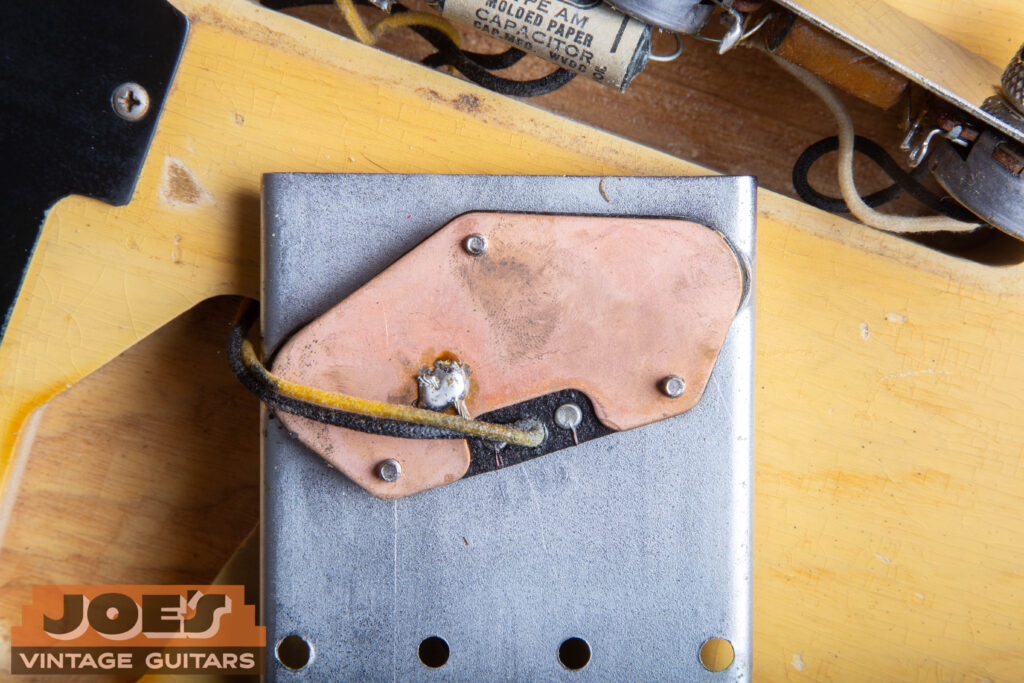
A defining characteristic of the early ’50s bridge pickup is this copper-plated steel baseplate. Beyond serving as a mounting surface, this plate interacts with the pickup’s magnetic field to broaden the frequency response, creating the unmistakable low-end punch and high-end “twang” that 1952 Telecasters are famous for. Note the authentic black and yellow cloth-covered wires and the visible wax potting—essential details for identifying a period-correct Fender pickup.
-
Authentication Tip: Authentic pickups from this era will show wax-potting and period-correct plain enamel 42 AWG wire.
V. Authentication Checklist
If you are inspecting a guitar to see if it is a true 1952 Blackguard, use this checklist to verify every major component:
-
The Nail Hole Check: Remove the pickguard and bridge. You must find the tiny factory nail holes in the body. They should be mostly clear of finish, proving the body was painted in the original Fender factory.
-
The Pickguard Check: The pickguard must be made of black phenolic (fiber) material, not modern plastic. It should show circular sanding marks on the back and a thin layer of clear lacquer on the front.
-
The Neck Dates: When the neck is removed, you should see a handwritten date in pencil (like 6-12-52) and the initials TG (for Tadeo Gomez).
-
The Body Dates: Look in the neck pocket and the pickup cavities for matching pencil dates or builder names like “Eddie” or “Davis.”
-
The Hardware Check: Verify the “No-Line” tuners with the “Pat. Appld” stamp. Check that the bridge saddles are solid brass and that the serial number is stamped clearly into the bridge plate.
-
Pickup Originality: The bridge pickup should have flat (not staggered) magnets and be wrapped in black string. The neck pickup should have a chrome-plated brass cover. Both should use black, cloth-covered wire.
-
Electronics Check: Confirm the presence of Clarostat pots with blue ink codes starting with “1402” and the CRL 1452 3-way switch. Capacitors should be either the “phone book” wax style or the blue and white paper-in-oil style.
Verify Your Vintage Legacy: Professional Authentication & Buying
Whether you have inherited a family heirloom or have spent years hunting for the perfect “Blackguard,” understanding these technical nuances is the only way to truly value a 1952 Telecaster. Given the high stakes of the vintage market, professional verification is your best tool for peace of mind. If you are looking for clarity on your instrument’s history and current market value, we invite you to take advantage of our free vintage guitar appraisal service. And, if the time has come to pass your legendary instrument on to its next owner, we are actively buying. Visit our sell my Fender guitar page to see how we provide a transparent, expert-led selling experience that honors the legacy of your vintage instrument.

Joe’s Vintage Guitars
47 N Fraser Dr E
Mesa, AZ 85203
Phone: (602) 900-6635
Email: joesvintageguitars94@gmail.com

Written by Joe Dampt
“Driven by a love for classic tunes, I specialize in buying, selling, and appraising vintage guitars, bringing music and history together.”