Specific Model Highlights

16 03, 2026

The Definitive 1962 Fender Stratocaster Authentication Guide: Slab Board, Black Pickups & Pre-CBS Details

2026-03-16T19:26:24+00:00March 16, 2026|

The 1962 Fender Stratocaster sits at the end of the first golden age of Fullerton production — pre-CBS, pre-veneer on early examples, and built to a standard that has never been matched. The defining challenge of authenticating a 1962 is the mid-year slab-to-veneer rosewood transition, but there's far more to it: black-bottom pickups, pot code triangulation, the puzzle piece finish test, nail holes with bare wood inside, and a mint-green pickguard that only original celluloid produces. This guide covers every detail.

16 03, 2026

1959 Fender Telecaster Authentication Guide: Originality & Specs Check

2026-03-16T15:59:17+00:00March 16, 2026|

The 1959 Fender Telecaster is the most transition-dense year in the instrument's history — slab rosewood fingerboard, top-loader bridge reversal, the Telecaster Custom introduction, and a mid-year gap where Fender employees were ordered to stop dating necks entirely. This guide covers every feature change, every dating method, and every detail that separates a genuine 1959 from a reissue or misrepresented example.

16 03, 2026

1954 Gibson Les Paul Goldtop Authentication Guide: Every Detail That Matters

2026-03-16T11:59:54+00:00March 16, 2026|

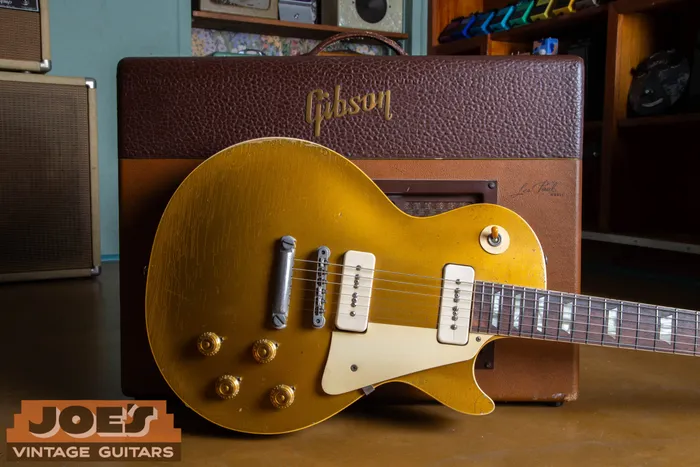
The complete authentication reference for the 1954 Gibson Les Paul Goldtop — the first full production year with the corrected neck pitch and wrap tail bridge. Covers every year-specific detail: serial numbers, no-line Kluson tuners, Grey Tiger capacitors, barrel knobs, P-90 pickups, bullion gold finish, and how to distinguish a genuine 1954 from a reissue or a date-shifted neighbor.

16 03, 2026

Gibson Byrdland Authentication Guide: How to Date & Identify Any Example (1955–Present)

2026-03-16T11:31:27+00:00March 16, 2026|

How to identify and authenticate any Gibson Byrdland — from the first Kalamazoo prototypes in 1955 through the current Custom Shop era. Covers every major construction change: cutaway shape, pickups, solid vs. pressed back, neck lamination, nut width, labels, serial numbers, hardware, and more.

12 03, 2026

The 1951, 1952 & 1953 Fender Precision Bass: The Complete Slab-Body P-Bass Authentication & Valuation Guide

2026-03-12T23:17:36+00:00March 12, 2026|

The definitive collector's guide to the 1951, 1952, and 1953 Fender Precision Bass — the original slab-body P-Bass that changed music forever. Joe Dampt covers every authentication detail: butterscotch nitro finish, tan lines under the hardware, nail holes, the early single-coil pickup with white string wrapping, pressed fiber saddles, Clarostat pots, paper-in-oil capacitor, large flat metal tuner buttons, mismatched neck and body dates, and more. Free appraisals nationwide.

5 03, 2026

The Hardtail Stratocaster: Why This Underrated Vintage Fender is a Tone Monster

2026-03-05T22:26:22+00:00March 5, 2026|

Think of it as the ultimate "Telecaster on steroids." The Fender Hardtail Stratocaster is one of the most underrated tools in the vintage guitar world. From the resonant pre-CBS models of the 1950s to the punchy, lightweight players of the 1970s, the hardtail offers a unique, percussive "snap" and rock-solid tuning stability that traditional tremolo models can't match. Discover why these rare "string-through" Strats—comprising only about 5% of early production—are the secret weapon for legends like Nile Rodgers and Robert Cray.

5 03, 2026

The Gibson L-5 CES: The Definitive Guide to the Holy Grail of Archtops

2026-03-05T21:12:06+00:00March 5, 2026|

Explore the history of the Gibson L-5 CES, the instrument that set the standard for the electric archtop. This guide covers its evolution from the 1920s acoustic breakthroughs of Lloyd Loar to the iconic "Staple" and PAF humbucker eras. Learn how to identify rare finishes, date your instrument using serial numbers and orange labels, and distinguish between Venetian and Florentine cutaways. Whether you are looking for a professional appraisal or the definitive story of this legendary guitar, discover everything you need to know about the king of Gibson archtops.

5 03, 2026

The 1959 Gibson ES-335 Forensic Authentication Guide: Identifying the “Holy Grail” Semi-Hollow

2026-03-05T18:13:59+00:00March 5, 2026|

Discover the forensic details that define the most coveted year in electric guitar history. From the rare 1958 'thin top' construction and 'mummified' Kluson tuners to the 'white bobbin' PAF pickups hidden beneath original nickel covers, we take a deep dive into an exceptionally preserved 1959 Gibson ES-335 'Dot Neck.' Whether you are a collector looking to authenticate a Golden Era masterpiece or a seller wanting to understand the true market value of an heirloom instrument, this guide reveals the nuances that turn a vintage guitar into a world-class investment. Learn why the 1959 ES-335 remains the gold standard of tone and craftsmanship.

3 03, 2026

The 1962 Gibson ES-335 Guide: Identifying the Block Inlay & Patent Number Transition

2026-03-09T18:34:55+00:00March 3, 2026|

The 1962 Gibson ES-335 is the ultimate "transitional" masterpiece, bridging the gap between the 1950s dot-neck era and the iconic block-inlay aesthetic. In this deep-dive guide, we explore the rare "Mickey Mouse" ear body shape, the high-stakes shift from PAF to Patent Number pickups, and the forensic details that determine 1962 vintage value. Whether you're looking for an expert appraisal or curious about what makes this "Golden Era" semi-hollow sound like the holy grail of tone, discover why the 1962 ES-335 remains a collector's sweet spot.

2 03, 2026

Authentic 1955-1958 TV Yellow Les Paul Special: The Definitive Collector’s Guide

2026-03-02T19:31:50+00:00March 2, 2026|

In the 'Golden Era' of Gibson production, few instruments carry as much mojo—or as much confusion for collectors—as the 1955–1958 single-cutaway Les Paul Special. Clad in the legendary TV Yellow finish, these 'slab-body' mahogany icons are the bridge between the working-man's Junior and the high-end Standard. But with seventy years of history comes seventy years of modifications. From 'Bumblebee' capacitors and original P-90 soapbars to the tell-tale patina of aged brass tuner posts, we’re diving deep into the forensic details that define a world-class instrument. Whether you are a seasoned collector or looking to sell a family heirloom, our expert guide—backed by the experience of personally authenticating over 40 of these specific models—reveals what makes a 'dead-original' Special the ultimate prize for any vintage enthusiast.

Go to Top