Complete Dot Neck ES-330 Authentication Guide & Timeline (1958-1962)
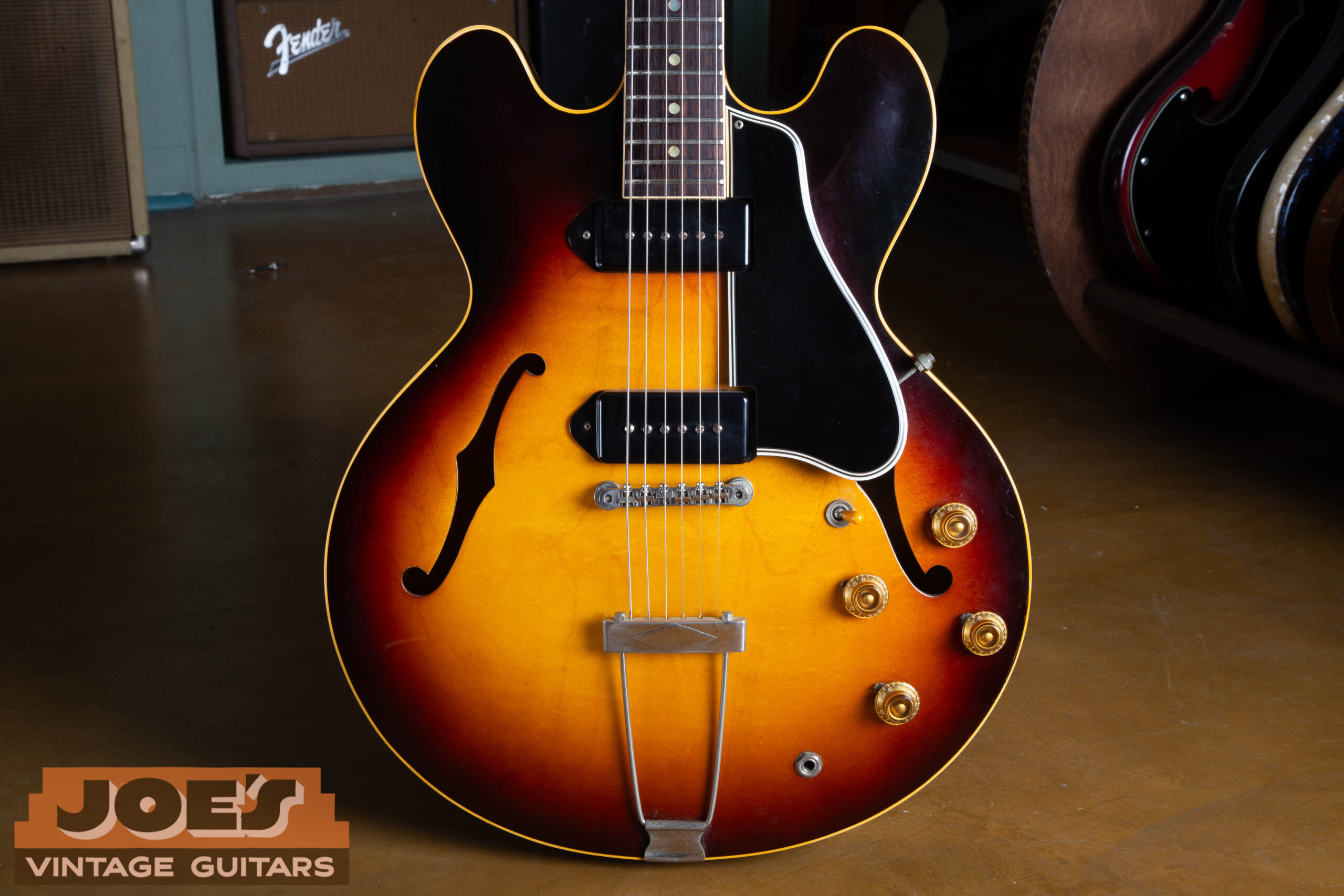
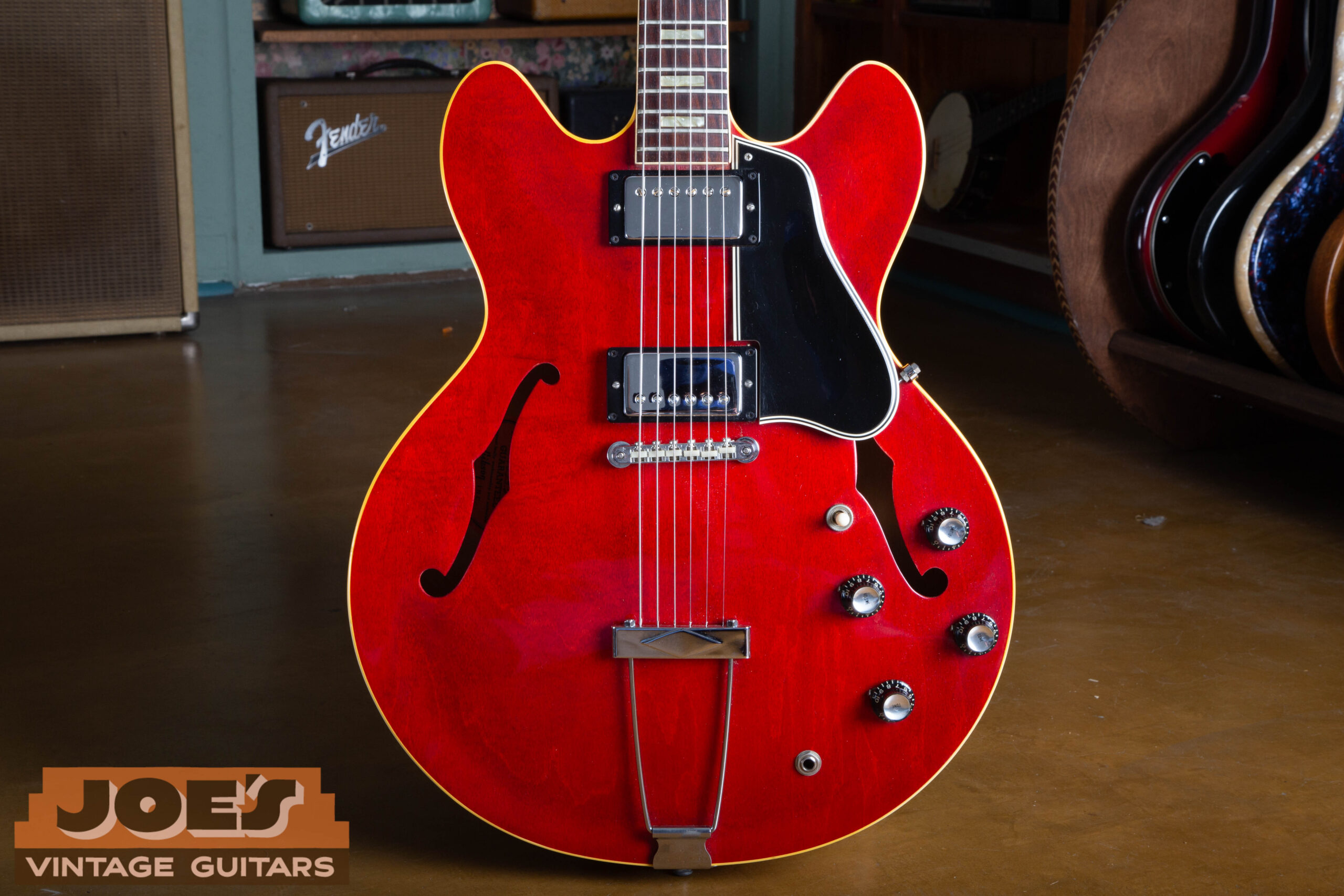
The Gibson ES-330 occupies a singular position in the post-war electric guitar story — a fully hollow thinline with a short-neck 16th-fret joint, a pair of dogear P-90s, and a price tag aimed squarely at the working player who wanted something new and modern but couldn't stretch to an ES-335. From its introduction in 1959 through the transitional years of the early 1960s, the 330 went through a remarkable number of quiet but consequential specification changes. These early examples — the ones wearing pearl dot inlays and single-layer body binding — are the instruments collectors and players seek most actively today, and the details that separate a first-year 1959 example from a 1962 late-dot-neck guitar can be surprisingly dramatic. This guide covers every specification we know, in as much depth as the historical record allows.
If you're hunting for one of these guitars, browse our current inventory of vintage Gibsons or read our broader guide to vintage guitar collecting. And if you have questions about a specific instrument — or want to know what yours is worth — reach out directly or request a free appraisal — we're always happy to talk specs.
Origins and Context: Why the ES-330 Existed
By 1958, Gibson had already launched the semi-hollow ES-335 — a guitar built around a solid maple center block that fundamentally changed what a thinline electric could do. The 335 was a revelation, but it was priced as such. Gibson needed a companion that shared the thinline silhouette without the cost of the center block construction. The answer was the ES-330, introduced officially in 1959 as a direct replacement for the ES-225T (single pickup) and ES-225TD (two pickup) — full-depth, single-cutaway archtops that had been in the catalog since 1952. Where those instruments carried a traditional full-depth hollowbody format, the ES-330 brought the concept forward into Gibson's new double-cutaway thinline body — the same silhouette as the ES-335, but fully hollow and priced for the working player rather than the professional market. The two-pickup version was designated the ES-330TD — TD standing for Thinline Double (two pickups). The single-pickup model was the ES-330T, T standing for Thinline. Both are commonly referred to simply as the ES-330.
A small number of ES-330s carry 1958 Factory Order Numbers and pot codes, and these genuine 1958-built examples do exist — but the model was not listed in Gibson's catalog or officially available to dealers until 1959. For all practical purposes, 1959 is the correct introduction year, with the caveat that a handful of pre-production or very early-run 1958-dated examples are documented in the wild.
Where the ES-335 is a semi-hollowbody — meaning it has a solid maple center block running through the body — the ES-330 is a fully hollow thinline. There is no center block whatsoever. The top, back, and sides form a completely hollow cavity, making the 330 closer in acoustic behavior to a traditional archtop than the 335 ever was. This matters tonally, practically, and in terms of feedback resistance (or lack thereof). The 330 is more susceptible to feedback at volume, has a slightly more open, resonant character at lower volumes, and requires more care in a high-gain live setting.
One structural detail defines the ES-330 above all others: the neck joins the body at the 16th fret. This short-neck joint is the single most important physical characteristic of the dot-neck 330, and it remained completely constant across the entire dot-neck era from 1959 through 1962. The ES-335, by contrast, joins at the 19th fret — giving it three additional frets of upper-register access and a fundamentally different feel in the upper positions. The 330 did not adopt the deeper neck joint until the 1968 redesign that also brought mini-humbuckers and a range of other specification changes. Every dot-neck ES-330, without exception, joins at the 16th fret.
ES-330 vs. ES-335 — the key differences: Both use the same double-cutaway thinline body shape. The ES-335 has a solid maple center block; the ES-330 does not. The 335 neck joins at the 19th fret; the 330 joins at the 16th. The 335 carried PAF humbuckers from the start; the 330 used dogear P-90s throughout the entire dot-neck period. Both the 330 and the standard 335 used nickel-plated hardware — gold hardware was the province of the upscale ES-345 and ES-355, not the standard 335. The 335 was the premium thinline; the 330 was the mid-tier, working player's entry into the double-cutaway lineup. For a deep dive into authenticating the ES-335 specifically, see our ES-335 authentication guide.
Body Construction and Shape
Thinline Fully Hollow Construction
The ES-330 body is built on Gibson's standard thinline depth of approximately 1¾ inches (roughly 44–45mm) at the rim — the same depth used for the ES-335 and ES-345. The body width is approximately 16 inches at the lower bout. Internally, the body is braced beneath the spruce top in the typical Gibson style for this era. The top is laminated maple — pressed and arched rather than carved — finished with a thin lacquer sealer before the color coats are applied. The back is also laminated maple and the sides are bent maple. This laminate construction kept costs down and is one reason dot-neck 330s tend to be somewhat more humidity-stable than carved-top instruments.
The Double Cutaway and Ear Shape
The double cutaway shape follows the same template introduced on the ES-335, but the 330's upper bout cutaway horns — the "ears" — evolved visually across the dot-neck period. On the earliest 1959 examples the horn tips are noticeably more rounded and fuller. By 1960 and into 1961 they became somewhat more pointed and slightly narrower in profile, though the change was gradual and inconsistent. Individual examples within the same year can vary meaningfully — Gibson's production tolerance in this era was broad.
Back and Side Finish — Varies by Top Color
The finish treatment on the back and sides of the ES-330 is determined by which top finish the guitar carries — and this is a detail that is frequently oversimplified in descriptions of these instruments.
On Sunburst examples, Gibson did not carry the burst treatment around to the back. Instead, the back and sides received a warm brown/walnut stain followed by clear nitrocellulose lacquer, giving them a rich honey-brown amber appearance. This creates the distinctive two-tone look — sunburst top, walnut back — that most people picture when they think of a vintage ES-330.
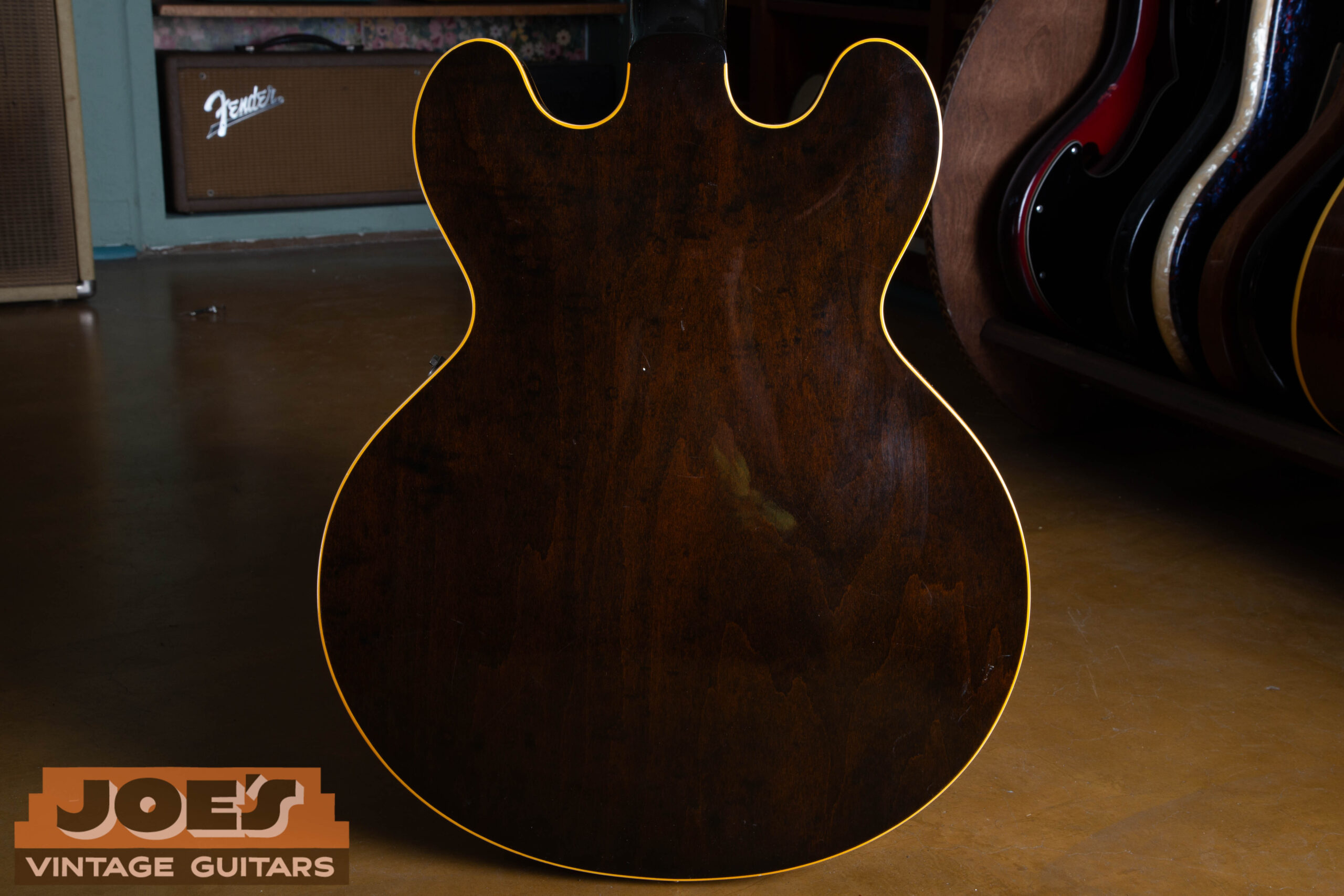
The walnut stain on the back and sides is specific to sunburst examples — Cherry and Natural 330s have matching finishes all around.
On Cherry examples (which began appearing in the early 1960s as Cherry became available as an ES-330 finish option), the back and sides are finished in the same Cherry red as the top — a uniform cherry finish all around. On Natural examples (available as a special-order finish throughout the dot-neck era), the back and sides carry the same natural honey-blonde finish as the top, consistent all the way around the instrument.
Finish: Sunburst in Detail
The standard ES-330 from 1959 through early 1962 was offered in Sunburst as the primary finish, with Natural available as a special order. The sunburst follows Gibson's conventional formula for this era: a yellow-to-amber center transitioning through orange to a dark brown/black edge, applied in nitrocellulose lacquer over the maple laminate top. Early 1959 bursts tend to be particularly rich and warm, with a strong amber center. By 1961 and 1962 the burst character remained broadly similar but can read slightly cooler or more uniformly distributed on some examples.
The nitrocellulose lacquer used in this era ages in ways that modern polyester finishes do not: it checks, crazes, shrinks slightly, and develops a patina that acts as a record of the instrument's history. An example with original lacquer from 1959 showing appropriate checking and patina is generally far more desirable to collectors than a refinished example, even a technically flawless one.
Refinish warning: The value of a dot-neck ES-330 is significantly affected by finish originality. A refinished example — even a high-quality period-correct refinish — typically sells for a fraction of an all-original instrument. Always inspect the heel, the control cavity, and the pickup routes for overspray before purchasing. UV light is a useful tool for identifying refinishes. For more on how originality and year of manufacture affect pricing, see our guide on how vintage Gibson year affects value.
Neck: Profile, Material, and Joint
Neck Material
The ES-330 neck in the dot-neck era is one-piece mahogany, cut on a slight angle from the billet. The headstock is angled back at approximately 17 degrees in Gibson's standard fashion — a design that contributes to string break angle over the nut and helps maintain tuning stability. A small number of examples may show a three-piece laminate in the heel area, used to maximize yield from mahogany stock, but this is relatively rare on the 330 compared to some other models of the same era.
Neck Profile by Year
The neck profile changed meaningfully across the dot-neck era and is often the easiest way to identify the approximate year of an example by feel:
- 1959 (early): Large, full C-to-D profile. Typically .88" to .93" deep at the first fret, up to .96"+ at the 12th. A substantial grip that fills the hand completely.
- 1959 (mid-to-late): Profile begins to slim perceptibly — the transitional neck. Still full by modern standards but noticeably less massive than an early-1959 example. Many players find this the ideal compromise.
- 1960: Profiles continue to slim; most examples fall in the .82" to .87" range at the first fret. Shape shifts from a deep C/D toward a shallower C.
- 1961–1962: The "slim taper" profile. Typically .80" to .83" deep at the first fret — fast and slender. Preferred by lead players; sometimes less comfortable for large-handed chord players.
Note: Neck measurements on any vintage Gibson should be confirmed with calipers on the specific instrument. Individual variation within a given year can be significant. The ranges above are generalizations based on documented examples.
The 16th-Fret Neck Joint
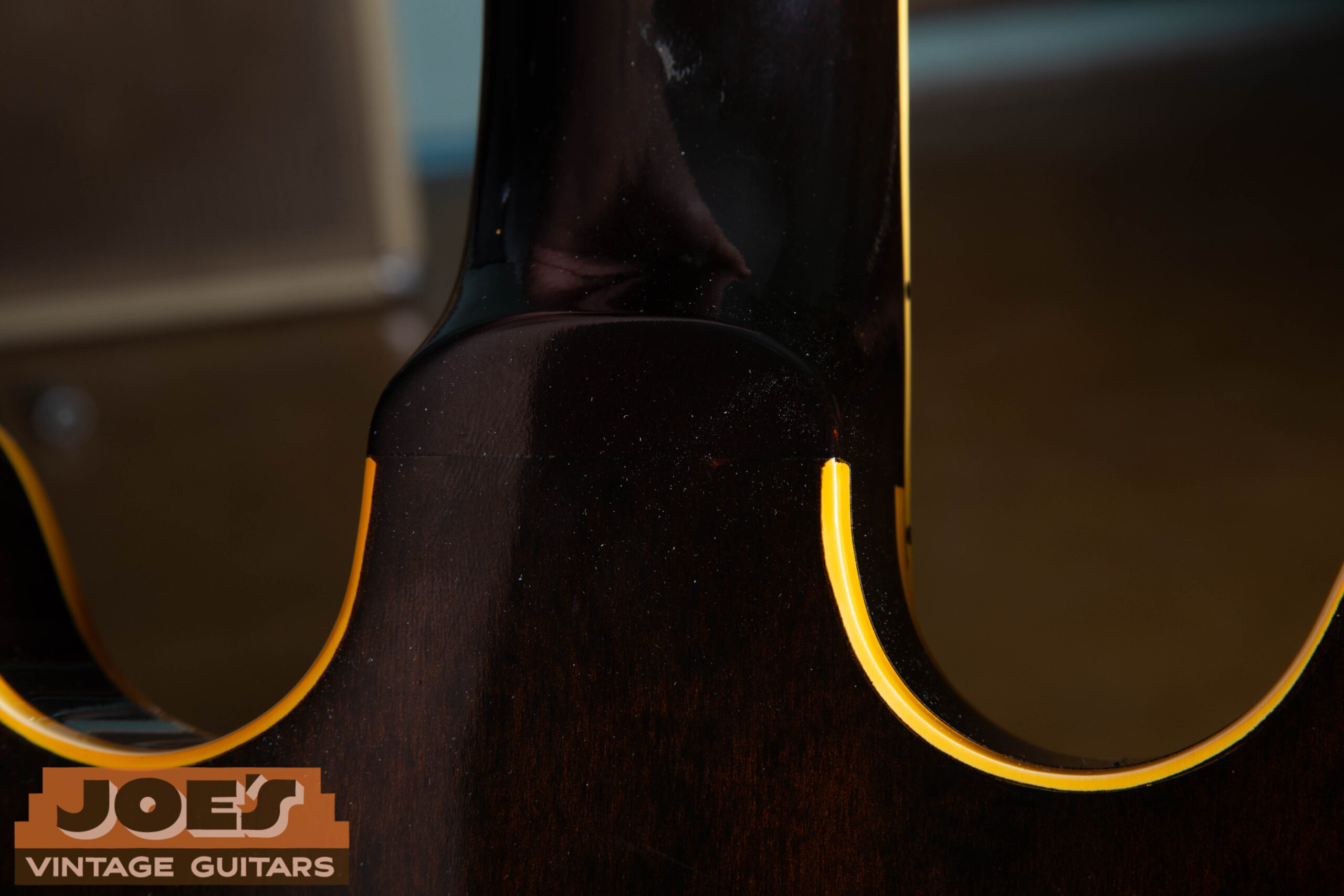
The neck joins the body at the 16th fret on all dot-neck ES-330s — the defining structural characteristic of the "short-neck" 330.
The ES-330's neck joins the body at the 16th fret — the defining structural characteristic of the dot-neck 330. The joint itself is a traditional Gibson dovetail, with the neck tenon seated into a routed pocket in the body. A neck that has been reset, if done properly, is generally acceptable to experienced buyers. Signs of a neck reset to look for include finish disturbance at the heel, shimming evidence visible through the f-holes, and inconsistency in the neck angle relative to the body plane. A correctly set ES-330 neck should present a straightedge placed along the fretboard that just grazes the top of the bridge saddles when the bridge is at a reasonable height.
Fretboard, Inlays, and Binding
Fretboard Material and Dimensions
The ES-330 in the dot-neck era uses a rosewood fretboard — specifically Brazilian rosewood (Dalbergia nigra), the dense, oil-rich species that Gibson sourced exclusively during this period before Indian rosewood became standard in the late 1960s. The color ranges from chocolate brown to near-black on many examples, with tight, uniform grain and a naturally oily surface that requires no finish. On the finest 1959 examples in particular, the Brazilian rosewood can be so dark and close-grained that it approaches the appearance of ebony — a characteristic that experienced collectors specifically seek out and that serves as a meaningful indicator of wood quality and age. The fretboard radius is 12 inches on virtually all examples. The nut width is 1 11/16 inches (approximately 42.8mm) — Gibson's standard electric nut width throughout this period.
Dot Inlays
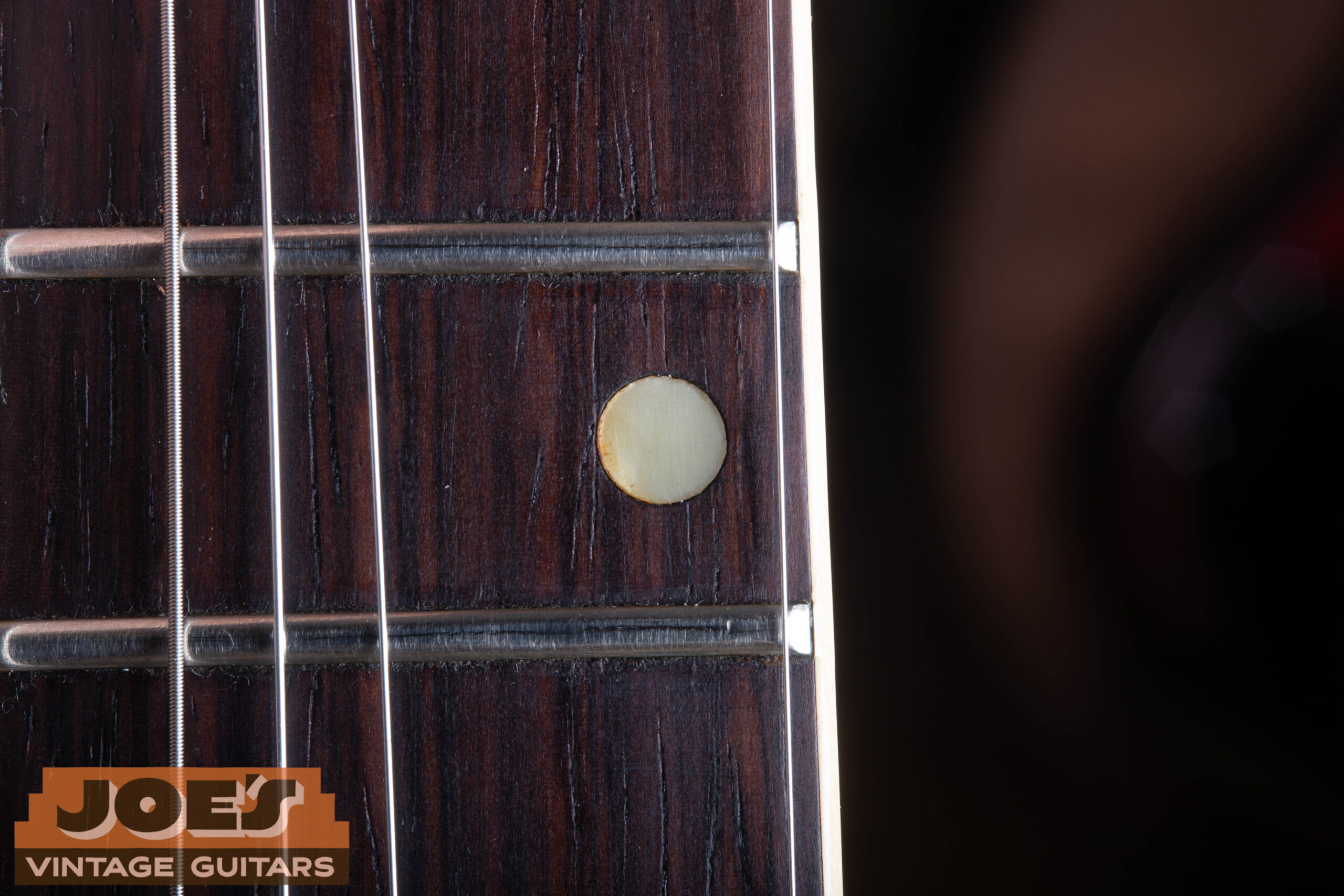
Pearl dot inlays on near-black Brazilian rosewood — the look that defines the dot-neck era. Note the near-ebony darkness of the board on this 1959 example.
The fretboard position markers are plain white/cream plastic dot inlays, giving this generation its "dot neck" designation. Dots sit at the 3rd, 5th, 7th, 9th, 12th (double), 15th, and 17th frets, approximately 6mm in diameter, flush with the rosewood surface. The material is a plastic or celluloid with a creamy white appearance that has aged well on most surviving examples. The block inlay that replaced them — shown below for comparison — did not appear on the ES-330 until late 1962 at the earliest.
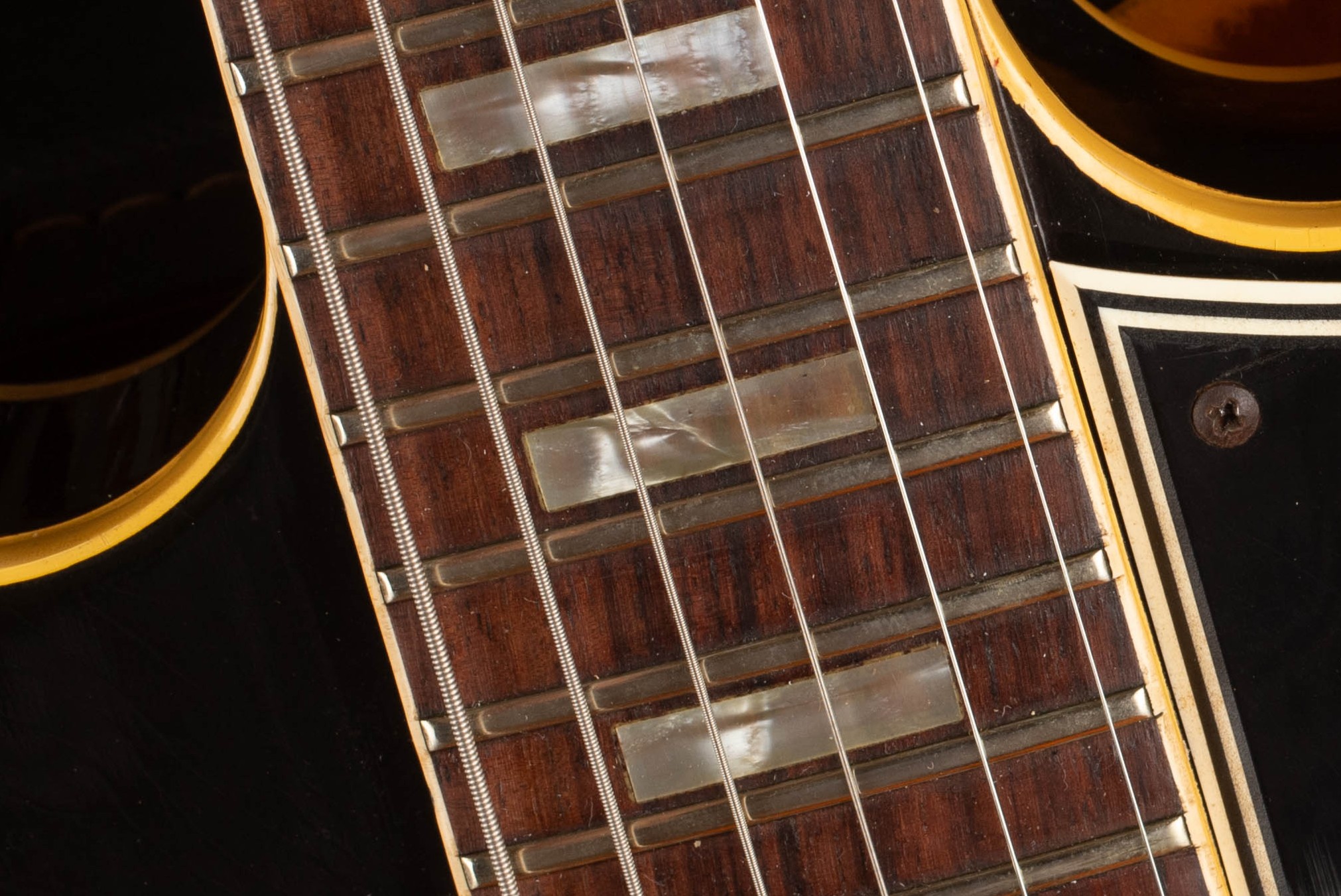
Block inlays as seen on later-era ES-330s — these did not appear until late 1962 at the earliest, marking the end of the dot-neck period.
Side Dot Inlays
Side dots are present on all dot-neck ES-330s — single small white/cream dots at the standard positions (3, 5, 7, 9, 12) with a double dot at the 12th fret. On some very early 1959 examples the side dots can appear slightly irregular in placement, reflecting hand-fitting in early production.
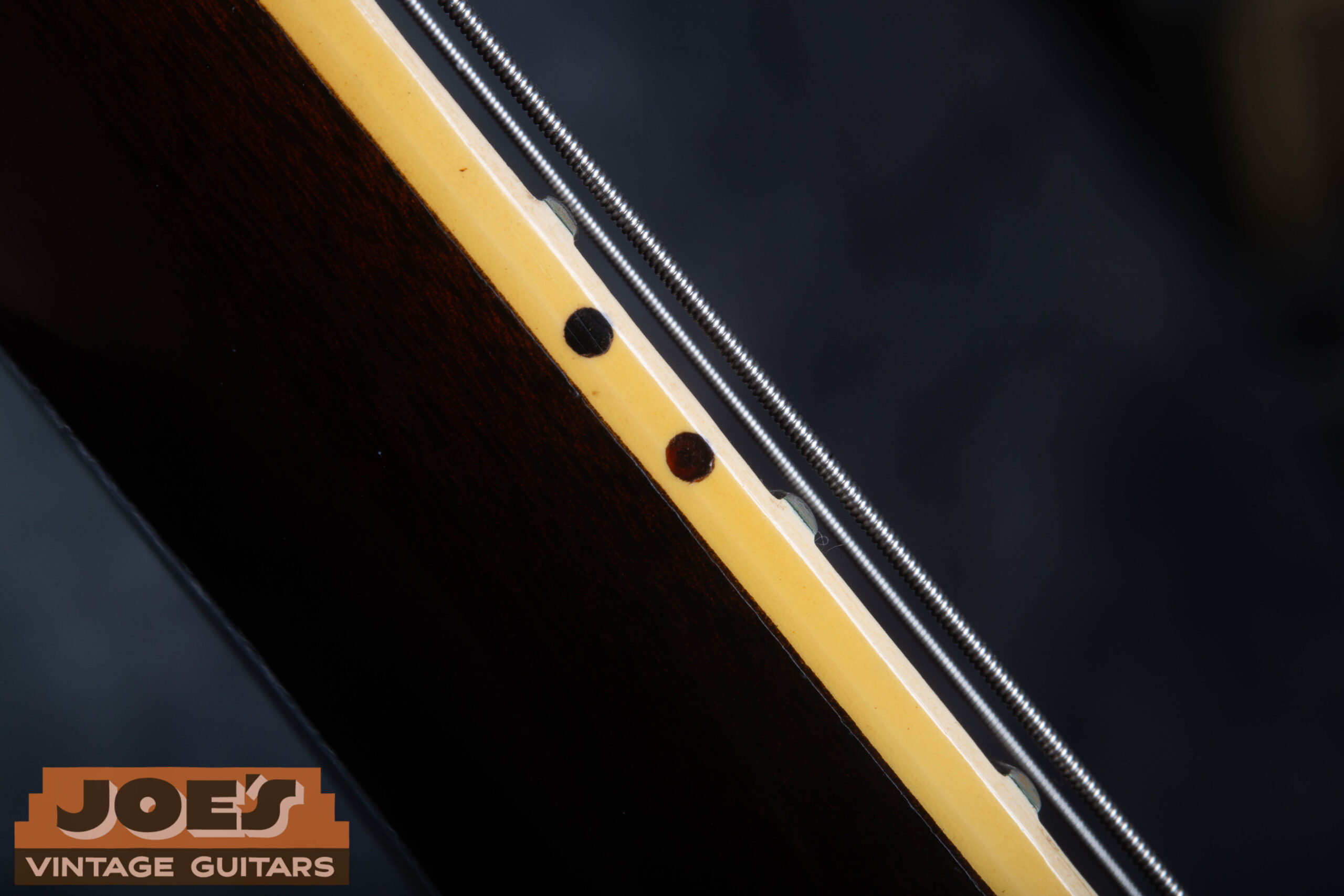
Side dot position markers on a 1959 ES-330. The cream dots are consistent with the face inlays and the overall cream plastic trim throughout the instrument.
Fretwire
Original frets are Gibson's standard nickel silver wire in the "small vintage" size — narrow and relatively low by modern standards, approximately .080" wide by .040" tall. Early fret wire was softer than modern stainless options; well-played examples show wear in the lower-position frets, which is entirely normal. A competent re-fret using period-appropriate nickel silver wire is acceptable and can breathe new life into a heavily played example.
Fret Nibs
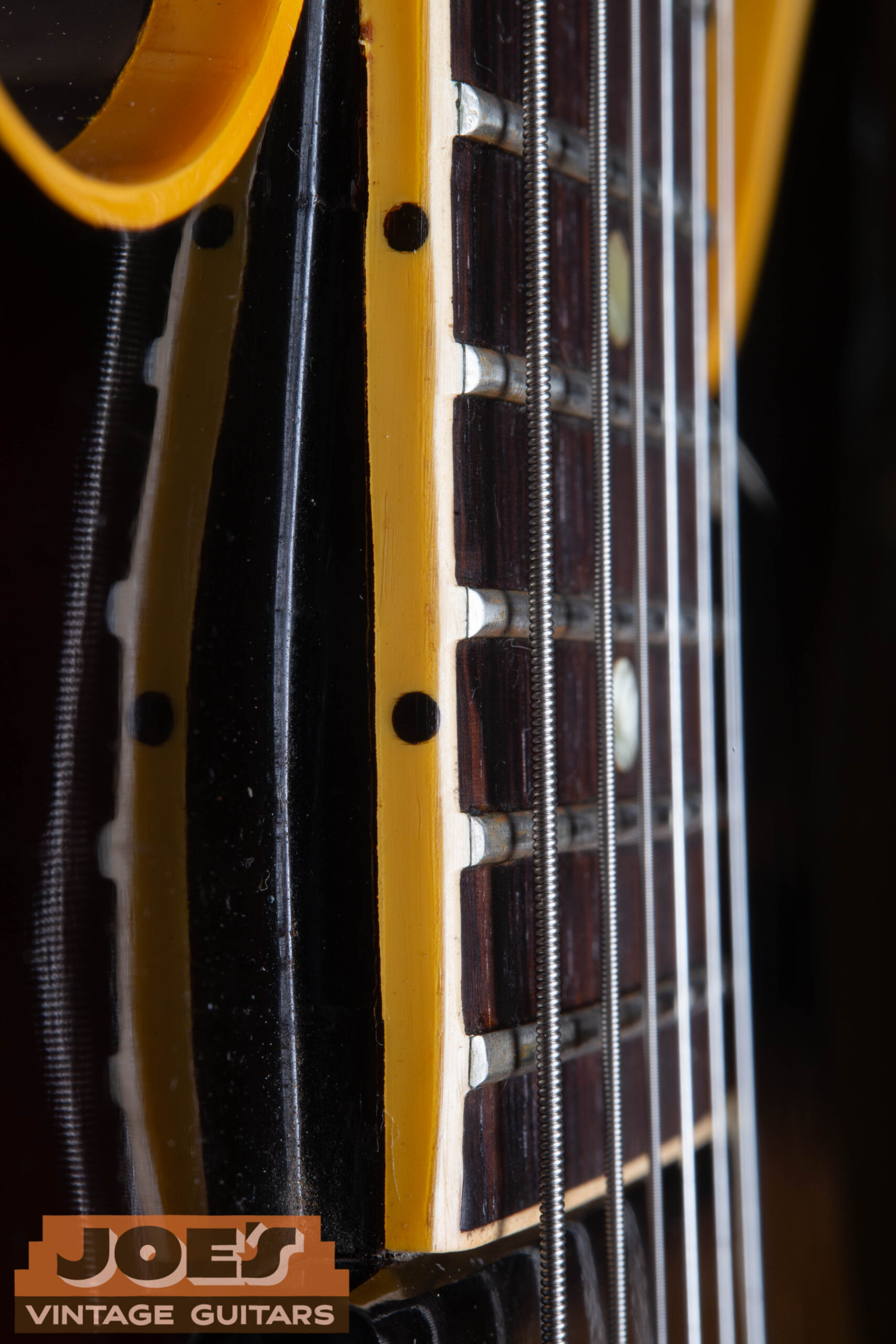
Fret nibs on a 1959 ES-330: the cream binding projects above the fret ends, creating the smooth side-of-neck feel associated with the best vintage Gibsons. Loss of nibs is a tell-tale sign of a prior re-fret.
All dot-neck ES-330s have fret nibs — small extensions of the fretboard binding that project above the fret ends, creating a smooth, continuous edge along the side of the neck. Because the binding was installed before the frets were pressed, the fret ends are fully contained within the binding. The result is a smooth, comfortable edge under the thumb. When a guitar has been re-fretted, the nibs are sometimes filed away during the process. Loss of nibs indicates a previous re-fret and is a meaningful originality observation.
Binding: Fretboard and Body
The fretboard has a single layer of cream/white binding on both bass and treble edges. Body binding is also single-layer cream/white on both top and back edges — consistent with the 330's mid-tier position in the lineup. The binding material is a nitrate or acetate-based celluloid that shrinks and pulls away from the body over decades of aging. On virtually every surviving example some degree of binding shrinkage has occurred; this is entirely expected. The cream color has typically darkened to various degrees of amber or ivory on surviving instruments.
Nut
The nut on the dot-neck ES-330 is Nylon 6/6 — a hard engineering plastic that was Gibson's standard nut material for production electric guitars in this era. This is sometimes confused with bone, which Gibson used on higher-end acoustic instruments and certain custom work, but the production ES-330 left the factory with a nylon nut. The nut is seated in a slot at the end of the fretboard without glue on most examples, relying on string tension and the fit of the slot to hold it in position. Replacement nuts of various materials are extremely common on surviving examples.
Headstock: Logo, Shape, and Truss Rod Cover
Headstock Shape and Binding
The ES-330 uses Gibson's standard open-book electric headstock shape. Critically, the dot-neck ES-330 has an unbound headstock — there is no binding on the headstock face. This is an important and frequently confused distinction: the ES-335 carried a bound headstock, the ES-330 did not. A dot-neck 330 presented with a bound headstock is either a very unusual custom order or has had work performed on it. Similarly, the ES-330 carries no crown or thistle inlay on the headstock face. The crown was a feature of the more expensive ES-335 and related premium models. The 330's headstock is plain — logo only, no decorative inlay. Any dot-neck 330 with a crown inlay should be regarded with significant skepticism.
The face of the headstock is finished in black — a thin application of black pigmented lacquer over the mahogany, giving the headstock the dark face that contrasts with the pearl logo.
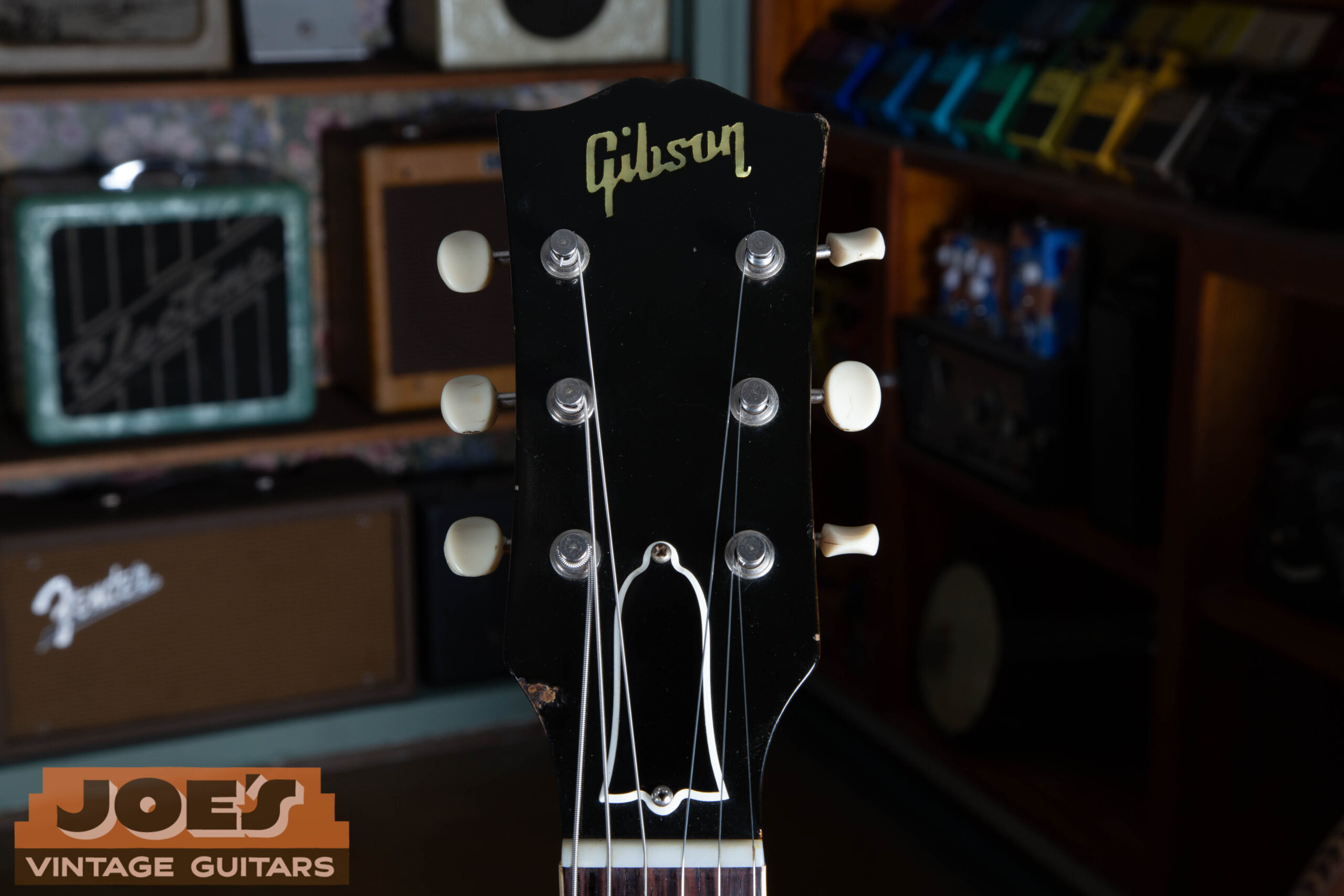
The 1959 ES-330 headstock: plain unbound black face, pearl script Gibson logo, and "ES-330TD" model designation below. No crown inlay — that was the ES-335's feature.
The Gibson Logo
The headstock carries the Gibson script logo in pearl inlay set directly into the headstock face. The letterform character evolved slightly across the dot-neck era, with early examples showing slightly more open letter proportions than later ones. Below the Gibson script, the headstock carries the model designation: "ES-330T" for the single-pickup version or "ES-330TD" for the two-pickup model — both in smaller lettering on a separate line. The "made in USA" stamp on the back of the headstock is absent on most early 1959 examples and becomes more consistent through 1960 and into 1961–62.
Truss Rod Cover
The truss rod cover is a small, single-ply black plastic cover in the standard Gibson bell or tulip shape, retained by two small screws. It is entirely unadorned — no engraving, no text, no decoration. This plain cover is correct for the entire dot-neck era. Replacement covers are extremely common, as the originals are thin, brittle, and easily cracked or lost.
Tuners
Kluson Deluxe Machines
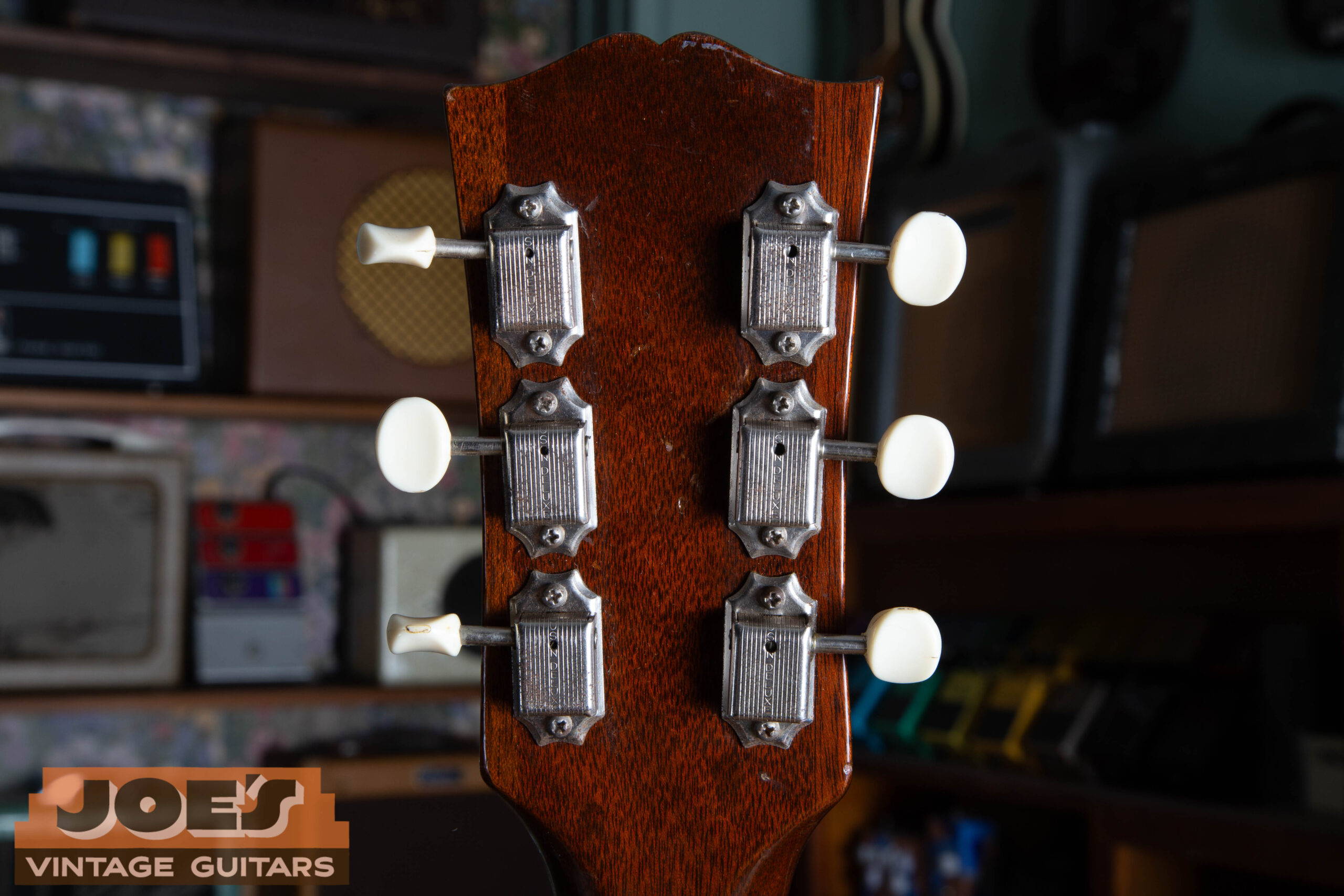
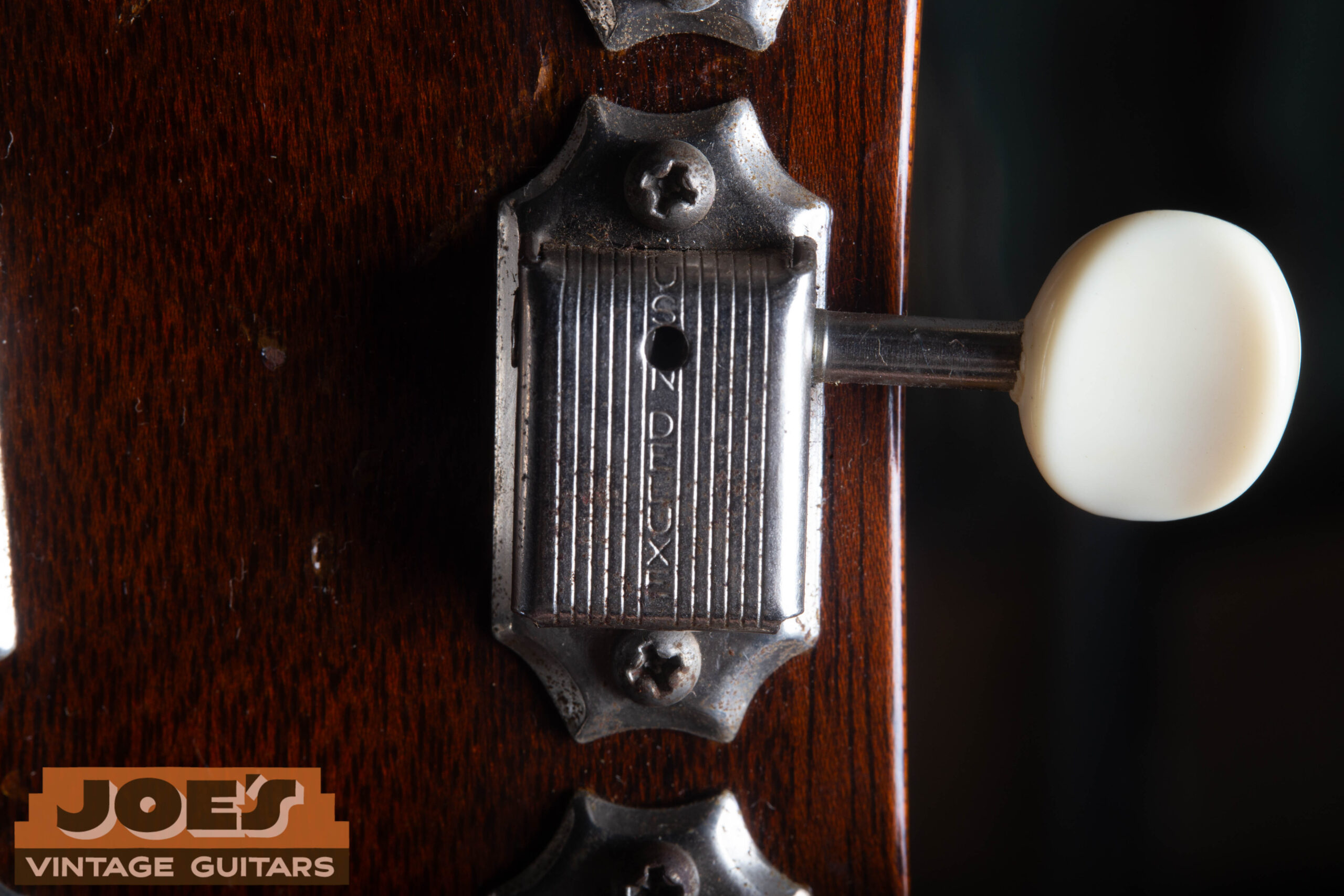
The ES-330 was equipped with Kluson Deluxe tuners throughout the dot-neck era — the single-ring base plate, open-gear-housing style that is standard on dot-neck Gibsons across all models. Early 1959 examples carry the single-line Kluson Deluxe (where "KLUSON DELUXE" is stamped in a single line on the cover plate); by approximately mid-1960 through the end of the dot-neck era, the double-line variant is standard.
Tuner Buttons
The tuner buttons are single-ring tulip-shaped plastic in cream/white — the solid single-post plastic tulip style closely associated with late-1950s and early-1960s Gibsons. The celluloid-based material is prone to shrinkage and cracking over time, particularly along the barrel where the shaft passes through. On 60+ year old examples these buttons frequently show cracks or chips. All-original, uncracked buttons are increasingly rare and represent a meaningful originality point.
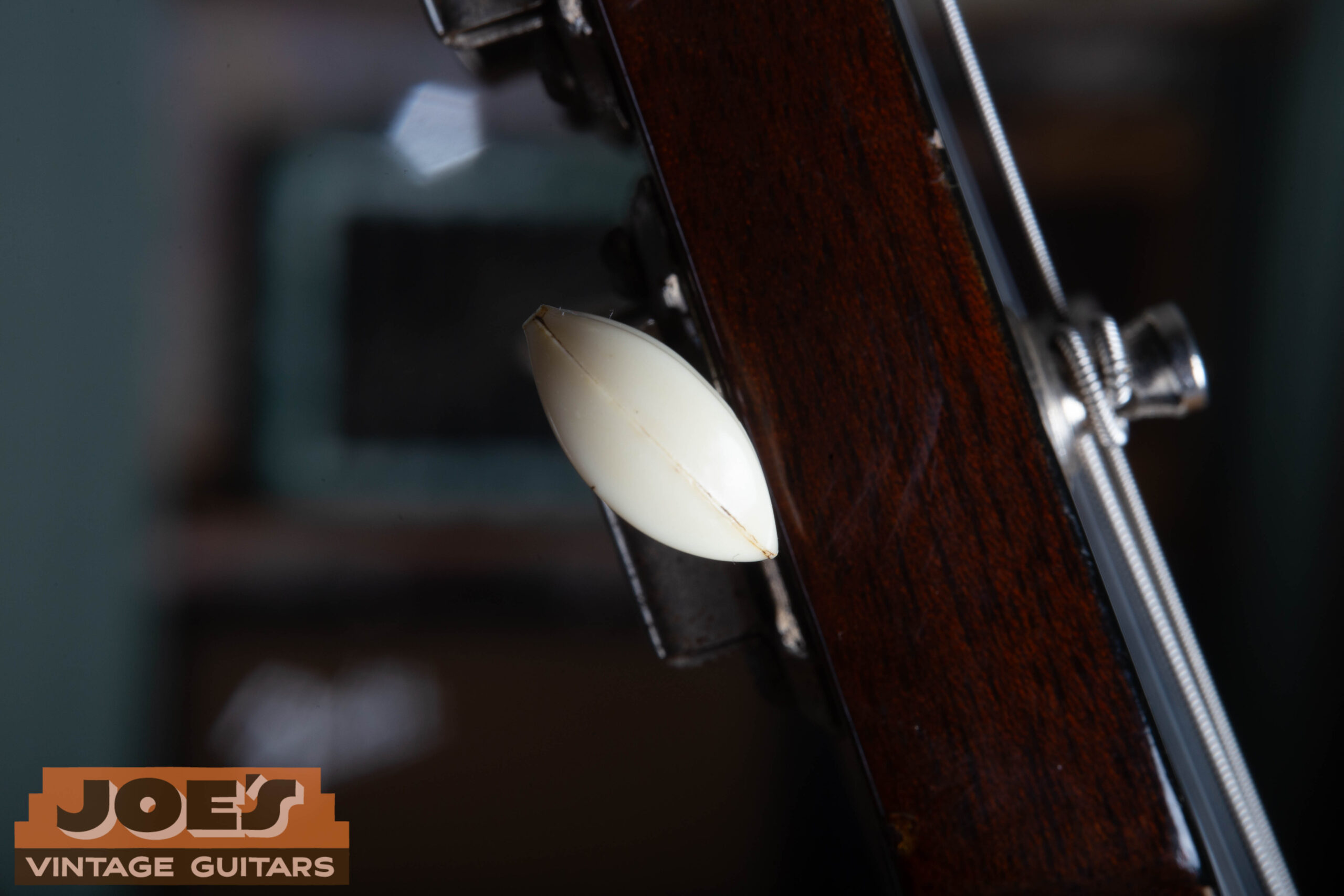
An original 1959 Kluson tulip button showing the visible seam line and appropriate celluloid shrinkage and aging. This kind of wear is expected and correct — buttons without any aging are often modern replacements.
Pickups: The Dogear P-90
The most consequential specification distinguishing the ES-330 from the ES-335 family in this era is the use of dogear P-90 pickups. This is not the soapbar P-90 found on Les Pauls and solidbody instruments — it is the dogear variant, and the distinction is fundamental.
Soapbar vs. Dogear: The Critical Difference
The soapbar P-90 mounts via screws that pass through the pickup body, typically with a separate mounting ring. The dogear P-90 takes its name from the small flanged "ears" that extend from the sides of the pickup cover — these flanges are what screw directly to the guitar's top, making the dogear the correct solution for surface-mounting on a hollow arched top where routing a soapbar cavity would be structurally compromising. The dogear cover is also taller and more visually prominent than the soapbar.
On the ES-330, the dogear pickups are mounted directly to the top of the guitar through the flanges, typically with a thin rubber gasket beneath the housing to minimize mechanical coupling between pickup and top — important on a fully hollow instrument prone to feedback. A set of soapbar P-90s on a dot-neck ES-330 is not original and is the result of a pickup swap at some point in the guitar's life.
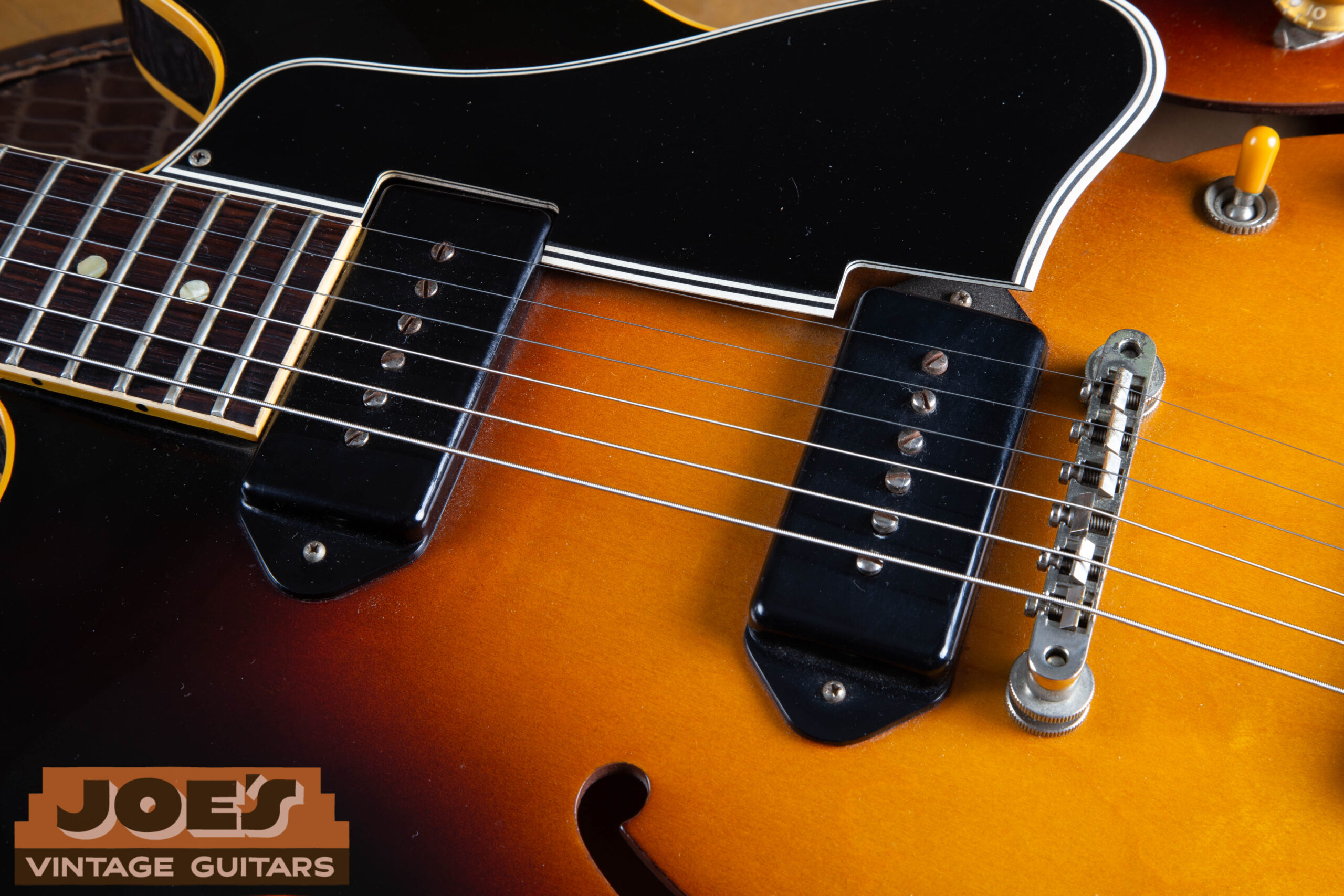
Dogear P-90 pickups with black plastic covers on a 1959 ES-330. Note the characteristic flanged ears that mount directly to the top surface — the feature that distinguishes a dogear from a soapbar.
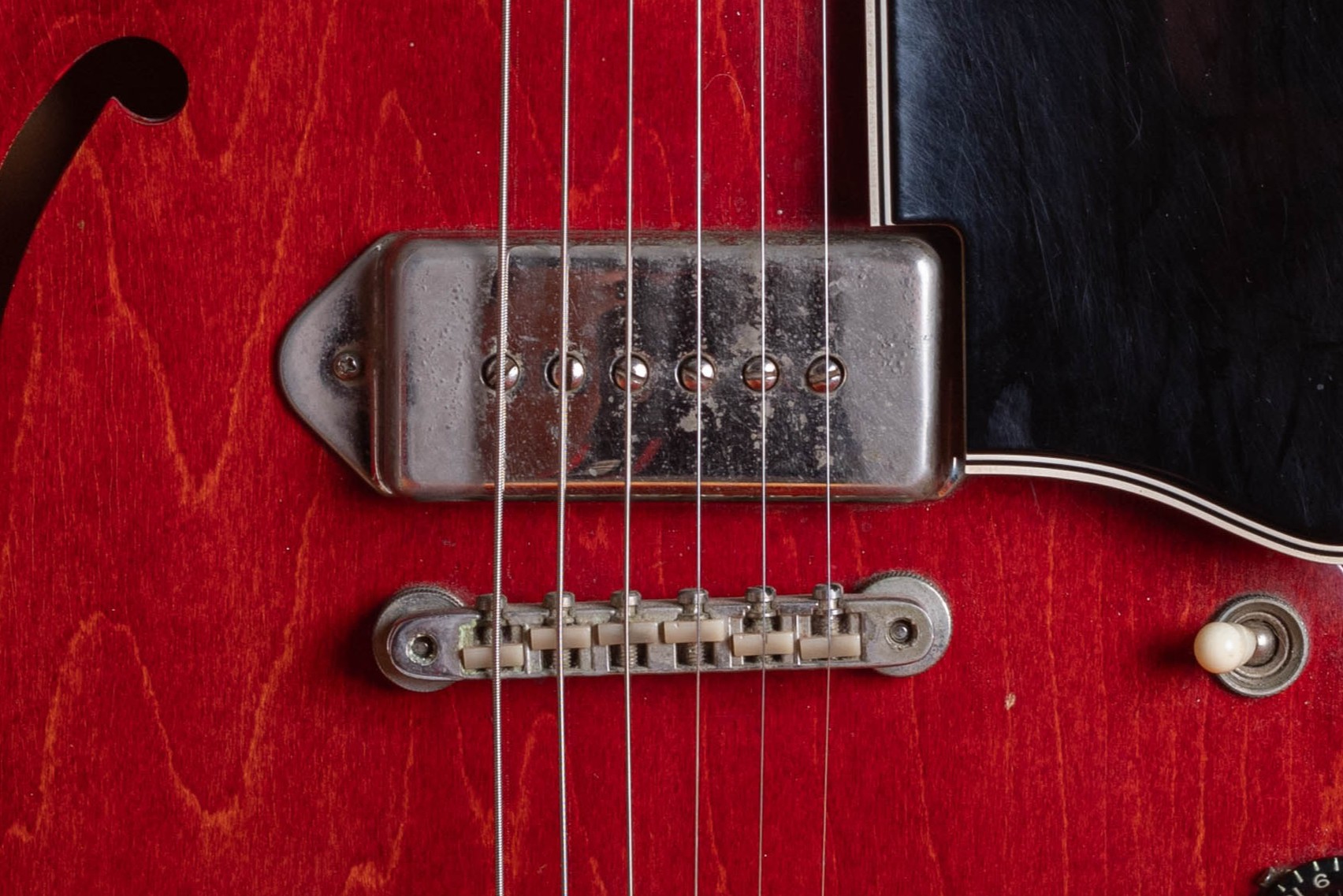
Nickel-plated dogear P-90 covers began appearing on some ES-330s in late 1962 as a transitional specification. Black plastic covers are correct for 1959 through early 1962.
Dogear P-90 Specifications
Bridge: ABR-1 Tune-o-matic
ABR-1 Construction
The ES-330 uses the ABR-1 Tune-o-matic bridge — the same unit used on the ES-335, Les Paul Standard, and virtually every other Gibson electric of this era. The ABR-1 is a two-post bridge with individual saddles for each string, allowing intonation adjustment and overall height adjustment via the two thumbwheels.
Saddle Material: Nickel-Plated Brass, Then Nylon
Saddle material on the dot-neck ES-330 changed across the production period — and this is one of the most commonly misrepresented details in vintage 330 listings:
- 1959 through early 1961: The ABR-1 used nickel-plated brass saddles. This is correct original equipment for the majority of the dot-neck run. They provide good intonation and a slightly brighter, more focused tone.
- Late 1961 and 1962: Gibson transitioned to nylon saddles. These are correct for later dot-neck examples. Nylon saddles are often the first component to be replaced on well-used examples, as they wear and can break over decades of use.

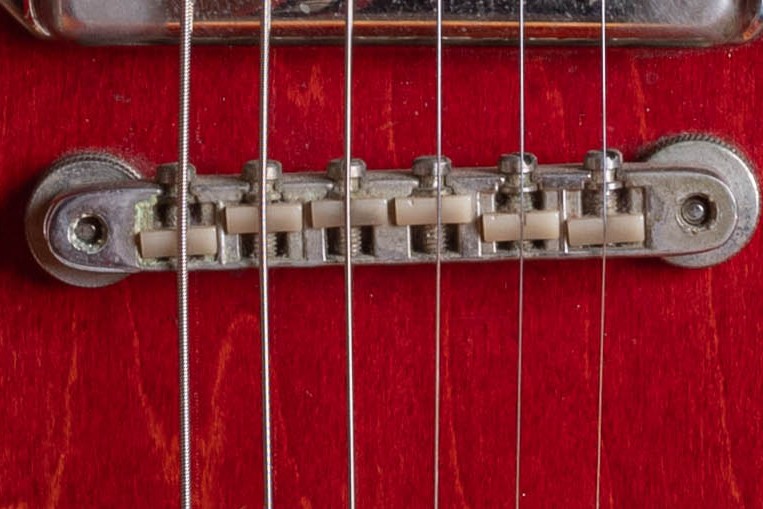
Important: Nylon saddles are not correct for a 1959 or 1960 ES-330. If you encounter an early dot-neck 330 with nylon saddles, they are almost certainly replacements. The correct saddle for 1959–early 1961 is nickel-plated brass. Sellers sometimes present nylon saddles as original on early examples — this is incorrect.
Wire Retention and Post Anchoring
The ABR-1 through most of the dot-neck period is the non-wire-retained version, with saddles held by tension rather than a retaining wire. By approximately 1961–62, Gibson began using a retaining wire on some ABR-1 production. On dot-neck ES-330s, the bridge posts are threaded directly into the maple laminate top itself — there are no press-fit metal anchors or bushings beneath the posts as used on some later Gibson designs. The wood alone carries the load. This is an important authentication and condition detail: after 60+ years of string tension, the wood around the post holes can become compressed or stressed, causing the posts to lean forward toward the neck. Inspect both posts carefully for any lean or rocking — a leaning post indicates the wood has been stressed and may require stabilization before the guitar is playable at proper string height.
Tailpiece
The standard ES-330 uses a trapeze tailpiece — a direct consequence of the fully hollow construction. There is no solid center block to anchor a stud tailpiece into, so the traditional archtop-style trapeze is used instead. The trapeze is a single-arm, wide-bar design with string slots across the tail bar. Strings loop under the bar and angle up to the bridge saddles, creating a shallower break angle than a stop-bar guitar — slightly easier string bending and a somewhat different acoustic character. The trapeze is nickel plated, consistent with all other hardware on the production ES-330, and attaches via a single mounting block at the endpin end of the body.
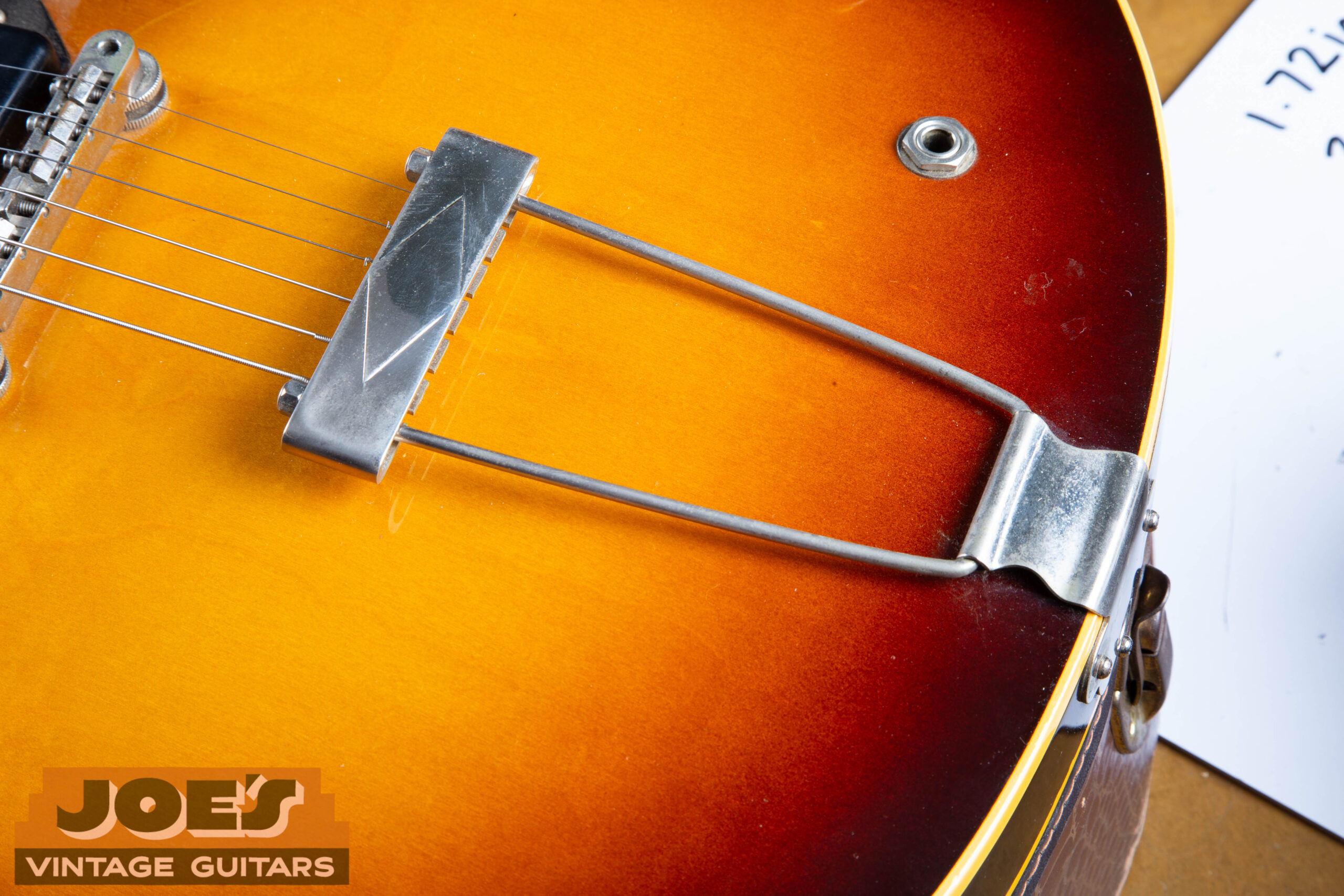
The nickel-plated trapeze tailpiece on a 1959 ES-330. The shallow string break angle is a defining acoustic characteristic of the instrument.
However, the trapeze is far from the only tailpiece you will encounter on a dot-neck ES-330. Gibson offered — and dealers and players installed — a range of vibrato units on these guitars both from the factory and as period accessories. The following variants are all documented on original dot-neck examples:
Maestro Vibrola
The Maestro Vibrola is the most commonly encountered factory-installed vibrato on the dot-neck ES-330. Gibson's own Maestro unit — a relatively simple, lyre-decorated vibrato arm assembly — was offered as a factory option and appeared in Gibson's own catalogs on ES-330 configurations. The Maestro Vibrola mounts to the same end block as the trapeze, replacing it entirely. A 330 with a Maestro Vibrola that shows no evidence of tailpiece swapping — original finish under the unit, original mounting hardware — is a legitimate factory configuration, not a modification.
Bigsby
Bigsby vibrato tailpieces appear on some dot-neck ES-330s and are among the most desirable vibrato configurations to players today. Bigsby units were available as both dealer-installed and factory-ordered options on Gibsons of this era. The Bigsby mounts to the end block of the 330's body and works naturally with the ABR-1 Tune-o-matic bridge already on the guitar. When evaluating one, check that the mounting holes align with the original end block hardware and that the finish disturbance beneath the Bigsby is consistent with the guitar's overall age and wear — period-installed Bigsbys will show matching patina.
Lyre Vibrola
The decorative Lyre Vibrola — a more ornate vibrato unit featuring a lyre-shaped engraved cover plate — also appears on some ES-330s from this era. The Lyre Vibrola is more commonly associated with the ES-335 and ES-345 in period Gibson literature, but it was not exclusive to those models and appears on documented dot-neck 330 examples.
Sideways Vibrola
Perhaps the rarest and most unusual vibrato configuration documented on the dot-neck ES-330 is the Sideways Vibrola — Gibson's distinctive unit in which the arm moves laterally rather than up and down. The Sideways Vibrola was a factory option on certain Gibson models in the late 1950s and early 1960s and is known for its idiosyncratic feel and limited pitch range compared to a conventional vibrato. Seeing one factory-installed on a dot-neck ES-330 is genuinely rare — but it does exist, and a correctly spec'd example with original finish underneath the unit is a legitimate and historically interesting find.
Vibrato-equipped 330s — what to check: Any vibrato tailpiece on a dot-neck ES-330 should be evaluated for installation date. Look for finish wear and patina consistent with the guitar's age under and around the unit, original mounting screws with matching oxidation, and no evidence of filled holes or refinishing around the tailpiece area. A period-installed vibrato is original equipment; a recently swapped vibrato is a modification. Neither dramatically harms value the way a refinish would, but knowing which you have matters for accurate representation.
Hardware Finish: Nickel Throughout
All metal hardware on the standard ES-330 in the dot-neck era is nickel plated. This is a critical and frequently misunderstood point — and worth stating clearly, because even the ES-335 (the 330's more expensive semi-hollow sibling) used nickel-plated hardware as standard during the dot-neck era. Gold hardware was reserved for the upscale ES-345 and ES-355 — the stereo and custom models at the top of Gibson's thinline lineup. The 330 used nickel throughout, without exception: the Tune-o-matic bridge, the trapeze tailpiece, the tuner machine housings, the strap buttons, the pickup mounting screws, and all other metal components are nickel. If a dot-neck ES-330 is presented with gold hardware, that hardware has been replaced or the guitar is not what it's represented to be.
Pickguard
The ES-330 carries a black multi-ply pickguard — specifically a four-ply laminate construction with a black outer layer, a white inner layer, another black layer, and a white base layer. The layered construction is visible on the edge of the pickguard when viewed from the side, and the four-ply laminate is correct for the dot-neck era.

The four-ply laminate edge of the 1959 ES-330 pickguard — black/white/black/white layers. The layering is clearly visible when the pickguard is viewed on edge, and is one way to assess originality of an unremoved guard.
The pickguard is mounted to the guitar via a single-arm metal bracket — a nickel-plated metal arm that extends from beneath the neck pickup, with the guard screwed or clipped to it. This bracket style is specific to the thinline hollow-body family and is different from the simple screw-to-top mounting used on solidbody instruments. The bracket allows the pickguard to float slightly above the top surface rather than lying flat against it.
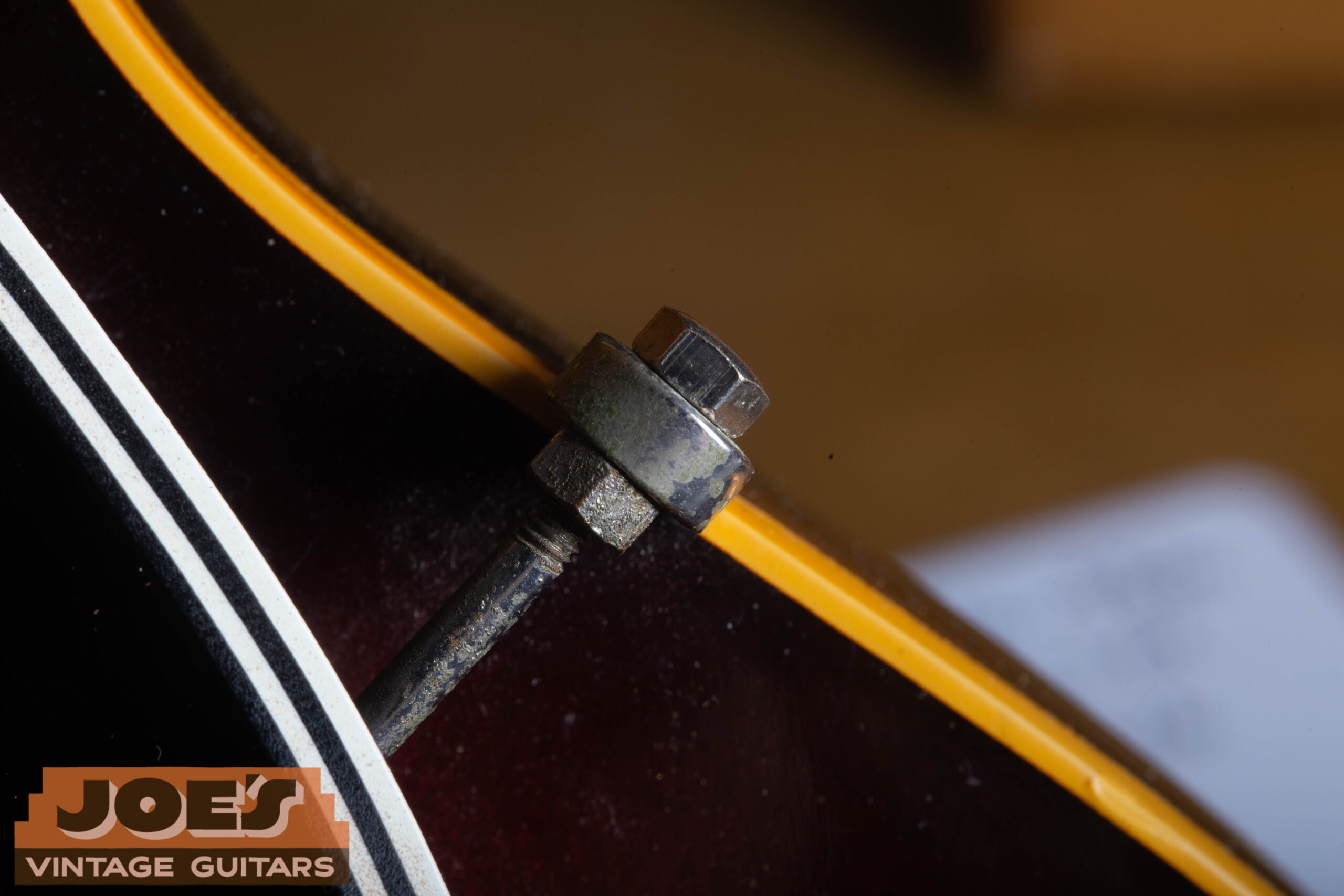
The single-arm pickguard mounting bracket on a 1959 ES-330. This bracket is specific to the thinline hollow-body family and allows the guard to float above the top surface. Original brackets are nickel plated and should show period-appropriate oxidation.
Pickguards are commonly missing or replaced on surviving examples, as they are easily removed and frequently lost over a guitar's life. An original four-ply black pickguard with its original bracket in place is a meaningful originality detail. A replacement guard in the correct four-ply configuration is generally acceptable to most buyers; a tortoiseshell or other incorrect material is not original to any production dot-neck ES-330.
Electronics: Controls, Pots, Wiring, and Switch
Control Layout
The ES-330TD's control layout consists of four controls — two volume, two tone — in a standard offset diamond arrangement on the lower treble bout, plus a three-way toggle switch on the upper treble bout. The neck volume and tone controls govern the neck pickup; the bridge volume and tone controls govern the bridge pickup.
Potentiometers
The controls use CTS 500k ohm pots — standard for P-90 equipped Gibsons of the era. The use of 500k pots rather than the 250k pots common in Fender designs gives the dogear P-90 signal a brighter overall baseline, appropriate to the pickup's character. Pots carry EIA source-date codes stamped into the casing; CTS pots beginning with 137 are expected and correct. Date codes should correspond to within approximately 12 months of the guitar's shipped date. Pot codes are one of the primary dating tools for vintage Gibsons and should always be read in conjunction with the FON and serial number.
Capacitors
The tone circuit uses .022µF capacitors — consistent with Gibson's standard wiring for P-90 equipped instruments. The capacitors used were typically bumble bee or black beauty (Sprague) wax-paper-and-foil types, both of which are highly sought after by vintage tone enthusiasts. These are often the first components replaced in vintage Gibson wiring. Original capacitors in-circuit are a meaningful originality point.
Toggle Switch
The three-way pickup selector is a Switchcraft toggle switch — the long-shaft barrel-style switch standard on Gibson electric guitars since the late 1940s. Toward the neck position selects the neck pickup only; toward the bridge selects the bridge pickup only; center position activates both.
Switch Tip
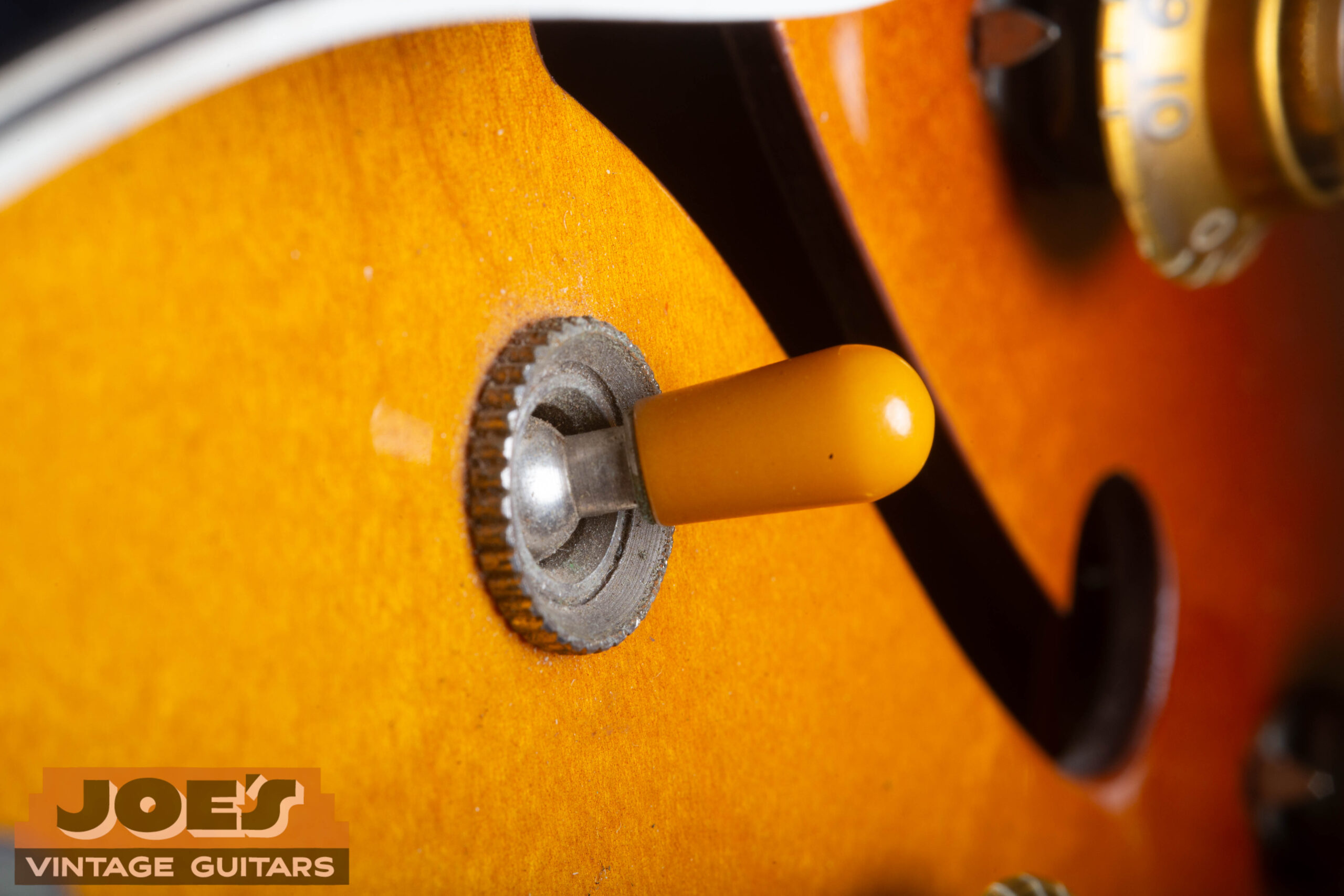
The amber/cream barrel switch tip on a 1959 ES-330. The warm color reads distinctly amber against white, consistent with the aged cream plastic used throughout the instrument's trim.
The toggle switch tip is a cream/amber colored plastic barrel-style tip — the standard barrel switch tip associated with dot-neck Gibsons. The warm cream color reads slightly amber against pure white. The tip threads onto the toggle shaft and is fragile; original examples are commonly missing or replaced. A correct cream barrel tip is generally acceptable as a replacement.
Knobs: Gold Bonnets, Then Gold Reflectors
The knobs on the dot-neck ES-330 are one of the most commonly misidentified details on these instruments — they were never cream-colored top hats. The correct knobs changed once during the dot-neck era:

Gold Reflector knobs on a 1960s ES-330. Note that the metallic insert in the dome can be either a gold or silver finish — both are correct period variants. The transition from Gold Bonnet to Reflector knobs occurred around mid-1960.
Knob Pointers
Beneath each knob, on the guitar's top surface, is a small cream-colored pointer disc with a small projecting tab that indicates the control's setting. This pointer sits between the guitar's top and the base of the knob, seated around the pot shaft. It is sometimes missing on guitars that have had their pots replaced or controls disassembled. Original pointers intact are a positive originality indicator.
F-Holes
The ES-330 has a pair of bound f-holes — traditional archtop-style openings in the top of the guitar that provide acoustic projection and access to the interior. The f-holes are bound with the same single-layer cream binding used elsewhere on the instrument. Unlike the ES-335 where the f-holes are to some degree decorative (with a solid block behind them), on the ES-330 the f-holes open into the genuinely hollow body cavity. They are also the primary access point for reading the Factory Order Number and inspecting internal components with a flashlight and mirror.
Serial Numbers and Factory Order Numbers
No Interior Labels — Ink Stamp and FON Only
One detail that surprises many buyers encountering their first dot-neck ES-330 is the absence of any interior paper label. Unlike later Gibsons and many other manufacturers of the period, dot-neck ES-330s do not carry a label glued inside the body. Instead, identification is provided by two elements: the model name and serial number ink-stamped directly on the inside of the body (visible through the treble f-hole), and the Factory Order Number (FON) written in pencil on the interior.
The ink stamp typically shows the model designation ("ES-330T" or "ES-330TD") alongside other production markings. On 1959 examples, there is generally no serial number on the back of the headstock — the primary identification is the FON visible through the f-hole. A headstock serial number began appearing more consistently from 1960 onward. This means that on many 1959 examples, the only external identification is the model name stamped on the headstock face below the logo — and the interior FON is the primary dating tool.
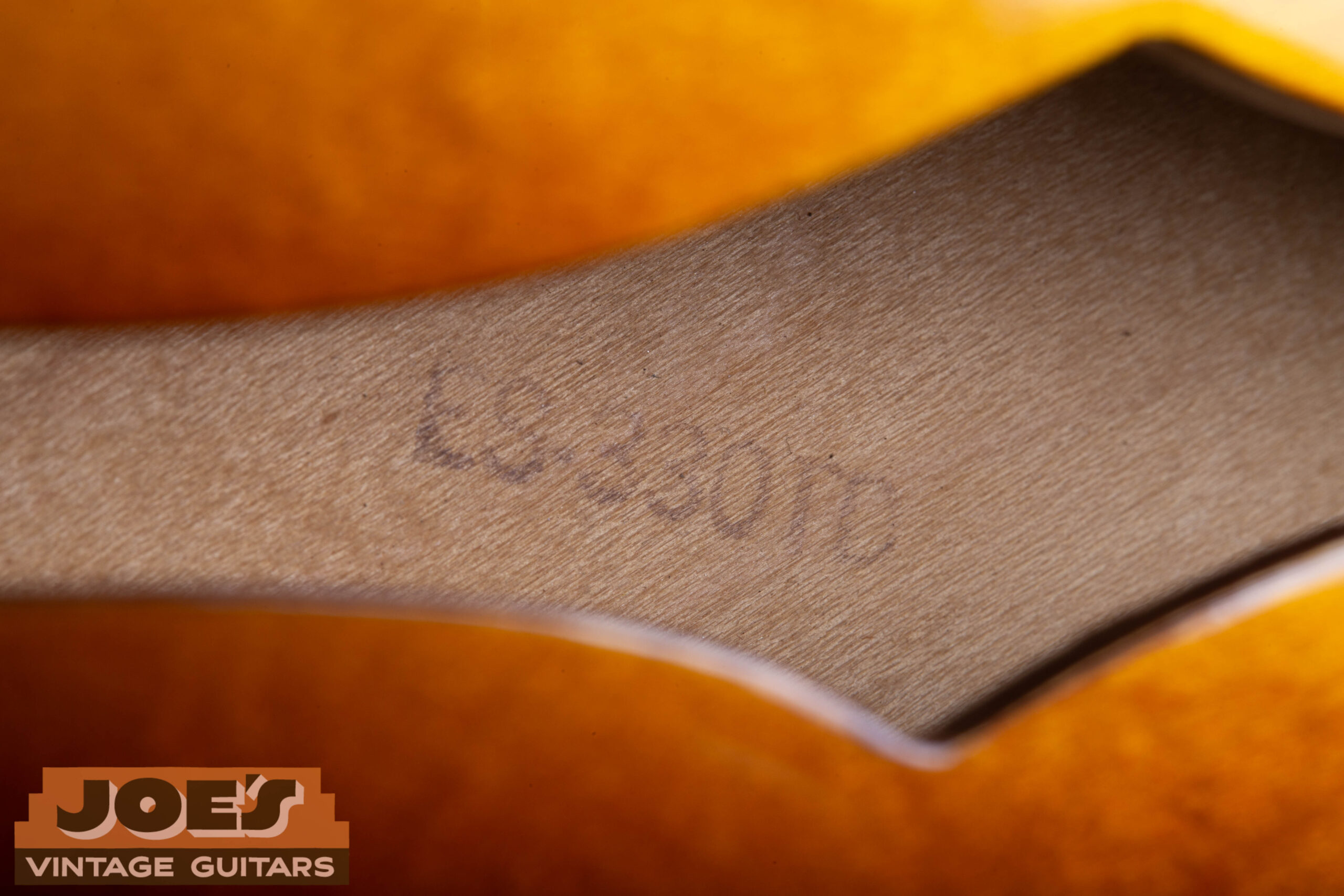
The interior ink stamp on a 1959 ES-330 — this model designation stamped inside the body is the primary identification on dot-neck examples. There is no paper label. The penciled FON (Factory Order Number) appears nearby and is the main dating tool for 1959 instruments, which typically lack a headstock serial number.

FON close-up on a 1959 ES-330. The "T" prefix letter identifies this as a 1959 build — this penciled number, visible through the treble f-hole, is the most reliable dating tool on the instrument.
The Gibson Serial Number System
Dating a dot-neck ES-330 requires understanding Gibson's serial number system of this era — which is, to put it charitably, complicated. The serial numbers alone do not always provide an unambiguous year. The pot codes, FON, and physical specifications must all be considered together for accurate dating. We've written a dedicated guide to reading Gibson serial numbers that covers the full picture across all eras if you want to go deeper.
In 1961 Gibson transitioned to a new serial number format, and these numbers overlap substantially between 1961, 1962, 1963, and 1964 — creating one of the most confusing dating puzzles in vintage guitar collecting. When the serial number is ambiguous, go directly to the pot codes and FON.
Factory Order Numbers (FON)
The FON is written in pencil (sometimes ink) on the inside of the guitar body, visible through the treble f-hole with a light and mirror. It typically consists of a letter prefix indicating the year, followed by a batch number and sometimes a sequence number.
| Year | FON Letter Prefix | Notes |
|---|---|---|
| 1958 | S | Rare pre-production / very early-build examples only |
| 1959 | T | Standard introduction year; no headstock serial on most examples |
| 1960 | U | Headstock serial begins appearing more consistently |
| 1961 | V | New serial number format transition; some overlap |
| 1962 | Z or no prefix | FON system less consistently applied by this point |
Pro tip: The combination of pot date codes + FON prefix + serial number range + physical specifications gives the most reliable date estimate. No single element should be considered definitive on its own. Always look through the treble f-hole with a good flashlight and a small mirror to read the FON directly — don't rely on the seller's description of it. Remember: on 1959 examples especially, the FON is often the only hard dating evidence on the instrument. For context on how many ES-330s were actually produced in each year, our Gibson shipping totals guide gives the factory numbers from 1948 through 1979.
Year-by-Year Specification Summary
1959 — Introduction Year
1959- Full-to-transitional neck profile: .88"–.93"+ (early); .84"–.88" (late year)
- 16th-fret neck joint — constant for the entire dot-neck era
- Rounded upper bout horn tips
- Unbound headstock; pearl script logo; no crown inlay
- No headstock serial number on most examples — FON is primary identification
- Interior ink stamp of model designation only — no paper label
- Single-line Kluson Deluxe tuners; cream/white tulip plastic buttons
- Dogear P-90 pickups with black plastic covers
- Nickel-plated brass ABR-1 saddles; non-wire-retained bridge
- Nickel hardware throughout
- Gold Bonnet (top hat) knobs
- FON prefix: T (very rare S prefix on earliest examples)
- Four-ply black pickguard with single-arm nickel bracket
- Bumble bee or black beauty capacitors
- Cases: alligator-grain chipboard (standard) or Lifton brown/pink hard shell (upgrade)
1959 was of course the same year Gibson was producing its most celebrated ES-335s — if you own or are researching a 1959 335, our dedicated 1959 Gibson ES-335 authentication guide covers the equivalent spec details for that model.
1960 — Transition Year
1960- Slim C neck profile: typically .82"–.87" at first fret
- Knobs: Gold Bonnet early in year → Gold Reflector knobs from approximately mid-year
- Single-line Kluson transitioning to double-line Kluson Deluxe by mid-year
- FON prefix: U
- Nickel-plated brass ABR-1 saddles continue
- Nickel hardware throughout
- "Made in USA" and headstock serial beginning to appear more consistently
- Cases: Lifton / stone / transitional black and gold
1961 — Slim Taper Era
1961- Slim taper neck profile: typically .80"–.83" at first fret
- Gold Reflector knobs standard
- New serial number format on headstock back
- FON prefix: V
- ABR-1 saddles: nickel-plated brass transitioning to nylon late in the year
- Wire-retained ABR-1 on some examples
- Double-line Kluson Deluxe tuners
- Nickel hardware throughout
- Black and gold Gibson hard case standard
1962 — Last of the Dots
1962- Slim taper neck profile: .80"–.83" at first fret
- Gold Reflector knobs
- New serial number format; FON less consistently applied
- Nylon ABR-1 saddles standard; wire-retained bridge standard
- Dogear P-90 covers: black plastic through most of the year; nickel-plated covers beginning to appear late 1962
- Nickel hardware throughout
- Black and gold Gibson hard case standard
- Block inlay transition begins at some point late in the year
Quick-Reference Specifications by Year
| Specification | 1959 | 1960 | 1961 | 1962 |
|---|---|---|---|---|
| Neck joint | 16th fret | 16th fret | 16th fret | 16th fret |
| Neck depth at 1st fret | .88"–.93" early; .84"–.88" late | .82"–.87" | .80"–.83" | .80"–.83" |
| Knobs | Gold Bonnet | Gold Bonnet → Gold Reflector (mid-year) | Gold Reflector | Gold Reflector |
| ABR-1 saddles | Nickel-plated brass | Nickel-plated brass | Brass → Nylon (late year) | Nylon |
| Pickup covers | Black plastic | Black plastic | Black plastic | Black → Nickel (late year) |
| Hardware finish | Nickel | Nickel | Nickel | Nickel |
| Kluson tuners | Single-line | Single → Double-line | Double-line | Double-line |
| FON prefix | T (rare S) | U | V | Z / none |
| Headstock serial | Usually absent | Begins appearing | New format, consistent | New format |
| Standard case | Chipboard or Lifton brown/pink | Lifton / Stone / transitional black & gold | Black and gold | Black and gold |
Cases
The Alligator-Grain Chipboard Case
Gibson's standard base-configuration case for the late-1950s and early-1960s thinline lineup was the alligator-grain chipboard case — an economical tolex-covered chipboard case with an embossed alligator grain texture in black or dark brown, a pink/salmon-colored crushed velvet interior, and minimal hardware. This was the standard case shipped with the 330 when no upgrade was specified. These cases offer limited structural protection by modern standards, but they have a period-correct charm and are increasingly collectible in their own right.
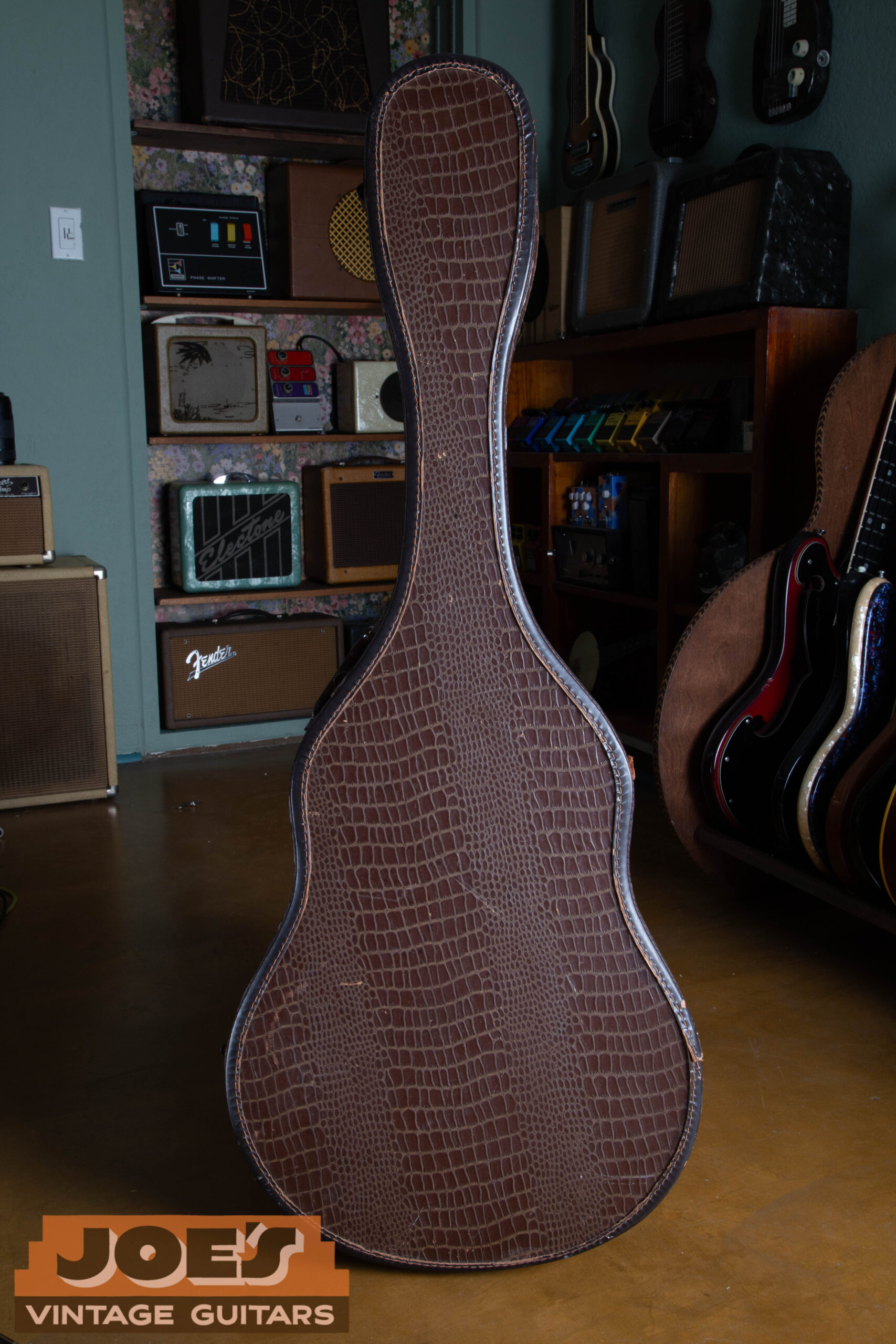
The original alligator-grain chipboard case that shipped with many 1959 ES-330s. The pink/salmon crushed velvet interior is period-correct and increasingly collectible. These cases are structurally modest but visually iconic.
The Lifton Brown/Pink Hard Case
The premium hard case option for late-1950s ES-330s was the Lifton-made brown exterior, pink/salmon-lined hard shell case — a brown or dark brown alligator-grain tolex exterior with crushed pink/red velvet interior (sometimes described as "dusty rose") and bright nickel or chrome hardware. These are among the most visually iconic vintage guitar cases in the American market. Finding an original Lifton case with a 1959 ES-330 adds meaningful desirability and value to the combination.
The Stone Case
A somewhat less common option seen on some late-1950s and very early 1960s Gibson shipments is the stone case — a gray exterior tolex with a deep red or burgundy interior. These cases appeared briefly in the transition between the brown/pink Lifton era and the black/gold era that followed.
The Black and Gold Case
From approximately 1960 through the end of the dot-neck era and beyond, the standard Gibson hard case was the black exterior with gold-tinted orange interior — often called the "black and gold" or "black and orange" case. Black or very dark gray tolex exterior, bright chrome hardware, and a rich amber/gold crushed plush interior. This is the correct case for 1961 and 1962 dot-neck examples and remains a functional, sturdy case today.
Buying Guide: What to Look For
If you're in the market for a dot-neck ES-330, the following checklist covers the most important inspection points. Browse our current inventory of vintage Gibson ES models — we're always happy to provide detailed condition reports and photographs of specific instruments.
- Original finish — check heel, pickup routes, and control cavity for overspray under UV light
- Pot date codes consistent with the claimed year
- FON visible through the treble f-hole — read it with a light and mirror, don't just trust the seller's description
- Correct knob style — Gold Bonnet (1959–mid-1960) or Gold Reflector (mid-1960–1962)
- Dogear P-90 pickups with dogear flanges intact; black covers for 1959–early 1962
- Correct ABR-1 saddle material — nickel-plated brass (1959–early 1961) or nylon (late 1961–1962)
- Fret nibs present — indicates original frets or a careful re-fret that preserved the binding
- Original tuner buttons — check for cracks at the collar
- Bumble bee or black beauty capacitors in the control cavity
- Unbound headstock with no crown inlay — both are correct and expected on all production dot-neck 330s
- Four-ply black pickguard with original single-arm nickel bracket
- Neck angle — place a straightedge on the fretboard and check that it grazes the bridge saddle tops
- ABR-1 post lean — check both bridge posts for forward lean indicating stressed or compressed wood around the post holes
- Binding shrinkage — expected, but extreme lifting or loss is a structural concern
- Top cracks — fully hollow top is more vulnerable than a solid top; inspect in raking light
- F-hole binding condition — corners are prone to lifting and separation
- Headstock repairs — inspect for glue lines, overspray, and grain irregularity; angled headstocks are vulnerable to breakage
- Soapbar P-90s installed — not original; the 330 requires dogear P-90s
- Gold hardware — not original to any production ES-330; indicates replacement or modification
- Crown or thistle inlay on headstock — not original to any production ES-330
- Bound headstock — not original to any production ES-330
The ES-330 in Context
- Gibson ES-335 (1958–): The premium semi-hollow sibling. Center block construction, PAF humbuckers, 19th-fret neck joint, nickel-plated hardware (like the 330 — gold was for the 345 and 355), bound headstock with crown inlay. More expensive in the vintage market but a fundamentally different instrument in construction and feel.
- Gibson ES-225T / ES-225TD (1952–1959): The full-depth archtop models that the ES-330 directly replaced. Single-cutaway, full-depth hollowbody, single or dual P-90s — substantially different in feel, access, and application from the double-cutaway thinline 330.
- Epiphone Casino (1961–): The ES-330's closest cousin — virtually identical in construction, with the same fully hollow thinline body, the same dogear P-90s, and the same general hardware complement in the early 1960s. Carries the Epiphone brand but is an equally capable and historically significant instrument.
- Gibson ES-345 (1959–): The step above the 335 — center block, stereo wiring, Varitone circuit, humbuckers, gold hardware. A completely different instrument and significantly more expensive in the vintage market than the 330.
- Gibson Les Paul Junior: Another P-90 equipped Gibson of the same era — solidbody, slab mahogany, very different in feel and application but sharing the same dogear pickup DNA. See our Gibson Les Paul Junior guide for a deep dive into that model.
Final Thoughts
The dot-neck ES-330 is one of the great underappreciated instruments of Gibson's golden era. It lacks the solidbody cachet of the Les Paul, the collector frenzy surrounding the ES-335, and the rarity value of some of its more exotic thinline siblings. What it has instead is genuine character: a fully resonant hollow body, a pair of well-voiced dogear P-90s, a 16th-fret neck joint that gives it a completely distinct feel from anything else in the thinline family, and the physical evidence of a manufacturer at the peak of its craft building instruments for working players rather than for posterity.
The specification changes across 1959–1962 are real and meaningful — particularly in the neck profile evolution and the knob and saddle material transitions. A 1959 example plays, looks, and feels very differently from a 1962 example. Knowing which end of that spectrum suits you is worthwhile before you commit to a purchase. Both are legitimate, wonderful instruments — they're just different tools.
If you're searching for a dot-neck ES-330 or want to discuss a specific example you've found, visit our shop or use our contact page to reach out. If you already own one and are thinking about selling, our Gibson consignment and buying page explains how we work with sellers. We've handled many of these instruments over the years and are always glad to help a fellow enthusiast find — or find a good home for — the right guitar.
Looking for related reading? Explore our guides to other classic Gibsons on our blog, browse available vintage inventory in our shop, or get a free appraisal on a guitar you own.

Joe’s Vintage Guitars
47 N Fraser Dr E
Mesa, AZ 85203
Phone: (602) 900-6635
Email: joesvintageguitars94@gmail.com

Written by Joe Dampt
“Driven by a love for classic tunes, I specialize in buying, selling, and appraising vintage guitars, bringing music and history together.”