The Definitive 1966 Gibson ES-335 Authentication Guide: Patent Number Pickups, Trapeze Tailpiece & Every Pre-Norlin Detail
Authentication Guide · Gibson Semi-Hollow · 1966
The complete year-specific reference for dating and authenticating a genuine 1966 Gibson ES-335 — Patent Number pickups, transitional hardware, serial numbers, and every detail that separates a real example from a fake or misrepresented instrument
- Why 1966 Is a Transitional Year
- At-a-Glance Specifications
- Serial Numbers & Dating
- Headstock, Logo & Truss Rod Cover
- Neck, Nut, Fingerboard & Inlays
- Body, Horns & Binding
- Pickguard & Controls
- Patent Number Pickups
- ABR-1 Bridge & Tailpiece
- Tuners, Knobs & Switch Tip
- Orange Label & Interior
- Neck Tenon & Routing
- Chrome Plating & Aging
- Case & Case Candy
- Fakes, Reissues & Modifications
- Authentication Checklist
- Related Resources

Why 1966 Is a Transitional Year
The 1966 Gibson ES-335 sits in an interesting and often misunderstood position in the instrument's history. It is not the celebrated "dot neck" of 1958–1961, nor the CBS-era instrument of the early 1970s — it is a mid-CBS-acquisition guitar that retains much of what made the ES-335 great while beginning to show the first signs of the cost and quality changes that accelerated through the late 1960s. Understanding 1966 specifically requires knowing both what it still was and what it was beginning to become. For context on how production year affects value across Gibson's electric guitar range, see our guide on how year of manufacture affects vintage Gibson value.
CBS acquired Fender in 1965; Gibson's ownership change — to Norlin, through Chicago Musical Instruments (CMI) — occurred later, in 1969. So a 1966 ES-335 is still a pre-Norlin Kalamazoo guitar, built by the same craftsmen and to fundamentally the same standards as the early 1960s examples, just with hardware and materials that were already evolving. The pickups are no longer PAFs but are excellent Patent Number humbuckers; the bridge saddles are in transition; the tuners may still be Klusons. This is a genuine vintage guitar with significant collector value — and one that requires attention to specific year-defining details to authenticate correctly.
1. Are the bridge saddles nylon or chrome-plated? 1966 is precisely the transition year. Both are correct; knowing which your example has and confirming it matches the bridge casting is important.
2. Are the pickups pre-T-top Patent Number humbuckers? The T-top design came in approximately 1967–68. A genuine 1966 should have earlier Patent Number pickups — authenticating these is covered in detail in Section 08.
3. Does the serial number confirm 1966? Gibson's 1960s serial system has quirks and overlaps. Understanding what a genuine 1966 number looks like — and why it can appear faint — is essential.
At-a-Glance Specifications
Serial Numbers & Dating
Gibson's serial number system in the mid-1960s is more reliable than Fender's contemporary system but still has quirks and overlaps that require understanding. The serial number alone can confirm a guitar is consistent with 1966 production, but it must be cross-referenced with the orange label and physical features to build a complete dating case.
The Ink Stamp on the Back of the Headstock
The 1966 ES-335's serial number is impressed (stamped) directly into the wood of the headstock back — the number is physically indented into the mahogany beneath the finish. It is also inked onto the orange label inside the body. The impression in the wood is the primary reference.
The impressed serial can be difficult to read on darker-lacquered headstocks because the finish fills the impression over time. If the serial number on a claimed 1966 ES-335 is hard to read, that is not necessarily suspicious — raking a light across the surface at a low angle reveals the physical impression in the wood even when it reads faintly. What warrants scrutiny is a serial that appears to have been added recently or looks inconsistent with the surrounding finish.
Angling a flashlight across the headstock back at a low angle (raking light) often makes a faint stamp dramatically more readable. The stamp sits on the lacquer surface and may be partially filled with finish overspray from subsequent coats — a side-lighting technique reveals the physical impression in the finish even when the ink has faded significantly.

1966 Serial Ranges
Gibson used a 6-digit serial number system during this period with no letter prefix. The approximate range for 1966 production is 300000 to 420000, though this range overlaps significantly with late 1965 and early 1967 production due to Gibson's batch-production numbering practices. A number in the 300000–420000 range tells you "mid-1960s" with confidence; pinning it to specifically 1966 requires the orange label and physical feature confirmation. For a complete breakdown of Gibson's serial number systems across all eras, see our Gibson serial number dating guide.
Gibson serial numbers in the 1960s were not strictly sequential by production date. Numbers were assigned in batches and instruments of the same model built weeks or months apart can have numbers that appear out of sequence. Never date a mid-1960s Gibson by serial number alone. Always cross-reference with the orange label date, the FON (factory order number) if present inside the body, and the physical specification details covered in this guide.
Factory Order Numbers (FON)
Some 1966 ES-335s have a Factory Order Number (FON) ink-stamped inside the body, visible through the f-holes. The FON is a production batch identifier reflecting when the guitar was built. It is not always present — its absence is not a red flag. When it is present and consistent with the orange label serial, it adds supporting dating confidence.
Headstock, Logo & Truss Rod Cover
Headstock Shape & Inlay
The 1966 ES-335 headstock is the standard Gibson "open book" or "crown" shape — a symmetrical split-diamond form that Gibson used across its electric guitar range throughout the 1960s. The headstock face is veneered with holly (a white hardwood) over the underlying mahogany. The crown inlay at the top of the headstock is mother-of-pearl, set into the holly veneer.
On an original 1966, the crown inlay should sit flush with the headstock surface. Lifted or re-glued inlays that show gaps at the edges indicate either damage or a headstock that has been worked on. The pearl of the crown inlay ages with a characteristic depth and slight iridescence that reproduction inlays — which are typically plastic or lower-grade pearl — do not replicate convincingly.
The "Gibson" Logo
The 1966 ES-335 carries a mother-of-pearl inlaid "Gibson" logo on the headstock face — the letters are individually inlaid pearl, not silk-screened and not a decal. This is an important authentication distinction: the pearl inlay sits flush with the headstock surface, with the surrounding finish flowing over it. Under a loupe, the individual pearl pieces and their inlay channels are visible. A silk-screened or decal logo on a claimed 1966 indicates either a later instrument or a headstock that has been altered.

Truss Rod Cover
The 1966 ES-335 uses a bell-shaped truss rod cover — a black plastic cover with a slightly wider bottom that narrows toward the top, secured by two screws. The cover is blank — no text. It also features a narrow raised bezel around its perimeter, a detail specific to this era of Gibson truss rod cover. This is the standard format for mid-1960s Gibsons.
- ShapeBell-shaped — wider at the bottom, tapering to a rounded top. Earlier Gibson guitars used a diamond-shaped cover; the bell shape is correct for 1966.
- MaterialBlack plastic. Should show age-appropriate brittleness at the edges and screw holes on a 60-year-old original — not crisp and fresh-looking.
- TextBlank — no text. Both screws should show consistent aging with the surrounding headstock finish. One fresh-looking screw on an otherwise aged guitar is a service indicator.
- ScrewsTwo screws secure the cover. The screw slots should show consistent oxidation and tool marks from original factory installation.
Neck, Nut, Fingerboard & Inlays
Neck Construction & Profile
The 1966 ES-335 neck is mahogany, set into the body with Gibson's long-tenon joint. By 1966, Gibson's neck profiles were beginning to transition from the slimmer profiles of 1963–1965 toward the fuller profiles of the late 1960s and early 1970s. A 1966 neck is generally a comfortable medium C-to-D profile — slimmer than a 1968–1969 example but slightly fuller than a 1964. This is not a precisely defined specification since profiles varied somewhat from instrument to instrument even within the same year.
The Nut
The 1966 ES-335 uses a white nylon (or white plastic) nut — not bone. Gibson transitioned away from bone nuts in the early-to-mid 1960s, and by 1966 the white nylon nut was standard across the electric guitar range. This is a detail that surprises some buyers who assume bone is always more "original" on vintage Gibsons — on a 1966, it is not. A bone nut on a claimed 1966 ES-335 suggests a replacement nut.
The original nylon nut should show wear consistent with 60 years of string contact — subtle grooves in the string slots, slight yellowing of the white material, and consistent patina with the surrounding headstock finish. A bright white, crisp-edged nut is likely a replacement.
Fingerboard & Binding
The fingerboard is rosewood, bound on both edges with a single ply of cream/white binding. This binding is a structural and aesthetic detail — the bound fingerboard is one of the features that distinguishes the ES-335 from more budget-oriented Gibson semi-hollows of the period.
The rosewood on a genuine 1966 will show a natural grain pattern. Modern rosewood replacements or refretted necks with resurfaced boards may show different color uniformity or grain character.
Fret Nibs — A Critical Authentication Detail
One of the most important and revealing authentication details on a 1966 ES-335 is the presence of fret nibs — small projections of binding material that extend over the ends of the frets at the edge of the fingerboard. These are a direct result of Gibson's manufacturing sequence: the fingerboard was bound before the frets were installed. The fret ends were then filed flush with the top of the binding, leaving a small nib of binding material visible at each fret end.
Fret nibs are present on all factory-original Gibson necks from this era. Their importance as an authentication tool is this: when a vintage guitar is refretted, the fret nibs are almost always destroyed. New frets are pulled, the slots are cleaned, new frets are installed and dressed. In this process the binding nibs are nearly always filed away as part of leveling and dressing the new frets.
If a claimed 1966 ES-335 has intact, well-defined fret nibs at every fret position, the frets are almost certainly original. This is one of the fastest and most reliable single checks for fret originality. Worn nibs (from normal playing) are fine and expected — absent nibs strongly suggest a refret. Some partial nib loss from wear at the most-played positions (first through fifth frets) is normal on a played guitar.

Block Inlays
The 1966 ES-335 has small rectangular block inlays in the fingerboard — not dots. Gibson switched the ES-335 from dot inlays to block inlays in 1962; the dot-neck ES-335s of 1958–1961 are a separate and generally more valuable category. All 1962 and later ES-335s through this era use the block inlay format. The blocks are mother-of-pearl (MOP), set flush with the fingerboard surface.
Genuine pearl inlays show a layered, iridescent quality that catches light differently at different angles. Plastic or epoxy replacement inlays are typically more uniform in appearance and don't show the same depth. At the headstock end of the neck (first position), look at the blocks under raking light — original pearl should show natural layering and variation across the block's surface.

Side Dot Inlays — Tortoise, Not White
This is one of the most consistently overlooked details on mid-1960s Gibsons: the side dot position markers on the neck edge are tortoise-colored — a dark reddish swirl pattern — not white. Gibson used tortoise-colored plastic side dots throughout the 1960s on the ES-335. The switch to white side dots occurred later.
A claimed 1966 ES-335 with white side dots has either a replacement neck or has had the side dots replaced. The tortoise color is subtle and can appear darker or lighter depending on how much the plastic has aged, but it should never be the bright white of a modern replacement. Under a flashlight, genuine tortoise dots show a dark reddish swirling pattern — the characteristic tortoise shell appearance.

Body, Horns & Binding
Construction
The ES-335 body is a thinline semi-hollow double-cutaway — maple top, back, and sides with a solid maple center block running the full length of the body internally. This center block eliminates the feedback problems of fully hollow instruments while retaining some acoustic resonance. The body thickness is 1¾ inches, unchanged from the original 1958 specification.
The internal construction — specifically the routing and the way the center block meets the top and back — is a detail visible through the f-holes that can help authenticate or raise questions about a guitar. Genuine 1966 bodies should show consistent, period-correct construction without evidence of internal repairs, added bracing, or routing that doesn't match factory specifications.
Horn Shape — A Subtle but Real Difference
The cutaway horn shape on the ES-335 evolved gradually over the instrument's production history, and the 1966 horns are detectably different from the horns of the earliest examples. The 1958–1961 "dot neck" ES-335s have rounder, more gently curved horns. By the mid-1960s the horns had become slightly more pointed and angular at the tips — a subtle change that is most visible when comparing an early example directly to a mid-to-late 1960s example side by side.
This is not a dramatic visual difference and should not be the only basis for dating or authentication, but it is a consistent period indicator. A claimed 1966 with noticeably round, blunt horn tips may warrant a closer look at whether the body is actually from an earlier period.

Binding
The body has single-ply cream binding on both the top and back edges. Binding condition varies widely — mint unplayed examples exist with binding still looking fresh, while heavily played examples show checking and yellowing. What matters is that the binding character is consistent throughout the instrument.
The f-holes are also bound — a distinctive ES-335 detail. The binding around the f-holes is particularly vulnerable to cracking and lifting over time; original bound f-holes that show period-consistent aging but no signs of re-gluing or replacement are a positive indicator.
Pickguard & Controls
Multi-Layer Pickguard
The 1966 ES-335 pickguard is a multi-layer laminated unit — the layered construction is visible at the edge as a sandwich of alternating materials (typically black/white/black or similar). This is distinctly different from a single-ply guard, and the layering is immediately visible at the cut edge of the pickguard. The guard is mounted on a metal bracket that attaches to the body — it does not screw directly into the top.
Original 1966 pickguards will show age-appropriate warping, shrinkage, and checking of the laminate at the edges. The guard may have pulled slightly away from its original flat shape. A perfectly flat, crisp-edged, multi-layer guard on a claimed 1966 is more likely a replacement than an original.


Controls Layout
The ES-335 has a standard layout of four controls (two volume, two tone) and a three-way toggle switch. The toggle is mounted on the upper bout. The output jack is on the side of the body, recessed into a barrel-style jack cup. All wiring on a genuine 1966 uses coaxial wire with a metal braid outer shield.
Potentiometers (pots) carry manufacturer date codes. CTS was the most common supplier for 1966 Gibson guitars. A pot code reading "137 6625" indicates CTS (code 137), made in 1966, week 25 — approximately mid-June 1966. Read all four pots (three controls plus the toggle switch wafer if accessible) and confirm they all read from approximately the same period. A pot reading significantly later than the others indicates a replacement.
The "bumblebee" capacitors associated with late-1950s Gibsons were phased out by approximately 1962. By 1966, Gibson was using a variety of capacitor types including ceramic disc caps and early "Vitamin Q" style caps. The specific capacitor type on a 1966 ES-335 is less diagnostic than on a late-1950s instrument — what matters is that it's not a modern orange drop cap or other obviously anachronistic component.
Patent Number Pickups

The pickups on a 1966 ES-335 are among the most important and scrutinized authentication points on the guitar. Understanding exactly what they are — and what they are not — is essential.
The Pickup Evolution: PAF → Patent Sticker → Patent Number
Gibson's humbucker pickup went through three distinct phases in the first decade of production:
- PAF Era~1957–1962. "Patent Applied For" sticker on the base plate. The gold label. Hand-wound with varying specifications. Generally considered the most tonally complex and desirable. NOT present on 1966 instruments.
- Patent Sticker Era~1962–1965. The PAF sticker replaced with a black sticker reading the patent number. Still largely hand-wound with similar specs to late PAFs. Transitional era. NOT present on 1966.
- Patent Number Era~1962–late 1960s. A black sticker reading "Patent No 2,737,842" on the base plate. This is what a genuine 1966 ES-335 has. Pre-T-top winding and construction. Genuinely excellent pickups that are often underrated.
- T-Top Era~1967–1975. Named for the T-shaped coil former visible from the adjustable-pole side. More consistent winding, different sonic character. NOT present on 1966.
Authenticating 1966 Patent Number Pickups
Pickup swaps are extremely common on vintage Gibsons — PAFs especially are highly desirable and frequently transplanted. For production volume context, our Gibson shipping totals 1948–1979 shows how many ES-335s were built each year. Confirming that the pickups in a claimed 1966 ES-335 are original and period-correct requires checking multiple details:
- Base plate stickerA black sticker reading "Patent No 2,737,842" on the base plate — this is the correct form for 1966. On a 1966, you should see the sticker.
- Magnet typeAlnico magnet — not ceramic. Genuine pre-T-top Patent Number pickups use Alnico II or Alnico V magnets. Ceramic magnets (which are stronger and harder to the touch) indicate a later or replacement pickup. A small rare-earth magnet held near the pickup will be attracted to Alnico; ceramic pickups interact differently.
- Pole piecesOne row of adjustable pole pieces (slotted screws) and one row of non-adjustable slugs — the standard Gibson humbucker configuration. Both rows are only visible with the cover removed.
- DC resistanceTypically 7.5k–8.5k ohms per pickup on period-correct examples. Readings significantly outside this range suggest a rewind. Both pickups should read in roughly the same range — a dramatic mismatch indicates one may be a replacement.
- Lead wiresCoaxial lead wires with a metal braid outer shield over a cloth-covered inner conductor. Plastic-insulated lead wires indicate a replacement pickup or a rewound unit.
- Cover solderThe pickup cover is held by solder — not screws. The cover is soldered to the base plate at two points. Undisturbed original factory solder at these joints is a strong indicator the cover has never been removed. Re-flowed or disturbed solder is not automatically disqualifying but should be noted, as it indicates the cover has been off at some point.
- T-top checkThe T-top coil former (visible from the adjustable-pole side with the cover removed) indicates 1967 or later production. However, you do not need to remove the cover to make this assessment — and on an original unplayed example you should avoid disturbing the solder. If you have suspicions about pickup replacement, check instead whether the pickup aging and wiring condition matches the rest of the guitar. Mismatched wear, different lead wire style, or solder that looks re-flowed are more practical tells than pulling the cover.


Because PAF pickups are significantly more valuable than Patent Number units, there is an active market in misrepresenting Patent Number pickups as PAFs — removing the patent number sticker and replacing it with a gold PAF sticker. Always verify the sticker type, the magnet type, and the coil former before accepting any pickup identification claim.
ABR-1 Bridge & Tailpiece
The ABR-1 Tune-o-matic Bridge
The 1966 ES-335 uses the ABR-1 Tune-o-matic bridge — the original Gibson adjustable bridge design introduced in 1954. The "ABR-1" designation is cast or stamped on the back of the bridge, which is a key authentication detail. The bridge sits on two threaded posts that screw into anchors in the top; height is adjusted by raising or lowering these posts.
- "ABR-1" markingLook on the back of the bridge (the side facing the tailpiece). "ABR-1" should be legible — cast or stamped into the metal. Later Nashville-style Tune-o-matics are dimensionally different and do not have this marking in the same location. An ABR-1 is narrower and sits on smaller posts than the Nashville bridge.
- Retainer wireA thin metal retainer wire runs through the saddle adjustment screws, holding the saddles in position on the bridge chassis. This wire is present on all authentic ABR-1 bridges through approximately 1975 and is one of the fastest ways to confirm an original or period-correct bridge. A bridge without the retainer wire on a claimed 1966 is either a replacement or has had the wire removed.
- Posts and anchorsThe bridge posts on a 1966 ES-335 have thumbwheel adjusters that allow height adjustment by hand. The posts thread into anchors set into the maple top. Original posts and anchors will show consistent aging and chrome wear with the rest of the hardware.

Bridge Saddles — The 1966 Transition
The 1966 ES-335 uses nylon/plastic saddles on the ABR-1 bridge. Gibson used nylon saddles on the ABR-1 from its introduction through approximately 1969–1970, when they switched to chrome-plated saddles. A 1966 should always have nylon saddles — chrome saddles on a claimed 1966 indicate either a bridge replacement or a later instrument.
Nylon saddles can show string contact grooves and occasional cracking or chipping over time — this is period-authentic aging. Check that all six saddles are the same type; a mix of nylon and metal saddles indicates a partial replacement.

Stop Bar Tailpiece
The 1966 ES-335 uses a trapeze tailpiece — a hinged, bracket-style tailpiece that attaches to the strap button on the end of the body and angles up to anchor the strings above the top. This is the correct tailpiece for the ES-335 in 1966.

The trapeze tailpiece hardware and finish should show aging consistent with the rest of the instrument. The hinge mechanism and string bar should move freely and show no evidence of replacement or non-original hardware.
Tuners, Knobs & Switch Tip
Kluson Deluxe Double-Line Tuners with Double-Ring Buttons
The 1966 ES-335 is fitted with Kluson Deluxe "double-line" tuners — named for the two lines of text stamped on the back of each gear housing: "KLUSON" on the first line and "DELUXE" on the second. This distinguishes them from the single-line Klusons used on contemporary Fender instruments and from the no-text versions used on earlier guitars.
The tuner buttons on this era of Kluson are the "double-ring" style — buttons with two concentric raised rings visible on the face of the button, giving them a distinctive appearance also sometimes called "double-ring" or "tulip" in collector terminology. These are all-metal buttons, not plastic, with a chrome plating that shows age-consistent patina.


Gibson began transitioning some models to Grover Rotomatic tuners in the mid-1960s, and some 1966 ES-335s left the factory with Grovers rather than Klusons. If your example has Grover Rotomatics — the enclosed, oval-housing tuners — and they appear original (no added mounting holes, consistent aging, no evidence of Kluson holes being filled), this can be a correct factory specification rather than a modification. The double-line Klusons with double-ring buttons described here are the more common 1966 tuner, but Grovers are not automatically a red flag.
Top Hat / Reflector Knobs
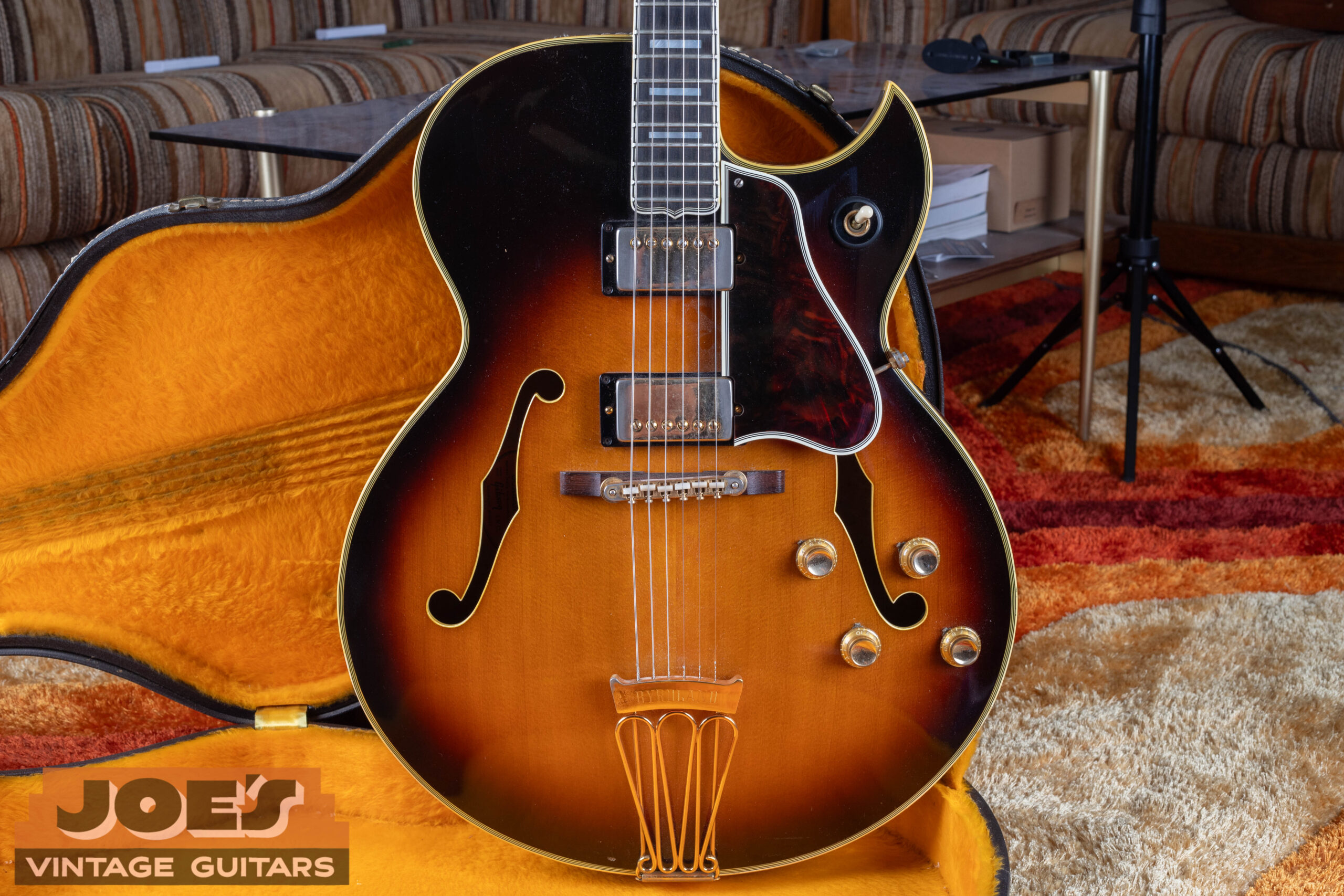
The volume and tone controls on the 1966 ES-335 use "top hat" knobs — also called "reflector knobs." These have a two-part construction: a reflector "hat" top sitting in a metal skirt. The top color varies by finish — black tops on cherry-finish guitars, amber/gold tops on sunburst guitars. The example shown in the photos has black tops, correct for a cherry-finish instrument.

All four knobs should match in both top color and skirt condition. A mismatched top color or one knob with a noticeably different appearance suggests a replacement.
Earlier ES-335s used "speed knobs" — a different, more dome-shaped style. The top hat/reflector style is correct for the mid-1960s.
Toggle Switch Tip
The pickup selector toggle switch tip on the 1966 ES-335 is white plastic with a visible mold seam running around the top portion of the tip. This seam is a characteristic of the injection-molded plastic tip used in the mid-1960s — it's where the two halves of the mold met during manufacturing, leaving a slight raised line that is visible and can be felt. This mold seam is a period-authentic manufacturing artifact.

Replacement switch tips — which are widely available and commonly swapped — may or may not have the same seam. Compare the color and aging of the tip to the nut and any other white plastic components on the guitar. All white plastics on an all-original guitar should show consistent, matched aging: they should not be blindingly white after 60 years, but neither should they be drastically different from each other.
Strap Button
The strap buttons on the 1966 ES-335 are aluminum with a chrome screw. The aluminum button itself is noticeably less shiny than the chrome hardware elsewhere on the guitar — do not expect them to match the bridge or tuner chrome. One button is on the lower bout end pin and one is on the upper shoulder.

Orange Label & Interior
The Orange Oval Label
Inside the body of the 1966 ES-335, visible through the bass-side f-hole, is the orange oval paper label — one of the most important authentication and dating references on any Gibson from this period. The orange label replaced the earlier white labels and tan labels and was used by Gibson through the 1960s and into the 1970s.
- ColorOrange — unmistakably orange on a genuine example. Not red, not yellow, not tan.
- ShapeOval. The label includes "UNION MADE" and "HEREBY GUARANTEED" text — these are period-specific details to look for on a genuine 1966 label.
- Model designation"STYLE ES-335 TDC" — the suffixes stand for Thinline, Dual pickup, Cutaway. This model designation should match the instrument you're looking at.
- Serial numberThe serial number is printed on the label and should match the ink stamp on the back of the headstock. A mismatch between label and headstock serial is a significant red flag.
- Kalamazoo, MichiganThe label reads "Made in Kalamazoo, Michigan, U.S.A." — correct for all pre-1984 Gibson electric guitars. Nashville production began in 1974 for some models; by 1984 Kalamazoo had closed. A 1966 label should read Kalamazoo.

Orange labels can be removed and reinserted through the f-hole, and labels from scrapped or parts guitars are sometimes used to give fraudulent credibility to a different body. A label that appears too clean, too flat, or shows evidence of being re-glued is suspicious. The label should show age-consistent yellowing, slight adhesive bleed, and should lie flat against the interior of the body in a way consistent with having been there since 1966.
Neck Tenon & Routing
The Long Tenon Neck Joint
The ES-335's neck is attached to the body with Gibson's long tenon mortise-and-tenon joint — the tenon (the protruding tongue of the neck heel) extends significantly into the body cavity, providing a large gluing surface area. This long tenon is a structural feature of 1960s Gibson construction and differs from the shorter tenon joints used on some later and less expensive instruments.
The long tenon is visible by removing the neck pickup — it can be seen extending into the body cavity from the neck pickup route. A tight, gap-free joint with no evidence of shimming or re-setting is correct. A neck that sits oddly, requires a dramatically lowered bridge, or shows evidence of shimming or re-setting may have been removed and reset at some point — which is not disqualifying but should be disclosed.

Pickup Routing — The Deeper Humbucker Channel
One of the more technically specific authentication details on the 1966 ES-335 is the routing pattern for the pickups. Because the ES-335's f-hole semi-hollow construction requires routing through the maple top into the body cavity, the pickup routes have specific dimensions and depths. The critical detail for humbuckers is the additional channels routed on the sides of the pickup route for the pickup height adjustment screws.
When a humbucker pickup is installed in the ES-335, the adjustable pole piece screws extend down through the pickup baseplate. The routing on the sides of the pickup cavity includes deeper channels that allow the pickup height adjustment screws to travel their full range without the mounting ring contacting the wood. This deeper routing channel is visible through the pickup route when the pickup is removed.

The presence of these side channels in the correct locations confirms factory-original ES-335 body routing. Bodies that have been improperly modified will show evidence of non-standard routing or filled channels.
Chrome Plating & Aging
The hardware on a 1966 ES-335 — bridge, tailpiece, tuners, pickup covers, strap buttons, switch ring, truss rod cover screws — is all chrome-plated. The aging pattern of original 60-year-old chrome is one of the most reliable overall authentication indicators, and one that is very difficult to fake convincingly.
How Original 1966 Chrome Ages
Genuine mid-1960s Gibson chrome on a well-played example shows a characteristic consistent dulling — the chrome loses its mirror-bright quality and develops a patina. However, mint unplayed examples do exist — including the guitar shown in the photos throughout this guide — where the chrome remains bright and largely unaged. On such an example, the key authentication indicator is not the level of aging but the consistency: all hardware should look equally new or equally aged. A mix of fresh and tarnished hardware on the same guitar is the red flag, not brightness itself. This aging is not random: it follows the natural pattern of corrosion and environmental exposure, which means areas protected from handling (like the underside of the bridge) age more slowly than areas in contact with hands (like the top of the tailpiece bar).
- Consistent patinaAll chrome hardware on an all-original guitar should show matched, consistent aging. Hardware that is dramatically brighter or more tarnished than the surrounding pieces suggests replacement. The bridge, tailpiece, and tuner housings should all show the same general level of age.
- No pitting on originalsOriginal 1966 Gibson chrome typically shows a uniform dulling without heavy pitting or flaking — the mid-1960s chrome plating quality was generally good. Heavy pitting more often indicates lower-quality plating (common on import reproductions) or extreme environmental exposure.
- Reproduction hardware tellsReproduction chrome hardware is almost always either too bright (freshly plated) or artificially aged in a way that is too uniform — real aging follows contour, contact, and protection patterns. Artificially aged hardware tends to look consistently dull across all surfaces, whereas genuine age produces variation.
- Where aging concentratesAreas with regular hand contact — the tailpiece top surface, the bridge thumbwheels, the tuner buttons and housing backs — show more significant wear than protected areas. This differential wear pattern is authentic and should be present.
Case & Case Candy
The 1966 Gibson ES-335 Case
The correct original case for a 1966 ES-335 is a black hardshell case with the Gibson logo badge on the exterior. The exterior covering is black, with metal latch and handle hardware. The interior is yellow/gold plush — a warm yellow fabric that lines the interior including the body cavity, the neck rest, and the accessory compartment.
This yellow interior is a very specific detail. It is not crushed velvet (which appeared on later cases) and not the purple, red, or green interiors of other periods. The yellow/gold plush is correct for mid-1960s Gibson cases and is one of the fastest case authentication checks. The color should be unmistakably yellow-to-gold. Mint examples will retain a brighter yellow; played examples may show compression and deepening of the color over time.


A matching-period case with consistent aging, the correct interior color, and a Gibson logo badge is strong supporting evidence of an unbroken chain of custody from the factory. Cases can be swapped, but a case that matches the guitar in age, interior condition, and period-correct fittings is significantly more compelling than a guitar presented without a case or with an obviously mismatched one.
Case Candy — A Complete Original Set
The ES-335 was shipped from Gibson with a collection of accompanying literature and accessories — collectively known as "case candy" — stored in the case's accessory compartment. A complete original set of case candy for a 1966 ES-335 is exceptionally rare and represents the guitar as it left the Kalamazoo factory in 1966. Each piece is an individual authentication point as well as a piece of Gibson's manufacturing and commercial history.

Tune-o-matic Instructions Sheet
Original Gibson factory documentA folded instruction sheet covering how to use and adjust the Tune-o-matic bridge — intonation adjustment, height adjustment, and saddle positioning. Printed on period paper stock with period typography. The paper should show age-consistent yellowing and any handling marks consistent with having been in the case since 1966.
Humbucking Pickup Instructions Sheet
Original Gibson factory documentAn instruction sheet covering pickup height adjustment for the humbucking pickups — explaining how to set the correct distance from the strings for optimal output and tone. Period typography and paper stock. This document is specific to humbucker-equipped models.
"Attention Guitarists" Electrical Ground Tag
Original Gibson factory documentA small tag reading approximately "Attention Guitarists — All electrical components in this instrument have an internal ground." This document addressed player concerns about electrical noise and hum from grounding — confirming that Gibson had internally grounded all electrical components in the instrument. Its presence is specific to the 1960s production era and is a period-authentic detail.
Gibson Handmade Sonomatic Strings Tag
Original Gibson accessoryA hang tag indicating which Gibson Sonomatic strings were used on the instrument at the factory. This is not string packaging — it is a tag documenting the specific string specification Gibson set the guitar up with before shipping. Its presence confirms the guitar left the factory with documentation of its original string setup.
Gibson Instruction Booklet
Original Gibson factory documentA small booklet covering general guitar care, tuning, and operation. Gibson produced these for inclusion with new instruments throughout the 1960s. The 1966 version has period-specific typography, printing, and content. The booklet should show age-consistent yellowing and any handling evidence consistent with having been in the case since 1966 — not crisp and fresh from a stash of new-old-stock documents.
"This Guitar Has Been Adjusted" Tag
Original Gibson factory documentA tag reading approximately: "This guitar has been adjusted for professional usage, light pick action." This tag was attached to instruments that received factory setup before shipping, indicating the action had been set to Gibson's "light pick action" specification. The presence of this specific tag is consistent with factory-fresh delivery condition and is a significant completeness indicator.
Original Case Key in Envelope
Original Gibson hardwareThe original case key, typically in a small paper envelope. Gibson cases from this era had a keyed latch. The key is a simple barrel-style key. The presence of the original key in its original envelope is a completeness indicator — the envelope should show the same age as the other case candy, not fresh paper. This is increasingly rare as keys get lost, separated, or the cases are eventually opened with substitute tools.
Original Price Tag
Dealer attachmentThe original dealer price tag from the point of sale. Unlike the factory documents above, the price tag would have been attached by the selling dealer — so its format varies by retailer, but it reflects the period retail pricing for the ES-335 in 1966. The presence of an original price tag is one of the strongest provenance indicators available: it connects the guitar to a specific time and place of purchase. The paper, font, and price should all be consistent with a mid-1960s retail transaction.
Fakes, Reissues & Modifications
Gibson ES-335 Reissues
Gibson has produced numerous ES-335 reissues, including the Memphis-era ES-335s, the Custom Shop 1964 ES-335 reissues, and various Historic Collection examples. These are well-made instruments but are not 1966 originals. For comparison with earlier ES-335 specifications, see our 1959 ES-335 authentication guide and 1962 ES-335 authentication guide. Key differentiators from all reissues include:
- Serial number format: All post-1977 Gibson serials have a letter prefix and specific format — "YYDDDNNN" or similar. A genuine 1966 has a plain 6-digit number on the headstock back.
- Orange label: Reissue labels use modern printing and modern paper — visible under UV light and to a trained eye. The Kalamazoo address only appears on genuine pre-1984 instruments.
- Headstock logo: Reissues use silk-screened or waterslide logos that may approximate the period look but show modern application techniques under magnification.
- Pickup stickers: Genuine Patent Number stickers show age-consistent yellowing and adhesion. Reissue pickup base plates use different markings entirely.
- Tortoise side dots: Many reissues use white side dots — incorrect for a mid-1960s original.
Import Fakes
High-quality ES-335 fakes — particularly from Asia — have become more sophisticated in recent years. Close inspection generally reveals tells:
- Wood and finish: Genuine 1966 bodies show grain telegraphing through the finish and checking patterns consistent with nitrocellulose aging. Modern fakes often use polyester or polyurethane finishes that don't check.
- Chrome quality: Import fake hardware is typically too bright (over-plated) or shows uniform artificial aging without the differential wear pattern of genuine 60-year-old chrome.
- Pickup base plates: Fake Patent Number stickers are often too pristine or incorrectly positioned on the base plate.
- Fret nibs: Fakes rarely have fret nibs — this single detail eliminates the vast majority of ES-335 fakes quickly.
- Tortoise side dots: Fakes almost universally use white side dots.
Common Modifications on Genuine 1966 ES-335s
- Pickup swaps: The most common. Either original pickups replaced with PAFs for "upgrade" purposes, or pickups replaced with later T-tops after originals were damaged. Always verify pickup dates against the guitar's date.
- Refret: Very common on played examples. Loss of fret nibs is the primary evidence. Period-correct refret wire and retained original fret slots is the best-case scenario.
- Tuner replacement: Grover Rotomatics are the most common swap. Added mounting holes or filled Kluson holes are the tell.
- Refinish: Extremely common on cherry-finish examples (the dye fades). A refinished ES-335 loses significant value. Check under the pickguard bracket, inside the f-holes, and at the pickup routes for original finish traces.
- Knob replacement: Top hat knobs are commonly replaced. Check for consistent aging across all four knobs and with the other hardware.
- Bridge/tailpiece replacement: ABR-1 bridges are sometimes replaced with Nashville-style bridges (requires drilling new post holes — a destructive modification). The retainer wire is often missing on replacement ABR-1 bridges sourced from non-period stock.
Authentication Checklist
Use this checklist as a starting framework. No single item is definitive — authentication requires the complete picture.
Serial Number & Label
- 6-digit serial in ~300000–420000 range, ink-stamped on back of headstock
- Serial may be faint — use raking light to read; faintness alone is not suspicious
- Orange oval label inside body (bass f-hole), reads "STYLE ES-335 T" and "Kalamazoo, Michigan"
- Serial number on label matches headstock stamp
- FON (factory order number) inside body consistent with 1966 if present
Headstock
- Crown inlay is mother-of-pearl, flush with headstock surface
- Gibson logo is silk-screened (under finish, not raised above surface) — NOT a decal
- Bell-shaped truss rod cover reads "ADJUSTABLE" in white lettering
- Nut is white nylon/plastic — NOT bone (bone = replacement on a 1966)
Neck & Fingerboard
- Fret nibs present at all fret positions — confirms original frets
- Block inlays (rectangular) — NOT dots (dots = pre-1962)
- Block inlays are mother-of-pearl with natural iridescence — not plastic
- Side dots are tortoise/amber-brown colored — NOT white
- Fingerboard binding is single-ply cream/white
- Rosewood fingerboard shows period-consistent grain and color
Body
- Double-cutaway semi-hollow — 1¾" body depth
- Horn tips are slightly pointed (more so than 1958–1961 examples)
- Single-ply body binding shows age-consistent checking and patina
- F-holes are bound; binding shows consistent aging
- Finish checking consistent with 60-year-old nitrocellulose (if applicable)
Pickguard & Controls
- Multi-layer laminated pickguard — layers visible at cut edge
- Pickguard mounted on bracket (not screwed directly to top)
- Pot codes consistent with 1966 (e.g., CTS 137 66XX)
- All braid-covered coaxial wiring throughout — no plastic-insulated wire
- No modern capacitors (orange drops, etc.)
Pickups
- Black "Patent No 2,737,842" sticker on pickup base plate — NOT a gold PAF sticker, NOT an engraved number
- Alnico magnet (not ceramic) — confirm with small test magnet
- Adjustable and non-adjustable pole piece rows both present
- DC resistance approximately 7.5k–8.5k ohms per pickup
- Braid-covered coaxial lead wires
- NOT T-tops — no T-shaped coil former visible from adjustable-pole side
Bridge & Tailpiece
- "ABR-1" marked on back of bridge
- Retainer wire present holding saddles on bridge
- Saddles are nylon/plastic — chrome saddles indicate 1969–70 or later bridge
- Trapeze tailpiece — correct for 1966 ES-335
- Bridge post thumbwheels allow height adjustment
Tuners, Knobs & Hardware
- Kluson Deluxe double-line tuners ("KLUSON" / "DELUXE" on two lines on gear back)
- Double-ring all-metal buttons — consistent chrome aging
- Top hat / reflector knobs — amber top, chrome skirt — all four match
- White plastic switch tip with mold seam visible around top portion
- Aluminum strap buttons with chrome screw — noticeably less shiny than chrome hardware; this is correct
- All chrome hardware shows consistent, matched patina
Case & Case Candy
- Black hardshell case with Gibson logo badge
- Yellow/gold plush interior — NOT crushed velvet, NOT purple/red
- Tune-o-matic instruction sheet present
- Humbucking pickup instruction sheet present
- "Attention Guitarists" electrical ground tag present
- Gibson Sonomatic strings hang tag present
- Gibson instruction booklet present
- "Adjusted for professional usage, light pick action" tag present
- Original case key in original envelope
- Original dealer price tag present
Related Resources

Joe’s Vintage Guitars
47 N Fraser Dr E
Mesa, AZ 85203
Phone: (602) 900-6635
Email: joesvintageguitars94@gmail.com

Written by Joe Dampt
“Driven by a love for classic tunes, I specialize in buying, selling, and appraising vintage guitars, bringing music and history together.”