1959 Fender Telecaster Authentication Guide: Originality & Specs Check
Authentication Guide · Fender Solid Body · 1959
The complete year-specific reference for identifying, dating, and authenticating a genuine 1959 Fender Telecaster — every transitional detail that makes this the most complex year in Tele history
- Why 1959 Is the Most Complex Year
- At-a-Glance Specifications
- Serial Numbers & Dating
- The Neck: Maple vs. Slab Rosewood
- Body, Wood & Finish
- The Bridge: Top Loader vs. String-Through
- Pickups & Wiring
- Hardware, Controls & Plastics
- Headstock, Logo & Tuners
- Dating From the Inside Out
- The Telecaster Custom — New for 1959
- Reissues, Fakes & Modifications
- Authentication Checklist
- Original Case & Accessories
- Related Resources
Why 1959 Is the Most Complex Year
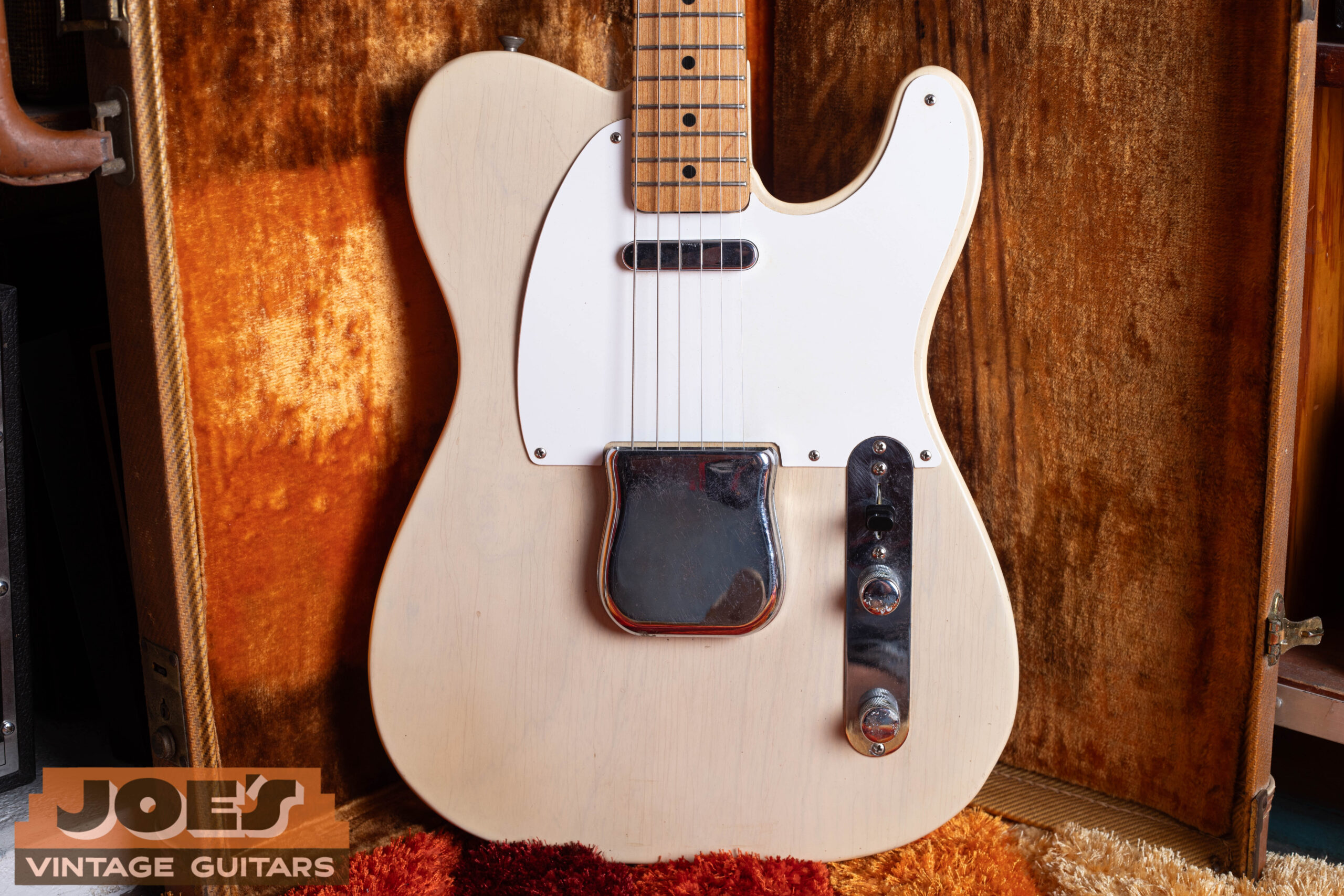
No other year in the Telecaster's history packs as many simultaneous changes as 1959. It is the year Leo Fender introduced the slab rosewood fretboard, reversed the controversial top-loading bridge back to string-through-body stringing, introduced an entirely new model (the Telecaster Custom), and navigated a mid-year transition during which employees were specifically instructed not to write dates on neck heels — creating a narrow window where necks have no date at all. Any of those changes alone would make 1959 noteworthy. Together, they make it the most transition-dense year the instrument ever saw.
The result is that a genuine 1959 Telecaster can look dramatically different depending on when in 1959 it was built. An early-1959 example has a one-piece maple neck, a top-loading bridge, and the same basic specification as a late 1958. A late-1959 example has a thick slab rosewood board, a string-through bridge, a slim "D" neck profile, and clay dot inlays. These are not the same guitar in the eyes of collectors — and knowing exactly where on that timeline a given instrument falls is the core challenge of authenticating a 1959.
1. Maple or slab rosewood neck? Maple necks run January–approximately March/April 1959; slab rosewood from approximately April onward. Early maple-neck 1959s are exceptionally rare and valuable.
2. Top loader or string-through bridge? Top-loading bridges were standard from mid-1958 through mid-1959. String-through returned in mid-to-late 1959. Many 1959 examples have a bridge with both sets of holes — the transition hardware. This is discussed in detail in Section 06.
3. Is the body ash or alder? Standard blond Telecasters used ash bodies throughout the 1950s. 1959 models with custom colors or sunburst (including the Telecaster Custom) used alder.
At-a-Glance Specifications
These specifications reflect the majority of 1959 production — mid-to-late year slab rosewood examples. Early 1959 maple-neck variants are noted separately. All changes from 1958 are marked.
Serial Numbers & Dating
Fender's serial number system in 1959 is unreliable as a standalone dating tool. Serial number plates were produced in large batches and stored in bins — assemblers grabbed plates at random, meaning a guitar's serial number does not necessarily correspond to when it was built. The neck heel date and internal pot codes are far more accurate.
The Neck Plate Serial
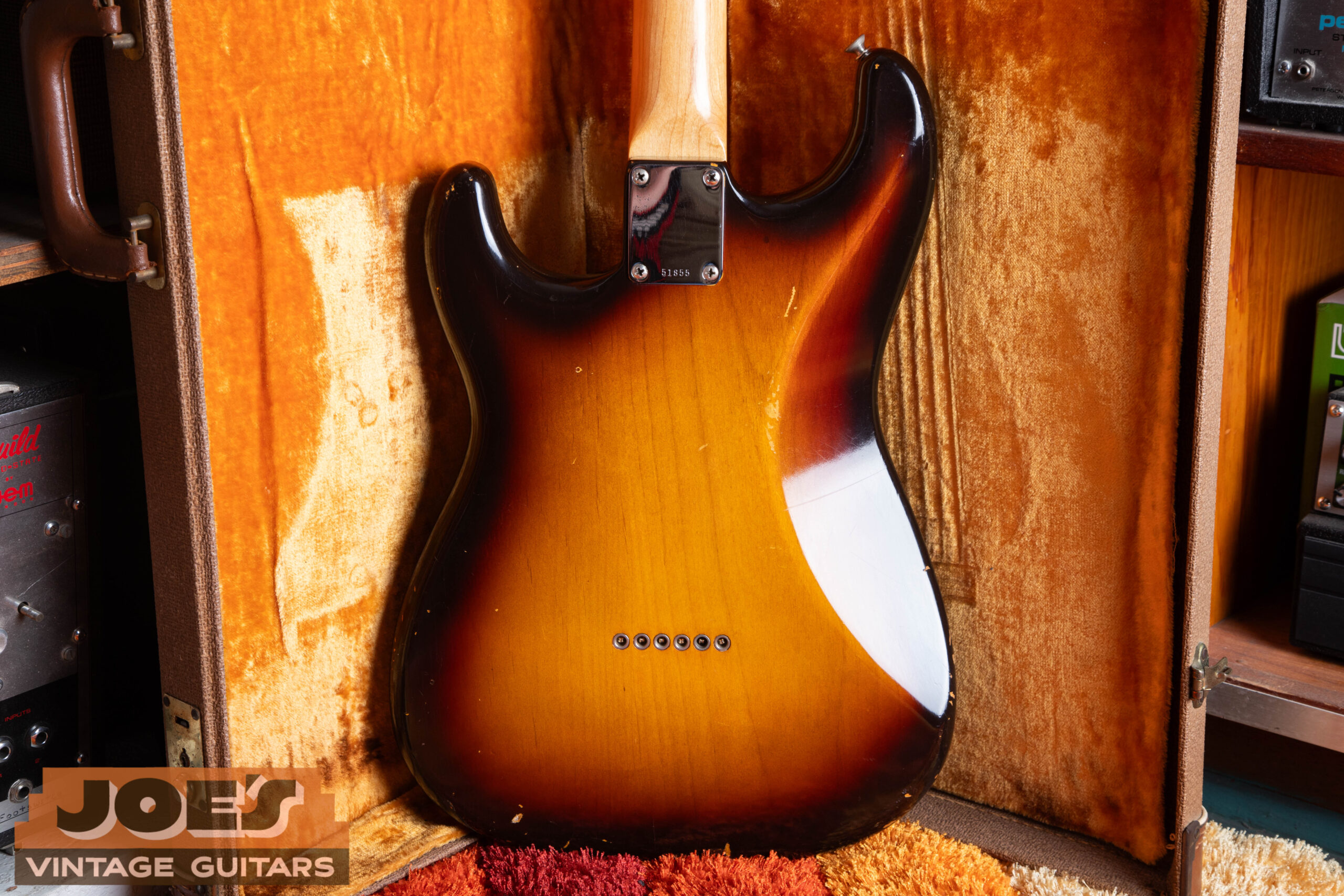
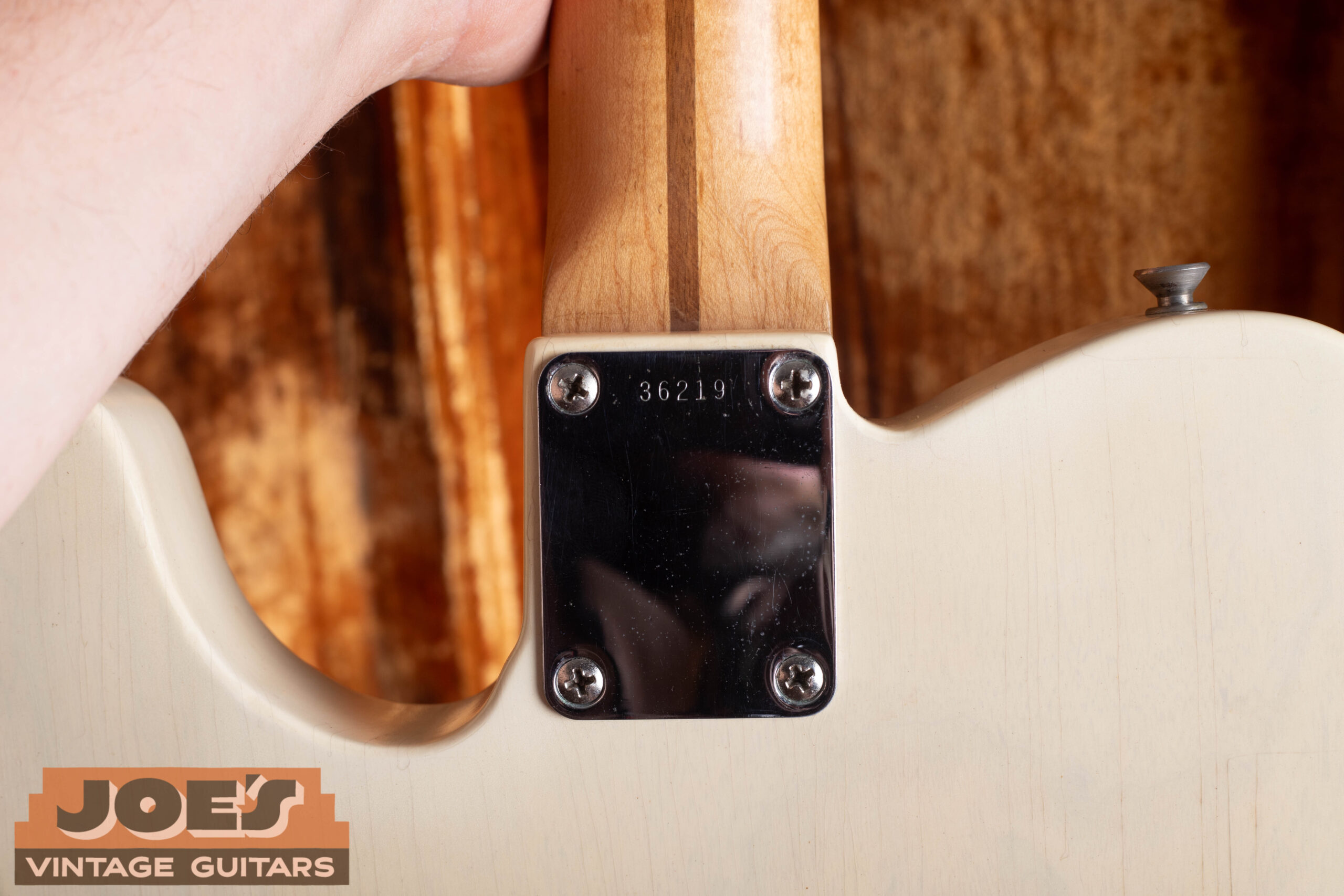
The serial number is stamped on the 4-bolt metal neck plate on the back of the body, at the neck-body junction. For 1959 production, the approximate serial range is 30000 to 40000 — five digits, no prefix letter. However, this range overlaps significantly with late 1958 and early 1960 production. A serial in this range tells you "probably late 1950s" but no more than that without corroboration.
Fender neck plates were not assigned in strict production order. A plate with serial 35000 could appear on a guitar built weeks before or after a plate with serial 33000. For any pre-CBS Fender valuation or authentication, always cross-reference: neck heel date + body date + pot codes + physical features. The serial is a starting point, not a conclusion. See our complete Fender serial number guide for the full dating framework.
The Neck Heel Date — and the 1959 Gap
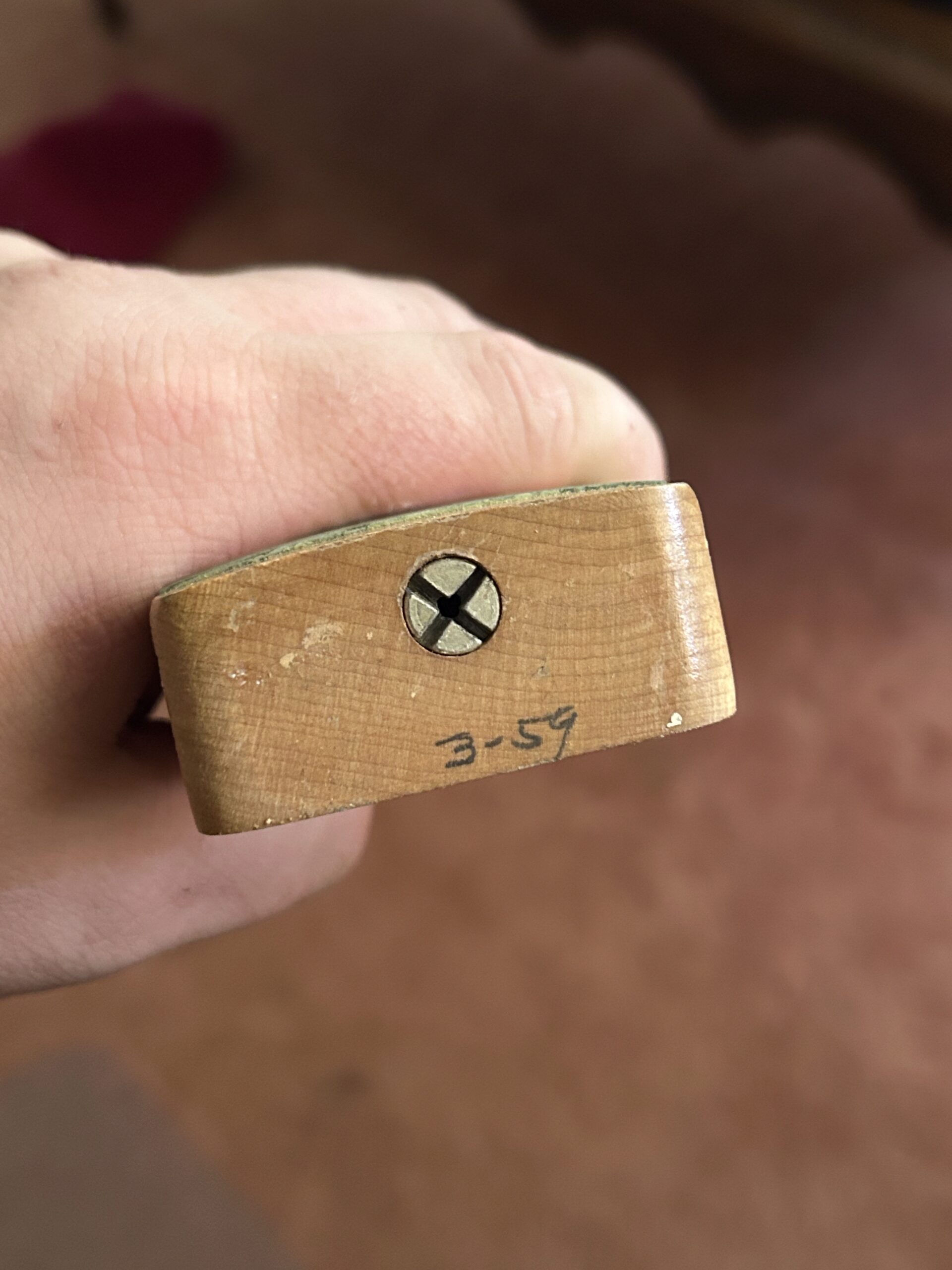
The most reliable single dating reference on a pre-CBS Fender is the penciled or stamped date on the butt end of the neck heel, visible only when the neck is removed from the body. On pre-1959 Telecasters, a Fender employee penciled a date in month-year format directly on the wood — for example, "9 58" for September 1958.
In 1959, something unusual happened: a Fender employee had been writing obscene words on neck heels, and when management discovered this, they issued an order to stop writing on necks entirely. The replacement rubber date stamps were not distributed immediately, creating a window of approximately mid-1959 during which Fender necks carry no date whatsoever. A completely blank neck heel on a claimed 1959 Telecaster is therefore not a red flag — it is in fact a period-specific authenticating characteristic for instruments built during that transitional window.
From approximately late 1959, date stamps in a similar month-year format replaced the handwritten pencil dates.
If you remove the neck from a claimed 1959 and find no date at all on the heel, that is consistent with — and actually somewhat confirmatory of — genuine mid-1959 production. A blank heel that also has a slab rosewood board, clay dots, threaded saddles, and period-correct pot codes is strong evidence of authentic mid-1959 Fullerton production. Confirm with the body date and pot codes.
The Body Date
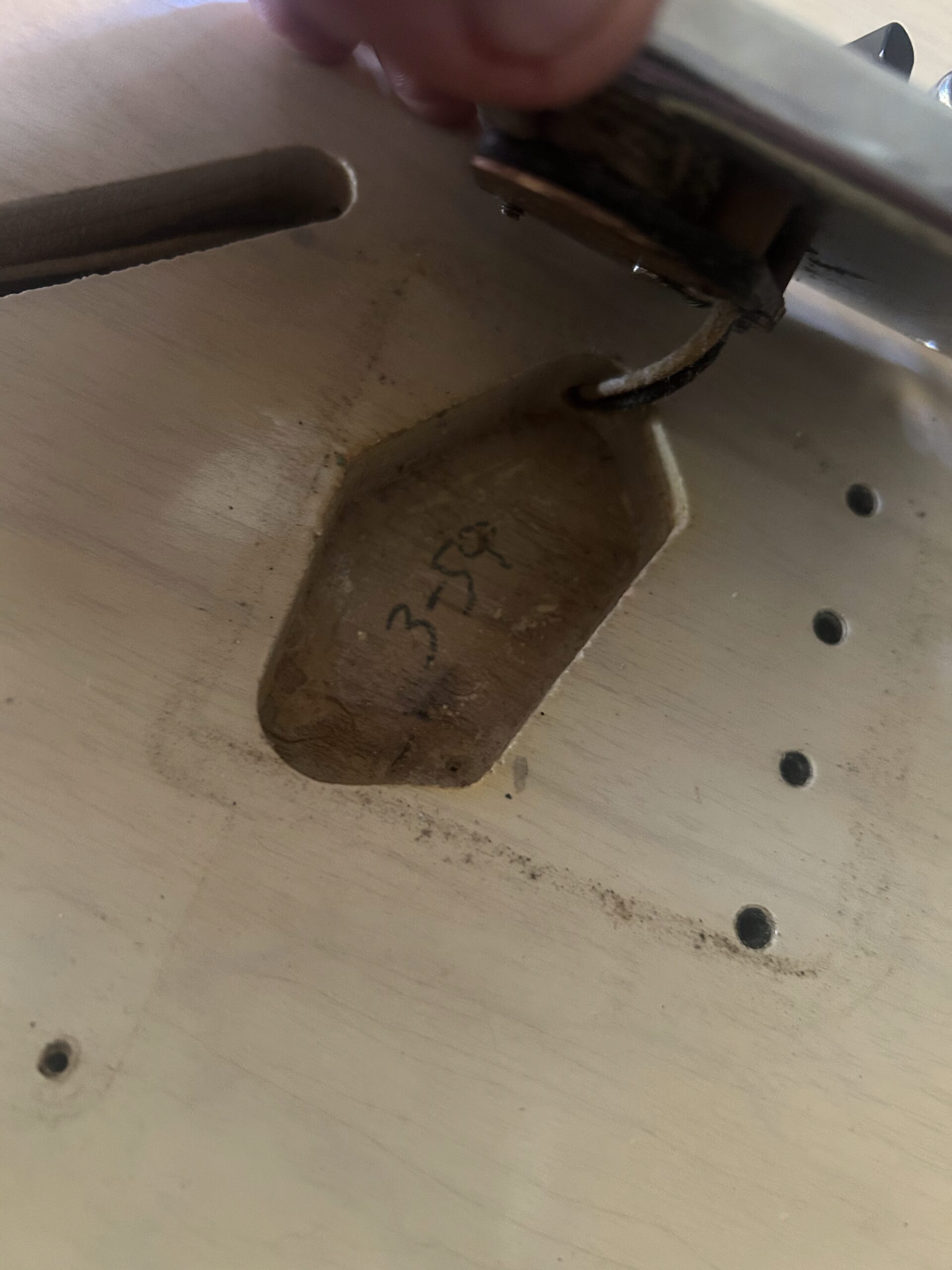
From approximately 1956, Fender penciled a date in the bridge pickup cavity — visible by removing the bridge plate. On 1959 instruments this is typically in the format M-YY (e.g., "4-59" for April 1959) or M/YY. This date reflects when the body was routed and prepared, which may be weeks or months before the final guitar was assembled and shipped. A body date and a neck date that differ by several months are normal and expected.
Potentiometer Date Codes
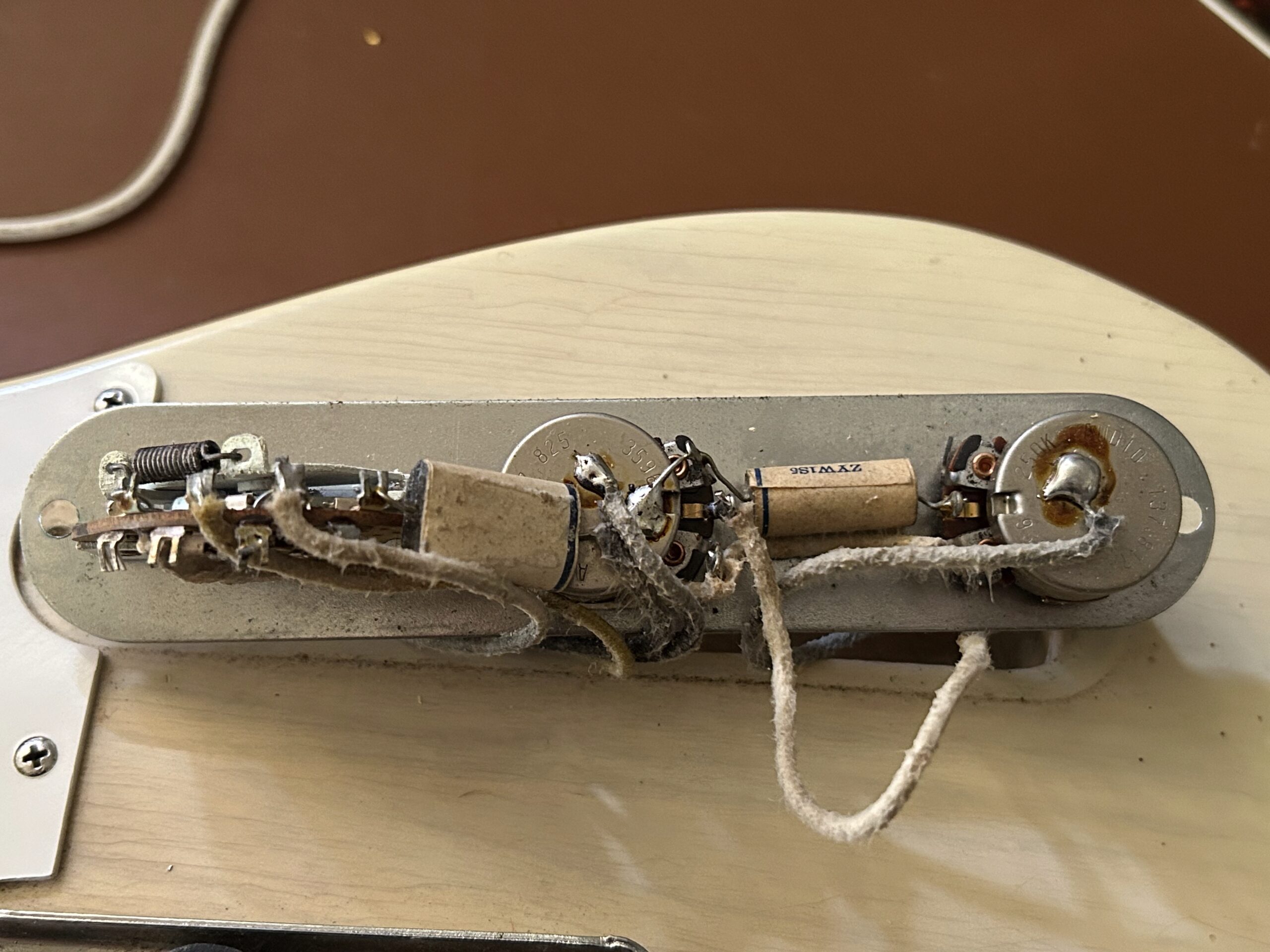
The control cavity pots carry manufacturer-stamped date codes in the format XXXYYYWW: manufacturer code, year (2 digits), week (2 digits). Common 1959 Fender pot manufacturers were Stackpole (304) and Centralab (134). A pot code reading "304 5932" was made by Stackpole in 1959, week 32 — meaning the guitar was assembled no earlier than approximately mid-August 1959. The pot code gives you the earliest possible assembly date. Always read all pots — the latest date sets the floor.
Access by removing the chrome control plate (two screws on the Telecaster). The two pots — one volume, one tone — should both read from the same general period. A pot reading several years later than the neck date indicates a replacement.
The Neck: Maple vs. Slab Rosewood
The introduction of the rosewood fingerboard is the defining change of 1959 — the reason this year is remembered and sought out by collectors. Understanding the distinction between a maple-neck 1959 and a slab rosewood 1959, and how to verify which you have, is fundamental to authentication.
The original Telecaster configuration from 1950 through approximately March/April 1959. The neck and fretboard are a single piece of maple, with the frets seated directly in the maple. The playing surface was finished with a thin coat of lacquer.
- Period: January–approximately March/April 1959
- Rarity: Extremely rare — small fraction of total 1959 production
- Identification: No glue line between neck and fretboard; single piece of wood all the way through; no skunk stripe on back (that came with the rosewood board)
- Value premium: Very significant — maple-neck 1959s are among the most desirable early Telecasters
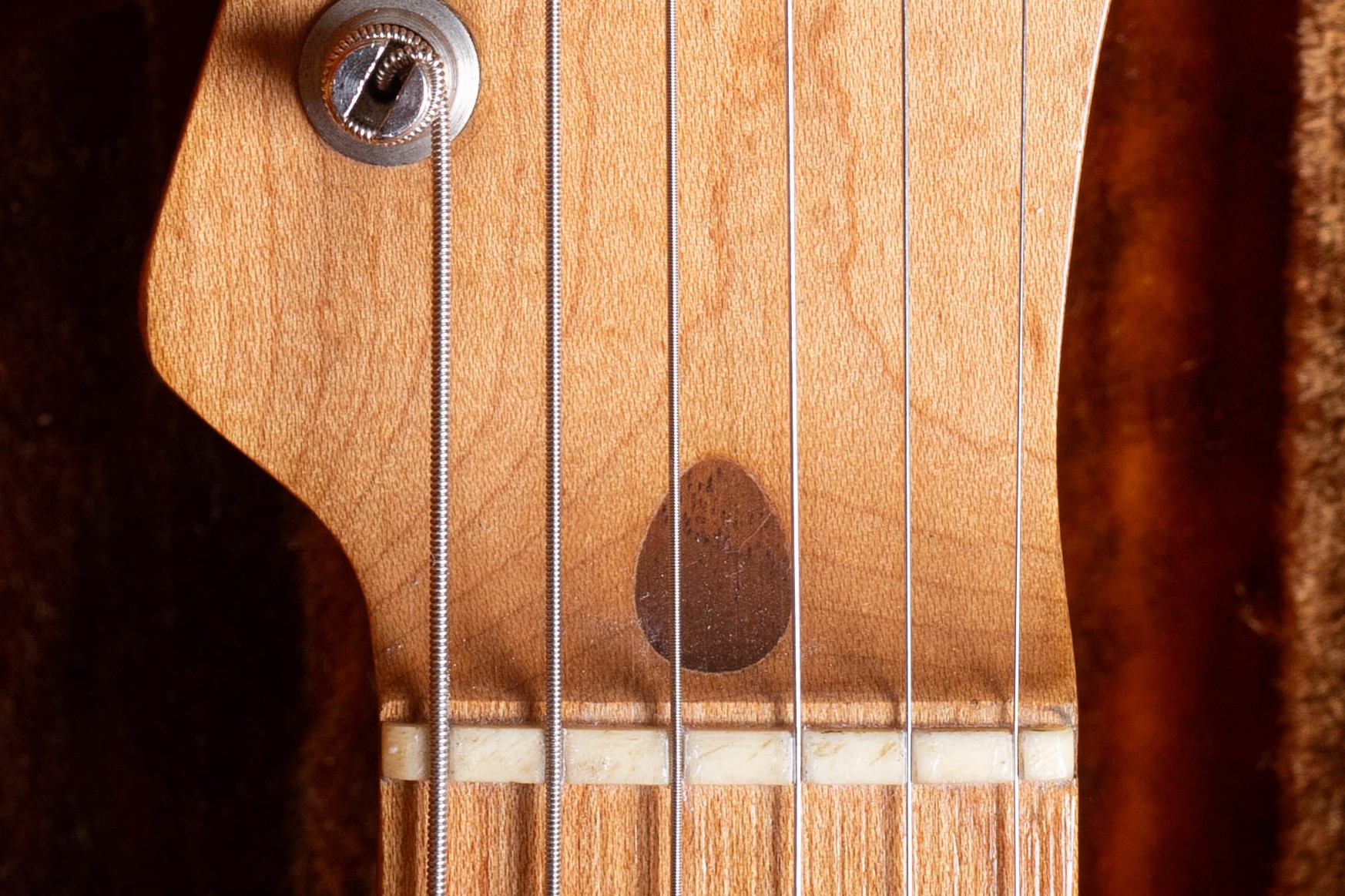
The new configuration first used on the Jazzmaster in 1958 and introduced to the Telecaster in the spring of 1959. A thick, flat-bottomed slab of rosewood (approximately 4.8mm) is glued directly onto the maple neck, with its flat underside matching the flat-milled top of the neck. This is the "slab" — it has a completely flat glue surface, unlike the thinner curved "veneer" board that replaced it in mid-1962.
- Period: Approximately April 1959–mid 1962
- Rarity: More common than maple-neck '59s but still pre-CBS desirability
- Identification: Visible glue line at headstock (rosewood meets maple); skunk stripe on back of neck; thick rosewood with flat underside when viewed at headstock end
- Value premium: Slab boards command a premium over later veneer boards
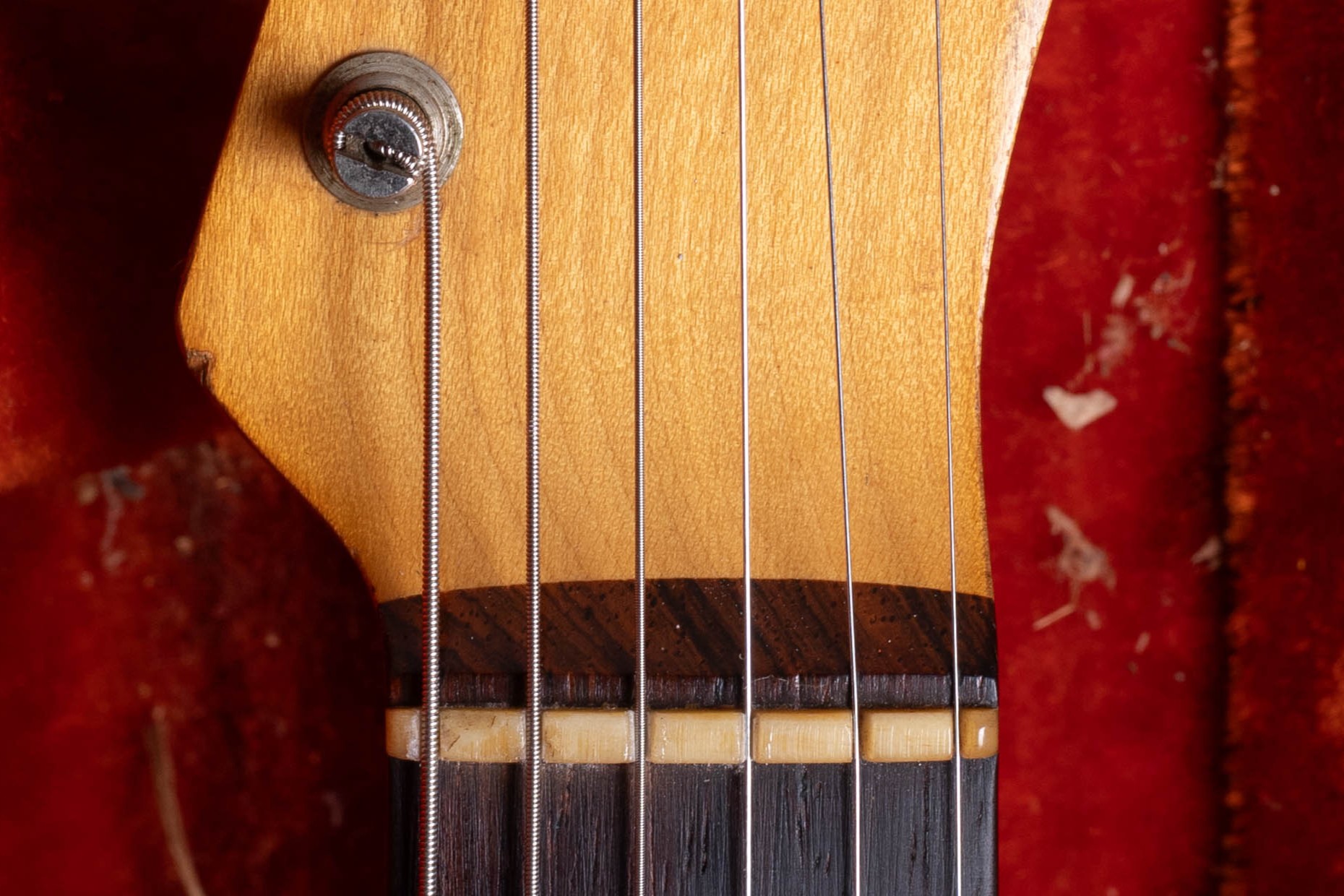
Identifying a Slab vs. Veneer Board
The slab rosewood board (1959–mid-1962) and the veneer rosewood board (mid-1962–mid-1960s) can look nearly identical from the playing surface. The key is to look at the headstock end of the neck, where the rosewood meets the maple at the nut area:
- Slab board thicknessApproximately 4.8mm thick — visibly substantial. When you look at the headstock end from the front, the rosewood occupies a significant portion of the neck depth. The glue line between the rosewood and maple sits well below the fretboard surface.
- Slab board undersideThe underside of a slab board is completely flat — it was milled flat to glue directly onto the flat top of the neck blank. On veneer boards the underside follows the curve of the neck radius.
- Veneer board thicknessMuch thinner — approximately 2–2.5mm. The rosewood contributes less visual depth at the headstock end, and the neck wood is visible much higher relative to the fretboard surface.
- Truss rod accessBoth slab and veneer boards adjust at the neck heel (not the headstock). The truss rod slot opening on a slab board's headstock end shows the rosewood slightly intruding into the slot opening — this was noted as a period-correct detail.
- Skunk stripeBoth maple-neck and slab-board necks have a walnut skunk stripe on the back of the neck — the channel for the truss rod, routed from the back and filled with a contrasting wood strip. Absence of a skunk stripe suggests a non-original neck.
All 1959 rosewood-board Telecasters use clay dot inlays — a dull, slightly chalky material that ages to an off-white or yellowish tone with a matte finish. They are never shiny or pearlescent. Pearloid (plastic) dots replaced clay in early 1965, so bright, shiny dots on a claimed pre-1965 Fender are an immediate mismatch. The 12th fret clay dots on 1959 instruments are also positioned slightly closer to the edge of the neck than on later examples — a small but documented detail specific to this era.
Neck Profile
The 1959 neck profile is a slim "D" shape — the result of a progressive thinning that began around 1957–58 after the thicker "V" necks of 1955–56 and the transitional rounder profiles of 1957. By 1959, Telecaster necks had become quite slim, with the slimmest examples appearing toward year-end. Typical measurements: approximately 0.82"–0.90" deep at the first fret and 0.94"–1.00" at the twelfth fret. Players with large hands sometimes find these necks uncomfortably thin; conversely, they are beloved by players who want maximum speed and comfort.
The nut width is the standard Fender specification of 1 5/8" — not widened to 1 11/16" as on vintage Gibsons of the same period. This remained constant throughout the 1950s Telecaster production.
Body, Wood & Finish
Ash vs. Alder — Which Is Correct?
This is one of the most misunderstood aspects of late-1950s Telecaster authentication. The answer depends on the finish:
- Blonde finishAsh body. Standard blond Telecasters used swamp ash throughout the 1950s. Ash is semi-transparent under a blond finish — the wood grain shows through as a warm, visible pattern. Ash is also noticeably heavier than alder, typically putting a blond 1959 Tele in the 7–8+ lb range.
- Custom colors / sunburstAlder body. When Fender produced Telecasters in opaque or semi-opaque finishes (custom colors, the Telecaster Custom's sunburst), they used alder — a lighter, less visually dramatic wood that was easier to finish with solid colors. An alder-bodied blond Telecaster from this era is unusual and merits investigation.
- Visual testUnder a blond finish, ash shows characteristic long, open grain lines and a slightly golden color. Alder grain is finer and less visually distinct. If the finish is blond but the grain is very tight and uniform, look more carefully at what's underneath.
The White Blond Finish
The standard 1959 Telecaster finish is a white blond nitrocellulose lacquer applied semi-transparently over the ash body. This finish is meaningfully different from the butterscotch blond used on 1950–1954 Telecasters. The 1954–1959 blond is lighter, whiter, and more opaque — it hides more grain than the deep golden tints of the early-1950s instruments.
Aged 1959 blond finishes typically show: fine checking across the body and neck, a slight yellowing toward tan in areas of heavy UV exposure, and characteristic nitrocellulose crazing that is distinctly different from the even, thick appearance of a polyurethane finish. The lacquer is thin by modern standards — you can feel the grain through it when the guitar is new, and after 65 years of shrinkage, the grain telegraphs strongly through the finish.
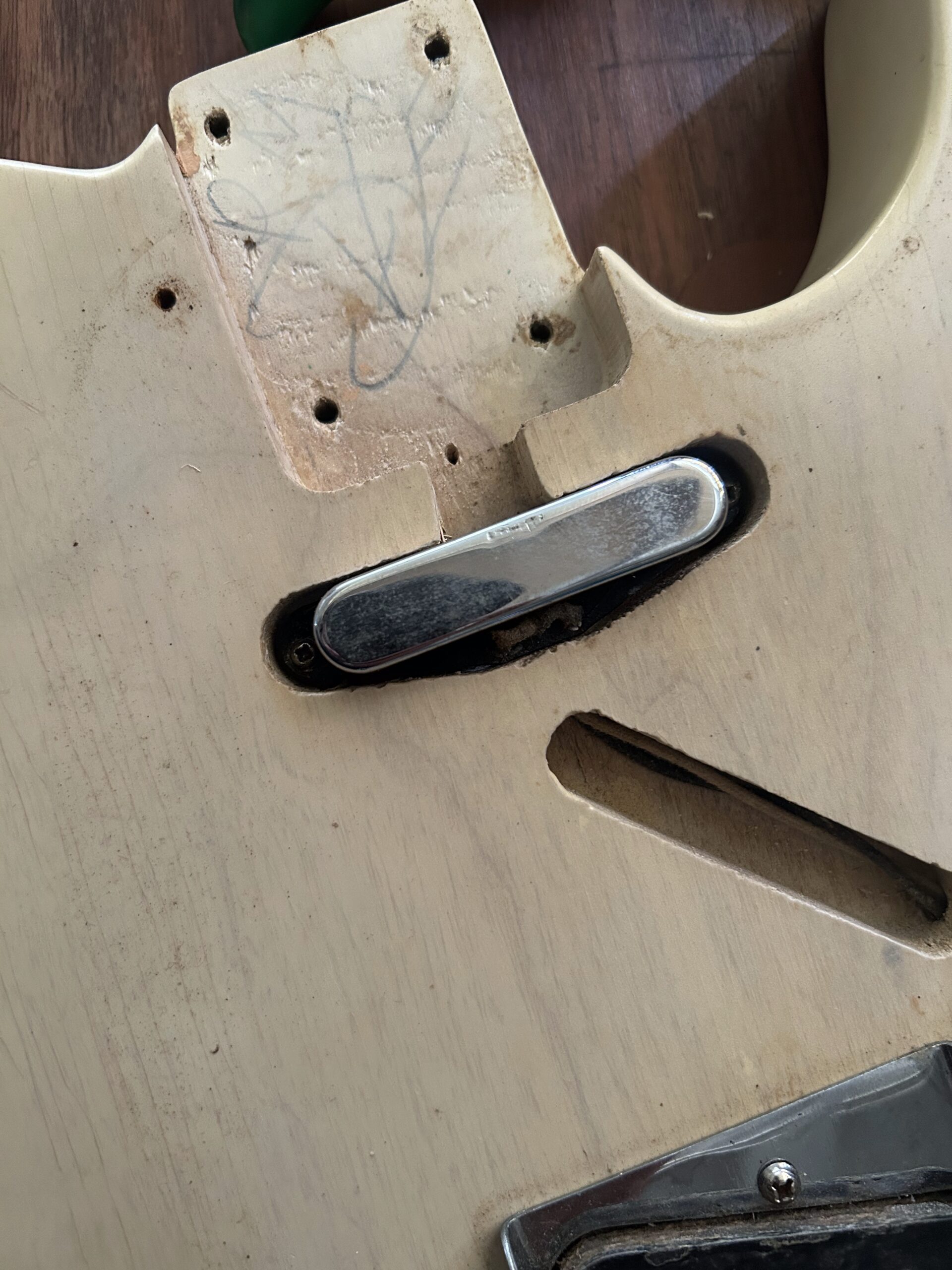
Fender suspended guitar bodies from nails during the finishing process. On pre-mid-1959 bodies, these nail holes appear on the face of the body in four specific locations: under the pickguard near the neck pocket, under the control plate, under the bridge plate, and near the cutaway horn under the pickguard. From mid-1959, Fender moved the nail holes inside the body cavities — into the neck pocket, bridge pickup route, and control cavity walls — and dropped the fourth cutaway nail entirely. This is a reliable body-construction dating marker: face nail holes = pre-mid-1959; cavity nail holes = mid-1959 onward.
The Pickguard
Standard 1959 Telecasters carry a single-ply white pickguard — a thick, opaque white plastic piece. This replaced the thin black Bakelite guard of 1950–1954. The white guard changed to a three-ply mint green celluloid guard on all models in 1963, so a three-ply guard on a claimed 1959 is a replacement (or indicates the instrument is the Custom model — see Section 11).
The white pickguard on an original 1959 will show the characteristic yellowing and aging of period plastics. It should not look bright white and pristine after 65 years. Check the underside — original guards show Fender's pencil marks or routing marks from the factory, and the screw holes should show the same patina as the rest of the hardware.
Body Routing & Construction
The 1959 Telecaster body is a single-cutaway slab with three routed cavities: the neck pickup route, the bridge pickup route (also housing the control cavity access), and the electronics cavity accessed by the control plate. The body is typically one or two pieces of ash, and the routing should show the unfinished wood of the interior — any black paint or shielding material inside an original cavity is a non-factory addition.
The Bridge: Top Loader vs. String-Through
This is the other defining 1959 variable — and the one that most surprises buyers encountering the year for the first time. Understanding the top loader situation in 1959 is essential both for authentication and for understanding how to value a specific example.
How the Top Loader Came to Be
From the Telecaster's 1950 introduction through mid-1958, strings passed through the body from the back via ferrules, and were anchored behind the bridge plate — the classic "string-through" design. In mid-1958, Fender modified the bridge plate design to allow strings to anchor directly at the plate itself, eliminating the through-body holes. This is the top loader configuration. The change was made for manufacturing simplicity and perhaps tonal reasons, but it was not popular with Telecaster players, who found they preferred the feel and tone of the through-body design.
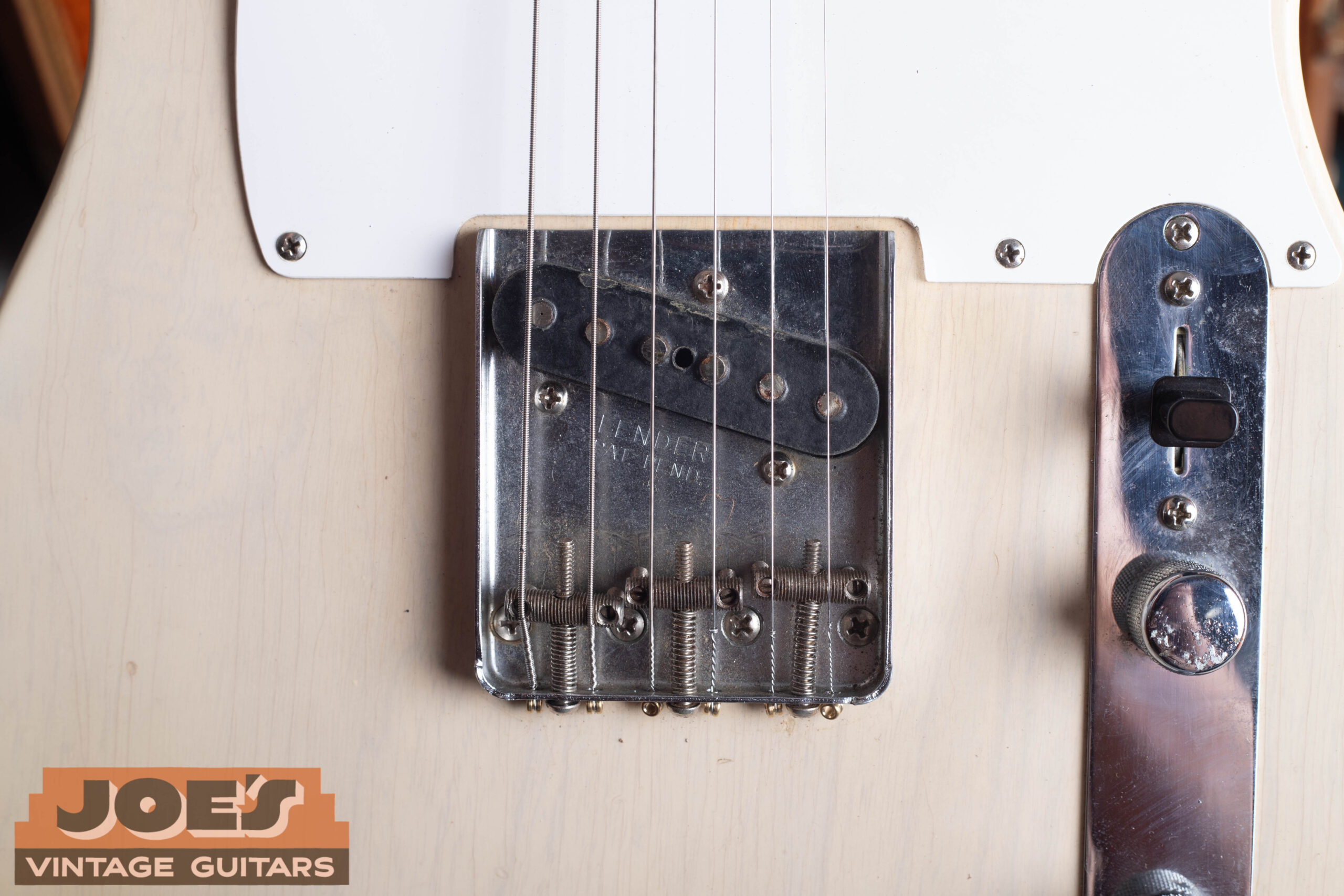
In response to player feedback, Fender reverted to string-through construction in mid-to-late 1959. But — in the efficient Fender tradition — they did not simply discard the inventory of top-loading bridge plates already manufactured. Instead, they drilled additional holes in the existing top-loader plates to allow string-through stringing while still using up the existing stock. This is why many 1959 Telecasters (and examples from 1960 through 1962) have bridge plates with two sets of holes: the original top-loader holes at the back of the plate and the new string-through holes below them.
Pure Top Loader Bridge
Mid-1958 through approximately mid-1959The original top-loading bridge has string holes only at the back edge of the plate — no holes in the front face for through-body stringing. The strings insert from the back of the plate and anchor there. No ferrules on the back of the body. Early 1959 Telecasters still carry this configuration.
- Identification: String holes at bridge plate back only; no ferrules or string holes through the body
- Body: No string-through holes drilled in body
- Collector note: Pure top loaders are prized by some collectors and players for their specific feel (slightly easier bending) and tonal character (some describe it as slightly warmer)
Transitional "Dual Hole" Bridge
Mid-1959 through approximately 1962The most common bridge configuration found on late-1959 through early-1960s Telecasters. The bridge plate has two sets of string holes — the original top-loader holes at the back of the plate, and a new row of holes at the front of the plate for through-body stringing. The body has ferrules on the back. The guitar is strung through the body (through the front-of-plate holes, through the body, and out the back at the ferrules).
- Identification: Two rows of string holes on the bridge plate; ferrules on the back of the body; strings pass through the body
- This is normal and correct — not a modification. Seeing dual holes is period-accurate and confirms Fender's practical use-up-the-stock approach
- Value: Some buyers prefer the "cleaner" look of a pure through-body bridge; transitional dual-hole plates are typically valued similarly to pure through-body plates for the same year
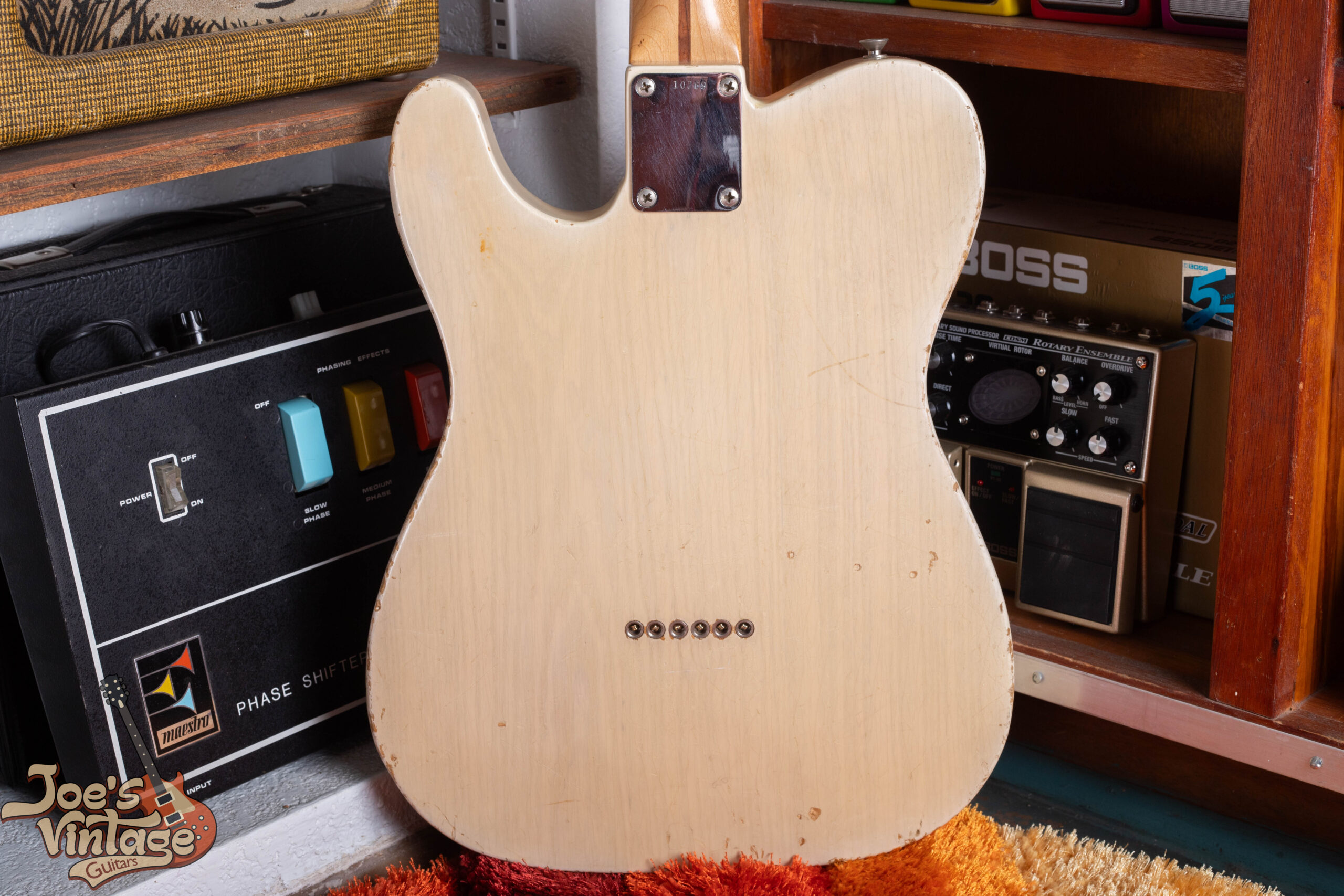
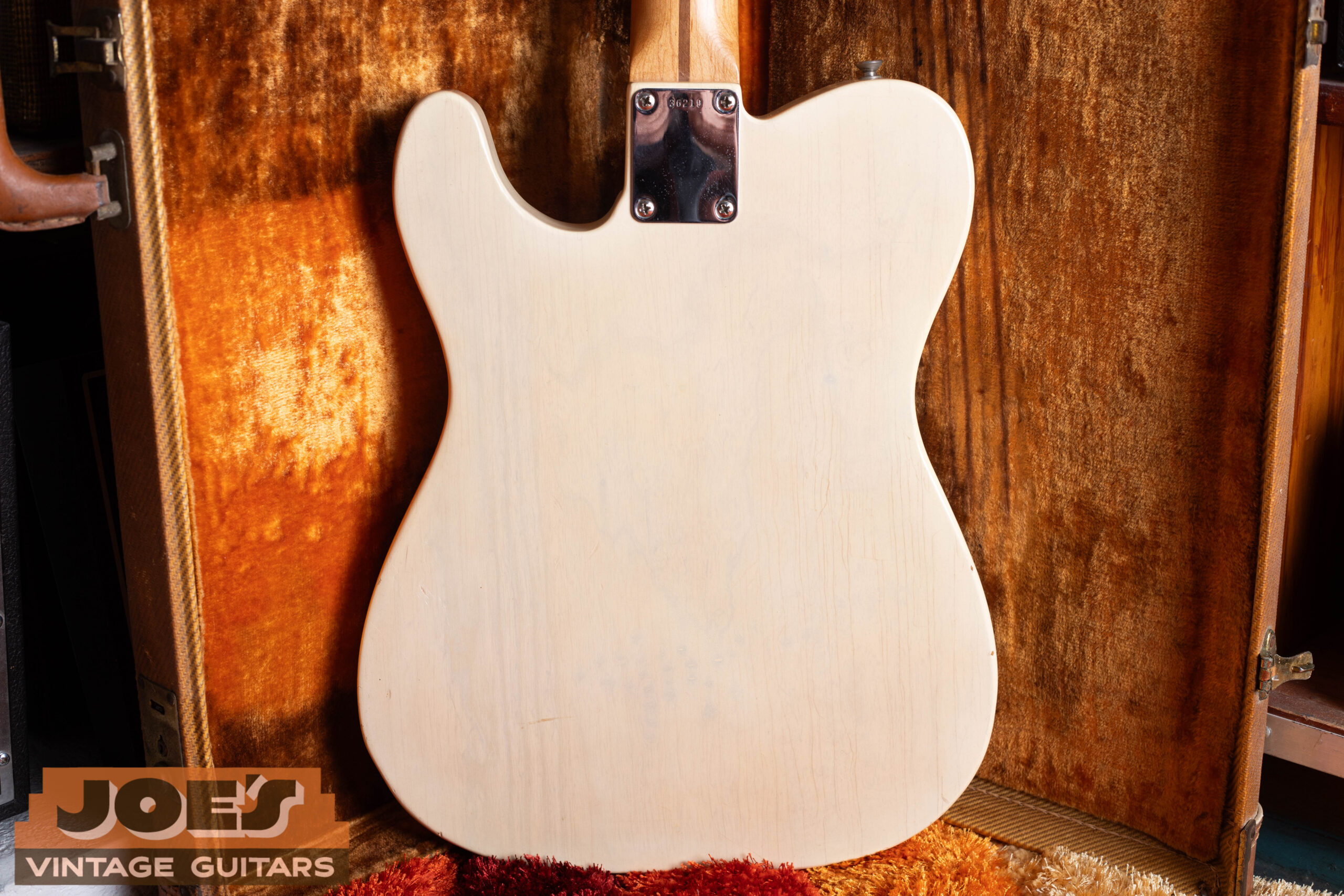
The top-loader and string-through configurations overlapped throughout 1959 and into the early 1960s — there are no hard cutoff dates. Top-loader bridges are very common on 1959 Telecasters but not universal, and a string-through bridge does not disqualify a guitar from being a genuine 1959. The bridge configuration is a useful corroborating detail, not a pass/fail test. If the bridge type conflicts significantly with the neck heel date, pot codes, and other physical features, investigate further — but a mismatch here alone is not cause for alarm.
Bridge Saddles
All 1959 Telecasters use three paired threaded steel saddles — six strings across three adjustable saddle units. These replaced the smooth steel saddles used in 1954–1957 and the briefly-used smooth saddles before that. The threaded saddles are chrome-plated steel and show a distinctive knurled/threaded surface. Each saddle is adjusted for height via a single height-adjustment screw and for intonation by moving the saddle fore or aft on the bridge plate.
Original threaded saddles show consistent chrome plating and period-appropriate patina. Later replacement saddles (brass, stainless, or modern compensated steel versions) are immediately identifiable by their different material and appearance. Original threaded steel saddles that show rust pitting are authentic — steel saddles of this era are prone to it.
Pickups & Wiring
Bridge Pickup
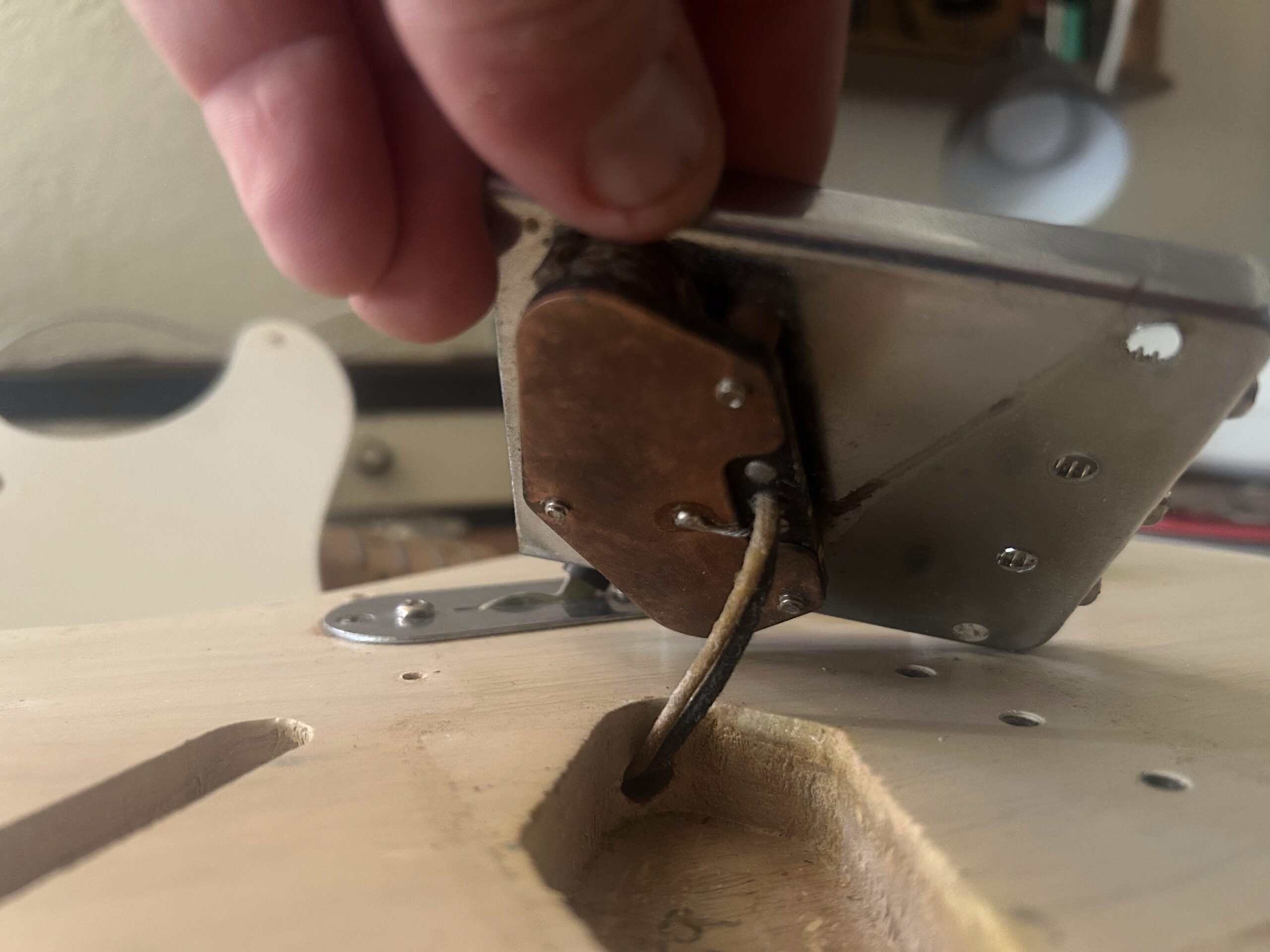
The 1959 Telecaster bridge pickup is a single-coil unit mounted to the bridge plate, not to the body or pickguard. It sits in a chrome baseplate that is part of the ashtray bridge assembly. The pickup cover is chrome-plated steel — the characteristic look of the Telecaster bridge pickup. The poles are flush to the cover or barely protruding.
Original 1959 bridge pickups use formvar-coated wire and typically read approximately 6.5–7.5k ohms DC resistance. The bridge pickup carries the staggered pole pieces introduced in 1955 — the bass strings (E, A, D) have slightly taller poles than the treble strings (G, B, E) to compensate for the imbalanced output of wound vs. plain strings. A bridge pickup without staggered poles is earlier (pre-1955) or a replacement.
Neck Pickup
The neck pickup on a 1959 Telecaster is mounted in the neck cavity with its cover sitting flush to the pickguard surface. The cover is also chrome-plated steel. The neck pickup typically reads approximately 5.5–6.5k ohms — lower output than the bridge, contributing to the warmer, rounder tone of the neck position.
Original 1959 neck pickups use the same formvar wire. The pickup leads run under the pickguard to the control plate. Both pickups should show cloth-covered leads — plastic-insulated wiring on the pickups indicates a rewire or replacement.
The Vintage Telecaster Wiring Scheme
The 1959 Telecaster uses the original Fender Telecaster wiring, which is notably different from what most players expect and from "modern" Tele wiring. The three switch positions in the original scheme are:
- Position 1 (toward neck)Neck pickup only, with a bass-heavy capacitor-rolled tone — a dark, almost cello-like jazz tone designed to simulate an acoustic bass response. Many players found this position useless for typical playing and rewired the guitar immediately.
- Position 2 (middle)Neck pickup, straight to volume — the neck pickup with a normal tone control, producing the warm, jazzy neck pickup sound most associated with the position today.
- Position 3 (toward bridge)Bridge pickup with tone control — the classic bright Tele twang with full tone control access.
This original wiring is not the same as the "modern" Telecaster wiring (which has bridge in position 1, both pickups in position 2, and neck in position 3 with a standard tone). A guitar still wired in the original vintage configuration is an indication of an unmolested instrument. Most vintage Telecasters have been rewired to the "modern" scheme at some point — this affects playability but does not significantly affect value if done with period-correct components.
Remove the control plate and examine the wiring. Original 1959 wiring uses cloth-covered hookup wire throughout. The capacitor on the tone circuit for 1959 should be a brown rectangular "chicklet" paper capacitor — this replaced the earlier round brown paper cap that was used through 1958. Finding a brown chicklet cap is a strong indicator of 1959 or very early 1960 electronics. Bumblebee capacitors (as used on Gibson) are not Fender parts. Orange drops and other modern caps are replacements.
Hardware, Controls & Plastics
Control Knobs
The 1959 Telecaster uses chrome flat-top knobs with a knurled skirt. These replaced the earlier smooth-sided dome knobs that preceded them. The knobs are chrome-plated metal, not plastic, and show the appropriate level of chrome wear for a 65-year-old instrument.
The switch tip is the top-hat style, which replaced the earlier barrel-style tip in 1956. If a claimed 1959 has a barrel switch tip, that tip is from pre-1956 production and has been installed on this guitar at some point — it is incorrect for 1959.
Control Plate
The chrome control plate is the rectangular metal plate on the lower bout that houses the 3-way switch and the two control knobs. On original 1959 examples, the plate should show an electrode mark — a small spot where the electrode was attached during the chrome plating process at the Fender factory. This mark is visible as a slightly rougher or differently-textured circle on the chrome surface, and its presence is corroborated as a period-authentic detail. The neck plate will show a similar mark.
The Ashtray Bridge Cover
Every 1959 Telecaster shipped with a chrome "ashtray" bridge cover — a large rectangular chrome cover that snapped over the bridge assembly. Most players removed these immediately (the nickname "ashtray" comes from their popular second use), so surviving examples with the original cover are relatively uncommon. The presence of the original ashtray cover with a guitar is a mark of completeness.
The neck pickup had a similar chrome cover that is even more commonly missing. If the pickup covers are present and original, the chrome should show matching patina across both covers and the hardware generally.
The Neck Plate
The 4-bolt neck plate is a plain chrome-plated steel plate with no logo or markings — just the serial number. The four screws securing the neck are Phillips-head (the transition from slot-head to Phillips was complete by 1953). The neck plate on an original 1959 will show the same electrode mark noted on the control plate.
The neck pocket — the routed cavity in the body that receives the neck — should fit the neck snugly. A loose neck pocket is often a sign of a neck replacement.
Output Jack
The output jack is a standard Switchcraft 1/4" jack mounted on the side of the body in a barrel-style chrome jack cup. The jack cup is secured by two screws. All wiring from the jack to the control cavity should be cloth-covered. The jack itself should show the characteristic single-ring construction of a Switchcraft unit from this era.
Headstock, Logo & Tuners
The "Spaghetti" Logo
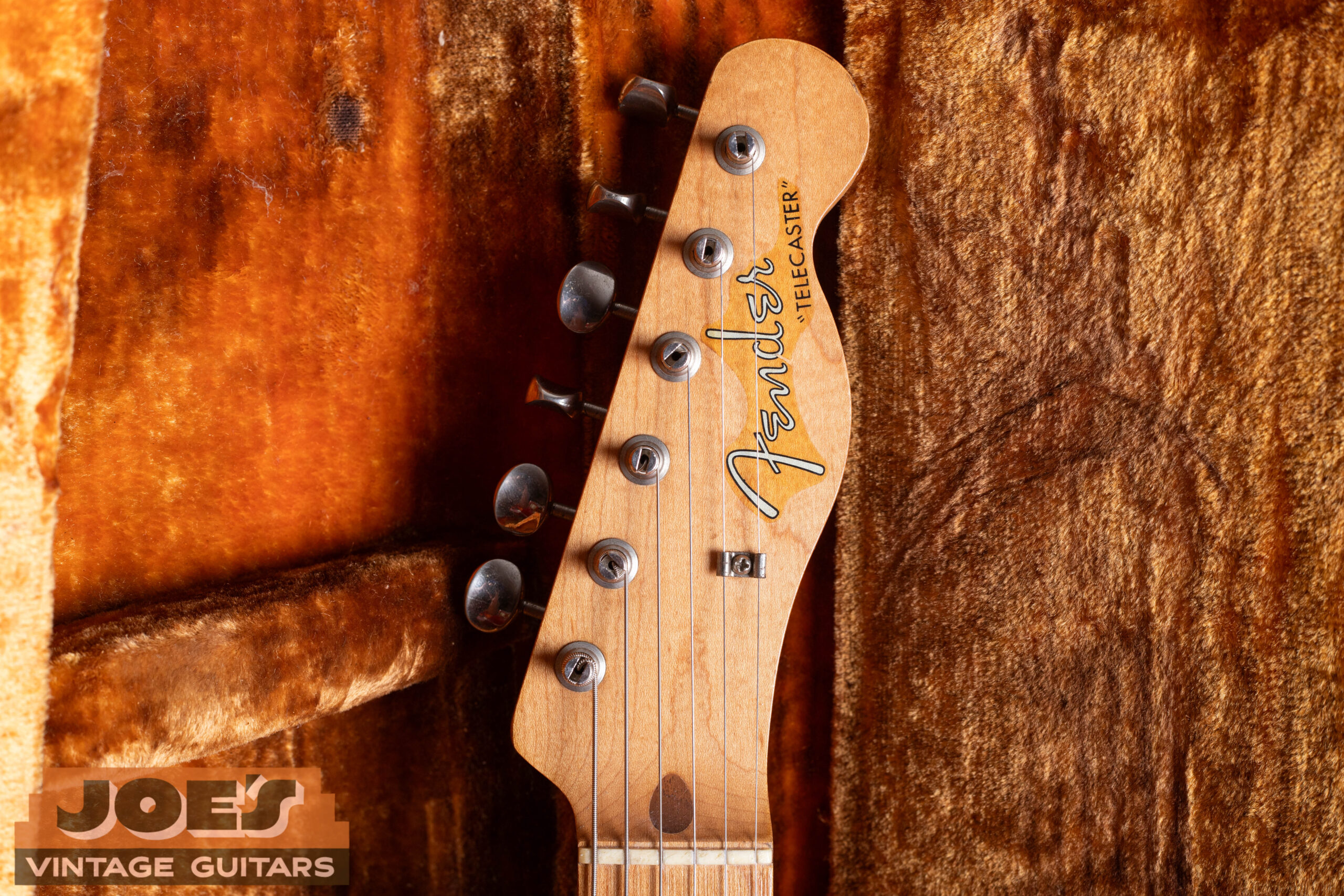
The 1959 Telecaster headstock carries the classic "spaghetti" Fender logo — a thin, cursive script decal in silver/chrome with the Fender name in an elegantly flowing font. This logo is called "spaghetti" by collectors because of the thin, noodle-like strokes of the lettering. Below the Fender name, in smaller text, is the model name "Telecaster."
The spaghetti logo was used through approximately 1964–65, when it was replaced by the thicker "transition" logo and then the bold CBS-era logo. Key authenticity points:
- MaterialWater-slide decal applied on top of the finish — not a silkscreen. On an original 1959, the decal sits on the lacquer surface and is protected by a clear topcoat. The logo may show very slight edge relief but should not feel raised in a way that suggests a fresh re-application. A logo that sits well above the surface with no clear topcoat over it has likely been replaced.
- Patent numbersThe 1959 Telecaster headstock decal includes two patent numbers below the model name: "2,573,254" and "2,784,631." The presence of both patent numbers is correct for 1959. Note that the second patent number was added in 1959 — earlier examples have only one. A claimed 1959 with only one patent number may be from early 1959 or earlier.
- Logo positionThe spaghetti logo sits relatively high on the headstock face, close to the nut. The exact vertical position varied slightly from example to example.
- ColorSilver/chrome, sometimes with slight yellowing or patina after decades under lacquer. A bright, fresh-looking logo on a claimed 1959 may indicate headstock refinish or decal replacement.
Kluson Deluxe "Single Line" Tuners
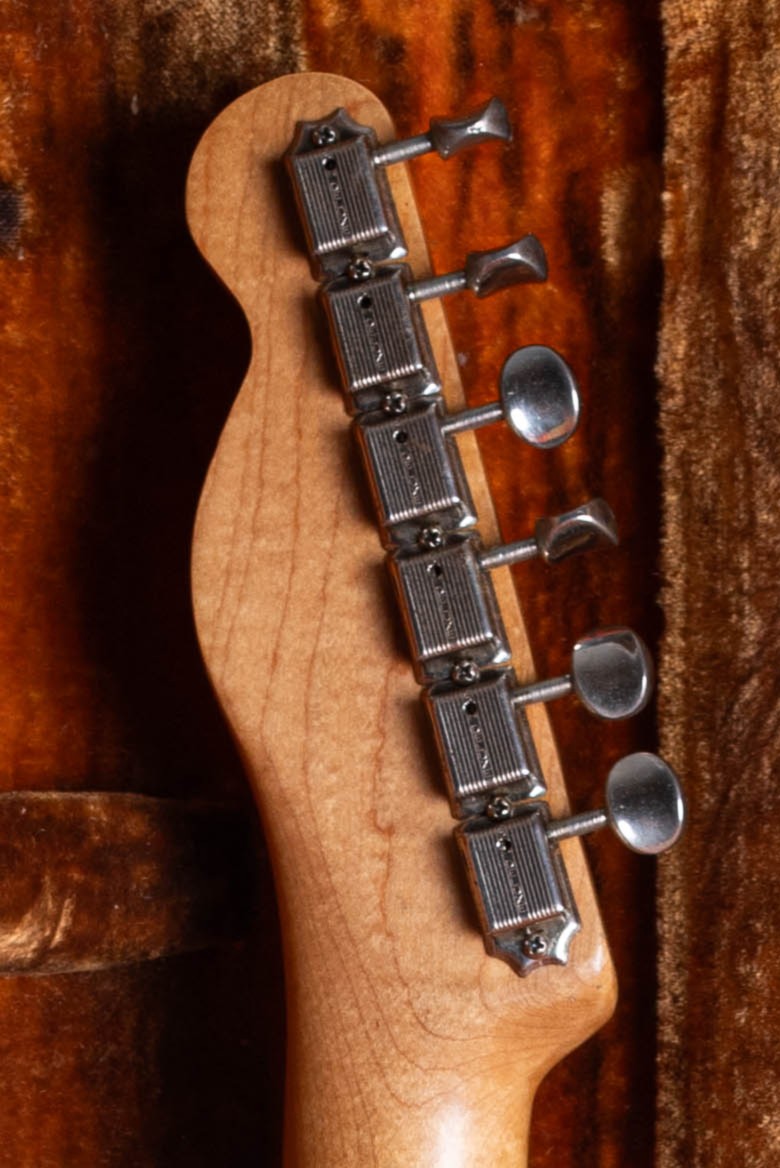
The 1959 Telecaster uses Kluson Deluxe "single line" tuners — named for the single vertical line of text ("Kluson Deluxe") stamped on the back of the gear housing. This distinguishes them from earlier "no line" Klusons (no text on the housing, used on earlier Fenders) and later "double line" variants. The buttons are plastic and age from cream to a warm off-white or ivory tone with a slightly waxy appearance.
The single-line Kluson Deluxe is consistent across late-1950s Fender production and their presence is one of the easiest visual confirmations of a pre-CBS instrument. Modern Grover Rotomatics — enclosed, circular-housing tuners — are a very common replacement and are easy to identify. Six tuner grommets on the headstock face are all that remain when Klusons are replaced with Grovers, along with a possible third mounting screw hole per tuner where none existed before.
String Tree
The 1959 Telecaster headstock carries a "butterfly" or "wing" string tree — a small stamped metal guide that keeps the B and high-E strings seated in their nut slots under appropriate break angle. This is the same string tree introduced in approximately 1955, replacing the earlier round-button style. A round-button string tree on a claimed 1959 is incorrect; a butterfly/wing tree is correct.
Dating From the Inside Out
Because the 1959 serial number is so unreliable as a standalone tool, building a triangulated date from multiple internal sources is essential. Here is the complete methodology for dating a 1959 Telecaster accurately.
| Source | Where to Find It | What It Tells You | Reliability |
|---|---|---|---|
| Neck heel date | Butt end of neck, visible when neck is removed | Month and year neck was manufactured. May be penciled (pre-mid-1959), stamped (late 1959+), or absent (mid-1959 transition) | Very high — single most reliable reference when present |
| Body date | Bridge pickup cavity, under bridge plate | Month and year body was routed/prepared. Format: M-YY (e.g., "4-59") | High — but body and neck dates can differ by months |
| Pot codes | Back of volume and tone pots — remove control plate | Earliest possible assembly date. Format: MFRYYWW (manufacturer, year, week) | High — gives earliest assembly floor |
| Pickup date | Bottom of pickup — may be stamped or written on cloth tape | Approximate manufacture date of the pickup; not always present | Moderate — corroborating evidence |
| Neck plate serial | Metal plate on back, neck-body junction | Approximate era only — ~30000–40000 is 1959 range | Low standalone — use only for broad era confirmation |
| Physical features | Bridge type, board type, dot material, knobs, logo | Which part of 1959 based on feature transitions | High when features align |
Early 1959: maple neck + likely top-loader bridge + serial ~30000–33000. Mid-1959: blank neck heel + slab rosewood appearing + serial ~32000–36000. Late 1959: slab rosewood + date stamp or blank heel + slim D profile + serial ~35000–40000. Bridge configuration (top loader, dual hole, or string-through) overlaps throughout the year and is a supporting detail, not a defining one — use neck date, body date, and pot codes as the primary sources.
The Telecaster Custom — New for 1959
1959 also saw the introduction of an entirely new Telecaster variant: the Telecaster Custom (note: the official name was "Custom Telecaster" — the reverse order "Telecaster Custom" was used on later models). This was a dressed-up version of the standard Telecaster aimed at players who wanted a more premium aesthetic, and it represents Fender's first bound-body production Telecaster.
How the Custom Differs from a Standard 1959
- Body bindingThe Custom has white plastic binding around both the top and back of the body — the first bound Telecaster. The binding is a distinctive visual identifier; standard 1959 Telecasters are unbound.
- Body woodAlder body, not ash — because the Custom came in sunburst, which requires the more even-grained alder for a clean finish.
- Finish3-color sunburst — a yellow-to-orange-to-dark-brown gradient. This was the first time Fender offered a standard Telecaster in sunburst. The sunburst is nitrocellulose, applied in layers.
- Pickguard3-ply mint green celluloid pickguard, not the single-ply white of the standard model. This is a key visual differentiator.
- Headstock logoA gold spaghetti logo reading "Custom Telecaster" — not the silver logo of the standard model. The earliest Customs (from approximately April 1959) briefly carried a standard silver "Telecaster" decal before the gold "Custom Telecaster" decal was produced; these transitional examples are the rarest Customs.
- NeckSame slab rosewood board as the late-1959 standard model. Clay dots, slim D profile.
- Hardware/electronicsOtherwise identical to the standard 1959 Telecaster — same pickups, same bridge options (top loader or transitional depending on date), same controls.
Because the Telecaster Custom is relatively more valuable than the standard model (rarity + bound body + sunburst + gold logo), there is an incentive to present a stripped and refinished standard as a Custom, or to add binding and a gold decal to an otherwise standard guitar. Check that: the binding is original (no paint bleed under the binding; correct binding profile throughout); the alder body is consistent with the sunburst finish; the gold decal shows authentic aging and is protected by a clear topcoat; and the pickguard is original 3-ply mint green with correct screw-hole count and positions.
Reissues, Fakes & Modifications
Fender American Vintage / AVRI Reissues
1982–presentFender has produced numerous reissues of the 1959 Telecaster, including the American Vintage series and Custom Shop "Time Capsule" and "Closet Classic" versions. These are quality instruments and not fakes, but they must be correctly identified. Key differentiators:
- Serial number location and format: Modern reissues typically carry the serial on the headstock face (not the neck plate), with a letter prefix (e.g., "V" for vintage reissues)
- Modern construction details: Graphite nut, compound radius fretboard, modern truss rod access; Custom Shop versions use traditional heel adjust
- Pot codes: Modern pots with current dates
- Polyurethane finish on standard American Vintage (not nitro) — feels thicker and plastic; nitro on Custom Shop versions
- No authentic aging: Even "relic" models have applied aging that looks and feels different from 65 years of natural use
Date-Shifted Late-1950s Fenders
1957–1961 Misrepresented as 1959Because 1959 — particularly a slab rosewood example in excellent condition — commands a premium, there is incentive to present closely related instruments as 1959. Watch for:
- Wrong neck type for claimed date: A rosewood-board neck on a guitar with a body date of early 1959 or 1958 is mismatched — either the neck or body has been swapped
- Bridge/neck date mismatch: A 1958 neck date with a 1959 slab board is impossible — the rosewood board didn't exist in 1958
- Altered pot codes: Look closely at all four digits of the year and week codes under magnification; altered numbers typically show edge inconsistency
- Bridge configuration inconsistency: Bridge type alone is not a strong authentication marker for 1959 since both top-loader and string-through bridges appear throughout the year — but a bridge that has clearly been drilled or modified after original manufacture (rough hole edges, mismatched plating) is worth flagging
Common Modifications on Genuine 1959s
Original guitars with non-original partsMany genuine 1959 Telecasters have been modified. None of these disqualify the guitar from being a 1959, but all affect value and must be disclosed:
- Tuner replacement: Grover Rotomatics, locking tuners, or modern Klusons replacing original single-line Kluson Deluxes. Check for third screw hole per tuner or compressed finish rings around bushings
- Rewiring: Modern wiring scheme (bridge in pos. 1) replacing the original vintage scheme (bass-heavy neck in pos. 1). Modern capacitors replacing the original chicklet paper cap
- Pickup replacement: Even high-quality replacement pickups reduce value. Verify with DC resistance readings and examine for period-correct construction
- Neck replacement: Body with one year's date paired with a neck of a different year. Check that both neck and body dates agree with the claimed year and each other
- Refinish: Look for overspray in the neck pocket, under the bridge plate, and in the control and pickup cavities. Original finishes show grain telegraphing through the lacquer and age-appropriate checking
- Bridge modification: Removal or addition of through-body holes inconsistent with the claimed production date; non-original bridge plates
Authentication Checklist
Work through each item systematically. Every confirmation adds confidence; any contradiction demands investigation before purchase.
Serial & Dating Sources
- Serial number is on the neck plate (not the bridge or headstock) — 5 digits, no prefix, range ~30000–40000
- Neck heel date present (penciled or stamped) and reads 1959 — OR heel is blank (consistent with mid-1959 transition window)
- Body date in bridge pickup cavity reads 1959
- Pot codes read 1959 (Stackpole 304 or Centralab 134 manufacturer codes)
- All dating sources agree — no single component date dramatically later than the others
Neck & Fingerboard
- Early 1959: one-piece maple neck, no visible glue line, lacquered playing surface — dot inlays are black on the maple board
- Mid–late 1959: thick slab rosewood (~4.8mm) with flat-milled underside; visible glue line at headstock end
- Skunk stripe present on back of neck regardless of board type
- Dot inlays are clay — dull, matte, off-white/tan (NOT shiny pearloid)
- 12th fret dots are positioned relatively close to the neck edge (period-specific detail)
- Neck profile is slim D, thinner than 1957–58 examples
- Nut width is 1 5/8"
- Truss rod adjusts at the neck heel (not at the headstock)
Body & Finish
- Blond finish: ash body with visible grain texture through semi-transparent finish
- Custom/sunburst: alder body with binding on top and back
- Finish is nitrocellulose lacquer — shows checking, crazing, and appropriate age wear
- Body nail holes: face nail holes = pre-mid-1959; cavity nail holes = mid-1959 onward
- Pickguard is single-ply white (standard) or 3-ply mint green (Custom model only)
- No black paint or shielding inside pickup/control cavities (factory original)
Bridge
- Top-loader bridge (string holes at back of plate only, no body ferrules) is common on 1959 but not exclusive — both configurations appear throughout the year
- Mid–late 1959: transitional dual-hole bridge (both sets of holes) OR string-through body with ferrules
- Bridge plate shows "Pat. Pending" or "Pat. Pend." stamp — period-correct for this era
- Saddles are threaded steel (3 paired) — NOT smooth steel, NOT brass, NOT compensated modern
- Bridge configuration (top loader, dual hole, or string-through) is a supporting detail — cross-reference with neck date and pot codes rather than treating it as definitive
Electronics
- All hookup wiring is cloth-covered — no plastic-insulated wire
- Bridge pickup DC resistance ~6.5–7.5k ohms; neck ~5.5–6.5k ohms
- Original or early wiring scheme (bass-heavy neck cap in position 1) — if rewired, note it
- Switchcraft jack, CRL or equivalent switch
Headstock & Hardware
- Spaghetti logo in silver (standard) or gold (Custom model) — under lacquer, not on top of it
- Two patent numbers below "Telecaster" on the decal: 2,573,254 and 2,784,631
- Tuners are Kluson Deluxe "single line" — "Kluson Deluxe" stamped vertically on gear housing back
- String tree is butterfly/wing style — NOT round button (that's pre-1955)
- Neck plate is 4-bolt, plain chrome, no logo — just the serial number
- Control plate and neck plate show electrode mark from chrome plating process
- Switch tip is top-hat style (NOT barrel — that's pre-1956)
- Knobs are chrome flat-top with knurled skirt
For any 1959 Telecaster valued above $15,000, insist on removing the neck and reading the heel date, reading all pot codes, and examining the bridge configuration against the body and neck dates. The four-source triangulation (neck date + body date + pot codes + physical features) should all point to the same narrow window. If any source contradicts the others, dig deeper before purchasing. For a free appraisal inquiry, see our free appraisal page.
Original Case & Accessories
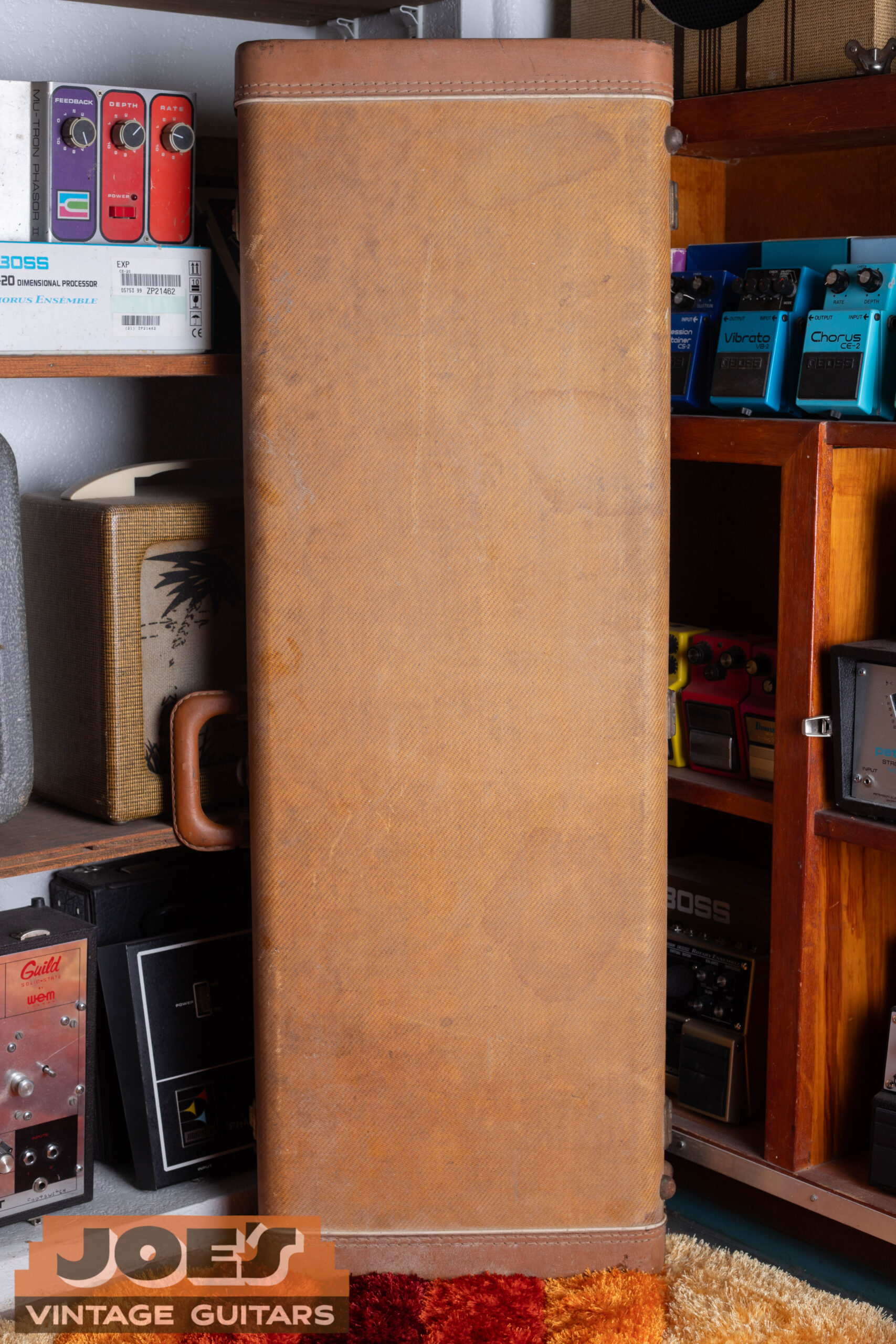
A 1959 Telecaster accompanied by its original case and paperwork is significantly more valuable and historically compelling than one without. Fender's case changed in 1960, which makes the case itself a useful dating cross-check: a correct original tweed case confirms pre-1960 shipping.

If a 1959 Telecaster comes with a receipt, warranty card, or any documentation showing the original purchase — dealer name, date, and price — that paperwork is irreplaceable. It establishes an unbroken chain of ownership from the factory and eliminates much of the uncertainty that makes authentication necessary in the first place. Store such documents separately from the guitar, in a cool, dry, dark environment, and photograph them at high resolution before handling.
Related Resources

Joe’s Vintage Guitars
47 N Fraser Dr E
Mesa, AZ 85203
Phone: (602) 900-6635
Email: joesvintageguitars94@gmail.com

Written by Joe Dampt
“Driven by a love for classic tunes, I specialize in buying, selling, and appraising vintage guitars, bringing music and history together.”