1954 Gibson Les Paul Goldtop Authentication Guide: Every Detail That Matters
Authentication Guide · Gibson Solid Body · 1954
The complete year-specific reference for identifying, dating, and authenticating a genuine 1954 Gibson Les Paul Goldtop — every detail that matters
- Why 1954 Is Special
- At-a-Glance Specifications
- Serial Numbers & Dating
- Headstock & Neck
- Body, Top & Finish
- The Wrap Tail Bridge
- P-90 Pickups
- Electronics & Wiring
- Hardware & Plastics
- Internal Construction Details
- Reissues, Fakes & What to Watch For
- Authentication Checklist
- The Original Case
- Related Resources
Why 1954 Is Special
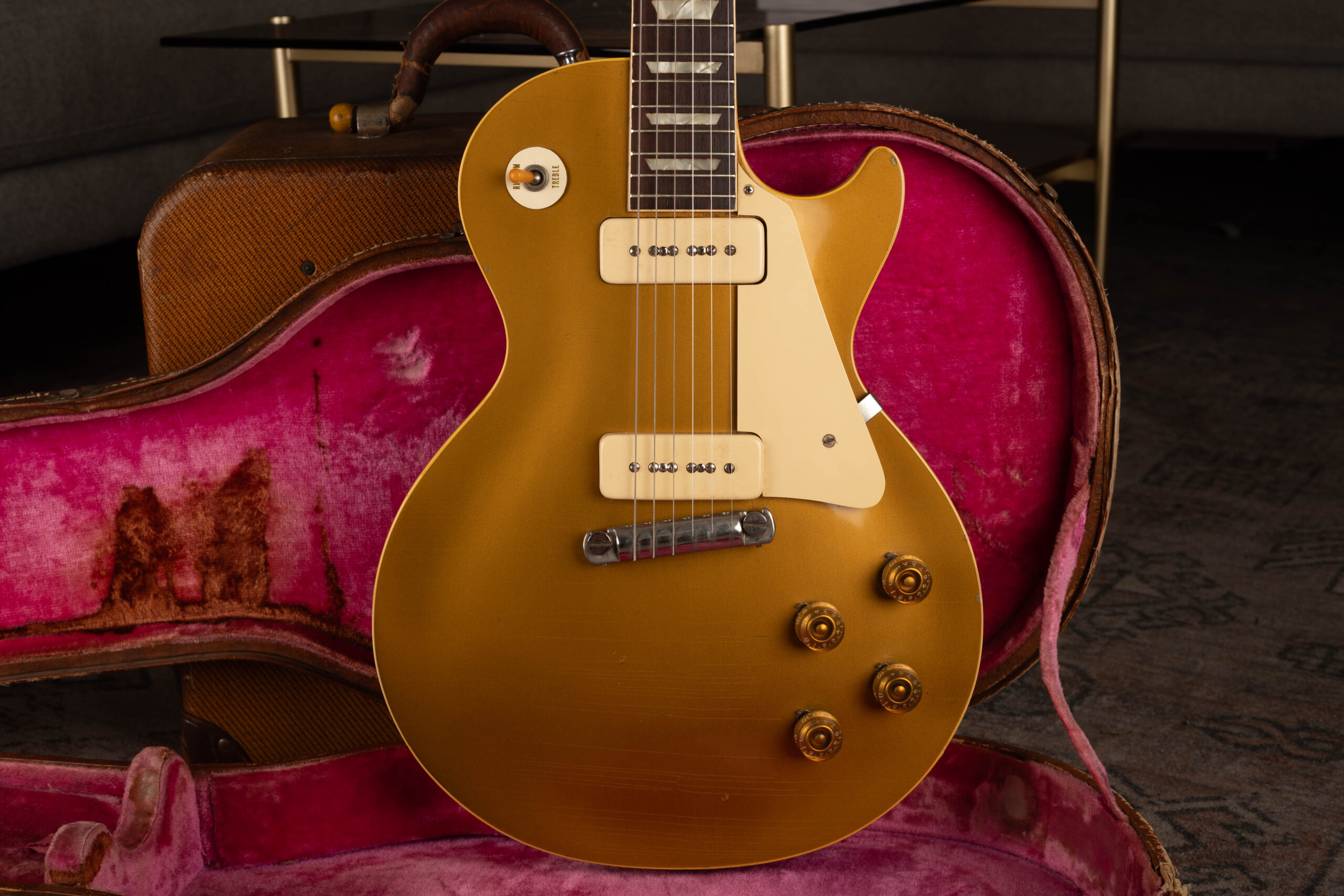
The 1954 Gibson Les Paul Goldtop occupies a precise and unrepeatable position in the instrument's history. It is the first full production year of the wrap tail bridge combined with the corrected neck pitch — the two engineering fixes that transformed the Les Paul from a flawed debut instrument into something genuinely great to play. And it holds that distinction without the Tune-o-Matic bridge that would arrive in late 1955 and define the later goldtops. In other words, the 1954 is the purest expression of the original wrap-tail concept at its best.
The original 1952 Les Paul launched with a shallow neck pitch and a trapeze tailpiece that had the strings wrapping under the bar — a design that made palm muting nearly impossible and caused chronic tuning instability. Gibson corrected the neck pitch to approximately 3° on late 1953 models, then increased it again to 4° for 1954 production. This deeper pitch is one of the 1954's defining characteristics: it gives the wrap tail bridge proper geometry, so the bridge sits at an appropriate height off the top and the action can actually be set correctly without the posts bottoming out.
If you're evaluating a 1954, the most important things to confirm are the wrap tail bridge (not a trapeze, not a Tune-o-Matic), the 4-prefix serial number, the "no line" Kluson tuners, the barrel-shaped amber knobs, and the Grey Tiger capacitors inside the control cavity. Each of those features places the guitar squarely in 1954 and nowhere else.
vs. 1953: The 1953 had a shallower 3° neck pitch. Some early 1953 wrap-tail examples had the bridge posts bottomed out against the top just to achieve playable action. By 1954, the deeper pitch solved this — posts sit at a proper height and there is real downward adjustment available.
vs. 1956: The 1956 guide on this site covers the ABR-1 Tune-o-Matic bridge, bonnet (top-hat) knobs, and Bumblebee capacitors. None of those belong on a 1954. If you see any of them on a "1954," something is wrong. The two guitars share the P-90 pickups and Kalamazoo build quality but are otherwise quite different in their hardware and electronics.
At-a-Glance Specifications
All specifications listed here are correct for 1954 production only. Items noted with a change year are features that were different before or after this year.
Serial Numbers & Dating
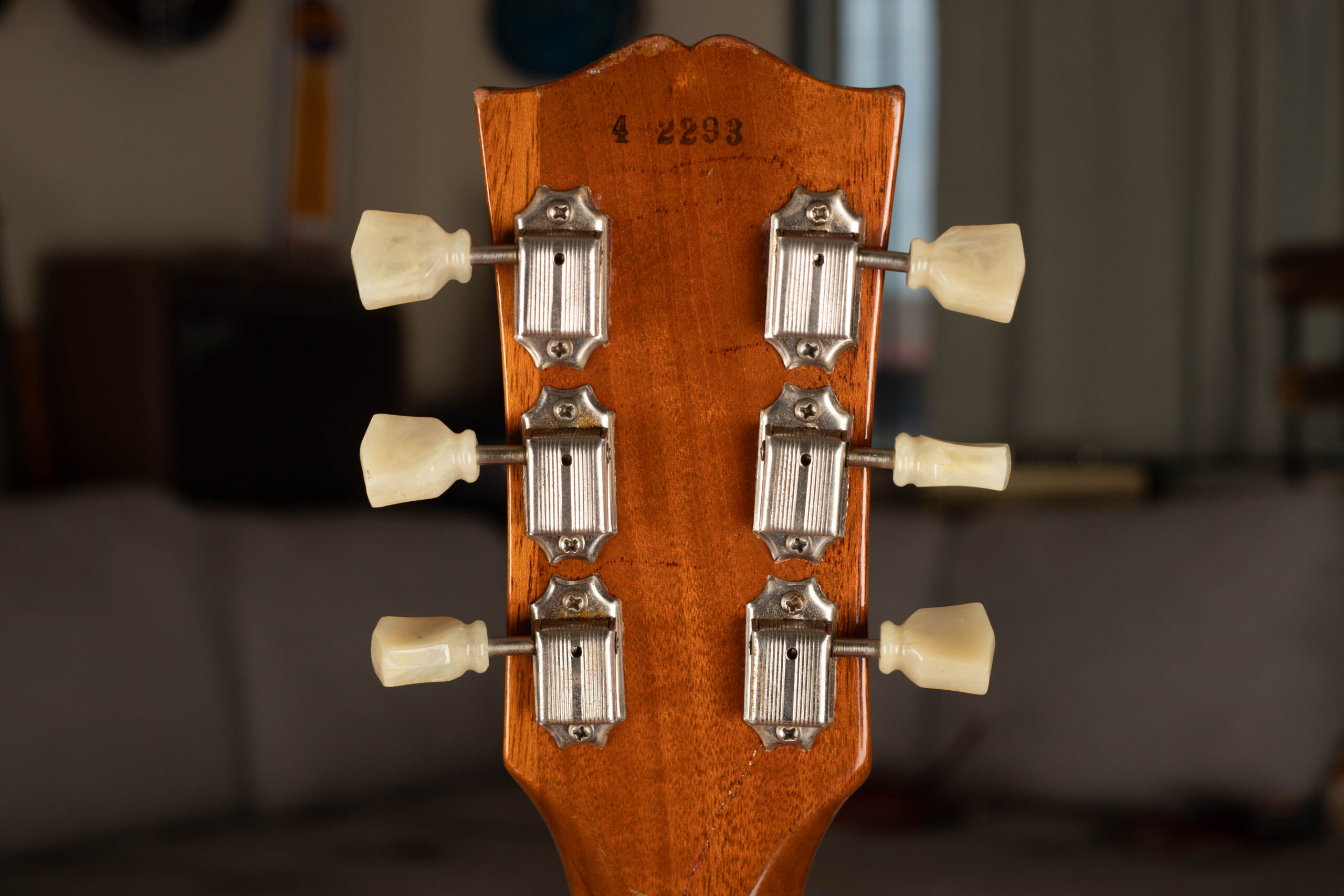
Gibson used an ink-stamped serial number on the back of the headstock for all solid-body guitars from 1953 onward. The system is straightforward for the 1950s: the first digit indicates the last digit of the production year, followed by a space and then a 4- or 5-digit consecutive number.
A genuine 1954 Les Paul Goldtop serial number starts with "4", followed by a space, followed by 4 or 5 digits. Example: 4 2891 or 4 31472. The ink is black, the typeface is distinctly blocky and mid-century in character, and it is stamped — not impressed into the wood. Impressed numbers indicate post-1961 production.
Reading the Serial — What to Look For
- Prefix digitMust be "4" for 1954. A "3" = 1953, a "5" = 1955. There is no ambiguity in this prefix system for 1950s solid bodies.
- Application methodInk stamped — the numbers sit on top of the lacquer surface. You may see slight ink fading or "halo" bleed into surrounding lacquer after 70+ years of aging. This is authentic. Impressed/die-stamped numbers = 1961 or later.
- FontThe mid-1950s Gibson ink stamp uses a specific blocky, slightly heavy typeface. Numbers are not perfectly aligned — there is slight organic variation from unit to unit. Modern reissues and fakes typically have a cleaner, thinner, or more evenly spaced font.
- LocationCenter of the back of the headstock, between the tuner bushings. Not on a label, not inside the body — 1950s solid bodies have no interior label.
- Pot codesCross-reference with potentiometer date codes inside the control cavity. 1954 pots carry codes from Stackpole (304) or Centralab (134). On 1954 examples, the date code is often on the side rim of the pot, not the back face — making them harder to read without removing the back plate. This is a known characteristic of mid-1954 production.
Gibson's Custom Shop reissues of the 1954 Les Paul use the same "4 XXXX" format as the originals, making them potentially confusing at a glance. The reissue font is noticeably thinner and more uniform. More importantly, reissues carry a Certificate of Authenticity and have modern construction details (Nashville bridge inserts, modern pickup cavities, polyurethane or VOS lacquer). Always verify with physical features — the serial alone is never sufficient. For detailed help decoding serial numbers, see our complete Gibson serial number guide.
Headstock & Neck
The Gibson Logo
The "Gibson" headstock logo on a 1954 is a mother-of-pearl inlay in the classic mid-1950s script. Key characteristics to verify:
- Letter formsOpen "b" and "o" — the counters (enclosed spaces) are open, not filled. This open-letter style is correct through 1967. Closed letters appear post-1967.
- Dot over "i"Present on 1954 examples. The dot is a small, separate piece of MOP inlaid above the stem of the "i".
- Logo positionOn 1954 examples, the "Gibson" logo sits relatively high on the headstock — approximately ¾" from the top tip. Some late 1954 models begin showing the logo positioned slightly lower, a change that became standard by 1955–56. The exact position can help narrow down early vs. late 1954 production.
- MaterialGenuine mother-of-pearl — creamy white with a subtle orient (directional shimmer). Not abalone (more colorful iridescence) and not plastic (no shimmer, uniform color).
"Les Paul Model" Silkscreen
Below the Gibson logo, in gold script between the tuner rows, the headstock reads "Les Paul Model" — not "Les Paul Standard" (that name came later). This gold silkscreen sits between the two rows of tuners. The positioning and weight of the script is specific to the era; modern reissues often get this slightly wrong in terms of font thickness or vertical spacing relative to the pearl logo above it.
Truss Rod Cover
The truss rod cover on a 1954 is a traditional bell-shaped, 2-ply black/white plastic cover — identical in form to the 1956 and other mid-1950s Les Pauls. A very thin white border is visible around the edge of the black outer layer. The two mounting screws should show appropriate patina consistent with the guitar's age. An undisturbed truss rod cover with original screws is a meaningful detail — the screw heads on frequently disturbed covers often show multiple-pass tool marks.
Tuners — "No Line" Kluson Single-Ring
This is one of the clearest year-specific dating markers on the 1954. The tuners are Kluson single-ring tuners in what collectors call the "no line" configuration — meaning there is no "Kluson Deluxe" text printed or stamped on the gear housing cover. The gear cover is plain metal with no branding visible from the back.
This distinguishes 1954 tuners from the later "single line" Kluson Deluxe tuners (which have "Kluson Deluxe" stamped vertically in one line, introduced around 1955) and the later "double line" variants. The tulip-shaped plastic buttons on an original 1954 will show their age — a slightly waxy, translucent quality with possible minor shrinkage. Bright white, clean-looking buttons are suspicious on a claimed 1954.
The back of the gear housing should carry a "Patent Applied" stamp — not "Patent No." which comes later.
Flip the headstock over and look at the back of any tuner gear cover. If you see "Kluson Deluxe" stamped vertically, those are single-line tuners — correct for 1955–1960 but not for 1954. Original 1954 covers are plain. This is one of the most commonly overlooked authentication points on early goldtops.
Neck Profile & Nut
The 1954 neck has a pronounced, chunky "C" to "soft D" profile. Typical measurements run approximately 0.88"–0.92" deep at the first fret and 0.98"–1.02" at the twelfth fret. The nut width is the standard mid-1950s Gibson 1 11/16" — Gibson did not narrow the nut to 1 9/16" until 1965.
The nut material on original 1954 examples is Nylon 6/6 — an off-white, slightly translucent material that is distinctly different from both bright white modern plastic and the granular texture of bone. Aged original Nylon 6/6 takes on a soft, slightly yellowed appearance. The string slots should show authentic wear patterns consistent with decades of use.
The neck is bound with single-ply cream binding on both the top edge of the neck and the fingerboard.
Fingerboard
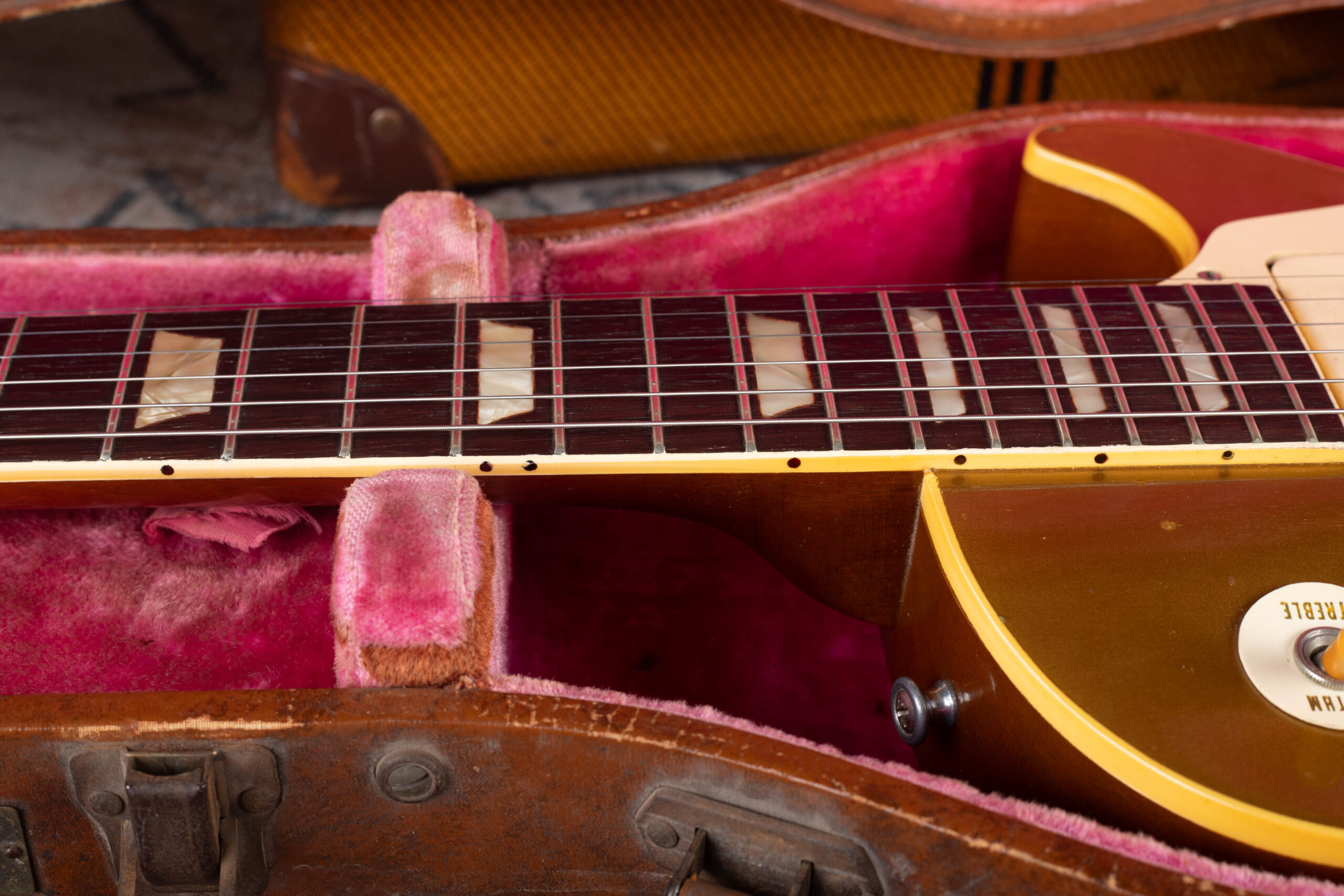
The fingerboard is Brazilian rosewood — a dense, dark, tight-grained wood with a characteristic rich chocolate-to-black color and occasional black streaking. Brazilian rosewood was replaced by Indian rosewood on Gibson guitars in the mid-1960s when export restrictions made Brazilian increasingly scarce. An original 1954 fingerboard should have the visual character of Brazilian: very dark, very tight grain, almost glassy surface.
The inlays are Cellulose Nitrate trapezoids with sharp corners and a distinctive swirling, marbled internal texture. Over 70 years, Cellulose Nitrate off-gasses and shrinks slightly, creating hairline gaps or subtle separation between the inlay edge and the rosewood — this is authentic evidence of age, not damage. Modern reissue inlays are typically acrylic or plastic and will not show this characteristic shrinkage.
Body, Top & Finish
Construction
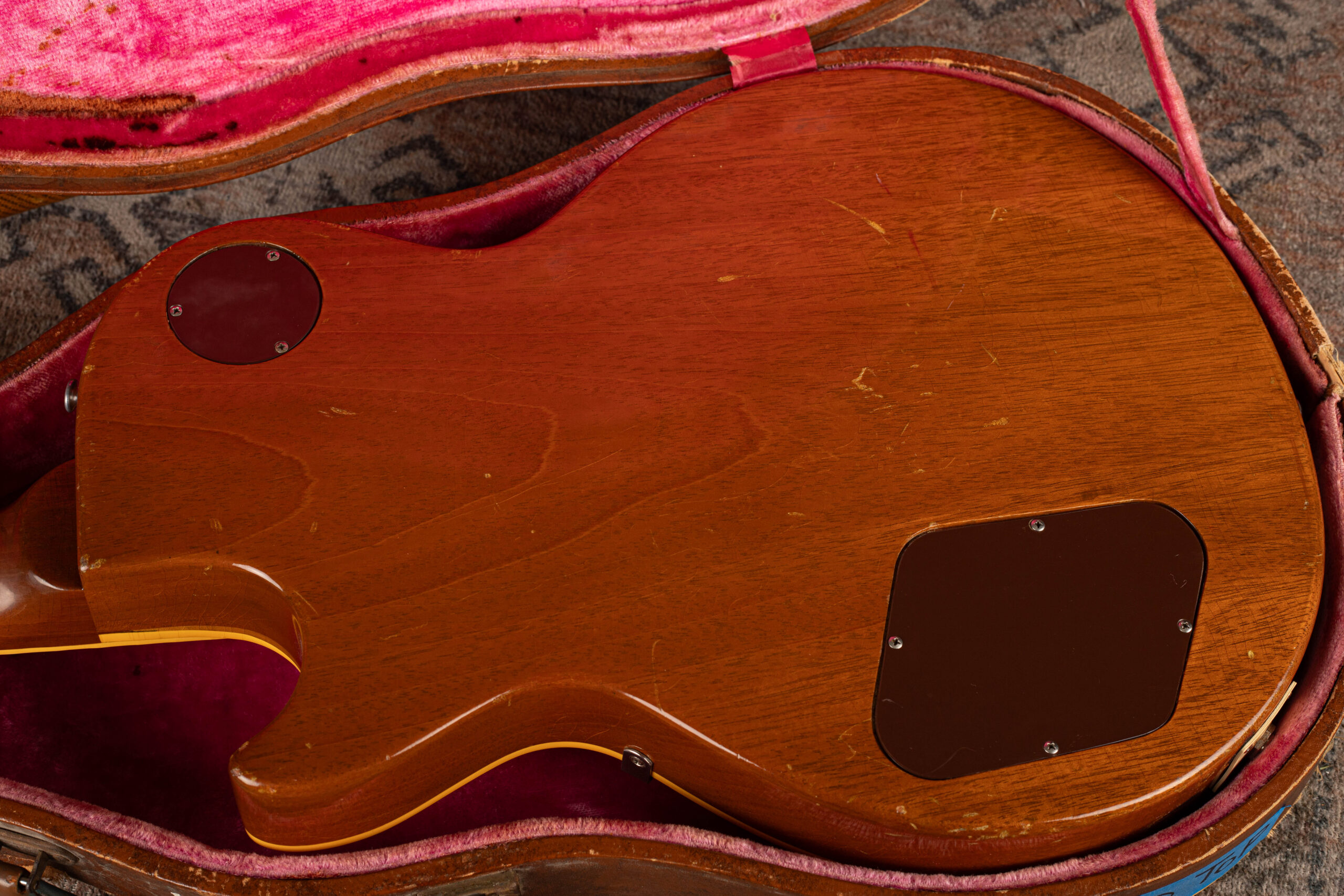
The 1954 body is a solid mahogany back and sides with a carved maple cap — identical in material specification to every goldtop Les Paul of the 1950s. The mahogany back is typically finished in a warm brown stain. However, a notable subset of 1954 production was built as "all-gold" guitars — with the gold nitrocellulose finish applied to the back, sides, and neck in addition to the top. These are rarer than the standard brown-back examples and are visually striking, though the gold finish tends to oxidize and green more obviously on the back of the neck and other high-contact areas. An all-gold finish that has turned green on the neck is still authentic and original — that greening is simply the bronze powder in the lacquer oxidizing from skin contact and humidity over 70 years.
The Goldtop Finish — "Bullion Gold"
Gibson mixed actual bronze powder into the clear nitrocellulose lacquer to achieve the goldtop color — not paint over a base coat, but metallic particles suspended in the finish itself. This has critical authentication implications because the bronze oxidizes over time, producing the characteristic green discoloration seen in areas of arm wear, neck contact, and anywhere the finish is compromised. This greening is authentic and expected on a 70-year-old guitar.
Critically, a refinished guitar will not show greening in the same organic, wear-pattern-specific way. Refinishes show greening applied uniformly or not at all. The most common place to see authentic greening is the lower treble bout where the right forearm rests, the back of the neck below the nut on all-gold examples, and around the bridge post holes where the finish has crept over years of string tension.
Authentic 1954 lacquer will also show fine checking (crazing) — a network of hairline cracks in the finish caused by 70 years of thermal expansion and contraction. This checking pattern should be consistent across the entire body. An area with no checking surrounded by checked areas suggests a localized touch-up or repair.
If a 1954 shows no greening whatsoever in any player-contact area after 70 years, it has either been very exceptionally stored (possible but rare) or has been refinished. A completely clean, no-checking, no-greening goldtop claiming to be from 1954 should be approached with significant caution.
Binding & Cutaway
The body is bound with a single ply of cream plastic binding on the top edge only — the back is unbound. The binding on the Florentine (single, pointed) cutaway of the 1954 is relatively thin. If the binding is thick enough to completely hide the maple cap edge at the cutaway, that is worth noting — authentic 1950s binding allows a sliver of the maple to be visible where the carve meets the binding.

At the cutaway, look closely at the junction of the binding and the body edge. On original 1950s Les Pauls, the relatively thin single-ply binding leaves the edge of the maple cap partially exposed. This thin line of natural maple wood visible between the gold top finish and the cream binding is one of those small but reliable tells that separates Kalamazoo original from modern reconstruction.
The Pickguard
The 1954 pickguard is cream single-ply plastic in the longer, more dramatically angled shape used through the mid-1950s, before the outline was subtly revised in later production. It attaches via a bracket under the neck pickup ring. The cream plastic should show the same off-white, slightly yellowed patina as the other plastic parts. A bright white pickguard on a claimed 1954 is a replacement.
The Wrap Tail Bridge
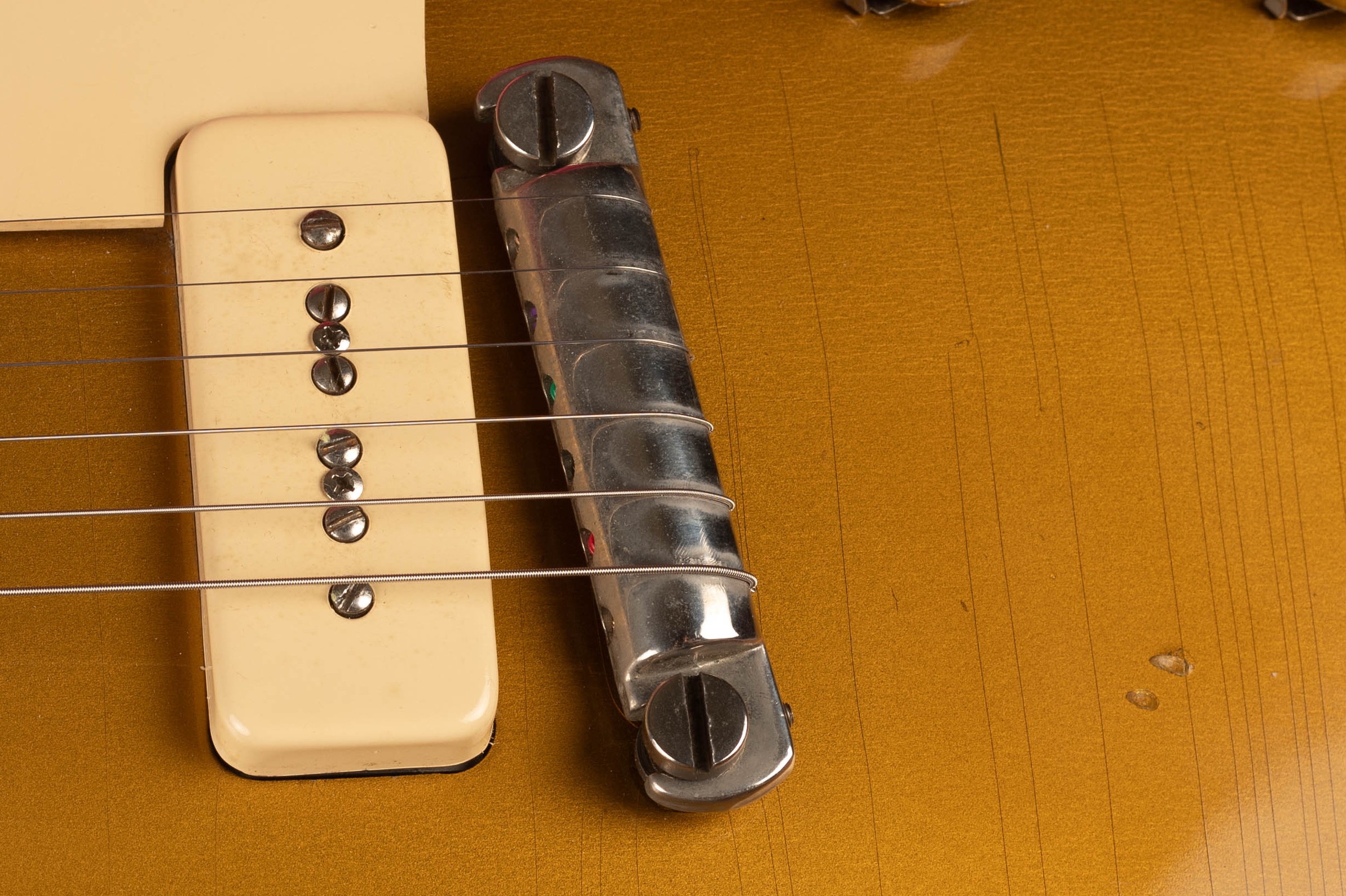
The wrap tail bridge — also called the stud bridge, stopbar bridge, or wrap-around tailpiece — is the defining hardware feature of the 1954 Les Paul. It is a single nickel-plated bar of metal anchored to the maple top by two threaded studs, with the strings passing through it from the back and wrapping over the top. There is no separate saddle adjustment in the traditional sense; intonation is managed by the height of the bar and by angling the two rear-mounted set screws that bear on the underside of the bridge.
Why the Bridge Looks the Way It Does
The wrap tail design came from Les Paul himself — it was his solution to the chronically unstable trapeze tailpiece of the 1952 models, which had strings wrapping under a bar that was pressure-mounted to the top (no studs, just friction). The new design anchored the bridge solidly to the top via threaded bushings, dramatically improving tuning stability and string-to-body contact.
On a 1954, the bridge should sit at a proper height off the top — typically with visible clearance between the bridge bar and the maple. If the bridge is completely flat against the top with the posts screwed all the way down, that indicates a neck pitch problem (often associated with 1953 instruments). The increased 4° pitch of the 1954 neck allows the bridge to sit at an appropriate height with adjustment to spare.
What to Check on the Bridge
- MaterialThe bridge is nickel-plated on all 1954 hardware — not gold, not chrome. Verify that the plating color matches the rest of the nickel hardware (studs, tuner housings). Gold-plated hardware on a claimed 1954 is incorrect.
- Post bushingsThe 1954 bridge posts use shorter bushings than those introduced in 1956. This shorter bushing depth was identified as contributing to the "post lean" problem — where sustained string tension gradually cants the posts forward. Many 1954 bridges show slight forward lean of the posts; this is an authentic and common condition, not a defect per se.
- Post leanA certain amount of forward post lean is normal and expected on a 1954. Experienced luthiers can replace the short bushings with deeper post-1956 units to stabilize the posts if needed. The presence of the original shorter bushings is actually an authentication point.
- String wearOriginal bridge bars will typically show string-contact wear grooves on the top surface of the bar where decades of strings have rested. Absence of any wear on a claimed original bridge is worth noting.
- NOT presentThere should be no ABR-1 Tune-o-Matic bridge and no separate stop tailpiece. If you see those, the guitar has been heavily modified or is misdated. The ABR-1 arrived on the goldtop in late 1955.
Many 1954 goldtops have had their wrap tail bridges replaced with ABR-1 Tune-o-Matic setups at some point — either by a previous owner seeking better intonation, or as part of a Gibson factory update in the late 1950s or 1960s. If a claimed 1954 has a Tune-o-Matic, look for the plugged stud holes under the bridge — two filled holes ahead of the bridge post holes confirm an original wrap tail was present. Also check for a third hole between the two pickups where the wrap tail's center mounting screw (if any) was located. A bridge swap significantly affects collector value but does not disqualify a guitar from being a genuine 1954.
P-90 Pickups
The 1954 Les Paul uses two P-90 "soapbar" single-coil pickups with cream plastic covers — the same pickup specification used on goldtops from 1952 through 1956, before PAF humbuckers arrived in 1957. The P-90 is a broad, flat single-coil design with two large bar magnets underneath the coil, producing a warm, punchy tone with more midrange complexity than a Fender-style pickup.
Identifying Original 1954 P-90s
- Cover colorCream — not black (black covers appear on some other models), not white (a brighter, more modern-looking plastic). Authentic 1954 cream covers have aged to a warm off-white with a slight yellow cast.
- Lead wiresOriginal 1954 P-90 coils have two black lead wires coming from the base of the coil. This is a key authentication detail: P-90s from the 1960s onward use one black and one white lead wire. Two black leads = pre-1960 production. If you can access the inside of the pickup cavity and see the wires coming off the coil, this is a reliable early-production indicator.
- Shielding wireSome 1954 examples use three-strand shielded lead wire running from the pickup to the control cavity — a less common configuration seen on some 1952–1955 production. More typical is standard single-conductor shielded wire.
- Black tape wrapOriginal 1954 P-90 coils are wrapped in black electrical tape applied at the factory. Undisturbed coils still carry this original tape. Disturbed or rewound coils will not.
- DC resistanceOriginal 1954 P-90s typically measure between 7.2k and 8.0k ohms. Both bridge and neck pickups should be in this range. Significant deviation (especially over 9k) suggests a rewind.
- Pole piecesSix individually adjustable slot-head pole screws are visible through the top of the cover. These are steel screws against an Alnico bar magnet underneath. The pole screws should show light oxidation consistent with age.
Original 1954 P-90s in a 1954 body produce a famously vocal, midrange-forward tone — warm and thick in the neck position, with a cutting, slightly nasal quality at the bridge. The combination of these pickups with the wrap tail bridge (which some players believe transfers string energy more directly to the body than a separate bridge/tailpiece combination) gives the 1954 a very specific character. This is why players like Freddie King, Alan Wilson of Canned Heat, and later Jeff Beck specifically sought out these instruments.
Electronics & Wiring
The internal electronics of the 1954 are a rich source of authentication evidence — and are often easier to evaluate objectively than cosmetic features, since they either match the period or they don't. Access the control cavity by removing the two back cover plates (both secured with slotted screws).
Potentiometers
The 1954 uses four potentiometers — two volume, two tone — wired in the standard Gibson 50s configuration. Correct manufacturers for 1954 are Stackpole (code 304) and Centralab (code 134). The date code format is XXYYWW (manufacturer, year, week).
A critically important detail specific to 1954: the date codes on these pots are frequently stamped on the side rim of the pot body, not on the back face as on most later Gibson pots. This means you may need to remove the back plate and angle the pots slightly to read the codes — they will not be visible with the plate simply removed and the cavity viewed straight-on. A guitar presented as a 1954 where the seller "couldn't find the pot codes" may simply need a closer inspection of the side rims.
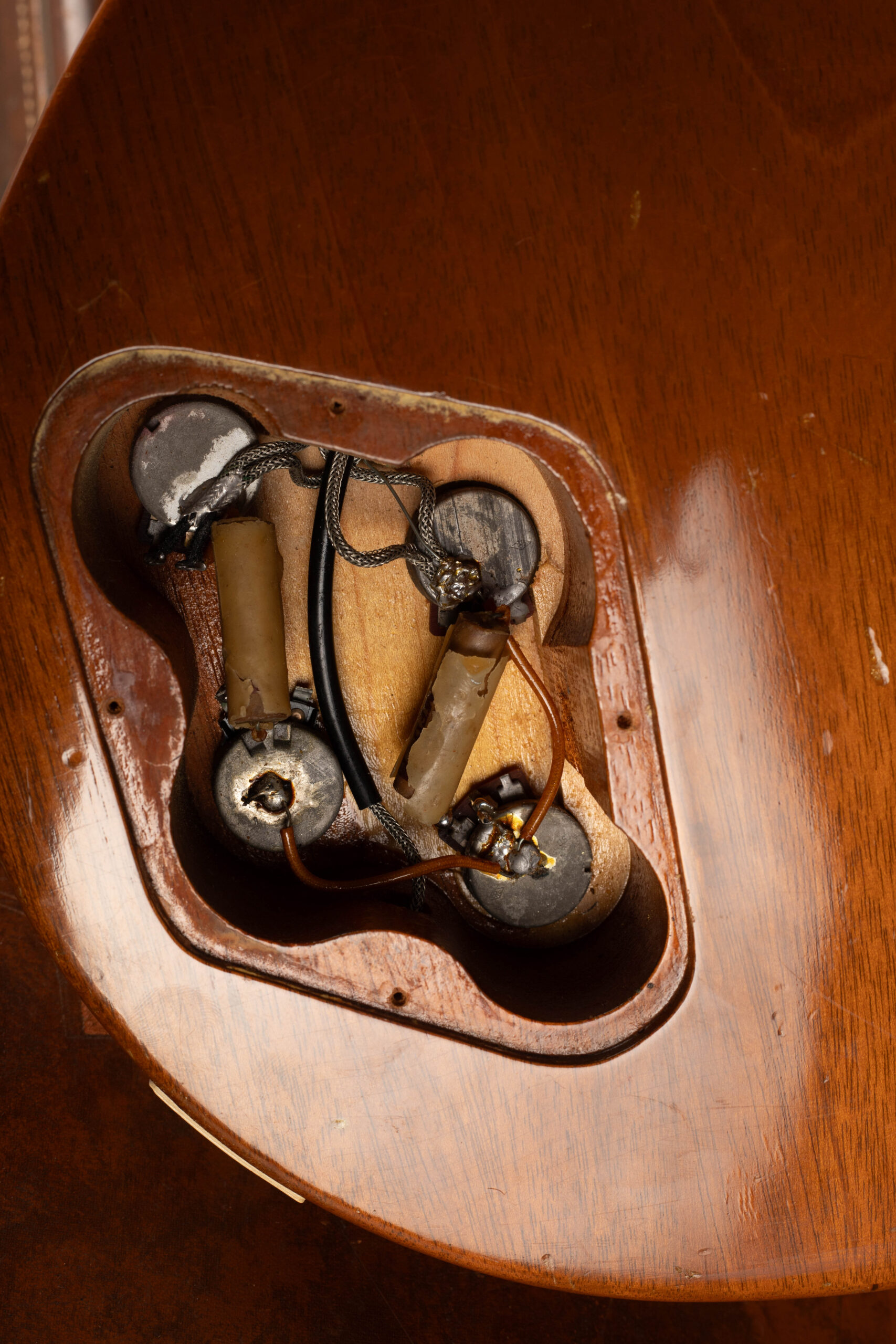
The Grey Tiger Capacitors
This is one of the most visually distinctive and reliable authenticity markers inside a 1954. The tone capacitors are Sprague "Grey Tiger" capacitors — tubular, brown/tan-colored components with a waxy, slightly mottled appearance. They look almost like a small brown crayon stub.
The Grey Tiger was replaced by the Sprague "Bumblebee" capacitor (black with colored stripes) in late 1955 to early 1956. If you open a claimed 1954 and find Bumblebee caps, that guitar either has been re-capped or is misdated into the 1956 range. The Grey Tiger is uniquely and specifically a pre-1956 component.
Grey Tiger capacitors inside = strong evidence for pre-1956 production (could be 1952–1955). Bumblebee capacitors inside = 1956 or later. This one detail resolves more "is it really a '54 or a '56?" debates than almost anything else. Never buy a high-value early goldtop without verifying the capacitors in person.
Wiring & Cloth Wire
All internal wiring in a 1954 is cloth-covered wire. The main shielded lead from the pickup to the control cavity is typically braided cloth over a metal shield. The individual hook-up wires between components have cloth-wrapped insulation in period-correct colors. Plastic-insulated wiring inside a claimed 1954 is not correct and indicates a rewire or repairs.
The control cavity route on a 1954 is also notable for what is absent: the ground wire channel that ran to the trapeze tailpiece on 1952–early 1953 models is gone by 1954. If you see a routed channel on the bass side of the control cavity heading toward what would be the strap pin end, that indicates an earlier guitar body, likely 1952 or very early 1953.
Toggle Switch
The 3-way toggle switch is a Switchcraft unit, the same as used throughout the 1950s. The tip is an amber Catalin — a phenolic resin that deepens in color from pale cream to warm amber over decades of oxidation. A pale, nearly white switch tip on a claimed 1954 is either an earlier example that was stored perfectly (possible) or a replacement. A dark brown tip has likely been exposed to heat or UV. The ideal authentic 1954 tip is a warm translucent amber.
Around the switch is the cream plastic "poker chip" rhythm/treble indicator with gold-embossed lettering. The lettering is pressed into the plastic and filled with gold paint — on originals the paint often shows slight softening or bleeding at the edges of the letters, a detail that modern laser-etched versions cannot replicate.
Hardware & Plastics
Control Knobs — Barrel Style, Not Bonnet
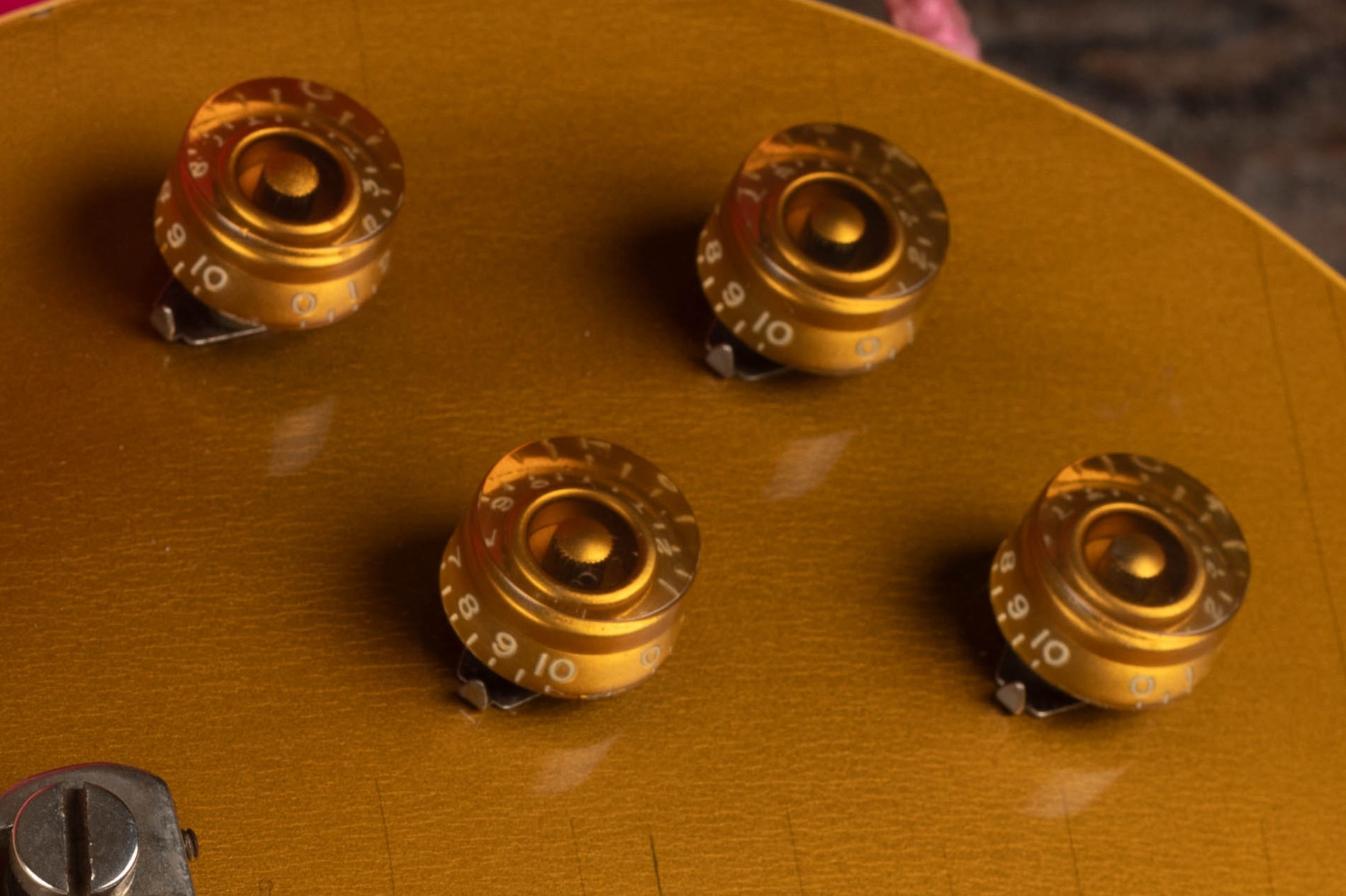
This is the single most immediately visible difference between a 1954 and a 1956 goldtop. The 1954 uses barrel-shaped (speed) knobs in gold/amber — a short, cylindrical design approximately ½" tall with a slight taper. These are fundamentally different in silhouette from the dome-shaped "bonnet" or "top hat" knobs introduced in 1955.
On an original 1954 the four knobs are gold-colored, with the amber plastic body aged to a warm caramel tone. The numbers 1–10 should be visible on the knob face. The pointer on each knob is a sharp metal "finger bleeder" washer — a thin metal plate with a pointed indicator, positioned between the knob and the control plate. This detail is correct for 1954 and distinguishes originals from later replacements.
If a claimed 1954 has dome-shaped bonnet knobs, those are either replacements or the guitar is a 1955 or later. The barrel knob was standard on goldtops through most of 1955, when bonnet knobs phased in. A 1954 with four original barrel knobs is highly desirable and significantly more valuable than one with replaced hardware.
Jack Plate & Back Covers
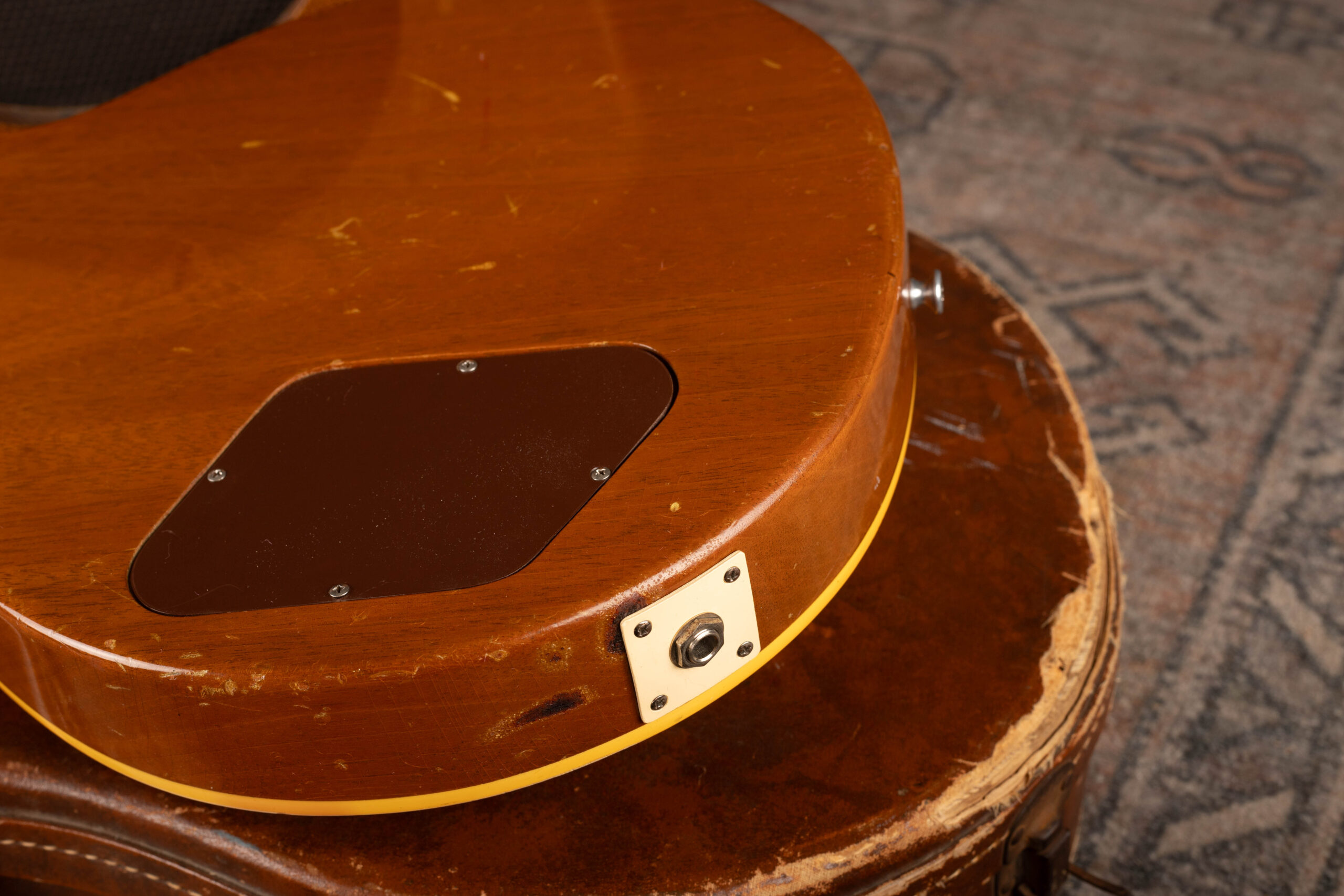
The output jack plate on a 1954 is cream-colored plastic — not black, not chrome. This is a frequently replaced item since cream plastic jack plates are prone to cracking. The presence of a black or chrome jack plate is not disqualifying (it's a common replacement), but a cream original jack plate in good condition is a meaningful indicator of an unmolested guitar.
The two back control cavity cover plates are also cream-colored plastic with a slightly off-white, warm aging patina on originals. Both attach with slotted screws.
Neck Joint — The Long Tenon
If the neck pickup is removed from its cavity, the long tenon neck joint should be visible extending deep into the pickup route. This is a characteristic of 1950s Gibson construction — the neck tenon is long enough to extend beneath the neck pickup cavity, providing a large gluing surface. The long tenon is associated with the excellent sustain of 1950s Les Pauls and is conspicuously absent from the 1969–1970 reissues, which used a short tenon. Seeing the long tenon confirms pre-1960s Kalamazoo construction.
Internal Construction Details
The internal details visible through the pickup and control cavities are among the richest sources of authentication evidence on a 1954, because they are rarely examined and even more rarely faked at the level required to pass expert scrutiny.
Control Cavity Route
The 1954 control cavity is a roughly rectangular parallelogram shape, as established during the 1952–1953 design evolution. What it should not have is the square channel for the trapeze tailpiece ground wire that ran toward the bottom end of the guitar — that route was eliminated during 1953 as the trapeze tailpiece was discontinued. A 1954 body should have a clean route with no vestigial trapeze ground channel.
The cavity walls should show the tool marks of Kalamazoo routing — consistent, slightly curved chisel or router marks in the wood. The wood should be unfinished inside the cavity (natural mahogany color), with the finish only on the exterior edges. Areas of black paint or shielding inside a vintage cavity indicate a non-original modification.
Pickup Cavities
The pickup routes on a 1954 are cut for the P-90 soapbar form factor — a specific rectangular shape. If the cavities have been enlarged or modified to accept humbucker-sized pickups and then filled, this will be visible as wood filler, different-colored wood patches, or irregular cavity edges. This is a common modification from the 1960s and 1970s when humbuckers were fashionable.
Inside the neck pickup cavity, the long tenon of the neck joint is visible as a raised platform of wood running through the base of the route. On 1950s instruments this tenon is substantial — running at least half the depth of the pickup route.
The Mahogany & Maple Construction
The body is one-piece mahogany (or occasionally two-piece) with a carved maple cap. On an original 1954, the seam between the mahogany back and the maple cap should be visible at the edge binding channel as a clear line between two distinct wood colors. The maple carve is modest compared to later archtops — a gentle, relatively shallow arch that nonetheless creates the carved-top aesthetic Les Paul and McCarty wanted as a departure from Fender's flat slab bodies.
Reissues, Fakes & What to Watch For
The 1954 Les Paul Goldtop is among the most frequently misrepresented vintage guitars on the market. The combination of high value, recognizable appearance, and the fact that a compelling fake needs to get dozens of details right simultaneously means there is a real market for deceptive examples. Here are the most common scenarios:
Gibson Custom Shop Reissues
1993–presentGibson produces excellent 1954 reissues through the Custom Shop — the "VOS" (Vintage Original Spec) and standard Historic Collection versions. These are high-quality instruments, not fakes, but they must be correctly identified. Key differences from originals:
- Serial number font: Reissue ink stamps are thinner and more evenly applied than originals
- Pot codes: Modern pots with current-date codes inside (not 1954 codes)
- Certificate of Authenticity should be present — its absence on a reissue should prompt questions
- Modern construction details: Properly fitted Nashville bridge inserts, modern truss rod, consistent lacquer coverage
- No authentic aging: VOS guitars have artificial aging applied; it does not look or feel like 70 years of natural aging
Date-Shifted Goldtops
1953–1955 Misrepresented as 1954Because 1954 carries a specific premium over 1953 (due to the corrected neck pitch) and commands a different value from 1955, there is incentive to misrepresent closely related instruments. Watch for:
- 1953 neck pitch: A 1953 wrap-tail with the bridge sitting all the way down to the top with no height adjustment left — the shallower pitch means less height to work with
- Altered serial: A "3" that has been inked over or partially obscured to look like a "4" — examine with magnification under raking light
- Bonnet knobs on a claimed "1954": Bonnet knobs belong on 1955–1960, not 1954
- Bumblebee caps on a claimed "1954": Bumblebees arrive in 1956 — finding them inside confirms late 1955 or later production
Hardware-Swapped Instruments
Modified OriginalsMany genuine 1954 goldtops have been modified over 70 years. Common modifications and how to identify them:
- Tune-o-Matic conversion: Look for plugged stud holes where the original wrap tail anchored. Two filled holes slightly ahead of the ABR-1 posts confirm the original bridge type.
- Humbucker conversion: Enlarged pickup routes with filler material or irregular edges. Check for evidence of original P-90 mounting screw holes.
- Tuner replacement: Single-line or Grover tuners on a claimed all-original 1954. Check all six for consistent aging.
- Recapped electronics: Modern capacitors where Grey Tigers should be — easy to check with the back plate off.
- Neck replacement: Different wood grain, finish color mismatch at the heel, or modern construction details on the neck inconsistent with a 1954 body.
Modifications do not make a guitar worthless, but they must be disclosed and will significantly affect value. An all-original 1954 goldtop commands a very substantial premium over a modified example.
Authentication Checklist
Work through this checklist systematically when evaluating any claimed 1954 Les Paul Goldtop. Each item that checks out adds to confidence; any item that contradicts the claimed year demands investigation.
Serial Number & Headstock
- Serial number starts with "4" — ink stamped (not impressed), black, on back of headstock
- Font is blocky and slightly organic in character, consistent with 1950s stamp (not thin or perfectly aligned)
- Gibson logo is mother-of-pearl with open "b" and "o" — not closed letters, not a decal
- Logo positioned approximately ¾" from headstock tip (some late 1954s slightly lower)
- "Les Paul Model" gold silkscreen is present (not "Les Paul Standard")
- Truss rod cover is bell-shaped 2-ply black/white plastic
- Tuners are "no line" Kluson single-ring — no "Kluson Deluxe" text on gear cover back
- Tuner gear cover back shows "Patent Applied" stamp (not "Patent No.")
- Tulip buttons are cream/aged, not bright white
- Nut is Nylon 6/6 — off-white, slightly translucent (not bright white, not bone)
Body & Finish
- Finish is nitrocellulose lacquer — shows checking, patina, and expected wear (not thick or plasticky)
- Gold finish shows bronze-powder greening in wear areas (treble bout, wherever finish is compromised)
- Single-ply cream binding on top edge only
- Fingerboard is Brazilian rosewood — very dark, tight-grained, near-black color
- Trapezoid inlays are Cellulose Nitrate — marbled texture, sharp corners, possible slight edge shrinkage
- Pickguard is cream single-ply, longer mid-1950s shape
- Jack plate is cream plastic (not black or chrome)
- Back cover plates are cream plastic
Bridge
- Bridge is wrap tail (stud bar) — NOT an ABR-1 Tune-o-Matic
- Bridge hardware is nickel-plated (not gold, not chrome)
- Bridge sits at appropriate height off the top — posts are not bottomed out
- Bridge posts use shorter bushings typical of 1954 (some forward lean is normal and authentic)
- If Tune-o-Matic is present: plugged stud holes confirm original wrap tail
Electronics & Hardware
- Tone capacitors are Sprague Grey Tigers — brown/tan tubular waxy components (NOT Bumblebees)
- Potentiometer date codes read 1954 (note: may be on side rim, not back face)
- P-90 pickup lead wires are TWO BLACK wires (not one black/one white — that's 1960s+)
- All wiring is cloth-covered (not plastic insulated)
- No trapeze tailpiece ground wire channel in control cavity
- Control knobs are barrel/speed style (not bonnet/top-hat dome shape)
- Metal "finger bleeder" pointer washers present under each knob
- Switch tip is amber Catalin (warm translucent amber, not bright white)
- Long tenon neck joint visible in neck pickup cavity
For any 1954 Les Paul Goldtop transaction above $20,000, insist on a physical examination by a recognized vintage Gibson specialist. The three most reliable triangulating data points are: (1) pot codes (side rim of pots in 1954), (2) Grey Tiger capacitors, and (3) the "no line" Kluson tuners. If all three are period-correct and agree with a "4"-prefix serial, you have a strong case for a genuine 1954. For a free appraisal inquiry, visit our free appraisal page.
The Original Case
A 1954 Les Paul Goldtop that still has its original case is meaningfully more desirable to collectors — both because the case confirms provenance and because it protects the guitar from the humidity and light exposure that cause the most damage to vintage instruments over time. Knowing what the correct case looks like is also a useful cross-check: a guitar claiming to be a 1954 accompanied by a completely wrong-era case prompts questions about the guitar's history.
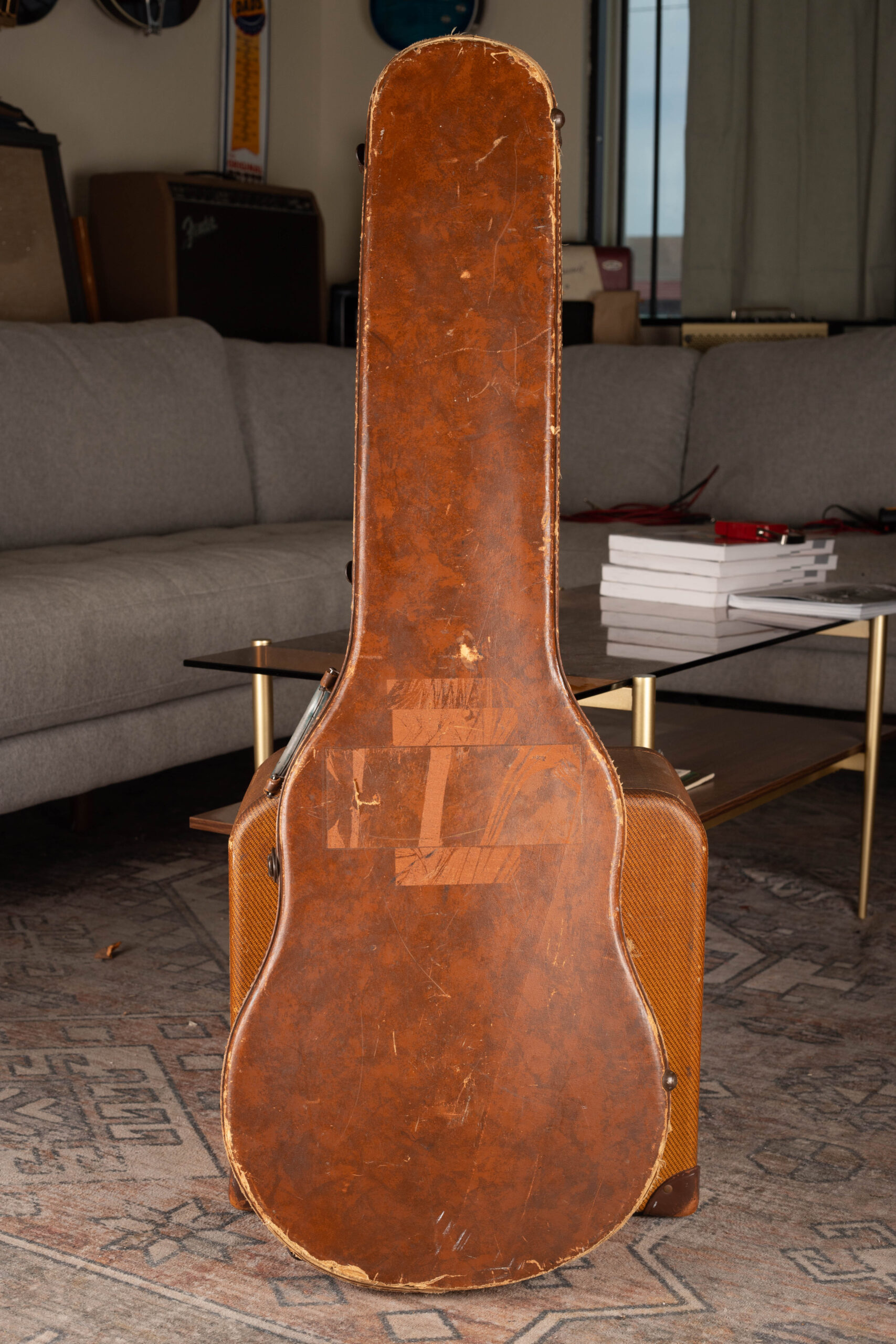
Case Authentication Details
- ManufacturerLifton — the case manufacturer used by Gibson in this era. The Lifton name may appear on a small label inside the case lid.
- ExteriorBrown imitation leather exterior with a curved top lid — the arched lid shape was introduced in 1953 and mirrors the carved maple top of the guitar. Flat-lid cases predate this era.
- Interior liningPink, salmon, or orange-pink plush lining. The exact tone varies with age and light exposure — heavily faded examples can appear almost tan. The lining is the same color on the lid and body of the case.
- LatchesFour latches — one at each corner end and one on each long side. Correct hardware is nickel-plated.
- Case fitThe original Lifton case is form-fitted to the 1954 body shape. A guitar that sits loosely in a case or requires packing material to stay in place has likely been paired with a non-original case.
- Inside lidA small accessory pocket inside the lid is typical. Provenance items — original hangtags, receipts, old strings — are sometimes found here and can add significantly to a guitar's documented history.
An all-original 1954 in its original Lifton case in good condition commands a premium over the same guitar without a case. More importantly, a case with provenance documentation — original receipt, owner's name, purchase date — is a remarkable find that adds both historical value and authentication confidence. If a 1954 comes with paperwork, treat that paperwork as carefully as the guitar itself.
Related Resources
Dig deeper into vintage Gibson authentication and valuation with these guides.

Joe’s Vintage Guitars
47 N Fraser Dr E
Mesa, AZ 85203
Phone: (602) 900-6635
Email: joesvintageguitars94@gmail.com

Written by Joe Dampt
“Driven by a love for classic tunes, I specialize in buying, selling, and appraising vintage guitars, bringing music and history together.”